Awake!, June 8, 1952
Download: PDF — Awake!, June 8, 1952
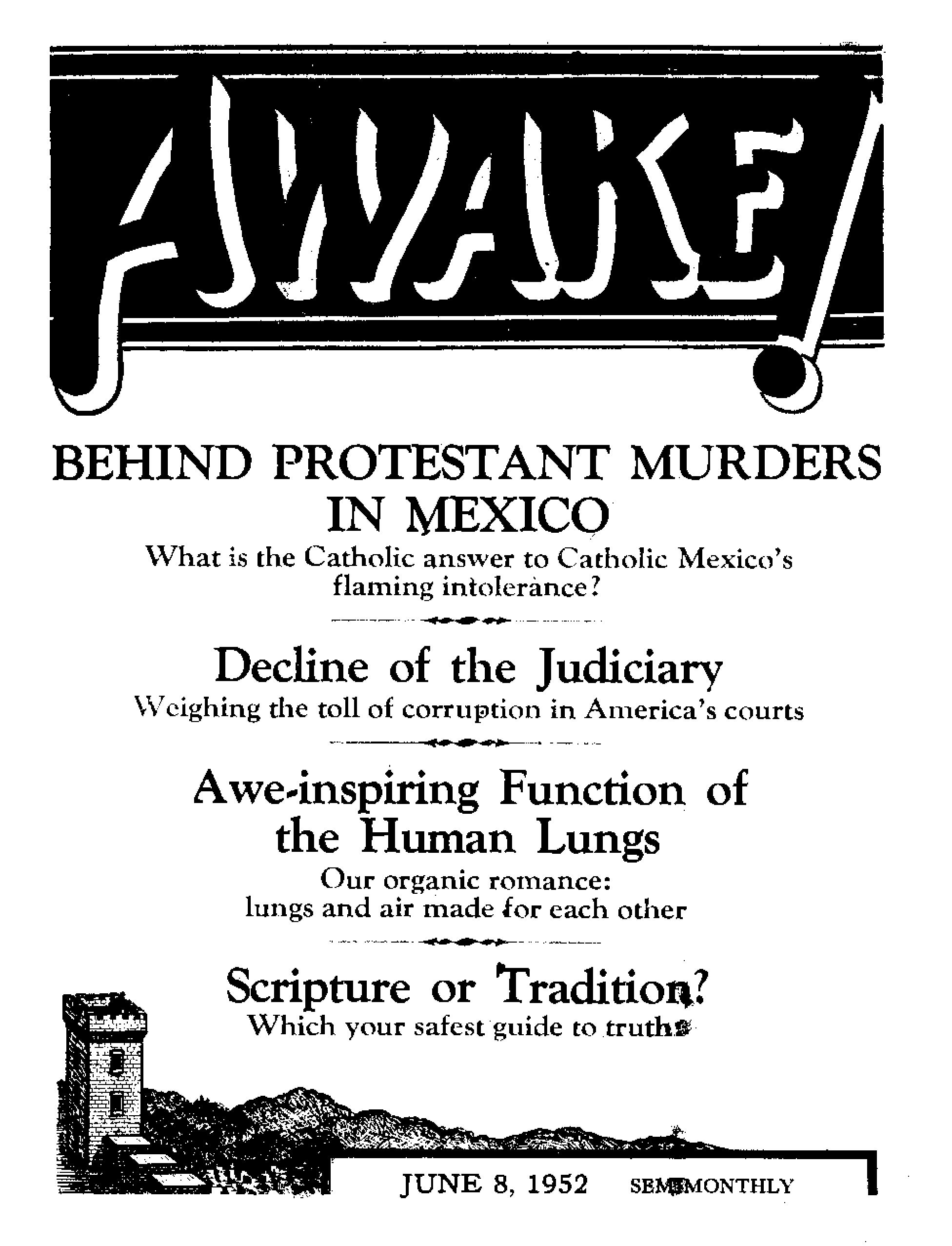
JUNE 8, 1952 SEMIMONTHLY
THE MISSION OP THIS JOURNAL
News sources that arc able to keep you awake to the vital Issues of our times must be unfettered by censorship and selfish interests. “Awake!” h®* no fetters. It recognizes facts, faces facts, is free io publish facts. It la not bound by political ambitions or obligations; it Is unhampered by advertisers whose toes must not be trodden on; it i-unprejudlced by traditional creeds. This journal keeps itself free that it may apeak freely to you. But it does not abuse its freedom. It maintains integrity io truth.
“Awake I” uses the regular news channels, but is not dependent on them. Its own correspondents are on all continents, in scores of nations. From ths four corners of the earth their uncensored, on*the*scenes reports come io you through these Columns. This journal’s viewpoint is not narrow, but is international. It is read Ln many nations, in many languages, by persons of all ages. Through its pages many fields of knowledge pass in review—government, commerce, religion, history, geography, science, social conditions, natural wonders—why, its coverage is as broad as the earth and as high as the heavens.
“ Awake I” pledges itself to righteous principles, to exposing hidden foes and subtle dangers, to championing freedom for all, to comforting mourners and strengthening those disheartened by the failures of a delinquent world, reflecting sure hope for the establishment of a righteous New World.
Get acquainted with “ Awake 1” Keep awake by reading “Awoke!”
Published Semimonthly By watchtower bible and tract SOCIETY, INC.
117 Adama Street
N. H. Knooh, President
Printing this inue: 975,000
Linmiti In which the maivina h nbliihid: ttmuMithly—Afrikiati*, EciJiah, Flench, French, Genoui, Hdlandbb, NwwwUn, Spanish, Swedish, Monthly—Durinh, (Iretk, Portwurse, lifcrifohn,
Offices Yeirly subscription Eato
A■ «rl**, U.S., 117 Adina St, BrwWyn 1, N.Y. *1 Antralii. 11 Beresford Ed,, Btnthfleld, N.8,W. 8j C*flnd*. 40 Irwin Ate-, Toronto 5, Ontario fl Enllud. at Craven Terrace, Lon doc, W 2 fa Stith Afrtu, Prints B«, P.O. Elan dirt on teln,
TransTiil fs
Entered as second-dm mittw Oaklyn, N, Y
Brooklyn 1( N, Y., U. S. A.
Ghant Suites, Secretary
Five cents a copy
Harnittinm ihotitd be iwat tn office io your country In compliance with i+tulitioiu to guarantee gate deliTtry of iricney. Remittance are accepted al Brooklyn from ccmn trits where no office i< located, by International money order only. GubscriLUlon rates in different countnea are here stated in local currency. N*tlt* of sxylratlM <vrttb renewal blank) Is sent at least two Issues, before subscription expires. Chinpe *f adfreu when sent to our office may be expected effeedfe within one month. Bend your old aa well as new odirtsi.
Art of March 8, Printed 1b U. B. A.
CONTENTS
"A Wicked* and Adulterous Generation” 3
Decline of the Judiciary
Corruption in High Places
Presidential Pardons—Another Scandal? 8
Embezzling: Another Sign of Times 8
Behind Protestant Murders in Mexico 9
Catholic Clergy Are Blamed
What Shall It Be—Coffee, Tea, or
Yerba Mate?
1,000-Year-Old Seeds Sprout
Awe-inspiring Function of
the Human Lungs
Nature’s Famous Fasters
Wycliffe and the Lollards
Where the Kids Dictate
Courts Clarify Selective Service Rights 24 “Your Word Is Truth”
Scripture or Tradition?
Jehovah’s|Witnesses Preach in
All the Earth—Venezuela
Watching the World
Volume XXXIII.................... Brooklyn, N. Y„ June B, J 952~Number 11
"A Wicked and Adulterous Generation”
DO YOU see the title of this article? To whom does it apply? Does a tide of righteous indignation within you say, “Not me—not in this Christian age when the cathedral, the crucifix and the name of God on clergy lips fill every street of the Western world.” Or is your conscience more tenderly aware of a gnawing religious apathy, juvenile delinquency, mounting crime, lax social morality, open political corruption? Does it make you wonder?
These words find their origin with Jesus Christ, the Founder of Christianity. Once a group of Jewish Pharisee and Sadducee sectarians, to tempt him, “asked him to display ... a sign from heaven.” Contrasting their ability as weather prophets with their knowledge of God’s Word, the Son of God replied: “You know how to interpret the appearance of the sky, but the signs of the times you cannot interpret. A wicked and adulterous generation keeps on seeking for a sign, but no sign will be given it except the sign of Jonah.” (Matthew 16:1-4, New World Trans,) There would be no “magic tricks”.
Of course, modem Christendom is. not like those foolish Jews. Why, they turned down Christ’s kingdom and rejected him as their Messiah, choosing to meddle in Roman politics with a cry that “we have no king but Caesar”! Their dull spiritual eyesight saw in Jesus' works not fulfillment of prophecy but sensational magical art. They looked at the sky and forecast the weather; but they peered into inspired written prophecies of a Messiah, stared at the fulfillment in their very midst, and saw nothing. When has Christendom ever been guilty of such things? When indeed!
Readers will recall a photograph given wide circulation by Religious News Service purporting to show planes on a U. N, bombing mission over Korea. However, as if etched on the cloudy backdrop, the likeness of what were passed off as the face and outstretched arms of Christ appeared. When an air of mystery settled over its explanation, a wide-eyed public made it a “best seller”, a public that had gained its faith in Christendom’s religions. However, Air Force Staff Sergeant Roy C. Bumham finally turned up with a duplicate of the photo which he had acquired in England during World War II. An Air Force photo laboratory technician had done the retouching against a picture of a B-17 bombing sortie over Europe with the idea of selling prints for souvenirs. Said Bumham, as Time magazine (December 3, 1951) quoted him: “I thought it was time people, found out the truth. The thing has been carried too far. Some people are actually beginning to believe that stuff about the picture.”
Take another example. Go back to October 13, 1917, near the little Portuguese village of Fatima. A great crowd is gathered to watch three small children receive a “vision”. Of course the anxious crowd
saw no vlaiop—anxious crowds never do— but the children claimed for sure that the "Virgin Mary” appeared. Something many of the others did see, however, has been handed down ever since like folklore. Witnesses swore that the sun swung crazily and dipped sharply toward the horizdh.
For long the Catholic Church was cati-tious, but at length accepted the event as a true vision and miracle, never discouraging the "sun dance” story which acted as a sort of “physical proof” of the whole thing. However, Life magazine (December 3, 1951) remarked: “No astronomical observations in other parts of the world verify that it happened.” But finally, after thirty-four years, on November 17, 1951, the Vatican newspaper L’Osservatore Romano published photographs dated Fatima; 12:30 p.m., October 13, 1917. The amazing pictures show the sun very low, near the horizon. It is much hazed over and the sky is quite dark. If the time were accurate it would indeed leave one grasping for'an answer, especially since no astronomical records bear any mention of it. Not daunted by this, L’Observatore’s intrepid editors added that the pictures were of “rigorously authentic origin”.
Buoyantly, Vatican sources released the pictures for world-wide distribution. But in a stroke of woe to the original editors, copies naturally fell into the hands of their “rigorously authentic origin”. Between the official newspaper for the shrine of Fatima and Dr. Joao de Mendonca, brother of the man who took the pictures, their true origin was established. Alfredo de Mendonca, brother to the doctor, had been one of a party of pilgrims returning from Fatima on May 13, 1922. (The Fatima paper gave the date 1921, but the New York Times inserted the correction as 1922.) At about 5:30 p.m. someone thought the sun was performing in an unusual manner and Alfredo took pictures. Records establish that the day was rainy and cloudy. Considering the time of day and the weather, there is certainly nothing phenomenal about a dark sky and a hazy sun low in the heavens. Later, Dr. de Mendonca says he inscribed the date, Fatima, 1917, and presented them to a visiting cardinal (Federico Tedeschini) as a gift while still bearing the erroneous date. Most embarrassing. At first Rome hedged. On this March 10 “a high Vatican source” protested that its pictures were still “rigorously authentic”, and spoke wildly of “other photos” as the unauthentic culprits. Three days later Rome capitulated. L’Osservatore Romano limply admitted that if the pictures were not authentic, their editors had been deceived.
From this two things become very clear: (1) that it is a shame L’Osservatore’s editors were deceived, and (2) that it is an infinitely greater shame that they did not see fit to thus dismiss the entire sun hoax, the vision of Fatima itself, which is still considered quite “rigorously authentic", and all the other alleged “visions” after which shrines the world over are named and which are considered “rigorously authentic”. Instead, in such spiritual sensations Christendom prefers to rest its faith while completely ignoring the great and positive sign of the birth of Christ’s kingdom which has been made evident for the first time in our day. (See Matthew 24, Mark 13 and Luke 21.) Concerning this truly important and authentic sign she does nothing except ridicule and persecute the few true Christians who take it seriously and go about preaching the good news of God’s kingdom. Like the faithless Jews of Christ’s day, she would gladly follow Jesus as the world’s greatest magician, but as the Messiah then and the reigning King now they ignore him.
al the < mm-/
JUSTICE is not for sale* None should tamper with it. Its source is righteousness; its foundation, truth. The Great Judge and God ministrators no business firm in the nation would have them. Yet it is to these “judicial misfits” that we have entrusted our lives and property in the highly precarious work of justice.
The Canons of Judicial Ethics of the American Bar Association lists judicial obligations as follows: “In every particular his conduct should be above reproach. He should be conscientious, studious, thorough, courteous, patient, punctual, just, impartial, fearless of public clamor, regardless of public praise, and indifferent to private political or par
of Justice is Jehovah. His judgments are sure. His decisions never reversed. His timely counsel to the judges of Israel was: “You must never tamper with justice, you must never be partial to anyone, and you must never accept a bribe— for a bribe blinds even men whose eyes are open, and it destroys the case of a good man. Justice, justice you must aim at, that you may live and possess the land given to you by*the Eternal your God.” “You act as judges not on behalf of man but of the Eternal, who is beside you as you give your decisions. So let awe for the Eternal control you; be careful to act in that spirit, for the Eternal our God knows nothing of injustice, nor of favouritism, nor of bribing/’ (Deuteronomy 16:18-20; 2 Chronicles 19:5-7, Moffatt) The judges of Israel spumed this wise counsel and the nation fell from its high judiciary to corruption and was destroyed.
A similar condition exists in the judiciary today. The incompetence, tyranny and political corruption in the courts is scandalous. Judges devoid of legal knowledge rely on secretaries and “has-been” lawyers to write their decisions. Some are lazy. Some are drunkards. Others sleep on the bench. Some are such miserable adtisan influences; he should administer justice according to law, and deal with his appointments as a public trust; he should not allow other affairs or his private interests to interfere with the prompt and proper performance of his judicial duties, nor should he administer the office for the purpose of advancing his personal ambitions or increasing his popularity.” The disgraceful truth is that almost every rule in this judicial code of ethics has been smeared by judges who hide behind the black robe and the awesome aura of “Your Honor” and "May it please the Court”.
Each year four million look to the traffic court for justice. It is a proved fact that a competent traffic judge can hear about fifteen nonaccident cases an hour, averaging at best four minutes for each. It is virtually humanly impossible to try more cases with justice. But an Indianapolis judge raced traffic cases through in less than two minutes each. Another judge boasts in disposing of six hundred traffic ' cases in a single day. A New York judge has “tried” 967 cases in three hours; the New York record is 1,016 in two and one-half hours! A traffic judge in Detroit has the habit of leaving the bench while the witness is testifying. He returns minutes
later to decide the case. An Alabama judge amuses himself by having Negro traffic violators roll dice to s?e what the fine or penalty will be, Of some 602 of those elected as justices, investigation in a single state showed only one-quarter had*had any legal training and one in five did not even possess copies of the traffic laws he was administering. Favoritism and political influence has warped the sense of justice. In many of the lower courts even-handed justice is a forgotten principle.
Corruption in High Places
“There is scarcely a corner of our lives to which the power of a judge does not reach,” said Harold H. Burton of the United States Supreme Court. A judge can deprive a widow of her rights, women the support of their husbands, commit persons to insane asylums, take away property and children, etc. The bench, therefore, is no place for a judge to be found sleeping, writing letters, or nursing a hang-over. Yet a judge of one of the nation’s highest courts gave this flimsy excuse for his conduct: “I’ve been working at night. I just have to get some sleep in the daytime.” He sleeps or sits there with a devil-may-care attitude while your life and property hang in the balance. .
Justice Hubert T. Delany of the Domestic Relations Court charged that there were judges who drank to the point that “they aren’t on the bench half the time”. Presiding Justice David W. Peck of New York’s Appellate Division spoke of a judge who was “so righteous he would never quash a jury notice, but when he got on the bench to discharge his truly vital duties he sat there writing letters—paying no attention to the case at hand”. If an objection was raised he would stop writing and ask the court stenographer to read back a few lines so he could make a ruling. Another ambitious judge, who resorted to handing out perfume and silk stockings to get elected, sent one of his decisions to a law journal which highly praised the ruling as brilliant, only to discover later that the judge made up the case and the decision out of thin air.
Federal Judge Medina, who spoke of U. S. trial methods as fantastic as “Alice in Wonderland. You could not believe it if it had not happened in front of your eyes”; also told of a judge who was famous for his swift decisions. “Once I asked him on what basis he was able to arrive at such swift decisions. He replied, ‘I base it all on the witnesses. If a witness lifts his left heel off the floor 1 know he’s lying. I simply decide against him.’ ” “But he wasn’t serious, was he?” “Of course he was serious!” was Judge Medina’s answer. “We have people on the bench much worse than you could believe.” New York Supreme Court Justice J. Edward Lumbard told the cold truth when he said: “Only twenty-five per cent of our judges are anywhere near capable. Some of them are less fit than the people they put in asylums.” But this judicial tragedy does not end here.
Attorney Morris Ernst, champion of civil rights, said; “One of the judges I know is a sadist, pure and simple.” What chance for justice have you before such a man? Or before a judge who permits his black robe to turn him from a suave, affable gentleman to a dictatorial arrogant man on the bench, an unmitigated tyrant?
Wc would not tolerate a baseball umpire who was negligent of his duties or a referee who conveniently looked in the wrong direction, still we tolerate judges to leave the bench for a smoke while the livelihood of men, women and children is at stake. We shrug our shoulders and wink at politics and favoritism that has wrung the life out of justice in our courtrooms. Is not justice worth the price of a baseball ticket, or truth a pass to the prizefight ring?
Chief Justice Bolitha J. Laws, of the United States District Court, District of Columbia, declared: “No business house in the country would tolerate the devilish conditions of fiduciaries in our county courts.’'
Fraud, deceit, laziness and injustice have wormed their ways into'the higher courts of the land. A litigant who had won an important decision in the federal district court at Philadelphia urged that it be set aside because it was tainted with fraud. In federal district court at Springfield, Illinois, A. F. Howe, an inventor, settled a patent infringement case for $1,958,240. Before turning the check oven to Howe, Judge Briggle, who approved the agreement, handed down a decree approving $794,038 in attorneys’ fees. After Howe had paid off the attorneys and settled his taxes, with the government, his almost $2-million check dwindled down to a mere $132,840, or about $50,000 less than Judge Briggle had granted to two of his attorneys.
Circuit Judge Martin T. Manton of the United States Appellate Court, considered to be number ten ranking jurist in the nation, was accused and convicted of corruption. Judge Manton had dealings with a host of shady characters, and his decisions were influenced by dollars and cents. Yet while he was so engaged, he was being mentioned as a Supreme Court possibility.
The U.S. Supreme Court
The Nation’s “best and highest bench” has recently come under a withering blast by Fred Rodell, professor of law at Yale University. Rodell charged that the Supreme Court of the United States “has sunk to its lowest point in a hundred years”. And that by the quantity of work it takes on and by the quality of its work it has branded itself, “conservatism aside—as incompetent, indolent and irresponsible.”—Look, July 31, 1951.
Under Chief Justice Charles Evans Hughes, the Supreme Court heard arguments on, discussed, decided,rand found time to write opinions on over two hundred cases a term with ease, but today’s number has plummeted to a new and scandalous low. In the 1949-50 term, the first that saw the Truman-Vinson Court on the bench, the Court wrote opinions on a bare ninety-four cases; during the 1950-51 term, it dropped to a new low of eighty-six. This amounted to only about one out of ten cases brought before the High Bench. The Hughes Court in its heyday could have completed all the work of this past term—beginning in October, when the court meets—and could have been through in time for Christmas with the term completed. Incompetence and sheer laziness are the reason why no more work is being done, says Rodell.
Individual freedom of thought and expression—not free thought or expression for those who believe and agree with us, but freedom and expression for the thought that we do not agree with—is slowly being strangled to death by the loud cry of the present Supreme Court majority. The upholding of New York’s Feinberg Law on March 3, 1952, is evidence of this fact. It “denies them [the citizens] freedom of thought and expression", said Supreme Court Justice Douglas. Condemning the Court’s decision in this case Mr. Douglas said: “The law inevitably turns the school system into a spying project. . . . What happens under the law is typical of what happens in a police state. Teachers are under constant surveillance; their pasts are combed for signs of disloyalty; their utterances are watched for clues to dangerous thoughts.... There is no real academic freedom in that environment. Fear stalks the classroom.”
Justice Black agreed with Douglas and said: “This is another one of those legis-
lative enactments which make it dangerous—this time for schoolteachers—to think or say anything except what a transient majority happen to approve at the moment. . . . Basically these laws rest on the belief that Government should supervise and limit the flow of ideas into the minds of men,”
This trend of thought is that the government is supreme; the individual is inferior. Fear dictates the policy of the present court majority instead of individual freedom. The scales of freedom which have always been tipped in favor of the individual are slowly but surely tipping in the opposite direction, in the direction of authoritarian oppression, from which history teaches there is no return.
How long will God tolerate the oppression of the poor and this underhanded justice? Not for long. Soon at Armageddon Almighty God will balance the scales of justice by destroying the wicked oppressors and establishing righteousness. He will not tolerate forever the wicked who tamper with justice, for “righteousness and justice are the foundation of thy throne”. —Psalm 89:14, Am. Stan, Ver.
Presidential pardons—Another scandal?
< The Constitution or the United States permits the president to pardon federal offenses. Logical reasons are actual reform of the criminal, unduly harsh laws as applied to a particular case, etc. Publicizing the names of those pardoned would provide a check on this presidential power. This was done prior to 1933, but not since, according to the December 26 Boston (Massachusetts) Post. It said that since 1933 more than 5,000 prisoners (over 300 a year for 18J years) have been freed by Presidents Roosevelt and Truman, and that more than 99 per cent of these pardons were clothed with secrecy. According to the Post, certain “legislators believe secret White House pardons may cloak scandals". It continued: "President Truman was in office less than a month when he began issuing pardons to fellow workers in the Pendergast machine. Beginning with James G. Gildea on May 5, 1945, he restored the civil rights of 15 persons convicted of vote frauds. He followed that with commutation of the sentence of James J. Gavin, an Indiana gambler serving a five-year term for dodging income taxes, who had obtained intercession of the Pendergast machine. Joseph M. Schenck, motion picture mogul, who was a heavy contributor to the Democratic political war chest, was the next to receive a pardon. . . . Edward F. Prichard, a former aide to Chief Justice Vinson and prot£g£ of Justice Frankfurter, got a two-year sentence for ballot stuffing commuted by the President after serving five months." This report further said that by "administration edict*' the Justice Department firmly refused to disclose the names of others who have received White House clemency.
Embezzling: Another Sign of Times
Persons who claim today’s morals are no worse than those of a few years ago are in for a setback. Not all the scandals are in the government. One is in the increasing number of bank embezzlements, where the widespread tendency to walk off with other people’s money shows another sign of the times. "This trend is being accepted as a rough measure of the broad decline in moral standards throughout the country,” said U.S. News d World Report, January 18. It provided the following information on how bank embezzlement cases have more than doubled since 1946, when there were 270 cases. The number of embezzlements increased each succeeding year to 393, 426, 513, 555, and reached 638 in 1951.
Protestant Atorcfers f/7 Mex/co
By “Await*!" correipqnd^nf in Mexico
LIKE an angry serpent, religious persecution has raised its head in very recent years from its former place of seclusion to strike at those who form minority groups of various religious faiths in Mexico. Since 1944 reports have come in of more than seventy cases wherein religious groups or individuals, in widely scattered parts of the republic, have been persecuted and in some cases murdered in cold blood. News of these atrocities has been suppressed or published only locally.
On January 27, 1952, an incident occurred which was brutal beyond description and received publicity in many of the leading newspapers of the republic. So vile and malicious was the attack upon a small group of Protestants that it caused a wave of revulsion among the Mexican people of every walk of life. The incident took place about sixty-five miles from Mexico City.
A Protestant committee of six ministers had been visiting the small towns in the State of Mexico, preaching to their adherents on consecutive Sundays. On Sunday, January 27, they arrived in the small town of Mavoro. A group of about twenty persons were having a peaceable assembly in a private home, when suddenly they heard the approach of a mob of more than four hundred men, women and children. Armed with knives, axes, stones and other objects, the mob attacked the home, causing the meeting to disband. Some of the twenty in attendance were able to escape the fury of the mob, but the attack was directed primarily against four of the pastors. These were obliged to flee for safety,
but the crowd chased them for more than ten kilometers through open country.
By this time the crowd was joined’by angry aggressors on horseback. Agustin Corrales, who had been pointed out to them as the leader of the Protestant group, was “lassoed” and dragged over rough terrain hanging from the saddle horn, causing him untold suffering and severe wounds. The climax came when the victims, now completely exhausted from running and the beatings which they had received, reached the highway leading to Queretaro. There the fanatical persecutors pelted the victims with stones, leaving them beside the highway as dead. After some delay the victims were taken to nearby towns where they received first-aid treatment. The above-mentioned Agustin Corrales was attended by a doctor who was unable to help him, but not only because he had been dragged by the horse. The doctor discovered that he had been knifed in the back as well.
Not satisfied with the taste of blood, the religious fanatics of the region have taken other steps to advance their ambitious persecution against resident Protestants. On February 15, the religious bullies together with their henchmen took upon themselves the task of expelling forcibly two entire families from their homes in Mavoro, with the threat that if any member of these families returned to the town, he should “consider himself as dead”. The only “crime” charged against the two families was that they had been associated with the Protestants. Before being expelled, they were the objects of innumerable annoyances. For days they had been practically besieged by the hoodlums; their water supply which came from private wells had been contaminated by dead animals, stones and all kinds of garbage thrown in by the hood’ lums. They were prevented from going to the market to buy food, or from communicating with anyone. Under such circumstances, being unable to maintain themselves, they were obliged to leave their homes to find employment elsewhere. Why have not the civil authorities taken some action to prevent such atrocities? The facts are that the authorities are impotent or unco-operative and afraid themselves.
Crimes Come to Surface for Judgment
Hie newspaper Ultimas Noticias, of February 15, quotes Attorney Rafael Carvajal Gonzalez, public prosecutor of the town of Ixtlahuaca, State of Mexico, as follows: “In these towns (Ixtlahuaca, Concepcion de los Banos, Mavord, etc,), murders because of fanaticism, because of religious intolerance, because of land disputes, and for whatever minor cause are everyday happenings. And we as judicial authorities are just a grain of sand in this sea of bloody acts.”
Also, the same newspaper quoted the military commander of the Military Zone of Toluca, Lieutenant Colonel Manuel Vargas Maldonado, as follows: “The State of Mexico, of all the Republic, is best characterized by its bloody deeds, and by its religious intolerance, due basically to its lack of culture and economic backwardness for centuries. They lack soldiers, they lack police, they lack teachers,”
Perhaps the strongest rebuke is found in the form of an editorial in the daily newspaper Zdcalo, under date of January 20, 1952, entitled “A National Disgrace”: “The foreign press has been publishing information, mysteriously eluding the attention of the Mexican reader, referring to the mortal and underground fight that has been developing for more than ten years between the Catholic clergy, with all its wisdom, power and influence, and the representatives and propagators of the Protestant faith. For more than ten years, foreign readers know that here other apostles of Christ kill new apostles of Christ in the name of the legitimacy of one church or the other. It has been necessary to have committed a bestial act which is unclassifiable, unworthy of Mexican tradition and of the courage and dignity of our people, in order for the news of this daring and unscrupulous war to come to the surface, from where it had been kept before, to the level of the pages of the national newspapers. The lynching of two Protestant pastors or ministers or propagators at Kilometer 115 of the Queretaro highway, near Ixtlahuaca in the State of Mexico, constitutes a motive for shame and disgrace for our hation. Who is it that so frequently and with such ability moves our Indians, who are indifferent to everything else, to rise up blindly as in moving pictures of the Indian Fem&ndez against the propagators of another civilized form of the Christian faith?”
Catholic Clergy Are Blamed
Perhaps the answer to the question propounded can be found in the magazine Tiempo, which republished the following words of Monsignor Luis Maria Martinez, primate of the Catholic Church of Mexico, at the opening of the Jubilee Year of Guadalupe in October, 1944: “With Christian serenity, but also with great energy, we will oppose the Protestant campaign’s continuing to spread. What is more, we will combat it until we do away with it.”
The Protestant bishop, David G. Ruesga, president of the National Committee of
Evangelist Defense, charged: “The wicked acts of the Catholic Church against the Protestant people of Mexico constitute a real crime of Genocide.” Commenting upon the Catholic-instigated crimes, the newspaper Zdcalo said on February 8,1952: “In these three years all kinds of crimes have occurred against Protestants: fires, lynchings, rapings of women, expulsions, persecutions, threats against those who refuse to abandon their religious creed, forced baptisms, etc. This continuous persecution, seemingly directed by the Catholic clergy themselves, as appears to be confirmed by the words of the Catholic priest of Los Reyes, justifies the accusation of Genocide according to Bishop ftuesga.”
Arnulfo Uzeta R., special reporter for Zocalo, who made an on-the-scenes report of the crime, said: “Fernando Vidal, the priest of the little town, 40 kilometers from Toluca, where today judicial proceedings were started to determine who are the ones responsible, was indicated by those who were attacked as the one who instigated the mob. They said that from the pulpit of his1 parish he is continually inciting the faithful to punish severely those who come near with strange doctrines and who make fun of their beliefs and religion.” He also quoted the vicar general of Toluca as saying that what is repeated the most in all the parishes of the State is the Fifth Commandment: “Thou shalt not kill” fit is actually the Sixth Commandment of the Law.], but that nevertheless when their feelings are hurt, they respect no one.
The same reporter spent one day visiting the two leaders of the two branches of these religions, but whose attitudes seem to be irreconcilable. The presbyter of the Protestant church finished the interview with the deduction that the Roman Catholic clergy should stop inculcating hatred among the Mexican people. He added, “After all, we are all brothers, and we should love each other. We believe in Jesus Christ and they in God, but I believe that it is the same.”
Next the reporter visited Archbishop Jose Maria Martinez, primate of the Catholic Church in Mexico, who whitewashed the crimes with these words: “We profoundly regret the happenings at Ixtla-huaca, but we have no control over the people in this respect. It is truly regrettable that Protestant ministers should go to Catholic peoples to spread their faith. We have always tried to avoid these disgraceful acts, but the people have their beliefs, and good or bad, we cannot take them away from them.”
Confirming that the Catholic priests use the pulpit to stir up hatred, the chief director of the Evangelical Council of Mexico explained to the Zocalo reporter that in the past few years persecution of Mexican people has assumed alarming proportions. He declared: “Four years ago, 800 evangelists were going to be killed during a meeting which we were holding'in Toluca, due to the instigation of a Roman priest.”
To see members of one faith persecute and kill members of another faith and to hear their cry for justice may seem strange to honest-thinking persons. But to true Christians this is not strange, because they lenow this is an evidence of the closeness of God’s kingdom to which they look for the establishing of love, tolerance, and good will among earth’s inhabitants. Then Isaiah’s prophecy will have its fulfillment, namely: “They shall not hurt nor destroy in all my holy mountain [kingdom], saith Jehovah.” (Isaiah 65:25, Am. Stan. Ver.) Furthermore, “You must love . , . your neighbor as yourself” and “Love does not work evil to one’s neighbor; therefore love is the law’s fulfillment’*.—Luke 10:27; Leviticus 19:18; Romans 13:10, New World Trans.
What Shafi It Be ygRBA MATE?
Coffee
By "AwokeJ” corriipondent In Porogwoy
VERBA mate? Never heard of it, What is it*?-It is a drink made from leaves of a South American tree. Yerba is the leaf from which the drink is brewed and mate (pronounced mah'tay) means gourd, the traditional vessel for the steeping and sipping of the beverage, Both the processed leaves and the infusion made from them are generally known as yerba mate, or simply mate.
There are three methods used In making the beverage, known respectively a$ bitter mate, sweet mate, and mate tea. The sweet mate Is said to be a sign of friendship; the bitter a sign of indifference; and when served with cinnamon it says, “I think of you often/’ or with an orange peel it conveys, “Come to me.*1 And the favorite saying is, “He who accepts mate will come back again."
The people of Argentina, Brazil, Paraguay and Uruguay are sold on it. They prefer it to either tea or coffee. The drinking of yerba mate has become so much a part of the national .pastime of these countries that no occasion is complete without it, whether it Is a fiesta or wake, a wedding or just the family gathering. Due to its popularity, certain customs grew up for its preparation and use. For example, among an assembled group, the same mate and bomb ilia (tube used for sipping the beverage) are parsed from one person to another, in a similar manner as the early American peace pipe was passed around and smoked. It is customary that the guest does not thank his hostess until he has satis-fled his thirst for the mate; his thanks at this point signifies that he does rot wish any more, C Between the months of May and October when the leaves are fully matured and have
eyed natives go out from camp to locate / the yerbales, or ; groves of these trees.
The harvesters cut ■ ■■ the smaller branches ( and tie them in huge \ bundles of two to three hundred
j pounds each and load them on their heads and shoulders to be carried back to camp.
**The first step in preparation of the leaves consists of a rapid toasting over a hot open flame. Then the leaves are dried in large domed racks. The threshing of the branches removes the leaves, which are packed into , sacks for shipment to the refining mills, Here, after several months of aging to improve the <• flavor, the yerba is cleaned, ground, sifted, blended, and packed. There are now more than eighty popular brapds of mate on the market. i < In Paraguay, yerba mate is credited for winning more battles than gunpowder. The reference is. usually made to the fortifying i and invigorating zip that the mate gives one—
an asset to any army in action. Many Paraguayans attribute to mate much of the sue-f cess of the victory of the war with Bolivia, which was fought under difficult conditions. * Further exploring the possibilities of yerba < mate, “scientists have discovered the feasiblL ■ ity of extracting caffeine from the leaves for
pharmaceutieal purposes. There are at present half a dozen factories producing caffeine from mate in Brazil, There is also keen inter*
est in the possibility of employing yerba mate i leaves, which are especially rich in chlorophyll, to make Che vegetable coloring matter so extensively used by the food and cosmetic
the best flavor, small groups of strong, clear-
industries.”
f.OOO-
The University of Chicago’s Dr. Willard F. Libby has reported Manchurian lotus seeds 1,000 years old still able to sprout. Previously, it had been concluded by English scientists that seeds were lifeless if more than 150 years old. Dr. Libby’s findings are also based on a more reliable standard than past calculations. Whereas formerly investigators had to gauge the age of seeds by the age of the places where they were found and local tradition, Dr. Libby employed the most up-to-date means of measuring ancient ages. He tested them for radioactive carbon 14, an element found in everything living, and found his seeds to be 1,000 years old.
Awe-inspiring Function of the
HUMAN LUNGS
OUR lungs and the air we breathe are marvelously adapted for each other.
Intelligent man realizes that the Master Chemist designed both, precisely fashioning this human organ to utilize the exact proportion of gases mixed together in the atmosphere of the earth. The lungs could not function with any large variation in this blend of gases. Both its composition and physical properties are exactly right for human usage. Strange then that any man dependent upon the air so bountifully bestowed could doubt that his lungs were designed to use it. Just as surely as the automobile was designed to fuel with gasoline, the lungs, with divine skill and craftsmanship, were made to take fuel from the air, and thus support all the processes of human life.
The function of the lungs is to provide oxygen for the blood stream and to remove carbon dioxide foiined in cell consumption of oxygen. The lungs are made of spongy "frothed tissue", reddish from many blood vessels, so light that, unlike any other body organ, they will float on water. The lungs of an adult male weigh between forty and fifty ounces; those of a female from twentyeight to thirty-five ounces. In structure, the lungs are composed chiefly of some 700,000,000 microscopically small air sacs, having thin walls in which blood capillaries are spread out. AlKthe blood of the body passes through these blood vessels,' called capillaries, many times during an hour. The walls of the capillary are so thin that oxygen passes from the air through them into the blood. The blood gives off carbon dioxide through the walls into the air spaces. The contaminated air is driven out of the lungs and is replaced by fresh air.
The more deeply one breathes, the more com-p1e t e the change of air in these sacs.
The very posit ion of the heart and lungs emphasizes the need of one for the other. The lungs are situated in an airtight chamber called the thorax. Together with the large blood vessels, the heart and lungs' completely fill the thorax or chest. The heart is located in the center of the two lungs, occupying a forward depression. The floor of this compartment is formed by a'large, arched sheet of muscle called the diaphragm. By action of the diaphragm, which converts the lungs into a sort of bellows, air is inhaled and-exhaled.
Within the thorax is a thin, two-layered membrane called the pleura. One of these layers lines the chest while the other cov-j 4
ers the surface of the lungs. This permits the rise and fall of the lungs without friction during the process of breathing. But when the pleura becomes inflamed by the disease known as pleurisy, friction develops which causes a slight rasping noise distinctly audible through the stethoscope. In order for the blood to perform its vital function, which is to sustain life, it must be supplied with oxygen and purified of its carbon dioxide- Hence the blood makes a short trip to the lungs to be purified and refreshed.
Before cons! dering the ind ispendable journey of the blood through the lungs, let
us follow7 the course of the air through the respiratory system. The air is taken in through the nose or mouth, next passes to the pharynx and then through the voice box, the larynx, located at the top of the windpipe. The larynx is the movable hard object popularly known as the “Adam’s apple”. Below is the flexible trachea, or windpipe, a tube about four and one-half inches long which divides into two main branches, called bronchi, each of which feeds one of the lungs. (Inflammation in the bronchial tubes is called “bronchitis”.)
Our Journeying Blood
On plunging into the lung each bronchus breaks into numerous small branches, like roots of a tree, reaching out in every direction covering the entire lung. At the end of each of these roots or hairlets, called bronchioles, are tiny clusters of air sacs— this is the end of the line for air’s inward journey. It is here at these air sacs that the blood through capillaries lining their walls comes in contact with the air. The blood releases its load of carbon dioxide and takes up a fresh supply of oxygen, returns with it through the capillaries, through the veins, to the heart. This circuit, or round trip of the blood from the heart, through the lungs, and back to the heart is known as the lesser or pulmonary circulation. This is to distinguish the passage of the blood through the lungs from its circulation through the entire body. So there are two circulatory routes or roundtrip journeys of the blood, one throughout the whole body and return, another, through the lungs and return. The trip to the lungs is to discharge carbon dioxide gases and to pick up the oxygen. The complete cycle of the whole process is as follows:
The heart receives the highly carbonated blood brought by the-veins into the right auricle and discharges it to the lungs through the right ventricle. The carbonated blood Is purified and refreshed and returns via veins into the left auricle of the heart, then the heart sends it forth to the body through the left ventricle.
But why does the blood in the capillaries take up the oxygen and give off its carbon dioxide? This is due to both physical and chemical action. Liquids under pressure will hold gases in solution, just as the pop bottle retains carbon dioxide, which, however, bubbles off1 when the pressure is reduced by removal of the cap. While in contact with the functioning body cells the blood receives the carbon dioxide produced in their operation, at the same time supplying the cells with oxygen. These physical operations which follow the laws governing the action of gases are greatly increased by chemical reaction between the blood and the carbon dioxide which is partly changed into sodium bicarbonate. There passes into and out of the lungs in one day no less than four hundred cubic feet of air.
Process of Breathing
Each outgoing breath contains two cubic inches of carbon dioxide, and contaminates five thousand cubic inches, about half a barrel of air. The lungs exhale every day an amount of carbon that, if caught and solidified, would about equal a lump of coal weighing half a pound. In the lungs and throughout the body the oxygen and carbon dioxide gases are carried along by the blood fluid and by the pigment of the red corpuscles called hemoglobin. The oxygen dissolved by the fluid of the blood is hardly 1/50 of the amount taken up by the hemoglobin of the blood cells in chemical combination. The blood when it comes to the lungs heavily loaded with carbon dioxide is dark red, and when it returns refreshed with a new supply of oxygen it is brilliantly crimson.
The process of breathing and purifying the blood must be kept up night and day, asleep or awake. The lungs have not the power to Inflate themselves. They hang in the chest cavity inert and helpless. If it were not for the weight of air, which presses upon man from every side at the rate of about fifteen pounds per square inch at sea level, his blood vessels would rupture, his intestines would swell from the pressure of gases within, and he could not breathe. Breathing Is accomplished by increasing the size of the chest. The compartment in which the lungs are located is' airtight and when the ribs move outward and increase the space there is a tendency to form a vacuum between the chest wall and the lungs; the lungs, being thin and stretchable and having an opening to outer air, are forced to expand. It is generally thought that we draw in air, but the fact la that the weight of ah on the outside Is greater, causing it to rush in and expand the lungs, by stretching them, when the chest walls spread out and make room. This space between the chest wall and the lungs is kept constantly at a pressure below that of the outer atmosphere. The lungs are considerably smaller than the chest cavity, even at its smallest, but the vacuum on one side and the air pressure on the other keep them constantly on the stretch, In this way, without any mechanical connection, they are held in contact with the chest wall and are made to fill a space larger than themselves throughout lifetime.
In case the chest wall is punctured the lung will collapse or. the side that is punctured and it will cease to operate. Air entering the open wound destroys the vacuum effect. However, a hole in one side deflates only the one lung, the reason being that the lining of the thorax Is folded up snugly between the two Jungs in such a way that each is virtually ip its own separate half of the compartment. There would be little advantage in having two lungs if both were affected by the one puncture.
Ute fact that lungs can be deflated by admitting air through the side is now made use of in the cure of tuberculosis. It constitutes a rest cure for the lungs. Instead of admitting air, however, the practice of the surgeon Is to pump nitrogen, mtn the space. If air were pumped in the I would soon absorb it and establish the vacuum again. So for more lasting effects a combination of exygen and nitrogen is used.
Breath Control
The control of breathing is chemical. The nerve center that sends out impulses to the breathing muscles is situated In the lower part of the brain, in the medulla oblongata. If a child were to stop breathing, or a man were at the point of death from asphyxiation, it would seem that the logical thing to do would be to pump in oxygen; but, to the contrary, a doctor will fill his lungs with carbon dioxide, thus shocking the nerve center at the base of the brain which wakes it up and starts it to operating the respiratory'muscles again. Because of this stimulation by carbon dioxide no one can hold his breath for very long. Commenting upon this phencmencm one authority remarks: "When it is remembered that carbon dioxide is a waste gas, which must be removed from the body, we cannot hut be overwhelmed with admiration for the ingenuity of the chemical control of breathing. Through the power of carbon dioxide to stimulate the respiratory center and through this the respiratory movements, it calls into play the means for its own removal.” Here again is evidence of the Creator’s wisdom and his awesome skill.—Contributed.
Nature’s Famous Fastens
f7" ASTING has, in all ages, and among all F peoples, been much in use in times of mounting, sorrow, and afflictions. It is, in some sort, inspired by nature, which, in these circumstances, denies itself nourishment, and takes off the edge of hunger.” (Gruden's Com
plete Concordance) However, rather than choice, as it is with men, nature’s 1 asters fast because of the con* ditions and circumstances they are forced to endure. If families were
to follow nature’s example in fasting there would be no food shortages or grocery bills to pay. Nature simply closes shop and tucks itself away, not tor days or months, but years!
Experiments carried out as far back as 1825, by professor of geology and mineralogy at Oxford, England, show that toads lived up to thirteen months without food or water. The Natural History Museum in
Kensington, London, England, once exhibited an Egyptian desert snail. This snail is said to have Iain dormant for almost four years, from March 25, 1846, to March 15, 1850. It was placed in water and within 15 minutes the snail moved and the next day it ate cabbage.
Even the fish fast from food and water. The African lungfish, a long conger eellike fish with a flattened tail end, enjoys its life in swamps and streams. But in certain parts of Africa these streams might remain dry for months. During this time the fish fasts. The lungfish, however, makes “hay” while it rains and dozes away after the sun dries pool and stream. But before things get too hot and the puddles dry up completely, the lungfish begins to prepare for his fast. No stock of vegetables or juices, just digs a cozy nest in the clay or mud, leaving a tiny air hole to the surface. His body will absorb all the muscle tissues to keep him alive during the fast.
But what keeps his body moist? Ah! Nature has seen to it that the lungfish is carefully sealed in an air- and water-tight cellophanelike wrapper, protecting it from all evaporation. So at the close of his fast he is just as moist as when he began it. Frank W. Lane, in his article “Nature’s Record Fasters”, says, “Lungfish have proved themselves able to live in their mud cakes for over four years and then be revived by moisture.” The first trickle of water will bring the fish to life, and long before the clump of clay is soaked the fish is ready to eht and swim again!
The bedbug by na means is & feeble faster. They have been found alive in homes that have been vacant for three years. W. L. McAtee, formerly of the U. S. Fish and Wild* life Service, writes: "In the town where I grew up was an old soldier's home,’ and it was reported that some of the inmates there had bedbugs which they had sealed up In bottles for various terms of years (five and ten, I recall), and I remember seeing at least one of these specimens which could move but was practically translucent.”
Like the bedbug, the tick too is a warm* blood eater. It will hang on to a blade of grass or a plant until some warm*blooded animal
rubs up against it—the switch will take place and the tick will dine. But years might pass between meals! Russian authorities on ticks, Pavlov* skii and Skruinnik, say that one species (Omit ft odor us Papillipes) can live without food for seven and a half years. In the book The Nature af the Beast, J. Baron UexkuH and G. Kriszat claimed, in 1934, that some ticks can live 18 years without eating!
Nematodes are small worms. These are known to have been revived after 27 years without food and water! Professor Heinrich
Simroth is said to have kept in galled wheat at the Zoological Institute of the University of Leipzig a nematode that was revived after 28 years of dormancy. In June of 1945, G. Steiner and Flor* ence E. Albin, two experts on nematodes, examined a dry rye seedling and found five nematodes on it, tw’o females and three larvae; moistened, them, and these came to life after a 39-year fast! From the autumn of 1906 to 1945 these nematodes lived without food or water.
Next time you boast about your ability to stay on a diet think over these cases!
John Wycliffe is chiefly remembered as the first one to translate the Bible (from the Latin or Vulgate version) into the English language for the benefit of the common man and to the great consternation of Catholicism. According to one of his contemporaries, the Roman Catholic archbishop of Canterbury Arundel, 'John Wycliffe was a pestilent wretch, a son of the old serpent, the forerunner of antichrist, who completed his iniquity by inventing a new translation of the Scriptures?
Wycliffe lived from 1324(?) to 1384, or what may be termed the halfway mark in England’s struggle with the papacy for independence, Ever since King John, in 1213, surrendered sovereignty to the pope because of the threat of invasion by Philip Augustus, king of France, as sword of the pope, England chafed under the yoke of papal bondage, which was as grievous economically as it was religiously and politically. This bondage ostensibly came to an end in 1534, when Parliament, under Henry the Eighth, abolished all papal authority m England. In the latter part of the fourteenth century Wycliffe played a prominent role in this struggle.
In addition to translating the Bible Wycliffe also wrote hundreds of tracts in English at a time when there were no English dictionaries, spelling books or grammars, and all scholarly works were written in Latin. Because of these efforts he has been termed the father of English prose even as his friend, Geoffrey Chaucer, author of the Canterbury Tales, is known as the father of English poetry. In his day Wycliffe was the foremost theologian, philosopher and scholar of England’s foremost university, Oxford. He was also a keen student of the Bible and in his later years became known as the “Gospel Doctor”.
Fourteenth-Century England
Wycliffe seems first to have come into the public eye by reason of his discourses against the abuses of the monastic orders and, later, those against the mendicant friars* These begging friars of the Dominican and Franciscan orders had entered England comparatively recently but soon exceeded older orders in power and wealth. They roamed the countryside, mixed Bible stories with ridiculous legends and Greek fables, sold the pope’s indulgences, privileges and livings and had great influence with the womenfolk. To swell their ranks they kidnaped youths from the universities; causing Bishop Fitzralph to complain to the pope in 1357 that as a result of their depredations students at Oxford had dropped from 30,000 to 6,000, all because of parental fears that their sons would be kidnaped.
Another burden against which the English people were rebelling at the time was the papal tax, which, according to one parliamentary remonstrance, was taking five times as much from the people as the king’s tak. Another concerned the foreign occupancy of benefices. These benefices were church offices that carried with them
very lucrative incomes and political rank, and were auctioned off by the papal court at Avignon to the highest bidders. This meant that still more money left the country, as these benefices were usually purchased by foreigners who did not bother coming to England to live. And there were many other grievances: the ever-increasing wealth of religious bodies, tax exemption for the friars, the right of sanctuary, whereby any criminal could escape punishment by fleeing to a church building, and the pope's demand of resumption of payment of the annual vassal fee of 1,000 marks as per King John's agreement, after its neglect for more than thirty years.
Because of his outspokenness and reputation as an independent thinker Wycliffe’s judgment and his opinions on these matters were frequently appealed to and adopted by the Commons, he himself sitting in Parliament. He held that each state had supreme jurisdiction over its own land and that the pope had no right to levy taxes but merely to accept alm£, which could be refused on sufficient grounds. He further argued that it was sheer fatuity to send immense sums to the papal court, rich as it was, when the country was so impoverished. In 1374 Wycliffe was one of seven Royal Commissioners sent to the pope to discuss grievances.
Wycliffe's position in these matters won him many friends among both small and great But not among his superiors in the Catholic Church! These summoned him to face charges, in 1377, at a convocation which drew a great crowd. A dispute between one of Wycliffe's friends and the presiding bishop caused the hearing to end in a riot. Shortly thereafter the pope issued five bulls against him and he was summoned before another convocation in 1378. Just before the trial got under way the queen mother sent word forbidding any untoward action to be taken against
Wycliffe. A popular mob also broke up this trial.
Wycliffe’s Religious Activities
As time went on Wycliffe became Jess and less occupied with political problems and more and more concerned with religious ones. To spread his message as well as to counteract the baneful influence of the mendicant friars, he instructed, trained and sent forth itinerant preachers known as the Poor Priests. The example that Wycliffe set before these was that of the seventy evangelists sent out by Jesus.
These Poor Priests, went forth in simple attire and preached to the people from the Bible texts they had, to the extent they understood them, in churchyards, market places and in the fields. Their message so delighted the common folk that they often emptied the churches. They spread so that an enemy of Wycliffe complained that every second Englishman was a Lollard, or follower of Wycliffe.
Opinion differs as to why they wene called Lollards. In the previous century certain devout and semimonastic societies in Germany and the Low Countries had been termed such because of their remarkable singing, or “lollen’', as it was called in Low German. The term was also used to designate heretics. But, whatever its origin, the connotation of the term was unfavorable.
While there is nothing to indicate that Wycliffe and his Lollards had the truth on such subjects as the trinity, eternal torment or immortality of the soul, they did present a decided step forward to compare with the teachings and practices of the Catholic Church. They condemned use of images, pilgrimages, monastic orders, hierarchy of priests and prayers for the dead, Christ's sacrifice was sufficient and so no need for confessions, penances, indulgences and the mass. Condemned also were the great tem-
poral possessions ot Uie church, political Offices of the clergy and wars.
After-Wycliffe’s attack on the doctrine of transubstantiation (that the priest had the power to transmute the bread and wine of the Mass to the actual flesh and blood of Christ) a Catholic court convened to try him, and, as a result, Wycliffe was ousted from his position at Oxford. It seems that it was chiefly from then on that he translated the Bible into English, with the help of his friend Nicholas of Hereford; ■ Wycliffe translating the Christian Greek Scriptures and about half of the Hebrew Scriptures ("Old Testament”), his friend translating the remainder.
One of Wycliffe’s staunch friends was John of Gaunt, duke of Lancaster, second son of King Edward and considered by some the strongest man England ever had. During Wycliffe’s time King Edward HI died (1377) and was succeeded by his grandson Richard II, his ailing son, the "Black Prince”, having preceded him in death. John of Gaunt had much influence with his father, Edward HI, but not with his nephew Richard H, who leaned toward the papal party and was no friend of the Lollards. In 1395 he forced the chancellor of Oxford to publicly condemn Wycliffe’s “errors”. Toward the close of his reign he became the indefatigable pursuer of heretics. These were forced to recant Lollard-ism and to "swear to god ... that fro this day forward I shall worship images, with praying and offering unto them in the worship of the saints that they be made after, and also I shall no more despise pilgrimage”.—Wilkins, Vol. Ill, page 225.
…