Awake!, April 22, 1952
Download: PDF — Awake!, April 22, 1952
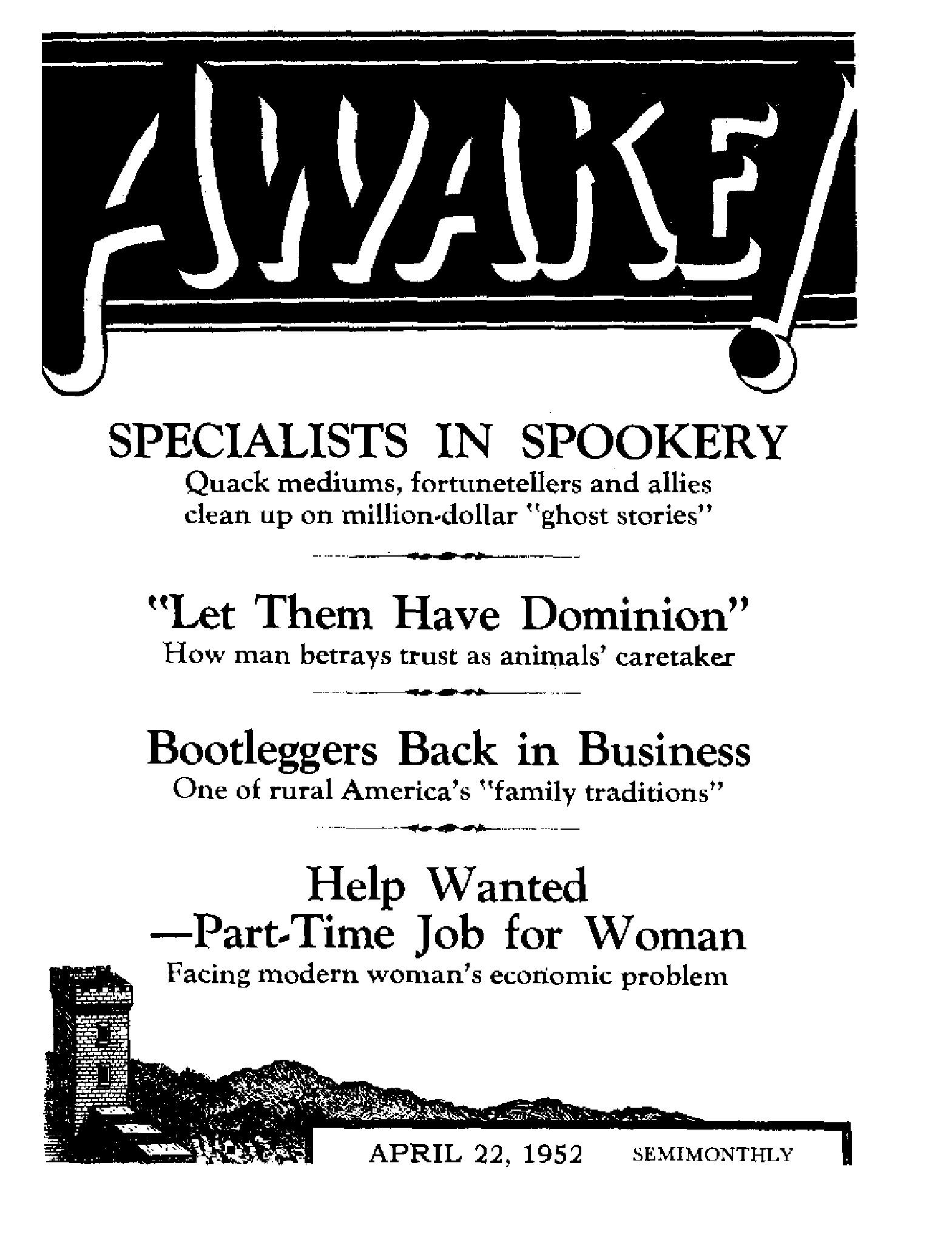
SPECIALISTS IN SPOOKERY
Quack mediums, fortunetellers and allies clean up on milliomdollar "ghost stories”
"Let Them Have Dominion”
How man betrays trust as animals’ caretaker
Bootleggers Back in Business
One of rural America’s "family traditions”
Help Wanted
—Part-Time Job for Woman
THE MISSION OF THIS JOURNAL
News sources that are ab|e to keep you awake to the vital Issues of our times must be unfettered by censorship and selfish interwtB. “Awake 1” has no fetters. It recognizes facts, faces facts, is free to publish facts. It is not bound by political ambitions dr obligations; it is unhampered by advertisers whose toes must not be trodden on; It is unprejudiced by traditional creeds. This journal keeps itself free that it may speak freely to you. But it does not abuse its freedom. It maintains integrity to truth.
“Awake I*1 uses the regular news channels, but is not dependent on them. Its own correspondents are on all continents, in scores of nations. From the four corners of the earth their uncensored, on-the-scenes reports come to you through these columns. This journal’s viewpoint is not narrow, but is international it is read in many nations, in many languages, by persons of all ages. Through its pages many fields of knowledge pass in review—government, commerce, religion, history, geography, science, social conditions, natural wonders—why, its coverage is as broad as the earth and as high as the heavens.
“Awake [” pledges itself to righteous principles, to exposing hidden foes and subtle dangers, to championing freedom for all, to comforting mourners and strengthening those disheartened by the failures of a delinquent world, reflecting sure hope for the establishment of a righteous New World.
Get acquainted with “Awake!” Keep awake by reading “Awake!”
PPBUISHED SKMIMOMTHLT Bt WATCHTOWER BIBLE AND TRACT SOCIETY, INC.
117 Adams Street Brooklyn 1, N. Y., U. S. A,
If. H, Knorr, President Grant Suiter, Secretary
Printing this i*sue: 975,000 Five cents a copy
LangoaiM in which tttfo maiazln* is fiblhhed: Semimonthly—Afrllmns, Ertidish, Fiiinhli, French, German, 11 rd tan. dish, Norwegian, Spanish, Swedish. Mtmtlily—Danish, Greek, Pnrtijpicsc, Ukrainian.
Officei Yearly sufoicrlptlnn Kato
AhctIci, LLS.h 117 Adami St., Brooklyn 1. N.Y. $1 Aflttralla, 11 Beresford Rd., Strathficld, N.H.W. 8a Canada, 40 Irwin Arc., Toronto 5, Ontario fl England, 34 Craven Terrace. London, W. 2 7s Spath Africa, Private Bag, P.O. Elindsfontefii,
Transvaal 7s
R«mittano*s should be eent to office In your country in compliance will, regular ion# to itiaranlec safe delivery of money. Remittances are accepted at Brooklyn from countries where no office is located, by International money order only, Subscription rates in different wuntrin are here staled in local currency. Nstice #1 •xoifttlon (with renewal blank} Is sient at least two jb-Stjos before subscription expires, Chans* Of ttfdre«s when sent to our office may be ex peeled effect! re within uno month. Send your old as well as new address.
Entered as second'cIbss matter at Brooklyn, N. ¥. Act of March 3, 1873. Printed In U, S. A.
CONTENTS
Has the Clergy Failed?
Quoth the Clergy
Specialists in Speckery
Help Wanted—Part-Time Job lor Woman 1
Seances with "Built-in” Spooks
Netherlands Religious Dikes
Author Spillane Makes Mind Over
"Amy” Visits the Visayas
Bootleggers Back in Business
Moral Deterioration in Japan
A Family Business
Trailer-Park Ministers Upheld
“Brain Age” or “Comic Age”?
"Your Word Is Truth”
“Let Them Have Dominion”
“A Ransom for All"—Why and How?
Man's Best Friend Has Man as
Juan Chapin Is No Communist!
Its Worst Enemy
Watching the World
Volume XXXIII Brooklyn, N. Y.t April 22, 195g Number 8
HAS THE CLERGY FAILED?
^TVTE HAVE made a mess of telling the VV world about God. The mess the world is in is eloquent testimony to our failure.’1
From the lips of a modern clergyman are these words taken. Their source is Alson J. Smith, pastor of Roxbury Methodist Church in Stamford, Connecticut, and a religious writer. He contributed an article titled “Have We Ministers Failed?” to Tomorrow magazine of May, 1949, in which he freely admits clergy shortcomings and deplores the inconsequential things that are allowed to substitute for weighty Christian teaching. He thus admits what cannot be denied. The absence of firm Bible truths from the mouths of the large orthodox religious organizations has evoked a tide of ridicule from critics and scoffers who charge that the Bible is impractical and its principles foolish, even childish in a modem world.
But Pastor Smith thinks the average parishioners ask for the spiritual famine that descends upon them. He says on this point: “The parish wants a minister who has 'presence’ and 'bearing/ and if it can get a minister who has these qualities, and a mellifluous voice, its cup of joy is overflowing. He does not have to use the mellifluous voice to say anything; in fact, it is better if he says as little as possible— especially anything controversial.” It seems the parish’s chief concern is to acquire a pastor who will “stand out” at community functions while vying with other clergymen. “In selecting a new shepherd,” Smith goes on, “its ‘call’ invariably goes to the candidate who seems to represent the best available combination of looks, manner, voice, and that quality which is known in less dignified circles as ‘sex appeal/ What is in his heart is not particularly important.”
Note what they said of the apostle Paul, that “his letters are weighty and forceful, but his presence in person is weak and his speech contemptible”. But none who followed the advice of this inspired apostle suffered from spiritual hunger or moral breakdowns for which this modern world is known so notoriously. Paul himself explained: “Let such a man take this into account, that what we are in our word by letters when absent, such we shall also be in action when present. For we do not dare to class ourselves among some or compare ourselves with some who recommend themselves. Certainly they in measuring themselves by themselves and comparing themselves with themselves have no understanding.”—2 Corinthians 10:10-12, New World Trans.
Modem false religion’s habit of straining at gnats and swallowing camels was hammered hard when Smith said: “The church unerringly points out the rum blossom on the nose of the drunkard, but at the same time manages to overlook the cancer on the face of all human society. . . . Hitler’s blood baths were justified^ in some Protestant circles, on the grounds that he did not drink, smoke, or run around with women (although it now appears that he double-crossed us on all points). Sentimentality and moralism erode the body of Protestantism as destructively as the lust for temporal power and arrogant antiintellectualism corrupt Roman Catholicism. Through these lesions the life-giving power and authority of the church drips slowly away.”
This minister admits opening his career with the usual high-sounding vows, “to preach the Word, baptize, marry, bury the dead, comfort the afflicted, solace the dying, and visit from house to house.” But what does all this amount to in practice? Smith’s observations quickly hack down clergy pretensions of true Christianity. He says the clergyman “is a specialist in something that doesn’t matter. ... He is not an authority on anything. ... He has a ceremonial function in the community as a marrier, baptizer, funeral orator, and pronouncer of invocations and benedictions at public functions. These are but vestigial remnants of a prehistoric age of faith”.
As for the weightier matters, how much “house’to house” preaching in the manner of Christ and the apostles do they do? Smith’s article relates the tedious routine of sick calls and other visits around the parish which both clergyman and parishioner usually dread and deplore. No such activity among the general public for which Jesus set the example is carried on. (Matthew 10:5-15; Luke 8:1) And whether in pulpit or in the home of a parishioner, the “Word” preached by the clerics is far removed from the message of hope contained in the “good news” Christ preached. Christendom’s many creeds are well-known. Equally well-known is how little these say about the Bible’s true teachings, God’s purposes, his kingdom and the blessings it is destined to bring to the earth and man upon it.
So obvious have clergy shortcomings become that even official church hierarchies are forced to notice the problem. The Rural Church Department of the Drew Theological Seminary (Methodist, too, incidentally) issued a clever bit of satire concerning how some modern clergymen might respond to the call once received by the apostle Paul, to “come over into Macedonia, and help us”. Time magazine published the seminary’s version of what the cleric would say in reply, which, in part, went: “You have told me nothing about Macedonia beyond the implication that the place needs help. What are the social advantages? Is the church well organized? I recently had a fine offer to return to Damascus at an increase in salary, and I am told that I made a very favorable impression on the church at Jerusalem.”
Has the clergy failed? Yes. It has failed to bring God’s1 Word of truth to the laity. Overriding any pretensions of Christianity are the all-impelling motives of pay, prestige and position. To be sure, wrong example by Christendom’s religious hierarchies, for centuries apostate, contribute to the cause. Also, parishes that choose their pastors for the surface appearance they make come in for their share of blame. But the evil remains inexcusable. Persons of good will, seeking the truth, are turned away famished from such systems. The deplorable condition heaps reproach and disrepute on God’s name and Word. Jehovah’s prophet recorded that they were a people that drew near with their mouth but kept their hearts “far remote; since” he says, “their religion is a mockery, a mere tradition learned by rote.”—Isaiah 29:13, Moffatt.
evil spirits, known
in pookery
Quack mediums, fortunetellers and allies clean up on milUon dollar '’ghost stories’'
HE Middle Ages had it, ran it in the ground and almost killed it. Then it wa$ attributed to more accurately as
witchcraft or demonology, and came near to being scrapped as superstition. Just in time the “Brain Age” revived “it”, that is, the practice of contacting the “other world” of the spirit. Now it is heresy to connect evil spirits with the matter. The phenomenon is at present attributed to “the operation of certain tenuous and imponderable laws that permeate the Cos* mos” Not demon worship but “Extra Sensory Perception” they call this gift today. Far from superstition, in the fashion of the times the art has been exalted to the level of science, its study dignified with names like “Para-psychology”.
A strange fascination for the unseen has drummed up trade for mystics of ail ages— the sibyls, prophetesses of the ancient world, the famed Greek Oracle of Delphi, etc. In the twelfth century B.C. the same craving rushed Israel’s apostate King Saul to the door of the witch of Endor. He got exactly what he deserved, a slick impersonation by a demon of the dead prophet Samuel. (1 Samuel 28:7-19) At the very best (or worst) that is all that any consultant of a medium before or since has received for his trouble. Modern haunted-house tales help keep interest at high pitch.
There was the incident in January, 1950, when residents of a house in Bristol, England, complained to their vicar of (‘haunting” by what was thought to be the ghost of the former owner, dead some eighteen years. The vicar rolled up his sleeves, studied up on an ancient church ritual for sparring with spooks, and went through the house, spreading his “ghost remover” behind him. But, alas! only two weeks later the inhabitants announced the return of the unwanted one, noisier than ever. The vicar had lost the first round and whether he wished to answer the bell for another was not revealed.
However, when and if man crosses the path of a real demon the damage is purely mental. But modern racketeers, “demons” of another sort, were bound not to let it go at that—not forever. And when they caught up with this great field of human interest, they converted it into one of history’s best-paying rackets. .
Most fortunetellers today are interested only in the fortune they can glean from the purses of a gullible public. They are more “face readers” than mind readers, sizing up their customers by ext e r n a 1 appearances. First they explore, go-
Ing on what little the surface shows. Usually the client's facial expression will begin to register the hits and misses like a scoreboard and it becomes a simple matter of experienced “artists’* to enlarge on the right guesses. The field narrows, becomes easy to follow. Then a sensitive point is touched and the customer, now the victim, opens up and tells all. Quickly, the fortune teUer becomes fortune listener, 'He carefully notes the details, which he will fire back at the wide-eyed one later while he or she swears such knowledge is unbelievable.
To get things started the same general subjects are exploited on nearly everyone, things in which all are interested—love, money, business, ambition, health, friends, enemies, desires, dangers, etc. A character analysis, mostly flattering, will come in, a general air of mystery, a little advice and plenty of sympathy. One thing more, the victim’s pocketbook is too bulky. The fortuneteller will offer immediate assistance there.
Coronet magazine reported in March, 1949, on the results of a survey made to trap these frauds in the act. The same person received reports from different seers that differed like day from night.'More seriously, even immoral, illegal and highly dangerous advice was given. “Marriage” without legal sanction was mentioned approvingly, and a specific drug was named and suggested for medical treatment. Yet victims like sheep before the slaughterers will pay from $2 to $25 or more for such sessions. It is estimated that Americans swell the fortunes of such fortunetellers to the tune of over $200,000,000 a year.
For those who prefer their forecasts by horoscopes and starlight, astrology is on the scene to take their orders—and astrologers to take their money. Three million rabid followers will tell you that your entire character is determined by the exhct positions of all the heavenly bodies, stars, sun, moon, planets, at the moment of your birth. Devotees of the stars provide a glowing example of twentieth-century superstition. The late cinema actress, Maria Montez, was a typical astrology enthusiast, watching the stars for approval of contracts, working conditions, etc. Once she defied the stars and went motoring when the planets were “angry”. A serious accident ensued. Ever after she maintained that she owed her life to Jupiter. Good old Jupiter alone of all the planets that day was disposed to help her and condescended to snatch her from death’s door.
There is usually little to be done legally as long as seers keep reminding their following that they have “no occult powers to foretell the future”. This brings up the amazing and amusing “Fast Luck Brand Incense” advertised by circular and sent out from Chicago. The ad was labeled, “16 Incense Lucky Numbers Tablets.” Quaintly the burnt ash of the incense would form into numerals. But the fine print reminded, “We make no claims to lucky numbers.’* The circulars insisted that no claims of supernatural powers were made. But they were covered with “testimonials” relating phenomenal social and spiritual uplift experienced by users, all somewhat out of the ordinary for incense. Amid fumes from the product a girl was pictured with money falling into her lap. “Your Luck May Change,” screamed the bold type. But, ‘We make no claims that it will,’ the fine print reminded.
Seances with “Built-in” Spooks
Probably the most outstanding spook specialists are the mystic mediums who “illustrate” their ghost stories with specters to match. These “artists” take their cues direct from the witch of Endor; but many of them lack the “contacts” necessary to conjure up a real, live demon to imitate the customer’s dead relative. Still, they reason that mediums must live too, so they “build In" their own spooks. Furniture that moves about without help is a fine aid In this direction. The customer never detects the thin rubber hose beneath the carpet connecting a bulb on one end by the magic one’s foot with a balloon on the other just under a table leg. The general setting and the jiggling table fill the minds of the credulous with other conclusions.
Of course, courteous spooks must answer when addressed. But “ghost talk" is not difficult. The medium may gird his midsection with a belt and spring-steel attachment. Mere flexing of the stomach muscles and a little practice can make the spectral visitor very talkative! Three weird snaps for “yes", two for "no", one for "that depends". An old favorite is a wax hand, supposedly a replica of the hand of a dead medium, or, more interestingly, of Cleopatra, Enoch or Moses. Placed on a wooden tray, it can be made to tap out answers with its fingers. Inside, a steel ball bearing upsets the hand’s balance at the slightest movement, causing the fingers to roll forward and tap on the wooden sounding board as the hand rocks on its heel. Or there is the imitation human skull that clatters out the messages with its jaws. A charming conversationalist this! Actually the jaw is set upon a wire pivot inserted through the cheek bones. A lever from beneath can turn this pivot like a crankshaft, and this in turn sets the jaws swinging.
Of course, some of the smarter victims are sure they know just what a “disembodied spirit" looks like. Have they not seen many of them in the comics, dimly outlined shapes resembling a bed sheet? So accommodating, up-to-date mediums turn out the lights, arrange the traditional circle, and provide for an assistant to enter, draped in cheesecloth specially treated with chemicals. He pauses at the right spot and the medium turns on an ultraviolet ray light, the beams of which are Invisible to human eyes. But it catches the reflection of these chemicals. When this runs its course the medium turns off the ultraviolet rays, the assistant removes the cheesecloth and retires.
Television has cut in on virtually every form of entertainment. But some enterprising mediums got a jump ahead and started telecasting their “spirit messages". After a widow would arrange to attend a seance, a fake "telephone inspector" would call, while unnoticed make a photograph from a picture of the deceased, later have it developed and touched up somewhat. At the darkened seance room, the poor widow would fix her eyes on a large television screen while strange, unearthly sounds belched forth from the set. Then, slowly, the slightly altered photograph would appear to convince the bereaved one that she had seen a telecast from heaven.
East and west, in heathendom or so-called Christendom, stark superstition makes possible the rise and spread of such merciless rackets. At the bottom of it all is the Devil-inspired doctrine found running throughout the tenets of false religion, that the human soul is immortal, it cannot die. In Christendom practitioners of the racket repeatedly quote the Bible to justify their wicked deeds. But the Bible says plainly that the human soul is mortal, it can die. The Bible condemns sorcery, fortunetelling, astrology, etc., whether faked or real. (Ezekiel 18:4, 20; 2Chronicles 33:6; Isaiah 47:13,14) "And when men say to you, ‘Consult the ghosts and spirits that chirp and gibber! Should not a people consult its gods? On behalf of the living should they not consult the dead for instruction and direction?’—of a truth, they shall keep making a statement like this, in which there is no light."—Isaiah 8:19, 20, An Amer. Trans,
AUTHOR SPILLANE MAKES MIND OVER
ANEWSPAf^e.tt aeaunne in nut noir.niuwu j Newburgh (New York) News shouted
“Spillane Forsakes Lusty Books, Seeks Great- w er Story in Religion.” The next day the Pitts- * burgh Press proclaimed, “Author Quits Sex ' Writing, Joins Jehovah’s Witnesses." Other ® headlines from around the country: “Hot Novelist Sees Light” and “ Whodunit’ Spillane * Believes His Books Aided in Moral Break- > down”. What had happened? i
V Mickey Spillane, whose lusty novels are plastered over America’s pocketbook racks and translated into several languages, whose > writing is reportedly being sought by Holly- * wood and TV interests, suddenly quit writing * filth. His five books in four years had become among the fastest-selling mysteries of the decade, skyrocketing in sales to ten million B copies. The most recent one made the biggest > first-printing splash in quarter-book history, t 2,500,000 copies. *
Why the change from sex writing? One of * Jehovah’s witnesses had called at his home w and placed the book “Let God Be True” with Mrs. Spillane. The author scoffed at first, then > discovered there was truth in what was said, 111 His belief in evolution was shattered by Evo- * Ivtion versus The New World, after which he J sought more knowledge. Now, instead of de- t scribing the notorious night life of his favor- » ite detective and that detective’s favorite girl b friends, Mickey Spillane issued this sharply * written, worth-while statement to the United > Press, February 22: J
“This world of ours has become a mad- « house with a million kill-crazy problems trying to be solved by even bigger kills and ’ft bigger problems. We’ve been knocking down ° the spider webs without killing the spider. J But it’s all a planned madhouse and I’ve * found out who’s planning it, why and what the conclusion is. All it requires to learn is s a little study and a little understanding, but * it takes you to the Bible and because it does " people are -ready to laugh or condemn or put the finger of fanaticism on you. There are * millions today associated with Jehovah's wit- * nesses who are learning this truth and will live because of it, and not just for a little * while, either.
y, ox wnav I w&g? what I did and
the way I wrote, the public, critics and columnists have slapped the stigma of the same old worldlyism on Jehovah’s witnesses, but know this: I haven’t written a book after my old fashion since I became a publisher for Jehovah's kingdom. (The latest book, just out in paper cover but circulated in hard cover for some time, was written before Spillane became associated with Jehovah’s witnesses.] / “And know this, too: there are more books on the way, but they won’t contain the things that bolster the excuses for the moral breakdown of this present generation. I’ve changed my work and course of action to be in harmony with Jehovah’s kingdom and be a favorable example as one who publishes the good news of this kingdom.
T “This world has been screaming for leadership, it has been getting leadership—but foot where it has been led. Great, isn’t it? Along with millions of others I’ve found the answer to the problem the world is going mad trying to solve, and the answer is a greater surprise than anything you or I will ever find in fiction.
, “The Kingdom of God so many have prayed for is not only going to be established, it's here/ The physical proof is absolutely conclusive and open for anyone to see. Ask yourself this: Can you live forever in happiness on earth? and find out what I have found out and see why I’ve changed.
"? “God says it can be done. Soon, too. And it’s easy.”
/ The principle of making your mind over upon learning the truth was set long ago by the apostle Paul who had himself contributed to a delinquent world’s delinquency (though in a different manner): "Quit being fashioned after this system of things, but be transformed by making your mind over.” {Romans 12:2, New World Trans.) Only the truth will enable you to do this. Not more of the old world's religion, but more true religion is what is needed. Paul’s advice to gain right knowledge and make your mind over is good advice.. Those who do change from the old system’s course, seeing, as did this author, that no comparison exists between what is discarded and what is gained.
BOOTLEGGING is a multimillion-dollar business. According to the Licensed Beverage Industries, Federal government losses are $650,000;000 a year in taxes! Add the loss in state and personal taxes and this figure will leap into a billion dollars a year.
Florida officials estimate that in their state alone moonshine business exceeds $100,000,000 a year. Wilkes County, North Carolina, known to many as “The moonshine capital of America’*, is said to have made 500,000 gallons of whiskey in 1949, which brought some $2 million into the county and cheated the government out of several million dollars in revenue. Some counties in Kentucky are operating as many as 100 stills. Georgia leads the 48 states in illicit whiskey-making. She and her three sister states, Florida, South Carolina, and Alabama, produce more than half the illegal whiskey in America.
However, recent seizures disclose big-time city operators have dwarfed the smallfry mountain moonshine stiller both in production and circulation of the "stuff”, as it is called. Dwight E. Avis, chief of enforcement for the ATU (Alcohol Tax Unit), told the Senate committee investigating interstate crime that seven or eight moonshine syndicates operate in interstate commerce in the Middle Atlantic states and southern New England. A giantsize still producing 1,000 gallons daily was seized near Philadelphia and destroyed. This still provided moonshine for Philadelphia and New York markets. Another 1,000-gallon-a-day still was destroyed in Atlanta, Georgia. More recently, 526-gallon-a-day stills have been uncovered in Camden, New Jersey, also in New York city. New York Times, August 18, 1951, reported the Treasury agents’ seizing-a "seagoing bootleg still that netted its operators up to $3,000,000”. The American Mercury, November 1950, shows still seizures have been 50 per cent greater during 1950 than in 1946. There were some 10,000 stills seized and as many arrests made.
Nobody knows definitely how much illegitimate whiskey is made each day, nor the number of illegal stills in operation. The State Liquor Authority pointed out “that stills seized in United States in 1949 could produce 12,000 gallons more a day than licensed distillers were producing in the same period”. Business Week, October 21, 1950, states: "Best estimates are that home-cooked output of hooch has jumped 300 per cent in the past few years. The distillers say their illegal and taxfree competitors are cooking up the stuff at a 4-million-dollars-a-day clip.” The article further asserts that stills "exist in every state of the union, and in every town and city of any considerable size”.
Reason for Boom
What is it that has put the boom in bootlegging? Both the retailer and the consumer agree—taxes. High Federal and state taxes make bootlegging a profitable business. To begin with, the bootlegger escapes a $10.50 Federal tax and a state and local tax exceeding in most cases $2 on every gallon of legal whiskey. In addition, he is not concerned with corporate taxes, social security taxes, welfare taxes, personal taxes, stamps, high rents, etc, Erwin B. Hock, alcoholic beverage control director in New Jersey, said it was “generally accepted that illegal distilled spirits can be produced and distributed to the consumer under current conditions for $1 a gallon or even less”, which is less than the Federal tax alone on a pint of legal whiskey!
His overhead expenses amount to almost nothing. To set up a medium-size basement or backwoods still costs as little as $100, which can be paid for with the first run. Years ago moonshiners took pride in their ability to make good "cawn likker”, but today commercialism and expediency have corrupted their pride and the art of hoochmaking. Usually “Kentucky squirrel”, “white lightning,” or “panther sweat” were concocted from com meal, malt and sugar. This mixture takes close to nine days to ferment. With the Treasury Department's ATU men combing the mountains and cellars, the distiller cannot afford to wait; so he leans heavily to a sugar-and-water mash which takes less than three days to ferment. During the war, when sugar was scarce, candy was used.
To rush fermentation when business is buzzin’, Kentucky moonshiners are said to use “silo drippings or prepared cattle feed”. In some cases, to give the whiskey a touch of daintiness, 'sprouted com is buried in barnyard manure, then turned through a food chopper and mixed with the malt’. Not exactly appetizing, but it does the trick. Also, to add flavor and the famous “kick”, “a little glycerin or fusel oil was added. Some cutters, however, used a sulphuric-acid compound. ... To customers who demanded that their whiskey have more fire and bite than the usual stuff . .. iodine was added.... In some of the larger cities manufacturers of hooch sometimes used embalming fluid to give their whiskey an even greater kick,”
Ordinarily 1,000 gallons of live mash will produce about 100 gallons of moonshine. A wholesaler will buy this mountain or basement “dynamite” for less than $3 a gallon at the still site. The driver who delivers the goods to the market averages close to $1,500 a week. The wholesaler in the city will average about as much and the retailer will clear about $300 for his troubles.
Battle of Wits
The job of catching bootleggers is mainly assigned to the ATU, Federal men attached to the Treasury Department. They are known to be the best bird dogs in the business. He speaks the mountain language, goes to their prayer ‘meetinand sometimes gives the mountain folks a plain talkin' to. In this game of matching wits with the mountain folks every trick, old and new, is used, plus mystery, bluff, woodcraft and intuition. Spotter planes and coast guard planes are used to locate stills. Walkie-talkies are used in raids. Even wives eager to get their husbands or sons home are a source of a surprising number of tips. Bootlegging is a highly competitive business. When one is captured and his still destroyed, in many cases he will give information regarding the whereabouts of other stills, to keep his fellow moonshiners from profiting from his temporary inability to supply his customers.
To make an arrest the operator must actually be caught “with his hands in the mash”. This is about as simple as trapping an Alaskan bear in South America. It just isn't done. Owners seldom if ever come near the plant Young long-legged mountain boys are hired to operate the stills on a 50-50 basis. These boys vanish from the still site at the first sign of suspicion or warning. Their long legs and know-how in the hills almost ensure them perfect safety. The familiar cry of American folklore, “Maw, git the guns, it's the revenooers!” has been greatly exaggerated. These young boys know better than to try to shoot it out with them, and be sent up for a murder rap. Treasury Department regulations forbid ATO men to use their guns unless their lives are endangered, which is very seldom. The mountain boys run like scared deer through the underbrush confident that they will not be shot in the back. But when caught the game of tag is all over. Rules forbid him to run again, so he stays put. The mountain moonshiner is a man of his word. When captured handcuffs ^re dispensed with. Arrangements are made to meet the next day at the U. S. Commissioner’s office for a hearing. The prisoner never fails to appear. That same informal code of relations also says that the “revenooer” must never abuse a prisoner, never seem vindictive about getting a conviction, never lie on the witness stand. Court sentences are lenient. In at least one case “a chronic still operator proved to have had more convictions than he was years old”. Jail stretches are not considered a disgrace, just an occupational hazard.
A Family Business
Moonshining is generally considered a family business and the birthright is usually the family still. hi some locations a loosely knit co-operative exists. When the Federal officers destroy several stills, the moonshiners in that vicinity all pitch in and help the unfortunates get back into business again. To protect the family still, every in genius art of camouflaging is used. Wire netting strewn over with branches and leaves, army camouflage cloth, retractable smokestacks, and to lessen the smoke chestnut wood or coke is burned, which are practically smokeless.
An alarm system equal to any radar screen covers the area. Tin cans are fastened to brush to rattle, thread is webbed along the earth, spotters are placed near ATU headquarters to flash the whereabouts and descriptions of pny new Federal men, boy runners are sent out and dynamite explosions are set off to warn the entire community of the presence of officers.
To protect the transporters hauling the moonshine to retailers an elaborate lookout system operates. Some big-time bootleggers on the West Coast have used a radio station that sounded the all-clear signal by certain records that were played. The lookout system operates so efficiently that revenue officers are seldom able to intercept a loaded automobile.
To prepare for an emergency, the drivers practice for months to learn how to take hairpin curves at great speeds, and drivers and guards are always prepared to shoot it out with officers if they are cornered. Regular hopped-up Fords with superchargers, multiple spark plugs and twin carburetors, gear-ratio change, auxiliary fuel pump, oversized cylinders, aluminum pistons; also multiple rear-vision mirrors and a special switch for snapping off the taillight are used. When police cars could match them for speed, the bootleggers switched to Offenhauser engines made for racing cars. These young daredevil drivers streak down the highway at night with or without lights on at 110 to 125 miles an hour, with a pilot car in front and a block car behind. They stop at nothing.
It is admitted by bootleggers and ATU men alike that bootlegging is a battle of wits or an adult game of hide-and-seek or cops and robbers. Many stills are destroyed. Some operators are caught and prosecuted. Others are killed, but the business flourishes. Will it spill over with mobs, crime and cold-blooded murder as in years gone by? That remains to be seen.
Contucius Is supposed to have fathered the popular saying that “one picture is worth 10,000 words”. If he did, that venerable old Chinese gentleman proved himself a shrpwd observer;
and
i'.r;
?I||In
were he living now would probably lay claim as a prophet of the ’'Age of Comics”. Atom smashers prefer the label “Brain Age”, but popular reading habits might rather favor the former suggestion. Only now, with that in view, the statement should probably read, “one picture is worth $10,000.”
<L Perhaps many factors make the comics the sellers they are. Adults show the same tendencies in all ages by their enjoyment of the prevalent picture magazines. Also, the air of mystery, of the unknown, plays its part, accounting for the love for such comic strips as “Buck Rogers” or of motion pictures dealing with space travel. In a sense comics are a juvenile edition of science fiction.
€, Beyond denial, readers take their comics seriously. “Smiling Jack” fans implored Pan American Airways to dispatch a rescue plane when their hero was lost in the Pacific. “Captain Marvel” receives a reputed 30,000 letters a year, many from foreign lands. And a spinach*growing section in Texas raised a monument to “Popeye”, The fabulous strong man’s creator, E. C. Scgar, received a .tide of appeals from mothers asking that he make his hero stop opening spinach cans with his teeth. Comics are impressionable! R
€, American folklore and customs have be* come enriched by comic contributions, “Sadie Hawkins Day,” the annual big day for all unwed gals of cartoonist Al Capp’s fabled “Dogpatch” to literally “catch” a mate in a free-for-all marathon, has become a nationwide event. Dances or other social events are held to which the girl must treat her escort, But when comic books came in for a cut of EC A funds, many thought that was carrying the realism too far. The Christian Century questioned whether such expenditures were for “relief and reconstruction”.
< Satire has ever proved a potent weapon In newspaper editorial cartoons that graphically depict prominent evils or complaints of the day. In some comic strips it has achieved a similar prominence. An outstanding master at the art is the above-named Li’l Abner-c renting Al Capp. He reached a high point in his book The Life and Times of the Shmoof released at the close of
I 1948. The work capitalized on the success of : the mythical little cure-all animal that aj> peared in Li’l Abner^s life earlier the same year. At once the shmoo’s 'Life and Times' proceeded to outsell the then nonfiction best seller, TEooseveZt and Hopkins.
€, Pointing to the satire present, Life (De-:i cember 12, 1948), in editorial review of Capp’s I ' work, said: “For in The Life and Times of i: the Shmoo the happy little animal unfortu-i- nately gets caught in the crossruff of the class Jl war. With shmoo meat providing a free liv* ii ing for everybody, Brewster McRewster, the ! egg tycoon, and J. Roaringham Fatback, the
pork monopolist, are, naturally, outraged.
i They are gluttons of privilege and they don’t like shmoo meat. And so, in spite of a few feeble yips from liberal capitalists who pro* pose to make a living by producing shmoosical
i comedies, McRewster and Fatback hire a goon agency to kill all shmoos. Reaction is triumphant.”
i. C So while atomic and military science set Ii off explosions of untold significance on a Ne-'■ vada desert, other citizens of the “Brain Age” relax on their porches to peruse their favorite comics. It is a strange contrast, but perhaps not without meaning, Possibly such trends be* ; tray a tense world’s efforts to find relief and ‘ letup from its otherwise critical existence. Or ; maybe learning what is wrong is not so bitter a pill when delivered in the comic technique. But whatever the source, finding fault is al
! ways easier than correcting, i Even the “Brain Age” has learned this. It Is badly in i need of a sure guide, some! thing more stable than the i; comics it reads for diversion, or than even its atomic formulas.
A WAKE I
Let Them Have Dominion
& T ET them have dominion over the fish Jb of the sea, and over the fowl of the air, and over the cattle, and over all the earth, and over every creeping thing that creepeth upon the earth.” Thus man was empowered with authority by Jehovah God to exercise dominion over the lower ani-’ mals. (Genesis 1:26,28) As serious as is instructing the student in cruel and inhuman practices, there is a more terrible crime: the abuse of man’s God-given dominion over the animals.
History condemns man as being guilty of the foulest, most degenerate crimes against the animal kingdom. Animals can look upon man’s dominion over them as a reign of terror: being starved to death, ripped apart, burned alive, crushed piece by piece, skinned alive, torn to shreds, ail to delight his master in games of sport or to satiate his lust for blood.
The abuse of this divine authority dates back to the world’s first-known dictator, Nimrod, ruler of Babel, the first human political government after the Flood. Thanks to his carnage of animal flesh, all for the sake of “sport” and his own fame as a great hunter, he scattered the wilds with the carcasses of the animals he cut down, and contributed to the fear and enmity of the beast for man. (What Has Religion Done for Mankind?) The taste for more brutalizing spectacles grew apace. Wild animals were pitted against one another or against men in mortal combat. The first certain instance on record of this is in the year 186 B.C., when M. Fulvius exhibited lions and tigers in the arena. For a single show Sulla provided 100 lions, and Pompey 600 lions, besides elephants, which were matched with Gaetulian hunters. Julius
Caesar is said to have invented the bullfight. At the inauguration of the Colosseum 5,000 wild and 4,000 tame beasts were killed, and to commemorate Trajan’s Dacian victories there was a butchery of 11,000 beasts.—Encyclopaedia Britannica. , During the seventeenth and eighteenth centuries “bull fights were held on Sundays or on Feast days in an almost religious light”. Cities petitioned for the privilege of bullfighting "to encourage the worship of God”, but no one ventured to say how this was possible with such brutalizing spec-, taele and desecration of God’s authority.
“Over the Cattle’’
In order to thrill the crowds the bull ring became a scene of terror. To infuriate the bull “baiters sawed through the horns to the quick”, "exploded gunpowder in the face of the expiring animal,” "boiling water was poured down its ears,” and if the bull collapsed from exhaustion, "fires were lighted against or under it,” “spikes were commonly thrust into the most tender parts of its body,” “tail was frequently twisted to dislocation,” all of this and more to quench the thirst of the crowds who lusted for the hull’s blood. (Brutes and Beasts ? published 1933) Collier’s magazine of November 16, 1946, reports: “A new feature has recently been added to bull fighting in Spain to increase its
plunged into the neck of the animal to enrage it are now equipped with an incendiary device that, on contact, bursts into flame and inflicts pain that the bull virtually goes Insane. In the first fight with these fire darts, a crazed bull gored one horse through its heavy protective mat and tossed another horse and its rider several feet off the ground/' A similar fire dart was outlawed by Royal Decree published In the Spanish Official Gazette; on June 14, 1928, as being “unnecessarily cruel and repugnant to the majority of the spectators’*.
The horse, which has no doubt served man more faithfully than any other animal, tasted its share of humanity’s inhumanity to beasts. Old worn-out horses were led into the arena “blindfolded” and with their “ears plugged”, so as not to avoid the vicious attack of a wild bull. The furious charge of the maddened bull usually left the horse on “the ground in its own blood, its entrails gored out, perhaps with a leg or two broken”. Not a sound from the writhing animal. You may wonder why. The cry of a horse in agony is one of the most pathetic sounds that can be heard. The cry might clear the arena! In consideration for the paid customers the humane bull-tenders “have ripped out its vocal cords before it comes into the ring”? His overlord has deprived him even of a relief of a scream of pain,—Brutes and Beasts, by John Swain,
The abuse of the horse does not end in the bull ring. The so-called “sport of kings”, or horse-racing, has pushed many jockeys and owners to inhuman abuses, which are frequently winked at by racing officials. In an article dealing particularly with Maryland racing, published by the American Weekly; March 7,1948, entitled “Horrors Mar the Sport of Kings”, shocking disclosure was made that a slow-starting horse was regularly shot In the rump by a blast of rock salt Other Investigations disclosed a trainer had his own sinister method of exacting the last burst of speed frdm his mount. In the privacy of the stall he would mercilessly beat the thoroughbred with a length of chain with such regularity that the animal began to associate his torment with the rattle of th& chain. Then in the race the jockey would secrete a length of chain on his person, or have it handed to him with the last pat of the owner, and when the need was greatest for speed, he rattled the chain in the horse’s ear. In a desperate effort to escape the horror of further beating, the racer burst ahead, driven by fright. Even after racing days are over miseries do not cease. (American Weeklyf April 18, 1948) Dan Parker charges: “For every star of the turf that retires in comfort there are ten thoroughbreds abandoned with cruefest neglect.”
Man to Man magazine, issue of December 1949, charges that a “veritable craze of gambling has taken over rich and poor alike throughout the Far East”; that “ancient and traditional sports which have not stirred the imagination of the people for centuries are revived”. True magazine, June 1951, remarks, “bull fighting . , . cock fighting, fish fighting, cricket fighting, and even ant fighting” are among the popular sports of Thailand. All of these creatures are bred to bring out their “combative strains”.
Fish of the Sea, Fowl of the Air
Gambling and a thirst for pleasure and excitement make fish fighting popular in Thailand. Fish are matched, bets are placed, then the fish are put together in a jar—the fight is on! Their supporters bend forward on hands and knees, eyes glued to the jar, giving their favorite fish shouts of encouragement. After several minutes and sometimes after four, five or six hours
one fish will show signs of weakness, The stronger will rip mercilessly into him until he sinks motionless to the bottom of the jar. A cheer goes up for the winner— losers walk away or place bets on the next match.—True magazine, June 1951.
Awake! correspondent in El Salvador reports “cock fights are most popular, but the excitement of the fight is not the only attraction. There is another—betting". To make the fight thrilling for the audience metal spurs as sharp as razors are placed over the natural spurs of the cock. These spurs range from 1J inches to 2| inches in length. They allow the birds to literally tear each other to pieces. After being pitted against several opponents the birds are mutilated, with eyes gouged out, neck covered with blood, the breast and body tom to shreds. The dens and spectators are splattered with blood. Here also winners smile, but losers may pacify their wrath by roasting the “poor cock" to death. A case of this kind was reported in “An Essay on Humanity to Animals", 1798.
The commercial lust for gain has swept the forest of some of its most beautiful birds. The feathers from the heron, the beautiful plumes from the male bird of paradise and the sea-swallows, all are massacred to provide a few feathers for milady's hats. The slaughter of birds during breedingseason means that countless young ones must die too. Great Britain alone imported every year over thirty-five million birds for hat trimmings, not counting those that were killed on the island. This was before the Importation of Plumage Act.
Afan’s Best Friend
Has Man as Its Worst Enemy
The dog is often called man’s best friend. But this friendship ends, as far as man is concerned, when he lusts for filthy lucre or thirsts for blood. This depraved mind has turned the dog into a killer and has gone to almost no end to satisfy its brutality. Fighting dogs are bred for a price. John Swain wrote: “A newly whelped bitch had its feet hacked off one by one by its owner, when pinning a bull to show its courage and enhance the value of its litter." True magazine, October 1951, tells of an owner wagering that his dog would not let go of a bar even if its forepaw was chopped off. The dog’s paw was chopped off to win the bet, while the dog held its grip on the bar. The beast was made to fight on three legs until finally killed. Such torture is nothing short of demoniacal.
How cruel would one have to be to skin a domesticated animal alive? Yet this was a common custom in England until prohibited by the Act of 1835. A Century of Work for Animals reports: “A woman and her two daughters, who made their living by selling skins, were found with the remains of 150 cats that had ‘ been skinned alive." Dr. Gordon Stables, R.N., writes in Story of the Arctic Ocean: "I have seen . . . living flayed seal [pitched] into the water to see whether it would move off or not?’
These are only a few of a host of similar cases to prove a point. Multiply their number, their horror, their wickedness a thousandfold, and you will have a truer picture of the demonic abuse of man’s dominion over the animal creation. In retribution for such cruel dominion over the lower creation, the Scriptures denote that Jehovah God will employ animals in the battle of Armageddon to act against those who have defiled the earth by such hideous practices. Jehovah God will not take joy in the death of the wicked, but justice will be done. “A righteous man regardeth the life of his beast: but the tender mercies of the wicked are cruel." (Proverbs 12:10) For such inhumanity and disrespect of authority wicked men will die. God will give animals rest under the righteous reign of Christ.
Quoth the Clergy
IN REFERRING to conditions among the clergy, there would seem to be no more appropriate place to go than to the gentlemen involved. So with interest we note an article in the British paper Evening Chronicle of November 15, 1949. Writing is the "Rev/' Rowland Jones, a Manchester vicar, and excerpts from his revealing article follow: d “I know parsons, since I am one of them, and I say that if in the national crisis they were all liquidated we should be nearer to genuine Christianity than we are with them. , . . They swallow up millions with their stipends, they occupy their lordly vicarages and palaces, and periodically cry out about their 'starvation' wages. . . . But you ask a parson to go into the bar parlour, like Jesus did, and chat with the men there, or gossip with the bus conductor at the Tote window at Belle Vue, or ask him to leave his cosy vicarage Are and preach side by side with pacifists and escapologists on the Market-street 'blitz' site, and what will you get for an answer? .,, These professional parsons are as different from the hunch-backed Paul tramping the hard roads of the Roman Empire as their theology is different from the Sermon on the Mount. . . .
<f "What kind of a gospel is all this? The measure of the Church’s failure is surely the measure of the mile-distance between the parson and his master. The truth about this modern 'pagan’ world is that while it will have little to do with the Church and her parsons, it is yearning for the true message of the Christ But who is there with courage to give that message? Make no mistake, it is not easy to declare the uncompromising precepts of Jesus. They run counter to the basic fabric of our modem civilization. They make nonsense of our military pacts and our atombombs.
<f "But, none the more for that, those precepts are the only hope for this rapidly disintegrating world. . .. You can rebuild all your blitzed churches and staff them with brand-new clerical collars from the universities, but as long as you allow the Sermon on the Mount to be blitzed and shattered, as it has been by two world wars, then so long will this modem 'pagan’ world run on down its crazy path to ruin."
<1. Across the Atlantic, in the United States, the New York World Telegram and Sun, on October 25, 1950, reported an interview by a staff writer with retired Congregational and Reformed minister Dr. Frederick Keller Stamm. Stamm, who spent forty years in the pulpit, expressed his fervent desire to hear voiced from the pulpit the preacher's impression of the faces before him. Putting it in his words:
<f '‘He sees some stuffed shirts who have no interest in saving souls, but who insist that the preacher shall be their hired man, that he shall preach the types of sermons they prescribe, raise money for the budget and keep busy at any kind of work the church committees want done. ... If more preachers would tell what these committees do to them, the public would learn why there isn't more of the spirit of primitive Christianity in the churches. People need to have their consciences disturbed, They need a minister to be rough and plain with them. That might make the preacher unpopular. It might make things tough for him and his family. But if the preacher wants to be popular he can behave like a politician, be good at back-slapping, tell terrible parishioners how wonderful they are. I know these things from my own experience."
<f Such candid remarks must be appreciated by lovers of truth and honesty who have wondered at the clergy’s failure to diffuse knowledge of God. Pointing to the same evils in his days on. earth, Jesus once said: "You hypocrites, Isaiah aptly prophesied about you, when he said: ‘This people honors me with their lips, yet their hearts are far removed from me. It is in vain that they keep paying respect' to me, because they teach commands of men as doctrines.’ ’’ -Matthew 15:7-9, New World Trans.
I tell you that every unprofitable saying that men speak, they will render (tn account concerning it on Judgment Day; for by your words you will be vindicated, and by your words you wiZZ be condemned.
—Matthew 12:36, 37, New World Trans.
‘'Almost no firms answered 'position wanted' newspaper advertisements when looking tor part-time workers,” reported the survey made by the Women's Bureau duving the period from June 1949 to June 30* 1950, While the statistical Information below' Is exclusively far women as a result of the survey, the practical information can be of benefit and Just as applicable to men seeking part-time work, Consider the following information carefully before you start out part-time Job hunting'
PART-TIME work has a place in the business world. It is not a full-time job squeezed into a couple of hours each week, or a “hang-over” from war years, nor a temporary job. It is well-planned and scheduled work time adjusted to meet the requirements of the business.
Eating places, stores, recreation services, beauty shops, etc.—businesses with regular rush-hour periods—often depend on part-time help to regularly supplement their full-time working force during these periods. Extra workers are needed to relieve full-time workers on days off, or as “relief workers” to cover over-all hours beyond the normal working week. And, too, there are small establishments that cannot afford a full-time bookkeeper or stenographer, but can use a part-time worker. Limited budgets and limited work restrict full-time employment in social agencies, hospitals, and educational organizations. Openings are made for part-time workers.
Married women fill most of the part-time jobs. Few have children. Many were full-time workers, now doing the same work only part time. Most part-time workers are between 35 and 55 years of age. Over three-fourths live in-small families of from two to four persons. Almost half of these do their own housework without outside help. About two-fifths have completed high school, one-fifth have gradeschool education, and less than one-fifth have attended college. Over half have no vocational or specialized training.
Few part-time workers depend entirely on their earnings for a living. Their primary motive for working is the need to ease the strain on the family budget or to increase the regular family income. Widows sometimes said it helped them overcome loneliness, and housewives stated that part-time work overcame the boredom of housework. Some said that they felt the need for outside contacts, since their children were either in school or grown up. Professional or technical workers and those with special abilities accepted part-time jobs mainly to keep abreast of the latest developments in their respective field and to keep from getting “rusty”.
Pioneer ministers of Jehovah’s witnesses, devoting more than 100 hours each month in door-to-door preaching, often find it necessary to do part-time work to care for their material needs. They find pleasure in supporting themselves in the ministry. Their case is like that of the apostle Paul, who supported himself in the full-time ministry by working part-time as a tentmaker. (Acts IB:3; 20:33-35) Christian ministers of Jehovah have no desire to sponge off their brothers, even though fa workman is worthy of his hire*.—Matthew 10:10.
Those experienced in part-time work highly recommend the system. Married women often say it contributes to the “enrichment of married life” and that it is a “morale builder for a housewife”. Other part-time workers say they “feel better”, and are ' ‘happier*\ also that their “mental and physical health" has improved Some appreciate the sense of “independence" that it creates.
A part-time Job carries with it the same obligation and responsibility as does a fulltime job. Just because it is part time does not mean that it is not important- If it is worth being paid for, it is worth your first attention during working hours. Lack of sense of responsibility and lack of dependability are two outstanding charges leveled against part-time workers. Employees appreciate receiving their check on time and a little consideration from employers, do they not? In the same way, employers appreciate employees that arrive at work on time and share some of the attitude of responsibility. Your indifference may mark you a liability and not an asset to his business.
Suggestions for Women
Seeking Part-Time Work
Those seeking part-time employment should ask themselves these questions: Why do I want a part-time job? A fulltime job may suit your needs better. Parttime work means fewer promotions, less chance for growth, perhaps no vacations with pay, and only a rare possibility to use your professional talent and training. If, however, your family obligations and household duties do not free you for fulltime work, then arrangements can be made to work part time. If such arrangements are made, ask yourself: What can I do? Do I have any special ability? Am I experienced in any field? What did I do on my last job? If you were a bookkeeper, stenographer or secretary, it may be necessary to brush up on your shorthand, typing, office machine, etc. A few trips to night school or a private business school might improve your chances of getting a better job.
If you are a beauty operator, Jeam the latest techniques. If a professional worker, teacher, social worker, nurse, etc., bring yourself up to date in your line of work. Ask friends in your line of work what you must do to qualify for the job. Your profession might require a certificate, or a license, or a physical examination; be sure to do whatever is necessary to qualify for immediate employment. Sharpen your talents and skills. Be your best. Employers see you only as you are, not as what you have been or promise to be.
Hours, Cast, Requirements
Do you know what hours you can work? Are you available mornings? Noons? Nights? How early can you begin? How late can you stay? What days can you work? What schedule would you prefer— two or three eight-hour days a week, or two to three hours each day for five days a week? Before deciding, ask yourself: Will such hours interfere with my household and social activities? Are these hours agreeable with my husband? With my children? Will they assist me to make a “go” of part-time work by helping with the housework?
Determine, too, whether a part-time job will be an asset or a liability to you. All jobs cost money. It may prove more economical for you to stay at home. Carfare, meals, clothes cost just as much for a parttime worker as for full-time—only a parttime worker makes less. Commuting time is the same for both. It often runs into two hours each working day. Part-time workers find jobs in walking distance a great saver in time and money. Other questions that should be answered are these: Shall I need someone to take care of my child? Shall I be able to do my own laundry and house cleaning? Shall I be able to hire a maid part time on part-time pay? Your expenses may prove to be out of proportion with your earnings. Win you be able to stand the extra “grind” and make it prove worth while?
Employers expect the same educational qualifications and efficiency of part-time workers as they do of full-time. Education depends greatly on the kind of work that is to be done. In professional fields, college degrees are almost always a “must”. Nurses are usually required to have registered nurses’ training. Clerical work calls for high school or the equivalent in education. Stores have no hard and fast rules regarding education. Employers often comment that their best workers are older women (35 to 55 years of age) without high school diplomas. Qualifications for motion-picture theaters, cashiers, ushers, and salesgirls are neatness, attractiveness, and good manners. Restaurant employers considered educational background unimportant for waitresses. She must be neat, pleasant, and know how to handle the public. Almost all jobs require these qualifications.
…