Awake!, October 22, 1951
Download: PDF — Awake!, October 22, 1951
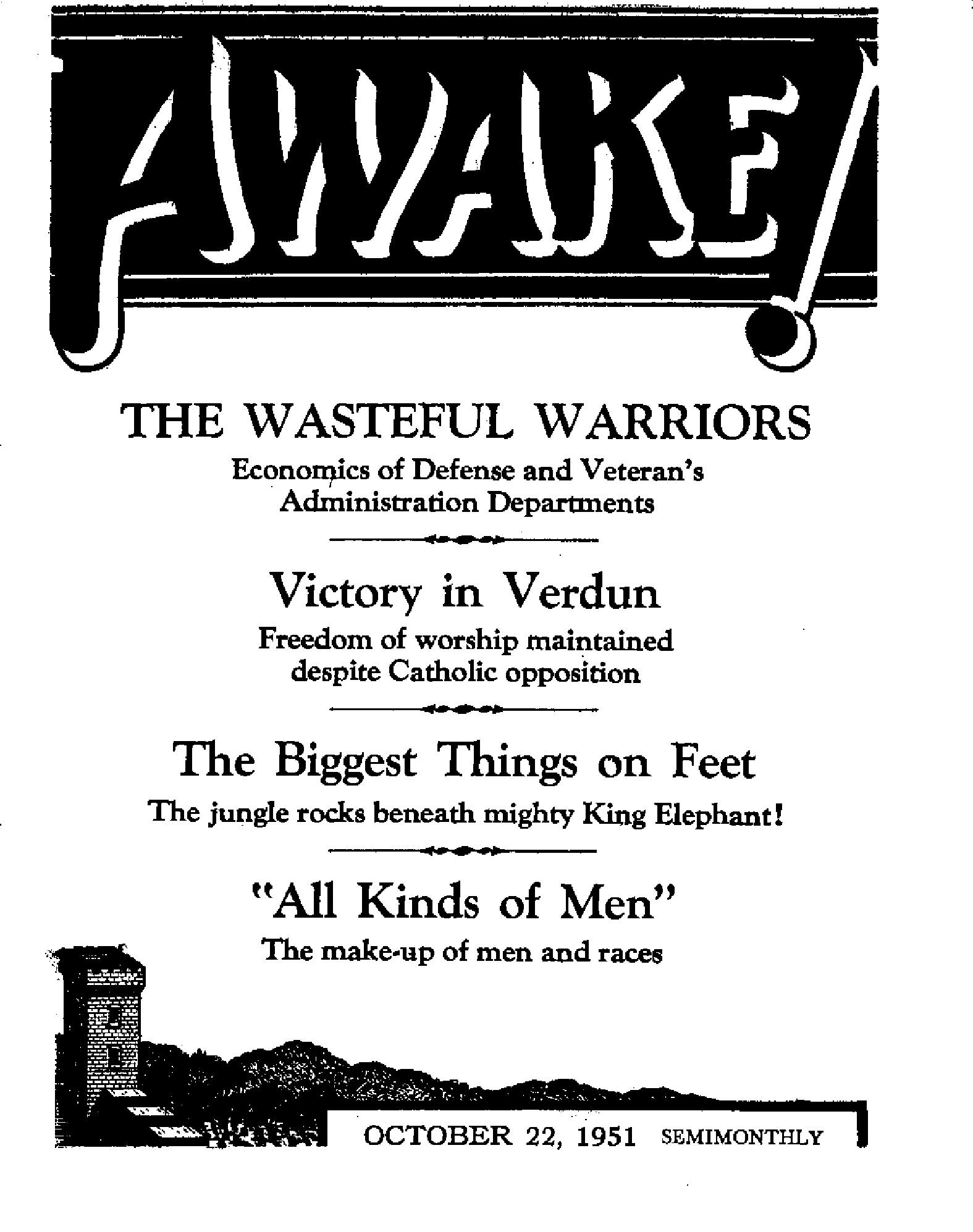
THE WASTEFUL WARRIORS
Econorpics of Defense and Veteran’s Administration Departments
Victory in Verdun
Freedom of worship maintained despite Catholic opposition
The Biggest Things on Feet
The jungle rocks beneath mighty King Elephant!
"All Kinds of Men”
THE MISSION OF THIS JOURNAL
News sources that are able to keep you awake to the vital issues of our timefl must ba unfettered by censorship and Belfiah interests. “Awake 1“ has no fetters. It recognizes facts > faces facts, is free io publish, facts. It is not bound fry political ambitions or obligations; it is unhampered by advertisers whose toes must not be trodden on; It is unprejudiced by traditional creeds. This journal keeps itself free that it may speak freely to you. But it does not abuse its freedom. It maintains integrity io truth. 4
"Awake 1*’ uses the regular news channels, but is not dependent on them. Its own correspondents are on all continents, in scores of nations. From the four comers of the earth their uncensored, on - th e* scenes reports come to you through these columns. This journals viewpoint la not narrow, but is international. It is read in many nations, in many languages, by persons of all ages. Through its pages many fields of knowledge paas in review—government, commerce, religion, history, geography, science, social conditions, natural wonders—why, its cover* age la &b broad as the earth and as high as the heavens.
“Awake 1” pledges itself to righteous principles, to exposing hidden foes and subtle dangers, to championing freedom for all, to comforting mourners and strengthening those disheartened by the failures of a delinquent world, reflecting sure hope for the establishment of a righteous New World.
Get acquainted with “Awake!” Keep awake by reading "Awake/”
FUBLfSHfiU SSMZifCWrHLF Bl watchtower bible and tract SOCIETY, INC.
117 Adama Street Brooklyn 1, N. Y,, U. S. A,
N. H. Knohb, President Graht Suiter, Secret ary
Printing this ipquei 975,000 Five cents a copy
Lino>*l*s Tn wifefi Ififa lugmfat ft aitlfsherf: Semimoiithlr—Amkaam, Enelfeh, Finnish, Oraw, Norwesteii, Spanish. Monthly—Datrlah, Fronth, Greek, Portuguese, Swedish, Ukrainian,
Office Yearly aubscrlpilon Bali
Ab HISS' U-S., 117 Warm fiynoHm 7, MF. fl AjrtrBDh 11 Btmfprd Md., Bualhfeld, N.&.W. Bt CuBds, 10 Irwin Ats., Toronto 5, Ontario $1 England. 34 Ciaran Terrace, LcindMi, W. 2 Ti
Soilb Africa, £33 Bostrc Hou®, Cape Town Ta
Entered u second-dug natter at BfooUjn, K. Y
ffetnfttancn abould bfl sent (fl nfflee tn your country in campliauCB with teeulapohq io guarantee safe delivery of mniiey. Remittances are accepted at Brooklyn from ■eoun tries where no office it ideated, by internatteioal money order only, ftiitwriptlOD rates in different countries tr« here stated In local curt-etK^, Motta tt iXftriilfH (with renewal plank) jf sent at two Issues before mhaeriptigg t3t-plrea. Change at titeesi when sent to our office may be expected effective within om month. Send your old as wall as naw address.
Act of March 3, 1879. Printed In fl. fl. A.
CONTENTS
Government Force in Medical Treatment 3
The Pope’s Rules on Law and Order 4
The Wasteful Warriors
The War Surplus Scandal
Atinga—a New Racket in Africa
Eskimos HAve Their Own Religion
Would Trade In Prayer Book
for New Model
The Biggest Things on Feet
The Elephant Is Very “Nosy”
The Stickleback’s Happy Home
“All Kinds of Men”
Why the Races?
'Chromosomes and World Domination 29
Victory in Verdun
What Do You Do with Your Time?
“Your Word Is Truth"
Which Is Practical—
the Bible or Modem Civilization? 25
Demon Voices That Destroyed a Nation 27
Watching the World 29
Volume XXXII
Brooklyn, N. ¥., October 22, 1951
Number 20
Government Force in Medical Treatment
The following l» an article that appeared In the June 27, 1951, Colorado Springa (Colorado) “Gazette Telegraph”. Ite clear-cut vialon In this vital Issue is refreshing to those who champion civil rights.
WHERE do the rights of parents in regard to their children end and the rights of the state to take over guardianship of childrep begin?
Maybe you haven’t given much thought to that question, although it is one of tremendous importance to every father and mother in the land. It is becoming even more important these days, so far as Americans are concerned, because of the swiftly growing powers of the state over the lives of the citizens.
Even in the days of our greatest individual freedom the state had powers over our individual lives which it should not have had. But in recent years these powers have increased enormously and are continuing to increase. Laws which enable the government to initiate force against parents to compel them to send their children to schools which are under the dictation of government are tyrannical laws. They enable the state to take over a measure of guardianship of children, thus invading the rights of parents over their children.
There are other laws which make it possible for government to make children wards of the state, the conscription law, for instance. And the so-called child labor laws. The tendency is toward more and more of this sort of thing.
Another question that calls for deep thought in these days of growing governmental powers over the individual is that of religious freedom. We are guaranteed freedom of worship by the Constitution of the United States, but do we still have that freedom?
There is still another question that should have deep thought on the part of all of us, parents and nonparents. This question includes both of those already mentioned and deals with the authority of doctors to prescribe treatment and administer it over the objections of parents.
We bring up these questions because of a recent court case in Chicago in which the three issues were involved. This was the case in which a six-day-old infant figured.
A doctor ordered a blood transfusion for the infant. The parents, members of Jehovah’s witnesses, believe that a blood transfusion is a violation of God’s law, and objected. The state went to court in Chicago in order that the doctors might give the child a transfusion over the parents’ objections. The issue was further complicated later by the denial of the family’s regular doctor that the baby needed a transfusion.
So here were involved the three points we’ve brought up, the rights of parents, the right of free worship and the power of the medical profession to dictate treat-
ment in place of recommending it and ad* ministering it only with the consent of those concerned.
Naturally, the parents in this case loved their child. No one denied this. When arguments were presented to the child’s parents to persuade them to consent to the transfusion the father said, “I can’t change, I can’t There is nothing I can do about it. If anything happened to my wife or myself it would be the same.”
Just before the hearing in court .the mother said; “Of course I want my baby to live. And I pray, that she does. I’ve always wanted a little girl. But we can’t break Jehovah’s law. He gave us these commands. He told us if we follow them, we will live. If we do not, he will cast us off. We believe it is more important to cany out his commands than to deliberately break them by giving my baby blood.”
A semimonthly publication, Awake! published by the Watchtower Bible and Tract Society, Inc., reports that the doctor who had cared for the child’s mother during pregnancy was absent on vacation when the infant was born and when the transfusion was ordered. The father, the magazine says, quoted this doctor as saying, the day after the forced transfusion, that he did not think the operation was necessary.
Says the magazine about the doctors, “They are always making sweeping statements, telling people how long they have to live, frightening patients into conforming to their remedies. Their mistakes help fill cemeteries, though the graves cover them over. Certainly doctors do much good, but we are not ready to hail them as infallible and bow to their every edict. iTie patient or patients’ parents may still choose their own medicine.”
In the case we’re talking about the parents did rfot “choose their own medicine”. The state' and some doctors chose it for them, despite the rights of parents and the constitutional guarantee of freedom of religion.
We believe it was wrong for the state to interfere with the authority of the parents in the Chicago case. We believe that it was wrong for the state to interfere with the parents’ religious freedom, and that the doctors who joined with the state in a dictatorial role in demanding that the child receive the treatment these doctors prescribed when the parents objected were wrong.
Incidentally, there was another recent case which received much publicity and in which parents in Georgia refused to believe their child had cancer of the eye as diagnosed, with an operation prescribed. They took their child to the Mayo hospital, where the diagnosis of cancer was refuted. As a result, today this child has 80 per cent vision, which is getting better right along, because the parents had the courage and freedom to decide what medical treatment they wanted their child to received
The Pipe’s Rules 012 Law and Order
£ An official Catholic position against mob rule was expressed by the pope in his encyclical, "Instruction to Local Ordinaries About the ‘Ecumenical Movement',”
Issued by the supreme Sacred Congregation of the Holy Office, February 28, 1950:
“Those who profusely sow the seed of hatred, of discord and of rivalry; those who secretly or openly rouse the masses and provoke rebellions; those who deceive with empty promises the easily agitated masses, even they must understand that the justice demanded by Christian principles, which gives birth to equilibrium and fraternal concord, is achieved not through force and violence but with the application of the law/’
Economics of Defense and Veteran's Administration Departments
Ttomas Jefferson, one of the founders of the United States, once said: “If we can prevent the government from wasting the labors of the people under the pretense of caring for them, they will be happy?' Today enlightened and thinking people are not happy as they note the way in which the government wastes their money under the pretense of caring for them.
That the most profligate wasters of the people's money are the military, from top brass to humble draftee, should not seem surprising. Is not their business the destruction of life and property? And particularly as regards the leaders, is not their very education conducive to wastrel habits? Says Senator Chavez, of New Mexico, army and navy cadets at West Point and Annapolis are “educated by the government at a cost of $10,000 a year in an atmosphere where they don’t have to worry about money”. He urged that the future generals and admirals be given courses in taxes and costs so that they would become “mentally conditioned on economy”.
A striking example of military waste was the “Canol” pipeline, which was to supply petroleum to bases in Canada and Alaska. Be^un in 1942, it took more than two years to complete. Even though experts time and again warned that the project was not practical, in view of its cost, the military stubbornly went ahead with it After $100 million had been spent on it a senate committee called a meeting of top army, navy and WPB officials, and all, except the army, agreed that the project was not worth completing. But the army refused to budge, and spent $35 million more on it. Regarding its usefulness, a government investigating committee reported: “A single tanker during the same time could have delivered twelve times as much petroleum to Canadian and Alaskan bases as Canol actually delivered.”
On the “Canol” pipeline as well as on the Alcan Highway the army guaranteed a monthly rental of $775 for tractors costing $8,600, whether used regularly or not, with overtime for more than 240 hours a month; tractors paid for themselves in eleven months or less. Five-ton trucks costing $3,500 drew a rental of $500 a month, paying for themselves in seven months.
Other examples of army waste were the $18 million spent on wooden cargo planes, none of .which ever got off the ground, and the loads of winter underwear sent to tropical Guam, which were simply dumped. The army could not be bothered with returning the underwear or shipping it to where it could have been i^ed.
The JFar Surplus Scandal
Bad as was the waste of the military during the war, such was a mere bagatelle to compare with their waste of the “surplus" after the war. According to the New York Times, April 26, 1951, the “U, S. Lost 2.8 Billions in Ship Sales". And, according to a national weekly, $4 billion worth of planes were auctioned off for $6| million, at a fraction of a cent per dollar. One of the fortunate buyers of such airplane bargains got an unexpected dividend of $700,000 worth of 100-octane gasoline that had been left in the tanks of the planes by mistake. What’s a mere $700,000?
One congressman read into the Congressional record some of the letters he received from soldier boys telling of army waste: of millions of dollars’ worth of lumber being burned for days and days at an army base in the San Francisco area, military guards having no explanation except that It was “orders”; of so many new, not even unwrapped, tires floating along the coast of Alaska that you could have walked on them for 25 miles, thrown into the ocean by the army at a time when tires were extremely scarce in the States; of new radios being smashed and covered by tractors in a southern army camp; of literally acres of army supplies being hauled out of warehouses and dumped into the ocean.
At the close of World War n the army had on hand equipment for 89 divisions, but when it began to rearm it had on hand only enough for 18 divisions. What happened to the equipment for 71 divisions? In many places when the war ended the boys just left their equipment standing where it was and made for the boats. According to the U. 8. News and World Report, December 15, 1950, the $50 billion of army supplies, which today would cost $75 billion to replace, “were given away, sold for a fraction of the cost, left to rot or rust in Pacific island jungles, scrapped for junk.” And this in spite of the fact that the “military were put on notice six months after the end of the war as to the seriousness of the international situation”.
Rearming Waste
Today the civilian economy of the IL S. is being deprived of many essentials and threatened with runaway Inflation, in a mad race to replace the very things that were so wantonly and ruthlessly destroyed five years before, a race accompanied by “staggering waste”, according to former President Hoover. After this race had gotten under way it took a congressional watchdog committee to drive home the idea to the army to stop selling its surplus through one agency while buying the very same things in the open market through another agency.
In 1949, although the army was committed by Congress to a stock-piling program, it ignored the pleas of nations in the sterling area to help the market by buying critical materials such as tin and rubber, of which there was a plentiful supply at the time. But a year or so later, the army suddenly went on a buying spree in a rising market, causing prices to double and even treble.
When the draft stepped up induction certain doctors made from $450 to $1,125 per day taking X rays of inductees. It was not until the situation was publicized in the press, in August 1950, that the army proceeded to eliminate this profit-making by getting their own machines. An officer who verified this was penalized.
In January 1951 the government had 67 million pounds of powdered eggs on hand. But when the army needed five million pounds it bought them elsewhere, refusing or ignoring the government supply, on some subterfuge or alibi. During the same month two Kansas congressmen vigorously protested the proposal of the air force to build a $37 million air base in their state, as there were six World War II bases available.
In recent months the reconditioning of the Sampson Air Force Base, in New York, has come in for much congressional criticism. One plumber foreman received $543 for three days* work, and unskilled labor was drawing fancy wages. Many workmen worked only Saturdays and Sundays and drew overtime rates for doing so. Army engineers justified it all on the basis that it was a rush job. Originally estimated to cost $18 million, latest reports indicate that it most likely will reach $30 million.
The Men of the V. A,
The top brass of the Pentagon (war department building) trade in fear: “Do you want to risk the security of our country?” Of course, the congressmen concerned with balancing the budget would not think of doing such a foolhardy thing, and so they give the army just about everything it asks for. On the other hand, the veterans themselves have organized a powerful lobby which asks the same congressmen: “Didn't those soldier boys save your country? Is there anything too good for them?” Congressmen, not wanting to be accused of ingratitude, and with an eye to the ballot box, generously grant the veterans* requests. As a result we have an octopus, the Veteran's Administration, which is second only to the Defense department, when it comes to wasting the people's money.
According to the Hoover Commission the V. A. is a scrambled organization topheavy with executives; one unit was found to have 24 supervisors for 25 employees. One of the big jobs of the V. A. is to supply the veterans with insurance. The commission found that 268,000 veterans had paid premiums without being credited^for it, 167,2§9 of which number whose basic records could not even be found- Employees, irritated at the job of transferring records, simply dumped them into trash cans or into the toilets!
A private Insurance company of comparable size took one-seventh as long to pay claims, made six times as many changes of addresses and paid ten times as many death claims per employee as did the V. A. Fifty per cent of all claims were found to be improperly handled or needlessly delayed. Promotions are based on length of service rather than on ability, and 42 out of every lymdred hired quit within the first year.
According to a congressionally appointed investigator: “Some employees not only 'flagrantly* violate rules requiring them to put in a full working day, but they also habitually arrive late, bringing magazines and newspapers so that they can better while away their time. [This] involves al! classes from clerks to lawyers and doctors.** Not least among the profligates wasting the taxpayer’s money are the 24 veteran's associations which have their offices right in the V. A. building, and who pressure and influence decisions in behalf of their members.
The V. A. hospital program also wantonly wastes the taxpayer's money. Theoretically these hospitals are built for the purpose of caring for such injuries or ailments as can be directly traced to military service. However, the law says that veterans may be treated for other ailments, if beds are available. Well, the V. A. makes sure that beds are available. In 1949, at a time when V. A. hospitals were only 60 per cent occupied, the V. A. asked for $300 million with which to build scores of more hospitals. President Truman strenuously objected and urged a drastic reduction in the program, but the V. A. lobby and the congressmen in whose areas the hospitals were to be built fought until the $300 million was restored to the budget.
The V. A, has upward of 150 hospitals, with 120,000 beds, which cost the government some $650 million annually. V. A, hospitals cost close to $25,000 per bted to build, which Is more than twice what it costs to build nongovernment metropolitan hospitals. An average of 100,000 veterans are treated daily, and 83 out of every hundred cases handled have nothing whatsoever to do with their war service. And to top .it all off, while navy and army hospitals were being closed down, the V. A. was having new ones built in the very same areas.
Veterans’ Training Waste
Veterans’ schooling presents another scandalous waste of money. In a big-hearted moment Congress gave veterans a “Bill of Rights”. Included were $500 'worth of schooling and subsistence in the case of unemployment; which subsistence runs from $75 to $120, depending upon the number of dependents a veteran has- and upon which he can draw for as many as 48 months, if he was in the army for three years or more. This program cost the government some $2 billion in 1950 and will cost about $3 billion in 1951. Total cost is estimated to reach between $25 and $30 billion.
Schools aiming for the veteran’s $500 tuition allowance offer all manner of subjects at all manner of rates. In fact, a number of schools were found to have high rates for veterans and low^rates for nonveterans. Late in July 1951, a report made by investigators of the government accounting office disclosed that the government had overpaid by at least $20 million to schools, because of such dishonest practices, In Illinois, courses in “chicken sexing” (how to determine sex of chicks) cost $500; in Missouri, some schools charged only $40 for the same course. Or, perhaps the veteran is interested in becoming a bartender. It takes seven months to learn the course, as offered by' the Maryland School of Mixology; fee, $500. If the veteran Is unemployed and hits a family, the government is paying $1,340 to teach him to become a bartender!
Some go in for instruction to become dancing teachers. If unemployed what a delightful way to get subsistence allowance! Some veterans who are attending schools which operate only 25 hours a week are receiving $1.20 an hour for studying, via their subsistence allowance. And it Is available to them up to four years, depending upon their length of army service.' " .
Unless he is disabled, the V. A. offers the veteran little or no help in choosing the right kind of vocation and school Among the more culpable offenders are the photography and television mechanics schools, chief of all offenders being the flight schools. Hundreds of thousands of veterans have enrolled in these flight schools, but only eight per cent of them completed the course. And what are the prospects of these obtaining employment? One large airline has 12,000 waiting for jobs!
One veteran with 1,500 flying hours to his credit enrolled so as to obtain the subsistence allowance while ostensibly training, Other seasoned aviators enroll but, instead of taking the course, let the school apply the $500 tuition fee it gets from the government toward the price of a plane. Thus the veterans rob the government and the schools rob both the government and the veterans.
To one whose only hope is democracy, such conditions must indeed cause anxious concern. To the Christian, however, who places his trust in God’s kingdom, the Theocracy, such conditions are proof that he is living in the last days of this crumbling old system of things and that soon it will be replaced by a new world of righteousness.—2 Timothy 3:1-6; 2 Peter 3:13.
eA New Racket in eAfrica
By '‘Awake!" correspondent in Nigeria
IN THIS twentieth-century “brain agc’\ with all its advancements in science and medicine, many will be tempted to regard witches and the practice of witchcraft as things belonging to medieval times. Witch hunts and trial by ordeal were almost daily occurrences in those days. But there are witch hunts today. Only recently the public press described the nation-wide propaganda drive in the United States against Communist sympathizers as a witch hunt But the kind of witch hunt we are concerned with in this article is more akin to those of medieval times. Its setting is on the “dark continent” of Africa.
According to Bible prediction the final days of this system of things would find men more than ever before “lovers of money”. That being the case it is not surprising that men of depraved minds resort to any and every device to line their pockets at the expense of the credulous people. Can you imagine a racket in which you invest one English penny (1.17 cents) and in a few days realize a return of £4 ($11.20)? Well, that’s the latest racket in Africa, and it all has to do with witches.
In recent months a certain body of people called “Atinga” have come into prominence in Nigeria. These people crossed the border from French Dahomey, arriving at the town of Meko. The claim was advanced that they had the power to detect witches. In the course of dewitchment of individuals at their hands fantastic and startling occurrences were alleged to iiave taken place, and fabulous sums of money were being extorted from the people.
So startling were the reports that they gained the attention of the British district officer. In fact, everybody everywhere was talking about the Atingas. On the streets, in buses and trains, in houses and shops, reports were being circulated about this or that “wonderful thing” supposed to have been performed by the Atingas/ Anyone traveling to Meko or Aiyetoro came back on the same footing as war veterans returning from Burma and Japan at the close of World War II—hundreds of admiring listeners would gather around as he related his experiences. Visitors went streaming down to these two towns, some to consult the Atingas and some to satisfy their curiosity. Transport companies tripled their charges and the cost of foodstuffs became unbearable.
To satisfy our curiosity we decided to make the journey, and see for ourselves what was really happening. Traveling only part of the way, we saw a white mark on the forehead of a passer-by. By this we knew that the Atingas had reached that district; so we stopped off. We soon arrived at Atinga headquarters. A wide circle of people had formed in front of the house. In the center were all kinds of native medicines, gourds, pots, traditional jujus that had been worshiped for generations, all of which had been confiscated by the'Atingas, who claimed that these objects contributed to the practice of witchcraft.
On one side of the circle were five old women lying on the ground, their faces turned toward the blistering tropipal sun. Of course, dewitchment cannot be done
without torture. That these old folks had already been subjected to violent and brutal treatment could be seen by the fact that the ground had been pounded and smoothed from the friction of their naked bodies. Reports that we heard stated that often Atinga priests pounded such old women with their clenched fists to extort “confessions”.
Freedom from this frightful torture was dependent on a money consideration to the Atinga priest, ranging from about £2 ($5.60) to £16 ($44.80)—not unlike a similar racket widely practiced in Christendom by which sums of money are passed over to Catholic priests for prayers and masses to release souls from imaginary purgatorial torments; only in this case the torture is real It was learned that under these conditions all kinds of “confessions” of witchcraft were extorted. One “witch” confessed to having killed nine persons by witchcraft, but it so happened that four of them were known to be alive and one was present on the occasion! In another instance two “witches" confessed to having killed the same person.
But Jet us scrutinize this racket more closely. The first thing the Atingas do is to ask everyone present whether he has eaten a piece of kola nut. If not, you must go into the house, where you will receive one quarter of a kola nut from the chief priest. After eating the nut white clay is placed on your forehead, but only after you have paid the fee of 2/6 (35 cents). This is supposed to make you immune from the power of the witches.
Four whole kola nuts can be bought for one English halfpenny (.58 of a cent). So one penny will accommodate 32 persons. At 2/6 each, that makes £4 ($11.20). The white clay costs the Atingas nothing. According to one report 440 kola nuts lasted four days* a total intake of £220 ($616.00). If your child or relative is sick you must pay the Atinga priest a consultation fee of 5/- (TO cents) t In our presence we heard the Atinga priest tell the patients that their sicknesses were due to the work of witches, and five of them were then and there charged 21/- ($2.94) each.
The Law Steps In
On the statute books of Nigeria (Section 210b of the Criminal Code, Cap. 42) we read: “Any person who—(b) Accuses or threatens to accuse any person with being a witch or with having the power of witchcraft, is guilty of a misdemeanour, and is liable to imprisonment for two years/1 On arrival of the district officer at Aiyetoro the Atingas were officially advised that their work was illegal, and they were ordered to leave the town. They arrived at Haro. The oba (king) of Haro was officially informed that their work was illegal, so he withdrew consent for the Atingas to work in the town. The townspeople, having been persuaded that their ailments were caused by witches and that the Atingas could deliver them, brought pressure to bear upon the oba, About 300 people mobbed him, and he was compelled to fiee to his palace. In the evening over 1,000 hysterical mobsters attacked the palace, sticks and stones were thrown at the oba and he had to take refuge in an inner chamber.
The following day a big gathering was held and the people declared themselves immovably determined that the Atingas should be allowed to work. A council meeting convened and the council weakly succumbed to the pressure of the mob and gave their consent In the course of these demonstrations and riots 104 persons connected with the Atingas were arrested and jailed. The religious affiliations of these people have been listed and are interesting, showing that the Atinga racket Is not something confined to illiterate pagans.
The 104 persona were made up of 69 Mohammedans, only 10 pagans, and, If you please, 25 “Christians”. Of these (including four “Christians”) twelve have now been charged with the murder of an old woman.
The public press reported further acts of violence In connection with Atinga witch hunts. Three Atingas were expelled from the railway town of Oshogbo and fled to Ola, where many women were in* timidated and tortured to confess that they were witches. Two police were sent there but were mercilessly beaten and chased out of town by the demonized Atinga supporters. More police were dispatched and caught the Atingas at work demonstrating their method of detecting witches in the presence of the chief. Chief and Atingas were arrested and criminal charges have been preferred against them (Daily Service, January 25,1951, issue). According to the Daily Times of February 1,1951, thirteen Atingas were fined various sums amounting to £69-10-0 at the Ikeya magistrate’s court for unlawful assembly and assault and of accusing 19 aged women of being witches.
Undoubtedly the demons are pushing the Atinga racket as a means of terrorizing and exploiting the credulous population. Village after village and town after town invite the Atingas to come to them. The fee demanded depends upon the size of the village. A small village must contribute £60 ($168.00), while a larger place as much as £350 ($980,00). Many of the people live in dirty, unhygienic surroundings and drink bad water, but they prefer to attribute their ailments to witches, and pass over their money to the Atinga racketeers.
But some are beginning to realize that despite the many Atinga “dewitchments” in the area, their ailments persist. Among these are found some of good will toward God who, learning the truth, are tumipg to the one and only cure-all, Jehovah’s new world of righteousness, soon to be established here on earth.
Eskimos Have Their Own Religion
<1, Author Hans Ruesch, in his new book Top of the World, summarizes the effect religious missionaries have on the Canadian Arctic when he puts the following words into the mouth of'an Eskimo medicine man: “Each tribe has the god it deserves, for gods are made in the Image of those that believe in them. Therefore the stupid have a stupid god, the intelligent an Intelligent god, the good a good god, the wicked a wicked god. The god of the white men is jealous, selfish and greedy because they themselves are jealous, selfish and greedy. . . . The white man's religion is designed to restrain the wickedness of a very wicked people— and a people exceedingly afraid of dying. Their love of their god has been built on their fear of death.’*
Would Trade In Prayer Book for "New Mode!
C The “Very Rev” John W^. Suter, dean of Washington Cathedral, told a mass meeting In San Francisco, California, that “it is doubtful whether the Prayer Book will satisfy the Church during the second half of the century”. Expressing the belief that the present book jn its many unintelligible phrases has collected “more air than prayer'1, has moved for modernizing the language and instituting prayers suitable for everyday application.
The BIGGEST THINGS ON FEET
short time
ably
it is not difficult to find
one that can be '‘interviewed’*.
HEN an ant looks up at a man, if the tiny creature has any thought at all, it must be that the whole world begins and ends right there. If the man is not particularly concerned over what becomes of the ant, this reasoning will likely prove at least half right. The world will end right there—for that ant. Ah, but when a man looks straight into the eye of
a full-grown elephant, what then ? Wilf not much of the man’s future happiness depend upon how the elephant feels? Should the powerful pachyderm not think the man indispensable to society, a mere sweep of the long prehensile trunk, a butt from the massive head, a gore with the sharp tusks or a few gentle pats by the great front feet, and the expendable one will be eliminated.
Only by utilizing all of his mental alertness and by arming himself with powerful hunting guns has man proved any match for the elephant. Even then, when best equipped, man is the only source of fear and watchfulness to the mighty king of beasts. “King of beasts"—yes, despite unwarranted propaganda to the contrary favoring the lion. Other animals, without the mentality of either man or elephant and with nothing near the elephant’s might, can offer no formidable challenge to the mighty monarch. A closer examination of the elephant’s possessions only shows why this should be true. Since even mature adults can be tamed in a remark-
The Elephant Is Very “Nosy”
Starting with the feet, the elephant from the ground up does everything in a big way. A large African specimen may have a forefoot boasting a circumference of sixty-eight inches. The underside is soft and picks up foreign objects easily. Regu-lar cleanings contribute to greater walking comfort. Powerful ankles near the ground make the elephant a much better climber than the horse. Ordinarily, of course, the horse enjoys superiority in running, since the elephant’s ponderous body structure will not permit more than two feet to leave the ground at once without danger of capsizing. The result is a very singular shuffle effect. But when terrified, the ponderous pachyderm musters an unaccountable speed that, combined with the weight he can add to any situation, makes him the terror of the jungle. Beyond all hope is the man or beast caught in the path of an elephant stampede!
Some foolish Jaymen might hastily conclude that tracking anything as large and
usually as slow-moving as an elephant would be child’s' piay. The elephant can anord to smile inwardly at such folly* Elephants “follow the leader” in strict order, stepping in the very prints of the one before them. In this manner a single herd can sink holes quite deep, and the rains fill them with water. Following tracks like that dll day will try the legs of any man. Also, despite his heft, at the they will be considerably smaller. The head dips, giving the nervous intruder an unwanted head-on view of two gleaming ivory tusks. Each of these will average the weight of a man, from 150 to 180 pounds apiece, in many cases. Record breakers over 200 pounds are known. You will sympathize to learn that carrying around such a load can be quite tiring. Frequently an elephant will rest his head in the fork of a tree to
sudden flash of a plunging tiger, the Asiat-take this load off his mind. Otherwise, he
ic elephant is said to whirl as quickly and silently as a ballet dancer. When necessary either the Asiatic or African kind can slip through a thicket without so much as snapping a twig. An inexperienced huntsman, not hearing any noise, might believe his quarry far ahead of him. Imagine his surprise when a gigantic bull elephant might decide to call his bluff, double back and confront him face to face at the top of a hill! It is the hunter’s move next. But, frankly, what would you do?
This would hardly be the place for collecting technical data; but if he felt inquisitive enough, the young adventurer might calculate that the beast’s height at the shoulders is about twice the circumference of the forefoot, ft the particular specimen is an African the back will be about level from head Asiatic, two noticeable knobs will dominate the forehead and a de^ pression will be found behind the shoulder blades. This rises in a modified hump effect to a high point in the back’s middle* Shaking his head at the not especially welcome visitor, the elephant, if an African, will display great spreading ears; if an Oriental, may lean his entire body against a stout tree, or even lie down completely, perhaps using an anthill for a pillow*
to tail. If it is an
The elephant’s hesitancy at the sight of the hunter at this moment might be due to some curiosity of his own* The elephant is truly a very "nosey” fellow. In fact, his nose is probably his most obvious feature. Commonly called the trunk, it is a vital organ to the elephant, containing about 40,000 nerve endings. Humans who are “ticklish” can imagine how the elephant feels when some ants stray into the end of his prominent proboscis! The trunk is “Jumbo’s” vital attachment, and he is very “attached” to it. He breathes with it, smells with it, gives love pats and kisses with it (the latter by placing it in the
female’s mouth), scolds with it, wallops with it, uses it to uproot one-ton trees or to pluck a blade of grass by means of the delicate fixture on its end. It is an antenna of sorts, detecting the nearness of friend or foe; and when he chooses to saunter along a river bottom, the trunk protrudes above the surface in the manner of a submarine periscope.
JVoi Handsome, but Brainy
There he stands, from three or four to six or seven tons of jungle giant. This behemoth does not claim to be handsome. His profile is not aided by the hanging nose effect, and his skin hangs loosely on him In the manner of an Inexpensive suit of clothes after exposure to a rainstorm. But when he wishes to combine his brawn with brains for a venture, the elephant needs no business partner. He is as shrewd an individual as will be found anywhere in the animal realm.
Martin Johnson once observed a herd charging upon a river. Rather than recklessly plunge into the current, they first paused for a very serious huddle discussion. Then they proceeded to cross the stream in the most logical manner available. In the Orient elephants are used prevalently for work, and they have produced the Eastern version of the "machine age’*. In the most scientific way, they can work a log jam free, almost sensing which Is the key log, then jumping free in time to avoid the crash of the suddenly loosed logs. When a herd of elephants is grazing a distinct bowel rumble is audible for a great distance. Hunters can hear this. However, by that time or before, the elephant has smelled the hunters, and will promptly "shut off" the rumble. It is well they can do this, for daily they spend many hours eating in an effort to fill their great internal cavity. Enormous grinding teeth care for the great chewing job required. Describing an unusual system of "built in*’ dentistry possessed by the elephant, the June, 1934, issue of National Geographic adds: "These huge molar teeth thrust upward and forward exactly in proportion to the wear on their crowns; so that when the tooth is worn down and useless it is pushed to the tip of the mouth and falls out. . . . Six of these molars, or cheek teeth, pass thus through each jaw on each tfde of the mouth. Thus the elephant in his lifetime uses 24 teeth/’
The elephant’s usual courtesy and consideration for the “sanctity of the home" properly fall under the heading of the beast’s intelligence as well. Consistently, even wild herds will usually not maraud a native village, though no guarantees can be made'for the food supplies in the fields. Occasional “rogue" or outlaw elephants, however, can be very troublesome. In an unaccountable fit of distemper, or because maddened from a wound, such "public enemies" will forsake a herd and depart on a life of crime. They are the contempt of their fellow elephants as well as of humankind.
To show how considerate the normal elephant is, there is the verified story of the circus elephant which, while foraging for food near a circus lot, unwittingly upset a bird’s nest. With infinite delicateness, the massive monster replaced each scattered part with its trunk and restored the nest to the order in which he had found it. Then, with unbelievable gentleness, he backed away from the scene as if tiptoeing out of a nursery.
Such pachydermic poise is not wasted. Not- all Oriental elephants are employed for menial labor. On festive occasions, they are seen in formal processions, adorned in the finest trapperies and wearing a king’s ransom in jewels. Frequently, even the tusks are sheathed in gold! In the open royal court, they take their places, come forward at the designated time, add their part to the celebrations by blowing beautifully colored flowers in the air, and "curtsy" before the ruler with incredible finesse. Their poise in circuses is well known and also demonstrates how they can be trusted with the safety of humans, even young children, their special delight.
AffcdUef and Make-Believe
There are almost endless examples of the elephant’s thoughtfulness and consideration that reflect a high intelligence. Not unlike some other animals, elephants live by the code: “Never let a pal down/’ When one Is wounded by hunters’ guns, others will return even in the face of death, take their positions at either side of the wounded fellow and nudge him off into the jungles. Even in wild herds, the aged and inflrm members of the society are not cast off to shift for themselves, but the others continue to care for them. Parental love is outstanding and females will even take any orphan baby elephant and rear it. But early in life the babies betray the elephant sense of humor. They will hide in brush and emit loud cries. The mother rushes over, only to be met by the baby, which dashes out and butts the unsuspecting parent in the stomach!
But the juveniles are not the only mischievous delinquents. Adult examples are more sly but just as plentiful. If bothered with a cold or stomach cramps, attendants will usually give tame elephants a bucket of gin and ginger (a potent “cocktail” that only the elephant constitution could survive to describe). The elephant finds that such “medicine” truly hits the spot. The next day he feels much better but is as dry as ever. A convenient sneeze or agonized moan Is in order to signal a return of yesterday’s malady. The indulgent trainer responds with more of the same. But after a few days of this the most gullible trainer senses the ruse and cuts off the supply lest he have a confirmed alcoholic on his hands.
In a reverse way, Eastern elephants avoid the distasteful pills given them for heat stroke. Catching the bitter taste through the sugar coating, they hide the tablet in their jaw, reasoning that if the pill is spit out, the watchful mahout will call for help to force others down the hapless beast’s throat The», at an opportune moment, he will remove the pill with his trunk and blow it backward over his body and far away.
Perhaps the “Jumbos” feel such mischief is only recompense for the fables credulous men have passed off concerning this royal monarch. The big one’s bulky sides literally shake with mirth to hear repeated the yarn that elephants are afraid of mice. Aren't they really? “No!” the big head shakes definitely in the negative. In fact, some elephants have even been trained to let mice run along their trunks to disprove this myth. Contrary to popular opinion, though, the thick, loose skin is highly sensitive, and ants and mosquitoes can plague the poor giant to distraction. This is probably one reason for “Jumbo’s” many shower baths via his trunk.
The Biggest Rumor of AU
Most noted of all elephant legends is the tale that for generations the great beasts have, by instinct, left their herds as death drew on and proceeded to a mammoth valley making up a great elephant cemetery. With their last breath they are said to heave themselves over the precipice into the chasm below as their last cries send jungle life for miles around scurrying to cover in tribute and fear. For years scientists and explorers, spurred on by the careless assertion that elephant remains dead of natural causes were never found in the jungles, sought such a place In the hope of fabulous treasures in ivory. About the time all stock in the theory was about to be abandoned, an aged native would show up with the tale that he had once seen the graveyard. But he would always turn silent when it came to divulging the location to white men.
Actually this hoax is based on a fallacy. Elephant remains are found regularly in the jungles, though not in proportion to which they die, Answer to this is reasonable. The bones are quickly picked clean by the many forms of life about, and the flourishing vegetation covers the skeletons in short order. Many others are to be found in river bottoms, and the following from Our Dumb Animals^ of December, 1931, seems to climax the story. After relating that herds probably have their own burial grounds, the article adds:
‘'This is always a swampy tract of land overgrown with trees and rank vegetation. Here he dies, and his great body buries itself by its own weight in the soft soil. Many of these elephant graveyards are known to the African hunters, who make journeys to them each year for the purpose of digging up the ivory tusks. Few white men have ever seen such a place, for the natives know that an elephant graveyard is as valuable as a gold mine, and they keep the secret.”
But debunking such fables detracts: nothing from the magnificence and wonder of the jungle’s king. To watch an elephant stampede thundering through the jungles, the leader trumpeting the commands, his or her ears spread widely, trunk straight out before him, the earth- trembling beneath them, all life scattering to the sides in front of. thern; one can scarcely believe that this same beast is the most quickly trained for peaceful work and entertainment. Yet there is the living evidence, the silent, contented giant of the circus grounds, calmly entertaining small children, balancing on hind feet, swinging girls from his trunk. He seems quite happy —after all it isn’t a bad life. Why, he even gets weekly manicures, or perhaps we should say pedicures, his toenails filed and feet cleaned of aggravating perspiration. And he has not relinquished his crown. His power and prestige are knowh everywhere. He is the biggest thing on feet.
Jfappy Jtfame
With th& sea stickleback, 'man's place is in the home’—and a home that is very temporary and not given to showing him much appreciation at that. Never hearcfof a stickleback? The weird little fish is not common. It dwells off the coasts of Britain and Western Europe, and spends its life swimming with its characteristic little jerky motions in the sea or large estuaries. When at rest, and probably for protection, the stickleback will /©sort to the stems of weeds and sea growths that it so closely resembles in color. There the crafty fellow will pose, head downward, reaping the benefit of virtually perfect camouflage. Birdlike, the stickleback builds a nest amid the sea plants when it wishes to “settle down”. Be it noted that the male performs this task, and it is he, as will be seen, that is the true upholder of home life among the sticklebacks. The nest is sewn together by means of a thread secreted from the external opening of the stickleback’s kidney duct. As the fish passes in and out amid the materials it has assembled for the nest, thread trails behind and binds the walls in one. The home finished, the male simply awaits the arrival of a partner to share it, having no need of the aggressive conquest method usual to his sex in other life forms. Nor is he an “easy catch”. At the female’s first appearance (it is spring!) the male greets her belligerently with a barrage of biting. However, the egg-loaded female is not to be lightly shoved aside, and when the male sees her true Intentions, he mellows, Then his bites become mere love nibbles as he assists her into the nest,- then joins her there. The female’s eggs, once fertilized, she is content to leave in the nest which she now forsakes forever. The male fans them with water to supply oxygen and cares for the young when hatched. Then the sea scatters his family and the patient male starts again from scratch.
OMETIMES It'
there are over twi lion others living this plandt. The ii d i vid u a 1 understands himself so well, he wonders ।
in amazement if " J others fail to 1
quickly recog- f
nize his virtues and overlook his shortcomings.
Nations of men are much the same with their pride, th tradition and t— -grounds, or just wil ■ ■ names, lb some like a foreign language to hear
the following Bible passage: “God . .
‘ will reside In a "'y for generations, '/ever, recessives ill appear, then fade away just as quickly, perhaps becoming evident only L in one genera-
U- tion. Some genes
l) . j appear to be sex-M linked, products ing effects evi
dent in only one sex, as the male affliction of nae-1 mopnnia, occumnt itn the blood fails Lot. inis introduces ■ in all too brief covie varied characteristics of an earth full of “all
kinds of men*’.
made out of one man every nation of men,
to dwell upon the entire surface of the earth.”—Acts 17:24,26, New World Trans.
Accounting for the foregoing, along with all the differences existing among men, is this very important fact about human genetics: all members.of all human nations inherit at birth sin and imperfection. Because of this the appearance 1900 years ago of the Messiah was history changing in nature. Commenting on this, the apostle Paul wrote afterward that it was Godfs will that “all kinds of men should be saved and come to an accurate knowledge of truth”. (1 Timothy 2:4, New World Trans.)
It will be well to bear this in mind while considering the many other things about man that geneticists, those experts in heredity, have at their disposal. The same principles uncovered in the study of plant and animal life will apply in human heredity.
Assisting this process is the fact that dominant genes (genes are the carriers of
Genes Make the Man
Minute panicles in the eye’s iris will reflect blue light unless obstructed by a brown pigment, which, according to its density, will produce light or dark-brown, green or gray eyes. Brown is dominant to blue, and two blue-eyed parents could even, theoretically have a brown-eyed child. This could occur if one parent had a brown gene that in himself had been renressed due to some inhibiting factor not pass^n nn cniia. Though it appears an incredible exception to the rule, it would be unwise to say that two brown-eyed parents absolutely cannot' have a blue-eyed child. Hooton, in his work Up from the Ape., even cites record of a dark-skinned tribe phenomenally marked with blue eyes!
Concerning defects, susceptibilities, allergies, etc., geneticists keep supplying ready answers. Eye defects like myopia (shortsightedness, in which optical structures cause the eyes to focus on nearby objects while at rest) are attributed to gene action. Allergies may come from foods, pollen, or simply dust from hair. One authority lists among signs of such allergies hay fever, asthma, eczema, edema, hives and migraine. Such action is attributed to a dominant -or irregularly dominant gene, and it is claimed that members of a family may carry the same gene yet be allergic to different things. Hereditary influence is attributed to longevity as well as to the ace affliction, cancer. The latter often recurs among members of the same family at about the same age. But it is consoling to remember that an inherited tendency toward a disease does not necessarily mean the disease will follow.
Two mentally defective persons marry. With monotonous consistency they produce subnormal children. Outright insanity takes a number of forms. Dementia praecox or schizophrenia, expressed by lack of interest in things about you, incoherent thought and action and delusions, Alls more than half the space in insane asylums. That it is inherited seems to be accepted; how is another questiop. Action by more than a single pair of genes is thought involved.
And just as feeble-mindedness is Inherited, so, in degrees, is intelligence. But many other factors enter in here. Opportunity and environment appear to play important parts in giving expression to one’s inherent ability. But given the slightest chance, intelligence will show itself above the crowd. With regard to special arts, such as musical ability, Bach, Mozart, Beethoven, Brahms, Schubert, Liszt and Weber were produced by families noted for the talent. Apparently genes make the man. But at that their work is not through.
Why the Races?
Genetically, the races can be divided according to the frequency of certain genes
In their make-up. In his authoritative book, Genetics and the Races of Man, published just last year, Dr. William Boyd lists them accordingly as Early European, European, African, Asiatic, American and Australian. From their names the locality for these will be obvious. It will be necessary only to point out that Dr. Boyd’s map indicates an area between France and Spain as the heart of his “Early European** peoples; and that the inhabitable part of Greenland is assigned to the American division. Iceland is European.
But the average layman is not so much interested in the technical discussion of what races are as in how the different ones came to be. Frequently Awake! receives questions from readers regarding tKiT point and inquiries as to whether the Biffle gives answer. The Bible does trade the post-flood repopulating done by Noah’s three sons, and it tells of the rise of languages on the plains of Shinar. However, ous definite ^characteristics marking the the Bible nor science or any other source on earth can answqjr concisely. However, on page 192 of the previously mentioned book, Dr. Boyd grovides a^scieqyfis^ swerjhat, while not telling how the races came, at least gives logical reasons for not knowing. What we have already discussed on genetics in general in this and previous issues should be sufficient to understand this technical explanation:
“The independent assortment of chromosomes in inheritance and the possibility thaj^genescancrossjoverbe^eenpairs
fi^ty of trying to^reeognizeje-
jgon. In a population of ‘mulattoes,’ for instance, it would be quite impossible to deduce the skin colors of their forebears, who might have been 'pure' white and ‘pure’ Negroes, or—mulattoes! Any types of mankind with differences pronounced enough really to constitute races must in most cases differ in a number of genes. ... In a mixture of two or more races, Independent assortment and crossing-over would soon mix up these genes to such a degree that it is very unlikely that any ancestral type would emerge, except perhaps very rarely, in a population descended from such a mixture.'*
in
This authority and others testify to the relatively minor differences among the races. It is known, of course, that, unlike different natural species, the races frequently intermarry with little obvious difficulty, (Though some say this may occasionally provide some disharmonious combinations of characteristics in the offspring.) Boyd cites authority for the belief that the characteristic differences between the white and the black races may be as little as only six pairs of genes. C. H. Waddington, In An Introduction to Modern Genetics, modifies this somewhat with the belief that the difference from the South Africans may be but a few genes, while from the West Africans it is a case of difference of many genes. Dr. Boyd offered his own belief that the difference was probably a little greater than the figure of his authority but that it was proportionately very slight, then adds that “any outraged conviction that the difference between the two races must be much greatefc than this, which some persons might feel, ^^j^op^faetors. ... An inherited difference becomes vital as marking off a race only when someone chooses to treat it as vital, as Hitler did with the Jews in Germany, or as some individuals in the United States have chosen to do in the ^ase of the Negro”
Chromosomes and World Domination
Hitler followed his “master race” fanaticism to defeat and death. But with his claims no more than burled, the world shudders at the cries 'of today’s would-be “supermen” of the Soviet. Among many idolized Soviet “heroes” is the revered Ivan Michurin, who died in 1935, His laurels under, Russian communism were won through his championing the now-antiquated genetics theory, once hailed by evolutionists, that acquired characteristics can be inherited. This dovetails beautifully with the Marxist line that an eventual “dictatorship of the proletariat” will surround man with ideal environmental circumstances and weed out practically all of his undesirable characteristics. An enthusiast once even wrote that someday under communism mankind would discover the way to eternal life! Present Russian claims to 30,000 persons over 100 years of age within the Soviet were severely doubted by genetics authority Amram Scheinfeld. However, in a manner devastating to the Red “ideal environment” theory, Scheinfeld concluded a letter to the New York Times with this thought: “The greater the state of ignorance and illiteracy anywhere the greater will be the number of persons reported to be aged 100 or over.”
Michurin’s current “heroic” successor Is one Professor T. D. Lysenko. He has been greatly favored by his government, a government that, during a Red “biological purge” in 1948, ousted the core of legitimate modem Russian geneticists. Of course, outside of Russia, Lysenko’s wild ideas have been universally denounced. And even within the homeland, ripples have appeared on the surface. An anonymous Russian tabbed him “the Rasputin of Soviet biology”. Moreover, Time, January 1,1951, reports that the Russian magazine Culture and Life has dared to lift a questioning voice in its demand that all scientific theses be subject to review, even Lysenko’s.
But in the meantime, continued Russian arrogance makes the biological front a center of increased attention in the East-West division. Delivering an address at Columbia University’s MacMillan Theater on November 15, 1950, Nobel Prize winning philosopher Bertrand Russell warned that genetic competition might add a grim new phase to the international armaments race. He talked of the possibiEfies of scientific breeding of humans after religious and emotional obstacles had been overcome. He pointed out that if Russia overcame these and went ahead with the program of breeding “a race stronger, more intelligent and more resistant to disease than any race of man that has hitherto existed”, the other nations might feel forced to do likewise or risk later military defeat, Thus, by a strained expression, we might say that some men foresee the stockpiling of chromosomes along with their atomic stores in their effort to survive the present hectic world crisis over the all-out bid for world domination.
…