Awake!, July 8, 1951
Download: PDF — Awake!, July 8, 1951
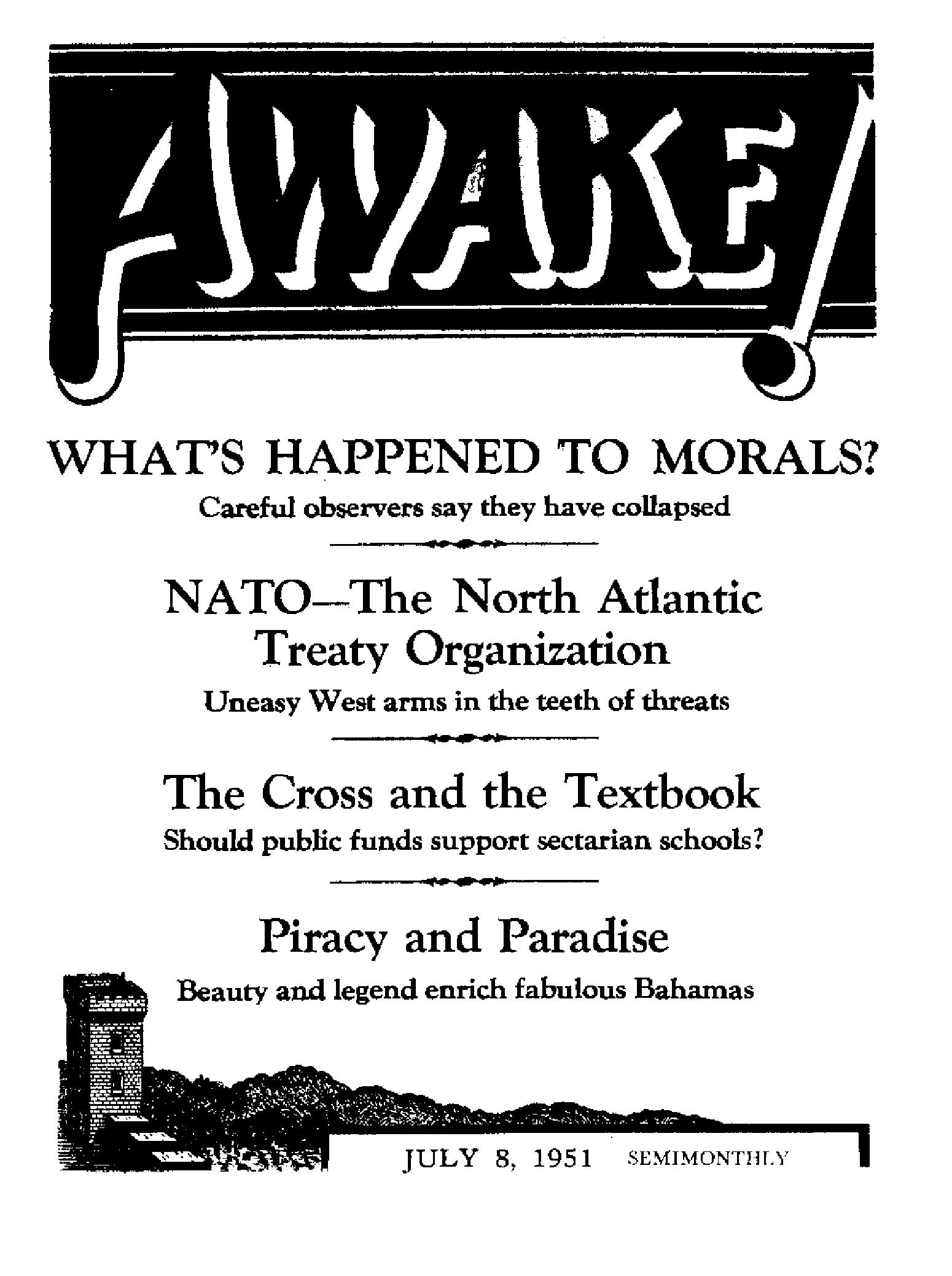
WHATS HAPPENED TO MORALS?
Careful observers say they have collapsed ------——.—,—
NATO—-The North Atlantic Treaty Organization
Uneasy West arms in the teeth of threats "■ - ----------------
The Cross and the Textbook
Should public funds support sectarian schools?
Piracy and Paradise
THE MISSION OF THIS JOURNAL
News poorces that Ore able to keep you awake io the vital luuee of our timed ^nu*t be unfettered by censorship and selfish Intersefr. “Awake J** has no fetters. It recognizes facta, faces facts, is free to publish facts. It is not bound by political ambitions or obligations; it is unhampered by advertisers whose toes must not be trodden on; it is unprejudiced by traditional creeds. This journal keeps itself free that it may speak freely to you. But It does not abuse Its freedom. It maintains Integrify to truth.
“Awake uses the regular news channels, but is not dependent on them. Its own correspondents are on all continents, in Mores of nations. From the four corners of the earth their uncensored, on-the-scenes reports come to you through these columns. This journal1 s viewpoint is not narrow, but is international. It is read in many nations, in many languages, by persons of all ages. Through its pages many fields of knowledge pass in review—government, commerce, religion, history, geography, science, social conditions, natural wonders—why, its coverage is as broad as die earth and as high as the heavens.
“Awake!” pledges itself to righteous principles, to exposing hidden foes and subtle dangers, to championing freedom for all, to comforting mourners and strengthening those disheartened by the failures of a delinquent world, reflecting sure hope for the establishment of a righteous New World.
Get acquainted with “Awake!” Keep awake by reading “Awake!”
PVBLI8LL0D SBMIMOSTHLY ET Watchtower bible and tract society, inc.
117 Adama Street Brooklyn 1, N. Y., D. B. A.
N. H. Knohh, Pr&sitfertf Grant Suited, Secretary
PfintinQ thEa latua: 070,000 Ptw« qenta * copy
Languapit Ib which til* ntHHin* ti pibtlihii: Semimmlhly—Afriiaani, Engllah, Finnish, Gunnaa, Nurwegj»n, Spanish. Monthly—Danish, French, Greek, FortigiMe, Swttflih, Ukrainian.
. Offices Yearly subscription Hate
America. U.S., 117 Adama St., Brooklyn 1, N.I. 11 Aaitralla. 11 Beresford Rd., atratWd, N.S.W.
Canada. 40 Irwin Art., Tocontd 5, Ontario fl Eflflind, 34 Craven Tterr&ce, London. W. 2 Ya Soith Africa, 023 Boaum Hoose, Cape Town Ta
Entered is Becand-daaa matter K Brooklyn, N. T,
■emlttiittM should be refit to ofliee In your Country In compliance with nculationa to nirtatee safe delivery of money. Hemittances are accepted at Bwoklyn from cotritrles wbeje no office Is located, by laternatUnal money order only. Subscription rites in different countries are here elated in lool currency. Motia of txJlraUM (with Hnwal blank) la scat at least two issues before subscription expires Chupa of tMtast when sent u o» office may be erpected effective within ret month. Send yohr old m Well aa new address^
Art <tf Man* 3, 1879 Printed Id U . fl. A
C O N T E N TS
Franco Spain at Sunset
What's Happened to Morals?
The Collapse Recognized
Morals and Marriage
Religion’s Morals
When It Began
Ocean Dwellers
Piracy and Paradise
“Kinsey Sex Volunteers Found More Unconventional”
NATO—The North Atlantic Treaty
Organization
Eisenhower's Job
The Cross and the Textbook
“Let America Take Warning”
“Your Word Is Truth"
A Son Writes His Clergyman Father 25
Evolutionists Fail to Tame the Shrew 27
Gambling and the Woman
Watching the World
FRANCO SPAIN AT SUNSET
THE shadows are lengthening on the 1 Iberian peninsula. The cruel fascist dictatorship of Francisco Franco, born during the bloody explosion of the Spanish Civil War, seems to many to be near the close of its “day”. News from Spain has been increasingly dark and mysterious, with rumblings of discontent and govern1 ment alarm for some time. Now, this midApril, Americans were suddenly surprised with the news that New York Times correspondent Sam Pope Brewer had been denied renewal of his press card and would be expelled from the country.
It is the setting for this event rather than the occurrence itself that is most significant. It comes at a time when strikes, threats and general unrest, rip Spain from end to end. March 13 found Barcelona in the throes of a full-scale strike against prohibitive living costs.
In ousting Times correspondent Brewer, official Spanish sources gave as their reason, “lack of truthfulness observed by you and your newspaper?' But Time magazine of April 30,1951, noted: "The strange part of the whole affair was that Newsman Brewer . . . has recently found fewer flaws and weaknesses to report. . . . With full diplomatic relations re-established, Spain apparently thought it safe to be tough with U. S. correspondents.” The Nation of April 28 reported: "The Swiss Basler Nachrichten, which has previously minimized the possibility of any serious crisis in Spain, went much farther than the New York Times in presenting the Barcelona strike as the first important indication that the Franco regime had lost its stability?1
Mr. Brewer's dismissal was prefaced by another highly interesting event. On April 16 his paper carried his last dispatch from Spain, in which he reported that the Catholic Church had begun to criticize Franco Spain. However, he underlined the fact that the church still voiced no protest of the regime itself. As the Christian Century of May 2 added, "With the fascist principle on which Franco's dictatorship is founded it has no quarrel?1 Rather the church's grievance was said to be with Spain's "economic mess’1; but she elected to seize Franco's present time of tribulation to point out this long-standing and very obvious evil. That this life-long friend should now side with his enemies would be an understandably bitter pill for Franco to swallow. That the democratic West, whose pocketbook he woos, should learn of it could only provoke el caudillo the more. The next day, April 17, correspondent Brewer’s pass was given the official ax.1
But the growing clamor was too loud for any government crackdowns to silence. A few days later, April 23, approximately
250,000 workers in Spain’s northern industrial belt systematically laid down their tools. Though of but forty-eight hours’ duration, it opened the door for a new flood of protest from the citizenry. In the stress of things, some other foreign sources of communication may have offended Franco’s delicate susceptibilities, for on May 1 he attacked “nearly all the world’s broadcasting systems and especially the British Broadcasting Corporation”. He said B.B.C, was controlled “by a modem demoniacal spirit, by Free-Masonry and by materialistic enemies of the true church”. While the little Hitler was spouting at the world in general, his people were thinking what they could not say about him. The Nation of May 5 carried excerpts from a series of letters written out of Spain by private individuals from March 3 to April 24.
One letter recounted an occasion when Madrid students greeted the new U. S. ambassador with whistles and catcalls. Others have suggested it would not be strange if Spanish liberty lovers should view the American loan as merely a prop for a hated tyrant. General dissatisfaction runs through the letters. Another says that even some of the corrupt officials who have profited from the regime “are now dissatisfied because there is little left to steal”. The younger men are unimpressed by the fear that to overthrow Franco would require a bloody struggle. A writer voiced their feeling in these words: “It is better to die fighting than to die of tuberculosis.” Inscriptions in Barcelona’s public places proclaim such slogans as: “There is no coal, but something is burning.”
Americans who argued for the Franco loan had gone to elaborate lengths to depict Spain as an indispensable fortress in the defense of Western Europe. But one of these letters quoted a railroad engineer who said that of the nation’s 6,000 miles of railroad only 600 are fit for normal use! “If an American army is sent here to fight against the Russians,” he said, “it will have to be moved to the front on the backs of donkeys.” Said another: “The Franco people view a world war as their only chance of salvation. It is idiotic of them, for who would fight against the Russians to defend Franco?”
Thus do we learn how the pulse beats in Spain. But almost unnoticed during all the other furor was the announcement by the American Legion that on April 11 it had pinned its medal of merit on Franco’s barrel chest. Some, including legionnaires, took time to offer protest, asking how other holders of the award might feel to share the distinction with Franco. Interestingly enough, this same American Legion similarly honored Mussolini in 1935, the Italian ducts’s “big year” in Ethiopia.
But with the appearance of criticism by another old friend of fascism, the Catholic Hierarchy, it may not be amiss to remind the Legion it is out of date in befriending Franco. Incidentally, Rome also was a onetime friend of Mussolini and of Hitler, as its concordats with their governments of 1929 and 1933, respectively, show. However, her affection for them suffered gradual cooling as their war fortunes slowly sank from 1939 to 1945. Finally, she renounced them completely. Could the church be laying the groundwork for a similar exodus from Franco’s sinking ship of state?
Certainly all the signs of evening are closing in on Franco’s heyday. Amid strikes, strife and tension the decadent dictator may derive some limited relief from the shower of American medals, loans and ambassadors, but it is doubtful that even these will help long. The bells of destiny toll eventually for all tyrants, and Franco’s final serenade is long overdue. The sun must set finally on his tyranny as it win on all totalitarianism and godlessness at Armageddon.
^What’s Happened to Morals
Men of affairs, political leaders, religious heads and those whose work deals with sorting and classifying the world's news cry aloud for our ears and a moment of our time to tell us of today's moral breakdown. The Bible predicted the very conditions that are today be* Ing called to our attention, and it says they portend greater events, even more serious than those in the past. Hence "Awake!” here begins a series of articles that will discuss the existence and the cause of and the remedy for this moral breakdown in politics, in religion, and in general public life-
Careful observers say they have collapsed.
^jVFOTHING has happened to morals! li Only pessimists and alarmists say there's a moral breakdown today. Morals are no worse now than at any other time.” That is what many individuals would tell you, for they sincerely believe it to be the truth. Yet other well-informed persons who are really in position to evaluate present conditions cite today’s blindness and callousness over corrupt government, business and sex practices as proof that society’s morals have collapsed.
Something has obviously gone wrong with the world and with the people in it. Said Gerald Heard, in his book The Third Morality (page 13), “No one can look at civilization today without the liveliest concern. That is a truism—a truism so painfully obvious that we have ceased to be able to respond to it.”
In The Rediscovery of Morals Henry C. Link, Ph,D(f adds to this (page 8) by quoting Howard Vincent O'Brien’s statement, “Wherever you look, there’s something missing. I think it is morals. We strive to get as much as possible for doing as little as possible; and we strive to gouge out of the buyer the most for the least. Simple
honesty is rare enough for amazed comment. The thief has become re
spectable. The shadow of corruption
hangs over the land. And poor witless
clowns think they can do something about it by making agreements and passing laws. But the soul of man is sick. It will take more than this to cure him.”
U. S. senator Kefauver, certainly an authority on modem political morals, said, in the Saturday Evening Post of April 7, 1951, “As a realist I still cannot shut out completely a feeling of fright as I contemplate how close America has come to the saturation point of criminal and political corruption which may pull us down entirely. . . . Has criminal and political corruption, which we now know is rampant in the United States, reached the point where this country, too, must follow the downward path after others? I say that we are dangerously close to that ruination point.”
Ut S. News and World Report said editorially, on November 3, 1950, “Political morals seem to have taken a turn for the worse. Bad as they have been in the past, this era appears to have become tainted even more with the use of money to buy influence and special favor.” Then after a column and a half of examples given as proof, it said, “What we need is a regenera-
tion ar along the line a different attitude toward public service and toward politics itself.”
The General Attitude
On April 16,1951, Life magazine pointed out the lack of righteous indignation over these conditions when it said, "Commentators and preachers who take off on the sheer sinfulness qf the practices and conditions recently exposed by Senate investigators are the exception, not the rule around the country today. . . . But what of the whole concept of individual moral responsibility? It is stiU around, but you have to look pretty hard to find it. . . , The thought that the level of general and individual morality may have something to do with it all has crossed the minds of some editorialists, commentators and preachers. But they are in the minority, and most of them creep up on the subject with all the enthusiasm of a rabbit snapping at a tiger/’
Further deterioration of morals is shown by the apathy with which corruption is viewed byi the public, as well aa by the leaders. Senator Fulbright, urging a moral drive and citing the callousness to scandals, said, on March 27 (Time, April 9, 1951), "What seems to be new about these scandals is the moral blindness or callousness which allows those in responsible positions to accept the practices which the facts reveal. It is bad enough for Us to have corruption in our midst, but it is worse if it is to be condoned."
Dorothy Thompson said (Los Angeles News, March 29, 1941 J, "What is happening to us is essentially a moral collapse. The gap between what we pretend to believe and what we do in practice has been constantly widening/’
The Collapse Recognized
The New York Times has reported statements of many leaders who decried today’s moral breakdown. On June 6,1949, it quoted the "Rev.” Timothy J. Flynn of the staff of St. Patrick's Cathedral in New York as saying, “The world is sinking into an abyss of paganism. . . . We live . . . in an atmosphere of heathenism, where the truths of moral living are shrugged off as inconsequential and sanctity is scoffed at.” On August 21, 1949, it reported that Senator Margaret Chase Smith of Maine said, "We hate been stressing physical force to the exclusion of moral force/’ On March 18, 1951, it quoted the statement of a New York rabbi, David H. Panitz, who said, ttThe real crisis in American life is the cleavage between our professed ideals and the pattern of life practiced. We tell our children that honesty and integrity are the basis of a good life and yet we give them daily illustrations of trusted civic leaders who do not measure up to these standards.” (Dates of publication are given. Each statement was made a day earlier.)
Additionally, the March 31, 1951, New York Times quoted Dr. Delbert Obertauf-fer, a professor at Ohio State University, who said concerning the stresses of modem living on children, "They have lived in times characterized in almost every respect by moral retrogression^ Among our 15-year-olds we can count on one out of every twenty being committed for psychiatric care before they go much further in life,”
In view of the moral decay that has thus far been shown, note the following condemnation of twentieth-century morals, which we quote from The Rediscovery of Morals, by Henry C. Link (page 18), "The very destruction of the human race seems foreshadowed by recent events. Young couples are asking whether they do right to bring children into a world of such hatreds and strife. The great majority who refuse to face the facts are living in a fool’s paradise.” Page 21, "The significance of the atomic bomb is not go much its promise of physical death to come as its proof of the moralt death which has already overtaken mankind. The atomic bomb dramatizes what has been going on for generations, the pursuit of physical science and the neglect of moral science,” On page 51, after showing the increased crime among youth, the status of the Negro, the prejudice against Jews “because both Jews and Gentiles have so nearly abandoned the moral laws”, it says that this disunity threatens, “Because, as a people, we have increasingly discarded the great moral values which constitute our heritage from the past.”
Dr. Robert J. McCracken, pastor of New York’s Riverside church, asked the pertinent question, December 4, 1949 (New York Times, December 5), “Americans often speak of Russia as atheistic. It is openly and frankly atheistic . , . [but] is the moral tone of this nation—-its politics, its business life, its literature^ its theater, its movies, its radio networks, its television stations—Christian?”
Morals and Marriage
Have morals in marriage broken down^ Princess Elizabeth said, in London, on October 18, 1949 (New York Times, Octo aer 19), “We can hardly help admitting ithat we live in an age of growing selfindulgence, of hardening materialism and of falling moral standards. I would go sc far as to say that some of the very princi-l pies on which the family and therefore the nealth of the nation is founded are in danger,”
T. C. Skeffington-Lodge, a Laborite, de dared in the British House of Commoni (New York Times, May 11, 1946) tha 40 per cent of girls marrying under the age of 20 in England are pregnant on their] wedding day and one-quarter of the first pabies born to married couples are conceived outside of marriage. When challenged by shocked members, he said the figures were accurate and had been supplied by the Marriage Advice Council. He said the “disintegration of family life has been developing for many years”, fostered by a breakdown in religious faith and practice and the “low tone and content of the press”.
The Annals of the American Academy of Political and Social Science for Novem-r ber, 1950, says (page 182) concerning England, “The figures are startling. From about 5,000 per annum in 1937, the divorce rate actually multiplied by ten in ten years!” Concerning Sweden it says, on page 191, “The divorce rate in Sweden has steadily increased. It rose by more than 100 per cent in the past decade and by 1,000 per cent in the past half century.”. It quoted an official marriage mediator as reporting, “50 per cent of the husbands and 25 per cent of the wives [in Stockholm] were accused of practicing adultery.” Concerning the United States il shows on pages 15 and 16 that the aver age number of divorces per hundred mari riages in the 1881-90 decade had increaseo 466 per cent by the 1940-49 decade! Similar increases are In other countries.
Religion's Morals
Even religious morals have collapsed. The clergy all too often preach what suits their hearers. Generally they did not get around to preaching against crime and corruption until Kefauver so publicized it that the people demanded it. Life magazine said, on April 16, “Of course, only an ante-, diluvian relic would expect a general denunciation of sin and sinners.” Religion’s failure to really teach the Bible has led to the moral downfall of those who now have no real knowledge of this true moral guide.
Many of the clergy admit this. On November 11, 1945, Dr. John H. McComb
pointed to the need of "a return to earnest Biblical preaching by ministers of the Gospel”, and said, “The Protestant Church is literally famished for the Word of God. It has been fed on philosophy and politicaleconomy, and sociology and psychology and mere ethics until the souls of its members are starved for they know not what/* —New York Times, November 12,1945,
Royce Brier said, in the column “This World Today**, in the March 24, 1949, San Francisco Chronicle, “As for the kids, a little Bible-reading in the home wouldn’t hurt anybody, provided the adults can pry themselves away from the car, the movies, and the whisky-and-soda discourse with their chums about the helluva fix this World is in.”
When It Began
Awake! has frequently pointed to the beginning of this moral breakdown that occurred at the very time that the Bible predicted it would, but here we are showing that others recognize the same facts, so we go to them to see what they say.
President Charles Seymour of Yale said, May 16,1948 (New York Times, May 17), that between the two world wars “our educational institutions seem to have abdicated entirely their obligations of moral leadership’*. Dr. John Haynes Holmes, a noted New York clergyman, was quoted by the Passaic, New Jersey, fferald News of April 5, 1951, as saying* “Americans are trying to live without God and it can’t be done. They have been trying it for about 30 years.” An editorial in the New York Sunday News, March 13, 1949, quoted a former president of Fordham University as saying; “Your generation has a different point of view. You were born into chaos”; and the News commented “The last completely ‘normal’ year in history was 1913, the year before World War I began.” That is to say that anybody born after 1907 or so has no personal recollection of anything but abnormal, upset, excited, jittery times—though a lot of younger people have doubtless heard plenty from their elders about the good old days before the wars.
John McPartland, in the book Sex in Our Changing World, likewise marks the moral breakdown with the beginning of World War I in 1914. He says (pages 12, 28, 29, 79), ‘The gaslights were still a part of the city evenings back in 1914, the farms were kerosene lit loneliness. . . . These children were not going to gradually accept their parents’ beliefs and manners, these children were to grow up in a new kind of world. . . . And so it began. The rigidity of the announced sexual code of* the country—the so-called Victorian code —was beginning to give a little. ... It was a long time ago, and far away, that America of 1914. We went to war in 1917; we sort of left home and never came back again. . . . Until our time most people found contentment only at home.’*
Further evidence that 1914 marked the beginning of the moral breakdown was ehown in an article by Waverley Root in the lune, 1947, American Mercury, where he Eaid, “Dr. L. M. Terman, in a book entitled Psychological Factors in Marital Happiness’, reports that before the first world jwar 12 per cent of American women were not virgins at marriage; that during and After the war, the percentage increased to 26; in the 1922-31 period 49 per cent; and ih 1932-37 to 68 per cent.”
This is also supported by the Annals of he American Academy of Political and Social Science, referred to above. On page 18 it compares the average divorce rate in twelve nations in 1910-12 with 945-47, and shows the divorce rate in all jut one country has increased from one to (Continued on page 20)
cean
Human Eyes Feast on a Watery Realm of Wonder
Geographies ten us that the oceans cover 71 per cent of this globe’s surface, Though we speak of “oceans” or the “seven seas”, they are, of course, just one body of water, divided for convenience into North and South Atlantic, North and South Pacific, Indian, Arctic and Antarctic. Greater than all land area in extent, the waters of the sea are even vaster in bulk. Computations by the Encyclopedia Ameri-cuna, which estimate the average land elevation above sea level at 2,300 feet, dwarf this “upper crust” cubic content by contrast with the earth’s watery covering. Averaging two and one-third miles in depth, the great body of salt water exceeds the total land volume by fourteen times.
On the bottom of this great expanse, mountains rear up, canyons crease, plains spread forth. The deepest recorded abyss, near the island of Mindanao in the Philippines, plunges more than six and one-half miles below the waves, or 35,400 feet. Towering Mount Everest, highest mountain on earth, 29,239 feet since the Assam quake, if submerged in this Emden Deep would not reach within a mile Of the surface. The Milwaukee Deep near Puerto Rico and the Aldrich Deep in the South Pacific both exceed 30,000 feet. Several months ago, two scientists reported the Cape Johnson Deep of the Mindanao trench, and said its 34,440 feet was the greatest known depth, the Emden Deep figure being inaccurate because of prim
itive measuring apparatus, they claimed.
The creatures in this great realm of water are said to possess aquatic forms more adapted to environ mental changes than any other creatures. Very few birds, for example, range over the “seven seas”, and, in addition, none can, like certain species of shark and whale, tolerate pressures ranging from one to a hundred atmospheres. (An atmosphere is the air pressure at sea level, about 14.7 pounds to the square inch.) The giant tunny or tuna ranges the temperate and tropic seas, while even the commonest food fish, the herring/* ini grates thousands of miles.
Life in the sea is often divided according to zones of habitat, the shore waters along the “continental shelf” being referred to as the “littoral”, the upper several hundred fathoms of the open ocean as the “pelagic”, and the depths as the “abyssal” zone. Generally, aquatic animal life is more abundant in the littoral zone because of the prevalence there of plant life. The “pelagic” zone, oilers mostly floating or weakly swimming plant and animal life, while in the blackness of the abyssal zone, not a cell of plant life grows.
Abyssal Creatures of the Crushing Depths
Scientist William Beebe spent many years observing marine fauna in their natural environment under the sea. His crowning success was achieved with an undersea observation globe called a "bathysphere”. Fitted with quartz windowpanes three inches thick, it was built to endure pressures of a ton to the square inch. Its interior accommodated two observers, an array of scientific instruments, telephone, giant searchlight, two oxygen tanks and air-purifying equipment. After making several lesser dives, in the latter part of 1934, Beebe was lowered over the ship’s side after the jib had swung the bathysphere free of deck, and began his descent into the deep waters off the shores of Bermuda. A few hours later he had made the reconi dive of 3,028 feet! Once an artist accompanied him to the ocean floor. Actually seated on the sands five fathoms down, he painted the brilliant hues of the salmon coral and the purple and blue sea fans (gorgonias).
While yet in this realm of comparatively shallow diving (fifteen to sixty feet), Beebe saw some wonder-invoking sights: giant jellyfish which harbored hundreds of small fish beneath their "umbrellas”, and darting wrasse fish busy cleaning the face and jaws of huge blue parrot fish, an aquatic parallel to the plover’s picking the crocodile's teeth—among the good turns animals render each other. He watched giant crabs methodically planting seaweed on their backs through clever manipulations of their claws. Apparent object: camouflage! Spying a tremendous sponge, he had it hoisted to the surface. After the excess water was drained off, it weighed 150 pounds. He paused to wonder at the process, entirely unknown to man, by which the sponge, a sea animal, extracts the infinitesimal amounts of silicon from sea water to build such extensive, ramified structures. Also adding their dash of color and danger to the brilliant enactment were tentacled squids, giant ray fish, flashing sharks and cruising yellowtails, all hunting rapaciously. Fish fins he saw employed for purposes other than swimming: to "walk” on the bottom, to gain leverage in prying out bits of coral, to fan away seaweed from desired food. At a thousand feet the water turned blackish blue, tapering into nameless gray. Below 2,000 feet every sign of color blacked out, but only in the water. Marvels of colorful creation met his eyes all the way down.
Imagine yourself 1,810 feet below the waves looking over the shoulder of Beebe at one of the most amazing fish in this wonder world. It looks like a ship at night, porthole lights blazing! Viewed along the twinkling broadside, a yellow oval bulb on its cheek, below the eye and twice as large, flashes on and off. Beebe recognizes this fish from a specimen, once caught in a deep dredge, as the "dragon of the shining green bow”, Lamprotoxus ftageUibarba. The cheek light actually revolves in a socket, turning inward to black out its beam. This sixteen-inch gem is literally covered with parti-colored lights. Arranged in four lines along its sides, pale lavender lights set in golden rims costume this brilliant creature in carnival colors. As it turns another constellation appears, the “shining green bow”. This greenish line of illumination etches the outline of an archery bow on its anterior side. Momentarily a more intense shaft flows around the bow.
Depths Defy Evolution Theory
Science professes amazement at the intricate design of many deep-sea creatures. Following the fallacy of evolution, they had predicted very primitive creatures in stages of undeveloped evolution would be discovered in the depths. The llght-deco-rated dragon, just described, is only one
proof of their error. Besides its astonishing lighting system, the “dragon’* evidences the traits of a swift hunter of fish: long Overlapping fangs which hinge inward for permitting the prey to be swallowed, lightning movements and a tapered lariat called a chin barbel, seven times its own length, and also capable of lighting up. Is this barbel used to lure or stun its victims? How can it snap its jaws with the steeltrap precision needed to capture its finny victims unhindered by such an appendage? How can it endure the bathymetric range or change of pressure found in its known vertical habitat of 450 feet to two miles down? Does it use its heatless light to see in the dark, to attract or to identify its own species? Science does not know.
Continuing the descent with Beebe, at 1,900 feet a sad-eyed fish peers curiously at the window of the bathysphere. Suddenly it turns an astonishing broadside. Quickly we count five lines of purple and yellow lights flashing from its dark length. Never before seen, Beebe has given this creature the descriptive name, “constellation fish/’ because, he states, “it resembles a pulsating aurora borealis" As the depth gauge just turns 2,000 feet, a six-foot monster is caught in the beam of the searchlight. As it passes, majestically unhurried, our eyes are astounded to see a tentacle reaching out ahead of its jaws. A matching tentacle trails behind its tail, and both tentacles terminate with red and blue “traffic lights”.
With the beam off, lights of sea creatures dotted and flared almost continuously. At one moment forty-six lights, ten of large size, appeared. Along came two angler fish, brandishing their triple, lighttipped masts, nearly a half-mile below the surface. Following, as if by stage sequence, two corpselike forms of a curious buff hue and equipped with enormous vertical flns showed for a moment; then gave way to a shadowy form of huge dimensions, probably a whale.
Many were the copepods or crustaceans peopling this underwater realm. In point of numbers these prawns and shrimp compose the “insects of the sea”. Scarlet, even blue and yellow vary the colors of these brilliant creatures. The Sapphirina glows like an opal, the Cystisomei like an iridescent crystal. The performance of the most startling member of this family was for long shrouded in mystery. During the descent, Beebe caught himself frequently jumping back from what resembled a red explosion outside the quartz window. At last, by concentrating on this phenomena he discovered that the “explosion” was actually an emission or cloud of sepia fluid discharged by a three-inch crustacean. Thus its Creator had designed for this little creature an effective smoke screen long before human armies conceived the idea.
Elsewhere Beebe described other undersea marvels, many of which were taken in his deep-sea dredges or nets: the Daemonfish supporting a veritable “Christmas tree” from its snout, complete with “luminous balls at the extremity of each branch”; the Cyclotone, each of whose many lights, arranged in double lines, was provided with a “deeply convex, manyfaceted lens”; the Hyacine Leaf-jelly which disported its garment of “purple, blue and cream” in an environment of utter darkness. So astounded were some at Beebe’s discovery of the angler fish furnished with a rod, line, illuminated lure and three hooks, that Punch quipped: “Dr. Beebe has discovered a fish with an entire angler’s outfit. The only thing it lacks is a pair of hands to show how large were the fish which got away/’
Strange indeed and awe-inspiring are the wonders of the deep. To reverent men they reflect the unfathomable genius of the Creator.—Contributed.
By "Awake!" corrtipondeHf in the Bahamas
a vision
coral strands bordered by waving palms, perpetually
came the haunt of pirates and privateers; pirates who sacked all vessels indiscriminately , privateers who robbed and sank only
blue skies with fleecy white clouds, crystalclear waters of jewel colorings, jade, emerald and sapphire. Behind all this natural beauty, giving the impression of isles of paradise, lies a history—not a^ chronicle of peace and security, but one of violence and vengeance, of pillage and piracy. „
The Bahamas appeared “on the map” with the landfall of Columbus. On October 12,1492, Columbus landed on San Salvador, now Watlings Island, being received in friendly fashion by the hospitable brown-skinned people- These he called Lucayans and Indians, thinking he had traveled so far westward round the world that he had reached the eastern lands, loosely designated the Indies.
The advent of the white man brought anything but blessings to these simple islanders. Their good will was grossly abused. At the suggestion of Columbus some 50,000 Lucayans were forcibly removed from their peaceful homes and taken to the salt mines and mills of Hispaniola. How lightly do the history books pass over the agony of a whole people! There in slavery they perished in misery and suffering, in bewilderment and homesickness. Their people live no more in the Bahamas; they live only in the records of the archaeologists.
So the islands remained uninhabited for a period. Then came the Spaniards and also the English buccaneers. The Bahamas be-rivals of their own country, even if not enemies. Of this kidney were such men as Drake, Raleigh and Morgan. Esquemeling wrote a history, after he reformed and lived in England, of the cruel fate of those who fouled these cutthroats. Tales of marooning without food and water—a man tied naked to a mangrove tree, where the insects make short work of him. Atrocities were chained on both sides, against Spanish and English alike. It soon became no crime to despoil a Spaniard, but rather a crusade. The sheltered bays of the islands provided excellent hide-outs for these international sea gangsters, Teach (Biackbeard), Vane, Homigold, Fife, Burgess, Martell and Samuel Speed, this last, who after he reformed bought favor for himself with his ill-gotten gains and became a religious preacher in a south-coast town in England.
The English were perhaps more vocal in their protests against these barbarous acts, for the British Parliament was moved to action. In 1647 a grant was given to the Eleutherian Adventurers, a band of colonists who set out from England to make their homes in the Bahamas. They landed on the island they named Eleuthera, but later left it and moved to New Providence. The islands were still controlled by the buccaneers, and here the pirate crews gathered to repair ship and to divide their spoils. Stories of hidden treasure circulate on almost every island. In the shipping
route between Europe and Panama the islets provided good places to lie in wait for prey, the rich merchant ships laden with precious cargo.
Coming of “Lain and Order”
In 1667 Captain Sayle was cast ashore on the island he named Sayle*s island, but on being saved a second time from drowning by being thrown onto this same island, he renamed it New Providence. On his return he reported to his employers, the Lords Proprietors of Carolina, the fertile conditions he found there. So they applied for and secured a grant from Charles II in 1670. They sent out one John Wentworth to be the governor, and he found the town pirate-infested, lawless, disease-ridden, a rendezvous for licentious relaxations. His firm rule was objected to by both citizens and buccaneers. Rising in revolt against him, they seized him, put him in chains and shipped him to Jamaica. His successor made the colony prosperous by compromising with the pirates, but he fared very little better in the end, for the Spaniards invaded from Cuba, devastated the island and took the governor away with them— history has it that they roasted him over a spit. The remaining inhabitants deserted New Providence. Then, when the Cubans left, the buccaneers returned.
Further history of the governors of the Bahamas adds to the lurid light shed on them. Cadwallader Jones lev-■■r ied taxes for his own private purse. Accused of this by the incensed citizens, he brought them to heel by having a pirate ship train its guns on the Council Chamber while they were in session there.
This did not avail him
long, however, as they rose up again later and imprisoned him. He was released by Avery the pirate and escaped being charged with treason.
Then arrived Governor Trott, and the town’s name was changed from Charles Town to Nassau, in honor of the father of King William III, the prince of Nassau. It was now argued that since Avery had 100 men and 46 guns, he could take by force what he wanted, whereas he would pay for it if treated as a friend. So citizens and pirates worked hand in hand, and Nassau was run like a pirate ship. Trott built Fort Nassau, equipping it with 28 guns and some demiculverins, and it was due to this preparation that several attacks by the French were repulsed. The seventy men then in the island were on duty night and day during that period, so few of them that half were on duty at a time, and watch came round far too often.
After pressure had been brought to bear on the Lords Proprietors, Elias Hackett was sent by them to be governor. He was an honest man, but his stiff rule caused a rebellion. He was seized, put in chains and shipped to England. The next governor, Lightwood, was appointed by the people without reference to the Lords Proprietors Of Carolina. Nicholas Webb, governor, was approved by King William of England. Such small trade as was carried on, in salt from Exuma, and brasi-letto wood, was with Carolina. Wrecks and pirates were the hope of New Providence.
Then the Spaniards came and cleared out Nassau, razing it to the ground. They carried off the slaves, and the whites fled to Carolina. This was the final end to that regime; no family records survived, and perhaps most citizens were content that it was so. The next representative the Lords Proprietors sent found himself on a desert island, and he did not stay long.
The other islands were being used by the wreckers, and these needed a metropolis to trade in. So the merchants of Bris-tol and London who benefited most from this nefarious activity petitioned the Crown. Scattered ships had come back one by one, houses went up little by little, blackened trees revived and put forth green shoots.
Some Progress Is Made
Perhaps on the principle of “set a thief to catch a thief” in 1718 Woodes Rogers, ex-privateer of the Spanish Main, was sent by George I of England to act as governor. There was a trend now in the Caribbean toward respectability. The infamous Henry Morgan, reformed, gave generous contributions to the treasury, built some chapels, and was now given a title and made governor of Jamaica. So Rogers took over the civil government of the Bahamas in the name of the king of England. At his arrival a guard of honor greeted him, pirates and freebooters, perhaps some shipmates of his earlier ventures. They kept up a continual firing of muskets and pistols, and it may be that one of his comrades hailed him, or drooped an eyelid in attempted familiarity.
But Rogers had come to do business on a new stand. He provided the wording for the Bahamas coat of arms “Expulsis piratis, restitutat commerca”. He initiated summary court-martial, put citizens on oath as civic police, and patrolled the town after curfew with a local militia under his own men as officers. He set about a sewage and sanitation campaign, and granted a royal pardon to all who would agree to forsake pirate ways. Many took advantage of this offer, but there were also many recalcitrants. That first December of his rule he hanged nine pirates in what are now the gardens of the British Colonial Hotel. These were held under the gallows for forty-five minutes so that they might be absolved spiritually! However, one was saved at the last minute by representations made by his reformed friends now sworn in as officers of the Crown. Another kicked off his boots so that he might keep a vow not to die with his boots on!
There were new occupations in the Bahamas now, husbandry, pineapple- and coconut-raising. Nevertheless, memories of nights at sea caused restlessness, and with it the increase of wrecking. At selected places all over the colony, from the Biminis to Abaco, Harbour Island and Eleuthera, false channel lights were used and false counsel when piloting. Receivers of ‘ship’s merchandise’ on shore soon had a profitable business under way. They thrived, and these activities absorbed more and more of the efforts of the natives. Finally, His Majesty’s government stepped in. Lighthouses were built, local jails were filled.
Governor Fitzwilliam alienated the people by his irrational and despotic assumptions and regulations. He was deposed. His attitude was probably the reason for the sympathy shown later toward the American Revolution. For when the new United States navy was taken on a first cruise to Nassau under Admiral Hopkins, the town capitulated. Two hundred guns were taken away from Nassau that day, shell in large quantities, as well as fifteen barrels of gunpowder. These supplies no doubt helped to destroy the defenses of Lord Howe, Gage, Burgess and others who were at bay in the rebellious colonies. But at the same time, as well as the guns, smallpox was carried away with the victors, and not till over two hundred shipmates had fallen with it was the scourge satisfied. The admiral was severely censured by Congress, then at Philadelphia, not for attacking Nassau, but for failing to capture a British ship on that occasion.
From 1782 on, fresh life was infused into the colony by the influx of loyalists. Dur* ing the American Revolution these left the mainland colonies and settled in the Bahamas on grants of land from the Crown. They were masters of slaves, and very soon owned large cotton plantations. Some made a fortune and returned to England or to Scotland. Slavery was the cornerstone of the economic structure. About 300,000 slaves were carried in vessels of Bristol merchants to the West Indies, mostly from West African ports. It was a very lucrative trade, and brought in £13,-000,000 in profits in ten years. The magnificent port of Liverpool this trade helped to make must be, says one writer, cemented in human blood.
Then came the movement for the abolition of slavery in England, and much public emotion was aroused on the subject of this traffic in human lives. Finally in 1834 the Emancipation Bill was passed. Four years passed before the colony took legal action, and it was only in 1837, after a period of outright defiance, that Bahamian slave owners acceded to it. All together, £128,296 was paid out of the British treasury to slave owners, about £12 per slave, as compensation. This freeing of the slaves meant the dissolution of the great cotton estates, and the falling into disrepair of the largef homes resulted. On many islands remains of these could be seen for a time, until the lush subtropic vegetation finally hid the ruins. Many mulatto descendants were left by these plantation owners, and today these eke out a peasant existence with the poor rewards of those that are easily content.
The last hundred years have not been without event in these islands either. But from the time of their discovery by Columbus the Bahamas have been through much at the hands of'selfish and debased men, and only under the benign rule of the Theocracy will they become truly a paradise wherein righteous people will enjoy without let or hindrance the beauties provided by a loving Creator.
“Kinsey Sex Volunteers Found More Unconventfonal”
<L Confirming the position taken by Awake! magazine in its issue of December 8, 1948, Science News Letter of April 14, 1951, produces the following under the above heading: “The men who contributed the stories of their sex lives to Dr. Kinsey’s investigation may not have been typical of the general population. This is indicated by a Study conducted by Drs. A. H. Maslow and James Sakoda of Brooklyn College and reported to the Eastern Psychological Association, Brooklyn, N.Y. Names of men from Brooklyn College who volunteered to furnish sex history to the Kinsey investigation were supplied by Dr. Kinsey to Drs. Maslow and Sakoda- These students had already taken personality tests in the psychology class. Comparison of the volunteers with others who had refused to give information about their sex lives showed the volunteers to be more sure of themselves. Since men who score high in self-esteem are likely to experiment more with sexual deviations and be less conventional and less Inhibited, Dr, Maslow told the meeting, it is possible that the men interviewed by Dr. Kinsey, being largely volunteers, were much more likely to be unconventional in their sex behavior than men not interviewed.”
ii/AN EVERY side, I saw heartening evi-V/ dence of a regeneration in Europe’s
spirit Its morale, its will to fight, will grow with every accretion to physical strength.” General Dwight D. Eisenhower, as supreme commander of the North Atlantic Treaty nations, was pinpointing the picture of Western Europe as he saw it to the listening ears of America’s radio audience. He had just returned from an inspection tour of the eleven countries leagued with the United States in the NATO.
He was speaking on the evening of February 2,1951. Earlier that day he had appeared before the armed services and foreign affairs committees of the House of Representatives and a Senate preparedness committee, and had voiced his confidence that a “wall of security” could be built up in Europe against Communist aggression.' By mid-February he expected to return to Europe to set up headquarters for the European Supreme Command at Versailles, France. There he would build up his corps and recruit a 60-division force from the combined Atlantic Treaty nations. Participation of Spain and Western Germany and perhaps other “friendly” countries was a matter to get around to in due process of politicing.
Birth of the North Atlantic Treaty Organization is the closest thing to the forming of a United States of Europe that has ever been. Of course, it is not strictly that
—The
North Atlantic Treaty Organization
—with America and Canada in on it.
But because it comes so close to it, the matter of national sovereignty having to be surrendered to a supranational control, the birthpangs of NATO have been more painful and prolonged than if a mere loose confederation of states in mutual defense were in the making. Indeed, the NATO nations have yet to yield their national sovereignties to a super government.
But when you have a dozen countries, each of them independent and most of them traditionally jealous and suspicious of each other, and little to remember each other by except a past full of sanguinary wars; and then it becomes necessary for them to work together to throw up a stout wall of defense against encroaching aggressors, everybody concerned has to chip in with guns and cannon fodder and, more than that, the factories, the resources, the trading markets, the rationing of raw materials and all that goes to make up economics has to be synchronized. You cannot very well organize and co-ordinate the economic setup of a dozen different countries unless there is political agreement among them and somebody at the top big enough for them all to listen to and take directions from. When you get through building up the war machine, you have just about finished building up a collective economy, and all that will not come through without collective-minded politics. This is what NATO has been leading up to, and it explains why some independent-minded nations like Great Britain have kicked at every move to hitch their national trace chains to the collective plow.
Back in November 1948 it was felt that something stronger was needed to take the place of the Marshall Plan. Europe still did not have an integrated market Europe still did not have a common currency—and all her various currencies kept falling shorter and shorter of value alongside the American dollar yardstick. More than that, Europe still had no defenses to preserve her growing new economy, and all that Uncle Sam had done was cultivate some big ripe plums for Uncle Joe to pick whenever he got ready.
Conceived in haggling and shaped in wrangling, the North Atlantic Treaty went through many months of cruel handling until there finally evolved a 1,040-word treaty of 14 articles which would bind the signatories to a 20-year pact dedicated to their mutual defense over an area of the globe extending from the Tropic of Cancer to the North Pole. By the 27th of January 1950 the seven nations of Belgium, Britain, Denmark, France, Italy, Luxembourg and Norway had qualified to receive their wedges of a $l-billion “mutual defense assistance” pie which Uncle Sam had baked and prepared. (It cost 50 million dollars just to assemble and recondition the equipment for shipment.) On that day the seven nations each signed a separate agreement with the U.S. stating the conditions on which they would receive the aid and how they would use it. Then the representatives of the eight nations assembled signed their names to a document. The document was the North Atlantic Treaty. The instant the last pen flourished it went into effect in five nations, awaiting parliamentary approval only in Norway, Belgium and Luxembourg. By March 22,1950, the membership had swelled to include Portugal, Iceland and Canada.
Article 1 voiced determination to resolve all internal obstacles to peace and security. Article 5 packed the biggest wallop: “The parties agree that an armed attack against one or more of them in Europe or North America shall be considered an attack against them all,” and from there it would be all for one. Article 8 prohibits any signatory from entangling itself in affiances with any other powers that would conflict with this treaty. Article 7 disavows any thought or intent to bypass or usurp authority of the United Nations or relieve that organization’s responsibility of maintaining international peace and security.
Its Sickly Childhood
During the first months of its life NATO showed signs of being an undernourished baby, dandled about by some mighty cantankerous old grandpas who were more concerned with what the youngster was going to cost them in terms of national sovereignty and domestic recovery than anything else. By May, 1950, it still didn’t show signs of cutting teeth. Up till then some committee or another would meet to try to agree on some proposition. As often as not they disagreed and left off with nothing concrete for their foreign ministers to pass on. But on <May 17, at Lancaster House, London, the foreign ministers decided to put a stop to that. They agreed to create a permanent board of strategy. This board was to be in continuous session and make quick decisions.
To correlate the economic and defense planning, to have some actual say-so over domestic economy as well as military strategy, this board was to have for its head" a proved and capable civilian. He was to be an American. The name of General Dwight D. Eisenhower was suggested as a feeler. All this meant surrendering some measure of national sovereignty. It might even mean rationing of some strategic raw materials such as iron, steel and coal, and channeling them off to the war factories, thereby biting into the standard of living even in touchy Great Britain. But so what? To have a defense or not to have a defense was the question. You can’t turn a pig of iron ore into a plowshare and a bazooka barrel at the same time. Make no bones about it, NATO was going to cost her parents a dear little penny. They might be poverty-stricken and war-weary and not yet off their World War II crutches, but that just made her all the more expensive.
At least the military gentry of any age or crisis are frightened by nothing so much as modesty. They proffered their bill It staggered the finance ministers. Where was all that gigantic war machinery to come from? It would have to come out of the hands and off the backs of a war-weary people.
To spark the military stampede Uncle Sam upped his defense appropriations right and left. Truman’s original $1 billion was raised to $2.2 billion, and by August 1950 he was asking for ?4 billion. At the London conference of Atlantic Treaty ministers in July and August U. S. deputy Charles M. Spofford was talking in terms of a $10-billion pace-setter which his government had set aside for NATO. The Council of Deputies was proposing that “idle productive capacity in armament plants be put to work at once without waiting for a completed defense plan for the Atlantic area”. Britain was talking of increasing its appropriations by 45 per cent, amounting to 10 per cent of its national income. France stood ready to “make the maximum effort”. Italy announced that she could place at the disposal of NATO about fifty per cent of her industrial resources and man power for the production of ammunition, arms, trucks, jeeps, airplanes, military uniforms and other goods and equipment needed for Western European defense. One cheerful spot in the picture was the assurance that the NATO nations outweighed the Cominform four to one when it came to raw materials and industrial and technical skill.
While speed was the watchword, the wheels of progress sagged on broken axles. April 17, 1950, the Consultative Council admitted outright that what was required of them was “beyond the economic resources of Britain, France, the Netherlands, Belgium, Luxembourg, and beyond the military aid now budgeted for these five countries by the United States”. By this time Uncle Sam was getting his dander up. Within another month he had made it plain that it was high time the Atlantic powers pooled their economic and military resources under one central control. So what if they couldn’t agree on France’s plan to pool Europe’s iron, steel and coal? What if Britain would not submit her sovereignty to a supranational government? What if nobody could decide what to do about Germany right now? Was everybody to sit around and fuss like a caucus of old maids planning a church social? Were they waiting for Stalin to drop in and announce that the jig was up?
Progress amid Tension
On December 2,1950, the U. S. High Commissioner to Western Germany, John J. McCloy, warned that there were more than twenty-five Russian divisions in the Soviet zone of Germany, fully equipped and stockpiled with gasoline and sufficient necessities to drive straight to the Rhine river in the first blitz. (It was not emphasized that the Soviet forces had been there all along, even before the Korean war.) Anyway, two days later the U. S. pushed through the move to have General Eisenhower appointed as military commander of the Atlantic Treaty forces.
While all this was going on, compliments of a rather nasty sort were being passed between everybody in general. Uncle Sam felt peeved because “Europe let us down in Asia”, meaning that the U. S. was suffering more casualties in Korea than Europe had troops there. To this the Europeans could not digest the enigma of America barnstorming for troops and armaments in Europe when she was hollering for the troops and armaments to be sent to Korea.
Anyway, by the time Eisenhower wound up a 5,000-mile flying jaunt and called on the heads of five states in the NATO, the excitement had somewhat turned into a feeling of testy confidence. Relieved that Uncle Sam was not trying to embroil them in a war with Red China, and as the issue of German rearmament was not going to be pushed to the point where Moscow would be “provoked” to attack, they gingerly relaxed. Eisenhower arrived in London on January 13. Three days later the Council of Deputies announced appointment of a head co-ordinator of the Defense Production Board, whose duty was to do for production what Eisenhower was to do for military defense. The co-ordinator was another American, William Rogers Herod, 52-year-old head of International General Electric Company.
Progress was being made by sheer dent of push-push. In fact, the biggest problem was Germany, and she was causing more teeth-gritting and slow bums than she was real harm. The thing about Western Germany was that she was finding herself in green pastures, in a most luxurious meadow of a bargaining position. She could bargain because both Moscow and Washington were kowtowing to her. Moscow was asking for a date, to make some romantic proposals about marrying East Germany back to West Germany. Washington had already given her to understand that if she co-operated with NATO her government would not have to submit to any Allied plans. The irony of it all was that Germany, and incidentally Japan, had been enjoying & wave of prosperity because German (and Japanese) industries had not been permitted to produce war goods; no, they were turned loose to produce consumer goods while their “conquerors” had to produce armaments to protect them from former “allies”.
Eisenhowerfs Job
General Eisenhower’s task of putting the NATO on a defense basis has been described something like this: He has started with a fine-sounding title, the nucleus of a staff, a sheaf of promises, and a defense force that does not exist. To get results he must sell both Europe and an ornery segment of apposition in America on the idea. The army he must build with his own hands out of troops that nobody wants to give him.
When he assumed command Europe boasted 15 ill-equipped divisions. He was given as a starter 2 U, S. divisions in Germany, 3 British divisions, 3 French divisions, 3 Italian divisions, 1 Belgian division, and small Dutch, Danish and Norwegian forces. The U. S. air and naval forces in England and Germany were added, along with some small French naval units. The $5.5 billion earmarked for war goods to be rushed to Europe is mostly at his disposal. Mobilization of all ground forces is necessary to furnish the starting goal of 60 divisions—50 of them European and 10 American.
Yet with all this force, at a cost so tremendous that it will drag down the living standard of the people in all nations involved, the NATO hopes only to provide a force that would merely “slow or halt” a thrust at Western Europe.
When Eisenhower voiced his conviction that he “saw heartening evidence in Europe’s spirit”, maybe he did. There is only one thing that will really lift the spirits of the people everywhere, however. That is the hope of seeing war and its makers wiped off the earth. No man, from General Eisenhower on down, presumes to be able to bring this relief. But that does not leave the people hopeless. A long time ago Someone foretold the time to come when nations would learn war no more, after He had destroyed those who ruin the opportunities of life on earth. That One is fully capable of fulfilling His promise. He ought to be. He made the earth. More than that, He made man. He has also organized a new world government and authorized it to assume authority over the earth. This One is no communist savior. You have to study his Word, the Bible, to learn about Him.—Contributed.
…