Awake!, January 8, 1951
Download: PDF — Awake!, January 8, 1951
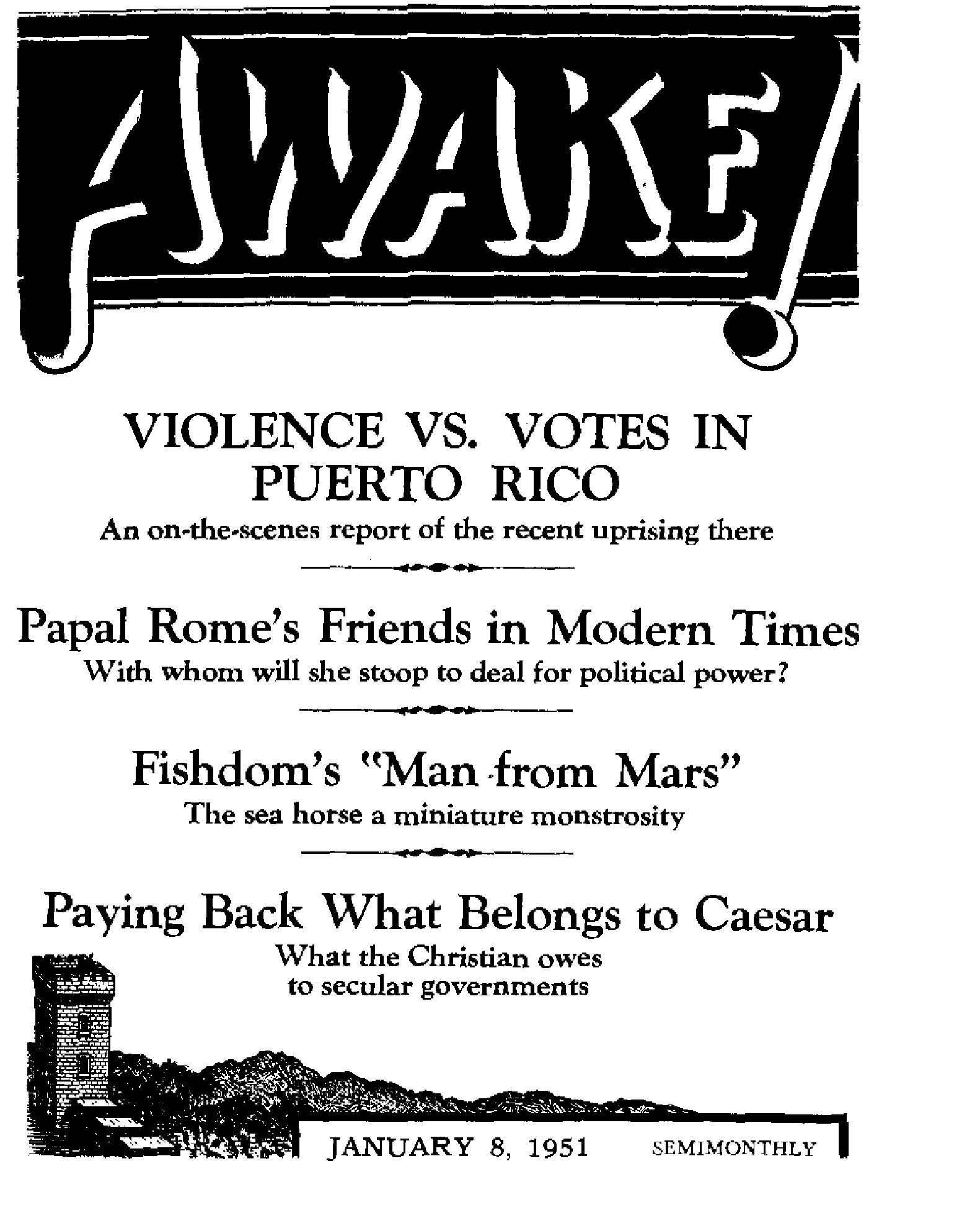
VIOLENCE VS. VOTES IN PUERTO RICO
An on*the*scenes report of the recent uprising there -----:—-
Papal Rome’s Friends in Modern Times
With whom will she stoop to deal for political power?
Fishdom’s "Man from Mars”
The sea horse a miniature monstrosity
Paying Back What Belongs to Caesar
THE MISSION OF THIS JOURNAL
News sources that are able to keep you awake io the vital issues of our times must be unfettered by censorship and selfish, interests, “Awake 1” has no fetters. It *^codnizes facts, faces facts, Is free io publish facts. It is not bound by political ambitions or obligations; If is unhampered by advertisers whose toes must not be trodden on; it is unprejudiced by traditional creeds. This journal keeps itself free that it may speak freely to you. But it does not abuse its freedom. It maintains integrity to truth.
“Awake!” uses the regular news channels, but is not dependent on them. Its own correspondents are on all continents, in scores of nations. From the four corners of the earth their uncensored, o n • the - scenes reports coma io you through these columns. This journal’s viewpoint is not narrow, but is international. It is read in many nations, in many languages, by persons of all ages. Through its pages many fields of knowledge pass in review—government, commerce, religion, history, geography, science, social conditions, natural wonders—wny, ita coverage is as broad as the earth and as high as the heavens.
“Awake!” pledges Itself to righteous principles, to exposing hidden foes and subtle dangers, to championing freedom for all, to comforting mourners and strengthening those disheartened by the failures of a delinquent world, reflecting sure hope for the establishment of a right' eous New World.
Get acquainted with “Awake!” Keep awake by reading “Awake!”
Published Semimonthly By WATCHTOWER BIBLE AND TRACT SOCIETY, INC.
117 Adams Street
N, IL Kxohr, President
Printing this issue; 870,000
Liuigisges In whlth.thk maguine is puhfUhcd:
Semimonthly—English, German, Kpanisti. Monthly—Afrikufttis, Banish, French, Greek, Porti^uese, Swedish, rkraiiiiai!.
UlUccs Yearly Subscription Rato
America, U.S., 11" Arfujns Bl., Brooklyn 1 NX $1 Amiralis, 11 Beresfurd Rd., &lrntWliL N.S.W. Ms Canada, 40 Irwin Are., Toronto 5. Ontario $1 England, 34 Graven Terrao?, Izmdcin. W. 2 7s Scith Africa, 623 Boston Hmiac, Cape Town 7s
Brooklyn 1, N. Y-, U. S, A.
Chant Suiter, Secretary
Five cents a copy
RcimHtanct& should be sent to office in your country in compLhiuce with rcgulaltops to ftoaranue safe fell'tty of hteuw, Be mlttonces W accepted Brooklyn trum ■countries where no office is located, by international money order only. Subscription, rates in diftereiiL countries are here stated ih local currency. Notice of expiration (with renewal blank} js sent at least two issues before aitliwjlptil]|) expires. Change al address when sent to our o.fTlL'v may he expected effective within one month. Scinl your old as well as new address,
Printed in U. g, A,
Entered as second-class matter at Brooklyn, N. y, Act of March 3. 1879.
CONTENTS
Keeping Resolutions
Revolution Mainly in Headlines
The Vatican’s Good Neighbors of the Fast
Plot on Truman, Arrest of Campos
Removing the Halos
The Trim Line Is the Health Line
Papal Rome's Friends in Modern Times
Science Delirious?
Open Friendship with Dictators
Surgery Goes to the Bugs
Would ‘Deal with the Devil'
“Your Word la Truth”
Fishdom’s “Man from Mars'1
Paying Baek What Belongs to Caesar
Violence vs. Votes in Puerto Rico
Argentina’s Fifteenth International
Nationalists Good Catholics
Cattle Show
Premature Explosions
Watching the World
Volume XXXII Brooklyn, N. ¥■, January 8, 1951 Number 1
KEEPING RESOLUTIONS
EXPERIENCE teaches cruelly that "New Year’s resolutions” are made to be broken. Their life span often proves so short that before the new year has outgrown the cloth triangle in which it is pictured as a romping infant, most of them are dead and buried. True, many of them will be due for a resurrection the follQWing year, but with little probability of gaining life where they failed before. Instead, the greater likelihood favors their suffering the “second death”.
The lackadaisical attitude of the private citizen toward improvement can be directly attributed to the bad example set for him by those to whom he looks for example, instruction, leadership and guidance.
Youths are especially influenced by the behavior of prominent, stage, screen and radio celebrities. Their impressionable minds take careful note when such personages enter into the sacred covenant of marriage. But it is too well known how many of these persons treat this contract. They marry in haste to divorce at leisure and exchange partners in the manner of schoolboys at a week-end dance. Modem marriages are not famed for their durability.
And what is so rare as a political promise fulfilled? Despite their prominence and opportunity for taking the lead in trustworthiness, worldly politicians have proved miserable examples. So groundless and empty have their resolves become that only the most credulous voter entertains a glimmer of hope for their fulfillment once his candidate is in office. While clothing himself in the garb of purest virtue, each politician will level the most scathing denunciations at his opponents, resolving to eliminate all their evils if elected. Party platforms are designed to please virtually everyone and offend nobody. They fit well into the mouths of silver-tongued, oratnra; then disappear until the next election.
Business, too, has long lacked integrity, its fantastic advertising claims often prompting government action to bring them down to earth. All will remember the Federal Trade Commission’s 1950 crackdown on unfounded cigarette advertising. And how often are highly paid lawyers in court to rescue their commercial clients from suits involving violated contracts? How many times a year are capital and labor at odds over broken agreements?
Among the dearest of man’s hopes has been the longing for lasting peace. But hedged by nationalism and jealousies, he has spent his history in almost constant war or the dread of it. Consolingly, his inspiring leaders have talked of peace and solemnly resolved to live together in harmony, while signing literally thousands of peace treaties and pledges meant to remain in force forever. But at most only a few scattered hundreds of man’s thousands
of years have been spent in even relative peace. It is enough to make one feel like the Bible writer of old who wrote: “I indeed said in my despondency, Every man is a liar.” (Psalm 116:ll,Leeser) But such practices can only be expected, for said the apostle Paul expectantly of our day: “In the last days perilous times shall come . . , men shall be lovers of their own selves . . . trucebreakers”—2 Tim. 3:1-3.
To Christendom's religions, then, men turn for a word they can trust. Solemnly they inscribe their names on church rolls and enter what they believe to be a covenant with the Lord. The sermons to which they listen with such benign approval prate loudly of brotherly love and Christian fellowship, of peaceful living and of setting a shining example. But outside the church doors it is quickly forgotten and replaced by six days of conniving, slandering and defrauding one another. The “golden rule” they shed with their Sunday clothes, to live the remainder of the week by the code of the wilderness, or the survival of the fittest. In a more critical vein, Christendom’s “Christians” mutter that 'thou shalt not kill, steal, covet thy neighbor's wife or commit adultery’. Yet, investigate and you will find that all the way from juvenile delinquents to thieves, adulterers and murderers, these sects are supplying the high criminals of the day.
Like men, like nations. The sixteen centuries of her existence have seen Christendom torn by continual warfare between her members, with the religious faction often at the very bottom of the struggle. In our times it was not heathen savages but the supposedly Christian nations of “western civilization” that suffered most in the grip of two world wars while modern-day peace treaties and covenants were turned to laughing mockeries. They will offer many excuses but God is just in holding them responsible as people having sworn to uphold his law which rules, “covenant breakers . , . are worthy of death.”—Romans 1:31, 32,
It is a good thing for man that his Creator possesses incalculably greater integrity than he. God's Word assures us that the earth was made habitable for man’s dwelling place. It tells us of the function of the sun, moon and stars and assures that this order will remain, all to the benefit of life on the earth. Were this not so and, say, the earth were to rotate much faster or slower than it does, then, as the book Man Does Not Stand Alone points out, all life would perish, either by a night freeze or a daytime cremation. If God decided to change the earth from its present (twenty-three-degree tilt on its axis, there would be no seasons, and a horrible combination of snow, ice and desert would result. And finally, remember that it is Jehovah God’s promised resolve for a new wTorld where “righteousness is to dwell” that provides the underlying theme of the entire Bible and offers the only possible hope to the throngs accepting it. Were he, like vain man, contemptuous of his sworn word, all such hopes would be dashed.
But we know that, as his Word, previous acts and visible creation all testify, God will never fail us. Thus, what a joy to learn that this covenant-keeping God invites man into an intimate agreement with him under a resolve to henceforth do his will unequivocally. However, when a man learns what God would have him do and then enters into a resolution to conform to the divine will, there is no turning back.
For their faithfulness, those who keep their word with God will suffer no sorrow when this old untrustworthy world dies at Armageddon amid a bed of broken resolutions. Instead, they will know only joy as they look ahead to their part in the new world under God’s kingdom, the kingdom of the God who never breaks a promise.
LMOST before the echo had died away from the ^Second atomic bomb blast on Japan ending World War II in August, 1945, a steady and concerted campaign of Catholic propaganda opened up against Soviet Russia, flooding the press, radio and education centers of the Western democracies. Granted, the Catholic Church has long held forth against communism. In 1937, Pope Pius XI declared in an encyclical: ‘'Communism is intrinsically evil and no one who would save Christian civilization will co-operate with it in any undertaking whatsoever.”
As one, two, three years dragged on following the war, as the Kremlin extended its influence in Europe and Asia, and even prosecuted Catholic prelates accused of political meddling in communist lands, the Vatican fought back with propaganda and mass excommunications. When the Red surge reached high tide, lapping at the very cornerstone of St. Peter’s in the spring of 1948, the pope rushed to his balcony and pleaded with Italian voters to defeat the communists at the polls.
Not Neighborly with Reds
Rome has well succeeded in convincing the current generation that she will be no neighbor to communism. But betraying one end to which the Roman Catholic Church has apparently worked, a Pennsylvania Catholic bishop, William Hafey, declared
IPtore a college graduating class the summer of 1947 that critics >'■■Sttfthe Catholic Church were falling s;^^to a communist trap. Honest per-y ;dons with reasoning minds will tolerantly consider the source of such ’ statements. At least these columns will let no such imaginary dread suppress them from revealing truths of public benefit. Nor is this intended as a defense of communism in either its godless features or its slavish totalitarian political philosophy. But readers of Catholicism’s bitter denunciations have a right to examine all the possible motives of the Hierarchy at Rome for making her accusations. There are truths about Catholic policy just as important to the public as the truths about the aggressive and atheistic policies of communism. When the Catholic Church calls attention to acknowledged Red evils, well and good, but when she defies criticism of herself and cloaks any possible hidden motives for her attack with propaganda picturing the pope as a gallant, crusading shining knight against the forces of darkness, this is quite another matter. So moved was a Texas Baptist fundamentalist, Dr. J. Frank Norris, that in October, 1947, he foamed: “The issue today is not Catholicism or Protestantism. It is God or no God, and Pope Pius is God’s last great defender in Europe.” Rubbish.' Daring to begin an investigation, then, we wonder why, with all the current Catholic hue and cry against “Red totalitarianism”, “Red fascism,” “Red godlessness,” “the Red moral code,” etc., the church has waited until so late in her existence to discover these very apparent evils in the autocratic system of government. One wonders indeed at all the reasons Rome can present for not keeping company with the Kremlinites. She has not always been so particular about her traveling companions.
The skeleton of bad Vatican companionships is so monstrous that no ordinary closet can contain it Thus, to conceal it the owners long ago dismantled It and dis* tributed the parts over the world where they have arranged intimate deals with every kind of political riffraff the world has known. But a patient search through documented history brings the tattletale bones to light and unveils repeated Vatican association in the most questionable neighborhoods.
Cradled in Bad Environment
Non-iCathoIic historians can find no record of the Catholic Hierarchy as it is today identified before the Council of Nicea A.D. 325. Rome, however, claims her origin with the apostles and points to the Nlcene Council as simply a landmark whereby Arianism was officially condemned. The purpose here is not to argue this point, but to point out that all the benefits accruing to the Catholic Church from Nicea were wrought chiefly by the influence of the then Roman emperor, Constantine, whose title pontifex maximus has entitled him in the minds of many writers to the office of pope. However, Gibbon describes him as a chronic sun worshiper. There is evidence that he professed Christianity, but nothing to prove he abandoned his life of idolatry, vandalism and murder. From her very cradle the Catholic Church felt no shame in the fondling arms of a prize thug.
At the turn of the seventh century one "Gregory the Great” occupied the papal throne. The Catholic Encyclopedia calls him "one of the most notable figures in ecclesiastical history**. He was canonized and made a "doctor of the church”. To merit such lavish praise from his church the modern reader would of course suppose he was every bit as squeamish concerning his friendships and alliances as the present pope is about communism. But not so! During his reign a captain in the emperor’s army, Phocas, led a successful revolt, murdered the emperor and empress, their six sons and three daughters, and usurped the throne for himself. FOr long a dispute had stood between the Roman pontiff and the patriarch of Constantino* pie over the office of ‘Universal Bishop” of the church. The former emperor had turned a deaf ear to Gregory’s plea for recognition, but the new ruler promptly bestowed this recognition on Rome.
History openly condemns Phocas, but Gregory saw no cause to do so. Rather, R. J. Long in his book The Popes of Rome records some of the praise the pope smeared over this murderer: "Let the heavens rejoice and the earth be glad, and, for your illustrious deeds, let the people of every realm, hitherto so vehemently afflicted, now be filled with gladness. May the necks of your enemies be subjected to 4he yoke of your supreme rule.” Thus the church gains a victory—and lauds a murderous usurper en route.
Removing the Halos
Students of history remember that on December 25f A.D. 800, Pope Leo IH, at the close of a public mass, slipped a surprise crown on the head of Charlemagne, visiting king of the Franks, declaring him emperor of the "Holy Roman Empire” Charlemagne is thought not to have overly appreciated this act seemingly binding him in subservience to a papal overlord while not enhancing his individual prestige in the least. However, lifting the papacy to a position of tacit supremacy over the world’s then mightiest secular ruler gave birth to a new era in Roman Catholic influence and opened her "millennial reign” of temporal power.
Today’s reader, knowing how carefully the pope picks his company and fires away
at such men as Joseph Stalin and his gang in the Kremlin, will of course assume that Charlemagne was the purest of Sir Galla-hads, the very essence of virtue. Quickly erasing such an impression, Joseph McCabe describes him as a barbarian giant, rude of manner, simple and coarse. Peculiarly, he fastidiously kept after his clergy to mend their ways, while not lifting & finger to correct his own. Following anything but a Christian code, he took to himself five wives hi succession besides an unknown number of mistresses on the side. By one means or another he came to be father to at feast twenty natural children. While energetically engaged in “converting” the Saxons, he employed the papal policy of ramming his religion down their throats while threatening with fire, sword and inhuman atrocities those unwilling to surrender- But he was in the church fold, he could be used, and use him Leo did.
But in that glorified high light of Catholic history, the period of the crusades from the eleventh to the thirteenth centuries surely the peak of honor and greatness would be exemplified by the ‘swords of the church’ sent to reclaim Jerusalem from the Saracens. And did not Pope Urban II launch the crusades with the cry, “They who die will enter the mansions of heaven”? Surely to win such reward one would suppose that Urban, just as Pius apparently does, would carefully screen all applicants for Vatican employ and favor. But again, vain such supposition!
The Catholic historian Albert, the monk Guibert, William of Tyre and the Jesuit Maimburg, all admit the bulk of the papal crusaders were ‘perjurers, adulterers, incestuous persons, thieves, assassins and brigands’. Bayle exclaims: “Who will dare maintain that these monsters, who exhibited so much ardor for the Holy Land, were the flower of Christendom? Could those wretches who abandoned their country, their wives and their children, to go and fight against the infidels, be called the soldiers of Christ? No, for those hypocrites who pretended to see angels and saints at the head of their armies were but pillagers and assassins; they violated women, deflowered young girls, and murdered those who granted therri hospitality. The cruelty and depravity of those barbarians were so great that the Christians of Asia whom they went to succor evinced more fear at their approach than at the arrival of Turks and Saracens. The crusades are assuredly the most hideous pages of the history of Christianity.” Are these the men you said would enter the "mansions of heaven”, Urban? How different the papal Gallahads look without their halos!
Nothing They Would Not Do
As time went on and papal ambitions rose for more and more power, it became apparent that there were fewer and fewer things she would not do and that there was no scoundrel too vile to serve her selfish aims. In 1269 the Mongols under Kublai Khan, who had pushed his domains clear into Europe’s back yard, tried to contact the papacy in an effort to reach a working agreement with western Christendom. But alas! Rival claimants were at the time disputing over the pope's three-decked crown and by the time a return papal expedition was sent, it consisted of but two Dominican friars who quickly gave up the long trip. Probably just as well. By that time the Mongols too had become fed up with the workings of what they were told was the office of "Christ's vicar”. H. G. Wells comments that though the Mongols may have been interested in becoming part of the kingdom of God, they would have no relish for a satellite position under the "kingdom of the pope” or a lot of quarreling French and Italian priests.
Though heathen, they apparently had enough common human decency to abhor Christendom’s iniquities and hypocrisy.
Space will not permit a close account of all the Infamous partners the Vatican took Into its camp in the intervening centuries to satisfy its political lusts until the Treaty of Westphalia closed the Thirty Years’ War and disintegrated the '‘Holy Roman Empire”; or till 1799, when Napoleon sheared away the pope’s last temporal authority, and then till 1929, when it was restored by Mussolini, But today, honest persons will want to know if the leopard has changed its spots. And If not, what of the sudden burst of righteous indignation over the Red flood prompting all the black names with which the Hierarchy has contrived tobrandthe carcass of communism? The blunt truth is that not a spot has been removed. The answer is furnished from the mouth of the papacy, itself. Her acts of the past thirty years are but current carbon copies of those of the past centuries, telling us again and again that her policy was and is: “the end Justifies the means.” One motive and only one has inspired her every move, her every alliance, namely, the effect it would have on her political influence and her aim to rule the world.
But lest any cry out that this conclusion is based solely on the dim past, let him but keep it in mind while next considering the Roman Hierarchy’s modern record.
Papal Rome’s Friends in Modern Times
AD companion-Jj ships spoil good morals,” says God’s Word the Bible.
(1 Corinthians 15:33, Weymouth) Human history bears this out repeatedly. Of all organizations in the world, probably none has ever possessed such a wonderful combination of wealth, power, prestige and influence on the individual as the Roman Catholic Church. If ever any system had the opportunity to do good and assist the people to worth-while knowledge, certainly papal Rome in her sixteen centuries of existence has been that system.
But alas! If ever any system or organization made a miserable failure of such a golden opportunity, papal Rome has been that organization. While she has dealt with hoodlum princes and warriors in the past for political gain, her people have been left to abject poverty and ignorance.
In modem times Rome has proved both these principles still true. She deals with any.
Today the Catholic Hierarchy poses as the deadly foe of communism and the virtuous defender of all godliness and morality. But for all such talk her past is a history of willing alliance with every form uf godless and immoral desperado under the sun. In hope of relief and change in this century of enlightenment, Vatican well-wishers have again been sorely disappointed and disillusioned.
Prior to World War I the Vatican again turned to its ancient sword, Germany, and began a polishing and sharpening process. At the pope’s prompting, the kaiser acknowledged Germany’s position as the 'sword of the church’, and was probably glad to have something to add a note of sanctity to his forthcoming aims of ag-gresslon in Europe. Papal aims became increasingly clear, ao that surely by no mere coincidence the Treaty of London, signed by the Allied powers in 1915, precluded any papal representative from a place at the peace table. Does this clear up the question as to the Vatican's aloof treatment of the old League of Nations?
Again playing the field in the twenties, the Vatican even made friendly overtures^ to Russia, which had, in 1917, dethroned Rome’s arch-rival, the Eastern Orthodox Cnurch. However, nothing permanent came of the proceedings, and after 1930 the proGerman Pacelli succeeded to the office of papal secretary of state, and again attention was turned to Germany. In the meantime, the pope had arranged a treaty with Mussolini, the Lateran Pact in February, 1929, by which he secured restoration of Vatican temporal authority.
Open Friendship with Dictators just fifteen days after the Ethiopian inva-
Other developments were to be forth- ^i°n» “H Fascism goes under, nothing can coming. In July, 1933, a thirty-four- save the country from chaos, God's cause article concordat between the papacy and\\goes under with it.” Proof positive, all Hitler's Nazi government was concluded, thls^ of another celebrated Vatican good neighbor.
Sweeping liberties were granted the Catholic Church in the Third Reich. Di turn the churchpled^ged itself to German Allegiance on thepart ofJ3enpah prelates, to pray for tEe welfare of Germany and to submit to Hitler's approval of individuals appointed to ii)gh churdi ogices.At once someone may sense the logical accusation that the papacy willingly aligned itself with the Nazis and Fascists in ttteir intent to wreck the League and set up a totalitarian new order. You may forearm yourself with Francis McMahon’s argument, in his book A Catholic Looks at the World, that concordats do not mean endorsement of political ideals. You may feel that the Vatican did not anticipate the future intentions at Axis toctators. at tba tvrne wjsx-cordats were signed. There may be other arguments in your mind of similar vein. But the cold facts thundering an opposite answer are far too plentiful.
Not five months after iZ Dice's legions marched into Ethiopia in October, 1935, Cardinal Eugenio Pacelli, since Pope Pius XII, on February 23. 1936, declared in a public address thaj^frfussolini was “not only the government's* head, but_ the cul-tyj?4^^5£^5O!3£erialJ§mg?^7iSie Rome then of the Fascists he called “God's city” and “the city of knowledge, majesty, truth and saintliness”. On July 31, 1946, while Italian fate was under discussion by the victorious Allied commanders, this same man, now as pope, seized the opportunity of another public occasion to call the Lateran Pact with Mussolini part.qf, an ‘inviolable faith ^inherited fTPm Roman ancestors*. He declared such to be “forever unchangeable laws”. Chanted Cardinal
Htastev TAZ&, ?c>
What of the Nazi colleague? Just following Hitler’s election the German Catholic bishops convening in Fulda withdrew all criticism of the Nazi party. Seven years later, in 1940, during another Fulda conference and when the Hitler plan of aggressive conquest was perfectly apparent in course of execution, such bishops endorsed the German war program, expressing their thanks to German soldiers for their “victorious advance and defense of the German homeland”. But from the start the Vatican political engineers were well informed on Nazi policy. Cardinal Pacelli (again!) concluded the German concordat and signed for the Holy See. This 'jears di personal experience on his part in Germany. He knew Hitler's
plans for conquest from Mein Kampf and he had seen Nazism take root.
Back to Westphalia!
By 1940 the Nazi juggernaut seemed irresistibly launched on its course. Boldly the Goebbels-dominated Fremdenblatt of Hamburg declared: "It is not the revision of the Versailles Treaty which is the thought written on the banner of the German troops, _of^thc
lagt^remnantsof theJTreaty^of Westpfialia of oTher'"words, extinguishing
tEe^iastremnants of the Protestant victory that year, extinguishing the last remnants of liberal government in Europe, that got the go-ahead that year, and re-establishing a papal-dominated "Holy Roman Empire” with the assistance of the pope’s modem associates, the totalitarian dictators. Professor F. L. Schuman of Chicago University in his book The Nazi Dictatorship reveals that^Franz^ yon Papen^ the ^apai kpight. rescued Hitl^andjhis^patty from bankrupt^; in^January^ 1933, by opening the way^fpr financial assistance tq_the_ N^zi^frojn w^alffiy Q^side_soqrces. Three months later the concordat was signed, with von Papen signing for Germany. Tibor Koeves, in his biography of von Papen, declares the concordat was a great moral victory for Hitler, his first such recognition from the outside world.
And who can ignore how warmly the Vatican has welcomed Spain’s Franco regime into its inner circle of friends, how papal blessings have draped the fascist dictator of Madrid even in recent postwar years? In January, 1946, the pontiff called attention to Spain’s having been dedicated to the "Sacred Heart” in 1919, and he expressed the confidence that the nation would be guided thereby to the goal that "Divine Providence has ever set for her”. The Catholic clergy in and outside of Spain have consistently stood by Franco
and his Falange fascists to the point of defiance. Small wonder that the generalissimo has thus been buoyed with the temerity to defy the United Nations and uphold his regime. Also, papal blessings bestow upon him the idea he is favored of God, crying out as he did in March, 1946: "We are right and God is with us. God will not allow barbarism and brutality to rule over Ms.” (Thisj^fter ten yea^^civilj^aj^dic-, tatorrule, erisUvonient of /thought and mass murder!j J
In her march back to Westphalia Rome has decried, the comfnunists, but only a few months after the Japanese Axis partner sneak-attacked Pearl Harbor, the Vatican opened formal diplomatic relations with that Shinto-inspired power. Protests from the Allied powers were politely ignored and the Axis march went on. Godless Japaq,_y$s ^godless Russia, no! After 'all, tfeis talk of the evil of godless associations is good enough for the masses, but the hierarchical rulers know by experience that it often pays off politically. Furthermore, the German Catholic priest, KarZ Adam, in his book The Spirit of Catholicism, even boasts about the moral advantage of such leagues. Repeated heathen companionship, says he, in India, China and Japan will only serve to make Catholicism "even richer, more luxuriant, more manifold in dogma, morals, law and worship”. Why not? Newman al
ways di^ontendjhat ^py-pagaji pr^tjce could be ‘sanctifie^^jjte^^ddption into tfie^oih^n^hurcjj^ In the much-blessed refiel^armife^ofVranca with which he destroyed the Spanish Republic from 1936 to 1939, thousands of North African Moslem Moors were employed. Did Rome complin about their religion? Of course not. Their membership in Franco’s, "crusade” was enough to "sanctify” them.
And on it goes. The Nazi-Fascist chain across Europe was joined in time by Cath-
otic satellite rulers like Petain in France and (ISo^ the priest, In Czechoslovakia, The aeSlgn was complete. A child could see it clearly: The Vatican politicians conspired with a gang of professional thugs to upset the Protestant and liberal Europe formed since Westphalia and strengthened after the defeat of the Central Powers in 1918. They stuck with their consorts, well, almost to the bitter end, pulling out just in time to change costumes for their postwar play with the Allied democracies.
Blessings for Axis; Curses for Reds
In all the years they remained in the Axis camp, was a papal word ever said about the Nazi and Fascist standards of morality, of how these isms undermined godliness, of Hitier’s un-Christian_ “freg love” pracfi^eToFfnssuppressiorrof every-THngandeveryone contrary to his own, will?For fee prosecution of but one man, as in the cases of Cardin§kMifidszerity and Archbishop Stejipae.every last individual directly jpvorved was placed under major excOTnhiunication. Yeai^grlier^or^jh^ mere ^crime^ of separating churclCand s(^s-Sna*<&Iacnig^3I2§figi2Ss^^^qual foQungTT^ entire government oi tHe ^panish KejouET lie? Yet MitlerT^Iussolini, FrancoTall Catholics, and Tojo could obliterate freedom, enslave millions, send Catholic, Protestant and Jewish dissenters to concentration camps, torture chambers and the execution block, commit vile atrocities against humanity, and yet continue to receive only pipal blessings and benedictions in return. Uife was all that could be mustered from
God's last great defender in Europe”!
Yes, they may say the pope has no temporal interests and is above politics. With their gelatinlike speech they may say that concordats do not signify agreement with governmental policies. But the facts are all against them. Illljiowthe^^^^ri^ concordats with Germany and Italy have never been rescinded, and Cathode fascist regimes continue to flourish as in Spain and Argentina. The facts prove the Vatican to be the world’s most astute political force—when it wishes. She now calls for a “united Christian front against communism”, but why did she never do so against Hitler? She complains of pagan Russia; yet the London Catholic Herald of November 25, 1949, spoke of a possible Catholic-Moslem front to fight the Reds.
Regardless of the meaning of a Vatican concordat, it is certainly no excommunication as levied upon communists today. The papacy had twelve long years to cancel its Hitler concordat and excommunicate him and his government, Catholics in America, on the basis of Hitler’s Catholic nativity, specifically reminded the pope of the weapon of excommunication in 1939. Everyone knows what the Vatican did about it. Even the upside-down understanding of the papists should be able to reason why,
, Why then the vast difference, like night and day, between the way the papacy has reacted toward the fascist dictators and the communist rulers? Until the time that Nazidom was a complete wreck, the pope’s declarations were so supple that both sides could anxiously claim them as endorsement of their respective causes. On this subject, Avro Manhattan, in his book The Vatican in World Politics, says: .
“Then, more than a month after Germany’s complete defeat; above the moans of the millions of bereaved, homeless, wounded, humiliated and bewildered Germans; above the 9,000 to 10,000 Catholic churches out of the total of 12,000 in Germany proper which were completely destroyed or seriously damaged by Allied air raids or land battles; above the burned-out shells of cathedrals looming grimly against the sky—for the first time since the rise of
the regime the pope dared to breathe the word ‘Nazism’ in condemnation. During a short allocution Pius XII had the moral courage to declare that it was *a good thing’ that ‘Satanic Nazism' had been de* stroyed. That was all. The Pope had spoken against Nazism at last.”
Can any be childlike enough to believe that the Hitlerian legions, for all or their Catholic veneer, were one whit more relenting, kind, charitable, godlike or humanitarian than the Reds? Why be facetious? Or course not. But what was the lone difference? They were ‘swords of the church’ offering service to the Hierarchy of Rome, while the Reds (at least till now) are not. What then prompted the Vatican's “holy crusade” against communism? Love of right and justice? Hatred of Red aggression policies? Impossible! for these policies are hers, copied by present rulers IMom the pages of Catholic history. It is significant that remaining fascist rulers of today like Franco and Peron make capital of this same “anti-Bolshevik” crusade. Thereby they have been highly successful in duping the Western democracies into overlooking their existence. Whether planned or not, does it not appear that the same ends have been served for the Vatican and that this smooth cover*up has enabled her to adroitly change horses since the war, curry the favor of the democracies and at the same time prepare some new “swords” for what she evidently hopes will result in a world crusade to bring Russia to her penitent knees?
Would ‘Deal with the Devil*
The evident conclusion of the matter is simply that, as Pope Pius XI once put it, the papacy would deal ‘with the Devil himself' in an effort to win souls. Souls won by the Hierarchy, however, have ever been enslaved to the support of her autocratic empires. But since this policy exists, one wonders if a Vatican-Russian negotiation might ever conceivably occur. Do you think Stalin is too wicked for a pope to shake hands with? Then you do not appreciate how many slimy hands popes have shaken in sixteen hundred years. But be that as it may, only one source can answer this question and that is the Vatican itself, so we quote the official Vatican newspaper, Osservatore Romanof in October, 1948:
“So far as the U.S.S.R. is concerned, it is jintrue to say the Holy See or the church has invoked its destruction.” Continuing, the paper assured that friendly relations with Russia would be welcomed “as soon as possible”, just as with all other countries. Osservatore commented that papal agreements with the czarist regime of 1847 “certainly were not broken by the Holy See”. Thus, if ever Russia surrenders her own selfish ambitions of world domination to those of Vatican City, you may expect to see the blood-red paw of the Kremlin clasped with that of the pope, who will let bygones be bygones.
Perhaps, from such truthful revelations, you turn, sick at heart, and look pessimistically into the future. If so, remember that all such two-faced worldly potentates and their selfish schemes of rule or ruin at the cost of innocent lives are now living in their last and numbered days. The finality with which God’s great battle of Armageddon will shortly wipe them from the world scene is as certain as the rising of the morning sun. Certain too is it^that people of honest heart of all nations will thereafter feel no sense of loss. Incoming now is the rule of God’s great Prince of Peace, Christ Jesus. Such administration in righteousness can be counted on to endure, for it is founded on the sure covenant promise of Jehovah God, who never plays politics and never changes.—Isaiah 55:11; Malachi 3:6.
The Sea Har<« a Miniature Monstrosity
OUT of “Davy Jones' Locker” comes one of nature’s strangest examples of “it can’t happen here”. The sea horse has been described as a “very improbable kind of animal”; and, stranger still, the more they are described and seen, the more improbable they seem. The common first conception of a gigantic, sea-going steed with a fish’s tail and weird slashing fins has been enhanced by storied fable wherein “Neptune” is pictured riding in a chariot drawn by such beasts. But the sea horse is no such animal. To make it appear such in comparison, the observer would have to stand, no more than an inch high, for the average sea horse is only from three to five inches long, dwarf models measure about two inches, and only rare varieties are more than a foot.
Facing an on-coming “herd” of sea horses, what do you see? The lead “horse” comes up for close inspection, not at a gallop, mind you, but erect, his head at right angles with his body, and his curious, flnless monkey’s tail curved out below him and inward. Perhaps he is somewhat in a hurry, so he leans his head forward a little and furiously flutters his dorsal and pectoral fins atop his head and back. These act as his propellers.
It is at once easy to see the resemblance of the creature’s head to that of a miniature horse. Now you note at close range that the body is embraced by encircling tubercles or spines of varying length and is compressed beneath these. Also, armory scales are evident about the body, giving the appearance of a medieval war steed girded for battle. It Is easy to see that this rigid structure would prove very confining and prevent much flexing sideways by the body. The delegate before us is a male, so he boasts a kangaroolike pouch on the underside of his belly. But what on earth for? Therein lies an interesting tale—more on that later.
Now the creature before you slows down from slow, his top speed, to dead stop, his favorite speed, glances about, then snags a piece of sea growth with his tail in true monkey fashion. By now any observer pauses in amazement. The head of a horse, a kangaroo’s pouch, a monkey's tail and a suit of armor thrown in besides—yet what is it? Why, a fish, of course! No wonder it is fishdom’s “man from Mars”; truly a fish ‘out of this world’.
Curio of the Deep
Then for the first time you look into the creature’s round, deep eyes—or you think you do. But you have only half his attention. Suddenly you become aware that though one eye condescends to take in this odd human visitor, the other spies something more interesting, food; for the eyes function independently and can look in entirely opposite directions simultaneously. Most sea horse delicacies are not much larger than a pihhead and consist largely of tiny crustaceans, capepods, sand fleas and opossum shrimps. Such a diet is none too plentiful, so the sea horse has to eat when he can. He will slowly move up on the unsuspecting meal; eye it furtively, come very dose, then suddenly the victim is gone from sight and the sea horse is licking his chops. His food must be perched stationary, as the sea horse is too slow to catch anything moving.
From his build and manner of movement, you correctly suppose that the sea horse must be delicately balanced to provide equilibrium. He is kept upright in the water by means of an air sack or “swim bladder” in the upper part of the body. This bladder is always extended by a quantit X of gas so exactly in harmony with the specific gravity of the body that the emission of a single bubble therefrom the size of a small pinhead would immediately knock the sea horse from his proud perch. Down to the bottom he tumbles in such cases, there to struggle about, thinking or muttering whatever disparaging things sea horses think or mutter in such circumstances, until the wound is healed and a new supply of gas is secreted by an internal membrane in the bladder.
By chance, do you suppose that sea horses do not “mutter”? Well, surely one more surprise concerning this curio of the deep will not startle you now. In his “Life History of the Sea Horses’*, Theodore Gill tells of two in separate glass vases of water that exchanged faintly audible sounds caused by snapping their jaws. Other like observations have led to the belief that this provides the sea horses with some means of communication or signaling.
Portable Camouflage
In the manly art of self-defense the sea horse is none too resplendent. It is fortunate in not ranking high in the taste appeal of larger fish, for its sluggish speed coupled । with opposition met from the tides makes it easy prey when in the swim. However, the creature can hide quite well in the seaweed and other oceanic plants about which it habitually twines its tail. Some varieties have stringy appendages to their bony spines that add to their elusiveness when found among sea plants. Another saving feature is the fact that they can remarkably change colors to suit environment, thus carrying their own camouflage with them from one “pasture” to the next. The fish authority Gill cites examples of several of the Mediterranean species brought into captivity. They were at first bright colored, red, pink, yellow and some were almost white, all quite irregular shades among sea horses. In a short time, however, these colors began fading and were at length changed to the more orthodox sea horse light brown or speckled hues. So this is just another accomplished gift for the sea’s “Man from Mars”—he is a chameleon!
The sea horses are an almost antisocial lot. Even the intrusion of relatives upon one's solitude is resented, and alone the sea horse prefers to hang by the tail from some secluded growth.
But of course there is one exception to the above rule, that common to all forms of life, the time when romance plays upon the heart strings and drives Mr. Average Sea Horse into public life in search of feminine companionship. As ever the case with all life, he finds it; but the results lead to consequences for Mr. Sea Horse never dreamed of by other males.
It is a rare treat to observe the sea horse courtship to its completion, but Dr, Filipo Fanzago, in May, 1874, was so privileged, in an aquarium in Naples, He records that the male remained quite pas-
sive while the female circled him and made all the advances in his direction. Here it appears opportune to disclose the big sea horse secret: At this point the female carries the yet unfertilized eggs. Her advances toward the male are with the intent of transferring the eggs to the pouch mentioned earlier on the underside of the male’s stomach. Dr. Fanzago tells of the female he observed pressing the aperture from which her eggs were expelled against the opening of the male’s pouch. This process was repeated five times until apparently she had made the transfer of her entire egg supply. In some way the eggs are fertilized during the act of transfer. Then off they frequently go together, their tails intertwined in a sweet sign of affection, or at least so it appears.
The Male’s ‘Beginning of Sorrows’
But by reading between the lines you will have already correctly supposed that the male’s trouble is only beginning. Prior to the courtship his pouch has become thickened with layers of fat for the purpose of feeding the young now soon to hatch inside. This would make possible their nourishment until sufficient maturity is reached to bring them forth to the outside world and put them on their own. Hence, papa sea horse plays the role of incubator. From the time he receives the eggs until the hatched offspring are expelled, the male spends about forty-five days in ever-increasing discomfort. So uncomfortable does he become that during the last few days before the “blessed events” become events, it is all he can do to lean groggily against whatever plant life he can find and convincingly look the part of a very seasick sea horse.
Worse still, is his mate there to hold his tail, pace the floor or die the traditional “thousand deaths” of the orthodox male on the day of the grand event? Why, no!
In fact she may not even be in the vicinity, so little does she apparently care for her woebegone husband or the new arrivals.
When he concludes that the time is ripe, the expectant father may pull himself erect, curl his tail around a handy growth and press downward with the weight of his body to force the delivery of the young ones through the opening in the top of his pouch. Or he may grab a smooth shell with his tail and rub his swollen pouch against it to accomplish the same end. Each effort produces a few babies and is followed by a brief rest. Delivery of an entire brood will consume several hours. The babies are very tiny carbon copies of the parent. One average brood may consist of 200, though sometimes this is increased to 300 or more.
Still the mamma remains entirely apathetic, and if any care is to be given the young, it comes from papa, who really pays in the sea horse household. But at best the assistance is of very short duration, and in what seems a heartlessly short time, the babies are shifting for themselves in a hard underwater world. There is no way they can return to the parental pouch if they grow tired. At least this makes it possible for all of them to one day exclaim, “I am a self-made sea horse!”
There are about thirty or forty varieties of the common sea horse found in tropic or subtropic waters the world over and along both coasts of the United States. If their sedate, haughty manner is a sign of conceit, they are not without some right to it. Consistently in aquariums they rate high if not highest in interest. Even when dead, their dried remains are often “best sellers” in marine curio shops.
With a last look we turn away, perhaps glancing at Mr. Sea Horse, who seems to have a twinkle in his eye. We think we know what is on his mind: “Who said it is a woman’s work that’s never done, eh friend?”
By “Awaktl" correspondent In Puerto Rico
FOR long the Caribbean island of Puerto
Rico has enjoyed the reputation of being more or lessxa model of order and tranquillity among tie traditionally explosive Latin-American countries. While the various sister republics of Central and South America had their internal and external quarrels, flare-ups and violence, Uncle Sam’s political niece in the Caribbean quietly went along with little if anything to spot her record for good behavior. Then, at the end of October, 1950, usually well-mannered little Puerto Rico suddenly shot its way into the world headlines with a burst of violence that claimed more than a score of lives in the first five days. In rapid succession came a major prison break, armed rebellion by members of the Puerto Rican Nationalist party, and an attempt by two Puerto Rican Nationalists to assassinate President Truman at Blair House, Washington, D. C.
The pot which boiled over on October 30 had been brewing for a long time. The United States took over political guardianship of Puerto Rico in 1898. Just the year before, the island had been granted autonomy or self-government by Spain, this after many years of effort on the part of the island’s political leaders. Though submitting rather quietly now to U. S. political rule, the people’s interest in independence or at least self-government by no means died out.
In the early 1920*s a party was formed in Puerto Rico called El Partido Naciona-lista. Its leaders were quick to let everyone know that they believed the time was long overdue for Uncle Sam to turn Puerto Rico loose from his political apron strings. The party did not specialize in soft-spoken diplomacy or political maneuverings but trusted in the lusty insistency of its demands to eventually gain its end: full and complete independence for Puerto Rico.
When don Pedro Albizu Campos stepped into the role of party president in 1928 the scene definitely took on a foreboding aspect. A graduate of Harvard, where he proved an outstanding student in law, Albizu seemed to have developed a deep-seated hatred for the United States. It is popularly supposed that his bitterness springs from unpleasant experiences he underwent there due to racial discrimination. There is evidence to indicate, however, that such reason was circulated chiefly for its political effect At any rate, back in Puerto Rico now, he zealously fomented this hatred of the * Yankees and their imperialistic government* in his Na-cionalistas. With his broad-brimmed black hat, flowing cape, and black ribbon-tie he made quite a striking figure, and his eloquent tongue and fertile brain drew a crowd of admiring followers, especially $mong the younger element. Under his dominance the party went militaristic. The “Army of Liberation’* was formed, made up of black-shirted men and women. In the newspapers notices of political meetings were always set out in the form of a military command. And when Albizu spoke he always spoke to “the nation”.
Violence and Imprisonment
Verbal violence led to physical violence. In 1935 there was an outbreak between Insular Police and a carload of Nationalists in Rio Piedras and four Nationalists died in the shooting. On February 23, 1936, the Nationalists took vengeance when two young members of the party assassinated the head of the Insular Police, Colonel Riggs, while he sat in his car in front of the post office. The assailants were arrested by the police and taken into their headquarters. A little later shots rang out and the police came out and announced that the two assassins had died in an attempt to escape. A round-up was made of Nationalist leaders, including Albizu Campos, evidence was gathered, and they were brought to trial accused of “conspiracy to oppose by force the authority of the United States, incite rebellion, and recruit soldiers to serve in armed hostility against the United States”. While their “commander in chief” was waiting out an appeal in jail, members of the “Army of Liberation” lined up for a parade through the streets of the southern city of Ponce, although police were on hand to enforce a nb-marching order issued by the authorities. From somewhere a shot rang out, and what the Nationalists now refer to as the “Ponce Massacre” set in. When the smoke settled eighteen Nationalists and policemen lay dead in the streets. Violence continued until after Albizu and seven others were finally shipped to Atlanta, Georgia, federal prison on June 7,1937, to serve terms of from six to
ten years. Then, gradually, a measure of tranquillity set in.
Six years passed and “don Pedro” was released. After spending several years on parole in New York, came 1948 and he boarded a ship back to Puerto Rico, where an immense crowd gathered at the docks to see him disembark. After a brief period he again began to take an active part in the Nationalist party’s campaign to “free Puerto Rico of Yankee imperialism and oppression”. But the party, which in 1936 polled only 4,00Q votes out of a total 300,-000, had definitely gone on the wane. Early this year I watched as they paraded through the streets of San Juan behind their smiling leader; men and women in uniforms that were far from neat or impressive attempting to march in unison as they headed for the cathedral and mass.
Nationalists Good Catholics
This is interesting to note, that almost invariably their meetings or parades wound up at the local Catholic church and terminated with the celebration of a mass. And Albizu’s speeches, which were always extremely vitriolic, sometimes made one think of Peter the Hermit and his rabble-rousing at the time of the Catholic Crusades. Albizu specialized in the stirring up of nationalistic pride and prejudice, pro the Puerto Rican “fatherland” and against the Yankee empire of the United States. The theme of many of his talks seemed to be that all that was good in Puerto Rico had come from Spain or other Latin countries, all that was bad had come from the Anglo-Saxon world.
But in his whipping up of such nationalistic spirit he frequently made use of the religious angle and made clear his loyalty to the Roman Catholic Church. When he was speaking to a large crowd in the public plaza in Ponce several weeks ago, I listened while he praised the Catholic Church and its “great men” of history. Then, referring to those who had left the “faith” or “fallen from it”, he shouted that they must be commanded to stand up and that sometimes it was necessary to “lash or scourge them” to make them rise* Although Catholic dignitaries in the island are quick to write column after column in the papers if some political figure1 mentions birth ipntrol, they seemed not toTflnd time to condemn Albizu Campos’ hate-provoking tirades. Constantly he stressed that his listeners should not hesitate to use violence to gain their independence.
1948 was election year and Puerto Ricans for the first time in 50 years of American rule had the opportunity to elect their own governor. The Partida Naciona-li&ta followed a customary procedure and instructed its members not to vote. Then as soon as the elections were over they promptly claimed to have won them, saying that all the nonvoters were Nationalists. Actually the Partida Popular or Popular Democratic party won an overwhelming victory, their candidates being elected in 75 out of 76 municipalities and the head of the party, Luis Munoz Marin, being elected governor.
Premature Explosions
Then 1950, and the United States Congress, with one dissenting vote, extends to Puerto Rico the right to frame its own constitution. November 4 and 5 are set as the dates for new voters to register for the island-wide referendum to be taken next year. But before November 4 arrives something explodes.
The fuse was evidently lit on the night of October 26, Thursday. Albizu Campos had delivered one of his violent addresses in the eastern town of Fajafdo. On the return to San Juan, a car accompanying him was stopped by police and investigated, with a resultant arrest of four of its oc~ cupants for carrying revolvers and other weapons.
While Puerto Ricans were still excitedly discussing this, on Saturday afternoon came the news flash from the Insular Penitentiary at Rio Piedras that some 112 convicts had made a mass prison break, killing two guards and raiding the prison arsenal before blasting their way out of the rear gate of the prison. With several murderers and life-term criminals among their numbers, the people became increasingly jittery. And that night police raided the home of the Nationalist leader in Ponce on the south coast and found a large supply of bullets and a number of bottles filled with some unidentified liquid, supposedly incendiary bombs known as “Molotov cocktails”.
Monday, October 30, while police throughout the island were still busy with their manhunt for escaped convicts, on the south coast a group of policemen from Ponce, on their way before daybreak to raid the home of a Nationalist leader in nearby Penuelas, were surprised and attacked by a group of armed Nationalists. This news quickly reached the capital of San Juan but proved only the precursor of bigger events. At noon Monday in the capital a car traveled down the dead-end street which terminates before the big white building called “La Fortaleza”, the governor’s mansion. When about twenty-five feet from the entrance, out jumped six Nationalists armed with pistols and a submachine gun and opened fire on the police guards. The gun battle was fierce and brief, with death resulting to four of the Nationalists, another severely wounded, and the other arrested apparently uninjured.
Revolution Meanly in Headlines
Tljat was what actually occurred, but the effect on the populace as a whole was electrifying. Accurate repo'rts were slow in reaching the papers and radio stations, and the people, not knowing the extent of the attack, gave way to wild excitement and speculation. Reports were quickly circulated that a force of 300 Nacionaltetas were attacking the Fortaleza, And then San Juan’s tabloid, SI Imparcial, came out with screaming red headlines, Rebellion in the Island! From within the island reports came in of attacks on police in other towns: Arecibo, Mayaguez, Ponce. The town of Jayuya, high up in the mountains, was reported to be completely in the hands of the Nationalists.
The impact of this sudden burst of violence on the ordinarily pacific Puerto Rican scene left the people stunned. Though the governor urged for calmness, the newspapers and radio generally rendered a disservice to the people by grabbing at any and every rumor, splashing it on the front page of their extra editions and interrupting their programs to flash it into the minds of their already upset listeners. But real facts were extremely hard to get. On Monday afternoon, after trying in vain to find out what the actual situationwasbylistening to special "news” broadcasts which told absolutely nothing as to what the final results were, I made a trip to downtown San Juan, expecting to hear gunshots and other sounds of battle, There were none. The streets around the Fortaleza were blocked off by police and likewise those leading past the headquarters of the Nationalist party and residence of its leader, Albizu Campos. A crowd of two or three hundred persons was gathered at the lower end of Calle Cruz on which this building is located and another similar group stood at the upper end looking down, while a large number of policemen were stationed along the street. For two days the crowds watched and waited.
Puerto Rico had no real revolution nor even a full-fledged uprising. The vast majority of the people remained calm though somewhat bewildered- In reality the disturbance consisted chiefly of gangster attacks by armed fanatics and isolated gun battles- The one exception to this was the mountain town of Jayuya. Here the attack did assume the proportions of a revolt. The town was actually taken over by a group of Nationalists, but control by them only lasted about 24 hours, and then National Guard detachments occupied the town,
But even now that the shooting is all over it is difficult to say just what did happen in the majority of cases. An example of the confusion which was rampant was the “Battle of Barrio Obrero". In this section of the capital a gun battle broke out Tuesday afternoon about five o’clock when police went to the barbershop of one Vidal Santiago, said to be Albizu Campos’ personal barber ai^d a Nationalist leader. Four carloads of policemen and National Guardsmen quickly arrived on the scene and with them came a portable broadcasting outfit to carry a shot-by-shot report to radio listeners. This went on for some two and a half hours, with the dozens of policemen and National Guardsmen shooting intermittently into the barbershop at the "group of Nationalists” supposedly inside. Over the radio it sounded like the battlefront of a small war—and a very confused one. Some listeners later likened the broadcast to the Orson Welles* dramatization of the Martian invasion. When finally the soldiers were convinced that the shooting from inside had stopped, they broke into the barbershop and there found one man, Vidal Santiago, lying on the floor nearly dead from bullet wounds. As one
…