Awake!, October 22, 1950
Download: PDF — Awake!, October 22, 1950
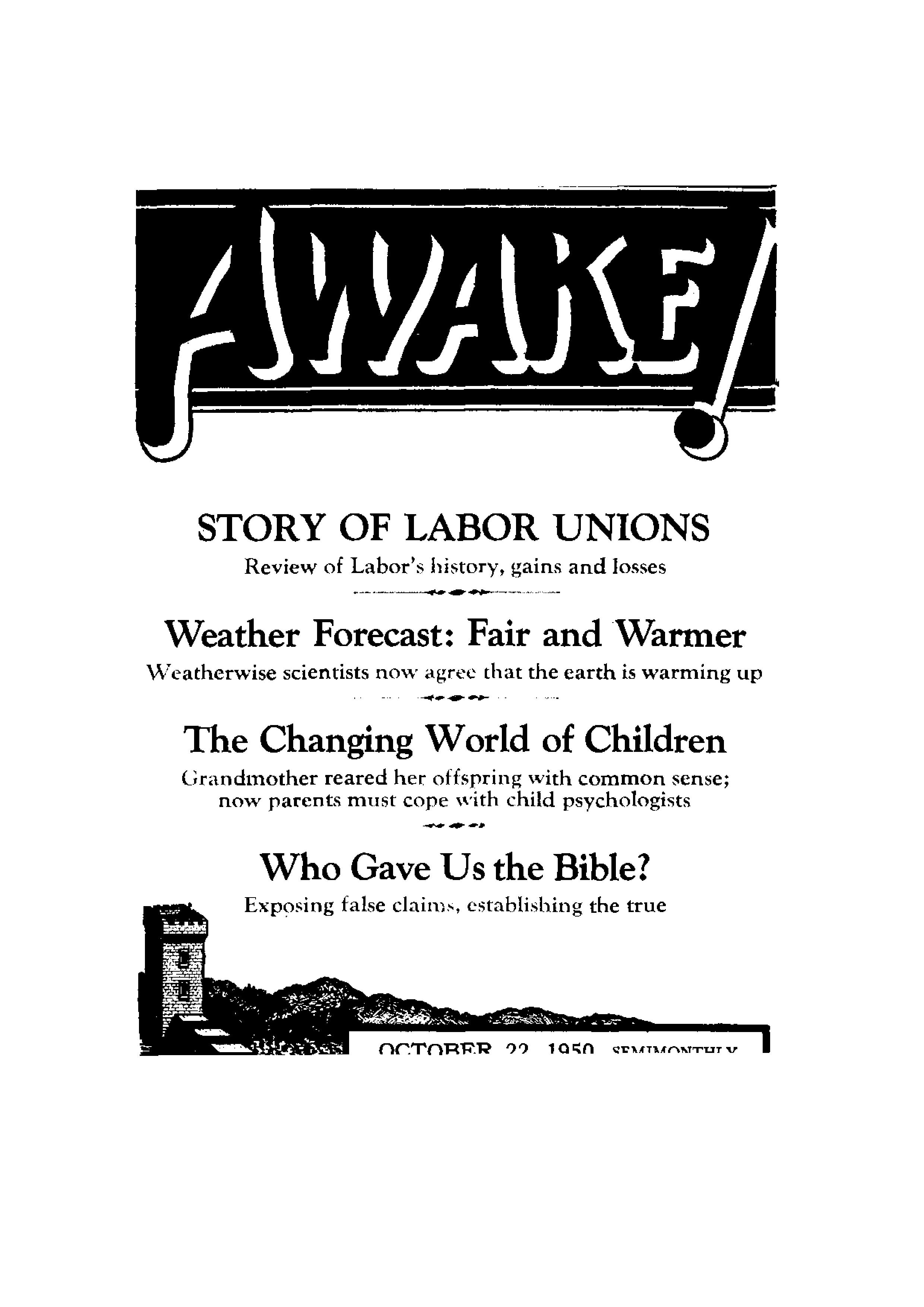
STORY OF LABOR UNIONS
Review of Labor’s history, gains and losses
Weather Forecast: Fair and Warmer
Weatherwise scientists now agree that the earth is warming up . ■ —
The Changing World of Children
Grandmother reared her offspring with common sense; now parents must cope with child psychologists
Who Gave Us the Bible?
THE MISSION OF T.HIS JOURNAL
New* sources that are able to keep you awoke to the vita! Inuce of our time* must be unfettered by censorship and selfish interests. ‘ ‘Awake I** has no fetters. It recognizes facts, faces facts, is free to publish facts. It Is not bound by political ambitions or obligations; It is unhampered by advertisers whose toes must not be trodden on; it is unprejudiced by traditional creeds. This journal keeps itself free that it may speak freely to you. But it does not abuse its freedom. It maintains integrity to truth.
"Awake 1” uses the regular news channels, but is not dependent on them. Its own correspondents are on all continents, in scores of nations, From the four corners of the earth their uncensored, on*the-scenes reports come to you through these columns. This journal’s viewpoint la not narrow, but is international. It is read in many nations; in many languages, by persons of all ages. Through its pages many fields of knowledge pass in review—government, commerce, religion, history, geography, science, social conditions, natural wonders—why, its cover* age is as broad as the earth and as high as the heavens.
“Awake!” pledges itself to righteous principles, to exposing hidden foes and subtle dangers, io championing freedom for all, to comforting mourners apd strengthening those disheartened by the failures of a delinquent world, reflecting sure hope for the establishment of a righteous New World.
Get acquainted with '‘Awake 1” Keep awake by reading “Awake!”
J’JRUHBTID fiS.kl I MON Tn LT Ri WATCHTOWER BIBLE AMJ TRACT SOCIETY, INC
U7 Aduna Smet V H. Know, JVe*tds»(
Prlntlrg th l« i»»ua‘ 110,000
Broqklyu 1, N. Y„ U. fl. A.. Chawt fluirm, Minatory
Five c«n1« a copy
LwfBtfi* k whkh tNt wtuiv* I* MaJuquUlJF—<;**«, kteltP
Ij—AfriiMM- fcw5, Qrnk, P*rtk<mrd
»»vdMd IkrU^iQ.
Munca, VS., LIT Afeni 04 . arakljD h BuT.
A* Mil. Il B9 , BvrJAM, N.0.W
CatJi, 40 JfFj Ar* , 5. On Link
E*Mu*i. 34 Otrn Terrier L«6», W 2
11 fli
9k
Bi
frjnd «• v*i'«r it BrwCjfli,
*Mi4tt*ii*M xhwiia be *0)1 u> m yrjr rem-fy ?& xlit «r fMMn rr
utt if nrtatj Irail'uncr* ara ^crated «; IrtMba from 0MPtrl«i v:i«rt co office k bciM, ty InttmrJrcd ikn<y onter nir. BtAttnrtlvn fMm id differt raumfi *?? twr, xtiiwj >2 fcxij rarer, cy ff*tfck *f Mpkatl«N fwfri mml Mank) Is kfUt >«st tws lauM tofav wterlpdott n-pirn CUkh at adtoaa »teti *r»: to rar oc« ■uy te «%*«r«d mkt't* an* aocrb ^xi yw dM » weH m hr adcna.
. Ad ar Uirdt 3, PrlntM to IL ij.
The Story cf Labor. Unions
Who Gave Us the Bible?
Birth cf Labor Unions
The Word of Popes and Councils
-.8
Labor's Gains and Losses
Horse and Lion Trade Diets
Women In the Driver’s Seat
Japan Adds Edison to Its Demon Gods
What Do You Say When You Sneeze?
Our Fine-Feathered Orators
Weather Forecast; Fair and Warmer
Scientific Surprises
Injections May Cause Paralysis
“Your Won! Is Truth'’
The Changing World of Children
Bitterness or Tenderness?
Common Sense vs. Nonsense
Violent Outbursts in Bolivia
The Foremost Training
Watching the World
Volume XXXI Brooklyn, N. Y., October 22, 1950 Number 20
THE STORY OF
U A THREEFOLD cord is not quickly
XI broken.” That truth, uttered by wise King Solomon nearly three thousand years ago, well states the principle underlying the efforts of men to organize labor unions. Of course, if all men followed the Scriptural injunction: ‘You must love your neighoor as you do yourself/ there would be no need for men to organize unions.
"As an individual/’ states the Encyclopedia Americana^ “the worker is helpless when facing the employer in search of a job or with a grievance to redress. Should the employer decide, under the stress of competition, to reduce his wages, to speed up production, or even to discharge him, the worker, if unorganized, must submit. The average worker rarely escapes from the economic and social [environment] in which he was born . . . Long experience, therefore, taught the workers the necessity of combination in labor and trade unions in order to bargain with their employers on equal terms/’
Modern labor organizers are wont to portray Moses as a great labor leader who engineered a successful strike against Pharaoh & Company. But the Scriptural account allows for no such interpretation of those events. Wages, shorter hours and improved working conditions were not involved. The facts are that the Israelites were enslaved and they cried to God for deliverance and he set them free by a
LABOR UNIONS
series of miracles.—See Exodus, chapters 1 to 12.
That there was much such oppression in ancient civilizations history always clearly shows. Nimrod, proud and wanton hunter and builder of great cities, was doubtless one of the first to ^exploit labor on a large scale. From the Bible account it appears that oppression of workers was a crying evil in Judah shortly before its fall in 607 B.C. However, no record has come down to us of those oppressed workers organizing to improve their lot
Guilds—First Unions
It seems that the first workmen’s organizations were formed in Rome about the sixth or seventh century B.C. According to the historian Plutarch, Numa, ancient legendary king of Rome, organized the workmen of his country into “colleges”, according to their respective crafts. History also records the organizing of workmen in Greece from the fourth to the second centuries B.C. The Roman “colleges” or craft guilds seem to have continued in some form or another until the fifth century A.D.
The sixth century saw the forming of free workmen’s guilds in Italy, first mentioned being the soapmaker’s craft of Naples. The need and value of guilds soon became apparent in other Countries also, becoming most numerous and powerful in
Germany and Great Britain. The twelfth and thirteenth centuries saw great activity and progress in the formation of guilds, their incorporating regulations governing the training of apprentices, the requirements of journeymen and of the masters, etc.
The craft guilds of some countries, such as Germany, became very monopolistic and cared little or nothing about the welfare of other workers or of the consumer. Also, they went in for specialization to a degree that was fantastic. For instance, a silversmith was not permitted to fasten a gold ornament on a piece of silver jewelry. And, especially until the Reformation, the Roman Catholic religion played a very prominent role, each guild having its own patron saint, chapel or altar and religious banner. Violation of religious fasts or holidays was severely punished. Needless to say, there was no place in these guilds for the Jews.
In Great Britain the first craft guild was organized in 1164, that of the weavers, although religious and other guilds had been formed several centuries before. These craft guilds were mostly interested in politics and featured mutual benefit provisions. They differed radically from the guilds on the continent in that they were not .monopolistic. Among other guilds of that period were the merchant guilds, which were something like the chambers of commerce of today.
In other countries the workers were less fortunately situated. In France, for instance, the government sold the guild privileges, and, as a result, the lot of the artisan was most pitiable. The Revolution put an end to this form of oppression in that country. On the whole, the guilds were marked by a shortsighted selfishness and were a decided obstacle to progress. Opposition to them was at first based on their political activity, as they had become quite a power in local governments; but their increasing monopolistic features doomed them, the edicts of the various countries against them in the eighteenth and nineteenth centuries giving the death blows.
Birth of Labor Unions
The era that marked the decline and the end of the guilds also saw the birth of labor unionism. The year 1789 saw the forming of the first craft or trade union in the United States, and 1791, the first strike, that of some carpenters who struck for shorter hours and against a reduction in wages.
The goals of those labor organizations were a sad commentary on the blind selfishness of the employer class of their day. Typical of the labor legislation of that time was a law passed in Great Britain in the first decade of the nineteenth century which limited the factory working hours of children under nine years to twelve hours a day!
The organizing of these unions presented quite an uphill fight from a legal standpoint. The law allowed men to form combinations for the purpose of lowering wages but it did not permit workers to combine for the purpose of securing higher wages. That is, as soon as they struck, their union became illegal and the men were fined and imprisoned for “conspiracy to raise wages”.
A case in point occurred in New York in 1836. Certain manufacturers combined and agreed not to meet the demands of their striking employees. They further agreed not to employ any worker who was a member of a Trades Union Society or any other society whose object was to influence wages. The grand jury refused to indict the employers for conspiracy, but did fine the striking tailors involved from $50 to $150 each.
Gradually, however, the lawmakers saw the light, and the right of men to quit work to benefit themselves was recognized by law, Massachusetts being the first to do so, in 1842. A few years later New Hampshire passed the first law limiting the working day to ten hours, and not long thereafter began agitation for an eight-hour day.
As industries increased in size and competition became more keen prices were lowered, and with lower prices went lower wages. More and more workers felt the need of organizing, and so we find that by 1864 local union membership neared the quarter-million mark, while national unions soon exceeded the half-million mark. During that decade more than thirty national unions were formed, most of which were short-lived.
During this time the “Molly Maguires” were organized in the coal industry, at one time having 6,000 units, one in every coal center. Concerning this society of Irish Catholic coal miners the Encyclopaedia Britannica^ among other things, states: “In the mining districts of Pennsylvania, the organization fell under the control of a lawless element, which created the inner order of the 'Molly Maguires’, with the object, it app&ars, of intimidating the Welsh, English and German miners and ridding the region of mine superintendents, bosses and police who should in any way make themselves objectionable to the members of the order.” An Irish Catholic Pinkerton detective joined the society, “The evidence he secured led to the arrest, conviction and execution or imprisonment of many of the members during the years of 1876 and 1877, and, subsequently, the outrages ceased and the Society was disbanded.” During their heyday they had the whole region in terror.
The next striking phenomenon on the labor horizon, and as far removed in principle and action from the “Molly Maguires” as east is from west, was the organization, known as the “Knights of Labor”. Organized in 1869, it reached its peak of some 700,000 in 1886 and helped give the decade of the 1880’s “one of the most dramatic and* significant episodes in the history of American labor”. It set out to organize all laborers, regardless of craft, and interested itself not only in hours and wages but also in cooperative schemes, in socialism, in plans for reorganizing the country’s banking and currency systems. It even advocated the suppression of the liquor traffic. But the “Knights” bit off more than they could cheiV and were soon to be replaced as the leading national labor union by the up-and-coming rival American Federation of Labor,
The 4. F. of L.
Instead of interesting itself in politics and in economic and moral reforms the A, F. of L. concerned itself with craft unionism, collective bargaining and improvement in working conditions. It was organized in 1886 and its first president was Samuel Gompers. Its original constitution was taken almost word for word from that used by the British trade unions. Being rather loosely organized, the various craft unions would often be involved in bitter jurisdictional disputes.
About twenty-five years later, in 1905, the I.W.W., Industrial Workers of the World, nicknamed “I Won’t Work”, was organized. Among its original founders was Eugene Debs, many times Socialist candidate for president of the United States. According to the I.W.W,, “The working class and the employing class have nothing in common. Between these two classes a struggle must go on until the workers of the world organize as a class, take possession of the earth and the machinery of production and abolish the wage system.”
At one time the I.W.W. was quite effective, all out of proportion to its size. And while its main strength was with the western miners, it won its most notable victory on behalf of some 30,000 non-English-speaking textile workers in New England. Because of the radical ideas of the organization its organizers suffered much from both the police and from mob action, some 5,000 of them being imprisoned one or more times and several of them murdered. Today the organization is of no consequence.
A. F: of L, va. C. 1.0.
While the radical ideas of the I.W.W. made comparatively little progress among the laborers as a B’hole, there was a growing number of labor leaders who felt that the A, F, of L. was too slow in organizing the industrial areas and that its method of organizing men according to trade or craft was not the best for that purpose. This ran counter to the ideas of the leaders of the A. F. of L.f and, compromise failing, resulted in a split and the forming of the C.I.O., the Committee (now Congress) of Industrial Organizations, in 1935, with John L. Lewis as its first president. (Since then Lewis quit the C.I.O., and at present the coal miners’ union, of which he is president, is not associated with either the A.F.nfL. nr the CtLO.,1 At. the time of the split the A. F. of L. had between three and four million members. Within a few years of this division both A. F. of L. and C.I.O. had that many.
Technically, the A. F. of L. unions are organized according to trade or craft and are known as “vertical unions", whereas the C.I.O. organizes its unions on an industry or plant basis and they are called "horizontal unions’’. To illustrate: according to the A. F; of L., the compositors, the pressmen, the truck drivers, the engineers in a printing plant would each belong to their particular trade union. On the other hand the C.J.O. or horizontal union would have al] the men and women working in one plant belonging to the same union regardless of what kind of work they did. These distinctions today, however, are most general, there being craft unions in the C.I.O. and plant unions in the A. F. of L., the tendency being toward generalization.
There fs another form of union activity in the United States, that of the Roman Catholic variety, the ACTU—Association of Catholic Trade Unionists. It has served as a spearhead for fifth column Roman Catholic Action in labor and has succeeded in dominating the C.I.O. (For details of Catholic Action in labor see Awake.' May 8, 1950.)
Modern legislation has been most favorable to labor organization, the N.L.R.A., the National Labor Relations Act, being largely instrumental in the success of the organizing activities of the C.I.O. This law outlawed "yellow dog contracts’* whereby an employee was made to sign a statement that he would not join a union, and gave unions a legal standing such as they had never before enjoyed. Some felt, however, that it had gone too far, or that labor was abusing its advantages, and, as a result, the Taft-Hartley labor act was made and passed. Many consider the opposition to this bill more prejudiced than reasoned.
During 1949 labor in the U. S. counted heavily on the Truman victory to put across its program of repeal of the Taft-Hartley labor act and to enact civil rights legislation. An independent congress, however, had other ideas on the matter, and now labor is concentrating on defeating the legislators responsible.
Labor’s Gains and Losses
During the year 1949 more than 55 million working days were Jost by the workers because of strikes. This was second only to the all-time high of 116 million working days lost in 1946, the first postwar year. The unemployment situation, which worsened during the year, suddenly improved in 1950 as the U. S. took action in Korea. At present there are reports of a labor supply shortage.
In the latter part of 1949 the C.I.O., at its annual convention in Cleveland, Ohio, ousted the liberal unions, accusing them of being communist controlled or sympathetic to communism. In May 1950 the newly formed C.I.O. electrical union gained control of the majority of the locals of the largest of these ousted unions, the U.E., but not without the most bitter injection of religion into the issue by the priests and bishops of the Roman Catholic Church. Those voting fpr the liberal unions were told they had committed a/‘mortal sin”.
Outstanding victories for labor included the winning of the coal strike, the steel strike and the signing of a contract with General Motors, which contained a generous pension -plan, termed by the press (Life) “the most important contract an industrial union had won since the C.I.O. first signed U. S. Steel in 1937”. A notable gain for labor was the voluntary raise granted the 120,000 workers of the Chrysler Corporation on August 25,1950, which, according to the New York Times, caused more excitement in the auto manufacturing circles than any development since Ford’s $5-a-day minimum pay policy in January 1914. This was in striking contrast to the 100-day Chrysler strike, which ended in bitterness on both sides on May 4, 1950.
According to the 1950 World Almanac, 16 million workers belong to unions in the United States: 8 million to the A. F. of L., with William Green as their president; 6 million to the C.I.O., with Phillip Murray as their president; and 2 million to independent unions. These figures are generally considered by those “in the know” as somewhat exaggerated.
As for other parts of the world: Until Hitler destroyed them in 1933, the German unions were considered the most powerful and best organized unions in the world. In Great Britain organized labor continues to hold on to the reins of government, though rather precariously at present. In Australia it lost that hold during the past year. In Italy the big bad wolf of communism is making very strong inroads in organised labor in spite of the professed Catholic religion of its population; to a lesser degree this is also the case in France. Consistently, labor has fared better in Protestant countries, and there too the threat of communism has been negligible.
While labor unions have helped the worker in many ways, they are not an unmixed good. Corruption in them matches that found in politics, if such is possible. And what men need is far more than labor unions would ever be able to give them. For, regardless of their power, their good intentions, regardless of their complexion, whether radical, communist, socialist, democratic or religious (Catholic), they have not been nor will they be able to stop wars, depressions, crime, nor will they be able to end disease and death. God’s kingdom alone can and will accomplish these things. (Revelation 21:4; Micah 4:1-4) The wise man will therefore devote his time and energy to learn how he can gain the benefits of that kingdom in God’s new world of righteousness. In that new world there will be no labor unions, for there will be no need of them. All will work for the benefit of one another.
Women in the Driver's Seat
THE ladies behind the wheel who have endured so many jests and jibes directed at women drivers, and longed to get their hands on the fellow that started it all, will have to go back much farther than they may have thought to snare the culprit. It was away back in 205 B.C. that the Romans passed a law banning women from driving the chariots, the first known legislation of its kind. So says Professor Roger L. Morrison, curator of the University of Michigan Transportation Library.
<i: Of course, the girls then had the same lighting spirit as those of today and they weren't going to take that lying down. Promptly they launched a protest that went on for twenty years. Professor Morrison relates that in the 180’s B,C. they stormed the capital and gave the senators a bad time until "Marcus Cato made a speech for women’s rights and they were given the right to drive
* While this was going on, it seems that in Athens Lycurgus brought about a similar law restraining women drivers, but with no better results. The first violator was Mrs. Lycurgus, who paid for her misdemeanor to the tune of 6,000 drachmas.
In the eighteenth century Louis XV struck with one cruel blow at the ladies' most vulnerable spot, to end France's then current problem of lady drivers. In his day it was fashionable for the noblewomen to drive their own carriages through the streets of Paris. However, it was soon apparent that milady’s place was in the salon and not in the driver’s seat. Accidents steadily mounted and congestion became almost intolerable. So Louis and his ministers decided to do something about it. They forbade all Women under thirty years of age to drive. The results were most gratifying: all women ceased driving, since none would admit she was over thirty.’
In 1891 American women drivers were in the news. In that year Cincinnati reported that twenty-five of thirty carriage accidents were caused by women drivers. Roused by this threat to local security Cincinnati officials at once raised a cry for an ordinance to outlaw driving by women.
It seems that women drivers provide a theme through history that the men are determined not to let them forget.
^What Do You Say When You Sneeze?
When a friend goes ‘kachoo’, do you respond with "God bless you”, or "health” or "gesundheit”? People have done so for longer than you may think, for the ancients believed the Devil would walk right into an open mouth and that a sneeze was an outright invitation for evil to enter into the body. Related beliefs among various early peoples form a chain of similar customs around the world. Some thought that the soul dwelt in the head and that the sneeze was an omen from it-—either for good or for evil. The South African Zulus to this day believe that the spirits of the dead enter into them to cause diseases and that they can be expelled by a sneeze.
The pope had a hand in linking Italy with the superstition surrounding the sneeze, as related by the Italian historian Carlo Signonio: "The practice began in the sixth century during the pontificate of Gregory the Great. At this period a virulent pestilence raged in Italy which proved fatal to those who sneezed. The pope, therefore, ordered prayers to be said against it, accompanied by signs of the cross."
During an expedition into Florida, Hernando de Soto was visited by an Indian chief. In the course of their discussion the chief sneezed, and immediately Ids attendants extended and closed their arms and chanted, "The sun guard thee and be with thee.” De Soto, surprised, called to his fellow Europeans, "By St. James! Did ye notice? They salute a sneeze as do we. Do you see that all the world is one?”
WHILE many view the daily weather forecast with an air of skepticism and take raincoat and rubbers when the weatherman predicts “clear and sunny”, most people do nod in agreement when he proclaims that our earth is getting warmer. Old-timers are perhaps the quickest to attest to this fact, 'Stating that the world is not the same as when they were young and that they have lived through many more hard winters.
It’s true; and most of the gauge-reading, record-studying, weatherwise scientists now agree that we have entered a new climatic era and good old terra firms is warming up. If the world’s temperature keeps rising at its present rate, or a faster one, many things may happen: Can you imagine coconuts in Central Park? pineapples in Picadilly? bananas in Boston? or perhaps shorts on the Champs Slysees? Warmer temperatures could mean a “dark ages” decline for the United States and Europe, smaller adults in the United States, and a bustling, energetic population in the now-frozen reaches of Northern Siberia and Canada! Also, warmer weather would be the key to the yet untouched polar storehouses of resources. But, on the other hand, it would result in melting the icecaps, making the oceans rise. If the icecaps started melting more rapidly their waters could inundate Coney Island, Washington, D. C., Britain and Holland. Many a seaport around the world would have an obituary reading “death by drowning”. Of course, more land would appear from under the polar icecaps, covering millions of
Naturally, there is a minority of authorities who go to considerable trouble to prove that the world’s climate has remained essentially stable since early historical times. Nevertheless, the burden of evidence says that the climate has undergone marked changes in recorded history. Consider the following two cases taken at random:
First observe Greenland, that barren, frozen waste in the North Atlantic. Did you know that in the 11th century, almost a thousand years ago, there was a flourishing Norse culture there? Yes, its sagas relate that there were some 300 farmsteads along the west coast of the island, supporting 10,000 people and large numbers of sheep and cattle. This colony continued to enjoy life on this fertile island until the 14th century, when it appears to have experienced some grim days. By A.D. 1400 very few settlements remained, and these were fighting a losing battle against old man weather. While the depopulation of Greenland probably cannot be attributed entirely to a climatological change, there is irrefutable evidence that the climate did undergo a deterioration. There are Norse cemeteries in southern Greenland with tree roots intertwined among the bones, in soil that is now permanently frozen.
OCTOBER 22, 1950
The other illustration is from the British Isles. England’s summer seasons in recent years have not been warm enough to ripen grapes except in a very few sheltered locations, and then only if the summer is unusually hot. But at the time of the Norman Cbnquest things were a bit different. The Domesday Book, the record of a great survey of lands of England made in 108586, mentions no fewer than 38 vineyards in addition to those of the Crown. In the 12th century vinedressers are frequently mentioned in abbey chronicles as forming part of the normal staff of an ecclesiastical estate. One William of Malmesbury, writing about A.D. 1150, supports the point by saying that Gloucester “exhibits a greater number of vineyards than any other county in England, yielding abundant crops and of superior quality: nor are the wines made here by any means harsh or ungrateful to the palate, for in point of sweetness, they may almost bear comparison with the growths of France”. A century later such references became less common, and by the end of the 14th century they had disappeared almost completely. It would appear that the English summers were distinctly warmer then than they are today.
From the 11th and the 12th centuries on, the climate, particularly in the Northern Hemisphere, began to grow colder. So remarkable was this change between 1600 and 1850 that the period became known as the “Little Ice Age”, by analogy with the “Great Ice Age”. It was during this time that the mammoth glaciers snaked down from the north and routed the farmers of Norway and Sweden and forced those not directly affected by the ice to change over to hardier crops. It was in this same period too that England grew colder, Greenland was depopulated, and Egypt’s Nile river reached its greatest flow (it depends on melting glaciers for its water). But the mercury pulled out of Its nose dive in about 1850, the year the world’s glaciers reached their maximum extension. Since then cumulative reports show that the world has been getting warmer.
Note the Change
We can measure this change in four ways: (1) Study temperature recordings from the middle of the nineteenth century till now; (2) see what is happening to the glaciers today and measure their decrease by volume; (3) observe what is happening to the birds, animals and fish that live in the northern part of the world and see whether the northern birds and fish are spreading southward, or whether the southern ones are ousting them from their old homes, and (4) examine the lakes in different parts of the world and see whether their levels are sinking or rising.
An investigation of temperature readings around the world shows the fluctuations are not short-termed. Consider the Northern Hemisphere for example: In Philadelphia the mean annual temperature has risen four degrees in a century, from approximately 52 degrees Fahrenheit in the 1830’s to over 56 degrees in the 1930’s. In Montreal the rise has been from 42 degrees Fahrenheit in the 1880's to 44 degrees in the 1940*s, In Spitsbergen the rise since 1912 has been approximately four degrees, while in Scandinavia and the British Isles rises of from one to two degrees have been recorded over the past 100 years.
More noticeable than the rise in mean annual temperature has been the warming up of the winter half of the year. At Washington, D. C., over a 20-year period ending in 1892, there was a total of 354 days with freezing temperature during the spring months; for the 20 years ending with 1933 the corresponding total was 237.
Tn Montreal subzero temperatures are now only half as common as they were 75 years ago. In Spitsbergen, in the North Atlantic, the average December temperature is now more .than 10 degrees higher than it was 30 years ago. This is not purely a local rise, limited to the North Atlantic area, for temperature readings in Norway, Idaho, India and Argentina have gone uniformly upward.
Some will contend that a variation of only two or three degrees does not constitute any real change in our weather. However, too few realize that the smallest fluctuation in temperature makes a great deal of difference. To illustrate: At Helsinki, Finland, the winter temperatures of 1921-22 and 1928-29 show an insignificant difference of but 5 percent, yet the difference in the extent of ice in the harbor was 50-percent! That small 5-percent difference meant only half as much ice during the winter.
Going, Going, Gone!
With the help of the camera, which was invented just before the glaciers reached their largest size in the middle of the last century, scientists have been able to record the gradual glacial retreat. The photographs of the Abrekke glacier in Iceland, which were taken in 1869,1900,1933, and 1946, show quite clearly how rapidly this glacier has shrunk, particularly during the past twenty years. The Stor glacier in Lapland lost 9.6 million cubic meters of water (264.173 gallons to 1 cubic meter) during the year 1946-47 and has lost nearly 30 feet in height since 1902. Other glaciers, in Switzerland, on the mountains of Africa and in North America, show similar figures. One famous Alpine glacier, a favorite haunt of skiers and mountaineers, completely disappeared during the summer of 1947 and has not been seen since!
A warmer climate means a change in the temperature of both land and sea. During the past number of years this has brought about the migration northward of such fish as haddock, halibut, herring and the common cod. The codfish is perhaps our best example of this point. At the beginning of this century it was a rare event indeed to catch cod in the waters off Greenland. In fact, in 1913 only five tons of cod were caught in west Greenland waters, while in 1946 the figure had risen to 13,000 tons.
In Iceland today the beneficial effects of warmer weather can be seen in that greater acreage of barley is cultivated. And the forests of northern Scandinavia are spreading rapidly above their former timberlines. Even the birds reflect the change, the northern species gradually disappearing and the southern species taking their place. According to one authority, this same trend is seen in the insect world.
While warmer weather may bring benefits to the “cold” regions of the earth, in Africa and other “hot” areas we view the other side of the picture. Here we see the glaciers of the East African mountains and those of Kenya receding and vast areas of Africa beginning to suffer from drought. Lakes that were once of large size and great depth now dry up completely in summer. In February, 1947, at Nakuru lake great clouds of dust and salt were seen blowing over the lake’s depression. The neighboring lake of Elementeita has only two feet of water remaining in it. Even vast and beautiful Lake Victoria has dropped seven feet in the last ten years. And off in the distance, the Sahara Desert continues its relentless march southward at an average speed approaching one kilometer a year.
Whatte the Cause?
The underlying cause for earth’s increased warmth is a complete mystery, and how long the temperature increase will continue is conjectural. Many theories and ideas have been advanced therefor. Some say it is due to cosmic radiation; others claim that it is caused by the sun and the great frequency of “sun spots'*, and another will say that the earth is wobbling on its axis and ready to take a flip-flop. Then there is the scientist who believes the whole thing can be attributed to the heat created by our modem cities. And Mr, Average Man has his views: There was the taxicab driver who blamed television for heating up the air, and the Southern
California rancher who said, “Chalk up all this nutty weather to the A-bomb they dropped in New Mexico?* And don’t forget the Iowa farmer who wrote this profound explanation to his local newspaper: “I think that if General MacArthur checked, he’d find that the warm-water Japanese Current has been diverted by the Russians. They want to make U. S. weather the freakiest in the world, and thereby create discontent?*
But whether the weather is hot, or whether the weather is cold, those acquainted with God’s Word know that one day in the not-too-far-distant future the weather will become perfectly suited earthwide for everlasting life in Jehovah’s new world.
Injections Moy Cause Paralysis
<L Combined injections for diphtheria and whooping cough in children may cause severe cases of infantile paralysis, according to a report in the Hobart, Tasmania, Mercury, April 11, 1950. It stated that a St. Pancr^s, London, medical officer found nearly 40 cases; that a British Health Ministry doctor reported 65 cases where paralysis occurred two weeks after injections, and in 49 of these the paralysis was confined to the limb in which the injection had been given; and that a Guy's Hospital doctor reported more than 80 cases where children developed infantile paralysis soon after having been given injections. The Mercury said, 'The doctors, realizing the danger of their findings to the government’s diphtheria immunization campaign, withheld publication until some of the cases could be followed up over many months. Some of the children have taken over a year to recover full use of their wasted muscles. Others are still paralyzed after 18 months.” After the many months of study, and despite the danger to the government’s campaign, the London county council has finally banned the use of the combined diphtheria and whooping cough injection in its clinics during the months when infantile paralysis is most prevalent.
Two of the cases studied followed injections of penicillin, and there is no evidence that the injections contained infantile paralysis germs. The doctors believe that during an epidemic thousands of people get mild attacks of infantile paralysis which normally do no harm, but that the irritation of an intramuscular injection given during such mild attacks may cause the disease to flare up.
and psychiatry were prescribed, the evolution of which can be clearly traced over the past sixty years.
ONCE upon a time there were no child psychology books. In those dim ages of the past, parents
had a baby and presto/ there it was with no authorities to tell what germs of thought were'beginning to circulate in its fresh mind. From cradle to walker on its own two feet, the child proceeded to make normal progress with the usual obstacles here and there, such as childhood sicknesses, periods of obstinacy, fights with the neighbors* offspring, etc. "Whatever the circumstances, somehow the parents seemed to conjure up the necessary remedy, a reward or correction, depending on what the needs demanded. When “Junior” wouldn’t eat his mush in those days, mamma and daddy were apt not to be very tactful. Rather than to pull out books, pencils and paper and attempt to determine when, why and where “Junior” had developed a fixation that now caused him to turn a cold shoulder to the harmless oatmeal, they simply stayed with the subject of mush and convinced their heir apparent through the art of forceful persuasion that it would be ever so much to his advantage to eat the stuff.
Though the laws of parental love, instinct, judgment and good common sense prevailed for so long, there came a time when expert opinion decreed that these traits were insufficient for the arduous task of rearing and earing tor the next generation. In addition, the laws of psychology Pointed information thereon was released through the Journal of Pediatrics, as cited in Life magazine of June 26, 1950.
In the 1890’s mother was still considered in supreme command of the nursery. It was thought quite proper if, when confronted with a sudden emergency, She simply relied on her own judgment to work it out. This was the age, too, of indulgent love and cuddling exercised on the part of the parent toward the little ones. “Authorities” were confined to brief friendly articles in magazines, and these upheld the aforementioned trends of the times. Then entered the psychiatrists.
The handwriting of future changes appeared on the walls in the 1910 era. Excess affection toward children began to be frowned upon. Illinois University’s Dr. Celia B. Stendler, who submitted the above-mentioned article for the Journal of Pediatrics, offers the supposition that these early “reforms” were the result of the great age of change then sweeping the country. Trust-busting and railroad regulating came in during the social storm, and babies probably were just another item caught in the tide. Whatever the original cause, the notion that babies should be introduced to the hard realities of life from the tsigirsfnng eentinued to grow 1 or the next decade; in the “roaring twenties” it
reached flowering maturity, and it zoomed into the early thirties at rocket speed
‘Never Kiss ... Shake Hands with Them*
Foremost of such disciples was Dr. John B. Watson, a Johns Hopkins University professor of psychology. The theories he conceived have been called “Behaviorism”. In brief, this called for adult treatment for the baby. In the world of adults, everything is run by the clock. Very well, do the same with the infant, making him conscious of this from the start. But for three elementary emotions, Watson found the baby’s mind a piece of damp clay capable of being imprinted according to its environment and training. With the parents, he considered, lay the decision as to whether this clay would produce a genius or a dolt, “Condition” the child, he urged. The world is a tough place, so no mollycoddling for Johnny. No cuddling or quarter in any way; make him self-reliant. To put it in his words, as they were cited in Life:
“Let your behavior always be objective and kindly firm. Never hug and kiss them, never let them sit on your lap. If you must, kiss them once on the forehead when they say goodnight. Shake hands with them in the morning. . . . When the child can crawl, give it a sandpile and be sure to dig some holes in the yard so it has to crawl in and out of them, Let it learn to overcome difficulties almost from the moment of birth, . . . It is a serious question in my mind whether there should be individual homes for children—or even whether children should know their own parents. ... In, 50 years there will be no such thing as marriage?'
But about the time that daddy had got used to trntting into the nursery every morning to grab “Junior’s” hand with a cheery “good morning, old man, how are you doing?” along came the thirties with an entirely different temperament. Dr.
Watson’s fateful forecast did not materialize as the pendulum swung inevitably back again to the feeling that maybe baby had a few breaks coming to him after all. Gradually this has welled up to cover over all traces of the former philosophy, and Dr. Stendler points out that by 1949 all the experts were convinced of this ‘new order of things'. That means that since the ‘gay nineties’ we have swept the clock and are now ready for ... but that is it, ready for just what the already baffled mother and father do not know. They do know that by now the world has come to be filled with child psychology books of every size, kind and description and with as many answers for the parents’ problems.
A “Word or Two” from the Experts
There are those that say a stingy, petty or overmeticulous child is usually one that received his toilet-training too early. Someone else, with just as many initials following his name, will flatly deny this. For thumb-sucking, one says it is hereditary, another that this theory is bosh, a third that it will deform the mouth, a fourth that this seldom happens, and, if it does, the effect will be only slight and temporary, From a new quarter a voice will declare that it is due to too much nursing, others will attest that it means one or both of the parents have implanted a tension on the thumb-sucking infant through rejecting it openly or privately. Also, some say, it may be caused by a high-strung emotional atmosphere in the home. Much documentary evidence, when it is available, and many theories (always free and plentiful) are supplied. How, then, does the child finally overcome the habit? He outgrows it.
Other simple child problems, when explained by psychiatry, often show that practice in a bad light. Some will apply themselves diligently to analyzing why an
unprovoked child should throw a rock at a neighbor or passer-by. Can it be evidence of frustration in failing to fulfill some personal desire? Some experts think so, but what is the dismayed parent to do? The experts freely admit they are low on proof for their theories. Shall we then wait for the men with the belettered names to rake together some evidence and suggestions for proper handling, or proceed to administer suitable corrective measures?
Waiting for the “expert’s” solutions would not be quite so futile if one could expect something final. But no. When the answer does come it, will be as varied as the rainbow. In 1948 the Connecticut Health Department decreed that the old manner of "burping a baby” is all wrong. Instead of the over-the-shoulder method, this source advocated "holding baby across mother’s knee, and gently stroking his back”. But when this was put before a number of authorities, one held that the over-shoulder method was more efficient and superior, while another disagreed with the health department and the other authorities, asserting that it is not necessary to burp babies at all. Someone else said it was "most important” to burp them, and another that it was important but not as to the method used, “either way that gets results is okay.” So there you are.
However, for all of our circling around in the last sixty years, much good has been accomplished too. Through doctors, interested people, some psychologists and parents’ experience more progressive ways have been found for handling the weightier problems of childhood than those employed in the 90’s. Stork stories and the like are tabooed now in favor of more honest answers in phraseology children can grasp. Many now favor a happier combination of parental understanding linked with discipline in preference to the Victorian *yours not to reason why; yours but to do and die’ policy. Discipline through example more than by words alone is now the order of the day. Now more than ever, wb are reminded that child-rearing is the job of both parents and that the head of the house should assume his task to a proportionate degree when home from work. This he can do by introducing the children to sports and skills and other more masculine activities they enjoy and that mother is unable to provide for them.
Such practical suggestions will aid those parents who are truly interested in rearing their children, but will go unnoticed by the social benefactress who, while her husband is working, is too busy herself in gaining her master's degree in child psychology or in promoting some civic league or drive to care for her own family. Jane Whitbread, in Coronet magazine of February 1950, asks, “Why do such women believe that everyone in the world needs attention except their own families?”
Common Sense os. Nonsense
Plaihly, the task of these times is to make use of the rational conclusions drawn from scientific progress without going overboard for "psychopathic olo-gies”. It is needful that those who bring children into the world finish the job rather than turn the enterprise over to “experts” upon the exodus from the cradle. Inability to comprehend the fourth dimension does not debar from the right and qualifications to rear one’s own children. Today’s psychiatry-vaccinated parent' would be amazed to learn how much instinct and good judgment have to do with it, and that these are not found in books. Read what Hilda Espy discovered, as revealed by her clever article appearing in the Los Angeles Times of May 28, 1950, under the title "Who Said ‘Dumb Animals’?”:
“A phoebe came to our house this spring, built a nest under the eaves, and raised her young. She raised them so quietly that though they were under my roof, I never knew how many she had.
"I must say that she did more to deflate my ego than any neighbor I have ever known.
"What made her achievement even more spectacular was that she was probably an egg herself this time last year. Still, without any previous experience, without consulting contractors, architects, close friends or How to Do It books, she made herself a house as much like any respectable phoebe’s nest as if she had been carefully studying Audubon.
"Occasionally, when I was out in the front yard shouting at my four little girls, I’d see her beak and bright eyes protruding from the hatch of her nest under the eaves. It made me feel as if I might do better if I just gave up all my attempts at reasoning and instructing and just took to calling ‘phoebe, phoebe'.
“That’s all she ever said, and she was obviously managing her brood more sagely than I.
"Of course, she had never been confused by child-care experts. When I had my first children, the twins, pediatricians were sternly recommending routine. (Four hours between bottles; if the babies cry, let them; don’t pick them up oftener than necessary.) By the time I had my fourth daughter, all this was earnestly reversed: feed her when she’s hungry, pick her up often, love that child.
"True, I occasionally used my common sense and/or instinct, but I was never as lucky as Phoebe, who needed no advice at all.
“Maybe she had never seen an egg, but she knew how to hatch one, what to feed it and when it was ready to take wing on its own.
“When Phoebe’s babies flew away, she seemed to feel no need to cultivate outside interests, get a part-time job, or join the Women’s Club. In fact, I doubt if it occurred to her that she had ever had a husband or family, or would ever have again.
“Spring had come and gone; it was now another season and she was up to it. She hadn’t gotten a little too fat, nor did she require a term in Success School to cope with the future. . . . and she simply flew off to do all the things a single phoebe had to do and enjoy.
“I’m not sorry she’s gone, though; I have discovered it’s far, far easier to keep up with the Joneses.’*
The Foremost Training
One final factor must be considered. In the present treacherous times, Christian parents will take their office of childrearing with an added degree of seriousness. With social standards of morality crumbling at the feet of a reckless world in a mounting tide of juvenile and adult delinquency, they know better than to laugh off this very real threat to the home and the child. Furthermore, in a plainness of speech scattering all argument and psychological theorizing to the four minds, God’s written Word, the Bible, their guide of life, places the sole responsibility for proper rearing and guidance of children on the shoulders of, not teachers, social workers, child clinics, child-care “experts’* or doctors of psychiatry and psychology, but the parents:
“These instructions that I am giving you today are to be fixed in your mind; you must impress them on your children, and talk about them when you are sitting at home, and when you go off on a journey, when you lie down and when you get up.” —Deuteronomy 6:6,7, An American Trans.
A WAKE !
been intense. Today it will be heard said that he was excommunicated for “heretical teachings”. But this is exposed as a graceful cover-up for the worst evil he did to Rome, in the words of the archbishop of Canterburyt who wailed to the pope: “that pestilent wretch, John Wycliffe, the son of the old Serpent, the forerunner of antichrist, who had completed his iniquity by inventing a new translation of the Scriptures" Yes, new, in that it was readable by the masses! For Wycliffe had but translated the pet Hierarchy Bible translation, the Latin Vulgate of Jerome, into the tongue of the people of England.
Another Englishman, William Tyndale, followed 200 years later. Knowing the original Bible languages, he was able to translate the Christian Scriptures and the book of Jonah and the Pentateuch from the original Greek and Hebrew. While the raging Cardinal Wolsey fumed, his work poured into England from Tyndale’s continental refuge. While religious hate piled high and Bible copies were burned at St. PauFs Cross in London, truth-hungry people all over the land were getting those the religionists could not snatch. Tyndale was hunted, betrayed, tried in mockery and condemned as a “heretic”. In October, 1536, he was strangled and burned by the same fanatic hate that made martyrs of Cranmer, Latimer, Ridley, Huss and a host of others across Europe. True, the Catholic Hierarchy says much about the Bible, but when she had the absolute power to do so, the plain truth is she did nothing to make her now-professed desires come true.
The Word of Popes and Councils
Pope Pius VI is cited by Catholic authorities as having urged the reading of the Bible in his time. However, Pius VII made it clear that “the Bible printed by heretics is to be numbered among prohibited books, conformably to the rules of the INDEX
[Expurgatorius] ” When Bible societies came along and began the wo rid-wide mass Bible distribution that has made the Bible the “best seller”, the papal heads lashed out their opinions. Said Leo XII (1825): “This society [the Bible society] has collected all its forces, and directs every means to one object: to the translation, or rather the perversion of the Bible into the vernacular languages of all nations,” Pius IX called them “very crafty and deceitful societies . . . which thrust the Bible into the hands of the inexperienced youth”.
The complaint will be heard that the only Catholic objection is to Protestant “heretic” versions of the Bible rather than to the Bible itself. However, the hierarchs* argument receives another slap in the face by history. A.D. 1229 (long before any of the so-called “heretic” Bibles appeared in their completeness), the Catholic Council of Toulouse decreed: “We also forbid the laity to possess any of the books of the Old or New Testament... having any of those books translated into the vulgar tongue we strictly forbid." In addition this takes all the weight from the Catholic argument that “copies of the Bible” were made in the vernacular tongues of the various nations by the Church before the coming of the reformers. Though limited fragments did undoubtedly exist in England, the earliest belonged to the Celtic Church, and while some translating or paraphrasing of Biblical fragments into the vernacular may have been done by Catholics, there is no evidence to show these were ever distributed farther than to a few private libraries. Certainly, it is not likely that the “faithful” would flout such a decree as that made at Toulouse! Indeed, if “approved” versions of the Bible were in existence before the reformers, why did not the church that was free to openly do so distribute them, to offset the work of
Wycliffe and the others? Evidently it was never the work of “heretics*’ alone that the Roman Catholic Church truly objected to. It was the Bible in any form that the people could read that she protested against.
Still Kindling the Fire with Bibles
Then, has she at all changed or mellowed in these modern times? On May 27, 1923, many Protestant Bibles were burned in Rome in honor of the "Virgin”, and this was freely acknowledged by the Courrier de Geneve the following June 15. During Ireland’s Eucharistic Congress in Dublin, in 1932, Protestant Gospels were publicly burned; and on October 6, 1940, the New York Times reported that Rome’s “Christian gentleman”, Generalissimo Francisco Franco, lauded so often and so lavishly by the Vatican, caused 110,000 copies of the Bible sent to Spain for distribution to be destroyed and ground to pulp.
Pressed to the wall with facts, Catholic authorities have admitted that 'their Bible’ “is not much different from the Protestant version”, and all thinking persons know this is bound to be true. The main difference lies in the few spurious apocryphal books on which Catholics themselves could not agree until the Council of Trent (1546) arbitrarily approved them amid opposition. These books had been uniformly rejected by Christian congregations entirely until the close of the fourth century. Exposing the “real difference”, Pope Pius X authorized the publication in The Catholic Faith (1934), page 110, this statement: "Protestant Bibles are forbidden, because they are corrupted and contain errors, and because they are not approved by the church, and are without notes explanatory of difficult passages, and hence may do harm to the faith,"
For Catholic leaders to assert along with their “Reverend” Robert Yates of Toledo, Ohio, on the last day of February, 1943, that the Catholic Church ‘made and preserved the Bible' is one thing. But if you are a Catholic you will want to know if they are living up to their claim in these days through the benefit you are receiving. You may ask yourself how much personal Bible instruction you have received from your priest, how many Bible-study classes your church holds for public Bible reading and analysis, how many times you find yourself taking your Bible, not your prayer book, due to your religious training, and perusing it. It is obvious that where no practical demonstration and assistance are offered, it is practically valueless to verbally urge the reading and studying of the Bible.
Today, thanks not to any man or to any organization of men, the Bible exists pro-lifically throughout the earth; its circulation in the billions, its tongues more than a thousand. This is the doing of its true Creator and Preserver, Jehovah God, and this he has done for you, whether you are Catholic, Protestant, Jewish or of no religion. It is your right to read and be instructed by the Holy Scriptures as much as it was that of the young Christian Timothy in whose youthful hands the apostle Paul did not think the Bible dangerous. Nor did he condemn those who put it there, but he said:
“But continue thou in those things which thou hast learned, and which have been committed to thee: knowing of whom thou hast learned them; and because from thy Infancy thou hast known the holy scriptures, which can instruct thee to salvation, by the faith which is in Christ Jesus. All scripture, inspired of God, is profitable to teach, to reprove, to correct, to instruct in justice, that the man of God may be perfect, furnished to every good work."—2 Timothy 3:14-17, Roman Catholic Douay Version.
Horse and Lion Trade Diets
A FEW months ago a group of seven farmers and federal trappers watched in stricken amazement while a saddle-broken horse near Oregon City, Oregon, feasted on a young lamb. Earl Diskin, local sheep raiser, had reported a loss of 33 lambs last year and 17 so far this year, and previous to the discovery of the predatory horse he had been taking the trappers to task for not eliminating the assassin.
Though all of the witnesses to the bizarre event stated that such eamivorousness on the part of a horse was an unknown thing, they had photographic proof to support the fact that this time they had witnessed the entire proceedings. The gentle horse “Doc” was noticed standing in the lambing pasture in which Diskill’s ewes have been running each spring. Suddenly he broke after a 2-day-old lamb, caught it, stood it on end and crushed its head, then disemboweled it, devouring it.$- entrails and leaving the muscular carcass. “Doc,” it was discovered, would chase the lambs until they were about a week old. He would eat the bowels of any he could catch, apparently for their content of clahbercd milk.
But it is strictly no meat for “Little Tyke”, a tawny 350-pound lioness owned by Georges and Margaret Westbcau on Hidden Valley Ranch near Auburn, Washington. Garnish the finest steak and set it before her with all the trimmings and she would not even bother to sniff the plate unless there were some vegetables on the side.
The Westbeans obtained Little Tyke soon after her birth in a local zoo and have had her ever since. Never would she touch meat, and this was cause for alarm to her owners during her babyhood, when they felt sure she would perish. However, a diet of cereals, raw eggs, milk and cod liver oil brought her through, and this past summer she reached complete lion adulthood at four years.
Nor is this the most amazing part of the story. This lioness is completely tame and dwells in peace and contentment on Hidden Valley Ranch in the untroubled company of man, dog, peacock, horse, raccoon, lamb and cat. Recently, a newspaper writer visited the ranch and witnessed evidence of this when Little Tyke came strolling in from a walk with her master, who was carrying some sprigs eff flowering wild currant. Like an overgrown friendly dog, the lioness padded past the totally unalarmed prize chickens and peacocks, and hesitated long enough to playfully nuzzle one of the horses. To the bewildered reporter the incredible scene seemed like an illustrated page from Biblical prophecy.
In the house, Little Tyke frolicked with a pet coon, a toy terrier puppy, a r at, a young lamb and finally with the reporter, Mr, Hal Boyle, an Associated Press correspondent. A picture was then taken of Little Tyke lying with her head in Boyle's lap and his hand in her mouth. When he left she kissed him good-by.
It is not presumed that Little Tyke has ever read the prophecy of Isaiah, where it states: “The wolf also shall dwell with the Jamb . . . and the calf and the young lion and the fatling together . . . and the lion shall eat straw like the ox.” (Isaiah 11:6,7) However, many human creatures have read it who claim not to believe it. But it is this lioness and not the worldly scoffers that is up to the times. And while the old world sleeps on, more and more men of good will are waking to realize that God's Word is true. The foregoing local setting of peace is a delight now in this troubled world. Think of its possibilities on a global scale in a perfect paradise!
…