Awake!, February 22, 1950
Download: PDF — Awake!, February 22, 1950
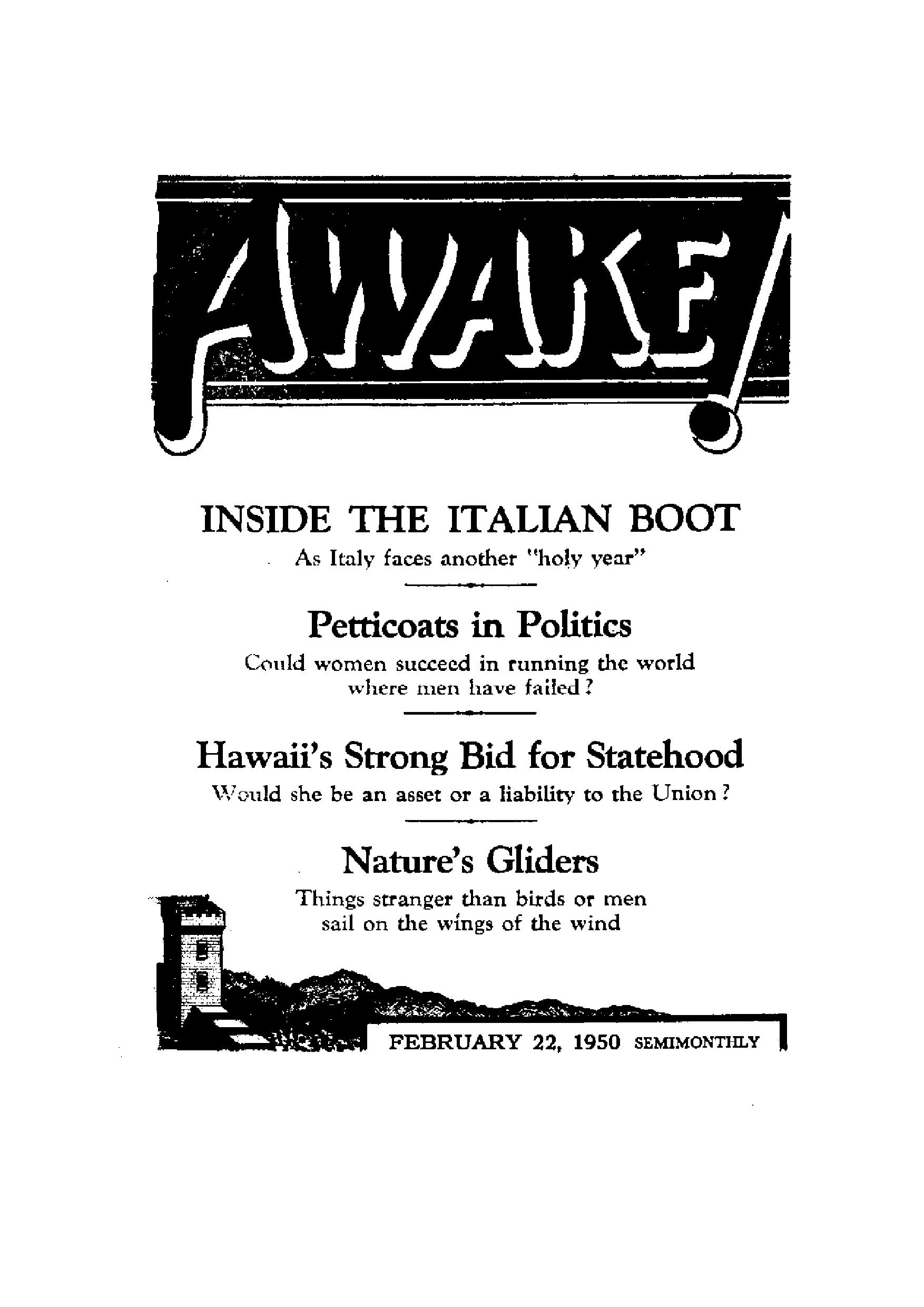
INSIDE THE ITALIAN BOOT
As Italy faces another "holy year’*
Petticoats in Politics
Could women succeed in running the world where men have failed ?
Hawaii’s Strong Bid for Statehood
Wc-uld she be an asset or a liability to the Union ?
Nature’s Gliders
Things stranger than birds or men sail on the wings of the wind
-j
FEBRUARY 22, 1950 semimonthly
THE MISSION OF THIS JOURNAL
News aoitrcss that are able to keep you awake to the vital bailee of our time* mud be unfettered by censorship and ffeliteh interests. “Awake I” has no fetters. It recognizes facte, faces facte, is free to publish facte. It te not bound by political ambitions or obligations; H te unhampered by advertisers whose toes must not be trodden on; it La unprejudiced by traditional creeds; Thin journal keeps Itself free that Lt may speak freely to you. But it does not abuse ite freedom. It maintains integrity to truth.
“Awake!" uses the regular news channels, but is not dependent on them. Ite own correspondents are on all continents, in scores of nations. From the four corners of the earth their uncensored, on-the-scenes reperte coma to you through these columns. This joumaFs viewpoint te not narrow, but la international. It is read in many nations, in many languages, by persons of all ages. Through its pages many fields of knowledge pass in review—government, commerce, religion, history, geography, science, social conditions, natural wonders—why, its coverage La us broad as the earth and as high as the heavens.
“Awake !” pledges itself to righteous principles, to exposing hidden foes and subtle dangers, to championing freedom for all, to comforting mourners and strengthening Ui use disheartened by the failures of n. delinquent world, reflecting sure hope for the estobUslunent of a righteous New World.
Get acquainted with “Awake 1** Keep awake by reading “Awake!”
Published Semjkosthlt Bt WATCHTOWER BIBLE AND TRACT SOCIETY. INC.
117 Adam* Street Brooklyn 1, N. Yr, U. A, A_
N. H. KNOKB. /TSaidfwl Gbakt SlIIeK, Serre fury
Flv« cent* M copy On» dollar a yoar
RwNlMtM WvU Im to rfteo la rovr <■»-trj la cooipiLatM wiih ngniiUaw <b fnruitw uta taUicQ tf none,, kriulitaacei ik itnpbd at Brooklyn Iran MUBultt rttn no la ioc»l«J, h* IriDmarJonil a»DcT arte ofili. SUvrUUm ratal tn dUiM&i towlrta ar* hm it* lad Ln tail curnucr.
NVtlH (f nplrotM (van revnl Stank) to nt at ImxL twu talon vtecripUoa dOlNL
Ckm if uew »Mi nt io cw tfn» nv t* «sp*rted ifaihf vithln orin moath Rand jnur nU ■a «U u ie» addrtK.
Mtan Ywly HubacrlpUin ftato
AaHM, IX, 117 AOW BU. Bmkljni L, KT. *1 Aetnita. 11 TtamTiod BA. SlntlifltM. ttHW Hi Cull*. <0 Irwin i«*.. TfWWrLo 5, Ontario 11 EMOlaaf. 34 Ctawa Terrane, Loudon, Vf, 2 Bo SO«t* Atria, 633 BootCD BUH cape Town EM
■otml M letcsri-du* Brittan 4 Hrtwtalrn, N. T., Iri of Mwrii S, 1RTR. Maul la U. H. A
CONTENTS
In aid a the Italian Boot
Political Problems
Agriculture and Industry
Religion’s Contribution
Bible Education
Petticoats in Polities
Woman’s Rise Politically
Truman Snuggles Up to “God”
Hollywood's “Samson mid Delilah”
Hawaii’s Strung Bid for Statehood
Financial Status
The .Japanese and Corn manic t Questions 15
Writing—Who Invented It T
Oldest Writings ¥et Found
Writing Before the Flood
Nature’s Gliders
Flying Opossum
Flying Dragons, Snakes, Frog*
Aviation’s 1949 Record Fruiu of Scientific Research "Thy Word la Truth”
Marriage or Singleness, Which!
Aluminum from the Ground Up Watching the World
XlW-AKE/
®™Now it is high time to awake.—Romans 13:11 9j
Volume XXXI Brooklyn, Nfy., February 22, 1S50 Number 4
■ j ■ 1 1 ~ 2 ■ _ — _■- -*■
INSIDE THE ITALIAN BOOT
By "Awake!” correspondent In Italy
STILL badly bruised and bleeding* the world staggers to its feet to face another fCholy year” in 1950. In Italy it is called Anno Santo and great prospects are in view. Among other things, it will bring a gOodly influx of dollars, pounds and pesos as an anticipated two million pilgrims and tourists converge upon the “Eternal City” Rome in response to papal invitation. The pope, expressing hope that 1950 would result in “the return of humanity to God”, declared it the year of “the great return". Whether or not it will be so in a spiritual sense leaves room for conjecture. But all indications favor a substantial return in the numbers of visitors to Italy and Rome as world travel agencies gear themselves for the heavy traffic expected. However, when the travelers arrive, what will they find? Inside the water-bounded boot what is taking place ?
First you must cast an approving eye over the natural beauty of the land / its scenic spots would be hard to match. Up in the north, the stolid, snow-tipped peaks of the Italian Alps reach up into the blue, making wide-eyed passengers crane their necks upward from passing trains to take in the full height of their beauty. Just to the south and following the Po river eastward spreads out the fertile Fadana plain, in whose center throbs the nation's industrial heart, IJi-lan, first in economic importance and second only to Rome in population. The curving coastline to the west delights the tourist with its unparalleled climate and seaside resorts that have made famous the Italian Riviera. But the coastline on the east offers picturesque Venice, whose streets are paved with water and whose romantic setting makes it ideal for an Italian honeymoon. Una gondola^ Sift signore!
Like a rock-ribbed backbone, the Ap-ennine mountains run the length of the boot, making many an Italian farm slant steeply; yet the farmers till the slopes. Ah! then there is Rome, rich in its tradition and historic ruins, its culture and priceless works of art, resting as of old upon its seven hills while the greencolored Tiber snakes its way in and out. And here is found also the center of attraction for the "holy year”: the temporal kingdom of the Vatican City state from which the vast spiritual domain of the pope reaches out to embrace 345,000,000 people throughout the world. Traveling 130 miles farther to the south one finds gay Napoli, gay despite its misery, while across its beautiful bay sulks the menacing Mt, Vesuvius. The prolific fruit-producing island of Sicily at Italy’s toe tip and the rectangular island of Sardinia complete our geographical sketch. But what about its size and population? Italy has approximately 46,000,000 inhabitants; so if you take
about one-third of the population of the, 48 United States and aqneeae it into an area slightly smaller than California, you Will have an idea of what Italy is up against.
Political Problems
Only a century ago Italy was divided into many small, jealous kingdoms and dukeihnus, including a large territory over which the papacy ruled. Years of hitter struggle finally united them all together under the fighting zeal of Gari-baldi. Victor Emmanuel 11 assumed the title of King of Italy, and with the subjugation of the papal state in 1S70 Rome became the capital of the new kingdom. Then began much-needed reforms; railroads, streets and schools were built, and colonies acquired.
On October 28, 1922, in the wake of postwar disorder, the black-shirted forces of Mussolini’s fascists effected their “Marell on Rotne”, and a new regime began. It ended sadly fur the Italian people, after plunging them inlo the abyss of war from which they have yet to recover. After the nsra new democracy was formed, and the nalion began putting the broken ends together. Anew, liberal Constitution wae produced in 1945, Article 7 of which, however, renews the marriage bond between Church and State by declaring the Mussolini-signed Lateran-Treaty of 1 929 still valid.
Today, no sooner does one enter Italy than he realizes something is brewing politically. The government is sharply divided between loft wing Communists and right wing Christian Democrats. In the controversy the newspapers violently take sides, leaning either to the right or to the left, with a few trying hard to remain independent but not always succeeding. Thus, in regard to the government’s failure to apprehend the notorious Sicilian bandit. Giuliano, who has eluded an army of police for several years, tile conservative II Tempo observed' “What is the new democracy doing! Hasn't it any laws! Haan’t it the necessary powers 1 Hasn't it the will and energy to ensure respect for law and defend public safety ?”
The highly independent II Memento got in a crack at the girverimenfe extensive ''morality drive” which outlaws kissing in public and wearing abbreviated bathing suits: "Banditism represents at least an serious an offense against morals as does naked shoulders," Such straining at a bathing suit and swallowing a bandit seems typical of the influence of the clergy who are famous for their ‘'morality drives" the world over but who neglect to provide that whinh is the best defense against immorality: true knowledge of Ged’s Word, the Bible.
Because of the political discord, .the debates in tho Chamber of Deputies Kild in the Senate provide plenty* of action these days. On occasion, the heat of argument has passed the name-calling stage aud erupted in the swinging of fists and ehair-l.lirowing.
Agriculture and industry
In southern Italy, a minority of wealthy barons, annuls and countesses own vast uncultivated domains, actually feudal inheritances. The poor farmers, poverty-stricken, with hungry motif Its at home crying for food, have been driven by desperation to become "Equattprs," on this idle land, cultivating portions of it to provide some necessities of life for their families. The alternative is to starve. Learning of this encroachment on their property, the opulent landowners summon the authorities, and what results is well typified by the following incident reported in IlPaene:
A group of unemployed farmers, living in tire moat, squalid misery, were intent on oe copying a small area rtf land belonging to the Marquis Anselmo Berlingeri, land cm which had grown every kind of weed, not having been cultivated or tilled for at least twenty years, About 4 p.m. the farmers were attracted by the roar of acamionefte of the "Cetere" (meeh.
urized police), with a hundred militiamen aboard, commanded by the marshal of the Garttitiuen from Gird. . * ,
The farmers, in their innocence far from supposing what would happen, welcomed with joyous cheering the appearance of the “Celere" police. But these, armed with pistols, submachine guns and hand grenades, hurriedly descended and made threateningly for the workers of the still. Reaching the farmers* who stood immovable and astonished, they rounded them up together with the women, pushing the men and boys with Lite butts of their submachine guns. The poor farmers, with only their boos for weapons of defense, tried in vain with words to placate this unsuspected ' police fury, and then decided it was best io retreat, while the jvomcn and youngsters took to their heels, terrified. Then the police, for motives unusually difficult tn explain, hurled a number of hand grenades at their backs and fired their sub-machine guns. A 15-year-old boy, Francencn Zito, fell on his face in a pool of blood, his shoulders riddled with bullets; a few steps away, SB-year-old Francesco Nigro collapsed Lu the giuund will) large, mortal wounds in his back. . . , thirteen of the wounded wqtc taken to the hospital.
Other shootings followed. In protest against such police action a nation wide strike was called by all bus and tram operators, paralyzing the country’s transportation system, president of the Council, De Qaspen, visited the trouble areas in Calabria to pacify the farmers with promises of putting into effect certain agricultural reforms long overdue. But already many lives have been lost in the bitter struggle between the hungry peasants and rich landholders.
But surely the condition is better for the workingman in the city, is it nut? In Naples, Some, Genoa, Palermo and other large cities one sees bright store windows filled with all inarmer of fashionable clothes, rich-looking bolts of cloth, household goods, and every other necessity. The colorful markets that fill the piazzas daily are well-stocked with fruits, vegetables, fish and meats. Truly there ia no scarcity. But who can buy these products on the salary of the average laborer who earns from $1.00 to $2.00 a day? A railroad worker, for instance, may earn 30,000 lire monthly, which is less than $50.00. Yet beef costs 70c a pound, or half a day’s wages. Butter is 83c a pound. Coal, $30.00 per ton. A man's suit will cost $45.00, while a pair of shoes runs from $fi.5O ami up. In one family^ the husband is working 14-16 hours a day, his wife worka about 6 hours, and together they earn L.1000, or $1.50, to support themselves and three children. How can one properly feed, clothe and medically care for a large family on that amount And whet about those poor unfortunates who cannot obtain a joh of any kind! The unemployed number dose to two million. Beggars abound.
It is in this discouraging economic abyss that thousands of Italians exist today. An Italian journalist reflected this seemingly hopeless condition recently while inspecting the unbelievably bestial con di Lions under which the sulphur mine workers of Sicily labor and live. Moved by the sight of back-breaking IhIxh\ filth, poverty, large families of ragged, shoeless, skinny children, he muttered: "Why are these people living!” And;'in truth, were it not for the will in man to live, ami to live in hope that some day things will be better, it would all seem so futile, vain.
Religion's Contribution
But has Italy's religion, which should offer hope and enlightenment to the pfo-ple, made it a better place in wliich to Eve! For all its 1,600years of existence, influence and opportunity to help the Italian people, what has she to show! A man who lived on earth 19 centuries ago, imbued with more than human wisdom, declared: “For there is no good tree that bringeth forth evil fruit; nor an evil tree that bringethtf'orth good fruit. For every tree is known by its fruit?'—Luke 6: 43,44, Dotwiy Verst ow.
It is this combination of economic poverty and clerical political connivance that is fructifying the seedbed of Communism in Italy. To stem the rising tide, the Catholic Church threw all her weight into the 1948 elections to prevent a Communist victory. Monks, nuns end priests, many of whom had been secluded from the world in cloisters and convents, showed up at the polls to vote. An unprecedented sight, but it worked! The Christian Democrats scored a majority* However, more and more Catholics—many alienated from the clergy by their tactics during Fascism and the war —began to show increasing sympathy toward Communism, and the pope was constrained to apply his most powerful weapon, excommunication. Each one must decide: arc you a Catholic, or a CommunistT You cannot be both. In a nation traditionally bound io the Church as is Italy, the decree had its effect with many who were “on the fence”, but with others it was “the straw that broke the camel’s back” and they became more hardened in their anticJericalism,
If prayers and religious blessings count, Italy’s health ought to be tops. Probably no other one nation in the world has as many churches per square mile, whose citizenry pray oftener or longer before images of saints and madonnas, than right here in Italy. Vet it seems not to be the most blessed. Priests and people prayed fervently during the last war, but suffered miserably at the hands of both friends and enemies. Their cities were hollowed out by bombs, and when the useless war was ended it was found that neither saints nor madonnas had protected husbands, fathers, brothers and sons, women and children. For all this the clergy had an answer. From their pulpits they unashamedly declared that this was a just punishment from God justly executed upon a sinful people. t
But the reasoning mind rebels at this! Are these people more sinful than those
in the many countries left unscathed or less damaged by the war! Have not these prayed and confessed and partaken of communion as much as and more than other peoples! And here in Italy is the very heart of the “Christian religion”
Religion in Daily Life
But turn now to the religious aspect of Italy. It permeates every phase of daily life. It affects the customs, habits, and even their dress. It influences them strongly in both social and political affairs. Religion is compulsory in f.Fie schools, where young minds are early indoctrinated. Statues of saints are placed in special niches cut. in the exterior of most buildings and in the entranceway of apartment houses. The part played by images of saints, and particularly of the Madonna, is very significant in the Italian’s worship.
High iifi on a mountain near Genoa rests a little sanctuary. It was built on the spot where, three or four centuries ago’, h । >e as a nt is reported to have seen the “Blessed Virgin”. According to the tradition, the vision requested him to build a church there, but when he excitedly told his wife about, it she ridiculed him with scorn. So he said no more. Some time later, confined to bed by an injury, he beheld in a night vision the Madonna repeating her request. Miraculously cured soon after, the story continues, he proclaimed to everyone what had happened; his account was believed and the religious leaders saw to the building of both a church and a chapel.
Within the chapel reposes h life-size statue of the Madonna della Guardia, the baby Jesus in her arms, and the old peasant kneeling before her, hands clasped in worshipful attitude. At the foot of her altar is a basket and, as we look, the simple folk who come to pray and light a candle addlheir contribution to the pile of Italian lire already there.
Farther up the road a little carnival is going on, with hucksters of every de-
imri/
scription. There is a restaurant and hotel for those who come to stay and pray for several days, local stores offer religious knickknacks for sale/ stories of the Madonna’s miracles, etc. Upon entering the church in the square, we hear the priest discoursing about the Madonna, and note his words as he declares: “Next to the Blessed Trinity, Mary appears as the greatest thing in the Christian religion. Why? Because she was chosen by God the Father to be the mother of His son and finally she conceived by the Holy Ghost. This means she was married to the Holy Ghost?’ It was Mary that had always helped the Church in its hour of distress, and so he called upon her to defend the Church against Communism.
We leave the building, calling to mind the simple Jewish woman, Mary, of the tribe of Judah, who knew little of and cared less for politics, and who loved God too much to ever want so much adulation given her. In her day she knew Hie Scriptures declared: “I the Lord, this is my name*. I will not give rny glory to another, nor my praise to graven things.” —Isaias 42: 8, Douag Version.
Idolatrous Procession
Last spring, the Madonna della guardia left her retreat on Mt. Figogna and was carried into Genoa. For weeks in advance, wall posters and church announcements notified everyone that the Madonna was to make a parish-to-parish pilgrimage. As the day approaches, the excitement heightens; feverish preparations are made; a sign appears in lights on the church facade, '‘Come, 0 Alary!”
Then one evening the movement in the streets below gives evidence that the long-awaited hour is near. Sometime tonight the Madonna will come. Women and children are seen carrying candles, shielded in a cone of white paper to protect the flame from the wind. Draperies, special banners, blankets and even bedspreads are hung from every window. Though it is an hour before midnight, the illumina-
tion makes everything day-bright, throwing into clear relief the packed procession now entering the street to the right. The air is filled with the muffled murmuring of thousands, the scuffling of shoes on the pavement, the shouts of children, and the boom of a loudspeaker thundering above it all. '
Now the noise changes as the throng joins unevenly in a song of supplication to the “Biased Virgin”, th^ thin, InmfeTit-ing wail of feminine voices drowning out the fewer masculine notes. The crowd comes nearer. In the lead are a number of men walking in loose order; a soundcar precedes the float of the Madonna carried aloft on the shoulders of twelve men; on each side are the ever-present carabinieri, rifles slung over shoulders; and finally the mass of the procession, jamming the street behind and overflowing onto the sidewalks, lips moving in hymn or in prayer, eyes fixed on the image, the ground, or gazing up at the windows above. The cone-shielded candles and several torches add a weird lighting effect to an already fantastic scene. Spasmodically as it had begun, the singing stops; the "Virgin" is immediately below us.
In front of the Madonna walks a hlack-robed priest, beside the powerful soundcar. His heavy, amplified voice splits the night with a phrase in Latin. The multitudes mumble the response in unintelligible discord. Tbew the, priest's vVite again, followed by the chant of the heaving, moving mass'. Thus down the street they pass: the stiff, inert image of the Madonna inclining and veering, bobbing and swaying, utterly impassive and unresponsive, borne along on the uncertain crest of the tide of worshipers.
Scenes such as these are very common throughout the length and breadth of Italy. To the mind leap the words of the Bible: “The idols of the Gentiles are silver and gold, the works of the hands of men. They have mouths and speak not: they have eyes and sec not. They
have ears and hear not: they have noses and smell not. They have hands and feel not: they have feet and walk not.” —Psalm 113:4-7, Douay Version.
Bible Education
In the midst <jf all this veneration of images, burning of candles, “solemn” masses, pomp and procession, what is to be said of the Bible? Is it widely distributed and readt AIhs! no. In but a meager number of homes is it found, American missionaries, who in recent months have been eon ducting a campaign of Bible education here, have lieen amazed to find ho few having copies of the Scriptures. N<>(. that Italians disdain God's Word; to the contrary; But they have not been encouraged to read it. When shown the Bible and allowed to scon its pages they express themselves elatedly over the wonderful truths they And. Ques lions by the dozens pour forth ou subjects long repressed by minds daring at last to think unharnessed.
The endless experiences of these American missionaries, gradrmleff of the Watchtower Bible School of Gilead, give proof that the desire of Italians for enlightenment is battling its way up through the morass of superstition, h» breathe in finally the clear, fresh air of truth. They have distributed thousands of Bibles and Bible helps. They are conducting hundreds of family Bible studies weekly. Publie Bible tli^coursea arranged by them have packed out theaters, with an overflow in the street outside. From industrial Milan to Palermo, these missionaries, together with their Italian coworkers, are bringing new meaning to the lives of many hundreds of goodwill, farmers, lawyers, factory workers, housewives, clerks, cobblers, carpenters —jieople from every walk of life.
All this has not been without its reaction, however. Under clerical inspiration, in Palermo, some of the Bible literature was gathered up-from the homes where it had been placed, and then burned in front <d churches, while the rchgious newspapers dubbed the missionaries ‘‘wolves in angels’ clothing”. At Milan, both Catholic and Communist pressure shared in an attempt to deny Jehovah's witnesses a place io moeh It failed. In Genoa, a Catholic priest snatched a Bible from the hands of a missionary, refused to return it, and then brazenly defied him to report the matter to the police, knowing full well that the latter would give no heed. Religious intermeddling in government circles is working to deny the missionaries permission to remain in Italy to ch t ry on their benevolent activity. Everywhere, the clergy, fearful of the effect of Bible information in the bands of the people, have loudly and sternly warned their flockx riot to give ear. But the “sheep" in. those flocks give ear nil the more. And despite it all, the preaching of “this gospel of the kingdom’’ goes on apace, to end only when Almighty God so wills it.
This, then, is a brief glimpse of Italy as it enters the “holy year”. Its problems arc many. But they are not problems created solely by the war. The roots go farther back. They are the same difficulties to be found in one form or another in every nation of this dying old world. Not in Communism nor in Catholicism is the solution to be found. The answer is found only in God's established kingdom by Christ Jesus, under which this penins nla of friendly, mu sic-loving, sensitive people will begin to enjoy true prosperity and peace. In that Kingdom the people of good-will of all nations arc placing their hope today, turning from this world’s politics and religion even while the pope taps the door of St. Peter's with his gilded hammer and the “holy year” begins.
THE old cry of “What this world needs is more religion” has a competitor. This competing, cure-all prescribed for tho political mess is “What this country needs is a woman president!”Or at least, “Let’s have more women in political offices.”
Advocates ask if anyone could more appreciate the problems of home, school, and civic improvement. Indeed, women do the marketing; aren't they more familiar with, and hence better equipped to handle, inflation and the rising cost of livingf Wouldn’t the mother-instinct curb the repetitious sacrifice of sons in war? Wouldn’t they apply house-cleaning l.adica toward ward heelers, civic rol.len-ness, graft, and dirty politics in general T Who would have deeper insight into problems of health facilities, housing, educational systems and the intricacies of equal-status, since her own “liability” of being a woman was one she had to con-
Thousands cry that women are surely the answer. “If women controlled the unions and politics of this world,” one speaker avers, “we wouldn’t have millions unemployed, nor would we have hundreds of thousands starving while we have plenty to eat. The influence of women has kept men from being worse animals than they are.”
Lady Astor thinks women’s peacemaking activities are among the future’s surest hopes. “Just wait another 50 years, we’ve got a lot of mistakes to undo,” she promises.
Quoth one more :
“The world is governed by cunning, selfish men, who go into politics with axes to grind, whereas women instinctively and universally are prone to place human needs first . , . After thousands of years of blundering man-rule, woman might take matters in hand and succeed where man has shamefully failed.”
Woman*a Rise Politically
But the trend for a feminine “champion of the people” has far exceeded public opinion and conversational topic. Harvard Law School, for the first time in its 132 years, has opened its portals to women applicants. Public administration is Hinong the courses now open to women applicants. Gone are the days when the Victorian Miss thought ward heelers were district shoe makers, a lobby merely-a reception room, planks just so much lumber, and the Department of the Interior existed solely to devise a “new look” for her little nest. Actually, women’s political appointments are appearing almost daily. Ever since Susan Anthony's fight for her underprivileged sisters won its final triumph in 1920, women have forsaken home by the range and become mayors, senators, representatives of the House, ninljnssadors, members of the cabinet, director of th£ LJ. S. mint, secretary of labor, ministers to Norway, Denmark, Luxemburg, etc.
While foreign nations have long accepted woman's administrative reign, its ascent in the United States has been a slow and hard-fought process. The early crusader a for equal political rights received taunts anil jeers, and sometimes physical violence for their efforts.
On duly 19, 1848, the first Women’s Bight's convention was held. Many women were active in this movement— Lucy Stone, Elizabeth Stanton, Angelina Grimke and Lucretia Mott being some of the outstanding figures. Most prominent of al], however, was the aforementioned Busan D. Anthony, who did some very effective organizing and leading of the group. In 1854 and 1855 she held conventions in each county in New York to pro-motw woman suffrage. In 1868 she and two others began to publish a paper called tho “Revolution! si”, devoted to a further pica of the cause. At the sialo and congressional elections in J872 at Rochester, N. Y., she cast ballots to clar-h ify the application of the four teen th and fifteenth amendments, which guarantee protection of the rights and privileges of U.S. citizens. For this she was proclaimed guilty of voting illegally.
After Mrs. Anthony’s death the various women's leagues continued cam-. paigning, rallying, parading, In 1919 Congress finally yielded and women were at last recognized in the administrative processes. From that time forward the advance of female supervision has grown considerably. Women are here!—to stay ?
Hane Women Succeeded
Where Men Failed?
Is the world now safer for democracy T Have women established any revolution^ ary democratic beachheads ? Have problems of home, school, and civic improvement been remedied thus far? Have the unemployed millions been reduced by woman's 30-year advent? Or have they, too, taken a course like their ^blunder-ing", “aniinal-like” fellow, man, and gone the way of all flesh?
Offeuttin^ the thousands who cry for more political petticoats, other thousands range in opposition. One published opinion: ‘Tn spite of the purifying effects of the coming of women into politic cal ai'livities it is open to a group of critics to say that as much graft, as much corruption, as much malfeasance in office exists as at any time during the present century/'
The Catholic dignitary Edward Lodge Curran states that the nineteenth amendment granting women the right to vote instead of being "the beginning of a new era of cleaner polities has been a hopeless failure. . . . They winked at the abuses in their own political organizations just as much as men; they yielded to the same specious arguments and paid tribute to the same ward heelers and grafters".
Some time ago a member of the National Labor Relations Board declared that a large njjjuber of women’s appoint^ monte were purely through political influence. Same old story I
It is strongly believed that women have no natural aptitude for leadership. Their instincts are to follow. Tko domineering wife lias never made for happiness in any matrimonial venture. The Bible, too, corroborates this: “The head of the woman is the man.” Mother Eve wanted to blaze a new trail in leadership, hence the world's woes. A not so splendid ad for the “women instinctively place human needs first” plank in the platform of feminine rule I
Women really haven't faith in women. A writer for the N.Y. Times observes, “If women were to use their votes as women they could control every election as a solid block; they could vote women into every important office in the land, even create a Madame President for the United States. In point of fact, women appear very reluctant to vote power to ■other women; presumably they cannot make the laws personally they prefer to delegate the authority to men. Maybe they do not trust other women to exercise authority with discretion; maybe they are right”
Another danger of woman's dominance 13 the smothering power of raatcmalism. Many a man’s stamina has been stifled from little up, beginning with IfManiii knows beet", then, “Now listen to teacher," then, “After all, I am your motherin-law t” To have some motherly political monarch reign over him would be die final crushing blow to any remaining male self-r^pect.
Of course there's always the woman's-place-ie-in-the home angle. Another country heard from—Egypt (which has been confronted with a uhw suffragette movement). A spokesman for the leading political party there opines: “The Egyptian nation does not desire a new feminist party. The Egyptian woman dons not need anything of the sort because woman has a place in society that must not be neglected for Htiollmr. She must occupy herself with the home and preparation of the new generation."
W/w Shall Ruler,
. From the viewpoint of Jehovah God's infallible Word, the Bible, are women the future’s surest liopvb? Will they be the cure-all for this political mess F Emphatically, No! Why not? The Bible states that soon this earth will no more be subject to experimental rule by woman, nor to imperfect, blundering man, but that the nations and their crooked, warped political set-ups are without exception to be dashed in pieces like some old clay pots! (Psalm 2) A righteous government shall be over all the earth, without ward heelers, civic rottenness, graft and dirty polities; without crooked elections, stuffed ballot boxes and political pull, and even with out sickness, sorrow, and death. (And let’s see any political party match that, even in its rosy, empty campaign promises!) But it wul rain down permanent life, justice, security and happiness for ever and ever,
“For unto us a child is born, unto us a son is givpn; and the government shall be upon his shoulder: and his name shall be called Wonderful, Counsellor, The mighty God, The everlasting Father, The Prince of Peace< Of the increase of his government and peace there shall be no end, upon the throne of David, and upon his kingdom, hi order it, and to establish it with, judgment and with justice from henceforth even for ever. The zeal of the Lord of hosts will perform this/’—Isaiah 9:6,7.
The honest conclusion must be: The petticoats in politics slip and show the same imperfections hk the pants in polities. Christ's kingdom rule is the only hope for perfect government.—Mdtthew 12:21, Am. Sian. Ver.
‘Urwndn Snwfglw Up to "God”
Wfifihitigtdnj Dec. 22 [1949J—God was invoked every other sentence yesterday when Mr. Truman dedicated a carillan ammonal to the war dead at Arlington National Cemetery. Whenever a government begins to heat up emotion for a new war, it drafts God for its armed serviefts. . . . When a nation’s leader begins to snuggle up to God, it usually indicates there's some new wiukeilnees in the offing, ... It is nonsense to imply, as Mr. Truman did, that if only people believed in Cod, there would be peace. There is some doubt 'as to whether and bow much Mr. Truman himself believes in God. “Much as we trust in God," he »jd, “while He ia rejected by so many in the world, w« must trust slw* in ourselves." What dots it mcau to “iraM aJao m ourselves"? The neat phrase provided the answer, “We must resort to our own strength to hold aggression at bay." In other words, much aa Mr, Truman trusts in God, he does not think God quite as dependable as atom bombs. B-3(Ts and battleships. God bulks ever larger in the propaganda, hut bombs hulk ever larger in the budget—News commentator I. F, Stone, New York Daily Compass.
F you go to eee the highly publicized jnotma picture ^Sftmaan and Deuiah”f do not
ae4iirate portrayal of Samson, But the pietUTLsatloft or Samaan is almost perfect in comparison with”that of Efeli-Lah. This treacherous villain ess of the Bible narrative has been whitewashed in this technicolor extravaganza till at the climactic end she shares in the blazingly glorious exit of Samson, In fact, in the movie he could never have toppled the temple of Dagon without Delilah’s help. The Lord also helped, by the grace of producer-director Cecil B. DeMille. These typically Ilollywoochan liberties taken with the facts of the Biblical drama deserved the easy irony movie-reviewer Seymour Peck delivered in an offhand manner:
“Take it from old Cecil B. DeMille, Delilah was a much nicer girl than we all thought. She may have betrayed Samson to the Philistines, but she loved him all the time, and afterwards her conscience bothered her terribly. So great were her agonies that she Jed the blind Samson to the pillars holding up the Philistine temple, aod when Samson pulled the temple down upon himself and the populace, Delilah made no attempt to escape. She died near ber beloved Samson, a wistful smile upon her lips, denoting possibly the regeneration of history’s most famous scarlet woman.
“At least that’s the way it happens in Mr. DeMille’s new movie, 'Samson and Delilah? I was waiting for the souls of Samson and Delilah to be wafted heavenward on clouds of Technicolor, but somehow Mr. DeMille overlooked that. Perhaps ho considered that his movie already deviated sufficiently from the Samson and Delilah story as the Bible tells it.
’S
on and Delilah'
“Undoubtedly Mr. DeMille and his four writers should be permitted a few deviations and embellishments, siaceithey have made a. film lasting over two hours from a tale running only a few paragraphs in the Bible. It is not so much the need to embellish that troubles me: it is rather that Mr. DeMille has brought a kind of monumental vulgarity to one of the classic tales of all ages. The Biblical figures have been eut down to the level of Hollywood gUyjs and dolls.”—New York Daily Compass, December 22.
Mo vie’•reviewer Peck has just about wrapped UP in a near nutshell the adverse judgment Holly-wbod*s #fSaifisOTl and Delilah’’ earns. The picture made a aeries of events through
which Jehovah God's spirit surged aa a mighty undercurrent, Hollywood feels obligated to sell sex, even to Samson, and lightly reduces his life history to a se^ queues of events shaped by love triangles. If anything was more appalling than the transformation of Delilah from villainies to heroine, it was the published report that Mr, DeMille “was particularly anxious to portray Delilah with stunning authenticity”! It was the absence of authenticity that stunned.
Was there any good in this movie “epic” that was made at a cost of more than $3,000,000 and publicized by almost another $1,000,000 spent before release! There is mi denying the sweep of power generated in several scenes where Samson’s divinely given prowess is unleashed, such os when Philistine soldiers fell before the crushing blows of the jawbone, or when the temple of Dagon crashed to the ground amid billowing dust clouds. These and other accurate scenes were foretastes that whetted the appetite for what never came, were as teasers to show what might have been. Hollywood’s “Samson and Delilah” could have heen a truly great picture, with less of DeMille fantasy and more of Biblical fact.—See Judges chapters 13 to Id.
Hawaii's Strong Bid Statehood
ALMOST any of the islands of the tropical Pacific are a delight to the passenger's eyes. Seen from the deck of an incoming vessel, the welcome sight of green vegetation gleams lush and undulating as it climbs to mountain crests in the clouds. The trunks of palm trees lean seaward, where the constant trade winds have bent them to their force. They sway ns stemlike supports for spreading crowns of frond* edging the golden strand. Here the outline of beach contracts perceptibly us blue waters churn whitely before each comber, then expands ever so slightly as azure and spray glide bad: for another cycle of ebb and flow. To the passenger winging in by air, this move merit barely exists. To his view the isles are emeralds, with the merest suggestion of platinum setting, laid out for display on a field of blue satin, sparkling for an admiring sun.
Yes, almost any of the islands of the tropical Pacific are a delight. But the Hawaiian Islands, first called the Sandwich Islands by Captain Cook of the British Navy (1778), are not merely some of earth's most colorful spots. Jn addition? their equable climate, productive fertility, advanced knowledge of coif government, economic strength and strategic location endow them generously for their place as "gateway to the South Pacific”, Mark Twain found them "the loveliest fleet of islands Hint lie anchored in any ocean"; while that great exponent of civil liberty, Abraham Lincoln, found in them an early kinship with the American ideal. Baek in 1864 when Hawaii was ruled by a cmritdilutional monarchy, he remarked: "Its people are free, and its laws, language and religion are largely the fruit of our own teaching and example," Ten years before Lincoln thus commented King Kameharneha ITT offered to cede the islands to the United Slates in exchange for statehood. Since then Hawaii has been h. territory for some fifty years and still is not a state. Many people in government and out, and the great majority of Hawaiian3, are urgently if not indignantly asking, Why!
Qualifications for Statehood
More than two years ago, the then secretary of the interior, J. A. Krug, on his return from a 24,000-mile tour of the Pacific, vigorously recommended Hawaii's admission as a state. Concluding his outline of Hawaiian history through its stages of absolute monarchy to its annexation (1898) and organization as a territory (1900), his position was made emphatic: “I do not care what standard you apply—whether it is population, devotion to American ideals, the effect upon the nation in foreign affairs, wealth, ability for self-government or social consciousness, Hawaii passes the test/’ It seems that in view of al) the evidence Hawaii has the highest qualifications and the strongest case in favor of being admitted to statehood.
One reason that most Americans are not familiar with is the fact that when Hawaii was annexed to the United States in 1898 she was an independent republic with world recognition. Annexation actually took place only after several futile attempts du the part of Hawaii ana. Every attempt of the ’land of the hula girls” to bring herself into the American family seemed to find Uncle Sam hiding behind his beard. One treaty of annexation was killed by the Senate in 1854, another was tabled by President Grover Cleveland four years prior to the Spanish-American War. Only after Dewey won the Battle of Manila in 1898 was the annexation put through by McKinley. In 1900 the Organic Act, establishing Hawaii's government as a territory', was passed and the islands still continue under thin establishment. For four full years after the summer of 1894, when Cleveland recognized the infant republic, Hawaii continued as an accepted member of the family of nations. Even from this single fact all doubts as to whether Hn-wa liana cun govern themselves should be entirely erased.
The only other facts of historical interest concerning the Hawaiian islands are that they we r e peopled by Polynesian seamen unknown centuries ago, and came to world attention first in 1778 when Cap tain JairjcH Cook of the British Navy touched these idyllic isles and with singular lack of imagination dabbed them the Sandwich Islands, after his patron, the Earl of Sandwich. Between 1816 and 1850, successively the Russians, British and French unsuccessfully attempted to take over the islands. Native rulers held sway until Queen Liliuokalani was deposed in 1893, but “by the close of the nineteenth century, a small coterie of Americans had succeeded in acquiring two-thirds of all the taxable real estate in the islands'7. This group is fairly well perpetuated today in what is known as the Big Five.
Succinctly, the Hawaii Statehood Commission has arrayed a formidable battery of additional arguments in support of their statehood plea. As to stse, Hawaii's land surface of fl,435 square miles constitutes an urea slightly larger than the states of Rhode Island and Connecticut combined- It approximates the size of New Jersey. As to population, its 540,000 total, of which 85 to 90 percent arc American citizens, exceeds that of six states.
Financial Status
Is it a dowry Uncle Sam seeks before leading the little lady to the altar of statehood T As to wealth, the islands have been stuffing their unappreciative Uncle's coffers for a half century. In fact, Hawaii is an outstandingly paying investment shining like a jewel among Uncle Sam's increasingly vast number of losing ventures. Hawaii should be treasured more. It is not only solvent but is helping to pay for Uncle’s extravagances. After considering the facts up to this point even most stern Yankees would give up and marry the girl.
But there is more. The territory pays taxes to the federal government greater than those paid by 14 states. Its gross taxable income is more than a billion dollars; real estate valuation $500,000,000. Excluding military appropriations, the United States spends only about $13,-000,000 on the average and receives in taxes for remission to Washington the comparatively staggering sum of $140,-000,000. The lady is evidently nut only paying her way but furnishing a good many free rides. In 1945, a ‘’peak17 year, Hawaii added $173,000,000 to the federal coffers. It is not surprising to learn further that in 1947 the percentage of the Hawaiian population filing individual income tax returns was higher than that of 26 states of the union. From 1939 to 1946 while the continental U. S. was multiplying her bonded indebtedness, Hawaii reduced hers from $28,511,458 to $9,237,835, a sixty-eight percent cut. According to this the American taxpayer could afford to send Washington’s budgetary experts over for a year's training, to be taught how the llawaiians did it.
It might be of interest to pause in the eon rid era Lion of the arguments for Hawaii's admission and explore the source of the islands' income. Agriculture, depending upon Hawaii’s tremendous rainfall, which Teaches as much as 600 inches annually on the island of Kauai, supports the islands. More specifically, the two crops that are Hawaii’s breadwinners are sugar, first, and pineapple, second. Sugar, upon which the economy of Hawaii has depended so largely for the last ten years, reached the value of a hundred million dollars for a crop of 975,000 tons average for tho ten years prior to the Pearl Harbor attack. The sugar industry lias been largely Hull by the world-famous coterie called the Big Five, whose interlocking directorates once controlled the island. (Now the power of the Big Five is waning, giving way to well organized labor unions under the C.LO.) One-fourth of the sugar used by the United States comes from Hawaii. As for pineapple, not far behind sugar in value, Hawaii furnishes 90 percent of the world’s canned supply. The third industry is the tourist trade, which, though it collapsed during the war, has now exceeded prewar levels to the tune of $33 million in 1948.
Japanese-Americans carry’ on a thriving and picturesque tuna industry on their slippery, rail!ess gampans. Manufacturing is limited chiefly to pineapple and fish product. More important than sea products, however, is beef-raising, ho greatly stimulated by war shortages. By 1945 Hawaii boasted a total of 141,800 head of cattle. On the island of Hawaii the Parker cattle ranch claims to hold second place to Texas King ranch in size. IL has a “spread” of 500,000 acres. Of commercial importance also, though in much smaller degree, is the raising of coffee and the macadamia nut. Though comprising less than ten percent of the islands, the tillable area produces “more calories per acre than any other land in the world”. Thus water, soil and sunshine supply Hawaii's abundant riches.
THE Japanese and Communist Questions
In a Land where the educational system has been developed to a liigher standard than in some parts of the United States, where illiteracy among the native born is npHi;ly nonexistent, some opponents of statehood urge the dangers of Japanese or Communist political control. The 1949 congressional booklet State-Jiood for Alaska gave these population figures for Hawaii's different races: Caucasian American 177,580 {33.4 percent); Japanese-American 144,640 (32.6 percent, in addition to 31,640 alien Japanese) ; Hnwaiians and part-Hawaii a ns 80,760; Chinese-Americans 28,180; Filipinos, Puerto Ricans, Knrraim make up the total of 540,000. The opponents urged two objections to the Japanese, disloyalty during the war and habitual blocvoting The charge of betraying, the American forces and strategic locations, such as hangars and air fields, at the time of the Japanese assault on Pearl Harbor was completely disproved by Federal Bureau of Investigation. The generally accepted story, for example, that Hawaiian-Japanese cut arrows in the sugar fields to direct enemy planes to bombing targets was libelous fabrication. “Robert Tj. Shivers, former Special Agent in Charge of the Federal Bureau of Investigation office in Honolulu from August 1939 to April 1943 . . . emphatically ata ted that every such rumor of [Japanese] treachery was utterly false/*
As to bloc-voting the record states: "The racial composition of the Hawaiian legislature in 1940 presented rather conclusive evidence that bloc-voting has not been practiced by any racial group save, possibly, the Chinese. Of the forty-five legislators [bicameral, 30 members of the houspT 15 senators] only three were Japanese; on a population ratio the Japanese should have numbered thirteen. On the same basis the whites were entitled to fifteen seats, hut actually held twenty-one. The Hawniiaus, rating twelve seats, boasted seventeen. But the Chinese with a theoretical ratio of four legislators were represented by exactly that number, ” Apparently the Japanese are inclined to vote according to political, social and economic motives rather than according to racial loyalty.
The summary of opinion is to the effect that Hawaii is the true “melting pot” where the different races and peoples get along with much more amity and harmony than in many states of the Union.
Ab to the communist question, this has been argued pro and con. It has been spotlighted by the Bridges’ organizathm of all Hawaiian labor under the C.I.O. Chief Hawaiian branch was the 1LWU (International Longshoremen's and Warehousemen's Union, responsible for the recent crippling strike). In 1947, through C.LO.-P.A.C. democrats the legislature was almost dominated by the Beds. The effect on the statehood question is that Congress docs not want any communist representatives.
About the only other objection to Hawaii’s becoming a state, besides the U. S. Senate’s party concern as to whether the almost equally divided constituents of Hawaii would elect democrat or republican senators, and representatives (two), is that the eight principal islands of the archipelago arc about 2,400 air miles from the mainland at the closest point. They, like Alaska, are not “contiguous and compact” with the other states,. Refuting this point it is argued that France made Algiers a “department”, though not contiguous, without ill results; that California had no closer state than Texas when admitted. In addition Hawaii is as close in time today to Washington, D.C., as all but the adjacent states were when the capital was first located there.
On November 14 Hawaii's determined campaign to become a state gained impetus as Territorial Governor Stainback signed a proclamation calling for an election to name delegates to a constitutional convention. The announcement set up the following schedule: (1) a primary election on February 11, (2) a final election on March 21 for chonsing sixty-three convention delegates, and (3) the calling to order of a constitutional convention on April 4, 1950. After the constitution is drafted, it will be studied by the legislature, which in turn will submit it to the public for a vote. If ratified by the public it becomes the basic law of the slate of Hawaii, if and when Congress grants statehood to Hawaii. Hawaii will be the first territory in sixty years to draft a slate constitution without prior authorization from Congress. But fifteen.of the present forty-eight states followed a similar course. So the advance drafting of a state constitution, according to fifteen precedents, will not jeopardize Hawaii's statehood chances and will certainly save time.
In general both people and press favor Hawaii's becoming a state. It is now virtually blocked by the United States Sen-, ate alone. What the present Senate will do is the big question.
Sing unto jenozah a new AOMj/, and Am praise from Me and of the earth; ye that g, Jwh to ths sea, and ail Mat « therein, ike isles, and the inhabitants thereof. Let the wilderness and the cities thereof lift up their voice . . . let them shout from the top of Mtf ntoun/dinj. Lei tJL?m give glory unto Jehovaht and declare his praise in the islands.—Isaiah 42; 10-12, Am. Stan. Ver.
WRITING
WHO INVENTED IT ?
NOT so long ago people believed that Moses was the first to invent writing, doing so in order to carry out God's commandment: “The Lord said unto Moses, Write this for a memorial in a book/’ (Exodus 17:14) However, many Bible critics pooh-poohed the idea that Moses wrote the Pentateuch, claiming that writing was invented long after Moses died. Archaeologists, however, have in recent years, dug up indisputable proof that both these former theories are wrong. Writing, it has been learned, was at a high state of development many centuries before Moses' day. Who, then, was the first to write: Abraham? Noah? Enoch? Seth? or Adam?
Twenty-three of our alphabetic letters came from the Romans of 2,000 years ago. They had taken IS of them from the Greeks about the fourth century before Christ, The Greeks in turn had picked up 15 of them from Phoenician traders in the early part of the eighth century B.C. Where the Phoenicians got them is an unanswered question. Maybe they fabricated some of the letters themselves or maybe they drew upon Cretan, Assyrian, Babylonian or Egyptian sources, “These are questions,” says 0. F. Ege, “that probably will never be answered satisfactorily. Many arguments and theories are advanced," (The Story of the Alphabet) A couple of years ago it was announced that “the. oldest form of characters from which the English alphabet originated", dating back to the 15th century B.C., had been found in the Sinai peninsula. From this, let none jump to the erroneous conclusion that writing had its beginning in the Sinai peninsula or in the 15th century B.C. A century earlier, Moses had begun the writing of the Pentateuch, A century before that, in the 17th eenfciry B.C,, the righteously disposed Job was familiar with the art of writing.—Job 19:23,24, Moffatt; Job 31: 35, 36, An Amer. Trans.
Sir Frederic Kenyon, the noted archaeologist, pointing to the Prisse Papyrus in the Bibliotheque Nationale at Paris (Nos. 183-194), written in hieroglyphics during the 12th dynasty some time between 2200 and z!000 B.C., declares: “We thus have from Egypt an actual manuscript which was written before the end of the third millenium B.C., and the works contained in it, if we are to believe their own statements, were composed respectively in the fourth millennium, and early in the third." Egypt, the first world power, was busy carving its hieroglyphics centuries before Moses began writing the Bible.
Oldest Writings Yet Found
In 1887 (A.D.) more than 350 clay tablets were found in Egypt about 160 miles south of the Nile delta, tablets written in cuneiform, meaning “wedge-shaped", instead of in hieroglyphics. Cuneiform writing originated in the Mesopotamian valley, in that part of the world now known as Iraq; and since it is a more ancient form than hieroglyphics, the search for the original source of writing shifted from the valley of the Nile to the alluvial plains between the twin rivers of the Euphrates and Tigris.
Diggings in this cradle of civilization unearthed about a quarter of a million clay tablets and inscriptions. Some of the tablets are syllabic cuneiform and some are an even older form of writing, a kind of writing identified as belonging to the Sumerians, a people who lived in that part of the world before the ancient Babylonians. Some of the tablets discovered at Ur of the Chaldees and at the city of Kish Were “the most primitive writings of all, which can hardly be later than 3500 B.C?’, saya Kenyon, The Sumerians lived in the days of Noah, who died at the age of 950 years, two years before Abraham was born.
Concerning tho writing of the Sumerians, some authorities believe they simplified an even older form of writing known us pictographic, in which each sign was a picture resembling some object or word. One noted authority ia this field of investigation, G. R. Driver, observes that at tho same period of time that abstract sign-writing was in use, Sumerians were also u^iug the semi-piotographic form of writing. TTenite, Driver comes to the conclusion: “Possibly then, two distinct traditions of writing were current c. 3500-3000 B.C.; the abstradt signa employed at Ur and Lagash and the semi-pietographic characters of Elam and the district of Kish, As the two systems were practically contemporary, the one could not have been developed out of the other. . , . The only plausible conclusion in the present state of knowledge is that these two types of script are derived from a common -source?' {Semitic Writing. 1SM8, pages 1, 2) When talking about "'a common source” and in dealing with dates around 3,000 B.C. we are getting back before4hc flood of Noah's day!
JVriffjtff Before the flood
There is no indication that Noah or his descendants were the first to invent the art of writing. All the evidence points to the fact that people before the flood were able to write and did write. It is true that one cannot accept dates set by archaeologist* since sueb fail to tally with the authentic chronology of the Bible, and also because it is necessary that such dates be revised from time to time. For example, fifty years ago the archaeologists said the year of the accession of the ruler Hammurabi was 2342 B.C- Now they estimate it to have been in the year 1728 B.C. But even if their dates* are further pared down with succeeding revisions, yet the material already dug up shows that people were writing five thousand years ago, people who lived before the flood, which according to the Bible is set at 2370 B.C.
In view of the fact .th at actual records have been found that go back “certainly to the time of the First Dynasty of Kish, the first recorded to have ruled after the Flood'*, IJarold Peake admits the probability “that writing was known before that €*HtaKtri»2»be took place, for, os we have seen, a later tradition mentions written tablets, which were buried for safety during the Deluge”. (The Flood, 1930, pages 76, 77) Josephus, the Jewish historian of 19 centuries ago, tells how the SSethitea {descendants of Adam’s bod Seth) made certain discoveries in astronomy «nd “inscribed" their findings on two pillars, concerning which Josephus says: “Now this remains in the land of Sirind to this day?’ (Voafe and His Times, J. M, Olmstead, 1354, page 52) And one of the archaeological findings, ujiitainiug n very significant statement by Ashurhanipal (called Osnappar in the Bible at Ezra 4:10, rim. Stan. T^er.), says: “I had my joy in the reading of inscriptions on stone from the time before the flood."
And why think you that those people living prior to the flood were not capable of writing! It is only when so-called “scientists” ignore genuine scientific facts, and substitute for them the pagan theories of evolution, that they are led astray. Warped in their power to reason such men say that man was first a low-grade savage, than a high-grade savage; that from there he evoluted upward to be a lowbrow barbarian, then a Inghbrow barbarian; and that finally, through a slow process, he became “civilized"*. They think that man's language followed the same pattern, that at first he only grunted, that later he learned to enunciate and
syllabify his grunts, and that after eons of “baby talking” he finally learned to speak intelligently. Believing such a nonsensical theory, their final conclusion is that man’s written language followed a similar pattern of development.
But not so! Adam and his wife Eve were able to converse intelligently with each other and with their Creator. It must therefore be admitted that such ability to speak was a wonderful gift from God their Creator, who made man’s mind and tongue to coordinate so he could give utterance to his thoughts. Before the flood men were well developed in the arts and sciences. The science of metallurgy they mastered. They were capable of smelting ore and forging instruments of copper and iron. Being highly cultured in the art of music, they were fully equipped to “handle the harp and organ”.—Genesis 4: 21, 22.
…