Awake!, January 8, 1950
Download: PDF — Awake!, January 8, 1950
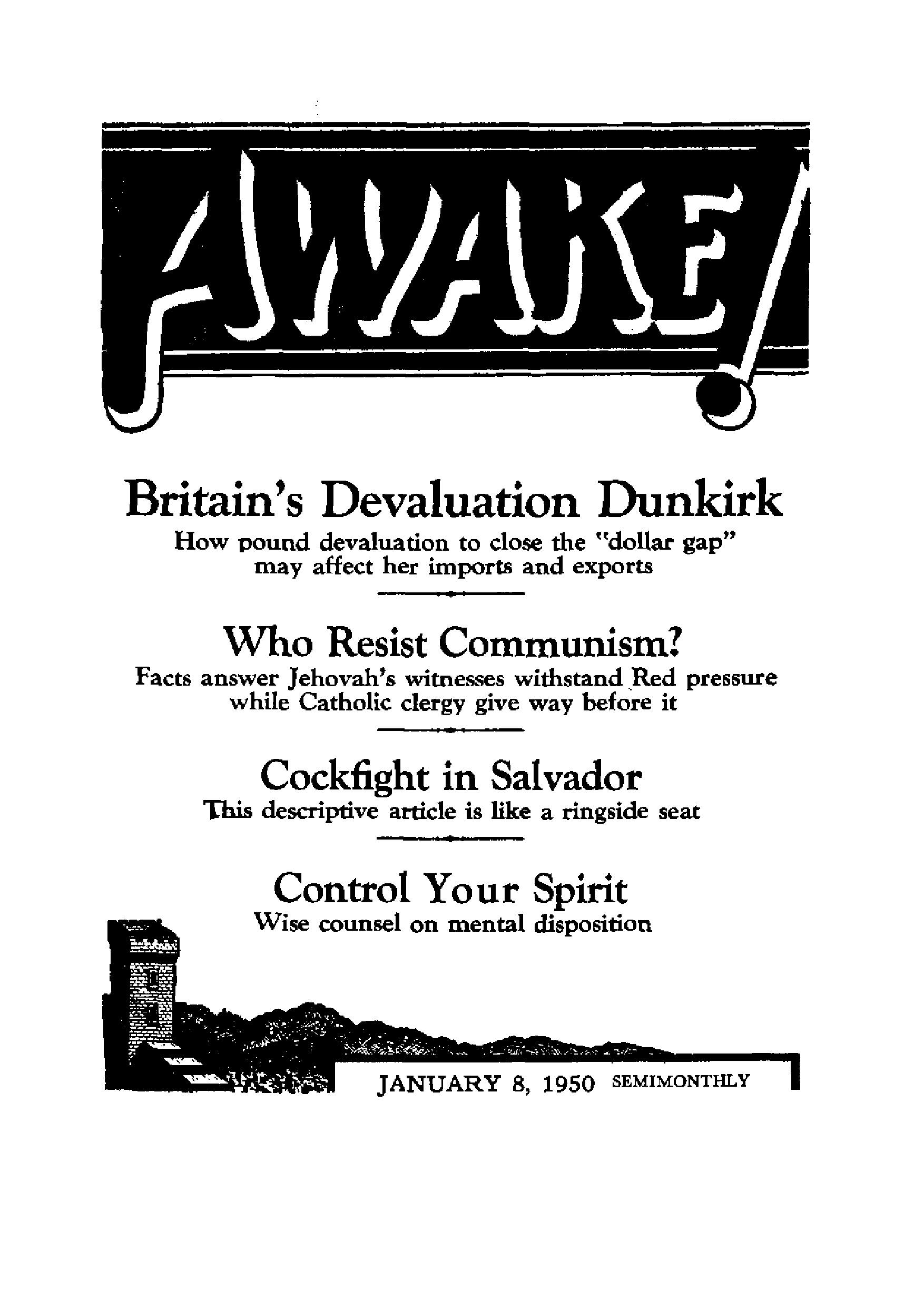
Britain’s Devaluation Dunkirk
How pound devaluation to close the ’'dollar gap” may affect her imports and exports
Who Resist Communism?
Facts answer Jehovah’s witnesses withstand Red pressure while Catholic clergy give way before it
Cockfight in Salvador
This descriptive article is like a ringside seat
Control Your Spirit
Wise counsel on mental disposition
JANUARY 8, 1950 semimonthly
THE MISSION OF THIS JOURNAL
News sources that are able to keep you awake to the vital issues of our times must be unfettered by censorship and selfish interests. “Awake 1” has no fetters. It recognizes facts, faces facts, is free tb publish facts. It is not bound by political ambitions or obligations; it is unhampered by advertisers whose'toes must not be trodden on; it is unprejudiced by traditional creeds. This journal keeps itself free that it may speak freely to you. But it does not abuse its freedom. It maintains integrity to truth.
“Awake!” uses the regular news channels, but is not dependent on them. Its own correspondents are on all continents, in scores of nations. From the four comers of the earth their uncensored, on-the-scenes reports come to you through these columns. This journal’s viewpoint is not narrow, but is international. It is read in many nations, in many languages, by persons of all ages. Through its pages many fields of knowledge pass in review—government, commerce, religion, history, geography, science, social conditions, natural wonders—why, its coverage is as broad as the earth and as high as the heavens.
“Awake!" pledges itself to righteous principles, to exposing hidden foes and subtle dangers, to championing freedom for all, to comforting mourners and strengthening those disheartened by the failures of a delinquent world, reflecting sure hope for the establishment of a righteous New World,
Get acquainted with “Awake!” Keep awake by reading “Awake!”
Published Semimonthly By WATCHTOWER BIBLE AND TRACT SOCIETY, INC.
117 Adams Street Brooklyn I, N. Y„ U. S. A.
N. H. Knobs, Premdrnt Ghani Suiter, Secretary
Five cents a copy One dollar a year
Rmltfancvi should b? sent lo ufflee In your country in compliance with regulations to ^wantes safe delivery of money. Berni Hit tices are icerpLfd at Brooklyn from countries where do offleo locuud, by LntemaLlonal mmey order only. Sutbsn-iptlijii rates in different otuutries ire hers stated In j«a] currency.
Nfrtles of oxplratlon (with renewal bl ant) li ism at Inst two issue? b&^re subscri ptftm tipires.
Chao*e of address when sent to our office .in ay be expected efTucLlTs within one rnnnlb. fiend your old an well as new address.
Offices Yuriy Subscription Bate
Amerlw, U.S., 117 Adanufit. Brooklyn 1, N.Y, 1L Amtra/li, 11 EcresfOTd Rd., Slrsthileld. N.S.W, th Canada. 40 Irwin Ate., Taranto 1, OflUdn 91 Engl end, 3< Grawn Terrace. London. W. 2 5a Soith A trie*, 623 Boston House, Cape Town (is
Entered aa second-dase matter at Brooklyn, N. Y<f Act of March 3, 1370. Printed in U. B. jL
CONTENTS
Britain’s Devaluation Dunkirk
Causes of the “Dollar Gap”
Effects of Devaluation
Increased Cost of Imports
Curtailment of Government Spending
Heavy Taxation Saps Incentive
Danger Lurks Behind That Headache!
Characteristics of Chronic Headaches
Headquarters Buildings of United Nations 12
Soup’s On!
Turning Stock into Soup
Garnishes Complete the Soup
Who Resist Communism?
True Christians Resist
Clerical Confession
Cockfight in Salvador
The Fight,
Selecting the Knives
Crnelty’s End
“Weeping” Image in Poland a Fake
“Thy Word Is Truth”
Control Your Spirit
Tickey’s Day
Watching the World
/UVAKES/
®^Now it is high, time to awake.'—Romans 13:11 Qj
.................. ■ I 1^*^—»-»TTWT^»—। , II MM—
VoFum* XXXI Brooklyn, N. ¥., January 8, 1950 Number 1
BRITAIN’S DEVALUATION DUNKIRK
By “Awake!” correspondent In Britain
THE devaluation Dunkirk which Britain now faces has arisen from one of the gravest financial and economic crises in the nation's history. It will demand ail the resolution and sustained endeavor that characterized the British military epic of Dunkirk in World War II to get the nation out of its present predicament But even given all the unity of purpose which this people can muster when occasion demands it is not at all certain wl ^ther the economic and financial difficulties will be completely surmounted.
When Prime Minister Attlee told the nation on October 24 that they were entering on their last chance to save Britain’s future as a trading nation it will be readily appreciated that devaluation means much more than the mere "adjustment ip the rate of exchange between the pound sterling and the dollar’", as devaluation is so euphemistically termed in public speeches by certain ministers of the government. And yet in the face of so grave a situation neither the prime minister nor the Cabinet seems inclined to take thoroughly courageous and drastic action and thus give a realistic lead to the nation.
To traders and others the decision to devalue came as something of a shock, but in financial circles it had been more or less expected, notwithstanding Sir Stafford Cripp’s firm assurance that there would be no devaluation of sterling. What was surprising, even to the financiers, was the lowness of the rata chosen for the pound. It wp.s $2,80 to the pound, which represents a depreciation of about 30 percent, whereas nobody had previously thought it would he more than 20-25 percent, a dollar rate of 3 or 3,20 to the pound. Since 1939 the pound sterling had been worth in terms of dollars $4,03. The heavy reduction in value necessarily dealt a severe blow to trading relationships throughout the world, for Britain is the banker of the sterling area. It is, of course, too early at the time of writing to report on the full effects of devaluation, but they can be reasonably well anticipated.
Causes of the “Dollar Gap?*
Before dealing with the effects of devaluation, however, a brief review might be given of the economic difficulties which led up to Britain’s reluctant decision. Her difficulty in making ends meet is to be traced predominantly to the direct effects which war had on its economy. Apart from affecting Britain, one of the World War’s general effects has been a changed pattern of world trade by reason of the increased dependence of all other nations on the United States, both as a source of primary products and as a market for manufactured goods.
The war left the United States the world’s chief creditor nation, having a
favorable trade balance with almost every oilier country and particularly with Britain, The wide disparity between the total value of Anremsan rtnpurt? iff Co Britain and the value of British exports to the United states mad its actrnmulated deficit for Britain is known as the dollar gap, and the crux of the problem for Britain has been and still is to close that gap and make trade between the two countri fef* more nearly balanced
It is obvious that the dollar gap cannot be closed without a pronounced and continuing increase in Britain's exports to the United States Mid alee tv other dollar markets,, partwWly Canada, The British government had hoped that progress would be far and fast enough to show that, with KBP aid in the meantime, the sterling area's trade with the dollar countries could he balanced by 1952 at the pre-devnlnation change rates.
Far frotn an increase in dollar earnings, however, the sterling area suf. fered a severe reverse in the second quarter of 1949 when the gold and dollar deficit roae Io the annual rate of sterling £62S million—almost double the deficit of the first quarter. Thiis was partly due to increased payment* by Britain und other sterling area countries for imports of dollar goods, but also, in largo part, to a fall tn the dollar income of those countries, mainly due to three factors.
One of these was the rumor and exportation of the devaluation of sterling whicili encouraged people tn whom the British owt-d dollars to press for payment, while those who owed the British dollars tended to delay payment. The second was a sharp fall both in the price and in the amount of sterling-area raw materials sold to the United States. This reduced the dollar earnings of the rest of the sterling area by one-fifth, t he commodity r !no?t Heriously a Uetted being diamond % rubber, cocoa, tin, wool and jute. Thirdly, as a reaidt of more competitive selling conditions there waa a reduction in the shipments of British goods to dollar markets. The situatinn for Britain wae also aggravated by full-fwg prints of Antorie&s. niamtivdtetvtv since the third quarter of 1948, whereas British prices were ri Mug till the turn of the year and showed little change until the devaluation of sterling.
In mid-June the British government ordered a standstill of dal J ar purchases, and It wag later agreed with the other in embers of the sterling Commonwealth to aim in 1949-1950at a reduction in dollar imports to a level 25 percent below the 1945 rate. But a balance cannot be reflated dimply by a ajrf is dollar W-ports. The only effective way is by increasing dollar earnings through an expansion of exports to the United States and other dollar markets* and the British government's view has been that devaluation nf the pound tderliug is the only simple measure that will quickly and automatically enable British exporters and exporters in other parte of the 8lei’ll ng Commonwealth to get more business by selling their goods at the lower prices which devaluation forces upon them.
JSffectt of Dutvttluailon
This immediate efifeet of dAvalnation —making British goods cheaper in dollar markets—brings ns to a consideration of the other consequences that follow, one of which is that dollar ^oorts are dowt more expensive for Britain to buy. At the B<me time it must be stated that devaluatinn of sterling does not concern the intCTjiul value of the nations currently and prices ia the shops are tsfiri more or [ess the same, tor the internal value of the pound has not changed. But to whatever extent Britain imports from the dollar area, she now pays more dearly than before devaluation, and the prices of certain tsomTnoditics are bound to rise. For instance, the higher cost of raw materials and machinery used in industry bought from the United. Stalos
cannot but be reflected in higher prices for British manufactured goods.
It is estimated that the 30-percent devaluation will mean an increase in the general cost of living of at least 5 percent In view, however, of the dire need of increasing exports and in due course a consequential shortage of goods on the home market, it is not at all improbable that shop prices in some instances may rise by 10 percent.
An interesting sidelight, with a very broad beam, on the extra expense in which devaluation now involves Britain is that if the present exchange rate remains unaltered an additional £475 million will be needed to repay the American loan (amounting to £1,000 million) granted in 1946, which is actually nearly double the cuts Mr. Attlee announced in his crisis speech to Parliament on October 24,
As to the expansion of Britain’s export trade, which was the primary objective of the government’s devaluation decision, the consequent lower selling price of British goods in the dollar markets may not produce the full result expected. It is true that they will be sufficiently price-attractive to the foreign buyer to encourage demand, hut just think what a great expansion of trade will be necessary now that the exchange rate of the pound is so much lower in relation to the dollar. Even to maintain the pre-devaluation amount of exports to dollar countries, a large increase in Britain's exports is now imperative. To still further expand is going to be a tough problem.
Parallel with this object is obviously increased production by British industry, and here we meet a situation which fairly bristles with difficulties. For a year dr so British industry generally has been working virtually at capacity and the only way left open for greater production so as to meet export needs is either by working longer hours or by more intensified work which in some cases may involve the installation and use of the most modem machinery.
Here the position comes right up against trade union policy and practice, and although some of the leaders are anxious to support the government in its appeal for more productive effort, others at the moment are quite unconvinced, and the question of wages in relation to a longer working week is quite thorny. Another problem is that some industries, pottery for instance, not only are operating at full capacity but have already been working overtime to meet demand. This, of course, means that 4f Britain is to increase still further her exports to the dollar markets then some- articles now on sale in British shops will become very scarce in the future.
Again, even if Britain were able to manufacture on a sufficiently large scale to sell abroad to such an extent as to bridge the dollar gap, can she be certain that the United States and other dollar countries will take what she has to offer? It is true that so far as the United States is concerned the Truman administration is prepared to reduce the tariff barriers which for so long have hindered the flow of goods from other countries, and that gesture for the encouragement of international trade is most welcdme to Britain.
But what is going to be the attitude of American manufacturers who by reason of the devaluation of sterling will have to compete with the lower prices of British goods, and in any event apparently will have a more limited market than they formerly enjoyed under tariff protection? The rtiore one thinks about it, the more one finds that the policy of devaluation as a help to British trade is as much a gamble as it is a "shot” in the arm for stimulating the body economic.
Increased Cost of Imports
Then when consideration is given to the other side of the trade equation^
Britain’s imports, another serious prob' Jem looms up. Before devaluation Britain's purchases from the dollar area, chiefly food, tobacco and raw materials for industry, were about three times as heavy as her dollar sales. The decision of the British government to reduce American imports by 25 percent (about $400 million in 1950 is a realistic eontrihn-tion to the closing of the dollar gap, but it still leaves an overwhelmingly largy supply of imports which will now cost more in sterling than before devaluation.
It requires no accountancy skill to see that this will impose an extra burden on industry which will have to pay more for its raw material from the dollar area and, together with the higher prices of other dollar commodities will mean a rise in the cost of Living. 0n October 1’2 Lord Hollenden, president of the Wholesale Textile Association, stated that prices of raw materials for the men's wear trade had already started to climb and tii nt, in view of the export demand, supplies in the shops, particularly of shirts, pajamas, socks and knitwear, were going to be scarce.
Also with respect to the effect of devaluation in causing Britain to pay higher sterling prices for food and raw materials imported from dollar countries and also from olher countries which have not devalued by loss than the I" a tied Kingdom, it should be noted that the British Ministry of Supply has already announced increases in prices of copper (up by about 30 percent), aluminium (20 percent), load (32 percent) and zinc (3d percent]. Other raw materials whose sterling prices have increased since devaluation include tin (up by about 30 percent), rubber (15-20 percent), wool (about. 20 percent) and American cation (over 40 percent). Bread and flour were the only majqr foods immediately affected by devaluation. Some further inrr<-ns-ob may eventually take place in imported foods ns a re sub of the alteration in exchange rates, hut at the time of writing it is impossible to predict bow large they will he.
The effect of the increased import prices on manufacturing co^ts will, of course, offset to some extent the competitive advantage which (United Kingdom ex parts will derive from devaluation. Prices of imported materials are, however, estimated to represent not more than about one-seventh or one'eighth Of the prices of United Kingdom exports as a whole, and it is only in a few hut very important lines (notably nonferrous metals and manufactures, woolens and worsteds, and cotton yarns and manufactures) that higher raiv material costs may necessitate a major increase in sterling expert prices. Groups of British exports likely to bo rdntivriy little affected iu this way include machinery, vehicles, electrical goods, chemicals, pot-tcry and glass, and cutlery; in each of these groups imported materials represent about o percent or lees of export prices.
Tourist Trade
Another angle from which the effeetB of devaluation may be viewed i? that of tourism. It is estimated that by the end of 1949 more than 135,1)00 visitors will have come from the United States to Britain, including persons in transit, and that jwrrdrjga from this particular traffic will reach $70 million. The British Travel Association hopes that next year dollar earnings from both die United States and Canada will reach $100 million, for the much lower rate of sterling is curtain to encourage more tourists.
Devaluation, h owe vet-, while it should help to overcome previous complaints of high prices in Britain, is likely to lead to a lower rate of dollar spending by individual American tourists who obviously will get more for their, dollar. So it may be that the Travel Axsoria-tion’F estimate of Britain’s dollar cam tags from tourism next year is aome-wind optimistic. Another doubtful fao-.
tor in regard tn tourist earnings is that with the new cuts in building in the government’& new devaluation economic program the urgent problem of providing more hotel accommodation service may not be met For the British tourist devaluation, of course, mcane that Britons will find it much more expensive traveling to the United States.
Curtailment of Government Spending
The financial cuts announced on October 24 by the prime minister to meet the nation's economic needs are regarded as anything but adequate. It is generally considered that the total of £250 million stated by Mr. Attlee should have been at least double to meet the retrenchment requirements which the situation demanded. The city view is that the government is merely tinkering with the problem, and to biisinpRsmen a whole the extremely modest cute have been all the more surprising because of the serious warning given by Mr. Attlee and other ministers on the gravity of the situation, and which was abundantly emphasized immedintely before the cuts were announced.
To have thus prepared the pnhlic mind for a most severe pruning of government expenditure in various directions (which, let it be noted, the nation was randy to accept) and then to go only half way in that direction does seem to indicate a lack of true leadership and i? certainly wanting in that hoMneaa of action which the situation consequent on devaluation so fully demands. In the event the prime minister's statement produced an anticlimax.
Of the £250 million the heaviest cut is in capital expenditure, which is reduced by £140 million, to become fully effective in the second half of 1950. There will be a reduction in the housing program of £35 million annually, and a similar sum will be saved by a further restriction of private building. This means that instead of, say, 200,000 new permanent JAJfUdBT 8. JP5P
dwellings next year there are to be about 180,000, the reduction being achieved bv halving the quota of 40,000 houses which would have been allowed to private interests, This, of course, adversely affects the Labor party’s social aims in housing. The present annual subsidy of £36 million on animal-feeding stuffs is to end next February, and there is also to be an adjustment in the prices of some less essential foods.
Other savings will he affected by in-crentung by one penny the charge for school meals, and there m to be a charge of not more than one shilling on each proscription under the National Health Service. The Health Service prescription charge is flcnsihle and should prevent many unreasonable calls upon doctors and trivial demands of the chemist. It baa been suggested that in the more expensive items, such as spectnclftB, the government conld have saved a good deni more by charging, nay, ten ahilungs for each pair of spectacles, except in the case of pensioners and children. The small increase in the school meals seems justified, and it is estimated that parents will in future pay about £13 million instead of £11 million toward a total annual expenditure of about £39 million on meals at school.
Outside the £250 million in cuts there is to be a small retrenchment in expenditure on defense al the annual rate of £30 million, but this is to be reviewed Inter when the future striirturc of the anned forces has been completed. As forecast by Sir Stafford Cripps, last July, a now dollar import program will reduce imports in the first half of next year to $600 million.
The nation received the announcement of the cuts quite coolly. The more one thinks about them the more one concludes that they are merely temporary expedients which put off to a later day the real shouldering of the nation’s financial and economic burdens. At least, that is what it appear? to be to the av-
erage citizen; However, Mr. Herbert Morrison, lord president ol‘ the Conned, speaking on October 27 in the closing debate on the cuts in Parliament, told the House that the present iiistaliment of cuts had been mode to serve notice on everyone that the government meant business about economy. Anyone, he went on, who imagines that the present list represented the end pt the government's effort was going to be undeceived before long.
Hcatiy Twation Sapu Inc&tttt*
No discussion of Britain’s present problem would be complete without ref-acMt to the vital matter of taxation. Britain's taxation now amounts te about 40 percent of the national income, and it weighs heavily upon the financial incentives of nil classes, As about half the salaries and wages of the people above what would be regarded in America as h very low figure is taken by the government in taxation, there ha? been little inducement to earn more than the customary weekly or monthly amount by working longer hours or in the case of professional men by undertaking extra, coinmissions. And, of course, it is strongly claimed in business circles that the high rate yf profits taxation curbs on tux prise.
It is this laek of tivc that 1b prob
ably the government’s biggest headache on the home front. In spite of all the appeals by nAatetera ot state ter gieatei effort on the part of the trade unitAi rank and filo there has not up to this moment been any notable response. The- Miriness couimouitv and professional men would receive a Wealthy stimulant to enterprise if the guvumment made a really heavy cut in state expenditure. As it is, the huge sums involved in the various socialization policies, including hatioufiJiEa-tioti of certain industries and the Health Service scheme, have contributed in no small measure to the high rate of taxation, find many now question whether it would not have been better for the government to have ‘‘hastened slowly" instead of implementing its oxpenflive schemes in quick succession.
There is no doubt that the situation facing Britain ijj grave, As the worldly politic] uns, businessmen and ficcmomist-s sec it, everything depends upon ths sue-umb of the dollar export drive Hud that in turn depends upon the extent to which Britain can increase her production for the dollar and other markets. Speaking te vftmap; st o®. Qet&-
bar 23 Mr, Harold Wilson, president of the Board of Trade, unite this significant statement: 'This is Britain's lastdiaucc. There is no alternative to increasing our dollar exports.”
Fortunately to those who have knowledge of Jehovali’s kingdom there is 4 most welcome atterriMive, not dependent upon the vagaries of international trade nor on the financial manipulation of exchanges. The alternative is to be found in the new world of righteousness under Christ’s beneficent ridership. Be it capitalist, socialist or (’ommuniet government, not one can bring order, peace, prosperity or life out of the present chaos and decay of this corrupt and evil world system; and die combined prayers of aYl Yhe TeYigioniats cannot hinder Elie accomplishment of its prophetically declared doom at Armageddon. There is no devalnati™ id the kingdom of Jehovah, bid. the value of His blessings will appreciate eternally, and obedient mankind will delight themselves in the most blessed economic and social order that will ever have bean established.
Dancer Duries Behaind
THEBE is scarcely a person young or old but who ha? had a hcmfache. At least 12 million Americana—about 1 out of 12—suffer from frequent or chronic headaches. More working hours are lost on account of "pain in the upper story” than from-any other single ailment, unless it might be the common cold. Why, it is oven claimed that cranial tribulations rank with incompatibility and the other woman as a cause for divorce.
Whnt can we do about our bcadudieet Pain-harried Americans gulp down 15 billiw aspirin a year, and spend $85,000, 000 on drugstore headache remedies. But patented pain-chasers are worse than no protection nt all when relied upon continually to stand buck the chronic headache demon. Even though it may never have occurred to anyone, an aspirin tablet has no miraculous intelligence, no power to propel itself to the site of the trouble and combat the foe. Even the new "wonder’ concoction, called cafe-gone, merely raps the pain in the head a temporary deadening bop without going even remotely near the ogre that is causing the misery. Some palliatives, like ucetanilid, after liberal, regular intaken, join forces with the evil genius of distress and produce headaches of their own, Some have other ways of fuel to the mental and physical miseries of inorc and more people. There are nuriruiiiH dial are habil-fbrniing, leading the victim down the wretched road to drug addiction. Others, like brom idea, produce conditions of drunkenness and even in
JANUARY 8t
ridding
sanity. Bui meanwhile, what about the headache T
It throbs and racks, undisturbed.
Medical science has not much more than its own headache to offer. It has established special headache clinics in leading hospitals, but nut enough to take care of 12 ini Ilion, patients. It is exper* imenlbig with drugs, physiotherapy, vision correction and surgery. It is compiling a Talmud-thick theology trying to explain what causes headache and what can he done about headache. But as one baffled investigator attests, the chronic headache sufferer "may find himself on an excursion to the ophthalmologist, neurologist, dentist, psychiatrist, osteopath and chiropractor. Thereupon he is X-rayed, massaged, analyzed, fitted with glosses, relieved of his turbinates and teeth, and too often emerges with his headache intact”.
The supreme enigma halfling science is how to survey and correct the emotional life of the patient, because emo* tiunal unbalance is the familiar spirit that stirs up more head pain than any other factor.
What Is « Headache?
Atp you surprised to hear that it seems to be anything else than the brain IhrobbtegF The brain is as insensate as "so much boiled cereal”- Doctors have prodded the brain of volunteer victims undergoing surgery without anesthetics and (whether such victims under these circumstances can give reliable testi-
mony, don't ask) found that the headache seems to be, (1) pain in certain parts of the dura, a tough white tissue which covers the brain; for instance, the dura may be stretched by brain tumors, although this is rare. Or (2) action of pulsating veins upon pain areas of the scalp: dilation of the large cerebral blood vessels which have nerve fibers in them; the widening of important arteries in the neck may also contribute to or stir up a headache.
There are said to be two general classes of headaches. One is called organic, when the headache is caused by some disease, infection or other physical disorder, The other is called psychogenic or emotional, when the trouble is emotional in origin.
Not that organic and emotional headaches, can always be easily distinguished: they may overlap and agitate each other* Patients examined at the Mqntefiore hospital headache clinic in New York were found to be suffering from headaches to which emotional factors contributed in 95 percent of the cases; in 35 percent of the cases emotional disturbances were the sole cause of headache.
If it is the action of pulsating veins upon the pain areas of the scalp that causes headache^ then it is no mystery why emotional disturbances cause so much headache. Any strong emotion— fear, anxiety, anger, hate, worry, guilt, tension—is a trigger that sets off that kind of agitation. Mr. and Mrs. Citizen of this swirling, panicky world, besieged by their everyday anxieties, frustrations and worries, getting too little sleep and generally overworked, are bull's-eye marks for the chronic headache*
In case you have unfortunately fallen into the clutches of the head-racking fiend, or should encounter it, there is no sure method of self-diagnosis, of course* However, leading authorities have outlined the general characteristics of the
more prevalent types of chronic headache, which are summarized below.
Characteristics of Chronic Headaches
Psychogenic—Emotional. The most common headache. Although not generally so severe, it makes itself felt by a constricting clutch, starting at any point and spreading insidiously to the top and finally taking over the entire cranium, to settle down eventually in, perhaps, the frontal region. The victim may experience the sensation of wearing a tight hatband, or a feeling of pressure. He may feel lightheaded. His palms may sweat. Neck muscles may feel stiff and tender,
Noting that the psychogenic case is precipitated during or after states of nervous tensions, investigators generally conclude that prolonged tenseness of the scalp muscles produces the pain. Besides the drugstore panaceas, enemas, lying down, scalp massages, modified chiropractic, or maybe a vacation, may help temporarily. But the permanent cure? Well, the victim will have to gaiu an insight into his conflicts and solve them, which many times is about as easy as jumping over the moon.
A variation of the psychogenic headache is induced by general muscular tension. This is the kind that grows slowly, exasperatingly, as the day wears on, until you are suspended in a vise-like grip. Ask the tense, high-strung individual who can't relax or who uses shoulder and neck muscles a great deal for more details about this kind of headache. Temporary relief may come from rest, heat at the back of the neck, massage, loosening of the body's nerve centers. When spinal arthritis is the cause of the headache, the general ■ health must be improved, metabolic disorders corrected, fatigue and eyestrain must be avoided. But here again permanent relief requires learning to relax, to work without strain, to avoid anxiety.
AWAEE I
Migraine. Well does the victim know it before it comes; it sends him an “aura” of warning. He, or twice as often it is she, notices, out of one corner of the eye, zigzag flashes of light, climbing sawteeth, luminous spirals or other blinding contortions. Back of the eyes and on one side of the head (migraine means “half a skull”) begins a dull, throbbing, sickening dolor. Bright light makes it worse.
Commonly misnamed the menstrual, relaxation, Sunday, week-end and sick headache, migraine may come at any time, especially at “letdown” periods, such as on rest days or the first day of vacation. It may last an hour or a week. It tends to weaken in the evening hours.
What causes migraine? There is at least one theory in every’ sufferer. Some say allergy. Some, heredity. At any rate there is a personality factor involved. Migraine sufferers are almost invariably the hypersensitive type, persons who cringe inwardly over little things other people do not notice, the emotionally insecure, ambitious, tense, and, it must be added, stubborn, inflexible, resentful personalities.
Now what can be done for such unfortunates? About as much as can be done with them. Various ergot preparations, like the aforementioned ca'f egone, may lessen the misery’, possibly at the risk of precipitating high blood pressure. Inhalation of pure oxygen, avoidance or reduction o* exposure of allergens, relaxing for half an hour in tepid baths, may tender some help, as a mirage helps the desert wanderer. But permanent relief calls for changes so drastic that the victim has just about to don a new personality, or at least seek new environmental factors. Cut the work routine. Develop a hobby. Reduce tension. Cross one bridge at a time, as it is reached. Learn to accept or avoid aggravating environmental circumstances. A change of attitude and habits.
A variation of migraine is the brutal histamine headache. It wakens its victim after an hour or two of sleep with a boring, one-sided, excruciating pain in-•volving eyes, temple, neck and face. Histamine lasts less than an hour anil usually picks on people in their late 50’s. While it may be related to some allergic reaction, histamine is thought to be an accumulation of the chemical by that name in the blood. In most cases, sitting up in bed routs the torturer. Gradually increasing shots of histamine injected under the skin or into the veins desensitizes the pain.
High blood pressure. Here is another cranium-throbblr that usually attacks its victims in their sleep, during early hours of morning. The sleeper is gradually prodded into a torturous awakening by a growing sense of pain which may be anywhere in the head, varying from a dull ache to an intense pounding.
When the doctors find out for certain what causes high blood pressure, then they will probably know more what to do. uhout the headache it causes. Until real relief comes, the self-respecting victim will try not to aggravate his already existing hypertension by fatigue or emotional upsets. A nervous shoek, hard effort, excitement or the like may rouse the horny oppressor though it has been absent all day. An icecap on the head, sitting up, walking around, drinking coffee, may help. Some people are relieved by sleeping with the head of the bed raised 10 inches or more.
For permanent relief—that same plaintive refrain again: a call for the kind of life that avoids high blood pressure. Relaxation. Sedation. Rest. Diet. Removal of aggravating emotional dif-liculties. A better ordering of personal affairs. The kind of change that gives the victim a calm mind.
Nasal, There are two types. One is caused by acute sinusitis. The victim feels it with colds and upper respiratory .infections. It is a “sore-head” joy-killer that aches with a deep dull pain which is worsened by stooping over or shaking
the head, straining, coughing, a draft of cold air or alcohol. A frontal sinus infection makes itself felt by pain in the forehead, beginning at about nine in the morning and growing worse during daylight hours. Maxillary sinus causes early afternoon distress fn ’the forehead, cheek, face and teeth. The day-long sufferer will have sphenoid or ethmoid sinus infections, with pain between and back of the eyes.
The other type of nasal headache, which is uncommon, is a by-product of chronic sinusitis, nasal obstruction, or the like. There is little to offer any nasal headache victim other than rest, heat, aspirin or the like, shrinking of membranes of the nose by vasocanatricting drops. Allergens aggravate some cases. In more serious cases of sinusitis the medico's procedure is irrigation or surgical drainage of the sinuses, or the removal of head growths.
Besides these more prevalent types of chronic headache, there are at least 200 accountable causes for the ailment—stiff combs, eye trouble, constipation, anemia, infection, fever, allergies, tumor, alcoholism, stomach, kidneys, liver, muscle a—the symptoms of all are about the same. In short, the headache is-nature’s warning signal that something, emotional or organic or both, is in distress. Danger lurks behind the chronic headache. The victim should do something about it. He should not continually dose himself on drugstore jejune until ho hastens the destruction of his health and mind, or deadens the pain until a brain tumor has grown too big for the surgeon. On the other hand, there is no guarantee that headache specialists can work a cure.
Frankly, the panacea for tile world's headaches calls for something higger than men and science can provide. It must be more than fresh air and sleep and diet. It is the kind of living atmosphere that produces stable and courageous personalities, where life is emotionally serene, free from tensions, fears, anxieties. What an eloquent dis-tress-eall for Jehovah's incoming new world of peace and tranquillity, wherein rejuvenating health will dispel out of existence forever all headaches and the maladies that cause them!- -Contributed.
Headquarters Buildings of United Nations
At the United Nations cornerstone dedication ceremonies? on October 24 President Truman said: “These are the most important buildings in the world, for they are the center of man's hope for peace and ft better Next day the New York Times editorialized: “The buildings whose ceremonial cornerstone was laid yesterday, where Forty-second street meets the Ernst river, will be of cement and stone, of glass and steel. They will also be made o£ the blood and bones of men, of tears and broken hearts. Their builders will be not only the architects and contractors; they will be not only the workers in overalls and plastic helmets, some of whom stood on the sidelines yesterday, or perched on dizzy scaffoldings, or guided the stone into place. They will also be the men who fought the air war over Britain, who fell at Tarawa and Okinawa, who laid down their lives in North Africa, on the Anzio beach, in the Normandy landings, in the Battle of the Bulge, on torpedoed ships at sea; they should include, if Mr, Vishinsky, grim-faced on this festive day, will have it so, the valiant soldiers who died for their native land in front of Stalingrad; among them will also be a veteran who died of wounds, too soon to read the adopted charter, at Warm Springs, Ga. These are the unseen builders/*
These buildings “made of the blood and booes of men" the center of numfs hope for peace 1 Not to Christians, for the Bible, says that God dwells nut in buildings made by men, that Christ and His kingdom are the hopes for peace, that only woe comes to things built upon blood.—Acts 17:24; Isaiah 9; 0,7; Daniel 2:44; Micah 3:10,12; Hahakknk 2:12.
Spotify
'J TV7HAT happy ^SjfSSSlk / W wurdu io hear on a cold and dreary day when one is hungry and tired! Warming and appetizing, nourishing and satisfying—that is trnup when it is made right and served right. But alas! so often soup is not made or served right. Sometimes it is lukewarm, watered down and as tasteless as the turnip "soups" served up in the Nazi concentration camps. Sometimes curdled, it is as repelling to Look upon us dish water, or, again, it is thick and lumpy, like a faulty batch of paperhanger’s paste. The housewife that turns out such discouraging failures as these usually ends up buying a can opener and some of the “57” varieties of tinned ku ups.
AU soups, and this includes the 10,000 fancy 4 to Frenchy soups, are com-Sosfid of no more than four basic Lugre-ients: stock, seasoning, vegetables, and garnishes. "Stock1' is the liquid part, mostly water, that contains the esFence, juice and gelatin boiled out of meat, poultry, fish or vegetables; it is simple to make. Take a lew pounds of lean veal ur beef, together with a knuckle or shinbone that is first broken open so that the marrow can escape, and place these in an enamel or stainless-steel put. Other metals give an undesirable “taste”. Add 1 quart (inure or less, depending on richness desired) of cold salted water to each pound of ment, nnd boil for 5 or 6 hours. Chicken, duck or turkey bones are, good additions to this stock. After boiling, strain, and allow to cool, and then remove all or part of the hardened Tat from the top. This stock can be kept for Boverul days and used to make different soups. Other stocks can be made 1'rom lamb or ham bones. Oxtails make a favorite stuck. Rabbit, venison, goose, f rogs.cto., also produce suitable soup stocks. Fish, clams, oysters, shrimps and turtles make popular soups. Saving the water from cooked and canned vegetables and using it instead of plain water in the f’toek is good, since it adds extra fond values and flavor.
The next steps in soup-making are al-must as simple as making the stock, for all that is needed is the addition of this or that, and the stock is transformed into an exciting bouillon, consomme, creamed or thickened soup. While soup is quite simple in its basic formula,, it is by no means a dull <fcut and dried” affair. The greatest latitude is afforded the individual cook to express her artistic genius, especially in seasoning and flavoring the soup, .
Fresh or dried basil, chives, lovage (wilh its celery-Jike taste), summer or winter savory, are only a few of the herbs for soup pots. A fine, bouquet is obtained with 2 sprigs of parsley, 2 sprigs of thyme, 1 sprig of marjoram and bay leaf, all tied in a bag that is removed after cooking. Herbs should be added about J hour before the end of the cooking so that their goodness is not boiled away. Many spices also‘are used, the principal one being pepper.
A word of caution t a dclictife-fasting soup can easily be spoiled, and often is, simply by oversea soiling it. However, if a soup is designed to be hot nnd spicy
in flavor, then do not skimp, but rather hit a high note with the sea.soning. Salt, a very important item, will ruin a soup if too much is used. But if by accident you get too much salt in the soup do not throw the whole away in a torrent of tears. All you have to do, unless you know a better way, is to slice up some potatoes, boil them in the soup a few minutes, and then fish them and the excess salt out together.
Turning Stock into Soup
A plain stock with nothing added except a little seasoning is served to invalids, as broth or bouillon. Sometimes it is strained through fine cloth or cleared with egg white and egg shells. Stimulating, it is of little food value and is easily digested. A consomme is similar to a bouillon, but is made with less water, is richer and is more elegant in flavor. The many modifying agencies that may be added make available a great variety of consommes that serve well as appetizers before the heavier dinner courses.
If, however, the soup is to be the principal dish or is to be a meal in itself, then it must have substantial additions of vegetables to give it not only flavor, but also body, substance and a satisfying amount of food value. Such a fortified soup may he either clear or thickened, the thickened ones being either creamed soups or purees. Vegetable soups are good examples of reinforced bouillons. The combination of vegetables, and the amount of each used, are usually determined by the odds and ends in the icebox or refrigerator. Onion, or ebive and leek, is greatly desirable in a savory soup. Celery, turnips and tomatoes are also important vegetables.
If one has a choice of vegetables, then here is one suggested recipe: 1 quart canned tomatoes, 3 large carrots, 1 turnip, I .sliced onion, 2 diced potatoes, 3 chopped branches of celery, a handful of chopped cabbage leaves, $ cup canned corn and I cup of green beans or peas. Vegetables are either added at intervals which permit them to finish cooking at approximately the same time, or they are first fried in butter a few minutes and then placed in the soup to simmer for about two hours. The latter method makes a richer soup. If, instead of having a balance between a number of vegetables, a particular one gives a predominating theme, then the dish takes the name of that vegetable, as, for example, onion soup, broccoli soup, corn soup, tomato soup, mushroom soup, etc.
Those soups made with peas, dried or fresh, lentils, beans of every sort, potatoes, pumpkin or squash, are usually called purees because the predominant vegetable is rubbed through a sieve to make a soup having a thick consistency like heavy cream. A cup or two of tasteless soybeans can be nicely hidden away in a puree to add extra food value.
Another very important class of soups are those that are thickened by creaming. Originally, a creamed fish soup was called “bisque”, but today the term is applied to other creamed soups. Real cream or rich milk is best to use for delicious cream of almond, cream of corn, cream of chestnut, cream of chicken, cream of asparagus, cream of spinach, cream of tomato, and cream of mushroom soup. But most families cannot afford to use expensive cream. Hence, most recipes call for white sauce as the thickening agent, made of flour and water or flour and milk. The amount of milk or sauce to be added depends on the quantity of vegetables present and what consistency the artistic cook desires. From | cup to 14 cups of cooked vegetables to 2 or 3 cups of thickener are the usual proportions.
Garnishes Complete the Soup
You may think of garnishes as super-fluoms additions that go only with “ritzy” soups; but this is not so. No soup is complete without proper garnishes, no mat-
ter how simple it is or under what humble circumstances it is served. This is because the garnishes are integral parts of the soup, performing the twofold function of both pleasing the eye and gratifying the taste.
There aie many types of garnishes. Dry crackers or various crispy croutons give excellent contrast with the wetness of the Roup, Cnhea of broad may he toasted, or browned in butler or meat dripping*. Or they may be spread with peanut butter and oven-browned. Italian pastes, such as elbow macaroni, spaghetti or vermicelli arc excellent gar niehet in a simple bouillon soup. Noodles too, and “alphabets”, are good. Boiled barley or rice, or oatmeal, farina and tapioca are also tt.^ed extensively in soups. Try puffed wheat or rice, or vari ous cereal crispies, or if you want to serve a novel, yet a pleasing dish, place hot buttered popcorn on creamed corn soup just before it is to be paten.
Vegetable* are very tllicient garnishes to give delightful color and flavor to clear soups. A few slices of yellow carrots, hits of red pimientn, pieces of green pepper or asparagus tips will lift an otherwise coniine u soup up to a chef's specialty. Red tomatoes and beets also have great value as garnishes. Want to use np that extra hard-boiled e^gin the icebox? Then press it through & sieve and sprinkle it iu the soup just before serving. One or two beaten raw egg yolks added after removing a soup from the heat will improve its color and crcnmy richness.
Besides those used as seasonings, many herbs are fine garnishes. Parsley and chive are popular in vegetable soups. Dill, for fish soups, and spearmint leaves in a lamb or mutton soup, do very welL Grated cheese added just before serving fives richness to any creamy soup. Try it in an onion soup the next time. Cheese sticks or toasted cheese eubea can be used to garnish many soups. Never overlook left-over poultry from the Sunday dinner. Dices of it in the soup pot are wonderful. If bean or lentil soup, or creamed celery, mushroom or asparagus soup is on the menu, then do not forgot to garnish it with sliver a of smoked ham or sauRQge, or pieces of crispy bacon. This little trick will raise the family's praise al least an octave.
Whipped cream, marshmallows, fruits and mats served in soup may soom farfetched, hut they arc among the must delightful of all garnishes. Cream whipped with salt, pepper, cayenne, tabasco or with orange or lemon rind, and then floated on each serving of Roup, is most effective. Marshmallows, toasted or not, and dusted with paprika are also good. In the line ul* fruits, try diced, oilrich avocados in a consomme. Or if a duck soup is loo rich cut it with raisins or currants. Sliced hnnnnns browned in butter will take the place of potatoes in the not, or as a special treat serve the family hut cherry soup. There are also many recipes for wine and fruit Roups for serving cold during the hot summer months, and in these apples, apricots, grapes, cranberries, pineapple, peaches, oranges, coconut and many kinds of berries are used to good effect. And do not overlook the exciting possibilities of garnishing soups with nuts. A few pine nuts, or shredded Brazils, almonds or pecans that are first rousted, ur poppy seeds, or bite of cooked chestnuts in a creamed soup work wonders. With finch, try a small dash of nutmeg too.
Save the fruit and jelled soups for hot summer days and serve them arctic cold. Serve clear soups piping hot before heavy dinner courses. Furves and bisques are for family lunches. Chowders, gumbos and pepper pots arc main supper dishes. So numerous the recipes and materials, so simple the procedure —why, any amateur, with no more equipment than a pot on a hot stove, a spoon with which to taste the broth, and a little know-how, can turn out a different soup every day of the year.
Is K the Roman CUhoBcr denjy in Czecho-tiovakla who now take an oath of loyalty to a communist government f
/Who Resist
ROMAN Catholicism poses as the spiritual antagonist of materialistic communism. From her safe pulpits in democratic lands She blasts forth a gale of invective against the Red menace. One would think her adamant in her position and ready'to hold it at any cost. Adding to this impression the pope hurls an excommunication, decree at her millions of Catholic communists. But that showy purge of Red from Catholicism is never carried out. Courageous wTords turn cowardly when faced by the foe at close quarters.
Do you. recall the much-publicized resistance of the Catholic clergy to state control of their church in Czechoslovakia? Would you even dream such advertised courage would ever quail? For weeks and even months before the new law was to go into effect.these highly touted clerical resisters of communism were applauded and back-slapped by a foolish Western press, fanning in its desire to tickle religious egos. Then just one week before the law was to take effect the blown-up bubble of clerical bravado collapsed. On October 25 the Cathr olic Church in Czechoslovakia lost its nerve, or rather abandoned its bluffing, and said the priests there, would swear loyalty to the communist government, accept salary-increases from the state, submit to control of church finances and administration, and bow to the requirement of state approval of appointments of priests for church posts.
Now the cry may charge forth from Catholic mouths that the foregoing paragraph omits mention of an important point, namely, that loyalty wras sworn to
Communism?^
Or 1b It Jehovah’s witnesses who now withstand communistic assaults on free worship in Eastern Germany?
the Red state, with reservations. So to be fair this paragraph will consider those reservations. In reporting this Catholic: clergy retreat the New York Times, October 26, 1949, said the priest is required by the law to take an oath that “I shall be loyal to the Czechoslovak Republic and its people’s democratic regime and shall not do anything that would be against its interests, security and unity”. The priests were to add the oral or written reservation “unless it is in contradiction to the laws of God and the church and the rights of man”.
Another paragraph is needed to show what happened to these face-saving reservations of the clergy. On November 1 the new law went into effect, and it became time for the priests to swear their loyalty oaths, with reservations. But alas! even the courage to make the timid reservation vanished at showdown time, for on that day a high church dignitary-announced that this qualification had been abandoned and that instead the priests would merely add to their oath these words: “Since I am convinced that the government would never ask anything which would be contrary to the laws of God or human rights.” (New York Times, November 4, 1949) What an amazing and appalling thing to say!' Or do they even know what they are saying? Those Roman Catholic clergy now swear on oath that they are convinced that a communist government would ask nothing contrary to God’s laws or to human rights!
And now to ask, Why did these compromising clergy make such a miserable retreat after the world expected so much
from their proclaimed courage? Let the excuses come from an authoritative source, and as reported in the New York Times of October 27, 1949:
Emphasis was laid on the fact that acceptance of the government's church control laws did not mean that the episcopate “has completely abandoned the principles it always fought for so decisively" an editorial in I'Osscrratore Romano said, The reason for the episcopate’s decision must be sought in the concern it felt over the fate of 7,000 members of the clergy who would otherwise become the target of government persecution, it was qaid. The compromise, if it can be so called, has been made on “political" and not religious grounds, Vatican circles added. . . . They added that the latest reports they had received from Czechoslovakia had outlined government plans for the construction of a concentration camp with 800 beds especially designed for recalcitrant priests while there were other indications that a new wave of reprisals by means of tortures and other forms of intimidation was tu be expected in the clergy’s open defiance to state laws.
Blessed are those who suffer persecution for Christ’s sake. All who live godly in -Christ Jesus will suffer persecution, Christ foretold it for Christians. No real Christian will run from it. If any asks a Christian to ilee from it, that one speaks for Satan, Remember when Christ Jesus told His followers of the severe persecution He must undergo? And do you recall how Peter reproved Jesus and said such things should not happen to Him? Listen to Jesus’ reply: “Get behind me, you Satan! You are a hindrance to me! Your outlook is not God’s but man’s/’ —Matthew 16: 21-23, Moffatt.
And it will not do for these compromisers to try to wriggle out by claiming the retreat is on political and not religious grounds. For the state to project itself into the church and dictate its internal policies, control church money and administration and appointments, and finance the church as a state tool is certainly invading religious grounds.
Later on the Czechoslovakian bishops apparently realized that the oath that a communist government would not act contrary to the law of God was false, for in a statement dated November 17 they said their “conciliatory directives” had failed to effect a compromise, that the control laws were “against the law of God”, and that “a religious fight could arise”. The Czech word the bishops used for “fight” was “boj”, which may also be translated “struggle” or “conflict”. Press headlines, wanting more sensationalism, called it “civil war”. (New York Times, December 5) But the bishops did not withdraw their instruction that priests take loyalty oaths.
True Christians Resist
In contrast, note Jehovah’s witnesses in Germany, They held four district assemblies in Germany in 1949, The one to’ serve” the vritnesses ni’the* communist-dominated Eastern zone was arranged forJjiHieBritish sector^ofJBer-lin. Quietly7^iglyrs^ciarTraIns^wer?en-Tis’ted?' uYiew Tburs^beTore* departure they were canceled without cause, leaving hundreds of witnesses stranded at railroad stations. Take one of the regular trains? The communist puppets sought to squelch that by refusing to refund the money paid out for special train tickets, saying it must be held two weeks. Approaches to Berlin from the Eastern zone were guarded by communists. Cars, buses and trucks were searched^affiTffl’-coming
But througTTthe Red obstacles the witnesses poured into Berlin from the Eastern zone, and more thanlLOOQwere presenj^on^SalurG^CJ^^3j22JOSr^ Sunday^orPffiand^OOTassembTed. On pages 1(3"and 17 appears a photograph of that assembly, held at the beautiful “Waldbiihne” (forest stage). When the assembly was over and the witnesses returned to their homes in the Eastern zone, again the roads wer^locked, cars
Hovv boJeho\'ahTs witnesses react ? Did they cringe, compromise, .retreat.
c^invasion of" the i
js|y nrowstg omofwoTEhL
quibble, or swear loyalty tu the persecuting communists? Absolutely not! On Saturday at the assembly they passed qv jpgc on^mjj mst 8. It was couehcdin pnraseblum an3*^troiig. And the only
allegiance it swore was as follows* “Whatever may happen, we anew vo'w allegiance until death to our great God and everlasting King, We shall not stop preaching the glad news of the Lord’s kingdom as lie has commanded,.Against all efforts to interfere with us ih thig course oj ^orship 6v force oT prohibitions,/ restrictions and illegal measures we are vigorously uuDosed_ becauae mustjjbey God rather than men! Cuu-ra^eoUsiyTrefcKttig' up theshWrds with action, in the month that followed 568 more witnesses were active preaching in jgq -Eastern zone than eye rjbe fore! -vT&cflocting the divine spirit and courage that supports Jehovah’s witnesses, their spokesman at the district assembly in Berlin declared in ringing tones 'We grg^xactlyjie Jittl^^fraid-of Jh e_ p o weY JhaF QMjjjT Agam^Ts
Bolshevisin better Than otfier systemsf Does the SEP believe that that which Hitler h egan mu si be fim shed by IhiemT We are no more afraid~of the SEP than
we were of the Naxia I’ljja those, for Witness Eni
spoke NajTe
ylre yeara in TDunng Hif-
swim
mqre than datholic
TeFsmadSess 10,600 witnesses were in the eamps, 2,000 died there, 2,000 left too weak to work, and 6,000 started unrestrained preaching upon their release in 1945. Now that 6.000 has grown to he could not finish—smash Jehovah’s witnesses. Now it seems the communists will take aTHbleTurn afThisHnijfrf. Je^ TiovafiT wifhessesTear them exactly as little as they did the Nazis, which means not al all! Jl?heyjwiU notJcniidjle [q coinmunism_~nof- submit th^ir prean-
they swear ce-To jgmnjpujQs tic
goveriimen^T^Jh^iSsSiS^SEsS will
not swear uihF they are convinced that a communist government will nut ask anything contrary to human rights or to God’s law I In democratic lands Catholic clergy malign JaWaKr witnesses as communists. In the Eastern zone and other communist-dominated lands they hpgjiddien]^impenahst^. But honest per
Clerical Confession
If The following appeared in the New York Times, October 10 “The weakness of the cbuwh today is largely the rraulL of the absenee uf pensecuLiuu and suffering, the Her. Dr. William L, Pe tiing i] I, paslor uf the First Baptist Church, Broadway and Seventy -ninth street, said in h. sermon yesterday morning. ‘Religions teaching that is dished out uow is a curse and not a blessing/ he declared. ‘Most of it is false religion which ignores the jjeacihiugs of Chriflt. Jl^gS-e^fdse beliefa j&Jled-jeligioD arejuirj^eatfig£Even right here in New York city there are many churches wlueh do do more than parade under the name of God. Ninety-nine percent of religion in diifi eity should be trapped because one cannot believe man and God at the Ba me time. One muat believe God.1 ’ Pettingill is wrong about there being an absence of persecution and ’suffering for the true Christiana, ae Jehovah *e witnesses well know. But ho is right in speaking of false religions with tbeir false beliefs as being curses and enemies, and in aoymg that orthodox churches only parade under God's name and that musty -nine percent of religion should be scrapped. It is as Jesus said; “Oat of thine own mouth will I judge thee, thou wicked servant."—Luke 19:22.
…