Awake!, November 22, 1949
Download: PDF — Awake!, November 22, 1949
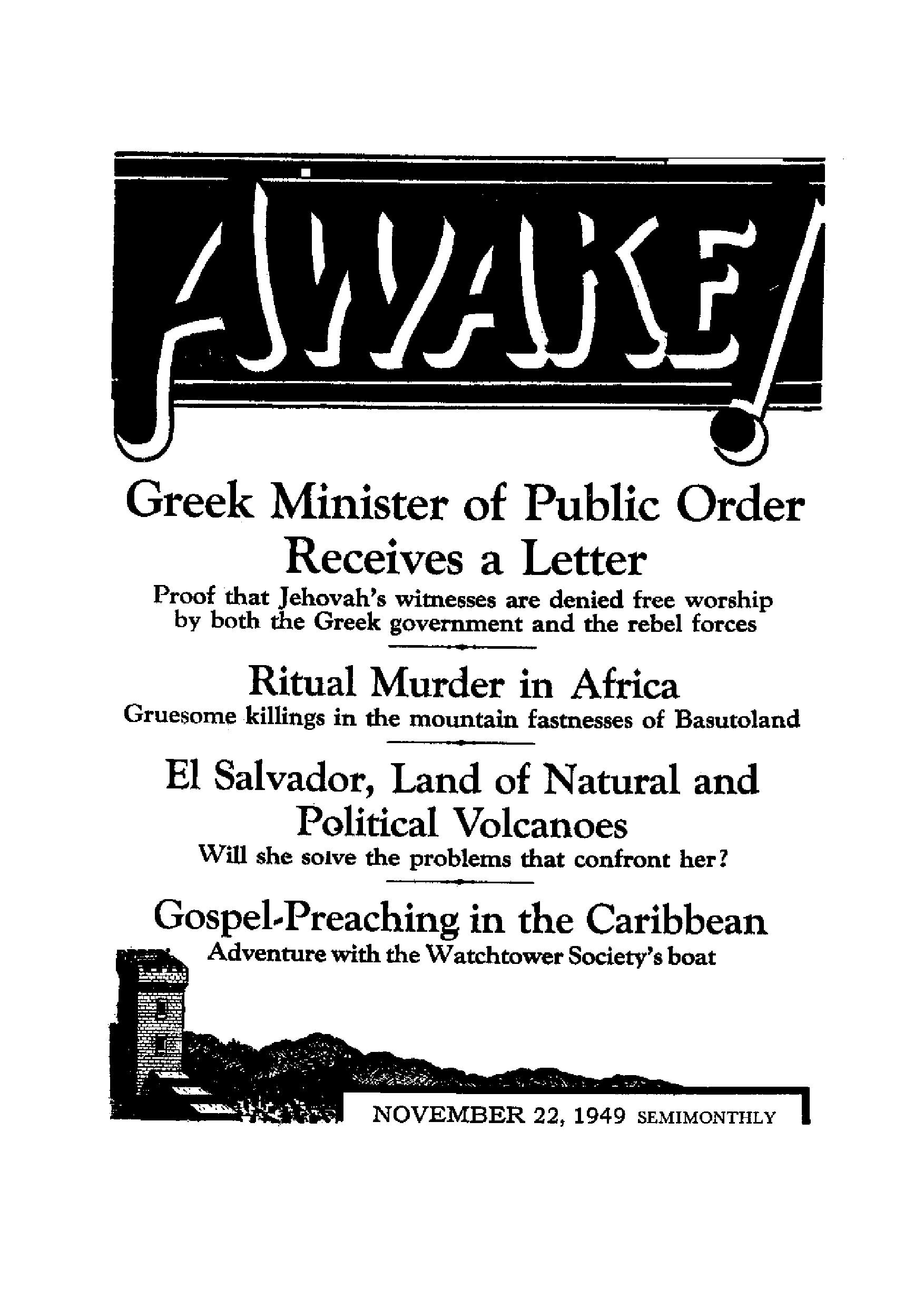
Greek Minister of Public Order Receives a Letter
Proof that Jehovah’s witnesses are denied free worship by both the Greek government and the rebel forces
Ritual Murder in Africa
Gruesome killings in the mountain fastnesses of Basutoland
El Salvador, Land of Natural and Political Volcanoes
Will she solve the problems that confront her?
Gospel-Preaching in the Caribbean
ml Adventure with the Watchtower Society’s boat
THE MISSION OF THIS JOURNAL
News sources that are able to keep you awake to the vital Issues of cur times must be unfettered by censorship and celfish interests. “Awake 1,J has no fetters. It recognize* factst face# facts, is free to publish facts. It is not bound by political ambitions or obligations; if is unhampered by advertisers whose toes must not be trodden on; it is unprejudiced by traditional creeds. This journal keeps Itself free that it may speak freely to you. But it does not abuse its freedom. It maintains integrity to truth.
“Awake 1** uses the regular news channels, but b not dependent on them. Its own correspondents ore on all continents, in scores of nations. From the four corners of the earth their unccnsored, <yn-the-acene# reports come to you through these columns. This journal’# viewpoint is not narrow, but b international. It is read in many nations, in many languages, by persons of ail ages. Through its pages many fields of knowledge pass in review^govemment, commerce, religion, history, geography, science, social conditions, natural wonders-—why, its coverage is as broad aa the earth and as high as the heavens,
"Awake !" pledges itself to righteous principles, to exposing hidden foes and subtle dangers, to championing freedom for all, to comforting mourners and strengthening those disheartened by the failures of a delinquent world, reflecting sure hope for the establishment of a righteous New World.
Get acquainted with "AwakeT Keep awake by reading “Awake!"
PUBJ.JBHED SmifOKTHLT Bl WATCHTOWER BIBLE A24D TRACT SOCIETY INC.
117 Adami Street Brooklyn 1, N. Y.t U.R.A.
> IT. GJtt^f Sun fix. feecreiarp
Fiv* cent* ■ copy Ong Ooilir a yur
be artit bi Ui yra eoj«-t7 In with rr«il»tj<o eg [iirictH
MTt ftt'lwi 5t HJinicf HtrpitUm** NCttpKO it Pr»Urn frgM L-nujU-W wiwt m oftea 1* kr*Led, hj mney trJ«r onir S*4acrJptlM
nut iti ditenm cmunriet >n fert ititid In Jw*I t^rrfxr.
N»tJM «f utlMUw 1*llb rurt-il Mint) U g*m it h«tt 1n<j Iwm bcfvn iuMcr.ct.in
Ectgred u jgecod-dL« natur it IruAklTD, N.
Cki*9* «t iMrttt whw seat to yjr o<r« inaj fee ixreeUd gSertlw with in mt mcntra. Sued jucr •'! ii fell mi tlW.tsl
OKm furls Sufeseriptlan Rati
AtHrlti, U,|, II’ AOnu Bk. 1. N.Y. »!
A hl till li, 11 ikroferd Id. biri'.h'IcM. N.s.W. fti tfeUNi. 10 Irvin An . 1»r«Aj Out*"is II Et|liBd, 31 (rtres 'Te-ftn Lx.oj;■, 4, a 6t Uitfe Aftta, feutoc Wgu*. Cipg Tova Ai
T., let «c n«nb 5 imb" fn^uc in u. s. a.
CONTENTS
Greek Mir.ifd.pr of Public Order
Receives a Letter
Exiled Bemuse of Their Faith
Witnesses uj Greece Not Communists
Greek Comm uniats Murder Witnesses
Whom the Government Executed
Ritual Murder in Africa
Animal Antics
El Salvador, Land of Natural and
Political Volcanoes
Heated Politic
Political Volcano Explode
B
Gospel-Preaching in the Caribbean
Storm-tossed Around Cape Materas
Tn the Bahamas at Last!
Dividing ‘‘Shrrp" from “Goau”
Is Jeruisairni * 1]oly (Ttyf
A Ci!y of Multiplied Atrocities
Massacres Otitsitie the Walls
End of Mandate Did Not End Trouble 23
“Ttv Word Is Truth”
“Parents in the Lore"
Second 'Eucharistic Congress in Ecuador 27
Watching the World
/AWAKE!/
^™Now it is high time to awake.’—Romans 13:119)
Volume XXX Brooklyn, Nr November 2Z, *l®48 Number E2
M=^=— * ■ ■ 1 _______■ .■ '-■_ ' -------- ' * ----------------"”= ■ U-Ki-i-11
Greek Minister of Public Order Receives a Letter
REPORTS about the terrible persecution of Jehovah’s witnesses in Greece have appeared in the newspapers in many parts of the world. On several occasions readers of the Awake! magazine have been given detailed reports of the shocking facts. Letters were, sent by many liberty-loving people of the world to the competent authorities in the Greek government, protesting the cruel persecution, imprisonment and killing of Jehovah’s witnesses in Greece.
The Minister of Public Order, Mr. Rentes, and the Minister of War, Mr. Kanellopoulosj wrote a number of replies to the protests, trying to whitewash the position of the government. They dogmatically stated that no one in Greece is persecuted for his religious beliefs. Not only ^hat, but they tried to create the false impression that there is a connection between Jehovah’s witnesses and the communists in Greece; it was said that “many communists hide under the mantle” of Jehovah’s witnesses, which is anything but the truth.
Therefore it was necessary to address a letter to Mr. Rentes and send copies to Mr. Kanellopoulos and principal members of the Greek government, as well as to the United States Embassy at Athens. The facts could not be stated more clearly. Now the Greek government has no excuse. It has the choice of allowing the undemocratic persecution of Jehovah’s witnesses to go on and taking full responsibility for it before God and the world or else immediately seeing that justice is done and freedom of worship made available to everyone in Greece, including the now-persecuted Jehovah’s witnesses. The letter read:
September 15, 1949
His Excellency 0. Rentes Minister of Public Order Athens, Greece
Sir:
The Watch Tower Bible and Tract Society is a non-profit organization which was incorporated in 1884 under the laws of the State of Pennsylvania in the United States of America for the purpose of disseminating Bible truths. The Charter of the said Society stipulates that the Society is the legally constituted governing body lor that group of Christians known as Jehovah’s witnesses. Jehovah’s witnesses are found in most countries of the world, and, as you know, there are many of them in the Greek Kingdom, Because you are honored tb be in the high position of Minister of Public Order, your attention has been called by various persons and organizations, including certain Members of Parliament in London, to the persecution of Jehovah’s witnesses who live in Greece and you have found it convenient and necessary to write concerning the position of Jehovah’s witnesses in your country. We now refer to letters you wrote to friends of ours in London and Paris, dated May 21, 1949 ref: 21/2/107 and May 25, 1949 ref: 21/2/107.
Government Denials False
In those letters the statement was made: “No one is persecuted in Greece for his religious beliefs.” Yet today it is a matter of historical record that Jehovah's witnesses in Greece have suffered and are suffering continued persecution, which has actually been constantly intensified and increased. We are honestly sorry that in your famed land ^uch a state of affairs exists, a fact which is in full opposition to and contradiction with official assurances and also with the spirit of democratic ideals and religious erance governing the western world.
In times- past communications reviewing concrete cases of such actions have been submitted to responsible officials of the government of Greece and, even recently, to your ministry, fully testifying to the existence of this unjust persecution. We now briefly direct your attentiofi to specific cases which are characteristic of the religious persecution against Jehovah's witnesses who live in Greece:
I. In the evening of April 12, 1949, nine of Jehovah's witnesses (five men and four women) were arrested en masse while they were celebrating the Lord's Memorial (often referred to as Communion). They were taken to the police station, where they were detained for four days and then were released. Later, on August 8, 1949, they were required to appear for trial in the Athens Extraordinary Court-Martial. In spite of the depositions of the witnesses for the prosecution to the effect that it was a religious meeting, as well as the fact that the searches made disclosed only Bibles and other Christian literature of Jehovah's witnesses, plus the bread and the wine on the table, and in the face of the testimony of the defendants that they, as Christians, met together peacefully in order to celebrate the Lord's Memorial, the Court-Martial sentenced all nine and imposed penalties of from 2 to 8 months in prison. Three-year suspensions were granted to six of the defendants. The other three were taken to prisons. These were:
1. ISvanghelos Kolettis, aged 63, suffering from ulcers of the stomach and hernia (8 months in prison);
2. Maritsa Saran tithou, aged 34, mother of two minor children (8 months in prison) ;
3. Stassa Panayotopulu, aged 55 (6 months in prison).
The Court allowed redemption of the penalties and fixed it at 28,000 drachmas per day; but these witnesses of Jehovah were not able to pay such money and so remain in prison, suffering only for righteousness' sake. This was reported in the press as follows:
“The A Section of the Athens Extraordinary Court-Martial sentenced the following millennialists yesterday: Evang. Kolettis, to 8 months prison; J, Vlachopulos, Stam. Vuvudakis, Emm.Loghiotatos,to 5 months; Harris Phantazia, to 4 months; Maritsa Sarantithou, 8 months; Stassa Panayotopulu, 3 months; and Chryssanthi Vezyryan-ni, 2 months, because of not complying with the Military Governor's order and meeting together without a permit from the police authorities in a house where they applied themselves to worshiping Jehovah.” —Eleftheria, Athens, August 10, 1949.
Thus it is admitted by the Greek press that “worshiping Jehovah”, the Almighty God, is sufficient to make “criminals” of Jehovah's witnesses under present Greek jurisprudence. That is indeed deplorable.
Exiled Because of Their Faith
II. At Patras, nine witnesses of Jehovah were arrested on June 24, 1949, while at their homes and places of work, without any reason and without having transgressed any law of the country. They have been exiled to Makro-nesos Island for one year because they are Jehovah's witnesses. This is nothing else but outright persecution of Jehovah's witnesses for their faith.
III. At TrikaJa (Thessaly) Jehovah's witness Nic. Stefopulos was arrested on June 6, 1949, and on the strength of a decision No. 123/49 of the local Commission of Public Security he was exiled to Makronesos for one year. The sending to him from Athens of a small parcel which contained copies of our Christian magazine The Watchtower (printed in Greece) intended for subscribers in the Trikala district was found to be sufficient cause for him to be arrested and exiled even before taking delivery of the parcel, This is nothing else but outright persecution of Jehovah’s witnesses for their beliefs.
IV. At Rhodes (Dodecanese) Pantelis Pa-paemmanuel and Athanassios Antoniades, both of whom have been Jehovah’s witnesses for a number of years, were arrested on July 25,1949, and exiled to the barren islands Anaphi and Folegandros for four months. This is persecution of Jehovah’s witnesses fofr their faith.
V. In the village of Vromovrysis (Calama-ta, Peloponneses) Jehovah’s witnesses Athanasios Voutsas (father of five children), Nico-laos Theodoropulos (father of three minor children) and Elias Kamarinopulos, were arrested and charged with proselyting. They were committed for trial and by virtue of decision No. 457/4,5.49 of the Calamata Criminal Court they were discharged of all accusations. In spite of this, however, the local police authority arbitrarily arrested these three family men on June 23, 1949, because t they were Jehovah’s witnesses and they are now kept under arrest in the lockups of the village ctf Arfara, Calamata district. This is purely a case of persecution of Jehovah’s wit-, nesses on account of their faith. ,
VI. A letter received from a lawyer at Trikala (Thessaly) states that from August 18 to 24, 1949, the following witnesses of Jeho-vah were arrested and placed in the Trikala Camp: G. Papageorgiou, N. Papageorgiou, S. Papageorgiou, C. Peristeris, and Ch. Stro-matas, all residents at Eleftherochori (Trikala) ; and J. Costarelos, D. Costarelos, G. Costarelos, and C. Mustakas, all residents of Dendrochorion (Trikala) । and N. Frangos, A. Nizamis, N. Nizamis, A. Katsiakos, C. VLa-chos, and G. Betsikos, all of Fiki (Trikala); and A. Tsaggaridas and N. Tsaggaridas, of Dousikon (Trikala) ; and S. Grammenos, V. Vaitsis and V. Kyritsis, of Baya (Trikala). As is always the case where Jehovah’s witnesses are concerned, these persons never had any connection with banditry nor with any kind of anarchist organization. They werp arrested one by one from their homes, farms, meadows, and other places of work. They were arrested on the grounds that they "apostatized from Orthodoxy and are witnesses of Jehovah, or Millennialists, as they are generally called.” They were brought before the competent police officer. He put the question to them as to 'whether they will henceforth be going to churches of Orthodox Christians’, and, as they replied in the negative, they were taken to the Camp. This is in direct violation of the Constitution and is clearly a persecution of Jehovah’s witnesses for their faith.
VII. That the actions which are being taken against Jehovah’s witnesses in Greece are taken on account of their beliefs and for the purpose of converting them to Orthodox beliefs can be easily seen when the treatment of Jehovah’s witnesses now imprisoned at Makro-nesos Island is reviewed. The Ministry of Public Order communicated to them through Mr. Kolovos, adjutant to the local administration, that if they wished to obtain the benefit of a release they should disavow their “heretic” religious beliefs, as he called them. As punishment for not denouncing their faith, Jehovah’s witnesses at Makronesos Island were ordered transferred to a compartment containing purely communistic, godless elements and. were told emphatically and repeatedly that they are never to be released unless they disown their religious beliefs as Jehovah’s witnesses.
These are but a few.examples of instances where Jehovah’s witnesses in Greece have been persecuted. Many more cases can be cited if you wish further proof of the fact that people are persecuted in Greece for their religious beliefs. None of the above-mentioned Christian people have committed anything worthy of so cruel a treatment.
m Greece Not Communists
Through the newspapers and periodicals in other parts of the world the news of these persecutions reaches the minds of the people. Good-will persons in Anglo-Saxon countries and other nations have learned with deep regret that Christian witnesses of Jehovah in Greece are suffering what must be called intolerant and medieval treatment. Jehovah’s witnesses are known all over the world. They are recognized to be peace-loving and lawabiding men of the highest principles, for their principles are based on the Bible. There is no connection whatsoever between Jehovah's witnesses and any political movements, especially with the communistic and ungodly elements. Some men have done disservice to your country by incorrectly reporting that Jehovah’s witnesses have in their midst fellow travelers of the communists. Those who oppose the worship of Jehovah's witnesses make an effort to identify Christian witnesses of Jehovah as, or liken them to, the ungodly communistic elements. Perhaps some men have been deceived by the lies of those who are opposing Jehovah's witnesses. It is truly sad that some have apparently believed this abominable slander.
It should be known by all responsible officials of the Greek government that the writings and publications of the Watch Tower Bible and Tract Society have been distributed for more than 65 years in all parts of the world. They have appeared in more than 90 languages, clearly outlining the Christian principles and beliefs of Jehovah's witnesses. Everything that the Society has published has been according to the Holy Scriptures and it has been in direct opposition to the delusive theories of godless communism. Because of the opposition of Jehovah's witnesses to godlessness in all its forms, those adherents to the faith who reside in countries now behind the so-called “iron curtain” are suffering violence and exterminatory persecution.
In Yugoslavia, after communistic rule gained away, the three principal supervisors of the witnesses of Jehovah were sentenced to death and twelve others to prison for fifteen years of hard labor because they had relations with the Watch Tower Bible and Tract Society's offices at Brooklyn, New York, U.S.A., and Berne, Switzerland. The Society's branch office in Yugoslavia was closed at that time and the worship by Jehovah's witnesses in that country outlawed. That condition remains to this day.
When communism grabbed control of Czechoslovakia the rulers took steps against the Watch Tower Bible and Tract Society, The branch office of the Society in Suchdol u Prahy was entered by the state police, all files were taken and the entire personnel were rounded up and placed in prisons. Since then the Society's representatives have been placed in labor camps; they received no court trials.
The work of Jehovah's witnesses and the Watch Tower Bible and Tract Society has never been allowed in the Soviet Union. When, through World War II, land was acquired by the Soviet Union, thousands of Jehovah's witnesses found themselves inside the new borders. They tried to carry on their worship of Jehovah God, but it was not permitted. Hundreds of Jehovah's witnesses have been exiled to and tormented in the work camps of Siberia. Many were not permitted to go to Siberia; their lives were taken instead.
Persecution of Jehovah’s witnesses is great also in Poland, Romania, Bulgaria, and Hungary. But Jehovah's witnesses have not been shaken in faith on that account. Those who remain free continue to carry oh their worship in the face of threats of arrest and death.
Greek Communists Murder Wftneaaes
And what of Greece under the rebels? Particularly in Western Macedonia district, where the communists remained for a while in the spring of 1948, Jehovah's witnesses were cruelly mistreated by them. One of Jehovah's witnesses, Christos Molotas by name, aged 37, father of five children, "was killed on March 5, 1948, by communist bandits because he declined to render services to them.” (Certificate of the President of Community Mavraneon, Grevena, dated July 19, 1948.)
You may say it is to be expected that innocent people will receive such treatment under communistic misru'p, and we are in full agreement because such misrule is anti-God and anti-Christ and we have already seen the fruits. But it is very sad to say that a similar mistreatment of Christians is occurring in parts of your anti-communistic country.
It is true that Jehovah's witnesses (called “Millennial!sts” by some in your country) are dissenters to many of the beliefs and teachings of the Eastern Orthodox Church. We submit that the persecution campaign now being waged against Jehovah's witnesses is almost entirely, if not entirely; due to the fact that they are not in full agreement with the teachings and actions of that Church. Indeed it is painful to see that so many blameless and harmless Christian people have been caused to suffer imprisonment and separation from families merely because they chose to worship God according to the dictates of their own consciences. While their worship may not be popular with the majority and is not in accord with the dogmas of the Eastern Orthodox Church, nevertheless it is not wrong for Jehovah's witnesses to so worship. It is right. It is inconceivable that anyone should be able to envision in the worship of God by Jehovah's witnesses any danger to the country. You will find none of Jehovah's witnesses in the prisons of your land on account of the fact that they have been guilty of stealing, murder, vice, insurrection, or violence. We submit that they are the most law-abiding class of people in the Greek (Kingdom today. They have not participated in the politics of the land, nor have they incited anyone to rebellion against your government. The only "crime" of which they have been found guilty has been that they have persisted in. their Christian ministry and in their manner of worshiping God, and "that has in no way violated the moral decency nor jeopardized the security of the state.
It is a blemish on the historical record of your country that innocent Christian people have been permitted to thus suffer. Apparently there is an element among the people of Greece who seek to besmirch and destroy the worship of God as performed and practiced by Jehovah's witnesses. This is somewhat similar to the situation which arose in the days of the prophet of God named Daniel. In the Sacred Writings of the Bible (Daniel 6:5) appears the record of how men of olden times sought to prevent Daniel from worshiping his God as Jehovah commanded. No fault could be found in him except in his way of worshiping, so mischief was framed against Daniel to bring about his untimely death. The result* as we feel sure you know, was that Daniel was rewarded by God for his faithfulness and the persecutors met with disaster because the just ruler saw through the plot.
Your attention is respectfully called also to the wise counsel that was given by the doctor of laws named Gamaliel in the days of the persecution of the early Christians on account of their worship:
"Ye men of Israel, take heed to yourselves what ye intend to do as touching these men. For before these days rose up TheudaB, boasting himself to be somebody; to whom a number of men, about four hundred, joined themselves: who was slain; and all, as many as obeyed him, were scattered. and brought to nought. After this man rose up Judas of’Galilee in the days of the taxing, and drew away much people after him: he also perished; and all, even as many as obeyed him, were dispersed. And now I say unto you, Refrain from these men, and let them alone: for if this counsel or this work be of mon, it will come to nought: but if it be of God, ye cannot overthrow it; lest haply ye be found even to fight against God.”—Acts 5: 35-39.
If someone in Greece who is held in the esteem of the people were to make similar public utterance in these days.of turmoil and war, it would surely be a great service to the country, for it would bring about a unifying of the ranks of the people and would be a means of. alleviating the terrible persecution of Jehovah's witnesses in Greece.
Whom the Government Executed
The investigation which you were pleased to make for providing information regarding Jehovah's witnesses executed in Greece, namely, John Tsukaris and George Orphanidis, is much appreciated by us. Nevertheless, to the free peoples living outside of the "iron curtain” it is incomprehensible how it is possible for men proved to be consecrated to God and the ministry to be taken before the firing squad or sentenced to long-term prison because of being unable to take up military duties owing to their sincere and indisputable Christian beliefs.
We think it will be interesting to you to know some of the details regarding the executed minister of the gospel, John Tsukaris: His parents were Jehovah’s witnesses, and he was consecrated to God from his early youth. He had always been a chaste Christian, spending his life in God’s service and seeking to put into practice his Christian faith and beliefs. In October 1947 rebels invaded this village where he lived, Karytsa'(Thessaly). Among those abducted from the village was John Tsukaris. The rebels pressed him hard to take on arms. He refused owing to his responsibilities as a minister of the gospel. They put him through the “rebel-court” hearing and sentenced him to death. Out of an entirely accidental event he was saved at the last moment, escaping and going to the ranks of the national army, wherefrom he was set free. In August 1948 he was arrested at Larissa as one of Jehovah’s witnesses. You are quite familiar with the tragic conclusion of the Tsukaris case.
The case of George Orphanidis is quite similar. Regarding the character and strict attachment of this youth to the gospel principles you may inform yourself accurately from the Royal Attorney of the Corinth Court-Martial which sentenced him and also from the Orthodox religious circles of the Nauplia Metropolis.
Also similar are the cases of the other Christians who have been sentenced to many years or life-long imprisonment, or even death, with votes of 3-to-2 and 4-to-l and who are detained in several prisons of your country. A careful and minute examination of the dossiers of all above eases will fully persuade you of the fact that reasons of purely individual Christian faith led these chaste Christians to make simple and dignified statements to the competent authorities to the effect that they felt unable to depart from their worship of Jehovah God and their beliefs which are deep and unshakable. They hid nothing of their reasons for their stand and consequently they are not at all persons hiding subversive activities under the mantle of religion.
Moreover, it is necessary to emphasize that these matters of consecration to God are strictly individual and each one who is a mature Christian is certainly able to give a ready answer for the hope and convictions that are within him, according to the good admonition given at 1 Peter 3; 15,16. We believe every person should enjoy freedom of conscience and therefore we do not participate in any violation of the principles governing freedom of conscience by meddling with the consciences of our fellow believers. Each one must take his own position in line with his conscientious scruples and his beliefs, Jehovah’s witnesses have never hindered any person from serving in the armed forces of his country according to his own desires. Also, they do not oppose the efforts of any nation to raise an army by conscripting its manpower.
If you should wish to have more information concerning Jehovah’s witnesses in Greece or other lands, please communicate with us at once. t
Now that we have brought certain facts to your attention we trust that you will see the true position more clearly and, as far as it depends on you as Minister of Public Order, will take a strong and suitable step to put an end to this repugnant situation. It would render a great service to your country because a certain stigma has been created through the fact that Jehovah’s witnesses are, wrongfully persecuted in Greece. Moreover, this course of yours' would be in keeping with the provisions of the Greek Constitution in force, which insures free operation of any “known” religion, and states that worship services can be performed without hindrance, under protection of the laws. We are not asking you or anyone else to agree with the teachings or tenets of the faith of Jehovah’s witnesses, but we veiy frankly ask you to do what is in your power to make it possible for Jehovah’s witnesses and all other law-abiding peoples in Greece to openly and without fear of persecution practice the worship of Almighty God. The citizens of Greece can never be contented until this freedom is theirs.
Respectfully submitted, Watch Tower Bible and Tract Society M. G. Henschel, Director.
blank spot somewhat
southeast of the
geographical center of the Union, me empty area appears as a roughly drawn rectangle, within which, except along its northwest border, the map shows few place names and nd roads. It appears as, an island of isolation set in a sea of civilization. AU around it flow the arteries and appear the settlements of the lustily growing Union of South Africa, but at its boundaries the tide of bustle and progress ceases as though mighty cliffs abruptly barred its way. Within the ragged rectangle stretches an unending vista of mighty mountain peaks and ranges, valleys, chasms, cliffs and mountain streams. The name of this mountain stronghold is Basutoland, or, as its Native inhabitants call it, Lesutu.
Building a Nation
Unique is the fact that the nation of mountaineers which now inhabits Basutoland is hardly more than a hundred old. When the year 1800 dawned, the forefathers of the present Basuto nation dwelt as scattered, independent tribes upon the plains of what is now the province of the Orange Free State and in the flat, dry wastes of Bechuana-land. But across the Drakensberg (Dragon mountains), in green Natal, a destroyer had arisen. Tshaka, the Black
Gruesome killings in the mountain fastnesses of Basutoland, as recounted by “Awake!” correspondent in South Africa
Napoleon, was welding the Amazulu into a military power. He had discarded the throwing assagai and had armed his men with the short stabbing spear and had shown them how to get in close and kill.
Soon the dreaded “horns” of the Zulu impis were reaching out to destroy. Whole tribes perished. Others, broken and desperate, fled north and south, and west across the frowning “berg” into the plains beyond. And a.s they fled they emulated their destroyer and hacked and slew and burnt whatever lived within their path. Pandemonium raged among . the tribes of Southern Africa. The wnpis ' of Tshaka, the “Great Elephant”, slew not less than a million men, and the slaughter had repercussions as far north as the banks of the Zambesi. Amid this turmoil a young chief arose in what is now Western Basutoland. His name was Moshesh, and of him a commentator has written:
This young man had ideas about government other than those of Tshaka. Instead of sending men to death by impalement with a wave of his little finger, and of causing living men and women to be cut to pieces; instead of waging a never-ending war on every neighbour, near and far, this chieftain invited the homeless to come and live with him ■ ■ -among the Maluti peaks. He offered grain to the hungry, and cattle to those who had no meat When he sat in council it was to speak words of justice . . , Tidings of this new kind of leader spread like lightning through the desolated marshes of the Zulu Empire. [African Switzerland, page 42]
Thus was the Basuto nation born. Fugitives flocked to Moshesh from far and near, and soon the young chief was a force to be reckoned with by black men and white men alike. For in 1835 began the Great Trek, and Dutch-speaking inhabitants of the Cape, dissatisfied with British rule, began to travel northward in increasing numbers. Many of them settled in the empty plains to the north and northwest of Lesutu. These white men —the Boers, as history calls them—recognized Moshesh's sovereignty and made treaties of nonaggression with him.
Two factors determined that those treaties should not be kept; the Basutos were,incorrigible cattle-raiders and Moshesh possessed territory which the white man coveted. This was a strip of flat, level land, thirty miles wide, which ran for a hundred miles abutting Moshesh's northwest mountain "wall”. This area, today the Union's, granary, is one of the few spots in South Africa where the soil is deep enough and the climate told enough for wheat to be grown. The next 35 years saw constant friction between the Basutos and their white neighbors, culminating in war.
Moshesh defeated the white man, both Boer and Briton, several times, not only on the field of battle but even more decisively in the field of diplomacy. He is remembered today as the “Black Statesman". But in his old age he was forced to acknowledge the superiority of the white man's arms. In 1867, after an exhausting war with the Orange Free State Republic, Moshesh sued for peace, promised to end the cattle-raiding and gave the white men the wheatlands they desired. Then, fearing the eventual absorption of his country by one or other of his white neighbors, he asked that Lesutu be taken “under the Queen's blanket" as a prot6g6 of the British Crown. That is its position tndav.
The, Protectorate
Basutoland is a native state. White men may not acquire land therein. Much of the administration of the country is in the hands of chiefs, hereditary descendants of Moshesh, over whom the British government exercises what has been termed “a benevolent despotism”. They are regarded as being the most intelligent of the South African tribes. Education in Basutoland is almost entirely in the hands of mission societies, supported by government funds. French Protestants were first in the field, and until a few years ago French Protestantism was almost the “state religion" of Basutoland. But it has been superseded by Roman Catholicism, which is now the dominant religion in the territory. This change can be largely attributed to the conversion to Catholicism some years ago of the Paramount chief. There is good reason to believe that his choice of religion was influenced by Rome's willingness to wink at the continued heathen practices of her converts.
Ritual Murder
Basutoland has been known as a country in which serious crime is almost nonexistent. This has served to emphasize the frightfulness of a series of ghastly murders which have been committed among its mountains since the second world war ended. These were no ordinary killings. They were murder by ritual, and in nearly every case the master of ceremonies was a chief dr subehief, descendant of Moshesh. The pattern was similar in each case. A victim was selected, overpowered and taken to some lonely place of execution.
' It was no quick, easy death. First the living victim must be mutilated. Sometimes his nose or his ears were cut off, or his eyes removed. Sometimes flesh was cut from his whimpering body and cooked and eaten, or blood collected from an opened vein and drunk. Only then was the victim permitted to die.
In August, 1949, one of the most nauseating of these killings was considered by the High Court at Maseru, the seat of British administration in Basutoland. The trial was peculiar in that the principal actors in the crime, Chiefs Bereng
Lerotholi and Gabashane Masupha, two of BasutolanfcTs leading chiefs, were not present They had been hanged a few weeks previously for another ritual murder of which they had been found guilty.
The case now before the court followed the all too familiar pattern, except that the killing had not taken place among lonely mountains, but along a main road within 40 miles of Maseru, and had been witnessed by an estimated number of 60 persons. Chiefs Bereng and Gaba-shane had given the word and a victim, Paramente Khotatso, had been caught, much as men catch a beast for slaughter. A drug had been administered to render him incapable of resistance and then a fiend named Michael Tskei had done the chief's bidding. Armed with a surgeon's scalpel and rubber gloves, Tskei removed completely, the living skin from Paramente's head and face. The eyes, nose and tongue were then excised and the bloody trophies carefully collected in a billycan to form the basis for certain nameless, savage rites. The horror which had been Paramente was then east into a cave of evil repute, known as the “Cannibals' Cave”.
From Tahoka to Rome
The term “voodoo” has been applied to these murders. This is a misnomer. Voodooism is the fetish worship of West Africa transplanted in the days of the slave trade to the West Indies and America. The ritual murders of Basutoland are not the-, fetish worship of West Africa. They hre the acts of men who see their power waning and who have reverted to the demonistic savagery pf their ancestors for cure.
The children of Moshesh, the hereditary rulers of Basutoland, have on the whole shown little of the ability and progressiveness of their famous progenitor. Today the chiefs are largely ignorant and unlettered men, clinging to old forms and customs and presenting a very real barrier to progress. On the other hand, a group of Basu to intelligentsia is arising, demanding reforma. The chiefs watch, jealously and suspiciously.
Conservatism turns ever backwards, and the chiefs (or some of them) have turned back farther than the founding of their nation, to the superstitions and practices in vogue among the tribes^ before the wise Moshesh^ the imbaptized heathen, put them down with an iron hand. Every Bantu tribe has its tradition bf human sacrifice to seal a chief's appointment and of “medicine” made from human flesh to increase his power. In addition, the Basutos almost alone among the tribes have a tradition of cannibalism. For in the days of Tshaka, •starving men ate men in the Maluti mountains and learned to like the taste of human flesh. Man-eating spread as an evil cult throughout the land. The inaugural sacrifices of the old Bantu chiefs and the lingering cult of cannibalism seem to form the basis of the Basutoland ritual murders, performed by superstitious men. to increase and perpetuate their power.
From Basutoland to Rome is a far cry, but the Roman Catholic Church cannot escape a measure of responsibility for these sordid crimes. The chiefs of Basutoland are nearly all her acknowledged children. In their acts of murder is reflected the failure of the Church of Rome to enlighten men's minds with the Word bf God. It is small wonder if her superstitions, impressed on simple minds, have called to life other superstitions only half-forgotten.
Animal A vtics
C “These chickens are the nearest thing' to a schmoo of anything alive.” So declared Peter Baumann, of Des Moines, Iowa. He referred to his breed of wingless chickens, developed after 12 years of selective breeding. He has about 400 of them. Advantages? White meat where’bony wings once were; drumsticks that are bigger; no high fences needed to keep them from flying the coop. The chickens cannot fly at all, and can high-jump only about 20 inches. So, a 2-f oof fence keeps them in. The hens lay about the same as other chickens, and 95 percent of the eggs hatch out wingless offspring. The roosters lack zest for living associated with the barnyard cockerel. They have no wings to flap when crowing or drop when strutting, and care little for fighting other cocks.
A hobo cat in New Jersey rides the rods, but not on the trains. A motorist on a 20-mile trip heard a meowing in his motor. Looks under the hood were unrevealing; so at the end of his journey he went to a garage. They found a hitchhiking cat perched on the axie. xney gave the feline the bum’s rush. Twenty minutes later the garageman’s telephone rang. Another motorist who had recently left the garage was on the line: “The cat’s parked on my transmission and won’t get off!” He’ll need his nine lives.
C. You’ve heard of the man that eats as though he had a cast iron stomach? He has competition. The Game Department of Uganda says that “the digestion of the crocodile is both powerful and rapid. In a period of six to eight months a mild-steel hook, a quarter-inch thick, can be completely digested. In one instance a male crocodile, in reasonably good condition, was eaught with a spear iron healed in its back. About four inches of this iron had been digested away without leaving a trace”.
C, The U. S. National Museum in Washington now has frogs that eat mice and bellow like bulls. They hail from the mountains of Brazil. Not stopping at being five-by-fives, they might be called Mr. and Mrs. Six-by-Six (inches). Their mouths are so wide they hardly stretch to gulp down mice or other frogs. Nor do they flee before such monsters as humans: they merely swell up like a balloon and cut loose with their bellowing. Outgrowths of skin that protrude like horns enhance their fierce appearance.
C Atop a mountain in Yellowstone Park is a neighborhood nursery. Not for human babies nor by human nursemaids, but for bighorn lambs by bighorn ewes. The mothers take turns watching the youngsters, disciplining by rebuking snorts or even butts for a particularly unruly juvenile delinquent. Papa sheep is off with the other rams, taking no turns or even interest in this daytime baby-sitting. He will not even take notice of the ewes till fall. He’s no ewe-pecked husband for baby-sitting shifts.
< Lorehen should have known about the boy in the fable that yelled “Wolf” so often that eventually none heeded him. Lorchen is a parrot, kept in the office of his master, proprietor of a stamp and coin company in New York. When a customer entered Lorchen would shout, “Help! Lemme out!” When the person left the parrot would bid him “Good-bye”, and sometimes add a jolly “Get out of here!” One afternoon gabby Lorchen set up his usual clamor. None of the neighboring tenants iri the office building bothered. The only reaction to Lorchen’s frantic cries was unkind comments about the voluble bird, A half hour later a customer sought entrance, found the door locked, and hunted up the assistant superin-, tendent. They found Lorchen still screaming “Help”, found his master bound, but did not find the two thieves who disappeared with coins and stamps and $744.
LAND OF NATURAL AND POLITICAL VOLCANOES By "Awake!” correspondent in El Salvador
TT IS 12:31. 1 The big plane settles lower toward the mottled earth beneath. Ragged Guatemalan mountains now a good thirty minutes behind appear in the distance as a faint, purple fringe on a backdrop of blue. The rich lands below seem to form a crazy quilt of greens and browns. This is El Salvador, where Spanish flows like water; where the sun sparkles in the streets; and dark eyes do too.
thing, and it has long since left behind _ the agonizing labor of pioneering roads
Lopez, so soon, is conscious of the great- through swamps and jungles, a job yet to er heat of El Salvador even before the be done by some of her neighbor^. El
The plane is now very much lower. Senor Lopez’s watch shows him exactly 12:45. Obeying the red warning light, the kindly old gentleman fastens his safety belt as do the rest of the passengers. Another drop in altitude and tiny, winding roads run hurriedly in all directions. Coconut palms rocket by on both sides; an explosion of trees and mixed colors flashes into view and out of view’. Time for a deep breath—and then is felt the slight rolling of cushioned wheels on the concrete runway. Senor taxi run up to the temporary shed used by - TACA for its terminal office. The fresh breeze which fills the ship with the opening of the doors is welcomed by all. Senor Lopez is-home.
This too is ’ home to two million* Here iridescent mountains shut in the richness of the land and comb the clouds with their jagged peaks. Volcanoes such as the formidable Izalco, which overlooks Sonsonate in the west, enchant the inhabitants with great displays of fire and smoke. Izalco, majestic in its place, passes the daylight hours puffing noiselessly like a huge cigar. In the nocturnal heavens, the hapless clouds that drift too near are set ablaze as their lacy wisps
brush by Izalco’s white-hot crater.
Surprisingly
the country is not overrun by visitors; nobody seems to be too concerned about it in El Salvador. Occasionally one will read of a mild movement to encourage tourist visits, but nothing is ever done strenuously toward that end. As a result one does not find there a bazaar of excursion parties, travel agencies, and picture-taking tourists. Some of the most beautiful features of the country have never been exploited nor abused commercially, but they have been left to glow becomingly in their natural and original environment. But the country is not backward. It was the first of all in Central America to complete its part of the Pan-American Highway, which highway is only one of numerous paved roads that traverse the land.
Transportation is a well-established
Salvador, having only 34,000 square ' kilometers [13,127 square miles] of land area and being the smallest of the Central American republics, still can boast in having made those kilometers accessible to her people.
For eighty cents of a dollar and from the doorstep of one's home in San Salvador, the republic’s capital, one can step into a latest-model station wagon and be delivered with touring-car comfort to one’s destination 35 miles and 90 minutes away in Santa And, second city in importance. For those of poorer means there are buses which are scheduled to run continually every half hour between San Salvador and Santa Ana. The other larger cities of importance, such as San Miguel, San Vicente, Sonsonate and Ahuachapan, are likewise served efficiently by bus service. This transit system provides an irreplaceable factor toward a strong national unity.
Also, an effective transit system has been worked out for the city of San Salvador. The fare to any part of the city on a municipal bus is $.02, and by means of this service the citizens may avail themselves of the comforts and pleasures of their beautiful municipality. Parks and sunny plazas are abundant, as is common in Latin America. Also within the city is the lovely Chacra, a municipal swimming pool; this beauty spot set among the pines and filled with constantly running, thermal waters is a wonderful relief from the heat of April and May. It is indeed a wonderful gift to the people, and the moderate charge of four cents places before all of the people an unequaled diversion under hygienic conditions.
El Salvador depends economically on its coffee crops. This product as grown in the cool mountain regions of El Salvador is rated among the world's best, and without its mellow blending qualities and delicious flavor Brazilian coffee, upon which the world depends for quantity, would be worthless. Coffee requires just the right amount of shade and altitude for peak maturity and production, and the mountains of El Salvador are ideal n this.
As one motors upward through the mountains one will see at once the very apparent changes in growth in the coffee trees, which changes are a direct result of changes in altitude. When the most satisfactory level is reached, the shade of green of the leaves and the bright red of the berries are beautiful things to see. Still higher the bushes, which are really trees, grow taller and slimmer with a sednt yield; the berries are small, out of reach of the pickers, and are inferior in quality.
Heated Politic*
Like all Latins, the Salvadoreans are devout politicians, and they delight i. highly emotional discussions of the very latest governmental developments. Especially do they take seriously the presidential elections. The government is a republic, but more often than not it slips oyer the border into very close association to a dictatorship. This has been the case under many of the Salvadorean presidents, who, being mostly military men, have found it simple enough with armed support to gain control of the country through might to the hurt of the people. Such has been the situation under El Salvador’s latest president, General Castaneda Castro, who placed his country under armed siege.
Basically the Latin is a sensationalist, and the newspapers exploit this emotional quirk by flashing glaring headlines and pictures backed up by little real information for the reader. They are, however, careful to publish verbatim any important government declaration which at once sets the plazas and parks to buzzing with gossip and haggling as the political-minded Salvadorean joins in with his favorite group to argue out the day’s problem. These discussions are taken very seriously to the extent that it is no oddity at all to awake in the night to the sound of some happy gent lecturing to imaginary thousands while fighting for his balance on some dark street corner.
Party politics is not carried on as it is known in other democratic lands. The candidates for office having made themselves legally known start their campaigns months in advance with public meetings and many words cast upon the breezes. As the campaign proceeds, the people take their stand in support of the man who pleases them most, and names and party slogans may be found chalked up in all public places—sidewalks, walls, bridges, trees and literally wherever the enthused party member might find himself when politically moved. After the
election, all melt back into one party and one spirit waiting for the next time.
Political Volcano Explodes
With such strong feeling for liberty of expression in his blood, it is not surprising that the Salvadorean would do something about an unjust and oppressive condition. On numerous occasions an unfortunate president has found himself bounced from office by force of arms; and when the worm turns in El Salvador it is activated violence with a vengeance. The most recent occurrence of armed overturning of the government was on December 14,1948, when General Sasta-ueda Castro was cast out of office by a neatly executed armed coup d’etat.
General Castro determined to make a stand in the police headquarters building; so with great resolution he started down 10th street with the police station as his objective. He made the security of this refuge with a barrage of machinegun bullets and grenades at his heels., ■ The revolutionists, in typical revolting-style, rained bullets and cannon shot off the police station until President Castro decided to give up after misdirected gunfire, throughout the afternoon, had torn through the mud walls of some of the poorer adobe buildings along the firing line, gouging out huge chunks of plaster and roofing. Fortunately no more than fourteen persons had been wounded, but most of them were hurt seriously, and many died later in hospitals. The revolt broke out about- noon and by evening everything was under control of the revolutionists, who were headed by five men who call themselves, as of this date, "The Revolutionary Council/’
Everything appeared too wonderful. The high officials who had stolen money from public funds would be prosecuted. A great and energetic auditing of all government books took place. Thousands of dollars* worth of colons were found to be misappropriated. General Espinola Castro, one of the high government min-NOVEMRER 22, 1949
isters, was made to return 90,000 colons and to flee the country. Even the religion of Spain was publicly embarrassed; for when the revolutionists turned on the lights to investigate secret and shady government activities, who should be caught with' her skirts up? None other than the Catholic Church, with a transaction under way whereby she would have received several thousand colons from the government. The fact that this was published did not help either, but the church soon regained her dignity, and she was back in her prominence just in time to inaugurate the new government.
But despite the birth of new governmental opportunities with its expected betterment for the people, El Salvador, from San Miguel ("Pearl of the East”) to Ahuachapan far in the west, is faced with a staggering problem. It is a problem which seems hopeless to solve, in view of its decaying effect on the country to date. That many Salvadoreans are awake to the dangers of the present conditions is manifest in the way the newspaper El Diario de Hoy, under date of August 4, 1949, presents this problem of the people:
Of each one hundred children born in the country: Thirty do not go to school; ninety go without shoes ■ fifty have dental decay; forty-six die before they are five years old; twenty-three die before the age of one year; twelve die before the age of one month.
Will a satisfactory solution for all be the final result for this people? Can Sener Lopez and his family rest in assurance of final tranquillity? The questions come easily, but for the answers we must wait.
■ This is El Salvador, where Spanish flows like water ; where the sun sparkles in the streets; and dark eyes do too. Izalco in the west, majestic in the wis-*dom of unknown ages, draws deeply on his smoke to the delight of sun-warmed thermals which frolic over his lava-scarred crags.
‘’Awake!** correspondent aboard the Watchtower Society % boat reports on its adventures and work
EXPANSION of the pure worship of
Jehovah God is rapidly taking place not only in the continental nations of the earth but among the multitude of civilized islands of the sea. In November, 1947, the Watchtower Bible. Society ob-' tained another boat, a 59-foot Marconi rigged schooner registered’ under the n&me “Sibia”. A year later, after being refitted and equipped in New York harbor, it set sail on its important mission of expanding the knowledge of God’s King and kingdom among the inhabitants of isolated islands of the Caribbean.
During the months of preparation Sibia was converted from a racing pleasure craft to a practical missionary home. The main engine was shifted; a small engine to supply electricity and refrigeration was installed on the forward deck; a glassed-in cabin was constructed ; single bunks, drawers and closets were made. Complete with an 80-book Theocratic library she was a miniature Bethel built on a keel, a keel of lead weighing eight tons which gave her an 8$-foot draft, a heavy keel that acted as a counterbalance for the two slender masts that held the white sails sixty feet in the air.
As the pale dawn of November 16, 1948, moved up the sky this sleek white ship lay at the dock gently heaving to the light swell. Her shapely bow kissed every little wave while she strained easily on the mooring lines as if alive and anxious to be on her way for the warm Caribbean waters. The four of us (three graduates of the Watchtower Bible School of Gilead, and one a member of
the Bethel family of Brooklyn) made a lastminute check to see that everything was in t
place. Anchors had been lashed fast to the bow, the deck-engine was securely covered from the wet, the little flat-bottomed dinghy was made fast to the deck, and wooden shutters were screwed over the windows of the cabin or “dog housed Below deck many cartons of Bibles and Bible literature were safely stowed. Realizing that the middle of November is rather late to set out for the Bahamas on the outside passage, every precaution had been taken against gales that frequently churn up the North Atlantic, especially around treacherous Cape Hatteras.
Everything ready the lines were cast off, and under the power of the 40-horse-power auxiliary engine the vessel slipped away from the dock on that bright, clear November morning a year ago. The voyage had begun. When clear of the channel, the sails were shaken out of their furls and hoisted, and Sibia heeled over from the wind. The water whispered under the bow and gurgled under the stern as 1,300 square feet of white canvass pushed her southward down the coast of New Jersey.
The weather at this time is never dependable; so, shortly after leaving, the wind subsided and not even a ripple disturbed the long, smooth billows as they rolled out of the great Atlantic and passed quietly beneath the boat. The sails hung limp and useless. It was the calm before the storm, for shortly a dark ripple passed over the water, little whitecaps began forming, and once more the sails swelled and strained hard on the sheet tackles. As the trim boat bowed and curtsied her way swiftly through the blue waves a white foamy trail was left astern. The sun was ready to set and every wave to the west had its own private sun, until they all merged in one mass of brilliance too great to look upon. Overhead the cloudy sky was tinged an angry-looking red. The wind became uncertain and began to veer until it was right ahead of the boat, making it necessary to tack. This meant steering at 45-degree angles from the true course, covering many miles, but getting ahead very slowly. The moan in the rigging began to take on a' more insistent note, and as the vessel was put closer to the wind she protested with violent pitching and rolling, Two members of our crew became intensely sick, while the other two kept watch through the drenching rain of that cold and windy Noyember night.
Storm-tossed Around Cape Hatteras
After resting at anchor in Chesapeake bay until the weather somewhat cleared the voyage was again resumed on November 21 and the course was set for the memorable trip around North Carolina’s notorious Cape Hatteras. During the night the ship held a trjie course, and the next morning the lighthouse on the cape was sighted a b o u t ,18 miles away, but as the morning wore on and the squally weather worsened, concern over the situation deepened. Ominously, the barometer began falling,
NOVEMBER 22 f 1949
the wind increased, the sea was running high and the vessel labored heavily as Diamond Shoals lightship was approached. Shortly after noon, with the ship double-reefed and the wind at gale force, it was necessary to alter the course and head for the open sea. Then, for the next two days the good ship Sibia and its precious cargo was battered and beaten by the most enraged tempest encountered on the whole trip.
No longer is the sea beautiful, no longer is heard the unbroken rhythm of gurgling water under the hull. A mighty frown is spread over the foam-flecked water from horizon to horizon as thick dark clouds race across the sky, completely hiding the sun. When the blackness of night falls no star is visible to cheer the lonely steersman. So dark is the night, it appears to press in from every side and form a wall just beyond the helmsman’s reach, penetrated only by the sound of an angry invisible sea. His face and hands appear ghostlike in the reflected light of the compass while his arms jerk spasmodically as he fights the kick of the wheel. When the wind increases he changes his position to compensate for the more acute angle taken by the boat. The ever-freshing wind that moans so ominously in the rigging makes the man at the wheel shiver, the night is so cold, so black, and out of the blackness comes flying spray to sting his face and smart his eyes. From out of that thick darkness also comes a sound like that of escaping steam or gravel rushing down a metal chute; it is caused by the windswept waves breaking in-
to a white and phosphorescent foam.
There is a resounding thud. The boat shudders and stops. Her bow rises high in the air only to fall again with a staggering crash, while water races down the deck. The helmsman bends his head and shoulders as he catches the stinging spray. Wet to the skin he simply presses the water from his eyes in order to see the compass and bring the little boat back on her course again. “Take in a reef, boy," he shouts, and all hands hit the deck. Down comes the main sheet and all hands fight to control the undulating mass of canvas. The reefs soon tied, the sail is hoisted again, but now with only two-thirds of its original area exposed^ to the fierce wind. Sibia heels over, now sailing about 40 degrees off the intended course. Diamond Shoals light, now behind and to the right, flashes its last warning before being obscured by the drenching rain.
Sibia is heading straight out to sea, and so strong is the wind, all sails are taken in except the foresail, and eventually when daylight begins to appear it is noticed that it too is beginning to tear, and so it is taken in. Now Sibia pitches and rolls in the tremendous seas without sail or engine. One moment in a great sea valley surrounded by mountains of foaming water, and the next moment poised high for the next plunge into a watery gulf cut off from all visibility.
There is now no need for a man at the wheel. The small engine is useless in such a storm, so we sit facing each other on opposite sides in the cabin, bracing ourselves with our feet as we try fitfully to doze. The shrieks through the rigging are in two keys—a low angry moan when the masts fall away from the wind and a shrill scream as the sturdy boat rolls gamely back.
In the Bahamas at Last!
Eventually, with the passing of the storm, the sun broke through the ragged clouds, allowing a sight to be taken which fixe< the position of the boat at 60 miles e^st- outheast of Cape Hatteras. A new cour e was then set and finally, wear17 and exhausted, we reached the shelter oi Georgetown, S.C., where anchor was dropped November 28. There, in the muddy waters of the river Sibia rode almost motionless as her tired crew slept the clock around.
Some of the local fishermen advised using the Intercoastal Waterway; so for 135 miles the missionary schooner, under power from her engine, threaded her way through the twisting placid waters of this narrow passageway. But at Port Royal, S.C., with her crew fully rested, Sibia put to sea again, and after some days one of us shouted from his stand in the rigging: “There she is, about two Joints off the starboard bow." Yes, Great saac light in the Bahamas was in sight! Racing southward with a strong east wind, her lee rail awash, Sibia soon slid gracefully into the quiet waters at Nassau Harbor at New Providence island. Thus, after traveling 1,500 knots in 29 days 8 hours 30 minutes, the four hearty missionaries were at last in their territory.
…