Awake!, October 8, 1949
Download: PDF — Awake!, October 8, 1949
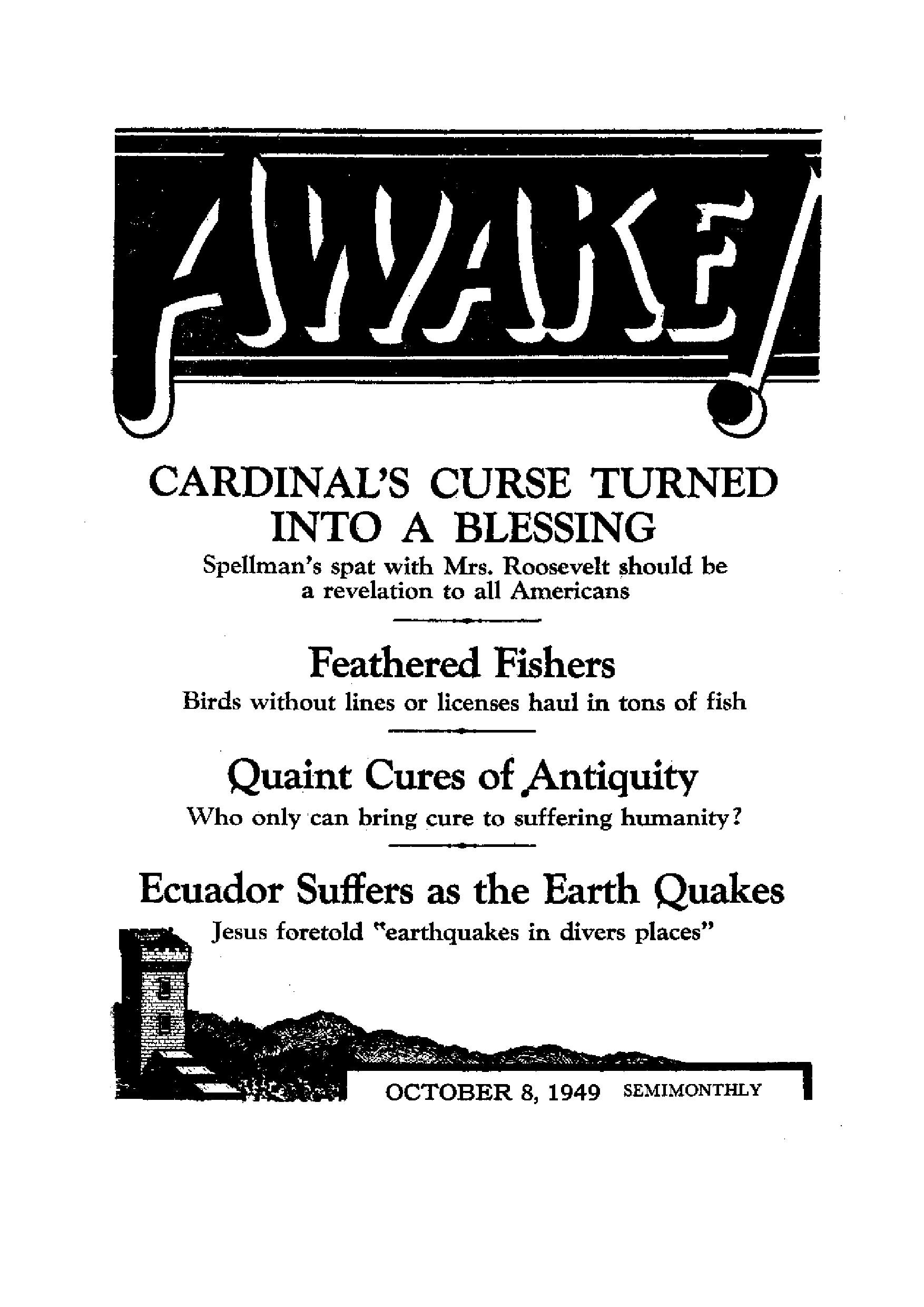
THE MISSION OF THIS JOURNAL
News sources that are able to keep you awake to the vital issues of our times must be unfettered by censorship' and selfish interests. “Awake T* has no fetters. It recognizes facts, faces facts, Is free to publish facts. It is not bound by political ambitions or obligations; it is unhampered by advertisers whose toes must not be tread upon; it is unprejudiced by traditional creeds. This journal keeps itself free that it may speak freely to you. But it does not abuse its freedom. It maintains integrity fo truth.
“Awake 1’* uses the regular news channels, but Is not dependent on them. Its own correspondents are on all continents, in scores of nations; From the four corners of the earth their uncensored, on-the-scenes reports cbme to you through these Columns. This Journal’s viewpoint is not narrow, but is international. It is read in many nations, in many languages, by persons of all ages. Through its pages many fields of. knowledge pass in review—government, commerce, religion, history, geography, science, social conditions, natural wonders—why, its cover* age is as broad as the earth and as high as the heavens.
“Awake lrf pledges itself to righteous principles, to exposing hidden foes and subtle dangers, to championing freedom for all, to comforting mourners and strengthening those disheartened by the failures of a delinquent world, reflecting sure hope for the establishment of a rights eouS New World.
Get acquainted with “Awake!’* Keep awake by reading “Awake!”
Published Semimonthly By WATCHTOWER BIBLE AND TRACT SOCIETY, INC.
117 Adams Street
N. H. KNfitte, President
F/ve c<srtt» a copy
RenHtinrit ehotiH be nut to in your country In compliance with regdhtioiu io fuarantw ufe delkrery of mow. BeMlttances art accepted at arooJelpo Jrara countries where do office is located, by international money order only. Butecription rate* In different countries are here stated in local Correney, '
Not lev nt •xplfatloo (with renewal blank} U «ect At least two Imus before nb»crlp*» expires.
Bxuotlyn 1, N. Y., U, S. A. Geant Suiter, Secretary Ont dttltr x year
Chuai of addrau when sent to <w office may tn expected effective nlthlu one month. Seed jour old M well m rutw address.
Offices
Yearly Subscription Hit*
Amerfts, if,®., ik Atrinw gt.f Brcwkiyc 1. O. Amtrtfia. 11 SeresfOTtiM., StrstiifrM, N.8.W. Cinria, 40 Irwin Ave., Toronto 5, Ontario Enf land, 34 Craven Terries, LondOD, W. 2 Srith Africa, 423 BoaioR House, Cape Town
fl 6s 11 51
Bateretf u aocambctasa natter at N- Y, Act of March 3, 1879. Printed in U. & A.
CO N T E N T S
Cardinal’s Curse Turned into a Blessing
Flimsy Argument
Some Facts to Recall
How the Curse Becomes a Blessing
Blessings That Are Actually Curses
Spellman's Letter Backfires
Public Figures Speak Out
Voice of the People
President Truman’s Position
Feathered Fishers
Bait but No Hook!
Catholic Authorities Look at Crime
. 8
. Quaint Cures of Antiquity
Medieval Medicine
No Wonder He Died!
Free Speech Wins Another Battle
Ecuador Suffers as the Earth Quakes
Awake! Correspondent in Quake Area
Churches Hardest Hit
Estimate of Damages
uThy Word Is Truth”
Hatred Between the Two Seeds
Gilead’s Thirteenth Class Graduates
Watching the World
ZUrtZAKE/
^"Now it is high time to awake.— Romans 13:11
Volume XXX Brooklyn, Nr Y., October 8, 1940 Number
Cardinal’s Curse Turned into a Blessing
Spellman’s spat with Mrs. Roosevelt should be a revelation to all Americans
CARDINAL Spellman of New York burst into the front pages of the pub’ lie press when he penned his letter of July 21 to Mrs. Franklin D. Roosevelt. His blast started a chain reaction of explosions that dominated the headlines for days afterward. So intense an attack, charged with emotion and adverse judgment, and with an* arbitrary finality slamming the door against further discussion, sounded like the pronouncement of an ancient curse from which there would be neither appeal nor escape. Nevertheless, the cardinal’s spat with Mrs. Roosevelt led to beneficial results. Remember how centuries ago Balaam was hired to curse Israel, but that “God turned the curse into a blessing”? (Nehemiah 13:2) So this letter that fell like a curse can also be viewed as a blessing. A review of the facts and issues of the case will show why.
On June 23 Mrs. Roosevelt in her column “My Day” took a stand for federal aid to education, but limited to public schools. Columns dated July 8 and July 15 enlarged upon her position. Only in the June 23 column was Spellman mentioned, it opening with the words: “The controversy brought about by the request made by Francis Cardinal Spellman that Catholic schools should share in federal aid funds forces upon the citizens of the country the kind of decision that is going to be very difficult to make.”
This the cardinal interpreted as a “personal attack” upon him, and opened hie letter with the following paragraph:
When, on June 23d in your column “Mj Day” you aligned yourself with the authoi and other proponents of the Barden Bill and condemned me for defending Catholic children against those who would deny them their constitutional rights of equality with other American children you could have acted only from misinformation, ignorance or prejudice, not from knowledge and understanding!
Yet Mrs. Roosevelt used no word of condemnation against the cardinal, and no need exists to defend Catholic children against inequality, since they are welcome at public schools, just as are children of Protestants and Jews and atheists. Or, Catholic parents are, free to establish and finance private schools for their children, just as are Protestant or Jewish or atheistic parents. The issue of equality is imaginary. And since the premise of condemnation and inequality is unsupportable, the judgment of misinformation, ignorance or prejudice based thereon vanishes.
The“cardinal scolded the lady for not reading an address he delivered at Fordham University concerning federal aid to education. Did you rpad it? Yet a glance at the newspapers was sufficient to inform you that Spellman wanted, the government to help support Catholic schools. He chided Mrs. Roosevelt for
not carefully studying the Bardefi bill that would grant federal aid only to public schools. MJhat’s the point of his chiding! Who knows! Mrs. Roosevelt never championed the Barden bill. In fact, she said: "I have been rather careful not to say if I am for or against any particular bill or bills.”
After insinuating that Mrs. Roosevelt launched a “personal attack” against him because her faith differed from his, and not because of her belief in the American tradition of separation of church arid state, he tells why he wrote his letter to her: “I have received hundreds of messages from persons of all faiths demanding that I answer you. I am, therefore, not free to ignore you.” Can this be true! Such a broad statement. Persons of all faiths demanding that a Catholic cardinal speak for them 1 Or was it persons of only twenty faiths ! or fen! or two! Such sweeping claims are always suspect, and thinking persons find that such broad statements cannot be swallowed whole with safety. Let the cardinal drop the pose that he speaks for all faiths.
Flimsy Argument
“‘Taxation without representation is tyranny’ was the cry that roused and rallied our pioneer Americans to fight for justice. Taxation without participation should rotlse today’s Americans to equal ardor to protest,” the cardinal continued. A ruse of propagandists is to associate the point they want to sell you with another point on which you are already sold.. So the tricky rhetoric that links “taxation without representation” to “taxation without participation” does not prove the latter to be tyranny because the former is.
What about this new political doctrine of the political cardinal! Is it sound! He argues Catholics should not be taxed for a school program in which they do not participate. Now let this principle hurdle the bounds of a narrow mind on a single track, and see the result. You are single, or married but childless! Then pay no school taxes. You have no car! Then pay no tax for roads. You don’t use national or city parks! Withhold the taxes you pay for their upkeep. You don’t go to 'public libraries! Stop your tax payments for their support. Do ■you use the courts *of law! live, in the jails! lie in public charity hospitals! rave in the tax-supported asylums! die in the county poorhouses! fight in the expensive wars! use goods delivered by the Marshall Plant favor supporting Myron Taylor as a representative to the Vatican! Maybe not. But you pay for it all. Taxed for it, without participating in jt. The list of “taxation without'participation” examples could grow indefinitely, but the consequences have been enforced enough to reduce it to absurdity.
Up to this point the cardinal’s letter displayed reason at low tide and emotion at high tide, but hereafter all attempts to reason are drowned in the continuous tidal wave of tears that his emotional rhetoric gushes out. One can almost hear the quavering voice of the overcome churchman as it fights its way through a lumpy throat to say:
But why I wonder do you repeatedly plead causes that are anti-Catholic ? Even if you cannot find it within your heart to defend the rights of innocent little children and heroic, helpless men like Cardinal Martyr Mindszenty, can you not have the charity not to east upon them still another stone!
America’s Catholic youth helped fight a long and bitter fight to save all Americans from oppression and persecution. Their broken bodies on- blood-soaked foreign fields were grim and tragic testimony to this fact. I saw them there—on every fighting front—as equally they shared with their fellow-fighters all the sacrifice, terror and gore of war—as alike they shared the little good and glory that sometimes comes to men as together they fight and win a brutal battle.
Would you deny equality to these Catholic boys who daily stood at the sad threshold of
untimely death, and suffered martyrdom that you and I and the world of men might live in liberty and peace?'Would you deny their children equal rights and benefits with other sects—rights for which their fathers paid equal taxation with other fathers and fought two bitter wars that all children might forever be free from fear, oppression and religious persecution ?
During the war years you visited the hospitals in many countries, as did I. You too saw America's sons—Catholic, Protestant and Jew alike—young, battered, scarred, torn and mutilated, dying in agony that we might learn to live in charity with one another. Then how was it that your own heart was not purged of all prejudices by what you saw these, our sons, suffer?
All of this is calculated to paint Eleanor as a fiend, delighting in if not responsible for all the sad scenes above pictured. She stones little children, stones Mindszenty, scoffs at Catholic boys who fought on battlefields for her, denies their children equality, and looks at the hospitalized soldiers with a heart filled with prejudice against them.
Some Facts to Recall
During the Mindszenty controversy Mrs. Roosevelt described him as “the center and symbol of resistance during the Nazi occupation” and a naan of “fearless actions” and wrote: “There is no excuse for the action that has been taken by the government and, since in Hungary the government is, practically under the control of Russia, the Soviet Union cannot escape the blame.” That was not “still another stone” on Mindszenty.
Yet Spellman glibly misrepresents Mrs, Roosevelt. Why? To hint and imply what he fears to say openly—that he considers her a Communist sympathizer. For the dull-witted, Monsignor John Cartwright of Washington made the Red smear plain when he commented on Spellman's letter, saying that Mrs. Roosevelt was “very sentimental and a little more than tolerant toward the Reds and the Communists and the friends of Russia in this country—for as long as it was safe to be so” and that in the Spanish civil war she “lent her prestige to the Loyalists”. The hierarchy branded the latter Reds, though they were largely Spanish democrats fighting the black Fascism of Catholic dictator Franco. Actually, Spellman cannot shake Mindszenty from mind. Spellman craves for the United States what Mindszenty lost in Hangar y—government-supported but Catholic-run schools.
When Spellman in his letter struck a patriotic pose and emoted about Catholic “broken bodies on blood-soaked foreign fields” and lying ftbatteredj scarred, torn and mutilated, dying in agony” in hospitals he strayed far from the subject of federal aid to education. But to stray with him for a moment, we recall that not only did a minority of Catholic youths fight for America, but also a far larger proportion of Catholics were in Hitler's armies fighting against Americans. Catholic killed^ Catholic. Would Jesus have beheaded Peter to please Caesar?
Moreover, we recall that before World War II began a group of prominent Catholics in America appealed to the pope to excommunicate Catholic Hitler, but were tersely told to tend to their own business. Excommunication could have broken Hitler's power in the strongly Catholic Greater Reich and nipped World War II in the seed stage. Supporting the Communist cause is a sufficient crime to draw papal excommunication, but apparently strewing earth's gory battlefields with Catholic and other broken bodies is not. Spellman should have addressed his patriotic palaver ,to the pope, not to Mrs, Roosevelt.
Of course, the point that his inflammatory rhetoric burned to make was that the offspring of these broken Catholic bodies should be on an equality with othei* American children; but it goes up in smoke, without substance, since no inequality exists., As explained before. Catholic children are free to attend public schools or parochial schools. The majority attend public schools, free of charge.
Jfrs. Roosevelts Unwanted Reply
Cardinal Spellman concluded his letter:
Now my case is closed. This letter will be released to the public tomorrow after it has been delivered to you by special delivery today. And even though you may again use your columns to attack me and again accuse me of starting a controversy, I shall not again publicly acknowledge you. For, whatever you may say in the future, your record of antiCatholicism stands for all to see—a record which you yourself wrote on the pages of history which cannot be recalled—documents of discrimination unworthy of an American mother I .
The cardinal felt that with his tirade the subject should close. He favored a hit-and-run letter. By saying he would not answer again he was tacitly suggesting to Mrs. Roosevelt that she make no reply and print no more in her column regarding federal aid to education. And if she did continue the subject in her column, then he would 'remain dumb as the sheep before the shearers and as the lamb that opens not its mouth when led to the slaughter*. He spoke of her 'record of anti-Catholicism which cannot be recalled*. True. We cannot recall such a record, nor did the cardinal recall it to back his reckless charges.
As for the unmanly and unworthy final thrust, "documents of discrimination unworthy of an American mother/* we let Mrs. Roosevelt ably answer it. She did answer Spellman's letter by one of her own to him, dated July 23. She said that she had never advocated the Barden bill, that she believed in the public school system, that she thought the real religious teaching of the child must be done m its own church and home, that free medical care should be available to all children but not tied in with any school, that the history of Europe shows that "the domination of education or of government by any one particular religious faith is never a happy arrangement for the people”, that she had no bias hgainst Catholics and supported Catholic Al Smith and other Catholics for political office, that she spoke out against unfair trials and religious persecution at the time of the Mindszenty case, that when she visited hospitals she was concerned about the boy in the bed and not his religion, that she had no intention of attacking the cardinal or his church but that she would continue to stand for things in government that she thought were right, and concluded:
I assure you that I have no -sense of being “an unworthy American mother”. The final judgment, my dear Cardinal Spellman, of the worthiness of all human brings is in the hands of God.
How the Curse Becomes a 13 les sin ff
"We owe Cardinal Spellman a debt of gratitude for letting the cat out of the bag. The whole country now must be aware bf what the real issue is. It knows the intentions of the Catholic Hierarchy/* So spoke Congressman Steed of Oklahoma, and with those words he indicated how the curse could become a blessing. It is generally conceded in Congressional circles- that the Spellman assault on Mrs. Roosevelt has killed any action on aid to education this year; but even this steep price is cheap if the people and the nation awaken to the Hierarchy's purpose to dominate the school system and eventually overthrow the principle of separation of church and stBfte. Methodist Bishop G. Bromley Oxnam spoke of such an awakening on August 7 over radio station WWDC, saying:
The American people have recently learned that federal aid to education in this session of Congress is dead. Most of our citizens deplore this fact. The Roman Catholic Hierarchy is responsible for killing the bills that might have brought aid to our public school systems. Far more children from Roman Catholic homes attend public school than parochial school. It will come as a shock to these parents when they learn the hierarchy is responsible for denying their children higher education standards. Thousands of loyal and able Roman Catholics are teachers in the public schools. They will not forget that the much-needed salary increase was denied them by the action of the hierarchy. The blind may lead, but the eyes of their followers will open.
We dare not speak in pleasantries when the American principle of separation of church and state is in jeopardy. The hierarchy has launched a full-scale attack upon this principle. Cardinal Spellman’s personal attack upon one of ^he greatest women of American history, Mrs. Eleanor Roosevelt, reveals the method that we may expect from men determined to master American life. . , .
One could wish that the cardinal were more candid and less crafty. It is not milk and medicine, books and buses. What he wants is the support of parochial schools by taxes levied on all the people. In a word, he seeks public funds for sectarian education. The Church not only wants public funds for private purposes, but must know that to drain off vast sums from public education is to so weaken it as eventually to destroy it. . . .
Many people do not know that the Roman Catholic Church is fighting for its life in Europe. It has become so interlocked in political affairs of state, so encumbered with vast land holdings, and so allied with military and feudal reaction that the common people are turning from it. . . . When the American people realise how far the world political organization of the Roman Catholic Church has moved into American life, there will be a reaction that will astound men who have the audacity to announce an_ attempt at excommunication of Protestants.
L F. Stone, columnist writing for the Sunday Compass of July 24, told how the reckless quality of the cardinal's letter might cause the public to view in a different light the Catholic propaganda on events in Eastern Europe, a propaganda that precipitates repeated international OCTOBER 8j 1949
crises and raises the temperature of the cold war. Mr. Stone wrote:
The fury of the cardinal’s attack on our respected and beloved First Lady of the New Deal will do the Church a disservice, but it may have a cooling effect on public opinion in this country. It may serve to illustrate the fact that events in Eastern Europe are not quite as irrationally mad and criminal as the hierarchy would like us to believe.
I do not know enough to pass on the merits of the Mindszenty case, but the issues between him and the Hungarian government were not So different from those between the American cardinal and Congress. Mindszenty opposed land reform and state control of education. This alone by no means made him guilty of treason. It does serve to show that the issues were not peculiar to ^Communist godlessness” but concerned reforms long established in other countries.
I hope to return to this subject again soon, and will make but one more point at this time. It is important to notice that revolutionary movements, like Communism are Strongest where authoritarian churches have exercised state power, and weakest in the so-called “secular” states the Church deplores.
Where did the first successful Communist revolution occur? In Russia, where the Orthodox Church had the czar’s full support in controlling the minds and consciences of men. Where is the second largest Communist party in Europe today? In Catholic Italy, in the pope’s own backyard. Where has the Church suffered most in this hemisphere? In Catholic Mexico, where the priesthood held nuchal lenged sway for centuries. Where is the Catholic Church most secure? In America, where church and state have been kept scrupulously separated from the time ’ of the Revolution,
Thte lesson is written on the blackboard of history Urge and plain. The cardinal would do well to glance at it.
In addition to showing Hierarchy political aims in America and the tactics of smear and falsification of Catholic propaganda, which make us question the accuracy of the picture of Catholic persecution in Eastern Europe, the aftermath of the cardinal's letter was a blessing in that it showed many politicians, editors, columnists, Protestant clergymen and common people, among them Catholics, still have courage to speak plainly against a cardinal of the Catholic Church—a quality so long hidden that its existence began to be doubted. For an array of such courageous-expressions please see the article that follows.
Blessings Thai Are Actually Curses
Tn her reply to Spellman Mrs. Roosevelt observed: “I cannot^ however, say that in European countries the control by the Roman Catholic Church of great areas of land has always led to happiness for the people of those countries.” The'facts would not allow anyone to say it, truthfully. Where are the blessings of the Catholic Church in South American countries? and in Spain, where Protestant activities in worship and schooling are crushed? Catholic domination and culture and parochial schools for nations overwhelmingly Catholic have resulted
fiMic tcboois, writ Mn. at Uu
bulTt-tye of bit target, the kickback from fbt diicbargt was quick and powerful. Tbit article fuufmanxet the public reac-lic» io Spellman’s letter.
4 fT MUST acknowledge in my column
I the numerous telegrams and letters that have come to me in the last few days. I am a little overwhelmed by the amount of mail that confronts us. as a result of Cardinal Spellman's letter. . . . in dictatorial government, arrogant priesthood,. abject poverty, extreme highs in illiteracy and extreme lows in morality, where men have several women and illegitimate births are so common as to go unnoticed. Where the Hierarchy controls the government she is not interested in expending funds for improving the parochial school system or spreading democracy or bettering living standards or boosting morality.
From a far-sighted focus on foreign lands change to a near-sighted view. Look at America. Are Catholic culture and parochial schooling making Catholics exemplary citizens, outstanding as a group? For the answer to this read the short article on page 16 of this issue, and which is based upon figures compiled by Catholics. Just as Spellman’s letter intended as a curse turned out to be a blessing, so the supposed- blessings of the Catholic Church turn into curses for the recipients. It has happened as God foretold to unfaithful religious priests: will curse your blessings,”—Malachi 2: 2.
Anyone accustomed to hearing from the public knows that those who disagree usually write in far greater numbers than those who agree. In this case, however, the reverse seems to be true.” Thus wrote Mrs. Roosevelt in her column “My Day” for July 29.
Similarly, the public reaction expressed through the news channels of press and radio was overwhelmingly in defense^of Mrs. Roosevelt and sharply critical of the cardinal. The following quotations are typical reactions of columnists and editors.
We believe that Cardinal Spellman will come to realize that Mrs. Roosevelt cannot be justly charged with prejudice or bigotry. —N. Y. Times, July 26.
Francis Cardinal Spellman has aligned himself with the most reactionary elements in public life today by -his purposeful attack upon federal aid to education, ... I have previously expressed myself as tolerant, at this time and for expedient reasons, of tax exemption and public bus service for parochial schools conforming to state regents’ Standards of education, on the ground that there are not yet sufficient public schools to house our children for educational purposes. I hereby withdraw that support, and confess error. It is clear that it is a serious mistake to compromise at any point with those who seek to encroach upon the state’s functions.—N.Y. Daily Compass, July 25.
To assail Mrs. Roosevelt as having “a record of anti-Catholic ism .. . unworthy of an American mother” because she stated with care and sympathy what every American knows to be true, is as flagrantly unjust as it is ill-mannered. The Courier-Journal favored the senate’s handling of the issue of aiding religious schools [which allowed federal aid to parochial schools if the individual states wished it] ... Cardinal Spellman’s strident defense of this position [government aid to parochial schools] has force many people who otherwise would have let the issue ride to re-examine their conscience and to make a stand. In our case this stand has to be for the principle that only public education can be financed by public funds.—Louisville Courier-Journal, July 23.
We believe Cardinal Spellman is probably wrong and Bishop Oxnam, Representative Barden and Mrs. Roosevelt are fundamentally right in the discussion over federal aid to private and parochial schools.—Pontiac Daily Press, July 28.
Some of the off-the-record comment on the cardinal by New York politicians who are good Roman Catholics has been sulphurous enough for excommunication, but even the so-called “liberal Catholics” are scared stiff of coming to Mrs. Roosevelt’s defense.—I. F Stone, N. Y. Daily Compass, July 26.
If Mrs. Roosevelt wants my help she can have it. Not that she may need it. She is not liable to excommunication. She has her. own road to heaven and her papers are in far better order, I dare say, than Westbrook Pegler’s or Francis Cardinal Spellman’s or mine.—Jennings Perry, N. Y. Daily Compass, July 26.
Cardinal Spellman’s denunciation of Mrs. Franklin D. Roosevelt is a tragic document. It is unjust, unfair and unworthy of a man to whom millions of Americans look for spiritual guidance. . . , Mrs. Roosevelt has always spoken her mind and welcomed dissent on that level. But the cardinal’s charge that her position oii tthe education bill climaxes a “record of anti-Catholicism” is a terrible and baseless assertion. . . . This is cruel and inflammatory rhetoric founded on a misstatement.—N.Y. Post Home News, July 24.
Public Figures Speak Out
Politicians, clergymen, educators and organizations all took courage in numbers and spoke out against Spellman’s insulting letter. Some of the spokesmen, it is noteworthy, are ‘Catholics. One of the first political figures to speak boldly was former Governor Herbert H. Lehman. Others followed, .taking courage as public indignation snowballed to imposing proportions. Excerpts of their statements follow.
I am deeply shocked at the attack of Cardinal Spellman on Mrs. Roosevelt. ... The -issue is' not whether one agrees or disagrees with Mrs. Roosevelt jon this or any other public question. The issue is whether Americans are entitled freely to express their views on public questions without being vilified or accused of religious bias.—Herbert H. Lehman, N. Y. Times, July 24,
I have never answered the cardinal and I'm just letting him talk. As far as Mrs. Roosevelt is concerned, her reputation for tolerance is well known and needs no-defense at my hands. I learned long ago that when the eagles appear it is time for the sparrows to retire. —Representative Barden, author of the bill restricting federal aid to public schools, and branded by Spellman as the “new apostle of bigotry”; N. Y. Times and N. Y. Past Horn# News, July 24.
Your open letter to Mrs. Franklin D. Roosevelt makes it necessary for me, a former representative of the Department of Justice on the committee appointed by President Franklin D. Roosevelt to codify the citizenship laws of the United States, to reveal that, under the Nationality Laws of the United States, 1940, Section 401 (B) (D), then and now in force, you lost your American citizenship in 1946; that you are not now speaking as an American citizen, but as an alien; that you are now the representative of a foreign state whose purpose it is to destroy the constitutional political principles of the United States. There are millions of loyal American Catholics in the United States who, 1 believe, do not know that you deliberately expatriated yourself. They accept your leadership in political matters as though you were still a loyal American citizen.—Telegram sent to Spellman by Albert Levitt, former special assistant to the United States attorney general, according to INS dispatch of July 24.
Representative Tom Steed, Oklahoma Democrat, wrote Mrs. Franklin D. Roosevelt today that Cardinal Spellman's letter criticizing her stand on federal a|d to public schools was “a masterpiece of distortion, misrepresentation and deliberate twisting of the truth”. "I am writing you to say that in all my experience I have never read a more clever bit of propaganda than this letter. It could not have been written by anyone except a man who holds no regard for God's justice or truth —it was written by an expert of the highest skill and is the best example of the ‘smear’ that I have ever noted.”—AP dispatch of July 23.
The language used against her will bring no good to either my church or my country. I regret ’it exceedingly. ... As long as we have the same right to send our children to public schools as anyone else, we are not discriminated against, and as Catholics we do not have the right to a separate publie-supported school system, nor does any other group of people have such a right—Representative Andrew Jacobs, outstanding Catholic layman, in Pontiac Daily Press and INS dispatch. '
On a radio program titled fTs Congress Doing Its Job?” four Congressmen appeared. Two of them were Representatives Steed and Jacobs quoted above, and the other two expressed similar sentiments. Ed Hart, conductor of the program, apologized for not having the opposition view presented. He made strenuous effort to find a Catholic Congressman who would speak for the cardinal's views but found none. It was at a then future session of this program th^t Methodist Bishop Oxnam spoke on this issue, as quoted in the leading article concerning Spellman's letter. At that time Hart invited Spellman to appear, but the invitation was refused.
Space forbids any more than a fragmentary quoting of additional expressions, but even that gives a fast feel of the public pulse. Dr. John Norton, ♦professor of education at Columbia University^ Teachers College, said that namecalling should cease, that “Americans should not be called bigots,.atheists or Communists merely because they differ with ecclesiastical officers” and Roman Catholic clergy who feel “any disagreement with them is an attack on them and their religion” should revise such feeling. Norman Thomas claimed that the cardinal's “intemperate language” suggested “a weakness of his case”. Many individual clergymen and several religious and civil organizations joined their voices to the general protest of the cardinal's charges..
of the People
Papers throughout the nation printed letters from readers concerning the Spellman-Roosevelt controversy. The majority ran in the same vein of condemnation of the cardinal as do the foregoing quotations. A few excerpts: from the public follow.
The headlines "Spellman Assails Eleanor” are in error. The correction should read "Spellman Assails United States Constitution”.—Milton Smith.
We are against public tax aid to parochial church schools, Millions of intelligent, responsible, unbigoted Christians are against it. Those same millions are not anti-Catholic when they express their opposition.—Richard Allen.
As for Cardinal Spellman's ridiculous spiel about the "poor little Roman Catholic children”, he had me almost in tears to think the poor little things have to take the same that the Protestant, Jewish and other children do. —E. Jones.
Cardinal Spellman has rendered a great disservice to the Catholic cause and alienated a great many friends of the church by his unjust attack on Mrs. Roosevelt.—M. Dunn.
As a Catholic, who calls himself a "liberal”, let me warmly thank you for reprimanding Francis Cardinal Spellman when he stepped out of line. Certainly his attack on Mrs. Roosevelt, who helped to frame the UN Bill of Human Rights, was extraordinarily unfounded.—J. O'Connor.
It is surprising that a man of Cardinal Spellman’s position can only attempt to prove his point by resorting to a childishly immature method of name-calling, instead of logic and reason.—M. Whitelaw.
It surprises me that a cardinal, who should preach "Love thy neighbor as thyself”, should in public print violate the commandment "Thou shalt not bear false witness against thy neighbor”!—M. Hoffman.
I want to stress that I am a good Catholic and have always loved and respected our church, but I see no reason why any servant of our Lord Jesus Christ should mix in politics. Politics and religion just do not mix. From the pope down, the church is a place of peace and prayer, not a battleground for dirty polities. If after today, I hear of any Catholic church or people of the church getting mixed into polities, I will stop going to our church, and many of my friends feel the same way.—M. Vickers, in a letter to Spellman.
President Trumarfs Position
It was generally understood that President t Truman would appoint a Catholic to the Supreme Court to replace the deceased Catholic, Frank Murphy. Instead, he appointed Presbyterian Tom Clark. In response to queries, Truman said he did not believe religion had anything to do with the high bench. Asked to comment on the' Spellman letter to Mrs. Roosevelt, he said he had no comment as "the press was taking adequate care of that matter”. Apparently, he believed the censure of the cardinal contained in the press was proper. On this point John O'Donnell in his column "Capitol Stuff”, in the N.Y. Daily/ News of July 29, wrote:
It is a simple statement of fact, accepted in every part of political-Washington, that Truman's decision to name Clark today was a direct crack at Cardinal Spellman and that he intended it to be so interpreted. Certainly, it has been so interpreted by the Democrats.
The backfire from his letter was so violent that it shook the cardinal from his lofty resolve to henceforth ignore Mrs. Roosevelt on this matter. He prepared a lengthy statement in subdued tone wherein he did considerable retreating, contacted Mrs. Roosevelt, had her go over it, and she gave the cardinal a statement saying his was "clarifying and fair”. Both were released by Spellman on August 5. On August 19 the cardinal called on Mrs. Roosevelt at Hyde Park.
Peace has returned to the surface, but the unresolved issues still boil beneath to overflow at a future time.
MILLIONS of birds every day eat tons of fish, but they do not get their supplies from the fish markets or the canneries. These feathery creatures dp their own fishing in the fresh-water lakes and streams and in the salty waters of the sea. Birds without bait, boats or boots; fish-catchers without nets, lines or licenses! Using their own peculiar tactics they either ontdive oroutswim the swiftest fish, or they use their beaks and claws on the slippery things in a most skillful and deadly way.
■ The pelican, noted for his funny looks, is also famous as a <fsuper fisherman”. His ungainly and rather grotesque look is due chiefly to his long beak, which measures from 9 to 13 inches, and his enormous pouch, which hangs from the lower jaw, and which, when expanded, holds more than 31 gallons. This pouch, however, is the pelican's greatest asset in scooping in the fish. He has only to open his mouth alongside a fish and the inrushing water carries with it the victim, The water is forced out through the lips, so it does not have to be swallowed, and then with a backward flip of the head the fish goes down the throat in one gulp.
The brown pelican, which may roam fifty miles from home searching for a fish steak, flies thirty to sixty feet above the water. Spotting its prey it suddenly dives with head and neck thrust forward and wings backward. With terrific force its bulk hits the water, and, though it dives time and time again, it does not injure itself, due to the masses of air sacs beneath the skin that act as a pneumatic cushion. This bird from its infancy lives exclusively on a fi^hy diet. The parents predigest the catch for the young and either regurgitate it up or let the youngsters shove their heads and beaks down mama’s throat and help themselves.
The white pelican, one of the largest waterfowl of the North American continent, with a wingspan of 8 to 10 feet, has difficulty in getting into the air, but once up it sails with great ease and rises to considerable height. This great bird, however, instead of plummeting into the water like its brown cousin, swims along the surface with a majestic air, scooping up the fish as it goes. Sometimes white pelicans fish in companies, numbering as many as 150. They form a semicircle off shore and drive the fish toward the beach, thus forcing the fish to the surface. During one such communal fish drive crafty cormorants dived in ahead to get their fill of fish that had been rounded up by the pelican fishherders.
In exploiting the cormorant's great ability at fishcatching, the Japanese tie
strings around the necks of wild birds to prevent them from swallowing what they catch. This, however, does not seem tc discourage the birds; for they return immediately for another fish.
Chinese fishermen go a step farther and breed and train cormorants, A number of small fishing boats may be working in the same waters, each with a dozen or so cormorants sitting on the gunwales, yet each bird knows its master and brings each fish it catches to its. owner. With no strings attached' to these highly trained birds they are able to catch more, for in diving for the fish they sometimes go to great depths.
The Peruvian cormorant walks erect, somewhat like a penguin; and, unlike other cormorants that dive many fathoms for their fish, these guanay birds, as the natives call them, feed only on surfaceswimming fish, including zyichovies and herring. These cormorants have worked out a system similar to that employed Uy ant ft and other social insects. In the morning, instead of the whole rookery’s going out 'tishin’ ”, small scouting parties set out at high altitude to search for any ruffled signs on the ocean’s surface that would indicate a school of fish. Then when these scouts dive for the kill this is the signal for the great flocks on the islands and coastland to stream forth.
H'S
The smallest feathered fisher in Peru is the diving petreh The gannets, variously called pique.ro and cu-g t e ep-walled cliffs, are said to be far more handsome than either the cormorants or the pelicans.
A visitor to those parts once told of the awesome spectacle when it so happened th£t a great cloud of gannets passed overhead at the same time that a vast school of fish suddenly appeared below. As if a gun had been fired, the bibds simultaneously dropped, thus clearing a sky that 'a few seconds before was black. The birds, having hit their targets, rose from the water in unison only to repeat the performance with a second plunge.
Gannett also called boobybirds, are the largest winged creatures of the North Atlantic; they are also the champion deep-sea divers. Climbing to a height of 100 feet, they shoot downward like an arrow. Says Science Illustrated: “Fish hawks, which also plunge out of the sky, probably dive to a depth of three feet. Kingfishers may go to five. Some diving ducks regularly reach 25 feet. But the gannet goes to 90 feet—and deeper 1 Be has been found trapped/in nets 100 feet down?'
* Not all the members of the heron family and their long-legged marshland rela-tives, which love to .spend nianay, which zthe winter wadnest on the'' ing up to their knees in the
Fishing on “Stilts” swamps of southern Uhit-ed States, live exclusively on fish. The fla-mingos enjoy nothing better than a full bill of fare of mollusks. Oyster-catchers eat shrimps and other sea food but if given a choice they take their food on the half-shell. Snipping the muscles of partly opened oysters to prevent them from closing, they can leisurely take their time to eat .the contents. The great blue heron standing on his long legs and wielding a long daggerlike bill slowly stalks its prey or quietly waits for it to swim close by before bayoneting it. Red-necked egrets, on the other hand, spend the day chasing down killifish in the shallow mangroves. It was a rare occasion when an egret was seen balancing itself on a rope that swung a little above the water, and, as it did so, striking out at passing fish. Out of 15 strikes it caught a dozen fish without so much as getting its feet wet.
Bait but No Book!
White ibis, according to Audubon, ingeniously drop little pieces of mud in the holes of crayfish, and then when they come up to remove the plugs the crafty birds seize them. The wood ibis or stork is also a smart fellow when it comes to fishing. In fact, he is about the only bird that uses bait to lure his victims within striking distance. Slushing around in a lagoon a fish is stirred up and is then killed with a lightning stroke. But instead of eating it it is allowed to float near by as bait, while the stork draws its head in between its shoulders and calmly waits for other fish to come and inspect their dead comrade. These, then, are the ones that are snapped up for dinner.
The'water turkey, belonging to the Anhinga or Darter family, is one of the most proficient pursuers of the speedy fish. Swimming with its body entirely submerged, and with only its head and long neck sticking out, it takes on the aspects of a submarine cruising along with only its periscope visible. It is this peculiar appearance that gives the bird its nickname of “snakebird". Waterturkeys, says the Encyclopedia Americana, “are the best fresh-water divers known, and drop into the water with such surprising skill that the large body makes scarcely any noise, and but little ripple on entering the water. . ■. . It captures fish, not by diving upon them from above, but by pursuing them under water and spearing them with its closed beak."
There are nearly 40 known forms of grebes, some of which would easily win blue-ribbons in a fishing contest among birds. The piedbilled grebe, also called “dabchick”, “didapper," “hell-diver" and “water witch”, is especially famous for its diving and swimming skill. Either diving from a great height, beak first, or slowly disappearing beneath the surface as a sinking ship, the grebe then sets out to catch the fastest fish.
The loons are rather heavy waterfowl with strong, sharp beaks. Those that have been fortunate enough to observe a loon swimming in hot pursuit of fish say they use their half-folded wings as well as their feet, leaving one with the impression they are actually flying through the water.
The expression “as crazy as a loon” carries with it no allusion to the mental condition of the bird, but rather to its peculiar cry, which to some sounds like the laughter of a madman. Anyone who thinks the loons are stupid birds should match his wits with a loon's in an effort to catch one of them dead or alive. A person can hardly get within shotgun range before they dive, and there is no teDing at what point of the compass they will come to the surface before again disappearing. “A man may thus follow a loon for half a day if he wishes," says the National Geographic magazine, “but will find himself at the end not one bit closer to the object of his quest."
The Kingfisher and the Osprey
Not all the 200 different birds classified as kingfishers feed exclusively on fifth. tiome, like the kookaburra or laughing jackass of Australia, prefer a menu of insects and lizards. The common American kingfisher that tunnels into the creek banks, however, likes to fish in clear, fresh-water streams for small fish. These he catches with his beak in a spectacular dive from an altitude of 50 feet. One observer gives the following description of a kingfisher at dinner:
How he gags and writhes, swallows his dinner, and then, regretting his haste, brings it up again to try another wider avenue down his throat! The' many abortive efforts he makes to land his dinner safely below in his stomach, his grim contortions as the fishbones scratch his throat-lining on their, way down and up again, force a smile in spite of the bird’s evident distress.
No bird likes fish more than the osprey or fish hawk. Tender chickens, tasty ducks or plump rodents it will not touch. Instead of seizing the fish with its beak, like other avian fishers, the osprey is equipped with a set of grappling hooks afc terrible-looking as those of any . bird. Even the inside of its feet are covered with spiny foot pads to prevent slippery fish from escaping. These powerful talons, however, have proved the downfall of their owner» more than once, for, if the bird misjudges the size and sinks its claws into a fish too big to be hauled out, the osprey may be dragged until they both die.
When fishing the osprey leisurely flies between 30 and 100 feet above the water waiting and watching for a target close enough to the surface to be grabbed. Then in a deadly plunge the osprey crash-lands on the water feet-first, Sometimes going down several feet. It does not eat the fish for predigestion. like the pelican, but carries it back to the nest in its claws, where it tears off bit by bit for its young.
The osprey is the noblest-looking of the hawk family and bows only to the great bald eagle as its superior. Not that eagles ever eat osprey; eagles also like fish, yet will never get their feet wet to catch them. Rather, they watch from on high pntil they see an osprey homeward bound with fresh fish, then fall upon the smaller bird and harass it until it drops its catch. Robbery? Such a thought! Why, the eagle only picks up in mid-air what the osprey drops.
Other Fish-Eaters with Feafhers
The merganser or fishing duck, also called the goosander, diving goose and dun diver, has the most gluttonous manner of eating. Often this fellow tries to swallow a fish so big that only half of it will go down. But this does not seem to bother him. He simply walks around until the first half digests, and then swallows the rest of it!
No account of feathered fishers would be complete without mentioning one of their most dignified apd devout members, the penguin. Using their flippers they get up a speed of 35 feet per second under water and run down fish as hounds do a fox. And what appetites! In one day they eat one-twelfth their own weight of smelt. Even as the penguin is a friendly sight to the Antarctic explores so is the dovekie a cheerful sight to seafarers of the frigid north. Dovekies, also called sea doves, sea pigeons or ice birds, happily float along on ice floes or dive in the icy waters for their dinners.
Few people think of owls as birds that would go out and fish for a meal. While none are vegetarians, a few species feed on fish. It is reported that Audubon once saw a snowy owl fishing in a water hole, but, unlike other feathered fishers, this one lay down at the watef s edge on a flat rock. There he remained motionless until a fish, out of curiosity, came up to get a close look at this freakish sight. Thereupon with a lightning-stroke the wise old owl thrust out its claw and seized the poor fish.
One thing about all these feathered fishers: they seldom come home with tales of "the fish that got away"; they come home with the fish.
Catholic Authorities Look at Crime
OKE of the greatest criminal incubators is the Boman. Catholic Church. This is not said out of malice or hatred, nor is it said to hurt or offend Catholic people, or to hold them up to contempt or ridicule. It is said because it is the truth backed up by irrefutable facts. Honest Catholics want to know the fa/te, <1, Not the cold, unbending statistics of government bureaus nor the biased figures of antiCatholic agencies, but data supplied'by official Catholic sources show that the majority of the hardened criminals have been hatched and raised by the Catholic church. The same is true of the younger crop of juvenile delinquents. Of the juvenile delinquents arrested in New York city in the early part of 1943, according to "Father” George B. Eord, Catholic chaplain of Columbia University, three-fifths were Catholies in a city that is only one-fifth Catholic. The Catholic church, therefore, bears & large share of the responsibility for the lowering of the average age of ‘criminals. In 1890 a criminal's average age was 48; but following World War II the average plunged to a$£e 16!
“Father” Leo Kalmer, O.F.M., chaplain from 1917 to 1936 at Illinois state penitentiary, published a book, Crime and Religion, wherein he seta forth the number of Catholics in the prisons based on facte and figures collected from 36 Roman Catholic prison chaplains throughout the country. According to this authority, in 28 states that have an average Catholic population of 17;24 percent the number of Catholics in the prisons average nearly twice as many, 33.62 percent. Typical examples follow:
State
% CafholicS IKT State’s Population
% Cath, jn
Prison Pop.
Arizona
33,16
53.26
California
16.83
43.61
New York
26.73
56.46
Wisconsin
23.79
43.52
Wyoming
7.13
32.18
Consistently, year after year, the same
spawning grounds supply the prisons with their "quota” of newcomers, as shown by the following percentage of Catholics committed to two of the most notorious prisons in New York
£ State, Clinton andr Sing Sing: 1940, 50,7%; P 1941, 49.5%; 1942, 48.3%; 1943, 48.&%; 1944, s 49.5%.
) <1 The state of Connecticut is really in a class by itself, according to the Catholic magazine
J Commonweal. In its issue of October 9, 1942, ' this magazine admitted: "Catholics far out-K number Protestants in Connecticut jails, possibly by four to one!” In discussing these facts,
$ L. H. Lehmann, in his pamphlet The Catholic Church and The Public Schools, takes note that
J Catholic apologists attempt to excuse the high r number of criminals that are Catholics by say-2 ing that most of them are of foreign extrae-/ tion: Austrians, Irish, Italians, Polish and j Spanish, "This, however,” observes Lehmann, J "does not serve to exculpate the Catholic 2 Church, since these are Catholic countries par J excellencCf where ‘Roman Catholic culture* is most effective.**
j C A similar story is told by Canada. There Catholics, the minority outside the prisons, are | the majority inside the criminal institutions. Conditions in the British Isles are no different.
i Liverpool, for example, with its high percentage ' of Catholics, had a juvenile crime sheet in 1948 j that was nearly three times as bad as either ) Birmingham or Manchester, both of which > have higher populations. It is reported that
1 82 percent -of the young criminals in Liverpool / come from Roman Catholic schools, whereas j only 6 percent attend the council schools. In
Scotland too, where the population is about ■ 13 percent Roman Catholic, nearly three times this percentage, or 37.41 percent, of the con! viets are Roman Catholics. And from the far-off antipodes, New Eeal&nd and AastraUat comes
: a similar report. "Down under” in Australia the
1 general population runs about 18 percent Cath
, olic, but according to 1937 figures, 34.4 percent i of the prisoners were Catholics,
<L Listing criminals like Al Capone, Tom । Pendergast, Federal Judge Man ton, Mayor
Curley, Mussolini, Hitler, Franco, Petain, etc.
—all of which were children of the Catholic church—would only add further proof that the Boman Catholic Church breeds more criminals than any other religion.
in a kind of ecstasy, real or simulated, during which he pretends to be in communication with the spirits, declares the place in the body where the malady is centered. He then starts rubbing
’Y'ROM the time of x. Adam until now sickness and disease have plagued generation after g e n e r a t i o n, until each in its turn has been swallowed up in death. The doctors and physicians in ancient times were the priests of pagan religions who claimed they possessed supernatural powers to cure both “the soul and the body5 of the sick. Even today the primitive tribes of the earth, such as the Taramuhara Indians that live in the remote Sierra Madre mountains of Mexico, have their religious medicine men and witch doctors that are supposed to have special powers to heal the sick. This claim is founded on the belief that sickness is either the work of an evil spirit or a visitation from God, and hence, in either event, the treatment should consist of some kind of sorcery or occult divination.
Among these tribes, if an ailment is pronounced to be the result of a demon, the sick person is subjected to the most horrible and repulsive treatment, in. the belief that if the demon's habitation is made miserable enough it will not be able to stand it and will flee. So the witch doctor proceeds to make the most deafening noises, accompanied by terrible facial expressions and body gestures, while the sick one undergoes insufferable heat and pain or inhales nauseating smells.
Oftentimes such witchery is accompanied by much deception, For example, among the Araucani-an Indians of South America, the doctor, after having remained for some time the affected spot until he triumphantly declares the object of the illness has been removed. Thereupon he displays a spider or a toad or some other reptile which he has cunningly concealed in his hand till this moment when the patient is pronounced “cured”.
In ancient times Babylon, Persia and India went to the limit in developing an elaborate system of astrology, sorcery and magical divination for treating diseases. The Egyptians, also devil-worshipers, while adopting much of Babylon’s demonism, also used certain botanical drugs; they also gained a meager knowledge of anatomy and produced a few surgical instruments, Imhotep, designer of the Great Pyramid, is thought to. have written the first'medical treatise thousands of years before Christ, and therein displayed a knowledge of the circulatory system long before Harvey, the noted English doctor of the seventeenth century.
Thereafter, as Greek learning and domination came to the fore, philosophers, who were the medicos of the time, drew heavily upon the superstitions of Babylon and Persia as well as the medical learning of the Egyptians. Greek medical schools sprang into existence and ovfer 100 collections of medical treatises were written over a
period of several centuries. One of these, though it is disputed which one, is attributed to Hippocrates, who is often called the father of medicine.
Aristotle, who died in 322 B.C., concocted a medical doctrine that was destined to govern to a large extent the profession for many centuries. He held that there were four primary qualities: hoi and cold, and wet and dry, Other philosophers taught that the body was made up of four liquids called “humours”—blood, phlegm, black bile (melancholy) and yellow bile (choler)—and that when these four get out of balance disease and sickness result. After Aristotle’s day came Herophilus, the father of surgery, and Erasistratus, the father of physiology, and each of these contributed much toward a better understanding of medicine.
In ancient times it was also believed that blood of both humans and animals had great curative power. According to Pliny, the Roman historian, human blood was; considered a remedy for epilepsy. Egyptian kings afflicted with elephantiasis bathed themselves in blood.
Medicinal Use of Herbs
With no knowledge of the chemical compounds and drugs contained in the various herbs and plants the ancients used the same plant to treat all kinds of diseases. Pliny the Elder declared that 28 different ailments responded to the application of onions. Also fits and thja “evil eye” were thought curable with onions. Nowadays it is known that any prophylactic value in onions is due to the 20th part of one gram of thioaldehyde found in a pound of the bulbs.
The Jew's, with their rabbi doctors, were herbalists to a large extent, and, according to the M’Clintock & Strong Cyclopedia, the Talmudist’s pharmacopoeia contained the following:
Besides such ordinary appliances as water, wine, beer, vinegar, honey, qpd milk, various oils are found; . . . garlic, leeks, onions, and some other common herbs; . . < gall of fish, ashes, eowdung, etc., fasting-saliva, urine, bat’s blood.
Chinese medicine men, cut off from physical contact with the Western world, brewed their own superstitious recipes out of bones, skulls and herbs and mixed these with a goodly quantity of black magic and pure quackery. The turtle was to them a symbol of longevity; hence the eating of powdered turtle shell was supposed to increase one’s own hardness and longevity. Crabs, tiger skulls and stuffed gorillas were each said to have special medicinal merits. Tiger bones soaked in wine would give one the tiger’s strength. For wounds rub in powdered crab shells; for polio and colds administer ground pearl dust; for impotency eat seal kidneys;, and for feminine ailments use gorilla blood. An elixir made from the fetus of a stag* was supposed, to pep up fertility. Powdered snake skin was prescribed for rheumatism, and powdered lizard skin was given for stomach troubles and-'hiceup.
Medieval Medicine
With the rise of apostate Christianity under the sponsorship of the papacy, medical knowledge not only failed to advance, but actually went backwards and degenerated. Yes, dogmas of the Catholic church bred and fostered diseases. It is an indisputable fact that dirt and disease go hand in hand as inseparable companions, yet physical filthiness and neglect of personal hygiene were glorified as outward signs of sanctity. Declared Jerome, early father of the Catholic church: “Purity of the body and its garments means the impurity of the soul.” Hence “Saint” Benedict Labre is said to have been made a saint only because he lived his whole life clothed in rags and covered Witn fleas. Why, even to this day such Catholic religious orders as the Benedictines, Cistercians and Trappists forbid bathing! From the Converted Catholic, June 1946, we quote to
show why Catholicism then opposed surgery:
The reason for this unrelenting opposition to the art of surgery on the part of the Catholic church was the extraordinary teaching that there is in the human body an incorruptible and incombustible bone that will be the nucleus of the future resurrection of the body. It was to keep this myth from being exposed that the vigorous prohibitions against all dissection of the body was mainly due,
Indeed, some of the medicinal “remedies” employed .during the Dark Ages were as silly as those used by the most primitive tribes. It was superstition in its rankest form that caused people to carry horse chestnuts in their pockets to cure rheumatism. For headaches, dried and finely ground moss that had been stored in a human skull was taken. Epilepsy was “cured” by drinking water from a suicide's skull. Again, as a treatment for epileptic fits it was recommended that an electric catfish be placed on the patients brow.
…