Awake!, July 8, 1949
Download: PDF — Awake!, July 8, 1949
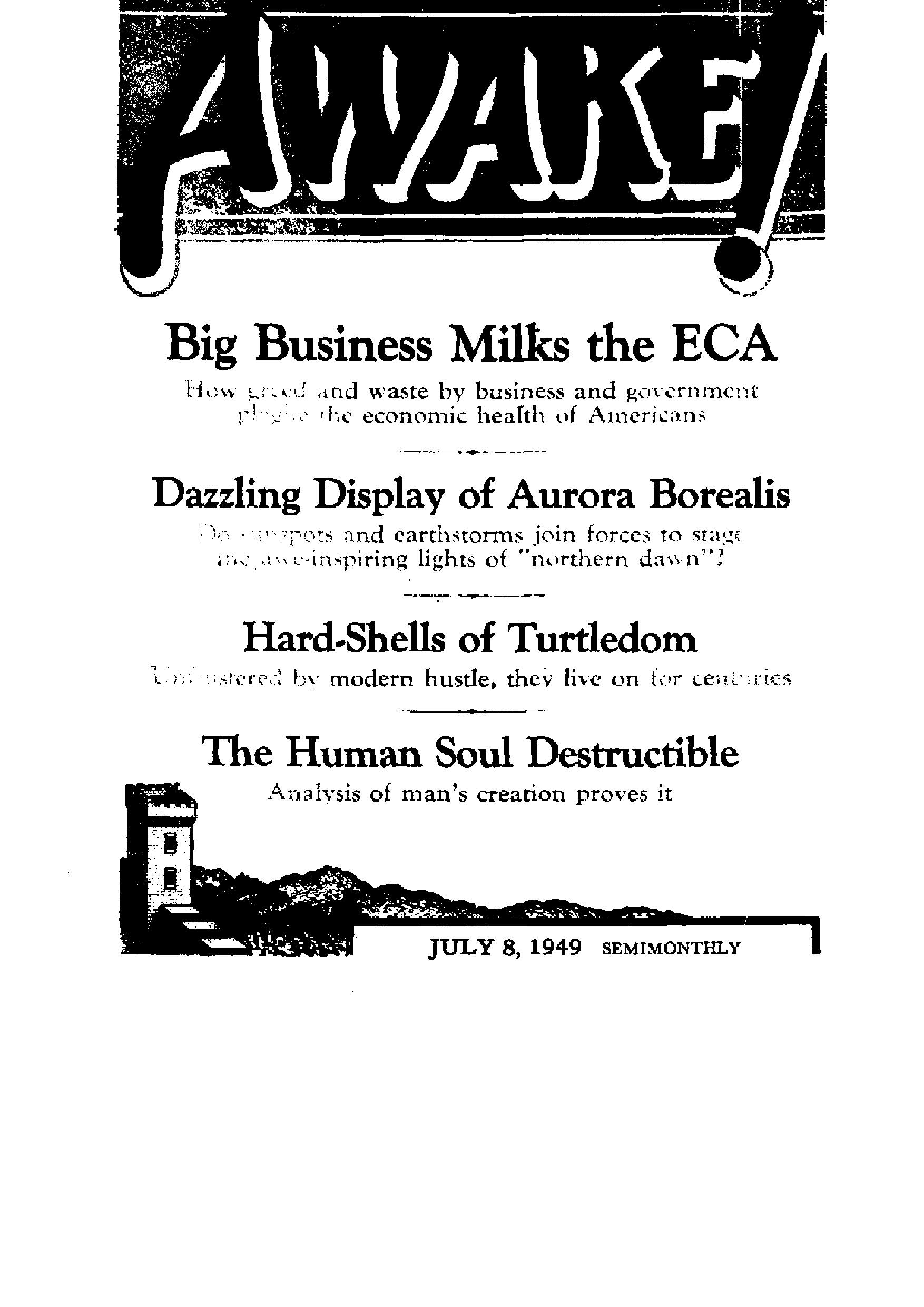
THE MISSION OF THIS JOURNAL
News sources that ere able to keep you awoke to the vital issues of our times must be unfettered by censorship and selfish interests. "Awake I” has no fetters. It recognizes facts, faces facts, is free to publish facts. It is not bound by political ambitions or obligations; it is unhampered by advertisers whose toes must not be tread upon; it is unprejudiced by traditional creeds. This Journal keeps itself free that It may speak freely to you. But It does not abuse its freedom. It maintains integrity to truth.
"Awake I” uses the regular news channels, but is not dependent on them. Its own correspondents are on all continents, in scores of nations. From the four comers of the earth their uncensored, on-the-scenes reports come to you through these columns. This Journal’s viewpoint is not narrow, but Is international. It is read in many nations, in many languages, by persons of all ages. Through its pages many fields of knowledge pass in review—government, commerce, religion, history, geography, science, social conditions natural wonders—why, its coverage Is as broad as the earth and as high as the heavens.
"Awake I” pledges itself to righteous principles, to exposing hidden foes and subtle dangers, to championing freedom for all, to comforting mourners and strengthening those disheartened by the failures of a delinquent world, reflecting sure hope for the establishment of a righteous New World.
Get acquainted with M A wake!” Keep awake by reading "Awake!”
FUBLlfiJlElD Sbmiuontbly Bt WATCHTOWER BIBLE AND TRACT SOCIETY, INC. 11T Adama Street Brooklyn 1, N. Y., V. S. A,
N. H. Knoeb, PrwideM Gaant Suiter, Swetary
Five cent* a copy Ono datUr * ywr
ihodd ba atm to ton In tw cttin^ try io crapUtnn with r«gulAtloM to purihte, uto delivery of money. Remitting an accepted it Brooklyn frctn «untrle8 where tjq is located, bf International money order only. Subscription rates in different countries an ban stated la local currency.
Notlu of miration (with rauval blaui) fa tent at laut two Issues bafom lubKriptton expires.
Entered *s KCond-cUu matter at Brooklyn. N.
Chatto of tri4ria when sent to our oftlca may bo erpeetod effective within one month, Stud your old as well u new address.
Offices Yearly Subicrlptlcn Bate
Amartai, U.fc.r 117 Adama St., Brocken I, N.Y, fl Aaitrella, u Beresford Rd-, StratWld, N.S.W. 6a Canada, 40| Irwin Ave., Toronto 5, Ontario Si England, 34 Craven Tinace, London, W> > $a Boat* Attlct, 623 Boston House, Cap* Town Si
I., Act CT Mu* 3, 1879. Printed in U 0. A.
CONTENTS
Big Business Milks the ECA
Aluminum “Scandal” Confusing
ECA and War
Economic Enslavement in the Offing T
Depression Ahead f
The Chavante—A Vessel of Hate Forged by the White Mau
Successful Meeting
When Hate Will Die
Dazzling Display of Aurora Borealis
Advice About Dogs
Exploding Grain into Breakfast Food
Tigare—Religious Racket in Africa
Public Reactions in the Gold Coast
Poisoning by Broken Fluorescent Lamps
Hard-Shells of Turtledom
Queer Creatures in Other Ways
Family Life a Small Problem
Hazard of Being a Turtle
Backsliding Religion
“Thy Word Is Truth”
The Human Soul Destructible
Liberation of Jews from Cyprus Camps
Watching the World
®/4<Nbw it is high tune to awake.—Romana 13:11 ?/
VoJurriA xxx Brooklyn. N. ¥., July I, 1H# Number II
Big Business Milks the ECA
The recent aluminum "scandal” focused public attention on the Economic Co-operative Administration. Charges reverberated around the world that certain ECA beneficiaries, England, Belgium and Holland, received free aluminum under ECA, then sold it back to American purchasers at more than 30c a pound. These charges were hotly denied with considerable cause, and the exact status of the case, left for later discussion herein, remains in doubt. On the other hand, the revealed hookup between large industrialists and ECA lending deserves more than casual scanning.
The ECA, European Recovery Program (EBP), and the Marshall Plan, all refer to the same thing. The EBP, originally called the Marshall Plan, was first proposed by former Secretary of State George C. Marshall, June, 1947. Later approved by Congress, and dubbed the EBP, it provided funds, foods, etc., for the sixteen Western European States and the three Western Zones of Germany. The ECA is the agency created by a Congress which dotes on the multiplication of alphabetical agencies, to direct and control the operations of the ERP. ECA and ERP designate head and body of the same organization, and Marshall Plan is its “baby name”.
Officially, according to Truman, its purpose is “to further world recovery”. Others charge that ERP, etc., is “now tied to military measures”; has been
JUXT 8, 1949
forced "to absorb the military commitments which the United States government, under the Truman Doctrine, already had made in Greece and TujJtey; and “military chiefs are inclined to regard ERP as part of their own strategy for rearming the western world”. All the painstaking analysis of motives is entirely beyond the concern of Big Business. For the pro/vteers the ECa-ERP-Marshall Plan acts as a productive cow for commercial milking.
For a little over a year the disbursements of ECA amounted to about five billion dollars, and requested for the fifteen-month period to end June 30,1950, is $5,430,000,000. Here was a rich plum that stirred many avaricious minds with longing! ECA allotments began to be fiercely scrambled for. After about fifteen months of operation the record discloses the intimate nature of the tie that binds politician and profit seeker. The big boys got the contracts and at a big price instead of the minimum cost which is usually urged as a reason for accepting the bids of major concerns. Monopolistic food processors, aluminum, steel, oil, cotton and shipping corporations have been preferred both in price and in allotment.
Racketeers in Oil
A brief glance at the oil contracts granted the greasy-handed Middle Eastern Oil companies furnishes a good case in point The oil industry generally
earned an unsavory reputation during the ffhot phase” of World War II by selling to the Democratic Powers and the Axis Powers (via “neutral Spain”) fairly indiscriminately. By the same token that blood is thicker than water so is oil much thicker and more precious to the international oil industry than the crimson stream of suffering humanity, nationality disregarded. As related in a previous Awake! article more oil has been found by the mere drilling of 300 wells in Iraq,'Iran, Saudi Arabia and territory adjacent to the Arabian penin* sula than that said to lie beneath “America^ 500,000 dribbling wells”. The chief squatters on these foreign oil rights are British and American-owned companies, with smaller holdings by Royal Dutch Shell, and France.
t These companies hold a strategic position for sale of oil to Europe. Their dealings with the navy during the war provoked Senator Brewster to expostulate on the “amazing picture of corporate greed” disclosed. Another Congressional inquirer has recently wired the president of Standard Oil requesting information on the astonishing profit now charged for oil bought for needy nations under ERP. The facts reveal that production of oil by the participating firms costs from 10 to 25 cents a barrel, and scarcely comes to 50c a barrel including payment for royalties, etc. The price chirped ERP is $2,65 a barrel! One authority notes that Middle Eastern oil could be sold in New York very profitably at $2.50, to compete with Texas oil delivered today at the same port for $3,05. The president of Standard Oil is still trying to explain just how, then, $2,65 a barrel for delivery’ in the Mediterranean represents a competitive price.
Of course, competition is as nonexistent among the Middle Eastern concessioners as in a small orderly family when dividing a large pie. There is so much to divide nobody could complain, especially since complaint might cause undesirable publicity. That is, nobody except the American taxpayer, because “this billion-dollar take will come out of the pockets of the American taxpayer”.
Like a crocodile hidden beneath the waters of visible operation, its real form never emerges unless forced to the surface by threat of danger or menacing attack. Only when the flow of profits is dammed or cut off, the corrupt stream recedes enough to reveal the monster —flashing, striking, snapping giant jaws to protect and control its cherished river of commerce.—See Ezekiel 29: 1-5.
Big Business in its national-bdundary-jumpmg operations is beastly, heartless, ultraselfish, remorselessly cruel. Oil is only one instance. Other interests are also sucking at ERP’s expansive udders. American firms have been collecting 50-percent greater charges for delivering ERP donations than the rates of foreign shippers. When Director Paul Hoffman attempted to relieve ERF of this burden the Maritime Commission and the National Maritime Union protested to Truman on the theory that American shipping should be given the preference. Since this would amount to a government subsidy (monetary aid) to an industry already rich it raises two related questions: Why should a shipping subsidy be charged to ERP ? and why should the American taxpayer be charged 50 percent additional for delivering a gift!
Even anticipating that ERP will shortly be made available to Spain, the National City Bank recently loaned Franco $25,000,000 with tacit approval of the State Department. Thus for the third time that Franco's despotism has been threatened Big American Business (and Religion) has stepped in to protect the most outrageous Fascist government extant.
Greed, Unltd,
Whenever big sums of money, such as the five billion spent by ERP, and the other five billion allocated, are involved,
Big Business and its whole litter come squealing and jostling for the handout. Only in the pigpen are similar scenes enacted. The highly advertised motive of humanitarian interest said to prompt ERF generosity (although a variety of other reasons such as blocking Russian aggression are concurrently advanced) has as little meaning for the conscienceless cartels as the farmer's incentive for filling the swill trough has to the hogs. The main thought in both cases is, Get all we can. Admittedly though, there are limitations even to this form of comparison: the hog's belly has a large but measurable capacity, but the lust for gold is unlimited. And while commercial greed dwrfs the swine's in magnitude, commercial conduct's counterpart is nowhere found in the animal kingdom. For business not only fills its insatiable belly but provokes bloody wars to prevent others from enjoying the surplus. To what beast can Big Business be likened!
In this discussion legitimate firms operating for a reasonable profit are entirely excluded from censure. But rather it is the corporations whose holdings are, so vast as to make national allegiance impractical, who operate on the Seven Seas, who are justifiably under fire. Among these are the arms and munition companies that recently counted their customers (and stockholders also) among both Axis and Democratic countries, who impartially sold to “friend" or “foe". To such organizations profit is the practical consideration, principle is scorned as an obstacle only for the “weak sentimentalists". To them the aspect of profits is not changed by their national origin nor their means of acquisition. “Blood money” is untainted for the insensibly selfish, tells no incriminating tales, talks with no foreign accent! Familiar then becomes the ring of Congressman Walter C. Ploeser’s charge: “A few giant companies are getting most of ECA's exports and profits, particularly in cotton and other farm products, and jpzr wo
small business is being left out in the cold."
Some of the outcry comes from abroad. One dispatch from Vienna captioned “Profiteering by U. S. Companies in Europe Through Loophole in ERP Pact Reported." Deploring the hurt caused to the “reputations of the United States and ERP in this part of Europe", the correspondent describes the method of exploitation;
The trick used by these American firms is to buy up in an ERP member country all or a part of the available supply of some scarce commodity, upon which another EBP member is dependent for industrial purposes. The country that is the victim of this technique then learns it can only get the essential materia) by paying free dollars/usually out of very restricted reserves. ... A favorite field for this practice, it is reported, ia certain scarce chemicals and raw materials.
Aluminum ,iScandal>> Confusing
Could one of these possibly be aluminum! At last report on the “aluminum scandal” the source of some of the shipments to the U. S. marked “Britain” were “untraeeable". “On the Continent the situation is vastly more complicated. Countries doing an enormous warehouse trade like Belgium and Switzerland do not and in the nature of the case cannot state with any confidence what is the ultimate destination of any of their exports. This would be equally true of reexports *of materials supplied by ECA.” (New York Times, December 26, 1948) When it comes to international business, the question always is, Just who owns what! One authority charges that ERP participators have set up “New York corporation dummies” to purchase their products and “force their European, trade partners to buy with dollars". Perhaps it would be well to restate the charge concerning aluminum, etc.:
The second scandal ia the cf slw-
minum and lead by three European countries, Britain, Belgium and Holland, using EGA money, that is, the money of the American taxpayer, and reselling the stuff to American manufacturers at a profit, . . . These three countries bought aluminum in Canada at 16 cents a pound—using EGA money which they got for nothing from the American taxpayer for the reconstruction of their countries. They sold it as scrap at from 27 to 30 cents a pound in the United States! EGA also financed lead purchases for Holland from Mexico and Peru, and for Belgium from Canada and Newfoundland. Half of these purchases found their way to the United States. . . . EGA spent $25,015,000 of the American taxpayers’ money on the aluminum deal alone. [New York Daily Mirror, December 16. 1948] . The aluminum mystery seems to cast the U. S. in the familiar role of Uncle Sap. [New York Daily News, January 7, 1949]
In the general denials that followed David Bruce's charges that the three countries had received 99,043 tons of the two metals free through ECA and had sold back 21,700 tons to the U. S., the scandal became “curiouser and curiouser”, according to the St. Louis Post Dispatch. Now the story agreed upon is that customs reports show unquestionably that the United States is giving away aluminum and buying some of it back; hut nobody knows for sure where it comes from. Britain was exonerated because aluminum shipped by British dealers was in reality routed from Switzerland by way of Rotterdam.'Making the picture more confusing the report stated that “the shipments had not originated even in Switzerland but were simply in transit through that country ‘from still another country or countries’.” A person of suspicious mind might wonder why—-since nobody can say exactly what route was followed by the touring aluminum—the traveling metal might not have started in the United States and returned to the United States. Could not all the reroute agencies have made a nice profit and the American taxpayer as usual paid the bill!
EC A and War
Economic issues play a big part in international disputes. Determining the exact purpose of ERP-ECA-Marshall Plan is about a$ difficult as deciding who bought aluminum from whom. The only parties sucking contentedly are Big Business. Abroad there are complaints from Britain and Switzerland (this prosperous country is not an ECA beneficiary) that America is using the ECA to accomplish results too quickly, or as an economic club. In France, Guillaume de Tarde, vice-president of the French National Railroads, remarks, “Out of a thousand ordinary Frenchmen, perhaps one half of one Frenchman knows what EBP really means.” In an article written last April dealing with <rEBP and Wart” Freda Kirchwey, writing for the Nation of April 10, 1948, observed:
American foreign policy is not departmentalized : it is one immense mish-mash, in which categories run together and lose shape and meaning. ... The degree to which politics and military plans today dominate economic aid is amply illustrated by the inclusion in the final ERP bill of the military appropriations for Greece and China. . . . Guns, goods, dollars—all are lumped together, along with the military and political purposes they represent.
A year later the military motive behind ERF was emphasized by the signing of the Atlantic Pact by eleven Western powers, several of which were ERP beneficiaries.
Nobody can say for a certainty just what ERP will lead to. British writer Barbara Ward thinks America must extend aid beyond the 1952 period set for termination of ECA. De Gaulle skeptically belittles ERP: “France has lived hundreds of years without the plan and can do so still.” France has not, however, refused the free tractors, and other products sent by America. Where it will all lead is questioned by Henry Hazlitt in his column “Business Tides”: “From the beginning the basic aims of the .Marshall Plan have been vague and con* fused. If anyone pointed to the economic misconceptions behind it he was told that its aims were primarily political. If he called attention to its political inadequacies he was told that the plan was primarily economic. Trying to pin down its purposes has been like trying to nail a custard pie to the wall/’—Newsweek, February 28, 1949.
ti
awake;
Economic Enslavement in the Offing?
“There can be no doubt that Moscow for the last three years has been cherishing a hope of our coming economic collapse/’ (Editorial in the San Diego Union, February 14,1949) In December the report of the advisory Committee to the (Hoover) Commission on the Reorganization of the Executive Branch of the Government, sometimes called the Eber-stadt Committee, described the United States as a “huge, sprawling, wasteful land”. The commission pointed out: “It [government] has accumulated excessive stocks of equipment and goods valued at more than $2,500,000,000.” Practically every agency has excessive stocks of supplies. The commission estimated that half of the several million purchase orders issued by the government each year are for $10 or less, and said: “Since the cost of processing a purchase transaction is greatly in excess of $10, the overhead cost is more than the cost of the goods. . . . Funds remaining near the end of a fiscal year are frequently expended^for supplies to avoid returning the money to the treasury.”
Some of the duplication, overlapping and general confusion would be laughable except that the losing taxpayer pays too much for the jokes. For example, the government “misplaced” 9,000 tanks, an item of more than two billion dollars! Henry J. Taylor, in his article in Reader's Digest (February) “Billions for Defense—How Much for Waste t” adds another mystery:
The question “What became of the missing tanks!” remains unanswered. But this is only part of the larger question, “What became of the equipment for 71 divisions!” At the war’s end the army had 89 fully equipped divisions and enormous quantities of armaments in reserve at home and in wo rid-wide pipe lines. Today the army says it has equipment for only 18. The disappearance involves equipment and many complicated war machines used in outfitting 71 divisions. The commission was baffled by this overall picture, especially so because “the military were put on notice six months after the end of the war as to the seriousness of the situation”.
In the budget the army asked for “$100,000 per tank” for improving 102 more such tanks than the army possessed. Money requested for 910 family houses in Alaska figured out at $58,350 per house; and 7,880 family houses for domestic posts at $18,600 each. For howitzers the budget called for 39 million dollars. “But the front ‘3’ had drifts ed in—and stayed there—by clerical error. Thirty million unneeded dollars had been defended to the last ditch by the budgeteers,” said Mr. Taylor. Funds for enough “tropical worsted uniforms” were requested for “all the enlisted men in the army and then some. At the same time there was 213 million dollars for stockpiling other clothing and personal equipment” The price for the requested 838,000 tropical worsted uniforms was $129 each. What is doubtless one of the most tactfully expressed criticisms ever issued was the commission’s comment: "It is difficult to escape the conclusion that padding has been a fairly general practice.” *
In all this Big Business profits. If the government loses or dissipates equipment, manufacturers replace it for prices greater than an individual, vrifh none of the advantages of large buying power, would pay. Who stands to profit more than monopolistic business, enterprises!
What, then, is the economic outlook for the fiscal year beginning July 1,1949 ! In his State of the Union speech of January 5 Truman gave the national debt figure as $252 billion. This figures the per capita indebtedness at something over $1/700, A family of four then is accountable, besides its personal debts, for $6,200. Without making a dent in this enormous burden, "all federal, state and municipal tax collections in 1947 added up to a staggering sum of 49.6 billions, or almost 25 percent of the national income. This was some 3.5 billions less than the record 1945 tax total. Nevertheless it is equal to $344.46 for each of the 144 million residents of this country?’ (Business Week, November 6, 1948) From the brief survey above it is evident that a large part of this painful load of taxation is funneled into the insatiable maw of commerce.
Depression Ahead?
Despite slackening up in many lines of business the Truman regime remains in ifnholy wedlock to the Roosevelt doctrine of "spending your way to prosperity1’. In the year starting July 1 government will spend $15,909,116,800 to maintain the armed forces. Much of this sum will go for government housing, automobile, heavy industry, food processors, clothing, oil, aircraft, and ship purchases. Part of the reason for the partially optimistic, or at least undisturbed, outlook for business is that the eold war with Russia means more business activity. A lower but prosperous level is in sight. In his report Truman promised something for everybody: free medical care, more pay for the jobless, bigger pensions, more education, eleeiric power for the farmer and stabilization of prices, better housing at low rents, old age pensions for man and wife to go as high Has $37.50 a week; $45 for the disabled. Truman is having difficulty with some of this program, but the outcome is still unsettled.
In general the outlook indicates that a "dip” not a "depression" is in sight. Consumer resistance against high prices forces some items down, but a ‘Trig buy? ing pool" remains for tapping. But, despite the fact that government spending and- unsatisfied public wants probably preclude the prospect of any considerable depression for the coining months, yet the average man has reason to reflect on the old Chinese proverb: "Getting money is like digging with a needle; spending it is like water soaking into sand?’ Money is the weapon used by the god of Mammon. Satan makes it difficult of attainment except by those few chosen by his minions who will use it for ultraselfish purposes. Because of waste, monopolies, and huge tax burdens the average man can enjoy less and less of money’s fruits, the more abundant life.
Realizing they have been thwarted and cheated, men are lured by such political appeal as that of Truman’s, that* in the role of common man himself, he stands in the gap defending the people from "those special interests who are making excessive profits out of present shortages". Nonetheless, Truman has been a party to the government spree of spending and he himself has an income greater than any private citizen could enjoy. With the new salary of $100,000, with $50,000 additional tax-free for expenses, plus a yacht, home and other privileges, 77. S. News estimates that for such luxuries an ordinary citizen would require an income of $3,500,000 per year! 1
Let none then be lured into thinking that j help from oppressive commerce comes from politics; much les$ from religion. A news dispatch, states: "The Vatican recently entrusted the House of Morgan with management of the Pope's financial interests in Africa and India. . . . In the Moslem world of 250 million persons strong it is held that religion— the Koran and Koranic Law—is the basis for politics.” The eyes of the people should be opened from examining the misdeeds of religion, politics and commerce, and they should seek Jehovah’s kingdom as their true hope.
HAVANTE
’ A Vessel of Hate Forged by the White Man
ecause of their desire to be let alone and to live alone the white man has come to call them "gentil Chavantes'’. Only in olden times in the middle of the eighteenth century did he submit to any contact at all with civilization. The chiefs of the Chavantes submitted themselves to the crown of Portugal, of which Brazil was then a colony. The treaty was celebrated between them and the governor of the province of Goyaz, Tristao da Cunha. One day the governor invited the newly-pacified Indians for a visit to the capital of the province. He thought that probably a handful of them at the most would come, but he was stricken with panic when he saw hundreds and hundreds of Indians arrive. This brought a very new problem to the governor, although in that epoch one of the worst headaches of the jungle was that of food provision.
He was unable to play host to all of his visitors. Through desire for food and entirely without the notion of robbing, the Chavantes passed quietly through the city taking to eat anything and everything upon which their eyes fell. This act, simple and entirely justifiable in their sight, became one of the worst ransackings of a city that Brazil had ever known. The situation was unbearable, but the Indians, knowing that they were invited, had no intention of leaving. The governor was unable to convince them of the gravity of matters.
Hate Is Barn
Force was resorted to. Regular troops were hurriedly set against the surprised Indians and many were slaughtered.
Hence till now that inexplicable and hateful attitude of the white man has never been understood by the Chavante. From then until now the white man was marked as a traitor in the memory of the Indian. Attack after attack followed by the soldiers and thousands of Indians were conquered and subjected to the white man. Scores of these died of an epidemic of measles; while the residue fled to the
woods and thus escaped. What a beautiful recollection it was that the thousands who escaped carried with them! It was a ' campfire story of massacre to be told over and over again. It passed from generation to generation through the tribe’s traditional storytellers, who, perhaps after the witch doctors, are the men most respected in the tribes. At any^ rate, since 1765 this Indian tribe deep in the heart of Brazil in the states of Matto Grosso and Goyaz had systematically refused to receive any kind of visit from the white man. That is, until recently.
The hostile attitude toward the few
white men that chance to wander through his forest home does not leave any doubt as to his appraisal of the pale face. But the Chavante has isolated himself not only from the white man but also from the conquered and civilized Indian who at one time was of his own nation. Well illustrating is the clash and massacre of the Carajas by the Chavantes that occurred in 1930. Np opportunity to attack and kill any and all intruders is overlooked by him.
Many call the Chavante lazy, probably because he leads a nomad life. He wanders about in the thickets hunting and fishing, but always on land. Strangely he sees no good use for the river. Instead of a means of communication and help he looks upon it merely as an obstacle separating two portions of firm land on which he can and is accustomed to walk. He limits his navigation to a log, which, after perfecting tie crossing, he abandons without any thought of returning to use it again.
Unlike the Incas and North American Indians, the Chavante remains in a very primitive mental state. Confronted with a new problem he halts with indecision as if it presented something that to him is overcomplex and impossible of solution. But one thing that he is not in doubt about is his distrust of the colored man, the white and the civilized Indian.
A Celebration Dance
Only with such an outlook on others can his action against Pimentel Barboza be explained. In September of 1941 with two timid and frightened interpreters from the Cherente tribe, cousins to the Chavantes, Barboza, inspector of the Service of Indian Protection, and his expedition set out into the thick forest to meet with them in an exchange of gifts and with the desire to bring about peaceful relations between them and the outside world. Before entering Indian territory the expedition members chanted the slogan of General Rondon of the Service of Indian Protection, “Die if necessary, but never kill.” Thereupon Barboza disarmed all his men and proceeded with the journey. Finally the grasslands of Roncador rose visible in the setting sun. There was the heart of the Chavante nation. Here Barboza chose a woods as shelter and set up camp, dangerously elose to the Indians.
Barboza had not the slightest doubt of the success of his expedition, for he thought the Chavante to be no different from other tribes. He promptly sent out from there three scouts, a white man and two Cherentes, to locate the various villages of the Indians. The three rode horseback, the whole day, through territory immediately surrounding the camp. At nightfall their eyes fell on a village low in the foothills. From their elevation they could see fires in among the straw and branch community houses. They realized that they were viewing one of the most impressive celebrations that their eyes had ever seen among Indians.
There were men and women mixed in one grand and frantic dance that seemed to be a manifestation of collective insanity rather than a celebration or perhaps some kind of commemoration. The drums pounded with deafening thud. The celebration filled the whole night through and the ground shook beneath the tremendous procession of barbarous men with war instruments. Arrived early dawn and there lay the dancers completely exhausted around dying campfires. In fear of being seen the three scouts abandoned the sight with the coming of dawn to complete their mission in search of other villages.
Not one mile was traveled before one of the superstitious guides halted motionless in a trance of‘terror. “The black bird flew over my head,” he cried. “At this hour Captain Barboza and his companions are no longer alive. We must return” Retracing their steps to the camp of their companions the Indian's fear was confirmed. There lay the bodies of all the party horribly mutilated. Smashed radio and motor equipment lay scattered round about. There lay the clubs and other implements customarily used and left by the Indians in massacre. .There remained alive not one-soul. The horses were slaughtered and mutilated, for the Chavante knows no other means of transportation than by foot. The utility of the horse would never enter into his mind. Everything round about indicated to the three scout survivors the presence of the Chavantes.
■ The inspiration for the celebration of the night before, of course, was clear in their horrified minds now, and witfi the memory of that massacre celebration in the tribe's own camp, the three had but one worry, to cross the river and save their lives. According to the Salesian priests of that region, the Chavantes have for thirty years remained alert and prepared for that and any opportunity to repel the white man from their dominions.
Successful Meeting
Recently the successor of the unfortunate Pimental Barboza, Francisco Meirelles, succeeded in coaxing them first by leaving presents and making a discreet withdrawal, then finally succeeded in making a closer contact with them face to face and exchanging knives for arrows. But where was the Che rente interpreter! Oh, this time he had taken sick all of a sudden and failed to join the party, which was almost a fatality, because the party had only 80 knives. The Indians kept appearing until there were about 400 of them, and no more knives! Meirelles made a noble attempt to communicate with them by gestures that he would go and get knives for the rest of them and return. This satisfied the chief and those who received knives, but it was evident from their gesticulations that there was resentment on the part of the others who in their disappointment at being left out worked themselves up into a frenzy of attack. The party of “pacifiers” made a quick getaway on horseback, outdistancing their pursuers who were afoot. No fatalities, only one wounded mount
The second expedition was planned with great care, checking up on the mistakes of the former failures and taking full advantage of the lessons learned. The first attempt succeeded in leaving presents at the Pimental Barboza camp, as the SPI camp was now called in memory of the martyred inspector. These the Indians furtively took in the absence of the members of the expedition who intentionally got out of sight. With the six months rainy season coming on, the party withdrew to prepare a return effort.
This time the expeditioners, headed
by Francisco Meirelles of the SPI, in two launches descended the river formerly known as Meek river but renamed River of the Bead after a terrible clash in the year 1770 on its banks between a party of explorers in search of gold and the government agents also in search of gold in the form of taxes for the Portuguese crown. Both sides lost heavily, with only one among the explorers escaping alive. The river ran with blood and the gruesome bodies of the dead wqre carried downstream by the current, and the river from that time on has been known as the River of the Dead.
At long last, a thrill ever so chilling. The Indians came out I Out of hiding and into personal contact with the expedition, who exchanged* knives and trinkets ,with them for arrows. The expedition succeeded in taking some pictures although the machines terrified the Indians. Conversation was impossible, for. as always, the interpreter who could speak a kind of Chavante dialect failed them, becoming suddenly speechless in the presence of the Chavantes. He found his tongue only after the encounter had ended when the presents were all given out and the expedition had returned to camp. This latest meeting was made in September, 1946.
The Chavante "Historian"
Will these Chavante Indians never forget and forgive the inhospitality and bloodshed of so many years gone by! Forget, no. Their tribal history is kept alive and handed down from one generation to the youth of the next generation by the official tribal storyteller. As the young Indians reach the age when other youngsters would be entering primary school, they gather around him and Are taught who their ancestors were, what they did, how they conquered and how they suffered. These stories are repeated faithfully, without variation. One or more youngsters with the best memory are selected to train for the place of storyteller upon the death of the present one. As they reach the age when they can use a bow and arrow or learn the art of war, these remain in the eamp while the others go out, attending their course in history, hearing and repeating the tales which go to make up the national -patrimony of the tribe.
Generations back, members of the Cha-vante tribes would, in the dead of night, visit their ‘relatives of the subjugated Cherentes in their villages, returning home at dawn, unwilling to remain among those who had made friends with their inhospitable hosts of years gone by, who had repaid their visit with wholesale murder. As these older ones died, the friendship ceased and the Chavantes gradually came to Sespise and fear the Cherentes as much as they did w’hite men.
fFAen Hate Will Die
But if the storytellers still faithfully inculcate in the youth of the tribe hatred and distrust of the white and the subjugated Indians as well, what accounts for his changed, more conciliatory attitude as shown in his more friendly contact by the whites at the present time? There are two factors that enter into this apparent change of attitude. One is his physical situation, hemmed in by the Rocador Sierra on the north, civilization on the west, the pacified Tapirapes oh the island of Bananal to the northeast, and the SPI advancing upon them from the south. So he must choose one of the two horns of the dilemma, either make friends or fight on all fronts.
But there is another powerful factor. The Indian brave, like so many other “braves”, is a hero so long as he holds the superior power. Let his opponent display a superior power, and his prowess is gone. And so it has happened with the Chavante. Of late these hated and distrusted enemies have sent flying over his land enorfiious gray birds that are proof against their arrows and all the charms of their medicine men. Proof against even their storytellers, who have nothing in their lore to account for these strange creatures that fly so swiftly and never flap their wings. Thus the airplane of this twentieth century has struck awe to the heart of the savage, and he realizes that the white man wields a power superior to his.
Pitiful Chavante! Staunchly he resisted the encroachments of “civilization” which would take from him his simple freedom and care-free life with worship of the one' “Great Spirit” and give in place of these the white man’s uneom-fprtable clothing, his tobacco and alcohol, his multitudinous diseases, his prisons and torture, his diplomacy and nations disunited by their “good neighbor” policy, and, worst of all, his religious worship of “three gods in one”.
Would that it could be that he should not bow his neck to the kings of the earth, but gain a'freedom greater than he has ever enjoyed, the freedom of everlasting life in the New World. May there come from his nation too those to whom are promised “out of every nation and of all tribes and peoples and tongues” shall be gathered a great multitude who hail him as King over all the earth. The great spirit power of Jehovah has the willingness to fulfill this promise that “they shall hunger no more, neither thirst any more”. “For the LamE) which is in the midst of the throne shall feed them, and shall lead them unto living fountains of waters: and God shall wipe away all fears from their eyes.” (Revelation 7:9, Am. Stan. Ver,, 16,17) Why should not the Chavantes be among those tribes T—A wake / c o r r e-spondent in Brazil.
Do sunspots and eArthstorms Join force* to stage the awe-inspiring lights of Northern dawn"?
^TVTORTHERN dawn”: that is the lit-_L 1 eral meaning of the term “aurora borealis”. These beautiful and awer inspiring phenomena were originally so named because of the direction in which they were generally seen, to the north, and because, especially in lower latitudes, the light glowing in the northern sky seemed similar to the dawn. Now they are called simply the “northern * lights” or “aurora”.
But just how large a portion of our globe is privileged to see the aurora! And how often! A surprisingly large area of the earth, although much of it does so very infrequently. Starting in an oval-shaped area whose southern boundaries are roughly the Mediterranean, southern Asia, northern Japan and central Mexico these lights are seen about once in ten years. This southern limit is still imperfectly known, due to scarcity of observations. Traveling northward, the lights gradually increase in frequency until a maximum of more than two hundred and forty are seen each year in a section through northern Norway, Iceland, Labrador, northern Canada and Alaska, and the Arctic coast of Siberia. Then they decrease as the .geomagnetic pole, the center of the earth's magnetic field, is approached. At this spot near Etah in northern Greenland they are seen about fifty times a year. It is probable that there is some aurora present constantly, but at times too faint to be seen, or hidden by clouds, moonlight or sunlight.
Human creatures have long asked what the aurora might he, ancY the answers have been many and varied, ranging from the theory that they were the mythical Valkyries riding their horses through the skies, or the spirits of the dead at play, to the “scientific” claim that they resulted from the refhwtian uf sunlight from the polar icefields. Even today these lights and their causes are imperfectly understood; but increasing knowledge of the material creation has brought to light some pertinent facts about them.
Observation has established that the gigantic storms seen upon the face of the sun as sunspots gradually grow in numbers from a minimum to a maximum over a period of about eleven years and that the auroras also increase in frequency over the same period, keeping in step with the sunspots- Apparently the two phenomena are related.
The latest theory visualizes these sunspots throwing out vast quantities of hydrogen atoms something like a volcano, or perhaps more like a monstrous fire hose throwing out a stream of water. Many such streams of hydrogen are spurting from various places on the sun and in many directions. The pressure of the sun’s tremendous light may be the propelling power behind thoso streoroft, but, at any rate, the fact is established that the magnetic storms which always accompany the bright, shifting auroras seen in the middle latitudes occur between twenty-four and twenty-five hours after the sunspot which caused them crossed the central meridian of the sun. That is when the sunspot would be “aimed” in the direction of the earth. To accomplish this journey from sun to earth the particles must travel around a thousand jniles a second.
These magnetic storms should not be confused with the electric or thunderstorm. A magnetic storm may be in progress without a cloud in the sky or any visible -evidence except the aurora. But these storms do interrupt,telephone, teletype and radio communication and cause erratic compass readings, and for these reasons attempts are now being made to forecast them, with some success.
When a sunspot has caused one aurora and accompanying magnetic storm, then it may well cause another when it is again brought into position to throw its stream of hydrogen particles in the earth’s path. This interval varies, depending on the position of the sunspot on the sun. Sunspots in latitudes of thirty-five degrees from the sun’s equator are carried around the sun in some twenty-seven days’ time, while those near the sun’s equator take only twenty-five days. These sunspots may continue for six, or even twelve months, spraying the earth with hydrogen particles each time the sun turns that portion of its face in our direction.
Of course, there are many sunspots which throw out their streams in directions far from the vicinity of the earth. Because of the angle between the plane of the earth in its circle around the sun and the plane of the sun’s apparent rotation on its axis, the earth is in a more direct line with the areas of greatest sunspot activity on the sun during the equinoxes; and it is set these seasons that the aurora is most frequent.
When the earth approaches one of these streams of hydrogen atoms from the sun then its magnetic field takes control and diverts them toward the north and south poles, where they smashrinto the gases of the. atmosphere, causing these gases to glow with that light which we call the aurora. Oxygen ana nitrogen are the atmospheric gases affected and both give off a variety of colors depend-in$ upon their state of excitation. The principal colors seen are white, yellow, red and green. Oxygen is the source of the bright red, nitrogen of the orange-red, oxygen of the yellow. The remaining colors, blue-green, violet, and white, are from nitrogen.
And how high are the auroral lights? Many are the accounts describing them down lower than the mountains, and some will even describe displays they have seen touch the ground. The lowest measured aurora, according to the University of Alaska, at Pairbanks, was some thirty miles above the earth. Mostly they occur at heights of fifty miles or more, the highest yet measured being six hundred miles high.
Many and varied are the forms of the aurora, and several forms may succeed each other or may be present at the same instant forming part of one grand pageant. Add to the variety of form the major colors of the rainbow, and the effect is indeed almost beyond description. Sometimes all you see is a misplaced and unimpressively faint patch of light in the northern sky, truly a 'northern dawn’: or it may be a single brilliantly white ray of light that you at first dismiss as a searchlight beam but finally realize it is too far-reaching to be a man-made light. Often there will appear a group of these rays all radiating from a common center. These rays may be of various lengths, some disappearing beyond the horizon. This form is called a corona.
Another time a long band or arc will appear, perhaps greenish-blue, purple, or orange-red. This may develop a rayed appearance along its upper edge, as if hundreds of searchlights were pointing upward parallel beams. When an arc is very bright the lower part will usually be red, the middle, yellow, and the upper part, green. A rarely seen event is the arc from which a series of arcs spring up at intervals of one or two seconds moving swiftly upward and across the sty like ocean waves following one another.
Can you picture a gigantic theater curtain whose bottom edge is hanging some fifty miles up in the sky and extending hundreds of miles to your right and left! Its upper reaches fade out so that you cannot see from what it is hanging. Can you see the high-lights where some unseen colored footlights catch the folds in the curtain and reflect from them! There is darkness between the folds where the shadows of the high-lighted portions fall, but the undulated lower edge is clearly outlined for its entire length. And the folds of this curtain are moving, rippling as if blown about by a strong wind. There you have a picture of the ‘drapery’ form of the aurora. These may be shorter, some horseshoe-shaped.
An excellent and vivid description is
that by George Kennan in Tent Life in Siberia, as follows:
The whole universe seemed to be on fire. A broad arch of brilliant prismatic colours spanned the heavens from east to west like a gigantic rainbow, with a long fringe of erim-son and yellow streamers stretching up from its convex edge to the very zenith, At intervals of one or two seconds, wide, luminous bands, parallel with the arch, rose suddenly out of the northern horizon and swept with a swift, steady majesty across the whole heavens, like long breakers of phosphorescent light rolling in from some limitless ocean of space.
In times past some outstanding auroras, the evidence of the Creator's power and love for His creatures, have startled religiously inclined persons into great fear and consternation as they jumped to the conclusion that the earthly globe was about to go up in flames. Contrastingly, informed servants of Jehovcdi, viewing the vast, colorful, panorama of an aurora, alive with movement, see with added force the truthfulness of David's inspired words, at Psalm 19:1: '*The heavens declare the glory of God; and the firmament sheweth his handywork.” —Awake! correspondent in Alaska.
Advice About Dogs
During 1948 the Chicago poet office displayed a poster instructing mail carriers on how to protect themselves from vicious dogs. The following ia an extract from the advice it gave: *'A dog is not necessarily a brave fellow. He calculates the strength of his enemy. He likes to bluff and likewise can
be bluffed. It is fatal strategy to give evidence to the dog that one is afraid of him or that one hesitates. The fast-walking-straight-ahead letter carrier, speaking roughly to the dog and paying little attention to him, ofttimes gains entrance. The dog is nonplussed or is uncertain. The least attention one can pay to the dog aids in lessening the dog’s desire to attack. Never pet a dog. In many instances when there is imminent danger, the best strategy is to face him and stand perfectly still. Then back away slowly. Never turn your back and run. Talking to a dog in & soft, low, friendly tone aids somewhat. It is a problem which never can be solved entirely, and the dog is only acting logically from his viewpoint. He thinks he is doing a great favor to his master when he barks and gives the appearance of attacking. Usually, a person in uniform or a person carrying some article is a suspicious character to the dog. For the letter carrier to chase the dog, strike at the dog or otherwise attack the dog seldom is good policy. It does work occasionally, but in most instances the dog acquires a life-long enemy, in bis opinion.”
Exploding Grain into Breakfast Food
For centuries man has devised various ways of preparing his food. Grains have been roasted or parched for thousands of years, for we read at Leviticus 23:14: “Till you have brought the offering for your God, you must eat neither bread nor grain, roasted or fresh.” (Moffatt) But only recently have grains been roasted so intensely that they exploded into puffed cereals. A visit to Kingdom Farm in upstate New York will show us the process. There Jehovah’s witnesses produce large quantities of food for full-time ministers, and possess facilities for puffing cereals.
Th$ equipment is simple. It is essentially a heavy iron barrel with a tight-fitting lid, and it rotates slowly as it is heated by a gas flame. Into the heavy iron compartment has been put eight pounds of wheat, a tablespoonful of salt and a little water, and these ingredients have been sealed in by a £eavy lid that has a special double-grooved lead seat. The gauge indicates slowly mounting pressure, till it exerts a force of 250 pounds to the square inch. Quickly the operator stops the rotating mechanism, throws the lever that releases the lid, and out flies the exploding grain with a boom like a small cannon!
<1 What has happened is this: Inside the revolving barrel the grains of wheat have reached a high roasting temperature and also a great pressure is built up inside the grains. The heavy structure of the barrel not only is required to withstand the 250-pound pressure but is needed to retain the heat and bring all the kernels to an even temperature. When the moisture and pressure and heat are correct and lid is thrown open, the pressure blows the grain from the barrel’s mouth like buckshot from a shotgun. When the grain hits the* atmosphere it puffs out in a sort of “controlled explosion”, enlarging to about eight times its original size. Thousands of air spaces interlaced between the cells of the grain give us the familiar puffed wheat. If too much heat and pressure are used the “explosion” of the grain is not “controlled”; the grain loses its shape or even flies into dust particles. If other conditions are not correct, unpuffed grains result.
€. When the ‘^barrel gun” booms and the grain shoots out it is trapped in a small room or specially constructed enclosure and falls into a container. The puffed wheat is ready to eat. Never is it better than right from the puffing machine. The grains are warm, fresh and crisp, and seem to taste better than when served on the table. To retain this desirable crispness manufacturers often heat the puffed grain again just before packing it in moisture-proof containers. If moisture in the air has robbed tlje grains of their crispness, restore it by heating in an oven before serving. €. Why are not more grains puffed? Well, it seems that only a few grains lend themselves to successful exploding. Even some varieties of the same grain puff better than others. With wbeaty the hard, winter varieties are the best, and old wheat is better than newly harvested grain. Rice puffs very well, and the procedure is the same as that employed on wheat, except that the operator does not turn the heat so high and brings the pressure up slower and allows the machine to run longer. Whereas wheat was not released till the pressure rose to 250 pounds, rice is puffed when 150 pounds of pressure is reached. Incidentally, the pressure in the usual pressure cooker does not exceed 15 pounds.
<1. Corn also puffs quite well, but is not as popular as wheat or rice. When com is blasted from the barrel it is quite different from the familiar, fluffy popcorn, Puffed corn expands equally in all directions to form a round, enlarged ball. Popcorn varieties are better for puffing than the field com. Barley has been puffed some, but the grains do not enlarge as well as wheat and it has never become popular. Some manufacturers have spent much time and money trying to puff oats and other grains, but have never found it practical enough to put them on the market.
;are band is on the Drummers crash out with a few bars of hearty drumming. Crowds burst into the biggest of yells. A fervor of excitement arrests the attention of the passer-by as the Tigare priestess dances amid the excited tom-tom beats and the rattling calabashes. With unbound hair, and a short calico skirt slung loosely about her waist, her body decked with black and white beads, sundry anklets, bells and amulets, the fetish-priestess dances. Suddenly she will tremble like a reed on her feet; then, like lightning break into jiggling and shaking in every limb. An occasional skip and a high leap in the air form part of the possessed medium’s dance. And indeed the woman is possessed, for as one looks at the oppressed and worried look on her face she appears to be in a hysterical fit, a curious mixture of unrestrained and selfconscious behavior.
The priestess, streaked with runnels of sweat, does a few forward dancing steps, halts, and is followed by the drums and the beating tom-toms. This action is followed from time to time, for the town must hear that the Tigare band is on the march. Round the town the band dances on its way. Many of the hitherto following spectators, upon hearing the continuous yells, singing, monotonous drumbeats, clapping and bawling rhythmically, join in on the dance, doing an occasional somersault or roll, only later to join the ever-growing crowd.
Parading around town in this way is done in the hope that many more credulous people will succumb to the newly demonized practices of Tigare. But where did the Tigare cult originate ? and what are its effects upon the people in this part of the globe? Such questions are timely and appropriate, for today throughout many parts of West Africa there is an overspreading of the movement, and its blind adherents grow daily. Tigare originated from the French Ivory Coast and was introduced into the Gold Coast some years ago as Abereiva. Later, to avoid falling foul of the British government, it assumed the name of Hwemso.
However, turning back the pages of history on the Gold Coast, we find that long before the invasion of Tigare from the French Ivory Coast the Ga people were ruled by a high priest. Hence the one-time government of the Ga tribe was a fetish hierarchy. Fully realizing now that many parts of West Africa found their deep-rooted origin in fetishism, it is no wonder then that certain credulous individuals, helped by their ignorance or lack of conviction in higher beliefs, once again try to turn to the original form of fetish rule, and this as represented today under the new name Tigare, It has also been proved, from information that has come to light, that certain of the native chiefs have either allowed or in some cases asked priests of the Tigare cult to come and practice in their states, and this in some ways serves as a source of revenue to the chiefs*
If in this article we had time to check the ancient practices of the original fetish-priests, and paraphernalia associated with them, we would realize that ancient fetishism and Tigare are in fact one in purpose and ideas.
Practices 0/ Tigare
Let us now for a few moments pause to look in on an official secret meeting of the Tigare cult. Before our eyes is a raised mound or platform at the rear of which is a wall; this is termed the “sanctified” area and has previously been covered with kola that has been “sanctified” by the high fetish priest Our attention is next drawn to a black bag hanging on the wall above the “sanctified” area. This is the Tigare fetish,! and contains cowries and kola. A little way ahead of us, some little distance away from the “sanctified” area, attired in his official dress of a big gown and cap, both of which are studded with charms and amulets, the priest stands.
The meeting is about to begin, and the priest beckons a woman toward him. Apparently- the woman is here in the hope that Tigare will give her power to beget a child. Now the priest, hand in hand with the woman, leads her to the “sanctified” area, Where she kneels and prays to Tigare, and promises to give four bullocks if her prayer be granted. The woman has now finished her petition. The priest now moves nearer to the “sanctified” area and invokes the help of Tigare saying: “Thou great hunter Tigare, thou hast heard the prayer of thy maidservant; bless her and grant her prayer? Audible to all, the priest is reciting the Tigare ten commandments to the supplicant!
(1) Do not speak evil of your friend on the public highway. (2) Do not use the name of God in cursing your fellow men. (3) Do not steal, except where Tigare allows it. (4) Do not defraud your fellow men. (5) Do not break up another person's home through adultery (if you are a woman). (6) Do not gossip or speak untruth about your fellow man.
* "RoU" Is a not collected from a tropical African tree. It U used as a condiment and digestive, a toniCi and an antidote to alcohol.
+ "By Jfetlah’ I mean a palpable inanimate object which is either permanently or intermittently the home of an invisible being." Refton end Jfedietae of the Ga People, by M, J. Field, page 4, paragraph 1.
(7) Do not make sipe" (i.e., cherish evil thoughts about other people). (8) Do not harbor witchcraft, (9) Do not take the life of another person either by poisoning or by any other method. (10) Do not challenge the power of Tigare.
Silence falls over the meeting. The woman and the priest stand together for a fe;w seconds. Again the priest is speaking; this time it is a message of warning to the woman. “If you violate or break any. of these commandments your only hope is to return immediately and confess to Tigare and fulfill the appropriate penance to receive pardon.” The devotee is now being offered some of the “sanctified” kola, and with white clay from the “sanctified” area a mark is placed upon the woman's forehead, ears, back of her head and on her neck, by the priest. The markings on the devotee are an outward sign of -sanctification and admission to the Tigare group.
Many are the people who, like this woman, come to Tigare. Some come in search of health or wealth. Yet others come in the hope of gaining position or promotion. Whatever be the petition to Tigare, it must always be accompanied, if answered, by a gift offering.
Public Reactions in the Gold Coast
Many are the dangers that lurk in the path of the Tigare follower. First, it is clear to see that there is a great drain of wealth due to the unceasing demands of the fetish. Second, when people are possessed of the fetish kola is offered for them to chew. It is thought, although it has not been proved, that the kola offered to many of these people has been subjected to treatment in one way or another. To bear out this above statement, the hook, Tigare, A Report issued by The Christian Council of the Gold Coast, page 5, paragraph 3, alleges that in the kola nut in some instances “alligator bile is inserted capable of causing at least temporary mental derangement ... in this condition even child devotees have
…