Awake!, February 8, 1949
Download: PDF — Awake!, February 8, 1949
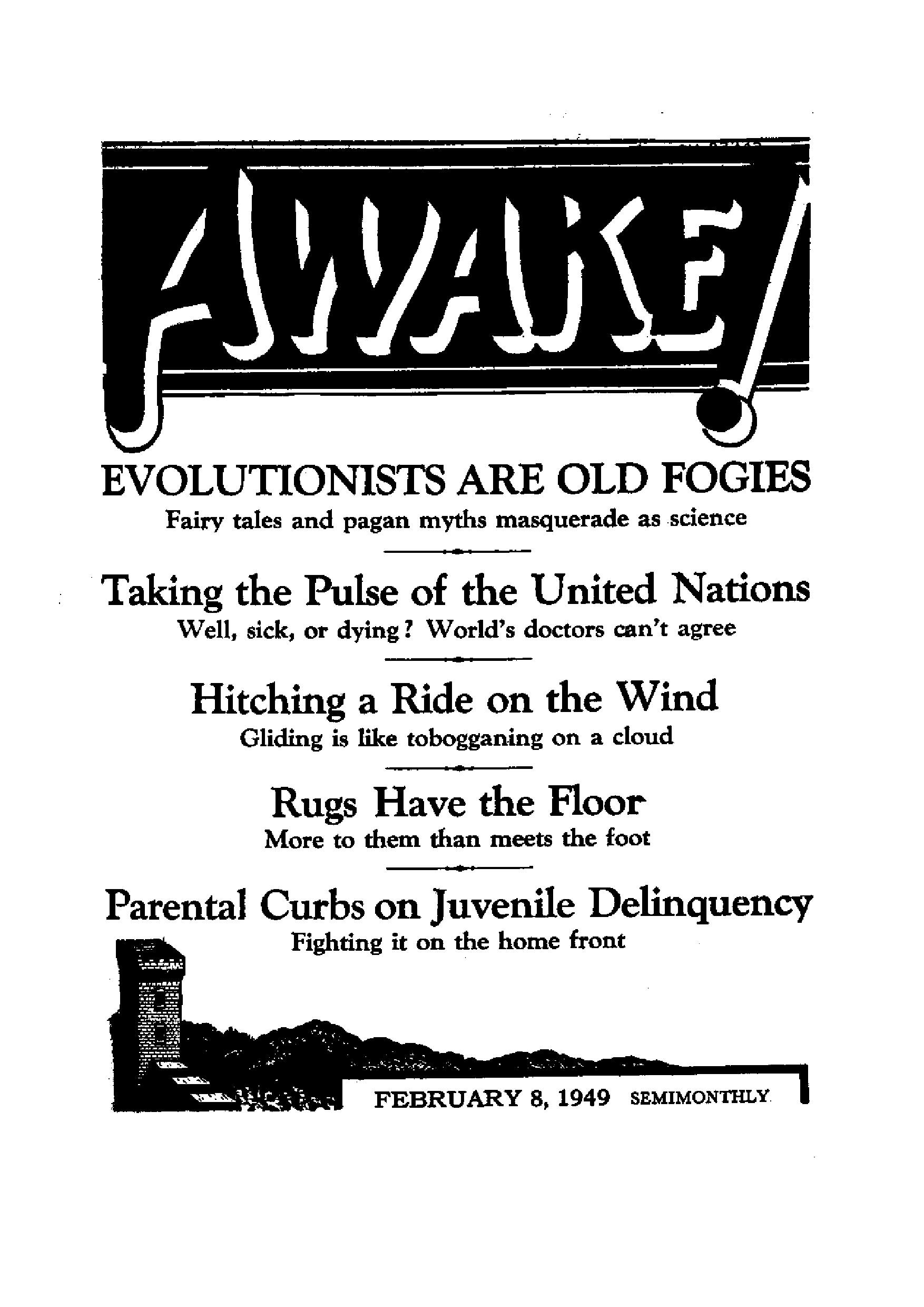
EVOLUTIONISTS ARE OLD FOGIES
Fairy tales and pagan myths masquerade as science
Taking the Pulse of the United Nations
Well, sick, or dying ? World’s doctors can’t agree
Hitching a Ride on the Wind
Gliding is like tobogganing on a cloud
Rugs Have the Floor
More to them than meets the foot
Parental Curbs on Juvenile Delinquency
THE MISSION OF THIS JOURNAL
News source* that arc able to keep you Awoke io th* vital tatues of our time* must be unfettered by censorship and selfish interests. "Awake!” has no fetters. It recognize* facts, faces fact*, is free to publish facts. .It 15 not bound by political arnbitions or obligations; it is unhampered by advertisers whose iocs must not be tread upon; it is unprejudiced by traditional creeds. This journal keeps itself free that it may speak freely io you. But it does not abuse its freedom. Xi maintains integrity io truth.
M Awake I” uses the regular news channels, but is not dependent on them. Its own correspondents are on aJi continents, tn scores of national. From the four corners of the earth their uncensored, on-the-* scenes reports come to you through these columns. This journal's viewpoint is not narrow, but is international. It is read in many nations, in many languages, by persons of all ages. Through it* pages many fields of knowledge pass ih review—government, commerce, religion, history, geography, science, social conditions, natural wonders—why, its coverage is as broad as the earth and as high as the heavens.
"Awake I” pledges itself io righteous principles, to exposing hidden foes and subtle dangers, to championing freedom for all, to comforting mourners and strengthening those disheartened by the failures of a delinquent world, reflecting sure hope for the establishment of a righteous New World.
Get acquainted with “Awake I” Keep awake by reading “Awake!”
Publish cd Semimonthlt Bt WATCHTOWER BIBLE AND TRACT SOCIETY. INC.
117 Adams Str^t Brooklyn 1, N. Y.r U. S. A.
X a 5*0**, GtAHT SL’ITXl,
Flvf canta a cofty Ona rfattir a ynr
te Mtt to a«et te yev^wn-try in »v[:lUw w.t* rtftUtUo* U gwifiQM ■aft ddlwr it *mw. IvattUMM tn* MtMpttd at Ann cnuitdM wtit* » ii louMd. hj liL4rn»tntja] »«*•? <xd*f «■!?. Sutesrir<ic« rite* in <nfu*5C tent 1* foal
turrtMp. ■
SJtlN at artrtltt (»hi fwm! tlKk) 1* *tnt at to; iw tew Infer* aeteajpUM W5*™*-
u n*tt*r it IrfaMn. B.
Cbtef* «t *Mt«N *t*C *tm to 4UT o*C* U7 te ntttfcd <eotiv« vltbia m wioatb. B<«< your o.d m »*tt m aw *Olrw*
44fccc TmiV tiataKiVtiM lata
Jtaarka, 11T a^juw Si.. BrnttUn I h'.T- H *wtri«i, r KmCerd M, Buiztte’d, P 8.W. At C*M4«, +0 Inrfo Am. . Tangelo 6. OiUrW tl E*fHM' 34 CmTO TtTr»t*, Loo4«a, W, S fa te«U AItIm, 813 Butoo Bow. c*p* two fa
Aa ot Mudi ft. lift. Wj«1 Sc U, li
CONTENTS
Evolutionists Are Old Fogies
“Give Me that Old Time Religion"
It s Good Enough for Orthodox Ctergy
O1(L fashioned World Blind to the Times
Taking the Ptttae of the United Nations
Some Want to Operate
Is the I'. N. Dying!
Title Trouble
Inkles^ Printing
Hitching a Ride on the Wind
The Glider in Aviation History
Storm Flight and Latest Glider Records
Sunny Spain!
Old Spanish Customs
Oppressive Rackets
Rags Have the Floor
The Low-down on Modern Rugs
Rug Materials from Afar
Men Can Sme!l Sweet, Tuol
Winged Words
'Thy Word Is Truth”
Parental Curbs Against Juvenile Delinquency
Watching the World
IB
/IVUAKE/
^“Now it is high. time to awake.— Romans 13:119)
Volume XXX
Brooklyn, N.Y*, February 8, 1848
Numbers
EVOLUTIONISTS ARE OLD FOGIES
EVOLUTIONISTS take pride in their back in the bogs of a n ti q u i t y r „ no modernism. They rocket ahead to is it that is Seeping in ignorance pierce new frontiers of knowledge, gra- ' ‘ ‘ ‘ ~ ‘
ciously leaving their brilliance in their
wake that others might see to follow their newly blazed trails. They are not shackled by superstition, bound by myth, snared by religion, anchored by ignorance, or stopped in their tracks by old-fashioned thinking and gullibility. Oh, no! they would never retard their fast forward steps by hanging the Bible around their necks like a millstone. With smears and sneers and contempt they cast it aside as garbage for the mentally impoverished to pick over, for the simple folk who know no better to chew on. With the haughty pride that precedes falls, the evolutionists congratulate themselves on their great wisdom and superiority and rejoice that they are not gullible victims of ancient ignorance and myth. They smack of the “holier than thou” Pharisee that thanked God he was not like the publican.—Luke 18:10-14,
But just how modern is this puffed-up evolutionist that sits in his empty glass house throwing stones at Bible believers! Just which one believes mythology! Who babbles the fancies of fairy tales! Who is soaked in superstition and heathen religion! Who thinks he is traveling so fast, but is actually stranded, stalled
of the most vital knowledge of modem times! Just who is the old-fashioned fogy! Whose charges boomerang! Whose words return void to find fulfillment in the one that spoke them!
Evolution teaches that from a single remote ancestor, a one-celled speck of protoplasm that somehow spontaneously generated itfeelf in sea slime hundreds of millions of years agoT has evolved all the living things of today. The single-celled beginning grabbed its bootstraps and lifted itself into an invertebrate, then hoisted itself successively through fish, amphibian, reptile and quadruped stages, and thence scrambled up the ladder of evolution, with little more than a whistle stop at the rung of some primitive ape form, till it reached humari status. And it is still scrambling, still screaming, “I don’t know where fm going, but I’m going !” How modern is the theory!
Evolution Rooted in Pagan Religions
It was taught in the fifth century B.C. The Greek philosopher Empedocles (493435 B.C.) has been called “the father of the evolution idea”, Aristotle taught it, and the Greek philosophers generally preached it. Note how many of the basic beliefs in the present time-worn and polished theory were present in the rough some twenty-three centuries ago, according to The Encyclopedia Americana, volume 10, page 606, 1942 edition:
Empedocles . . . believed in spontaneous generation as the explanation of the origin of life, and he believed that different forms of life were not produced simultaneously. Plant life came first and animal life only after a long series of trials, but the origin of the organisms was a very gradual process. ^All organisms arose through the fortuitous play of the two great forces of nature upon the four elements. Thus, animals first appeared not as complete individuals, but as heads without necks, arms without shoulders, eyes without their sockets. As a result of the triumph of love over hate, these parts began to seek each other and unite, but purely fortuitously. Thus out of this confused play of bodies all kinds of accidental and extraordinary beings arose.” But the unnatural products soon became extinct because they were not capable df propagation. After the extinction of these monsters other forms arose which were able to support themselves and multiply. Thus, if one cares to, one may see in the ideas of Empedocles the germ of the theory of the survival of the fittest, or natural selection,
Aristotle (334-322 B.C.), the greatest of the Greek natural philosophers . . . Nature, he says, proceeds constantly by the aid of gradual transitions from the most imperfect to the most perfect . . . Man is the highest pofit of one long and continuous ascent. . . . The Greeks, taken altogether, suggested more or less crudely the idea of theA gradual development of organisms, the idea of the elimination of mistakes in production, and therefore the idea of the survival of the fittest, the idea of the adaptation of parts.
It has been suggested that the Greek philosophers gleaned their evolution .theory from the Hindus,, who had the soul evolving and transforming from one animal to another till it reached the pinnacle state of nirvana. Six hundred years before Christ the Mayan culture began, and its religion taught a streamlined evolution, saying that the rain-god made man in this order: a river, a fish, a serpent, and then man. Note that modern evolution teaches that water brought forth life, and that fish and serpent are steps to man. Evolution is routed in the heathen religions and mythologies and superstitions of centuries before Christ.
And is it not the evolutionist that is the gullible gobbler of fairy tales! Is it not the fairy tales that deal copiously with physical transformations! that tell us of children turned into spiders and back again? of mice becoming horses and lifcards becoming men to serve Cinderella! Of course, the evolutionist’s transformations are fables more cunningly devised, and instead of popping in on the wings of a witch's spell or magic potion or the wave of a wand they steal in so slowly that in comparison a snail's pace" would appear as the lightning's flash. Evolutionist W. Beebe writes (The Bird, page 97): “The idea of miraculous change, which is supposed to be an exclusive prerogative of fairy tales, is a common phenomenon of evolution/' Dr. McNair Wilson, formerly editor of the Oxford^ Medical Publications, observed that’ evolution is “a theory which is as full of ogres, mermaids and centaurs as any fairy tale”. It is the evolutionist that suffers hangovers of childhood, when he .was intoxicated by the fantastic fairy tales.
*Give Me that Old Time Religion”
Why, then, do the majority of scientists accept the theory of evolution! Because it has been proved! No; it has not been proved, and most scientists will admit that. Some fanatically advance the theory to teardown faith in the Bible account of creation. By some strange reasoning process they believe that their professional reputation as scientists demands their allegiance to evolution, demands profession of their faith in it. But it is not the faith that comes from hearing evidence and gaining knowledge and producing works, as is the true Christian’s faith. It is a blind, credulous faith, a'faith without works that is dead. It is a faith induced by fear, fear of fellow scientists and what they might think if one does not accept the orthodox doctrine of evolution.. So with typical religious zeal the rabid evolutionists wrest evidence to prove their theory, just as the hypocritical clergy of Christendom wrest the Scriptures to fit their traditional creeds and dogmas. To prove their orthodoxy many scientists become unscientific. But even within the evolution-olatry sect there are many divisions and contentions. The foregoing will be established by the following series of documented quotations, some from evolutionists, some not, but all from scientists.
Evolution is unproved and unp rovable. We believe it only because the only alternative is special creation, and that is unthinkable.—Sir Arthur Keith, Hunterian professor of the Royal College of Surgeons of England and former president of the Royal Anthropological Institute.
Evolution itself is accepted by zoologists, not because it has been observed to occur or . . . can be proved by logically coherent evidence to be true, but because the only alternative, special creation, is clearly incredible. —Professor. D, M. S. Watson, F.R.S., of the University of London.
We all, even the youngest of us, profess to accept the doctrine of evolution, if only as a convenient weapon with which to meet the fundamentalists.—Dr. W, T, Caiman, F.R.S., formerly keeper of zoology in the British Museum.
One of my university students once said to me: “We are determined to believe evolution, not because it is true nor that we believe there is any evidence for it, but because it has become the symbol of our liberalism.”—Professor A. P, Kelley, director of the Landehberg Laboratory,
I repeatedly observed the dissausiaeuon in the minds of students over the existing "proof” for evolution, The thing which repeatedly won them over to acceptance of the theory was sheer weight .of authority on the part of scientists through a not always highly refined method of brow-beating. If the young aspirant was to keep face with the more seasoned scientists, he was obliged to accept the evolution theory.—Professor F. L. Marsh, of Union College.
Evolution is very highly prized by biologists, for many of whom it is an object of genuinely religious devotion.—Dr. W. R. Thompson, F.R.S., assistant director of the Imperial Institute of Entomology.
Evolution is a kind of dogma which the priests no longer believe, but which they maintain for their people.—Professor P. Lemoine (obit. 1943), formerly director of the ^Museum of Natural History, Paris.
To believe either one of these [evolution] doctrines in the present state of science is simply an act of faith, not that kind which is based on testimony or evidence, however slight, but of that unreasoning kind which we usually stigmatize as mere credulity and superstition.—Sir J. W. Dawson, F.R.S. (obit. 1899), professor of geology and principal of McGill University.
The more one studies palaeontology, the more certain one becomes that evolution is based on faith alone; exactly the same sort of faith which it is necessary to have when one encounters the great mysteries of religion. —Professor T. L. More, University of Cincinnati.
Though we must hold io our faith in the evolution of species there is little evidence as to how it came about, and no clear proof that the process is continuing in any considerable degree at the present time. . . . Meanwhile, though our faith in evolution stands unshaken, we have no acceptable account of the origin of species. . . . Let us then proclaim in precise and unmistakable language .that our faith in evolution is unshaken.—Professor W. Bateson, F.R.S. (obit. 1926), Cambridge.
Set evolution remains—we cannot get away from it, even if we hold it only as an act of faith, for there is no alternative,—Professor D. H. Scott.
Evolution has thus descended to a mere belief, an article of faith, and faith without works is dead,—Dr. J. Knight, F.R.S.E. (obit. 1939) r formerly president of the Royal Philosophical Society of Glasgow.
What is it [evolution based upon? Upon nothing whatever but faith, upon belief in the reality of the unseen—belief in the fossils that cannot be produced, belief in the embryologies! evidence that does not exist, belief in the breeding experiments that refuse to come off. It is faith unjustified by works. —A. N. Field, New Zealand journalist and author and editor of the Examiner.
We want to know where we are: faith, as Dr. Bateson says, has given place to agnosticism: it is necessary to start afresh, to see things as they are, and not as we think they should be.—Sir A. Seward, F.R.S. (obit. 1941), of Cambridge University.
The whole battleground of evolution will have to be fought over again; this time not so much between scientists and theologians as among scientists themselves.—Professor W. E. Ritter (obit. 1944), of the University of California.
The average biologist, accepting as he does evolution as a creed, fails, when writing, to distinguish between established fact and theory, and, in consequence, sets forth theories as if they were proved truths. In my view such procedure is inexcusable in a treatise dealing with any science.—Douglas Dewar, F.Z.S., British naturalist.
The modern evolutionist matches in zeal the screaming evangelist in tent-meeting revivals. His crooked tongue and poisoned pen belch out a flood of propaganda to fill the earth and convert the world. All channels of information keep the stream flowing, and multitudes that know nothing of the unfounded theory accept it through a credulous faith in the infallibility of science. Just as millions of religionists follow their clergy, so millions of evolutionists follow unquestioningly the scientific hierarchy. Any that think for themselves, that ask for proof, are shouted down as heretics. Just as the clergy say that some of their unexplainable doctrines, such as “trinity", are mysteries, so one scientist said concerning the origin of species, “It is a great mystery ” The laity should not try to think, but should just follow. And as the evolution revivalists shout to make you hit the sawdust trail the congregation bursts into singing the spiritual, “Give Me that Old Time Religion.” How the rafters ring as they sing!—“It was good enough for the heathen Hindus, it was good enough for the gullible Greeks, it was good enough for the pagan Mayans, it was good enough for fairy tales, and it's good enough for me!”
It's Good Enough for Orthodox Clergy
The clergy of Christendom and Jewry swing their bodies and stamp their feet and get in step with science as they take up the chant. If the scientists can swallow evolution, so can the clergy. Why, who have bigger mouths and more expanded bellies? Have they not demonstrated that they can swallow paganism, by their gobbling up such heathen doctrines as “trinity”, “inherent immortality of the soul,” “masses for the dead,” “purgatory” for the sinners and “hellfire” for the damned! After all that practice to perfect them, certainly they can stomach the pagan dogma of evolution! In fact, some Catholic Church “saints” beat sciencb to this pagan delicacy. Note what the Catholic Encyclopedia, volume V, pages 654, 655, edition of 1909, says, under “Evolution”:
It is in perfect agreement with the Christian conception of the universe; for Scripture does not tell us in what form the present species of plants and of animals were originally created by God. As early as 1877 Knaben-bauer stated “that there is no objection, so far as faith is concerned, to assuming the de-
went of alFplant and ammai species from a few types” '(Stimmen aus Maria Laaeh, XIII, p. 72). , . . To what extent is the theory of evolution applicable to man!—That God should have made use of natural, evolutionary, original causes in the production of man's body, is per se not improbably and was propctmded by St. Augustine. [Augustine of Hippo, A.D. 354-430] '
evolution
was an
WOL 0* m tWXMTVH
CULT
Thus from the very birth of Catholicism (Augustine died ten years before Leo I became the first pope over the Roman Catholic realm) integral part of the off spring, and still is today. The Catholic Digest, September, 1946, said : “Our faith, however, demands only that we believe in the unity of the human race since Adam’s time. There could have been pre-Adamic men,, with animal bodies ana rational souls."
ware. Shun “profane und vain babblings, and oppositions of science falsely so lJJL .v called”, cautioned the apostle Paul.—
thority”: “Our greatest teachers, as well Matthew 15:1-9; 1 Corinthians 1: 1S-23;
Protestantism never tags very far behind Catholicism, and is right on its heels in accepting evolution as a part of its religion. The Christian Century, July 7, 1948, ballyhooed evolution and claimed that the result of modern research has been “to establish more firmly than ever the doctrine of evolution”. Comfort, December, 1930, reported that a then recent Lambeth Conference, of Anglican bishops adopted a resolution declaring that “evolution was accepted as a process of creative development consistent with Christian theology3’. S. Parkes Cadman, D.D., lamented the “neglect of Christian theology to baptize the theory into faith”; also, “The Biblical account reflects the primitiveness of its age; the Darwinian explanation appears to me as the greatest I have ever known? Harry Emerson Fosdick applies pressure for the theory by using the “tyranny of au-as the poorest, those who are profoundly religions ^as well as those who are scornfully irreligious, believe in evolution,” Irreverent Doctor Albert E. Ribourg asserted : “Belief in creative evolution suggests a nobler idea of God than immediate and time limited creation, for it helps us to understand that God is in His world all the time, developing and perfecting it.” Bishop Barnes, of Birmingham, sermonized in Westminster Abbey: “Darwin's assertion that man has sprung from ape has stood the test of more than
half a century of critical examination; increasing knowledge and careful inquiry have but confirmed its truth. The stories of the creation oi Adam and Eve and their primal, innocence and their fall have become for us folklore."
As for Judaism, the Jewish Encyclopedia, edition of 1910, volume V, page 281, says that the felation of Judaism to evolution is “not necessarily one of hostility and dissent”, that the’ Talmudical view of miracles ii “not inherently irreconcilable with the hypothesis of evolution, while modern (Reform) Jewish theology is not concerned to defend the belief in miracles based on literal constructions of Biblical passages”.
Old-fashioned World Blind to the Times
Evolution was old-fashioned nineteen centuries agof when Christ Jesus trod th$ earth. He did not swallow it, but scorned such traditions of men that voided God's Word. The evolution theory was a part of the wisdom of the Greeks, which was foolishness to God. It was a part of the philosophy and vain deceit of which Christians were warned to be-
3:19; Colossians 2:8; 1 Timothy 6:20.
But hypocritical religion has backslid. She has deserted the fountain of living waters and hewn out her own broken cistern that holds no water. With false science she sucks at the stagnant cesspools of pagan antiquity. Like the sow returning to its wallow, like the dog Japping its vomit, Christendom's religions revert to pagan folly. They flout the command, "Be ye not unequally yoked together with unbelievers/' Having done so, they have degraded to the level of the unrighteous and infidels, to idolatry and darkness and Belial. While keeping up a hypocritical pretense of following the Bible, they let first paganism and then false science write their scripture and creed. As they have wrested Holy Scripture to support "trinity" arid "eternal torment" and "soul immortality", so now they wrest Genesis chapter one to admit the evolution theory. They ignore that after creating all other forms of life God still went to the basic ingredient dust to make man, that the first man was perfect, that he disobeyed and fell and since then his offspring have degenerated, not evolved to any state of perfection. Clergy of Christendom, do you think God used evolution up till Eden, then reversed the process to devolution? Is evolution now backsliding with you? How long will you try to carry both evolution and the Bible? In attempting to tote water on both shoulders you have become all wet.—Jeremiah 2:13; 2 Peter 2:22; 2 Corinthians 6:14-18; 2 Peter 3:16.
Evolutionists think that they are so modern and up to date; but they are so far behind the stirring times of these "last days" that they are as outdated as Empedocles and Aristotle. They have so strained their eyes to see all the way back into the dim past to the Greek philosophers that they have gone blind to the signs of the times. They cannot see that4he world wars, famines, pestilences, earthquakes, perplexities, distresses, delinquencies and scoffers of this generation are coming in heavy doses to fulfill Christ Jesus' prophecy of visible signs of His second coming and the imminent final end of this wicked world. They cannot see that the preaching of the Kingdom gospel on a global scale by Jehovah's witnesses, that the persecution these followers of His suffer, that the formation of international government bodies to rule the world, are signs foretold by Jesus to alert men of good-will to Armageddon's cleansing battle and the New World's establishment.—Matthew 24; Mark 13; Luke 21.
Christendom's clergy and science's evolutionists bunk together as good bedfellows. Like lazy sleepyheads they snore loudly, and if any one seeks to waken them to modern events of greatest significance they toss and turn in irritation, mutter and mouth cursings in contempt. They are so engrossed in the dark past and their speculated future that they are dead to the present.
But others need not sleep with .them and die with them. Be alive to the times, to survive Armageddon and live in Jehovah's New World. Have evolutionists blinded you to Bible truth? Dp you let the theory stand as a stumbling-block in your path? If you believe it, do you know why, aside from the fact that many others believe it? Scientists cannot prove it. Modern clergymen accept it, but come no nearer proving it than they do their creedal dogma. Its advocates assume and assert, and want you io swallow and follow. And if any question it the scientific hierarchy berates and smears as a religious hierarchy does to "heretics", and lol Jly announces that they are the only ones competent to interpret the evidence; They are loath to see the evidence weighed, but want you to accept it by credulous faith.
You shouldn't. You needn't. The next issue of Awake! will put evolution's case on the scales. You see how far it tips the balances.
Taking the Pulse of the United Nations
EVER since the United Nations Baby was born some three years ago it has been in a very sick condition. Constantly by its bedside are the many physicians and nurses that attended its birth. Besides these, many other surgeons, doctors and specialists have been called in for consultation, and, together, they have all examined the infant from head to foot in an effort to diagnose its ailments. Much medicine has been prescribed and many changes and adjustments have been made in its diet* and living quarters in a desperate effort to cure the crying baby's colic.
Outside the U. N. nursery chambers the parents, the worried world in general, gather, to read the frequent bulletins issued by the doctors of diplomacy* but instead of being encouraging these reports are very confusing. It seems that the specialists on one side of the bed think the child has growing pains, and its constant and increasing howl they say is a good omen that it is getting bigger and stronger. From the opposite side of the bed the bad reports say that the patient’s pulse is dropping and its general condition is growing weaker. Fear that the child might die makes the nations tremble. This is because they have all hoped and prayed that some day this U N. baby would political expression of the Messianic Kingdom and bless the people with peace, pro sp erity, health, joy, happiness and contentment —t h i n g s so much desired by all people of good-will*
rule the earth as the
All good-will persons, therefore, before pinning their hopes on the United Nations should go beyond the bulletins and reports posted in the outer corridors and take a look for themselves on the inside of the U. N. setup. There they will see the confusion of the world's greatest minds as they frantically administer artificial respiration, heart stimulants, injections, heat treatments, ice packs and various other measures in a desperate effort to make the disjointed, disunited U. N. monstrosity a living and going organization.
One of the baby's principal wet nurses, U. N. Secretary General Trygve. Lie, confesses that the organization fails to ‘capture the imagination and harness the enthusiasm of the people’. “The problems ahead of us/’ Lie declares, “are terrific/’ yet, “we are going to settle them, and, because of the United Nations, we are going to settle them peacefully/' Lie's assistant, David G*. K. Owen, rushing up to support his chief, says that there is “no justification for pessimism or despair" over the condition of the United Nations, for despite its shortcomings it is “a going concern". To be sure, it is “going", but where? In circles, if one looks at its past trail of talk, disputes and meaningless agreements.
As the 17. S. News & World Report says: “The world is really in quite a mess, can't seem to get straightened out, , . . United Nations, once the big hope for peace, faces a split-up/' Or,
.Roberts, former justice of the U. S. Supreme Court, sees it:
Three years ago our leaders joined in signing the United Nations Charter. When it tv as ratified we and all the world heaved a sigh of relief, for it promised peace in our time, perhaps peace forever. And today our people stand disillusioned, distraught and disheartened at the impotence of the agency they joined in creating. Internationally we have now the law of the jungle. It is pure anarchy, because these entities called “nations” exert their unbridled will and power to do the selfish, aggressive, too th-a nd* claw thing, if to any of them it seems right.
Speaking of. “tooth-and-claw”, those who have looked in its mouth $ay they “would like to see more teeth in the United Nations system”. According to nurse Lie, the U. N. has come through the "incubator stage of its existence”, and on October 24 it celebrated its third birthday/Hence, if all of squawking and squealing has not been over cutting teeth, something is wrong internally.
Some Want to Operate
After checking over the internal conditions the diagnosticians still cannot agree. Trygve Lie says: "The organs of the IL N. are now virtually the only place where regular contact and discussion have been maintained between the Western powers and the USSR/' Others think this “regular contact” causes friction and “reddens” the U.N.’s subcommittee “organs”. Still others think the "veto* is the cause of the inflammation. Russia used her 29th veto in barring Ceylon’s application for membership on December 15. ft is “the veto rather than the lack of military establishment which most weakens the authority of the Security Council", aws Dulles. Hence the need "for an emergency operation to rein oye the cancerous veto. Newspaper editorials and paid advertisements whip up the excitement. The people are begged to “write or wire your senators and congressmen” to get “action to assure the
strengthening or the United Nations”
Over in the corner of the room is another group-with designs all of their own, blueprints that call for a general remodeling of the United Nations from stem to stern, rather than a patch-up job. What is needed, they say, is a “global federation”, a “world state”, a “world government”, with power to enforce its decrees on all people of all nations. “United World Federalists” they call themselves, and among them are many scholars and professors with important names and titles. Also associated with them are the brainy atom-smashing scientists, including Einstein, Urey, Brown, Hogness, Muller, and Setiz—all members of the Emergency Committee of Atomic Scientists.
Among those that advocate no change in the United Nations is Belgium's PreDrier Spaak, who avows: “Whatever are the United Nations defects, disillusions, inefficiencies and criticisms, we must remain faithful to it.” Former undersecretary of state, Sumner WeJJes, moans: “If the United Nations fails, the one hope humanity today possesses , . . for the establishment of a peaceful world order will vanish with it” And Australia's minister of external affairs, Evatt, whom the Vancouver Daily Province calls “cocky”, warns: “There is no substitute for the United Nations.” These voices are faint compared with the multitude that proclaim that the U.K is wobbling on its last legs.
Is the U* N. Dying?
No, of course not, says one of its bedside delegates: “This talk about the IL N. being on its last legs is stupid!” Reports the New York Times: "The United Nations is not dying, contrary to popular belief, Mr. Lie declared/The organization, in fact, is 'doing very well indeed except when one or the other of the five powers fails to use it as it should be used . - \ he added.” In other words the baoy is very healthy except when it
A. wake i
la sick. This is just the point; for more than three years the U. N. has been sick unto death. As James Burnham, writing in the Reader's Digest, says: “It is a hard but unpleasant fact that the United Nations is sick—so sick that its anxious friends are beginning to wonder whether the cradle of this infant organization maj not also be its deathbed.”
The psychiatrist, Dr. Carl F. Sulzberger, when appointed as consultant for the nutty U, N,, immediately diagnosed its malady. “When all the highfalutin" and magical jafgon of diplomacy is removed,” he said, “you’ll find the diplomats acting like a group of children, age 3 or 4, trying to break up one another’s toys or squabbling to get closer to the ice cream dish?’ Commenting on Sulzberger’s analysis the Asheville (N. C.) Times said: “Unless he is a super-superman he’d better start getting heavy reinforcements. The idea of just one psychiatrist being assigned to a rise of a world gone mad appears as fantastic as sending Snow White to the -jungles to civilize the gorillas?’
No honest person observing the grotesque antics of the U. N, would say it is a normal, healthy child. It has the most -f w
frightful ups and downs; its temperature rises and falls like an express elevator in a skyscraper. From time to time the Russians or someone else gives it an icy shock-treatment by throwing “cold water" on the fiery debates, Or again, the U. N. has a series of convulsions when the Western and Eastern powers alternate the therapeutic treatment. First, the Western powers give it aTub-down with oily diplomacy; then, chiropractor Vishinsky rough houses it by jumping up and down on the patient’s spine. Periodically, the organization has a spasm of active fits followed by a deep coma of inactivity, when it looks for all the world as if it wer^ stone dead. When it was in such an immovable stupor last spring, Max Lerner, newspaper columnist, wrote: “The U.N. is dead. It will go on for a while holding meetings, as the League of Nations went on. But in effect it is dead.”
All the full-page hypo injections of the newspaper ads, carrying headlines reading “Save the United Nations”, have failed to needle it back to life. Its pulse continues to drop, and is now so low everyone is worried except the outwardly somber undertaker, who stands at the door inwardly smirking that his services will soon be required. The New York Daily Mirror is so sure that the undertaker won’t have long to wait it calls the organization’s proposed New York headquarters the U. N, “Tombstone”. When Congress was asked to put up the money for it, Senator Flanders sprang to his feet and cried: “We cannot bring a dying body back to life and health by building a $65,000,000 mausoleum for it.”
Seeing the long clergy skirts fluttering around the IL N. chambers, one might suppose they were there to perform the pagan 'last rites”, were it not for the fact they have been praying in “church, synagogue, temple and mosque” that the U. N. might live. According to the Denver (Catholic) Register, “almost half of the delegates to the United Nations Conference on International Organization [at San Francisco, 1945] are Catholics and an unofficial representative is a bishop.” When each General Assembly convenes the majority of the delegates attend special masses, church bells throughout the world are rung, and “divine guidance upon the deliberations of the general assembly” are invoked, to quote Cardinal Spellman. Headlines in the papers read: “Pope Calls U. N, Hope of World”; “The Pope Tells the World Don’t Lose Faith in U. N,”; “Pray for the United Nations—Says the Pope”; and recently, “Holy See Voted Permanent Observer Status in U. N.”
Of a truth, the United Nations has sipped from religion’s poisonous ^Vine-cup of fornication, as mentioned in the 17th chapter of Revelation, and as a resuit it wobbles and staggers to and frc like a drunken man. Lovers of righteousness will therefore turn away from it as a repulsive and hateful abomination, and
will place their hopes in Jehovah God’s glorious Theocratic Government as the only means of obtaining peace, prosperity, health, happiness and contentment.
Trouble
From the Spectator, an insurance trade paper, comes this delightful account of the trials of an individual entangled in governmental regulations. A New Orleans attorney, negotiating an RFC [government] loan for a client, was asked for a painstaking and accurate abstract of title. A few days later came a pleasant letter from RFC, complimenting him on his able presentation, but noting regretfully that he had failed to chain the title prior to 1803. The attorney replied as follows: .
“Gentlemen: I was unaware that any educated man in the world did not kno^ that Louisiana was purchased by the United States from France in 1803. The title to the land was acquired by France by right of conquest from Spain. The land came into the possession of Spain by right of discovery made in 1492 by a Spanish-Portuguese sailor named Christopher Columbus, who had been granted the privilege of seeking a new route to India by the then reigning monarch, Queen Isabella. The good queen, being a pious woman and almost as careful about titles as the RFC, took the precaution of Securing the blessings of the Pope of Rome upon the voyage before she sold her jewels to help Columbus. Now the Pope, as you know, is [supposed to be the] emissary of Jesus Christ, who is the Son of God, and God, it is commonly accepted, made the world. Therefore, I believe it is safe to assume that he also made that part of the United States called Louisiana. I hope this satisfies vou.”—Florida Broker and Builder*
Inktess Printing
Not since the days of Gutenberg, and the invention of printing from movable type in the fifteenth century, has a more revolutionary discovery been made in the graphic arts than the recently announced process known as xerography. Literally, xerography means “dry writing”, a name that well describes this unique reproducing procedure that uses dry powder instead of wet printing ink. The beginning of the story goes back six years, when a New York patent attorney stumbled on the idea while searching for a cheap way of duplicating his manuscripts. Xerography, applicable in both the photographic and the printing industries, involves several theoretically simple steps, but when the non-technical mind seeks to fathom the process the simple steps can cause much stumbling. By an ingenious process a specially prepared powder, consisting of fine pigment mixed with minute particles of iron and powdered resin or plastic, is picked up and held to the printing surface by a high charge of electricity, the powder forming the desired words. This principle can easily be demonstrated by running a comb through dry hair until it is charged with static electricity, and then bringing the comb near dry powder like face powder. The powder literally leaps to the comb. To prevent the powdered ink from rubbing off, the last operation consists of passing the printed sheet through an oven, under heated platens or under infrared bulbs so that the resin is softened sufficiently to form an adhesive bond between pigment and printing surface. Any kind of material or any surface can be used,' giass, woodt metal, cloth, ceramic, or paper.
Exciting adventure awaits those who ride the '‘air lift" up 20,000 feet or sail through a thiLDderetorm!
GLIDING in motorless sailplanes is like tobogganing on a cloud. But the air slope, the air mountain, is in motion, always changing/Each day, even in the same location, presents a new air pattern for maneuvering, Tour sled is the glider or super-glider called the sailplane. No motored craft of land, sea or air matches the noiseless speed, the finger-touch control, and the responsive grace of the soaring glider. Even to the experienced glider pilot, accustomed as he is to floating around in his air-boat of birdlike design; even though the whittle of the wind through the struts, the banking, coasting, spiraling like a leaf in the autumn wind, are nothing new,, yet the unexpected is always occurring, Some thrilling experience will add another purple memory to the royal tapestry of recollection.
Certainly Peter Hesselbach, German gliding instructor imported to the United States after the First World War, was an expert pilot when he experienced one of those unpredictable “breathtak-ers”. Under the auspices of a newly established glider school on Cape Cod, Massachusetts, he set out on a distance flight routed along the coast to take advantage of the upcurrents frequent at the shore. He had been fortunate in feeling the nudge of rising current just as he disengaged the launching rope. It was like , a bump underneath his seat. Circling in slow spirals he held within the bounds of the upward air movement FEBRUARY 8j 1949
Checking his instrument panel, lie noted‘that the variometer indicated a rise of about two feet
per second, which would mean that the current was rising aloft about seven feet per second, since his constant fall due to the pull of gravity was about five feet per second. This was a nice, slow “air lift". His altimeter registered 2,100 feet.
Another* nudge from below and he realized tile upcurrent was still bearing him aloft. As he touched the stick lightly and simultaneously the right rudder pedal, the ship responsively continued the spiral sky ride. The wind purred softly, perfect musical accompaniment for the limitless panorama. Below, and northward of the lacy border of surf, the doll houses clustered closer together; while seaward the toy boats 'barely moved. Water and land lost its rugged character, spread out smoothly. Serenity settled upon him like a cloak. Then the unforgettable occurred.
Suddenly he shared the sky with companions. This was something that might have been dreamed up for the comic thrillers about space ships and never-never lands, but it was happening to him. Even in his excitement he realized the sky companionship was unique. Now he could even count them, they were sp close, eight or ten gulls forming two lines. Quickly the leader fell back, giving place to the sky ship. The sailplane thus became, by friendly adoption, the lead bird in a V-formation of sea gulls!
Without breaking ranks, his battalion craned their necks in unconcealed curiosity. It occurred to him whimsically that, although he was gripping his stick with excitement, yet for perhaps a whole generation of sea* gulls it might occasion greater jubilation. Their fathers or even great-grandfathers had Hows with a bird of wings bigger than fifty gulls! Now there was a slight quiver in the flight of the bird nearest the wing tip, undoubtedly the former leader. He seemed to hesitate, perhaps feared the great oversize gull. Maybe he felt it was tempting fate to stay in such exalted company, that he had already rendered bold account of his command, for by some signal known only to his flock he led them seaward.
As Hesselbach's brief lead of a gull flight.ended, and they disappeared like a fading vision, he felt the letdown of a melodrama's end. But the few moment's of riding the "lead bird" of a gull squadron would retain a high place among his cherished memories. This was the kind of thing that can happen only to a glider pilot.
The Glider in Aviation 'History
A glider, as the term is used today, is an aircraft, constructed along the same lines as the conventional airplane, having similar controls, but lighter-built, without motor; and, particularly in the case of the sailplane, the aristocrat of gliders, having a somewhat longer wing spread in proportion to the length of the body or fuselage. In general it has only one landing wheel (or a skid), since a glider is often landed as slowly as ten miles an hour, and generally at twenty or twenty-five miles. In the nose, where many planes have their propeller, the glider is equipped with launching gear and equipment for the release of the launching cable.
Achievements of this modern glider may be left for later consideration. The history of the glider has a tremendous importance in the development of the modern airplane. The importance^ of gliding has never been fully appreciated in this country. It was their experiments in gliding that led the Wright brothers to develop the powered airplane. The principles of gliding and sailplaning are the dominating, fundamental principles of all mechanical heavier-than-air flight.
In flight history, as in the case of most developments, attempts are made to link it with myths and unreliable records of antiquity. The myth of the wings Daedalus, a Greek philosopher, made for himself and his son Icarus of feathers fastened with wax is cited, and assigned to the thirteenth century B.C. A Chinese general, Han Sin, about 200 B.C., is credited with raising a man by means of kitqs to observe movements of the enemy. But it was not until the nineteenth century, that Otto Lilienthal, the father of gliding, designed his batlike glider (1891-96), which he controlled by swinging his body.
. The Wright brothers, Wilbur and Orville, have since stated that their interest in aviation was aroused by Lilienthal. They had studied the information that' previous glider builders had acquired, several at the cost of their lives; It had been demonstrated that in order to achieve the maximum lift the wing or plane must have a curve*d surface, or cambered surface which in cross section approximated that of a bird. Lilienthal had shown that the plane could be raised or lowered by hinged surfaces or airfoil elevated above or below the horizontal plane of the tail, and that a rudder like a ship's rudder could be used to control its turning. However, the Wrights found out how to regulate its balance or roll. By warping or flexing the wings, a movement which is now. regulated by the hinged ailerons, they were able to keep it upright With a glider they developed a gasoline engine and made the first successful powered flight at Kitty Hawk, North Carolina, December 17, 1903.
In the year 1921 and generally since World War I, gliders had become popular in Germany due to Versailles Treaty restrictions. Slope gliding, which had haen abandoned during" the war, was snmed in the Rhoen mountains. Shockcord launching was now practiced. The shock-cord method was really like a giant ‘‘forked-stick” slingshot:. This was accomplished by securing the plane or holding it by many hands and having cables with elastic tanted by handlers or machine and then, when sufficient tension had been achieved, release of the plane so that it was catapulted into the air. Later launching was done by car and towrope, and by motor-driven winch and towrope, and now much launching is done by tow plane.
In 1926 the use of the upcurrents of storms and rising hot air to achieve altitude and distance became popular. It was found that hot currents or thermals often rose beneath cumulus clouds, and storm flying and thermal flying increased. It was discovered that thermals rose also over cities, hot b$re ground surrounded by shaded or forested ground, above steel mills, above brush fires, etc. Storm flying, particularly where the flier actually enters the storm cloud, is exceedingly dangerous. Unless equipped for instrument flying, which many gliders are not, the flier may be turned upside down.
What Keeps Airplanes Up?
ture when it appears barely to move, were discovered. At first men attempted wing
ordination and efficient * * Un* * wtn'1 —*—
What is the underlying principle in the design of aircraft and gliders which is employed to keep them aloft? Why, for example, could not a chair or rubber ball be maneuvered so that it could, using the same winds and currents, be kept in the air? It was through the study of birds and their flight that some of the secrets of flying and soaring such as is accomplished, for example, by the hawk or vulaerodynamical form
FEBRUARY 8, 1949
tow
OIOSS SKTIOM OF WING
of the turd, proved fruitless. However, Otto Lilienthal's book completed in 1891 or shortly before, entitled “Bird Flight as the Basis of the Flying Art”, was until 1942 used in Germany for practical training.
Study of this book and experiments showed that the rounded forepart of the wing that cleaved or parted the air in forward flight gave a lifting effect because of its particular manner of curve. Thus the air going over the concave top of the wing had farther to go than the air flowing beneath. The displaced air produced a partial vacuum above and increased pressure below. The total effect was a lift on the wing, offsetting the downward pull of gravity. In general, the lift increased with the speed of flight and the surface of wing spread.
Not only speed but the angle at which the wing strikes the wind (called “angle of attack”) determines the lift. As the wing surface is parallel to the win$ direction, it has small lift, but as it is tilted upward the resultant force lifts the plane in much the same way that a kite is borne aloft when drawn across the wind current. But how is this upward tilt accomplished? By raising the elevators (pulling the “stick" backward), the hinged perpendicular surfaces on either side of the upright rudder^ the wind tilts the plane and the wings lift it. The tail with its rudder apd elevators accomplishes much the same function as the bird's tail; the ailerons on the wings simulate or at least perform the function of the flexing feathers; the struts and supports are made hollow, like the light bones of the bird; structural weight is reduced as far as possible for adequate strength. In the case of airplanes, motors had been developed in
1945 weighing only one pound per horsepower, whereas in |875 the lightest engine weighed over 80 pounds per horsepower.
Many planes now ap-
proximate the body of a gull, loon or goose, such as the German Taube design, Further, man learned that the soarers, the eagle, hawk, albatross, used thermals and upcurrents to sustain effortless flight. Thus all the basic principles of flying have been learned from observation of Jehovah's creatures, and human experimentation utilizing the basic laws of the Master Designer.
Storm Flight end Latest Glider Records
In this troubled era when breaking of ail sorts of records is frantically sought and often achieved, the case is no different with records for gliders. Ever since the Germans startled the world by capturing the island of Crete by landing troops in gliders and other air transport, in June, 1941, new uses for the glider have been constantly found. It has been suggested for a radio-controlled bomb carrier; as a transport for “sneak landings”.
Lately it was used in a most phenomenal as well as dangerous exploration of air conditions in a thunderstorm. Padl Tuntland, former AAF glider instructor, volunteered to navigate a thunderstorm, to secure data for the U. S. Army's Thunderstorm Project. He was towed under a towering cumulus cloud, reaching perhaps seven or eight miles into the sky. At about a 4,000-foot ceiling the base of the cloud was blackening for the downpour. Here he was boosted by a 600-feet-a-minute up-current. Raising the ship in tight spirals he was caught in a violent updraft of a half mile a minute at the 7,000-foot elevation, while at 10,000 feet icy winds almost threw the ship out of control. This, mind you, Was a 770-pound LNE Pratt-Read sailplane, getting the going-over.
Up and up he shot His altimeter shivered at 15,500 while icy sleet beat its way into the cockpit. Hail also was actually rushing upward in the chimney of the storm! Windshield and cockpit were neavily coated with ice and sleet was being blown through cracks in the cockpit. He cordd not reach his oxygen bag, and while he struck some downdrafts he kept striking rising thermals until his altimeter showed 22,500 feet. He was exhausted from fatigue and lack of oxygen; so radioed his ground crew for a directional out of the storm. A few minutes later, at 20,000 feet the lightning struck the ship and he lost control. She was whirling down at the dangerous sneed of 140 m.p.h. Finally he came out of the storm, took a whiff of the oxygen, “killed altitude in a series of acrobatics, and landed?'
“Official calibration of the barograph showed the storm had tossed him aloft to a point 18,700 feet above the point of release from the airplane tow; a new record/’
This was just a year ago. Since then this and other records have been broken. The United States does not hold any of them.
INTERNATIONAL RECORDS Single-Space Gliders
Duration of 36 hours 35 minutes, held by Germany.
Distance $£ 468,5 miles, held by U.S.3.R,
Distance and return, 212.7 miles, held by U.S.S.R.
Distance to goal, 374.3 miles, held by U.S.S.R.
Altitude above point of release, 22,434 feet, held by Germany. (Exceeded last year by Sweden with a flight of 26,905 feet, now subject to international ratification)
Multi-Place GliIjehs
Duration of 50 hours 20 minutes, held by Germany.
Distance of 358.1 miles, held by the U.S.S.R.
Distance and return, 258 miles, held by U.S.S.R.
Distance to goal, 307.6 miles, held by U.S.S.R.
Altitude above point of release, 18,771 feet, held by Spain. ,
It would thus gj^em that man has had some interesting ventures in the realm of the birds, hitching free rides on the wind.
SUNN)
•frW*
'b?
46A 7TSIT Sunny Spain!” These words, V together with some picturesque scene or view, were often displayed in railroad stations in Britain during the early ’30's. Many Britishers, anxious to escape the uncertainties of the English summer, accepted the invitation; and they enjoyed a vacation of sight-seeing with low cost of living, a genera) atmosphere of freedom and glorious sunshine.
But early in 1936 clouds began to gather over t Spain, politico-religious clouds of dark, ominous aspect. On July 18 the storm broke. For nearly three years the country quivered and convulsed with civil war, bloodshed and suffering. In the wake of war have followed years of oppression, loss of freedom, slaughter of political enemies, wholesale burning of books, enforcement of flag-saluting, and many other characteristics of fascist regime.
Yet there is a sunny side of the picture, Spain has its beauties and natural advantages. Spain is essentially a mountainous country; in few locations is the horizon free of some bold range or sierra. Many of these are majestic in height and gorgeous in scenery, as, for example, the Pyrenees, towering up like a great wall in the north at the French
FEBRUARY 8, 1949
frontier, rising to some 11,000 feet in height and forming a natural boundary which has played a big part in history, shutting off the gierian peninsula from the rest of urope. The Pyrenees merge into the Cantabrian range running along
I™ the north eoast, where the climate is KS wet and more temperate. Sprawled RS across central Spain is the Guadarrama sierra just north of Madrid, <the capital. Another famous range is the Sierra Nevada in the south-J east, the highest range in Spain.
The scenery of the country is varied, but one misses the green fields and woodands of northern Europe. Spanish scenery is more rugged, with little pasture land. In the center is the fmeseta' or high tableland approximately 2,000 feet above sea level. Here the winters are chilly, but the summers very hot with* little rain, and in parts one can travel for miles without seeing a tree. The shortage of rainfall makes irrigation from rivers or wells a vital factor in Spanish agriculture, but where this is well organized, as in the ‘huertas* or gardens of Valencia, the result is abundant fruit and rich crops. The main product in tips area is oranges of undisputed quality and in great abundance.
In Biblical phraseology Spain could be described as a land flowing with oil and wine, these being its two main products. Aragon in the north and Andalueia in the south are the two main oil-producing regions, but almost everywhere in Spain, except the flat, or treeless meseta, the olive grove is a familiar feature of the landscape. Another feature of Spanish agriculture that is very important is terracing. The country being so mountainous, wherever possible the hillsides are terraced, and on thes» terraces as well as in open plains are the vineyards producing the famous wines of Spain. In comparison with agriculture industry plays a small part in Spain.
Bilbao is an important engineering center. Other cities have their factories, but the main life of the country throbs in the pueblos (villages and small towns) where the peasant folk live their humble, humdrum lives, Spanish production of such things as cars, bicycles, machinery, etc., does not enjoy a high reputation.
Old Spanish Customs
“Spain is fifty years behind the times” is an expression often heard. Life in the cities has been modernized considerably, but even in the cities remain many old Spanish customs. One of them is the service of the vigilante. He is a night policeman or watchman with a peculiar uniform, a staff and a bunch of keys. Each one has a certain section of the city to guard and see that all doors are safely locked. All apartment houses (comprising the vast majority of homes) are locked about 10:30 pan,, the vigilante having the key of each, so that anyone arriving late without the street-door key has to clap his hands and await the vigilante, who naturally expects a tip for his trouble.
Another old Spanish custom is that when a casual caller interrupts a family at mealtime, it is proper for the family to invite the caller to partake, and the conventional answer is a polite refusal with the addition of trQue aproveche!" . (‘‘May it profit you”) Both parties know perfectly well that the hospitality is hollow. When a British visitor, unaccustomed to Spanish ways, once accepted the invitation, one can imagine the embarrassment of his hosts who nevertheless felt obliged to put out an extra plate! A strange feature of Spanish diet is snails; yes, snails are eaten frequently by many Spaniards, who regard them as a delicacy.
Although the use of wine is restricted by the high cost of living, yet it is still the main mealtime beverage. In some parts, notably Catalonia, a glass beaker called a purr on is used. This has a wide nedr for filling And & narrow spout for drinking. The thirsty one holds the purron at the proper angle above and away from his mouth, into which the wine flows in a thin jet. Unwary strangers usually find themselves spoiling their shirt fronts at the first attempt, but once the art is mastered the practical advantages are obvious. Similar to the purron is the batijo, a larger vessel of rough earthenware used for. drinking water.
Many features of Spain remind one of Biblical life. “Neither do men put new wine into old bottles” has rto point to it when the bottles are of glass, but refers to the leather bottles used in Eastern countries and in Spain. These usually are of goat-skin and are carried by the men to the fields. Other Palestinian features are the flocks of mixed sheep and goats taken out by shepherd boys to the mountains each morning and brought back at night with their melodious bells tinkling. Many of the shepherd boys still carry slings as did David, Jn the more remote parts of Spain the grapes are still trodden with the feet as m Israel. One of the most common trees is the carob tree producing those hard but edible dark-brown pods which are the husks eaten by cattle and swine and with which the prodigal son “would fain have filled his bell/'. Fig trees, olive groves, vineyards, pomegranate trees, yoked oxen, laden asses, all help to create an atmosphere reminiscent of the days of David and Solomon,
When Solomon was old,he became unfaithful to Jehovah and according to post-mortem critics, he bound a heavy yoke on Israel (1 Kings 12:4). The Spanish people have certainly felt the weight of a heavy yoke these last ten years since Franco has been in power. Is it not significant that the symbol of the ‘Falange’ (Fascist party) is five arrows and a yoke The heavy reprisals and the purges carried out by Franco's troops when the Republicans collapsed struck terror into the hearts
Bilbao is an important engineering center. Other cities have their factories, but the main life of the country throbs in the pueblos (villages and small towns) where the peasant folk live their humble, humdrum lives, Spanish production of such things as cars, bicycles, machinery, etc., does not enjoy a high reputation.
Old Spanish Customs
“Spain is fifty'years behind the times” is an expression often heard. Life in the cities has been modernized considerably, but even in the cities remain many old Spanish customs. One of them is the service of the vigilante. He is a night policeman or watchman with a peculiar uniform, a staff and a bunch of keys. Each one has a certain section of the city to guard and see that all doors are safely locked. All apartment houses (comprising the vast majority of homes) are locked about 10:30 pan,, the vigilante having the key of each, so that anyone arriving late without the street-door key has to clap his hands and await the vigilante, who naturally expects a tip for his trouble.
…