Awake!, January 22, 1949
Download: PDF — Awake!, January 22, 1949
the mission op this journal
News sources that are able to keep you awake to the vital issuer of our times must be unfettered by censorship and selfish interests. “Awake 1” has no fetters. It recognizes facts, faces facts, is free to publish facts. It is not bound by political ambitions or obligations; it is unhampered by advertisers whose toes must not be tread upon; It is unprejudiced by traditional creeds. This journal keeps Itself free that it may speak freely to you. But it does not abuse its freedom. It maintains integrity io truth. ■■ '
“Awake 1” uses the regular news channels, but Is not dependent on them. Its own correspondents are on all continents, in scores of nations. From the four comers of the earth their uncensored, on-the-scenes reports come to you through these columns. This Journal a viewpoint Is not narrow* but is international. It is read in many nations, in many languages* by persons of all ages. Through its pages many fields of knowledge pass in review—government, commerce, religion, history, geography, science* social conditions, natural wonders—why, its cover* age is as broad as the earth and as high as the heavens.
“Awake 1” pledges itself to righteous principles, to exposing hidden foes and subtle dangers, to championing freedom for all, to comforting mourners and strengthening those disheartened by the failures of a delinquent world, reflecting sure hope for the establishment of a righteous New World.
Get acquainted with “Awake!” Keep awake by reading “Awake/"
Published Semimonthly Bt WATCHTOWER BIBLE AND T&TRACT SOCIETY, INC.
117 Adams Street Brooklyn 1, N. Y.t U. S. A.
N. IL Knorr, President Grant Suiter, Secretary
Five cant* a copy One dollar a year
BtMltttnt* *honld be mt to offlw In war country in etnuplliDCe with regulations to BUMmabee sale dellTery of money- Romlttancea »re accepted at Brooklyn from cwmtrta where no office is located, by internatioul money order only. Subscription rates Id different countries are We stated In local currency; it , t
N4ttH of «xplr*t|(ffl (with renewal Nack) 1* gent at Jeut two IttiMS before ubflcrlptUn expire*.
CfiMR of irttas when neat to car aSkx tz>ap i» mpocUrd effadiie within one month, fiend your did M well m oe* addftee.
Offices . Teerly fiuburlptlon Bate
Amrita, UA, Ilf Adama 0L, Brooklyn 1, N. I. *1 Allrtralin, ? Beresford Rd., fitrithfleld, fl.g.W. fie Canada, io Irwin Aw., Toronto 5, Ontario 11 EMlnnn, 84 Craren Terrace, Lotxfoit, IF, J £w Boat* Atrtea. 623 Boston House, Cape Town fia
Entered m asomd-diw mtt® at Brooklyn, Jf. T.t Art of March 8, 1879. Printed In U. & A.
CONTENTS
Quebec City, Bring Forth Your Witnesses! No Freedom of Worship in Quebec City Quebec’s “Holy Trinity” of Experts “Rabbi” and Un protesting “Protestant” Some of the Public Response
Human Folly
Mexico^ Sideshow of a World Squabble Enter the Archbishop
Enter Violence
Concentration Camps in America 7
Your Marvelous Sense of Taste Practical Use of Flavor Knowledge
World-weary Yearn for Island Paradise Beaver Paratroopers The Resurrection Plants
Other “Dead” Plants That Come to life
A Few Facts on Smoking
Along Alaskan Gold Trails
Alaska Gold Rush
Prospector Procedure
“Thy Word Is Truth”
Soul Death
Women Clergy in the Danish State Church Watching the World
g*$g g
^ffNow it is high time to awake.— Romans 13:11 9j
i >j i i ■■ i_. .. _ _ .. r~ ~ — — i— ... I.-. i jh
Vc/um« XXX 6roekfjrn( N. Y., January 22, 1049 Numftarf
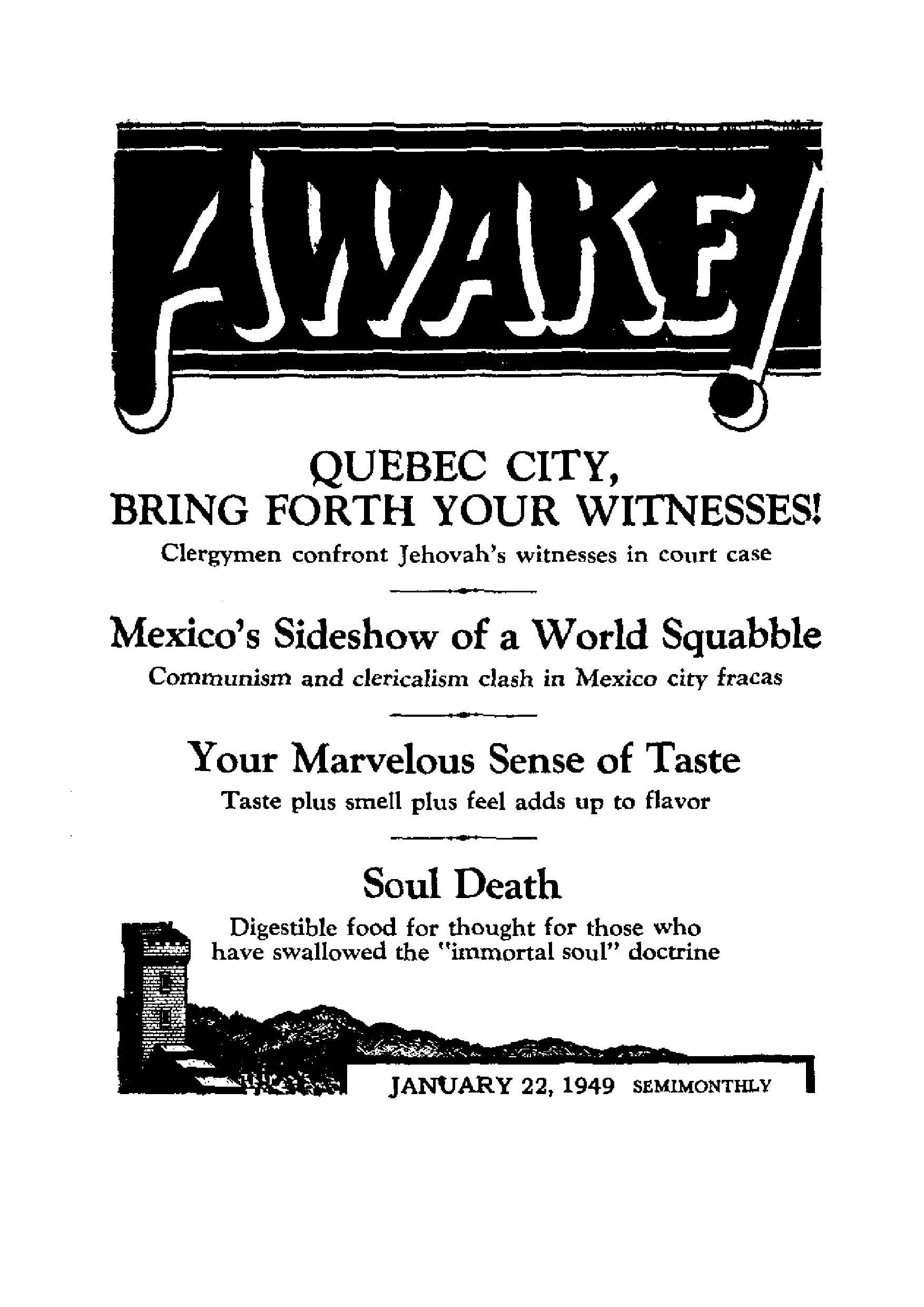
Quebec City, Bring Forth Your Witnesses!
JEHOVAH is a God of trath, but He does not fear error. What is the chaff to the wheat? Will not fiery Bible truth consume the chaff? And what is the rock to the hammer? When the hammer of truth cracks down on stumbling-stones, will they not crumble away? The hailstones of truth will sweep away the refuge of lies. There are no hidden errors that will not be exposed, no dark deeds that light will not make manifest Hence Jehovah God fearlessly ‘ says, Let the false priests and prophets go ahead and prophesy, and let those that have My word speak My word faithfully.—Jeremiah 23:25-29. .
So be it Jehovah’s witnesses know that organized religion teaches doctrine that is rooted in human tradition and paganism, that conflicts with the Bible, that blinds eyes and deafens ears to truth, and that by blacking out these windows to the mind organized religion has left the people in the dark as to God’s Word. Nevertheless, God says to let them babble their blasphemies, for His truth like a hammer will powder them, and His Word like a fire will burn them to ashes. Christ Jesus said it is the workers of evil that love darkness and hate light. (John 3:19-21) Hence Jehovah's witnesses seek to suppress no speaker, but let all word and doctrine stand or fall in the purging fires of public discussion. They abide by Jehovah’s decree of free speech, as stated at Isaiah 43:8-12:
f<Bring forth the people that are blind, yet have eyes, and are deaf, yet have ears! All the nations are gathered to-gethervand the peoples are assembled; yet who among them could foretell this, could announce it to us beforehand? Let them bring their witnesses to prove them in the right, to hear their plea, and say, Tt is true? ” [An American Translation) After thus inviting error to produce its witnesses, Jehovah God calls notice to the ones He will put on the stand to represent Him t “Ye are my witnesses, saith Jehovah, and my servant whom I have chosen; that ye may know and believe me, and understand that I am he: before me there was no God formed, neither shall there be after me. I, even I, am Jehovah ; and besides me there is no saviour. I have declared, and I have saved, and I have showed; and there was no strange god among you: therefore ye are my witnesses, saith Jehovah, and I am God?’—American Standard Version,
Such free speech is practical. In these turbulent day£ when truth and error spring like grass side by side, how is a separation to be made except by scrutiny of both I Truth need have no fear; only error need tremble and oppose the examination. Only error does. Posing in the garb of truth, frightened error screams that truth is false and should be denied freedom to circulate, should be suppressed. Error does not wish to fering forth its witnesses; not when they must face cross-examination by truth. Generally, organized religion does not want to do it. Particularly, the Boman Catholic Hierarchy does not want to do it. More specifically, Catholicism in Quebec City does not wish to do it. But she did. She maneuvered herself into that embarrassment. Here is how it happened.
No Freedom of Worship in Quebec City
Quebec City is overwhelmingly Catholic. Though in lands where the Catholic Church is a minority she of necessity tolerates freedom of worship, in areas where she is a powerful majority she casts aside this galling toleration of freedom. Hence at her hands the small group of Jehovah’s witnesses in Quebec City has suffered much persecution and imprisonment. One instrument of suppression has been a 'piece of mischief framed by law’, a by-law that prohibits circulation of printed matter without police permission. (Psalm 94; 20) This law allows the police chief to censor literature or forbid its distribution, though it merely he Bible instruction. Now one of Jehovah’s witnesses, Damase .Daviau, has challenged this ordinance on the ground that it contravenes freedom of speech and religion, and is seeking a permanent-injunction against the city to prevent the city authorities from interfering with Jehovah’s witnesses’ freedom of worship.
The case of Daviau against the City of Quebec and the Province of Quebec was called for trial before the Superior Court in Quebec City on November la, 1948, before Justice Leon Casgrain. Attorney for Daviau was Sam S. Bard, but the vice-president of the Watchtower Bible and Tract Society, Ine., and legal counsel for the Society, Hayden C. Covington, was present to direct court tactics. Mr. Covington took the stand.
For half a day he gave testimony under direct examination. He outlined the history and structure of the organization of Jehovah’s witnesses, the methods employed by them in training and preparing themselves as ministers, their ordination, their methods of preaching and reasons therefor, and the missionary nature of the Society. Thence he summarized the outstanding doctrines taught by Jehovah’s witnesses, climaxing with the most important one, the kingdom of God. The more recent literature of the Society was introduced in evidence.
Then began cross-examination, conducted by the city attorney for Quebec City, Ernest Godbout. He was assisted by the solicitor general, Noel Dorion, the chief counsel in the courts of the province for Attorney General Duplessis. It was evident that the city attorney, with the aid of the Catholic priest, had carefully examined the doctrines and books of Jehovah’s witnesses. He was not content to stop with the resume given M Mr. Covington on direct examination. He introduced in evidence many additional publications of the Society, among which was that little leaflet that has gen erated so much heat in Quebec, entitlec “Quebec’s Burning Hate for God am Christ and Freedom”.
Organized Religion Exposed
Early in cross-examination the cit attorney waded into the controversy doctrines. He produced the book Ene mies. Did Mr. Covington agree with it identification of the Roman Catholi Hierarchy as a part of the whore o Revelation? Yes; the Bible uses wome to symbolize organizations. The Catholi Church has relations with this world, i entangled in fEs wars and politics an commerce, is therefore guilty of spiri ual adultery, according to Janies 4:4 hence is fittingly embraced in the syn holism of a whore. Even Webster’s m abridged dictionary lists the Roma Catholic Church as one of the definitioi of “whore”.
Do you think it right to circulate sue doctrine in a province where the peop are 95 percent to 100 percent Cathoiu Yes, the witness thought so. Bible tru' affects the life prospects of all men, its presentation is most vital. If the Roman Catholic Church told the truth she would not object to having her teachings meet the test of discussion. Emphasis was placed on the fact that these adverse judgments of Catholicism were God’s Judgments, that Jehovah’s witnesses only declared them in obedience to His command.
The cross-examination bore down relentlessly with its contention that Jehovah’s witnesses were not a religious organization, hence freedom of worship was not here involved. The witness shelved the Bible distinction between religious formalism and Christianity. The Jews were warned about religion; Jesus denounced the religious scribes and Pharisees, their ceremony and tradition that voided God’s Word (Matthew 15:1-9; chapter 23); Paul said other religionists worshiped the demons. Today organized religion has been, snared by ceremony, formalism, lip-service and traditions that conflict with the Bible.- ■ Still, when legislation speaks of religion and religious liberty it is not concerning itself with distinctions within that broad field, and certainly it does not mean to exclude Christianity. It is guaranteeing freedom for all modes of worship. The Scriptures draw1 finer lines of definition on religion and Christianity than do dictionaries and laws. Within the legal meaning of the term "religion” comes the work of Jehovah’s witnesses.
Since you say the Devil is the ruler of this present world, do you think this court is of the Devil? That does not necessarily follow. When men have laws that are in harmony with God’s law, or do not conflict with God’s law, they should be obeyed; and'courts that seek to insure justice according to these laws serve a good purpose. Jesus said to render unto Caesar the things that are Caesar’s, and unto God the things that are God’s. Obeying worldly laws that preserve order and provide for the
necessary oversight to prevent anarchy is a part of rendering to Caesar that which is his; but when laws of men would prevent us from rendering unto God that which is His, then we must follow the apostles’ decision: "We ought to obey God rather than men.”—Acts 5:29; 4:19.
Quebec's "Boly Trinity" of Experts
'Space forbids further recounting of the cross-examination, but it took a full day to complete. After Witness Duncombe testified on the local organization in Quebec City and Witness Daviau told of his ministerial activity in that territory, Mr. Godbont began the city’s defense. It was reported that the city’s attorney had spent about $3,000 of the city’s money in getting into book form "expert evidence” from a "trinity” of clergymen, Catholic, Protestant and Jew, that became as one to expose Jehovah’s witnesses. But the work and money went down the drain when the judge would not admit the book as evidence. These "expert witnesses” sought to inject their error into the court record by means of this book, and thereby escape any embarrassing cross-examination. Quebec did not wish to have to bring them forth as witnesses, but the judge’s action of not admitting the book forced the city’s hand. But even admitting them as "expert witnesses” was illegal, for such prejudiced clergymen -had no right on the stand to judge Jehovah’s witnesses and babble their opinions.
First "expert” on the stand was "Father” Herve Gagne, French Catholic priest. He condemned the Witnesses, outlawed them, found them beyond the commonly accepted definition of religion, said that preaching from door to door or in homes was not an act of religion, nor was distribution of printed sermons or preaching from a pulpit. He was effeminate in his attitude, insulted oyer the pictures in the Society’s publications, and when given free rein "took off
JANUARY a?, 1949 5
fajtq the stratosphere” of philosophy and prattled about "inner man” and "outer man”, “inner religion” and “external religion”, and after one such "take-off” flew on for forty-five minutes into these flimsy abstractions till even those who understood French could not understand him. Judge and lawyers looked blank, and finally' the judge mercifully ended the flight by asking the city attorney to ask another question. He showed abysmal ignorance of the Bible, said he could not discuss the Bible since he was only a priest and not of the Hierarchy of the Catholic Church. But he did contend that a Christian should comply with all laws of the land, even those that conflicted with God's law. What would the "Father” do if the civil law forbade the celebration of mass? That was the question under which he squirmed when court adjournment, for the day rescued him.
“Rabbi” and Unprotesting "Protestant
The completion of the testimony of the Catholic priest did not resume the nqxt day, but in his stead the city put on its next member of the “trinity” of “experts”, a Jesuit-trained “Rabbi”. He loved everyone, all religions, and would criticize none. He unctiously swayed and dipped his corpulent body in the witness box, playing as much to the spectators as for the judge. He did say freedom of religion stopped when it was used to criticize other religions. Then on crossexamination he got all fouled up. He could not criticize the Witnesses because he did think they were religious, and he had said he would not criticize anyone because of his religion. He admitted Jehovah's witnesses were religious and their books religious. He had to read scriptures from the books of Isaiah, Jeremiah and Ezekiel wherein they criticized and condemned religious practices. When he finished he backed and scraped his way out of the courtroom, and that was the last seen of “Rabbi” Solomon Frank.
After the “extinguished” rabbi came the “Very Reverend” Kenneth Fvaris, loaded down with high-sounding titles and docility, at first. He said Jehovah's witnesses were religious and had a right to do the work they were doing, and on the fifteen or twenty questions put to him did not hurt the Witnesses' case bub only impeached the priest and rabbi in everything they had said to hurt the Witnesses.
But upon his return to the stand the next morning he showed evidences of being diligently coached to be a better witness for the city. He condemned the Witnesses, specially the doctrines exposing the Catholic Church and the leaflet Quebec's Burning Hate. He did not even want to look at the literature, and his excitement reached such a pitch that he was suddenly asked if merely reading the literature would incite him to do violence. Throwing his hysteria into reverse he replied slowly and quietly, “Why, I am a very mild and peaceful man,” But the affectation was so obvious the entire courtroom burst into laughter, including judge and lawyers.
Before he got off the stand this Anglican had to read Jesus' scathing denunciation of religious hypocrisy, at Matthew 23, and Isaiah 56:10,11, where religious clergy are called “dumb dogs”. He did not object to that language by Jesus and Isaiah,* hence if the contents of Quebec's Burning Hate were true would he object to it.1 Only a threat of holding him for contempt of court made him answer, that assuming the contents to be true it was proper to print and distribute it. He was glad to leave the stand.
The Catholic priest resumed the testimony previously interrupted. He still had to answer what he would do when the civil authorities forbade mass. Would he obey worldly authority or do God's service as he saw it? He refused to answer. A motion for contempt of court was made, with an alternative motion that he be forced to answer. The judge
ruled he should answer. The priest said the Church would not oblige him to say mass in defiance; of civil authority. But the biggest snare for this philosophywise, Bible-ignorant priest was his claim that the Catholic priest was mediator between God and man. When he was confronted with the Bible text, “There is one God, and one mediator between God and men, the man Christ Jesus,” he had to admit the priest was not the mediator. (1 Timothy 2:5) At this point the case was adjourned until January 24, 1949.
Some of the Public Response
Quebec brought forth its witnesses, “experts,” no less. But these witnesses brought forth could not prove Quebec City in the right, could not make the listening persons in the courtroom say, “It is true." After hearing the Lord’s witnesses that He had there to testify, many thought they were proved right The case started in a small courtroom, but ended in the largest one, with never nfore than standing room. The newspapers of Quebec City gave the trial much space. Incidentally, one newspaper clipping from New York that proved a conspiracy between the police and the Catholic priest was received in evidence. Regardless of the outcome of the case, the Lord has used it to give a tremendous testimony to His name and people in Quebec City. It attracted public notice.
Feel with us the public pulse as it beat at the trial. One of Jehovah's witnesses got in a taxicab and remarked, “I’ve been attending the trial this morning.” Forthwith the driver pulled over to the curb, switched off his motor, and parked for an hour and a half while the Witness explained the truth. Another taxi driver attended the trial, and remarked afterward: “I’m going to be one of Jehovah’s witnesses.”
In court, after Mr, Covington had finished his testimony, a court attache came over quickly and whispered: “You have told us things we have never heard JANUARY 22,1949
in our life, and we are glad to hear them. You have more friends here than you realize,”
During the trial the Catholic bishop came in and sat among his French parishioners. He saw one Frenchman write on a piece of paper, “What is religion?” and another in answer merely write, This bishop saw in the courtroom two little girls who were related to some friends of his. He asked them, “What have you come here for, to be converted?” Their short reply was, 'Wes; we have and we are,”
A stranger walked up to a graduate of the Watchtower Bible School of Gilead while in the courthouse and invited the Witness to his home. Ten Catholics were there. The priest came in the middle of the Bible discussion. The Witness and the priest discussed the Scriptures, and after several hours of discussion and much embarrassment for the priest when he could not Scripturally answer, the priest asserted, “Well, the Catholic Church is the preserver and interpreter of the Bible.” Thereupon the householder who arranged for the meeting turned on him, “When have you ever taught us the Bible!” He asked the others present, “Has he taught you?” All present answered No; and the priest retreated.
The company of Jehovah’s witnesses in Quebec City has taken fresh courage, and boldly witnesses now. They had many Bible studies going in and around the courthouse during the trial. They have many new back-calls in their file to be cared for. One afternoon a crowd of strangers were arguing outside the courthouse, vehemently. The question was whether or not the Catholic Hierarchy was the whore of Revelation!
When the trial in Quebec City is resumed on January 22 and “Father” Gagne again takes the witness stand, Awake! will have a correspondent there to give a report to its readers. Perhaps by then “Father” Gagne will have read the Bible.
Human Folly
Dispensing justice is a complicated process today. Ask any lawyer as lie wades through the hundreds of law books that stand as paper bricks of his library walls. But a thousand years ago justice was simple, and by simple we mean foolish, silly, senseless. And cruel. Trial was by ordeal. For instance, there was the t'ordeal of the cross*'. The accused and accuser were stood before a cross and told to stand still. The first to move his feet or fall over was guilty of lying. In another ordeal bread blessed by a priest was given along with cheese tb the accused. He was ordered to eat both quickly. If he choked on it as he tried to swallow, he was guilty. Then there was the test where a stone was placed in boiling water. The prisoner plunged his I are hand in and snatched up the stone. If his hand was Raided, he was guilty. There were many other trials by ordeal, such as carrying a piece of red-hot iron in the hand for * distance of several feet. If any marks remained on the burned hand three days later, the 9O0T *goose was cooked”
cise definition of “snail’s pace”.
It
es sometimes gobble up space at
a
treadmill and run him can beat the snail or
is 000363005 m.p.h. Lightning flash-a rate of 133,200,000 m.p.h. Now
who will put some scientist on week, so we will know whether
ragged for a the lightning?
£ Do you know what you are talking about when you berate some easygoing, slow-coming character as traveling at a snail’s pace? Now it can be told, in precise terms. An automobile manufacturer reports that scientists have kept a snail moving on a treadmill for a whole day. Result: pre-
sweet home, from cradle to; graven
Soon Hollywood cars will be home,
Out in Movieland they have drive-in restaurants, laundries, florists, clock shops, liquor stores, movies, and drive-in banks equipped with tear gas for drive-in bandits. Even some of the cars have built-in beds for the drivers to dive-in. But inconsiderate barber shops, dime stores, grocery stores, and a handful of other old-fashioned progress-blockers, are only semidrive-ins. Would you believe it?—you actually have to walk half a dozen steps! Next some zany evolutionist will say that soon Holly woo deans will be born without legs.
Out of England comes a spanking tale. Headmaster of Horsley Hall school invited Brio A. Wildman, president of the National Society for the Retention of Corporal Punishment in Schools and a cane manufacturer, to lecture to the pupils on corporal punishment. This school has free expression but no corporal punishment. At least, not till then. But Mr. Wildman bumped into both. During his talk he swished some of his twenty assorted canes and proclaimed, “The most reasonable punishment is six of the best,” Before the echo died out he was pinned to the floor by the pupils and held there while one husky lad treated his buttocks to seven strokes of his own medicine, with one of hie own canes. Mr. Wildman lived up to his name as he raved, “I’m going back to London to see my lawyers!” But why the furor? He favors corporal punishment—-and got it. The pupils crave free expression—and indn/gvd it. They were good listeners, even practicing wThat he preached. Wildman can speak from practical experience on the effectiveness of corporal punishment in general and his canes in particular. And he will remember the well-known principle, to wit, worms will turn occasionally.
JU SI DES HO IV
WORLD SQUABBL.K
OFTEN the great political situations . of the world have their echoes in minor situations throughout the earth. That is the case with what occurred this past June in Mexico city. The incident has to do with people that have little love for each other, the.Communists and the Catholics.
It all started out very inconspicuously in a new hotel, Hotel del Prado, claimed to be one of the most beautiful in the world, with hundreds of spacious rooms, large dining room, swimming pool, theater, stores, all within the hotel. They claim that the hotel is so complete that a person could live there without ever leaving it. Hotel del Prado is built on the wide and beautiful Avenida Juarez, facing the park, La Alameda Central. Without a doubt,' the hotel was built to attract the thousands of American tourists that yearly pour into Mexico a gold mine of dollars.
About four years ago the construction of the building was started, and shortly afterward the architect and director of the project, Carlos Obregon Santaeilia, solicited the services of the world-famous Mexican muralist, Diego Rivera, the Communist millionaire, to paint a large mural in the spacious dining room. Rivera, the 62-year-old artist born in Guanajuato, Mexico, “early in his career . . . became a Communist,” according to the World Book Encyclopedia. The En~
* cyclopedia continues by saying that his favorite subjects are r A revolutionary and labor ques-I tions. And his last mural in
Hotel del Prado practically cansed a minor revolution in vL/ Mexico.
Rivera, when first contracted to do the job, made a small ^4 drawing of the mural he was to k paint in the new hotel. It was to be a scene of the park La Ala-\ meda Central, across from the hotel, showing a water fountain and a number of men and women of the nineteenth century walking through the park. About a year ago Diego Rivera started his project, and it was not long before people started to notice that his work was not just a general park scene, but a mural showing Benito Juarez, Cortes, Ignacio Ramirez and other people famous in Mexican history, mixed in with some fruit peddlers, a^few witches and a pickpocket. Juarez has in his hands a copy of the Mexican Constitution while standing in front of him is the famous Mexican teacher and writer of the nineteenth century, Ignacio Ramirez.
Ignacio'Ramirez, also born in Guanajuato, Mexico, was as much a radical in his day as Diego Rivera is at the present time. Ramirez, known as the “Necromancer” in the literary world, is also represented in the mural as holding a script in his hands-which contains the sentence legible to all that caused such an uproar a few months ago in Catholic Mexico. The sentence reads, “God does not exist.” Ramirez himself first wrote the sentence in his time.
Luis Osio, the manager of the hotel, noted the sentence in Rivera's mural and, realizing that it might cause trouble, asked Rivera to remove the historical quotation, Osio probably remembered the trouble Rivera caused a few years ago with one of his murals in
Hotel Reforma. Rivera promised to remove it. But he never did keep his promise-
Enter the Archbishop
Then, as is the custom in the Catholic world of blessing bridges (remember Pacelli, now pope Pius XII, blessed the Oakland-Bay Bridge at its inauguration), wars, buildings, and any other object, the directors of the hotel asked the archbishop of Mexico, Luis B. Martinez, to bless the. new hotel. The archbishop readily accepted the offer. In touring the large hotel he noted in the dining room Rivera's mural and the disturbing words of the “Necromancer”, “God does not exist.” The archbishop stopped there and then and stated that he “could npt bless a building which contained a phrase denying the existence of God”. {El Universal; June 2, 1948)
This exploded in Mexico the incident which ended up in a Catholic newspaper attack against the Communists, In two days every newspaper and radio station in Mexico were blasting out their hate against Rivera and the Communist party he belongs to, the PP, or Partido Popular (Popular Party). Some of the headlines were quite interesting. One reads: "All the Catholic World Against the ‘Monkey Painter.” (La Prensa, June 3, 1948)
The fight continues, Rivera refuses to erase the disturbing statement, and the archbishop refuses to bless the hotel as long as Rivera’s mural contains the disputed sentence. Later Rivera proposed a solution to the problem to the managers of the Hotel del Prado. Hig solution is that Archbishop Martinez bless the building with the exception of the disputed mural, upon the which, says Rivera, he could put a cursing. (La Prensat June 2,1948)
the subject of Hotel del Prado was causing more excitement in Mexico than all the trouble in Europe. Then in a number of cities throughout Mexico appeared the sentence, “God does exist/* written on the walls of homes and bund ings. On June 3 La Prensa carried statements of the public in general concerning the topic, and one says, “If it were in my power to punish Diego Rivera I would slowly torture him to death so that he would realize how to love God.” What a strange way to manifest one's love for God! The Inquisitionists once showed their religious zeal by means of torture, but Mexico is no longer in the hands of the Catholic Inquisitionists, So Rivera was not tortured to death.
Enter Violence
Since no one would compromise in the situation, violence was finally resorted to. By this time the hotel was under guard. On the afternoon of June 5 about 100 Catholic college students entered he hotel in groups of two and three so that their plans would not be thwarted. At a given signal, the entire group rushed into the dining room with knives in their hands and in a few minutes scraped away the words “does not exist* leaving only the word “God” on the mural.
Mexico greatly rejoiced when it heard that the atheistic sentence had been erased. But the incident did not fend there. The original fight of Rivera and the archbishop continues. That very same evening at midnight Diego Rivera and another Communist muralist David Siquieros, leading a mob of about 150 people, forced their way into the dining room and there Rivera nervously penciled in the sentence “God does not exist”; after which Rivera and Siquieros each gave a short talk to the mob and then departed.
Now the situation really became tense. No one knew how it would turn out. Secretly some person erased the sentence the second time. But then the whole incident stopped as suddenly as it started, when the government started to investigate the matter and prohibited
Diego Rivera from rewriting the sentence. The hotel managers then covered the troublesome mural with a curtain and moved its dining room to another part of the building.
In the incident of the archbishop of Mexico versus the Communist Rivera neither side won, because up until* the present time the building has not received the archbishopJs blessing, even though it seems that that has not affected the prosperity of the new hotel, and the mural cannot be seen "by the public.
El Universal of June 4 showed how Diego Rivera used all the publicity he gained to attempt to enlarge the Communistic Sock in Mexico. At a Communist meeting which took place during the heat of the battle Siquieros stated that “the Communists were ready to fight and back up Diego Rivera". Then Rivera spoke and “repeated some of his usual phrases against imperialism, the hotel managers, Franco, etc., and, after praising Soviet Russia, he invited all those present to join the Communist Party", or the Popular Party, as it is known throughout Mexico.
It is too* bad the archbishop of Mexico goes about “blessing” hotels, and straining at a gnat, while he and the rest of the Mexican hierarchy continue to keep the millions of Mexican Catholics in ignorance of the God in whom they claim to believe. As for Diego Rivera, the God he claims does not exist, Jehovah, puts people like Jiim in a class by themselves by stating, in Psalm 14:1: “The fool hath said in his heart, There is no God." —Awake! correspondent in Mexico.
Concentration Camps in America?
*3? Walter Winchell charged that the “Hopley Report, sponsored by Secretary Forrestal, waa a greater attack the liberty every than ever dreamed, of by Hitler
or Stalin”, After saying this over the radio, Winchell wrote in his column a few days later (New York Daily Mirror, November 26, 1948) that on page 39 the Hopley Report suspends the Bill of Rights. On the subject of detention the report recommends: “The problem of detention is one of considerable magnitude during emergency conditions. It should be met by providing suitable, safe and secure places where persons may be detained for the public good until such time as conditions permit their release or circumstances warrant their trial. Places of detention should be provided to accommodate such persons temporarily deprived of their liberty.”
Walter Winehell logically reasons that the words “considerable magnitude” mean many are to be arrested. Also, this would allow you to be detained when they think it would be for public good, until they think conditions permit your release, until they think they have enough evidence to warrant giving you a trial. It provides for concentration camps now to hold you when you are temporarily deprived of your liberty. It provides for detention of persons “for the public protection”, when the Defense Department decides the public needs to be protected from you. No charges. No trial. “Heil Hopley!” adds Winchell, with more sarcasm than enthusiasm. He ably argues that the Hopley Report would open the way for crushing American labor, for demanding loyalty oaths, for depriving the common people of political opinions. He also quotes FonestaPe expressed desire that the Secretary of Defense “hire” the Secretaries of Army, Navy and Air. In other words, the president would no longer choose these cabinet members. Winchell says Forrestal would fire Truman as commander-in-chief.
A—Jentitive to taste* B—S*veett salty and aour C—S*Uy and aour Q-^-S<nir only
£»In>enaitiYe to all taite* F—Sweet and soar
G—Bitter, sweet and sour
along the sides to the very place where sugar roused no response, and there you find the taste buds that respond to salty tastes.
The farther back across the tongue you move a sour pickle, the more obvious its sour taste becomes. While the "sour” taste buds may be more evenly distributed over the tongue than any other of the taste perceptors, yet there is a .spot just back of the tongue's “blind spot” that registers no other taste than sour.
Bitterness is tasted best even farther back at the base of the tongue. A sprinkling of “bitter” taste buds occurs at the tip of the tongue, intermingled with the "sweet”, “sour,” and “salty” buds. From the diagram above it can be seen that all four types of the ingenious little taste perceptors are present at the extreme tip and extreme base of the tongue; hence from the instant food enters the mouth until the instant it is swallowed, its taste can be detected.
Temperature Affects Taste
But just -as speech is not. an exclusive product of the tongue, likewise taste depends to some degree upon other factors. In other words, there is more to taste than what meets the taste buds. Some foods affect not only the taste buds but other nerve endings in the mouth. Among these are the "hot” and spicy foods such as mustard and ginger, which set the nerve endings that respond to heat telegraphing their messages to the brain. These foods, for all physical
January 22,1949
purposes, cause the same reaction in the mouth as does something hot They are not giving off a taste so much as they are creating a kind of physical pain in the mouth. When we think we are tasting hot pepper we are more literally smarting from the pain it causes upon the nerve endings that respond to heat
Foods that are actually hot register a different degree of taste than when they are cold. Warmth stimulates the taste buds, makes them quicker to respond. Hence, a factor that helps determine taste, a factor outside the taste buds themselves, is heat. People who are more concerned about the pleasure of taste than about their physical welfare indulge in eating and drinking foods that are too hot for health's sake. When the taste senators are abused by overheating they are unable to register any taste at all.
No less vital than the riieat” nerves are the "cold” nerves which contribute their share toward modifying the sense of taste. While warmth stimulates the taste buds, cold cuts down their sensitivity. If the doctor obliges you to take a violently bitter medicine, first rub an ice cube back and forth over your tongue until the tongue feels numb. Then take your medicine. It will not taste so bitter. You have chilled the taste buds.
The power of cold to subdue the taste buds may in some cases produce advantages. Some wines taste better cold, because chilling masks their less palatable qualities; the advantage, or disadvantage, in this lies with the user. The hostess who has niade a dessert too sweet
uan solve the problem by serving it cold, because the colder it gets the fess apparent will be the sweet flavor Ou the other hand, if she desires a sweeter-tast-ing dessert, she can serve it warm, because the wanner it gets the more apparent will be the sweet flavor.
Feeling and Smelling a Taste
Does it strike you as odd that some tastes have to be felt and smelled! Yet consider for a moment how great a role the sense of touch plays in creating no end of taste impressions. Crackers are worse than tasteless and unsavory unless they are crisp and crunchy. Who cares how good the flavor of a steak is unless the meat it Self is reasonably tender! If you are one of those persons who think raw oysters are horrible, it probably is not the flavor you object to at all, but the "slimy" feel of raw oysters th the mouth. The biting or burning avor of spices, the coolness of j>eppor-mint flavor, the tickle of soda-water bubbles—all these are obviously flavor elements. Yet none of their can be tasted or even smelled. They have to be felt. While some might argue that the physical “feel” of a food has nothing actually to do with its taste, yet who will say that the touch sense does not greatly influence the Ekes and dislikes of all of us when it comes to taste preferences!
As for the role that smell plays, you can demonst raie for yourself by merely holding your nose while eating, that a great host of foods, such as fruits, coffee and butter, depend more upon their odor than upon the taste buds to convey their true flavor. Odor is sensed just as readily from the mouth as from the nose. There is a rear entrance through the throat into the smelling apparatus in the head. Every time we swallow, some of the air which has passed over the food in the mouth rises into the smelling area.
Up there, in the upper part of the nasal cavity, is an area about the size of a postage stamp, containing a group of highly specialised nerve endings called the olfactory cells, From each of the tiny olfactory cells six to eight small ifhairs” protrude beyond the mucous layer. They pick up the odor sensations and carry them through the olfactory nerve to the lobes, which gather all the impressions into one nerve response.
Below the olfactory cells "is another area of nerve fibers which are capable o' registering the tactile or "feel” components of flavor such as* the qualities of cold, heat, tickling, piquancy, etc. How these ingenious sense perceptors of smell co-operate with the sense of touch and the sense of taste to produce the complete and single sensation of a flavor is a marvel worth contemplating.
Think of a time when your nasal passages were stopped; then it seemed that just about everything you ate tasted alike, or, rather, everything alike seemed to have no taste at all. What you missed was, not the taste, but the odor of food. Shut your eyes, hold your nose, and let some one feed you some chopped apple and chopped onion; which one is which? Even strawberries taste much like onions provided you cannot inhale their f aroma while you eat. What we often mistake for a bad taste is in fact a bad odor, as in the case of cod liver oil. The senses of taste and smell co-operate so closely that we hardly know for sure whether we are smelling or tasting. Chloroform, for example, does not stimulate the “smell” sen si tors,' but rather the taste buds at the tip of the tongue. Although we think we are smelling chloroform in the air, we are actually tasting it
Flavor
By the wonderfully co-ordinated interplay of the faculties oT taste, smell and feel, all of them registering simultaneously in the brain, and their reactions further modified by the temperature of the food, a sensation is produced that is in reality more than "taste”. A word with a fuller meaning is "flavor”. Flavor k the combination of all the sensations produced in the mouth by food. Because the joy of eating is derived from the flavor, and because flavor cannot he confined within the narrow limits of a definition, a way is left open whereby even the senses of seeing and hearing can be played upon to further enhance the pleasure of eating. The restaurateur knows that the more delectably a dish is prepared the more palatable it will seem, even though his customer may not ordinarily like the dish. And if embraced in an atmosphere of soft lights and the melody of music, the menu becomes all the more irresistible.
Equipped with a refined knowledge of the factors that produce the sensations of flavor, the food processor, the chef, the baker, the restaurateur and the hostess have conspired to create a world of ersatz flavor thrills that seduce the appetite but fail to produce sound health. For example, the baker strives to produce a loaf with a pleasing taste plus a texture having just the right "feel", a clean bite, and a tender crust These qualities are better combined when he uses lifeless “white" flour rather than nutritious whole-grain flour. What is overlooked is that the true tastiness of food should be influenced more by the physical soundness and healtljy appetite of the consumer, rather than by an appetite stimulated by artificially crunchy goodness and synthetic taste thrills.
Practical of Flavor Knowledge
When the meat-packer salts meat too heavily he tones it down by adding sugar, knowing that strong salt and sugar solutions applied to the tongue at the same time cancel each other. The taste-wise cook avoids serving a menu of too many flavors, which might cancel each other and leave the diners feeling that the meal, no matter how sumptuous, was somehow just not up to par. He builds the menu around one taste, so that a predominating flavor is enhanced by the others, the way one theme predominates a melody in music.
The housewife haying a knowledge of flavor patterns knows that a heavy concentration of one taste affects the reaction to the tastes that follow’. Brussels sprouts may be the family's delight, but if served after a sour food, like kraut, their flavor will seem tepid and dull. A cereal served after grapefruit tastes sweeter than if served after toast and jam. Coffee tastes sweeter before rather than after a swTeet dessert. The experienced hostess arranges the dishes in the order that permits the taste of one to enhance rather than neutralize the other.
Each, of the four basic tastes—sweet, sour, salty, bitter—has its distinctive role in the flavor pattern, and serves to make the most ordinary food taste better if skillfully employed. Bitterness, most people’s notions to the contrary, is the most exciting to the appetite. The old folks of a past generation didn't drink their “bitters" before meals just for the sake of the alcohol in them.
Just as bitterness is the most exciting, sour is the most refreshing taste. A little lemon juice brings out the flavor of fish or spinach. Sour tastes are derived from food acids. There is lactic acid in milk, citric acid in oranges and lemons, acetic acid in vinegar, malic acid in apples, and the sourest of all common fruit acids is the tartaric acid in grapes.
When it comes to salty tastes, there is an equally wide variety.zln the Orient a chemical called glutamates is used to lend meat flavor to foods. Glutamates, labeled mon-sodium-glutamate by the chemists, is about seven times as salty as table salt. The salty taste gives a sense of zestful, nourishing, satisfying completeness to a ineaL
And, of course, the favorite taste is the sweet. I: is relished more for the sake of its taste alone than ail the rest. Jr takes something sweet to add the crowning touch 10 the meal—not so much for the sake of the nourishment found in sweet foods, but for the pure joy of tasting sweetness.
Is the range of tastes that excites the senses less wide and varied than the shapes and colors that attract the eye end the sounds that entertain the ear? Truly the Creator has provided an illim
itable symphony of sensations to play upon the organs of sense, and in the coming Paradise of harmony and balance in the New World it will be delightsome to live and respond to perfection to ail that greets the senses, including the tingling joys to be derived from your marvelous sens© of taste.—Contributed.
<7cWd'U:ezjry Yearn for Island Paradise
<L An outline of life on the Pacific isle of Samoa given before the United Nations so enchanted some who read the report that they asked, ‘What is the quickest way to get there The United States delegation painted Samoan Living as a blissful existence on breeze-swept islands, where everyone lived lazily off natural bounties, doctors sent no bills, and income taxes came to five dollars annually for adult males only. Ten percent of the inhabitants work for money; the others care nothing for it, as it is virtually a surplus commodity in a land where almost everything was available for the taking. Why, it was refreshing to hear that very few residents even thought enough of radio sets to own one. Upon hearing these alluring reports persons began writing to find out the quickest way io get there and to stay for good. The majority were sick of this human folly called “civilization”, where the money-mad and power-insane and socially vain claw and bite and fight to get atop the seething mass of restless humanity. But refugees bent on escaping the savagery of civilization struck a sn&g that scuttled their hopes. The United States government has ruled that practically no one-way passages would be permitted to the Polynesian "paradise of the Pacific”. This chilling damper was put out reluctantly, it was stated, to preserve the simple, primitive beauty of Samoa-One official conceded that the best way for anyone wanting to live in Samoa was to marry a Samoan. Now the sixty-four-dollar question is; How to meet the Samoans in the first placet
^Beaver Paratroopers
<L Paratroopers are again “hitting the silk”, but this time they are not waging destructive war. They are fighting to convert arid, sparsely populated land into fertile, watered areas. And they are not mezz, but beavers, “Operation Bearor” is being carried out by the Idaho Fish and Game Department, The beaver is a valuable animal, though in some sections he is viewed as a pest. So in such sections the Fish and Game Department is shifting Beaver populations by trapping these forty-pound aquatic rodents, putting a pair of honeymooners in one box, attaching a parachute, flying them over some primitive wilds, and then—“Beavers away!” The box & designed to open automatically upon landing. Out waddle the two pioneers, without apparent surprise or damage, and head for the nearest stream. The DB'b (Displaced Beavers) have found a new home. The hope is that the parachuted beavers will multiply and increase the fertility of arid and unsettled land by building dams that will spread the small, spring-fed lakes. Within one week after the first beavers were dropped a new dam was sighted in the area. Success I Now they are “hitting the silk” regularly. And to date the only casualty has been one bloody nose!
gjfguRRECTON PLANT^
THERE are m-any plants that have stamina enough to resist the cruel dryness of earth's desert wastelands. Among these, there are none more strange than those that shrivel up and apparently die when it becomes too dry, and then, when a little water reaches them, even if it is years later, they come to life again. “Sus tended animation” is what some people have called this dormant condition. In Asia, Africa and North and South America several nonrelated plants possessing this miraculous rejuvenating ability have been popularly named “resurrection” plants. Probably the most famous of these queer desert plants is the rose of Jericho found in Palestine, Arabia, Persia and Egypt. Sometimes in that arid land it can be found growing on the flat rooftops pf the houses. In reality the rose of Jericho is not a rose at all. It belongs to the order of C^uciferae, which has 175 genera and some 1,500 species, and which includes the cabbage, turnip, mustard, cress, radish and horseradish families. Naturalists give the “rose” the botanical name of Anastatica hierochuntica, which is probably the best explanation as to why everybody else calls it the rose of Jericho. The stem divides at the base into many branches that bear spikes of tiny white flowers that develop into round fruit or pods containing the seeds.
If a dry spell seems to kill the rose of Jericho when it is only partly grown it will again take on the appearance of life and begin to grow within a few hours after its roots are moistened. The buds ,swell, the leaves of the calyx open, the petals unfold, the flower stalk grows, and itill-bloom flowers appear,
Another remarkable thing about this little plant, which seldom grows more than six inches high, is the way it migrates from place to place. Instead of easting its seeds hither and thither when they are ripe, as other plants do, it has a very unique way all of its own. The leaves fall o^ and the branches fold inward to form a ball or basket containing the seed pods. Then when autumn winds start to blow the plant breaks off an the ground and rolls out to see the world. Eventually it will come to rest many miles from its home, usually in a low, hollow place where moisture is most likely to collect the following spring. Still holding its seeds it does not uncoil and open its pods until rain falls sufficient to assure germination of the next generation.
During the Dark Ages, when humanity sank to its lowest depths in ignorance and superstition, and when priestcraft rose to a high degree of deception, the rose of Jericho became a ready-made instrument in the tricky hands of the clergy, quacks and charlatans. These rascals gave the plant such names as “Rosa Mariae”, “Rose of the Virgin” and “Mary's Hand”, and then proceeded to spin a web of superstition around its extraordinary and peculiar characteristics. They told the credulous people of Europe that it grew only at the stopping stations along the trail taken by Mary and Joseph during their flight from Bethlehem to Egypt with the babe Jesus. Moreover, by the trickery of placing imported specimens in water just at the right time they convinced the ignorant people that it bloomed every year on the
vary day and at the very hour when Christ was supposed to have been horn.
Otiter “Dead” Plants That Come to Life
In the southwestern part of the United States, in the arid regions of Mexico and southward to Peru, other "resurrection plants” are to be found. Although they resemble the rose of Jericho in behavior and looks, botanically they belong to the family of club mosses of the genus 8elaginella> the most common being 8. Cdnvoluta, 8. lepidophylla and S\ lep-tophyllck These quaint plants, called by some people "bird's-nest moss” because of the nest-like ball of incurled branches that hold the seed pods, may be purchased in many curio shops throughout the country. When taken home and placed in a glass of water—Presto! In almost no time the dry and apparently lifeless roll begins to swell and turn green. The once gray stems unfold and become elegant, finely cut, fern-like bronze-green branches with purplish leaves radiating from a coiled central stem.
Africa too has many native drought-resisting and xerophilous plants. The Jf. irtpQliwn is designated as a “resurrection” plant Its more common name is fig marigold.
Rhodesia's Resurrection Plant
Visitors to the Rhodesias in Africa are familiar with still another “resurrection” plant that grows among the gray granite boulders of the Matopos Hills, among which is situated the famous 'World's View”. Belonging to the small genus of Myrothamnus, and called by-the botanist M. flabellifolius, this plant is a giant compared with the rose of Jericho. When “alive” and growing it reaches a height of two feet, but when “dead” (at least three-quarters of the year) it shrivels up and is only a dwarf.
It seems that the first European to come upon this Rhodesian resurrection plant was Frei Joao dos Santos, He describes his journey into the interior from Portuguese East Africa in his book Ethiopia Orientate, published in 1609, and undoubtedly he refers to Manica-land, the northern half of Southern Rhodesia, when he writes:
In the Kingdom of Maniea a small tree grows on the top of rocks and mountains which, for the greater part of the year, is bare and without leaf or verdure, but it has this strange property—that if a branch is cut off and thrown in water, in the space of twelve hours it buds and blossoms into green leaves, and when it is taken oi^t of the water it becomes as dry as ever. . , . This wood powdered and taken in water is a good remedy for dysentery.
The Portuguese in Portuguese Angola scent their houses with branches of the plant when they are green. This is because the shrub is balsamiferous, that is, one that produces balsam and has a strong aromatic scent. It is probably due to this fact that the natives believe it has curative powers over many diseases. Says Dr. Friedriek Welwitsch:
The natives in Pungo Andongo (Portuguese Angola) employ the shoots in the form of a cold or warm infusion to cure headaches, and in the form of fumigations in the treatment of rheumatic pains and sudden paraly« sis; also the Portuguese colonists hold in high esteem its medicinal virtues and keep its dried branches instead of incense to perfume their houses.
Of the endless variety in both design and function found in the vegetation that clothes this earth the resurrection plants truly stand out as most remarkable and unusual. In fact, one reverential worshiper of the Almighty Creator, in observing the handiwork of these plants^ exclaimed what a similarity there is between them and the people of this present evil world, who are dry and dead for lack of the life-giving waters of God’s truth! When people of good-will come in contact with the Kingdom truth and absorb it as the resurrection plant does Water, they quickly blossom forth in good works, praising the great Creator, Jehovah God.
TSE American people are smoking more cigarettes than ever before. The figures for 1947 run 7 percent ahead of 1946, The grand total comes to 327 billion cigarettes. That's more than 100 packages of 20 cigarettes for every man, woman, and child in the country; it's about 6 cigarettes (more than a.quarter of a pack) a day.
Doctors disagree on just how much harm we do our bodies when we smoke. There is no doubt that the smoke itself irritates some people's sinuses, as well as the membranes of the nose, mouth, throat and lun'gs. Other people are allergic to tobacco in any form. Smoking contracts the blood vessels. It reduces our ability to see far and clearly. It introduces carbon monoxide to the blood stream. It has bad effects on diabetics and sufferers from certain heart ailments. Alcohol, «n the other hand, makes the blood vessels expand. But this does not mean, as some optimists have asserted, that the bad effects of alcohol and tobacco cancel each other off. It takes alcohol an hour or an hour and a half to affect the blood vessels; so unless you are going to smoke a lot longer and drink a lot more than is good for you anyway, you won't repair the bad effects of smoking by having a drink and you won't repair the bad effects of having a drink by smoking. You will not find it hard to get through the first day without smoking. It's the first six weeks that give the real trouble. Eor it takes six weeks for the system to get rid of the past effects of tobacco and for the physical craving to subside. The nervous craving may, of course, last much longer; it never entirely departs. But on one point doctors and laymen agree. The best way to cut down smoking is to cut it out altogether. Perhaps the most annoying minor hardship from which thef British people now suffer is the high price of tobacco. With cigarettes selling at nearly seventy cents a package, not many people in the British Isles can smoke as much as they would like. Therefore they ration themselves and make each cigarette last to the bitter end, holding it on a pin. This may not be too healthy, because the last inch of the cigarette puts four or five times as much nicotine into the system as the first inch.
Most of the serious damage that tobacco can do comes from the nicotine it contains. As you probably know, nicotine has no color. That yellow stain that appears on the fingers of inveterate smokers is not nicotine, but tar. It may produce irritation, but .nothing worse. Just how much nicotine does, the doctors themselves do not know. Men, generally speaking, still smoke more than women, especially older men. And Dr. William H. Rienhoff, Jr., of Johns Hopkins, has recently compiled figures showing that cancer of the lungs kills six times as many men as it' kills women. This may not be the nicotine. It may not even be the smoking. We shall know more in another generation now that younger women are smoking about as much as men. This much, however, we do know: The infertility of rats inoculated with nicotine goes up from 17 percent, the normal figure, to 33 percent, and human beings are one or two hundred times more sensitive to nicotine than rats. But the effect of
tobacco on different individuals varies enormously. If you cut your cigarette consumption in two but inhale twice as much, you are no better off. Some people can get nicotine poisoning by smoking only one cigarette a day. Pipe smokers swallow a lot of nicotine, but smoking does not affect them in so many ways, or so seriously, as it affects cigarette smokers. Cigarette smoke may irritate the ends of the nerves in the upper windpipe. Pipe smokers often do not breathe their smoke deeply enough to have it reach any part of their breathing equipment; and that’s all to the good.
The late Dt. Raymond Pearl, of Johns Hopkins, showed. that heavy smokers have a shorter life-span than moderate smokers or nonsmokers. He could find no great difference between the life-spans of moderate smokers and non-smokers. In one field of research into the effects of tobacco on the human system, doctors have shown a timidity, a caution unworthy of the best traditions of their profession. Never has any med-, ical journal carried any comparative data on various brands of cigarette by name. For instance, three researchers at the Medical College of Virginia tried blowing the smoke of different kinds of tobacco, different blends, and different brands into the eyes of rabbits to find out which caused the most irritation. They found that they produced a wide variety of effects. But when it came to revealing what blends of tobacco went into various brands of cigarette and, when it came to comparing, which brand of cigarette smoke produced the most, and the least, irritation the researchers said nothing. They mentioned no brandnames at any point. This is surprising on several counts. Scientists customarily give full details about all their experiments. They tell what kinds of animals they use; they describe their equipment and the conditions under which they work. Nor is the scientist under any special obligation to the tobacco companies, Many of the magazines for which he writes run no general advertising. Is it fear of indirect pressure! But if such pressure do.es exist, surely one scientist would have defied that pressure at least once.
…