Awake!, January 8, 1949
Download: PDF — Awake!, January 8, 1949
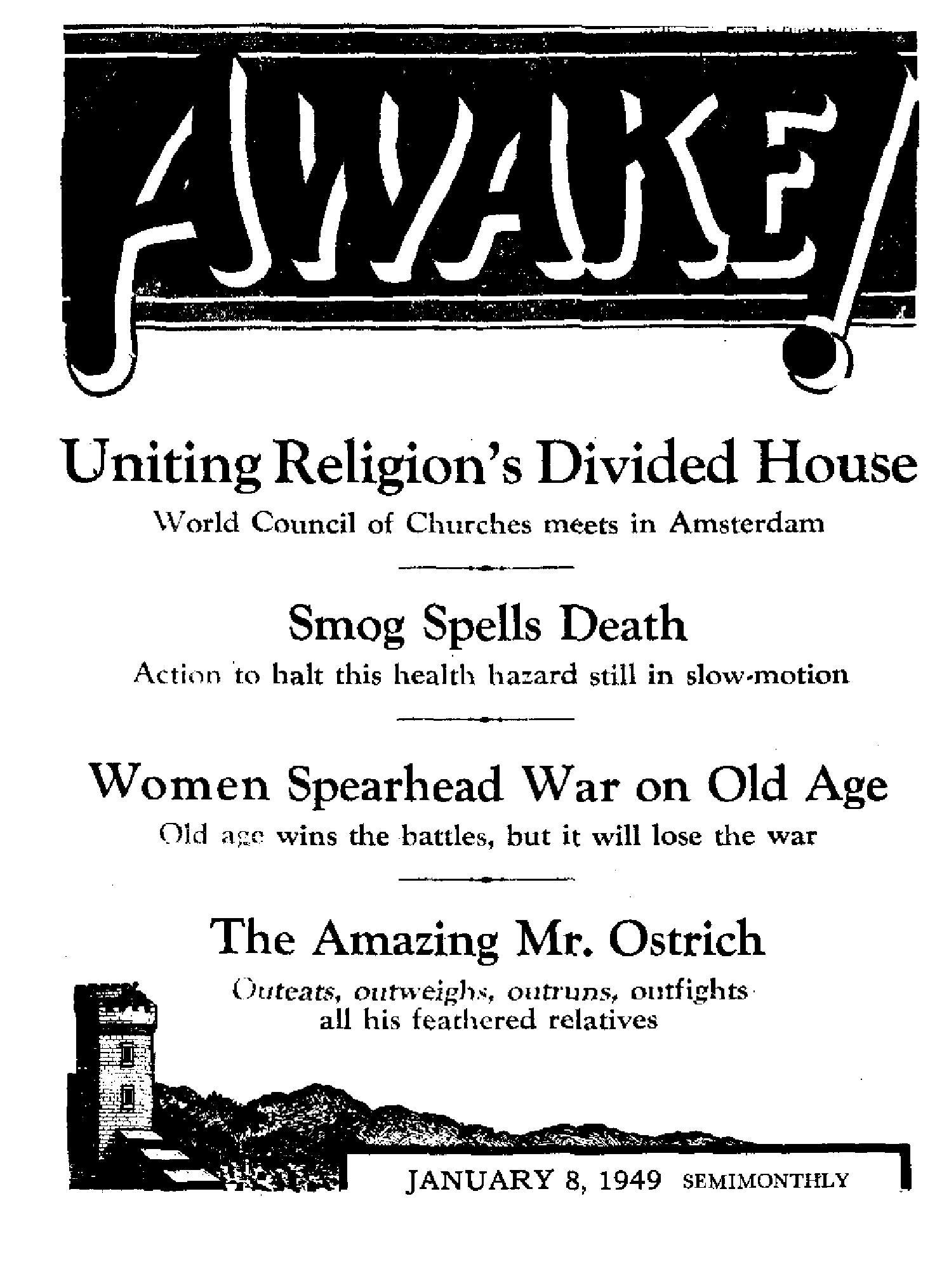
Uniting Religion’s Divided House
World Council of Churches meets in Amsterdam
Smog Spells Death
Action to halt this health hazard still in slow-motion
Women Spearhead War on Old Age
Old wins the battles, but it will lose the war
The Amazing Mr. Ostrich
THE. MISSION OF THIS.JOURNAL
News sources that are able to keep you awake to the vital issues of our* times must be unfettered, by censorship and selfish interests. “AwakeI** has no Tetters. It recognizes facts, faces facts, is free to publish facts. It is not bound by political ambittons or obligations; it'is unhampered by advertisers whose toes must not be trodden on; it is unprejudiced by traditional creeds. This journal keeps itself free that it may speak freely to you. Byt it does not abuse its freedom. It maintains integrity to truth.
“Awake I” uses the regular news channels, but is not dependent on them. Its own correspondents are on all continents, in scores of nations. From the four comers of the earth their uncensored, on-the-scenes reports come to you through these columns. This journals viewpoint is not narrow, but is international, It is read in many nations, in many languages, by persons of all ages. Through its pages many fields of knowledge pass in review—government, commerce, religion, history, geography, science, social conditions, natural wonders—why, its cover* age is as broad as the earth and as high as the heavens.
“Awake 1” pledges itself to righteous principles, to exposing hidden foes and subtle dangers, to championing freedom for all, to comforting mourners and strengthening those disheartened by the failures of a delinquent world, reflecting sure hope for the establishment of a righteous New VVorld.
Get acquainted with “Awake!” Keep"awake by reading “Awake!”
Published By
WATCHTOWER BIBLE AND TRACT SOCIETY, INC.
117 Adama Street Brooklyn 1( N. T.r U.S.A.
N. H. Knorr, President Gsant Sl iter, Secret ary
Five cent® a copy One dollar a year
Remittal!m etould be sent to office tn ytrar enun-try in compliance with regulations to guarantee sale dellrery of money, Beoiittarm are accepted at Brooklyn from countries where no office Is located, by international money order only. Subscription rates lt> diflfcrcDi wintrlaa are hers stated in Iccil currency.
Notlei irf eviration (with renewal Mank) la sppl at 3tut two Imum before subscription trplrts.
Change ut aidrtss when sent to our office may be expected effective within one month. Semi your old as well as new address.
Offices yearly SulKcriptinn Hate
America, U.S., 117 Adama SU Brr^Un 1. N.J. $1 Australia, 7 Beresford Ed., Strulffield. N.S.W> 6a Cen ids, 40 Irwin Ave., Terumo 5, Onlorlo $1 [ryland, 34 Craven Ttirace. Jjonfl™, W. 2 5a Stith Africa, 623 Boiksn Bouie, Cape Town Co
Entered u saohDd-cUH matter at Brooklyn, N. ¥,, Act of March 3, 1979. Prluud la U. 8. A
CONTENTS
_ iligion’s Divided House
“Amsterdam, Here We Are!”
“Unionizers” Go to Work
No Stoop, No Squat, No Sunburn
for Tomorrow’s Farmer!
Disgraced Jailbird
Shortage of Jackasses
Smog Spells Death
Pneumonia, Tuberculosis, Cancer
Noah’s Ark Found Again?
Blood Transfusion—One Doctor’s Opinion, 12 Women Spearhead War on Old Age
Battle of the Bulges
Ultimate Defeat of Old Age
Americans vs. Perpetual Motion
What a Man!
Inland-Hopping in the Caribbean
The Amazing Mr. Ostrich
Mama and Papa
Now Meet Junior
“Thy Word Is Truth”
This Thing Called “Soul”
Christian Integrity in Greece
Watching the World
/AWAKE/
^'Now it is high time to awake.— Romans 13:119)
Volume XXX Brooklyn, N- Y., January 8, 1949 Number 1
UNITING RELIGION’S DIVIDED HOUSE
IN THIS day of bousing snortages many an old, dilapidated firetrap is allowed to stand that would ordinarily in more prosperous times be condemned and torn down. Both unsafe for habitation and eyesores in the community, these old, rickety, rat-infested dwellings remind one of Christendom’s ramshackle, centuries-old house of religion, with its crumbling foundation, sagging floors, cracked and bulging walls, and fallingin, leaky roof. Protestantism down through the years has added room after room to the original Orthodox and Roman Catholic structure, until today there are over 256 different sects and cults nested together under a single multi* gabled roof.
Without plan or design, each addition has its own peculiar architecture of ritual and pattern of ereedal dogma. The passageways between them are so narrow, dark and treacherous that millions of persons have never left the confines of their native religious cell long enough to inspect the rest of the house. Hence they are totally unaware of the fact that with the passing of time the cellar has become damper, the rooms mustier, the cobwebs thicker and the cracks wider.
Instead of calling a demolishing crew and tearing the whole monstrous structure down to the ground, Christendom’s clergy have endeavored to hold together and patch up their tumble-down shack. From time to time they have made general repairs by bolstering up its pagan foundations, plugging up its doctrinal cracks and smearing over its decayed surface with whitewash, in an effort to make it-less apparent that it is a divided hou.se. This “unifying” work they love to call an ecumenical movement. During the last forty years their activity along this- line has increased until recently it reached a climax, at Amsterdam. There the World Council of Churches, from August 22 to September 4, attempted a major renovation of the entire disjointed house from top to bottom.
Setting Up the Scaffolding
Before the actual face-lifting on the old building began many details had to be attended to. The stage had to be set,1 the props arranged and the scaffolding erected. The people both in the house and in the neighborhood had to be awakened to what was about to happen; hence the buzzing commotion. The press, radio and movies were called in to amplify the noise. In religious circles great expectation was aroused; keen interest was created; many questions were asked.
What was this World Council of Churches all about^ anyway? From the loud-speakers of the publicity agents came the answer: ‘For the first time official representatives of hundreds of Protestant churches will put their hearts and minds together; for the first time a continuous, active, globe-encircling council of churches will be established; for the first time old and young churches will
have one voice with which to cry to the world for “more religion"/ Amsterdam was to be “the iridescent and inspiring dawn ofa new day”, the “most significant religious gathering since the conversion of Constantine”, a “great spiritual adventure", an “overwhelming experience". Why, “not since the historic stand of Martin Luther in 1521.. , has so epochmaking an event for Protestant Christianity happened as the World Council of Churches,” asserts Fifth Avenue's prominent clergyman, J. S. Bonnell. Or, to quote the then president of the Federal Council of Churches, Charles P. Taft:
We shall demonstrate the will of the churches toward unity, and their determination to act together in building a free and peaceful world. We shall set up an organization through which the churches may consult together and reach definite agreements. . , . That for which we most earnestly pray is that this new organization may rise up strong, and be an instrument to bring about a world of peace and brotherhood.
Well, such a house-rocking, earth-.shaking affair as this should have a theatrical theme to go with it. So out came the banner inscribed: “Man’s Disorder & God’s Design." A bulletin issued by the American Committee of the World Council declared:
Man's Disorder—revealing itself in war, aggressive nationalisms, economic strife, race prejudices, callousness, cruelty, greed, hunger, disunity (religious and otherwise). Seeing what man has done during the last three decades to destroy himself, not a few people have begun to believe again in an “underworld” —the seat of demonic forces which Seem to be riding mankind to its destruction.
What “God’s design” is, the bulletin is not too clear, but it seems from their boasting that they expect the Almighty to use this World Council to correct all of man’s disorders-
A look at the blueprints gives a better idea of the organizational setup of the World Council. It has six presidents and a “key group” or Central Committee composed of 90 members divided into 12 departments. This Central Committee, with executive headquarters in Geneva, is supposed to meet once a year and make out its time sheets, and then once evyry five years a general get-together of the entire. World Council will survey the progress made on the patch-up job.
Lest any fear that this organization will become a sort of super-church, a Protestant hierarchy, that will rule over half of Christendom with the same authority that the Vatican rules the other half, it is pointed out that this World Council] takes nothing away from the functions of the individual sects or cults that are members. Declared the archbishop of Canterbury: “It [the World Council] is no more a church than the United Nations is a nation.” In fact, there is a great resemblance between the two organizations, the World Council being a sort of religious U. N.
“Amsterdam, Here We Are!*
Of the expected 450 delegates 352 were on hand, with as many alternates, and a host of consultants and visitors—all together nearly 1,500 of Christendom’s most distinguished ecclesiastical architects and workmen from every corner of the globe, and representing nearly 150 separate denominations. There were i{ruff-collared Scandinavians; bearded, black-veiled Orthodox dignitaries; pur-ple-cassocked Old Catholics; saffron-stoled representatives of the Church of South India; U. S. pastors in business suits and glittering spectacles”.—Time magazine.
Pageantry reached a peak. Fifteen thousand people were on hand to satisfy their curiosity and feast their .eyes on this strange collection of “isms”. “I never saw flowers used in such profusion in decorating,” gasped one of the bishops. For fifteen minutes all the church bells of Amsterdam blanketed the city with their spellbinding notes at the same time bells in many other parts of the earth were joining in the pagan custom in an effort to awaken Christendom’s god, so that he might hear the prayers and supplications. Everybody was called upon to pray for the “ecumenic^ workmen. Many news hounds were also on hand, 2f2 of them, some writers, some radio commentators, some photographers.
First of all the roll call. About three-fifths of Christendom’s sects were officially represented by some 6f the brightest lights of the pulpit. Not that they are outstanding defenders of the Bible and true Christianity, for, as a matter of fact, many of them, like Dr. Reinhold Niebuhr, think and believe and preach that the teachings of Christ are too impractical for this world and its troubles.
High on the list of the "Who’s Who” at Amsterdam was the name of John Foster Dulles, one of the chief “tack and hammer” experts. Fresh from the debating chambers of the United Nations Dulles showed his ability by juggling both politics and religion on the highest scaffolding without falling off. After mentioning the fact that before the second world war Dulles was a Wall Street lawyer who worked for German cartels that backed up Hitler, I. F. Stone, editorial writer of the New York Star, goes on to;say:
About the middle of the war, he {Dulles] seems to have felt an urge to be numbered, among the prophets. Ever since he has paraded as a Christian with a capital “C”, ostentatious in his piety, like those of whom Jesus said, “all their works they do for to be seen-, of men?’ ... If Jesus had been as this man, he would not have struck out on the path of sorrow. He would have opened a law office in Jerusalem, catering to the wealthiest of the Pharisees.
‘'Personally,” confesses another writer, “I can’t bring myself to trust Mr. Dulles—theologian or statesman—as far as I can toss a Dutch windmill.”
Delegates from two-fifths of Christendom were conspicuous by their absence wThen the official roll call was made. Notable absentees included Russian Orthodox, Dutch Reform, Scandinavian Lutherans, Quakers of England, U. S. Southern Baptists, the Armenian Church and Roman Catholics. Some sects, like the Unitarian, were not invited, the reason as given by the council’s associate general secretary, Leiper, being that they do not accept the pagan doctrine of “trini^y”-
The Pan-Orthodox Conference met in Moscow a few weeks prior to the Amsterdam assembly, and decided that they would have no part in it as long as the bosses of' this “unionizing” movement were of (he West. Purely a jurisdictional dispute on a diplomatic level. Consequently* the'boys of Amsterdam were tickled pink when Tito, presumably bn the “outs” with Moscow, sent his “small boy” to represent the Yugoslav Orthodox church. All together, 24 of the 8a seats reserved for Orthodoxy were filled by the smaller branches. Russia also knew what was going on, for she had her news agency Tass on the spot.
in the Belfry
Some of the denominations that did not send official delegates did not want to be left out completely, and so they sent what they called “observers”. The Southern Baptists sent such a looker-on even though they had passed a resolution “declining positively and definitely” any membership in the world organization. Jewish * religionists also«sent their observer., These “visitors” were welcomed and gladly taken in. While the Roman Catholic Hierarchy refused to send participating delegates to the Assembly, they did send “a few priests” to “listen in” on the deliberations and keep air eye on the whole remodeling job.
The fact that Rome did not send delegates to Amsterdam with voting powers should not be interpreted as meaning that the Catholic church had no part in
the Assembly. True, the pope's jugges-tion wa» turned down that his personal chambermaid, Myron C. Taylor, be permitted to help out on the construction job, yet, at all times there was at least one Jesuit priest sitting on the platform directly behind the speaker's desk in the front row of the press section.
In reality, the Catholic church is more keenly interested than her Protestant children in uniting religion's divided house, and in bringing all qf Christendom together into a single organization, submissive, of course, to the dictates of Rome. Hence the Jesuit Boyer, quoted in Osservatore Romano, said that Catholics were happy and hopeful that this World Council would result in greater “progress toward unity” with the mother church. The Jesuit magazine America also rejoiced over the efforts of the World Council. Writes the Jesuit J. H. C. Creyton, in the Amsterdam Catholic weekly: “Catholics will listen to the appeal that the World Council of Churches may be a tool by which real union of all Christians in one Catholic Church of Christ may be advanced?*
Pope Pius XII blessed the Amsterdam assembly and in a special letter declared that he was “following with assiduous interest the providential movement for the return of dissidents.to the unity of the church”. Special prayers and special masses were held for the success of. the World Council.
Termites Within the Walls
"Unity” under the domination of Rome is much closer than most Protestants realize. Basically the strategy behind this World Council is to get Protestants to unite among themselves, then, as a unit, join up with the Eastern Orthodox churches, and, finally, all return to the arms of “mama” as the one and only “Holy Catholic Church”, Ever since the days of the Inquisition the papacy has been working toward this end. Now, with the rise of the ecumenical movement she has many, many menus ana netpers mat work as a “fifth column” inside the denominations. Like termites, they are eating out the walls of separation.
Within the Anglican Church of England, which 15 only a shade different from the 'Catholic Church in traditions and ritual, there are forces working for the union of that system with Rome. When 7,000 clergymen representing 21,000,000 Methodists met shortly before the Amsterdam powwow they agreed that since the only terms on which they could unite with Rome were as 'repentant-Protestants', then it was up to them to take the first step toward that union. The noted Danish theologist, K. E. Skydsgaard', reasons that since Protestants and Catholics cannot unite on the terms set by the Protestants it only means that they must unite on those laid down by Rome; hence he says, “it is perfectly right to say that the Roman Catholic Church already is along in the ecumenical movement.” Bishop Oxnam, former president of the Federal Council of Churches, has been one of the most outspoken advocates for return to the Roman yoke of bondage, going so far as to call the Protestant position a ‘sinful* one for which they should ask forgiveness. Others also speak of the "sin of denominational division”.
“Unionizers” Go to Work
One would think that since so many of Christendom's household desire to unite they would all have worked in unison to make the Amsterdam assembly a huge success. However, it seems that each one had his own patching-up methods. Power politics and national ambitions played their part.
At the very start Karl Barth, one of Europe's foremost theologians, with the bluntness of an honest man, warned his buddies that they were starting a bigger job than they could finish. Said Barth:
We ought to give up every thought that the care of the church, the care of the world, is
our care, . .. This is the final root and ground of all human disorder; the dreadful, godless* ridiculous opinion that man is the Atlas who is destined to bear the dom^ of heaven on his shoulders. ... We are not the ones to change this evil world into a good one, God has not resigned His Lordship over it into our hands. . . , By God's design is not meant something like a Christian Marshall plan. . , . AH that is required of us is that in the midst of the political and social disorder of ths world we should be His witnesses, as disciples and servants of Jesus.
Immediately the rest, branding Barth’s “cold water” statement of truth as “heresy"’, proceeded with their remodeling job. Kathleen Bliss, editor of the London Christian News-Lettert wanted to begin on the foundation by saying that if there was faith they could, “lay the foundation of a new society amid the decline of the old'*. Others urged that they “break down the walls of division’’; some started hammering on the “disturbing discrepancy” and the social problems of the day; another urged protection against “the terrible fate that impends”.
Meantime some of the boys were busy on the other side of the house putting up a brick wall against communism. One of these, hod-carrier Duties, worked fast and furious throwing bricks and mortar together as he raved about how “atheistic and materialistic” Marxian Communism is. As soon as he stopped to catch his breath Prague’s eminent clergyman, J. L. Hromadka, in an effort to push the wall over, started talking about the "Western man’s apparent fear, frustration and helplessness in dealing with the great issues of our times”.
For nearly a week about 400 delegates, divided into four sections, tinkered around behind closed doors. No doubt they saw how dark the inside of the house is, how much it is in need of a lighting system and a modern plumbing system for removing some of Christendom's filth and rubbish. But instead of doing anything about these important JANUARY 8, 1940
matters they as much as said: ‘We’ll just fix up the outside a little and leave the internal structure as is.’ Outside they had trouble with their paint. At first their condemnation of capitalism looked too “red”; so they mixed in a neutralizer called laissez-faire so that the jealous god of capitalism would not be offended.
Then, not unlike the builders of Babel's tower when their work was interrupted, these modern housebuilders each said the Lord's Prayer in his own language and went home.
And what was accomplished? A survey by the Christian Century says that “the most substantial work done at Amsterdam wa$ accomplished in the first hour of the first business session”. A constitution was adopted and the World Council became a "permanent” fixture in the divided house. For the next two weeks thereafter, besides offering Queen Wilhelmina .the opportunity of making “Bev.” Visser 't Hooft a knight of the “Order of the Netherlands Lion”, the World Council did plenty of gabbing. Time magazine: “Verbally, Amsterdam was earsplitting?’ Frank Stewart, religious editor of the Cleveland Press, cabled: “This is the greatest gabfest I ever heard any place or any time?’ Surely Gilbert and Sullivan describe the scene perfectly:
Bishops in thetr shovel hats Were plentiful as tabby eats, In point of fact, too many.
Be not deceived, all efforts to unite Christendom's divided house, which is made of hay, wood and stubble', will fail; hence the cry, “Come out of her, my people?" (Revelation 18:4) Likewise the associated World Council will tumble down with it at Armageddon, even as foretold: “Associate yourselves, 0 ye people, and ye shall be broken in pieces. . . . Take counsel together, and it shall come to nought; speak the word, and it shall not stand?'—Isaiah 8:9,10; Matthew 7:26, 27.
I.fU -high er Aarm prides'" are: tfe'' aspirin that . juand warm hand protected Against ;thej;ek?mehte.:;ih cureA-'the longysuffiericrgif armemg;headache, then.....bad weather. The cab, probably constructed- pf
scene of today's inventions might, well be called the liniment to relieve Ids backache. With. Ilin advent of new labor-saving devices and machinery, the farmer of tomorrow is promised a. life of veri-table armchair ease. A long list of new. diggerouters, picker-uppers, duster-o tiers and sorter-outers soon is to join the already impressive list .of mechan ical wonders now at work on farms. In addition to this galaxy of new tractor-drawn, niotor-p rap died, cl ectrical ly-o perated devices,^ tomorrow^ engineer of Agriculture is to have at his beck an.d call, the combined forces of’ clnmiistry and electronics. Yes. the farmer’s life will he a happier one with less drudgery and. name time to enjoy his anta mobile, television set and airplane!
There will be no weather seared face for the completely medmnized farmer of a few years hence. His air-conditioned tractor cab is designed to keep him cool and comfortable on hot days, transparent plastic., filters out the burning rays of the sun, yet allows him full, vision of his work* ing airju He may even enjoy his favorite radio programs, news broadcasts and market reports while he plows or cultivates* And two-way radio conn।nmication is a definite possibility for the large agricultural operator. The owner or manager might thereby be in constant touch with work progress in every corner of the farm . . . and call home to see if dinner is <in the table! Haying literally is going to a breeze with the chopper-blower that shoots the alfalfa or timothy up to the mow where new drying methods allow hay, cul with high moisture content, to be cured. Other farming innovations will include: Radar to select seeds capable of producing the finest crops;
ironic tomato harvesters that grade the fruit by size and color; &erm~killin$ lamps to guard poultry against disease.—Badger Paper Mills, Inc.
^Disgraced. Jailbird
Crime does not pa.yi'^S|O:ic, pet crow in Little Ferry, N. J., learned tins bitter lesson. When h(^ hf^/A^ freedom he attended school with, his young master from Tuesdays throng^^J^s. He dunked in deportment, with lowest dishonors. On. Mondays he play.oJt^ That w the day for his “perfect crime’’, namely, yanking
dcdliesph^ No school Saturday, so be whiled away the day swooping
at car ^hdpiitids and slowly strutting across busy ini ersections, jamming traffic for bl days he attended church, but * shunned the family pew, He joined the
belfry and from that perch “Lamonized” with the choir below. At this ^yf^rotherly ii^lp the choir was sour. But now all. Little Ferry breathes easier: by police orde^’^W'''^ttWe enemy No. 1, Blackie, is a jailbird .in his master’s backyard pen.
Shortage 0/ Jackasses ,
The demoera.te may soon be looking for another party Wthey expect to
keep up svith the times. Why1? .The mule is facing extinction. ; Dry mon < president
of the Horse and Mule Association of America, says the tr<mbhL back ..to.. the.' jackass, the mule’s papa. There just are not enough jackasses of' tW foite*te^geA;y^iyty to mate with m/m's and thereby father the hybrid mute The - jack- O<t
nearing extinction, we are told, and that means the mule will njao-. djh ,uuL< is better suited to certain work and conditions than horses ur. tutors,
the southern United States. Senators have been in consultation ort^In^ matter'., I'ffiHtiriiins often chimor, “We need more, religion,” Now it’s, “We need morirAnles1and. jackasses?’
IT IS December 1, 1930. Heavy, smoke-laden fog blankets the Meuse river valley in Belgium. No one notices. Near-by factory chimneys make smog a frequent visitor. Thre^ days, and it only snuggled closer. On the fourth day livestock writhed in agony. Fortyeight hours later 63 persons had died. Many survivors fled in panic. Others herded their remaining farm animals into their houses and barricaded themselves indoors, sealing cracks with wet rags.
Terrifying rumors whispered of German poison gas. Others spoke in awed tones of the return of the thirteenth-century scourge—Black Death. But official inquiry revealed it a twentiethcentury scourge, a simple case of air pollution that could happen in any manufacturing city. The coal used in surrounding factories had a high sulphur content. When burned sulphur dioxide filled the air, other industrial fumes added oxygen atoms to make sulphur trioxide, this gas absorbed water from the fog, and the resulting smog was a deadly sea of droplets of sulphuric acid. It seared lungs as though it were a flame.
The above disaster of 1930 was used by Bill Davidson to introduce his article "Our Poisoned Air”, in Collier's of October 23,1948. After an array of sobering facts on air poisoning in the United States and practical information on how the smoke menace can be eliminated, the article concludes: “Are we Americans waiting until we experience a Meuse valley disaster of our ownP’
Death Settles on Donara, Pa.
Yes. We waited. It came. One week after the date of issue of that article Americans experienced their “Meuse valley” disaster. On October 30 smog closed in upon Donora, Pa., a community of 12,000 in the Monongahela river valley, JANUARY 8, 7S4P
about twenty-five miles southeast of Pittsburgh. Twenty persons died. Four hundred were stricken, but were treated in time to ward off death.
Donora had lived in a twilight world enveloped in smog for three days before ill effects were noticed, but around 2 a.m. of October 30 the town’s eight doctors wore swamped with telephone calls fpr help from asthma sufferers and anxious relatives. In a short time the hospitals iu the area were filled. Doctors and emergency workers reported that patients showed similar symptoms: gasping for air and unbearable chest pains. Volunteer firemen from neighboring towns assisted the local fire department in getting oxygen to many victim Doctor William Rongaus, a physician and member of the Donora Board of Health, bitterly charged: “Its murder I There’s nothing else you can call it?’
Norbert Ilochman, a chemist attached to the Pittsburgh Smoke Prevention Bureau, announced the theory that there was definitely enough sulphur trioxide to be toxic in the air in Donora, particularly close to the zinc works of the American Steel and Wire Company, a United States Steel Corporation subsidiary. He explained that sulphur dioxide is formed in the process at that plant, which becomes deadly sulphur trioxide upon contact with the air. The Meuse river valley disaster over again, only eighteen years later and in the Monongahela river valley. It can happen here. It has.
M. M. Neale, superintendent of the
zine works, said the plant was being shut down as a precautionary measure. But spokesmen for the mill said that they thought there was small chance that the mill was responsible, on the ground that it had been using the same process in the plant since 1917. Smog had also visited Meuse river valley many times before December 1, 1930. At any rate, the governor of Pennsylvania announced that a state investigation would be made, Donora has asked the United States Public Health Service to enter the case, and the community is also prepared to spend $10,000 hiring private investigators to solve the mystery.
Pneumonia, Tuberculosis, Cancer
City smoke is a menace hanging low over the head of every industrial area. Doctor Clarence A. Mills, of the University of Cincinnati, declared; "Death rates from pneumonia, tuberculosis and lung cancer are three to five times higher for men in the dirty districts than in the clean suburbs. In Chicago alone, over 700 more people die each year from these three diseases than would die if the death rates of the suburban areas prevailed over the entire city/’ Verifying these contentions, Dr. I. Hope Alexander, Pittsburgh public health director, discovered that the four most air-polluted cities (Pittsburgh, Boston, Baltimore and St Louis) ranked one, two, four and five in pneumonia deaths.
The previously mentioned article in Collier's gives an insight into the steep price we pay for poisoning ourdn A research worker at Sloan-Kettering Institute for Cancer Research in New York city said that "there is a group of complex hydrocarbon chemicals any one of which will, when injected into mice, produce cancer in the animals 100 times out of 100”. These chemicals come from tar formed by burning coal. The researchers are now experimenting with ordinary soot collected from New York city rooftops, and London has already proved tnar cnimney soot produces cancer in men as well as in animals. In New York the United States Public Health Service collected air from the Holland tunnel, condensed it, injected it into mice. Result, cancer. It is common laboratory practice tp induce cancer in experimental animate by placing-their tissues in contact with synthetic hydrocarbons.
Though tuberculosis, pneumonia and cancer are the more deadly results to lungs on a smoke diet, there are many other lesser ailments induced or irritated by it. It does not always kill in as dreadfully spectacular a way as in the Meuse valley and at Donora. It is more often a slow killer that takes its time over the years. In addition to soot and sulphur dioxide, each lungful of air breathed by most American city dwellers contains anmioma, formatdehyde, nitric acid, hydrochloric acid, and chlorine and phosgene, the war gases.
City smoke also brings a huge economic loss. Public Health Service in Washington says that everyone’s personal smoke bill is between $10 and $30 a year. Cost to the United States is estimated at $2,500,000,000 annually. Cleaning buildings by sandblasting runs into a cost of millions each year, and around the home smoke does much damage, in addition to the endless marathon of scrubbing that housewives must endure. Obermeyer estimated that 1,780 tons of dirt and chimney smoke floats over New York city in the first 200-foot layer of atmosphere. This shroud blacks out the sunlight and its prized ultraviolet rays, as much as 30 percent being thus lost in some cities, and as high as 50 percent in certain cities in England during wintertime.
These and other evils of smoke and smog have given rise to repeated outcries for smoke abatement. There are solutions to the problem if the industrialists would co-operate. Different fuels may be the answer in some cases,
or oftentimes it is new equipment that is needed. Reduction of smoke and fumes results in more efficient burning;of fuels or in reclaiming valuable chemicals that otherwise go up in smoke, and such savings soon pay for the initial outlay required of industry. But if it never paid hack-in money, the improvement of public health would justify enforcement of smoke-abatement programs. St. Louis has gone far in eliminating her pall of smoke. Seven years of energetic action has raised Pittsburgh's visibility GS percent, and last winter she enjoyed 39 percent more sunshine than during the previous one. She may lose her reputation as the “smqky city"’.
Smoke and Smog No Joke
There are perennial anti-smoke campaigns in New York city. The problem has certainly been talked out; now it should be worked out. Ilie Now York Times runs many good editorials on the subject, and last October reported the introduction of a local law in the city council by Vice-Chairman Joseph T. Sharkey. But some other newspapers are more interested in coddling industry than in public health. The New York Star is a good example of this bad trait.
On October 22, 1948, it published an editorial entitled “Take Care with Our Air”. Its purpose was to poke fun at any smoke abatement program. First it blames the pair over the city as due to a breese off the Jersey flats. Then, “But as to Sir. Sharkeys claim that our air is foul and unhealthful, we say ‘Nuts!’ ” And adds in a strained effort to be coyly facetious about a serious matter, “It isn’t foul at all, just flavorsome/’ Amusing only thcj factory owners, the editorial prattles childishly about the city atmosphere’s needing its flavor, its carbon monoxide and smoke* It chides Sharkey on trying to launch steps to purify the air, saying that New Yorkers would feel lost without the blanketing smoke, that they have become adapted, to it and could not live comfortably without it
Eight days after this cute comic asi-ninely wrote in the New York Star as though smoke and smog were to be taken as a joke, smoke and smog killed twenty persons in Donora. Does the Star think that a’joke! Something to chuckle about, to laugh off? Does their editorial still strike them as cute and cunning! Would they like to let Donora in on the fun by circulating the Editorial there! And when surviving relatives of the twenty who died would say that smoke-laden air is foul and uphealthful, would the New York Star lightly respond: “Nuts! It isn’t foul at all, just flavorsome”!
City smoke and smog is no joke. It blackens homes and overworks housewives. It brings economic loss. It impairs health. And at times smoke and smog spell death.
TVoah/s Ark Found Again?
<L A few years ago a Russian aviator flying over Mount Ararat was supposed to have seen a huge boat stranded against the shore of a glacial lake. It was widely publicized as Noah’s ark. The report has never been substantiated, though it has been repeated and embellished. Most recent news of the ark on Ararat comes via an Associated Press dispatch of November 13, 1948, from Istanbul- It tells of the petrified remains of an object resembling the remains of a ship being found high up on Mount Ararat, Hidden for centuries, it came to light last summer when unusually warm weather melted away an ancient mantle of snow nnd -ice. Many peasants from the villages around the base of the mountain climbed to view the petrified remains and excitedly announced it was a ship. But this and other stories about Noah’s ark still leave the scientists cold and skeptical.
Blood Transfusion—One Doctor’s Opinion
IN The Layman Speaks, June, 1948, Alonzo J. Shadman, MJ)., of Forest Hills, Massachusetts, voices sentiments on blood transfusion. He said in part:
Years ago, in George Washington’s time, it was the style to open the patier t’s veins and let out a lot of blood. The procedure was considered by both the doctors and the laity as the thing to do. That being the accepted philosophy in that “enlightened day and age”, who could "squawk” at the fearful mortality? No one, of course; so what could anyone object to when the Father of our Country was killed by the doctor’s ruthless lancet?
He was' exposed to bad weather on a Thursday. On Friday he showed signs that his bronchi and throat were inflamed. According to homeopathic philosophy Aconite would have been the correct remedy and undoubtedly would have caused an immediate recovery. His physicians were allopaths, knowing not a tning about curative medicine. They did, however, invoke the measures in vogue at the time, namely, bleeding (venesection so-called), and they did it to the queen’s taste, and so poor Washington had to give-up the ghost. He did manage to gasp toward the end a request to be allowed, to die without further torment.
Today, amongst the allopaths, the pendulum has swung to the other side; so now it is the style to fill a patient’s veins with the blood of another, or of various other, persons. Again, it is accepted by physicians and laity as “the thing to do”, and who .has the temerity to question orthodox medicine in this great and enlightened year of 1948? Therefore, who can now “squawk” when people die as a result of this “about-face” professional antic? The general public seems so sold on it that it believes—with the Red Cross doing the thinking for it—that people would die untimely deaths unless a bumper crop of blood for the Blood Hauk is not forthcoming pronto, all of which of course is false and nothing more than a ridiculous hoax, which serves a purpose— never fear—though in actuality it is not only not a service to health, but is definitely deleterious to health.
I have practiced medicine and surgery for over forty years and never yet have I given a blood transfusion, nor fractionated blood, for any purpose, and I have never had a patient any the worse for not having received it. Ihave had many, many patients who were bled cold from accidental loss of blood and a infusion of normal saline solution always saved them. J have had patients paper-white with anemia. The homeopathic remedy always restored their health. I have seen patients turn over in bed and die following blood transfusions. I have never seen an untoward reaction from a needed saline transfusion.
There are as many types of blood as there are persons living on this planet. You are your blood; your blood is you. You cannot with impunity put the blood of one man into the veins of another. The ridiculous blood therapy is in itself had enough, but not;so destructive as the with holding of the proper homeopathic remedy, lack of which not only often results in immediate death, but complications and chronic conditions follow as a rule those who live long enough to pay the penalty of such repugnant measures. . . ,
You have been propagandized so thoroughly as to the wonderful life-saving power of blood and blood plasma that you may be inclined to turn a deaf ear to my warning. The virtues of blood-letting were just as highly extolled and practiced, and probably had I lived in those days any warning against it that I might have sounded would have gone unheeded. Well, history has proved that the warning would have been justified. Do you think for one moment that history will justify the antics of today’s medicine? You may be sure it won’t. So why not be sensible today? Forewarned is forearmed. What more do you need to convince you? ...
The alluring manner in which each and every racket is presented is convincing at the time, but only to those who do not bother to know the difference.
p Women Spearhead
on
OLD AGE
OLD age is fighting a losing war. It has been winning for centuries, but it will lose for eternity. It first brings its millions of victims to feebleness, then easily topples them into the grave. It has taken on all comers, heaten every antagonist. But if old age has set bounds beyond which man will not pass alive, it is cheering to know that a time limit has been set beyond which old age will not exist. It may now be winning all the rounds, but in the end it will lose the fight by a knockout. It can whip all adversaries but one.
Men have vainly resisted the onslaughts of old age, and even as their efforts through exercise, diet and medicine fail they seek to bolster their confidence by hiding the evidence of their defeat. Dye hides gray hair, toupee hides no hair, padded suitcoat offsets shrinking shoulders, elastic waistband gallantly strives to do what enfeebled muscles have long since given up, namely, hold in bulging belly and hold up fallen chest. His attempt to camouflage his failure to fight off old age yields but a hollow triumph to tickle his male vanity. Victorious old age hands beaten man over to the grave for complete disposal of the remains.
JANUAUY 8, 1940
Do women fare better in their war on old age? It is no secret, Eve's daughters fight harder than her sons to beat off the advances of age. Besides the natural will to live, other forces prod women on in their quest for eternal youth. Some girls d$^fhe movie-actress, bathing-beauty type can hold their spotlight only as long as they retain their youth and beauty. When they wilt and fade other feminine flowers are there to replace them. The
career woman holds her position in this selfish world of commercial c<>tn-petition and greed by reason of force and vigor associated with youth. Allied with this urge is the spirit to domineer, possessed by some women. Then there Is the matter of sex attraction. Women have a higher emotional mechanism than men, fear the loss of companionship more thdm men, and operate under greater pressure of competition, since therefore more women than mon. Not oaty^praiw, vanity and selfishness, but also simple fear of growingold,fear of losing companionship, fear of insecurity, fear of being pushed into a eorr r, shoved onto the sidelines of life, relegated to the loneliness of an old ladies home —a 11 of these thoughts and many others may harry the minds of women as they try to retrace their slipping steps toward death.
Though doomed from the beginning to defeat, few women forsake the fight to stay young till old age overpowers them at the grave’s brink. Another wrinkle! Another gray hair ’ Such discoveries may light the fuse to rocket her into all-
13 out, modern warfare against old Father Time. For her counterattack the frantic lady enlists every health and beauty “hint” peddled by radio, newspaper and magazine. She recruits the professional beauticians and hires these mercenaries and soldiers of fortune to help her stem the advances of old age. Questionable thanks to the fertile imagination of money-grasping inventors, the war-bag of the modern woman soon overflows with any number of fantastic preparations. These include youth creams, nourishing creams, cleansing creams, astringent creams, skin bleaches, skin fresheners, skin foods, blemish- and wrinkleremoving creams, and hormone creams —all guaranteed to turn back the hands of life's time clock. Like all wars, the cost of this one is staggering.
Battle of the Bulges
Many women have their battle lines drawn around their hips, waist and bust. Middle age has a nasty way of using obesity to scuttle that schoolgirl figure. To halt its persistent encroachments morning exercises are devoutly performed, and sometimes special rolling, kneading and shaking gadgets are rushed to these crucial battle fronts to break down and liquidate fat cells. Special diets, often injurious to health, are followed. Heat treatments and baths are tried, reducing pills are swallowed, and stiU stubborn victory stands aloof.
When the war is lost in fact, the women try to win it in fancy. Like the beaten men, they conscript camouflage to hide their defeat. Called in as reinforcements are mechanical devices, like armor plating. Foundation garments are hailed as creations that will slim hips, flatten tummies, smooth thighs, flatter figures, uplift busts. Padding in clothing at the right places will minimize bulges in the wrong places. These and many other artifices are drafted to reshape the illshaped. Graying and thinning hair is hidden by dyes and rats, rolls, switches and wigs. Many are the cosmetic capers by which wrinkles are concealed and pink cheeks and red lips are outwardly restored. When mud packs, buttermilk packs, ice packs, facial massages, ray treatments and nighttime chin-straps fail to rout the wrinkles and fatty folds, camouflage of a more gruesome type comes as the knife of the plastic surgeon slices away excess skin and fat to give the face a lift.
Without probing into the controversial reasons, women withstand the onslaughts of old age better than men, outliving men by five years, on the average. But men lose, and women cannot win.
Science enters upon the battlefield with grandiose speeches, but old age is not so hypnotized by its fanciful flights and theories as gullible men and women. An Argentine botanist, Luis Victor Vega, is supposed to have not only resurrected but also immortalized plants, and experiments now proceed on dead animal tissue. Dr. Maurice Ernest, British authority on longevity, claims that soon man will live as long as he wishes, certainly to 200 or 300 years of age. But as far back as 1921 an eminent biologist, Dr. E. L. Fisk, said: “If science keeps its present progress, within a comparatively short time the average human life will be 2,000 years.”
But twenty-eight years later, years in which science has greatly increased its tempo of progress, on the average human creatures atill die short of the limits of “threescore years and ten” or “fourscore years”. None live longer than did men of the past century, and the average life span is increased only by preservation of infants and youths and middleage persons till they reach old age. Old age has suffered no reverses, made no retreats; medical science has only preserved more humans to come within its reach, to die by its hands.
Yet these and other statements by scientists show that they consider an indefinite life span possible, that defeat of old age is not impossible, I'or many years a French scientist, Dr. Alexis Carrell, kept fragments of tissue from a chicken's heart not only growing but beating. Starting its pampered existence in 1912, it doubled in size every 48 hours, was pared down each week, and in 1946, still living and growing, was brutally cast aside. It had been proved that tissue could bt! kept alive indefinitely, and has been done not only with this chicken heart tissue but also with various parts of the human body, such as nerve cells, muscle cells, heart muscle cells, epithelial cells from various locations in the body, kidney cells and connective tissue cells. Dr. Goodhart thinks, ■“As science develops means to prevent disease or build up immunity, life may he extended to unlimited periods." Another report declared: “Our bodies arc potentially immortal!" Science now believes that old age is a disease.
Ultimate Defeat of Old Age
The important point to grasp is that science now considers the body capable of living forever under favorable conditions. Hence when persons today pooh-pooh the Biblical promise that in Jehovah God’s new world human creatures will live on earth forever, and say such is an impossibility, they are anti-science as well as anti-God. Science now says old age is a disease, and in the New World Jehovah God “healeth all thy diseases". (Psalm 103*3) Concerning mankind the promise is: “His flesh shall be fresher than a child’s: he shall return to the days of his youth." (Job 33: 25) “There shall be no more death."—Revelation 21:4.
Old age has been having its day for 6,000 years. Soon youth will have its day forever. Old age may win the battles, but it loses the war. And it is not men that thrash it It is not whipped by the women's tenacious scrapping. Beauty parlors can take no victory bows. Beauty preparations cannot pose with a foot on the corpse of old age and beat their chest and give a victory cry. Old age has always beaten these feeble adversaries without exerting itself, and continues to do so today. Even the hand of highly overrated science is not the one raised in victory. Old age is vanquished only by the almighty power of Jehovah God, exorcised through His kingdom under Christ Jesu< They win the victory fon the obedient men and women that will live everlastingly in the promised New World.
Till then, what1? Fret over wrinkles? Fume over gray hair? Fuss over fat? Waste excessive amounts of time and money and energy trying vainly to hide what everyone can clearly sec—that you arc growing old? Advancing age has its compensations, if the passing years are redeemed for righteousness. “The hoary bead is a crown of glory, if it be found in the way of righteousness.” While “the glory of young men is their strength", remember that “wisdom is better than strength", that “wisdom giveth life to them that have it". And also remember that it takes time to absorb the lifegiving wisdom and understanding concerning Jehovah God and His purposes, as we read: “With aged men is wisdom, and in length of days understanding." —Proverbs 9:10; 16:31; 20: 29; Ecclesiastes 7:12; 9:16; Job 12:12, Am. Stan. Ver.
The ono way to wage winning warfare on old age is to tight for God’s kingdom and be standing with it when it lands the knockout blow that finishes off old age forever.
Americans vs. Pert>et«<U Motion
Adequate Real. By thig I mean two things: Buffiacut sleep nnd oeca.-donil letdowns in tension. We Americans Are the only people who make | qut daily program compete with perpetual motion. A constantly accelerating tempo I is maintained from the time we are rocketed out of bed by alarm dodut till we Bink into an exhausted heap some 16 or IS hour? later. At the end of a day our bodies are [ like depleted electric batteries drained of every spark of surplus energy. This fatigue । attacks not only physically, hut in the higher centers of judgment., initiative, and I personality Every creative and professional person knows that when fatigue appears in the later afternoon judgment is not to be trusted, decisions arc dangerous to make.
Workmen know that their skill Is impaired, that accidents are likelier to occur around four p.m.
Quite profitably, we could take a hint from our British cousins; they have shorter working hours and & national habitmt afternoon tea which afford* a period of comparative real. The Latin races deciare that only fools and Americans are active at noon; in the recent uprisings in France and Spain even the rioters stopped fortheir midday resti and resumed rioting at the end of their siesta. A rest period of even five or ten minutes before the midday meal is a lifesaver in oflr high-pressure living,—William R. K Emerson, M.D.
What a Man!
<1 Some fellows can get away with anything. There** one in our neighborhood that does. Morals don't mean a thing to him. He's unmarried, and lives openly with a woman he*a crazy about; and doesn't care what the neighbors say or think. He has do regard for truth or law. The duties of the so-called good citizen are just so much busk as far as he^a concerned. He
doesn’t vote at either the primaries or the general election. He never thinks of paying a bilk We have seen him take a $2 taxi ride without giving the driver so much as a pleasant look. The driver only stared at him and muttered something silly. He won’t work a lirk; he won't go to church; he can*t play cards, or danoe, or fool around with musical instruments or the radio. So far as known, he has no intellectual or cultural interests at all. He neglects big appeararice terribly. Hp’e ,
AWAKEi
so indolent he’d let the house burn down before telephone can ring itself to pieces and be wouldn’t bother to answer it. Even on ’ awch a controversial subject as the liquor question, nobody knows exactly where stands, because one minute he's dry, and the next minute he’s ^et. But well say this for himt in spite of all his faults he comes of & dam good family. Iler's our new baby.—Zhnttery TaZfe, Chicago, Ill.
he'd tijm in an alarm. The
ever to an appointment! Very likely, yes. Was the transportation service to be blamed! Most likely, no. Indeed, transportation has made such progress that modern men take it almost for granted. In every large city of the world can be found high-powered private cars and taxis to whisk their occupants about quickly. Then there are the buses, trains and subways. And if one’s journey is great and demands much speed, a plane will get him there on time.
But here in the lazy Caribbean area, where the inhabitant is in no particular hurry, and one day follows another with little variety or bustle, appointments are more easily made than kept. To meet these demands are the above-mentioned facilities to some degree. As long as one confines his travel to the island where he happens to be, all is well; and he is reasonably sure of getting where he wants to go and on time. When, however, he decides to cross the expanse of wTater that separates him from another of the islands, wThich dot the Caribbean sea, his troubles multiply.
His choice of travel is limited to ship or plane, in theory. In practice, it amounts to taking what he can get. Few islands have any scheduled passenger service by ship or motor vessel; a number are not visited by plane at all. That ancient craft, the schooner, is many times the only solution to the harried passenger trying to reach his destination on time. Finally, customs formalities must be observed at each island, as several different governments are represented by them.
Mindful of these facts it was still deemed necessary to attempt a scheduled trip of two weeks from Port of Spain, Trinidad, to St, John, Antigua, some five hundred miles distant, then back three hundred miles to Kingstown, St Vincent, and finally home to Port of Spain. Three of us would go and make every effort to keep the appointments we had made at these two towns. Could it be done! Investigation revealed that we could fly to St. John on the day we had set and thus make our first hop accord' ing to plan. From there, however, plane passage to Kingstown was out, as service ended on an adjacent island. Well, if so, another way must be sought.
Take-off for St. John
Comes jnorning of our day to leave, and we are at the airport at an early hour. The plane rolls up to the loading station; we enter; then it dashes down the runway and leaps into the air. The first leg of our island-hopping has begun. Coconut trees reduced to match-stick size dot the terrain below. Clusters of thatch-roof houses hug the shoulders of roads which cut through the cane fields and forest land. Now sharp little miniature mountain peaks march slowly past far below. Great cottony blobs of clouds well-anchored on the higher pinnacles grasp at us and engulf us in their soft folds. A few minutes of blind flying, then we burst into the dazzling sunlight above the clouds with bright blue all around us and the clouds billowing below\
A rift in them reveals the jagged coastline, which fades quickly. A few more minutes; and another coastline appears to our right. There stretches long and narrow t&nhinson crnsoe island, or Tobago, It too recedes in the distance, leaving only the limitless sea as far as eyp can pierce. At seven thousand feet above it it looks almost as smooth as an orange. Whitecaps of the waves make tiny white lines in it. The waves themselves cause the dark green mass to take dh a sort of pebble-grain effect. We were to learn later that when the seven thousand feet are removed and one is riding on the waves the pebble-grain effect is shattered, and the surging waves in no way resemble the surface of an orange!
Now we see “Little England55, or Barbados, with practically all its level area under cultivation. Neatly laid out cane fields give it a tidy garden-like appearance Our only stop is here. Again we take wing for our destination, St. John. Island peaks rear their heads out of the water from time to time on our left too far away to identify or see clearly. Finally we pass directly over a large island and enjoy its contrast in level coast lands and rugged mountainous backbone. This is the Er'onnh nossession, Guadeloupe.
Some three hours After leaving Piareo Airport in Tfinidad we complete our hop to Antigua. Air pockets like wild horses buck us over the hills to the long ribbon of concrete which terminates our flight and ends at the airport A short ride by taxi to St, John, and we have made successful connections for the keeping of our appointments there. All is well so far; will it continue thus for Kingstown, St Vincent?
Flying over Mt Pelee
Our week ends, and we must move on to St. Vincent. We are able to fly as far as the island of St. Lucia, which is about sixty miles from St. Vincent. Well, from St. Lucia it will have to be a boat of some kind, as there is no other way of travel.
Ah, there is what we have been waiting for! Jutting high up in the aii* toward us is me Vuxvano of Mount FelSe with its crater swathed in fog. We speak to the hostess, who goes up front to see the pilot. Yes, he is going to fly over the crater, and veers the plane around. We go right over the crater and strain our eyes trying to pierce the foggy murk that hides it from view. We are disappointed, but are suddenly rewarded as the clouds sweep by and give us a clear view of the side of the volcano right down to the sea. It is bare of everything except some small growth. This is the path taken by the fiery lava and poisonous matter that fateful day of May 8, 1902, when it rushed down the mountain to wipe out the city of Saint-Pierre with some 40,000 persons in an instant of time. It causes the passengers to stare in somber reflection, then disappears.
We fly down the coastline of St. Lucia ; there is Beane Field, our airport Now, whatf We are forty-five miles from the seaport of Castries, where we must go to get a ship. It develops that there is taxi service—for a price, $30. A little haggling,. and agreement is reached for $20.
The road to Castries is very rough in many places and very crooked. Along the coast for some miles it is not too had, but it turns inland and begins to cross the mountains. Up and down we go at a dizzy pace, for the driver has one obsession i to get home before dark, as his lights are no good. We try ta enjoy the scenery and are almost successful, when there is a blatting of horns, a screeching of brakes, violent twisting on the steering wheel. A large truck, made over into a bus, filled with men shoots around a curve and bears down on us. The road-is so narrow that passing seems impossible, yet in some way we come together but do not crash. Each vehicle seems to slide around the other and continue. When we do have to stop on another occasion we learn that the engine is prone to die, and there is no starter; a push will do. This is all taken in its stride in eagerness to reach Castries and search
out a way to Kingstown and our scheduled week there.
By Schooner io Kinystoivn
After a night and day of visiting travel agents, it is quite clear that we shall not be able to book passage on any steamship or motor ship. There is only one thing to do, and-that is go by schooner. At least it will be a new experience. The schooner has an auxiliary engine which prevents it from drifting in case of a calm. It has nd cabins, no bunks, no accommodations of any kind except a little galley for the crew to use in preparing their meals. There is a small bench under a piece of canvas if one wishes to sit down instead of stand all night.
As we set sail it is early evening, and everything is, enjoyable in the calm waters of the harbor and with the lights of the city winking at us. This enjoyable sensation continues for some hours as we proceed down the sheltered coastline. Then imperceptibly some changes are made. We are still moving, yes, decidedly. The schooner is still making some progress forward, but new motions have been added. The bow lifts high in the air, and wham! down it comes as though determined to turn submarine and crash-dive. That is not all, however, as there is jnore movement yet. Somehow or other it contrives to twist and roll from side to side so as to ship up a goodly quantity of salt water and spray to discourage anyone bold enough to try to stretch his bones out.on the roof of the engine house. Oh, well, we were not sleepy anyhow.
…