Awake!, December 22, 1948
Download: PDF — Awake!, December 22, 1948
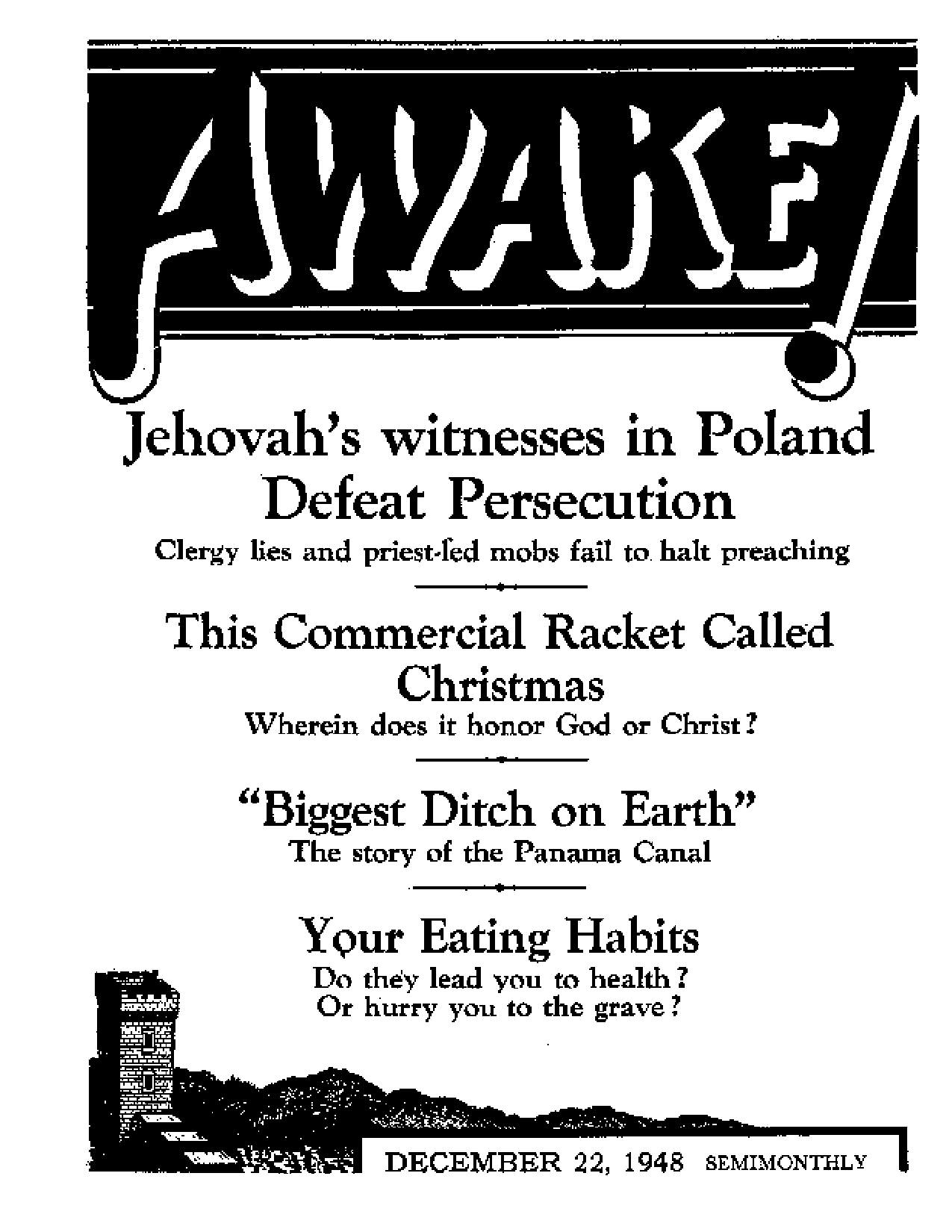
Jehovah’s witnesses in Poland Defeat Persecution
Clergy lies and priest-led mobs fail to halt preaching
This Commercial Racket Called Christmas
Wherein does it honor God or Christ J
“ Biggest Ditch on Earth”
The story of the Panama Canal
Your Eating Habits Do they lead you to health ? Or hurry you to the grave ?
DECEMBER 22, 1948 semimonthly
THE MISSION OF THIS JOURNAL
News sources thit are able to keep you awake to the vital'Imu^s of cur limes must be unfettered by censorship and selfish interests. “Awuhf has no fetters* It recogniso foots, faces facts, is free to publish facts. It is not bound by political ambitions or obligations; it is unhampered by advertisers whose toes must not be trodden on; it is unprejudiced by traditional’creeds. This journal keeps itself free that it may speak freely to you, Birt it does not abuse Its freedom. It main tains integrity to truth.
"Awake t’* uses the regular news chtnmels, but is not dependent on them. I's own correspondents are on all continents,, in scores u£*nnlipns1 From the four corners of the earth their unecnsoi'cd, on*-the-scene? reports come io you through these coluxuTifi, This journal’s viewpoint is not narrow, but is international. It is read in many nations, in many langua^ti’, by persons of all ages* Through its pages many fields of knowledge pass in review—-government, commerce, religion, history, geography, floience, social coiulitions, natural wonders—why, its coverage is as broad as the earth and aS high as the heavens.
"Awake I” pledges Itsdf to righteous principles, to exposing hidden foes and subtle dangers, to championing freedom for all, to coml'otiing mourners and strengthening those disheartened by the failures of a delinquent world, reflecting sure hope for the crtublwluiient of a righteous New World.
Get acquainted with wAwakel” Keep awake by reading 11 Awake!"
ruillJRWFTj SJtMIMOKTHLT Di
WATCHTOWER BH3L1& AND TRACT SOCIKT?, TNG.
117 Adams Sirent
N. II. Ktornt, PrtJWcst
Five cent* a copy
RralltaiiHi ahcmld ts sent to oHlct Id- tout tsua-tjy 111 ClWplla&H fflth nscuUUuUH to RUScultO fill'll ijtjnor? cf Wiry. BalulLIaocn »rj uttflWi it Eiuuilin from ^cnir.trlm wlmro OCr efltCp kj lOi'ati'O, by jntortaMonn] mimey urJtr onlT. CuhKrtBtLin Calis 13 dlffyrcno niuolrlui ICS Jwrt stlted in irr?»l Curran?.
Motlw rf laplrallotl (vJUi HtHvU tJad) If Wt at UnU ton Luuai baftn pi^rtjrkm ctjIwu
Brooklyn 1, N.Y., U. S, A.
QlLLtfT SurXJiU, ^cnri'XiN-y Dti-a dollar a yaar
(FiaafO tff tMriU v.lnU mtiL to OUT dttlco miy tz-fijwnliMl dteullre wtUiia Wrt PWHE Jjenif J a Ur dJi in will ii inw MMreta,
lyi’ffl Yuirlv •Hlissnotlflo DM»
/urlta. D.fl., 11T lilaOi Hu, ItCWlrlyu 1. N. Y. $1
■" — ’ ' -......*..... di
i-Elrilla, I TtcnssF-onJ Kd.. airiLhfldrt, 2<:J TV. Cgoaiai dfj IrrJli Aftu, lorcqito 5, On'-ido EftflMlj 34 Criren Turret, 10 Id Ki, K 0 iQlfttL AlrlA. 423 IK-tfOt. ncnw, Cijr Tnon
SI 54 Co
fcatttd u atr-rn111-ulias miliar 4t DwWftt. ft ?*. A* iif Marifi 3, Ltfr$, PrtSMd Jtt V R- A.
CONTENTS
Jchovflh'A witnesses ui Poland
Dcfonf Piirjweurion
The Church1?- Ccnrsp During the War
Petition ui Juhuvuh’s witn**= i=es
Falsa Charge! of Cummuuht Bac-lviTiE;
Thh CumincTc-ixl Jtaekct Called Chriatmus 9
The Santu Claus Fruuri
Lnhking Behind the "Charity1' MhkJt
The Truth A tout Lying Pun-ntsi
“Biggest Ditch on Karch"
Th ft French Attempt
The United States Tackles It
“Distress of Nat.inriA, with Perplexity’’
Kanu, VValhid City of .If?him
Atnnite Energy on Mount Carmel
Your TCafTTig- Habits
Vitamania
Food Cuinbmutjons
Hourefl of Health aiid Cure
The Unclean “Spud”
"Thy Word Is Truth"
Why a Heavenly Son Was Born as a Man 25 CcnsoTfilrip Fells Bambi and CurdimJ 27 Watching the World
Awake/
®^Now it is high time to awake.— Romans 13:119)
Volume XXIX Brooklyn, N, Y,, December 22, 1948 Number 24
JEHOVAH’S WITNESSES IN POLAND DEFEAT PERSECUTION
MUCH has been said over the radio and published in various newspapers and magazines about the government and religion in Poland. Oftentimes some of these reports have been distorted so as to cover up the truth and lead the readers into forming an unfavorable opinion of certain individuals or groups. Two Awake! correspondents who have been traveling throughout Poland for over a year and a half hope to give you a true inside picture of conditions as they actually exist in this land.
The Catholic Chronicle of Toledo, Ohio, contained an article in its February 27, 1948, issue, entitled, “Pole Reds Finance ‘ Jehovah’1 Agents/’ It goes on to say, which we qote in part:
Warsaw—The atheist government of Po-land is financing sects like the Jehovah's witnesses in an effort to destroy the Catholicity of the people. “Watchtower’ salesmen are making the rounds of homes with pamphlets reviling the Church, Sunday lectures also are Organized, denouncing Catholicism and glorifying communism. . . . Next they plead for conversions. Finally they offer cash inducements for joining. These bribes are disguised as “charity”.
At the very outset, all sensible thinking Poles inside Poland will readily agree that the Catholic Church is not being p&rsecuted nor are her privileges being taken away from her. Poland is over 90 percent Catholic, and the govern-DEGEMBER 22, IMS ment recognizes her strong influence in all spheres of life and so grants her full freedom of operation. Although the 1925 Papal Concordat has been dissolved, great liberalism and freedom have been shown toward the church by the present regime. The true picture of church and state relations was best stated and set forth by President Bierut in his famous interview with Ksawery Pruszynski, well known literate and journalist. He stated in an article entitled “The Government Desires Good Relations with the Church”, as published in the Wieczor Warszawy (Warsaw Evening) of November 24, 1946:
The best concrete evidence that the State desires good relations with the church is the status of the church’s possessions. This status includes private Catholic schools, low, average, and higher grade, with a Catholic Univers i to which includes th e ological depar t-ments, equipped by the State with full public rights. Further, it embraces the Catholic press which possesses a number of organs. Finally, in schools run by the government, it is a requirement to teach religion by catechists, and this teaching is obligatory provided the parents of a child have no objection to it. We add to this the leaving to the clergy their property, especially farms, and this despite farm reforms. In other countries the first victim of such a reform was usually the church. Monasteries and religious institutions evacuated from the territory outside of the river Bug
were moved by us to new centers in the re gained territories. Our army possesses chaplains j its standards are consecrated by the priests, it begins the day with a religious song at the morning roll call, and Sunday it goes to church. Our radio begins i:s programs with a religious song, and has sermons and church services. We do not believe, sir, you will find this in many countries. And this is happening in a country whose government is stubbornly not recognized'by the Vatican.
As further proof that the church is not being persecuted and her privileges are not being taken away from her, the government has been granting permits for the repairing of demolished Catholic churches throughout certain parts of the land. Sometimes more stress is placed upon repairing these than in renovating demolished homes for the masses of the common people. The following article from the newspaper Robotnik {The Worker/Warsaw) of July'28, 1948, under the heading “Edifying Example” is to the point in this regard:
While wandering among the rubbish heaps around the Vistula, I came across a freshly rebuilt church which was about the only building still standing in this section. No. I’m not an enemy of the church or churches. . . , Only the rebuilding of churches when many of the parishioners yet nest with their whole families in one bed, may not be a social crime but it surely is social untactfulness. , . * I do not contend in the least that the renovation of old churches and the building of new ones should be discontinued altogether, but it seems to me there will be time for this when the last parishioner comes out of his pigpen and lives like a human.
In view7 of the critical housing situation, it is an otitright shame that Anthony Lowihski, parish priest of Saint Waw-rzyn church, Warsaw, managed to cleverly steal the money going toward the rebuilding of his church and use it for his own selfish purposes* In commenting on his actions, Glos Wolnych {Voice of the Free) of Warsaw, dated May 30, 1948, stated:
As stated in the Wieczor of May 23, 1948, the prosecuting authorities drew up an act of impeachment against Anthony Lowihski, the priest of Saint Wawrzyn Church, Warsaw. Priest Lowinski was charged with selling building materials acquired for the church to the free market for considerably higher prices than the commercial prices paid for. He used the money fbr purposes which are in conflict with the dignity of the priest’s profession. He repaired the living quarters of his friend, Jenny Wankc, at 11 Wisniowa Street, which -cost 1,000,000 zlotys ($2,500), and he also bought furniture for her at a cost of 100,000 zlotys. . t t In the course of the investigation, priest Lowihski confessed to selling this state-controlled merchandise.
According to a similar article in the newspaper Zycie Warszawy {Life of Warsaw), priestLowihski was sentenced to three years in jaih
The Church's Course During the War
Many in Poland have seen and still remember the hypocritical action of the church during the war when it expressed its sympathy for the Hitler regime and ignored the cruel sufferings of the Polish people. President Bierut in eem-menting on the government's provocations toward the church stated, as quoted in the newspaper Wieczdr Warszawy ( The Warsaw Evening) of November 24, 1946:
The reasons for our provocations toward the church are twofold. The first reason is very unpleasant, but we frankly call this the Vatican's German love. During the war and in the period of the heaviest persecution the Polish nation has ever known, we waited in vain to hear the intervening voice of the Holy See. When this voice was heard, it was only incidental, casual, cautious, not equal to our great sufferings and German crimes. Today, this same voice is heard, but much stronger, in defense of oppressed Germany, even in such cases which but merit little mercy, as the hangman from Wartbegan.
The second source of our provocation is found in certain circles of our own clergy
and their sad tendency to misuse the pulpit for the purpose of carrying on a political war. These facts are always occurring and I judge it is high time the church authorities stop this. These assaults from the pulpit and vestry are a block in the road to peaceful relations between the State and the clergy.
The clergy have always mixed in the politics of nations, Contrary to the Bible teaching, and are willing to make all kinds of agreements to further church aims in their country. It has been reported that at present some Catholic priests in Poland are members of the Polish Communist party, the same as in Czechoslovakia. Many of the parishioners also belong to this party, attend all of its meetings, and carry its standards in certain governmental parades. The Hierarchy is willing to do business with anybody, even the Devil himself, as Pius XI put it.
Mention might here be made of the relations the clergy had with forest bands who plundered and murdered people throughout different parts of Poland. The sadistic priests who led these bandits administered absolution to them to ease their conscience for the killings they committed. The following articles from different sections of Poland -show the activity of the clergy in conducting these terroristic, criminal bands against innocent persons.
Express Ilustroiyany (The Illustrated Express) of December 28, 1946, stated: "The Regional Military Court in Warsaw announced its verdict in the case of the plundering band headed by priest Stefanski. Priest Stefanski and defendant Jaworski were sentenced to death.”
Echo Krakowskie (The Cracow Echo) of November 11, 1946, had this report: “Swiecie—Priest’Konczal stood today before the specially called-in Regional Military Court in Swiecie, Bydgoszcz, charged with helping the faseistic band NSZ and for illegally possessing firearms. Priest Konczal confessed to being guilty but denied that he directly incited DECEMBER S3, 1948
to arms. The court sentenced priest Konczal to five years in jail.”
On this same subject Robotnik (The Worker) of January 9, 1947, wrote, under the heading “Terroristic Priests”:
Not long ago the Warsaw Military Court sentenced priest Jarkiewicz of Kierki to death for organizing a terrorist band and for issuing the death sentence against the 'disobedient’ in his parish. ... A number of cases of this kind are in the course of court procedure. The warehouse of ammunition for priest Jarkiewicz’s band was located in the parish church. In the parish church of Drohiezyn, the safety authorities uncovered a whole arsenal provided with war equipment of the “Hammer” band. A church in Klimontdw served as a warehouse for merchandise robbed from stores and government institutions by the ravaging NSZ band in that district.
Position of Jehovah’s witnesses
How different, on the other hand, is the position of Jehovah’s witnesses in Poland! They are zealously active in the work of spreading culture and Christianity to the bedarkened peoples of Poland who have long been held in the chains of Vatican darkness. According to the statement of The British Foreign Bible Society, in Warsaw, Jehovah’s withesses in Poland distribute more Bibles among the people than all denominations .in the country combined. To show love for their neighbors, Jehovah’s witnesses personally visit the people in their homes with the message of truth from God’s Word, the Bible. This truth is concerning God’s kingdom, which will provide. the people of good-will with everlasting life, peace, happiness and security upon the earth.
In order to bring this message to the people in Poland, Jehovah’s witnesses have to go through great risks, dangers, slanders, hardships, and all manner of persecutions similar to those which befell the early Christians. Here are a few cases from among the many to give the readers an idea of what Jehovah’s witnesses have to go through.
On July 1, 1948, company publishers from Piotrkow Trybunalski, while working the towns of Moszczeniee and Gajko-wice for the purpose of inviting people of good-will to a public Bible lecture, were attacked by a large crowd of residents and beaten with brooms and wooden shoes, were stoned and had water thrown over them. Four persoris suffered injuries, with one losing consciousness. The Citizens’ Militia witnessed the whole affair but failed to arrest the assailants and did not offer the necessary help to the publishers of the gospel.
On September 5, 1948, after leaving a circuit assembly of Jehovah’s witnesses in Piotrkow Trybunalski, the writers of this article and some others were severely beaten by a large mob of fanatical and misguided Catholics who had been waiting for the finish of the assembly in order to get at the "bishops”, as they termed the ones in charge. Two of Jehovah’s witnesses were beaten into unconsciousness. When one of them revived, he discovered his new suit was covered with blood from the severe beatings he took. The matter has been reported to the proper authorities, and it is expected action will be taken soon against those held in custody by the safety authorities.
At practically every circuit assembly, the clergy incite large mobs in an endeavor to break up the meetings and persecute Jehovah’s witnesses. In October, 1947, in the city of Gorzow, a fanatical mob broke up the concluding part of a circuit assembly by throwing large stones and bricks through the windows of the hall, and attempted to force themselves into the assembly hall. It was necessary to set up barricades of tables and chairs around the doors. The guilty mobsters, one of whom was a priest, escaped trial and punishment.
The district assembly in the Catholicized city of Lublin July 2-4, 1948, was held under very difficult circumstances. Before the assembly, the clergy in special sermons told their parishioners Jehovah’s witnesses were coming into town to destroy the churches, were going to call upon the homes of the people in order to remove their religions pictures, and that the parishioners should prepare to defend themselves against such. As a result of this false, advanced information, groups of Catholic men and women were waiting outside the train depot to attack Jehovah’s witnesses. Some of Jehovah’s witnesses were beaten up quite badly after leaving the depot, while others were attacked on their way to the assembly hall.
There were so many cases of beatings during the first day, the Citizens’ Militia and Bureau of Public Safety told the convention committee they would not guarantee the safety of Jehovah’s witnesses if they went out to preach from door to door the following two days. Realizing later their plans were foiled the second and third days, the hoodlums next attacked some of Jehovah’s witnesses at their homes and at the Kingdom Hall. Two homes were partly demolished and some of the occupants injured. It was necessary for the militia to keep an all-night watch at certain homes where Jehovah’s witnesses were quartering.
During the public Bible lecture and afterward, the militia had its hands full with the.crowds of people gathered at different places. Dressed as firemen, they dispersed the people nearest the hall with water from a fire hose. This was the second time this method was used. The first was during the 1946 elections. Near the end of the program so many people lined up on the sidewalks, it was necessary to have several militiamen conduct each large group of Jehovah’s witnesses through the streets to the train depot. The writers of this article, while on their way to the depot with one of these large groups, saw youths throw stones at the group and heard people shouting out, “cat worshipers” (kociarze), “heretics,” “beasts,” “Je-hovites,” “new faith,” and other slanderous titles unworthy of print
Despite the tight hold the clergy have on the people, many persons of goodwill in Poland see the great zeal of Jehovah's witnesses in preaching the Kingdom gospel and are joining their ranks* Commenting on the matter of religious persecution in Poland, the monthly Glos Wolnych (Voice of the Free) of July 25, 1948, in an article, “Criminals in Cassocks”, stated:
After the war, the dignitaries of the church hierarchy started an energetic activity in two directions: politically against the structure of the people’s democracy, and (religiously) against faiths, having as their purpose the fighting and persecution of other faiths.
The Roman Catholic clergy are converting people of other beliefs to the Catholic religion through the methods used to fight against the Reformation in Poland. At present, attention is centered mainly on Jehovah’s witnesses (Bible Students), A few years after the war, it has been just one series of raids after another, organized and executed by Catholics under the direction of the clergy, raids combined with murder (there were 60 persons murdered), plunderings and stealings, beatings and tortures, setting of homes on fire, demolishing homes, and burning publications on the Bible, etc., of Bible Students. . . .
The assailants who attempt to convert Jehovah’s witnesses to the Roman Catholic faith are recruited from the underground bands of NSZ (The National Armed Force) and WIN (Freedom and Independence), Catholic Action, Ukrainian bands, professional thieves and ignorant Catholic population, all brought up by the clergy in fanaticism and hatred toward all non-Catholics and everything that does not bear the Catholic stamp. The responsibility for the barbarian religious persecution is borne by the bishops of the Roman Catholic church in Poland and their subordinates the clergy.
On February 18, 1948, Jehovah’s witnesses submitted a memorandum to the
Ministry of Public Administration and Office of Public Safety in Warsaw, in which they listed the following: 60 cases of death through torture, 226 cases of beastly torture, 256 cases of plunder, a number of death sentences rendered against them, demolishing of homes, window-breakjng, arson, stoning, violence, and threat* This memorandum did not cover all of the cases by any means, but listed only the most characteristic cases of violence performed in the name of the Roman Catholic church against Jehovah’s witnesses in Poland since the close of the second world war.
False Charge of Communist Backing
The charge that Jehovah's witnesses are on the communist pay roll is absolutely false. Before the war this charge was made against Jehovah's witnesses in Poland and it resulted in some being fined for libel and slander. Today, some of those who spread such false'propaganda before the war have changed their tune and are now saying that Jehovah's witnesses are being backed up by American dollars.
One clergyman in Poland was honest enough to come out with the truth, publishing an article before the last war on the benevolent work of Jehovah’s witnesses in Poland and their position toward communism. We quote, in part, from Gazeta Koscielna (The Church Gazette No. 32), pages 375-377:
There is no doubt that the teachers of this sect have been charged with being on the communist payroll. .Here it is right to ask, Is there any kind of proof for this charge? If such a person were found and the administration informed, he would most certainly be removed from his job . , .
Not of less nonsense are the charges heard often from the pulpits that the Bible Students pay dollars to those who enter their folds. The telling of this resulted in many really coming to the meetings of the Bible Students with the hope they would get something. Little by little they became convinced that the meetings were
for the benefit of the Bible Students, The people did not receive any money because none was handed out, and yet it was claimed those who preached became Bible Students through American dollars. , * .
I point out, that in the writings of the Bible Students, the expression is found proving that communism will not secure happiness for mankind, but to secure peace, the Theocratic Government is necessary.
As yet, the present government in Poland has not recognized Jehovah's witnesses as a legal faith or confession. There are about twelve different denominations, including Boman Catholic, all of which are recognized by the present government with the exception of one or two, Jehovah’s witnesses, who do more for the people in the way of culture and Bible enlightenment than all of these denominations combined, have been striving to become legalized since the year 1945, They have made many appearances before the authorities in Warsaw, hut to date have not been recognized. They are merely tolerated on the basis of the Constitution, according to the opinion of the authorities.
All of the denominations have their churches or other places of worship where they conduct their services without interruptions from officials or the public. Some of them, are even permitted to use the radio for such religions services, especially the Roman Catholic church, but, to this time, Jehovah’s witnesses have been denied the use of the radio for praising God’s name and advertising His kingdom. In some cities, Jehovah's witnesses have been refused suitable halls for their Bible meetings and public Bible lectures.
While it is true that some needy Jehovah's witnesses in Poland received food and clothing f rom various countries, this was not done to make them join any organization as is sometimes falsely charged. They were Jehovah's witnesses before receiving aid. The work of Jehovah's witnesses in Poland is carried on by means of voluntary contributions received from families of Jehovah'S witnesses and persons of good-will throughout Poland.
Most of the denominations in Poland receive a reasonable allotment of good paper in order to print their periodicals. The Catholic Hierarchy has allotments of paper for about 60 different periodicals that flood the country with religious traditions and propaganda against Jehovah's witnesses. On the other hand, Jehovah’s witnesses have to be satisfied, to mimeograph each copy of The Watchtower for group study at the Kingdom Halls and in their Bible studies at the homes of people of good-wilt
Jehovah's witnesses in Russia are experiencing much persecution from communism. Their Christian organization has not been recognized there, and countless numbers of them have been arrested because of their faith and sent to penal wTork camps in Siberia. It is of interest to note a statement in an official Catholic publication on the subject, “The Witnesses of Jehovah," published in the French language magazine Annales de la Bonne Sainte Anne de Beaiipre, Quebec, P, Q., September, 1947: “It is good not to ignore that Russia is the only kind where the witnesses have not yet>. been able to implant themselves. The iron curtain of M. Stalin is for them also impenetrable.” Now, after reading all of the above, dear reader, could you honestly believe that Jehovah's witnesses are being financed by ‘Polish Reds’?
Despite the above facta and the persecution from all parts of Poland and Russia, the 10,000 active witnesses of Jehovah in Poland, and 8,000 in Russia, are determined to do this one thing: preach the gospel even as the apostle Paul wrote in Philippians 3:13. Theirs is a blessed state mentioned by Jesus at Matthew 5:11: “Blessed are ye, when men shall revile you, and persecute you, and shall say all manner of evil against you falsely, for my sake."
'Tlile 'WlOVf'ifl 1 Rnrbpt knick-knacks of many varieties. 1 fllS AULKU Finally the climax is reached, a
THE raving mob is on the rampage.
The wild herd is again on the stampede. Dashing and furious, the crowds act like animals and brute beasts that are hysterical with excitement and on the prod. For weeks the pack pushes and shoves, horns with the elbows, tramples on one another’s heels, snaps and growls at each other in vicious fashion, until their nerves are raveled and frayed, and as physical and mental wrecks they are completely exhausted, weary and deflated. Every year this Christmas shopping scene is enacted.
Called the "spirit of Christmas”, this form of insanity begins to seize the masses in October. During November and December the plague spreads and the fever increases, until in the last stages the whole population is in an advanced state of delirium. When money is a scarcity the burden is that much greater, for a large number of gifts of many varieties have to be obtained: trinkets find baubles for friends, costly presents for relatives, and worthless toys for the children. These have 1q be carefully packed and wrapped with fancy paper, string and stickers. Moreover, evergreen trees have to he pur-chased, and then trimmed with glitter-
DECEMBEB 22, 1948
holiday is declared, and Christmas is celebrated with a burst of festivity. Reason and self-control, long since abandoned, the multitudes recldessly plunge as deep as possible into the momentary joys and pleasures of the affair in an effort to drown their troubles and sorrows of the past year. Many parties are held, excessive eating, and drinking is indulged in, and all sorts of foolishness run riot Surrounding the gala frivolity is a covering of religious piety and formality. Church-going, special prayers, special sermons, and most assuredly special collections, are sandwiched in with the other events as a part of the celebration. The occasion is Christendom’s greatest annual carnival!
What a mighty letdown when it is all over! The joy and pleasure, how short-, lived, considering the expenditure of time, money and energy in preparation! Ho^v" sobering the reality, when the emotional intoxication wears off and one begins to survey the damage and disappointments ! The financial damage is measured in the millions of dollars, damage that takes many months to repair. The physical and mental strain often completely exhausts the body and mind, leaving them limp and haggard. When the festival is over and sobriety returns,
Art
and when the mask of make-believe and the veil of sheer hypocrisy are removed, both adults and juveniles suffer disappointments. Sorrow stings the hearts of children who fail to receive what they had been led to expect. Remorse bites the conscience of adults who received more than they had expected when they gave themselves over to wanton excesses. Depression and despair creeps over the people as old worries and troubles return, bringing with them a flood of unpaid bills and visions of new calamities. And then there are night-marish Christmas ties to be worn.
Victims of Many Rackets
Only after it is over with can one soberly look back on the Christmas celebration and properly count its tremendous cost. Only then does one see that the event amounts to just so many dollars and so little sense, just so much business, so much work, so much worry, so much sweat, and in the end so many tears and sorrows. Looking back' one realizes what frightful pressure and duress was heaped upon the public by an unscrupulous and heartless business world that hiked the prices higher than normal, and then put the “squeeze” on the customers. Whether buying a toy for the kids, a tree for the parlor, or a card for a friend, the public is plundered and robbed by commercial fraud and deceit.
Take a'close look at the business of gift-giving. From all sides the people are pommeled with the idea that they must give something to their pals. Everybody is doing it; it is the popular thing; a social custom that should not be ignored. In many instances, no doubt, there is a deep feeling of love and affection behind the giving, but in many other eases selfishness is the dictating motive. Fear also enters in, fear that you may overlook someone who will remember you.
The toy business is a monstrous racket that swallows up $300,000,000 of consumer cash a year. With over 100,000 toys already on the market the manufacturers pressure the parents into buying expensive novelties by creating a constant flood of new gadgets and whatnots. The latest: toy pop-up toasters, mechanical washing-machines, chemistry outfits containing specks of uranium ore, and dolls that eat crackers and wet their panties.
Seriously, now, is not the Christmas-tree racket one of the worst wasters there are? Before the last war it robbed the public to the tune of $25,000,000, not to mention the additional cash rolled in by the multimillion-dollar ornament business. As a destroyer of the national resources every year more than 15,000,-000 trees, ten to fifteen years old, are ruthlessly cut down, and hundreds of thousands of these are never sold.
The Santa Claus Fraud
Probably the celebration’s most brutal hoax, the one that attacks the tender morals of the young and innocent children, is the bewhiskered old duffer called “Santa Claus”. Shattering the hopes and expectations of the young, and filling them with mistrust and disrespect for their lying parents, this St. Nick has become a model gangster in the minds of the little ones. Robert Ripley, in “Believe It or Not”, tells the kids that “St. Nicholas was the patron saint of thieves, gangsters and pawnbrokers, as well as children”. “The tomb of Santa Claus [in Italy] is a sanctuary for thieves and gangsters and is kept dimly lighted so that criminals can worship without fear of recognition.”
Simple-minded parents take up this thesis and tell their children, “Santa won’t bring you any .presents if you don’t eat your oatmeal.” As a result, the kids learn the ways of this world and try to bribe Santa by various means. In Belgium and the Netherlands they put out hay and fodder for Santa’s horse, and in America where money “talks” one youngster wrote a note to Santa, saying, “In my stocking you’ll find two bits for beer.” Efforts to halt this mischief have met with failure; as, for example, a professor in France was prosecuted for destroying a child’s belief in _ the Satanic Santa myth. Again, in Pittsburgh, when honest parents tried to get a court order to prevent Santa impostors from parading around deceiving the children they were severely denounced by the judge, who declared that “Santa Claus . .. will be protected in this court against all aspersions and insinuations”.
Taking full advantage of this mythical humbug Big Business has become^ Santa’s publicity agent,. eVen opening up schools to train these “jolly good gangsters” for the department stores. For $15 parents can rent one of these fellows to put on a 30-minute act for their offspring, In the end, however, this make-believe nonsense boomerangs on. the foolish heads of the parents, for they are forced to get the kids what they ask of Santa in order to save Santa’s face. What a magnificent racket!
Another colossal money-making scheme is that of selling Christmas cards and stamps. Strange, is it not? how the Xmas-card racket primes people to send cards to all who border on the fringe of their acquaintance. Love is not the motive. Rather, failure to send them is made to appear as a social error, and one’s standing in the community is measured by the number of cards sent and the price paid for them. The foremost artists are employed to satisfy the demand for new, more weird, blasphemous, and lewd cards. The “Mail Cards Early” hoax is pushed by the newspapers and radio; prices are boosted as high as $2.50 per card; and, as a result, nearly 1,500,-000,000 cards are unloaded every year on the American public.
Looking Behind the “Charity” Mask
The Christmas seal idea that began in 1904 in Denmark has spread to 45 na-DECEMBER 22, 1948
tions. While the double-cross symbol on le seals smells of the ancient Crusades, the most offensive odor arises from the fact that only an indefinite percentage of the millions upon millions of dollars paid for the privilege of licking these seals ever reaches the' victims of tuberculosis to relieve their suffering. Grabbing on to this lucrative idea a Catholic seminary out in Colorado printed its own Christmas seals, and up to 1946 had pocketed $70,000.
Beggars aplenty! There seems to be an endless number of pious-faced criers for charity around this time of year. On every street corner, at the entrances of the department stores and public buildings, religious panhandlers take up their stations. Jingling their collection pans and cups, ringing their bells, and lifting up their pity-filled voices for help, they touch the emotional soft-spots of the passers-by. All the onee-a-year alms-givers are called upon to help the orphanages, hospitals, old people’s homes and the churches, if for no other reason than that they themselves may, in the coming months, have “good luck”. What happens to the poor and needy, the halt and blind, the old and infirm, the rest of the year no one seems to worry about. The charity business does not overlook die school children, who are lined up for their “free-will offerings”, and the parents pay the bill.
Bow to Escape the Devilish Event
After a sober look at this wild and maddening celebration one wonders why intelligent people allow themselves to be ravished and plundered by it year after year. The explanation is found in the training and teaching and propaganda upon which they are fed. From a child they are taught religious traditions and customs. These Christmas customs and beliefs about Nimrod trees, yule logs, candles, firecrackers, mince pies, animal cookies, Santa Claus, mistletoe, ivy and
holly have npthin&to do with true Christianity as taught and practiced by Christ Jesus and His disciples, and as set forth in the Bible. The best authorities and the indisputable facts, as published in former issues of Awake! (December 22, 1946, December 22, 1947), prove beyond all doubt that these beliefs and customs are purely of pagan origin. But, until an individual has the opportunity to investigate these facts and learn the truth, he is bound to be swept along with the popular tide.
Forcing the popular Christmastide along is a relentless pressure of propaganda .that is poured forth from every side by press, radio, educational institutions and every other vehicle that hires itself out for commercial exploitation. Throughout the year specialists and technicians busily work behind the scenes creating new ideas to capture the eye, ear, taste, smell and feel of the Christmas shoppers. Each year the newspapers and magazines carry millions of words in ads and editorials glorifying the affair. Each year the schools dust off nursery rhymes and fairy stories; the clergy resurrect old sermons; and the radio fills the ether waves with earcatching music and carols. All of these agencies combine their strength to whip the people into an emotional lather and nervous frenzy. The result of all this is that the misery of the masses is increased, and the people put under a huge financial burden.
What, then, is the remedy, and how may honest and sincere people escape this tinsel-decorated snare? Only by a knowledge of the truth; for, as Christ declared, 4"the truth shall make you free.” (John 8: 32) If they know the truth they will be made free from all ignorance and superstition on the subject. They will be able to protect themselves from the Christmas racketeers. They will not be sucked into the celebration's whirlpool of demonism. If they know the truth they will not blaspheme Christ's name with an annual splurge of outward show. They will know December 25 is not the anniversary of Jesus’ birth. Moreover, they will worship and praise and honor Christ Jesus and His Father Jehovah God in spirit, in truth and in fact every day of the year.
c<She Truth About Lying Parents
In times past when children became a “problem” the usual procedure was to ask somebody like a psychologist what was wrong, and so often the answer came back that lack of affection on the parents* part was the cause. Why the children were not asked is not known, unless it was feared they might tell the truth of the matter. Recently, however, 276 underprivileged and so-called “problem children” in Children's Village at Dobbs Ferry, New York, were given the opportunity to speak their mind. They were polled as to what qualities in parents they liked and disliked.
Instead of affection racking the highest, it was placed sixth on the list. These children who spoke from experience said they hated parents that put on a hypocritical display of affection and gush when in public. Ahead of affection, and as more desirous, they placed such characteristics as honesty, justice, courteousness and a kind and quiet voice, and truthfulness. Ninety-eight percent said that the greatest attribute and desired trait that a father or mother could possess was the rare ability to speak the truth. Remember this, parents, when your children ask you about Santa Claus.
The Story of the Panama Canal
ii'T'HE land divided, the world united/
I Thus is described the narrow, ribbondike stretch of wTater connecting the Atlantic and Pacific oceans, known as the Panama Canal, Depicted by some as “the biggest ditch on earth”, this manmade “westward passage” sought for more than four hundred years by treasure seekers, and having become a twentieth century reality, emerges from an astonishing and intriguing past.
This “westward passage” became a “must” when Europe's land routes were closed in 1452 by the conquest of the Eastern Roman Empire by the Turks, Forty years later Columbus, in search of the treasure cities of the Orient, set foot on the Isthmus of Panama, thinking he had reached India, He was followed by Balboa, in 1513, who discovered the Pacific ocean.
But this “New World” was rich in treasure too. Colonization by Spain began, and soon the fabulous wealth of the Incan Empire had been transported by mule-back and shoulders of sweating slaves across the Isthmus to waiting ships on the Caribbean coast; but a canal was seen to be the best means of those seeking cheap and easy access to the East A survey ordered in 1534 by Charles V of Spain was opposed by his son, Philip II, on the ground that it
DECtf22, 1943 would expose Spain's colonies on the west coast of the Americas to her enemies. Philip appealed to Scripture: “What therefore God has joined together, let no man put asunder/
The situation remained practically static for three centuries, until the discovery of gold in California caused another westward surge of treasure seekers. The danger-infested journey across the North American continent caused many to seek the overland passage across the Isthmus. “The world had need of Panama, once more, as a traffic route/ and the quickest solution was a railroad.
An American company, in 1850, began the tedious task of carving a railroad through jungle-swamp and across the Continental Divide beneath the scorching rays of a tropical sun. Hundred*s of Chinese and Irish laborers succumbed to the malignant effect of the climate; but inexorably the railroad wormed its way across the Isthmus at a snails pace, about eight miles a year. In July, 1855, the first locomotive crossed from ocean to ocean.
The French Attempt
But the dr cam of a canal still lingered. In May, 1876, Cblombia, which controlled Panama, granted a concession to Air, Gogorza of the United States and General Turr of France to construct a canal across the Isthmus. In 1879 Count de Lesseps of Suez Canal fame arrived in Colon from Paris to begin a sea-level canal with a tidal lock. Work began the following year, and continued intermit-tently for the next twenty years. Although the French did much valuable work they were defeated from the beginning, for they had gone into the project with the idea of an investment that would make all its stockholders independently rich; and the millions poured into it came principally from frugal, hardworking, middle-class families. Those in charge of the work who lived on the Isthmus built themselves large mansions and spent much of their time in lavish entertainment instead of concentrating on canal construction.
However, the greatest thing that whipped them was tropical disease. By September, 1885, the death rate from malaria and yellow fever had risen to 176.97 per 1,000 employees. With no understanding of the cause.or spread of these diseases their very hospitals served as incubators for the mosquitoes that spread the plagues. By the turn of the century the French Company was bankrupt and the canal still appeared as an unattainable ideal.
With the collapse of the French project, the investors, particularly the Panamanian businessmen, began to search for a buyer for the French concession and equipment to salvage at least a portion of their money. Panamanians had no love for Colombia, and at various times had sought to free themselves from her control. The United States, interested in building a canal of her own, was dealing with both Colombia and Nicaragua to secure a concession, and the two countries played desperately against each other at Washington.
In 1903 a treaty between the United States and Colombia was ratified by the United States, but the Colombian congress failed to act on the matter before it adjourned; so the Panamanians took the matter in their own hands and revolted against Colombia November 3. President Theodore Roosevelt’s desire to have the canal in Panama instead of Nicaragua resulted in sufficient assistance to enable Panama to gain her independence. By December 2 Panama had ratified a treaty with the United States, and on February 23,1904, it was ratified by the United States.
The United States Tackles It
Recognizing that the conquest of the jungle was primarily a conquest of its two worst scourges, malaria and yellow fever, the president appointed Colonel Gorgas, who had made Havana livable, as the head of the sanitary commission to “pull the teeth of the tropics”. The greatest testimony to his ability is given in the statistics that prove that by the end of 1905 the death rate from all diseases was less than 25 per 1,000.
But the American project was slipping toward the abyss that had swallowed the French effort—mismanagement of finances. The work and machinery were being handled through private concerns more interested in fattening their own purses than in building a canal. With the exception of Colonel Gorgas, nearly all of the official representatives of the United States on the Isthmus showed a positive genius for offending the natives. And until June of 1906 the type of canal was still unsettled, at which time President Roosevelt signed the Act authorizing the lock type. He also turned the entire project over to the army engineers, with Colonel G. W. Goethals as chief engineer in complete charge. The work was put on a cost-plus basis, the idea being to move as much dirt as possible for the least money. Goethals lived on the Zone and daily made personal inspection tours of the Canal.
■ The enormity of the job can be appreciated by realizing that enough dirt had to be 'removed to make a tunnel more than 12 feet square through the earth at the equator. Never before had men dreamed of taking such liberties with nature, of making such sweeping changes in the geographical formation of a country. He had to build a young mountain, known as Gatim Dam, balance Gatun lake of some 150 square miles on the top of the Continental Divide, and gouge out a canyon 10 miles long, 300 feet wide at the bottom, over half a mile wide at the top and more than 250 feet deep in places, called Culebra Cut (also called Gaillard). Here in Panama, where the mighty chain of mountains stretching from Alaska to Patagonia drops to only 290 feet above sea level, the backbone of the Western Hemisphere was to be gnawed through by puny man to form the “westward passage”.
Gatun Dam and Culebra Cut
Among the famous locations along the canal is Gafun dam, necessary to impound the torrential waters of the Cha-gres river and harness its surging currents for the operation of the canal by forming a lake over 20 miles long, 85 feet above sea level. Skeptics questioned : Can a dam be built that will not be pushed over by the weight of so great a body of water? Will not such quantities of water seep through that it will not be feasible? The dam itself answers! For 35 years it has successfully restrained Gatun lake. A mighty barrier 14 miles long, 115 feet high, 80 feet wide at the top and almost a mile wide at the bottom cannot be toppled over, since its base is many times its height. A specially constructed concrete apron on the upstream side reduces seepage to a point lower than that through natural terrain.
Culebra Cut is undoubtedly the most spectacular job on the "Big Ditch”. Here at the Continental Divide the French had done most of their work and had cut the mountain range to within 150 feet of sea level. But with the acceleration of the excavating under American efforts unexpected difficulties arose in the form of landslides, the first one coming October 4, 1907. These earth movements, not so rapid as most landslides, were more DECEMBER S3, 1948 like the action of a great mud glacier steadily and relentlessly disrupting the intricate system of railroads used for carrying off excavated material. The tracks were tangled as for a giant's “Jack-straws” game or completely buried along with railroad rolling stock and the huge excavators. At times the tremendous pressure of the towering artificial cliffs on either side of the cut caused the very bottom of the excavation to bulge with disastrous results. Simply removing more dirt from the sides did not help; so huge hydraulic pumps were installed and the mountain tops were literally washed off into the surrounding lowlands until enough‘pressure was removed to stop both the slides and the bulges.
The final step in the completion of that long-anticipated “westward passage” was taken on October 10, 1913, when the president of the United States, Woodrow Wilson, pushed a button at his desk in Washington. This demolished the Gamboa dike by a discharge of dynamite planted under it and the dream of a connecting link between the Atlantic and Pacific oceans became a reality.
Through the “Big Ditch”
On August 15, 1914, the first commercial transit was made; so let us climb on board and make the trip through the canal. Sailing due south from the Caribbean sea we pass between the two massive breakwaters extending from Colon on the east and Toro Point on the west. The first four miles we sail through Limon Bay; then the shores close in and for the next four miles the channel lies between low banks covered with swampy jungle. Arriving at Gatun Locks, we spend about an hour and ten minutes being lifted up three levels to enable us to-sail out onto Gatun lake, 85 feet above our starting point.
Across this beautiful lake we steam under our own power until a rather sharp turn ushers the boat into Culebra Cut, where for nine miles we pass between precipitous walls. Pedro Miguel Locks greet'us at the Pacific end of the cut, and in approximately forty minutes we have been lowered down the first step back toward sea level. A short distance farther on and we enter the last of the locks, Miraflores, where we are lowered to sea level in fifty-five minutes. About eight hours after Jeaving the Caribbean sea we sail out onto the Bay of Panama, after a journey of about fifty miles, to find ourselves south and east of our starting point on the Atlantic coast.
This trip has cost the ship company from two to four cents per hundredweight of cargo, which means the average ship pays tolls amounting to from $5,000 to $10,000. But the saving over the longer trip around the Horn more than compensates. To maintain the Canal, $15,500,000 a year is required.
The United States spent $375,000,000 in ten years to build the canal, whereas the French spent $300,000,000 over a period of twenty years in their effort. At first it was estimated the cost would be paid in 100 years, but later estimates have said it will be paid by 1960. 4,969,802 long tons (2,240 pounds).were carried through the canal in 1915, the first full year of operation. With the exception of the years during World Wars I and II the use of the “Big Ditch” has steadily increased until, by the end of the year ending June, 1947, the total tonnage had reached 21,670,518. The following year tolls-paying traffic for the first time exceeded the prewar high of 1940 paying tolls to the amount of $19,956,595.
The capacity of the present canal is 48 ships a day, dispatched from either terminal at intervals ranging frorti one-half to one hour. Ships may begin the transit from either terminal at 6 a.m., but the last one to leave the Atlantic terminal at Cristobal must depart no later than 3 p.m. Vessels must depart from the Pacific terminal in Balboa no later than 3: 30 p.m., and those carrying hazardous cargo transit the canal at the discretion of the captain of the port and are never permitted to proceed unless they can clear the cut before dark.
The Panama Canal is a marvel of engineering skill, considering that it was constructed at the beginning of the “machine age”, but it is already insufficient to handle all modern sea-going vessels. Ope wonders what could be accomplished now with recent engineering developments and mechanical inventions. And one wonders more that if imperfect creatures can so use their God-given faculties, what marvelous things will they accomplish in the New World, when, under divine supervision, as perfect men, they will beautify this earth.—Awake! correspondent in Panama.
"‘'Distress of Nations, with Perp^xity”
C At the recent assembly at Amsterdam of the World Council of Churches Martin Niemdller said: “Weare faced by a critical situation, and this situation has driven us together, because it concerns us all and demands a response from us all, , , , The world in which we live and act is out of joint, not only here and there, but everywhere, and the disorder is increasing with alarming rapidity. Far and wide, and especially in the *Old World', a paralysing atmosphere of decline is spreading. We do not know how the difficulties by which we are faced are te he overcomej we even doubt whether they will be overcome at alt This doubt goes even further: we are already talking about a ‘postChristian era' in which we live, and we see the process of decay affecting the Christian Church itself. * t . As Christendom we are today with the rest of mankind in the same position, the 'solidarity of desperation'/'
layout of the historic city beneath. There was the walled city, with the twin towers of its gleaming white mosque sparkling in -the tropical sunlight. Separated by a strip of verdure wTas the sprawling suburb of'Sabon Gari, with its long, straight streets and rectangular plan in contrast with the jumbled mass of lanes and buildings within the walls. Dotted around were other suburbs and over in the distance could be seen the European reservation, with its fine avenues and inviting homes. The modern airport gives the visitor an initial taste of the international flavor of the city. Parked on the runways could be seen British, French and Dutch planes, while white-robed Hausas scurried to and fro among travelers of varied nationality.
Kano is the largest town and by far the most important commercial center in the northern provinces of Nigeria. It has a population of about 100,000, of which approximately 89,000 are found within the old city, which is surrounded by a wall at least ten miles in circumference. Although the major part of the population are Mohammedan Hausas, there are also a considerable number of Fulani, some Beri, Maguzawa, and other tribes.
The early history of Kano is obscure, but it is probable that there was a prosperous blacksmiths settlement on the site of Kano city a thousand years ago. The first recorded ruler of Kano lived A.D. 999. Later, probably during the fourteenth century; the rulers of Kano were converted to Islam, and as a result Mohammedanism became the predominating influence in the lives of the people. Kano appears to have been at the height of its military power during the fifteenth century, but it later declined and fell successively under the domination of Songhai, the Jukun Confederation and Bornu, and finally fell to the Fulani at the beginning of the nineteenth century. Kano emirate came under British administration following the capture of Kano city in 1903.
Leaving the airport by taxi, the traveler will be taken to a fine modern guest house, specially provided for European travelers. There he can enjoy splendid accommodation with fine meals and every convenience. But let us forget about Western standards of life and make a trip to the walled city. The best and most practical way of getting around is. to borrow or hire a bicycle. Accompanied by a guide, two or three miles’ riding brought us to the city gates. The walls are built of brown mud and vary in height, sometimes more than twenty feet, at other times less.
The Market Place
Through the gates and down the narrow mud street, we were soon in the market, which is the general rendezvous for the entire population. Here was an
unforgettable sight The market is the largest in thq whole of Nigeria and possibly in Africa. It covers many acres of land and seems to be a teeming mass of life: flies, goats, donkeys and humans. Market stalls generally consist of a patch of ground upon which wares of all kinds are displayed. One stall will be displaying brightly colored peppers; another, cakes of brown native sugar and spices. Over to one side will be a butch7 er*s stall with chunks of raw meat literally black with flies. As you pick your way among the donkeys, goats and twisting, twirling bicycles, a biting stench will assault the nostrils, as a white-robed vendor with skins atop his head passes by.
Rolls of native cloth can J>e seen on every hand. Over against the mud wall of some humble dwelling a Hausa will be “ironing” some cloth. With a modern electric iron? you may ask. No, but with a club-like implement with which he beats the cloth, rolls it in his hands, beats it again, continuing until it comes out to? a silky smoothness, enough to satisfy any American housewife.
What is that heap of powdered grainlike substance that you see a Hausa measuring out to*one of his customers? That has been imported from the south and is known as gari or ground cassava. The same Hausa will probably have locally-grown millet and Indian corn.
Then there is the native medicine store, and the general emporium where goods, wares and merchandise of every conceivable variety are on sale. Cocoa-nuts, oranges, bananas and different varieties of fruit from the south are sold along with locally-grown vegetables, such as lettuce,’carrots and cabbage. But let us leave the market and weave our way down the narrow lanes.
Mosque and Palace
Coining to the end of one narrow lane we arrive at the great white mosque standing in a large open space. It is a new building, still in course of construction. In appearance it bears all the evidences of Mohammedan religious architecture. Each Friday all good Mohammedans in the city, are supposed to assemble here for prayer, while five times each day they go to the little family mosques around the walls. But many have become apathetic and do not keep up these religious practices in full. Mohammedan priests are seen around the streets, easily identified by their more elaborate garb and the rosary thart is often carried in the hand. Shaggy beards and a dirty, unkempt appearance are distinguishing characteristics of these religious parasites.
Beyond ^the mosque is the rear of the emir’s palace, with the prison on the left. The prison is surrounded by a massive mud wall several feet thick. The palace likewise is encompassed by a mud wall, and stands in grounds covering some acres. It is like a walled city within a walled city. Passing the length of the walls we came to the main entrance to the palace grounds, facing the imposing secuetariat.
The present emir of Kano, Abdullahi Bayaro, is the tenth of his line and is descended from Silimanu, the founder of the present dynasty, who became the first Fulani emir in 1806, after the overthrow of the original Habe rulers of Kano. Within those walls he resides in all his splendor. He maintains three harems, with a total of 450 wives. On state occasions he comes forth mounted on a camel with all his chiefs in procession, while his obedient subjects grovel on their bellies as he passes by.
In the secretariat the general business of Kano emirate is cared for. There are the courts of justice and the offices of the Native Administration. The Kano native treasury, housed in the secretariat, is by far the largest in the whole of British West Africa and has a revenue as great as some of the smaller crown colonies. For the year 1944-45 the gross revenue was £388,822 ($1,566,952),
in
and expenditure £307,567 ($1,239,495). The administration is fairly progres-r sive and large sums of money have been spent on modern installations. It was the first place in the northern provinces to have good electric and water supply, and the city hospital for natives is the largest and best equipped in West Africa. However, in viewing the stinking gutters and insanitary condition of the streets and the begging lepers in the market, the visitor is impressed that there is still much that is lacking.
The language of Kano is Hausa. Unlike the rest of Nigeria, where English is the official language and is used in all government departments, here Hausa holds sway. All British officials must learn Hausa and be examined therein before they can take up any administrative post. Government documents, tax receipts and official publications are all printed in Hausa rather than in English. In the schools, we were told, Hausa is taught for the first seven years before the student is instructed in English.
…