Awake!, November 8, 1948
Download: PDF — Awake!, November 8, 1948
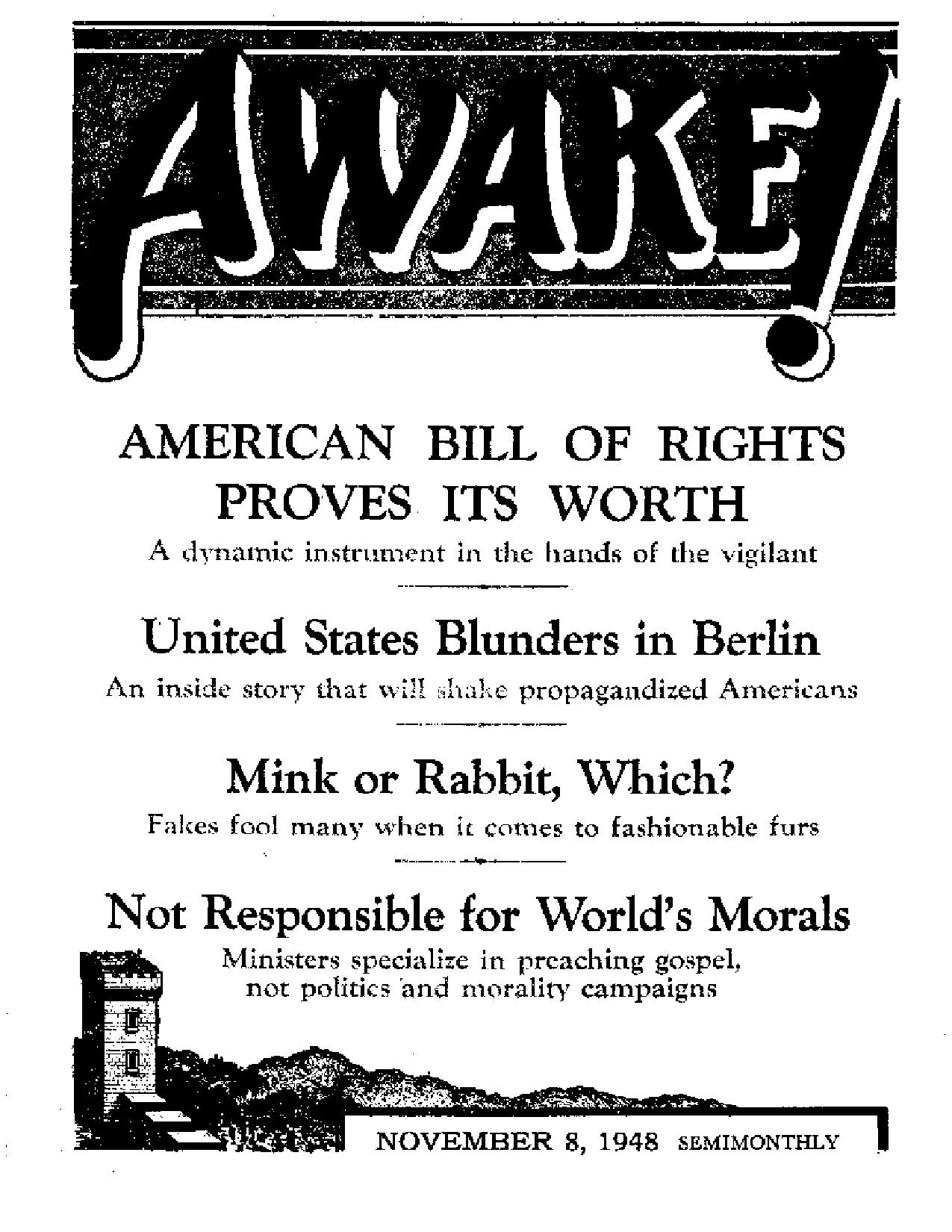
AMERICAN BILL OF RIGHTS PROVES ITS WORTH
A dynamic instrument in the hands of the vigilant
United States Blunders in Berlin
An inside story that will shake propagandized Americans
Mink or Rabbit, Which?
Fakes fool many when it comes to fashionable furs
Not Responsible for World’s Morals
Ministers specialize in preaching gospel, not politics and morality’ campaigns
THE MISSION OF THIS JOURNAL
News sources that are able to keep you awake to the vital issuer of our times must be unfettered by censorship and selfish interests* “Awake!” has no fetters. It recognizes faot% frees facts, is free to publish facts. It is not bound by political ambitions or obligations; it is unhampered by advertisers whose toes must not be trodden on; it is unprejudiced by traditional creeds* This journal keeps itself free that it may speak freely to you* But it does not abuse its freedom* It maintains integrity to truth*
"Awake 1” uses the regular tews channels, but is not dependent on tlwm. Its own. correspondents are on all continents, in scores of nations. From the four corners cf the earth their- unccnacred, on-the -scenes reports come to you through these columns. This Journal’s viewpoint is not narrow, but is international, It is read in many nations, in many Languages, by persona of all ages* Through its pages many fields of knowledge pass in review—government, commerce, religion, history, geography, science, social conditions, natural wcu.derS'—why, its cover* age is as broad as the earth and as high as the heavens*
"Awake!” pledges itself to righteous principles, to exposing hidden foes and subtle dangers, to championing freedom for all, to comforting mourners and strengthening those disheartened by the failures of a delinquent world, reflecting sure hope for the establishment of a right* eoq,s New World*
Get acquainted with “Awake!” Keep awake by reading "Awake!”
TmiLTSnED SEMIMONTHLY BY WATCHTOWER BIB LB* AND TRACT SOCIETY, INC,
117 Ailama Street Brooklyn 1, N. Y*. U. 8, A.
N. H. Enorb, Fresitienl (t&axt flvriBs, Secretary
Five cents a oopy One dollar a year
tumlttcmtW ohfldlt! DO «rt to cfflrR in ynur i-tillA-try in <!(fraplij,QCi? with FfgnlatUun Mi H'-ianuiLtie tufc dcliTwy or rntJUEj-. Jem1. llutitiBH lire icCtjikd at B?uo]:tyn trom eounirfpj »hpre eii utllce la located, by iolemltoul mopey nriipj- i:ulj'. Subgfriptltm rtiteg ia different, conntrlH? urn burs Stated in )□£&! curraOCf.
Not It a of MqjFrxtlM (with reiutwtd Hank) JU Rent at leut iso lulu* Lek'm sulactlntion *xt>irEB.
Chant* tf iddrMi when flent to ow gftcc itiny bo expected tffwiiT# vilbid pop mniiLh. fund yallf did U well *J new address,
Offices Nearly Subscription Rate
America, C.S., 117 Adama Bt, Broc-lilru 1, N , I. ?1 AirtraJte, 7 Bsnafo.-d IM., glrtilbflc-ld, N.8.W. Jf Canada. 40 Irwin Am., Toronto 6, Oalarlu . jn Ellliird, 84 Drivcc Tetracc. Uuta, ft. j! 5a South Africa, 622 Baeitau houm, capo Xutrn sb
iCTitMwi a? aMonl-rlam mailer at Brooklyn, N, Y,b Act of March 2, 1870. Printed in ll. a A,
contents
American Bill of Rights Proves Its Worth 3
“Clear and Pit sent. IJ anger”
Freedom io Disseminate Opinion
Freedom of Worship and Conscience
Eternal Vigilance Still Priw u£ Liberty 8
United States Blunders in Berlin
disagreements with Russians
Troubles of Air Supply
Misleading Methods to Analyse
Personality Complex
Phrenology FuoliAhness
The Situation Test
“Nuisances First-CIass,, Blame Teen-Agers Id
Mink or IiabbitT Which?
From Raw Pelts to Finished Furs 18
Facts Yon Should Know About Furs 19
Forest Fires on the Increase
A {Question of Color
Background of the Problem
The Division Today
“Apartheid” and the Empire
“Thy Word Is Truth”
Not Responsible for World's Morals
Watching the World
Awake/
^"Now it is high time to awake.— Romans 13:119)
Volume XXIX Broqklyp, N.Y,, November 8, 1948 Number 21
American Bill of Rights Proves Its Worth
“A people indifferent to their civil liberties do not deserve to keep them and In this revolutionary age may not be expected to keep them long/*—Justice Douglas.
TIIE first ten amendments to the American Constitution are known as the Bill of Rights. They have been the center of much controversy, both in and out .of court, and through it all they have proved their worth as a guarantee, of certain individual liberties. This article endeavors to show this proof of worthiness, particularly in the case of the First Amendment to the Constitution, appearing in the Bill of Rights, It guarantees such broad and vital freedoms as speech and press and worship.
The American Constitution establishes legislative, executive and judicial branches of government, and outlines the powers of each, A balance of power is set up, a sphere of activity for each is marked- out, and the court is thft arbiter of the boundary lines between the three branches. In addition, a certain' area of activity is reserved to the individual citizen, and, again, it is the courts that determine the line between the rights of the individual and the authority of the legislature.
Herein the American system differs from the English principle of a sovereign legislature unrestrained by any human power. The traditional British view is that the legislature should be free and unfettered to act. But how can persons injured by ill-considered legislation gain legal relief? The British system declares NOVEMBER 8, 1948
that the appeal must be to those wh ' elected the legislators, that is, the people. Such a remedy would be through a long and drawn-out political process of electioneering, and even then success would be problematical. What chance would a suffering minority have at the polls, where, the majority rules?
How different it is where a written Bill of Rights guarantees individual liberties! In the United States the federal and state legislatures may enact laws, but if those laws trespass on civil liberties of the individual citizen he can appeal to the courts and cause such unconstitutional laws to be declared invalid. This extraordinary power of the American ‘judiciary has made the federal Constitution, and especially the Bill of Rights, a dynamic instrument in the hands of the people. By invoking through the courts _the guarantees of the Constitution an American citizen is in the unusual position of being able to fight for his personal liberties against the legislative and executive branches of government themselves.
Opponents of a written Bill of Rights contend that it leaves the American government in a legal strait jacket., Can it truthfully be said that the social and economic and political growth and prog-, ress of the United States has been retarded by the Bill of Rights ? Has the right of the people to enter courts and fight for their freedoms, even against the government, impaired'the efficiency of the state? To the contrary! The United States, though far from perfect, provides a measure of personal liberty unsurpassed by any other nation. Remarkable strides made by the nation industrially and scientifically bespeak a healthy national life. Dictatorial rulers may deride as impotent a government that cannot (as they often do) deprive the people of their liberties. Totalitarians consider freedoms to be impractical luxuries, but the philosophy of fairness and equality before the law that is inherent in the Constitution of the United States has contributed to the nation’s growth to high stature among the world powers. The government is confined in no harmful legal strait jacket by the Bill of Rights, and that written bill prevents the government from slapping any strait jackets on its citizens.
Constitutional Guarantees in Theory
Since this article is specializing on the broad, basic freedoms of speech and press and worship and assembly, it quotes only those portions of the Constitution guaranteeing them. Outstanding is the First Amendment, which is Article I of the Bill of Eights, and reads:
Congress shall make no law respecting an establishment of religion, or prohibiting the free exercise thereof; or abridging th# freedom of speech, or of the press; or the right of the people peaceably to assemble, and to petition the Government for a* redress of grievances.
This amendment limited the powers of Congress only. But a further amendment, adopted following the Civil War, made applicable to the states the same limitations placed upon the federal government, particularly those relating to civil ’liberties. This additional amendment was the Fourteenth, and says:
No State shall make or enforce any law which shall abridge the privileges or immunities of citizens of the United States; nor shall any State deprive any person of life, liberty, or property, without due process of law; nor deny to any person within its jurisdiction the equal protection of the laws.
It was the purpose of the Constitution to provide a restraint against extreme measures at any time. Even during the troubled times of the Civil War the Supreme Court held to this principle. Mr. Justice Davis, speaking for the court, refused to countenance the specious argument that constitutional guarantees could be shelved in time of emergency. He said:
The Constitution of the United States is a law for rulers and people, equally in war and in peace, and covers with the shield of its protection all classes of men, at all times, and under all circumstances. No doctrine, involving more pernicious consequences, was ever invented by the wit of man than that any of its provisions can be suspended during any of the great exigencies of government.
Thomas Jefferson held that it was time enough for government to interfere when principles broke out into overt acts against peace and order, and that truth left to itself will prevail, that it is a sufficient antagonist of error. Mr. Justice Brandeis expressed belief in the practical value of free speech, declaring its exercise was more important to the nation than to the individual and that “in frank expression of conflicting opinion lies the greatest promise pf wisdom in governmental action; and in suppression lies ordinarily the greatest peril”. Such liberal thinkers envisioned liberty of expression in the fullest possible extent. If the ideas expressed are wrong, their impact on the public mind may be corrected by reply from those of contrary views. Discussion and controversy stir up thought and bring more minds, more ideas, more viewpoints to bear on the issue. None may be entirely correct, but by the balancing influence of all shades of opinion, wisdom is most apt to be reached. It is from suppression, not expression, that violence flows.
"Clear and Present Danger*
Following World War I thdre was a period when members of the Supreme Court entertained divergent opinions as to what speech was permissible and what was not. One school of thought followed the common-law rule that words were punishable if they were considered to have a “reasonable tendency”, no matter how remote, to cause evils forbidden by law. What was forbidden was couched in such vague and indefinite language that the law was in reality a dragnet which could enmesh any ideas that were at the moment in popular disfavor. The opposing line of thought as to what speech was permissible was first adopted by Justices Holmes and Brandeis. Mr. Justice Holmes, speaking for the court, laid down the test in a decision rendered in 1919, saying: H
The question in every case is whether the words used are used in such circumstances and are of such a nature as to create a clear and present danger that they will bring about the substantive evils that Congress has a right to prevent.
On this view of the law, speech is permissible unless there is a clear (that is, apparent, obvious, real) danger that the speech or writing will cause unlawful action and that the action will be taken immediately or in a short time. This test is more definite and enables the jury or court to reach a conclusion on the evidence and not on pure speculation. If laws are passed that prohibit the spread of certain ideas, the Supreme Court can examine the statute in the light of the “clear and present danger” test If there is no immediate or real danger that the words will interfere with the operation of some valid law, then the attempted legislative restriction on speech is void. Or, if the law itself is constitutional,, the court can still consider the behavior or speech specifically questioned under it. If the words are unlikely to cause any early outbreak of lawlessness, the conviction will be set aside even though the law itself is valid. Thus the court looks not only at the law, but at what is called in question by the law, so that individual liberties cannot be denied on the pretext that there is nothing wrong with the statute per se. This sound approach was further expounded in 1927, in Whitney v. California, Mr. Justice Brandeis said, in part:
The fact that speech is likely to result in some violence or in destruction of property is not enough to justify its suppression. There must be the probability of serious injury to the State. Among free men, the deterrents ordinarily to be applied to prevent crime are education and punishment for violations of the law, not abridgment of the rights of free speech and assembly.
In 1931 the Supreme Court invalidated a state statute that allowed courts to issue injunction to restrain as a public nuisance “malicious, scandalous, and defamatory^ newspapers, magazines and other periodicals. The majority opinion, written by Chief Justice Hughes, struck down this form of press censorship and pointed out the right course for victims of libelous journalism:
Public officers, whose character and conduct remain open to debate and free discussion in the press, find their remedies for false accusations in actions under libel laws providing for redress and punishment, and not in proceedings to restrain the publication of newspapers and periodicals.
Freedom to Disseminate Opinion
The foregoing has considered chiefly what may be said. But for free speech and press to be of practical effect the words, whether spoken dr written, must reach an audience. Hence any law that discriminates against or interferes with dissemination of information is invalid. Freedom of press carries with it the right to distribute what has been printed. This position has been bulwarked by many Supreme Court decisions, the ma^ jority of them having been fought by Jehovah's witnesses. Since 1938 they have had before that court over rorty cases (37 won, 7 lost, including draft cases) involving free speech and press and worship. The first was 'Lovell v. City of Griffin, The city forbade the distribution of literature without a permit from the city manager. The court ruled that such an ordinance would restore “censorship in its baldest form”, and added: "Liberty of circulating is as essential to that freedom as liberty of publishing; indeed, without the circulation, the publication would be of little value.”
Nor can dissemination of opinion be choked off on the grounds that the message may be objectionable and cause a breach of peace. In Cantwell v. Connecticut Mr. Justice Roberts said for the court:
In the realm of religious faith, and in that of political belief, sharp differences arise. In both fields the tenets of one man may seem the rankest error to his neighbor. To persuade others to his own point of view, the pleader, as we know, at times, resorts to exaggeration, to vilification of men who have been, or are, prominent in church or state, and even to false statement. But the people of this nation have ordained in the light of history, that, in spite of the probability of excesses and abuses, these liberties are, in the long view, essential to enlightened opinion and right conduct on the part of the citizens of a democracy.
It was stated by Chief Justice Marshall early in American history that “the power to tax is the power to destroy”. Yet towns in Alabama, Arizona and Arkansas had laws requiring payment of a license tax by vendors. That in itself was all right, but when the law was applied to the distribution of literature containing opinion it infringed on freedom of speech and press. Because contributions were accepted for Bible literature, the towns classed the activity commercial. In 1942 the Supreme Court upheld the towns, but in 1943, on rehearing, the court reversed itself and declared the' convictions invalid. As applied to the work of Jehovah’s witnesses, the ordinances ininngea on oasic rreeaoms. The court’s position v^as clearly stated in the Murdock v. Pennsylvania case, involving the work of Jehovah’s witnesses. The court’s opinion, delivered by Justice Douglas, stated:
The hand distribution of religious tracts is an age-old form of missionary evangelism—as old as-the history of printing presses. It has been a potent force in various religious movements down through the years. This form of evangelism is utilized today on a large scale by various religious sects whose colporteurs carry the gospel to thousands upon thousands of homes and seek through personal visitations to win adherents to their faith. It is more than preaching; it is more than distribution of religious literature. It is a combination of both. Its purpose is as evangelical as the revival meeting. This form of religious activity occupies the same high estate under the First Amendment as do worship in the churches and preaching from the pulpits. It has the same claim to protection as the more orthodox and conventional exercises of religion. It also has the same claim as the others to the guarantees of freedom of speech and freedom of the press. . . .
The mere fact that the religious literature is "sold” by itinerant preachers rather than "donated” does not transform evangelism into a commercial, efiterprise. If it did, then the passing of a collection plate in church would make the church service a commercial project. . . . Freedom of speech, freedom of the press, freedom of religion are available to all, not merely to those who can pay their own way.
Freedom to spread opinion overcomes such barriers as company-owned towns, through the provisions of the written Bill of Rights. For instance, a company-owned town in Alabama decided to prohibit Jehovah’s witnesses liberty to circulate their message there. The same controversy arose in the case of a housing project in Texas that was owned by the federal government. Such was tantamount to saying these towns were no part of the democratic nation, but separate communities where constitutional guarantees of freedom were inoperative. But in Marsh v. Alabama (1946) the Supreme Court, speaking through Justice Black, disagreed with this restrictive view and ruled concerning the inhabitants of such towns that “their information must be uncensored”, that “there is no more reason for depriving these people of the liberties guaranteed by the First and Fourteenth Amendments than there is for curtailing these freedoms with respect to any other citizen”. Thus the Bill of Rights, interpreted and enforced through the courts, proves its dynamic vitality by penetrating every corner of the nation.
Most recent in the array of cases involving Jehovah’s witnesses to reach the Supreme Court was one raising the right to be heard by use of sound equipment. On June 7, 1948, in a 5-4 decision, the high court ruled in favor of the Witnesses and upheld their right to preach in public parks and use amplifiers in order to be heard. It said:
Noise can be regulated by regulating decibels. The hours and place of public discussion can be controlled. But to allow the. police to bar the use of loudspeakers because their use can be abused is like barring radio receivers because they too make a noise. . . . When a city allows an official to ban them in his uncontrolled discretion, it sanctions a device for suppression of free communication of ideas. . . . The power of censorship inherent i> this type of ordinance reveals its vice. [Saia v. New York]
Freedom of Worship and Conscience
The most vital, the most cherished freedom is the liberty to worship according to the dictates of one’s own conscience, and not according to the conscience or dictates of someone else. Ofttimes freedom to worship has revolved around freedom to refrain from performing certain acts, rather than liberty to do specific things. So it has often been relative to ceremonies. Outstanding in the United States in recent years have been Supreme Court decisions concerning attempts to force school children to salute the flag. The flag is a symbol or imdge, containing stars on a field of blue and stripes of red and white. Oftentimes the image of an eagle perches atop the staff. Stars, colors, eagle, all are symbolical. But inasmuch as Exodus 20:3-5 forbids reverential attitudes toward images, Jehovah’s witnesses do not salute the flag of any nation.
And to those who brush aside such objection on the ground that the flag-salute ceremony involves no worshipful attitudes we offer, the reminder that the Encyclopedia Americana, page 316, speaks of it as reverence and says: “The flag, like the cross, is sacred.” Jehovah’s witnesses reserve their reverence for God and refuse to attribute salvation to the flag by saluting it. Others may do so with clear conscience, but this Christian group, feels differently. This ddes not make them disloyal, since there is no valid law requiring it, and since they are law-abiding and respect the principles for which the flag stands. Moreover, the Bill of Rights guarantees freedom of worship according to one’s conscience.
Hence when school boards throughout the country required students to salute the flag and youthful Jehovah’s witnesses refused and were expelled, the issue came before the Supreme Court. In 1940, by a majority of 8 to 1, the court upheld forced salutes. This decision precipitated wholesale expulsion of children from school and gave excuse for mob action throughout the nation. But on June 14, 1943, Flag Day, the Supreme Court reversed itself by a 6-to-3 vote. Oh this matter Justice Jackson, speaking for the court, said in the Barnette v. Ivesf Virginia Board of Education case-:
The refusal of these persons to participate in the ceremony does not interfere with or deny rights of others to do so. Nor is there any question in this case that their behavior is peaceable and orderly. ... To sustain the compulsory flag salute we are required to say that a Bill of Bights which guards the individual's right to speak his own mind, left it open to public authorities to compel him to utter what is not in his mind. , . .
Struggles to coerce uniformity of sentiment in support of some end thought essential to their .time and country have been waged by many good as well as by evil men. . . , Ultimate futility of such attempts to compel coherence is the lesson of every such effort from the Roman drive to stamp out Christianity as a disturber of its pagan unity} the Inquisition, as a means to religious and dynastic unity, the Siberian exiles as a means to Russian unity, down to the fast failing efforts of our present totalitarian enemies. Those who begin coercive elimination of dissent soon find themselves exterminating dissenters. Compulsory unification of opinion achieves only the unanimity of tiie graveyard- . . -
If there is any fixed star in our constitutional constellation, it is that no official, high or petty, can prescribe what shall he orthodox in politics, nationalism, religion, or other matters of opinion or force citizens to confess by word or act their faith therein. If there are any circumstances which permit an exception, they do not now occur to us.
We think the action of the local authorities in compelling the flag salute and pledge transcends constitutional limitations on their power and invades the sphere of intellect and spirit which it is the purpose of the First Amendment to our Constitution to reserve from all official control.
Also noteworthy in the field of freedom of worship were decisions rendered by the Supreme Court in three sedition cases brought against Jehovah’s witnesses. The three cases are cited as Taylor v* Mississippi, and decisions came on the same day as the favorable flag-salute decision. The basis of the conviction of the Witnesses in the lower courts was that the message they distributed about God's kingdom as being the only hope of the world would likely result in dissaffec-tion against the war effort and the peace and dignity of the state. But the Supreme Court disagreed, holding that an-nouneing (rod's kingdom as the hope of the world was not sedition, and the prison sentences of ten years imposed against the defendants were set aside and the prosecutions ordered dismissed.
Eternal Vigilance Still Price of Liberty
Mr. Justice Murphy, consistently the outstanding champion of civil liberties on the high federal bench, warned the American people in his powerful dissent in Prince v. Massachusetts:
No chapter in human history has been so largely written in terms of persecution and intolerance as the one dealing with religious freedom. From ancient times to the present day, the ingenuity of man has known no limits in its ability to forge weapons of oppression for use against those who dare to express or practice unorthodox religious beliefs. And the Jehovah’s witnesses are living proof of the fact that even in this nation, conceived as it was in the ideals of freedom, the right to practice religion in unconventional ways is still far from secure. Theirs is a militant and unpopular faith, pursued with a fanatical zeal. They have suffered brutal beatings; their property has been destroyed; they have been harassed at every turn by the resurrection and enforcement of little used ordinances and statutes. See Mulder and Comisky, *Jehovah’s witnesses Mold Constitutional Law/ 2 Bill of Rights Review, No, 4, p. 262. To them, along with other present -day religious minoiities, befalls the burden of testing our devotion to the ideals and constitutional guarantees of religious freedom.
At Chicago,'Illinois, Mr. Justice Douglas delivered an address on the occasion of the 100th anniversary of the birth of John Peter Altgeld, once governor of Illinois. Those who fee] that civil liberties are secure without legal protection and that public conscience can be trusted to see that there is always fair play should consider the following quotation from Justice Douglas' speech:
He who calls for the application of the Bill of Rights to unpopular minorities,-as well as (Continued on page 27)
UNITED STATES BLUNDERS IN BERLIN
An Inside Story
RAUCOUS blasts of propaganda have clubbed Americans to sleep on the facts of the explosive Berlin Crisis. Now a sober word picture has been painted that should have a wakening effect. Its calm presentation of facts argues for its truthfulness, just as the frantic emotionalism and sweeping condemnations of the general news dispatches make them suspect of unscrupulous and reckless distortion. The uncolored picture in black and white was sketched by Thomas F. Hawkins, regional editor in Germany for U.S, News World Report, when he recently returned to the United States for a vacation. By permission we reprint the bulk of his report, as it appeared in U.S. News <£ World Report, September 10, an independent weekly magazine on national and international affairs, published in Washington, copyright 1948 United States News Publishing Corporation. The report follows:
“Perhaps we shall know how to occupy Germany after another war. We certainly have made a mess of it this time ”
That remark was made by a friend in U, S* Military Government, economic side, with whom I spent a half hour shortly before leaving Frankfurt.
I fully .agree with him. I went to Germany in April, 1946—after watching the country during the war from the side lines in Switzerland—with considerable optimism. I expected to see the reconstruction of a defeated nation, and, in the process, development of mutual understanding and co-operation with Russia.
But we have not yet got Germany on a sound road to reconstruction. We have not yet conclusively^ won Germans to our side. Our relations with Russia are worse than ever. We must accept a good share of the blame, for failure to follow through with a firm, clear and practicable policy. Talks in Moscow may gain us time to develop such a policy, but I fear not more than a year.
We came into Berlin with Russian permission, having failed to use the opportunity to capture it first. As in the similar easest of Prague and Vienna, this east us considerable standing.
Worse, we came with an attitude of self-importance, and, with the debatable exception of Gen, Lucius D. Clay, with inadequate negotiators.
Why "We Feed Berliners
The story is told that, upon arrival, we staked out signs marking the U. S. sector in Berlin. The Russians took them down and said: "Yes, they can go back up when it's decided who's going to feed Germans in the sector.”
We thus were maneuvered into a responsibility not foreseen. It is this obligation that required the “air lift” and that has been the barrier to graceful renunciation of responsibility for the city.
There also is the story of a dispute with a Russian detachment billeted in our sector shortly after we entered Berlin. The Russians wouldn't leave. An impetuous American colonel had a tank rolled up to the building to chase them out. He had to be called off by a superior officer, and Russian withdrawal then was arranged by negotiation.
I can't vouch for these two yarns, since I wasn't present. But' I'm quite convinced they are true. The latter story, at least, is illustrative of methods we have used. They can, at best, be called straightforward but not diplomatic,
Maj, Gen. Ray W_ Barker was one Berlin Governor who appeared to be getting somewhere with the Russians—until a spinal injury from a jeep accident forced him home at the end of April, 1946. He felt there wag a great danger from Russian Communism that must be fought. But he—almost alone among the military—also was convinced that firm, frank dealing could bring a working arrangement satisfactory to both East and West. He had, I think, the respect of the Russians.
General Barker did not rush into fiery public statements when a dispute with the Russians arose. Instead, he solved many serious problems .by getting in his car and going directly to the Russians. He was not misled by arrests or fights .involving Russian and American soldiers; he knew fault could be on both sidesi Far too many cases of Americans arrested have been blown up as important incidents when they involved merely a drunken soldier, a soldier going to see a girl in the Russian sector, or an American on a black-market foray. Americans often have gone to the Russian sector, too, because they found it easier to buy liquor in German cafes, away from American MP’s,
Beating of a uniformed Polish correspondent and a woman companion by GPs in the American sector is among events I know of that have not boon generally publicized. And nobody writes about American drunks who knock on the door at 2 a.m. to ask if a German girl lives there. This isn’t very frequent, but it has occurred at my Berlin home*
The point is that an incident was news only if the Russians were involved, and the presumption almost always was—often erroneously—that the Russians were to blame. And, too often, these incidents should have been merely matters of record on the police blotter.
One of the bigger blunders occurred over seating of a city-government official. The Russians wanted to seat a certain fellow and we didn't. The American representative, little versed in politics, erroneously cast his vote with the Russians. State Department assistants had told him what to do before the meeting; he simply got his directions mixed.
Disagreements With Russians
We knew pretty well last January that the Russians might walk out of the Berlin Control Council, after breakdown of the four-power conference in London. Currency reform and the unity of Germany were the real issues. We had failed at London to present a concrete program for the unification of Germany, and I have the feeling we went to that meeting convinced that it wouldn't work. We didn't want unity then, and seemed determined to push ahead with a West Germany. We thus were vulnerable. Somehow we had gained the idea that we could tell off the Russians. They surely were aware of this, and I think we greatly underestimated thenx
We could have presented at London a carefully drawn plan for unification of Germany, taking the chance we ultimately must take anyway, that Germany may si verve to the Communist side. We could have been ready to argue that plan, to compromise.
We could have accepted a single currency reform, taking the gamble that the Russians might print too much money for stability. It is still debatable whether we can make the Western currency reform work in the long run, anyway. Going along with a unified reform, despite risks, would have eased the crisis, given a bit of time. These things we did not do.
Then, when the Russians proposed at the Berlin Control Council that general questions of the London conference be discussed, General Clay and his Western colleagues said those questions were outside their province. The Russian chairman thereupon promptly adjourned the council.
General Clay, with the British and French, might have offset this by saying that, while the matters were not within their jurisdiction, they would be happy to discuss, and pass on results to the proper authority. There then would have been no excuse for the Russians to walk out of that meeting, at least.
As chairman of the Control Council for the subsequent month, General Clay issued no meeting call. Had he done so and the Russians then refused to attend, ire would hare had a far clearer case for proving that it was the Russians, and not ourselves, who broke down four-power rule.
Stoppage of trains into Berlin also leaves
us in a somewhat doubtful position. The Russians were irritated, first, when commercial air lines began to carry German passengers over whom the Russians had no control. We did insist, however, that these Germans have interzonal passes, required under a four-power agreement. The Russians had honored these passes by train and car. In violation of the agreement, however, at lepst the British were using their train to send Germans to the Western zone$ without the interzonal pass. I don’t think it ever was published, but the British have acknowledged it. Some of the cases involved merely the convenient sending of a secretary to the zone for a holiday—with British military orders, but no interzonal pass.
Troubles Of Air Supply
The pass requirement may sound unreasonable and silly, since a German should be able to travel at will within Germany. But the failure to issue passes did violate four-power understanding, and gave the Russians an excuse, first to stop and search trains, then to halt them altogether. We could have—and probably without loss of prestige—quiekly agreed to the Russian offer to reinstate the trains if a Russian inspection were permitted. That inspection was permitted from the very beginning for auto transport. We could have used the train request to suggest a four-power MP setup—with a Russian, an Ameri-can, a British and a French MP as a team. This would be similar to the four-power xnili-tary-guard system, still in force at the Control Council headquarters in Berlin. If further trouble then arose, we again would have had a better case.
Instead, General Clay said he would fly in everything that was required and wodld use fighter cover if necessary. It was fdrtunate that fighter cover was not then necessary. We had only about 200 fighters available quickly, each roughly equivalent to the Russian Yak in ability. But, in the corridor alone, I would judge the Russians keep at least 400 Yaks.
Army Secretary Kenneth C. Royall’s statement from Washington was no help, either. His suggestion that General Clay had the authority to shoot if he thought it necessary was dangerous bravado. We were afraid jn Berlin, at one time, that the verbal blasts in Washington would be followed by a real blast that could set off a war.
All during this period our lack of statesmanship in Berlin became sharply apparent. At one four-power meeting, the Russian representative delivered a two-hour tirade, charging us with violating four-power agreements and not meeting food requirements. The British replied formally. The U. S. representative felt it necessary to tell the Russian officer he “had never heard such a pack of lies since the days of Ananias.” This may well have been true, but the statement was given gleefully to the press, made the front pages, irritated the Russians, and did no one any good.
There was also the case of the Russian who accused Americans of “biting” an elderly German woman. The U, S. reply was that American soldiers didn’t bite but Russians frequently did when fighting. That, too, hit front pages. Truth was that the U. S, translator erred. The Russians, discussing assault, hadn’t said “bite71 at all.
We have been operating an expensive air lift to supply Berlin.
Argument is that it gave us time to wait, ( to negotiate in Moscow. One can argue also that the Russians are letting the air lift run itself out. They could stop it in a minute, at the risk of war. But they probably are convinced they need only wait—that supplying sufficient food and coal to West Berliners by air throughout the winter will be a hazardous and, in the long run, a probably unsuccessful venture.
^Penny-Wise’ Education
We have failed in Germany to establish anything approaching democracy. There are constitutions along democratic lines, but no feeling for democracy. It was not to have been expected from a still-nationalistic people. Our educational budget for the U. S, zone is something less than 1 per cent of the total outlay. We have refused to put up the money for good textbooks because the Germans “have no money to pay.” Instead we have been using, in the basically vital task of rehabilitation, books that in many eases are of Nazi origin— with paper pasted over unacceptable passages. Only the French have gone at this sensibly, with good, new books and a carefully planned educational program.
We virtually are forcing the .Germans into a Western government. The Germans themselves don’t want it, partly out of fear of Russia, partly because Germans think they can wangle a unified nation more easily if there is no Western government now, and partly because they don’t like us much more .than they like the Russians. As General Clay has said, they perhaps “hate us least’* of the occupants. Even so, there is a strong feeling among Germans that a German deal with Russia must, can. and will be made. . . .
The sort of thing that hampers our effort to instill democracy by military occupation was sharply demonstrated in Munich in April, 1946, during an interview by visiting U. S. editors with German members of the Bavarian government. Seated at a long conference table, the American guests had cake and coffee, after which the Germans were shown in. We talked until noon. Then the Germans marched out, to lunch in an Army mess hall. The Americans went on to a swank club for cocktails and an excellent lunch.
Yet those Germans were our collaborators in seeking a democracy. Several had been in concentration champs under Hitler. At least one had dangerously co-operated with American intelligence during the war.
The Russians never made such an error. Those they paraded for company they also entertained with the company.
Except for the top men, our denazification program simmers down to statistics on people who filed questionnaires, were punished, released or cleared. We accomplished only chaos, and a hard Nazi core still exists. . . .
One long-standing trouble in our dealings with the Russians in Germany is a mental attitude that we are going to have to fight them. That feeling shows up in the military, at alb levels. It may be a true forecast, but the attitude of preparing to fight is a big handicap in working out the problems of peace. . . ■
The military setup in Germany has cost us a lot of seasoned State Department help. Ambassador Robert D. Murphy, as General Clay’s assistant, has kept affably in the background of the Army operation. But his staff has been bitter at being forced to sit on the side lines, unable to step in on many occasions when it thought it should.
General Clay gets credit for stopping the switch from Army to State Department administration, although the tension with Russia made it easy to argue necessity for keeping the military control. Military brass also is considered responsible for sidetracking the constabulary—originally set up as a policing force, a small emergency band to permit withdrawal of the Army. It would have been the protective unit in the interim between full occupation and no occupation. But its job now is mostly that of supplying traffic cops, its future uncertain.
Motives of Germans
All in all, we have flopped in most postwar diplomatic tussles with Russia over Germany We have failed to win Germany, can’t count upon Germans as potential democrats or Western allies. They will serve with what they consider their best interests.
Germans support us now because: (1) they think we will win; (2) they adhere to the anti-Russian Goebbels theme; (3) they personally are getting more benefits from us, and (4) a few are sincerely supporters of the Western democratic world. Most want to stay on the side lines, work with whoevef is at hand for profit.
We have never given proper sympathy and understanding to the French,'a really democratic hation. We have alienated the British on occasion. We are looked upon skeptically by the Scandinavians, the Swiss and the people of the Low Countries—much as they like US.
Unless the Moscow conference is the beginning of a change, we are headed in the direction of war with Russia which could mean ten years of fighting, followed by a ruined European world and chaos at home. That is the feeling in Germany.
Misleading Methods to Analyze
PERSONALITY COMPLEX
DO YOU believe all blondes are “aggressive, emotional, impatient”,' and all brunettes “conservative, submissive, seri-jus”? Are you convinced that the beautiful girl is more than likely dumb? Have you learned to estimate a cruel character by thin lips, close-set eyes? Do you expect a display of intelligence jy the possessor of a high forehead? strength by the square-jawed? honesty from the person who “looks you straight in the eye”? Are you persuaded that a receding jaw denotes weakness, a big mouth generosity, a small mouth selfishness? Or do you think more scientific methods of judging a person include palm-reading (chirognomy or chiromancy), study of the conformation of the human skull (phrenology), analysis of the handwriting (graphology) ?
Foreknowing man’s shallow tendency to set up superficial standards Jehovah announced His rule in the selection of King David. He explained to Samuel why David’s elder brother was not to be anointed by the prophet: “Look not on his countenance, or the height of his stature; because I have rejected him: for Jehovah seeth not as man seeth; for man looketh on the outward appearance, but Jehovah looketh on the heart.” (1 Samuel
to
16:7, Am. Stan. Ver.) Not that good looks or beauty was a detriment.
“Behold the beauty of Jehovah !” Banish with these words the myth that beauty, brilliance and righteousness are never found in combination. (Psalm 27:4) Not that good looks or the lack thereof decides our destiny. It is simply a gift that the eye of man is attuned to enjoy, just as he delights in a burnished sunset, the billowing spray of a white waterfall splashing down a green valley, or the heavenly splendor of our earthly glimpse of the universe. Handsome men and beautiful women should be grateful for this special blessing’and not fall into the error of unbecoming conduct. “As a ring of gold in the snout of a swine, is a woman of beauty who hath abandoned discretion.” (Proverbs 11:22, Roth.; or “a pretty woman without sense”, Moffatt) It goes without saying that physical beauty has, anciently as well as recently, been used to ensnare, Lucifer being the first to turn his beauty into vice. Leafing through the pages of the Bible we find that Saul, Absalom and Solomon failed to live up to their noble appearance. All of these examples prove that the heart, not the face, even as Jehovah emphasized, is the determining factor.
Hence a little reflection on these truths brings into focus certain examples of
Modern Quackery
It may come as a surprise to those who have considerable respect for the practical good judgment of the American business-man that many have adopted palmistry, phrenology 'and graphology as first-line determinants of personnel qualifications. The palm readers and chirognomists claim that the lines of the hand, the distance a person can bend his fingers backward, and the size, proportions and relative length of the fingers denote definite characteristics. Concerning this practice the Encyclopedia Americana reveals:.“Chiromancy or palmistry deals with the ‘seven mounts’ of the hand,- their lines, and the interlacings of the latter. The names given to these mounts, Jupiter, Saturn, Apollo, Mercury, Venus, Mars and the. Moon at once connect the practice of chiromancy with the art of divination as carried on by means of a study of the stars [astrology].” (Vol. VI, p. 5G6) And astrology and star-gazing have ever been instrumentalities of demon-worship.—Isaiah 47:12,13; Daniel 2:2,27.
While the demons can be relied on to do mischief, they could never be relied on for useful accuracy. Rosenstein’s findings condensed in Science Digest dismiss as foolish the claims of hand-reading.
Among other claims of the chirognomists are that the difference in length between the little finger and second finger is related to ambition; that the longer the fingers in proportion to the length of the palm the more impulsive the person is; that long, tapering fingers are a sign of artistic ability; that a flat spatulate thumb indicates uncontrollable and even murderous tendencies. These have all been studied and found to have no validity. . . . There is no relationship between the distance a person can bend his fingers backward and “keenness of mind”. [Science Digest, February, 1945, “Fallacies in Judging Character”]
He further concludes that a study of handwriting proves nothing more than that different people write differently. In view of these sweeping conclusions the amount of serious space devoted by leading periodicals to graphology and palmistry is amazing. Periodicals well know how anxious their readers are to pigeonhole their leiiow men, so uare nor overlook any bets,' even spurious ones. Generally commenting upon some of these misconceptions Rosenstein adds:
A high brow does not always indicate intelligence. A fishy eye does not indicate dishonesty; nor do long, tapering fingers indicate artistic temperament. Red-headed people are not all hot-tempered, nor is a colorless personality indicated by pale skin, sandy hair, and a flabby handshake. Not all fat people are good-natured and easy going, and,thin people are not necessarily critical and analytical. . . . Graphology is another interesting fake with no validity beyond proving that different people write differently.
Phrenology Foolishness
Phrenology has long been given serious consideration by laymen and scientists alike. A short, sloping forehead indicated barbaric, primitive motivation. Bumps, protuberances, depressions of the cranium, each were assigned their specific characteristic, and the whole head was mapped into areas controlling the emotions of love, hate, parental affection, combativeness, destructiveness, self-esteem, hope, wonder, ideality, as well as faculties relating to size, time, tune, form and weight. (TFebster>) Many sensible people have thus suffered the misapprehension for a lifetime that their head conformation was responsible for what they are. If they were not loving, if they hated excessively, the lack of a certain bump or the enlargement thereof was to blame.
The relation of head proportions to what we are is zero. Authors Cleeton and Knight, writing on the. “Validity of Character Judgments”, conclude: “Statistically the correlation between variations in physical traits and character traits is 0.000 (within the reliability of our data).” Further as for a certain portion of the cranium as being the seat of a certain emotion or motive it has been shown that as far as is known the brain does not work that way, and just how this exquisite thinking mechanism does operate is practically unknown. Brain operations for cutting out hates, fears, worries, are recommended only for statesmen who are trying to stir up war.
Another pet theory that goes down the drain upon investigation is that the temperament and qualities of an individual depend upon his nationality or national origin. In his publication Human Nature and Management, Ordway Tead says on this point:
As to the different personal and working traits which different racial groups will bring to a job, there is little of a truly scientific nature that can be stated here. There is a great deal of popular attribution of thoroughness to Germans, stolidity to Poles, excitability to Italians, and similar generalities; but the interviewer [for selecting employees] who was governed by these notions would certainly go wrong. The fact is that we do not know in any accurate way how much the racial factors count in creating personal differences. [P. 201]
About all the value of photographs is for partial identification and estimating facial good looks. The researches of Psychologist McCabe that hundreds of informal experiments conducted in classes of elementary’ psychology, involving many thousands of college sudents, have shown that the students could not, just from examining photographs of heads and faces, recognize the criminal, the salesman, the clergyman, the executive, the brilliant, the feeble-minded, the mechanic, or the teacher,, and distinguish one from another. As a matter of fact, equally good judgment might have resulted from tossing a coin or making selections while blindfolded.
Sheldon, another authority, concludes, after extensive experiment, “No relation could be found between intelligence and head and face measurements.” If, however, you are still skeptical, go to the prisons and mental institutions. There you will find every type of face and head.
Perhaps it is dangerous, before concluding the argument, to venture upon the subject of vital male interest and controversy, namely, the merits and demerits of blondes, brunettes and redheads, female of the species. Please be' assured that from the following comments no dispute should be inferred concerning your personal taste or ’preferences. The only question considered is whether the color of the lady's hair in-_ variably indicates specific traits and qualities that may guide your selection. Unfortunately for man’s quest for information on the enigmatical sex, the color of her hair will offer no reliable clue. Despite the claims by Katherine Blackford, who achieved some fame by asserting that certain definite behavior could be ascribed to blonde or to brunette, the results of experiments prove that any combination of desirable or undesirable qualities can be found lurking behind any color of hair or style of hairdo for that matter. In other words, brother, the color of her hair tells you nothing.
The United States. Army, after searching diligently for a suitable means for testing the qualifications of men before duty assignments, at last fell back on the ancient Scriptural test of men,
The Situation Test
What befell Israel in their arduous travels through the wilds and the desert was purposed by Jehovah to “prove them” or “test them”. (Exodus 16:4; Deuteronomy, 8: 2,16) Besides subjecting the nation of Israel to trials of their devotion and faith, Jehovah tested out individuals for specific assignments or honors. Before Abraham became the “father of all them that believe” he was subjected to a situation test that would have staggered even worthy men of less faith. (Romans 4:11) Abraham was commanded to slay his only son. God put this great test upon Abraham, and after he steadfastly endured this crucial test, He gave him a bountiful promise. —Genesis 22:16,17, Am. Stan, Ver,
Polls, tests and questionnaires are currently popular. Even the “question test" which is now employed to rate or gauge the individual’s attitude toward marriage, politics, sportsmanship, etc., and to measure his qualifications, intelligence, and numerous other attributes, is not new. Nearly a thousand years before Christ a famous queen resorted to similar methods. The record states; “Now when the queen of Sheba heard of the fame of Solomon through* the name of the Lord, she came to test him with hard questions.”—1 Kings 10:1, An American Translation,
An article in Fortune magazine, March, 1946, describes the army combination question and situation tests for picking personnel. “Their scales: three and a half days of skilled observation of a human being as he worked, played, talked, and went through thirty-five lifelike situation tests.” In a footnote the article states: “There is nothing new about situation tests. See Genesis 22; 1-13; Judges 7:2-7; 1 Kings 3:16-28.”
The summary of these observations is that the Bible judgment of men based upon their conduct under test is really the only reliable one. It is impossible to judge accurately by exteriors. To avoid errors of prejudice it is best to stveep the mind of all bias to the effect that race, face, head, hand or hair indicate special qualities. Doing so, the witness of Jehovah/ particularly, will reserve judgment awaiting the attitude of the individual toward the Kingdom, which is the essential test upon all peoples today.
-I*-----
"^uisancesiFirst'CIass” Blame Teen-Agers
^Chicago hotel-keepers Wednesday found themselves with a multi-thousand-doKar f hangover as a result of the Illinois American Legion convention. They' reported
that the Legionnaires, who closed their four-day show Monday, broke furniture, ■fejSjjMestroyed Ure-fighting apparatus, harassed guests, smashed property, and lost some friends* Tve seen Legion conventions come and go for a quarter of a century/ one Loop hotel man reported* "But this was the biggest mess yet These fellows haven't slowed down a bit/ One hotel-keeper said he is sending a bill for $5,000 damages to the American Legion* Other hotel men said their damages weren't that big* But all agreed that the convention-going Legionnaires acted "like nuisances first-class', ‘If yon had a fi-year-old son who acted as these men did, you'd take him to the woodshed/ an innkeeper said*
aEight mirrors were smashed in one washroom. A fire ax was pitched out a 20th-floor window, A lighted paper bag was thrown over a transom into a sleeping girl's room* Sand-filled refuse jars were thrown into a building court where men were at work* Thirty-five extinguishers were taken from the wall and discharged* Ten still ha^e not been found,. Every exit sign on one floor of a big Loop hotel was smashed* Two girls were thrown from the mezzanine to overstuffed chairs on the main floor of a downtown hotel*"—Report in the Chicago Daily News, September 15, 1948.
Those of you who have witnessed the Legion conventions, wherein the childish oldsters leave a filthy blotch on the name American Legion, would never guess it, but do you realize these poor men suffer unjust blame f George Kelly, assistant department adjutant for Illinois, explains: “Mueh of the damage of thia sort is done by teen-age youths and hangers-on who follow every Legion convention* Yet we get blamed for it all," Such manliness! Such gallantry I Such asinmity! A stenographer in one of the office buildings put bluntly what all know: “It wasn't the young fellows who were doing it—it was the old goats* I know*"—Louisville CowwrVowrwul, September 17f 1948*.
Mink or Rabbit -Which?
Many are the fakes and frauds to foal you when H come* fa those fashionable furs
CC/~\H, LOOK, Jean, here is a seal-
V/ skin coat !” Betty's voice was frill of excitement* For days Jean had been helping her find a winter coat, and now, tucked away on the corner rack, was what she was looking for. Quickly the two read the label, just to make sure: “Bonded and Guaranteed, Genuine Hudson Bay Seal/' As Betty tried it on all her tiredness from shopping vanished and over her crept the warm flush of exhilaration and satisfaction* Stroking its smooth and glossy surface her hands fairly tingled wdth joy. Jean too commented on its sweeping lines and the sleek black ripples running down its back* “Outstanding, exquisite!” And how much? The original price had been slashed during this midsummer sale ; it was now only $300. That was still a lot of money for Betty, but, after all, here was a Seal, something she had for a long time dreamed of owning. “It will last a lifetime/’ Jean assured her. No, Betty could not resist a bargain like this, and so she took it.
Several years went by and fashions changed. Meantime, through a very dear friend, Betty became acquainted with a furrier who was more than willing to re-and without charge. Only then did she learn, and to her great sorrow, that her “Bonded and Guaranteed” coat was nothing more than a good imitation made of dyed rabbit skin! Yes, she should have known that there are no fur-bearing seals in Hudson Bay, and that “Hudson Bay Seal” is only a trade name in the fur industry. But it was too late* All Betty could do wTas console herself with the knowledge that she was not the only one that has been deceived by phony labels and fake “guarantees” on furs. Over and over again d thousand times this example of fraud has been duplicated by one of the most lucrative rackets found in the unscrupulous world of commerce.
Some may laugh at Betty’s calamity as her just desert. They may accuse her of violating the “everlasting covenant” concerning the sanctity of blood, of being indirectly responsible for the death of hundreds of animals, and of being a shallow-minded creature who bought the fur coat only to satisfy her vanity. Grave and serious charges, these, and, if true, thousands of other women are under the same condemnation. Who is responsible? Who started the fashion of fur coats for women? and who is to blame for the abominations found in the furrier business today?
Any inquiry into these questions of necessity takes one a long way back in history, for the use of furs and animal skins for clothing is almost as old as man himself. In fact, one reads in the third chapter of man's oldest history book, the Bible, that none other than Jehovah God “made for Adam and for his wife coats of skins, and clothed them”. The historian Paul, apostle of Christ, tells how the ancient witnesses of God “wandered about in sheepskins and goatskins”. God’s faithful prophet namfed Elijah, the Tishbite, was “girt with a girdle of leather about his loins”. Moreover, Ezekiel, another prophet of the Lord who lived in the seventh century before Christ, says that badger or sealskin was included in a wardrobe fit for a queen.—Genesis 3:21, Am. Stan. Ver,; Hebrews 11:37; 2 Kings 1:8; Ezekiel 16: 10, Am. Stan. Ver.
Secular history tells a dramatic story of travel and exploration in the quest for furs. One of the most famous and colorful explorers, Marco Polo, in the year 1298, spoke of costly fur skins like ermines and1 sables. The real pioneers of North America were not the tillers of the soil, the miners, the lumbermen or the scientists, but, rather, they were the fur trappers and traders. Pushing over the wilds of uncharted plains and crossing .unknown mountain ranges, always in advance of civilization, these hunters of fur laid out the sites for what are now many of America’s cities. The fur companies, the first being the Dutch West India Company, then the Hudson’s Bay Company, which monopolized the field for two hundred years, and still later the Northwest Company of French-Canadian merchants, each contributed to the history of this period, a history written in the mingled blood of both men and animals. At one time 40 dead men could be counted out of every 100 persons engaged in the fur-trading business. How many millions of animals were slaughtered for their fur in this ruthless and reckless period, when conservation of the young and protection of the food and shelter reserves were overlooked, will never be known.
…