Awake!, September 22, 1948
Download: PDF — Awake!, September 22, 1948
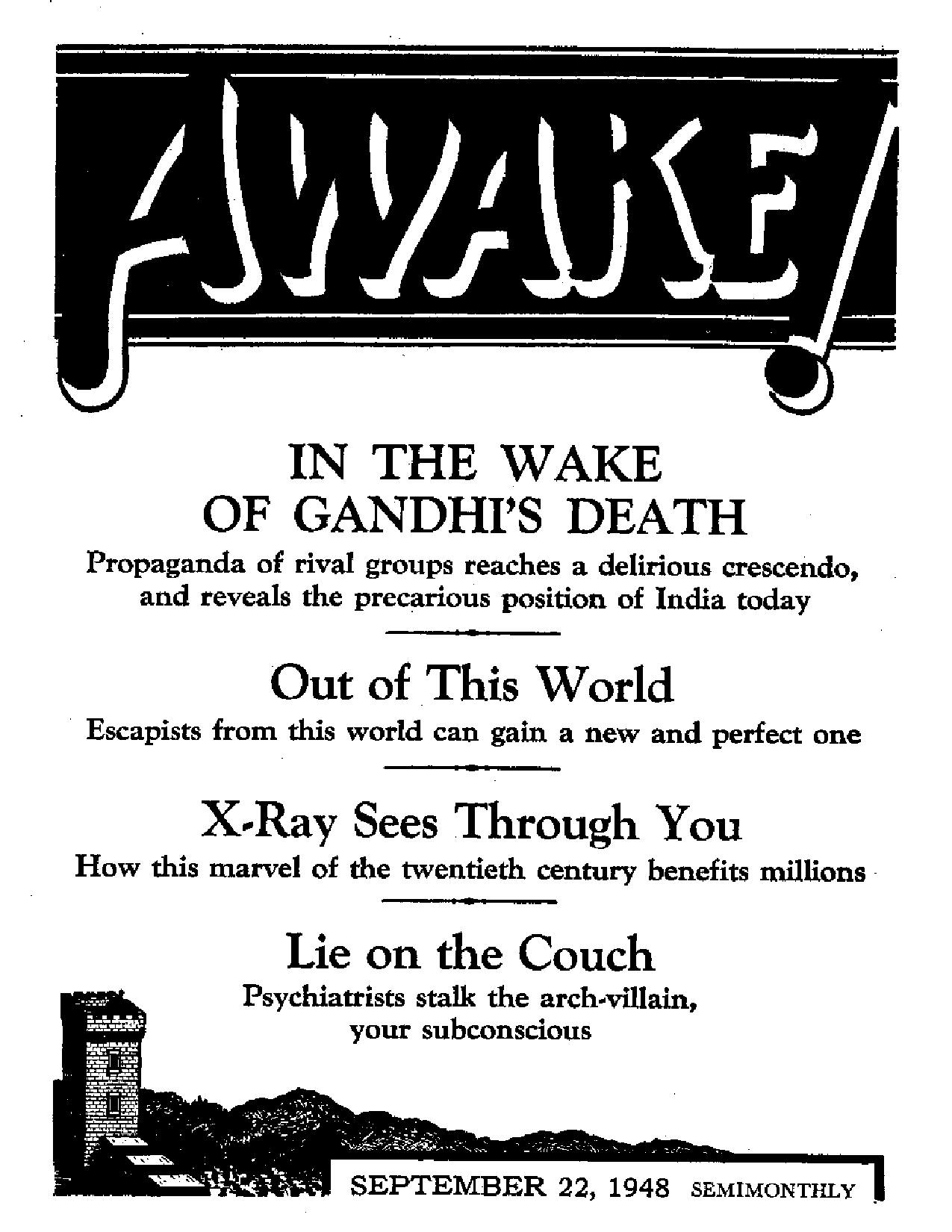
IN THE WAKE OF GANDHI’S DEATH
Propaganda of rival groups reaches a delirious crescendo, and reveals the precarious position of India today
Out of This World
Escapists from this world can gain a new and perfect one
X-Ray Sees Through You
How this marvel of the twentieth century benefits millions
Lie on the Couch
Psychiatrists stalk the arch-villain, your subconscious
SEPTEMBER 22, 1948 semimonthly
THE MISSION OF THIS JOURNAL
News sources that are able to keep you awake to the vital Issues of our tunes must be unfettered by censorship and selfish interests, ‘Awake 1” has no fetters. It recognizes facts, faces facts, is free to publish facts. It is not bound fry political ambitions or obligations; it is unhampered fry advertisers whose toes must not be trodden on; it is unprejudiced by traditional creeds. This journal keeps itself free that it may speak freely to you. But it does not abuse its freedom. It maintains integrity to truth.
“Awake!’* uses the regular news channels, but is not dependent on them. Its own correspondents are on all continents, in scores of nations. From the four corners of the earth their uncensored, on*the* scenes reports come to you through these columns. This journal’s viewpoint is not narrow, but is international. It is read in many nations, in many languages, by persons of all ages. Through its pages many fields of knowledge pass in review—government, commerce, religion, history, geography, science, social conditions, natural wonders—why, its coverage is as broad as the earth and as high as the heavens.
“Awake!” pledges itself to righteous principles, to exposing hidden foes and subtle dangers, to championing freedom for all, to comforting mourners and strengthening those disheartened by the failures of a delinquent world, reflecting sure hope for the establishment of a righteous New World,
Get acquainted with “Awake!” Keep awake by reading “Awake!”
Published Stjmimonthlt By
WATCHTOWER BIBLE} AND TRACT SOCIETY, INCL
117 Adame Street Brooklyn 1, N. Y*t TL S, A.
N, H. Knorr, PrwMent Grant Suiter /Secretary
Five cents o copy On^ dollar a year
SMilttanM* Bhould be sent to office la your wm-try In eampliance with reEoUtlons to guarantee tuft delivery of money* ReBiittoucee are accepted at Brooklyn from countries where no otDca is Incited, by International money order only. Subscription rates In different countries are here stated In local currency, Notice of expfratlMi (with renewal blink) is sent at least two issues before subscrfptkm expires.
Choate of Udreu when tent to our office may be expected cffettlre within one month, fiend your old as well m xww address.
Offices Yearly BubscrlpUon Bate
America, U.SM 117 Adame St, Brooklyn 1, N.Y, $1 Airtrallfti 7 Beresford Bd.t Strathfleld, N,S,W. 6b Canada, 40 Irwin Are., Toronto 5, Ontario Si England, 34 Craven Terrace, London* W. 2 5b Baath AfrlMf 623 Boston Hwse, Cape Town tSa
Entered as second-class matter at Brooklyn, PL T«, Act of March 3* 1879, Printed in U. S. A
CONTENTS
In the Wake of Gandhi’s Death
Indian States in the Indian Union
Kashmir and Hyderabad Tangles
Hope Fades
A Colossal Task
Out of This World
Envisioning a New World
Animals in a Beautified Earth
New World Real and Permanent
Jehovah’s witnesses Increase in Germany 12
Negro Ministers Protest Police Brutality 12
X-Ray Sees Through You
Medical Use of X-Ray
X-Ray and Fluoroscopy
Lie on the Couch
Sigmund Freud the Founder
Crime and Mystery Stories
You Can’t Win!
Do You Pray by Eosary?
From Rosaries to Prayer-Wheels
“Thy Word Is Truth”
Prayer to God
Gilead's Eleventh Class Graduates
1 Watching the World
flWAKE/
©'“Now it is high time to awake.'—Romans 13:11
Volume XXIX Brooklyn, N.Y., September 22, 1948 Number 18
In the Wake of Gandhi’s Death
THERE are particular mo-ments in the history of nations iqESffai when the people, stimulated B by some violent passion, or some illicit advantage, or misled by the artful misrepresentations of interested men, resort to measures which ultimately entangle them in a circle of evil-doing and misery.
Freedom had come to India in the wake of religious frenzy. Hindus and Moslems had brutally butchered each other. Millions of men, women and children had been driven out of their ancestral homes, broken in body and spirit, and forced to make a dusty, deadly trek in search of a new home. The dislocation caused by the mass migration of people between India and Pakistan had created problems of immense magnitude. Hindu communalism had grown to such an extent that it demanded the establishment of a Hindu kingdom.
Appalled by the evils of the movement and believing that he had a "mission of peace” to fulfill, Mahatma Gandhi, India’s "political father”, had since India’s Independence Day made efforts to dissuade the Moslem minority from leaving India for Pakistan. But early in 1948 the situation was at its worst in the capital city of India, New Delhi, and Gandhi had resorted to a fast for the purpose of restoring peace there and for restoration of full freedom to the movement of Moslems living in Delhi and the Indian Union. But by now fanaticism had so gripped the Hindu communalists that they feared not even to put Gandhi out of their way. Within a few days of his fast, a bomb was thrown in an attempt to kill him. And within ten days of this bomb-throw, on January 30,1948, he was shot dead.
The hopes that Gandhi had raised in the minds and hearts of the vast masses of the people were shattered. The sudden, violent end of the man who for many long years dominated the Indian scene plunged India into an abyss of gloom. Under the shadow of this calamity, Sarojini Naidu, governor of the United Provinces, lamented: "Alas for the Hindu community, that the greatest Hindu of them all . . . should have been slain by the hand of a Hindu! That indeed is almost the epitaph of the Hindu faith.” Gandhi’s assassination came as a thunderbolt to the people of the country. It enveloped the land with a darkness even more complete than the tragedies of the preceding months. Deputy Prime Minister Patel called it "a day of sorrow, shame and agony for India”.
The Aftermath
How, then, is India facing the future and the perils that encompass it? The convulsions and heartbreaks of the past months have affected both the spirit and the outlook of the people. The majority do not quite know where they stand today, and doubts and disillusionment grip the populace. The Congress leaders confess that while the present is full of uncertainty, the future is even more shrouded and difficult to pierce. Nevertheless, people whose minds are in a fluid state, not knowing which way to look and what to do, can be wooed with promises and ideals of human conception.
Propaganda and counter-propaganda worked up into a delirious crescendo by rival groups glaringly reveals the precarious position of India today. Communal rancor, provincial antipathies, sectional intrigues and various other elements have made fissures in the body politic and at key points deepen in intensity. Already a forceful movement for reorientation of the provinces on a linguistic basis is under way. The conflict may ultimately turn India into a second China.
Following Gandhi’s death and when the prescribed period of thirteen davs of mourning enjoined by the Hindu religion had elapsed, Prime Minister Nehru sought to console the nation and to allay the fears in the public mind as to the future policy of the government. Said he:
We must remember that India is a common home to all those who live here, io whatever religion they may belong. They are equal sharers in our great inheritance and they have equal rights and obligations. Ours is a composite nation, as all great nations must necessarily be. Any narrowness in outlook, any attempt to confine the bounds of this great nation, will be a betrayal of [Gandhi’s] final lesson and will surely lead to disaster and to the loss of that freedom for which [Gandhi] labored and which he gained for us in large measure.
It was felt that the disruption of the country into two states, the grooving ferocity of communal violence, the increasing importance attached in many quarters to provincial interests, and the complexity of international problems made it necessary for India to be a compact, powerful and largely centralized state. Moderate leaders expressed the view that “separation (from the British Commonwealth of Nations) may satisfy our present feelings of resentment or national elation, but will not lead to the greater security of our newly created status or to its rapid growth”. That feeling is reflected in an amendment of far-reaching implications made in the Draft Constitution for India.
“Sovereign Independent Republic" was the original description sought to be given to India in Nehru’s “Objectives” resolution unanimously accepted by' the Constituent Assembly. Now the words “Sovereign Independent State" are sought to be substituted for the original description. The object of the amendment, as explained by Dr. Ambedkar, chairman of the drafting committee, was “to see that nothing in the constitution brings about the automatic and instantaneous severance between India and the British commonwealth of nations”. It is with the British Crown that the Indian Union is at present linked. India’s leaders will have to think until November, 1948, when the Constituent Assembly will finally decide on the subject, whether India should remain within this British commonwealth or get out the way Burma did.
The general consensus of political opinion in this country had been for many years, in favor of complete independence. Partition, which was supposed to have facilitated or quickened the pace of transfer of power, has given rise to problems of a complex and formidable character. Tied up closely with this is the growing sentiment that India should give up neutrality as the guiding principle of its foreign policy and more or less side with the Anglo-American bloc with a view to improving its international position.
Indian States in the Indian Union
In order to have a correct idea of the situation, it is necessary to know the background. The term “Indian state” means any territory in India which was
not part of British India, and which was recognized as a state. Some 562 units were so recognized. They comprised a third of the area of undivided India and contained about one quarter of the whole population. The total area was 600,000 square miles, and the total population 93 million. They differed from each other enormously in size, resources and population. On one end is Hyderabad, with an area of 82,700 square miles, a revenue of one hundred million rupees per annum and 17 million subjects, and on the other end are petty chiefs whose territory consists of a few acres each. The internal government of the different states varies considerably. A few have legislatures and high courts. The majority are autocracies and feudal.
Prior to partition the relations between them and the British Crown were regulated by treaty, grant, usage and sufferance. The British Crown, as the paramount power, offered advice to the rulers through Residents and political agents. The states were intimately tied to India by a variety of economic and administrative agreements. But by the Indian Independence Act the British parliament declared that the dominion of His Majesty over the Indian states lapsed and with it all treaties and engagements in force between His Majesty and the rulers of the Indian states.
Except a few states like Bahawalpur. and Kalat, which are contiguous to Pakistan, all the other states adjoin or are surrounded by the territories of the dominion of India. Their future appeared to be a thorny problem at one time and the activities of the States Department of the government of India were directed to the task of fitting the states into the Indian constitution.
In co-operation with the rulers of the states, the transformation of "Princely India” has been a fairly quick process. Within the space of six months many of the smaller states had ceded their administrative functions to neighboring provinces or to the central government; others had grouped themselves into larger units styled "States Unions” and some had acceded as units of the Indian Union. In the result this motley crowd of feudal territories have been integrated into 30 units. It is conceded that, generally, the rulers have taken time by the forelock and made the best of a bad situation. Had they remained truculent they would have lost their domains and their wealth. As it is, they have saved their wealth, salvaged their privy purses and likely established a claim to political power and influence with the government of the Indian Union.
Of the two biggest states, namely, Kashmir and Hyderabad, the former has become an international concern although it has “acceded” to India. In the latter, situated “in the belly of India”, Indian Congress agitators for accession of the state to the Indian Union allege that the ruler’s court clique is taking advantage of a “standstill” agreement with India to convert itself into a “Southern Pakistan”.
Kashmir and Hyderabad Tangles
In November, 1947, India, confident that it had an unassailable case against Pakistan, rushed to the United Nations Security Council with rosy hopes for a solution of its dispute with Pakistan over Kashmir. The deliberations in the Security Council dragged on for months; debate and private talks led nowhere; consideration of the dispute was adjourned, postponed and elbowed out of the way by other business which was assumed to be more, urgent. India was discomfited and disillusioned. A final decision is to await the report of a commission which the Security Council is sending to Kashmir to investigate conditions on the spot and to supervise the holding of a plebiscite to decide whether the state shall be incorporated into India or Pakistan. But its resolution on Kashmir is recommendatory rather than mandatory. As a consequence the execution of the resolution rests on the sweet will of the two disputants. The Kashmir problem is not easy to solve. Bordered by Russia, China, Afghanistan, Pakistan and India, it is a political issue of immense consequences.
Hyderabad with its 82,700 square miles and its 17 million people could not have the same relation with India as a petty state comprising a few villages and a handful of people. On the lapse of paramountcy the nizam of Hyderabad, who is a Moslem, claimed that he was entitled to “resume status of independent sovereign” but the question of the nature and extent of association between Hyderabad and the units in British India “remains for decision at a later stage when their constitution and powers have been determined". At the end of November, 1947, India and Hyderabad signed a “standstill agreement” for one year. Hyderabad has since then continued to be a tough problem both for the Indian Union and for the nizam. Nobody knows how it will be settled and when. Will His Exalted Highness introduce responsible government in the state? Will Hyderabad accede to the Indian Union or maintain an independent status? These are the main questions about Hyderabad.
In January, 1948, India’s agent-general in Hyderabad stated: “Hyderabad cannot stand still despite the standstill agreement. Hyderabad is India and India is Hyderabad, bone of its bone and flesh of its flesh, and nothing can part it from India, for the people of India are one and indivisible.”
The Moslems of Hyderabad expressed fears that the Hindu majority of 85 percent within the state, with the help of the Hindu majority without, may oust them from their age-old position of prize and power. Opinion in Hyderabad thereafter hardened and Hyderabad made it clear that while it would never accede to India, it is equally unwilling to let the majority prevail at the present stage in the Hyderabad government. Protracted talks have ensued for so many months that people have almost lost count of the times India and Hyderabad have negotiated.
India, “Pillar of Hope”?
Asaf Ali, Moslem supporter of the Congress party and hitherto Indian ambassador to Washington, is reported as stating on his return to India: “All the south Asian and north African- states and peoples are eagerly looking up to India as the pillar of hope for the future. We must resolutely solve our own problems as quickly as we can and keep ourselves ready to play the role which history has assigned to us.”
But such ‘counsels of perfection’ and appeals for “co-operation and a joining together of all the forces which want to make India a great and progressive nation and to realize in this generation the dreams of Gandhi” failed to find a response from the younger elements within the National Qongress. Led by Jay-prakash Narain, the Socialist wing of the Congress, it is alleged, tried to make political capital out of the critical situation. Soon after Gandhi’s death Narain drew pointed attention to the weaknesses of the central administration. He demanded the removal of the communal elements from the government in order to meet the crisis which confronted the country. He urged that the administration be purged of communal saboteurs and replaced by democratic-minded nationalists, He called upon the legislatures to enact laws for depriving people of obstinate communal views of the right of franchise, because those who did not believe in democracy had no rights to democratic privileges.
The spark of action given by the refusal of the Socialists to be bound by cords of fidelity to the Congress perhaps made other supporters of the government to realize how, under the fagade of constitutional legality, a single party using familiar methods of intimidation can establish -a dictatorship. It was no surprise, therefore, that further weakening of the government front became apparent. Dr. Ambedkar, law member of the government and leader of the so-called “Depressed Classes”, the outcastes of Hindu society, seized the opportunity to take full advantage of the quarrel between the Congress and the Socialist party by advocating a “third force”.
Addressing a conference of the Scheduled (Depressed) Castes Federation on April 25, Dr. Ambedkar justified his acceptance of the Congress offer to him to enter the government on the'-grounds that he saw he could serve the interests of the Scheduled Castes better from within the government than from without and, since he was the law member, the Scheduled Castes had no fear of bad laws’ being made to their prejudice 1 What they had to fear about was bad administration.
’ In regard to the future he said there was no use joining the Congress. There must be opposition to criticize the government. The government may otherwise easily become dictatorship. It is a house that is burning, he added. The Congress itself is getting divided. The Socialists have gone out; how big they will grow one cannot say now. So he advised his hearers to form a third party in order that the Scheduled Castes may be able to hold the balance, thereby obtaining bargaining power ! “If you organize you can even capture the government,” he exhorted.
Charging deputy prime minister Patel with dictatorial ambition, the Socialists by April 15 definitely broke with the Congress. In a 1,000-word resolution on the political situation, the Socialist party convention declared that “with the achievement of freedom, the role of the Congress as the joint front of the Indian people had come to an end. The Congress talked of socialist slogans and a cooperative commonwealth, but after the attainment of freedom, instead of the Congress’ running the administration, the administration was running the Congress”.
The Socialists, they said, were leaving the Congress because the Congress was no longer the liberating instrument but was a limiting force, it being overwhelmed by anti-secular, anti-democratic forces of the Right. According to a Socialist leader, the Congress governments both at the center and in the provinces are sitting tight over their steam-roller majorities and becoming Fascists; deputy prime minister Patel was forming states unions, which was admirable, but why should- he pay millions of rupees to the former princes except to get their support in the formation of a conservative party; the Congress ministries were formed in the provinces on the basis of caste; it was against the democratic principle of casteless society; in the name of emergency, government was arming itself with powers which the British government did not possess; the new Security Act and Special Powers Ordinance enabled the government to muzzle the press.
Hope Fades
The word “ordinance” is hated by all politically-conscious Indians: it bespeaks the harder aspects of the former British raj. In one aspect matters are worse than under the British, for then freedom always loomed ahead. Now there is nothing more to look forward to. Therefore the use of the same methods by a government that claims to have won freedom has shocked the people.
The government’s defense was that a section of the people were conspiring to overthrow it by violent means; that unrest among labor grew considerably and there were strikes in factories; that a large number of arms were being collected and the security services were faced with a grave danger of being sabotaged. It therefore had to take steps.
The “national” government thereupon swobped down upon the Communist party,. totally banned it in one province and harried it in more. A future all-India ban is by no means improbable. This repressive measure should be seen in the perspective of world events. Men and women have been summarily arrested and detained without trial. Arrests, widespread though they are, do not remove the sources of Communist strength. The best of the leaders have gone underground. Their power to cause trouble is not materially weakened by the arrests.
The Communist threat cannot end b^ repression. The virtual illegalization of the Communist party gave rise to certain fundamental issues of civil and democratic liberties which a large section of progressive thought cannot ignore. It asks: Is government to be permitted to suppress all civic freedom through undemocratic methods? The government had worked itself up to a position wherein all strikes are virtually illegal and suppressed by force. The right to strike is regarded in all democratic countries as a fundamental right. To take away .this right, it is argued, is to be steadily moving toward a police state.
The suppression of the Communist party, presumably prompted by motives of self-preservation, non-Congress circles aver, was precipitate and unstatesman-like. It suggested that the Congress is trying to silence all opposition and to create a really monolithic state. “Opposition is too readily equated with sabotage,” they comment. But the Congress governments both at the center and in the provinces, it is contended, have given a poor account of themselves insofar as reconstruction of India is concerned. Many problems that vitally affect the common man have been left unsolved. Such a failure, it is pointed out, is not due so much to incapacity as to intransigence and influence of Big Business.
A Colossal Task
In India today there are huge differences between certain groups, classes and individuals. There is a wide gulf between those who are at the top and those who are at the bottom. The vast majority of India’s toiling masses suffer from hunger and poverty. Their sole cry is for more food and cloth, for the barest necessities of life, for the recognition of their claims to the minimum of human standards. Moreover, that India lives mainly in villages is a fact that often tends to be forgotten when people talk about plans for industrial development and social welfare schemes. Only 2| vhillion out of India’s 300 million are in industry.
Ap'art from the fact that nearly 85 out of every 100 are illiterate, the latest available economic data show that less than one in a million persons even begins to approach the standards by which riches are measured in a country like America. But, of course, the disparity is not just confined to the wealthy minority. In America 1 man in 4 owns a car, -whereas in India only 1 man in 5,000 possesses one. Every other American has a radio set, but in India only one in 1,500. The average American’s span of life is 60 years; the Indian’s, 26. America’s average per capita income is 30 times that of India, while per capita consumption of electricity in the U. S. A. is 160 times as high as this country. An average American working life is nearly 41 times that of an Indian. Indian production potentiality at present is not more than 15 percent of the American, the Englishman, the Japanese or the Russian, These are the effects, rather than the causes, of India’s poverty.
Viewed in the light of these facts alone, the colossal task before India under human rule must prove baffling to the ablest administrator the nation can produce.—-Awake! correspondent in India.
Out of This World
LITTLE wonder there are so many escapists in this present world* Who would not wish to escape its conditions of misery and woe? Its hopes for unity are splintered by divisions of color, race, creed, social classes, politics and nationalism. The world is a house divided, and its factions fight Wars avalanche their successive waves of destruction through the land. In their wake stalks famine, and those that survive its onslaught fall victim to pestilence and disease.
From the ruins rise myriads of fake saviors. Turn to free enterprise! cry the democracies, even as their capitalists put more squeeze on the family purse by another boost in the price spiral. Down with capitalism and all share alike! scream the communists, even as their Bed police state swallows personal freedoms in one greedy gulp* And in the discordant din clamor the voices of the fascist, the socialist, the world federalist, the United Nationist.
Envisioning a New World
Close your eyes to the scenes of misery
vroe, sorrow and degradation that
and
As the
fight
ing on the peace front continues to equal the battling once marking the war front, a wearied mankind turns away heartsick and hopeless. Some turn delinquent, others became criminal* Jails fill* The hungry and homeless increase. Fear gives way to despair, and the insane asylums overflow. And as the ailments mount, so do the saviors and the remedies* Finally, the seas of humanity, lashed and battered about by woe and misery and oppression, become calloused to the hackneyed blasts of the propagandists, their threats, their wheedlings, their rabble-rousings, their cajolings, their stale schemes, their hypocritical promises.
Weary and restless humanity wants to escape, to get away from it all. So they rush to the fantasies of the fiction story, to the make-believe of the stage, to the happy-endings of the movies. Not a remedy, of course; but it is a temporary respite from the miserable realism of this world* It is a way to taste happiness vicariously, and loose wistful longings in dreamings. It is a chance to escape this world for a soothing moment. prevail on all sides, and open your mind’s eye to the visions of a new world given many centuries ago. "Words written long ago paint the picture for our day, because they were focused upon this point in the stream of time. And as you read, set aside any cynicism spawned by contact with this present World, for the vision is not founded oh the broken planks of some political platform whose builders will promise anything to corral your votes. It is. built on rock foundation more solid than Gibraltar, its builder is a master workman beyohd human comprehension, and its rulers need not your vote to put them in office^By visualizing as you read, come take a walk in that promised new world and see why no sane person would wish to escape living in it.
They shall build houses, and inhabit, them j and they shall plant vineyards, and eat the fruit of them. They shall not build, and another inhabit; they shall not plant, and another eat: for as the days of a tree are the days of my people, and mine elect shall long enjoy the work of theiV hands.—Isaiah 65:21, 22.
No housing shortages. No landlords. No rent-gougers, And no famines.
I . . . will send down the showers in their season—showers of blessing shall they be. Then the trees of the field shall yield their fruit, and the earth shall yield her produce. Instead of the thorn shall come up the cypress, and instead of the brier shall come up the myrtle.—Ezekiel 34:26,27; Isaiah 55:13, An Amer. Trans.
This means no droughts. Hence, no rainmakers. And no dry-ice sprinklers trying to wring rain from a cloud. No back-breaking toil battling thorns and thistles, no waging of insect warfare with DDT. No crop failures.
“Be fruitful and multiply and fill the earth.” That envisioned new world will ring with the happy cries of children, cries never stilled by infant death that leaves weeping in its wake: "The voice of weeping shall be no more heard in her, nor the voice of crying. There shall be no more thence an infant of days, nor an old man that hath not filled his days.” —Genesis 1:28, Roth.; Isaiah 65:19, 20.
All human creatures will then fflvj be a delight to the eye, as evi-denced by the promise: “He hath made every thing beautiful in his time.” What a change of living this portends! No beauty parlors, and no beauticians! Upon retiring women need spend no time with hair-curlers. No skin lotions. No beauty creams. You would not use such concoctions on the fresh and firm flesh of a child, would you? Well, in that new world “flesh shall be fresher than a child’s: he shall return to the days of his youth”. (Ecclesiastes 3:11; J 3b 33:25) No more wrinkles, or baldness, or gray hair. And surely no need for elastic bands and belts to girdle up and hold our sagging bodies together!
Animals in a Beautified Earth
The earth, also, will be beautiful beyond description. "The heaven is my throne, and the earth is my footstool: ... I will make the place of my feet glorious.” Then “the wilderness and the solitary place shall be glad for them; and the desert shall rejoice, and blossom as the rose”.—Isaiah 66:1; 60:13; 35:1,2.
Oceans, rivers, lakes, plains, rolling hills, mountain crags—what a variety of views to spice a tramp over the countryside ! Follow that forest trail there, the one carpeted with springy pine needles. Greedily inhale the fangy air and exhilarate in the many deep-woods smells it carries to you. Hear how the birds fill the forest with song? And as you stride through the woods and cross grassy meadows fenced only by towering pines, what an unutterable thrill of joy to be joined by a stately elk trotting on one side, and a kingly lion padding noiselessly along on the other! Fear them? Fear any of the woodland denizens should nightfall find you still in their haunts? Listen:
I - . . will cause the evil beasts to cease out of the land: and they shall dwell safely in the wilderness, and sleep in the woods. In that day will I make a covenant for them with the beasts of the field, and with the fowls of heaven, and with the creeping things of the ground: and I will break the bow and the sword and the battle out of the earth, and will make them to lie down safely. The wolf also shall dwell with the lamb, and the leopard shall lie down with the kid; and the calf and the young lion and the fatling together; and a little child shall lead them. And the cow and the bear shall feed; their young ones shall lie down together: and the lion shall eat straw like the ox. And the sucking child shall play on the hole of the asp, and the weaned child shall put his hand on the adder’s den. They shall not hurt nor destroy in all my holy mountain: for the earth shall be full of the knowledge of the Lord, as the waters cover the sea.—E^kiel 34:25; Hosea 2:18; Isaiah 11:6-9, margin.
No cage-clustered zoos. No circuses. No animal trainers. A little child can do that work better then.
HAnd in your tramp, be it in mountain, prairie, woods or community settlement, never once will you see an army camp, or a military school, or a war plant, or even a weapon. “They shall beat their swords into plowshares, and their spears1 into pruninghooks: nation shall not lift up a sword against nation, neither shall they learn war any more.” (Micah 4:3) What a blessing for war-sick humanity, at last! No munition-makers. No warmongers. No A-bombs. No militarists.
And speaking of blessings, will it not be grand when radios no longer blare out sensationalisms about international crises and threatening World War Ill’s? When press headlines do not scream of race riots or class prejudices? When there will be no -windy politicians, .no political parties, no lying election campaigns where the poor people have to try to pick the cleanest from a gang of mudslinging politicians? When hundreds of confusing sects and cults will no longer batter your eardrums with religious oratory that sounds as hollow as the beating on an empty tub?
All that will come in the envisioned new world, for then: God “hath made of one blood all nations”, is “no respecter of persons”. There will be “one Lord, one faith, one baptism, one God and Father of all”, and “the earth shall be full of the knowledge of the Lord, as the waters cover the sea", and this without benefit of divisive, sectarian clergymen. That will be a new world, a united world that will stand, a Theocratic world that will look to Jehovah God and Christ Jesus and the prayed-for Kingdom as rulers.—Acts 17:26; 10: 34; Ephesians 4: 5, 6; Isaiah 11:9.
New World Real and Permanent
A fool’s paradise, this envisioned new world? No; for the promise is: “No fools shall wander there.” (Isaiah 35:8, An Amer. Trans.) Too good to be true? If God is not too good to be true, if the Bible is not too good to be true, then this is not too good to believe, for God promises it and the Bible records it. Then is it too good to last? No; this present is too bad to last. Even self-centered leaders of this present conceited world conjecture that if the insects do not get us atomic warfare will. But the promised new world will last forever. Note the following:
Jehovah is the Creator of that new world, and He is “from everlasting to everlasting”. Its King, Christ Jesus, “hath immortality, dwelling in the light which no man can approach urito.” His joint-heirs redeemed from among men who reign with him “must put on immortality”. And the kingdom government that will reign over paradise earth is an enduring one: “Thy kingdom is an everlasting kingdom, and thy dominion en-dureth throughout all generations.”
■Psalms 90:2; 145: 13; 1 Timothy 6:16; 1 Corinthians 15: 53.
Then maybe the earthly home of men will come to a fiery end, as the fundamentalist religions teach? No; Ecclesiastes 1: 4 says: “The earth abideth for ever,” Perhaps its inhabitants will get sick and die? No, again. “The inhabitant shall not say, I am sick.” “Bless the Lord, . ■. . who healeth all thy diseases.”—Isaiah 33:24; Psalm 103:2, 3.
No doctors.
Well, maybe the inhabitants will die at a ripe old age. “The last enemy that shall be destroyed is death.” “There shall be no more death.”—1 Corinthians 15:26; Revelation 21:4.
No funerals. No somber undertakers. Why, even the inroads death has made into the human family during past centuries will be turned back, as the graves of ancient time give up the dead prisoned in them: “Marvel not at this; for the hour is coming, in the which all that are in the graves shall hear his voice, and shall come forth.”—John 5:28, 29.
Certainly these prophecies give us a vision of something that is “out of this world”. Jesus said, “My kingdom is not of thist world.” He told men of good-will toward God to flee from this world to gain life in Jehovah’s paradise earth. So be an escapist from this present evil world by fleeing to the new one whose builder and maker is God.
And do not let the present woes trouble you overmuch. They were foretold to come -in large doses during these “last days”. (2 Timothy 3:1-5,13) Because such woes are sure signs that the incoming Kingdom is at hand, they are dark clouds that have the most silvery of linings! That is why Jesus encouragingly said concerning them: “When these things begin to come to pass, then look up, and lift up your heads; for your redemption draweth nigh.....know ye
that the kingdom of God is nigh at hand. Verily I say unto you, This generation shall not pass away, till all be fulfilled.” —Luke 21: 28, 31, 32.
Jehovah’s uitnesses Increase in Qermany
A Religious News Service dispatch of July 23 reports: “The rise of religious sects all over postwar Germany, at a rate far surpassing the mushroom growth of sects following the first world war, is disturbing leaders of ‘established churches' in this country. Leading the list of sects in point of numbers are the Jehovah’s witnesses, whose advertising posters <nay be seen in cities, towns and hamlets everywhere. In the Soviet Zone, where the Witnesses are strengthening their ranks, sects are not permitted to use some Protestant churches whose pastors favor sharing their church buildings with other religious groups?’ Jehovah's witnesses were banned and confined to concentration camps during Hitler’s dozen years of madness; now they are openly active again. In 1945 6,000 emerged from the concentration camps strong enough to work, and now more than 33,OOU actively preach each month.
Ministers Protest Police Brutality
C Religious News Service, July 27, cites a statement by 31 ministers of ilemphis condemning the “unbridled brutality of the police upon the colored citizenry”. It said, in part; “Our young girls have been raped; our young expectant mothers brutally assaulted; our women beaten down like wild dogs; Eli Blaine's eye was beaten out for reporting an offense by a police officer?' The statement rightly condemned the “acts of police brutality as anti-Christian, anti-democratic, anti-humanitaiian".
TROUGH YOU
X-RAY sEEE
er frequency). This gives them great penetrating power, enabling them to pierce substanc-wrould ordinarily be opaque to
light. But they produce the same effect upon a photographic emulsion as ordinary white light. Hence these rays can penetrate the flesh of the human body and record pictures of the more dense structures, for example, the bones. This ability of the rays to see through you and tell what they see on a photographic plate makes them an immense asset to the medical profession.
A SEALED glass tube containing a high vacuum and having two electrodes for admitting an electric current —that is what led to the discovery of one of the marvels of the twentieth century, namely X^ray.
In 1895 a German physicist, Roentgen, while experimenting on the passage of an electric current through rarefied gas in a sealed glass tube, noticed that when the pressure inside was reduced changes and phenomena occurred. One was that the electrons or negative particles of electricity liberated from the gas traveled at right angles toward theT positive terminal, and on striking the walls of the tube gave up 99 percent of their energy as heat and the remainder became X-rays. “X-rays” he called them because their nature was not understood at that time. Roentgen further discovered that when the electrons strike the tube or any substance of high atomic wTeight the point of impact becomes a source of new radiation, producing more X-rays.
Further experimentation di>sclosed other peculiarities of the rays. Though traveling at the same speed as light (186,000 miles per second), the X-rays have a much shorter wave length (high-
Developing X-Ray Tubes
After the discovery of X-rays and their possibilities, the hunt was on for efficient wTays of producing the rays. X-ray tubes were the results. The earliest one was a glass bulb with two projecting arms, nearly evacuated of air, or sometimes filled with hydrogen or other gases. On each arm a terminal is attached, and which is connected with a soufee of electricity. When the current is sent through the gas becomes ionized and electrons are liberated* The electrons were driven toward the positive terminal or anode of the tube, where they gave up their energy and the rays were produced. However, these tubes soon passed out of use as the inconstancy of the vacuum made it difficult to always produce the required amount of rays.
To offset this a hot cathode tube was designed, by W. D. Coolidge. He based his tube upon the fact that metals when heated liberated electrons. Coolidge fixed a spiral of tungsten wire at the cathode
Radiator type Coolidge tube
end which could he heated by a supply of current independent of the current necessary to drive the electrons. A current of about 12 volts heats the tungsten and liberates the electrons, then a potential of between 25,000 and 100,000 volts, flowing always in one direction, drives the released electrons across the gap separating the cathode and anode. The anode consists of a metallic block of tungsten, which arrests the electrons and converts part of their energy into X-rays. This tube is much better than the gas type of tube, in that by- varying the current heating the spiral of tungsten wire the amount of electrons liberated can be varied, and the speed of the rays can be varied by varying the voltage that drives the electrons from cathode to anode.
As time passed improvements were made by different manufacturers. For example, the shape and size of the anode or “target” have been improved so that it can take a great amount of energy (heat) without cutting down on the quality of the rays. If the anode is too large many rays are produced, of different wave lengths, and instead of having a pencil of rays of great penetrability there would exist several weak rays of poor penetration power and they would give a blurring effect upon the photographic film.
To overcome this is the line focus tube, whose anode is a block of copper with a small disk of tungsten (the focal spot) fused in the face of the copper. This is the type now in use in modern X-ray laboratories. Early types of tubes combated the heat released by having radiators attached to the back of the anode or baths of oil, but modern tubes are cooled by radiation.
Medical Use of X-Ray
When a part of the human body is placed in the path of the rays they will meet resistance according to the various tissues of the body. Those coming in contact with flesh meet with little resistance, hence will more or less pass through. Lesser amounts will pass through the bones, and more rays will penetrate certain parts of the bones, as they vary in density. Since the rays affect film as does ordinary light, if a photographic plate is placed under the bodily part on which the rays are falling, a picture will be made of the bones and joints. The image will vary in shade according to the density of the various parts of the bodily area being photographed. Where nothing blocks the rays the film will be black, where there is only flesh in their path the film will be a little less dark, but where there is bone the film will show gray or white. Incidentally, most of the rays are absorbed; comparatively few pass through to produce the desired picture.
The film placed in the path of the rays is usually a piece of paper or celluloid on which is -suspended in gelatin emulsion fine crystals of silver bromide. If the X-rays alone were depended upon to produce the picture or radiograph very long exposure Would be required, which would mean blurring on the film and damage to the tube. Hence the film is placed between intensifying screens. These consist o'f cardboard coated with calcium tungstate. When the rays strike this substance it becomes fluorescent, which intensifies the effect of the rays. The fluorescence acting upon the film instead of the rays themselves produces a greater effect. And this discloses another quality of X-rays: they cause certain substances to become fluorescent.
The film goes to the darkroom for developing. A solution of metol, hydro-quinonne, sodium sulphite, sodium carbonate, potassium bromide and water is used. The bromide molecules of the silver bromide combine with the solution and metallic silver is deposited on the film, thus giving a picture, of the part X-rayed. Following developing, the normal fixing, washing and drying as in ordinary photography is carried out. Thereafter the film is reported on by the radiologist for progress or diagnosis.
In examining boneless organs opaque liquids must be used. For example, the stomach is made of membrane transparent to X-rays and the patient must have his stomach filled with an opaque liquid, usually barium sulphate suspended in water. Then the X-ray will show up the outline of the stomach and intestines. In the ease of the kidneys the opaque liquid is injected to show up the urinary tract and bladder. Similar treatment is required to photograph the gall bladder.
X-Ray and Fluoroscopy
Another branch of X-ray work is fluoroscopy, vhere advantage is taken of the fluorescent effect of the rays. They are allowed to pass through a screen of calcium tungstate, which becomes fluorescent and converts the rays into rays of a wave length visible to the human eye. This enables the radiologist in a dark room to observe the working of any organ, especially the stomach. Such method of examination would be preferable to X-ray photographs if the image were bright enough, but fluoroscopic images are dim. The eye misses much that the camera would not. Hence the photographs are indispensable.
But why not step up the intensity of the images by increasing the intensity of the rays? There are machines that can do this, but a limit is imposed by the amount of radiation that the human body can absorb safely. However, in May of 1948, research physicist John Coltman announced that he and his colleagues had succeeded in brightening fluorescent screen images 500 times. After the X-rays pass through the human body they enter a small pilot tube, strike a fluorescent screen, release light rays that in turn strike a photosensitive surface and knock off electrons. As the electrons are released they are accelerated across the tube by a tremendous voltage “kick” and hit a second fluorescent screen at a speed of 5,000 miles per second. This speed is what releases a flood of light rays from the second screen and gives the far brighter image then viewed by the physician. In the first practical tube the high-speed stream of electrons will be “compressed” to form a final image only one inch across (one-fifth as large as the original X-ray image). This compression will brighten the image even more. As a final step, the intensified image will be restored to its original size by an optical magnifying system.
X-rays also have biological effects and are used in the treatment of skin diseases. Suitable doses of the rays have a destructive effect on unwanted cells. This also would indicate that overdoses of the rays might bring serious and undesirable consequences; and so they do. Damage to the superficial tissues, changes in the blood and damage from shocks are some of the dangers involved. Modern laborafories have suitable shielding facilities to absorb scattered rays and thereby reduce to a minimum the first two dangers mentioned, and danger of shock is almost entirely eliminated by improved methods of wiring.
The benefits derived from X-ray far outweigh the dangers. Diagnosis of disease and determination of position of fractures, and location of foreign bodies, etc., are much more easily accomplished. This branch of medical science continues to expand and improve as the years roll on, to the benefit pf millions the world over.—Aicafcet correspondent in Jamaica, British West ladies.
tit
LIE ON THE COUCH
66TS THERE a couch in the house?” J. This may soon become the stylish cry to replace the old-fashioned call for a doctor when someone collapses. The couch, of course, must come equipped with a psychoanalyst to lurk in the shadows and eavesdrop on the subconscious as the person reclines and aimlessly babbles. From his concealed listening-post the civilized head-hunter stalks the wary subconscious till it is enticed into the open via the carelessly wagging tongue, whereupon it is pounced upon and its secrets pried from it.
You may not know it, but any progressive modern can tell you that your subconscious is an arch-villain, long since replacing the dastardly knave of the blacksnake whip and twirling mustache who tied fair maidens to railroad tracks when not sawing them asunder. Instead of the breath-taking hero of brawn and beauty to the rescue, now comes the brainy psychiatrist to grapple with the stubborn subconscious, to needle and bait it with sly questions and promptings till he has wrung it dry of all the wickednesses it has repressed since infancy.
Of course, the trail is a long one and the battle tough. He may have to fish in the murky pool of the subconscious and hunt through the mazes of its wilderness for an hour a day, every day of the year, for one or two years before he flushes into the open all its secret inhabitants. The chase is an expensive one, costing' anywhere from ten to fifty dollars an hour, but the results in the end are worth it. The patient can climb off the couch
as sane as the brilliant psychiatrist.
Psychiatry has been boomed till it has caught the public fancy and become a fad. It is stylish to be psychoanalyzed. Everyone needs it, we are told. Psychiatrist Bond, Of Philadelphia, recently claimed that only about one million Americans are normal mentally. In fact, the claim is that psychiatrists should put under their care all classes of persons, from world leaders to ditch-diggers. Would it be impertinent to ask if this means a board of psychiatrists would oversee the mental health of other psychiatrists?
Alas, there are not enough psychiatrists to unload all the neuroses and psychoses that are burdening down the masses. Estimates are that there are 5,000 in the United States, some 400 of whom are psychoanalysts. But into their green pastures flood some 25,000 psychoquacks, and the qualified psychiatrists wail that these fakers are “swindling out of the public an amount of money beyond belief”.
Sigmund Freud the Founder
The cornerstone of modern psychiatry is Sigmund Freud. His theory is that memories unacceptable to the conscious mind are submerged in the subconscious mind, forced there because too painful for the ego to tolerate; But this repressing of unpleasant memories produces mental and physical illness, Freud reasoned, and if the patient were forced to recall the original painful emotion or episode he would be freed of his sense of guilt or fear or inferiority and get well. So Freud devised a trap for the subconscious. He had his patients lie on a couch, let their mind wander and their tongue wag. Freud sat out of sight and listened.
After months and sometimes years , ho claimed to locate the psychic wound at the root of the patient's trouble. This process Freud called psychoanalysis.
After examining many patients Freud became convinced that neuroses invariably had their origin in some sexual episode of adolescence; no, not just adolescence, the wounds often rooted themselves as far back as infancy. Back there the sexual instinct was driven from consciousness by the taboos of society and took refuge in the subconscious. In later life it forces itself back to consciousness as some neurotic symptom. Sex is the foundation of Freudian psychology, and the entire theory is pretty much of a nasty reflection on human nature. While many psychiatrists swallow this pill of pansexuality like good little disciples, many others gag at it and call it filthy, vile and obscene. Not do all psychiatrists support the practice of psychoanalysis.
Perhaps the thought of someone wiser and more powerful than man was painful to Freud's human ego. At any rate, he eliminates the existence of God the Creator with this vague mental ramble:
Psychoanalysis concludes that the God-Creator really is the father, clothed in the grandeur in which he once appeared to the small child. Even the grown man feels that fundamentally he is just as helpless and unprotected as he was in childhood. He therefore looks back to the memory image of the overrated father of his childhood, exalts it into a Deity and brings it into the present and into reality. The emotional strength of this memory image and the lasting nature of his need for protection are the two supports of his belief in God.
Psychiatry -would supplant God and
Christ as the savior of the world. The Humanist, March, 1948, opined: “Without the extensive help of psychologists and psychiatrists it is quite probable that mankind will not long survive the fearful changes which are taking place." Psychiatrists, conquerors of the wily subconscious, were recently urged (by a psychiatrist, of course) "■—to r°U UP ^heir sleeves, — s^orin the fastnesses of
& the State Department, and act as trouble-Y shooters at the United
Nations to iron out the kinks in this crazy /Tn?—^3* wo r J d-
—----=—— But let us get to know
our would-be saviqrs a little more intimately, a little more humanly, considering their insights into everyday living. And if some of their conceptions make you wonder whether the jokes about psychiatrists' being crazier than their patients are really jokes, be patient. They also have egos to protect and feed, and the more unusual, the more startling their theories, the more attention they draw.
First question: Do you know why an embarrassed girl blushes? Your answer will be wrong anyway, so save time and listen to Dr. Ernest Dichter, reported in Pageant, June, 1947: “The blushing of an embarrassed girl is believed to be a remnant of animal behavior. Many animals in the course/of evolution changed color in order to fit less conspicuously into their environment. Some, like the chameleon, still do." Blushing girls, for your comfort, the chameleon is a lizard.
Hasty ones might think that they see a flaw in this reasoning, since animals change color and become inconspicuous, whereas the girl’s blushes make her more conspicuous. But they should not try to outwit the psychiatrist, for he is ’way ahead of them and explains: “The fact that a blush draws attention rather than averting it exemplifies the ineptness of the unconscious as an arbiter of action for civilized man. ... As with the blush, actions which made sense in one stage of evolution do not necessarily make sense in a civilized state.” This hardly seems to make sense in any state, but may we conclude that when uncivilized man wore skins and lived in caves and dragged his woman about by the hair the shy maiden’s blush at such tender treatment would render her inconspicuous?
StfPTEJfBEB 22, 1948
Psychiatrist-author Eric Berne says: “Many people are in love, or angry or afraid for ten, twenty or thirty years without being aware of it until they come to a psychoanalyst.” Never propose or count to ten or run till a psychiatrist tells you whether you are in love, angry or scared. On the subject of anger, Dr. Wolff, of Cornell Medical College, said “a mad nose caught with its resistance down is easy prey to colds and other infections”.
According to the Baltimore SW, psychiatrists “have come up with a typically psychiatric reason for headaches”. Psychiatrists say that repressed hostility causes migraine or nervous headaches. The cure? Simple: blast away without restraint at your pet peeve and get soothing relief. Tell your boss what you think of him—and lose your headache and your job. Tell your friends their faults—and watch them and your headache fade from your life together. Give your mother-in-law that piece of your mind you have wished to for so long— then defend yourself from receiving fresh and worse headaches. Also, in loosing anger to rout headaches you may give your mad nose a cold, according to Dr. Wolff. So count the cost.
Know why we seek more goods, more money, better cars to keep up with the Joneses? and indulge in competitive sports and pursuits and even war? On March 1 Dr. Kubie, professor of psychiatry, revealed that in all this we were merely carrying over the repressed and forgotten nursery rivalries. He glibly contended that “to the end of our days we remain children emotionally, fighting out our nursery battles”. According to Dr. Kubie, the remedy is to grant the child “the right to feel and express his feelings as a fifth freedom. This may ultimately prove to be the most important freedom of all". So if your child kicks your shins and turns your house into a shambles, do not bottle up in him those conflicts. Grant him his fifth freedom, though it spoil him and your purse.
Crime and Mystery Stories
More instruction on children from psychiatrists, this time from Dr. Abra-hamsen, of Columbia University, clears up the causes of juvenile crimes. Where there is bickering at home the children tighten up with resentment, which finds its outlet in criminal activity, and not only criminal activity but also illness. The. article in the New York Times, April 4, that reports Abrahamsen’s views concludes: “So we have stomach and other troubles which are self-made for the purpose of arousing sympathy. For the same reason many offenders are prone to have accidents.” In similar vein the Chirolite, August, 1947, discusses the 133,000,000 neurotic persons in the United States and says: “Many individuals and families in this group are poor insurance risks because they seem to have an affinity for accidents.” Some say the frequent accident victim or ailing person seeks sympathy ; others, that he has an unconscious urge to commit suicide. At least they are agreed that it is the victim’s fault.
Psychiatry has interesting theories on why people like mystery stories. One is, it is an outlet for the killing instinct A second is, the reader is a passive person who identifies himself with the victim in a desire to be overwhelmed. Commenting on the latter reason, nationally-known psychiatrist Edward Strecker, a mystery-story fan himself, said: “While I probably do not know just why I enjoy reading murder mysteries, I feel very sure that .the gentleman doesn’t know either,” referring to the psychoanalyst who advanced the theory. Undoubtedly the motive for. reading them is a very evil one, as claimed good motives are only ruses to fool the ego and entirely out of harmony with psychiatric principle. Perhaps Strecker’s subconscious is repressing his evil motive from his consciousness to save his ego the humiliation of knowing it.
While on the subject of mystery and crime, we note a report in the Milwaukee Sentinel, August 9,1947, about a convict that was pardoned, and the statement: “Unsound advice from a psychiatrist was blamed for his mistake.” Again, there is the case of Stuart Allen, teenager in Missouri that cold-bloodedly beat to death a 58-year-old man with a hammer, and then bored holes in his body with an electric drill. He calmly asserted: “My theory is that I have been reading and thinking too much about the psychological.”
Getting away from the gruesome, Dr. Margaret Mead tells why some suffer from insomnia. When children they were sent to bed early as punishment. Now, as adults, they re-fuse to yield to fatigue and go to bed, but stay up late and read, and become insomniacs. Do you know why some women are frigid and man-haters? PM, June 21, reports that psychiatrist Isaac Frost attributes marital frigidity to “whippings received by the wife during her childhood” and that spanking little girls “could bring about lifelong hatred of men”. A week earlier PM reported London psychologist Dr. Hadfield as claiming that “anesthetics given mothers during childbirth may kill their love for the children they painlessly bear”. And here is one that will make you persons that have always quailed before the rasping dentist’s drill feel foolish. Time magazine, May 12, 1947, reports psychiatrists from Illinois University claiming: “Most of the pain people feel during dental drilling is no doubt only psychic.” Dentists have been seriously urged to study psychiatry and doctor, their customer’s minds before filling their cavities.
…