Awake!, July 8, 1948
Download: PDF — Awake!, July 8, 1948
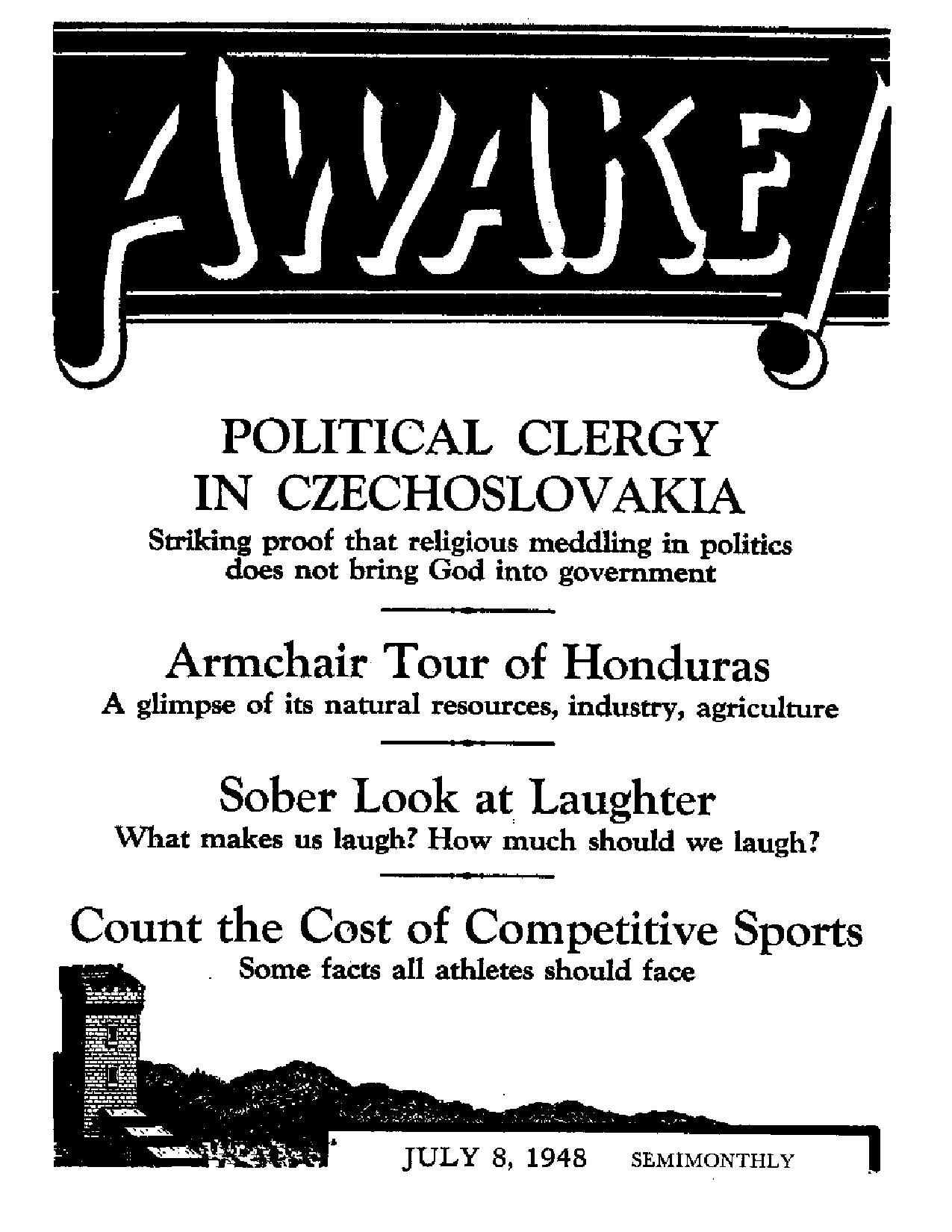
POLITICAL CLERGY
IN CZECHOSLOVAKIA
Striking proof that religious meddling in politics does not bring God into government
Armchair Tour of Honduras
A glimpse of its natural resources, industry, agriculture
Sober Look at Laughter
What makes us laugh? How much should we laugh?
Count the Cost of Competitive Sports
THt MISSION OF THIS JOURNAL
News sources th&tf are able to keep you awake to the vital issues of cur times must be unfettered by censorship and selfish interests. “Awake I” has no fetters. It recognizes facts, faces facts, is free to publish facts. It is not bound by political ^mbitions or obligations; it is unhampered by advertisers whose toes must not be trodden on; it is unprejudiced by traditional creeds. This journal keeps itself free that it may speak freely to you. But it does not abuse its freedom. It maintains integrity to truth,
“Awake l,s uses the regular news channels, but is not dependent on them. Its own correspondents are on all continents, in scores of nations. From the four corners of the earth their uncensored, on'the-scenes reports come to you through these columns. This journal’s viewpoint is not narrow, but is international. It is read in many nations, in many languages, by persons of all -ages. Through its pages many fields of knowledge pass in review—government, commerce, religion, history, geography, science, social conditions, natural wonders—why, its cover* age is as broad as the earth and as high aa the heavens,
“Awake I” pledges itself to righteous principles, to exposing hidden foes and subtle dangers, to championing freedom for all, to comforting mourners and strengthening those disheartened by the, failures of a delinquent world, reflecting sure hope for the establishment of a righteous New World.
Get acquainted with “Awake 1” Keep awake by reading “Awake!”
Published SBJflJfONiiTLY by WATCHTOWER BIBLE AMD TRACT SOCLETT, INC.
117 Adams Street Brooklyn lt N. U. S. A.
N. H. Knorr, Preside?# Grans? Suiter, £tecrefarjf
Five cents a copy One dollar a year
tan [fiances should be sont to offica la yonf emnb try ju compliance with regulations to guarantee safe deliver; Of mew. Remittances are accepted tt Brooklyn from countries where no office 1h located, fay interaatlonal money order only. Subscription rates in different countries are here stated in local Currency.
Notice of expiritlra (with renewal blanft) is sent 4t least two Issues before subscription espirei.
ChaiTfO of rfftwr when'sent to crur office may be expected effective within one month. Send your old ag well as new address.
Ottlcw Yearly Subscription Rato
America, U.3., 117 Adams St., Brooklyn 1, N.I. 11 A astral la, 7 Beresford Rd., Strathfield, N.S.W. 6s Canada, 40 Irwin Ave., Toronto 5, QnUrio Si Enrland, 34 Craven Terrace. London, W. 2 &
Sbltb Africa, 623 Buskirk House. Cape Town 5b
Entered <9 second-class matter at Brooklyn, N. Y., Act of March 3, 1379. Printed in U. & A.
CONTENTS
Political Clergy in Czechoslovakia
Tiso's Regime and Its Disintegration
Postwar Activity of the Hlinka Party
Conspiracy Uncovered
Goebbels Diary on Jehovah’s witnesses
Picketing the Uni oncers
Armchair Tour of Honduras
Natural Resources, Industry, Agriculture 10
Sober Look at Laughter
Surprise and the Incongruous
Literary Means of Humor
How Much Should We Laugh?
Count the Cost of Competitive Sports
“Manly Art” of Boxing
Blood Money
Remedies
Catholicism for Sale
Belief About Non-Catholics
The Pope and God
“The Bible Is a Catholic Book’
“Thy Word Is Truth”
A City from Heaven Awaited
Pan-Americans See Bogota
Watching the World 29
/AWAKE!/
©'“Now it is high time to awake.'—Romans 13:1/ 9)
Volume XXIX Brooklyn, N. Y.» July 8, 1948 Number 13
Political Clergy in Czechoslovakia
rFHE Czechoslovakian Republic is a J. small state in the heart of Europe, with around 12,000,000 inhabitants, which came into existence after the dissolution of the Austro-Hungarian Monarchy in the year 1918, by uniting the three Slav countries Bohemia, Moravia and Slovakia. This comparatively youthful state has already experienced many a critical crisis and upheaval since it came into being, with assaults from without and turmoil within.
Jn the years 1938-1939 it was crushed and invaded by the vassals of Hitler with the assistance of Fascist-minded elements within the state itself, led by the political clergy of the Roman Catholic Church. When, in 1945, Czechoslovakia was restored to its former status, the same circle of people began the very same disintegrating work as before World War II, and hatched up a conspiracy.
It is interesting to see with what cunning confusion of politics and church, with abuse of God’s Word, simple people can be misled. Many interesting things have come to light during the investigation of this subversive conspiracy. Several hundred persons have been held under arrest, among them distinguished political and military personages, not to nfention clergy of the Roman Catholic Church and nuns. As the threads of the Conspiracy lead back several years into the time of the Tiso regime and still farther into the latter years of the Czechoslovakian Republic before World War II, it would be of interest to briefly review the events of recent years.
Efforts to Crush Czechoslovakia
In the period between the first and the second world war, the Slovakian Hlinka party, designated thus after its leader, the Catholic priest Andrej Hlinka, was the strongest political organization in Slovakia. It was the party of the Slovakian Catholics. Primarily, Hlinka zealously advocated separate autonomy for Slovakia, within the framework of the Czechoslovakian Republic; but later, influenced by more radical collaborators, he set himself entirely to separatism. One of his most influential colleagues was the priest Dr. Joseph Tiso; already minister in 1926, and chosen by Hlinka as his successor as leader of the party.
When, in 1938, Hlinka died and Tiso took over the party leadership, he recognized that the most favorable moment had arrived for him to crush the Czechoslovakian Republic, and to install himself as dictator of Slovakia. The major part of the blame for the political crisis, which, in the same year, led to the Munich dictatorship, and finally to the devouring of the whole of Czechoslovakia by Hitler’s power, can be ascribed to his efforts.
Events progressed rapidly, one news item overtook the former in precipitous haste. The radical elements of the Hlinka party organized the Hlinka-Guard entirely after the pattern of the Nazi SS and SA.
Soon Tiso’s government dissolved all political parties other than the Hlinka party, which they proclaimed as totalitarian. They suspended the press of all other parties, took over their printing houses, buildings and other undertakings and confiscated- all other possessions in favor of the Hlinka party. The state crisis reached its climax when the priest, Dr. Joseph Tiso, traveled to Berlin with the minister of justice, Ferdinand Durcansky, in his function as president of the Slovakian autonomic government, on March 13, 1939, where they discussed the separation of Slovakia from the Czechoslovakian Republic with Chancellor Adolf Hitler and his foreign minister, Ribbentrop. The next day the Slovakian Parliament proclaimed Slovakia as an independent state, thus helping Hitler to an undisturbed occupation of Bohemia and Moravia.
Tiso’s Regime and Its Disintegration
The spirit of Nazism and the Gestapo penetrated more and more into the Hlinka-Guard, and the Hlinka-Youth were trained under the direct assistance of German instructors. The collaboration of the Hlinka party units and the Gestapo was very close in many ways, and their members fought shoulder to shoulder with the Nazi SS in World War II. According to the opinion of certain Catholics, this fact has greatly exposed Catholicism in Slovakia. The Hlinka-Guard terrorized and ruthlessly suppressed everything not pertaining to the Hlinka party, and enriched themselves by exploitation, plundering, confiscation and appropriation of the property of their political opponents and the Jews. Freedom of press and assembly, freedom of speech and education, and the freedom of true worship disappeared, and with them all the remaining human rights and security of property.
As commander-in-chief of the army, Tiso wrote an article addressed to his soldiers, which -was published in the paper Slovenske. Vojsko (Slovakian Army) on July 3, 1941, in which, among other things, the following can be read: “You have enrolled yourselves in the victorious German front on the side of all Christian nations of Europe, in order to turn aside the danger of hell from your own. nation and from Europe. Rightly.you designate yourselves as crusaders of the anti-bolshevist campaign.” A significant speech for a Catholic priest!
In solving the Jewish question, the Tiso government adopted, in their entirety, the methods of Hitler’s gestapo in the years 1941-1942. This applied not only to the rights and properties of the Jews but to human life itself. Packed into cattle trucks by the thousands, they were led to mass death in German camps. Slovakian bishops consented to this solution of the Jewish problem, which strengthened Tiso in his intentions, and, in a speech in Halic on August 16, 1942, he declared that the removal of the Jews lay in the interests of the self-preservation of the nation; and to rid oneself of one’s enemies was Christian. Leading factors of Catholicism in Slovakia identified themselves wholly with Tiso’s regime and with all he undertook in collaboration with Nazi Germany. The archbishop Kmetko, as chairman of bishops’ conferences, sent Tiso a letter in the name of all the bishops on November 15, 1943, declaring: “The Catholic clergy have a lion’s share in the bringing forth of the Slovakian state, and will number among its most devoted citizens.”
When it became as clear as day that the fall of Hitler’s regime was only a question of a few months, which would also mean the fall and the end of his allies and the Slovakian state, the leading men of the Hlinka party determined to make preparations for the postwar period. They called some of their men from their political engagements and entrusted them with a commission for the postwar activities. Their money was deposited abroad. They assigned the various appointments, and designated who should be sent abroad, and who should illegally prepare the collapse of the expected Czechoslovakian state at home. Foreign Minister Dr. F. Durcansky, who, in the year 1939, had signed the treaty for the protection of the Slovakian state with Ribbentrop, grasped the initiative. He gathered men around him who were devotees of the Hlinka ideology, allotted the duties and dealt out instructions for the coming activity inimical to the state. Thus, in March, 1945, Durcansky and his collaborators went abroad to previously assigned appointments, in order to direct the illegal activity in Slovakia from these strategic positions.
Postwar Activity of the Hlinka Party
The former ambassador of Tiso to the Vatican, Karol Sidor, gathered around him a further group of supporters, who pursued the same aims as Durcansky’s group; but it appears that these two most prominent groups could not come to an agreement as to the methods of carrying out the conspiracy. While Sidor advocated consolidating the position of his men in political and state functions in the newly established Republic and for biding his time for a favorable moment, Durcansky was for an immediate rising. The followers of Durcansky who had remained in the country itself began to assemble former members of the Hlinka-Guard and the Hlinka-Youth movement around them, organized them in a military way after the principles of the Fuhrer regime and in the spirit of unqualified obedience to all orders. This illegal organization was renamed “Tiso’s divisions in readiness [or “ready for action”]”. Its members swore a secret oath of allegiance to their superiors and the Slovakian state. The activity of this subversive movement tendered its branches, so to speak, into all districts of Slovakia during the next two postwar years.
In the meantime the former president of the Slovakian state, the Roman Catholic priest, Dr. Joseph Tiso, was delivered up to the Czechoslovakian government as a war criminal, and the special court in Bratislava investigated his whole political past. Prominent clergy made efforts to help Tiso and to liberate him, but when they were forced to recognize that this was not possible, then they at least rendered him assistance in his defense before the National Court. The sympathizers of the Hlinka party bolstered up their hopes that Tiso would not be convicted, and set the whole mechanism moving in his favor. The Slovakian Catholic allows himself to be easily drawn into rash actions by his spiritual leaders, and it therefore meant no strenuous effort on the part of the clergy to provoke demonstrations in the larger cities for the liberation of Tiso. We will mention a few interesting moments in the provocation of the Hlinka party’s underground activity, which indicate the political character in alliance with the clergy.
In Piestany the demonstrators assembled in the Jesuit church, from which point they set out in procession, carrying images of the Virgin Mary and epigrams against the Czechs and Jews. When singing the Tiso hymn the demonstrators raised their hands in Fascist salute. In other places, conscious of the danger, they cowardly sent fanatical women at the head of the processions. One priest celebrated the mass seventy times for Tiso, and others spoke continually of Tiso’s case in the churches. Political Catholicism now felt itself so strong that it did not shrink from inciting open actions against the state, and this not only in isolated cases but organized throughout the whole territory of Slovakia. The adherents of the Hlinka party fought for their leader, and political Catholicism for the representative of their ideas.
The trial of Tiso and his colleagues revealed a multitude of crimes against the interests of the population and against humaneness. Tiso denied what he could, feigned stupidity, and cowardly shifted all blame onto others. However, he became fortified in his self-confidence by the demonstrations of his backers and by the promises of some that they would liberate him; so that, finally, in his defense, Tiso expressed no regret for his acts, but in self-assertion declared that he would act precisely in the same way if he had the opportunity of doing so again. This Catholic priest would establish Fascist totalitarianism all over again; he would again connive with Nazism; and would again send thousands of Jews to a premature death. But contrary to the expectations of the underground movement of the supporters of the former Hlinka party, Tiso was condemned to death by hanging, and the sentence was executed.
Catholicism and its leading in Slovakia came into a peculiar situation on account of these happenings. They had endeavored to attain their aims by party politics, and not by means of the church. Under Tiso’s Slovakian state they had been completely absorbed in an unclean business, full of violence and bloodshed; and the Hierarchy had played a reckless political game. The fight for Tiso’s liberation they had lost, and had exposed themselves before their own believers; all their efforts had come to nought. What inferences would they draw from this situation? Would they forsake the political arena and dedicate themselves entirely to their clerical calling? Would they acknowledge that they had followed the wrong path? Only one not knowing their mentality and their aims could treasure such futile hopes. The events following closely in the wake of Tiso’s execution give us a clear answer.
Conspiracy Uncovered
The demonstrations which were organized in many places in Slovakia for Tiso’s liberation sharpened the attention of the police and assisted considerably toward the exposure of these hostile plots. The decisive moment to intervene arrived when the man acting as connecting link between the Hlinka party and their foreign leadership was arrested. The statements of the arrested man led to the disclosure of a widely ramified organization. According to various official bulletins which are based upon material found in the possession of adherents of tips organization, and upon their own statements, their goal was: The preparation of armed units to crush the Czechoslovakian Republic, and the preparation of an attempt to assassinate the president of the Republic, Dr. Benes. Several hundred persons were arrested in connection with these schemes, and many of them retained under surveillance. Among them are people with confidential functions toward government persons; deputies, officials in the state and public administration, distinguished military men, priests and members of women’s church orders.
Before his execution Tiso is said to have sent his followers a written legacy, in which he designates himself as martyr of God’s law and as martyr in the defense of Christianity. This legacy was found with the discovery of the conspiracy. Although Tiso’s designation of himself as martyr in behalf of the faith sounds most ironical, his adherents have made zealous efforts to widely disseminate this among the Catholic population. The legacy itself is a tangled mass of ideas taken from Hlinka’s ideology concerning the Church, God and the Slovakian state.
A man who sent thousands of people to their death, who robbed other hundreds of thousands of the natural freedom of worshiping the Almighty God, can, of all things, not only become the martyr of “God’s law” for his political activity, but even be declared a saint. And in Slovakia they now have such a , saint. They call him Joseph the Glorious, but this is no one else than Joseph Tiso. Solicitous shepherds of the Catholic fold have provided a prayer to Joseph the Glorious, and have concocted a litany; and spiritual sisters care for its distribution. The people are to believe that the soul of Tiso intercedes with God in heaven for the political schemes of the clergy. And, at the direction of the political-minded spiritual shepherds, the people pray in their simplicity and believe.
Following the execution of Tiso, Catholic Action began to provoke the organizations that did not share their ideas, by increased intolerance and oppression. They agitated the Catholic population to break up the meetings of peace-loving Christians, to torment and beat them.
It would be a mistake to assume that after all the events of the last months, and following the arrest of certain priests, the Catholic Church in Slovakia would cease to meddle in politics. On the contrary, it may be expected that the embittered clergy in their self-righteousness will be strengthened, and will continue in their policy, which is: to rule at all costs. In the interests of their political aims they reject the Lord Jesus Christ and the kingdom of Jehovah God.
Qoebbels Diary on Jehovah’s witnesses
“Himmler reported to me [Goebbels] a somewhat outstanding problem, the one about the ernste Bibelforscher [Jehovah’s witnesses]. The ernste Bibelf orscher are a very curious mixture of those who are apart from our present society. Their war-service opposition seems not to be based upon cowardice, but upon doctrine. For this cause Himmler was right in his insistence: ‘War-service opposers who are over the age limit, in order that they do not come into question regarding service, should be put behind lock and bars so that they will recruit no adherents.’ War-service opposers who are in draft age, because of cowardice and flag-disrespect, should be sentenced to death. A number of them accept the death penalty with absolute calmness on their part. The older ernste Bibelforscher conduct themselves in the concentration camps as extraordinary, valuable and trustworthy inmates; they commit the least causes for complaint.”
Ticketing the Unioneers
The Brotherhood of Locomotive Engineers, one of the three unions involved in the recent nation-wide rail strike crisis, own the Park Lane Villa hotel in Cleveland. Nevertheless, some fifty members of the AFL Building Service and Maintenance Union picketed the hotel during May. They sought retroactive wage increases and a union shop, and charged the railroad union owning the hotel as being “antilabor”. Through their business representative the strikers said: “Management of this hotel, in its antiunion way, has warned employees they will lose their jobs if they dare , to strike to enforce demands for a contract.”
rmchair
our
FOR most of us, in these days of soaring prices and unsettled futures, it is impossible to merely forget our cares and fly away to distant points when we have the whim to do so. All of us, however, possess the faculty of imagination ; so relax in your favorite armchair and let it become a cushion seat on a modern clipper, winging its way through the blue sky to a sleepy peaceful land, unmarked by the hustle and buatle so common in America. You are flying to Honduras. Honduras, a land ranging from unconquered, unexplored jungles to modern civilization. Glancing at the magazine you have in your hand you note with interest it was first discovered by .Christopher Columbus on his fourth and last voyage; in 1502. The Spaniards with him marveled at the deepness of the water near the coast, and gave it its name, Honduras, which means "depths”.
Columbus and his men found a semi-civilized people possessed with cunning gold work. Thereafter the news and lust for gold quickly brought on Spanish conquerors, and by 1578 colonization had started in earnest. Constant oppression by the Spaniards, however, resulted in the rule of Spain being broken in 1821.
The country then underwent a scries of growing pains, marked by squabbling and dickering and occasional revolutions. After years of unrest, the current president, General Tiburcio Carias Andino, was elected in 1932 by popular vote. Peace has marked his administration, and progress has been made in many fields.
The area of the country itself is comprised of 44,480 square miles, or the approximate size of Pennsylvania, ft is a land of great contrasts, ranging from the beautiful swaying pa Im-tree beaches of the Caribbean and the coastal plains adjoining it to a mixture of jagged mountain peaks, often reaching heights of 10,000 feet, and long green valleys and fertile tablelands watered by s p r i n g-f e d streams. The coast line is marked by the great banana plantations, swept by the ever-present moisture-laden trade winds.
Were you to see this coastal plain of banana farms stretching some sixty to seventy-five miles into the interior, you would only then sense to a degree the enormity and vastness of this, Honduras’ foremost product, bananas. The banana sections are surrounded by a dense growth of trees and bushes, as though they would wish to cover again the complete section. The Ulua river passes through this district on its way to the Caribbean, and its wafers are used to irrigate the trees when necessary. These banana plantations, though covering only a small portion of Honduras, supply much work for the people and many riches for the country. Indeed, Honduras is rightly named the “banana, country”, as its yield per acre and quality of fruit are equaled by none.
Farther east lies the enormous Mosqui-tia territory, so named, not as one would suppose for that little pestiferous enemy of man by the same name, but rather from the tribes of Missike Indians that inhabit that region. This swampy, malarial, disease-infected jungleland comprises one-third of the country’s surface. Slowly it is being conquered, for in it lie large sections of timber, rich with precious mahogany. Growing in isolation usually several acres apart, these giant trees rise one hundred feet into the air, and are often twelve feet thick at the base.
The coastal section is very rich of soil, and is called delta kind, stretching a distance of 500 miles, to compare with the forty miles of the Pacific coast, giving Honduras a triangular shape. Coconut palm trees, growing at all angles in their peculiar manner, dot the north coast, a beautiful sight against white sands and the intense blue of the Caribbean sea, where the waters are warmed by the tropical sun. But these palms provide more value than just beauty, since coconuts are exported in large quantities, mostly to the United States.
Exhilarating Mountains and Foothills
From the coast to Tegucigalpa is an interesting panorama of mountain scenery, with their rugged crags interspersed with green pine-covered foothills, every turn a different b r e a t h-t a k i n g view. 'Midst the mountains are grassy plateaus, with field crops and herds of grazing cattle, burros, or horses. On the shelf lands are coffee bushes and densely matted fields of sugar cane. Orange and grapefruit plantations, as well as pineapples, sarsaparilla, and cocoa, are found in the midlands. Highlands produce coffee and tobacco, and every hillside seems to have its patches of sugar cane, beans and corn.
The homes in the rural are simple
Structures, made ofttimes of the clay of the ground, with thatched or tiled roofs, and usually consisting of only one room with a dirt floor, A table, a chair, and several beds thonged with leather or rope and covered with a woven straw mat, comprise the furniture. In many eases a stove made of clay baked to durable hardness is to be found in one corner of this room. Here the natives do their cooking with wood; and, as the stove has no chimney, the smoke must find its way out of the one room the best way it can. The people work hard to eke out their existence by hand, or, perhaps, by the aid of a few oxen, which are huge, full-chested animals, or a few of the surefooted little burros. Honduras possesses over a million inhabitants, and four-fifths of these as well as nine-tenths of the total area are to be found in the rural.
Description of the topography of the country would not be complete without mentioning the climate. The coastal lowlands are hot and humid, with the temperature above SO degrees much of the time, and with a rainy season extending from inid-Scptember to February. From March mx-til mid-September is the comparatively dry season, with the temperature Iiovcring around 90; and the humidity makes the heat very noticeable. In the midlands between the highlands and the coast the climate is good, with an average temperature of 85 degrees. In the highlands around Tegucigalpa, 3,200 feet and more above sea level, the climate is nearly ideal; especially from November to the first weeks of February, when the air is brisk during the day and chilly at night. The dry season of the year, and the warmest, starts in mid-February and extends until mid-.May, when the refreshing rains, varying from torrential downpours to quick unexpected showers, appear.
Transportation
The economic situation in Honduras is perhaps best reflected in the transportation facilities available. The capital,' Tegucigalpa., is one of the few capitals in the world without railroad connections, The country has few roads easily traversed, but progress has been made to where there are now 780 miles of highways, of which 450 miles are improved, to compare with the 222 miles in 1938, of which 24 miles were improved. The two important roads at present are comprised of one which leads north from Tegucigalpa to railroad connections near San Pedro Sula, from which it is necessary to take a train to any of the points .on the north coast, and the other road which leads south to San Lorenzo. Much of the freight shipped to Honduras via Amapala comes over this road, after being transferred from Amapala to San Lorenzo by a motor launch requiring a trip of four hours.
The country has no bus system as known in the United States, owing to the condition of the roads. Passage can be obtained to the principal towns by trucks which have had bench-type seats inserted, thus converting them into buses. As yet these cannot travel from the north coast to the south coast, since the former can be reached only by rail.
Railroads are found only in the northern part of the country. There are about 900 miles of such, the majority of which are owned and maintained by American fruit companies, to help in the shipping of bananas and the other various products exported by them. All railroads are of the narrow-gauge type. A trip by train, in one of their antique keroseneburning-lamp coaches is am interesting experience, though sometimes trying. Windows are wide open, permitting dust, cinders, smoke and heat to enter. Market products are crowded under all the seats. Progress is slow, with sudden, violent, neck-jerking stops being made at nearly all settlements, even those of five or six houses. Here, a host of native vendors pour in from all sides to offer to the travelers their wares of tortillas, fried bananas, pastries or fruits. Trains seldom run on schedule.
Airlines offer the one bright spot in the transportation picture. Honduras gave birth to TACA, an airline, with headquarters at Tegucigalpa, serving Central America; and that now has international service to the States and other points, and has grown into one of the world’s foremost airlines, as to total freight tonnage carried during the year. TACA, together with SAHSA, a branch of Pan American, serves Honduras well, reaching over 100 airports within a radius of 100 miles. Many parts of the country are accessible only by plane or mule-back ; and, as a result, many and varied are the items transported by air, ranging from passengers, or mining machinery, to green vegetables.
Indeed, the transportation picture of Honduras can be summed up in a glimpse of a common scene of any of their streets, of men carrying enormous loads on their backs, oxcarts pulled by slow, plodding oxen, while alongside of them glide 1948 model trucks and overhead roar the modern plane of today; much of the very old and a little of the very new.
Natural Resources, Industry, Agriculture
Economically, however, Honduras is a land of great potential strength, the soil being extremely rich, but, as ypt, undeveloped. Bananas will probably remain its chief export for many years to come, but mention must be made of its gold, silver and fine hardwoods. Extensive gold and silver mines are operated at the town of San Juancito, where about $2,000,000 worth of silver is mined yearly; the bars of silver then being transported by mule train to Tegucigalpa. Honduras leads all Central American countries, and is third of all Latin America in silver production. Much gold mining is done by individual prospectors, native men and women, who, standing kneedeep in mire or water, and unmindful of sudden rains or steaming sunlight, pan the sands with bucket-sized sieves; thus managing to obtain their necessities of life from the few flecks they recover. Gold is found in this manner to the amount of approximately $100,000 a year. In addition, beds of zinc, antimony, platinum, nickel and manganese have been found in various sections. Coffee, coconuts, indigo, tobacco, and cattle hides are other items exported. Recently, a new product has been introduced that is now exported to some degree, namely abaca or manila hemp. Improved decorticating mills for cleaning the fiber have been constructed in Honduras. The United States receives 95 percent of all exports of Honduras.
Although not exported, corn is the leading crop of Honduras,_ and. figures prominently in the daily diet, since the basis of most meals is tortillas (flat, unleavened cakes, similar to pancakes), which are eaten along with rice and beans and often meat. Cattle are raised extensively and meat supplies satisfy the demand. All manner of vegetables are grown. There being little industry to employ them, the vast majority of people are forced to eke out their living on small farms; and eke it out they do, the average yearly income being 116 lempiras per capita. Their monetary system is based on the lempira, named after a famous native Indian chief, and is valued at 50c United States money.
Due to the fact that the rural population is so widely scattered, and that previous educational opportunities were inadequate, it was estimated in 1940 that seventy percent of the people were illiterate. In recent years, however, efforts have been made to correct this. Schooling has become compulsory for children between the ages of seven and fifteen. Night schools, as well as trade schools for adults, and schools of trade in the prisons, along with educational missions in rural districts, have been established. As a result of this, Honduras now has over 1,000 public schools.
The Capital Goes Modern
Tegucigalpa, the capital city, with a population of approximately 55,000, is sheltered by green vegetation-covered mountains, which rise up on three sides of it. Its name means “hills” or “slopes of silver”. The city was an ancient Indian capital, dating back beyond the conquest by the Spaniards.* The peaceful, winding Choluteca river now divides the city into two parts, Tegucigalpa and Co-mayaguela, which are linked together by the Mallol bridge built by colonial Spain three centuries ago.
The city, standing as originally laid out and built, even to its quaint streets of stairs, ■which at several points connect one level with the one above, has known neither earthquake nor hurricane, fire nor bombardment. However, today, Tegucigalpa is torn and scarred—not by war, as it might appear—but by the innumerable improvements in progress.
If your imaginative trip to Honduras were to blossom into reality, as you stepped out of your plane at Toncontin airport you would view with interest the new improvements appearing there. As you rode along the now swirling, dustladen road into Tegucigalpa, you would note, with appreciation, the preparations in evidence to soon pave the road from the airport to town. In Tegucigalpa itself you would marvel at the extensiveness of the renovations taking place about you, and perhaps you, too, would ask the question, "Shall this forward surge of Tegucigalpa lead the way for all of Honduras in a change from the very old to the new?”—Awake I correspondent in Honduras.
1DY is big busi-;, and comedians look at the business soberly. Those who try to be funny and succeed the world rewards with money and laughter. The other multitudes who only try receive at best heavy silence, at worst irate scorn. Perhaps if the sentence against the offending would-be gagsters were heavier the public would suffer less and laugh more. Perhaps more of the world’s self-appointed wits would sober up long enough to look into the causes of laughter.
An interesting starting point for a sober look at laughter is the etymology of the elusive word humor. As a Latin word it simply meant “wetness”, a meaning still retained in the English words humid and humidity. Medical practice by Hippocrates and his successors brought new meaning to the-word, associating it with the liquids they thought flowed through the human body, namely, blood, phlegm, yellow bile or choler, and black bile or melancholy. When these bodily fluids flowed properly the person was said to be in health, or in good humor. But if disease appeared the person was said to be in ill humor, or out of humor. Moreover, they held that there was one vein made
for laughter to run in, and when the fluid in that vein was stirred the person laughed, even if he felt like crying. Hence, in
Tasso’s epic “Jerusalem Delivered”, we read of the death of the knight Ardonio, when pierced with a Persian lance: “Pierced him through the vein where Laughter has her fountain and her seat, so that (a dreadful bane) he laughed for pain, and laughed himself to death.” Ancient physicians thought the temper of the mind changed according to the humors or moistures in it, according to which fluid predominated at the moment. As time passed the medical meaning of the word humor vanished, and it came to mean disposition or temperament. Today it relates to laughter.
But what causes laughter? Plato’s theory was that we laugh at the misfortunes of others, for joy that we do not share them. In similar vein Thomas Hobbes, seventeenth century philosopher, claimed: “The passion of laughter is nothing else but a sudden glory arising from sudden conception of some eminency in ourselves, by comparison with the inferiority of others, or with our own formerly.” Many persons today contend that it is the discomfiture and misfortunes of others that cause laughter. If this be true, it would be better if the only earthly creatures having a sense of humor, man, had none.
Many psychologists go along with such ancient theories, one saying in a book on laughter: “A survey of the occasions of laughter in the past suggests that men never have laughed and never will except at some form of humiliation.” The
psychologist claims that the smile starts ed, not from humor, but to relieve baby muscles around the mouth that were tired from nursing! But why does the light of laughter leap from baby eyes if the smile is only to relieve tense mouth muscles? Heaping theory upon theory, psychologists claim laughter comes instinctively to suppress feelings of unnecessary sympathy at the misfortunes of others, and amusement comes by the very rejection of their false claims upon our sympathy.. In what vague words and fantastic theories psychology can flounder !
Surprise and the Incongruous
But with dogged insistence rue question returns, Then what does cause laughter? Are there reasons that we can recognize as operating in our own personal experience with laughter? Writer Stephen Leacock said: “Humor may be defined as the kindly contemplation of the incongruities of life, and the artistic expression thereof.” Laughter is aroused by the incongruous, the exceptional, the unusual, the ludicrous, the ridiculous, the absurd, the unexpected. The element of surprise ranks high in humor. All good jokes have it. Either a character in the joke is surprised, or the hearer is surprised. There is a sudden surprised recognition of a fact not suspected before, the surprise of the incongruous, the surprise of a disparity between what things are and what they ought tb be. Recognition of that surprise precipitates laughter. The stale joke still has its incongruous circumstances, but the surprise is gone, and with it the humor.
It cannot be denied that oftentimes humorous situations involve discomfort
or humiliation. Most practical jokes bring a measure of discomfort—-the exploding cigar, the tack on the chair, the bag of water on an unsuspecting head— but even in these cruder forms of laughmaking it is not the discomfort inflicted that is funny. It is the surprise and dismay of the victim, and the extraordinary bodily antics and facial expressions he manifests. As in slapstick comedy, it is the incongruity of the physical gyrations of the victim that provoke mirth, and not any discomfort. The more slapstick comedy and the more practical jokes, the more discomfort produced; but this increase in discomfort does not increase humor. To the contrary boredom and annoyance set in and the practical joker becomes a pest. Why? Because the element of surprise has gone.
Nor is the psychologist correct in saying that laughter comes only from “some form of humiliation”. Who is humiliated by the delightful gymnastics of a kitten cuffing a ball about? The onlookers may double up with laughter at his scrambling, unpredictable onslaughts as he races in pursuit of the ball; but who is humiliated? Certainly not the kitten. Nor is it any feeling of superiority over the victim that produces hilarity. A humorous situation may involve feelings
of superiority and discomfort and humiliation, but analysis will show that not these feelings, but elements of surprise and incongruity, make it mirthful.
For instance, in slapstick comedy we see a free-for-all pie fight and howl with delight. We feno-w no one is seriously hurt. In real life a fat man slips on a banana peeling, flails arms wildly to regain balance, fails, falls ludicrously and sprawls on the ground with legs waving in the air. We laugh, sometimes even apologizing as we do so, saying we are sorry to laugh but just can’t help it. The sight is so unexpected and so out of.the ordinary that laughter cannot be denied; yet at the same time we feel some sympathy for the discomfited but unhurt victim. Again, in an old Mack Sennet comedy we may have laughed till we cried and held our midsection when an old model T Ford would run wild and scatter crowds and knock some victims flying grotesquely through the air. We knew no one was really being hurt. But what if such a thing happened in true life? Our blood would freeze in our veins, our knees would weaken in terror, and our faces would contort in horror. But why not laugh ? Discomfort is there, so are surprise and the incongruous. Another element, serious injury, has entered the picture and turned back the tide of laughter. Hence it may be said that humor must present a surprising situation that has something out of the ordinary or abnormal or wrong about it, but this wrongness must not be severe enough to unlock emotions that would smother our enjoyment, such as hate, rage, fear or overwhelming sympathy.
Literary Means of Humor
A primary essential in humor is putting the story across. Above all, the way of wit does not wander through many ■words. As Shakespeare had one of his characters observe, “Brevity is the soul of wit.” The idea may be there, but without artistic expression the joke is not. Humor may spring from the word, the character, the situation, the limerick, the parody, the repartee or snappy comeback, and other literary means. Humor is derived from words by repetition, rhythm, alliteration, or bv the familiar pun. Puns use words or phrases of the same sound but having different meanings. They play upon double-meanings. Puns are of ancient origin. The Romans brought them into prominence; Cicero hurled them about recklessly; Shakespeare used them often; Milton put them in the mouth of Satan. Though railed against, they refuse to die. They go out of style, but they return. At present they are upon us with a vengeance. Pointless puns rain upon us and the few good ones are drowned in the flood, and a suffering society rises up to brand punsters a menace, the few good falling with the multitudinous bad. Most punsters pun for the pun’s sake, merely playing upon sound and not idea. Ears may be tickled, but the mind squirms. But sometimes the combination of word sounds and doublemeaning may be so ingenious that we are tickled and laugh in spite of ourselves. The following has good, double-meaning; Goliath was astounded when David hit him with a stone. Such a thing had never entered his head before.
Humor of character deals with incongruities in persons, oddities of character that are contradictory. For example, a giant man with a squeaky voice, a meek man with a ferocious growl, a warrior terrified by a mouse, a timid sold bearding a lion, grandma making whoopee.
Situation can produce guffaws of laughter if it cleverly mixes in the requirements for humor, namely, surprise and the unusual or incongruous. The circumstances must be out of line enough to be funny yet bear a resemblance to possibility or sensibility. The resemblance must be new and unexpected. Here are two illustrations: In freezing weather an old-time hunter who had powder but no shot for his ancient gun was attacked by a bear. Beads of sweat popped out on his forehead, they froze into ice pellets, and the desperate hunter tamped them into his gun for shot. When he fired, the heat melted the pellets and the explosion rifled a stream of water from the gun. As it struck the cold air it froze into an icy spear, which.pierced the bear’s skull and thereafter melted from the animal’s body heat. The bear died from water on the brain. All of this is ridiculous, exaggerated wildly, yet there is. the semblance of possibility present. Similarly with the second illustration. A man wishing to commit suicide took rope and gun and gasoline and went to the river. One end of the rope he tied to a tree limb over the water, the other end around his neck. He poured the gasoline over his clothes and set them afire, then jumped out over the water, firing at his head with the gun as he did so. The bullet missed his head, cut the rope, his fall into the river extinguished the flames, and if he had not been a good swimmer he would have drowned. All of this is logical, yet ridiculous, with an unexpected solution. The exaggeration is great, but just short of the impossible.
The limerick is the only literary form used exclusively to present humor. The limerick fad is now big business, with competition and prizes offered for them by advertisers. The very beat of the limerick is advance notice that a joke is coming, and the punch line is always the last line. To illustrate:
There was an old man of Blaekheath, Who sat on his set of false teeth.
Said he, with a start, “0 me, bless my heart 1
I’ve bitten myself underneath!”
Parody is a take-off on some well-known work. It resembles the original so that it is recognizable, but it exaggerates and ridicules. It might make a mockery of superheroes, or mawkish love scenes, or famous detectives or political situations. It pokes fun at something that has been overdone, is a counteragent and acts as brakes to certain trends overworked. It magnifies faults and thereby amuses us at the expense of the original. Generally, the parody is a protest against the over-sentimentality or over-rating of the original, but it may also merely put the original, such as a nursery rhyme, into a modern setting to become a satire against modern conditions or persons. Satire is barbed humor.
Repartee, or snappy comeback, is a form of wit that becomes a powerful weapon. It is sudden, unexpected, and scatters adversaries in confused rout. Bepartee turns the tables, it is used to turn back an attack, and often it deliberately misconstrues the meaning of the original assailant. Because it is used in self-defense against an aggressor, some harshness is permissible. Yet, its exterior is genteel. It is the iron hand in the velvet glove. It is so devastating that the recipient is not so much resentful as nonplussed or flabbergasted. For instance, a woman protests: “Sir, I hear you have been attacking me.” “Attacking you, my dear lady? Why, I spend all my time defending you." But repartee need not be rough. For example, “What a beautiful girl J” cried a judge. Overhearing him, as girls do such remarks, she replied, “What an excellent judge!”
Other forms of humor may be the use of nonsense, action, or the unintentional. In a dull' and serious and miserable world a little nonsense is welcome relief. The radio comedian Gracie Allen is illustrative of this form of addle-brained humor. Humor of action delights us when we see two young puppies at play, dodging, nipping, bounding, leaping, tumbling, sprawling. Unintentional humor may pop out when someone commits what is popularly known as a bull, or a boner, or a slip.
The claim is made that there are no jokes really new. It is true that the majority of current jokes are old ones reconditioned. But one cannot force all humor into a few time-worn grooves. This is proved by the fact that humorists themselves fail to agree on any standard grouping or classification lists.
How Much Should We Laugh?
The test of humor is the laugh it provokes. But the test is so variable that it is not always reliable. The same joke does not get the same response from all persons, and from the same person the response varies with the time and place and mood. Some laugh loud at low quality; some laugh louder than natural to flatter the gagster or impress others with the fact that they have a sense of humor; and some laugh because they are expected to and do not wish to appear dense, even though they do not get the point of the joke. Often the one who merely smiles appreciates the humor of the situation more than the one who guffaws.
There is a popular slogan, "Laugh and the world laughs with you, weep and you weep alone/' It is not really true. Laughter is infectious only as other emotions are infectious. Persons are influenced by their surroundings, and sad surroundings quench a jolly spirit just fis effectively as gay settings chase away the blues. If a few tell jokes and laugh, others laugh, and soon all join in the merry mood and things not ordinarily humorous take on a funny hue because of the mood created by the group/ Everyone tends to flow with the tide of the group, whether it be a high tide of humor or a low tide of sadness. Instead of the world laughing with the habitually merry soul, it is likely to put him in the class of a fool, an irresponsible grasshopper singing and dancing and laughing away time that should be seriously redeemed. Often the world has contempt for those who amuse it, considering them of little intellect, while associating learning with heavy countenances and profound reflections, with few smiles and rare laughs breaking over their solemnity.
The Bible stabilizes us on this matter.
Extremes are not profitable. Piety or wisdom is not measured by the length of one's face; neither is joy of heart announced by the continual cackle of mirth. Solomon commended mirth, but also said there was fla time to weep, and a time to laugh". (Ecclesiastes 8:15; 3: 4) Christ Jesus spoke of the seriousness of the times in wdiich we live, and said: "Blessed are ye that weep now: for ye shall laugh. . . - Woe unto you that laugh now! for ye shall mourn and weep/' (Luke 6: 2L 25) Continual revelry and hilarity now, in these crucial times of decision, without any sober consideration of the issues confronting humankind, will lead to future mourning and prevent entrance into Jehovah’s new world where sorrow and sighing will flee away forever- Some mirth nowT is valuable for relaxation and as an emotional change of pace, but it is not edifying unto eternal life. “Wisdom builds the house* of life: frivolity pulls it down/'—Proverbs 14:1, Moffatt.
It is by far the better course to soberly face things now, to improve our minds and make them wise to the issues by serious study and meditation, than it is to continually giggle and laugh. The best part of our mental energy should be spent upon hearing and heeding wise rebuke and exhortation and counsel that will steer our feet into the pathway of life, rather than squandering it foolishly upon giddy songs and gags and frivolity that burn up mental energy and produce no more reward than cackling laughter. So (rod's Word advises us unto sobriety: 'Better is sorrow than laughter, for through a sad face the mind is improved. The mind of the wise is in the house of mourning, but the mind of fools is in the house of mirth. It is better that a man should hear the rebuke of the wise, than that he should hear the song of fools. Fof like nettles crackling under kettles is the cackle of a fool."—Ecclesiastes 7:3-6, An Amer. Trans, and Moffatt,
WITH attention drawn to the eleventh modern Olympic games, to be held at the Wembley stadium near London this summer, and the renewed fervor in postwar athletics, youth particularly is prone to overlook certain well-known but little-advertised dangers in some forms of competitive athletics. Danger, the sports enthusiasts and promoters will argue, is ever present, threatening everywhere. So why pick on' sports? Because the athletes engaging in some forms of sports take on additional hazards to life and health.
Sports writers, doctors, and a volume called The Commissioners 1941 Stand-ard Ordinary Table of Mortality (usually called the “C.S.O.”) expose these particularly dangerous forms of athletics. Perhaps you like these types of games, or earn your living by them. In that case you will probably continue playing, but at least the facts culled from many authorities will enable you to estimate the cost you must pay for participation.
The C.S.O. specifies that followers of such occupations as circus "top-perch” acrobats, wild animal performers (it seems that head-indiony-mouth act is not so safe), automobile racers, steeplechase riders, and steeple jacks, among others, will not be accepted for life insurance while thus employed. After these classes not accepted for insurance are listed occupations which call for age increases or rate increases for acceptance. Those who rated up include football players, swimmers, cyclists, and some forms of track competition. The law of averages shows that such forms of athletics reduce the life expectancy from five to eight years.
It is a well-known fact that track-and swimming competition has produced many a case of athletic heart, while swimmers and divers often contract ear and sinus infections. Gertrude Ederle, the great Channel swimmer, assigned her loss of hearing to this great but exhausting performance. As to football, the Helms Athletic Foundation of Los Angeles quoted some figures from the New Encyclopedia of Sports, by Frank Menke, to the effect that during the years 1931 to 1946, 283 boys died from injuries directly due to amateur-football game injuries, while an additional 147 died from injuries indirectly due to football participation. The average deaths each year in amateur-football competition is 28J. Anyone but fanatical enthusiasts, commercial traffickers, and parents foolishly basking in the publicity given the exploits of football-playing sons can realize that one can’t be kicked with cleats, hit at top speed by six or seven, two-hundred-pounders going in the opposite direction, as well as fouled by some player whose fair play is a bit tarnished from not getting the limelight ' himself, without suffering injuries disabling or worse.
Another feature that is generally soft-pedaled is the unscrupulous coach under pressure to produce a winning team who sends in exhausted or injured men, fired with a fanatical zeal to win for old alma mater, at whatever personal cost. With such an incentive coaches know that many fine young athletes will extend themselves beyond all safety limits, even when pain and fatigue eat with the fury of a prairie fire. For the fleeting plaudits of victory the boys themselves urge clamorously: “Coach, let me go in!” Then it takes a man of coolness and high principle to regard ' the man’s health above victory for the team. Plentiful evidence proves that not all coaches have such resistance.
Parents, especially fathers, are lured by the spreading fame of junior’s exploits. When the local newspaper headlines the touchdown technique of the young star his fatuous father holds forth exuberantly, and often boringly, whenever his cronies gather. Perhaps none should blame the father for pride in a stalwart son, but is not permanent injury or death a big price to pay for the cheap encomiums of a sensationseeking press?
Football has become the great focal point of many high schools and nearly all colleges. The non-players are chided and derided, while cherished honor and prestige is reserved for the player, particularly the star. A few college officials are questioning the wisdom of such an athletic caste system. At institutions allegedly established to educate or “bring up a child physically or mentally”, just what function is performed by football? If it reduces the life expectancy, does it enrich and cultivate the mind? It is a standing joke that the utmost ingenuity of the faculty is required to keep brawny players from “flunking out”. Excessive praise for young people is never beneficial. It blurs self-criticism, which is essential to later success in any field.
“Manly Art” of Boxing
According to the C.S.O., above-quoted, children at birth have an expectancy of 62.33 years of life. Considering the number of ways to death that snare the route to longevity, it is remarkable that out of every million children born in the United States 181,765 reach the ripe old age of eighty years. Thereafter the sands of life of the survivors fall away sharply and by the time the ninty-ninth year is reached only 125 of the million remain, while their expectancy is only six months more.
If, however, the prospect of old age tires you, then take up boxing or wrestling, and, on the average, you will end this boredom fifteen years sooner than others. Thus boxers and wrestlers are rated up fifteen years before accepting them for life insurance. Col. Harvey L. Miller, in his advocacy of boxing for training soldiers, hoots the idea that pugilism cuts years off life by citing the 67 years of James J. Corbett, victor over John L, Sullivan, and Janies J. Jeffries, hearty and active at 68 (March, 1944), and Joe Choynski, who died at 74 after fighting for twenty years. He recommended boxing for training in jungle fighting with knife and bayonet.
On the other hand many sports writers and doctors do not agree that boxing is beneficial even for jungle or commando action. In 1942 Pete Norton wrote an article for Esquire (November), entitled “Boxing Builds Bums”. His contention was that boxing is never good for anybody mentally, and rarely physically, least of all prospective soldiers. In the heat of battle, said Norton, men need al! their faculties, and “a man who has fought as much as 100 rounds is apt to be punch drunk the rest of his life”. He dubbed the alleged “art of self-defense” the “art of modified murder”.
Stronger still was the article in the July, 1943, Esquire by Sigmund Sameth: “Pugs Never Die of Old Age.” .Referring to Norton’s article, Sameth emphasized: “Shortly after it builds the bums boxing kills them. . . . Boxing’s occupational disease is death, . . . Statistics on box-els show most of them last about three years in the ring and pass out for good before they are forty. /. . Puffy ears, money-bag eyes, and shattered nasal cartilage gre milestones on the road between the headline and the bread line.” Not only did Sameth study medical documents in four languages, which supported his charges, but he also cased through the life histories of more than a hundred fighters. Here is what he found. Tom Johnson, Big Ben Brain, Jim Belcher, and Jack Bartholomew, all bare-knuekle pug-uglies, died of ruptured livers. With just one w’ell-placed blow a normal liver can be ruptured like an overripe orange. Of fifty-one old fighters thirty-six were known to have died of boxing injuries. Of fifty modern fighters studied, fifteen of them champions, the average age at death was 39.12 years. Of forty-nine “retired” fighters, “five are cripples because of boxing beatings, five are blind, ten suffer chronic invalidism, two are in mental hospitals, and sixteen are poverty-stricken poolroom attendants, dock-wallopers, porters, night watchmen, peanut peddlers and training-camp buffoons.”
Knockouts are usually effected by punches to the head or jaw, to the heart, and to the solar plexus. The latter contains a network of nerves (ganglia), and a punch is painful, causing gasping for breath, and often a somewhat paralyzed immobility, yet continued consciousness. A knockout to the heart, which is not nearly so much protected by the ribs as commonly imagined, is often fatal. The most common type of knockout is the blow to the jaw (mandible).
The explanation of the KO is that the mandible is jarred backward by blow, coming into contact “with the carotid arteries, momentarily interrupting blood circulation long'enough for the brain to black out”. While the blow itself is dangerous enough, the victim has yet another shock coming when he hits the canvas. If he strikes with sufficient force he may fracture the posterior portion of the skull (occiput). Very often the blow alone may cause “subdural or boxer’s hemorrhage”. When a fighter has become groggy an uppercut may result in pinching the brain stem and rupturing the brain membranes. “Repeated hammering on the head involves permanent pathological effects.” The “round heels”, those who can no longer be matched because of too tn any knockouts, are mental cripples also.
…