Awake!, June 22, 1948
Download: PDF — Awake!, June 22, 1948
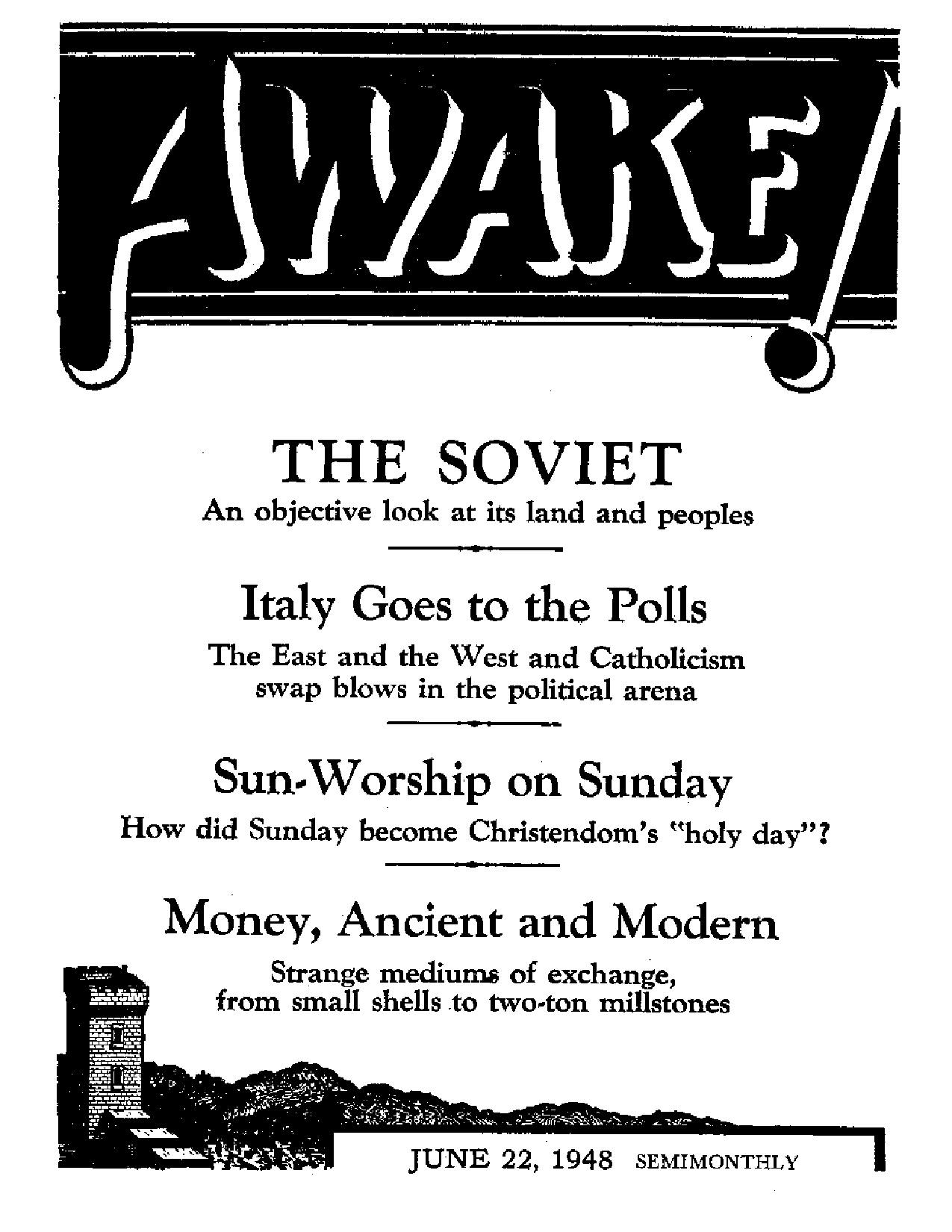
THE SOVIET
An objective look at its land and peoples
Italy Goes to the Polls
The East and the West and Catholicism swap blows in the political arena
Sun-Worship on Sunday
How did Sunday become Christendom’s "holy day”?
Money, Ancient and Modem
Strange mediums of exchange, from small shells to two-ton millstones
JUNE 22, 1948 semimonthly
The mission of this journal
News sources that are able to keep you awake to the vital issues of our times must be unfettered by censorship and selfish interests. "Awake!” has no fetters. It recognizes facts, feces facts, is free to publish facts. It is not bound by political ambitions or obligations; it is unhampered by advertisers whose toes must not be trodden on; it is unprejudiced by traditional creeds. This journal keeps itself free that it may speak freely to you. But it docs not abuse its freedom. It maintains integrity to truth,
"Av/ake I” uses the regular news channels, but is not dependent on them. Its own correspondents are on all continents, in scores of nations. From the four comers of the earth their uricensored, on *the- scenes reports come to you through these columns. This journal’s viewpoint is not narrow, but is international. It is read In many nations, in many languages, by persons of all ages. Through its pages many fields of knowledge pass in review—government, commerce, religion, history, geography» science, social conditions, natural wonders—why, its coverage is as proud as the earth and as high as the heavens.
“Awake I” pledges Itself to righteous principles, to exposing hidden foes and subtle dangers, to championing freedom for all, to comforting mourners and strengthening those disheartened by the failures of a delinquent world, reflecting sure hope for the establishment of a right-eous New World.
Get acquainted with “Awake!” Keep awake by reading “Awake!”
Published Semimonthly by WATCHTOWER BIBLE AND IJRACT SOCIETY, INC,
117 Adams Street
N. H. Knorr, President
Five cent* a copy
should be sent to office In yow coon-try Id compllscice with regulationa to guarantee safe delirary of money. RemlttaDCcs ire accepted at BrooJdya from countries There bp office la located, by iQterDBtlonal money order only. Subscription rates Id different countries are here stated In local currency. , -
Notice of Mptnrtlm (with renewal blank) is sent at least two issues before jsufcscriptlnn eiplres.
Brooklyn 1, N. Y„ U. & A.
Grant Suiter, £tecret<wp One dollar a year
Change of adrfnm when sent to our office may be expected effoctite within one mouth. Send your old as well aa new address.
Offices Teirlj Subscription Rate
America. U.S., 117 Adams St.. Brooklyn 1, N.Y. $1 Aastralfa, 7 Beresford Rd., Strathfleld, N.B.W. 6s Canada, 40 Irwin Are., Toronto 5. Ontario |1 England. 84 Craven Terrace, London, W. 2 5s South Africa, 623 Boston House, Cape Town 6b
Entered as secoiri-claM matter at BreoUyn, N. L, Act of March 3, 1879. Printed In U, & A
CONTENTS
The Soviet
Kazakhstan—Russia’s “Golden West”
Soviet Central Asia
The Ukraine
Five New Soviets
Is Russia Rooting Out the Other Hogs? 8
Olympic Games
Winter Olympics, 1948
For Feminine Fancy
Italy Goes to the Polls
The United States Participates
The Vatican in the Political Arena
Campaign Reaches a Climax
The Election Results
Nazi and Fascist Armies Called “Christian” 16
Sun-Worship on Sunday
“The Day of the Sun” in Christendom
Money, Ancient and Modern
Other Mediums of Exchange
Strangest Money
“Thy Word Is Truth”
An Everyday Sabbath for Christians
“The Highway of Liberty”
Watching the World
THE SOVIET
An Objective Look at Its Land and Peoples
THE Union of Soviet Socialist Republics is the most enormous nation in the world. An empire of many countries and peoples under one centralized authority. Expanding across two continents to cover an area of 8,389,300 square miles, or one-sixth of earth’s land surface, the USSR is three times as large as the United States, bigger than all North America, the size of four Eu-ropes. Can you visualize a journey from Finland to Alaska., then south to Japan, back west across the top of Mongolia, China and India, and north via Turkey and Poland to Finland again? It can be made without lifting a foot off Soviet soil, almost. Russian territory reaches to within 56 miles of Alaska and 8 miles of Japan. From the Arctic ocean south to Afghanistan (2,700 miles wide), from Poland east to the Sea of Japan (6,000 miles long) the Red flag flies, over rivers, seas, lakes, plains, steppes, mountains, plateaus, deserts, taiga and tundra. If a visitor were allowed to explore the length and breadth of this vast, inscrutable domain, he would encounter every degree of climate, from a perpetual polar blast to the scorching sunblaze of the desert. Rare is the form of vegetable or animal life that is not known within the Soviets. While America boasts of being earth’s richest nation, it would be wise not to overlook the scope of Russia’s natural resources; her minerals, oil, water power, agriculture, and timber abound to the extent of making the Soviet Union more nearly self-sufficient than any other nation. A goodly 90 percent of this wealth lies untapped in '‘cold storage” in Siberia, a region of forest jungles and frozen wastes twice the area of the United States.
There is a Russian proverb that "Russia is not a country; it is a world”. In terms of population that boast is by no means groundless when you reflect that 11 out of every 100 persons on the globe live within the Soviet Union. It claims 193 million population. These inhabitants embrace a greater number and variety of distinct and separate nationalities and racial groups, both large and small, than any other country. Amazing as it sounds, there are 189 distinguishable races, nationalities and tribes, speaking 150 different languages or dialects, all living behind the Soviet iron curtain.
Racial Divisions
While, like the American Indians, the racial groups or tribes may be many, yet in most eases there are enough likenesses and relationships among large numbers of tribes to make it easy to lump big blocs of the Soviet peoples into a few outstanding racial divisions. The largest such racial division is the Slavs, who total about 151 million. The Russians proper, or G-reat Russians (103 million), are classified as Slavs. It is the Russians proper that constitute. the core of Soviet strength. They are settled, more or less strategically, throughout the Union of 16 Socialist Republics that make up the USSR, with the majority of.their numbers concentrated in the vast republic named after them, the Russian Soviet Republic.
Next in imminence among the Soviet Slavs are the 27 million Ukrainians, occupying the rich industrial and agricultural Ukraine Republic that borders on the Black sea and'the Sea of.Azov. The Byelo-Russians (White Russians), with 81 million, are third in numerical rank among the Slavs; and they dominate the republic bearing their name, located between the Ukraine and the Baltic State republics. Divided about equally between the Ukrainians and Byelo-Bus-sians are 2,200,000 Poles and 250,000 Bulgarians. These altogether round out the bloc of Soviet peoples called the East Slavs. In religion the Soviet or East Slavs are Orthodox Catholic, stemming from the Greek Orthodox Church.
The bloc of Soviet peoples having an Asiatic background are collectively known as Turko-Tatars, or, better, Mongols. Some 21. million strong, the. Mongols, like the Slavs, are scattered broadly throughout the Soviet domain. Being originally a horde or series of hordes of fierce warriors led out of Asia by Ghen-ghis Khan and Tamerlane, they, during the 13th and 14th centuries, swept in wave after wave from the east, far into European Russia to the banks of the Volga and beyond. So mighty were these Asiatic conquerors that, for a time, they levied tribute even from the Russians proper, the Great Russians. Later, as the movement of invaders receded back eastward, the Mongols left behind permanent island settlements along the Volga, in the Crimea, and on the western shores of the Caspian sea, retiring finally to Central Asia and beyond. The prevailing religion of the Mongols is Mohammedan; but many, like the Yakuts, have been converted to Greek Orthodoxy.
. In the Caucasus and Transcaucasus lives a'group of peoples, about 6 million in number, which includes the picturesque Armenians, Abkhazians, Georgians, Kurds,'Kabardins and others. They speak a common language which, curiously enough, is close to the Basque in Spain and France. Collectively these kindred races are called “Japhetic”, after their ancestor Japheth, the second son of Noah. The Japhetic peoples are mixed in their religions, some being Mohammedans, some Greek Orthodox, while the Armenians adhere to their own special brand of “Christianity”.
Among other racial groups, the Soviet Union claims one-third of the world’s Jewish population, about 5,200,000. Next to the Jews are, perhaps, the 44 million Einno-Ugrians. Other minorities include the Latvians, Lithuanians, Moldavians, Germans, Iranians, etc.
The Sixteen Soviet Republics
Soviet Russia is a mighty imperial power, embracing one sixth of the earth’s land surface, dominated by the Russian racial majority. Under czarist rule the 1S8 or so minority peoples were scandalously exploited and downtrodden by this Russian majority. The Bolshevik revolutionaries, who bloodily obliterated the Czarist-Church tyranny in 1917, were no less covetous of the whole empire than were the czars before them. Like Winston Churchill’s determination to see that the British Empire is not liquidated, so was the Communists’ to sec that the Russian empire would not be, in the long run, liquidated. But how to soften the hatred of the minority peoples for the obnoxious Russian major-ity! Well, the British had counteracted a similar hatred somewhat by declaring a number of their colonial possessions, such as Canada and Australia,- to be independent republics or commonwealths within themselves, on a par with each
other and with the British Isles themselves, all together making up the British Commonwealth of Nations. This, played down the role of the British race. It made the colonial peoples feel more independent, more a part of the powers that ruled.
Now why could not the Russian empire under Communism be manipulated in somewhat the same manner? True, the Russian empire was not divided by land and sea; it was all intact, all one boundary. The thing to do was divide it up among its racial groups. Make the area where some sizeable racial group dominated an “independent” republic. Let the culture, language and customs of that particular racial group more or less prevail within, its own ^republic”. Let each republic be named after the racial group that dominated it. Hence the area of the Ukrainians would be called the Ukrainian Republic, the area of the Kazakhs would be called the Kazakh Republic, etc. Where the Russian race dominated nu-merically there would be just one more republic, the Russian Republic. That would play down the role -of the traditionally hated Russians. Finally, in 1940, with the extension of Soviet frontiers into Europe, the number of republics had grown to 16, the present figure.
And now for a glimpse at some of the countries and peoples contained within the more outstanding Soviet Republics.
Kazakhstan—Russia’s “Golden Wes?’
For the American to visualize the Soviet Kazakhstan, h,e would have to fill his imagination with a country as big as the combined western states of Washihg-ton, Montana, Idaho, Wyoming, Nevada, Utah, Colorado, Arizona, and New Mexico. The climate, the scenery, the natural resources, and the business of stock-raising in these Rocky mountain states resembles Kazakhstan. The Kazakhs are a cowboy-like people of medium build, black hair, and swarthy complexion. They are, in fact, one of the racial ancestors of the American Indians. Since early childhood they practically lived on the backs of their small wiry horses. Their basic clothing is sheepskin and felt. In religion they are' Moslems. The land of the Kazakhs, sprawling 1,600 miles, in a shapeless oblong from the Caspian sea to China, and a thousand miles from the Trans-Siberian railway south to the Uzbek Republic, is the second-largest republic in the Soviet Union.
Its population of 6,450,000, roughly that of the .above-named American states, is about half Kazakh and the other half divided between Russians and U-krainians. Under czarist rule the Mongo 1 o i d K a-zakhs writhed in perpetual rebellion. They led a nomadic existence, roving about over steppe and desert with their oxen, sheep, and horses, carrying their tents and scanty possessions on the backs of camels. But along came the Communist regime to collectivize the Kazakhs and harness their restless, turbulent spirits for the purpose of exploiting the rich resources, of Kazakhstan.
Within the million-square-mile area of Kazakhstan is stored more than half the Soviet Union’s total known deposits of copper, lead, and zinc. The Kourrad copper mine on the desert shores of Lake Balkhash is the Soviet Anaconda. There is gold ore near the Sea of Aral. Steam shovels scoop up the surface seams of the Karaganda coal basin, the third largest in the USSR. The Emba oil fields, near the Caspian sea, furnish almost a third of the Soviet petroleum supply. In agriculture Kazakhstan’s vast steppes rank among the most fertile in the Soviets, the northern farmers growing wheat and rye, and the southerners growing cotton, sugar beets, rice, and many varieties of fruit. The capital of the Kazakh Republic, a beautiful city built on a height in view of snowy sun-tinged mountains, is called “Alma-Ata”, which means “Father of Apples”. So much of the Soviet movie industry has moved here that Alma-Ata is called the Hollywood of Soviet Russia.
Soviet Central Asia
The Kazakh Republic and four sister republics south of it (Turkmenia, Kirghizia, Uzbekistan, and Tadzhikistan) all together make up what is called Soviet Central Asia. Under czarist rule this country was called Turkestan.
When it comes to a story of brutal conquest, oppression and exploitation, Turkestan can tell a prize winner. Drawn in eloquent contrast to its many conquerors and Moslem priestcraft who ruled in magnificence are a people inured to poverty, ignorance, and superstition. Its ancient cities of Holy Bukhara (second only to Mecca as a Moslem “Holy City”) and Golden Samarkand flourished with religious mosques and minarets and the finest architectural splendor in the Moslem world—as well as the most be-darkened, impoverished masses. Capital of the Soviet Uzbek Republic, the city of Samarkand was anciently the jeweled mingling cup of the commerce, art, and civilizations of the ancient and medieval
East with the Persian, Turkish, Indian, and Chinese.
In 328 B.C. Alexander the Great established Greek rule over Central Asia. Almost a thousand years later the Arabs sacked Samarkand and set up a Mohammedan state. In the eleventh century the Seljuk Turks conquered the country. In 1221 the Mongol horsemen of Genghis Khan overran, plundered and ravaged it. Tamerlane followed in the next century and with his overflowing hordes founded an empire in which Samarkand was made his headquarters, and upon it he lavished the riches and luxuries of the bloodstained spoils taken from far-flung conquests. After Tamerlane various Moslem khans and emirs divided Central Asia among themselves, quarreling and fighting over its possession, until the Russian czar annexed the territory to the Russian Empire, a part of which it remained until 1917.
Following the Communist seizure, Central Asia was once more bathed in human blood, this being the price of enforcing the new Soviet form of absolute rule over it; counter-revolutionary forces were resisting Soviet authority as late as 1931. The 17 million peoples inhabiting the five union republics of this huge Soviet domain, a country seven times the size of .France, enjoy no heritage of freedom.
What is new to its peoples today is the dawn of the Soviet industrial revolution. Highland farmers carry soil from the valleys uphill in baskets on the backs of donkeys, men, and women, while regiments of newfangled machinery rumble as collectivized natives terrace the eroded hills. Plains dwellers eke out a tenuous existence by utilizing the last drop of water, while a mighty scientific project of wind-rowing and irrigation moves in upon them. By such means the Soviet regime is reclaiming immense areas of Central Asia, especially in the Uzbek Republic. In fact, the southeastern part of Uzbekistan is collectivized into huge cotton plantations which produce percent of the Soviet cotton supply.
The Ukraine
While Kazakhstan is second to the Russian Republic in area, the Ukraine Republic ranks next to it in riches and population. It just about equals France in size and population (one-fifth of all the Soviet inhabitants live in the Ukraine, making it vthe most densely settled republic in the Union).
In 1939 the Ukrainian Republic acquired seven million new citizens and a large hunk of territory by the annexation of southeastern Poland. In the summer of 1940 it absorbed another million people and still more territory when the USSR seized from Rumania the province of Bessarabia (which once belonged to the Russian Empire), and the province of northern Bukovina (which never before belonged to the Russian Empire). A strip of Black sea coast, ranging from 50 to 75 miles in width, was added. This brought under Soviet-Ukrainian control an area of land which runs for more than 100 miles along the north bank of the commercially and politically vital Danube river in Europe.
The Soviet Ukraine possesses huge mineral deposits of coal and iron ore. Its big rivers, like the Dnieper, the Bug and the Dniester, are capable of producing tremendous reserves of water power. The rich Donets Basin and three great cities of Kharkov, Kiev, and Odessa are among its'crowning assets. Yet it is in the realm of agriculture that the Ukraine stands out head and shoulders among the Soviet republics. Here is both the “bread basket” and the “sugar bow!’ of Russia. Endowed with a mild climate, ample rainfall, broad rivers, and flat rolling plains, the Ukraine produces not only wheat and sugar but many other food crops on a vast scale. Its highly collectivized peasantry raise millions of head of cattle, pigs and sheep. And the land on which they toil is famed for its high-grade orchards of apples, plums and cherries.
More than any other Soviet territory, it was the Ukraine that bore th« brunt of Hitler’s "holy crusade”. Almost the ■whole republic was overrun during the first six months of the invasion, and large sections were held as late as the spring of 1944. More soldiers than the Axis powers threw into the first world war, at least 240 divisions, avalanched across-the Ukraine and surrounding sections, occupying an area of 6$),000 square miles. This territory included 40 percent of Russia’s farm output, 40 percent of her grain land, half the potato fields, 85 percent of the sugar beet area, 60 percent of the sunflower acreage (source of vegetable oil). For the United States to suffer an equal loss an enemy would have to seize all of Ohio, Indiana, Illinois, Iowa, Missouri, Wisconsin and southern Minnesota. Hitler hoped to feed his ’world conquest out of the Soviet bread basket and sugar bowl. But in front of his oversweeping tide millions of Ukrainian farmers evacuated, taking with them their machinery and 60 percent of their grain harvest. Their livestock they either freighted out or consigned to the Red army, and all else that they could not move they destroyed by a scorched-earth policy. The bread basket and sugar bowl were left empty.
Five New Soviets
During the first year of World War II the big Soviet bear reached out its' powerful paw and gathered in five new union republics. (These were the Karelo-Fin-nish, the Estonian, the Latvian, the Lithuanian and the Moldavian Soviet Socialist Republics.
As her price for losing the Soviet-Finnish war, Finland surrendered 19,000 square miles of land to the Karelian autonomous republic, which was then declared the 12th full-fledged Soviet Republic. This land of shimmering lakes, rushing waterfalls and teeming animal life provides a thriving paper and cellulose industry, and in its southern part dairying and vegetable-raising flourish.
The Finnish claim was signed, sealed and delivered in March 1940. In midJune that same year, while France was crumbling under Hitler, Soviet troops stole a blitzkrieg on the Nazis by crossing over and occupying the three Baltic States of Estonia, Latvia, and Lithuania. Two months later all three were declared new Union Republics by the Supreme Soviet. Meanwhile the Moldavian Soviet was annexed.
Is Russia Rooting Out the Other Hogs?
What lies behind this Soviet policy of expanding its boundaries at the expense of lesser countries and peoples? Is it proof that “the Communist leaders of Russia are merely continuing the, old policies of the Romanoffs; the same irresistible steamroller expansion across Europe and Asia”? From the years 1939-1945 the Soviets have expanded by outright annexation some 250,000 square miles, or about 3 percent. In Europe she has soaked up the Petsamo and Karelian districts' shyloeked from Finland, the Baltic States, the northern half of East Prussia, the eastern half of prewar Poland, Ruthenia, Bessarabia and northern Bukovenia. In Asia she has absorbed the southern Sakhalin island, the Kuriles and Tannu Tuva from Japan. The annexation of this territory is a partial restoration of the Russian empire of 1800, lacking only about 75,000 square miles. Is it the aim of the Soviets to restore the czarist boundaries? If so, then that goal is all but gained.
It is the other colonial powers that have bulged all out'of proportion during this same 150 years. From 1800 to 1914 more than half the earth’s surface changed hands. The United States expanded from 800,000 square miles to 3,800,000 square miles. The British Empire quadrupled from 2f million square miles to 11J million square miles, adding another million as her share of the loot from World War I. From her 200,000 square miles of European soil, the French empire grew until, at the end of World War I, it boasted 4 million square miles. Had Russia expanded at the same proportion since 1800 she would have by this time laid hold on a good half of the land surface of the globe. All make their claims, but the scripture is still true, “The earth is the Lord’s, and the fulness thereof .’’—Psalm 24:1.
But is not the dreaded Soviet monster getting all set to seize world control, even now? The ears of her enemies tingle with fear of the rising tide of Communism throughout Europe and other nations. What about the 11 million or more Communists who are organized into powerful political blocs in nations like France and Italy? What of the Communist regimes now taking control of one country after another—Yugoslavia, Hungary, Czechoslovakia? Are not all these and other deadly maneuvers directed from the same Soviet headquarters in Moscow that rules the’ Soviet Union? What means should earth’s other gluttonous empires use to- stamp upon the outreaehing paws of the growling Russian bear?
Quailing with fear, the hearts of men everywhere are stirred by a frantic religious and commercial hierarchy, and the drumbeats of another world conflagration are heard. Man’s United Nations idol appears a sorry hope to cling to. These are the “last days” of this world as foretold in God’s Word of truth, the Bible. While on the one hand the leaders of this reeling world scoff when reminded that this age has reached its consummation as Scripturally foretold, they turn right around and cry forth in their own words the very same fact, that thes age has-reached its consummation. Verily this is the time foretold when “He that sitteth in the heavens shall laugh: the Lord shall have them in derision”. (Psalm 2:4)—Contributed.
OLYMPIC GAMES
LIKE music a good athletic performance has cadence, modulation, harmony. Flexing rhythm pervades muscles in motion. To witness Charley Paddock’s famous, flying finish in the 100-yard dash; to watch Gordon Wren make his 224-foot Saint Moritz ski jump, coasting at mounting velocity down the runway, 321 feet from the bottom of the incline, then flying away from the take-off into giddy heights, with a flawless landing in split seconds; to gaze at figure-skater Barbara Ann Scott, “graceful as a ballerina,” also in this winter’s Olympics; or Jack Lovelock holding himself in leash then crushing his opponents with that long dynamic burst of speed;, or Pat O’Callaghan swinging the sixteen-pound hammer aloft, turning once, twice, three times, and even four, “a whirling mass of co-ordinated mind and muscle, and finally launching the great ball so that it soars away on high and plunges down again to earth some 200 feet away”—to. see these performances is to watch music in motion.
Like artists with different instruments, each sportsman renders a different but harmonious muscular feat of accomplishment
What was the origin of the Olympic games ? Olympia was one’ of the smaller cities of the Greek peninsula, Peloponneses. Situated in the fertile Alpheus river valley in southwest Greece, about ten miles from the Ionian sea, the games of Olympia came to surpass those of Athens and Corinth. Wheat, barley, grapes and olives, the chief products of ancient Greece, grew abundantly on the river banks (now called Ruphia). The stadion (from which we derive our word “stadium”) was measured for races on the gentle slopes. To the winners was given the “athlon” or prize; and’this word is the root of the English word “athlete”.
Tradition has it that the games were inaugurated as a religious festival in honor of the Greek god, Zeus. Although in size but a trifle larger than Maryland, Greece became a dominant world power. Their games were connected closely to their religion, and “the Olympic games were the outgrowth of athletic festivals held in various localities in ancient Greece”. Some authorities ascribe the origin to “funeral games in honor of Pelops, a tribal chieftain”. Apollo, one of the chief gods of manly achievement, was worshiped as a patron of the games. The importance of these festivals, which were held every four years, is evident from the fact that the Greeks counted time by these four-year spans, termed Olympiads. The first of record occurred in 776 B.C. The games continued until A.D. 392, a total time period of 1,168 years.
In 1896 the first revival of the games was appropriately held in Athens, Greece'. In ancient Greece all wars were held in suspense in honor of the games; but modern civilization has three times suspended the games while competitors fought wars with each other. England last held the games in 1908; while this, year they are scheduled between July 29 and August 14, the main events to take place at the great stadium at Wembley, near London. While major interest will center in the competition in the Olympics program of sixteen different sports and a combined event called the “pentathlon”, Britain has gone all-out for entertaining visitors with four days of rowing and two days of canoeing at near-by Henley, “one of the best and loveliest regatta courses in the world,” and yachting at Torquay, and cycle racing at the Herne Hill and Windsor Great Park. Al! these amusements occur almost simultaneously, evincing the postwar fever for sport. The Olympics include swimming, boxing, wrestling, track races, weight lifting, vaulting, and hammer throwing.
The British have observed higher standards of fair play than most countries, and they quote the words of the founder of the modern games, Baron Pierre de Coubertin: “The important thing in the Olympic games is not winning, but taking part, for the essential thing in life is not so much conquering as fighting well.” The British writer adds: “Our international reputation in sport stands high today because we have fulfilled those1 obligations in the past, not because of any sweeping victories.” {Manchester Guardian, April 8)
Winter Olympics, 1948
The writer might have had in mind some of the disgraceful controversies of the winter sports competitions of the Olympic games held in Saint Moritz this January. Newsweek of February 9,1948, reports that disagreements included the sabotaging of the American bobsled, loosening nuts, breaking pushers; a fist fight which ended a hotkey game between Canada and Sweden; speed skaters in eleven countries threatened to strike over racing rules; two Olympic committees’ dispute over a dispute required police intervention. Therefore when President Enrico Celio of Switzerland said that the games were “a symbol of a new world of peace and good will everyone thought he was carrying the ostrich idea too far”. The twenty-eight nations represented quite evidently were some of the United Nations, friction included.
In the outcome of these winter Olympics Sweden, Switzerland, and the United States took first, second and third place respectively. One of the most spectacular events was the figure skating of nineteen-year-old Barbara Ann Scott, whose victory created quite a furore in her native Canada. Wired Prime Minister McKenzie King: “From one end of Canada to the other there is great rejoicing.” The Americans won the bobsledding by a time of over five minutes for the four-mile course, and the men’s figure skating. Perhaps the most amazing victory was that of Gretchen Fraser, in the women’s slalom, a difficult type of skiing. Gretchen is a Vancouver, Washington, housewife. Generally, the skiing events went to the inhabitants of the “north countree”; in the eighteen kilometer cross-country race, of twenty finishers the first nineteen were Scandinavians. Fortunately, none proved the wag’s axiom: “Skiing is the shortest distance between two trees.”
-J
Jehovah looketh from heaven; he beholdeth all the sone of men, There is no king saved by the multitude of a host: a mighty man is not delivered by great strength, A horse is a vain thing for safety; neither doth he deliver any by his great power. Our soul hath waited for Jehovah: he is our help and our shield.
—Psalm 33:13, 16, 17, 20, Am, Stan, Ver,
For Feminine Fancy
Tty Shortage of Marriageable Men
The Census Bureau reports sev-eral hundred thousand more women / ^an men States,
>JLh but this does not mean a £f woman surplus” or a “husband shortage”* If you ladies are between 20 and 44 years old, you can revel in the statistics that there are 2,000,000 more single men than single women in that age group* Counting in widows and widowers and divorced, besides the single, there is still a surplus pool of 800,000 marriageable males* But if you are 65, yet still yearn for love and connubial bliss in springtime and Junetime, you are justified in taking a gloomy view of your prospects and resigning yourself to spinsterhood, for in those higher-age brackets the husband shortage becomes an acute reality,
Work Too Hard
*3? The American housewife not only works too hard cleaning house, but also fails to remove enough dirt in the process. So claims Dr* Elaine Knowles Weaver, home economist. Her survey of 24 typical homes over a period of time revealed that the use of more modern electrical equipment and following professional advice resulted in a 36-percent reduction in weekly cleaning time and a 185-percent increase in weekly dirt removal* Following their customary routine, the housewives spent an average of 5 hours 41 minutes weekly removing 10 ounces of dirt, which was later found to be only 34 percent of the dirt later removed with modem equipment* Evidently the other 66 percent was dust and dirt either missed entirely or merely “rearranged”. With the new equipment and professional instruction the weekly cleaning time was cut to 3 hours 38 minutes, and the dirt yield rose to 1 pound 12 ounces.
Trader in the Kitchen
H During the war the Raytheon Manufacturing Company of Waltham, Mass*, built a big tube called a magrmtron* This radar tube gives out energy convertible into heat* With the end of the war the Raytheon company started building ovens around their radar tubes, all enclosed in a tall, white, enamel and aluminum and stain^ less steel cabinet* The radio frequency waves move back and forth nearly 2J billion times a second, setting the food molecules to thrashing about, which agitation produces heat, which cooks the food* Because the waves penetrate the food, the inside cooks as quickly as the outside* Delicious steaks were cooked in 45 seconds; lobsters, 2 minutes; clams, 47 seconds; pork chops, 50 seconds; hamburger, 20 seconds; gingerbread, 25 seconds* The demonstrator apologized for the time required, explaining that the model used was obsolete and that newer models cut the time in half* ‘Sdty Wins Battle for Life
Meryl-Beth Kossak, born 21 _JHLf months prematurely and weighty "Ws iug a mere 1 pound 10 ounces, fought and won a three-month battle for life* Normal now, she weighs 5i pounds* Brought into the world by a Caesarean operation, the baby did not breathe at all for the first few minutes, with respiration thereafter irregular for some time, blue and cold, general condition poor, cry weak, and activity weak and almost nil* Her cheat showed a deep hollow where one lung simply never filled with air* The first day she was given only respiratory and cardiac stimulants* The second day she was fed by means of a tube inserted through her mouth and into her stomach, since she was not developed to the point of performing sucking motions. Her diet started out on sugared-water, then milk, with such aids as penicillin, saline and glucose water solutions and vitamins A, D and C, Gavage feeding through the tube ended about two months after birth, since she then was ready to suck* She was removed from the incubator that had been her home, and about a month later was taken from the hospital to join her parents in their home* She is one of the very few babies known to medical science ever to have survived the handicap of being born at such an early stage of embryonic development*
ITALY
GOES TO THE POLLS
^ALL the citizens sj 21 have the right to
associate freely in parties to compete in a democratic manner to determine the national policy.” Thus reads Article 49 of the new Italian constitution that went into effect on January 1, 1948. This constitution had been framed by a new assembly elected June 2, 1946, the first post-Faseist and postwar democratic election in Italy. The assembly was to be in power only long enough to frame this constitution for the Republic, and then a new election would be held,. The date for this new election was April 18, 1948, and announcement of this fact was made several months in advance to allow the different political parties time to exercise the rights granted to them by Article 49 quoted above.
It was a foregone conclusion that the political battle would be hard. Namecalling and mudslinging were well underway even before the actual campaigning had begun. The main contest developed between the strong “Demo-crazia Cristiana” (Christian Democracy) party and its bitter enemy the Communist party. Each side accused the other of not wanting, a free election. The Christian Democrats warned that the Communists plotted revolt to seize control of the government by force before an election could be held. The Qommunists retaliated that the Christian Democracy party was an instrument of the Vatican and the United States to be used against Russia in a future war. Not only was it the power of these two political enemies that indicated a bitter election struggle,
but also the fact that other elements outside Italy applied pressure on the Italian voters. The decision that Italy made on April 18 interested the world, and the world helped her make it.
The most popular method of campaigning used was posters. Usually they may be pasted only on specially designated walls. But during the campaign they were slapped on every conceivable kind of building, from churches to private homes. By poster the various parties accused, exposed, attacked and condemned their opponents. Without hearing a single lecture or reading a single pamphlet one could obtain a good idea of the issues in this political battle merely by walking down the street. To illustrate the method, one poster pictured ex-dictator Mussolini haranguing at his best, and above his picture are the words he spoke: “Peace, yes, but armed peace.” Right alongside of Mussolini's picture is that of President Truman, and he is quoted; “Peace rests on the strength of our arms.” Of course, this poster is one used by the Democratic Popular Front, which is the combined forces of the Communists and the left-wing Socialists. A poster used by the Demo-Christians showed a strong man representing the free Italian nation standing with one foot on the vicious red bear of Communist Russia and the other foot planted on selfish capitalism, represented by a horrible frog vomiting gold pieces.
Tons of paper carrying brief messages and political propaganda were dumped from airplanes to flutter their way downward over large cities and especially into public squares during a political rally. Such outdoor rallies on the public streets or squares caught the fancy of the people, and they responded readily. The radio and newspapers were also used, but they played a minor part in this campaign.
The United States Participates
Two powerful spheres of influence were interested in the outcome of the Italian election: the East under Communism, and the West under Democracy. With Communism already prevailing in many parts of Europe, the Western powers feared its spread into Italy. In the United States politicians, newspapers, churches and private individuals played what part they could to defeat Communism in the Italian election. On the Italian scene the American propaganda was that Communism must be stopped now, or face a third world war. The United States politicians made it clear to the Italian people that if the election favored the Communists it would be difficult for the United States to work with such a government in Italy. Italy would be cut off from the material aid of the European Recovery Program. A short time before the election the United States threw another bombshell into the ranks of the Democratic Popular Front by announcing that the United States favored Trieste’s going back to Italy. The Demo-Christians capitalized fully on the Trieste question and the prospects of material aid from the United States if the Communists were kept out Of power, and lauded these as examples of Uncle Sam’s generosity.
But leftist newspapers referred to this use of material aid as “blackmail” and foreign intervention in the democratic process of Italians choosing their own government. The Front declared that they were not against United States’ aid to Italy, but argued that they did not want Italy to become a dump for surplus American products, that it would destroy Italian industry and prevent the nation from taking its rightful place among other nations of the world. They were willing to do business with the United States, but wanted full liberty to do business with other nations as well, and to buy what they wanted.
Fearing the Communists, the United States propagandists have played into the hands of another totalitarian organization, the same one that blessed the Nazis and the Fascists, the one that has rifled Italy for many centuries past, the one responsible for the misery, ignorance, illiteracy and superstition of the Italian people, namely, the Roman Catholic Church. It worked hand in glove with Mjissolini, and every intelligent Italian in Italy knows that fact. It went all-out for the dictators of Europe when things were going their way. When the Axis powers held sway in Europe, Roman Catholic priests marched along with the victorious armies. Prelates all over Italy blessed the Fascists. Mussolini was referred to by them as the “Man of Providence”, and Pope Pius XI made the famous Lateran treaty with Mussolini, which treaty has been approved and voted into Italy’s new constitution. But now the right-wing dictators have fallen, and the Vatican fearfully looks around for another partner to fight a “holy crusade”. She has tagged the United States of America “it”.
The Vatican in the Political Arena
An overwhelming amount of evidence shows how the Catholic church influenced the election of April 18, 1948, and peppered out her political campaign speeches from the pulpits of every church and cathedral in Italy. Cardinal Schuster of Milan initiated the Hierarchy’s political campaign, declaring in a public letter to all under his diocese that all who supported or gave their vote to the parties of the left could not enjoy the sacraments of the church or receive absolution. This same letter explains that these ecclesiastical penalties are "medicinal, and that the church desires nothing better than the cure of her sick children.' If she refuses for some time the holy sacraments, she does like the doctor that forbids to the sick the same meal of the healthy, because they would be harmful to him”. The millions of Catholics who have become anticlerical will certainly never be brought back into the folds of the church by this kind of persuasion. All citizens of Milan well remember how Cardinal Schuster lauded Mussolini to the skies.
Soon after Schuster publicly showed that the church was against the Popular Front, other cardinals, bishops and priests followed his example, delivering their campaign speeches from the pulpit on Sunday mornings. Many sincere Catholics became thoroughly disgusted with the church’s interference in political matters and quit going to church. The churches bombarded their parishioners with political propaganda by circular letters, typical of which is the one sent out by Bishop Giuseppe Battaglia of Faenza, Province of Ravenna:
The date April 18 is destined to signal a decisive turn in the history of our Italy. We all have the duty of contributing to this date signal a true beginning of the Christian resurrection of our motherland. Hence, the serious duty, for those who have the right to vote, to go to the polls: It is a mortal sin to abstain from it; and the serious duty, for those who wish to be Christians, to vote for those who assure the defense of our faith.
As was to be expected, the pope himself gave political instruction early in the campaign. Quoting from his talk to an audience of priests at the Vatican Don Basilio, anticlerical newspaper, March 21, said:
It is your right and duty to attract the attention of the faithful to the extraordinary importance of the coming elections and on the moral responsibility that issues from them to all who have the right to vote. Without doubt the church intends to remain out of and above the political parties; but how can it remain indifferent to the forming of a Parliament, to which the Constitution gives the power to make laws in matters that regard so directly the highest religious interests and the conditions of life of the church itself in Italy ?
Campaign Reaches a Climax
During April the campaign intensified. Verbal combat was supplemented by violence. In various places throughout the nation the murder of aspirants for the left was reported. Communist party organs immediately accused the Christian Democrats of resorting to bloodshed and violence in order to bring about a civil war and thereby induce the United States to step into the fight, ousting the Communists and other People’s parties and establishing the party of De Gasperi in a dictatorship. In addition to this the Popular Front sought to lav hands on every crooked deal of the Vatican that could be brought to light and use it as propaganda against the church’s favorite. For instance, a certain Monsignor Cippico was caught stealing funds in Vatican City, but the Vatican did not publicize this fact until six months later, on March 4, 1948, after Cippico had escaped from Vatican City. The church sought to hush up this matter as much as possible, while the opposition gave the whole escapade a good airing. Such clerical sins as this were used to good advantage by the Popular Front.
The week prior to the election leaders of both the Communist party and the Christian Democracy party spoke before large audiences in Milan. Alcide de Gasperi said there on April 13, before an audience of 400,000 that thronged the same "Piazza Duomo” where Togliatti, the Communist leader, had spoken two days previously, that a secret pact existed between the Communists and Russia. He made a special effort to whitewash the Vatican, saying:
Aocnaationi are formulated against the Vatican. It is said that the holy see and Italian government are like two poles that are in contact all the time, plotting together, that try to solve problems together, that the Vatican is a center of international intrigue, who work even against the interests of the Italian nation: all this is founded on fantastic calumny, on malice and inductions similarly fantastic.
Two days earlier in the same square in Milan the Communist leader, Palmiro Togliatti, speke to an audience of 300,-000. He charged the opposition had promoted a smear campaign against the Communists, attempting to disseminate hate, fear, terror and panic among the people. He said that the Demo-Chris-tians were employing the same tactics as the Fascists, in that a trumped-up and false fear of Communism gave Mussolini the open door in Italy. “Who was it that used anticommunism to give the first dagger-stab at the democracy and unity of the Italian people? It was Fascism, it was Mussolini.” Touching the touchy subject of religion, which was probably the biggest issue of the campaign, Togliatti said: “Why then do the high hierarchs of the church, the DemoChristian party, or better yet the leaders of those who stand behind De Gasperi, conduct this battle against us as if we were enemies of religion, while there is no fact that justifies their position?” Togliatti’s claim was (hat the Front opposed the misuse of religion as a political power to rule and block the “advance of progress and social justice”.
The two above-mentioned speeches of Togliatti and De Gasperi were the las: important ones of the campaign, a campaign that doubtless, like ail political campaigns, contained plenty of smears and lies on both sides. Both parties had presented to the Italian people similar promises: to restore the economy of Italy, to rebuild Italy as a great nation able to provide decent livelihood, to maintain peace, to prevent entering a JUNE 22, 1948
third world war, to eliminate unemployment and to preserve the four freedoms of a democratic state. They differed in that if the Front had won the election it would undoubtedly have made many drastic changes in the policy of the government. Whether it would have gone completely to Russia is hard to say. At least, the Front denies such a charge. This party fought a hard battle against the Roman Catholic Hierarchy in Italy, net because of doctrines or religious issues, but because the Vatican as a political organization plunged into the political picture of this present election^ and also because the Vatican has proved herself to be a supporter of dictators and an opponent of true democracy.
The Election Results
Finally came April 18, election day. The rumors that were racing about that, the Communists would not wait for the election but start a wave of riots beforehand proved to he anticommunist propaganda. No violence occurred during the two days of voting, Sunday and Monday, April 18 and 19. There was complete tranquillity. More than twenty-five million persons went to the polls and gave their votes for one of the twelve or more parties written on the ballot. The Christian Democrats reaped more than twelve million votes. More than eight million voted for the Popular Front. The Christian Democracy party now has the majority of seats in Parliament, The president would be the choice of this Parliament, and all his ministers would be men who approved the politics of his party. Needless io say, the election results were gratifying to the Western democracies, and happy expressions were forthcoming from the lips of the leaders of these nations.
But what about the supporters of the Front? What will they do now? Their ideas are as far apart from those of the Christian Democrats as is Russia from the United. States, in the Christian De-
moeracy party are the former supporters of Fascism, the big land owners, industrialists, the clergy with their religious subjects, and many millions who fear Communism and its effects. In the Democratic Popular Front party are the Communists, Socialists and masses of people who despise the old system and want a radical change. To bring about the change this system would make the state supreme, ignore minorities and individual liberties, in order to reach their goal. And the people, once slaves to priests and rich landowners and industrialists, would become slaves of the state. Hence it is seen that both man-made parties are a menace to the peace, happiness and prosperity of a free people.
The Democratic Popular Front laments that the clergy repeatedly violated the electoral laws of the Republic in the political campaign, that they not only influenced, but intimidated Italian voters by threatening excommunication and removal of the sacraments and absolution from any Italian Catholic who voted contrary to the church’s wishes. They also claim a decisive element of the electoral results was the foreign intervention. Referring to this the newspaper Avanti, April 21, 1948, said voters for the Front “have resisted the threats and the allurement, the bread of America and the hell of the church”.
Such accusations and observations by the left were denied by De Gasperi. He did not deny, however, that the church had entered the political campaign. It was reported that 100,000 priests and 152,000 nuns took part in the election and, of course,-voted for the Vatican-sponsored party. The sick and disabled lodged in Catholic hospitals and in old folk’s homes were moved, if at all possible, to. the polls to give their votes for the Demo-Christian party.
In a way, the Italian election may be interpreted not so much as a victory for the Christian Democrats as a defeat for the Catholic church. Italy is predominately Catholic. Catholicism is the state religion. Notwithstanding this, eight million Italians refused to be intimidated by Hierarchy propaganda and voted for the Socialist-Communist Front. That there would be in Italy eight million people against the church in Vatican-controlled Italy as against twelve million for it, is something unexpected. De Gasperi lamented: “It is a shame.”
And yet, it is a worse shame that this system has kept Italy shackled for more than 1,500 years. The handwriting on the wall indicates that political religion is near its end. Organized religion will rbap a whirlwind harvest as a result of her sowing of hate, war, murder and political chicanery. Liberty-loving persons in Italy and all other nations will escape a share in this whirlwind to be reaped by abandoning such worldly religion and turning to the true worship of Jehovah God and Christ Jesus. Instead of lending support to the political parties of this present evil world, they will give their allegiance and service to Jehovah God’s King of kings, and Lord of lords. —Auwtel correspondent in Italy,
J'fgxi and Fascist Armies Called “Christian”
John O’Donnell, in his column “Capitol Stuff” in the New York Daily Netos, March 1G? emoted profusely about the peril to the Roman Catholic pope in the event the Communists should win the elections in April* He pooh-poohed as “silly stories” the speculations a few yeHrs back that the pope would seek
refuge in a neutral country because Italy and Rome were under Hitier-Duce control No reason for flight, said O’Donnellj for “after all, the armies under Der Fuehrer and Il Duee were Christians and the majority were Catholics”* According to O’Donnell,
greatest peril came to the pope when “F*D.R, gave his OK for Americans to bomb Rome”,
w A/T0EE twenty-five iHshfe w 1V1 centuries ago the ft prophetEzekiel saw twenty-< ' five men in Jerusalem facing the east, (Ezekiel 8:16) Behind them was the temple of the Lord. They professed to be worshipers of the true God Jehovah, but what they were doing proved them to be otherwise, Right there in the temple court, standing between the porch of the temple and the grqat altar, those men were actually worshiping the sun, in direct violation of Jehovah God’s express command ! In no uncertain language, Recorded nearly nine hundred years previously, at Deuteronomy 17:2-5, Almighty God declared: “If there be found in the midst of thee, within any of thy gates which Jehovah thy God give th thee, man or woman, that . . . hath gone and served other gods, and worshipped them, or the suit, or the moon, or any of the host of heaven, which I have not commanded, . , , thou shalt stone them to death with stones.”—Am. Stan, Ver.
Thus the new-born nation of Israel was warned not to bring out of Egypt any of that land’s sun-worshiping practices. Instead of worshiping the sun they were to worship the God who made the sun, and thus be protected from the idolatrous practices of the heathen and pagans round about. The whole subsequent history of Israel shows that when they were faithful in their -worship of Jehovah they prospered, but when they forsook His pure worship and turned to the worship of Baal they suffered. Baalism was sun-worship, a form of devilworship, in which idols, images, horses and chariots were dedicated to the sun. When good king Josiah cleaned out the Baal worshipers that were polluting the land in the seventh century B.C., it is recorded, at 2 'Chronicles 34:4 (margin) : “And they brake down the altars of Baalim in his presence; and the sub-images, that were on high above them, he cut down.”—See also 2 Kings 23: 5,11; 2 Chronicles 14: 5, margin.
Sun-worship, if traced back to its origin, is found to stem from the worship of Nimrod, who represented the Devil and who was regarded after his death as the “illuminator and enlightener” of men. This places the origin in the cradle of organized religion as it was established in the valley of the Euphrates following the Flood. From that common source sun-worship was taken along by the various races of people as they spread out over the earth after their languages were confused at the Tower of Babel. This explains why, among nearly al! the primitive races, worship of the sun was the center of their special rites and ceremonies. Though called by various names, basically they were similar. There was the worship of Baal by the Phoenicians, of Molech by the Ammonites, of Hadad by the Syrians, of Mithras by the Persians, of Surya by the Hindus, of Ra by the Egyptians, and all of them were centered in the sun.
From Scandinavia to the land of the Hottentots, and from Alaska to Peru, worship of the sun, and worship of fire that is closely related to sun-worship, made up the principal core of paganism.
Golden images of the sun were fauna in the temples of the Peruvian Incas, In Mexico the sun was pre-eminently above all other gods. The North American Indians considered their ‘‘peace pipe” a gift from the sun, and in smoking it they passed the pipe in a circle, to represent the sun's course. In comparatively modern times the Yezidis of Kurdistan, who openly profess to worship the Devil, as did their ancient ancestors, hold their wildest celebration in honor of Sheikh Shems, the sun.
On this matter of pagan worship of the sun, or heliolatry, McClintock & Strong's Cyclopedia says:
The worship of the great orb which insures to us light, warmth, and life is as ancient as history. It existed in the earliest ages among the Phoenician^, Egyptians, Persians, and Hindus, and later among the Greeks and Romans of the West, venerating its object under the different names of Helios or Sol, or of Baal, Osiris, or Mithras. Various forms of sacrifice and prayer characterized this worship among the different nations, but they agreed in regarding the sun as a mighty and superior deity who ruled the world with an independent authority more or less complete, , . . All Eastern nations considered it as practically the supreme divinity. The Romans, too, maintained the worship of the suit after Heliogabalus had introduced it and had built a temple to Sol,
Sun-Worship in the Roman Empire
By the time Rome reached the zenith of her splendor under the Caesars, the imperial city became a melting pot for the many sects and cults of paganism that practiced sun idolatry. Rome's “craze for foreign deities went to unheard-of extremes”, says the Encyclopedia Americana, “going so far afield as Persia, from which was introduced the great sun god, Mithras, with his elaborate mystical worship, which became very popular in the imperial city/' The Saturnalia celebration, held in December with great din and uproar, was in honor or cue renirrn' or the sun ai me winter solstice, and December 25 was called the Natalis invicti solis, meaning “the birthday of the unconquered sun”.
Around the calendar, every day of the week, the pagans of the Roman empire worshiped their demon gods. Each day was set aside for special devotion to a particular planetary7 god or goddess— Sun, Moon, Mars, Mercury, Jupiter, Venus, Saturn—a system of mythology that was dreamed up by the stargazing astrologers of Egypt. To this day the names of the days of the week are the same as the original Latin or Teutonic equivalents. And to this day the first day of the week is the sun’s day, the day &et aside by pagans for their indirect worship of Nimrod and the Devil* Says The Century Dictionary: “The name Sunday, or ‘day of the sun\ belongs to the first day of the week on astrological grounds, and has long been so used, from far beyond the Christian era, and far outside of Christian countries.”
"The Day of the Sun” in Christendom
It is understandable why centuries ago the heathen who knew not Jehovah God set aside, in their ignorance and superstition, a special day for worshiping the sun, but it is difficult for some people to understand why Christendom has taken this same day and made it her most “holy” day of the week There is no point in the argument of the clergy when they say that the fourth of the Ten Commandments provided for a sabbath day, for if Christendom were faithful to that law she would keep the seventh day of the week as sabbath instead of the first. Instead of hypocritically beating around in the bushes in an effort to stir up some Scriptural support for their sun-worshiping .day, they would do better to come out in the open and admit the facts of history.
History shows that it was Constantine who first commanded, A.D* 321, that all Christians should observe as holy the pagan Sunday as the saobath. The decree read: “Let all judges and townspeople and all occupations of trade rest on the venerable day of the Sun; nevertheless, let those who are situated in the rural districts freely and with full liberty attend to the cultivation of the fields. ... w In a second decree Constantine closed courts of law on Sundays, except for the freeing of slaves, “as it should seem most improper that the day of the Sun, -noted for its vrner-ation, be occupied in wrangling discussions and obnoxious contentions of parties.” Be it noted that there is nothing in either of these decrees that makes the old pagan Sunday anything more than what it always was, a day set aside for indirect devil- and demon-worship. As Philip Schaff says in his History of the Christian Church:
The Sunday law of Constantine must not be overrated. He enjoined the observance, or rather forbade the public desecration of Sunday, not under the name of Sabbatum [Sabbath] or dies Domini [Lord’s day], but under its old astrological and heathen title, dies Solis [Sunday], familiar to all his subjects, so that the law was as applicable to the worshipers of Hercules,. Apollo, and Mithras, as to the Christians. There is no reference whatever in his law either to the fourth commandment [of the Ten Commandments] or to the resurrection of Christ.
…