Awake!, May 22, 1948
Download: PDF — Awake!, May 22, 1948
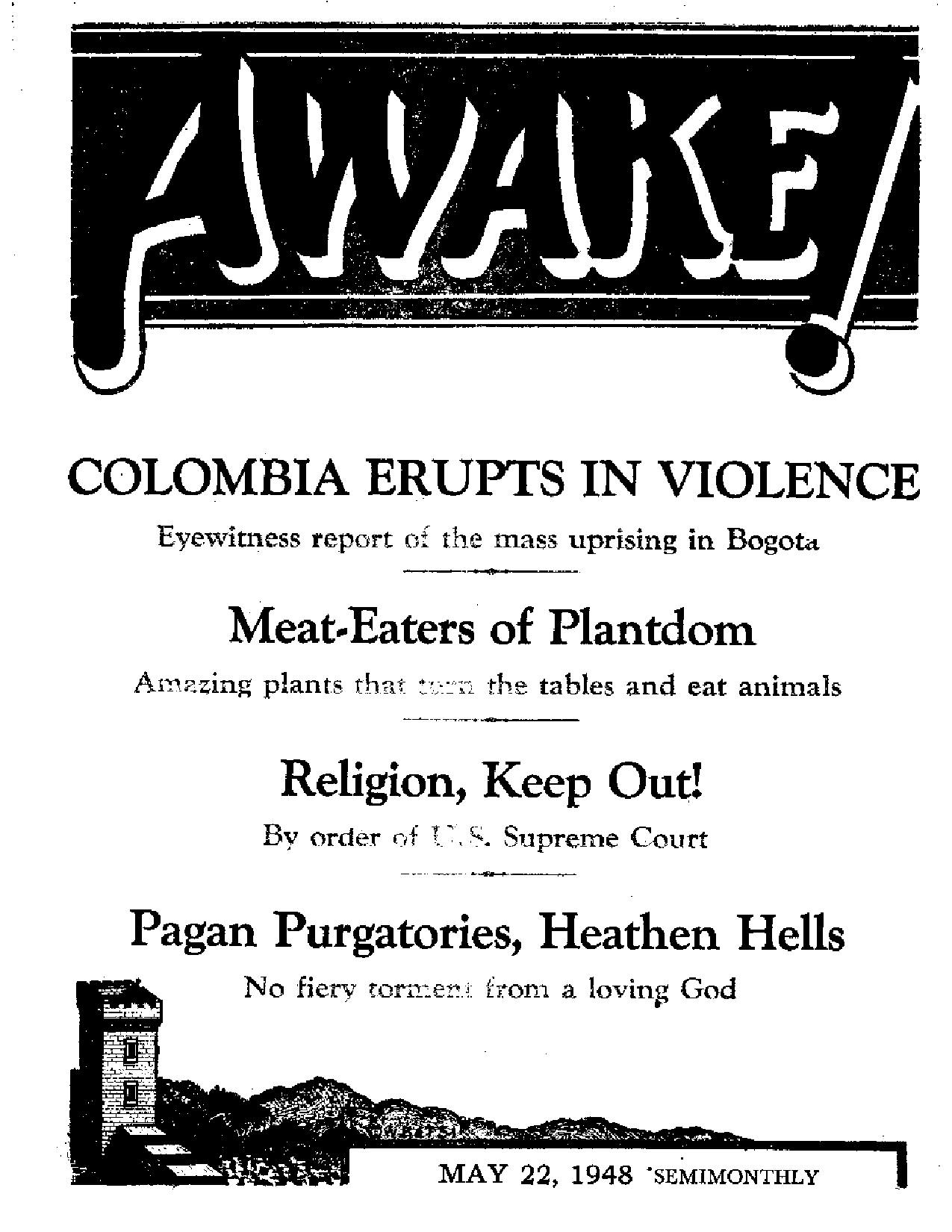
COLOMBIA ERUPTS IN VIOLENCE
Eyewitness report c£ the mass uprising in Bogota
Meat-Eaters of Plantdom
Amazing plants that the tables and eat animals
Religion, Keep Out!
By order of Supreme Court
Pagan Purgatories, Heathen Hells
THE MISSION OF THIS JOURNAL
News sources that are able to keep you awake to the vital issues of our times must be unfettered by censorship and selfish interests. “Awoke!” has no fetters It recognizes facts, faces facts, is free to publish facts. It is not bound by political ambitions or obligations; it is unhampered by advertisers whose toes must not be trodden on; it is unprejudiced by traditional creeds. This Journal keeps itself free that it may speak freely to you. But it does not abuse its freedom. It maintains integrity to truth.
“Awake F* uses the regular news channels, but is not dependent on them. Its own correspondents ore on all continents, in scores of nations. From the four corners of the earth their, uncensored, on-the-scenes reports come to you through these columns. This Journal’s viewpoint is not narrow, but is international. It is read in many nations, in many languages, by persons of all ages. Through its pages many fields of knowledge pass in review—government, commerce, religion, history, geography, science, social conditions, natural wonders—why, its coverage is as broad as the earth and as high as the heavens.
“Awake 1” pledges itself to righteous principles, to exposing hidden foes and subtle dangers, to championing freedom for all, io comforting mourners and strengthening those disheartened by the failures of a delinquent world, reflecting sure hope for the establishment of a righteous New World,
Get acquainted with “Awake!” Keep awake by reading “Awake!”
WO*’**
Published Semi monthly Bx WATCHTOWER BIBLE AND TRACT SOCIETY, INC.
117 Adams Street Brooklyn I, N. Y., U. S. A.
N. U, KnuKB, President GzUnt Suites, Mwrefar#
Flvfl cent* a copy One dollar a year
Remittances should ba sent to office in your uoun- Chanpe of tddrew when sent » our office w be try in compliance .with regulations to guarantee expected effective within one Booth. Send your old . safe delivery of money. Remittances-are accepted at as well aa new address.
Brooklyn fram countries where no office is located, Offices Yearly Subscription Rate
by International money erder ouly. .SubswipLlon America. ILS-, 117 Ariana St., Brooklyn 1. N-Y. |1 rates In different countries are hero stated in local A astral I i, 7 Beresford Rd., Btrathfleld. N.S.W. 6s
currency. Canada, 40 Irwin Ave.. Toronto 5, Ontario
fdotlee (if expiration (with renewal blfl.uk} Is sent Efland, 34 Craven Terrace. Tziodcm, W. 2 5s
at least two issues before subscription expires. Suath Africa, 623 Boston House, Caps Town Bs
Entered as stconfreiiss nutter at Brooklyn, N. T., Act ot March B, 1B79. Printed in U. 8, A,
CONTENTS
Colombia Erupts in Violence
Widespread Destruction
Placing the Blame
The Political Scene
Religion No Peacemaker
Lucky Stiff on the Wagon
Puerto Rico Grows Up
Take Out Potatoes, Toss in Silver
Meat-Eaters of Plantdom
“Sticky-Fly pap er7’ Traps
No Man-eating Plants
Religion, Keep Outl
Keeping Wall tligh and Impregnable 18
More “Keep Out77 Signs Needed
Students Dislike Patriotism by Ceremony 20
Pagan Purgatories, Heathen Hells
Hell and Purgatory Cooked Up in Greece 22
Looking info ftuddha's Hell 23
Tampering with the Ten Commandments 24 “Thy Word la Truth"
“Purgatory” Buddhist or Christian,
Which'?
Kingdom Farm
Watching the World
/AWAKE!/
©“'Now it is high time to awake."—Ramans 13:119j
Volume XXIX
Brooklyn, N. Y., May 22, 1948
Number 10
COLOMBIA ERUPTS IN VIOLENCE
THE eyes of the world were focused upon Bogota, Colombia, South America. Was not the Ninth Pan-American Conference being celebrated here? Had not many delegates already expressed their hopes and positions before the conference? Had not U. S. secretary of state, George Marshall, delivered his address regarding combined aid for Europe? Xes. And the world was awaiting yet more action—an expected bloc against Communism. But then, on Friday, April 9, the unexpected happened. Shortly after leaving his office, the leader of Colombia’s powerful majority party, Jorge Eliecer Gaitan, was lying in the street, having been shot from behind by a young assassin. The murderer was quickly battered to deah by enraged citizens.
Soon the world realized that the conference had been interrupted by the murder of Gaitan. To thousands of Colombians it spelled more. It meant the expression of the fury of the masses over the death of their idol, the one man that they had followed obediently, knowing that he was fighting for their rights. Within an hour Gaitan, “the captain of the people,” was dead. By 3 p.m., less than an hour after his death, Bogota had become a madhouse. All work had ceased in the city and violence had taken its place. Peace, law and order, and decency had been thrown to the winds.
This article Is an on-the-scenes report of the uprising In Bogota, Colombia, that interrupted the Inter-American Conference during.April. Because of its world import, the eruption of violence immediately attracted world attention. From Bogota the sensational news reports fanned out to the ears of all nations, and the predominant note they carried was that it was more Communist mischief, fomented this time to disrupt the conference. This report comes from a neutral observer, the “Awake!” correspondent in Bogota.
Radio stations in Colombia’s capital started attempting to give their listeners a picture of what was going on. The state capitol -building had been fired; street cars and automobiles were burning in the streets; El Siglo, Conservative daily newspaper, was in flames; the recently constructed modern Communications building had begun to burn and “El Palacio de San Carlos”, which housed the office of foreign relations, had been set afire. Bogotanos had gone temporarily crazy. Looting of stores was already the order of the day. First the desire was to obtain weapons, anything with which to fight and to destroy. It was soon apparent that all shops in the business section would be plundered. Thousands of persons by this time could be seen wildly flourishing machetes, axes, swords, knives, revolvers, pistols, rifles; yes, and bottles.
Soon after 3 p.m. “Radio Nacional” had been seized by a group of university students, and at once cries were heard for the resignation of the president, Mariano Ospina Perez, and appeals for revolution and immediate organization of Liberal action against the government in all parts of the country. It was claimed that the police and also the army had joined the revolutionary movement, and that the army was supporting the students at “Radio National”. However, before the afternoon was over, this broadcasting unit was once again in the hands of the government, having been taken over by the army at the expense of the lives of four students, so it is claimed.
By night all radio stations that had been prorevolutionist were cut off, with the exception of “Radio Cristal”, which continued its broadcasts urging the continuance of the revolution, until 10:15 p.m., when it suddenly went off the air. Announcements had been made by “Radio Cristal” that shots were being fired from the towers of the adjoining church. A red glow with its accompanying clouds of smoke covered the downtown area as part of Bogota’s population retired for the night.
Looting
Saturday found a strange calmness settled over the city. The writer and a companion ventured forth from their home to see what had taken place on the previous evening. Scattered food stores throughout the residential sections had been battered in and stripped of their supplies. On the outskirts of the business section, the Roberto Beck Company had been completely sacked of its hardware supplies. Gone, too, were its desks and file cabinets. A short distance away a street car stood as a charred monument to Friday evening’s activity. Numerous persons were still carrying . off, on their backs, huge sacks from the pillage of Bogota’s business district. Shortly, we came upon two more street cars completely destroyed. Beyond we found a scene of devastation. Store after store was completely void of furnishings and merchandise. Broken glass formed a jagged carpet over the asphalt sidewalks and street. Iron gratings protecting the stores had been torn from the buildings. There we saw three buildings burned out. Farther on could be seen the site of where the national post office had stood the day before. Flames were continuing their destruction of adjoining buildings and also those on the opposite side of the street.
No police or firemen were in evidence, and a few looters were continuing their work in a final mop-up activity. We were anxious to go farther into the center of the city, but when the army was heard approaching the crowd of spectators scattered, carrying the two of us on its crest. We had seen enough to prove that an infuriated people had wrecked the heart of their own country’s capital city, including many of the prominent buildings.
The two days of horror (many killings took place on Saturday also) were made more confusing by the conflicting radio reports on Saturday. In the morning a mobile Liberal station, called “La Voz del Pueblo” (The Voice of the People), began functioning, and kept broadcasting the greater part of the day from various locations. Another unit from the neighboring department of Tolima tried to continue the eruption that had commenced the previous day, telling of the Liberal domination in Ibague, the capital of Tolima. It also warned the people against the false reports of “Radio National”. In -spite of continued revolutionary action on Saturday, the government had made great strides in bringing the delicate situation under military control.
By Saturday afternoon it seemed certain that the solution of the uprising would be a collaboration of the Liberals with the Conservative regime. Shortly before the death of Gaitan all Liberals had withdrawn from prominent official posts, refusing further collaboration.
However, now, in order to remedy the situation, the recently appointed Conservative cabinet would be remade with six Liberals and six Conservatives, including the prominent Liberal and former president, Dr. Dario Echandia, as premier.
Today, April 16, finds Colombia’s capital struggling to re-establish normal conditions, a work that didn’t make much progress until yesterday.
Widespread Destruction
But take a look at the destruction of Bogota. In a section extending north to south for fifteen blocks and east to west for ten blocks hundreds of buildings can be found gutted by fire. Several streets are impassable, due to the masses of brick and concrete from the wrecked buildings. Power lines, telephone lines and trolley cables are seen suspended in strange positions. About fifty street cars stand as charred hulks throughout the business district. Burned automobiles stand abandoned in the avenues. One estimate puts the damage in Bogota alone at 5,000 business establishments destroyed. Among the buildings destroyed are the governor’s palace, the Atlantico and Regina hotels, the government edifice of “San Carlos”, which housed the minister of foreign relations, the ministry of justice and also the justice department building, the government intelligence building, La Salle Institute, Communications building (not completely destroyed), the newspaper. £7 Siglo, the archbishop’s palace, the national post office and Avianca offices.
The writer with a companion visited the central cemetery of Bogota yesterday and took a look at the unidentified victims of the shootings staged during the previous week. We saw the many bodies strewn along the tile walk bordering the occupied vaults in a far corner of the huge burying ground. A dump truck pulled away filled with dead bodies, those not yet claimed by relatives or friends. We followed it a short dis-tanee, where it stopped alongside open ditches. The bodies were thrown off or yanked off the truck, were permitted to thump on the ground and were thrown into the trenches in a mass burial. Some had been burned to a crisp. A complete report is not yet available concerning the number of casualties, but one report mentions 1,500 dead and many hfindreds more wounded in Bogota alone.
Placing the Blame
Sensational was the news of the disturbances in Bogota that commenced on April 9. The entire world, divided as it is into two great political camps, was daily listening to the bulletins from the Ninth Pan-American Conference. The world was all ears waiting to learn who was responsible for the break-up of this important political gathering. They didn’t have long to wait. Foreign correspondents in Bogota were sending out government-approved reports. “Radio Nacional” began telling who the guilty party was. Colombian newsmen began publishing the government’s decision. All had the same answer (all came from the same source)—Communism. United States Secretary of State George Marshall had his say and El Liberal gave it headlines “Marshall Accuses Communism”. Newspapers in the United States were quick to take up the cry. The case was clear. The Communists in Colombia were fearful of what the results might be of the Pan-American Conference, especially with the United States taking a leading role. Thus, they had a good reason for seeing the conference stopped. Swift revolutionary action throughout the country at almost the same time lent support to the argument that the assassination of Gaitan had been deliberately planned by professional trouble-makers.
In the excitement roused by the erupting violence premature reports declared that Colombia had broken off diplomatic relations with the Soviet Union. However, on May 3, after some cooling off, the Associated Press reported:
The Colombian Cabinet decided late this afternoon to sever relations -frith Russia almost a month after the abortive revolution that took 1,500 lives in Colombia. A diplomatic rupture had been expected since President Mariano .Ospina Perez put the blame on international communism for the revolutionary-rioting ... A Colombian note announcing the break was delivered to the Soviet Legation late this afternoon. [New York Times, May 4, 1948]
Do the Colombians themselves agree •with the government? Are they content to place the entire blame on the Communists for the assassination of Gaitan and also for the destruction that followed in its wake? True, they know that the Communists have existed in Colombia and that they have been active as has been evidenced by the continual signs and warnings painted on roadways, streets and walls, warnings against Yankee im-gerialism and urging support of the omnium st party in Colombia^. But Colombians have considered the Communists as an insignificant minority. Time magazine in its February 17,1947, issue reported that there were only about 5,000 Communists in Colombia as of that time. Yes, many news reports admit that without doubt the Communists took advantage of the murder of Gaitan to sow confusion and disorder throughout the land. However, Bogota’s daily papers in their own editorials are strangely silent about putting the blame on Communism for Gaitan’s death. Do they think that the murder was committed by a Conservative! or, possibly, by a Jesuit (who are active, in Colombia)! If so, are they afraid to express this view to the public? So far, Colombians are not convinced as to the previous affiliation of Gaitan’s slayer.
Perhaps, after this article is submitted for publication, more light will be shone on the motives connected with the death of Colombia’s popular Liberal leader. At the present time we have a number of reports at hand that tend to show that writers, both Colombian and foreign, are not convinced with the government's decision as to the assassination of the one who, many say, was the wmrst enemy of Conservatism in Colombia. Take, for instance, an editorial in Ft Espectador, prominent Liberal periodical of Bogota, in its issue of April 13, which says that Gaitan has just fallen on the altars of sectarian hate, and then associates him with another champion of liberalism who was murdered, General Rafael Uribe Uribe. Another editorial in the same paper states that the investigation is going forward to establish clearly and without doubt the dark origins of the uncouth assassin. It goes on to mention the past differences and the recent termination of collaboration of Liberals and Conservatives, thus associating the past struggles of the country’s two political parties with Gaitan’s death.
One might consider also the explanation of two Colombian Liberals, former Presidents Alfonso Lopez and Eduardo Santos, in the city of New York at the time of the disturbances in their homeland. Their words expressed to North American correspondents on April 13 show that the “insurrection” wTas not a revolution but “was an outburst of popular indignation” and a “moment of madness”.
Lest other factors and parties have been involved, we have raised questions as to the possible guilt of others besides the Communists. It has been said by some that it would be impossible to stage such a gigantic demonstration without the leadership of professional agitators. However, those persons that have lived in Colombia have seen the spontaneous demonstrations in times past of these hot-tempered Latin-Americans, and have noted the complete devotion of the masses for' Gaitan, their “captain”. They can well imagine how infuriated the people were upon learning of the murder on April 9. They can easily understand how a spontaneous combustion of pent-up feelings could have occurred.
The Political Scene
At this point in our account we believe a fleeting review of the political strife, especially during the past year, is very appropriate. For many years Colombia’s major political parties 'have been Conservatives and< Liberals. The Encyclopedia Americana, Volume 7, page 278, says:
The Liberals, whose first great leader was Santander, favored a federal republic, a large measure of local autonomy, restriction of the powers and privileges of the Roman Catholic Church, and the extension of public educational and economic opportunities. The Conservatives stood for a strong central government, resisted all manifestations of liberalism, and staunchly defended the Church . . , The Liberals advocated advanced social legislation, more equitable distribution of taxation, and the extension of democratic methods and institutions. The Conservatives defended the interests of the wealthy, especially the large landowners, fought democratic innovations, and in general opposed social legislation. On these issues the two parties are still deeply divided.
After sixteen years of Liberal presidents, the elections of 1946 put a Conservative in the presidency when the Liberal party was split. Gaitan had been a break-away candidate. Colombia, cried Gaitan, needed a candidate issued from a “Colombian belly”. The other Liberal candidate, Gabriel Turbay, happened to be of Syrian parentage. The two Liberals polled a total vote of 795,250, to compare with 564,666 for the Conservative, Mariano Ospina Perez. Since that time the Liberals have squirmed under the rule of a Conservative president. They have therefore set out on a course of reconquest of their power, and chose Gaitan as the one to lead them, electing him as chief of the Liberal party. The interparty struggle has been both verbal and physical.
In order to show their numerical power in the capital city, the Liberals staged a spectacular torchlight parade on July 18, 1947, with upward of 100,000 orderly marchers with flaming torches, forming a river of fire, extending for many city blocks. By January of 1948 killings had become so numerous in the department of North Santander that martial law was put into effect, and to this date has not been lifted. As a protest of the people a gigantic manifestation,without precedent, was held on the afternoon of February 7. The demonstration was protesting the violence and the bloodshed in the northern states of North Santander and Boyaca, In silence thousands from Bogota and other villages and cities, on foot and on horseback, made up a stream of humanity carrying black flags and red banners. (Red flags are symbols of the Liberal party.) Many thousands watched this strange procession as it filed past in silence headed towards the spacious Bolivar Square.
There on the opposite side of the square from the national capitol, Dr. Gaitan had delivered a memorable address. During the parade it had been surprising and interesting to see a large poster held high by one of the marchers. One could clearly see the picture of a priest preaching to a group of armed men. The bold words had caught the eyes of the spectators: “Predioando el odio, sembrando la maldad.” In English this means "Preaching Hate, Sowing Wickedness”.
Religion No Peacemaker
How important is the need for a peacemaker in Colombia! But where is he to be found? There is no reason to look to religion as a remedy for the situation, for the Catholic Church in Colombia has already proved itself unfit to bring peace to the numberless inhabitants of this land that hunger for the blessings of a rule of peace and tranquillity, those thousands that mourn because of the abominations done in their own land. Have not the Colombian people found out that religion is a part of this wicked world, and have not they shown her up as “preaching hate and sowing wickedness”? Have not the people read in Colombia's leading newspaper, El Tienipo, the following account?—
In accord with the information arrived from Arbolcdas, municipality where there has occurred the most tragic situation of violence, the Conservative contingents go forth in battle formation armed with long-range rifles with the purpose of persecuting the liberal peasants, not without first having received the blessing of the priest of the village to wish them the best of luck in their intent, which is in itself a demonstration of the gravest situation of social disorder that is existing in the municipality already mentioned, where the same shepherd of souls has decided to convert himself into the ringleader of the violence and the chaplain of the conservative forces (expeditionists) to whom the local police lend all kinds of facilities. (El Tiempo, Jan. 17, 1948)
Have not the Colombian people heard over their own radios the reports of gunfire from the towers of Catholic churches? Have not they talked to others that were witnesses to this action during the recent manifestations in Bogota? Moreover, has not Bogota’s daily, El Liberal, published reports confirming the activity of various priests during the riotous days of April 9 and 10? Yes, without a doubt, many persons saw the photo of the Catholic institution on page six of El Liberal, on April 13, with the explanation beneath: “Another Fom—The entire block occupied by the ‘Colegio Leon Xlir of the Salesian fathers, situated between avenues 4 and 5, and streets 7 and 8, was converted into a real fort, from where it shot against numerous groups of citizens during the weekend happenings?' (El Liberal, April 13)
In the same issue, on page three, under the subtitle “El clero armado"' (The armed clergy), we read that the La Salle Institute was burned after the people had been shot upon from there. After the fire began explosions were heard, proving that explosives for combat use had been stored within. Interesting also is the account of armed priests found in overalls engaged in violent combat in the streets. They were found to be priests when their hats became removed, disclosing the tonsure. No, far from sensible is the thought of religion’s being used to make peace in Colombia. She has been weighed and found wanting for such an important task.
Perhaps now the good people of Colombia, shocked by the destruction throughout their homeland, will lend a hearing ear to the message now being sounded publicly by Jehovah's witnesses. The message is a peaceful one of God's kingdom un^er Christ Jesus the King, which far surpasses the fondest hopes of those that have blindly followed men, both religious and political, whether they be democratic, liberal, conservative, or communist.
(Lucky Stiff on the Wagon
Under this meaningful title the New York Daily News of April 18 carried a United Press dispatch from Bogota, Colombia. The “lucky stiff” is Carlos Monroy, a one-time drunkard that is now firmly perched on the “water wagon”. He vows hell st$y there for life. During the height of the revolt Monroy tanked up on a few bottles of rum, and fell down, apparently dead to the world. Shots were fired and men fell, very much dead to the world. A hearse cleared the streets, taking the bodies to the morgue. It was' there Monroy awakened—and took the pledge.
^uertoj^ico
Qrows Up
IN THESE days when 'eastern and western powers struggle for control and wider spheres of influence, when charges and countercharges of imperialism are hurled back and forth, some otherwise little-thought-of spots on the globe come in for a greater share of attention. The western powers, denying interest in “feathering their political nest” and, particularly the United States, avoiding the appearance of imperialism, endeavor to present an appearance of disinterested benevolence and the paternalistic angle is played up. Thus, in postwar years they proudly point to the giving of independence to the Philippine islands, India’s becoming self-governing, and, of late, the recommendation that Hawaii and Alaska be accorded statehood. What, then, about the United States’ biggest colony, Puerto Rico?
Though this island possession is not big in size, yet its population (over two million) exceeds that of all but one of the Central American republics, and surpasses that of almost a third of the forty-eight states of its possessor, the United States, With statehood for Alaska and Hawaii having received presidential blessing recently, what does Uncle Sam offer this adopted niece in the Caribbean? Ordinarily, when self-government has been mentioned for Puerto Rico, either through independence or statehood, the political leaders have raised their eyebrows and murmured something about “political immaturity”. Last year a Senate committee of four visited the island. Of particular interest were the wise declarations
of one senator. Upon being interrogated aa to his views on possible improvement of the island’s political status with statehood or independence as preferred choices, he replied that statehood was not to be thought of. Reason? Why, every state has two senators and how could a little island one hundred miles long and thirty-five miles wide hope to have the same representation as states like Texas or New Jersey? Being from Wyoming the senator had probably not heard of Rhode Island, Connecticut or Delaware. Independence, he said, was also out as long as there were wars or possibilities of wars in the world. Thus Puerto Rico, upon this thesis,' would have two choices: they could arrange to enlarge their island or else wait patiently until the politicians eliminated wars and possibilities of wars from the world.
The “political immaturity” excuse also has a strange ring to it, in view of the fact that in 1897, the year before becoming a United States possession as a result of the Spanish-American War, Puerto Rico had been granted autonomy by Spain. Why has it taken the United States a half a century to reach the point of allowing the people to have a government not only “of the people” and, supposedly, “for the people,” but also “by the people”; in other words, to let them speak for themselves as to how they wish to be governed? Clearly a paternalistic interest in aiding Puerto Rico and Puerto Ricans is not the real reason.
History shows that political governments do not do things that way.
The main reason is quite evident: As a military base Puerto Rico constitutes a key point in the defense system in the Atlantic. It is a Gibraltar in the Caribbean and a vital guardian of the Panama Canal. Thus the United States is no more desirous of risking the possibility of having Puerto Rico cut the ties that bind than it would be-in putting Alaska up for sale or offering independence to Hawaii.
During the past year, however, concessions are beginning to be made. A law has been passed giving the islanders the right to elect their own governor. Then, on February 2, in a message to Congress, President Truman recommended that they be given the opportunity to decide for themselves the form of government they desired and what permanent political status they wished with relation to the United States. On visiting Puerto Rico, February 21, on his way to observe naval maneuvers in the Caribbean, he reiterated this statement. He could not, of course, guarantee that Congress would back him up on this, nor that it would place its stamp of approval on the decision of the Puerto Rican people, whatever it might be.
Apparently, then, Puerto Rico is “growing up” in the view of some of the “politically mature” politicians. This, no doubt, means that they believe that Puerto Rico would choose to string along with the United States, even if given the opportunity to declare in favor of cutting loose. There seems to be evidence that they are right. Whereas, about eight years ago, the Independence party, favoring complete separation, was rather violently active, it seems since to have gone on the wane. In fact, its leader is recently reported as accusing the American sport of baseball of destroying the patriotic spirit of the Puerto Ricans, who, instead of protesting against the “tyrannic regime” of the United States, talk about "home runs", "batting aver ages,” and “strike outs”. Strong though the power of baseball be on the Puerto Rican, yet the main reason for this growing affinity toward the United States seems to be mainly economic. Rich “uncles” don’t grow on trees, and Uncle Sam has been fairly generous to his Caribbean “niece”. There is no doubt that the island has benefited in many ways during this “colonial” period. The educational system has been developed into one of the best in Latin America. This is also true of sanitation and the island’s highway system. Not that this hasn’t served to the interes^s of the United States as well. The schools have helped to “Americanize” the children; improved sanitation and a good highway system are naturally advantageous in a military way. But the basic problems of homes, sufficient food and clothing and proper medical care are almost as acute as ever. Infant mortality rates have dropped severely since United States occupation, -with a boomerang effect : the population has increased so rapidly that it is outgrowing the island. Huge slum sections are piling up around the edges of the cities. During his visit President Truman got a glimpse of one of the biggest ones: El Fanguito. This section, on the outskirts of the capital, San Juan, stretches along the mudflats for about thirty-live blocks, and at places is six or seven blocks deep. It is made up almost entirely of little wooden shacks, pressed-so closely together that, from a distance, their roofs seem to touch. Underneath lies the mud or evilsmelling water. There must be at least 30,000 people living in this section.
Then, also, while living inside the United States tariff walls had had its advantages, it has likewise meant that the people must pay the same prices for food and clothing coming in as if they were living in California or Ohio. But the standard of living and the, wage scale are far lower here than there.
Thus, in effect, the people are required to live according to a standard of living which is just about beyond, their reach economically. While Puerto Rican laborers are the highest paid in the Caribbean, they also pay the highest prices for what they buy.
An effort is now being put forth by the insular government to bring about industrialization of the island, as a remedy for its ills. New industries are given financial backing and exempted from taxes for a period of years. Wall Street has even spoken an encouraging word in favor of Puerto Rico to those having money to invest. The capital city of San Juan is rapidly becoming modern in the fullAmerican” sense of the word. It now has three modern daily newspapers and the surprising number of seven radio stations in operation. Transportation equipment surpasses that of some cities in the States. In fact, those who merely visited the capital without venturing out oeyond its limits would be inclined to doubt the dire economic straits in which the island actually finds itself.
Perhaps one of these days the pleasant people of this beautiful island will gain the freedom from colonial rule in which they seem so much interested, thus acquiring the right to vote for all the various a non who will govern them and frame the laws affecting them. They will, of course, be dissatisfied with the eventual results, as are people the world over. No doubt, many of them will yet learn that true freedom, including freedom from hard times, sickness and sadness, can be had under only one government, that of Jehovah God by and through His Theocratic King, Christ Jesus. Under it problems of overpopulation and lack of employment shall give way to unending prosperity in a paradise earth.—Awake! correspondent in Puerto Rico.
^ake Out Potatoes, Toss in Silver
MADAM, is polishing the silver a nuisance to you ? Then here is the simplest, ■aVLMsl easiest silver-polishing method you can imagine. All you need is an aluminum pot. If you have cooked your potatoes or any legume, such as peas or b'eans, in your aluminum container, just take out the vegetables and toss your silver into the water in which they were cooked. While you are eating your vegetables, the broth in the aluminum pot will be eating the tarnish off your silverware.
This novel method of silver-polishing was announced by the American Hotel Association’s Testing Laboratory at Michigan State College. The procedure is outlined for you by the assistant to the director, Louise H. Carpenter, as follows:
“Pour the hot water in which potatoes have been cooked into an aluminum container, Immerse the silver in this liquid and allow it to stand for several minutes or until tarnish disappears. Each piece of silver must touch the aluminum, else the silver will not be cleaned. If the potato water is- insufficient to cover the silver, add more hot water. When the silver is clean, rinse it in clear water and dry with a soft towel.
“The liquid from cooked legumes such as peas or beans, also, may be used in the same manner.”
The purpose in publishing this news is not 'only to offer a practical kitchen help to the housewife. A more important reason is to draw attention to the role of aluminum cooking ware. When vegetable broth contacts aluminum a chemical solution is created that is powerful enough to eat the rust off silver. Would you care to eat this solution? Don’t you wonder whether it is also powerful enough to affect the human system?
MEAT-EATERS PLANTDGM
>for
these" strange plants, you should look in places where there is an
FLYCATCHER
SUNDEW
WHAT next! Plants are eating animals!
What is this world coming to ? Practically all animals, whether they are the smallest form of animal life or 5-ton elephants or 100-ton baleen whales, have for a long time lived directly or indirectly on plant life. _ This is common knowledge. But j>itcher
when the tables are turned and a plant eats an animal it is as sensational a news “scoop” as when a man bites a dog.
Probably the most surprising thing about this is not that certain plants are meat-eaters but that most people are totally unaware that some of these plants are to be found near their own homes. There are nearly five hundred different species of carnivorous plants with a world-wide .distribution, and though some are denizens of distant jungles, others are to be found in the marsh lands, meadows and forests of the populous temperate climate. Skipping the technical names, these peculiar plants that are commonly known as pitcher plants, Venus’s-flytraps, flycatchers, butterworts, sundews and bladderworts are classified in about six different botanical families. Nor do they include the wholely carnivorous fungi or saprophytes like Cordyceps and Em-pusa.
As other plants, these animal-eaters get most of their nourishment from the water and air and the minerals of the soil. In their leaves sunlight and chlorophyll work together to sup ply most of their body needs. However, because of the location of these plants they have a diet deficiency of nitrogen, the important protein building block. This is made up by the fresh meat they eat in the form of flies, gnats, mosquitoes, beetles, ants, spiders, worms, larvae and pollywogs. So, if you go hunting abundance of their particular meat supply, ■ such as stagnant swamps and streams, and marsh lands and boggy places. But don’t go before you get a good description of what you are looking for, or before you learn how they lure and trap their prey.
Pitfalls of Certain Death
drinldng cup”,
The most common of the bug-eaters are the pitcher plants, which have several colloquial names like “hunter’s “frog bonnet” or “hog bugle”. There are many species, each with its own curiously shaped receptacle formed by the leaves. Some resemble cream pitchers, others water pitchers; some vases, others urns; some jars, others goblets. Varieties found in the eastern part of the United States have clusters of little pitchers four to six inches high. In California some pitcher leaves grow to he three feet long, and'the receptacles of the world’s tallest pitcher plant reach a height of six feet. Some species have a cover over the opening that makes them look like hooded cobras. In the tropics pitcher plants are equipped with tendrils that permit them to climb vine-fashion, and which enable them to support and hold their own in the tangled undergrowth. These jungle pitchers doll themselves up in such brilliant colors they appear as flowers, a deception used to attract passing insects.
The rims of all pitcher plants are coated with a tantalizing bait of sugary nectar; and woe be unto the crawling creature that turns aside to sample it, for such are really “taken in” bodily. Standing there on the pitcher’s rim the bug or ant with a bump of curiosity cannot resist the temptation to investigate the inside of the cavern. So down he
goes, and fast too, for the inside waxy surface is very slippery. Landing in a pool at the bottom, which is mostly rainwater, the bewildered bug tries to crawl out, only to find that the sides are
BUTTERWORT
BLADDERWORT
TROPICAL PITCHER PLANT
insect to return and warn others of the treacherous deathtrap, and so it is not long before other unsuspecting insects
VENUS’S-FLYTRAP
covered with sharp, downwardpointing hairs or spines which throw him backwards until he finally is overcome with exhaustion and is drowned. Such a system does not permit a captured
enrich the pitcher plant’s stew. As each' adds his bit, bacteria and enzymes convert the bugs into a broth that is absorbed by the plant.
Some of the tropical pitcher plants are more humanitarian than other species in that they do not, cannibal-like, dump their victims into the caldron while they are fully conscious. Instead, they dope up their sticky nectars with an anesthetic compound containing ammonium salts that have been found useful as a local anesthetic by a Philadelphia hospital. Into these plants’ gaping stomachs the stupified and benumbed bugs tumble to their death.
Venus’s-Flytrap Catches “HW Game?
Unlike the pitcher plants that depend on stupid and silly insects falling into their chasms of death, the VenusJs-fly-trap uses a formidable mechanism that very much resembles a powerful bear trap, which snaps shut with starting force wlien its trigger is stepped on.
Also called the "sidesaddle plant” and the "whippoorwill's-boots”, this rather inconspicuous plant is found in the sandy boglands of the Carolinas along the eastern seaboard of the United States. Now learn how it works.
The end portion of the Venus’s-flytrap leaf is made up of two halves that are hinged together in the middle. In the center of each half are three very sensitive trigger spines or bristles. If an inanimate pebble or raindrop hits one of these trigger hairs, or if a leaf from a tree falls on all six of the hairs, the trap will not close. But just let a bluebottle fly or a nice juicy spider that is attracted by the plant’s perfume walk into the booby-trap and instantly it will spring shut.,This is because'it is necessary, if the trap is sprung, for one of the trigger bristles to be touched twice or for two of the hairs to be stepped on at the same time—a combination that only the feet of insects are likely to touch off. Once sprung the vicious jaws of the trap snap shut in less than a second’s time. The catch is made doubly sure by a formidable set of sharp teeth along the edges of the jaws.
The powerful Venus’s-flytrap, after literally crushing an insect to death, wastes no time to begin its feast of fresh meat salad. Not bothering to barbecue the wild game, its special glands in the leaves secrete strong digestive fluids that dissolve the nitrogenous' matter. Then, when the trap opens some eight to fourteen days later, it throws out the skeleton, resets its trigger hairs, and with an after-dinner, well-satisfied smile it patiently waits for the next innocent intruder.
“Sticky-Flypaper” Traps
Man thought he was smart the day he “invented” sticky flypaper, but plants knew it first. With them it is a tried and proved idea that for thousands of years has successfully served the sundew and other plants with fresh flies, gnats and mosquitoes. Even the people in southern Europe, Spain and Portugal recognize the sundew’s capacity and ability in catching flies, and so they hang the plants up in their houses. In nature this plant is a bog-dweller and is found in damp mossy places.
Flies and ants that call around to see Suzy Sundew do get stuck with a date they cannot break, for this plant’s ability and success in making itself attractive, and in clinging affectionately to all who drop in for a visit, is really remarkable. The round disc-shaped leaves that .look like bright-red or pink pincushions appear to be studded with countless jewels or dewdrops. Sticking out from these are about two hundred “pins” or tentacles, each a tins hair-like gland, and each tipped with a ruby globule of sticky honey-like substance. What a dazzling and alluring snare as it glistens in the sunlight!
Imagine the surprise bees and other insects get when they alight on the sundew leaves and find the “dew” so heavy they can’t shake it off! And the more they struggle the more the glandular tentacles secrete. The sensitiveness of these tentacles is greater than the cells of the human tongue, and their reflex action is most amazing. No sooner does an unfortunate victim alight than all the wiry tentacles in the vicinity bend over him, and, with their added mucilage, anchor him dowm to the leaf so that he can’t move. Such surface activity starts the internal operation of other glands, which pour out their digestive juices for the dissolving of the insect; and two days later most of the insect has added its vitality and strength to the meat-hungry, queenly, bejeweled sundew.
In these days of shortages the sundew’s rare ability of always having meat on the menu, even on Tuesdays, can be shown by securely anchoring a fly a half-inch away from the plant’s leaf. Astonishing as it seems thy leaf begins to move toward the fly and within a couple of hours captures it. But when it comes to dinner daintiness the sundew stalker is not to be compared with the tidy-minded Venus’s-flytrap. Whereas the latter cleans off its table after a week of banqueting, it is not unusual to see on a single sundew leaf the remains of flies, gnats, beetles or the hind leg of an ant. It does not bother with napkins. In this respect the sundew is like the flycatcher plant found in the dry rocky places of Portugal and Morocco. Along the narrow grass-like leaves of the flycatcher are myriads of reddish glands with their sparkling beads of mucilage for the entertainment and detainment of all visitors. Botanist Clarence Hylander says of the flycatcher: “The sight of this plant, its twisted leaves covered with dead and dying insects glued to its surface, is a memorable [though not a pleasant] experience.’’
The butterwort, though not belonging to the same botanical family as the sundew and flycatcher, uses the same “stick ’em down” method to catch its bug steaks and dainty morsels of.crawling larvae. Along the streams of the southern states or in the swamps of Minnesota or Vermont one will find butterworts with their beautiful yellow, white, blue, purple or lavender flowers that resemble orchids. Other species are found in northern Europe. Laplanders, for centuries, have made a junket-like dish by pouring milk over butterwort leaves.
The flowers of this plant have to be pollinated by an insect like other flowers; but death awaits the unwary fellow that, having pollinated the flowers, stops off to sample the s-weetish goo that covers the long, narrow and slightly trough-shaped leaves. Like tanglefoot flypaper it takes hold of him, and all of his struggling only awakens the edges of the leaves, which quickly roll around him to form a digestive chamber into which glandular gastric juices are poured. With such a meal of bug d la king the butterwort sometimes relishes bits of vegetation, such as pollen grains, as a side dish.
Mousetrap Supreme!
The bladderwort is undoubtedly the most remarkable of all the insectivorous or meat-eating plants. Unlike their cousins the butterworts, which prefer to stand on soggy swamp soil, the bladderworts take to the water like graceful Venetian gondolas. In roadside ponds and stagnant pools, where there is an abundance of protozoa and insect life, one will find these floating plants with their fine, fern-like leaves. Their root systems have many pale-green pouches or bladders attached to them, which are filled with air during the flowering season. This gives buoyancy and holds the flowers well above the water so that insects will pollinate them. But at other times the bladders serve an entirely different purpose. They are the plant’s “fish traps” by which it catches and digests an abundance of marine organisms, including mosquitoes, baby fish and tadpoles.
Of all the devices for ensnaring animals the bladderwort’s is the most elaborate and intricately designed mechanism to be found. Ingenious in originality, superlative in construction, they are matchless mousetraps—complete with a double valve, tripping mechanism, trap door with spring action and self-setting feature, as well as a chemical disposal plant for the customer—all working automatically once the trap is sprung and set in motion. The hinged trap door sw’ings inward when the tentacles or filaments in front of it are disturbed. And whether the visitor is some nosy insect, or a poor little creature that seeks asylum and protection from a pursuing monster, it is given the same hospitable reception. The trap door swings open so rapidly the visitor is literally sucked in, together with a quantity of HaO; and once inside the death chamber the door is slammed shut quicker than the victim can blink its eye.
The magazine House Beautiful once suggested that the bladderwort could be-
colors, honey-sweet nectars, paralyzing drugs, sticky mucilageo, special tentaeieB, glands which secrete digestive acids and enzymes—all of these work together in perfect unity for a given purpose.- The pitfalls of the pitcher plants are not just holes into which a casual insect falls. They are made attractive and alluring in color, scent arid taste. Entrance is made easy; escape, next to impossible! The hinged spring action of the Venus’s-flytrap with its trigger hairs and interlocking teeth is a most marvelous device. The gluey goo of the sundew, flycatcher and butterwort is as efficient a means of capture as could be imagined. And for intricate mechanism and functional coordination the bladderwort’s "mousetrap” is beyond duplication by any manmade electronic contrivance known to modern science.
All of which shows that only some great Master Mind could design and build such wonderful and fearful organs. Evolutionists, of course, will challenge this statement, but they are not the first. Darwin wasted fifteen years of his life trying to prove that the carnivorous plants are a connecting "link” between plants and animals, but he failed. Evolutionists since then have squandered many more years studying these plants with the same purpose in mind, and they too have failed. As one evolutionist. Professor' Francis Earnest Lloyd, of McGill University, in his book The Car-nivorous Plants, page 7, admits: “About the origin and evolution of the carnivorous plants, however much these questions may intrigue the mind, little can be said. . . . How the highly specialized organs of capture could have evolved seems to defy our present knowledge.” Challenged, but not disproved, the state-merit stands; Only the infinite wis-iX-ViV dom and power of Jehovah God, k the Most High Sovereign of the ' universe, could produce the endless wonders of creation.
cultivated in small streams and swampy ponds as natural mosquito traps. Farmers might take up the idea of raising carnivorous plants as a pest-eontrol measure. But before doing so they should consider the possibility of running into labor difficulties with the birds. Just imagine man’s feathered friends picketing such enterprises, and wearing signs reading: “This Plant Unfair to Birds,” “Bugs, Do Not Patronize This Plant.”
No Man-eating Plants
Many fabulous tales about monstrous man-eating trees in Madagascar and other places have been published in the last sixty years by lurid magazines and newspapers for the consumption of the credulous. However, there seems to be no truth to these fantastic fables. They are only figments of vivid imagination designed to ensnare the reader, not the explorer. And while it may be true, as some claim, that small birds have been caught by carnivorous plants, authentic records show, according to botanist Hy-lander, that the largest animal ever found entrapped was a small frog caught by a Venus's-flytrap.
As stated, this strange group of meatconsuming plants make up for the nitrogen deficiency of the swamps by supplementing their diet with insects and marine life. They would thrive just as well on sausages and hamburgers, and when cultivated in greenhouse swamps they 'are thus artificially fed. Experiments have shown that if other protein matter is supplied, such as hard-boiled eggs, beef or cheese, the tentacles of the sundew and its digestive glands function just as well as if a hard-shelled beetle or a fussy fly had alighted.
Truly the trapping device of the carnivorous plants is one of creation’s wonders. None of the traps are simple. All are ingeniously de- '
signed for the plant’s particu-
lar purpose and needs. Brilliant
Religion KEEP OUT!
— tty of
UJ. SUPREME COUHT
FREEDOM-LOVING Americans once gloried in their freedoms from church-state rule. They boasted of the public school system as the very foundation of their free democratic institutions. But in recent years the picture has changed and lovers of freedom have become alarmed at the stormy religious clouds that have gathered. Over thousands of “little red schoolhouses’’ the ominous clouds of sectarianism have grown very thick and black. Over many public schools these menacing church clouds hang so low one can scarcely recognize them as state-supported schools, or distinguish them from parochial schools. Stout-hearted, old-fashioned Americans, from time to time, have made heroic efforts to disperse these religious clouds. They have sought to post the area of the schoolroom with “Keep Out” signs for religion. One of the latest “Keep Out” orders is in the form of a Supreme Court decision.
The history of this case goes back to 1940 when the Roman Catholic, Protestant and Jewish clergy got together with the Board of Education of Champaign, Illinois, and hatched a scheme whereby children in the public schools were given thirty to forty-five minutes of instruction in religion each week, during the regular school hours and in their own classrooms. The clergy selected the “teacher” for the course and the school superintendent gave the final approval. Parents were required to say whether they wanted their children indoctrinated with the Catholic, Protestant or Jewish brand of religion. If the child was not signed up for the course it had to leave the classroom and carry on its secular studies elsewhere. More than one hundred schools throughout the state had a similar system.
A certain Mrs. Vashti McCollum, who is styled
as a rationalist and atheist; did not desire that her son be taught any sectarian religion, nor was she content to have him embarrassed and ridiculed by the teachers and other children by having him leave the classroom during such period of religion. She therefore appealed to the courts to remove this encroachment on her constitutional rights. In due time the case came before the United States Supreme Court, and on March 8, 1948, in an eight-to-one decision, the Court handed down its weighty opinion.
This “Religion, Keep Out” decision holds that a school district may not sponsor religious classes on a sectarian basis during school hours even though no expense to the state is involved, and though children whose parents object to such instruction are not compelled to attend. The decision holds that the First and Fourteenth Amendments of the United States Constitution prohibit the use of compulsory public school machinery and tax-supported property for religious instruction. The Supreme Court's majority opinion, read by Mr. Justice Black, emphatically declared:
This is beyond all question a utilization of the tax-established and tax-supported public school system to aid religious groups to spread their faith. And it falls squarely under the ban of the First Amendment (made applicable to the States by the Fourteenth) as we interpreted it in Everson v. Board of Education, 330 U. S. 1,
Continuing, the Supreme Court then quoted from the Everson decision thus t
Neither a state nor the Federal Government ean set up a church. Neither can pass laws which aid one religion, aid all religions, or prefer one religion over another. Neither can force or influence a person to go to or to remain away from church against his will or force him to profess a belief or disbelief in any religion. . . . Neither a state nor the Federal Government can, openly or secretly, participate in the affairs of any religious organizations or groups, and vice versa. In the words of Jefferson, the clause against establishment of religion by law was intended to erect t(a wall of separation between church and State”.
Keeping Wall High and Impregnable
In an effort to tear down the “wall of separation” the backers of the religion-in-the-schools program argued that the First Amendment was only intended to forbid government preference of one religion over another, but was not intended to prevent impartial government assistance to all religions. If the government could not give impartial assistance to all religions then it would be in position of fighting against all religions, so they subtly said. However, the Supreme Court did not agree with this tenuous argument. “The First Amendment,” said the Court, “rests upon the premise that both religion and government can best work to achieve their lofty aims if each is left free from the other within its respective sphere. Or, as we said in the Everson case, the First Amendment has erected a wall between Church and State which must be kept high and impregnable.” If religion is permitted to peddle its man-made doctrines and traditions in the schools, then, the Supreme Court declared, the state “affords sectarian groups an invaluable aid in that it helps to provide pupils for their religious classes through use of the state’s compulsory public school machinery. This is not separation of Church and State.”
Justices Frankfurter, Jackson, Rutledge and Burton joined in a concurring opinion and cited some- very interesting historical facts. “It is pertinent to remind,” says Justice Frankfurter, “tk&t the establishment of this principle of separation in the field of local education was not due to any decline in the reli-S'ous beliefs of the people.” Those who,
<e Horace Mann, James Madison and President Grant, fought the hardest for separation of Church and State and for a public school system free from church-ianity were men who reverenced the Bible and had faith in it. For them, this opinion of the Court points out, “the nonsectarian or secular public school was the means of reconciling freedom in general with religious freedom.”
Based on such historical facts, and in the light of the gross sins committed in the schoolrooms of Illinois, the concurring opinion of the Supreme Court reached the following conclusion:
We find that the basic Constitutional principle of absolute separation was violated when the State of Illinois, speaking through its Supreme Court, sustained the school authorities of Champaign in sponsoring and effectively furthering religious beliefs by its educational arrangement.
Separation means separation, not something less. Jefferson’s metaphor in describing the relation between Church and State speaks of a “wall of separation,” not of a fine line easily overstepped. ... It is the Court’s duty to enforce this principle in its full integrity.
We renew our conviction that “we have staked the very existence of our country on the faith that complete separation between the state and religion is best for the state and best for religion.” Everson v. Board of Education, 330 U. S. at 59.
Mr. Justice Jackson, while concurring with the decision of the Supreme Court, made some candid observations in a separate opinion. “While we may and should end such formal and explicit instruction as the Champaign plan and can at all tines prohibit teaching of creed and catechism and ceremonial and can forbid forthright proselyting in the schools,” yet it is impossible and undesirable to listen to every whim and objection raised by the 256 different religious sects. “If we are to eliminate everything that is objectionable to any of these warring sects or inconsistent with any of their doctrines,” observed Jackson, “we will leave public education in shreds.”
School subjects like mathematics, physics and chemistry may be completely secularized, but others like music, architecture, biology,(sociology, history, geography, etc., cannot be completely divorced from all taints or references to religion. “Music, without sacred music, architecture minus the cathedral,, or painting without the scriptural themes would be eccentric and incomplete, even from a secular point of view,” declared Jackson. The study of biology raises the issue between evolution and creation; a review of mankind’s tragic history reveals how saturated it is with paganism, Judaism and so-called “Christianity”. How could a study of history be complete without a general knowledge of the issues involved in the Reformation and the Inquisition? In the words of this opinion, “The' task of separating the secular from the religious in education is one of magnitude, intricacy and delicacy.” And the Supreme Court does not assume to be a superboard of education for every school district in the nation. The Supreme Court must therefore limit itself to maintaining the “wall of separation” by prohibiting the “teaching of creed and catechism and ceremonial” in the public schools.
Next Comes the Noisy Thunder
Coming as a cloud-splitting bolt of lightning the Supreme Court decision made quite a flash in the black ecclesiastical heavens. It was only to be expected that a clap of thunderous reaction wrnuld quickly follow when they saw the “Keep Out” signboard, for the thunder always terrifies the simple minds more than the lightning. It should be remembered that for years the Roman Catholic Hierarchy, in its zeal to undermine and destroy the separating wall between Church and State, has relentlessly labored to implant its religion in the public schools. So the issues at stake in this case were not local ones, but were far-reaching, as pointed out by the Jesuit, named John Courtney Murray. Prior to the handing down of the Supreme Court’s decision, Murray is quoted by the Denver (Catholic) Register as saying: “The Champaign plan is a form of 'released-time' program; such programs, in various forms, are going on in more than 7,000 school districts in some 46 states, and Catholics are participating in them. If the Champaign plan is declared unconstitutional, the whole idea of ‘released-time’ will be brought into question.”
…