Awake!, April 22, 1948
Download: PDF — Awake!, April 22, 1948
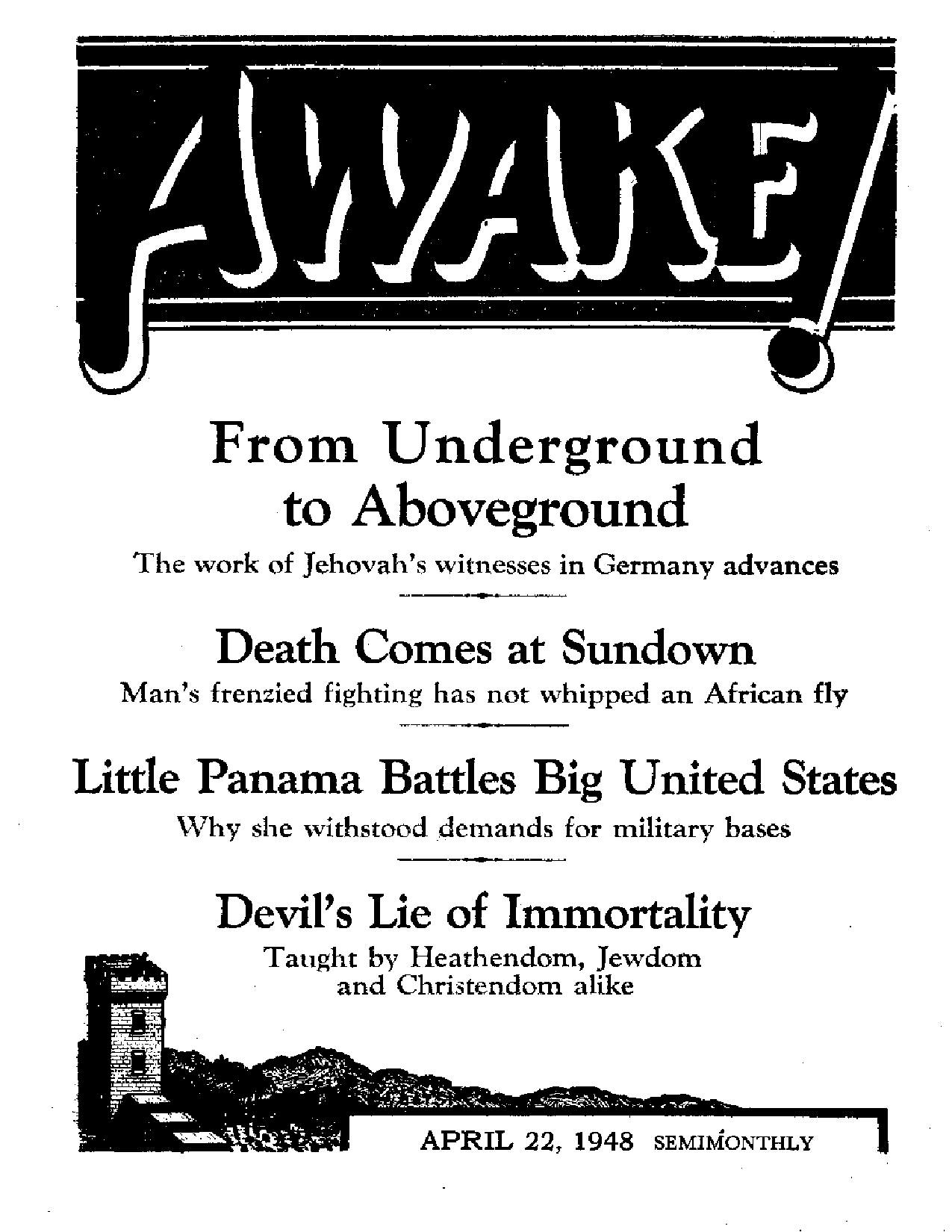
From Underground to Aboveground
The work of Jehovah's witnesses in Germany advances
Death Comes at Sundown
Man’s frenzied fighting has not whipped an African fly
Little Panama Battles Big United States
Why she withstood demands for military bases
Devil’s Lie of Immortality
THE MISSION OF THIS JOURNAL
News sources that are able , to keep you awake to the vital issues of our times must be unfettered By censorship and selfish interests. “Awake!” has no fetters. It recognizes facts, faces facts, is free to publish facts. It is not bound by political ambitions or obligations; it Is unhampered by advertisers whose toes must not be trodden oh; it is unprejudiced by traditional creeds. This journal keeps itself free that it may speak freely to you. But it does not abuse its freedom. It maintains integrity to truth.
“Awake!” uses the regular news channels, but Is not dependent on them. Its own correspondents are on all continents, in scores of nations. From the four corners of the earth their uncensored, on -the* scenes reports come to you through these columns. This journal’s viewpoint is not narrow, but is international. It is read in many nations, in many languages, by persons of all ages.- Through its pages many fields of knowledge pass in review—government, commerce, religion, history, geography, science, social conditions, natural wonders—why, its cover* age is as broad as the earth and as high as the heavens.
"Awake I” pledges itself to righteous principles, to exposing hidden foes and subtle dangers, to championing freedom for all, to comforting mourners and strengthening those disheartened by the failures of a delinquent world, reflecting sure hope for the establishment of a righteous New World,
Get acquainted with “AwakeI” Keep awake by reading “Awake!”
Published Semimonthly Br
/WATCHTOWER BIBLE AND TRACT SOCIETY, INC.
117 Adams Street Brooklyn 1, K Y.f U. 9, A.
N. H. Knorr, President Grant Suiter, Secretary
Five cents a copy One dollar a year
Hewitt anew abound b» rent to office Is yonr conn-try 1q ccmpllicLce with regulations to Eumratee safe delfrefy of mow. Remittances are accepted at Brooklyn from countries where no office is located, by internatipnal money order only. Subscription rates In different countries are here stated In local currency.
flatlet of tncpfratfoft (wltii renewal blank) is sent at least two issues before subscription expires.
CkM|» 9f address when sent to cur office may be expected effective within one month. Send your old u wall u new address,
. Offices Yearly SubacrlpUcin Rate
1 America, O-, 117 Adems St, Brooklyn 1, N.Y. $1
Australia, 7 Beresford-Rd,, Strathfleld, N.S.W. 6s Canada, 40 Irwin Ave., Toronto 5, Ontario
England, 34 Craven Terrace, London, W. 2 6t South Afflea. 623 Beaton Rouse, Cape Town 6s
Entered aa seeond-clMa matter at Brooklyn, & Y«, Act of March 8, 1879, Frinted la U.S.A
CONTENTS
From Underground to Aboveground
In the Concentration Camps
"Homecoming”
Reconstruction of Witness Work
Obstacles to Reconstruction
Religious Persecutors
Death Comes at Sundown
The Tsetse Fly
Efforts at Control
Little Panama Battles Big United States 13
Treaty Negotiations
Aroused Public Forces Rejection
Independence for Burma
Did Jesus Wear a Bushy Beard f
Troubled Religion
Devil’s Lie of Immortality
Egyptians and Greeks Believed the Lie
Jews Believed the Devil, Not Jehovah
Why Christendom Believes the Devil’s Lie 23
Gilead’s Eleventh Class International
“Thy Word Is Truth”
Immortality and Eternal Life
“Guiana for God”
Watching the World
/qvVAKE/
®**Now it is high time to awake.'—Romans 13:119J
Volume XXIX
Brooklyn, N. Y.» April 22, 1948
Number 8
From Underground to Aboveground
DEPRESSING were the days when democratic Germany ceased to exist, to give room for a rule of violence unequaled in the world. The 30th of January, 1933, had come. The political tension, continuously aggravated during the preceding weeks, had reached its climax. Late in the evening the loudspeakers proclaimed that the Nazis had become the masters of the land. Voices from the Deutschlandsender sounded rattling and rumbling through the air over all the ■provinces and rural outskirts, and assured, out of breath from the long race for power, that a happy time was dawning, that the efforts of the best ones in Germany had now resulted in the well-deserved rulership of Adolf Hitler’s idea, through divine providence. These voices were breaking, excited, hasting, threatening, aggressive, and then again sentimental, whining. In the background of all these noises continuously was ringing music, marches, good old real Prussian military marches, drowned by the sounds of the loud salutes “Heil” and the clicking of the boots of the marching masses of the SA in the streets. So it began . . .
Just at the time when the concordat between the new Germany and the Vatican was in preparation, the Watch Tower Bible and Tract Society and the Bible Students Association were banned. The Nazi party and the police would see to it that, like Communists and other political enemies of the state, Jehovah’s witnesses would disappear entirely. But the Witnesses did not disappear. They continued to go from house to house, and to give the witness concerning the establishment of Jehovah’s kingdom. Arrest followed upon arrest. The police broke into the houses of these peace-loving citizens to search for Bible books and booklets, and when some were found the daily papers would ballyhoo in a thrilling manner that “masses of communistic literature had been confiscated in the homes of biblestudents”. Gradually the public began to believe the news. What the papers are bringing again and again, the public is apt to believe.
But Jehovah’s witnesses and their preaching activity did not cease. The organization and work went underground. Amid great difficulties and dangers the literature of the Watch Tower Society was smuggled across borders and multiplied in. secret places. Small groups, called cells, were formed. These met in homes and studied and planned to fight. District servants and their assistants, who were often women, traveled through the land carrying the encouraging and strengthening “meat in due season” from God’s Word and linking in unity the little cell groups scattered throughout the land. Oftentimes the illegally-distributed literature £ell into the hands of the police, and in the wake of such seizures a new wave of arrests would follow.
The police would come during the night to take captive Jehovah’s witnesses without making any fuss, without calling the attention of the public in general to this campaign of suppression and persecution that they were making. But through their underground organization the Witnesses were told to loudly object to these night arrests, to make noises, to wake up their neighbors, to let them see how the Nazi masters separated husband and wife or tore parents from weeping children. Many thousands were witnesses to such cruel and brutal disruption of homes.
In the Concentration Camps
Called into play were the concentration camps, or, better, annihilation camps. Often did their doors open to receive Jehovah’s witnesses, but seldom to release them. In the fall of the year 1935, Himmler ordered that none of Jehovah’s witnesses, after serving his sentence, was to be released without signing a vow to renounce the faith of Jehovah’s witnesses and show willingness to become a Nazi. So in the concentration camps Jehovah’s witnesses remained. But even in the camp their underground organization operated effectively to bring in copies of the Watchtower magazine and other literature issued by the Society. Studies in this literature were held in the blockhouses. Of course, they were betrayed often and the Witnesses considered responsible were made horrible examples, but still the Bible literature got in and was studied, and strengthened and* refreshed the hearts of the incarcerated.
Nobody should believe that the hard experiences of Jehovah’s witnesses were limited to men.'Oh no! The reports that came out of the camps Mohringen, Lich-tenburg, Ravensbrueck and Auschwitz show that even hundreds of women, faithful sisters of the ranks of Jehovah’s witnesses, were tortured, tormented, and oppressed in the same way, for the same purpose of annihilation. There are reports to hand so gruesomely fascinating and sensational that they find no equal. The pen refuses to describe what these female heroes of faith had to endure. Just one of the many extremities of torture suffered by these Christian women was the practice of hanging them by their feet, head down, and left alone in their absolute exhausted condition to be eaten by rats and to die miserably.
Upon the outbreak of world war in 1939, hundreds of young men, Jehovah’s witnesses, seventeen and eighteen years old or older, stood courageously before the military courts and professed their belief and faithfulness to Jehovah God. Almost without exception they were sentenced to death and executed by shooting, beheading or hanging. Once, in Ploetzensee, eighty were killed in one day.
Then came the momentous days of May, 1945. Terror rule of twelve long years broke in pieces and the gates of prisons and concentration camps were flung open. The troops of the Allies were marching in and from the camp gates that they flung open came marching out some eight thousand of Jehovah’s witnesses. Two thousand had met their death in Hitler’s annihilation camp. Those who survived the trial and left the camp alive felt somewhat like the three Hebrew men cast into the fiery furnace by the Babylonian king because they praised only God and served Him. As these three Hebrew witnesses of God were delivered from the fiery furnace, so thousands of Jehovah’s witnesses lived through the ordeals.
Today they are-called “victims of fascism”. Actually Jehovah’s witnesses were and are “fighters against fascism”. The latter name is given to those who had been persecuted for political reasons, but it is denied to Jehovah’s witnesses. Some political prisoners in for some minor offense and for a few months only are counted as fighters and therewith receive all advantages, whereas Jehovah’s witnesses, who, in faithfulness and integrity, fought the Nazi curse lor ten ana twelve long years in the concentration camps are given the secondary ranking as victims. The fact is that many of the political prisoners broke down under the Nazi pressure and became soldiers in the Germany army. There was a special military formation made up only from concentration camp inmates and in these ranks fought many a “brave” communist for the flag of the Third Reich and gave his life in the fight against Bolshevism.
“Homecominff”
But of little consequence are the names the world attaches to Jehovah’s witnesses. The good result was that Jehovah’s witnesses, once underground, now came aboveground once more to preach this gospel of the Kingdom. The Witnesses released from concentration camps headed toward their homes, if they still had one after such long imprisonment. Many brave and faithful fighters, male and female, had lost husband or wife, children, home and property— everything. Cunning methods, like in the time of the Inquisition, sometimes enabled the wicked Gestapo to bring about a divorce by deceiving the husband or the wife and sometimes even the whole family. It was with Satanic joy that the servants of Himmler were often able to inform the concentration camp prisoner that his wife had obtained a divorce, or that he was deprived of his children.
Typical is the following experience of one faithful male witness of Jehovah, who loved God and the truth more than anything else. He had had no letters from his wife for about a year. She had not contacted him at all. In the beginning of June, 1945, he came home, released from his yoke. In the midst of ruins he found the house. It had been preserved. His heart was beating violently between hope and fear. He climbed the stairs to his former apartment. There was another name on the door. He knocked, the door was opened. He faced a woman he had never seen before. She looked at the man, who still wore his prison garment, a striped suit like a zebra, a suit he had worn for many years, and, like many others, now. wore coming home. He asked for his wife. The woman answered, stammering with compassion, that his marriage had been divorced, as everybody knew, and she had married again and moved to another place.
So she was divorced, “as everybody knew,” but he had not known anything about it. With faltering voice he thanked the woman and, taking his heart in both hands, swayed downstairs. Here the lovely spring air caressed him and he tried to pray. Then two arms were pushed under his arms and two of Jehovah’s witnesses, united with him in the same faith, welcomed him: “We have waited for you. Come with us and stay with us.” They took him in their midst and took him home, to his new home. But not all had the same experience. Some have till this day not heard from their beloved ones. Will they ever hear?
Reconstruction of Witness Work
From underground to aboveground! But this was more difficult to do than to say. The German Branch of the Watch Tower Bible and Tract Society was situated in Magdeburg in a large building housing 220 men and women workers and a large printing plant. But how different was the picture when in the beginning of July, 1945, some of Jehovah’s witnesses returned from the concentration camps and looked upon the former Branch quarters! It offered a desolate sight, not destroyed but badly damaged. German forces had been housed there for a time, and later on anyone who was homeless had taken refuge in the building. It had been stripped of everything movable, even the installations for light and water and the linoleum from the floors. Workmen from the town council started remodeling the premises. It should become, they said, a hotel for Russian officers.
However, legal action caused the return of the property to its rightful owners, Jehovah’s witnesses.
In the meantime the reorganization and reconstruction of the company organizations throughout the country began. Letters of instruction addressed to all who had so far confessed to be witnesses of Jehovah called them to assemble again to lake up their Bible studies and the service work of proclaiming the Kingdom. They were informed that witnesses in the full-time service of the Society prior to Hitler’s mad reign were once again in Magdeburg, whence the affairs of the Society would be administered. New life entered the veins of Jehovah’s witnesses. Service work began open and aboveground. More and more literature came to hand for distribution. Under appellation to the newly created first democratic laws of the military powers, nearly all of them annulling the prohibitions and bans of the Nazis and restoring the freedom of worship, Jehovah’s witnesses made good use of those regained rights and liberties, and so started in the whole country a campaign of public lectures. Audiences too large for the halls heard the message in the open air.
By the late spring of 1946 conventions of Jehovah’s witnesses were again being held in Germany: the first after long years of separation and privation. Because of the division of Germany into the four zones it was impossible to hold one central convention. Hence preparations were made in different towns of the American, British and Russian zones for the assemblies. The key city was Magdeburg, where 6,500 witnesses assembled for the convention. The Magdeburg convention served the Russian zone, while two cities in the American zone and eight in the British zone held assemblies for those residing there. The total attendance of these eleven convention cities was about 15,000.
Notwithstanding the fact that half of the town of Magdeburg is destroyed by bombs and lies in ruins, the accommodation problem was solved when kind-hearted citizens placed their already insufficient apartment space at the disposal of convention visitors. Out of small food rations the brethren had brought with them enough food to be pooled and a hot meal provided for all each day. The population of Magdeburg as well as the occupation forces were amazed. No political parties had found the courage to call an assembly of such magnitude. When 684 immersion candidates, men and women, marched through the town to the bath they were watched and accompanied by Russian soldiers. Not knowing what was going on they feared a demonstration should be made and, as everyone knew, it was forbidden by mill, tary law to raise commotion. But after walking along for a few minutes beside the peacefully walking Jehovah’s witnesses, and after learning the purpose of the procession, the Russian soldiers were satisfied and allowed the candidates to pass without any interference.
But the climax of the Theocratic assemblies was to be reached some months later, in the fall of 1946. The assembly for the American zone was held in Nuremberg and the assembly grounds Used were the same as those used in former years by the Nazis to celebrate their pompous festivities. On the third day of this assembly sentence was pronounced against some of the Nazi war criminals. How the Lord had turned the tables on the persecuting Nazis, who for twelve long years had sought to annihilate Jehovah’s witnesses! Now their rabid political party had ceased to exist and individual members of it were suffering for the party crimes, while Jehovah’s witnesses were serving God above-ground once more and assembling on the former parade grounds of the Nazis.
Assembled to hear the Scriptural discourses were 6,300 witnesses, and for the public talk the attendance mounted to
9,000. The chain of assemblies that followed in other cities in other zones continued until the middle of December and the combined attendance of these assemblies of Jehovah's witnesses mounted to the grand total of 31,400,
During that month of December, 1946, there were 14,135 of Jehovah’s witnesses reporting field service activity. One year later, December, 1947, there were active in the field in Germany 24,873 (in January, 1948, there were 27,650). At the rate of nearly 1,000 a month, Jehovah's witnesses in Germany have been recuperating their strength after a dozen years under the Nazi tyrants’ heels, and persons of good-will see these facts and they join themselves with these fighters.
Obstacles to Reconstruction
Though the concentration camp is gone, there are serious obstacles to hinder the work in Germany, but these obstacles are being hurdled by God’s witnesses, by His grace. For one thing, the publishers of the Kingdom must do their work on slim rations. Food conditions become worse daily. It hardly seems possible, because a year ago it was said it cannot become any worse. But it has become worse. The weekly food ration for adult persons in the American zone is: 5 pounds of bread, 3| ounces of meat; £ pound of victuals (barley, noodles or flour), 1 ounce of fat (mostly margarine), ounces of coffee substitute and 4 ounces of sugar. In addition to these weekly rations each adult person gets yearly 2 hundred-weight of potatoes. Vegetables are not available, unless one has a small garden and can grow something for himself. These rations in the American zone are, without doubt, better than those in the other zones, especially in the Russian and French zones. What can the people do if they would keep alive! They barter or buy on the black market. In other words, it is impossible to legally keep alive and strong.
Housing is acute. Millions of persons had to flee from their homes in parts of Prussia, in Silesia and in the Sudeten-land. All their possessions were left behind and they had to be accommodated in the districts and countries that remained German, and these remaining areas are half destroyed. Therefore the housing situation is extremely acute. On the door of one apartment are five or six different names. Several families Hv-ing in such cramped quarters causes strife, quarrels and endless irritation, in addition to providing breeding places for crime and illness.
There is no coal. What coal Germany produces is exported to a great extent. Coal rations for the German people are ridiculously small, and in many parts of the country no* coal at all is being distributed this winter. Electricity is shut off for hours, in Berlin often for the whole day. Gas is available only for one hour at noon and in the evening. These shortages, especially in the matter of coal, incites to thievery. The police chase men and women and even children carrying small or large bags of coal, coke and presscoal. There are hundreds of these persons running in the streets. The stealing is done quite openly. Everybody sees it and knows it, but who cares? One has to do it, if one does not want to perish.
With Jehovah’s witnesses the situation is more difficult. They will not stoop to theft. They suffer from cold and become ill. In their meetings they often sit by candles or little oil lamps, even for the public lectures during the winter months. Emergency illumination of this kind is at hand because the electric light will suddenly go out and everyone is sitting in the dark.
However, all of this misery does not make the people any better. Instead of softening their hearts and causing them to look to the Lord for aid, their hearts become cold, cruel, brutal and malicious. With calloused indifference they read of old and sick people found frozen and starved to death in bed. The people have become cynical and hopeless, pessimistic toward any leadership and indifferent to polities. A variety of political parties rise up to solve the situation. But the people generally are skeptical and suspicious and show indifference to these voices, and the younger ones among them take such with irony and sarcastic humor. Because of this political indifference ruling powers have felt constrained to resort to means of duress and threats in order to force the people to political activity. This oftentimes causes Jehovah's witnesses difficulty, since they will not engage in the politics of this world.
Religious Persecutors
Not only are foes found among the political groups, but the religious forces of the land seek to block the progress of the work of Jehovah’s witnesses. Right after the overthrow of the Nazi power the popular fad in Germany was for the, prominent clergymen and churches to overload each other with reproof, and even blame themselves for the course they had taken in supporting Nazism. They did not deny a certain complicity with the war and the conditions of terror. But the manner in which they admitted guilt and made their confessions left a bitter taste in the mouth. The rueful confessions were invariably made to publicize mock penitence or to gain some sort of advantage. With so many guilty ones it did not do any harm for these religious speakers to give voice to what the believers of their churches already knew, and it pleased the clerics for a change to show remorse, for show.
Now there is much talk about all sins’ having been forgiven. And it is true, they actually seem to have received full absolution by the men of authority of the four occupying powers, including the Russians. The large churches in Germany have the protection of the state and are even allowed in an extensive way to rob smaller communities and free churches of their rights. They are entering into their old rut of guilt toy ngntingireeuom of worship for smaller groups. Religious pressure has caused many denials of rights against Jehovah’s witnesses. Having tired of taking blame upon their own shoulders the big churches pose as pure and heap castigation upon Jehovah’s witnesses, the one group that did stand staunch and blameless during the dozen years of the Nazi madness.
The poisoned arrows aimed at Jehovah’s witnesses from these religious quarters come as no surprise attack. For years they have been warding them off with the shield of faith. They have fought against the onslaughts of religion from the subtle insinuation and misrepresentation on up to the violent tortures of the concentration camp’s inquisition. Jehovah’s witnesses are used to fighting, whether underground or aboveground. Now that they are aboveground once more and the work is going ahead and the ranks of their workers are expanding, envious and spiteful voices are at work to hinder and halt progress. The second world war has ended, but not religious persecution and misrepresentation. The days are filled with danger that cannot be banned by appeals or political decrees. Honest considerations of these facts cannot be clubbed down.
Another thing that will not be clubbed down, the gospel-preaching work of Jehovah’s witnesses. The Nazis tried it and failed. The comeback staged by the Witnesses in Germany is proof of their divine backing. Despite all that can be done by enemies, Jehovah’s truth will march forward in Germany, just as it will march forward in all other lands on the face of the earth. Jehqvah’s promise that the Kingdom gospel shall be preached in all nations for a witness unto all the world will not return unto Him void and unfulfilled. The work is sure to go forward until finished, whether that forward progress be made underground or aboveground.—Awoke! correspondent in Germany.
WtlEN the twentieth century was ushered in with pealing of bells and rejoicing, 300,000 black-skinned Africans dwelt more or less peacefully along the northern shores of Lake Victoria Nyanza, in Uganda, Central Africa. Within a few months 200,000 of them were dead. In the near-by district of Central Kavirondo another 100,000 of their fellows died with them. The sword that cut them down in swaths was the hair-fine, poison-tipped proboscis of the tsetse fly, the carrier of death.
Medical books name the disease from which these thousands died trypanosomiasis, the terminal phase of which is the lingering, half-conscious stupor that has given to the scourge the common name “sleeping sickness”. It is a curse of Africa. Within the past half-century its uncounted victims must number millions. Trypanosomiasis is caused by inoculation into the blood stream of one or other of the several species of the gerin trypanosome, a microscopic protozoan parasite to which the tsetse fly plays carrier and host. Infection usually takes place after sunset as the dreaded fly feeds at night..
A sharp prick of pain announces the bite of a tsetse fly, \ x\x followed immediately by a 'SjmM sense of tormenting irritation.
If the fly was infected, the hu-man victim becomes ill with fever some days later. The fever subsides and recurs with ever-increasing severity at irregular periods of days or weeks. The sufferer becomes anemic, weak in body, feeble in mind. His head aches. His glands become tender and swollen. During the recurring bouts of fever a peculiar rash appears on the middle of his chest. In the white man the disease usually hastens to a speedy death, or a quick cure is effected. But in the native African the disease may linger for years before the terminal stage .of sleeping sickness is reached. The disease is responsible to a large degree for the lethargy and dullness which is characteristic of many Central African natives.
Trypanosomiasis in humans, however, is not the sum total of the criminality of the tsetse fly. The sting of the tsetse is not only death to man, but death also to the domestic animals on which man so largely lives. The sting "which ends men’s lives in sleeping sickness carries to cattle the infection of nagana, the disease which destroys bovine herds as fife devours standing corn. Thus the geographical distribution of domestic cattle in Africa is determined by the existence of the tsetse fly, and there arc vast fertile areas in which domestic animals are I maintained only with great dif-
/ Acuity or not at all. In North-ern Rhodesia and Tanganyika the tsetse fly prohibits in ap-B^B~ proximately half the area the existence of domestic cattle. In Southern Rhodesia there is likewise a huge infected area, and in the Gold Coast colony, in Ashanti, and in the southern provinces of Nigeria the main reason why there are no animals for transport, for manure, for meat and for milk is the prevalence of the tsetse fly and the disease which it conveys.
The trypanosome germ, like its carrier the tsetse, is divided into several species. In the tragedy of trypanosomiasis in man and beast, however, three appear predominantly: Trypanosome gambi-ense, Trypanosome rhodesiense, and Trypanosome brucei. The last-named is the game trypanosome, to which game animals are immune, but which becomes the murderous nagana-producing germ when injected into the blood stream of domestic cattle. T. gambiense and T. rhodesiense are the agents of trypanosomiasis in humans, the latter producing a more virulent type of the disease.
The Tsetse Fly
The tsetse is close cousin to the common house fly. There are twenty or more different species of tsetse, ail of which are potential curriers of the trypanosome germ, but the convicted criminals are those belonging to the two groups known as Glossina morsitans and Glossina palpalis. The tsetse is about three-eights of an inch long,, is of a leaden brown color and is distinguished by the extremely sturdy proboscis which projects militantly horizontally from its head. Two other characteristics make it easy to recognize. First, when the tsetse settles, its wings overlap like the blades of a pair of scissors. Second, the vein formation of the wings is strikingly well marked and forms a peculiar diamond-shaped pattern.
The tsetse, unlike almost all other flies, does not lay eggs. Within the body of the female a larva matures from a single egg, and only when full larval development has been attained is it deposited in the outer world to continue its life cycle. And no human mother is more careful than the mother tsetse that her offspring should be brought forth in suitable surroundings. She finds a warm, damp, loamy soil in a shady place beneath fallen trees or heavy, overhanging shrubs and there the larva is brought forth. Female tsetses repeat the birth process at intervals of from two to three weeks.
The larva immediately burrows into the warm, moist bed. Wifein an hour the larva becomes a pupa, enclosed in a dull reddish-brown case, divided into twelve segments and as hard as a shell. From the anterior end project two small hooks with which the pupa burrows and anchors itself in the soil. At the opposite end are two minute protuberances through which the pupa breathes. From four to nine weeks later the young fly emerges from the case and with its sturdy mouth parts, or proboscis, digs its way up through the soil to freedom. Its wings harden in the air and soon another tsetse sets off on a lifelong search for blood.
The fly cannot breed in dry or exposed areas, neither can it exist at altitudes above 5,000 feet. It is .found in humid, low-lying country, where bushes or trees are plentiful and where the forests border the streams, Much of Central and East Africa answers to this description.
Until comparatively recently there were also vast areas which, although favorable to the "propagation of the fly, were yet free from infestation. But the fly’s rapid spread in recent years gives cause for alarm that the tsetse fly will spread over the whole range of tropical and subtropical Africa wherever conditions favor its development. From its original Central African habitat the fly has now sent a long, narrow, penetrating finger down the east coast as far south as Zululand, and the latest reports indicate that this disease-spreading wedge is now moving westward, threatening, among other areas, the Kruger National Park, South Africa’s great natural game reserve. In Southern Rhodesia the invasion of the fly from the north has been estimated to be spreading at the rate of 1,000 square miles a year. In Bechuana-land the fly is driving cattle from well-watered areas to the drier regions.
Efforts at Control
The Uganda epidemic at the beginning of the century brought forcibly to the attention of European governments with interests in Africa the havoc of which the tsetse is capable. Since then they have combined to investigate and solve the problem of the tsetse’s control and eventual extermination. Their success has been limited and in some cases the cure has been worse than the disease.
The first attempt at control followed the great Uganda outbreak. As the tsetse is not born infective and becomes a disease-carrier only after it has fed on infected blood, and as the complete destruction of the tsetse seemed a colossal and impossible venture, it was decided to remove, temporarily, all humans from the Uganda shores and islands of Lake Victoria Nyanza to a distance safe from the tsetse fly. The measure was successful and the tsetse which still infested the ravaged area eventually lost the trypanosome infection. Latest reports indicate that reoccupation of the area is now taking place, but, as the introduction of a single case of sleeping sickness would be sufficient to precipitate another epidemic, this reoccupation is being strictly supervised. Some success, too, has attended use of drugs in the treatment of trypanosomiasis in man and beast.
But in his fight to eradicate the fly man has met largely with failure and disaster, for man’s tactics in his war on the fly have been largely to meet destruction with ruthless counter-destruction.
Game animals have been proved to be not only the main source of the fly’s blood supply but also a great reservoir of the trypanosome germs which cause both human and animal trypanosomiasis. So the order went forth to destroy all game in tsetse fly areas, and in recent decades vast sections of the African veld have echoed to the sound of horrible, bloody slaughter, and then lapsed into empty, desolate, stinking silence. Periodically this sorry business moves various sections of the people to outraged protest, but the slaughter still goes on. And so does the tsetse fly.
The tsetse fly must have shade in which to breed. This has suggested another line of attack. Remove all shade, the theory says, and the tsetse must die. So the felling of forest and bush began, and thousands of square miles of wooded African valleys and plains rang and still ring to the sound of the woodsman’s ax. Where vast forests once stretched in green, leafy beauty, the land now lies naked and unlovely.
In Zululand
Zululand, the southernmost tip of present tsetse penetration, has for many years been the scene of intense antitsetse measures, and results achieved there are fairly typical of results achieved elsewhere on the African continent. Of these results Mr. T. E. Harrison, a Zululand farmer, in a recent issue of The Farmer’s Weekly, wrote bitterly.
Mr. Harrison mourns the green glory that was Zululand. He tells of forests which covered its hills and valleys, of luscious grass which clothed its plains. He tells of its rivers and streams, its “pans” and waterholes and springs, and its abundant rain. He describes its teeming game, its buffalo, wildebeest, zebra, kudu, waterbuck, nyala, mpala, rietbuck, bushbuck, duiker, steenbuck, antelope, klipspringer, warthogs, pigs, honey bear, leopards, hyenas, cheetahs, wild dogs and jackals, and its reptiles. Its birds were lovely and uncountable. It was a place of vibrant life and beauty.
Then came the tsetse fly, and in 1918 the call went out to repel the invader. The game, on which the fly fed, must be destroyed. Soon the stench of rotting, unskinned carcasses fouled Zululand’s once sweet air and the vultures and car-non eaters, the hyenas, jackals and wild dogs grew sleek and fat, and bones whitened unendingly under the Zululand sun.
After feast came famine. The dead were consumed and there were no living to take their place. The carnivora grew gaunt and hungry, and hunger made them bold. Donkeys, cattle, sheep, goats and fowls became their prey. Farmers fought the killers with poison and killed them in their thousands. Hungry vultures and all other carrion-eating birds ate ravenously of the poisoned carcasses and likewise died. Beetles, those little creatures, so essential to earth’s fertility, now robbed of their natural food, the dung of animals, turned to the poisoned carcasses of birds and beasts and they too died. And last in the tragic cycle came Zululand’s myriads of insect-eating birds that ate the poisoned beetles and joined them in extinction.
But tsetse fly still persisted. Deprived of its natural prey it turned to lesser life for food, to tortoises and lizards and snakes, and even the large black African ants were not beneath providing the tsetse with a meal.
Man now turned in anger to the forests. He would destroy the fly’s breeding places. Soon Zululand’s trees fell as soldiers fall on the field of battle. A new smell filled Zululand, not the smell of rotting flesh but of decaying vegetation. The long grass which had carpeted the floor of the forest, now unprotected, grew dry and brown under the heat of the sun. To destroy those flies that remained and which had found sanctuary in its scant shade this grass was set alight and for days and weeks vast fires burned.
Desolation was now complete. The country is black and bare. The fierce sun dries put the unprotected earth; great cracks appear. These cracks become great eroded clefts as the stormwaters, now unimpeded by the luxuriant vegetation which previously soaked them up like a sponge, race down them to the rivers, muddy, turbulent. Zululand’s finest soil finds its way to the sea. The animals which once tilled that soil with their sharp, pointed hoofs and fertilized it with their dung are gone. The beetles are gone and the birds are gone. Even the rainfall is diminished, the waterholes are dry, the springs and the streams have vanished. Zululand, once so green and beautiful, is parched, naked and empty.
But the tsetse fly remains. It is true, it has deserted the areas of desolation, but now it is found in swarms in areas where it was previously unknown, and to these new areas it carries death.
In recent months the Union government has been experimenting with the spraying of Zululand’s tsetse areas with DDT from the air. Official statements report good results, but Mr. Harrison is not enthusiastic. His main objection is that the DDT destroys what little bird and insect life remains in the ravaged country. His solution to the problem, which, seems reasonable, is to stop the slaughter of game at once, stop the destruction of vegetation and the indiscriminate spraying of DDT. Import animals to take the place of those that were massacred and spray them with the flykilling chemical, thus dealing death to the slayer without further harm to the land or to its legitimate insect, bird and animal life. And begin the vast work of restoring to Zululand its forests and grasses and healing the havoc of erosion. The task in Zululand alone is colossal. To accomplish the same necessary task over half the continent of Africa will require superhuman power.
It is good to know that such superhuman power is soon to be exercised, not only in behalf of stricken Africa, but to the blessing of the whole misused earth.
The tsetse scourge is just one more problem which will find its complete solution under Jehovah’s kingdom. Then no longer will the tsetse fly bring death at sundown.—Awoke! correspondent in South Africa.
as the present canal or along some other route either in Colombia or in one of the other Central Ameri-
QST December 23, 1947, the world was startled by the news that the small but strategically located republic of Panama had rejected a treaty between herself and the United
States for defense
sites then held by the United States in Panamanian territory outside of the Canal Zone, and for their continued occupation for the defense of the Panama canal. Congressional circles in Washington were surprised, as were many of Panama’s sister republics.
But why should a small and insignificant republic reject a treaty which apparently is so vitally important to herself as. well as to the defense of the canal? When we realize that Panama is largely dependent upon the Canal Zone for her livelihood, we realize that she did not lightly and for nothing reject this pact, but that she must have had some deep-seated reason that is very important to herself. In a way she killed the proverbial goose that laid her golden eggs when she rejected that pact. The consequences, no doubt, will be bitter and hard.
Negotiations for this new treaty had been going on for more than a year, and in Panama it had been a burning and hotly contested issue during all of that time. Also, during that time numerous investigations were made by congressional and senatorial committees from the United States as to why a definite agreement could not be reached. These committees also made investigations and recommendations as to a new sea-level-type canal, either along the same route can countries.
To find the root of Panama’s rejection of the treaty we go back a few years, to the year 1903. Panama had just gained her independence from Colombia and had signed a treaty with the United States whereby permission was granted for the building of the canal. Under the terms of this treaty Panama became something in the nature of a protectorate although not exactly so. The United States had the right to appropriate whatever land she needed in the territory for sanitation or for the defense and maintenance of the canal. For over thirty years she exercised this right, sometimes unjustly, with little or no consideration for the susceptibilities or interest of the Panamanians. The Panamanians viewed with alarm the extending of U. S. jurisdiction Over their territory.
In 1936, under President Roosevelt, a new treaty was signed which was designed to eliminate some of the unpleasant features of the pact of 1903. This treaty gave the United States jurisdiction only over the canal zone which includes the canal and a strip of land on each side which is leased for 99 years at an annual rental of $400,000. It also placed the relations of the two countries upon a mutual basis, each assuming responsibilities in the defense and maintenance of the canal. Also, it guaranteed equal rights and opportunities for Panamanians and Americans working in the zone. The most important of these provisions, and the one bearing upon the point under consideration here, is contained in Article X of that treaty, as follows:
In ease of an international conflagration or the existence of any threat of aggression in which the security of the Republic of Panama or the neutrality or security of the Panama canal might be endangered, the governments of the Republic of Panama and of the United States'of America will take measures of prevention and defense that they might consider necessary for the protection of their own common interests. The measures that might appear essential to one of the two governments to take,, in keeping with said interests, and that might affect the territory under the jurisdiction of the other government, will be the object of consultation between the two governments.
With the outbreak of World War II, in harmony with said Article X of the 1936 treaty, Panama leased to the United States sufficient land for 134 military bases in different parts of her territory outside of the canal zone. Some of these were just small aircraft warning outposts or radar stations, but some were quite large, such as Rio Hato, where from 1,200 to 1,300 men were stationed. Heavy bombers were kept here. This base represented quite an outlay of money for the United States. In 1942, a treaty was entered into by the United States and Panama covering the use and occupation of these sites, which treaty stipulated that the sites were to be released “one 'year after the definitive treaty of peace has been put into force, that puts an end to the conflict of war now existent”.
Panama interpreted this clause to mean that the bases were to be returned one year after the cessation of hostilities between the nations, and in keeping with this, on November 6, 1945, during a session of her National Assembly she dedared that according to her concept, the treaty expired one year after the treaty of capitulation signed on the battleship Missouri on Tokyo Bay in September, 1945, because this agreement was the “definitive treaty of' peace that put an end to the conflict of war” then existing among the nations. This fixed the time for the return of the bases to be not later than September 1, 1946.
At that time the United States did not oppose this declaration, nor did it set forth its own interpretation of this clause. It simply limited itself to stating that it had made a treaty with Panama and would fulfill it. If the United States had at that time made known her stand on this matter, or her interpretation of this clause and her intentions as to peacetime occupation of the sites, there would probably have been no difficulty in regard to their occupation. However, eleven months passed before she formally made known that according to her concept the treaty did not expire until one year after peace treaties were signed putting an end to the theoretic state of war, and not one year after the cessation of hostilities. This declaration was made on October 12, 1946, over a month alter the time limit on the bases had expired according to the Panamanian concept.
No move was made to evacuate the bases which, according to Panama, were now held illegally. This was regarded as a flagrant violation of their sovereignty over their own territory, as well as of the trust they held in the United States, and they began to clamor for the return of the bases. Naturally, as time went on and no move was made to relinquish this territory, Panamanian resentment against and distrust of the good intentions of the United States grew.
This resentment, and the wave of hysteria that resulted from the failure of the United States to return the base sites, can be better understood when we realize that Panama is an independent nation and not a protectorate or posses-Bion of the United States; also, that in the past she has been referred to as a protectorate and as a vassal state having no will of its own, unable to run its own affairs or enforce its decrees. This the Panamanians have bitterly resented, and the present situation did not help matters any;
Treaty Negotiations
Negotiations for the new treaty began about November 1, 1946. The United States asked for a 99-year lease. To Panama this meant that the defense sites would become another canal zone which would be intolerable for many reasons of her own. Besides, this was entirely out of harmony with Article X of the 1936 agreement, upon* which she felt the new treaty should be strictly based because it covers such concessions of territory for defense purposes. She sought to have said Article X specifically cited in the new treaty, but in vain. This omission was important to Panama because it meant that in later years it might be interpreted to mean that delegations of authority by her to the United States would be based upon Article II of the 1936 treaty, which would be inadmissible to Panama because it covers permanent concessions of territory that might become necessary for improvements to the canal in ease of an earthquake or other unforeseen contingency that might result in damage to the canal; whereas, Article X covers concessions of a temporary nature.
Panama could see no good reason why the terms of the new treaty should run beyond five years, as there was no actual threat of war at that time, although the conditions then existing could be interpreted as a potential threat of war; but if they continued to exist after the five-year term had expired the lease could be renewed. The United States finally dropped down to five years for all the bases she intended to hold except Rio Hato, for which she asked a ten-year lease with an unconditional option renewable for another ten years, at her own unilateral and absolute discretion.
To Panama the making of (his new treaty was a serious matter. She was not seeking to side-step her responsibility in the matter, but if she acceded to all the demands made upon her by the United States, which seemed to forget that Panama was the one granting favors, not the one asking them, it would mean that she would have to surrender at least a part of her sovereignty as an independent nation, and this she was determined not to do. On the other hand, the United States was contemplating the building of a sea-level canal either along the present route of the canal or along some other route, and she felt that she must be guaranteed adequate means of protecting it. As the negotiations proceeded she insisted upon introducing clauses into the new treaty that tended to accentuate her powers and privileges and weaken Panamanian sovereignty. This alarmed the Panamanians as they remembered the one-sided treaty of 1903 and its consequences, and they clamored more loudly for the return of the bases, while at the same time, from the American side, came the cry that Panama refused to cooperate.
That this was an unjust accusation is shown in the fact that Panama repeatedly submitted proposals which were designed to protect her rights and yet meet the demands of the United States for defense of the canal. She insisted that the terms of the 1942 treaty should be fulfilled, and the bases all returned to her before another treaty was entered into. However, all of her proposals were promptly rejected while at the same time she continued to be accused of indifference and not wanting to co-operate.
After fifteen months, during which the controversy raged with each side demanding an early settlement of the issue, and each accusing the other of its failures, the new agreement was drawn up and signed on December 10, 1947, Dr. Alfaro, who, as Panama’s minister of foreign relations, negotiated the new treaty, resigned the day previous in protest against its terms.
Aroused Public Forces Rejection
With the treaty signed and in the hands of the National Assembly for ratification things began to happen. Thousands of letters and telegrams poured in asking rejection of the treaty. Most if not all of the political leaders and their backers voiced their disapproval and asked for rejection. Resolutions of protest came from all sections of society, but noisiest and most insistent were the student and youth organizations.
Now the students demanded that the treaty be rejected and the matter, taken to the United Nations to force the United States to return the base sites. A mass demonstration was planned for December 12, the first day that the National Assembly would meet to consider ratification of the treaty. The mayor declared a ban against the demonstration. But the constitution gives anyone the right to hold such demonstration, and the students, determined to assert their constitutional rights, gathered in spite of the ban. Police attempted to enforce the ban and block off their march to the Palace of Justice, where the National Assembly was in session. The result was a street fight in which one 16-year-old boy was shot in the neck and forty others, including policemen, were injured, and twenty-five, including a number of professors, were jailed. This only madfe them more determined, and the next night another demonstration was held. Two days later a general strike of Panama City schools went into effect; parents and teachers joined with students in protest.
The strike spread until schools throughout the republic were closed. President Jimenez went on the air to defend the treaty and urge its ratification. He reminded the people of their contract relationship with the United States, and their obligation to co-operate in making the canal invulnerable; also, that the decision in regard to the treaty was of enormous importance to the country.
The final meeting of the National Assembly on December 22 was accompanied by the largest popular demonstration to take place so far. For seven hours the demonstrators chanted their demands for rejection outside the Palace of Justice, while the legislators debated the burning question, hardly able to hear because of the noise outside. When final unanimous rejection was announced the demonstrators, satisfied, marched off.
Thinking men of responsibility in Panama were not in favor of the terms of the treaty, yet they deplore the action takefi by the students. They would have called for a modification of the terms of the treaty, not complete rejection. The assemblymen in making their decision, no doubt, feared the consequences from the “ten thousand boys’ sharpening their knives downstairs”, as one of them put it, not only to themselves, but to the entire republic, and even to the demonstrators themselves, who had been worked up to fever pitch over the issue, and, they being of an irresponsible age, it is not difficult to imagine what might have happened.
The next day after the treaty was rejected preparations were made by the United States to evacuate the bases, while many startled American officials began their conjecture as to why the treaty was rejected. Communism and the coming elections received the major part of the blame, but it is quite evident that neither were directly to blame. The underlying reason was the failure of the United States to comply with the 1942 treaty and return the bases on time. This caused the Panamanians to lose confidence in the United States to such a degree that they had no desire to make any new concessions. So little Panama won her battle against Big United States.
—Awake! correspondent in Panama.
INDEPENDENCE for
TSurm
AGITATION for independence had flamed violently in Burma since she gained separation from India in 1937. Nationalists, then called seditionists, were rounded up to fill the country^ jails, but this kindled the flame more fiercely rather than smothered it. Prior to Japanese treachery at Pearl Harbor (December, 1941) a small group of Burmese students headed by the late U Aung San, and including, among others. Prime Minister Thakin Nu, parleyed secretly with the Japanese for driving the British out of the country. Independence for Burma was to be the reward for letting the Japanese in. The plan worked up to a degree: the British went out in the great withdrawal of 1942; the Japanese came in. But the independence granted this country by the Japanese meant only the replacement of the British "Thakin” by the Japanese "master”.
U Aung San's methods were direct, his speech terse. The action-loving Burmese swarmed round him and his AFPFL group when he promised them independence, within a year from January 31,1947. "Hl get /ou independence, or else—” the Bogyoke (General) told the people, in demanding all-out support. The demand was answered. U Aung San was not fooling when he declared AFPFL would resist any attempt to deprive the Burmese of freedom. When he announced the terms of the treaty giving almost full powers to the Burmese cabinet, he had to announce simultaneously the calling off of the armed resistance movement planned by his
AFPFL against the failure of the talks.
The April, 1947, elections saw the AFPFL romp home at the polls with an overwh elming maj ority. By mid-May. the AFPFL general convention adopted the draft of the new constitution along lines suggested by U Aung San, and when the Constituent Assembly met for its first session at the end of the month with the AFPFL occupying 176 out of 210 seats, U Aung San tabled and won a resolution claiming sovereign independence for Burma outside the Commonwealth.
Assassination
And then U Aung San died. He died as swiftly as he had lived. Within seconds assassins’ bullets snuffed out his life as he presided over a meeting of his executive council. With him went six members of the Cabinet We let Bogyoke’s own personal assistant, Boh Tun Hla, describe what happened on July 19, 1947.
I happened to glance at my wrist watch then. It wEts exactly 10:35 a.m. That instant there was a terrific bang. And both Boh Than Win and I flattened ourselves on the floor. Not a minute after that bang we heard the continuous tat-tat-tat of automatic weapons. Then the realization dawned on us that in that Council Chamber next to my room some assassins might be shooting down our leaders. This realization made us dash for the doors, I to that of the Council Chamber, and Boh Than Win to the one leading to the passage.
The scene that I saw the moment I opened the door to the Council Chamber was such as to haunt me all my life. The whole room was befogged and the fumes of powder pervaded the whole scene. The Councillors who only a little while ago had been planning Burma's future were either lying dead or were dying. Bogyoke had fallen backward, chair and all, .45 and .38 empty cartridge cases on the floor. Hon’ables U Ba Gyan, Pyawbwe U Mya, U Aung San Wei, as well as the Secretary U Shwe Baw had good fortune to escape. They had time at the critical moment to fling themselves down on the floor. Just about that time. Boh Than Win, who left my room by the other door, reached the head of the stairs leading down. He met the assassins there face to face. They shouted to him to keep off, pointing their guns at him. Seeing them in green uniforms he thought at first that they were in pursuit of the assassins. But when he saw them rush past, shooting down Ko Htwe, the body guard of Hon'able Mr. Razak, and were getting away only then did he realize that those were no soldiers but assassins. In a minute they were off in the jeep with the engine running which was waiting for them, below.
The putting down in words of this now seems to take a long time. Actually the whole thing happened so quickly that it seemed to be in the twinkling of an eye.
In the Council Chamber the only one who could move was the Sawbwagyi of Mong Pawn who took a few steps towards me asking for water. I immediately made him sit down again and comforted him, but my chief care Bogyoke lay with his left breast all covered with blood. In my confusion I only noticed two wounds. My hand flew to his wrist but it was cold and clammy and the pulse had stopped. He was, alas, breathing no longer! I knew X must try to prevent a panic. The sudden news that this symbol of our unity, our aspiration to freedom, our hope and devotion has gone might turn the whole country upside down. X lied to the immediate inquirers that Bogyoke was all right and added that it was only a flesh wound on the shoulder. Then I telephoned urgently to the Fire Brigade Ambulance, the General Hospital, the Police Headquarters, Government House and Headquarters, Burma Command.
For the 24 hours following, a crisis threatened the country. Hundreds of arrests (the official figure is placed at 1,500) came swiftly on the heels of the ministerial murders. The flamboyant Dr. Baw Maw, who headed the Burmese regime under the Japanese, the dynamic U Saw, premier of Burma at the time of Pearl Harbor, the volcanic Ba Sein, who swore to overthrow AFPFL for “betraying” the country and the Aung San-Attlee agreement, were among the many known opponents of Aung San, now arrested and thrown into jail. Governor Rance acted rapidly. Within a few hours of U Aung San's death he announced that Thakin Nu, vice-president of AFPFL and the slain leader’s righthand man, had agreed to head a new government. Less than 24 hours after U Aung San fell the new cabinet was announced.
Independence
On January 4,1948, Burma was granted complete independence by England. The Republic of Burma was born at a historic ceremony two hours before dawn on that date. The Union Jack was lowered from the flagstaff of the Constituent Assembly and replaced by the republic’s star-spangled tricolor. Burmese leaders and representatives of world powers saluted the Union Jack as it was slowly lowered under a pale moonlit sky. As it touched the ground, a Burmese band struck up the republic’s national anthem and the Burmese flag was immediately hoisted. The ceremony of transfer, proclaimed by a fanfare of trumpets, conch shells, and the beating of ceremonial drums, was watched by about 2,000 persons on the spacious, floodlit lawn of the Assembly building, inside the heavily guarded Government Secretariat
…