Awake!, March 22, 1948
Download: PDF — Awake!, March 22, 1948
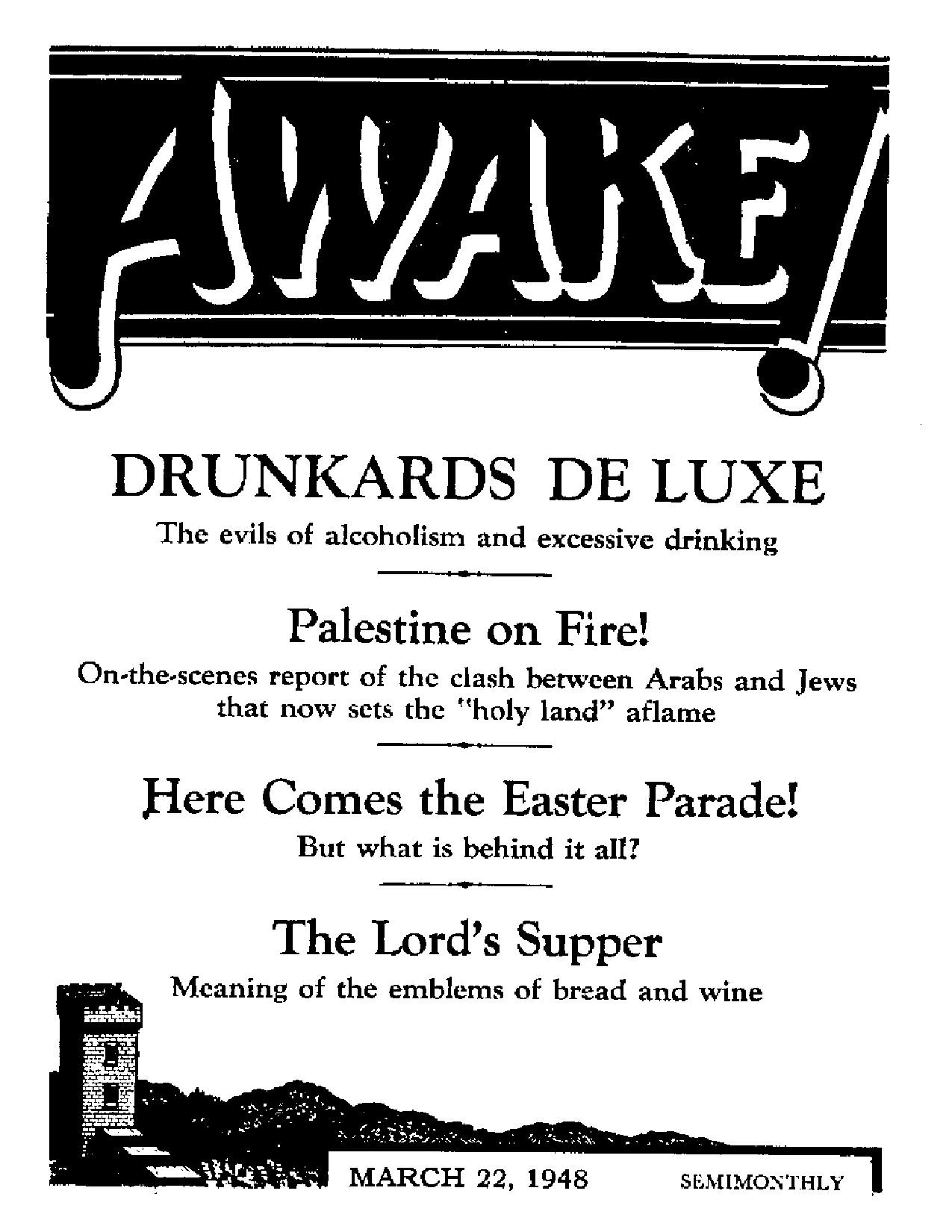
DRUNKARDS DE LUXE
The evils of alcoholism and excessive drinking
Palestine on Fire!
On-the-scenes report of the clash between Arabs and Jews that now sets the "holy land” aflame
Here Comes the Easter Parade!
But what is behind it all?
The Lord’s Supper
Meaning of the emblems of bread and wine
THE MISSION OF THIS JOURNAL
News sources that are able to keep you awake to the vital issues of our times must be unfettered by censorship and selfish interests. ’'Awake!*’ has no fetters. It recognizes facts, faces facts, is free to publish facts. It Is not bound by political ambitions or obligations; it is unhampered by advertisers whose toes must not be trodden on; it is unprejudiced by traditional creeds; This journal keeps itself free that it may speak freely to you. But it does not abuse its freedom. It maintains integrity to truth.
**Awake!” uses the regular news channels, but is not dependent on them. Jis own correspondents are on all continents, in scores of nations. From the four corners of the earth their uncensored, on * the - scenes reports come to you through these columns. This journal’s viewpoint is not narrow, but is international. It is read in many nations, in many languages, by persons of all ages. Through its pages many fields of knowledge pass in review—government, commerce, religion, history, geography, science, social conditions, natural wonders—why, its cover* age is as broad as the earth and as high as the heavens.
"Awake I” pledges itself to righteous principles, to exposing hidden foes and subtle dangers, to championing freedom for all, to comforting mourners and strengthening those disheartened by the failures of a delinquent world, reflecting sure hope for the establishment of a right* eous New World.
Get acquainted with “Awake I” Keep awake by reading “Awake!”
Published Semimonthly By WATCHTOWER BIBLE AND TRACT SOCIETY, INC.
117 Adams Street Brooklyn 1, N. Y.t U. S. A.
N. H. Knorr, President GEdtfr SE7T5E, Secretary
Five cents a copy Ona dollar a year
Hemlttairti should be sent to office la roar Cfmn-by Id compliance with regulations to guarantee safe delivery of mo&ey. Bemlttancea are accepts at Brooklyn from countries where no office is located, by international mcm-ey order only, Subwrtptlon rates in different countries an here stated in local camncy.
Notin of wpiratiMi (with roneval blank) Is sent it least two issues before subscription expires.
ChMpe of address when sent to our office mar be expected effective within one month, fiend four old as well as new address.
Offices Yearly Sabscrlptlon Bate
Ameriet, U.S., 117 Adams St-, Brooklyn 1, N. Y. fl Aottralla, 7 Beresford Rd., StrathArid, N-S.W. 6a Canada, 40 Irwin Are,. Toronto Ontario |1 England, 34 Craven Terrace. London. W. 2 Qa Soith Africa, 623 Boston House, Cape Town 6s
Entered sa matto at Brooklyn, N. Y„ Act of liarci) 3, 1879. Fritted In U. B.A
CONTENTS
Drunkards de Luxe
The “Curfe” for Alcoholism
Other Side of the Picture
Social Pressure to Drink
The Bible Guide for Christians
Alcohol Plays the Villain
AleohoFs Effect on Mind and Body
Social Ills and Excessive Drinking
Palestine on Fire!
Partition Scheme
Arab Plight, and Jewish Words
Barrel of Gunpowder Set Afire
Here Comes the Easter Parade!
Christendom Joins the Parade
Eggs and Rabbits on Parade
Lemmings on the Death March
“Judea” Doomed to Failure
Woods of Nicaragua
“The Constitution Be Damned”
“Thy Word Is Truth”
The Lord’s Supper
Tenth Class Graduation Broadens Expansion 28
Watching the World
Awake./
C^'Now it is high, time to awake.— Romans 13:11 Qj
-■- --1 ' ...... —JtJ...... H-.UJ , , ..... . . .. .... .. „ L - —.. ■- ..
Volume XXIX Brooklyn, N. Y., March 22, 1948 Number 8
DRUNKARDS DE LUXE
“TV/FY FATHER is a drunkard,” trem-lV.Lulously laments the orphan child in the tear-jerking ballad of yore. The orphan winds up dead. Serves her right, snap the faddists of today. The little beast should never have been so cruel as to call her poor, sick, diseased, alcoholic father a “drunkard”. He was sensitive. He could not stand sorrow and suffering. His delicate soul could not face the facts of life, its hard knocks, or even its simple boredom. It seems about all the poor fellow could face was the bartender. Hence to this “doctor” the sick alcoholic fled to find refuge in inebriation, to seek shelter in the stupors of the bottle. Then bursting in upon his convalescence comes his calloused kid wailing that he is a drunkard! She could just as well have used some such euphemism as “problem drinker” ; then he would not have had to face even his degradation as a drunkard. Surely a selfish imp! What matter if she was a sensitive child, let her face shame, homelessness, hunger, cold and death. She should face things bravely and not indulge in self-pity. Leave the latter for sick Papa, whose sensitive soul must have his medicinal bottle. Only from it will generous draughts float him out of this sordid world of reality and into an alcoholic dream-world, where he can always play the hero in his grandiose hallucinations. What’s that? No, the kid cannot join Pop at the bar to likewise solace her sensitive soul! One alcoholic in the family is enough to be pampered, petted, babied, coddled, excused and fashionably diseased.
The above hints that there may be two sides to the story about drunkards. In days gone by the pendulum of public opinion swung far to condemn. Now it swings far to condone. However, this article will attempt to look at both sides.
The Alcoholic’s Plight
It is when considering the causes of this fourth-worst disease that the patient slips out from under the odium of the harsh term “drunkard” and slides neatly under the kind label of “alcoholic” or “problem drinker”. Under these euphemisms the drunkards de luxe of modern times escape personal responsibility for their degradation, and even find themselves the center of attention and gain an odd fashionability and glorification as the subject matter of books, magazine and newspaper articles, club-meeting discussions and sermons. The doctors delving into the causes of dipsomania come up with divers theories that absolve the drunkard. First, he is sick. Usually mentally. Reasons given are: the ailing person is unhappy, he has suffered some failure or disappointment, he is worried, he is depressed, he has troubles, he is sensitive, he has an inferiority complex, he is neurotic, he has an underlying emotional conflict, he has an intense urge for excitement, or he is simply bored; at any rate, he cannot face reality, and retreats into the bottle.
Are these reasons real, or are they just more pampering and rationalization for the drunkard? They may well be what drives him to drink. But why? Few other persons in this troubled old world are free of all these afflictions. Why do not all become inhabitants of the alcoholic’s rosy realm? Are those who fall so much weaker mentally and emotionally than those who stand? Or have the alcoholics merely weakened themselves on a diet of self-pity? Digging deeper to unearth causes as to why some stand and some fall, could it be that some have more courage, others more cowardice?
Is there any other reason given for alcoholism? Yes, but the doctors generally minimize it to magnify mental illness—a fad in itself these days. The minimized reason is that some alcoholics began as social drinkers and thence drifted into the habit that enslaved them. This makes sense, common sense, and dovetails with the fact that as the total number of moderate drinkers increases the number of excessive tipplers increases, and as they increase the number of chronic topers mounts. It is merely a case of many starting downhill without brakes and piling up at the bottom. Doubtless by the time the bottom of the long downgrade plunge is reached the alcoholics have picked up or aggravated many emotional disturbances and neuroses which contribute heavily to their helplessness to start the long climb back up out of the pit of alcoholism; but these cannot be blamed for the original fall. In 1945 Dr. Joseph Thimann, director of the nation’s only hospital devoted exclusively to the treatment of alcoholic diseases, said: “Habitues all start socially, then gradually slip into their addiction.”
The “Cure” for Alcoholism
The studies of alcoholism by the Yale Foundation have proved that “any reasonably intelligent and sincere person who is willing to make a sustained effort for a sufficient period of time is capable of learning to live without alcohol”. The Yale Foundation begins the cure by giving the patients a warm bath and a sedative. Afterward they are urged to bulwark their abstinence by watching out for nervous or emotional fatigue; always carry chocolate bars to relieve fatigue; relax naturally; avoid alcoholic daydreams about former alcoholic pleasures; avoid needless hurry and worry ; maintain good health earnestly; and never drop the guard! The latter is a must, since, it is claimed, the alcoholic is never cured, but lives thereafter just one drink between himself and dipsomania.
The “cures” doctors and psychiatrists are able to effect are seldom estimated beyond 50 percent of the cases treated. There is another organization at work in the field of alcoholism, however, that is credited with “cures” of 75 percent. That organization is Alcoholics Anonymous. It began a slow growth with its one alcoholic founder in 1935. By 1939 there were 100 members, all ex-alcoholics. As recruits increased the work expanded, and ' membership had shot to about 12,000 by 1944. Thenceforward the group made the headlines more and more, grew faster on the wings of its reported successes, and today has 40,000, all ex-alcoholics.
Alcoholics Anonymous’ program for recovery has twelve steps, which boiled down are: admission that one is powerless over alcohol; searching moral in- > ventory and personality analysis; willingness to make amends to persons wronged; dependence upon a higher power; work with other alcoholics to aid them toward recovery. They do not crush the alcoholic with the prospects of a long future without alcohol; they nibble into the problem by setting a goal of 24 hours without alcohol, and cope with the problem on a day-by-day basis. Kind of a “sufficient unto the day is the evil thereof” approach. When psychiatrists and doctors and friends talk and plead with the alcoholic, their words fall on unre-ceptive ears because in the alcoholic’s
mind they do not understand him or his problems. How -can they? But with an AA member it is different. He can talk to the alcoholic understandingly, having been in the obsession that grips him.
But the contact with a former alcoholic does something else for the chronic drunkard: it shows him that it is possible to quit. He sees before him an example. Reasonably, alcoholics would rather see a sermon than hear one; aiid to them AA members are living sermons that it can be done. As for sermons, the alcoholic is still realistic enough to know that in hypocritical Christendom we hear too many and see too few. Assistance rendered by AA members is on the whole rather flexible to fit individual cases; but on one point they are adamant: the recovered alcoholic must never drink again. He can never be a moderate or social drinker. The only difference between him and the drunk sprawled in the gutter is, one drink! As a recent novel on the subject put it, for an alcoholic one drink is too many and one hundred not enough.
An alcoholic needs help desperately. He should have it. But this does not argue that he is diseased or sick in the medical sense. Proof that there is a difference in the alcoholic’s dilemma is that medical men cannot combat his ailment with a measure of success anywhere near that of the non-medical Alcoholics Anonymous members. The twelve steps of the AA program do not absolve the drunkard of blame, but urge him to see the errors of his rationalization and self-justification and to accept responsibility for past wrongs and make any amends possible. It is a straightforward approach, without a lot of shadow boxing with psychiatrist terminology and falderal.
Other Side of the Picture
While it is the popular cry that alcoholism is a disease, many observers find the comparison strained at the seams when considering treatment of the sickness. In other diseases the patient is confined, the germs not spread, but eventually killed off. In alcoholism the “germs*’ of the disease are manufactured wholesale and retailed to the patient as long as his purse can purchase them, and when the “germs” have knocked him out his hospital bed is the gutter. A woman whose husband is an alcoholic touched a few of these weak spots in the modern painting of drunkardism as a disease, and then proceeded to paint another view of the picture, a view we are not supposed to look at today. The Woman of May, 1947, condensed her article; she said, in part:
It seems that alcoholism is an illness, and the victim of the disease needs sympathy and not blame—the victim, according to this theory, always being the one who indulges, never the family. It’s just like a bad cough or measles. The weak spot in this comparison is that people are usually glad to be rid of disease and will go to ludicrous lengths to effect a cure, while the alcoholic clings to his so-called disease with a love “passing the love of women”. Better compare it to insanity, but again there is a difference. Insane persons are usually confined where they can do no harm, while the alcoholic is allowed at large to drive high-powered ears, to carry fire-arms, to squander money, to run up bills.
It’s nice, though, to have the alcoholic so fashionable. ... In fact, the alcoholic is now almost a hero. It seems he is a sensitive, noble soul, who can’t stand the sorrows and sufferings of mortal life, and must have liquor to cast a rosy glow over it, or to numb him into not feeling anything. Very good! What about the wife, sister, mother, or even brother, who is a sensitive creature too, but who must think about cold facts while cold sober, and also put up with the eternal worries, the chronic heartache, the everlasting pall which hangs over every home which shelters an alcoholic ?
What about them ? It seems they are impatient, self-righteous clods, lacking in understanding, thinking about such mundane subjects as how to pay the rent or what to feed the children. . . .
But you mustn’t be bitter* . . \ All you have to do now is to tell Johnny and Susy that papa is sick, “Why doesn’t papa have treatment?” little simple Susy asks. Papa doesn't want treatment What fun would papa have when Joe Doakes drops in, if he had treatment—what fun would papa have on his business trips, at his class reunion, at the bar? No, on second thought, better not tell Susy he is sick. Better not say anything to Susy, To Johnny, maybe, Johnny has been acting morose lately, embarrassed when the gang sees papa not quite himself.
Tell Johnny, “Papa is sick. He is an alcoholic. You mustn’t be ashamed of him any more than Jim is ashamed of his father’s heart trouble/’ Johnny might cry out, “But Jim’s father stays in bed , with his heart trouble. He doesn’t say and do foolish and bad things because of his heart trouble. He isn’t allowed to drive the car and pull down the fence posts when he’s having heart trouble!” But Johnny won’t say any of that He will squirm uncomfortably and change the subject* He’ll become quieter and meet the gang down the street a way, and sometimes you will catch him looking at you with sympathy in his eyes*
Thank goodness, Susy is different! She is gay and is never bothered by papa’s actions. But the little demon, memory, whispers, “Johnny was like that a few years ago too.” Susy will get quiet and ashamed, and will look at you with pity, and do little kindnesses far beyond her years—which will hurt you more than any childish thoughtlessness ever hurt. But you smile until your face aches, and you swear that no one will ever see you looking like a drunkard’s wife. . * *
You lose control more easily. You sob and cry and pound the table. But the next time papa gets out the drinks for the guest, you adjust your wooden smile and help. Never must the alcoholic’s wife openly disapprove of liquor. That will always be seized upon as a reason for his drinking, by relatives, by friends—by papa! In fact, you learn early that alcohol is a Sacred Cow*
It will take much more than the few emptyplatitudes of today’s broad-minded faddists, who have never had to live with an alcoholic, to wipe that picture from mind! Their minds might narrow down a bit on the alcoholic’s innocence if they had to live that sermon instead of just hear it I
The Road to Alcoholism
With all of the publicity given to the horrors of alcoholism, why do their numbers continue to increase alarmingly? As Dr* Thimann said: “Habitues all start socially, then gradually slip into their addiction/’ There is a pool of more than 58,000,000 social drinkers in the United States, Some drink too much, and become of the few million excessive drinkers, Then they stand at the dark portals of alcoholism, then they pass through and into dipsomania. Like something under the auctioneer’s mallet, the slipping drinker finds himself going—going— gone! The ones most likely to fall are the tough guys, the ones who can hold their drinks, the ones who can take their liquor. Instead, liquor takes them. It holds them* And it does not let go easily*
Here are some of the red lights that drinkers should watch for: requiring a drink in the morning; preferring to drink alone; allowing liquor to interfere witl\ work or home life; needing it to bolster confidence or offset difficulties tmd frustrations or overcome anxiety and fatigue; gulping drinks; sneaking a few on the side; or forgetting what happened during a debauch* If social gatherings are not complete for you without alcohol, or if you demand it as essential at times, you are leaning heavily on the alcoholic crutch, a broken crutch*
Social Pressure to Drink
Not all social gatherings use pressure methods to make non-drinkers drink. But many do, and to such the following applies* Properly enough, drinks may be offered* Some of the guests may decline. Thereupon, improperly, the non-drinker is ridiculed, either raucously or gently, as a poor sport, a softy, a sissy. This pressure to drink by calling names implies that the drinkers are just the opposite of softies, sissies and poor sports. Actually, it takes strength to resist this social pressure, and no softy can do it. Moreover, in view of the popular theory that heavy drinkers overindulge to escape reality, the tables might be turned to show that the excessive drinkers are the sissies because they run from reality.
Another lever used to exert pressure on the non-drinker is the old gag of thinking a man’s manliness is measured by his capacity for liquor or his ability to hold it. Dr. Jellinek of the Yale studies on alcohol says that this is the motive that starts youth on drinking careers. By imbibing, they think, they show superior age, show prowess, show manhood. Falling into this category of stupid social pressure is the asinine foolishness of Admiral “Bull” Halsey: “As a general rule, I never trust a fighting man who doesn’t smoke or drink.” Subsiding to sensibleness on this point, why can some stand more alcohol than others ? Manliness is not the measure. There are physiological reasons. Also, the temperament of the drinker is a factor. Manliness is not.
Why do some social gatherings exert social pressure on non-drinkers? They will answer that the abstainer must drink to be sociable, to not reject the host’s hospitality. When they serve coffee, you may safely choose tea. When they serve milk, you will not draw a frown if you ask for hot chocolate. Neither are you endangering a beautiful friendship if you request water when they offer buttermilk. But none of this fussy choosi-ness when liquor is the offering! You drink it—or else! Why is this? Offense at rejected hospitality? Then why is not hospitality offended by your refusal of coffee or your skipping the spinach? Actually, it is inhospitable of the host to press drinks upon an unwilling guest.
Then why do some do it? Could it not be the effect the alcoholic drink has, which sets it apart from other drinks? It puts to sleep the inhibitions and critical reasonings governing man’s higher intellectual centers, and sweeps aside these restraints that otherwise would cramp his emotions and actions. It enables the drinker to lose any stiffness or' self-consciousness he might normally have, to relax, to be more informal. To this mild degree there could be no objection to freeing the individual from such tension; no evil motive is behind the host’s insistence to drink moderately.
But the same principle, when applied to a greater degree, may not be so harmless. Perhaps the host wishes the gathering to imbibe quite freely, and set aside restraints to such an extent that the drinkers act silly and foolish.'The majority may favor this degree of hilarity, but they would appear too ridiculous to sober guests; they would become a joke, a laughingstock, a ludicrous spectacle. None wish to appear at such a disadvantage; so all must be urged to drink, so that the critical faculties of all may be drugged and to everyone everything will appear in order. To lower all to the same giddy level it is imperative that all drink freely, to bully the hold-outs to imbibe, so that none will remain aloof to the revelings and behold the others at a disadvantage.
Sometimes the degree to which this principle is pursued is very extreme, to lower the entire gathering to the status of a wild party where immoralities may be unrestrainedly indulged in. Certainly no sober witnesses would be welcome there. Hence social pressure is applied in varying degrees to keep all the guests at the same level of relaxation. Many social gatherings, however, properly serve moderate amounts of wine, without trying to force it upon guests who for reasons of taste or health do not desire it.
Sometimes toasts are proposed, and members of the group feel obligated to join in the drinking on those grounds, This practice is rooted far hack in paganism. The Babylonians drank toasts to their gods, and ended up drunk.. The Bible gives an account of one such instance. In 539 B.C. Belshazzar ordered the holy vessels of the Hebrew’s temple service brought out, and from them’ he and his party of revejers “drank wine, and praised the gods”. (Daniel 5:1-4) Such toast-drinking is in no way comparable with the drink-offerings Jehovah God prescribed for His temple service. When the Greeks gave entertainments and got tipsy thereat, it was for- pious reasons: they were drinking deeply in honor of their pagan gods. After the Greeks, the Bomans followed similar pagan religious customs of drinking toasts to the gods. Of course, they had so many gods that everyone was drunk before the ritual ended. Also, human heroes were toasted.
The Scandinavians before conversion to Christ gathered for drinking bouts, and toasted Odin, Njord and Frey. Christian missionaries were unable to abolish these customs, but the toasts were shifted to “honor” God and Christ and various patron saints, and to gain salvation for their souls. The future state of bliss was associated with constant drinking and much intoxication. Jehovah God and Christ Jesus are not honored by having pagan customs of toasting switched to Them, or to humans.
The Bible Guide for Christians
The Bible condemns drunkenness. God’s law to Israel linked gluttony and drunkenness, and provided death for those guilty of the charge, “He is a glutton, and a drunkard.” (Deuteronomy 21:20) The two are again linked, at Proverbs 23: 20, 21: “Be not found among winebibbers, or gluttonous eaters of flesh; for the winebibber and the glutton will come to poverty, and sottishness will clothe you in rags.” (An American Translation) Those who stagger in drunkenness are foolish: “Wine is a mocker, strong drink a brawler; and whosoever reeleth thereby, is not wise.” (Proverbs 20:1, Am. Stan. Ver., margin) One sign of an alcoholic is drinking in the morning ; and it seems that there were alcoholics in Bible times, and who with brusque bravado bragged of their “manly” might at quaffing strong, mixed drinks: “Woe to those who get up early for a drinking bout, who sit far into the night, heated by their wine . . . Woe to those who are brave—at drinking ! mighty at—mixing a bowl!”—Isaiah 5:11, 22, Moffatt.
The Bible warns that drunkardism would be a growing danger in these “last days”, that an increase of excessive “eating and drinking” would be a sign of the times. (Luke 21:34; Matthew 24: 37-39) Satan’s scheme is to counteract the sign by causing drunkenness to be winked at, to be excused on the ground of illness. The Bible does not warrant this excusal. It does not consider chronic drunkenness as an illness, like leprosy, crippled limbs, hemorrhages, insanity, etc. These ailments Jesus cured. There is no record of His curing an alcoholic by miraculous means. The Bible does not exclude the sick from the Kingdom, but it does the drunkard. Nevertheless, drunkards of humble heart were able by the Lord’s grace to quit and gain entrance into the Kingdom. (1 Corinthians 6: 9-11; 1 Peter 4:3,4; Homans 13:13; Galatians 5:19-21) The Bible calls a drunkard a drunkard, not supplying some euphemism that soft-pedals his sin and converts him into a curio and a de luxe model patient. Modernists excuse the alcoholic on the ground that he is escaping something. The Bible acknowledges the propriety of moderate use of wine to dull misery: “Give strong drink unto him that is ready to perish, and wine unto those that be of heavy hearts. Let him drink, and forget his poverty, and remember his misery no more.” (Proverbs 31:6,7) But this does not mean that the extreme retreat into drunkenness is the way to meet problems.
This last-quoted text shows that while condemning drunkenness the Bible does not condemn the use of wine, but rather recommends it. Noah used wine, once slipping into excess, but had God’s approval thereafter. (Genesis 9: 20, 21; Ezekiel 14:14; Hebrews 11:7) Mel-chizedek served wine to Abraham. The priests in Israel were permitted to drink wine, except when serving in the tabernacle or temple. It was used in f eastings, with God’s approval, and was gratefully accepted as a divine provision. (Leviticus 10:9; 2 Samuel 6:15-19; Psalm 104:14,15) Jesus’ first miracle was to change water into wine for use at a wedding, and the very context shows it could not have been grape juice, as some straight-meed religionists chunk (John 2:1-11) Jesus ate food and drank wine, and the religions generation of His day accused Him of excess, saying, “Behold a man gluttonous, and a winehibber.” (Matthew 11:19) This charge would never have been lodged against Him if it involved oniy unfermented grape juice. Nor does an unferinenting drink cause wineskins to burst.—Luke 5: 37-39.
The Bible urges moderation in the use of wine, however. ‘‘Use a little wine [not a lot? for thy stomach’s sake and thine often infirmities.” (1 Timothy 5:211) Christians may use wine, hut should he “not given to much wine”. They should exercise control and restraint, and not use it at all when in assembly or in gospel-preaching work. (I Timothy 3:8; Titus 2:3; Proverbs 25:2A; Leviticus 10:9) And certainly a Christian will never use social pressure to ‘give his neighbor drink’ or use alcohol when it might stumble or offend a weak one. —Habakkuk 2:15; Homans 14:21.
One more thing the Bible condemns: the rabid total abstainers that seek to force their narrow views on others as a tenet of religious laith. Their anti-alcoholic stand is also ami-God and anti-Christ and anti-Bible. Their arguments are saturated with emotional prejudice that slaughters reasoning. They have become single-track “Christians”, and their one track is a sidetrack that leads to a head-on collision with the Bible on the subject of wine. The Bible condemns drunkenness; not drinking. It condemns gluttony; not eating. If the temperance howlers ban one drink as leading to drunkenness, why do they not bar one mouthful of food as leading to gluttony! The intemperate views of the temperance peddlers are too unreasonable to reason upon. They have gone against the Bible and sided in with the Pharisees that waggled a finger at Jesus and cried, “Winebibber!” Christians will keep the balanced viewpoint of the Bible, and thereby avoid either extreme.
ALCOHOL Plays the VILLAIN^
VLCOIIOL in moderation can fit into human society as an acceptable member. But alcohol in excess dons, the hla.es garb of the dastardly villain, twirling his mustache and muttering his proverbial “curses”. When it plays this villainous role in the drama of life its “curses” upon humankind are. many. The blows it launches at :he brain of the excessive imbiber knock out that center of intellect, and i'.s heavy body punches jeopardize health. It multiplies traffic accidents. It tills hospitals with wounded. It Ells jails with criminals. It empties the public pocketbook to the tune of nine billion annually in me United States, and it does it. with a witty deftwet-s thwt wwuWL rouse the envy of any professional pickpocket. Increasing numbers open their arms to embrace alcohol in its role of villain by drinking to excess, and many eventually find themselves embraced in turn by the villain named Alcoholism. Let us view the drama of life and see how the plot is unhappily thickened by the entry of this “cursing villain”.
Alcohol’s Effect oh Mind and Body
First, how does alcohol affect the body? After it reaches the stomach some of it is absorbed by the stomach walls and goes to the liver. The remainder enters the small intestine, where it is absorbed and passed on to the liver. From the liver the alcohol goes to the heart, whence it is pumped to the whole body via the blood stream. Intoxication takes place in the brain, and as the alcohol content in the blood increases it acts progressively on different parts of the brain. First, alcohol attacks the brain area of judgment and inhibition; next, muscular co-ordination, speech and vision; finally, when sufficient amount is concentrated in the body fluid, the whole balance of the brain is upset and the drunk passes out.
This gives the cue to the answer of the old question, Why can some persons drink more liquor before becoming intoxicated? A large person has more blood, and, since intoxication depends to some extent on the concentration of alcohol in the blood stream, a large person must drink more than a small person to reach the same percentage of alcohol in the blood. When alcohol concentrated in the blood becomes .4 percent the drinker passes out. This is a safety measure; for if the concentration were to reach from .7 percent to .9 percent the automatic nervous system would be paralyzed and breathing and heart action would stop. Or if one drinker has more food in his stomach than another he will not be intoxicated so quickly. Food in the stomach slows the alcohol’s passage into the blood stream, and by the time the last of the alcohol in the stomach gets into the blood the first has worn off somewhat.
But there is one other important factor governing differences of individual tolerance for alcohol: the drinker’s temperament. Generally, persons normally sedate stay sober longer.
Contrary to popular belief, alcohol is not a stimulant, but is a depressant. When it reaches the brain it acts as an anesthetic and numbs or drugs the higher, intellectual brain centers. Inhibitions, judgment, self-criticism and feelings of inferiority are put to sleep. As behavior restraints decline self-esteem rises, emotion takes over, perception of cold, pain or other discomfort is dulled and a feeling of easy warmth and fine expansiveness suffuses the drinker. In this mood he is positive he can walk, drive, lecture, fight and be witty better than when he is sober. He feels stimulated to great heights. But it is an illusion. AcfuaJJy, his faculties to criticize or judge himself and his abilities have been depressed.
In reality, the drinker’s ability to do these things has declined in proportion to the increased concentration of alcohol in his blood stream. Careful tests have shown that after relatively small amounts of alcohol have been consumed body efficiency sutlers. Visual reactions were slowed by more than a third; hearing was similarly affected; memorizing a few lines of poetry took twice as long; performance of mathematical problems declined 13 percent; errors in reasoning and judgment increased 67 percent; and, though subjects were less conscious of fatigue after alcohol, laboratory tests showed their muscular strength had dropped 10 percent. Another discovery was that car accidents due to alcohol were more attributable.to this combination of sluggish reactions and the increased selfconfidence of moderate drinkers than to driving by actual drunks.
What about consumption of alcohol from the health standpoint? It is a food in the limited sense that it supplies bodily energy, mainly in the form of heat. It is not a tissue builder, and is not assimilated into cellular structure. Neither does it supply any needed minerals or vitamins. In fact, it is held responsible for vitamin deficiencies,. But many of the horrendous health hazards of heavy drinking held forth by rabid dries tb scare the wets to death evaporate upon investigation. Modern research gives alcohol a fairly clean physiological bill of health. It does not damage tissue nor corrode brain cells. The old claims of diehard dries, that liquor ruins the liver, kidneys and gastrointestinal tract, and makes the imbiber prone to cancer, heart disease, ulcers, tuberculosis, arteriosclerosis and many other dire ailments, are without foundation in fact, according, to Drs. Jellinek and Haggard, in Alcohol Explored. Of course, if the habitual heavy drinker negle'cts his diet and general health he will be more susceptible to disease and may have a shorter life.
Social Ills and Excessive Drinking
The fact should be faced that alcohol in excessive use accumulates social ills. Of 13,402 convicts studied, intemperance alone explained the careers in crime of 17 percent. Half the maintenance of jails is traceable to inebriates, and two-fifths of the women in jail are there for drunkenness. One authority charges $188,000,-000 of the crime cost estimated at $962,-000,000 to immoderate alcoholic indulgence. Alcohol must shoulder blame for a good percentage of traffic accidents. It is guilty of booming both juvenile and adult delinquency. It is a home-wrecker when used in excess. Dr. Landis of the Yale Foundation reports that when considering mental illness costs, bodily disease treatments, accidents and wage losses the annual bill chargeable to alcohol is about $780,000,000.
But that public expense is small in comparison with the amount the public pays annually for liquor. During 1946 the total expenditure for alcoholic beverages in the United States was $8,770,-000,000. That is more than $730,830,000 monthly, more than'$168,650,000 weekly, more than $24,000,000 daily! It is an average of $150 spent annually for liquor by each of this country’s drinkers. In the same year the country spent only three and a half billion for all public and private education. To get them to spend some eight billion annually for drinks the liquor industry spends $75,000,000 annually for advertising. The advertisements always lean heavily on psychology. The drinkers pictured are never drunk, never staggering, never boisterous or brawling, never disheveled, and never even slightly silly. Well-poised masterful men, men of prestige, today’s men of distinction. Never are they tomorrow’s men of extinction gripped, by alcoholism.
Since 1940 users of alcohol in the United States have increased 35 percent. About 60 percent of the population over 15 years of age consume alcohol, according to a Gallup survey. This would mean, in 1945, 58,250,000 persons. Of this number, 3,000,000 to 4,000,000 drink to excess, go on sprees, have benders. Additionally, there are from 750,000 to more than 1,000,000 that are alcoholics, according to varying estimates. Alarming is the increase in number of women chronic drunkards. “Today, bf the estimate of competent authorities, four out of ten chronic alcoholics are women. There are some 650,000 of them in the United States.” (New York Mirror, February 1,1948) Alcoholism is described as “our greatest unsolved public health problem” and, according to an INS dispatch, is “the disease rated fourth-worst in the United States”.
In this role of alcoholism the villain hands out his heaviest “curses”. It is the end of the road for the excessive drinker. Once there, it is extremely difficult for even the most heroic efforts to foil the villain. But that problem is not for this article to treat. The curtain on that tragic drama is drawn back by the leading article of this issue of Awake!
Z\N October 24, 1915, the British gov-V/ernment wrote a sinister letter. About two years later it wrote another one. These two letters were the origin of the catastrophe. On paper they were written in ink, but on the face of Palestine they were written in blood and tears. The first was a promise given by Henrj7 MacMahon, the high commissioner in Egypt, to King Husain. This was a promise to the Arabs. It runs:
I am granted the authority by His Majesty King of Great Britain to give the following affirmation, - and to answer your, letter: Britain is ready to recognize the independence of the Arabs in the countries which boundaries and borders had been marked by Sheriff of Mecca, and to support that independence. Great Britain guarantees the protection of the Holy Land against all outer aggression. Moreover, Britain will offer guidance to the Arabs when circumstances permit, and assist them in setting up the forms, of government which appear to be the best, in all the mentioned Arab countries.
The second was a promise given by Lord Balfour, the minister of foreign affairs, to Baron Rothschild. This was a promise to the Jews.
The Government of His Majesty appreciates the establishment of a National Home in Palestine for the Jews. It will do its best to carry out this promise. It is understood that nothing should be done to injure the civil or religious rights of the non-Jewish communities’in Palestine, nor to the political rights which the Jews enjoy in other countries.
Thus Britain promises the Arabs independence in all the Arab countries, and then she promises the Jews a national home in Palestine. She states in one sentence, in Balfour’s Declaration, that she will give all help to the Jews to establish the national home, and in the next, she points out that the civil and religious rights of the non-Jewish communities in Palestine should not be injured. How could a national home be established in another people’s country without injuring their rights? However, the Mandatory government began to encourage immigration of Jews into Palestine; and thousands of them poured into the country every year.
Before the British government took authority on Palestine, that is, in the Turkish1 reign, the Jews made a very low percentage of the population. They did not exceed 5 percent. Gradually this percentage grew, and with it grew the fears of the Arabs of Palestine, who 27 years ago began their resistance to the national home and the British government’s policy. At first this resistance wTas weak. The danger was still far away, they were not ripe politically, and assistance was not expected from other Arab countries, which were under the British influence. As time passed it brought about a change to all this. Danger drew nearer, the Arabs became riper politically, and assistance loomed in the distance. So their resistance grew harder.
Britain knows, however, what she should employ to break down trouble, and to put an end to resistance. Her unfailing means was committees. The Arabs, who had been suffering greatly from their opposition to the government and from the trouble they themselves had been making, were for many years ready to put the matter in the hands of the committees, and so give up violence. The committees were their only hope, and, believing in the justice of their cause,Jhey expected the result of investigation to be in their favor. But when it actually was, the British government would later ignore the committees’ proposals.
The White Paper
The years that preceded 1939, after Mandate, were full of events in the history of Palestine. Violence broke out several times; many Arab leaders were put in prison, exiled, or executed. Yet in 1939, after about three years which the Arabs had spent in revolution, the British government found it wise to plan a new policy for the future of Palestine. This was set down in a White Paper issued in that year. It consisted of a declaration that the British government was not held by an obligation to set up a Jewish state, nor was it in its policy to make Palestine a Jewish state, and, at the same time, it would not approve of establishing an Arab state. The White Paper added that the British government was planning to raise a Palestinian state, which would become independent in the end, after an interval for transference. No more than 75,000 immigrants would be allowed into Palestine in the next five years, unless the Arabs of Palestine should be ready to accept more.
At the beginning the White Paper roused the anger of the parties concerned. To the Arabs it represented the end of their hope to have an Arab state, and indicated that some 75,000 foreigners would find their way into the country. To the Jews it meant disaster. They rvould not be able to form a Jewish state.
As time passed the Arabs, realizing that their gain in the White Paper was more than their loss, ceased to show opposition to the intended scheme. Meanwhile, the Jews, seeing in the White Paper the sentence of death declared against the Jewish state, bitterly made desperate endeavors, putting forward all their resources, to get Britain to cancel the White Paper. .They attained their object. But what they had been seeking was more than the mere cancellation of the White Paper. One hundred thousand Jews should immigrate into Palestine immediately, they claimed; the restriction on selling land should be lifted as well.
The British government had no mind to accept the Jewish demands. In the diplomatic and financial fields of the world, the Jews worked diligently to overcome the opposition of the British government, but it appears that they failed. Then a desperate idea occurred to them. The Arabs obtained the White Paper from the British government by using force with the Mandatory government in Palestine, in their big revolution in 1936. Therefore, why should not they (the Jews) resort to violence too, in order to get what they wanted? Consequently, as soon as the second World War came to end, the Jewish disturbances began and continued till November 29,1947, when the General Assembly approved the partition of Palestine into an Arab state and a Jewish state.
Partition Scheme
It was first regarded to be the solution of the enigmatic problem of Palestine bv the Committee of Lord Bell, which was appointed by the British government in 1937. In addition to a Jewish part and an Arab part, this committee recommended partitioning Palestine into a third, an English part. But this, plan was put on the shelf, for the Arabs of Palestine resumed their revolution. Later the idea was adopted by the Anglo-American Committee, and afterwards by the United Nations.
It was repeated of late that the interference of the United States in the matter, and the influence it had with and upon several governments of various states, were what determined the material of the scheme placed before the General Assembly, and determined the approval of the partition plan.
Two different communities are living in a country together. They have different religions, different languages, different traditions, different hopes, and different education. And though they have many different goals as well, yet there is one goal in common, which both of them are after. This is Palestine. Each wishes to have it as its own. The two peoples do not understand each other, and for several reasons in connection with the way of living they despise each other. This is the first fact that has presented itself to the members of the committees coming to the country. The second is that each prefers death to being governed by the other, to put it iii their own words. Both dread being a minority, and wish earnestly to be a majority. The other facts are that violence would most' probably continue in Palestine if it were made'wholly an Arab state, or a Jewish state. In the first case, the Jews would be the trouble-makers, and in the second, the Arabs.
Arab Plight, and Jewish Words
That there are still more facts to be considered, important facts which should influence solution, is ignored by the Jews, the United States and several countries in the U. N., the Arabs declare. They shout in the others' faces: Let us remind those who forget, or pretend to forget history, that we, Arabi?, have lived in Palestine as its owners and inhabitants for over one thousand years. Its earth is mixed with our blood, its sky witnessed the deeds of our forefathers, its parts are parts of ourselves, of our souls. The Jews are foreigners. The Arabs add: They would make us their slaves, if they did not drive us out of our country, or out of this world. True, they own at present a big area of the land of the country, but had it not been for the Mandatory government’s policy this land would not have been sold by our weak, needy fellows. In addition, according to the partition scheme, about half a million Arabs with their possessions will be in the Jewish state. This number is'a little less than the number of all Jews that live within the boundaries of the intended state. In their desire to refute the Jewish claims, the Arabs go on to point out that in the Jewish state there would be the best ground in the country, most of the shore of Palestine, and quite a big area of land that does not belong to the Jews, but to the Arabs.
From this state, they say, the ropes will stretch and twist around the necks of the Arabs in the neighboring countries. It will be an ever-present menace to the Arab countries, for it will be the headquarters where plans are set to place those countries under the. Jewish influence. With thousands of Jews in the Arab countries, those plans would find agents who would be very earnest to fulfill them. Not long after the establishment of the Jewish state it will'be the most powerful military state in the Middle East. The millions of dollars which pour every year into the hands of the Jews of Palestine from their fellows in America and other countries would make the strong military state a reality. Secret maps seized by the Arabs show that it was intended that the Jewish state should include Trans-Jordan, Syria, Lebanon and a part of Egypt.
Bearing these facts in mind, and hat-boring those fears in heart, the Arabs around Palestine realize that the cause of the Palestinian Arabs is their own cause too, not only because they are of the same blood and race, but also because they are threatened themselves by the same dreadful danger.
The Jews, on the other hand, listen to these statements and protest against them. We are here, they say, not to make you or anybody else a slave. We wish to live in peace with the Arabs, on equal terms. We need you as well as you need us. We have money, you have not. The labor cost in your communities is cheap, in ours it is not; so we can and must,cooperate and work together. With the money we have, we could develop the country, produce the treasures of earth, raise your living standard. If we governed the country you would have a better schooling, more chances in life, and real civilization. For you, we, have nothing but good will, good wishes, and good schemes. Believe us, put your trust in us. You will not be sorry, you’ll see.
To this the Arabs shake their heads, and laugh sardonically. Bo you want us to believe this nonsense! We think we have some intelligence to recognize that this is a bait. Once we took it we would fall into your trap. Because you possess a lot of money, because your fiijst principle in life is to be capitalists, and because you are active, intelligent and united, you will be the masters in this country, occupying all the important positions and the main establishments. We know. This happened in Germany before. We see your influence in the United States, where you are only about 4 percent of the population. This is our country, after all. We are still the majority, and we own the greater part of its ground. In any case We are not going to let you govern us, nor are we going to allow you to establish a sta<te on any spot in our country.
Then the Jews would answer, though in great error: Not only is it man who wants us to have a state in this country, not only the U. N., but it is also God. We were given this country by God. He promised to return us to this land.
Barrel of Gunpowder Set Afire
When the General Assembly was voting on partition on November 29 it was after midnight in Palestine. Yet the Arabs and Jews were still awake. They were sitting beside the radios, listening to the translated discussions and the description of the turning of voting at Lake Success. In Tel-Aviv loud-speakers were placed in the streets by the Jewish newspapermen to enable the Jewish public to follow the debate. As it was announced, the Arabs turned off their radios and went to bed with a feeling of disappointment, bitterness and revolt. They realized that in the U. N. there is no justice, no good, no honesty. They knew that the U. N. in general, and the U. S. A. in particular, recklessly put fire to a barrel of gunpowder.
The Jews, however, did not go to bed that night. They were too happy to sleep, too excited to close an- eye. It was the day of victory to them, of thanksgiving, of elation. A Jewish state would shortly emerge. One would be able after a little time to say: "This is my state, this is my country.” There they would not see signs on doors of restaurants, "No admittance to Jews and dogs.” That night was spent in celebration in the Jewish quarters, settlements and cities. They danced in the streets, sang, and gave drinks free. Jewish flags rose on the buildings and on cars, running in the streets, full of joyful Jews. For three days these celebrations went on.
Meanwhile the Arab leaders in the neighboring countries declared the determination of the Arabs to break down the partition scheme in all possible ways. The Arab higher executives held a meeting and announced that the Arabs in Palestine would be on strike for three days beginning on December 2.
On December 1 the Arab college students in Jerusalem made a peaceful, very well organized demonstration. But the following day, which was the first in the strike, the trumpet of trouble sounded. At about nine o’clock in the morning a big disorderly crowd of l(i-zto 20-year-old Arab boys began their attack on the Jewish shops near the Arab quarters. They were armed with nothing but sticks and stones. They killed owners who could not escape, and looted and burned the shops. The damage to the Jewish property on that day was valued at more than one million pounds. While all this was going on, the British army stood watching, but did net intervene; yet they did not allow the mob to approach the security zones.
At midday a group of the Haganah, the Jewish Defence Organization, came marching down with arms carried openly to Rex Cinema, which belonged to Arabs, and set it on fire. The Jews, however, showed great patience on that date; for, with the arms they possessed, they could have easily defeated and broken up the Arab crowd. But they refrained from so doing. Their leaders did not want to make matters more complex, and thought that the disturbance would soon subside.
Next day curfew was imposed on the Arab quarters. So the Jews seized the opportunity and set about burning and looting the Arab shops; while they (the Jews) moved away the remainder of their goods in the shops that were saved by ehance the previous day. Thereafter violence spread in all parts of Palestine. While the Arabs in the beginning were using daggers as weapons for attack, now they used automatic fire arms. But still they are short in arms, prices of which at present are unbelievable. The ordinary gun is sold in the Arab side for 100 pounds, in spite of the fact that the neighboring countries send arms to them. But every Arab in Palestine hunts for a gun at least to defend himself, should he be attacked; for the Jews now are revenging themselves by attacking the Arab villages with machine guns and grenades.
Settling Down for W7 ar
Realizing that matters will still get worse, and as security measures, the Arabs have started to organize themselves, to prepare themselves for the coming desperate battle with the Jews. In every village and town a “national committee” has been set up. Its duty is to secure sufficient food for the village or town, to prepare for defending the place, furnish houses with the necessary furniture to make hospitals, and get doctors to teach the girls to be nurses. In short, this national committee is responsible for everything concerning the social and military activities.
But if the Arabs started to make this organization since the approval of the partition scheme, the Jews had it for years. All know in Palestine that the Jews are very well armed. They have weapons of all sorts. These weapons are in trained hands, for thousands of Jews were in the British army in World War II. Released, they gave training to many other thousands. Now it is said that the Jews could put forward 80,000 well-armed and well-trained men.
Both parties now attack the other every day with automatic weapons. At the time of this writing (January), according to official reports the wounded and killed have mounted to 1,064. But, I think, the number reported should be much bigger. Raids are made on villages. People are attacked in the streets. Trains going to the Jewish towns are stopped by the Arabs and robbed. The streets are almost empty except of those who have emergency missions or necessary tasks out. One is not safe outside, nor in his own home, for at any moment he might be attacked, whether he is an Arab or a Jew.
Thousands of Arabs in the neighboring countries are training to use arms so as to come to'Palestine to help their fellow Arabs, and fight the Jews until they give up the idea of establishing a Jewish state. The Arabs of Palestine are determined to allow no Jewish state to rise in Palestine. They are waiting to have more weapons, to .see those volunteers.
But the Jews shrug their shoulders with a sneer. A Jewess told me: “Whatever the price of the Jewish state will be, we are ready to pay it. It will be trifling compared with what we shall get in exchange.”—Awake! correspondent in Palestine.
QPRINGTIME again!,And there is no O surer sign of it than the Easter paraders all dolled up in their extravagant new outfits of colorful ensembles and gay bonnets. How these people love to show off their Easter costumes! Little do they worry if it takes them six months to pay for this fling of vanity. Let the future take care of itself, they say, for right now it is parade time! Down the Avenue they come. With them are the little kiddies, dressed up in their flashy new togs and carrying fancy baskets of multicolored eggs and candy rabbits. This is a church-bound parade, one of the biggest of the year, swelled on this occasion with many religious formalists who attend but twice a year. At the church the flower-scented populace pauses long enough to allow the special Easter sermons of the clergy to parade before their minds. Meantime, great multitudes of other people are watching from the side lines this whole Easter festival with mixed feelings of perplexity and wonderment. They wonder who started this Easter idea in the first place. They are curious to know how long these traditions and customs have been on parade. And they want to know the meaning of the peculiar symbols of Easter.
Only a little digging in the dictionaries, encyclopedias and reference works is necessary to uncover some amazing answers to these questions, answers that will astonish both paraders and non-paraders. Start with the name Easter. Webster’s New International Dictionary, first edition, says that the name comes from the Anglo-Saxon Eastre, the name of “a goddess of light or spring, in honor of whom a festival was celebrated in April”. The Catholic Encyclopedia backs up Webster by citing the venerable Bede as authority on this point. Various spellings of Easter (asster, aestere, esterne, eesterne, eostre) are found in old manuscripts, and they are akin to Ostara, the German goddess of Life and Spring.
Digging deeper into pagan mythology, the name Easter is traced back through the heathen religion of the Druids to the ancient demonism of the Phoenicians, Babylonians and Chaldeans, where the same goddess of spring and rebirth was called Astarte or Ishtar, names that are very. similar in pronunciation to the English name Easter. Alexander Hislop, in his weighty book, The Two Babylons, answers the question, “What means the term Easter itself?” by saying: “It is not a Christian name. It bears its Chaldean origin on its very forehead. Easter is nothing else than Astarte, one of the titles of Beltis, the queen of heaven, whose name, as pronounced by the people of Nineveh, was evidently identical with that now in common use in this country. That name, as found by Layard [the noted archaeologist] on the Assyrian monuments, is Ishtar.”
Now, whom did this goddess Easter or Astarte represent? Her name is derived from Asht-tart, meaning “The woman that made towers”. That woman was Semiramis, who, being both the mother and the wife of Nimrod, worked with him in building the tower of Babel as a means of reaching heaven in defiance of Jehovah God. Upon her death this mother queen was deified by her worshipers as the “queen of heaven” and the moon became a symbol of her “spirit”. (Nimrod’s “immortal spirit”, it was believed, inhabited the sun.) It is from this ancient cistern of demonism that the universal heathen worship of the sun and moon sprang. The springtime festival, held when the moon reaches its fullness, is part of this pagan worship of the “queen of heaven”, and it still parades throughout the earth under its ancient but Anglicized name “Easter”.
Christendom Joins the Parade
How the peoples and nations that call themselves “Christian” got into this pagan Easter parade, inasmuch as Christ and the apostles did not celebrate Easter, is indeed a strange story of spiritual fornication and political intrigue. The writings of the apostles make no mention of Easter. (It is no point to say that the word Easter appears at Acts 12:4 in the King James version, for all Bible scholars know that this was a gross blunder on the part of the translators, a blunder that was not made in any other translation. The original Greek word is pascha and is properly translated “passover”.) Christ and His early followers had a full knowledge of how God’s Word, the Bible, condemned the worship of Easter, i.e., Astarte, which in the Hebrew Scriptures is spelled various ways: Ashtaroth, Ashtoreth, Ashteroth and Astaroth. The early Christians knew how Solomon fell into disfavor when he began to serve the Easter goddess. (1 Kings 11:5,31; 2 Kings 23:13) They knew how Jehovah God’s wrath was kindled when the Israelites time and again turned to demonism and celebrated the Easter festival. (Judges 2:11-14; 10: 6; 1 Samuel 7:3, 4; 12:10; Jeremiah 7:18; 44:17-27) Hence, Christ and His early followers did not celebrate any Semiramis-honoring, God-dishonoring, “queen of heaven” Easter!
…