Awake!, February 22, 1948
Download: PDF — Awake!, February 22, 1948
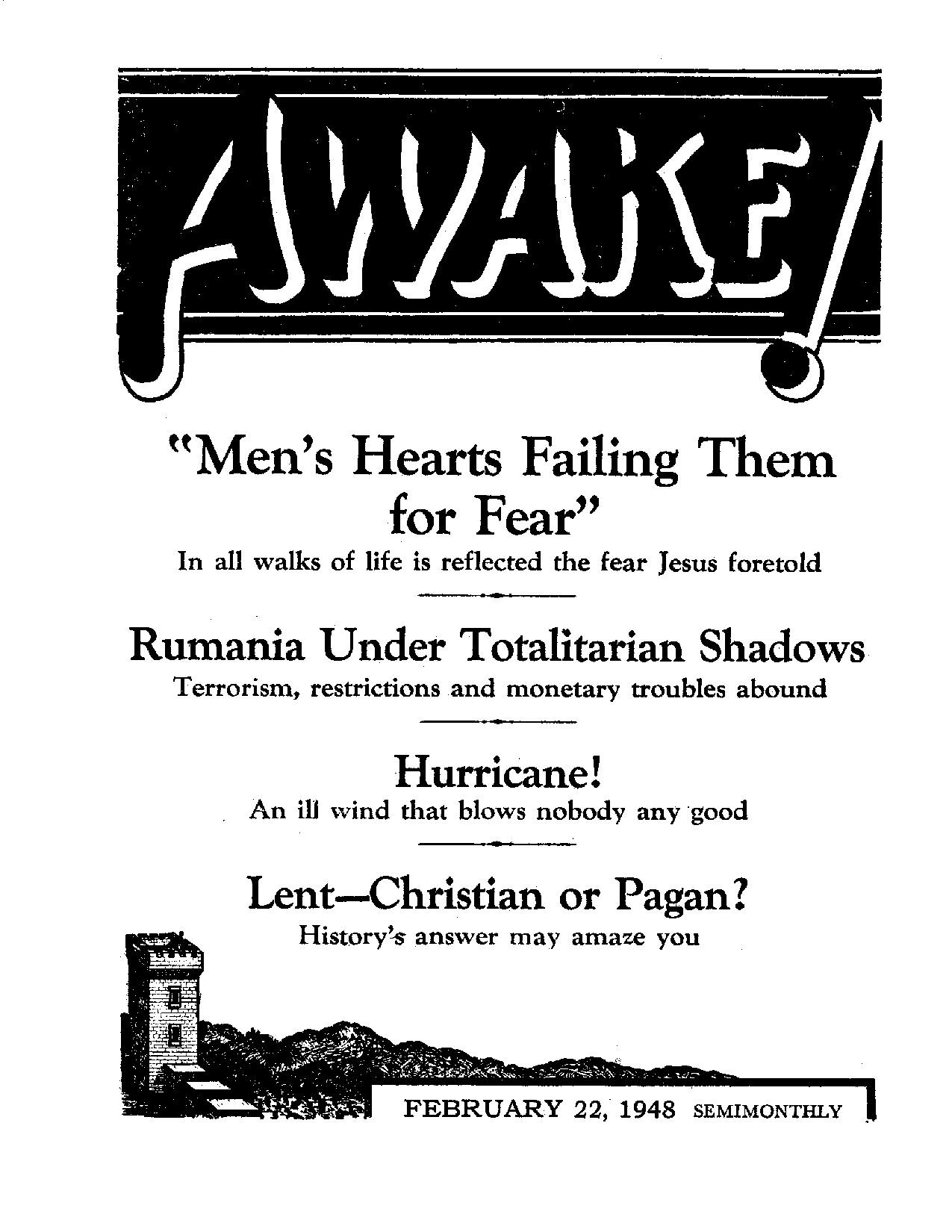
"Men’s Hearts Failing Them for Fear”
In all walks of life is reflected the fear Jesus foretold
Rumania Under Totalitarian Shadows
Terrorism, restrictions and monetary troubles abound
Hurricane!
An ill wind that blows nobody any good
Lent—Christian or Pagan?
THE MISSION OF THIS JOURNAL
News sources that are able to keep you awake to the vital issues of our times must be unfettered by censorship and selfish interests. “Awake I’* has no fetters. It recognizes facts, faces facts, is free to publish facts. It, is not bound by political ambitions or obligations; it is unhampered by advertisers whose toes must not be trodden on; it is unprejudiced by traditional creeds. This journal keeps itself free that it may speak freely to you. But it does not abuse its freedom. It maintains integrity to truth.
“Awake!” uses the regular news channels, bdt is not dependent on them. Its own correspondents are on all continents, in scores of nations. From the four comers of the earth their uncensored, on-the*scenes reports come to you through these columns. This journal’s viewpoint is not narrow, but is international. It is read in many nations, in many languages, by persons of all ages. Through its pages many fields of knowledge pass in review—government, commerce, religion, history, geography, science, social conditions, natural wonders—why, its cover* age is as broad as the earth and as high as the heavens.
“AwakeI” pledges itself to righteous principles, to exposing hidden foes and subtle dangers, to championing freedom for all, to comforting mourners and strengthening those disheartened by the failures of a delinquent world, reflecting sure hope for the establishment of a right* eous New World.
Get acquainted with “Awake!” Keep awake by reading “Awake!”
Published Semimonthly By WATCHTOWER BIBLE AND TRACT SOCIETY, INC.
117 Adams Street Brooklyn 1, N. Y.» XJ. S. A.
N. H. Knorr, President Grant Suiter, Secretary
Five cents a copy One dollar a year
Remittances should be sent to office in your country in compliance with regulations to guarantee safe delivery of money. Remittances are accepted at Brooklyn from countries where no office is located, by international money order only. Subscription rates in different countries are here stated in local currency.
Notice of expiration (with renewal blank) is sent at least two issues before subscription expires.
Entered as second-class matter at Brooklyn, N.
Change of address when sent to our office may bo expected effective within one month. Send your old as well as new address.
Offices Yearly Subscription Rate
America, U.S., 117 Adams St., Brooklyn 1, N.Y. $1 Australia, 7 Beresford Rd., Strathfield, N.S.W. 6s Canada, 40 Irwin Ave., Toronto 5, Ontario $1 England, 34 Craven Terrace, London, W. 2 5s South Africa* 623 Boston House, Cape Town 5s
L, Act of March 3, 1879. Printed bi U.S.A
CONTENTS
“Men’s Hearts Failing' Them for Fear”
War Jitters
Economic and Social Fehrs
U. N. Tower of Confusion
Vicious Armament Race
Clergy Are Trembling with Fear
Scientists Frightened by Future
Lacona Petition to Supreme Court Denied
Power-hungry Blasphemers Covet the World 11
Totalitarian Shadows on Rumania
Russian Rule
Soupless Days to Relieve Housing Shortage 16
Hurricane!
Causes of Hurricanes
Destructive Power
The Walking Dead'
Types of Leprosy
Filaria and Elephantiasis
Disaster Strikes in the U. S. A. “Thy Word Is Truth”
Miraculous Gift of Tongues
Lent—Christian or Pagahi
Ever-changing Lent Customs
Watching the World
/WWCi/
Now it is high, time to awake.'—Romans 13:11 Qj
Volume XXIX , ' Brooklyn, N. Y., February 22, 1948 \ Number 4
SSS=g=-—*»'" ...I =-’ — L5. HL.' ■! .. 2_. -■■■■ . ■— 1 ■■■■. ■ r ' ■. —=■-■— -=gi 1 w ■■ . n i..i r ■ i < ■ n . ■ i ■ jm
"Men’s Hearts Failing Them for Fear”
NEVER was there a time in the history of man when distress and perplexity lay so heavily upon the nations as it does today. Never was there a time when anxiety, fear, alarm, panic and fright crushed upon the minds of the people as now. Never was there a time when the world was in such a bewildered, uncertain and shaky condition of agitation and turmoil. Beset by the disconcerting affairs, events and developments in the world today, and the terrible forebodings of the future, the people are plagued with a vexation of spirit and a painful uneasiness of mind. In the throes of these prevailing conditions many people are mentally prostrate, frozen with terror and paralyzed with horror. Chaos and confusion reign in many places. Mad hysteria has seized the masses, and trepidation and terror has taken hold of the rulers.
And why not? Are there not plenty of reasons for this morbid fear that has seized mankind? Look at the mountain of crushing economic conditions, the insurmountable barriers to world, peace and. the open threat of an atomic war that confronts this twentieth-century world. Look at the political afflictions that enmesh humanity; the hatred in Palestine, the killings in India, the hunger in Europe, the rebellion in Greece, the trouble in Indonesia and Indo-China, the race riots in Africa, the unrest in Egypt, the scarcity in England, the inflation in America, the war in China, the revolutions in Latin America, the bondage in Spain and Russia, all of these mounting problems are topped by even a greater issue, international atomic energy control. Little wonder, then, that these insoluble troubles accompanied by one emergency after another and one crisis after another have caused the stoutest hearts to faint with fear.
To prove that this is so, one has only to listen to the daily conversation of the people in the market places, -the factories, the offices, and the homes. Daily the radio and newspapers describe this universal fear and trembling. The common man knows this to be a fact, but for the benefit of those having a “show me” attitude, who demand an exact quotation, it is well to submit a few of the words from the lips of eminent personages: statesmen, financiers, clergymen, scientists.
Pierre van Paassen, the noted correspondent, lecturer and author, known best by his book Days of Our Tears, writing in Woman’s Day, said:
We are living in a crazy world, a world possessed. Our Puritan ancestors might well have called it a world possessed of the Devil. For evil and violence and heart-rending anxiety seem to have gained the upper ham for the time being, so that even the most Christian and the most peace-loving nations on earth are caught in a seething whirlpool.
The pillars of society have begun to shake. The foundations of truth and humanity, of reason and justice, which we thought of enduring character and of lasting value, sometimes seem to be disintegrating. At times we feel as if the very ground under our feet were trembling, and we no longer know on what to build or where to take our stand. The future weighs upon us as a terrible, incomprehensible burden under which nobody dares to plan and scarcely anyone dares to look ahead.
Winston Churchill likewise expressed his fear in his famous address at Fulton, Mo. Speaking of “the awful ruin of Europe” and the danger of collapse of the U. N. “temple of peace”, he said:
When I stand here this quiet afternoon I shudder to visualize what is actually happening to millions now and what is going to happen in this period when famine stalks the earth. . . . Now, at this sad, breathless moment, we are plunged in the hunger and distress which are the aftermath of our stupendous struggle. . . . The Dark Ages may return, the Stone Age may return on the gleaming wings of science, and what might now shower immeasurable material blessings upon mankind may even bring about its total destruction. Beware, I say; time may be short. A shadow has fallen upon the scenes so lately lighted by the Allied victory.
A year and a half later Churchill is still filled with woe. Conditions in India, he says, constitute “one of the most melancholy tragedies Asia has ever known”. In Britain conditions are much worse now than during the war, he says, “but what has happened so far is only a foretaste of what is to come.” Though not expecting an immediate war, Churchill declares, “I cannot exclude the danger of war”; hence the Western democracies should “take every measure of prudent defensive preparation that is open to them”.
War Jitters
This fear of war is on all their lips. Senator Millard E. Tydings expressed the fear of many people when he declared: “In the present world situation all nations continue to straddle. They rely half on the United Nations to settle international disputes and half on their own mighty armaments, just in case. If the world continues to straddle, all is lost.” “American policy,” according to the newspaper columnist, Max Lerner, “proceeds both from a sense of power and a sense Of fear.” Moreover, he says, “the scared men in the Kremlin are matched by the scared men in Wall Street and Washington. The combination of power and fear on both sides may prove a fatal one for the world.” A scared man of the Research and Development Board, Dr. Vannevar Bush, fears that “the danger of aggression and war” is so great that the United States will have to maintain its military strength “for years to come”. Fear dictated the former secretary of state, James Byrnes, to say in his recent book Speaking Frankly that the only alternative to an agreement with Russia is to make “bigger and better atom bombs”. Fear also moved the prominent Socialist leader, Norman Thomas, to cry out: “Angels must weep at the spectacle of hungry peoples having barely survived one total war already preparing frantically to fight the third, deliberately robbing their children of bread in order to provide bombs.”
When Dr. Oswaldo Aranha, of Brazil, opened the second regular session of the United Nations General Assembly on September 17 he described the fearful conditions in the earth. “At the moment,” he said, “we have victorious peoples and vanquished peoples, while nearly all are burdened with poverty and fear. Peace in the occupied regions is merely a military condition. . . . Europe is an economic tragedy and a military question mark. In Asia the tide of blood which the war swept in has not ebbed away. . . . The next ten years may be envisaged as a period of doubts and insecurity.” Mrs. Vijaya Lakshmi Pandit, Indian representative to the General Assembly, noted the “tense suspense” in the world and warned that there was “an uneasy awareness that things are perhaps moving toward some new and annihilating disaster for mankind”.
Pointing to other causes for mankind’s jitters, Joseph P. Kennedy, former United States ambassador to Great Britain, said Americans today are confused and restless because “administration economists have become politicians, and statesmen pose as economists. The net result is a very sickening and discouraging political economic philosophy which has given the nation a case of first-degree jitters”. Henry Wallace is also fearful of the “dangerous course” that the nation is following, one in which he says “every propaganda technique known to man is being used to win support for basically rotten policies”.
Europe’s condition, said Myron C. Taylor, Truman’s 73-year-old “messenger boy” to the Vatican, is “a pretty sad picture, politically and economically”. Herbert H. Lehman, former governor of New York and who was director general of UNRRA, said that the world as a whole is really gambling for the very “existence of civilization and humanity”. And Secretary of State Marshall declared “we must face the facts”, for “we are faced with the danger of the actual disappearance of the characteristics of Western civilization on which our government and our manner of living are tiased”.
These are the grave warnings of world leaders, and throughout they are punctuated with fear. One can feel the pessimism, anxiety and frightful alarm that has taken hold of these men.
Economic and Social Fears
Robert Wood Johnson, in his book Or Forfeit Freedom, after discussing the labor management problem, says that “if it is not solved, our society will collapse, plunging us and perhaps the rest of the world into new and terrible Dark Ages”. Senator Taft is also alarmed, saying that the “abuses in the labor field can only lead to conditions which require violent emergency action”. The president of the National Association of Real Estate Boards, Morgan L. Fitch, is frightened over the possibility of a “ruinous” inflation, but M. S. Eccles, chairman of the Federal Reserve Board, fears that a “severe economic storm” is threatening and an “economic collapse” is sure to come if inflation continues.
The horrifying specter of starvation that stalks through the earth today strikes with terror even those that are well fed. Viewing Europe, Truman says that “France and Italy are without adequate food and fuel supplies for the . . . winter, and do not have the resources with which to buy them”. “The battle to save food jn the United States is the battle to save our own prosperity and to save the free countries of western Europe.” Frightened by the turn of events, Truman, in calling an extraordinary and special session of Congress, declared: “Our domestic prosperity is endangered by the threat of inflation; the peace of the world is endangered by hunger and cold in other lands.” James Forrestal, secretary of defense, said that the war “we are waging is against hunger and desolation, against oppression and tyranny, against disease and despair”. A crisis has been reached, says Secretary of State Marshall: “European economy might well break down under the intolerable strain of another winter of hunger, cold and want.” Dr. Martha M. Eliot, chief medical consultant of the U. N. International Children’s Emergency Fund, says that large numbers of Europe’s children are “terribly in need of still more food and clothing”. Europe’s hunger, says Secretary of Agriculture Anderson, is the kind “that gnaws at the very vitals of the human being, the kind of hunger that forces the body to feed upon itself”. Pleading for food, former governor of New York,
Herbert H. Lehman, says: “We must act quickly. We are in a battle against time. We cannot afford to give too little or too late. If we do not act properly I am fearful there will be chaos in all Europe.” Laments Secretary of Commerce Harriman: "I wish you could see, as I have, the slim margin of life of people in many countries and understand what will happen if enough food fails to come from us this winter.” Also Charles Luckman, chairman of the Citizen’s Committee, voices his fears: “Today the people of Europe are once again enslaved, this time by the tyranny of hunger. . . . We must fight. Food is the only weapon that can defeat hunger.”
Other people, no less worried over the shortage of food in the earth, yet fearful that the leaders at the top are incompetent,, have reasons to be panicky. They remember that the same secretary of agriculture, Anderson, that is now pleading for th^m to save food ordered the dumping and destruction of 45,000,000 bushels of potatoes last winter when people were starving, in order to keep prices up. Senator Leverett Saltonstall demands to know why the government was holding 90,000,000 pounds of eggs in dried and frozen forms at a time when eggless and meatless days were the order. Meantime, while such confusion worries people in America, this winter the 1,500,-000 surviving European Jews will face their worst crisis since the war, according to Moses W. Beckelman. The wailing of the Jews over the plight of their people on Yom Kippur was heard around the globe. And in Palestine the Arab and Jewish situation casts a frightful shadow of woes to come. The oriental, on the other hand, is not concerned over the troubles of Europe and the Jews; he has his own. In India, starvation, floods, killings, 100,000 tons of rice lost, and cattle destroyed, are the brutal tragedies of the land, and Prime Minister Nehru fears that the riots and killings will lead India into a form of fascism.
In addition to the economic troubles the postwar era “has ushered us into a time of moral confusion”, says the “Rev.” Dr. John S. Bonnell, of New York. With a high rate of divorces and juvenile delinquency, and “a marked decline in sexual morality, the sickness of our society is plainly revealed”, he declared. “Rev.” Dr. W. E. Purcell, of Maidstone, England, says that this ‘social rot that has set in’ has “presented a frightening picture”. It is “short-sighted to spend billions to bring about a betterment in economic conditions” and at the same time fail to solve the problem of youth, says the editor in chief of the Toledo Blade. Five hundred missionaries and Congregational Church leaders have asserted that action must be taken on these social' problems if war and chaos are to be prevented from spreading. Such are the expressions of fear that come from a large body of the perplexed population.
U. N. Tower of Confusion
Nothing personifies the truth that ‘men’s hearts are failing them for fear’ better than the monumental U. N. “Tower of Babel”. Erected as a symbol of peace, with a banner on which are twin olive branches encircling a map of the world, the United Nations is hailed by many fearful individuals as “the last opportunity to rid the world of the scourge of a new war, and secure for the peoples those four freedoms for which they fought”, to quote Chile’s U.N. delegate, Senator Jose Maza. Others say that “there is no cure for the ills of the world outside these [U. N.] principles”, and morally, ideologically and militarily it is “the world’s most important instrument for the defense of peace-loving nations”. Hector McNeil, the U.N. British delegate, avers: “If we darpage this Charter, if we harm it, if we fall short of it,” then history “will overtake us and damn us forever”. Such oratorical eloquence springs from men who are desperate with fear and are trembling in their boots.
Other people who are more realistic are frightened at the utter failure of the United Nations. To quote the Denver Post, the U. N. has been reduced “to a mere forum of word throwing, incapable of enforcing the peace”. The Chinese foreign minister, Dr. Wang, quakes to think that the “United Nations has reached a point when its future development and possibly its very existence hang in the balance”. After listing the defects of the U. N. the Netherlands ambassador to the United States, van Klef-fens, said: “Small wonder that people of Holland are critical of the United Nations. They joined with enthusiasm,’’ but “they have been seriously disappointed. They know they are not the only ones who are so disappointed and alarmed”. It is almost ludicrous to hear Dr. Evatt, Australia’s U. N. delegate, say with all seriousness that the U. N. fails to maintain world peace because there “is as yet no world peace to maintain”. Frightened men are not able to reason or think straight.
Even Trygve Lie, the secretary general of the United Nations, admits that the U. N. has “made little progress toward capturing the enthusiasm and harnessing the imagination of the peoples of the world”. And this in spite of the fact that special masses are celebrated for the organization, with Catholic cardinals officiating, and in spite of the fact that Cardinal Spellman personally prays to his god for peace. Frightened by this continuing failure of the U. N. to capture the people’s interest, the propagandists are preparing to use cheap advertising to “sell” the U. N. to the public. This to come in the form of 20-second radio announcements, like the following:
The world is round? You’re crazy! A man flying? Ridiculous! A voice heard across the ocean? Insane! Well, people used to say those things were impossible. We know better today. The General Assembly of the United Na-Z tions is accomplishing another “so-called” impossibility. . . . world peace! Get in on the discovery. . . . it’s an exciting experience.
Fearful Because of Peace Failure
* “Strange As It Seems,” edited by John Hix, says that in the last 3,434 years there have been 8,000 peace treaties signed but only 268 years of peace, which is enough to make the present puny peace-makers quiver and the people in general to tremble. “We have won the war,” murmurs Senator Taft, “but we have lost the peace.” Fearful that the United Nations will also fail, a group of frightened men are heard to cry for a “World Federal Government”. Albert Einstein, one of the sponsors, says that “everything has to be done to make it clear to the electorate that the solution can only be world government and nothing less”. “The very existence of mankind” is at stake, he says. Henry Chamberlin, in his book The European Cockpit, says that over there “a federated Europe”- is the only answer. Yugoslavia’s ambassador to the United States, Kosa-novic, thinks that peace will come when there is an agreement between the Soviet and the United States. Others, feai< ful that there will never be “one world”, work for a division into two worlds. On the one hand the “Truman doctrine”, the “Marshall plan” and the “little assembly” are put forth by the Western world as ways of obtaining peace, while Russia at the same time solidifies eastern Europe and revives the “comintern”, or . “cominform’’, as some call it, as her means of unifying the nations. And so it goes, every frightened mariner aboard the world’s sinking ship on this stormy sea suggests a different course to sail in hopes of reaching the same port of peace.
Instead of quieting the hysteria the splitting of the world into two camps has increased the people’s fears and anxieties by raising in their minds many new nightmares. Charges and countercharges are hurled from both sides with increasing violence. Russia is fearful of America’s military maneuvers above the Arctic Circle in Greenland and Alaska not so many miles from her borders. She is fearful that America is rebuilding “the war-industrial potential of Japar nese imperialism”, and reviving the German war potential in western Germany. She is fearful of a Vatican crusade, accusing the pope of “openly calling for war against the Soviet Union”. Russia sees America’s reorganization of her armed forces, development of new weapons and armament, the f ormation of military blocs for mutual hemispheric defense. Alarmed, she charges the western powers as “warmongers”, “imperialists,” “expansionists,” “cannibals, lusting for profits, who propose dropping bombs over the Old World.”
America also is trembling with fear from what she sees happening in eastern Europe: a totalitarian giant forcing itself, through a policy of aggression, on small countries while hiding her internal activity behind an iron curtain of censorship. America is fearful that Russia’s activity has filtrated into her own government, as an 'enemy within her gates’, “with the Single object of revolutionary subversion,” to quote J. Parnell Thomas, chairman of the House Committee on Un-American Activities. To stop this Russian expansion policy, Prof. Finer, of the University of Chicago, told a conference of several hundred distinguished scholars, the U. S. A. would have to use the weapon of fear. “The United States,” said Finer, “most probably will be forced to rely on fear; the fear of armed force.”
But beating the war drums loud and furiously does not produce music conducive to peaceful sleep. Says the Dutch psychologist, Dr. A. M. Meerloo:
’ Some people today have the curious idea that one way to insure peace is to play up the horrors of the next war. Behind this sort of thinking is the notion that people will actually be forced by fear to build a constructive plan for peace. Psychology tells us that this way of thinking is dangerous. We know that fear never evokes peaceful reactions in men. On the contrary, people react to fear by readying themselves for defense and attack. . . . The answer to how to build a positive peace cannot be found in military strategy and atomic science. The militant way of life always fails. It always turns into a vicious circle of defense, aggression, and renewed attack.
Vicious Armament Race
• Racing around this vicious circle the world seems to have gone mad with fear. “The greatest momentum to war in the history of the world exists today,” moans the editor of the Saturday Review of Literature, Norman Cousins. Francis Biddle, after returning from the famous Nuremberg trial of Nazi war leaders, expressed the fear that such trials will not end wars. Dr. G. W. Frasier, retiring president of Colorado State College, also fears that “the United States seems headed for war”. The former assistant secretary of state, MacLeish, thinks “the worst of all religious wars” is shaping itself up. In France, Ramadier (then premier) and President Vincent Auriol recently voiced their fears of another war, and Charles de Gaulle said: “There is not one who does not see the great and heavy clouds massing on the horizon.” And Marshal Tito warns: “we prepare for war as though it were starting tomorrow.”
Where is all their atomic energy control? for Dr. Ulloa, of Peru, says that atomic energy “is a Sword of Damocles hanging over peace”. The Soviet plan is considered “defective”, and the U. S. War Department says that even if the United States plan is adopted other nations can wage an atomic war on an equal footing with the U.S.A, within six years. Hence, with panicky fright the great powers accelerate their armaments race.
A survey made a few months ago by the New York Times revealed that the world is maintaining 19,000,000 men in its armies. The United States Navy is four times as great as in prewar days. Yet, the former Selective Service director, General Hershey, says, “I am frightened” because voluntary enlistment of men has fallen off. The militarists are' screaming for universal service. The cost to the world for its armies is $27,-000,000,000 a year, but this is only a fraction of what is being spent for another war. “Today millions, perhaps billions, of dollars -in concealed funds, only a fraction of which are reflected in this survey, are being spent on research and development into the atomic bomb, bacteriological warfare, guided missiles, jet planes and other new weapons.” (New York Times) Because of fear, tanks, heavy artillery and vital parts of battleships are hermetically sealed and stored away “ready for immediate use”. The production of bombs continues and these are being stored in earthen igloos ready for use. The development of bacterial warfare (BW) is being pushed for all it is worth. Already they have a certain toxin one gram of which will kill 7l,000,-000 people, and a virus 20 drops of which will kill 20,000,000 people.
Clergy Are Trembling with Fear
When the clergy pray for the deliverance of this insane world, only to find that their gods do not answer, they too are stricken with acute fear. From many pulpits come expressions of their terror. Dr. Channing Tobias, of New York, says that it is “a bewildered and pessimistic world”. The Associated Church Press writes about the “chaos and confusion”. Dr. Reinhold Niebuhr says the people are “hysterically anxious about the perils to which we are exposed”. Headlines in the New York Times read: “Oxnam [Methodist bishop] Holds War with Russia Sure,” “Bishop Tells Methodists Our 'Hysterical’ Policy Does not Solve Problems.” Dr. J. H. Cockburn says: “It is Christian civilization that is at stake,” not merely Europe. The archbishop of York, Garbett, is afraid that under the “growing tension” some nation “will decide in hysterical fear to end the crisis by using the atomic bomb”. Members of the World Council of Churches wail that a “crisis in the existence of mankind” has been reached. The American Council of Christian Churches says that unless Russia is resisted “the world is destined for the most horrible bath of blood anti holocaust of unimaginable proportions”.
The Catholic Bishops of America are fearful that maybe “there is no way out of the confusion and conflict which block the road to real peace”. The Chinese Cardinal Tien has advocated a third world war as the only remedy. Cardinal Spellman worries about “the world’s end”. The pope also is a frightened man who speaks of the present “perils without precedent”. In conference with his cardinals Pius XII said: “The time is running short. Incalculable calamities lie ahead if the world fails to agree.” Reporting the pope’s speech on the twenty-fifth anniversary of Catholic Action the New York Times said: “The Pontiff betrayed very deep anxiety as time and again he referred to the contest between the Christian and nonChristian forces, going so far as to state that ‘even a few minutes can decide the victory’.” And from the other end of the religious wailing wall, there is also heard an expression of deep anxiety. Protestant clergymen numbering 1,275, together with 6,000 laymen, declare that the Papacy is “the greatest single influence” working toward another war. How true Harry Emerson Fosdick’s confession!— “The world is certainly a mess, and whether or not we like to face the fact, religion helps to make it so.”
Scientists Frightened by Future
Surely the scientists, the “creators” of this atom-splitting synthetic world, should be optimistic about the future; but we find them as fearful and pessimistic as the rest of the world. Having a firsthand knowledge of the terrible horrors that are being perfected, yet unable to stop the unseen forces that are pushing them on, these men of science cry out in frightful alarm as they look into the future abyss. Expressing the fears of a great many of his colleagues, Dr. Harold C. Urey, Nobel prize winner and one of the foremost scientists ip the atom bomb project, wrote an article (published in Collier’s magazine) entitled “I’m a Frightened Man”. Therein he said:
I write this to frighten you. I’m a frightened man, myself. All the scientists I know are frightened, frightened for their lives, and frightened for your life. ... I say to you— and I wish I could say it face to face—that we who have lived for years in the shadow of the atomic bomb are well acquainted with fear, and it is a fear you should share if we are intelligently to meet our problems. . . . Now, in Washington, we have learned a new fear: We are afraid of what politicians and diplomats may do with the atomic bomb. . . . If you, the people, let things drift, we will perhaps see a world divided into, two great spheres of interest, east and west, afraid of each other, afraid of one unguarded word. Freedom from fear? We will eat fear, sleep fear, live in fear, and die in fear.
It is most manifest from all of the above evidence that the people together with their leaders dwell in a compressed atmosphere of hysteric fear; yet they know not why. They know not that it is because we are in the “last days” of this satanic world. They know not that Christ foretold that it would be a sure sign of the setting up of His kingdom. They know not that He said in very plain language that there would be “upon the earth distress of nations, with perplexity; the sea and the waves [of restless humanity]* roaring;. men’s hearts failing them for fear, and for looking after those things which are coming on the earth.”—Luke 21:25, 26.
When “Father” Gannon, the president of the Jesuit university of Fordham, declared that “a nearly desperate world stares with fascination toward Armageddon” he referred to an atomic war between nations. In truth and in fact the world is face to face with the Armageddon spoken of in the last book of the Bible, The Revelation. But because the people are blind and because the ‘blind are leading the blind’ (Matthew 15:14) they fail to see this real danger ahead—the ditch of Armageddon, which is “the battle of that great day of God Almighty”. (Revelation 16:14,16) In that battle, which will cleanse the earth of all evil and make way for the righteous administration of Christ’s kingdom over all the earth, the hearts of the wicked that now tremble with fear will stop cold. Persons of true good-will toward God will survive that universal war and live in endless peace and happiness. Former fears will neither be remembered nor come into mind.
-------<♦
Cacona Petition to Supreme Court Denied
C Awake! has kept its readers posted on the attempt of Lacona, Iowa, to inaugurate rule by moboeracy. Mob rule of the village resulted in disorders and denials of freedom of worship to Jehovah's witnesses. Deputized mobsters got the green light when a United States District Court ruled against the Witnesses, but the light turned red when a United States Circuit Court of Appeals halted the moboeracy steamroller and ordered religious freedom restored to the Witnesses. Lacona appealed the case to the United States Supreme Court. On January 12 the high court refused to hear the case. The light remains red for the mobocrats.
Power-hungry Blasphemers Covet the World
AT THE Eucharistic Congress held at Buffalo, N. Y., On September 22-25, seven cardinals and other representatives of the Boman Catholic Church set forth that cult’s recommendations for securing world .peace. Cardinal Spellman set the theme of the assembly on the second day, when he §aid • -I believe with all my soul and profess before the world that it is the sacred duty and the mission of the Church to bring peace.” This church boasts of its antiquity, yet throughout its centUries-long existence it has never fulfilled its “sacred duty". What a failure has this church proved to be, as testified by the hundreds of wars since its inception I Next this suave religious spellbinder called Cardinal Spellman as good as said Jesus lied when He stated that “with God all things are possible”, because Spellman arrogantly purred if'Even Goll cannot make a peace-, ful world without peace-loving men to help him." Modestly meaning himself and his sect, of course.
They are going to help God by making the world Catholic, At the seventeen sectional meetings during the Congress Catholic men and women in all walks of life were urged to spread Catholicism to all with whom they come in contact, to live their religion and win others tp it. Conversion activities are to sweep not only the United States but the world. And when this goal of world conversion has been reached, then the world united in Catholicism will be united in peace. Won't God be happy when they thus make it possible for Him to bring peace! What insufferable and gagging gall I
The aim of the ambitious Roman Catholic Hierarchy is not world peace, but is world domination. This aim as concerns
-<► the United States is well shown by Jesuit Francis X. Talbot: 'Why.can’t we raise a tidal wave that will bring Catholic culture into the United States! Why can’t we make the United States Catholic in legislation, Catholic in justice, aims and ideals! We are the greatest numerically in the country, strong and growing in the arts and education. We are now ready to expand. Now is the time to organize and strike hard to put the Catholic idea before all.” (New-York Globe, December 14, 1930) Since that time Catholicism has infiltrated its agents into key positions in polities and commerce, till now the nation is honeycombed with a Vatican State fifthcolumn. In time they hope to make the world Catholic in legislation, justice and ideals; then the clock’s hands will be whirled back to the Middle Ages with its bloody and unjust Catholic Inquisition.
We could well trade the entire bumper crop of nincompoop politicians of our day for a few Abraham Lincolns. He was awake to Papal Rome’s hunger for power, saying in warning:
"The Protestants of both the North and the South would surely unite to exterminate the priests and the Jesuits, if they could hear ... of the plots made in the very city of Rome to destroy this republic, and if they could learn how the priest, the nuns, and the monks, who daily land on these shores^ under the pretext of preaching their religion, are nothing else but the emissaries of the pope, and other despots of Europe, to undermine our institutions, alienate the hearts of our people from the constitution, and our laws, destroy our schools, and prepare a reign of anarchy here as they have done in [other countries].”—Fifty Years in the Church of Rome, pp. 699, 700.
kingdom is not of this world” of
“Whosoever therefore will be a friend
the world is*the enemy of God,”—John 18:36; James 4:4.
TOTALITARIAN
WORLD War II found Rumania torn by conflicting factions. However, the pro-Nazi element gained the ascendancy under Ion Antonescu, who for a time was the dictator of the country, and who invited Hitler to send troops Into Rumania to reorganize its army. Before the Germans finally left they did a great deal more than reorganize the army, and Rumania was led into the war on the side of Hitler, and against Russia.
The clergy became the willing instruments of the dictatorship and from their pulpits preached in support of the "anticommunist crusade’7, prophesying an early defeat of Bolshevist Russia and peace and prosperity for the Rumanian people.
The Rumanians occupied Odessa and took over a new building for its officers’ headquarters. The building had, however, been “booby-trapped” by the retreating Russians and many of the officers lost their lives in the resulting explosion. Antonescu took dire revenge. He ordered 50,000 Russian men, women and children to be shot for this purely military act. That number were accordingly hunted up by the Rumanian soldiers, who lined them up along the bank of a river and mowed them with rifle and machine-gun fire. They were then thrown into the river..
The Rumanian troops shared Hitler’s victories in Russia all the way to Stalingrad, There, however, a large number of Rumanians went over to the Russians. This is reported to have contributed much toward hastening at last the failure of the German forces to take the city. These Rumanian soldiers remained in Russia until the summer of 1947, when they returned to Rumania, being hailed, particularly by the Communists, as the true 'Rumanian democratic army”. They had been thoroughly drilled in Russia and trained both politically and in a military way, and are expected to play a leading part in Rumania and its army to further Russian policy.
War Ravages and Losses
The war caused terrible ravages in Rumania, In the capital alone 12,000 houses and buildings were destroyed and many times that number were damaged. Other cities shared a similar fate. Hardly a street or railway bridge and but few railway Stations were left intact after the Germans had passed through the country upon their retreat.
King Michael in 1944 staged a coup d’etat (August 25) placing Antonescu under arrest and appointing a new premier, General Constantine Sanatescu. Two days later Rumania declared war on Germany, the advancing Russian armies driving the Germans and their satellites, back through the country amid heavy fighting. A great part of the civilian population were compelled to leave their homes, and returned to find them stripped, so that they had to start anew with practically nothing.
Rumania came out of the war impoverished and weakened, having lost also the territories of Bessarabia and Bukovina, and being further obliged to agree to heavy reparations to the Russians. The Russians were now the occupying power, and that meant the virtual loss of national independence, at least for a time. All this as a consequence of the Rumanian dictatorial government of Antonescu having entered World War II at Hitler’s side.
The peoples of the West enjoy many things of which the common people of Russia had no knowledge. For instance, watches and alarm clocks. Everybody knows by now that Russian soldiers were very eager to get such as they advanced through the eastern part of Europe. They judged the quality of a watch by its noticeable ticking. If it did not tick satisfactorily they were disposed to throw it away or give the timepiece to somebody else. The story is told of a Russian wh« had gotten an alarm clock and attached it to the saddle in front of him. It went off suddenly, ringing merrily, but the soldier seized it and threw it from him with\.all his might. Another having become the proud possessor of an alarm, on hearing it ring, took his rifle and shot it to protect himself.
Russian Rule
Although it came in a disguised form, Russian rule came to Rumania with the end of the war. This was hard for the Rumanian people generally, for they always had more affinity with Western civilization than with the Slav peoples. But now the Communist party came to the fore. Many of the Communists had been imprisoned under Antonescu’s government. When the war ended many Rumanian clergymen were imprisoned for a time because of the role they had played in helping to create an atmosphere favorable for a war on Russia.
The Communists, knowing that they had only about 18 percent of the votes of the country, agreed to have a “bloc of the democratic parties” formed. The bloc included Social Democrats, Agricultural Workers party, the Communists, and some others. Once this political machinery had been established, the Communists began to elbow their way to the position of power, playing a part more and more out of proportion with their numerical strength. However, it was less the Rumanian Communists that ruled than the Russians, who were backing them. The first postwar government, still in power, was formed according to the wishes of Moscow as set forth by the clever and energetic Vyshinsky, who counseled the Rumanian Communist party.
In 1932 Ana Pauker, a Rumanian Jewess, was given a sentence of 25 years’ imprisonment for Communist activity in Rumania, but she was soon freed and flown to Russia by a Rumanian major. She returned with the victorious Russian armies twelve years later. September last she represented the Rumanian Communist party in the meeting of representatives of nine European communist parties in Warsaw, at which time it was decided to establish an Information Bureau in Belgrade which is known as CominformT It is generally considered to be a revival of the former Communist International organization known as Comintern. Ana Pauker is in some respects the most important person in Rumania, representing the Russian government and the executive committee of the Russian Communist party in Moscow. She transmits Russian orders—party and government—to the Rumanian government, and these orders or directives are carried out, too. Rumania’s government is largely the instrument of the Russian occupation. No minister is allowed to resign of his own initiative; if he did so, he might risk being fetched out of his home at night and disappear. There have been such kidnapings already. State ministers and government officials'are said to be constahtly watched by Communist agents, who want to know who comes to see them and where and with whom they spend their time.
The Constitution of 1923 was abolished by Antonescu, but was agaih put into operation at the end of the war. But only in theory, not in actual practice. The government has ruled by decrees. There is no court in Rumania today that would dare to take a position contrary to the decision of the Communist-dominated government.
Terrorist Methods
The following is an instance of Communist action: The keeper of a newsstand in an eastern Rumanian town sold papers of all the Rumanian parties, including the daily of an opposition party. The Communist chief of the place came to him and told him not to sell that paper any longer, although it was still permitted by the government. The man protested that he was selling all papers. After a further warning the Communist official left. The newspaper vendor thereafter no longer sold the paper openly, but only on request. After about a week, when returning home about 11 p.m. the newspaper dealer was attacked by two men and .dreadfully beaten. Another case: A small factory had a staff of about fifty workers, not including any Communists. The owner of the factory was accused of having engaged in “black” trade and of doing other forbidden things in his establishment. All the workers were questioned by the police and all refuted the accusation. As a result they were held in custody for three days.
The Communists do not take democratic principles very seriously, and apparently do not consider themselves bound by them. They refer to such rules for party ends, but their application would be a hindrance to reaching their goals. At the end of August (1947) they put up notices in the working rooms of the Bucharest streetcar company stating that every worker who had not joined the Communist party by the end of August would be dismissed. As to being enrolled in trade unions, all the workers of industries and other enterprises were automatically registered as members of such unions without being asked. Many qualified workers, foremen and officials of the Rumanian railways and of other enterprises were dismissed because they refused to join the Communist party.
The ever growing Russian and Communist pressure in Rumania has created a state of great apprehension which makes itself felt everywhere. Seeing that about 80 percent of the population are peasants and that most of these were organized in a strong political party led by Maniu, onetime prime minister of the Rumanian government, the masters of the day determined to smash this party, and sentenced Maniu and other party leaders to long prison terms.
Stabilizing the Currency
The inflation of Rumanian currency, due to the postwar conditions, reached a stage where something had to be done. The income of a worker in inflated lei amounted to but a fourth of his wages in 1938, or even less. A pound of bread cost 150,000 lei, a pound of grapes 80,000 lei, a streetcar ticket 10,000 lei. A dollar being worth 4,000,000 lei on the unofficial market, these prices, compared with the dollar, were actually quite low, but to the Rumanian wage-earner they were terribly high, because he earned but 4,000,000 lei a month, the higher officials receiving from 8,000,000 to 10,000,000 lei. In order to buy proper food, not to speak of other needs such as clothing, etc., they should have had from 15,000,000 to 20,000,000 lei per month. The peasants, naturally, held on to as many of their products as possible, rather than let them go at official prices.
The government therefore issued a new currency, and the Rumanian National Bank exchanged old lei for new at the rate of a million of the former for 50 of the latter. A peasant could exchange 5,000,000, a worker 3,000,000, employees and officials 1,500,000, while independent business people could not exchange anything. In this way peasants who had 5,000,000 lei received 250 new lei, $1.65, the workers a dollar, and the officials half a dollar. Rumania’s inhabitants had to start new, in fact, and millions of “millionaires” became- penniless, for accumulated lei were worth nothing beyond the small allowance indicated.
The government fixed twelve classes of workers, government employees and officials, whose wages now varied from 2,525 lei to 14,035 lei per month (or $16.80 to $93.40). While quite modest, these new wages could mean a great improvement over the former situation, prices in Rumania being comparatively low. However, the satisfaction felt over the stabilization, carried out according to the Communist proposals, did not last long. The new wages were not forthcoming, but only partial advances.
Before the stabilization trains were always overcrowded, many being obliged to travel on the roofs of the cars. Hundreds of thousands scoured the country to buy food from the peasants. Consequently less produce reached the markets. The peasants were not eager to sell their stun at official prices for the inflated lei, which constantly lost value. A government maneuver combined with the stabilization arrangement, however, greatly raised the price of railway travel. The people could no longer go into the country to buy food from the farmers. The stations were suddenly empty. For hundreds of thousands it had become impossible to travel, because of the exorbitant tariff. The service given by the railways never justified the increase. Trains often have no windows and at night no lights, the windows being either boarded up or open, without glass. Evidently the government wanted to compel the farmers to bring their products to the markets and sell them to the Incop, a semiofficial co-operative organization, at officially fixed prices.
Hammer and Sickle
Russian Communist leaders seem to be of the opinion that the peasants do not need to travel, but should stay on the farms and work. According to repeated reports Russian farm-workers do not get any wages, and do not see any money. They are fed, housed and clothed, and that is enough. The Communists, according to many Rumanians, were of the opinion there was too much traveling in Rumania and that this could be reduced by raising the tariffs. In Russia one is not even allowed to go from one village to another without official permission. The Rumanian clergy are not affected by the new tariff, for they have the privilege of traveling free. It has also been conjectured that another reason for cutting down travel was the bad condition of the railway equipment. Repair shops were unable to keep pace with the necessities of the situation. Some ascribe this difficulty to Communist dismissal of skilled mechanics and foremen just because they did not join the Communist party.
It is also suspected that the telephone tariff was raised drastically to cut down conversations to a minimum. Mail can be censored, whether foreign or domestic, but it is more difficult to check telephone conversations. It is asserted that this increase in rates was not called for by operating costs, and that the greatly reduced use of the telephone facilities may make it impossible to make the system pay.
Since stabilization many products have appeared in the stores which were formerly not seen there. Merchandise of all kinds, woolen, linen, cotton goods, shoes, etc., were brought forth, to the great surprise of the shoppers. If the Rumanians now get the wages indicated in the new government regulations, they may be able to buy themselves much-needed clothing, and by the time another year passes the streets of the cities will present a more cheerful picture.
Threatening Shadows
There are, however, threatening shadows of totalitarianism, political pressure, uncertainty as to how far Communist aims will carry things, and what will be the eventual status of the citizen. The peasants are afraid that they may become mere collaborators of some col-
lective farm, after the Russian pattern, and the owners of houses, stores, businesses, factories, etc., fear that it may be the aim of the Communist ideologists to have everything turned over to the state and thus destroy all independent existence. The recent dismissal of King Michael has added to the general perplexity.
Such apprehensions have a paralyzing effect upon the life of the nation. House owners are reluctant to have anything done to their property in the way of repairs, even if it is possible to get the necessary materials. The business world will carry on as usual without feeling any urge or ambition to go ahead, develop their enterprises and increase production, and even the authorities seem to have little courage in starting reconstruction work. The reparations weigh down heavily on the country, together with all the expenses of the occupying power, but the chief paralyzing force is fear, fear from which peoples were to be made free according to the promises of the Big Powers. The atmosphere is loaded with tension.
And what about the clergy? Under Hitler-Antonescu they blew the trumpet of the anti-Russian crusade. Now they have heard the order, “Left wheel, march!” They are quickly lining up on the side of the new masters. Some have even joined the Communist party, and one $nd all are ready to “maneuver” in agreement with the wishes of those in power, as they chuckle at their “success”.
Rumania is a rich country. She has a fertile soil and many natural resources. Her inhabitants could live in peace and plenty if only a just and fair government administered its affairs. But such a government, under present conditions, is a remote hope. Ultimately the kingdom of God, the only hope of the world, will do for Rumania what it will also do for the other peoples of earth, whosoever will. It will bring in health and prosperity, true freedom and enduring joys.
Soupless Days to Relieve Housing Shortage
< Men not only get themselves into a quandary of shortages, but plunge innocent birds into similar dilemmas. Take the acute housing shortage, for instance. There is a species of swift (Collocalia fuciphaga) inhabiting the Malay archipelago that supply their own building materials. Special glands opening into the mouth secrete a mucilaginous substance, and this the
ingenious swiftlets mold against the rocky walls of eaves to form cup-shaped platforms, hollowed out to receive their eggs. These nests are nearly white and appear like fibrous gelatine or isinglass. Now enters the villain, man. He knocks the nests from the eave walls and into bags hung on the end of pike-poles. Why? For money, of course. They bring several dollars a pound. They are highly prized by the Chinese for making soup. Politicians in the rut of poultryless-eggless-meatless days could break the jinx and bring some sense and success to their fad if they would declare soupless days. Then at election time they could point to their solving of the swift’s housing shortage.
FOR almost a week notice of the brewing storm, as it sported out in the Caribbean sea, came at regular intervals over the radio and in the newspapers. It had a little beginning down there in the cyclone incubator of the Caribbean, and there it remained, but only long enough to give it time to goad itself into a full-sized monster. Straining and testing its bonds, it wove back and forth as though not certain which way to go. Its course wTas still unpredictable, for while its path lay generally to the north, it had reeled forth with the wayward steps of a drunken Frankenstein monster and might at any moment veer to the east or wdst, or even blow itself out right there in its own nursery. Nevertheless, word was flashed to all residents of the provinces of Havana and Pinar del Bio to take every precaution for a hurricane. Windows were nailed shut, houses barricaded, plate glass store windows boarded over, and light frame buildings were literally tied to the ground with heavy ropes. Havana battened down all hatches and was set for the storm.
Days passed, nothing happened. Havanans wearied of vigilance; word was
even whispered about that the hurricane had headed west for the Yucatan Straits. But tendencies to relax -were brought up short wTith definite notice that old "Hurakan”, as the Carib Indians had callecLhim, had suddenly with all its pent-up, insane fury burst forth and headed north. While its advance on Havana was only ten miles an hour, the velocity of the cyclonic winds within it had passed hurricane speed of 75 miles per hour and were roaring at around 100 miles per hour. The sea-hatched monster of the atmosphere, now fully matured, had ceased its drunken stagger and with definite certainty set its- course for Havana. It would strike the Isle of Pines in the evening of October 17, and as this word was flashed to the city of Havana the squalls began. Havana would be in its rough embrace early on the morning of October 18. We passed the hurricane on the top floor Of a three-story home facing north, overlooking the Gulf of Mexico. As final notice of the onspeeding hurricane came over the radio the rain came quite heavily and the strength of the wind was felt as it beat against the windows. We were awakened about 2:30 a.m. by the trembling of our beds as the house shook under the impact of the wind. At 4 a.m. we turned on the radio to hear the latest report. The hurricane had arrived at the Isle of Pines on schedule, and all means of communications were cut off. At 6:30 a.m. it was to hit Havana, and so it did. Just as we finished breakfast the lights and gas wTent off. The electric and gas. company had taken precaution against fire. But we were not in darkness, for the dawning of the day was only partly obscured by the density of the storm.
Through the gray we could see the water that the hurricane carried, tons and tons of it. It did not seem to fall, but, carried aloft by the strength and force of the wind, it swirled and tossed like the crests of great ocean waves as it was sent hurtling past the windows. That was only the beginning, for as the full force of the storm came, water began pouring in at the windows, making miniature waterfalls as it rolled off the gills and fell to the floor. Now our work began, unless we wished to be inundated. We began to mop up as fast as we could. The five of us in the apartment kept busy every minute of that day to keep ahead of the water. On the floor below us the water was a foot deep, and in some houses it rose to two feet before it could flow outdoors and downstairs.
The “eye” of the hurricane with its dead calm in the center passed, close to the west of us, so we experienced some change in the direction of the wind, but not so much as those directly in its path. The wind seemed to come in from the east at first and later to shift over to the southeast and finally south. One must experience a hurricane to appreciate its power; human words cannot adequately describe it. Constant pressure is against the windward side of the house, incessantly pushing, squeezing until the house strains at its foundations and hovers on the verge of collapse; then, suddenly, Wham! a frightful blow from the same direction buffets the building with staggering force, rattling dishes and shaking the floor as though the very earth were being rocked in the arms of some supernatural force.
Time after time throughout the eight hours that the hurricane lasted these blows rocked the house to its base, while the steady force exerted by the constant pressure of the storm seemed as though it would succeed at any time in tumbling the house down around our ears. At about 11 a.m. a momentary lull came. This must have been when the eye of the hurricane passed near by. (The eye is the exact center of the hurricane, is of very low pressure, and a dead calm from three to fifty miles in diameter. This calm has proved to be the undoing of many, as they leave their shelter, thinking the dangerous storm has passed. Then they are unmercifully struck from the other direction as the other half of the circling hurricane sweeps by.)
Under the Hurricane’s Heavy Fire
It was just after the passing of the eye that the bombardment began. The wind had now shifted and came at us from the southeast. The roof on the house across the street gave up; it could withstand the phenomenal strain no longer. Large pieces of these tiles were caught up and hurled with terrific velocity, smiting the sides of our house with resounding smacks. Sixteen windows were shattered by these missiles, some of them traveling with such speed as to crash through the window and hurtle faster than the eye could follow to smash into the opposite wall of the room. Another danger now loomed threateningly: through these broken windows the wind can enter—and when “Old Hurakan” once gets into a house anything can happen. He may tear off the entire roof or blow out a wall, or content himself with merely heaping up all the furniture in a corner of the room. We quickly gathered up all available cartons and tacks, andt as soon as a window broke we rushed to nail it shut.
Although we were kept occupied most of the time, we did not miss the grandeur of the magnificent power manifest. We could see wave upon wave of the flying water as it was borne past the windows, rising and falling, twisting and swirling and rolling as it was tossed roughly about by the erratic will of the wind. At places, so strong was the wind, the paye-ment seemed completely dry, while right alongside rivulets inches deep flowed swiftly along, the wavelets of these miniature streams even being whipped into whitecaps. Peering out through the storm at the Gulf of Mexico, another phenomenon startled our already astonished gaze: the waves, which everyone knows steadily roll shoreward, had been thrown into reversei What a spectacle! The waves W’ere rolling back away from the shore and out to sea, and as they broke the crest tumbled and fell toward the open ocean. Also, as they broke the white foam of the crest was caught up by the grasping wind and whipped heavenward to swirl with the waters already boiling in the bosom of the storm. The giaht monster of sea and wind had grown to such overwhelming proportions that it was wont to surpass the power of the mighty ocean as it wrestled with the waves. And it seemed to be winning! But the billowing deep cannot be conquered for long by a foe whose passing is of only a few hours’ duration. Having spent its full force and fury in its effort to rule and destroy, the hurricane moved on.
…