Awake!, December 22, 1947
Download: PDF — Awake!, December 22, 1947
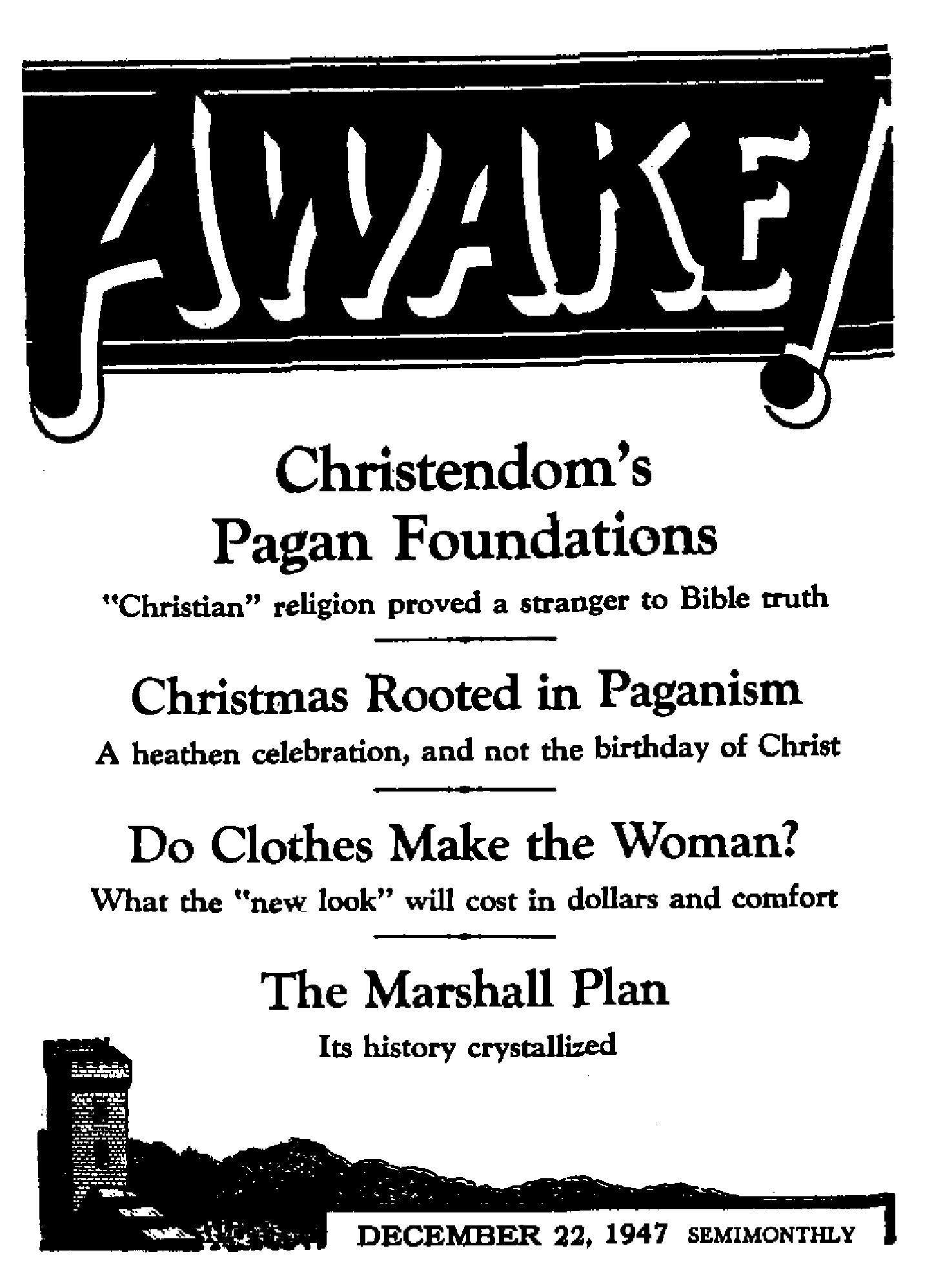
Christendom Pagan Foundations "Christian” religion proved a stranger to Bible truth
Christmas Rooted in Paganism
A heathen celebration, and not the birthday of Christ
Do Clothes Make the Woman?
What the "new look** will cost in dollars and comfort
The Marshall Plan
Its history crystallized
DECEMBER 22, 1947 semimonthly
THE MISSION OF THIS JOURNAL
News sources that are able to keep you awake to the vital lanUtf of our times must be unfettered by censorship and eelflah Interests. “Awake I’* has no fetters. It recognizes facts, faces facts, is free to publish facts. It is not bound by political ambitions or obligations; it is unhampered by advertisers whose toes must not be trodden on; it !s unprejudiced by traditional creeds. This journal beeps itself free that It may speak freely to you. But it does not abuse its freedom. It maintains integrity to truth.
“Awake I” uses the regular news channels, but is not dependent on them. Its own correspondents are on all continents, In scores of nations. From the four corners of the earth their uncen sored, on-'the-scenes reports come to you through these column^. This journal’s viewpoint is not narrow, but is international. It is read in many nations, in many languages, By persons of all ages. Through its pages many fields of knowledge pass in review—government, commerce, religion, history, geography, science, social conditions, natural wonders—why; its cover* age is as broad hs the earth and as high as the heavens.
“Awake I” pledges itself to righteous principles, to exposing hidden foes and subtle dangers, to championing freedom for all, to comforting mourners and strengthening those disheartened by the failures of a delinquent world, reflecting sure hope for the establishment of a right* ecus New World,
Get acquainted with *'Awake!” Keep awake by reading “Awake I”
Published Semimonthly By WATCHTOWER BIBLE AND TRACT SOCIETY, INC.
117 Adams Street Brooklyn L N. T., U. 8. A
N. H. Knohb, PreMent Geakt Suiteh, Secretpry
Fivo cent® a copy One dollar a year
Remfttantti should be MQt to office £z> Four country compliance with regulations to cturantee safe delivery of money. Benrittantes are accepted at Brooblyii from countries where no office Is located, by International money order only. Subscription rates In different coruitrieB are here stated In local currency.
Ratio aacpIntlDH (irtth renml b|ank) te mn at leaet two Jesus before suteaiplku expires.
Chtuw idditw vbeu sent te our office tW be expected tfecUo trithin one month. Bend Four old as well aa new addme.
Offices Yearly Bubecription Rate
Aeierlo, 0.1,117 Adams BL, Brooklyn 1, N.Y. 11 Autrella, 7 Beresford Bd., Btrethfleld, N.S.W, Be CUeda. 40 Irwin At*., Toronto 5, Ontario |L EnpliM, 04 Craven Terrace, London, W. 2 Be Sesth Africa, 623 Boston House, Cape Town Bs
Briand ae mtltf at Brooklyn, N. Tt, Ad of Marti) 3, 18 T9. Printed In 0. AA
CONTENTS
Christendom's Pagan Foundations
Christianity Becomes Paganized
Building the Catholic Structure
Hierarchy Boasts of Pagan Foundation 7
A House Beyond Reform
Christmas Rooted in Paganism
Devilish Worship of the Sun
Surely a “Feast of Fools”
Singeing Santa’s Whiskers
Do Clothes Make the Woman?
The Irate Public Protests
Protest from the Clergy
The Marshall Plan
Sixteen-Nation Conference
America Confesses
Marking Time
The Chinese System
The Roman Calendar
Gregorian Calendar
Comics and Radio a Boon to Delinquency “Thy Word Is Truth”
Time of Birth of “The Son of David” The African Silkworm
Watching the World
Jgg
®^Now it is high time to awake.Romans 13:119J
Volume XXVIII Brooklyn, N.Y., Doctmta* £2, 1X7 Number
Christendom’s Pagan Foundations
BEHOLD the ramshackle, rickety old house of religious Christendom!
What an astonishing mixture of confusion in architecture and design, what a conglomeration of building materials, what a rambling monstrosity, this manyroomed mansion of psendo-Christianity I From its uppermost cornices to its very foundations it is a fabulous mockery, a monstrous fraud, a magnificent structure of deception, that is plastered and smeared over with a form of godliness, bnt, in truth and in fact, is a heathenish fabrication throughout It is indeed a house divided against itself, a honse made of hay, wood and stubble, a house founded on the ancient and shifting sands of paganism, having as its notorious designer and engineer none other than the Devil himself.
For a closer examination of this tottering house of religion begin at the foundation, and you will be amazed, even shocked, to discover that practically aU of Christendom’s teachings and practices have a purely pagan origin. Go back two thousand years to the time Home was expanding its power and influence throughout the earth, concerning which expan-sion-the Encyclopedia Americana says: Naturdlly as the Boman Empire broadened and became more cosmopolitan, its religions system also became broader and more all-embracing. Having absorbed the deities of the Italic Peninsula, the habit of absorption became, with Rome, all-impelling, and the pantheon of the Imperial City, reaching out DECEMBER 22, 1S&7
its octopus arms in every direction throughout the already wide confines of the rapidly extending Roman domain, and even beyond it, brought new creeds, new deities and new religious philosophies into Rome.
Boma was as the Latin historian Tacitus (born in Nero's day) describes it: “the common sink into which everything infamous and abominable flows like a torrent from all quarters of the world." The philosophies of the Epicureans, the Stoics, the Cynics and the Pythagoreans ran rife. Pagan gods, rites and mysteries together with their priesthoods were myriad in number. “Thus Rome, bathed in philosophy, scepticism, mysticism, emotionalism and stoicism, with nothing solid to which to anchor, drifted npon the rocks of national religious shipwreck. In this condition she was found . . . for the development of the Catholic faith.”—Encyclopedia Americana,
It was with the goal in mind of avoiding "national religious shipwreck” that several of Rome's emperors attempted to solidify and amalgamate the diversified forms of demon-worship by melting them together to form a fission religion. During the winter of A.D. 302 Diocletian and Galerius, two of the four rulers of the Roman Empire at that time, were in a secret huddle. Says Edward Gibbon, in his Decline and Fall of the Roman Empire, "the fate of Christianity became the object of their secret consultations.” The outcome of this series of meetings was the issuing, A.D. 303, of an edict which was designed to establish uniformity of worship, and immediately paganism attempted to swallow up the so-called "Christians”. Other edicts fob lowed and the flames of persecution by the pagans increased, until, A.D., 311, shdrtly before his death, Galerius, seeing that all their efforts to establish a single state religion by persecution had failed, issued his famous- edict of pacification.
After the death of Galerius, Maximin experimented further in an effort to effect a single “state religion”. Quoting again from Gibbon;
In all the great cities of the empire, the {pagan] temples were repaired and beautified by the order'of Maximin, and the officiating priests of the various deities were subjected to the authority of a superior pontiff destined to oppose the bishop, and to promote the cause of paganism. These pontiffs acknowledged, in their turn, the supreme jurisdiction of the metropolitans or high priests of the province, who acted as the immediate vicegerents of the emperor himself* A white robe was the ensign of their dignity*
Though this pagan institution did not succeed, due to persecution of its opponents, yet it laid the pattern and foundation for the Catholic Hierarchy that was set up a few years later. Its “temples”, "priests” “pontiffs,” “bishop” “high priests,” “vicegerents,” and “white robe”, were all transferred over to Catholicism. The credit (or rather discredit) goes to Constantine for the successful welding together of the two factions. A.D. 325 Constantine accomplished by compromise what Diocletian, Galerius, Licinius and Maximin failed to do by force.
Compromise, the magic word that so completely describes Constantine's technique / as a builder of Christendom's house of religion I When he saw that the so-called “Christian” religion could not be suppressed beneath paganism he was shrewd enough to reverse the order and place paganism beneath apostate “Christianity” as the foundation for his “state religion”. To do this he merely had to take the rites and practices of the pagans, “sanctify” them with a superficial finish of “Christianity'5, and they became the building blocks in his new structure. The so-called “Christians” consented because the thing was called Christian, and the pagans were agreeable because they could continue their old rituals and ceremonies under a new guise. It should be noted, however, that Constantine ditj not unite and fuse true Christia nity with paganism, but rather he welded to paganism a degenerate^ apostate religion tiiat Was called “Christian”, and which in fact was already tainted with pagan doctrines.
Christianity Becomes Paganized
Mosheim, the noted, historian, in his Institutes of Ecclesiastical History, gives a hrief description of the ancient pagan religions.
The greater part of the gods of all nations were ancient heroes; famous for their achievements and their worthy deeds; such as kings, generals, and founders of cities* ... To these, some added the more splendid and useful objects in the natural world, among which the sun, moon, and stars, being pre-eminent, received worship from nearly all; and some were not ashamed to pay divine honours to mountains, rivers, trees, the earth, the ocean, the winds, and even to diseases, to virtues and vices, and to almost every conceivable object —or at least, to the deities supposed to preside over these objects.
The worship of these deities consisted in numerous ceremonies, with sacrifices, offerings, and prayers* The ceremonies were for the most part absurd and ridiculous, and throughout debasing, obscene, and cruel. * , * Over this whole worship presided pontiffs, priests, and servants of the gods, diyideti into many classes, and whose business it was to see that the rites were duly performed. ~ .
Besides this common worship to which all had free access, there were among both orientals and Greeks certain recondite and concealed rites, called mysteries, to which very few were admitted*
Little wonder that the apostle Paul, a true and diligent follower of Christ, Stood up among the Greeks in the Areopagus A.D. 50 and declared: “Athenians, I perceive that in all things you are extremely devoted to the worship of demons.” (Acts 17:22, Diaglolt) But during the next two hundred years after Paul’s* day ‘grievous wolves entered in’ and corrupted true Christians with their pagan doctrines and vain philosophies. (Acts 20: 29) Says Mosheim: “At the head of this class was Origen [early church “father”, A.D. 185-254], who, being fascinated with the Platonic philosophy [Plato’s foolish idea about immortality of the soul], ventured to apply its laws to every part of religion.” James Murdock, eminent Bible scholar, says that Origen "reasoned according to the reigning philosophy of the age and country in which he lived. He therefore believed in the pre-existence of human souls, and their incarceration in bodies for offenses previously committed”; ideas that were wholly pagan in origin. The historian, Philip Schaff, says that Synesius, bishop of Cyrene and pupil of the female philosopher Hypatia, “fuses” in his hymns the "doctrine of the trinity with the Platonic idea of God, and the Saviour with the divine Helios”, the Egyptian sun god. Thus, pne pagan corruption after another crept in, until by the fourth century, Mosheim tells us, . . . we see on every side evident traces of excessive veneration for departed saints, of a purifying fire for souls when separated from the body, of the celibacy of the clergy, of the worship of images and relics, and of many other opinions, which in process of time almost banished the true religioh. or-at least very much obscured and corrupted it..Genuine piety was supplanted by a long train- of superstitious observances. . . .
There was of course little difference in these Ijmes between the public worship of the Chilians and that of the Greeks and Ilo-mans. In- both alike there were splendid robes, mitres, tiaras, wax-tapers, croziere, prbc^s-DECEMBER tt, 1947
sons, lustrations, images, golden and ailvw vases, and innumerable other things.
AU the paraphernalia, trinkets and gaudy pageantry as well as the doctrines were stolen from the pagans. The bishop’s staff or crozier is an exact copy of the lituus or ensign of the ancient Augurs, according to Cicero. {De Divinations, lib. i. cap. xvii) Also "much of the politics of Catholicism”, says Will Durant in his Story of Philosophy, “was derived from Plato’s /royal lies*, dr influenced by them; the ideas of heaven, purgatory, and hell, in their medieval form, are traceable to the last book of the Republic.” Exclaims John Marsh in An Epitome of General Ecclesiastical History, “What ■ deplorable degeneracy from the simple worship of the Apostles I”
Building the Catholic Structure
With such a pagan foundation laid down Constantine found it rather easy to build up the rest of the Catholic church. He did a good job, too; for aside from a few alterations and additions, and a coat of whitewash from time to time, nothing has been changed in the framework of this pagan edifice in the last 1,600 years. As to builder Constantine himself:
In his relation to Christianity he was cool, calculating, always bent upon the practically useful, always regarding the practically possible. . . . His conversion was a change of policy, rather than of moral character. Long after that event [his supposed vision of the tfcro®” which has been said to mark his conversion to Christianity] he killed his son, his secfind wife, several other of his relatives, and some of his most intiftate friends.—A Religious Encyclopedia, edited by Philip Schaff, 1894.
This was the son of the Devil, the pagan, that set himself up as the "master builder” and Pontifex Maximus, a title since held by the popes of Rome. There is no need for surprise over this, for, after all, he lived flt a time when, to quote the historian Gibbon, *the various modes of worship, which prevailed in the Roman world, were all considered by' the people as equally true; by the philosopher as equally false; and by the magistrate as equally useful?* Constantine was the latter-
After Constantine got the walls up the finishers and decorators came along. In his Church History Dean Waddington says (page 118): "The copions transfusion of heathen ceremonies into Christian worship, which had taken place before the end of the fourth century/had, to a certain extent, paganized (if We may so express it) the outward form and aspect of religion?’ In the next century the pseudo-Dionysian writings about mystic theology and an ecclesiastical hierarchy appeared, concerning which the History of the Christian Church, vol- 3, page, 604, says:
This idea is a remnant of the aristocratic spirit of ancient heathenism, and forms the connecting link with the hierarchial organization of the church, and explains the great importance and popularity which the pseudo-Dionysian system acquired, especially in the mystic theology of the middle ages. [Italic® added]
See also other authorities, as Engelhardt, Ritter, Baur, Huber and Vogt In the seventh century came Pope Boniface, who (according to John Dowling in his introduction to Middleton s Letter from Rome) "not only adopted all the pagan ceremonies that had previously, in various places, been incorporated into Christian worship, but .speedily issued his sovereign decrees, enjoining uniformity of worship, and thus rendered these heathen rites binding upon all who were desirous of continuing in fellowship with the Romish church. . . . Thus incorporated, they became a constituent element of the anti-Christian Apostasy, and have so continued from that time till the present”.
Some think it strange that Catholicism of the West should be so similar to Buddhism of the East. But research discloses that both had a common origin in the paganism of the Indo-European race. Van Dyke calls attention to the remarkable resemblance between this Eastern heathenism and Western paganism in his book Popery,
That Romanism is indeed the twin sister of the Buddhist religion none surely caA deny, A comparison of the two will force conviction upon even the most incredulous. . . . Buddhism has ever had, and now has, precisely those features which mark the Papal Church. . . . The worshippers of Buddha in Burma, Siam, and the Chinese Empire . . . have their relics and their images, the objects of supreme veneration j their temples costing fabulous sums of money; their saints canonized by ecclesiastical authority; their priests with shaven heads, vowing chastity, poverty and obedience; their wax candles burning night and day; their penances and self-inflicted tortures; their endless traditions, and hair-splitting moral distinctions; and even their confessional. They have also their Lent, when for four or five weeks all the people are supposed to live on vegetables and fruits; their acts of merit, repetition of prayers, fasting, offerings to the images, celibacy, voluntary poverty, enforced devotions, and munificent gifts to temples, monasteries and iddls. Even the rosary; a string of beads used in saying prayers, -and supposed by Papists to be a device specially revealed to St. Dominic, is*part of the sacred machinery of the devout Buddhist.
Another Wing Added by Gregory
When it chme time for the Roman Catholic Hierarchy to expand its domain in the direction of the British Isles the “infallible” pope Gregory the Great, like his predecessor Constantine, sent Austin the monk to Britain with the following instructions:
Whereas it is a custom among the Saxons, to slay abundance of oxen, and sacrifice them to the devil, you must not abolish that custom, hut appoint a new festival Ip be kept, either on the day of the consecration of the churches,
or of the birthday of the saints where relies are deposited there, and on these days the Sittons may be allowed to make arbors round the [pagan] temples changed into churches, to kill their oxen, and to feast, as they did while they were still pagans, only they shall offer their thanks and praises, not to the devil, but to God. [Italics added]
"Thus was the religion of the Saxons,” says Dowling, “bo disfigured and corrupted with all the superstitions of paganism, at its first.being planted among them, that it scarce deserved the name of Christianity, hut was rather a mixture if Christianity and paganism, or Chris-iauity and paganism molded, as it were, into a third religion.” To this agrees the worthy testimony of Dr. Conyers Mid-Heton, who was one time principal librarian at Cambridge University. Hav-ng access to historical records, and after itudying and carrying on research work in Home itself, he published a book in L729 entitled Letter from Rome, Show-rig an Exact Conformity Between Pop-
iwid Paganism. After showing a defiled similarity between paganism and Catholicism Middleton concludes that there is "an exact conformity, or ma-formity, rather, of worship, between Popery and Paganism; for since, as I have shown above, we' see the present people of Borne worshiping iu the same temples,, at the same altars, sometimes the same images, and always with the same ceremonies, as the old Romana,0 Again this authority declares:
All their ceremonies appear plainly to have been copied from the rituals of primitive Paganism ; as if handed down by an uninterrupted succession from the priests oi old, to the priests of new Rome. . . . How vain ah attempt it must be to justify by the principles ot-JChriStianity a worship formed upon the and after the very pattern of pure enisml
Hierarcng Boasts of Pagan Foundation
Nevarieless, papal apologists have not hesitated in attempting to justify
st, 1047 this adoption and imitation of pagan hand-me-downs. In his account of subterraneous Rome (Vid. Aring. Rom. Subter. Tom. i. L. i. c. 21) Aringhus makes this defense of the popes "who found it necessary in the conversion of the Gentiles, to dissemble and wifik at many things, and yield to the times; and not to use force against customs, which the people were so obstinately fond of; nor to think of extirpating at once every thing that had the appearance of profane’’. But in openly confessing that Catholicism is in reality founded on demon-worship and paganism none have been more frank than the eminent prince of the Catholic Church, Cardinal Newman. In his book Essay on the Development of Christian Doctrine, published in 1878, “His Eminence” lets his hair down and tells all:
Confiding then in the power of Christianity to resist the infection of evil, and to transmute the very instruments and appendages of DEMON-WOESHIP to an evangelical use, and feeling also that these usages had originally come fronj primitive revelations and from the instinct of nature, though they had been corrupted; and that they must invent what they needed, if they did not use what they found; and that they were moreover possessed of the very archetypes, of which paganism attempted the shadows; the rulers of the [Roman Catholic] church from early times were prepared, should the occasion arise, to adopt, or imitate,' or sanction the existing rites and customs of the populace, as well as the philosophy of the educated class. [Italics added]
Then the cardinal and official spokesman makes this admission as to Catholicism’s demonic and pagan origin (and let all honest Catholics and others read it with great care) :
The use of temples, and these dedicated to particular saints, and ornamented on occasions with branches uf trees; utoanse, latapa, and candles; votive offerings on recovery from illness; holy water; asylums; holydays and seasons, use of calendars, processions, blesa-
ings on the fields; sacerdotal vestments, the tonsure, the ring in marriage, turning to the East, images at a later date, perhaps the ecclesiastical chant, and the [song] Kyrie Eleison, are all of pagan origin, and sanctified by their adoption into the Church.
Pages 355, 371, 373, Edition of 1881.
And that more demonism and paganism is to be “sanctified” by adoption into the Catholic Church in the future, we read from Catholic authority Prdfessor Karl Adam’s The Spirit of Catholicism:
We Catholics acknowledge readily, without any shame, nay with pride, that Catholicism cannot be identified simply and wholly with primitive Christianity, nor even with the gospel of Christ. . . . And we go further and say that thousands of years hence Catholicism will probably be even richer, more luxuriant, more manifold in dogma, morals, lflW and worship, than the Catholicism of the present day. A religious historian of the fifth millennium A.D. will without difficulty discover in Catholicism conceptions and forms and practices which will derive from India, China and Japan, and he will have to recognize a far more obvious “complex of opposites”. It is quite true, Catholicism is a union of contraries.
Arrogant Catholics may brag about their paganism and justify it, and. in blindness think they will continue to “enrich” their ritual with ever more paganism. Less blindness would let them see how contrary their position is with the inspired Bible: “Be ye not unequally yoked together with unbelievers . . . What part hath he that believeth with an infidel! And what agreement hath the temple of God with idols!” (2 Corinthians 6:14-17) Even the public press tells us that Catholicism’s adored St. Peter’s Cathedral in Rome is a religious temple of paganism and demonism. The American Weekly, April 13, 1947, stated: “Workmen recently came upon one of the most surprising discoveries of our time while lowering the floor of the crypt of the great Cathedral of St. Peter in Rome, to’ provide more burial space for popes and royal personages.” Continuing, the article tells that “pagan idols beneath •Si. Peter’s” were found;.also “the graceful figure of Dionysus, god of the wine harvest [who was worshiped with drunken revelry in the diabolical phallic worship of sex], accompanied by a satyr and a fawn decorates one of the old pagan tombs found underneath St. Peter’s.” Thus it is seen that doctrinally, ecclesiastically, spiritually and literally Catholicism is built upon a foundation of paganism.
A House Beyond Reform
In the sixteenth century certain men protested and decided to “reform” this monstrous structure of paganism. Some reformers thought -a slight remodeling . job was sufficient, so they knocked off a cornice and chimney or two, swept out some of the vermin and cobwebs, moved in some new doctrinal fixtures, and began to carry on bpsiness as usual. In other quarters large numbers of demolition crews wrecked great sections of the house. But while doing so they built new organizations alongside the old on practically the same foundation of paganism.
As a result, today we have a religions honse divided against itself, partly the original structure of Catholicism covered over with hoary antiquity, and partly the more recent structure of Protestantism with as many rooms, annexes and closets as there are sects, dach having its-own peculiar design. All together, the whole religious institution of Christendom is built on the same sandy foundation of paganism, and not .the rock foundation of Bible truth. Its builders are like the “foolish man, which built his house upon-the sand: and the rain descended, and .the floods came, and the winds blew, and beat upon that house; and it fell: and great was the fall of it”. (Matthew 7:26,27) Yes, great will be the fall when Christendom topples to destruction during the storm of Armageddon, the battle of the great day of Jehovah God.—Revelation 16:16.
Khrtrtsretf Routed
SHOCKING as it may sound, Christendom’s most sacred festival of the year is rooted in the very fertile soil of paganism. Of course, this is startling news, for on the surface everything connected with Christmas apparently seems devoted to a worship and honor of God and HistChrist. But roots lie below the surface, and hence it is necessary to hreak through the outer crust, hardened by the centuries of time, to uncover them. Dig around the customs, practices and activities connected with the celebration of Christmas and you will be amazed to discover that almost all of them are offshoots that have‘sprung from devilish pagan religions far more ancient than is Christianity.
The deceitful topsoil is so thin the honest investigator quickly discovers, with little effort, that December 25 is not in commemoration of Jesus’ birthday, for He was not born in the wintertime. (See page 25 of this issue.) Says the Catholic Encyclopedia: “Christmas was not among the earliest festivals of the Church. Irenaeus and Tertullian omit it from their lists of feasts.” Augustine shows that the celebration was not derived from apostolic usage, nor was it sanctioned by any early council. Where, then, did Christmas originate! and what dpes it celebrate!
The Catholic historian, Bail-let, says (Vies des Saints, tom, iii. p. 290); “There can be no reasonable doubt that it had its rise after the council of Nice [A.D. 325].” It was Julian I, bishop of Rome A.D. 337-352, DECEMBER
who first fixed the celebration on December 25, according to the archbishop of Nice, John, and an anonymous writer cited by Cotelerius. James Murdock, the well-known Biblical and historical authority, further enlightens us:
Some among the Catholies (as Harduin), and many among the Protestants (as Hospinian, Jablonski, Eisinschmid, Gieae-ler, &c.),, think that day was chosen-first, because it was the day on which the Romans celebrated their festival of natalis solis invicti {‘Birthday of the Unconquercd Sun’], or of the 'sun’s passing the southern solstice and beginning to return northward —a fit emblem of the approach of the Sun of Righteousness to mortals and, secondly, because the establishment of a Christian festival of several days, at that season of the year, might supplant the Saturnalia and other corrupting festivals of the pagans. ... The Christmas holidays ■. , hate borne so close a resemblance to the Roman Saturnalia, SigiUaria, &c. and to the Juel [Yule] feast of the ancient Goths, as to afford strong presumption of an unhappy alliance between them from the first.
Confronted with such an array of testimony the Catholic Encyclopedia is forced to admit : “The well-known solar feast, however, of Natalis Invicti [(Birthday, of the Unconquered’], celebrated on 25 De-dfember, bas a strong claim on the responsibility for our December [Christmas] date,” By digging deeper into the origin and doings of the Roman Saturnalia and the “birthday of the Unconquered” rank paganism is uncovered.
Devilish Worship or the Sun
Like the Egyptians, the Romans were sun-worshipers. Their December feast of the Saturnalia corresponded to sini-ilar feasts held at the same time of year by the Scandinavians, Anglo-Saxons, Celts, and those of the Druid religions. All these festivals were in celebration of the sun’s return, and all such feasts had a common origin in the Euphrates river valley whence migrated the different tribes and languages following the confusion of tongues at the tower of Babel in Nimrod’s day. Following Nimrod’s death the pedple, being devil-worshipers, deified him as god. They worshiped the never-dying sun as a personification of Nimrod’s “divinity", and each year at the winter solstice, or the shortest day of the year, they held a great religious festival irf honor of the “re-born” Sun. It was the 'birthday of the Uncon-quered’. This worship of the sun was really a worship of the Devil, and all pagan devil-worshipers thereafter, including Asiatics, Egyptians, Europeans and North American Indians, had their sun rites. When the fusion of paganism and apostate Christianity took place in the fourth century (see preceding article) the Devil’s Saturnalia feast was brought over and transformed into a so-' called “mass of Christ”, Christmas.
In doing this, the Eastern churches of the Syrians and Armenians, says the Encyclopaedia Britannica, “accused the. [so-called “Christian"] Bomans of sun-worship and idolatry,” and rightly bo. But the clergy today take a position similar to that expressed by “Bev.” James M. Gillis, C.S.P., editor of the Catholic World, when he said: “It is a well-known fact that popes and councils in the early Church deliberately placed a Christian festival on or near the day of a previously existing pagan carnival, with the purpose of ousting the heathenish and generally licentious celebration," But frankly, did the Catholic church, or, for that matter, any of the other churches that have since celebrated Christmas, oust “(he heathenish and generally licentious celebration” of the pagans? No, not, at all. Instead of ousting these customs Christendom has adopted them-as part of her own conglomerate system. Says Hislop’s The Two Babylons, page 97:
The wassailling bowl of Christmas had its precise counterpart in the “Drunken festival” of Babylon; and many of the other observances still kept up among ourselves at Christmas came from the very same quarter. The candles, in some parts of England [and America], lighted on Cbristmas-eve, and used ao long as the festive season lasts, were equally lighted by the Pagans on the eve of the festival of Babylonian god, to do honour to him. . . . The Christmas tree, now so common among us, was equally common in Pagan Home and Pagan Egypt. In Egypt that tree was the palm-tree; in Home it was the fir. —Berlin Correspondent of London Times, December 23, 1853.
Yes, and all the other shenanigans and foolery of Christmastime are of pagan origin. To quote from James Murdock’s footnote in his translation of Mosheim’s Institutes of Ecclesiastical History: "From the first institution of this [Chris-mas] festival the Western nations seem to have transferred to it many of the follies and censurable practices which pre-yaijed in the pagan festivals of the same season,* such as adorning the churches fantastically, mingling puppet shows and dramas with worship, universal feasting and merry-making, visits and salutations, presents and jocularity, revelry and drunkenness.”
Surely a “Feast of Fools'*
One of the most absurd and ridiculous of these Christmas customs that were stolen from the pagans was called the “Feast of Fools’”, concerning which the Encyclopedia Americana says:
Among the heathen festivals, which the Christians could not easily abolish were the Spturnalia, which, in the confusion of all distinctions of ranks, and in extravagance of merriment, exceeded the gayest carnivals, tike f«wt of fools, among Christians, wm an imitation of the Saturnalia, and, like this, was celebrated in December. [This feast consisted of "consecrating” a fool to act as a bishop, who in turn celebrated mass and blessed the people.] , . . Spring this time the rest of the performers, dressed in different kinds of masks and disguises, engaged in indecent songs and dances, and practiced all possible Tollies in the church. Except from their association w#h the Saturnalia nothing is known of the origin of these extravagancies, which appear to have been very ancient
Such foolery was practiced in Catholic churches throughout Germany, England and Scotland down to the Reformation, and in France they continued as late as the eighteenth century. Giving a few more details on this devil-honoring fool’s feast held on Christmas the Encyclopaedia Britannica relates:
A mock mass was begun, during which the lections were read cum farria, obscene Songs were sung and dances performed, cakes and sausages eaten at the altar, and cards and dice played upon it. . . . [Sometimes an ass was led to the church sanctuary and] mass was then sung; but instead of the ordinary responses to the Introit, Kyrie, Gloria, etc., the congregation chanted "Hinham” (Hee-haw) threte times. The rubric of the mass for this feast actually runs: ... (At the close of the mass the priest, turning to the people, instead of saying, He musa est,.shall bray; the people, instead of Deo grptias, shall thrice respond Hee-haw, Hee-haw, Hee-haw.)
In those days the clergy were braying like jackasses. And they haven’t stopped since! After receiving this base humiliation inside the church the poor ass was led out to the church square, where it "became -the centre of burlesque ceremonies, dancing and buffoonery being carried on far into the night”. Even today the Hierarchy does not frown upon such ludicrous paganism as shown in the following excerpts from a letter of a GI stationed on Yap island which was published in The Metaline Falls News, February 15, 1945:
The most important part of the [Christmas] holiday to the natives was Midnight mass. They are all devout Catholics. . . . After the mass was over, the natives returned to their huts and changed into native costumes. Then they hit into an all-night revelry of pagan dances. Consistent, aren’t theyt Tha dances were very interesting to watch. . . , The Yap island war dances especially were very sexy and ritualistic. . . . Jn the morning the natives went to mass in their own chapel,
Christendom truly is founded, on heathenism, and her Christmas in origin, design and purpose is grounded in the high jinks of paganism. She has her decorated trees, her wax candles and. her yuletide logs; she has her holly, mistletoe and her “St. Nick” called Santa Claus; she lays great stress on-the giving of gifts; She is wanton in excess and gluttony, with-feasting, drinking and licentious orgies carried beyond measure. Instead of being anchored in the Bible, Christmas is securely rooted in a heap of decayed pagan practices, and hence the whole thing is a stench in the nostrils of true Christians.
Singeing .Santa’s Whiskers
C. At Christmas time last year a Pueblo, Colorado, school brought in thrir “Santa Claus”, who proceeded to aak each child-jvhat it. wanted. Coming kround to seven-year-old Billy he asked him if he believed'infanta. “No,” said Billy. "Oh, you don’t* And why not J” inquired the much-surprised make-believe. Answered Billy, "The Bible teaches not'to tell lies in God’s name. You can’t do all yon daim. If you travel all over the world why do some little boys get so many nice toys and other boys don’t get snyf Why do same imre bread and others go hungryf” Before thig hbutt
S£, 1W , .
Fashion t what a world of mystery that word opens up! What a dangerous subject to probe! What dark corridors, what deep intrigue, what subtle hypocrisy, what riotous foolishness, what gems of comedy, are stumbled over, uncovered and brought to lifjht by the stout-hearted explorer! And it is b!1 iu the feminine world of fashion, some beneath the surface, some open and tangible, and some so lofty and celestial that it lies in the realm of speculation beyond the reach of man.
More than half thte world’s population is fashion-conscious, with a goodly portion fashion-crazy, a form of insanity that has reached epidemic proportions in recent months. To the uninformed this might appear as a comparatively new disease, but history shows that this strain of virus is of ancient origin. Modern fashions as we know them seem to date back to the thirteenth and fourteenth centuries of our common era. It was then that the wasp-like waist of the lady folks was admired. Says Calthrop’s history of English costumes-: “Not that the lacing was very tight, but it commenced the habit, and the habit begat the harm, and the thing grew until it arrived finally at the buckram, square-built, cardboard and tissue figure which titters and totters through the Elizabethan era.”
Since those days fashionshave gone up and down in their revealments at both the top and bottom of the gannents. During the Renaissance the "hour-glass” cornet gave the ladies so much ‘flift” it almost pushed their breasts-out of the low square-cut dresses. This phenomenon again appeared toward the close of the
yffafae, tAe ‘Wawati?
eighteenth century, a time when a critic remarked; “What delicate mind can view with unconcern the nudes we meet everywhere? The arm, once covered, is now bared nearly to the shoulder, the bosom shamefully exposed, and far more the ankle?’ During the prudish nineteenth century fashion swung to the other extreme by raising the neckline to the choking poini and giving women that ponderous, unapproachable, stay-your-distance look- It was an age of “upholstery” when women were first compressed in the ferocious grip of whalebone corsets, and then were padded up with bulges of crinoline together with three or more petticoats. After the day of hoops, bunched skirts and Puritan severity, “improvers” and saucy built-in collapsible bustles had their seductive influence.
Though a gradual reduction in the number and size of fdmale garments began in 1856, women in the “gay 90’s” still wore seventeen pounds of clothing about the house. Emancipation ’from much of fashion’s burden came after World War I, when dresseb rose from 7 inches above the ground to 20 inches in 1920, and in 1927 jumped above the knees. Corsets were thrown away and undies were limited to scanty panties, brief bras and sheer slips. In 1922 the able' Mr. Dennis Bradley, in defending this new freedom in feminine fashion, wrote:
Her gown is slipped over the head and donned in the twinkling of an appreciative eye. Comfort has been studied and grace has been attained. The neck is invitingly open and the arms are splendidly free. The waist is defined and the skirt is cut short enough to display beyond conjecture the elegance of her legs. High necks, trains, fastenings at the back, and all superfluous buttonings have been thrown on the Victorian dust heap. . . , She displays her form I Why not ? Is not her form beautiful? If her gowns are diaphanous, should the artist turn away his eyes from the crowning allurement of nature I la the human form beautiful or ia it uglyh That is a significant question!
the Latest “Look”
cinch the wearer np in the middle to emphasize the bosom and hips, an effect that is assisted by poufs and padding ' was held to be the proper and an extra-full, extra-long skirt This circumference of a femi-tied-in-the-middle bag look is “new” be-
But alas ! With the coining of the postwar styles, where is fashion’s freedom of yesteryear^? Oh, we are told, a “new look” has come over the horizon. But, frankly, speaking, it is an antique look reminiscent of the Renaissance, the “hour-gla®” and voluminous Victorian ages. Seriously, Harper’s Bazaar magazine defines the "new look” ae one that emphasizes “the very tiny waist, the rounded bosom, the curve of the hips”. Technically, the styles are divided into two types: the “wrap aronnd” that conceals the figure to give it a droopy appearance, as in the hug-me-tight capes, and the “rounded” design, accomplished by the pinch-me-tighter corsets which cause it reverses the wartime fashion which emphasized square, broad shoulders and,slim hips.
These new styles are said to “give every woman’s figure a chance”. If she does not have the “proper” figure she can get plenty of assistance from tummy-flqtteners, hip-smoothers and waist-squeezers that coax her nnwilling flesh into, or rather, out of shape. Writes a distressed woman to Bazaar: “Yon keep saying tiny waists. What happens when a woman simply hasn’t one ?” In answer, the magazine says: “Every woman has a waist and this year she must find it. She will have a lot of help from the corse-tieres who are making light, laced waistbands* ...” One of these eontrivan that pinches in the wearer's waist, pushes up her bosom and flares ont her hips, also nips her pocketbook to the tune of $29.50.
Commenting on these bulging-hip and buxom-bosom styles Life magazine says that it “represents the American woman’s willingness to compress, pad and otherwise distort her natural body into the unnatural shapes dictated by high fashion”. The magazine also assures the ladies that this idea is no modern one, when it says:
also cloth-
that is short on
In one form or another, the corset has swaddled women since Cleopatra laced herself breathless for Caesar. Medieval women used leather and wood plates to flatten hulges. In Shakespearean times 13 inches—no more, no less— nine waist. And 18th Century ladies cinched themselves to the point of frequent fainting spells.
These new styles seem to be the fashion, designers1 answer to the world -call for tightening the belt to save food. Why, then, in a world ing, do they make long, “sweeping skirts” that look more and more like the street-sweeping shrduds worn by nuns? This year they have been 13 inches from the ground; in 1948 they will be but 10 inches. One ankle-length model shown in Paris by a so-called “conservative house” is six yards around the hem. Why, they look almost as bad as old Neelee Jessee Reid, the 85-year-old bachelor in northern Ontario, who has worn anklelength skirts with bonnet and bustle all bis life because his mother raised him to be a girl 1
The Irate Public Protests
Criticism of fashion’s dictates is nothing new, but when such comes from the Indies themselves it indicates that a sudden and radical change has been made. From coast to coast a howl of protest has gone up from America’s soprano and alto voices. A New York radio broadcaster received over 70,000. letters about the “new look”, and only 6 of them were ■ favorable. A report from; San Francisco says that 99 percent of the women out there “are against the new longer dresses and the padded hips as well as the waist corsets”. In Texas protest parades have been staged; in California picket lines have been set up; in different parts of the country clubs have been organized to war on the new styles, one having a membership of 1,000 and another 1,500. In Louisville, Ky., hundreds of people signed a petition against these "outlandish styles”.
Miss Thelma Gregg, of Louisville, Ky., exclaimed: “Since most men don’t read fashion magazines, they haven’t really waked np to what’s going on. But when they see one of these outlandish bustle things strutting down the street, they’ll be flabbergasted.” Bernadine Peet, of Hamburg, N.Y., is even more concerned. Writing to Life she says: “Holy Hanna! I still like the b.f, [boy friend] to tell me I look snazzy, or words to that effect, and if I were to appear in these ont-landish watcha-ma-diggits he’d blow up in a puff of dust and I’d have him on my conscience for the rest of tny natural life!" For Peet’s sake, Bernadine, don’t do it, for the b.f, might go off to a South Sea island like the ex-GI who said: “What a mess! To think of the years I spent in the Pacific, dreaming of the day I’d return to a barracks bag tied in the middle. So long; brother I I’m going back to New Guinea where a fella can see what he’s getting.” Commenting on one of the new hats a couple of girls remarked that “the flying disk has nothing on that flapjack”. Which reminds us of what Morley Roberts once said: “From their feet to their necks women are fairly civilized, but on their heads savagery still sits triumphantly.” As to the new “waist finder” the Los Angeles Examiner gives the men folks some sound advice:
Going in for the “wasp waist” style will result in the follower of this foolish fashion getting pains in her back and in her hgad, So states a woman who was a “wasp waist” enthusiast, Keep this in mind, mister. Don’t permit your wife to become a “wasp waister”. The pains resulting will not only cause her to suffer but will make her irritable and she will snap at you. One of the greatest menaces to a happy home atmosphere is a snapping woman. She is almost as bad as a martyr type whiner.
This calls to mind the proverb of the wise man Solomon: “It is better to dwell in a corner of the house top, than with a woman of contentions in a wide house,’’ —Proverbs 21:9, margin.
The revolt against the new fashions took on an international scope when Britain saw in it a stab in her economic budget. For a time the battle ovqr the hemline, though not as gory, was almost as furious as the battle along the Maginot line. After a heated debate, with Sir Stafford Cripps declaring “the shorter the better”, an armistice was signed somewhere about 14 inches from the ground, and British women rejoiced that their carefully preserved wardrobes were not put completely out of date. To Polish women, the newspaper Zycie Warszawy said: “Women, do not surrender blindly to the demand of fashion, . . . Styles should be adjusted to needs, comfort and conditions of life,” In Russia the hemline, which has not slipped in the last ten years, is expected to stay where it is for another ten years. Due to the difference in climate these storms of faphion that blow over Paris and New York will hit Argentina six months later.
Protest from the Clergy
When the clergy criticize the fashions it is no surprise, nor does their illogical reasoning come as anything unusual. Recently they announced that the new long Sowing skirts are “immoral” and sinful "Christian women,” declares the "Rev.” 9.' M. Shoemaker, “ought to resist this miserable, selfish modem style of dresses as true sin.” And the “Rev.” A. P. Davies says: “They are immoral because they waste the material that is desperately needed by the world’s suffering people.”
How contradictory to the position taken by the clergy back in the roaring twenties, when they said that the leggy fashions and short skirts “constituted one of the greatest menaces to morals”, to quote the “Bev." B. A. Bauer. (Note: During the thirties and since, with longer skirts; immorality has .greatly multiplied.) Lashing out against the fashions or 1926 Pope Pius XI said that the men should correct women’s fashions. “It is deplorable/’ moaned the pope, “that dresses, whose natural aim is to cover the human body, should at the present time, when so many women forget their dignity, serve instead to offend modesty. ... I condemn this shameful behavior.” Thereupon Cardinal An-drieux, of ’Bordeaux, commanded: f‘Ne woman, should attend church or enter the. oumeasional unless she is suitably dressed. Her dress should be .high-necked, her arms should be covered ny the sleeves at least to the elbow. . . . I expressly forbid any of the clergy to administer Communion to or hear confession by anyone who does not comply with this warning.” Commenting on the pope’s edict the London Daily News said:
We are afraid the pope deludes himself ji he anticipates that a papal pronouncement will have any more permanent or substantial results than a government decree. It is too late ur the day to attempt to exercise any sort of fussy censorship over women’s fashion^; and it is time that persons in authority ceased to talk nonsense about them. ... On the whole it seems to us that the pope might more usefully have addressed himself to the women, in the hope that they would take in hand the hygenic defects and deplorable dullness of modern male attire.
Comment in America on the pope's narrow-mindedness was more pointed. Writing to a newspaper one person stated that the women were suggesting “that the Holy- Father might take a tuck or two in his own skirts and petticoats, and attend to his own hocus-pocuses in Rome”. Yes, if the clergy want a fashion reform they can begin on their own black and bloody skirts that have dragged in the filth of many centuries. See Jeremiah 2; 34. They could stand a “new look”.
Who Sets the Fashions?
AU of the above is bound to stir up many questions in the thinking mind. What is fashion! Who sets the fashion! Why do women wear the clothes they do! And do clothee really make the women what they are!
Fickle fashion has many definitions. “Fashion is that by which the fantastic becomes the universal,” said Oscar Wilde. Another says that fashions are dreams in the minds of designers that finally take shape and form and become realities. This probably explains why many of them look hke nightmares. 'Though a few fashions are begotten by social activities apd developments, such as the bicycle, motorcar, sports, and the old game of war, most fashions are fathered by big money interests commonly called Big Business. As with the birth of a premature baby, the bringing forth of these monstrosities of fashion requires a staff of specialists and techni-eiansi A clique of designers are hired to “create” something different. Then the press, radio and screen are regimented to sell the idea to the common herd. “Experts” are hired to console the grumbling public; popular women, like the Duchess of Windsor, parade around in them; beautiful models that would look good whether they wore fig leaves or flour sacks are photographed in them; “fashion shows” are staged and made a success by exciting colors, glamorous girls and delightful music.
Strip this commercial business down, and it is nothing more than a fiendish and vicious racket that preys upon the weaker sex. Look at the prices. Wowl Gowns, from $50 to $375; capes, $210; coats, $200 to $450; hats, $38 to $300. A Hollywood actress lays out $15,000 a year for clothes, and last year American women spent over $11,000,000,000 for clothing. What a gold mine! No wonder the clothing gangsters are out to strip another eleven billion from the income of the wage earner next year by changing fashions.
Well, then, why are women of this age foolish enough to fall for these fashions! Know the answer to this question and you know the fundamentals: of feminine dress. Clothing protects and warms the body, yes, but, bluntly stated, sex psychology, the emotional desire to attract attention, has influenced fashion’s capers through the centuries more than any other single thing. Many will strongly object to this statement; but if space allowed, overwhelming proof could be produced to substantiate it. Suffice to quote part of Margaret Lane’s review of Dr. C. W. Cunnington’s book Feminine Attitude in the 19th Century:
There is not, says he, a single ribbon or* feather, not a puffed sleeve nor a stiffened bodice, not an eye-veil nor a row of buttons worn by women that is not part and expression of an undying single deadliness of purpose, the top-dressing of a basic instinct that goes far deeper than she knows. The whole aim, says Dr. Willett Cunnington in his new explanation of the dress and behavior of our mothers and grandmothers,, of every changing style of women’s dress is to attract and capture, to subdqe to her eternal purpose intractable and indispensable man.- -London Daily Mail.
That undue emphasis is placed on sex by fashion designers of this old, degenerate and dying world is not surprising. It is part of this present evil world’s pattern of moral delinquency and utter putrefaction. This world generally overlooks real virtues and covers over its corruptions with an outward show of glamor. He'nce the apostle Peter is right when he tells Christian women that the putting on of apparel is not the most important thing;—r Peter 3: 3,4.
Clothes may make a woman to be flattered, but they will also make her poor if she tries to keep up with the ever-changing tides of fashion. Clothes may make a woman attractive to the sensual eye, but they will not give her the sterling qualities of real beauty—personality, poise, charm and character. If a woman clothes herself with honesty, sincerity, modesty, humbleness, is a lover of justice and truth, and is given to temperance, mercy, devotion and love of God, then she needs to give little thought to .the styles of her material clothing, frir she will be adorned with raiment more precious than money can buy. Material clothes may make a woman gleefnl momentarily, yet they do not satisfy her longings for life, health and eternal happiness with peace and contentment of mind. Such unspeakable gifts will clothe those who ate privileged to live in Jehovah God’s righteous New World under Theocratic rule.
Marshall Plan
WIDE publicity has been given to the
MQIC THAN uimcnnon Mt EMO
Marshall plan. Reams of copy have gone to news columns and editorial pages . of daily and Sunday papers. What is more interesting still, perhaps, is the fact that it did not originate wjth Marshall, America’s secretary of state. While its genesis appears to have been most casual, it had a, background of considerable scope. To begin somewhere near the beginning, Secretary of State Marshall, in a speech at Harvard University, June 5, and apparently quite incidentally, suggested “a program designed to place Europe on its feet eco-fioniically”, indicating, offhand, that “the initiative . .. must come from Europe”.
Back’ of the apparently chance remark, thrown to* the winds as it were, was the fact that official Washington had begun to consider the need of restricting aid to Europe and seeing to it that it accomplished more than merely temporary relief, such as feeding the 'hungry and taking care of current needs, while Europe itself did not work effectively to get itself out of the mire. Trying to help Europe was like pouring money down a rathole. Since the end of the war, which cost the United States more than three hundred billion dollars, that country had spent for foreign aid and relief the immense sum of more than seventeen and a half billion dollars.
Washington decided that help could be safely given only to those countries i®at would help themselves. This selfhelp, moreover, would be more effective if the various nations would cooperate, each supplying, where possible, •what the other lacked.
These considerations gave rise to the
“Continental Plan”, as it was called in some papers, in late May. It' was said that it might be well to weigh the idea of calling a European economic conference to consider the working out of a “Continental Plan”, the conference to embrace as many European nations as were willing to participate, though the rejection of it by some of them should not stop it This, in substance, was the basis of what has subsequently been designated the Marshall plan, and now EBP, European Recovery Program.
The Seed Tokee Root
About a week after Marshall’s Harvard speech the British foreign secretary, Ernest Bevin, took up the idea, stating that Britain would lead the way to a joint economic conference for Europe. A few days later he and French Foreign Minister Georges Bidault began to talk things over in Paris.
Simultaneously with the get-together of Bevin and Bidault in Paris things were set in motion in the United States, where President Truman and Secretary of State Marshall authorized Undersecretary of State Wm. L. Clayton to ex-ploretin Europe the possibilities of developing a program of unified “self-aid" among the European states, in view of the expectation that the United States would be called upon to make substair tial loans to many European lands, and the further fact that there was a limit to what the United States could supply.
June 16, on the eve of the British-French talks, the French government announced that it had proposed to. Washington the formation of four special committees, representing the producing countries of Europe in various fields, who, together with the United States, would work out a plan for United States financial assistance to Europe as a whole. The proposed committees were to draw up a balance sheet to show the utmost that European nations could do for themselves and for each other this year and next in the way of supplying transport, fuel, power, farm produce, iron and steel, and the amount of U. S. credits that the various nations .would need during the determined period of time.
Soviet Russia Invited
The warm reception given to the "plan” in Britain and France was not accorded it in Russiaj where comment in the press was critical, disparaging, suspicious. There was some unfavorable comment in certain other quarters also. For example, one French newspaper suspected that in furthering plans for aiding Europe the United States had in mind its own need for markets, and that any loans to Europe would be in the nature of pump-priming. While there was a measure of truth in this assumption, the paper overlooked the fact that the United States could induce quite as much “prosperity” for itself by using its billions to build up the United States itself, in a program of government spending. Moreover, there would be less risk, and probably less difficulty in getting Congress to approve such a plan. But political aspects and the desire to “contain” Communism are a prime factor in the Marshall plan.
Britain ana France agreed to convoke a European Economic Commission to map out and carry out the program of recovery. This commission was to work “within the framework” of the United Nations Economic Commission for Europe. On June 19 an urgent invitation was extended to Russia to join in the Paris talks, preliminary to the proposed gathering of all the nations concerned. At the same time it was made clear that Britain and France would go ahead even if Russia should decline to join them in the discussion of the overall European aid program.
The Soviet government on June 23 accepted the invitation to a three-power conference at Paris, and set June 27 as the date for its beginning. Molotov arrived with an entourage of 89 assistants, an indication that he attached considerable importance to the occasion. The three-power conference accordingly began, the sessions being secret. A statement was issued that the Marshall plan had aroused such great hopes that the foreign ministers did not want to discourage these hopes by having their initial differences advertised or exaggerated until the conference .had had an opportunity to iron out these disagreements. Inevitably the conference was charged with going hack to old-time secret diplomacy.
Deadlock
Mr. Molotov quickly showed that the Soviet was not disposed to favor this plan of overall European action which the United States had suggested as the best means of recovery, and which the French had sought to outline in the four-committee plan, duly presented for the consideration of the ministers. The Paris talks soon faced a showdown, as the Russian minister raised objections.
…