Awake!, November 8, 1947
Download: PDF — Awake!, November 8, 1947
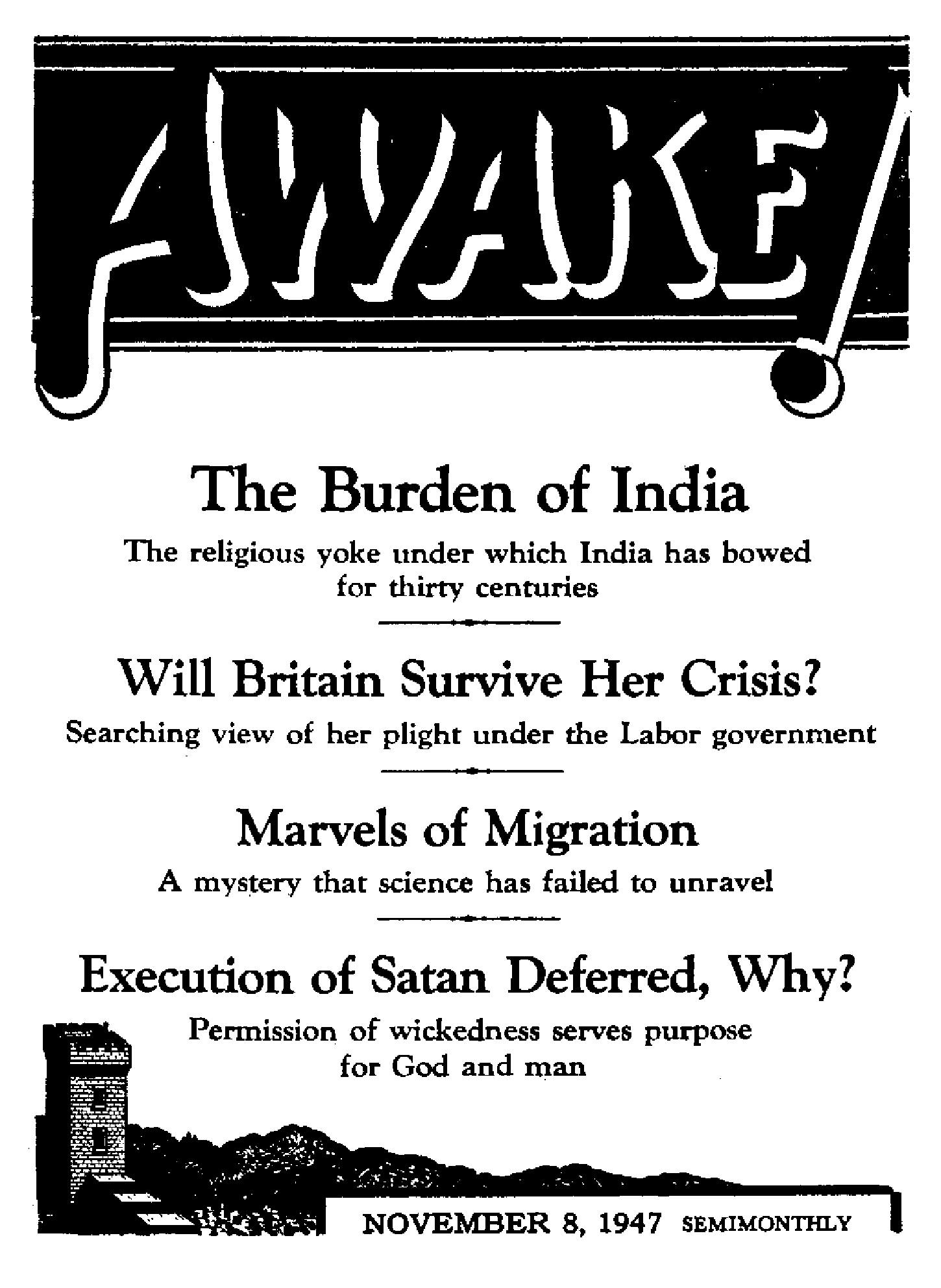
The Burden of India
The religious yoke under which India has bowed for thirty centuries
Will Britain Survive Her Crisis?
Searching view of her plight under the Labor government
Marvels of Migration
A mystery that science has failed to unravel
Execution of Satan Deferred, Why?
Slfak. Permission of wickedness serves purpose
■W for God and man
NOVEMBER 8, 1947 semimonthly
THE MISSION OF THIS JOURNAL
News sources that^are able to keep you awake to the vital issues of our times must be unfettered by censorship and selfish interests. “Awake I” has no fetters. It recognizes facts, faces facts, is free to publish facts. It is not bound ty political ambitions or obligations; it is unhampered by advertisers whose toes must not be trodden on; it is unprejudiced by traditional creeds. This journal keeps itself free that it may speak freely to you. But it does not abuse its freedom. It maintains integrity to truth,
“Awake !’* uses the regular news channels, but is not dependent on them. Its own correspondents are on all continents, in scores of nations. From the four comers of the earth their uncensored, on*the*scenes reports come to you through these columns. This journal’s viewpoint is not narrow, but is international. It is read in many nations, in many languages, by persons of all ages. Through its pages many fields of knowledge pass in review—government, commerce, religion, history* geography, science, social conditions, natural wonders—why, its cover* age is as broad as the earth and as high as the heavens,
“Awake I” pledges itself to righteous principles, to exposing hidden foes and subtle dangers, to championing freedom for all, to comforting mourners and strengthening those disheartened by the failures of a delinquent world, reflecting sure hope for the establishment of a right* eous New World.
Get acquainted with “Awake!” Keep awake by reading "Awake!”
ruunsnED Semimonthly By WATCHTOWER BIBLE AND TRACT SOCIETY, INC,
117 Adama Street Brooklyn 1, N. Y., U. S. A.
N, H, Knorr, Preeidenf Grant Suiter, Secretary
Five cents a copy One dollar a year
Remittance should be sent to office In your country jn compliance ffltb regulations ki Euvantse safe delivery of money. Remittances are accepted at Brooklyn from countries • where no office la located, by international money order only. Subscription rates in different countries are hsn stated Id local currency.
Notice of expiration (with renewal blank) is sent at two issues before subscription expires,
Chartie of address when sent to our office may be expected effective vithin one month, Send your d]d as well as new address.
Offices Yearly Subscription Rate
Amir lea, U.S., 1 IT Adams St, Brooklyn 1, N.Y. $1 Aultraiis, 7 Beresford Rd., Strathfleld, N.S.W, 6s Canada. 40 Irvin Ave.r Toronto 5, Ontario $1 Englaad' 34 Craven Terrace, London, W. 2 6s South Africa, 623 Boston House, Cape Town 5a
Entered as eecond-clua matter at Brooklyn, N. Y., Art of March 3. 1379, Printed in U. 8. A.
CONTENTS
The Burden of India
Caste System
Millions of Gods
Reincarnation a Basic Doctrine
Expensive "Holy Men” and Priests
Will Britain Survive Her Crisis?
"Work or Want”
Religion the Usual Failure
Yugoslavia Bars Boogie Woogie
Marvels of Migration
Marking Times and Seasons
How Do They Do It?
Living in a World of Plastics
Plastics in Business and Industry
Plastics in the Home
Notice Regarding Petition
The Story of Antigua
The Terrible Inquisition
Subterranean Power Plant
Invisible Wire
"Thy Word Is Truth”
Execution of Satan Deferred, Why?
But Why Light a Candle?
Watching the World
/WVAKKf
©“Now it IS tilTLC To
Volurnfl XXVIII Brooklyn" N,Y~, November 8, 1MZ Number 21
The Burden of India
YOU have heard of the enchantments of India, her magicians, snake charmers and “holy men” with unusual powers, able to walk in fire and lie on beds of spikes. You have perhaps heard of India’s caste system, a rigid social ladder which assigns to all Hindus positions high and low in society, leaving them no opportunity to climb it. You have very recently read of the Hindu-Moslem riots and of the harriers with which the British have been confronted in trying to settle conditions in India. Would it surprise you to hear now that the primary religion of India, Hinduism, is at the root of most of India’s troubles I
The little history that is known of the religion indicates that it was built up by Aryan immigrants to India. The Persian ancestors of these immigrants called them “Indus” because they settled along the Indus river in northwest- India. It was undoubtedly from this name that the present one, Hindu, was derived. Though very little is known about the religion of the natives of India, it was outstanding to the early Hindus that it was unlike theirs. From the first contacts with the natives there was a determined effort put forth by the Hindus to suhdue them. Not only did the Hindus do this that they might have for themselves the choicest portions of land, but primarily that the purity of their religion might be kept uncontaminated by association with the natives.
Despite the fact that the Hindus were trying to prevent such a thing, their religion was soon influenced by their new surroundings. But instead of the religion of the natives, it was nature that first effected changes in Hinduism. The Hindus saw in India natural wonders and beauties such as they had never seen before, and they were awed by them. Picture for yourself the giant Himalayan mountains as they saw them. Imagine the sudden illumination of the dark foothills and valleys by lightning flashes followed by heavy white mists which rolled up the mountainsides, blotting everything from sight. Picture the snowy mountaintops tnrning rose, then purple in color, dark-blue, and finally jet-black as night fell. Listen to the murmur of the Ganges; watch the sun as it rises and moves majestically across the sky. To the newcomers of India these things were manifestations.of the gods. They felt that the gods were in these objects they saw, and so they worshiped them. With, the eventual personifying and deifying of many of the natural wonders about them, the Hindus made additions to the number of gods they worshiped and the ritual associated with the Hindu worship.
With the passing of time the religion had so grown that the sacrifices and ceremonies it embraced became numerous and complicated. It was apparent that there was a need for someone ‘well acquainted with all these ceremonial details who could offer sacrifices for the fieoplc and care for their religious needs, n order to fill this specialized need, the Brahmans took the position as the official priesthood of the Hindu nation. Before long they were not only officiating at ceremonies but were regulating and prescribing ail mutters pertaining to both religion and society.
Caste System
With the exalting of the Brahmans to this highest position in Hindu society carne the formation of the caste system that holds sway in India to this day. The caste system was established to maintain purity of descent and religion, and separateness from that which was considered unclean. The word "caste” conies from a word that means color; and, undoubtedly, the enforced isolation and subjugation of the dark-skinned aboriginals encouraged the development of a caste system (originally a color system) for the whole Hindu society. The caste system, while dividing society into four primary groups, placed the original natives of India at the bottom of the scale; for they, by reason cf their color, religion and habits, were considered inferior.
Because such menial tasks as cleaning city gutters and handling soiled clothes or the hides of dead animals were considered contaminating and unclean by the Hindus, work of this sort was left for the lowest caste, the Sudras, and the outcastes to do. In the place on the social scale just above the Sudras are the Vaisyas who make up the merchants, traders, and fanners of India. The next placo up on the social ladder is held by the military classes and rulers called Kshatriyas, and above ail are the Brahmans, who are the priests, lawgivers, and controllers of the caste system. The upper three castes are considered as original Aryan stock and are called the “twice torn” by reason of their participation in a special religious ritual. To these upper castes, services from the Brahmans and other privileges in connection with their worship are granted, which, on the other hand, are denied the Sudra caste and outcastes.
The caste system has row been so subdivided that, instead of just four, there are 3,000 different castes and some 10,000 eubeastes, making almost one for every occupation. Yet, restrictions between these many castes are as rigid as they were between the original four castes in the beginning of the system’s operation. The Laws of Manu, that detailed and comprehensive code of laws which governs the caste system, forbid marriage between castes. They specify which caste one can employ to clean one's house, wash the dishes, or prepare the food. These laws specify the food one can eat, the work one can do, and with whom one can work and worship. Although this system stands as a barrier to the advancement of the Hindu sock tv vet it is claimed all this is in order that purity of faith may he maintained and that uncleanliness and contamination may he avoided.
Should one violate any of the laws of society cr religion he w’ould be in danger of losing his place in society. He would immediately be regarded as unclean, unworthy of holding caste; and, being no longer respected by his fellow castemen, he would become an outcasts. In this position all social rights are lost, all connections between outcastes and former caste members are broken, for fear that the members in good standing will become contaminated and outcastes as well. The washerman will no longer serve the outcaste, nor will his barber cr priest. The use of public facilities, schoois and tern pies is often denied outcastes in some sections cf India. Outcastes have even been considered untouchable. In some towns there have been laws forbidding outcastes to be inside the city limits after 3 p.m., for fear of contaminating others in good religious and social standing; for should even the shadow of an out-caste fall on one it would pollute him, and after 3 o’clock, when the shadow becomes quite long, there is great danger of this. Despite the seriousness of their position there are more than 60,000,000 outcastes in India.
On April 30,1947, the Constituent Assembly in India in framing a constitution for free India adopted a proposal that forever abolishes untouchability in India and makes its recognition an offense. For some time there have been forces working to abolish the caste system and restore the social position of the outcasts. In addition to Gandhi’s efforts to elevate the outcastes, the general use of railroads and increased employment of factory workers makes it almost impossible for one to get away from home without coming in literal contact with the untouchables on trains or at work. These conditions all work toward the weakening of the caste system and tend to encourage the restoring of social rights to the outcastes.
Yet, despite these facts and the opportunities the provision of the new constitution might open up for th4 untouchables, only the future can tell what the end of the matter will be, for the British have in times past enacted similar laws that were utterly disregarded in parts of India in favor of the age-old and nationally-recognized laws of caste, the religious basis of the Hindu community. Further, what can we expect will be the position of the Brahmans in this matter, since they were the ones who established the caste system with its laws concerning untouchability, upheld it, and made it sacred in the eyes of the people!
It has long been held that the caste system is a divine institution. And by claiming that it was the gods at the time of creation who established its divisions the Brahmans have endeavored to prove this. On the basis of the Hindu belief of transmigration or rebirth it is further argued that the system is just and prop-NOVEMBER 8, 1SJ7
er. For, believing that one’s present position in society is in consequence of his conduct in a former life as judged by the gods, it is held by the Hindus that the divisions of caste are just, right and governed by divine will. Thus, the caste system, the biggest hindrance to India’s progress, is justified by a religious belief and is securely established to remain a curse to India’s future generations.
Millions of Gods
Paralleling observance of the religious system of caste comes the worship of some 300,000,000 gods and village deities. With the personifying of the things of nature at the religion’s beginning, the numher of gods recognized and worshiped by the Hindus was greatly increased. So greatly was the number increased there are now more gods than Hindus. According to orthodox Brahmanism, however, there is one great universal spirit over all, represented in the Hindu trinity of Brahma the creator, Siva the destroyer, and Vishnu the preserver. The majority of Hindus through Brahmanic teaching know of the three great gods, Brahma, Vishnu and Siva, but for the most part think of them as just names. To the villagers, who make up 90 percent of India’s population, it is their own village deity that is the ready helper in time of need, and this deity, whether man or animal, is the one they worship. The origin of the village gods is quite noteworthy, for, should anyone make a great display of selfsacrifice or torture, show any extraordinary sanctity or heroism, or even be an accomplished juggler, he would undoubtedly at his death become one of the local deities of the village. A god worthy of being worshiped! Why, yes; for never could he have received the power to do the things he did except from the gods, it is argued.
With shrines and images erected in honor of the local gods, the Villagers come to worship and make offerings.
Offerings made by the llindus generally consist of food: rice, fruits, butter, milk, water, etc’. The Hindus feel that the gods, like themselves, have need of this nourishment and depend on it to give them strength to do the things that are requested of them by their votaries. In some shrines the gods are cared for just like men, being washed, clothed, anointed and fed, and entertained by dancers.
Within orthodox Hindu homes regular-devotional ceremonies are observed. In the poorer homes a corner of one of the rooms is set apart for this purpose. There is to be seen a small idol or .perhaps just a picture of a god set in a frame at floor level. Usually the image or picture, as the case may be, is garlanded with flowers and daily the devotee will squat in reverence before the image with the palms of his hands together and mutter his mantras or hymns and prayers. In well-to-do homes, instead of just a portion of a room being set aside for the imaged quite an elaborate shrine may have been built separate from the dwelling house.
Which of India’s many enshrined gods is to be worshiped is determined by the Hindu’s immediate need. For example: The goddesses that have control over the diseases smallpox and cholera are sacrificed to during epidemics, that the sacri-ficers may be spared the diseases. At the time of birth and marriage the gods having control over these matters are worshiped. As to sacrifices and offerings in general, it is said that the Hindus while making one offering to a patron god to petitiou his favor will make two offerings to a demon to avoid its disfavor.
Animals and birds are reverenced for deeds of valor ascribed to them in Hindu mythology and because they are believed to be the vehicles used by the gods. Among those that are worshiped for these reasons arc the snakes, monkeys and peacocks. The cow, however, is to the Hindus the most sacred of all animals. Enjoying the greatest immunity from molestation, cows can be seen everywhere in India: on the streets, in the temples and in the market places. Even while munching food displayed in the open market stands, instead of being beaten, the cows are reverenced. They are prayed to, sacrificed to, and garlanded with flowers. And why? Because of their utility. She'is called the “cow of plenty”, and because every part of her and everything she produces is considered useful to man, she is holy and sacred to the Hindus. Even her excrement is hallowed with the rest of her. Not a particle of it ought to he thrown away as impure. Cow urine is considered as the best of all holy waters, a sin-destroying liquid which sanctifies all that it touches. And, as far as a Hindu is concerned, nothing else purifies like cow dung.
This outstanding combination of devotion to man-made gods, heroes and animals is recognized by the Brahmans without objection. This means, then, that these leaders of -the Hindu religion, instead of .encouraging the intellectual progress of the nation, have been an influential force in undermining such advancement; for these flevotions and beliefs, sanctioned by the Brahmans, have filled the people with all manner of superstition and fear.
Reincarnation a Basic Doctrine
The basic doctrines of Hinduism are Karma and reincarnation. According to the teaching of these two doctrines one is called to account for his deeds during present life and must through rebirth in higher or lower positions in society eat the fruits of past actions. With this teaching in mind we can appreciate that the Hindu’s faithful keeping of caste regulations and participation in religious rites and festivals is to insure for himself a higher position in society in the next embodiment.
The ultimate goal of all Hindus is the attainment of nirvana, or reunion with the "Supreme Sou!" of the universe. It is believed, however, that not until the soul has been trained to be absolutely indifferent to things of the flesh and the pleasures of earthly life will it be fit for this reunion. For this reason devout Hindus have subjected themselves to all manner of austerities and asceticism, leaving homes, families, and all comforts, seeking separateness from the world in order that they might prepare their souls for reunion with the “divine”.
Expensive “Holy Meri* and Priests
The wandering ascetics of India make up an outstanding feature of Hinduism. These ascetics are called Sadhus, or ^Tioly men”, and are readily recognized by their scant clothing, ash-besmeared bodies, the string of beads around their necks and their calabash begging bowls. Their distasteful and unkempt appearance, they will tell us, is simply evidence that the things of the world and the pleasing of their flesh no longer matter to them. Often an ordinary layman will turn ascetic to return a favor to a god, fulfill a vow, or just honor his god and gain merit. The professional ascetic, however, seeks primarily to culture his soul and work toward nirvana.
These “holy men”, usually called ^jgi, hold that a period of meditation is most necessary if their goal is to be reached. The belief is that although by asceticism and self-torture the senses may be mortified and snbdued, yet without meditation on the “Divinity” and his attributes it would be impossible to get that superior knowledge so essential to reunion. We can approach an understanding of the philosophy of this ascetic as he lies inactive and almost motionless in the ashes of some bonfire or under some green tree while in deep meditation when we consider the Indian saying “It is not exertion, but inertion, that is the path to liberation”.
As to maintenance of the ascetics, they do no work and are not expected to. The community considers it their right to feed these devoted ones, and the ascetios consider it their right to be thus fed. Some in the community may occasionally be seen doling out rice to the “holy men”, hut, in most cases, the ascetics with their begging bowls come to the homes of the people. And, because of the people’s fear of being cursed by these “holy” beggars, they are seldom turned away without food. Despite the pious claim of the “holy men” to be working toward salvation, imagine, if you can, the expense to the people in supporting the 5,500,000 ascetics w'ho wander throughout India.
Probably an even greater expense is borne by Die Hindu people in their support of the priestly Brahmans, however. For almost every service the Brahmans render they are well repaid by feasting and gifts. So well are they repaid, they often depend solely on this means of support. Feasting and gifting in.harmony with the expectation of the priests more often than not results in far larger debts than families can afford to pay. Yet, the Hindus continue to bear this expense because they believe that without the services of the Brahmans ceremonies would be without effect. When considering facts like these, and further, that there are 14,893,300 Brahmans, the poverty of India is not so hard to understand.
An interesting relic of Hinduism is the notorious custom of child marriage. Though the British by passing the Sarda Act tried to put a stop to child marriages, the practice has not altogether ceased. The fact that this custom has been dearly held by the Hindus is not surprising to us when we realize that the Hindu law prescribes “that a man of thirty should marry a girl of ten; a man of twenty-one should marry a girl of seven”. The Laws of Manu add that “a father may give his girl before the proper age if the bridegroom is good-looking and worthy”. The parents themselves have been generally afraid to delay the marriages of their children because of these religions decrees and for fear that public opinion would make marriage for their child difficult later.
Similarly, the subjugation of India’s women is chargeable to the religious laws of the book of Manu, They say that “a woman is never lit for independence, or to he trusted with lilierty, for she may he compared to the heifer on the plain, ■which still longeth for grass”. The women of India l ave been put in a position lower than th ax of the cattle, and it is believed that those who in the process of reincarnation are born as women were the worst of Hindus. Their reincarnation as women is in punish went for their blaek deeds in the past.
Among the everyday opportunities for Hindus to care for their spiritual welfare and acquire merit come making pilgrimages, attending festivals, reading the sacred books, and bathing. To the merit-seeking Hindus bathing has long played an important part in the performance of religions rites. It is of such importance that it precedes almost every act of worship, and everv teniule of anv size has either a pond or a tank for the ablutions of the worshipers. The most holy place for bathing is at All ah abaci, in northeast India, where two other sacred rivers meet the (longes river. The water of this river, the Ganges, though in reality Cl led with all sorts of refuse and other debris, is to the Hindus holy water. Mere contact with the water is said to wash away all sin; and because of its outstanding sin-removing power, it ie bottled and sent to the farthest parts of India for use as medicine or for sacramental purposes. Pilgrimages to the sacred places in India are made most often when festivals arc being held: for then not oniy does the pilgrim acquire merit for his pilgrimage, but for being in attendance during the festival as well. During those festivals, constantly being held throughout India, upward of 100,100 are often present.
The oenefs and ritual of the Hindus are supposed to be based on the ancient writings of the Vedas, although actually most of the Hindu doctrines are not mentioned in these writings, which date as far back as 1000 to 1500 B.C. Much of modern Hinduism has been based on supplements to the Vedas of much later origin. These books, the Upanishads, Puranas, and the Laws of Manu, were written under the careful supervision, of the Brahmans. They outline the social obligations of the Hindus and the ritualistic precepts and ceremonial practices over which the Brahmans preside. The ancient Vedas, divided into four parts, contain mantras or hymns and prayers io be used on various occasions as well as other information concerning ritual and worship. Whereas these sacred writings can be read by the upper three castes of Hindus, the right Io interpret is held solely by the Brahmans. For a Sudra, the lowest caste Hindu, to even hear the Vedas being read is forbidden ; and the Brahmans must never teach sueh the Ia\vs governing expiation of sin. Despite these facts, it is said that to listen to the reading of the Vedas is to acquire merit.
The religious practices and beliefs of the Hindus have obviously worked injury to them. The devout adherence to caste regulations by all orthodox Hindus, instead of resulting in their progress, Jias resulted in their enslavement and subjugation. Their superstitious beliefs and devotions continue to stand as a blockade to their intellectual advancement. As India’s 5,500.000 “holy men” and 14,800,000 Brahman priests persist in preying on the meager earnings of the people, India falls into deeper poverty. Only when India ftiily realizes the zia-ture. of the heavy yoke under which she has bowed for the last 3.000 years and musters the courage *o shed that religious burden, only then will she be able to straighten up and Icok ahead with hope for the future,
A HEAVY cloud hangs over Britain.
The roseale morn of Socialization under an ever-hopeful Labor Government has turned into a day gathering blackness. The sun of Labor planning and nationalization seems’ to have reached its zenith in a period of economic and financial difficulty that is unprecedented. and the second half of the government's term cf office is entered upon amid gloomy conditions. Bark to wartime austerity but mildly expresses The grim outlook for the British people during the coming winter. In some directions the economic stringency will he more keenly felt than during the most burdensome period of the war. But apart from the great concern of those who realize the gravity of the position, the public appear to be not unduly perturbed. The stolid attitude wnich was so marked during the war period seems to be, “If the worst comes to the worst, we’ll face? up to it and see it through?* In getting a proper focus on the situation here in Britain, it is necessary to have in mind that some elements arc only too ready to make political pain from what may appear to be the collapse of the legislative efforts of the Labor Government, As against this, there have been mistakes on the government side as admitted by Mr. Herbert Morrison. Amidst the welter of arguments from both sides and steering a course to avoid the propagandiem so rampant, an effort is made here to present a factual survey of the situation.
Let it be stated at once that in the writer's opinion the present crisis does not appear to be altogether the fault of the Labor Government. It is war’s aftermath, brought about mainly by the shortage of dollars, the wide disparity between
Britain’s imports and exports, and the impossible ‘‘non-discrimination** and “convertibility” clauses of the American Loan Agreement* that has forced the British government to suspend the convertibility of sterling. No other government could have averted the situation, which is basically one of financia* strangle hold due to money congesting itself in the United States and no longer relating to the production and distribution of goods. It is not so much a question of a further loan, helpful though that will be in putting some nations on their feet again, but of a reconstruction of the currency systems of the world to enable them to meet and deal with modern economic conditions, as making for equitable trading and mutual help between the nations. In illustrating this, Ur. Ernest Bovin, the foreign secretary, referred to Uncle Sam as the big boy who has all the marbles; and until there is a redistribution of these the game of international trade cannot go on.
Some businessmen who were opposed to the American loan in the first instance, because of the two clauses already mentioned, appreciate that the justification for its acceptance lay In the laudable desire to save war-worn Britain unnecessary hardship, to re-equip the nation's industries and to gam time for recovery. But they still think it would have been better to refuse the loan and to take the harder road of more severe austerity.
The complaint is made from the American side that the loan has been drawn on much too quickly; but it should be realized, among other things, that after the signature of the agreement American prices jumped 40 to 50 percent, and this has had a major part in accelerating the exhaustion of Britain’s dollar resources. Now that even the last $400 million of the loan is not available, Britain is forced to make drastic cuts in imports; but care will have to be taken that essential raw materials and food are not so seriously affected as to hinder the nation’s industrial production, which is the key to reducing the wide gap between imports and exports.
The government has already made some austere cuts which rednee still further the meat ration. It has abolished the basic petrol ration, which means an end to motoring for pleasure; banned traveling for pleasure outside the sterling area after October 1; prohibited the import of certain “luxury” and other goods, including books except on license; and there is every indication that coupon and point values will be so adjusted as to make the country manage on shorter commons and fewer clothes. On the industrial side, drastic restrictions are to be imposed on “non-essential” industries in the government’s plan for the expansion of exports. Industries not on the “priority” list will have their supplies cut and will be affected by the direction of labor for which the government recently obtained Parliamentary powers.
There were many misgivings in regard to the granting of these powers and the Opposition party in Parliament had some hard things to say. However, with its superiority in numbers, the government was able to carry through its measures in regard to man-power. The assurance has been given, however, that the direction of man-power from non-essential to essential industries will be mainly on a local basis, thus minimizing hardships. The whole object, so the goy-ernment claims, is, of course, the maximum production for export, consistent with the minimum satisfaction of domestic needs to ensure that result.
On September 12, Sir Stafford Cripps, then president of the Board of Trade, in outlining the government’s export plan, said the immediate target was to increase the present monthly average by at least £30 million, which is about one-third. It might be necessary to cut capital investment in Britain by £200 million a year. It was hoped to step up exports next year to 160 percent of the 1938 figure.
“Work or Want”
It is now for the government to enlist the wholehearted support of the entire nation. From the general comments and attitude of the people it appears that it should not be a too difficult matter once the people are fully awake to the gravity and urgency of the situation. As- one means of bringing forcefully to the people the grave implications of the crisis, huge posters, “Work or Want,” are displayed on the hoardings throughout the country. The Trades Union Congress, recently held in Southport, showed a sense of realism in stressing the importance of increased production as distinct from restrictive practices which it has been rather chary of condemning in the past; and the same theme is being constantly preached by Cabinet ministers, politicians of all parties and industrialists generally.
The irony of it is that simultaneous with these urgent appeals the'very industry that is the basis of the nation’s economy and its great hope of increasing export trade is the scene of a needless and disastrous strike which has lost hundreds of thousands of tons of coal to the nation. At this writing, however, a settlement is being effected. Many people strongly criticize the government for not dealing with the strikers firmly, but the government’s reply is that the dispute is one for the miner’s union; and in any case they seem loath to interfere in any way with trade union opinion or policy. And so the loss of coal has continued, affecting seriously mhny industries and jeopardizing the winter supply of coal, gas and electricity to the domestic user. If anything is calculated to bring down the Labor Government in Britain it will be its inability to deal with the fundamental problem of increased coal production through the obstructive tactics of extremists in the trade union ranks. It seems that the danger spot is already showing red— perhaps in a double sense. However, on September 11, it was announced that Britain’s 700,000' miners had put forward new proposals for overtime working, with local arrangements for extra hours; so this may in due course lead to the much-needed improvement in the coal situation.
On August 16, Mr. Winston Churchill, in a political radio broadcast, criticized the government for wrongfully putting Socialist theory before the needs of national reeoverv. The choice now before the nation, he said, was between- a system of competitive selection and a system of compulsion. "Industrial compulsion in peacetime and all its consequences will result in an ever-diminishing standard of production, standard of living and of respect for law and of an ever-increasing army of officials fastened on the top of us all.” A week later, on the radio, Mr. Herbert Morrison, lord president of the council, admitted that the government had made mistakes. They had, perhaps, delayed too long in handing out drastic decrees, in the hope that the people would voluntarily do what was necessary for the country. We have planned, he said, to create a sort of planned society in which much of the driving force would come from the bottom upward rather than from the top downward. This candid statement by Mr. Morrison certainly seems to give some foundation for the criticism of lack of leadership and realistic- planning, which continues to be made by businessmen and industrialists; and if the government embarks upon the nationalization of the great steel industry as urged recently by the T.U.C., there will be the loudest protests and forecasts of ruination by the vested interests concerned.
Religion the Usual Failure
Religion, of course, bus nothing practical to offer in the crisis. At the end of August, the archbishop of York in his diocesan leaflet put forward the very “mushy” suggestion that the prime minister call a round-table conference of all political parties “to save Britain from ruin”. As expected, this has fallen on deaf ears, and a request on September 10 by the same ecclesiastic that he address the miners on strike was turned down flat as “serving no useful purpose”, a phrase which well describes the inefficacy of religion’s contribution to all national and international problems.
However, in spite of the dark and depressing winter that now faces the nation, Britain is far from “down and out”. Her people have recovered from the extreme tiredness and great physical and nervous strain of war, hut the effect of continued food rationing tends to handicap the full vigor of national effort. There is every reason to believe that Britain will revive whether the government survives or not. Mr. Bovin has put the nation’s difficulties at two years. There will be big adjustments.
For example, besides the transfer of labor into essential industries, the armed forces are being reduced so that more men may enter agriculture and industry; and we shall have to do without many of the things that, after a long absence, have this year been appearing in the shops. Prices, too, are certain to increase; in fact, in consequence of the flve-day week just granted to the miners, the higher cost of producing coal is already reflected in the price per ton and will affect the cost of nearly all industrial products. The government's new farming policy is not only expansive, but designed to make as well-balanced an agriculture program as is possible so as to reduce import of foodstuffs, and is welcomed by jarmers as a British stabilizing factor in the national economy.
The fact that British exports in July, at £110.3 million, were the highest in any month since 1920 shows that those concerned with the exporting industries have not let the grass grow under, their feet; in volume the shipments were 25 percent above those for the corresponding months of 1938. Motorcar exports were, 50 percent above prewar, totaling 13,854 units, chiefly to Empire countries.
As to the attitude of the people to the Labor Government at this juncture, this can perhaps best be judged by the recent by-election in Liverpool. Quoting from the Sunday Observer of September 14, 1947 (not a Labor newspaper), "Labour’s victory at Edge Hill by a clear majority over combined Conservative and Liberal polls was a blow to Conservatives. They had not expected to win the seat but believed that Conservative and Liberal votes together would outnumber those of the Socialist candidate.” It further states, "Two years after the General Election the party [Conservatives] has not yet succeeded in gaining a seat.” These by-elections are generally accepted as an indication as to which way the wind is blowing. If that is so, then despite weaknesses, the people still support the Labor Government with their votes.
-t> —>
It appears that the people are torn ben-tween the two extremes presented by the political parties. The tories or Conservative party, ,of which Mr. Churchill is the leader, warn the people that they will be regimented out of existence and there will be no private enterprise left, but instead, an army of officials with regulations governing one and all. There is much to be said for this viewpoint, for today government regulations are on the increase and it is difficult to get anything done without first having to apply for a permit and then waiting so long that one tends to lose interest and give up. The frustration that hangs about the people is due largely to the restrictive regulations that hamper free and unfettered enterprise.
From the Labor side the cry goes up that they will never return to the terrible days of unemployment such as this country experienced, before the war. The reason for this condition is due, they say, to the system that operated when there were no controls, no planned society. At least, under Labor direction there will be equality of sacrifices.
To those who know that neither a labor government nor any other kind of government by imperfect men can legislate for the growing difficulties that are now afflicting the people, there is hope in God’s perfect government now at the door. With the increasing afflictions burdening the people down beyond measure, there is hope that some will turn their hearts and minds to take heed to the words of the permanent Governor of all nations, Christ Jesus, and live.—Awake! correspondent in Britain.
Jugoslavia Bars Boogie Woogie
A decree published early in 1947 in Yugoslavia forbade the teaching or dancing of the conga, the big apple, boogie woogie and trucking. Penalty announced was a finn of 1,500 dinars or up to 45 days of compulsory labor. Also outlawed were fortune telling, hypnotism, spiritualism, graphology, or any other form of prognostication.
For these transgressions the fine is 50,000 dinars and up to three months’ compulsory labor.
WONDER of wonders!
There is nothing about birds that inspires man’s admiration or stimulates his imagi nation more than their seasonal migrations. Where do they go in the
Migration-’
wintertime t How do they know when and where to return! What enables them to fly to distant lands, over unmarked terrain and open ocean, through the darkness of night and the thickness of fog!
Millions of these feathered creatures travel thousands of miles over waste land and water for the winter season, only to return the following spring, and they have been doing it longer than man has been upon the earth. It is indeed a marvel how the birds with their much lower intelligence than man can accomplish these feats without the aid of chart or compass, radio beam or radar. Moreover, these aerial travelers hold no respect for international boundaries, nor are they burdened with human institutions of visas, passports, customs regulations and tariffs. Their Creator owns the earth and they are governed by His supreme laws of nature.
The puzzle of bird migration is not a modern one, for the ancients as far back as Aristotle, Herodotus, Hesiod and Homer observed, but could not understand, the annual disappearance and reappearance of the birds.
Many centuries later, when it was learned that the birds of Europe went to Africa each year, it was thought that the storks carried the smaller birds across the Mediterranean as air freight. In more recent times much information has been obtained* by both amateur bird watchers and professional ornithologists. The systematic placing of more than 3,000,000 tiny aluminum bands with serial numbers on the legs of wild birds since 1922 has added volumes to man’s definite knowledge of migration.
Migratory habits differ. For example, some birds, like the Ross’s gull, red-legged kittiwake and emperor goose, travel only short distances south of their breeding grounds in the Arctic. Chickadees, red-breasted nuthatches and crossbills will stay in northern woods through the winter if there is an abundance of food. The Carolina wren, western quail, bobwhite, cardinal, screech owl, tufted titmouse, ruffed grouse, house finch and woodpecker, as well as the meadowlark, blue jay aud song sparrow, sometimes travel no more than ten miles in either direction in the temperate climates. For this reason they are sometimes called “permanent residents”. Among birds like the robin there seem to be both southern and northern varieties, and when it comes time to migrate the southern birds move farther south and the northern variety then move down to occupy the vicinity vacated by their cousins. There are other birds, like the Maryland yellow-throat and palm warbler, that change this procedure: those that summer farther north pass over the southern variety and winter farther south.
While many birds remain in the United States during the winter, the majority travel to Central and South America and the islands of the Caribbean. Half of the fifty species found in New. England spend the winter in Cuba and Puerto Rico, while the other half wing their way on down to South America. The golden plover is a long-distance flyer. Nesting in the Arctic tundra, the eastern variety, when it comes time to migrate, travel down to Labrador and Nova Scotia. From there they fly directly south over the open Atlantic to South,America, a hop of 2,400 miles, which takes at least 48 hours of continuous flying. So wonderful is their flying mechanism that they consume only two ounces of body fat as fuel on this strenuous flight. Reaching South America the plovers continue on down tq the Argentine pampa, where they remain from September to March.
However, the “champion globe-trotter and long-distance flyer of the bird world” is the Arctic tern. He and his kind fire found far above the Arctic circle in the summer, one nest being discovered only seven and a half degrees from the north pole. After a ten-week stay in the north he flies to Europe, down the west coast of Africa, and on to the Antarctic, where he spends his winter. On the return trip he circles up the east coast of South America and arrives in the north to complete a trip that has touched four continents on a 24,000-mile tour. In this way he lives four or five months of the year in continuous daylight and the rest of the time he is on the go.
The mysterious migration of the chimney swifts took longer to solve than that of the Arctic tern, Aristotle, it is said, put forth the theory that instead of flying away in the winter swifts buried themselves in the mud and hibernated with the frogs and turtles. As late as 1878 Elliott Coues made a list of 182 papers supporting this theory. For many years in this century it was known that large numbers of these birds gathered each year in Georgia and Florida, but where they went from there no one knew until 1944, when some of the 375,000 banded swifts were discovered high up in Peru.
Principal Flyways
Practically all the North American birds, at least 768 species, use seven main boulevards or flyways in traveling south and north. As mentioned, some fly directly from Nova Scotia to South America, while others hop from island to island from Florida to South America. Many species use the "bobolink” route, taking a shortcut across the Caribbean from Cuba to South America. Little ruby-throated hummingbirds that seem so delicate and incapable of long-distance flying make the 500-mile leap over the Gulf of Mexico from the Southern States to Central America without going around through Mexico. Other popular routes funnel down through Mexico and the Isthmus. Cliff swallows that live in the northeastern part of the United States, by using this route, fly 2,000 miles farther than they would if they flew directly south.
During the "big push” wave after wave of orioles, vireos, flycatchers, gnatcatchers, indigo buntings, sparrows, rose-breasted grosbeaks and warblers (more than forty species of warblers alone) can be seen at certain spots on the Texas coast. Sometimes birds migrate outside their regular routes, as, for example, a flock of 3,000 hummingbirds 'may be seen detouring around through Texas rather than flying across the Gulf,
Not do all birds use the same route over which to return in the spring.
Shore birds, sparrows, blackbirds and waxwings migrate in flocks with close formation, but hawks, turkey vultures, swallows and swifts, blue jays and warblers travel in flocks with a very loose formation. Some flocks of birds, like Canada geese, maintain the family group while traveling in flocks, but most perching birds drive away their young, which usually leave for the south ahead of the adults. Winter wrens, grebes, great horned owls, belted kingfishers, and others, avoid crowds, preferring to travel in the solitude of their own company rather than in flocks. There is also a difference in the sociability of various species. Sparrows, shore birds, blackbirds and swallows may be seen together as they travel to and from their winter and summer quarters, but birds like the nighthawks, crows, kingbirds, bobolinks, waxwings and crossbills stay with their own species.
The majority of the small birds rest and feed during the day and migrate at night. Day travelers are strong-winged birds, like the hawks, gulls, cranes, pelicans, loons, swallow^ and swifts. The golden plover is one of the few birds that fly either by day or by night. Birds making the strenuous dash across large bodies of water avoid the heat of the day and fly by night. An astronomer once reported that as many as 9,000 birds per hour passed through the line of vision of his telescope and interrupted his stargazing.
Marking Times and Seasons
The return of the birds in the spring is as sure a sign of the season as any. “For, lo, the winter is past; the rain is over and gone; the flowers appear on the earth; the time of the singing of birds is come, and the voice of the turtledove is heard in our land.” (Song of Solomon 2:11,12, Am. Stan. Ver.) Man can also mark off the times of the year Vy the departure of these unfailing season prophets, that is, if one is alert. Orchard orioles, arriving in southern Pennsylvania in early May, stay only two and a half months, and depart by the middle of July. Shore birds also start moving south in July. The huge circling flights of swifts and swallows around sunset in the late summertime t\nd the noisy parliaments of blackbirds are sure signs that shortly they will be departing. Other birds, the snowy owls, redpolls, goshawks and Bohemian waxwings stay until severe winter conditions force them to move.
Returning in the spring of the year the Canada goose moves north with the thaw’s and the advance of a mean temperature zone of 35 degrees Fahrenheit. In contrast, the blue goose that winters in flacks of 50,000 in Louisiana seems to know that its special breeding grounds north of Hudson bay are still frozen shut; so it lingers in the south until the end of March and then makes a practically nonstop flight to Baffin and Southhampton islands. The movement of a few other birds, such as the robins, bluebirds, meadow larks and blackbirds, seem governed to some extent by the weather. Orioles, warblers, tanagers, and, in fact, the majority of birds, deem to watch the calendar rather than the weather and arrive at ■ their nesting grounds at definite times regardless of the weather.
Most migrating birds move rather slowly during the first stages of their northward journey, speeding up as they get closer to their breeding grounds. Black-pool warblers may advance 30 miles a day during the first ten days of May and then during the last five days of the month they average 200 miles per day. As a group robins take almost eighty days to travel 3,000 miles from lowa'to Alaska. Purple martins spread their arrival in Florida out over a period of four months. The black-and-white warbler moves across the United States
Bt the rate of 20 miles a day. The gray-eheeked thrush, on the other hand, after spending the winter in Peru, Ecuador, Colombia and Venezuela, make their appearance in New Orleans April 25, and a month later they are 4,000 miles away in northwestern Alaska. In the matter of mating, the males of some species, like the robins, arrive first at the breeding grounds. Shore birds, geese and ducks usually choose their mates in the south and honeymoon along the way north.
There is another type of bird movement known as “vertical" migration. Chickadees, juncos, rosy finches, nutcrackers, pine grosbeaks, Townsend’s solitaires and mountain birds camping in the lofty mountains during the summer, glide down to the valleys for the winter and experience as great a change as if they traveled several hundred miles south. A variation cf the regular migration flights is the seeming wanderlust indulged in by young blue herons, black-crowned night herons, snowy and American egrets, herring gulls, snowy owls, evening grosbeaks and Bohemian waxwings. They oftentimes journey several hundred miles north before going south.
Bow Do They Do It?
Science now knows where the birds go in the winter, but many other questions they are not able to answer: flow do the hinds know when to leave, where to go, and how to find the way tq their destination! True, the reasons advanced us to how the birds know, and the argamenra supporting the same, are legion, but nene have been proved. Theories of evolution and effects of the glacial ice age are hatched up in an effort to explain the phenomenon called “instinct”. Other theories involve weather, food, vita-mines, glands and sunlight. Cold weather cannot be the driving force, for some species leave for the south in early July; neither they nor their ancestors ever saw a snowflake. A food shortage cannot be the reason, since many birds leave jungles teeming with insects to return before, not after, the arrival of northern insects. Vitamine deficiency would not cause birds to forsake the blooming tropics lor a land just breaking into bud. Variations in gland secretions due to sunlight is only another theory. The inclination of the sun, the quantity and quality of sunlight, is also advanced by some ornithologists us the cause.
A more baffling question than these is, How do birds learn their way south! If migratory habits are due to flic great ability of birds to remember landmarks and geographical locations, as some think, then how are golden plovers able to fly 2,000 miles over open ocean and find a few tiny islands in the mid-Pacific with pinpoint accuracy and without elaborate scientific instruments! Penguins accomplish a .similar feat. Young cowbirds, European euckocs, and others going south for the first time ir. their lives, are not piloted by the older birds, which follow later. There is absolutely nothing to prove that birds have a super gyroscopic directional finder or that they are sensitive to the electro-magnetic waves of the earth.
With all their modern scientific wisdom men today are us far from solving this riddle as was Aristotle. With more force than when first spoken nearly 2,600 years ago Jeremiah’s words compare thc faithful migration cf the birds with the ways cf unfaithful Christendom today. "Yea, the stork in the heavens knoweth her appointed times; and the turtle-dove and the swallow and the crane observe the time of their coming; but my people know not the law of Jehovah.” (d:7, Am. Stan. Ve.r.) Jehovah himself asks earthly man the question: “Doth the hawk fly by thy wisdem, and stretch her wings toward the south!” (Job 39:26) No, indeed not! 2ian is so far benoatii Almighty God that he is unable to even understand or comprehend the deep mystery of migration.
Living in a World of
THIS chemical age, look at it! If it were possible to hurl yourself through this speeding modern world, taking a quick glance at every vocation, industry and activity in life, you would see that it is fast becoming a wdrld filled with synthetic plastics. All about us, from morning to night, plasties are constantly present in every form, size and shape. Follow the modern family around for a day and see how true this is.
Starting the day off with a brisk shower in a plastic-tiled room behind a decorated plastic curtain, the man of the house next runs his plastic-encased electric shaver over his beard, cleans his teeth with a plastic-bristled, plastic-handled brush, grocnis his hair with a plastic comb, and dresses. His clothes are held in place with plastic buttons, garters, suspenders and belt. The wrinkle-proof tie lie puts on is made so by a treatment with plastics. His efficient wife, in dressing for the dav’s activity, puts on her plastic foundation garment, nylon underclothes and stockings, makes her toiletry with a plastic vanity set, and picks out cf her great- variety of plastic jewelry earrings, bracelets and necklace to match her ensemble.
As the two eat their breakfast out of colorful plastic dishes that form a pleasing contrast with the plastic-topped tabic, and hear from the plastic-incased radio the weather report of scattered showers for the day, neither of them is conscious of the many plastic items about the kitchen—the heat-resistant handles on the cooking utensils and toaster, the ice trays in the refrigerator that will not freeze to the shelves, the light switch on the wall—all are plastics. NOVEMBER 8, W
Drinking down a last cup of coffee made from water that was filtered through a plastic resin water softener and purifier attached to the waterline in the basement, the husband hurries off to work, taking along his plastic raincoat and umbrella.
He never worries about his trousers' not being pressed, for they are treated with a special plastic that holds the crease in for the lifetime of the material. From his plastic neoprene shoe soles to his plastic-impregnated erush-proof and weath-er-p roof Fedora he leaves the impression of a modern businessman as he steps into his car and drives off. The steering wheel and dashboard are made of plastics; the windshield m shatter-proof because of the plastic sandwich filler; and under the hood the distributor cap, ignition insulation and water hoses are also plastics. The five-ply nylon cord tires are fiftypercent stronger than the older type. The custom-built plastic fenders are 4 of the 12,000
ing many plastic parts wear plastic helmets a
that were made this year, fenders which spring back into shape if dented or bent.
Plastics in Business and Industry
The modern office of this man is virtually all plastic. The plastic floor material stays like new without waxing or polishing. The wall panels are either molded or fabricated from plastics, some of one color, others of harmonizing colors. The relief maps hanging on the walls are molded out of plastic and can be taken down and rolled up without damaging the mountain peaks. The office fixtures and equipment, the keys on the typewriters and adding and accounting machines, and the handles on the filing cabinets are of plastic. The ruled ledger sheets were printed from plastic plates. The seat covers on the chairs are long-lasting imitation leather made of plastic. The letter openers, fountain pens, telephones, and many other things about the office, are also plastics. Why, even the lacquer used on the furniture is nothing more than a plastic that was dissolved in a solvent which evaporated as soon as it was sprayed on the surface. Notice the flashy advertisements and circulars on the desks! This is due to the high-gloss plastic resins used in the printing inks.
, Comparatively few people work in plastic-paneled offices like this, but those in other vocations are also surrounded with innumerable plastic articles. Industrial, chemical and electrical workers constantly use plastic gaskets, belting and acid-resisting tubing, carborundum grinding wheels bound together with plastics, plastic-handled tools, plastic lubricants that withstand more heat and pressure than oils and grease, and sensitive electronic devices imbedded in solid plastic. Painters use plastic-bristle, plastic-handle brushes to apply paint made of plastics. Farmers use equipment hav-
. Modern miners md operate electrical machinery having parts made of plastics. Fishermen going down to sea now use plastic sailcloth and fishing nets. Old briny sailors sheltered by transparent plastic shields no longer have their faces beaten by the gale on a storm-tossed sea.
Medical science, dentists and doctors, are finding more and more use for plastics. Hospitals have lueite oxygen hoods that give patients full vision with greater comfort. Surgeons use nylon sutures, and in removing portions of the delicate duramater that envelops the brain they have replaced it with flexible plastic. In the- human "spare parts” department there are plastic teeth, plastic eyes and plastic limbs. A newspaper columnist who lost his arm in the recent war says that these plastic arms are a great advancement over the former “abominations which are ineffective, cumbersome, obsolete and brutal”.
Air travelers that board the new DC-6 luxury transport planes with laminated plastic luggage find themselves surrounded with more than 300 applications of 20 different plastic materials. Similarly travelers by bus and train see the beauty and utility, of modern plastics put to use. In the field of sports and entertainment there is an endless application of plastics. There are billiard balls and bowling balls, rowboats and tennis rackets (including the strings), bathing suits, and transparent ones, too, all made of plastics. And what about the fabulous motion picture industry? The very principle of the projector is the transparent plastic film base upon which the emulsion is anchored. Cameras and even lenses are now cast in plastics. As a novelty a New York band leader recently equipped his orchestra with transparent plastic violins, clarinet, guitar, viol, cello, and drums.
Plastics in the Home
While her husband is at the office the wife of the modern businessman is busy taking care of her prefabricated plastic home which may be a glorified version of the 10,000 homes recently purchased by the Brazilian government Every room has a definite plastic accent. Not only are the floors, walls and ceilings of plastic composition, but also the furnishings : the upholstery, carpets, lamp shades, curtains, draperies, table covers and window shades, if not made entirely of plastics, have been treated with the same in order to improve their appearance and durability. Plastic-like chemicals are used to render fabrics rotproof, mothproof, waterproof, stainproof and flameproof.
…