Awake!, August 22, 1947
Download: PDF — Awake!, August 22, 1947
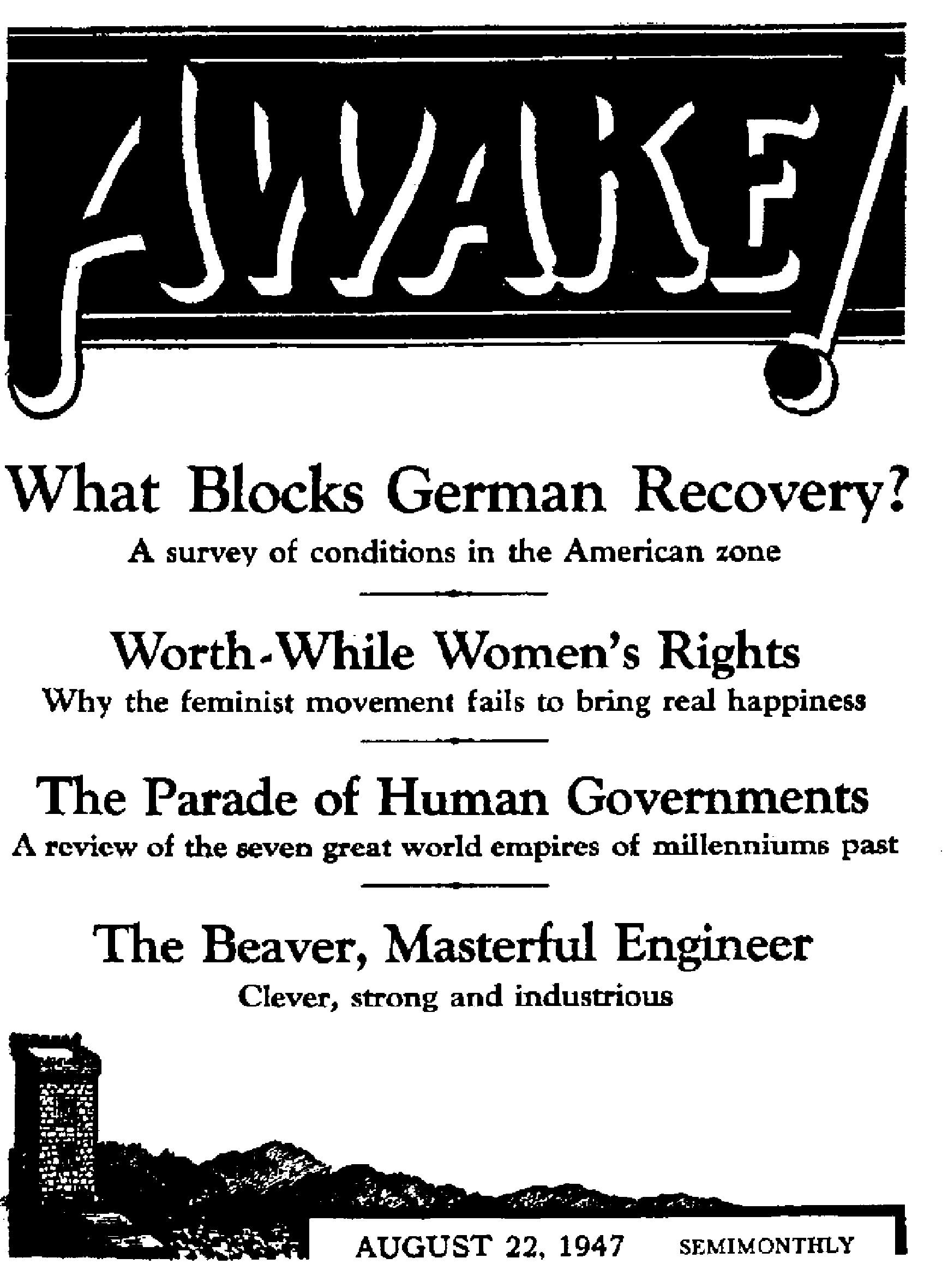
What Blocks German Recovery?
A survey of conditions in the American zone
Worth-While Women’s Rights
Why the feminist movement fails to bring real happiness
The Parade of Human Governments
A review of the seven great world empires of millenniums past
The Beaver, Masterful Engineer
Clever, strong and industrious
AUGUST 22, 1947
SEMIMONTHLY
THE MISSION OF THIS JOURNAL
News sources that are able to keep you awake to the vital Issues of our times must be unfettered by censorship and sdfish interreste. "Awake 1” has no fetters. It recognizes facts, faces facts, is free to publish facts. It is not bound by political ambitions or obligations; it is unhampered by advertisers whosi toes must not be trodden on; it is unprejudiced by traditional creeds. This journal keeps itself free that It may speak freely to you. But it does not abuse its freedom. It maintains Integrify tb truth,
"Awake!” uses the regular news channels, but 1? not dependent on them. Its own correspondents are on all continents) in scores of nations. From the four comers of the earth their uncensored, on-the* scenes reports come to you through these columns. This journal's viewpoint Is not narrow, but is international. It is read iri many nations, in many languages, by persons of all ages. Through its pages many fields of knowledge pass in review—government, commerce, religion, history, geography, science, social conditions, natural wonders—why, its coverage is as broad as the earth and as high as the heavens.
“Awake I” pledges itself to'righteous principles, to exposing hidden foes and subtle dangers, to championing freedom for all, to comforting mourners and strengthening those disheartened by the failures of a delinquent world; reflecting sure hope for the establishment of a right* ecus New Wbrli
Get acquainted with "Awake I” Keep awake by reading “Awake!”
Publibhed Semimonthly Br WATCHTOWER BIBLE AND TRACT SOCIETY, INC.
117 Adams Street Brooklyn 1, N. Y*T U* S. A,
N. H. Kwoeh, PrgMent Grant Suiter, Secretary
Five cent* a copy One dollar a year
R«mltten«n should be sent to oOce io roar mo-try In compliance with regulations to guarantae safe delivery of money. BemltUvCea are accepted al Brooklyn from countries where do offioe Is boated, by InUmatlODil money order only. Subscription rite* In different countries are here stated In local cfirreowr.
■rfleg. af nptntlon (with reoml blank) U sent tn? lores before lubaczlptton apires.
Change of address when sent to our office may be expected dfective Within one month, Bend your old as wdj as new address.
Offices Yearly SubscriptiQn Bate
AHarlca U.|M 117 Adams BL, Brooklyn 1, N.Y, $1 Autralh, 7 Beresford Rd., Strathfleld, N.S.W. 60 CtnUa, 40 Irvin Ave., Toronto 5, Ontario |1 England, 84 Craven Terrace, London, W. 2 $9
Stith AfrlOi 623 Boston House, Cape Town fie
Erring sg Mttmd-class matter at Brooklyn, N. Y., Act of Manfa 3, 1879. Printed in U.S.A
CONTENTS
What Blocks German Recovery I
Political Situation More Muddy
Nasis Change Costumes
"Can the Leopard Change His Spots?”
Clergy Still in the Saddle
Women’s Rights That Are Worth-While
Property Hights and Marriage
What Has Been Gained!
The Passing Parade of Human Governments 13
Religious Babylon
Fourth and Fifth Powers Foreknown
Last Human Government Overthrown
| The Beaver, Masterful Engineer
Watch This Engineer Work
A Home-Builder Too
Cocibolca and the Flaming Mountains
Around Cocibolca’s Little Sister
“I Am the Law” Hague Retires
Scientific Notes
"Thy Word Is Truth”
Modern-Time Fulfilment of Joel
"But First-Century Christians Never
Saw the Bible”
Watching the World
Awaken
^"Now it is high time to awake.'—Romans 13:11
-----------------------*-- --------------- i i u. , , „
Volume XXVIII Brooklyn, N.Y, Auouat 22. 1)47 Number 10
What Blocks German Recovery?
IN CONSIDERING the present economic and political situation of the U. 8. zone of Germany, it must be stated in advance that, the economic condition is much more simple to examine than the political. The material distress of the population, the misery of the refugees, the indescribable wfint of food, clothing and shelter of many millions of people are catastrophic effects resulting from the collapse of the Nazi regime, It is all too obvious that these circumstances press hard upon the people of Germany. And yet one must say that those living in the American occupied zone have been better provided for in their dogged fight against these miseries than are any of those in the other three zones.
The winter months have shown with forceful clarity the significance of coal as an economic factor in the lives of the people. The pivot on which all the efforts toward the resumption of German industrial production revolves is coal as a heating material for the furnaces of the mills and factories. How many industries could at least get started, the other necessities being available, had they only the coal! Even many factories that were already operating had to close their
AL7GC7ST st, tsi?
Here to an Inside report from the U. R mimi in Germany. It analyiM the basic problem* fit-lug the Oernwui people today. It wan written in Germany by an "A wake I” correspondent wbo bos attentively watched the economic and political de-Teiopmcntt In that country daring the two yrara rinee the collapse of the Nari ngtaon. Tree from the propaganda of the public pres* thl* article will give “Awake!" reader* a clear and penetrating view of conditions as they are.
doors at the beginning of winter through lack of fuel. Almost all paper mills closed down for the winter solely because of the coal shortage.
The absence of rain during the unusually dry autumn of last year affected the production of electricity in southern G ennany. In December current fur industrial undertakings was restricted, first to 70 percent and then to 50 percent. In January the situation became so critical that a general working prohibition was laid upon all industries, including small business enterprises. Only a few industries considered as essential to the life of the people were excepted in this enforced stoppage.
The chronic scarcity of raw materials has increased beyond measure the difficulties of economic recovery. Almost all raw materials necessary for the manufacture of household utensils can be obtained only at exorbirant prices on the black market, or by exchange for other things of substantial values that most people do not possess. Added to this situation is the real need for skilled workers in many professions. This is because four to five million Germans are still retained as war prisoners, and also because of tha
“denazification” of many workers, especially in the higher and key positions., These have had to be replaced by unskilled workers, often without sufficient training. There is also sufficient evidence that at times these difficulties have been artificially created in order to frustrate the purging from public life of these Nazi elements.
There are also a large number of people who have withdrawn from business activity because they have been able to rescue a sufficient amount of money out of the past years of war and are, therefore, not forced to seek an immediate income. The impossibility of buying anything with the literally worthless German money, other than that which is allotted by government control, has dulled the interest of many in making money. Endeavors have been made to meet this situation by only giving out ration cards upon proof of occupation, but there seem to be plenty of by-ways for safely navigating around these “danger reefs”.
How the labor market will shape itself np when once the major part of the millions of prisoners of war return to their homeland is uncertain. It is definite, however, that industry will be able to absorb only a part of them within the next few years. Henge, the re-establishment of German economy is a problem that fills sober and attentive observers with anxiety. Even the fact that the Allies have abandoned their intention, as threatened during the war, of reducing Germany to a “potato field”, and having expressed their readiness to permit the restoration of German industry, this does not help to overcome the difficulty.
Political Situation More Muddy
The economic situation of Germany, although offering a far from promising picture, is, nevertheless, a clear one, whereas the political situation is one of complete haziness. This fact remains, in spite of all the efforts of the political powers (which are lauded to the sky) to build up a democratic Germany, in which all the sins arid imperfections or the past are to be blotted out for all time. Since the American Military Government began to transfer certain powers of authority and responsibility to German officials, a “fight for the ascendancy” has broken out among the politicians, and the political parties, which for furiousness is not exceeded by the political battles waged shortly before Adolf Hitler took over the reins. The only difference, perhaps, due to necessity, is that it is waged with less brutal methods. What forces are working in secret and unnoticed by the wide masses in an endeavor to steer events in a certain direction and to a particular goal are clear to only a few who are acute of hearing and keen of sight, and who do not shy away from the effort of attentively watching political developments in all their detail over a long period of time.
In the first place certain proceedings at' the Erlangen University throw a significant light npou the political attitude in scientific circles in general, and among theological scholars in particular. A few months ago seventy-six professors, assistants and other scientific and administrative collaborators were dismissed by order of the Military Government. This was because the Erlangen University had failed to denazify its professoriate, its rector, Prof. Dr. Theodor Suess, being the principal one to blame. Suess had been a, member of the NS Teachers’ Union since 1933, member of the NSDAP, director in the staff of the NS Union for the Safeguarding of Bights, member of the Students’ War Help, and the SA Beserves. Also he had called professors to Erlangen that had been removed. from other universities because of their Nazi taint. Suess also forged questionnaires and instituted a “denazification” committee which the people of Erlangen dubbed with the apt aud humorous title “Society for the Saving of Shipwrecked”. The principal chairman of this committee was the well-known theologian Prof, Dr. Paul Althaus. The publication Die Neue Zeitung, writes about Professor Althaus: 'Tn his hook Die deutsche Stunde fur dieKirche [The German Hour for the Church] he welcomed the events of the year 1933* His book Obrigkeit und Fiihrertum [Higher Powers and Leadership] tries to justify the betrayal of the Weimar Republic and to make democracy ludicrous* As chairman of a 'denazification’ committee of the Erlangen University he advocated reinstating anti democratic professors,” Several other professors of theology were among the seventy-six dismissed because they supported Hitler*
Can the presence of such men in a German university be wondered at if a spe-ciu.1 minister for the political purge, Gottlieb Kamm, is, as publicly accused over the radio, guilty of having as one of his closest collaborators a former NS (National Socialist) party member and SA man? Or is it astonishing that theologians of the national socialist brand, such as Prof, Paul Althaus, have been able to hold themselves above water in the present “democratic” Germany whenr as reported in the Frankfurter Rundschau (February 18, 1947), “relief work of the Evangelical Church of Germany” distributed gifts (undoubtedly donated from abroad for the distressed population) among the SS men and other war criminals in internment camps?
There is no question that the purging of the Nazi element bas made the great est progress in the U. S, zone, although it does not appear to be in accordance with the facts to say that no serious beginning has been made in this direction in the Russian zone* Reports from the British zone, however, do not sound particularly encouraging. If the denazification does not seem to have progressed beyond the stage of a lamentable commencement in any part of Germany it is in the French zone.
Nazi* Change Costumes
For well-considered reasons the American Military Government has placed the denazification in German hands and has ordered the establishment of special courts for this purpose (Spruchkam-mer)t The jurists, composed of a president and assistant judges, are mostly laymen, who, for the greater part, belong to democratic parties. However, in these parties numerous former Nazi party members have also found refuge if only for the reason of being able to produce evidence of an actual “conversion” when brought to trial. Even late NS party members are being invited publicly under more or less veiled forms to join this or that party, if they are not too seriously incriminated, and those in charge of such parties close not only one eye, but both, when accepting new members. They try to help them “find the way back to democracy’, and such 'help” it appears has proved effective all the way up to the denazification courts themselves* Even if it is admitted that not all these former NS party members ore Nazis in the most odious meaning of the word, their years of membership and collaboration with the Nazi party has blinded their understanding of true democracy*
Moreover, the propaganda methods of the past Nazi system seem to have had a much too-enduring influence upon the political leaders of certain parties* Although they seek to hide it as much as possible, some of them cannot entirely conceal their secret totalitarian aspirations, as evidenced in the recent elections. This was the case with the CDU (Christian Democratic Union), which, although it does not admit that it is a Catholic party, cannot seriously deny the fact. That many Protestants also belong to this “Christian” party does not alter the fact, since serious efforts are being made to merge the Catholic and Protestant churches again, and in this way wipe out the Reformation and its effects of four centuries. The present fight against national socialism is being used as a plausible and harmless reason for this aspired union. In proof, the late bishop of Limburg, Antonius Hilf erich, declared shortly before his recent death: (iThere is no formal agreement 11] between the Catholic and the Evangelical Churches, neither have there been any meetings arranged between the two churches, but the present understanding is better than it ever was before.” Dr, Otto Fricke, the deputy for the Protestant Church in Gross-Hessen^ said: "After four centuries of battle both churches now work together. The time has come for both to step on to political ground [as though they had never done so before], so that nothing like national socialismraise itself again?’
The following incident show’s how seriously this “declaration of war' against national socialism is to be taken. On May 24, 1946, Dr. Kaspar Dilrr, chairman of the CSU (Christian Social Union)T Catholic party in Bavaria, was suspended by the Military Government and his party was prohibited all political activity in the territory directed by him. Reason: Dr, Durr had appointed a CSU member as verifier of the poll in the city council elections for Wurzburg, and had belonged to the NSDAP from 1933 and to the SA from 1937. But six days later, May 30,1946, There was a nice ling of the members in Wurzburg at wfliich Dr. Durr was unanimously re-elected as president.
CDU. It is quite comprehensible that such men, wThc have enjoyed the “advantages’" of the “political schooling” of national socialism for many long years, do not silently and sweetly renounce all political activity and therefore are all the more zealously endeavoring in concealment to gradually gain influence and even to lake over the leadership.
In a leading article in the Badischen Heuesten Nachrichten of June 25, 1946, Waiter Schwerdtfeger, a man who spent many years in concentration camps for political reasons, writes:
How would thinn® look, then, if the Occupation should shortly cease! Sod! Since 10-dny’s mentality does not compose a bulwark strong enough to repel the renewed rising of a brown flcod, a violent conflict would be inevitable, Had Germany tried to rid herself, out of her own inherent strength, of the Nazi rule of violence and terror after 12 yeara’ duration, this would have meant a revolution in comparison to which the great French revolution would have been child’s play.
Attitude of the Masses
It cannot rightly be said that the thoughts expressed in this article represent the attitude of the whole German people. On the contrary, there seems to bo much more ground to doubt whether the average person in Germany grasps the actual situation. They will say: 'Did .not Hitler do away with unemployment! did he not remove the economic crisis which gnawed al the vitals of German economy like a vampire at the beginning o: the thirties? Did he rot save Europe from Bolshevism and thereby win for himself a reward which even reconciles the many acknowledged “shortcomings” o: his system? And the abominations of the eon centrad on camps—who knows whether all that is really true1 Maybe Hitler wanted but the best. At least avc had enough to eatf These are thoughts which are not being openly and freely uttered, but the attentive observer has more opportunities than he desires to convince himself of their existence among a large part of the population.
So to speak of real democratic sentiments among the larger part of the German people would he a mockery of the true conditions. This will be quickly understandable to anyone who considers how little the German people are accustomed to real spiritual freedom, and how little used they are to independent and logical thinking.
The influence of so-called “Prussian-ismJ\ which laid the foundation for German imperialism, is too deeply rooted in the mentality of the German people to be obliterated in the few months that have passed +since Work) War it. This spirit, developed through centuries, firmly entrenched by the wholly one-sided and therefore adulterated history instruction, heightened by the lying Nazi propaganda to the point of nationalpolitical megalomania, is not so easy to eradicate. It seems impossible that a whole people, which, as no other, has been suffering so long from national self-conceit, could be changed in a few months both spiritually and morally that it would be ripe for a true democracy.
Apart from this, a political lethargy seems to have spread itself over the German people so that certain events seem to pass them by wholly unobserved. The material needs and the uncertainty of their future fate seem to have killed all interest in external events that are separate from their own immediate pitiable lives. For example: Dr. Friedrich, a member of the Evangelical Presbytery in Karlsruhe, dared to apply to the president of the Baden Administration for permission to retain in his service more than a dozen former members of the NSDAP. In another ease a party member, a former SA member and officer in World War II, was advanced to the position of auditor and made chairman of a parish committee. Military officials, who became unemployed through tfee cessation of war, were immediately placed in higher services. It may be mentioned here that in the Church journal of laws and prescriptions of 1934 the vicars w ere requested by the Presbytery to enroll with the SA.
Clergy Still in the Saddle
Only too well can we understand the significance of the warning spoken in a Stuttgart meeting of the Social Democratic party r few months ago: “Religion may not serve as a veil to hide Nazi or other reactionary views. Politics should be withheld from the pulpit. Christianity will be rendered the best service thereby.” But it is very doubtful that such worcis are taken to heart, for it looks as though certain representatives of church organizations and "Christian” parties were making earnest endeavors to preserve Germany from the “disaster’ of a thorough purge of national socialism. They seem to think that every means, from open sabotage of denazification to cautious waiting for “better times”, is justified.
When one thinks that it was reserved for Pope Pius XII to intervene on behalf of the sentenced war criminal Greiser; that it was Cardinal Faulhaber who telegraphed to (he lawyer defending the war criminal Hans Frank on October 5, 1946: "Please submit petition for pardon for Hans Frank as intercession to highest church authority in course of transmission”; and when one calls to mind many other things which have taken place in the past few years, then it is not difficult to trace the scent uf the particular religious fertilizer that nourishes the seeds of Nazi-Fascism.
Moreover, religious life is experiencing an upward swing in Germany, as evidenced by the Idled churches and assembly rooms resulting from the feverish activity of Catholicism. In spite of the paper shortage the Die Neue Zeitung of January 31, 1947, said that the Vatican intended to support two German Catholic newspapers with large supplies
of paper. In this way Borne notifies us of its program for further expansion of its influence in Germany. The facts themselves reveal in which direction this influence is to be asserted. Is it not the inhuman cruel form of Nazi-Fascism that they would like to make use of in the future? for indeed their totalitarian aspirations have remained unchanged, and now they attempt to put them across a second time by so-called “democratic” means.
That there are also underground forces at work striving to revive the brutal bloody terror of the Nazi system to a ‘joyful resurrection’ can be seen from the report. Die, Neue Zeitung said that an international committee composed of leading statesmen published a report on January 26 which stated: “There exists at present in Germany a net of national socialist organizations whose influence is increasing every month.” In less than a nonth’s time after this report a prom-nent former Nazi leader had been arrested in connection with a drive against a Nazi underground that resulted, all together, in the capture of several hundred Nazi conspirators.
Hope for Stability
Without doubt there is a danger in these newly organized groups composed of political gamblers and up-rooted Hitler Youth leaders, but the danger need not be overestimated. Of far greater danger is the political thoughtlessness and immaturity of wider circles of the population who, till today, have not learned to find in themselves the blame for national and personal disaster and distress. This error, which is not twelve, but is two hundred years old, prepares the ground for the undermining work of a numerically “mole” part of the middle classes of society, which weakens democracy’s strength by their systematic spread bf poisonous nationalistic propaganda. It is these middle classes of the people that threw themselves into the arms of national socialism so unrestrainedly when it first gained a foothold; it is they too that, as a whole, have enjoyed the greatest advantages from its reign of'twelve long years; and it is they that would be the first to return “to the flesh pots of Egypt”, and, without scruple, follow a second time the deluding strains of the pipes and flutes of a political charlatan whithersoever he might lead them. Not the German people as a whole, but a minority of many thousands, would be the ones ready to again take up weapons if they should be required to, say, fight against Eussia, against Bolshevism, regardless of the fact that it would kindle a third world war. *
Again it may be said that it is not the underground movements, and not the bombing of denazification courts and similar institutions, that looms as the greatest danger to the German people and its democracy. It is the German spirit that today, two years after the collapse, is still a danger to this people themselves, and even to the whole world if it is not overcome and replaced; and this can be done only by spiritual means. Nor is the spiritual means the brand that is peddled by the religionists of Christendom. If the German people are to receive a new spirit to replace the spirit of the Devil which they have received from following the world’s religious leaders (see, John 8: 44), then they will have to follow Christ Jesus, the “Prince of Peace”. Only then can they hope to bear the fruit of the spirit which “is love, joy, peace, longsuffering, gentleness, goodness, faith, meekness, temperance: against such there is no law”. (Galatians 5: 22, 23) Herein lies the only means for good-will persons of Germany, who have suffered so long beneath the iron heel of religious imperialism, of obtaining peace and stability. Let all of such righteously disposed persons, therefore, place their hope for recovery in God’s Theocratic Government.
. ; T/iat Are
Worth-WOl
MANY adventurous persons wTho set out to explore the subject of women's rights become lost and founder in the great stream of speculation. The subject takes a treacherous course marked with cross-currents of opinion about the fundamental nature of woman herself, and whirlpools of colored personal experiences. Many a brave man has capsized in this stream when venturing out too far on some silly raft of comment. Men like Tennyson, Aristotle, Virgil, Shakespeare, Defoe and Herrick have expressed themselves in every shade of emotion from bitterest denunciation to ecstatic delight. Gulping like a drowning man Homer said there is "no fouler fiend than a woman when her mind is bent on evil”. To Alexander Pope woman is "at heart a rake”. To Thomas Dekker "wom-an is, at best, bad”. Others going overboard on the other side have repeated the Hindu proverb "One should not strike a woman even with a flower’. Sang the poet Herrick: “’Mongst all the rest of creatures, woman is best” But these extremes bear the same stamp of stupidity.
Steering a straight course with a level head, the apostle Paul said: "The woman is the ginry of the man. For the man is not of the woman; but the woman of the man. Neither was the man created for the woman; but the woman for the man, . . . ; but all things of God.” (1 Cor. 11:7-12) All, therefore, who launch into a discussion on the prolonged struggle of the feminine movement for "equal rights”, or recount the pros and eons of political, industrial or social rights of women in this twentieth century, would do well to follow the dependable Scrip* tural compass.
It cannot be said that Alary Wo//stonecraft was the forerunner or first advocate of women's rights when she wrote the highly impassioned A Vindication of the Rights of Women, in 1793. Long before her Plato and Socrates spoke strongly for female rights. But centuries before these Greek philosophers the law of God defined the rights and privileges of women. The Bible explains the relation of the woman to the man, it tells of her duties and privileges toward both God and man, and it also enumerates many of her rights. However, Afary Wo/Istoiie-craft may be termed the forerunner of the modern doctrine of feminism.
Every man should feel pity, not harsh censure, for Mary, because, being ignorant of the righteous and just Scriptural precepts concerning women's rights, she raised her voice in a cry for full equality with man. She decried the economic necessity for women to marry, and clamored for economic independence for them. In effect, she denied that they were women, asserting that they needed no male protection. What she really sought was masculinity, by quest of which any woman reveals a distorted mind. Undoubtedly she inspired such modern examples as the late Carrie Chapman Catt and campaigners Susan B* Anthony, Elizabeth Cady Stanton and Matilda Gage.
Rise of Feminism
One of the darkest pages in human history tells of the prolonged slavery of women. Misery and suffering with unhappiness and discontent has been the lot of most women during the past 6,000 years. Overlooking the fact that much of this suffering and misery and discom tent is also experienced by men as well as women, the feminist movement has taken up the battle cry for "freedom" and has fought a hard fight to obtain what they call ^e^ual rights” for women in the political, social and moral fields.
The first American college to admit women was Oberlin, in Ohio, in 1834, although Wesleyan Female College opened in Macon, Georgia, in 1831. The first medical degree given to a woman was at Geneva Medical College (later incorporated with Syracuse University) in 1848, In 1940 the census showed that there were 1,386,103 women twenty-five years or older who had completed four or more years at college, to compare with 2,021,228 for men. At present there is a proposed change in Harvard's rule to permit women to go to Harvard in perpetuation of the wartime system. In England progress in gaining entrance for women into colleges was not so fast. In 1866 Newnham College and Girton College, Cambridge, were established. Oxford admitted women in 1879; London University, in 1882. But today women have almost accomplished their goal in that "no important institution in the English-speaking world declines to confer the higher degrees on women in any field”. This represents a great victory over many prejudices, a typical example of which is that of Professor Copeland, who refused to give a course in argument at Radcliff, a women’s college started as a "Harvard annex” (1882), because, he said, “How deplorable for women to become apt at argument. We can’t obliterate a natural tendency, but why cultivate it?”
Property Rights and Marriagt
Another insistent claim by modern feminists was that women should have equality in occupation and property rights. There was a time in England when women had no right to hold property nor retain wages paid them, and during which time they were in theory the chattel of their husbands, A classic example of this was the case of Lady Caroline Norton, who, during the nineteenth century, was separated from her husband because of disagreement and was not permitted to see her own children. Furthermore, she was not permitted to retain any money that she earned nor to sue in her own name, since, it was argued, she was not a legal entity. Probably this was a very exceptional case, as exceptional as the earlier English law permitting a man to beat his wife. But the outcry and publication of Lady Norton’s case caused English law to be modified so that, since the enactments of 1870 and 1882, women occupy the same position as men in relation to ownership of property. The United States is somewhat lagging in this regard. While some states have granted equal rights to women to own property without stipulation, other states do not.
The British and American battles for woman suffrage also followed parallel courses and were finally crowned with success in America with the passage of the Nineteenth Amendment, in 1920; in England in 1928; in France in 1945; and now, under the MacArthur regime, in Japan also.
Another salvo of many feminists is directed against marriage. Says The Modern Woman: The Lost Sex: “The entire object of feminism, however rationalized, was simply to enable women, as much as possible, to avoid being women. By avoiding all taints of femaleness, they imagine, they would be able to enjoy all the real and imagined pleasures of men—a notion in which they were tragically mistaken.” Just how many women have rushed to promiscuity and flaunted sexual morality in this day requires no elaboration here, but it is of interest to note that it was advocated and practiced by Mary Wollstonecraft, the misleading torchlight of 150 years ago,
Soviet "Russia has followed the feminist blueprint to the letter, including equal pay, right to “hold any position in any fields’*, promiscuity, contraception, and easy divorce. But if Russian women are happier than Americans under these conditions, their happiness springs from the full occupation of their time, rather than tho “equality” feature. On this point Lunberg and Farnham (The Modern Woman: The Lost Sex) maintain: “In the United States at the present time there are, despite all tho women who work in nnd out of the home, a greater proportion of aimlessly idle women than at any other time or previous place, not excepting Imperial Rome* Most of them are neurotic as well ns parasitic*”
What Has Been Gained?
If this is the end result of the feminist mo vein ent—far, indeed, America is far ahead of most of the world in granting ‘‘equal rights” and “emancipation” to women—then the penetrating question is: What beneficial result has been gained? After twenty-seven years, what valuable gains cun be shown as a result of woman suffrage? Can it be demonstrated that education, which fitted them for occupation away from home, and occupation in competition with men, has led to good results? Has not this very competition with men, which in many cases is even more menial than kitchen work, tended to deprive women of the natural enjoyment of home and husband? Is there not an evident relationship between neurotic and delinquent children and the absence from home of mother? Has the “freeing” of married women from the responsibility in the home in order to allow them time for office and factory work, which leaves their children neglected, brought them blessings and filled them with satisfaction f The answers to all of these questions are plainly written in the chronicles of domestic tragedy, which fill the daily press. How true the statement of Marynia Farnham!—“American women, richest in material privileges, are the most unhappy women in the world,”
The causes of this plight of womankind are of vital concern to all, for it goes without saying that the happiness of women deeply affects every person, men and children as well as woman. Whether in a covenant with Jehovah God or not, woman can never break the laws of the Creator with impunity. Woman was designed to be a helpmeet for man; provided with an awe-inspiring complexity of organs perfectly adequate and harmoniously functioning for the reproduction of children* Her psychic makeup fits her for tho mother role- When she steps out of character, leaves her proper sphere to gain imaginary freedom from the role for which she is fitted, it is to chase a rainbow, and find misery. When she indulges in moral looseness, which she wrongly imagines that all men practice, she is taking a road bounded on both sides by unhappiness and whose end leads to death* Taking woman out of her proper sphere has brought her unhappiness and, consequently, unhappiness to both her husband and children. Hence, the feminist movement, which masquerades under the banner of progress and liberation, is an abomination* It has blinded some to the real rights and privileges of womanhood.
Some will say that the “industrial revolution” is responsible for this condition inasmuch as' it has destroyed the great need of women in the home as far as spinning, weaving, repairing, washing, canning, mending, cooking and cleaning are concerned. But this is not true. The elimination of these back-breaking duties performed in former years by women gives them more time and energy to devote to the duties of homemaking and, consequently, woman should not be considered a "displaced person".
There is no objection to women’s voting, enjoying the fullest advantages of education and equal pay and property rights, as far as freedom to enjoy such is concerned, but the objection is to the feminist program and its propaganda which is designed to wreck the home and, hence, the woman herself. Many women are not interested in voting, campaigning and having careers, but are chiefly interested in home and family life. But such a woman as tries to follow her natural inclinations, the normal woman, becomes the object of attack by the zealots of feminism, who call her an old-fashioned woman who is wasting her life sacrificing her body and personal interests on an unappreciative male. The feminist movement thus appears as another devilish device to occupy the minds of the women and to destroy by diversion their natural affection and turn them away from the righteous Scriptural precepts concerning women's rights, privileges and duties,
God*given Rights
Today there are many faithful Christian women who do not marry, not because they follow the cult of feminism, but rather because they follow the Scriptural advice: “An unmarried woman or a girl is concerned about the Lord's work, so as lo be consecrated in body and spirit/' (1 Corinthians 7:34, Goodspeed) Such is their right Other faithful Christian women, who choose to do so, also have the right to marry according to the Scriptures: “For this cause shall a man leave his father and his mother, and shall cleave to his wife; and the two shall become one flesh/’ (Matthew 19: 5, Am. Sign. Ver.) For such women as marry in the Lord and live under His laws and commandments there is ample protection from female slavery. The Scriptures do not allow wife-beating. On the contrary, it is written: "Even so ought husbands also to love their own wives as their own bodies. He that loveth his own wife lov-eth himself: for no man ever hated his own flesh; but nourisheth and cherisheth it."—Ephesians 5:28,29, Am. Stan. Ver.; see also 1 Peter 3:1-7.
Such faithful Christian women, who marry and who diligently follow the admonition laid down in the Scriptures, and dutifully hold to the position in society assigned to them by Jehovah God, accepting the responsibilities of the home, caring for their husbands and raising their; children in the nurture and admonition of the Lord, experience tremendously more satisfaction in their occupation than the highly-esteemed career women of politics and commerce, and the glamour girls of stage and screen. These notables are generally unhappy creatures, as their own words so often testify, especially after they have become too old to enjoy the pleasures of sin and the lusts of the flesh. They have deserted their worth-while rights.
Let women who are enticed by the "freedom" of the feminists simply examine the record, if they honestly wisb to know where such feverish quest for "equality" leads. Let them realize that no stigma is attached to being a woman, a natural woman, a normal woman, who accepts and enjoys being such according to the way God made her. It is a glorious privilege. Let them look to Sarah, Deborah, Jael, Rahab, Mary, Lois, and Eunice, to mention a few, who received the highest praise from Jehovah while remaining in the role of wife and mother. This should constitute sufficient answer to those who advocate the dissolving of the home and family in favor of some worldly occupation or career. Let the woman who desires honor and glory and praise read Proverbs 31: 30 (Am. Stan. Ver.): "Grace is deceitful, and beauty is vain; but a woman that feareth Jehovah, she shall be praised."
TAe Passing Parade of HUMAN GOVERNMENTS
ROMAN -M HiU.
nun ।
JEHOVAH God is a God who knows government. From the beginning He knew the end result in the field of government. Oftentimes He announced the coming of human governments before they came, and foretold their fall before they fell. As we review the parade of governments by men we will appreciate the foregoing, and realize the following: that the seven world powers of human history have been a combination of polities and commerce and demon religion, and have caught up the Satanic claim of the right to world domination.
Commercial Egypt
In Egypt, the first world power, com. merce, with its supporting army, was the outstanding feature during its four centuries of supremacy (sixteenth to thirteenth centuries before Christ). Her first conquering emperor, Thutmose I, boasted : “I have set the boundaries of Egypt as far as the circuit of the sun/* Was he not thereby claiming world dominion f Interestingly to Bible scholars, records of how Thutmose I died are strangely lacking. The date of his death is variously given as 1516, 1514 and 1513 B.C. It was in 1513 B,C. that a hard-hearted Pharaoh of Egypt endured ten plagues and finally died in the Bed sea as he pursued JehovahJs people. Hardly a glorious end to be boastingly recorded by Egyptians. Thutmose I the noted historian Arthur Weigall describes (from his mummy) as “very wrinkled and completely bald, and, since he has an expression of shrewdness and cunning, his general appearance is that of a crafty old priest”.
Though commerce predominated and caused such wealth to pour into Egypt that a foreign king wrote to the Pharaoh that in Egypt gold was like dust”, politics also was highly developed. In the despotic monarchy the Pharaoh was military and political leader; his will was law. Though accused persons were entitled to court trials, all courts were largely made up of priests, whose weakness for bribes was common knowledge throughout Egypt
The Pharaoh was leaked upon as divine, was culled “the good god”. The rulers of the first world power did not always know Jehovah God, but received poor guidance from priests. (Genesis 41:8; Exodus 5: 2; 7: 11; 8:18,19) The Egyptians worshiped not only many images, but Pharaoh himself also. The priests also taught the people to be character-developers and to let their conscience be their guide, even deifying it. The Egyptian worshiper was taught that if he developed a fine character to the satisfaction of his conscience his so til after death would live in eternal bliss. But even if his conscience pricked him with the truth that Tiis character was far from perfect7, he could buy magical texts from the priests, which texts when buried with him would present him innocent before the divine judges.
Political Assyria
While Egypt was still a world power, in the fourteenth century before Christ, Assyria was a completely independent kingdom; but it was not till six centuries later that Assyria became the second world power. Nevertheless, five centuries before it became such it showed its ambitious desire for universal domination when one of its kings, Tukulti Urta I, assumed the title “King of the Universe, King of Assyria, Mighty King, Bang of the Four World Regions”.
The political element was outstanding in Assyria. Power was completely centralized in the monarch. The system of tributary states was abandoned; tributary states were incorporated into the monarchy by being made provinces under governors appointed by the Assyrian king. Even once-proud Egypt became an Assyrian province for a time. The kings of the second world power were known for their cruelty. Heavy tribute was collected from all subject peoples, and the government instituted the inhuman practice of transplanting whole populations in conquered areas. (2 Kings 17: 23, 24) Religiously, Assyria everywhere sought to establish the imperial institution of the god Ashur ana his vicegerent on earth, the king of Assyria, who never shared his divine prerogatives with a powerful priesthood. Commercially, Assyria controlled the main trade routes. To the commercial centers thereon it often granted charters of exemption from taxes and taskwork of all kinds.
Assyria failed to supply good government, as had Egypt before her. And as Egypt before her had tasted defeat at Jehovah’s hands at the time of the exodus, so also did Assyria when her attempt to take Jerusalem in the eighth century before Christ ended by an angel of the Lord’s smiting King Sennacherib’s entire host of 185,000 warriors. (Isaiah 37: 33-38) A little more than a century later totalitarian Assyria’s end as a world power came. Jehovah God foreknew it and foretold it. Through His prophet Nahum He branded Assyria’s capital, Nineveh, a “bloody city" and declared: “But with an overflowing flood he will make an end of his adversaries; . . . The gates of the rivers are opened, and the palace melts away. And Nineveh is like a pool of water.” (Nahum 1:8; 2:6,8, An American Translation) One historical account of Nineveh’s fall claims that the swollen Tigris river breached the city’s walls and flooded the capital, and that the Assyrian king made a funeral pyre in his palace on which he and his servants and concubines died. Then the besieging hordes of Nebuchadnezzar took the city, in 625 B.C., and Babylon became the third world power.
Religious Babylon.
Commerce was the prominent feature in the first world power, politics was to the fore in the second, but in the third it was demon religion that predominated. This was true when Nimrod founded Babylon and began building the tower of Babel on the plains of Shinar. Then such false doctrines as inherent immortality of the human soul and trinity and such practices as the worshiping and deifying of creatures became rooted in organized forms of demon-worship, and as centuries rolled by Babylon was prolific in creating and spreading new paganisms. By the time she became the third world power her religious system, with a king that was considered divine at its head, was highly developed. And long after Babylon as a power ceased to exist her paganisms lived on; indeed, her religious mark is indelibly stamped on the religions of present-day Christendom. Cardinal Newman was discussing these paganisms when he bragged in an essay that the Catholic Church did “transmute the very instruments and appendages of demon-worship to an evangelical use” and “all are of pagan origin, and sanctified by their adoption into the [Roman Catholic] Church”.
But Babylon’s saturation with demon religion did not save her; rather, it doomed her, Last-minute warning of Babylon’s fall came to Belshazzar from Jehovah God. Even as the eerie hand was tracing the famous handwriting on the wall and Daniel was interpreting its doomful message to terrified Belshazzar and his revelers the city was falling- (Daniel chapter 5) Darius the Mede and his nephew Cyrus the Persian had shunted aside the Euphrates river that flowed beneath the great city walls and led their hosts into the city via the erupt led riverbed. Thus Babylon fell, in 539 B.C. But many years before this last-minute warning Jehovah had foretold Baby Ion’s u ver th row, even to naming thu conqueror-Jeremiah 29 ; 10; 50:1-3; 51:37; Isaiah 44:28; 45:1.
Fourth and Fifth Poioern Foreknown
Now before the reviewer passes the fourth world power, Modo-Persia. This empire spread far and wide, till it stretched from India to Ethiopia, and into Asia Minor, and numbered 127 provinces. (Esther 1:1) As in the preceding empires, the rulers were considered god-kings. They patronized the local religions of the different parts of the realm. The government patronized international trade and fos?ered commerce by introducing a uniform coinage, light taxation, internal peace and unhindered communications within the empire and by building new roads that intersected it from end to end. Unlike the preceding powers, Medo-Persia did not rule by tributary kings, but by satraps, and the distinction between the ruling country and the conquered peoples was effaced by putting all the administrative divisions (satrapies) of the territory' on an equal footing. Nevertheless, diplomatic trickery and murderous intrigue were rampant,
Alexander, the Macedonian founder of the Grecian empire, m 331 B.C. conquered the Persian realm and made hirn-
AUGVST SS, 1917
self EHeecsaor of the last Persian king. This fifth world power was not a democratic rule; in fact, Alexander put an end to the political independence of the Greek cities that cradled democracy in limited form. In many respects Alexander governed as had the Persian monarchs, but he entrusted his generals with the business of controlling conquered countries. As boundaries were extended new markets and supplies opened up, and commerce nourished increasingly. Id almost all the empire the inhabitants paid Alexander divine honors. The blossoming strength of the fifth world power faded early, however. After Alexander's death, in 323 H.C.t a scramble for mastery followed and the empire disintegrated. Four main divisions of it were ruled over by four of Alexander’s surviving generals.
Did the great Authority on government, Jehovah God, foresee nueh happenings in the courses of Medo-Persia and Greece! Yes; the history was written in advance in God’s Word. While Babylon was still seemingly impregnable as third world power, Jehovah’s prophet Daniel was writing of the fall of the fourth and fifth world powers yet to come. In the eighth chapter of the Bible book bearing Daniel’s name the prophet records a vision of a two-horned ram being overpowered by a he-goat with one big horn, and thereafter the big horn was broken and in its stead appeared four other horns. Later the virion was interpreted for Daniel, in these words: "The ram which thou sawest having two horns are the kings of Media and Persia. And the rough goat is the king of Greeia: and the great horn that is between his eyes is the first king. Now that being broken, whereas four stood up for it, four kingdoms shall stand up out of the nation.” (Daniel 8:20-22) Hence the fall of Medo-Persia to Alexander, and the subsequent split of his empire into four kingdoms under hie generals came as no surprise to Jehovah God.
IS
Roman and Anglo-American Powers
From the sixth to the fourth centuries before Christ Rome was developing internally, and in the end she evolved her republic with the political parties of Plebeians and Patricians, with Senate and Assembly, and with public elections. From the fourth century she began expanding, and during the second century before Christ her victories had unquestionably established her as the sixth world power. The republic ended in 47 B.C., when Julius Caesar installed himself as dictator. The empire came into existence in 31 B.C.; but Augustus Caesar (Octavian) did not style Jiimself a dictator. He retained the Seriate and did things with a show of constitutional formality. However, he was a powerful monarch and only the outward forms of a republic remained. After Augustus decline began. In 302 (A.D.) Diocletian proscribed Christianity aud sought to unite all pagan religions; but the triumphant move in this field remained for Constantine, who in 325 fused the Roman paganism springing from Babylon with supposed Christianity. The monarch was head of the state religion, and many persons were deified._ But the religio-political empire, bolstered by commerce, came to an end A.D. 395, when it was divided between Honorius and Arcadius, the sons of Theodosius the last emperor of the united Roman world power.
The seventh world power is Britain and America, boasted strongholds of democracy. It started as a little horn of power when it sprouted A.D. 286 with the Roman general Carausins making Britain temporarily an independent state. During the first four hundred years after Christ the southern part of the island formed a part of the Roman empire, but was afterward abandoned. It experienced a meteoric rise to power from the sixteenth'century onward until, along with the United States of America, it became the seventh world power on whose domains the sun never sets. Not only nugnty commercially and politically, the seventh world power is extremely religious. Bishops are entitled to seats in Parliament and are called lords spiritual of the realm. The United States opens its sessions of Congress with prayer by a clergyman, supports some religions by transporting students to their sectarian schools, and the nation’s president maintains a personal representative at the Vatican.
Last Human Government Overthrown
When the apostle John was exiled on Patmos, near the end of the first century of our common-era, Jehovah inspired him to speak of the five world powers then past, of the sixth then existing, and of the seventh to come. Then He caused John to prophesy concerning an eighth governing power, a twentieth-century international combine of governments likened unto a ‘"beast that was, and is not, and yet is”. (Revelation 17: 8) That international ruling ‘"beast” appeared after World War I as the League of Nations. During World War II it ‘was not’. But it “yet is” after World War II, a resurrected league, only this time called United Nations. Since Jehovah foretold its coming in, did He foretell its going out? Yes; it is shown fighting against Christ’s kingdom for world domination, and is overcome. It is the end of the passing parade of humau governments. It is replaced by the everlasting kingdom of God by Christ, foretold by Jehovah before human governments began, and proved now here by Bible chronology and prophecy and physical facts. Convincing proof for all the foregoing paragraph is found in the Watchtower publication "Let Qvd Be True", pages 243-255. Let human governments pass from the earthly scene; put your trust and hope in the abiding Kingdom sponsored by the God who knows all about government, namely Jehovah.
THE
HATS off to one of the world's mightiest construction engineers! A specialist he is and, therefore, not particularly smart outside his field of training; hut as a master of the art of dam-building he is superh: clever in c r a f t m a n s h i p, mighty in strength and industrious in labor. Not only a hard worker, he also stays at home and minds his own business; he won’t fight, so he just works. All of which makes the beaver a very likable fellow.
Some say the beaver is the smartest thing in fur pants, hut this is on the score of intelligence rather than beauty, for the beaver belongs to the rodent family and, therefore, is not particularly handsome. Looking like an overgrown woodchuck, about the size of a large Scotty dog, the beaver averages two and one-half feet in length, is about a fuut high, and weighs about fifty pounds, unless he is a fat, old granddaddy, in which case he may tip the scales to eighty pounds. His back feet are webbed like a duck's and his front ones are shaped like little monkey hands. Most distinctive of his features is his tail, which is about ten inches long and half as wide, scaly, like a fish, and shaped like a ping-pong bat. Contrary to popular opinion, the beaver never uses his tail as a trowel for building mud houses and dams. Its main use is as a rudder when in the water, and as a brace when sitting up working, If danger approaches the beaver also uses his tail to sound *a general alarm by spanking the surface of the water as he
BEAVER
Masterful Engineer
pushes off from fehure, thus warning other beavers all along the creek to duck for cover. Treasure-seeking man is his No. 1 enemy, for the beaver wears a heavy fur eoat of great value.
This hard-working fellow is a strict vegetarian and lives on a diet consisting of the barks of such trees as poplar, alder, willow and swamp ash, with lily pads and water plants added as salad to the menu. In the summertime he likes to munch on tender blades of grass, roots and tubers, and for sweetmeats he nibbles on hard woods like aspen. Such a diet calls for rugged eating tools; and the beaver certainly has a fine set. Sharp claws, powerful jaws with long chiselshaped teeth covered with the hardest enamel, and, in addition, his teeth continually grow, so that if he stops cutting his own wood and eats soft food exclusively his teeth will become so long he cannot close his mouth.
In spite of such magnificent equipment, it seems that no one has taught the beaver the art of self-defense, and so, if attacked on land he makes for the water.
On land he is clumsy, but in the water he has the swift, sleek movement of an expert swimmer. One of his tricks consists of stopping down his heart beat, relaxing his muscles, closing his nostrils and sinking to the bottom like a bag of sand, where he can remain for a quarter of an hour. However, he is not a fish, and will drown if submerged much longer.
Often the question is asked, Why does a beaver build a dam*! The answer is, necessity. Living in the northern part of the United States and Canada he cannot migrate south when winter comes; so he prepares beforehand tjo live through the hard winter. Small streams freeze solid; so it is necessary for him to dam up the water deep enough to prevent this. He must also store his food below the ice before the deep snowdrifts cover over his bark supply. Not only does he have to eat, but he has a wife to keep and he has a family to raise. All of which means work; so work like a beaver he does.
Watch This Engineer Work
First of all, the pioneer beaver picks out a spot along the stream or creek where his favorite soft-barked trees grow. Deciding on a homestead site, he sizes up the course and current of the stream and goes to work, using different engineering methods on different types of streams.
Now watch this master engineer as he goes to work. First he drags in branches of trees and other brush, carefully laying them longitudinally with the current, taking care to place the butt end upstream and anchoring the branches down with stones or gravel. More branches are brought in and anchored down. This continues until the dam is the proper height, but its loose construction permits the water to leak through and, hence, no great pressure is put upon the dam in this early stage. Scientific, isn’t it? Now he begins to make it watertight. Mud and rocks are thrown in and packed against the sticks. Once started; the beaver works fast and furiously, hurling in everything that will jam and dam—mud, sticks, stones, grass clods, driftwood, and anything else that is loose or movable. Those little monkey hands certainly are handy. Each item is placed precisely where it will hold and strengthen the structure. Mud, of course, is the mortar which he brings up from the bottom, so that when finished there is usually a deep trench across the bottom of the stream on the upper side of the dam. Did you notice his engineering ability in placing his mud against the wooden structured Instead of beginning at the two sides and narrowing the water pressure down to a single gap, he begins at the middle and works toward the sides, thus dividing the water's force.
This beaver engineer certainly is resourceful when it comes to solving the many problems that arise. If heavy currents of a raging stream laugh at him as they wash away his small sticks and stones, he merely goes upstream a way, cuts down real man-sized trees, maybe a foot in diameter, personally floats them down and jams them crosswise where they will do the most good. Again, if the stream has practically no current and the supply of timber above is limited, he may go downstream and tow his logs up to their proper position. Sometimes beavers simply build a dam out of sod and mud with no timber.
The beaver is indeed a master ‘*dam-mer-upper”. It does not matter to him whether the stream is ten feet wide or a thousand feet: once determined to throw a dam across it, nothing, it seems, will stop him. If too colossal a task for him to handle alone, he recruits others to help, and in this case his lowest-paid helper is also a master engineer. There is any number of beaver dams one and two hundred feet long. In Wisconsin there is a 400-foot dam; in Alaska, one 900 feet; in Yellowstone Park, one 1,054
fwt; and in Montana there is a beaver dam 2,140 feet long. In height these dams range from one foot to over eleven feet Some beaver dams are of a most formidable structure, with evergreen trees of considerable size growing atop them.
Other instances of the beaver’s engineering skill are noted when they turn water from other streams into their own in order to maintain the water level. And again, in the spring of the year, at flood stage, when pressure might overtax their dams, beavers sometimes open a floodgate to relieve the pressure, and then later close it up.
A Home-Builder Too
Mr. Beaver, together with the Mrs., also constructs himself a fine home, sometimes on top of the dam, or on shore, or on an island in the middle of his artificial lake. When the water level is finally determined, ho builds a large conical, bsehive-shapod structure with different passages and rooms above the water. Usually this lodge is some eight feet in diameter and three or four feet in height, but some are as much as twenty to thirty feet in diameter. The dome is made of thatch work of sticks, which is plastered with thick mud after freezing weather sets in. Six to ten inches thick, it forms a hard, armor^plate protection against hungry wolves, as well as insulation against the cold. In the dead of winter, to gain entrance to a beaver fortress one must cut a hole through the ice and come up through the floor.
…