Awake!, February 8, 1947
Download: PDF — Awake!, February 8, 1947
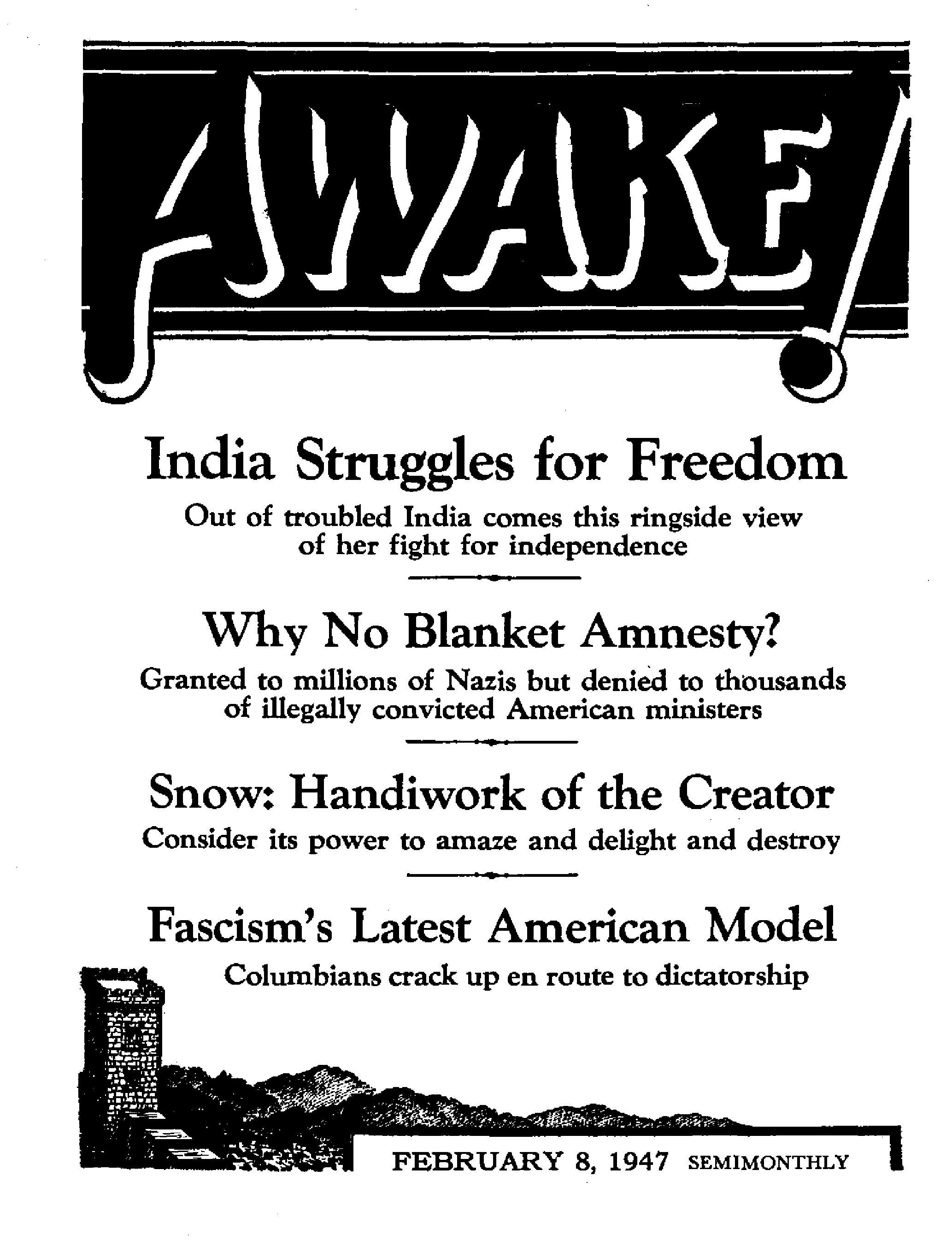
News source? fi-.az awake to the vital issues
of our times must . ..r.-.- . - . .- .. . . f/.ip and selfish interests.
“Awake I” has no fetter =. _t —7^ ttv—y faces facts, is free to
publish facts. It is r.:- ~- .r.-.zns or obligations; it is
unhampered by advertisers w •~_es must not be trodden, on; it is unprejudiced by traditi tn — meas - • rumai keeps itself free that it may speak freely to 3 - c- abuse its freedom. It
maintains integrity to trutr_
f<Awake I” uses the r: z Aar □£«: ; but is not dependent on
them. Its own correspondents z_~ r^..i_xccx mts. in scores of nations.
From the four corners of the e^rth. mmenscred, on-the-scenes
reports come to you through is not narrow, but is interr.it languages, by persons oz all ■ knowledge pass in review—: geography, science, social cor.;
any nations, in many z : many fields of
“Awake I” pledges itself to 5 -----to exposing hidden
foes and subtle dangers, to champaccz^r -ber-^ fhr ell, to comforting mourners and strengthening these _ .. — <—*»** tv Ae failures of a
delinquent world, refiectir.g sure h~-z :;r A—r.?--: of a right
eous New World.
Get acquainted with t:Awake A:.- i--: rv r-zadAg "Awake!”
FUBLi^St.b_ _ - Z _ _
WATCHTOWER BIBLE AN~ SOCZHTT. INC.
117 Adams Street ' BrockLyz. N. T-, U. S. A*
N> H. Knorr, President W L. Vas Ambesgh, Secretary
. Five cents a copy One dcHar a year
Remittances should be sent to offic: 'z: .
try in compliance with regulation? r.
safe delivery of money. Remittances are accept c Brooklyn from countries where no «?*'.?=
by international money order only. S^scripdEc rates in different countries are here j . A i .. currency.
Notice of expiration (with renewal blank) is seel at least two. issues before subseri ?■:::* =7
k" to onr office may be month; Send your old
=5 Yearly Subscription Rato
ijr*r-c^ 5-S-, _17 St.. Brooklyn 1, N.Y, Si A ?: “ z-jrzsA-A Ji.. S : rain field, N.S.W. 6s
liTzxi. - 3 Ave., Toronto 5, Ontario $1
EafEttL. 5 4 -7-":z Terrace, London, W. 2 5s S*r± Africa. 623 Belton House, Cape Town 5s
Entered as second-class matter at Bmatt . - . S, 1879. Printed in U.S.A,
CONTENTS
India Struggles for Freedom
Factions Involved
Ominous Rumblings Still
Why No Blanket Amnesty?
Amnesty Board Inadequate
Write to President Truman i
“Made of One Blood All Nations”
Snow: Intricate Handiwork of the Creator 13 ■■ ■ -
Formation of Snow Crystals
Snow as a Destroyer
Caches of Weapons and Fascist Propaganda in Albanian Convents
Burma as the Burmese See It
Burma’s Beauty
Burma’s Independence
Contrast in. Calcutta
Fascism’s Latest American Model
Lacona’s Legalized Mobocracy I'pheld
Jehovah’s witnesses Again A7indicated in Draft Cases
“Thy Word Is Truth”
The Highest Calling
Origin of Valentine’s Day
Watching the World
high time to awake.’—Romans 13:11
Brooklyn, N.Y., February 8, 1947
Volume XXVlii
Number 3
India Struggles for Freedom
FREEDOM is more easily de-fined than acquired, though even definition is not easy. D Ila Dictionaries variously define it as anything between non-slavery and complete unrestrictedness. More elusive than the definition is the quality that the word implies, as nations and men have learned to their cost. It is easy to erect a Statue of Liberty or to sing “Britons never, never, never shall be slaves’’; but the beautiful symbology of the one and the indomitable spirit of the other are canceled when upright and sincere compatriots rot in jails for reasons of personal convictions, as in America and Britain.
Nor does freedom come just by physical unrestraint. Many are physically free who are in severe bondage to such things as mental derangement, human passions and national and religious prejudices. Worse yet than these are binding forces that are the more powerful for being generally neither recognized nor admitted: the invisible spirit creatures whose rebellion against Theocratic rule left them with wicked designs against all members of the human race, nationality disregarded. Neither America nor Britain is free so long as these facts are ignored, much less India, which not only has been denied political freedom for centuries but also is swept by the evil forces of religion more than most other nations on earth.
These observations apart, all nations claim the right to rule their own people without the interference of outsiders. Whether that rule be good or whether it be bad, so long as any misrule does not overflow to the hurt of other nations it is the affair only of the nation concerned, they argue. Political freedom, then, at least until the perfect rule of the established Theocracy imposes its beneficial rule world-wide, is the right of every nation, India included. How that freedom is used or abused is the business of none but India. Freedom is her indissoluble right.
This principle established, the question propounds itself as to how it can bp obtained. That, in brief, is India’s problem today. It is easy to change one system of oppression for another just as binding, but difficult indeed is it to secure freedom in its purity. Impossible, in fact, for the reason stated above. With increasing volume the demand of Indians for political freedom has developed from a whisper into a mighty roar over the past thirty years, and Britain deems the time appropriate to step down from the imperial throne in favor of a government of India’s own choosing. But the jostling, shouting and angry melee that struggles to be seated in Britain’s stead is to the bewilderment of any onlooker from abroad.
So rapidly do the scenes change on the political stage of India that it becomes
almost impossible to supply Awake! with an up-tp-the-minute view of the situation, for as fast as the minutes fly the position alters; and by the time this reaches America and is published almost certainly some of it will be out of date. Yet a pause mnst he made at some time to take stock of the occasion, and this is as convenient as any. . . .
The position just now is this: An interim government, comprised of representative members of the various major communities and political parties, functions, with the immediate prospect of floating the Constituent Assembly, that is, the body upon whom falls the responsibility of framing the new constitution.
Background to Disunity.
“Constituent Assemblies” and “Interim Governments” will be as obscure to many readers of Awake! as the events that led up to the present situation; so shall we start at the beginning and see what it is 'all about? Granted, then, it remains to decide which beginning; for the history of India recedes far into the past until it is lost in a jungle of rank mythology. Convenient to our purpose would be the eighth century after Christ. We there find a system of civilization flourishing, built upon a self-contained village life. Common to all and the bond of unity between the villages we find the Hindu religion in much the same form as it exists today. This fantastic system recognizes four castes into which a man may' be born if he is lucky; but, if he is not, then he is an outcaste or untouchable. According to this if a man is born of mochi parents then he must also be a mochi or shoemaker. For to fail to keep caste is, with them, the greatest social crime, the penalty of which is to lose all caste and become an outcaste or untouchable.
It was then as it is now, a beastly, obstructive system. But it had this merit: it worked. Its strength was of an enduring kind and carried it right into our twentieth century. Into that system of simple village life there marched, at the time of which we speak, hordes from Arabia bearing a new and fiery faith, Islam. Islam, the religion of the Moslems or Mohammedans, granted a future paradise to the faithful who killed an infidel; and so it was to the creed of “convert or die” that these swept over India's northlands. The resistance offered them was scant, and conditions finally settled down to one in which a minority of invader and converted Moslems ruled over a majority subject-race of Hindus. In the north Moslems predominated; in the south, Hindus.
English traders, scouring the uncharted oceans for trade in the seventeenth century, found conditions almost unchanged. With the opening of that century a Moslem, Akbar “the Great”, was ruling, not by the “divide and rule” policy, as is often asserted, but by the policy of ruling the divided; for the Hindus and the Moslems were as divided on the day that he grasped' power as they were eight hundred years before, and as they are today. His “greatness” was that-he employed Hindu troops against the Moslems and Moslem troops against the Hindus and used Hie resultant power to the advantage of both.
It was an English trading company that first settled in parts of India and which, as a result of chicanery* and treachery involving British and French traders and native Indian rulers, found itself eventually governing an area as densely popu/ated and as large as all of Europe. The home government was" not slow in adopting this cumbersome infant as its own; and with the adoption also continued Akbar's policy of ruling the divided,, by which means it has retained its seat of authority until now.
Children, however, like puppies, are more easy to adopt than abandon; certainly so in this case. For now that Britain desires to dispossess her Indian etn-pire it seems impossible to do so with-
out bloodshed. Any attachment is not from India’s affection toward the foreign rulers, but from fear of the internal consequences that it seems impossible to avoid. Whereas for many years the Hindu and the Moslem have united in opposition to British rule, as was shown in a recent article in Awake! yet it has been the unity of expediency only.
It is a measure of desperation, therefore, that prompts the Indian to oust the British ruler and face the terrible consequences. For while that rule has brought some advantages, these have been rendered a minus quantity by frequent misrule and violations of justice. Even worse than these have been the superior, overhearing attitude of the foreign rulers toward India’s sons. It is rank hypocrisy for British children to be taught as “history” the story of the “black hole of Calcutta” and to keep them ignorant of the atrocities of their own “Christian” nation against a backward and browbeaten people. This “brightest jewel in the British crown”, as the Indian empire has been termed, somehow loses its luster in the light, or darkness, of the Amritser massacre of 1919, when unarmed and confined citizens were mown down by machine gun, killing 379 and wounding 1,200; or of the locking of a hundred Moplahs in a goods wagon so that only forty lived to see the journey’s end.
These are blots upon any nation, and blacker if it blasphemously takes to itself the name of “Christian”. Surely the God and Father of Jesus Christ, Jehovah, will not allow such blasphemies and such crimes to go unpunished! The reader of Awake! is probably thinking that thew criminals responsible were punished by their nation for these. Officially, maybe, yet that does not alter the fact that their fellow-nationals took up collections on their behalf in both cases!
Such excesses were not the monopoly of the British, however; nor should it be thought that their rule has been merely this. Frequently there have been brilliant and self-sacrificing Britishers who have served India well. Mostly, too, as such have sought the good of India their greatest opponents have been the Indians themselves: their opposition to the bill to remove suttee (the burning of widows on the funeral pyre of their husband) and the other to prevent the awful tragedy of elderly men being allowed to marry girls not yet pubescent being cases in point- But because under British administration such as the Amritser massacre has been possible, and more particularly because of their touch-me-not attitude, India prefers self-rule to the rule of the British, whatever the price she must pay.
Factions Involved
This preference has found expression in various ways during the past hundred years, the Indian mutiny being the classic example. Had that attempt been as organized as it could have been, today it would have been certain of success. But the Indian National Congress and the All India Moslem League did not then exist. It will come as a surprise to some to learn that it was the British government that fathered the Congress and brought it to its birth; and docile enough an offspring it was in those days of its childhood and youth. To change our metaphor, it was engineered as a safety-valve in the machinery of government to provide an outlet for the feeling of revolt against foreign rule.
That was in 1885. Despite all claims to the contrary, the Congress is Hindu. Twenty-one years later the Moslem League was formed and it came to be to the Moslem what the Congress was to the Hindu, each representing its own community.
Besides these two major communities there are others that should be known if one is to grasp something of the difficulties that confront the framers of the new constitution. Some of these are:
Scheduled Classes: The outcast untouchables. Although Hindu in outlook, yet they are divorced by reason of their untouchability. These are. gradually awakening to their real strength and are developing strong anti-Hindu and antiCongress tendencies. Congress is very eager to get this community under its wing, but it doubts the sincerity of the Congress maternal duckings. Denied every civilized right by the caste Hindus, they neither trust their promises nor are willing to be made their political cat's-paw,
Sikhs: A branch from the Hindus. Developed their own religion and are, unlike the Hindus, a martial race. The difficulty they present is that they live chiefly in the Punjab and hence come within the proposed Pakistan.
Par sis: A very wealthy community of Persian descent. Both powerful and influential.
“Christians”: Nominally so. Comprising domiciled Europeans, Anglo-Indians, Indian converts and their descendants. Less than one percent.
Here follow four of various communities, their strength, religion, their representative organization and its leader:
Community
Hindus
Moslems
Scheduled Classes Sikhs
Religion
Hinduism Islam Hinduism Sikhism
Organization All India Conffreas Moslem League Scheduled Crates Fed. Panthlc Board
Leader
J. Nehru
M. A. Jinnah Dr. Ambedkar Tara Singh
Population
240,000,000
90,000,000
60,000,000
5,000.000
Further adding to the complications of the situation that faces any constitution-making body are the native princes. These are hereditary rulers over twenty percent of India's population, having their own standing armies, legislatures and executives. In theory these have never been under British domination, and any contribution that they may make toward a new order in India must be purely voluntary on their part: and unless the new constitution is framed to leave them much as they at present exist it must be $t a great loss to the princely houses.
Organized to protect their common interests they present a formidable problem to the Constituent Assembly.
Introductions over, we are now in position to trace the development of events leading up to the present situation. During the first world war, by the Montagu Declaration, the British Parliament announced its purpose to be “the gradual development of self-governing institutions with a view to the progressive realization of responsible government in India as an integral part of the British Empire".
From the end of that war down to the event that next concerns us in 1935, wave after wave of popular revolt broke upon Britain's imperial sands; taking the form, generally, of non-violent civil-disobedience. In that year, by Act of Parliament, the Government of India Act framed a new constitution which gave Indians power to elect by democratic voting representatives on both the central and provincial governments. It was not democracy, but it was an excellent training-ground for democratic principles. One fact stood out in these elections: that the Hindus were wholly Congress and the Moslems almost wholly
League. The stage was being set for the tragedy of our day.
As soon as the
second world war dragged Britain into its vortex the viceroy, without consulting the wishes of the Indian peoples, declared India at war with Germany. Not from pro-Nazi, but from anti-British feelings, surges of unrest swept the length of the country. The elected representatives of the people withdrew from office and the Japanese armies, breaking through unprotected Malaya and Burma, bore down upon the open door of India. Sir Stafford Cripps, at the instigation of a Conservative home government, came to within the last inch of succeeding in uniting Hindus and
Moslems in a common form of government. That he failed is not to his discredit: and this man will always be remembered with kindness as a friend of the peoples of India. The gulf between Hindus and Moslems had the width of many centuries and the depth of communal hatred as only India can hate, and was not to be bridged by a single man, no matter how highly he might be regarded. From the one swing of the pendulum of near-success, his failure swung to the other of a yet wider breach.
This revealed itself in the demand by the Moslem League for Pakistan. Pakistan is the name given by the League to the portion of India which they demand shall be partitioned from the rest of India and have complete autonomy. Pakistan will be the northern section of the country, where there is a majority of Moslems; and Hindustan, the southern section, where Hindus are in the majority. This demand sprang, not from the mind of Mr. Jinnah as some might imagine, but from the common people. He, at first, opposed the scheme, but now leads a firmly-set ninety-percent in demanding it.
Having a clear view of the context we are now in position to examine the immediate causes of the present situation in India. Of these, two events stand out: (1) A viceroy is appointed who is as well disposed toward the aspirations of the Indians for self-rule as Cripps himself, Lord Wavell; (2) the Labor party of England gains a powerful majority in the British Parliament in the postwar elections.
British Labor Party Victory
The British Labor party had always avowed itself as favoring home rule for India, and now it could give effect to its policy, A viceroy enjoying the confidence of the Indian masses and a Labor government at home made the moment propitious for the clamoring masses of India to receive self-government; and Lord
Pethick Lawrence, Sir Stafford Cripps and Mr. A. V. Alexander, members of the British cabinet, were sent to India with the mission of giving effect to the transfer of power. Mr. Attlee, British prime minister, voiced the object of the mission:
We arc resolved that the machinery [of self-government] shall be set up, and we seek the co-operation of all Indian leaders to do so. . . . India is to choose what is to be her future situation and her position in the world. ... If she elects for independence —and in our eyes she has a right to do so —it will be for us to make the transition as smooth and easy as possible. . . . We are not going to hang on to anything for our own advantage which should be to the disadvantage of India.
Let the Hindu and'Moslem spokesmen voice India’s reaction to this fine gesture. Mr. Vallabhai, speaking for Congress :
The Congress is prepared to go to the farthest extent to meet the legitimate demands of the minorities and provide them with all reasonable safeguards, but the Congress cannot concede the impossible demands for the partition of India—the Pakistan of Mr. Jinnah.
Mr. Jinnah for the Moslems:
Today is Pakistan day . . . once more we affirm our solemn grim determination in the most unmistakable terms and once more by universal demonstrations that Moslems of India are prepared, eome what may, to achieve it. ... We are determined, eome what may, to resist any such attempt [to foister.majority rule on India] by each and every means and we are prepared to make any sacrifice to prevent any such dictation or imposition by the British government, and, if necessary, by the sacrifice of our blood.
Here, then, is the crux of the whole matter.
After discussion with all parties, the mission produced a scheme to serve as a basis upon which the work of building
the new constitution might be founded. In brief, it was this:
1, That the final government should be in three tiers, each with its own legislature and executive:
(a) Each existing province would have complete autonomy in all matters except those delegated to (c); (b) Provinces may elect to form into groups with a Group Government, with power to represent the group before (c); (c) A Union of All India with the subjects of external affairs, defense, communications and finance.
2. That the working out of the finally accepted constitution shall be in the hands of Indians only, and that for the purpose of framing it representatives of all parties shall form a Constituent Assembly.
3. That as a temporary measure, to rule the country while the new constitution is being molded, an interim government be formed from all parties by the viceroy.
Ominous Rumblings Still
A casual observer might conclude that at last India had reached a safe harbor of peace. But it would only be by ignoring the ominous rumblings that persisted from some quarters. Let this be clear to the reader: India is not united, has not been united for the oast thousand years, and will not be in the immediate future, no, not by a million cabinet mission schemes. Only to peep beneath the facade of unity is to discern in the structure of the one-nation theory vast gaps and flaws which may be ignored only at the cost of spilled blood.
Such gaps have revealed themselves in the events that have followed the visit of the cabinet mission. Recriminations have flown back and forth between all parties, over the forming of the interim government, the personnel of the Constituent Assembly, the details of the future constitution, and similar details. From then until now it has been a series of advances and withdrawals until the observer both outside and inside the country has become dizzy as he attempted to follow the meanings of each move. The f Scheduled Classes, through Lt. Ambedkar, declare that if they are not given safeguards they will seek “other means” to secure their rights; Nehru, slipping up in the slime, 'states that if the Congress cannot work the Constituent Assembly it will wreck it; Jinnah threatens “direct action”. Said Jinnah:
This council [League] calls upon the Moslem nation to stand to a man behind their sole representative organization, the All India Moslem League, and be ready for every sacrifice. This council directs the working committee to prepare forthwith a program of direct action to carry out the policy initiated above and to organize the Moslems for the coming struggle to be launched as and when necessary.
To the Congress he said: “If you seek peace, wTe do not want war; but if you want war we will accept it unhesitatingly.” Grave words, these.
August 16 was appointed as Direct Action day. Every informed person now knows of the terrible events inaugurated on that day, first in Calcutta and then India-wide. I have been in several trouble centers during the anti-British disturbances, but never have I experienced the atmosphere so tense as when in Calcutta for the Glad Nations Theocratic Assembly of Jehovah’s witnesses in October, two months later. The trouble had not ended then, it has not ended now, it will not end until the Moslem gets his Pakistan, and even then peace will be precariously held.
It is becoming the conviction of many that the Moslem in India has not been given a square deal. One feels a strong strain, of sympathy for a community from whose lips are wrung the following epochal words (Jinnah in his Id message to Moslems):
Today the horizon is dark for us, the doings of the British government and Viceregal
Lodge are shrouded in mystery; we are vilified, misrepresented and threatened from every direction. . . . Tremendous propaganda is carried on to throw the blame on the Moslem League. ... We have argued, we have reasoned, we have made concessions, but all to no purpose. There' remains in front of us a grim struggle and we must face it boldly and courageously.
Tt would tire the reader to go into the details of the parleys, the arguments, the threats and the riots that have lasted up to this day; and no purpose would be served. Sufficient for him, if he would watch with interest the affairs of India in the future, is to know the present situation. In spite of every difficulty the viceroy has formed the interim government. This now contains representatives of the Moslem League; not with the object, as they confess, of making it or the proposed constitution a success, but to serve the interests of Pakistan on the inside as they have served them on the outside. The Constituent Assembly is scheduled to meet on December 9, just two days from when these words are being typed, and Congress declares that it will do so “though heaven and earth split”. The news today reveals that the London conference has failed, as others have all failed.
One thing should be kept in mind: that the Congress is far ahead of any other party in propaganda methods, which are often Jesuitical in the extreme in the effort to catch and hold the eve, ear and sympathy of onlookers abroad. Beside it the League is but a child.
Future Prospects for Freedom
What of the future? what are the hopes of seeing peace dwelling within this sub-continent? At the moment all eyes in this country are upon December 9 and the opening of the Constituent Assembly. There is common talk of further bloodshed then, sometimes of civil war. Should that crisis pass peacefully, then it seems inevitable that another will crop up in the near future. For only if both sides are willing to make the new regime a success can disaster be averted; and both sides are not willing. To the Moslem it is like a man being in business with a partner who is to get all the profits. Viewing the alternatives before us: if the Congress attempts to ride the Constituent Assembly roughshod over the Moslem minority, then woe indeed is it to India from such a Himalayan blunder; if League and Congress attempt to work the Constituent Assembly together, sooner or later some quarrel is likely to lead to civil war; while even if Pakistan is granted, some “incident” in either Pakistan or Hindustan involving the minorities may break the dam of restraint and pour forth the mighty flood of pent-up hatred that has accumulated through the centuries.
What of the future, then? Can the leaders possibly guide the nations called Indian,safely through the dark and dangerous jungle ahead? Given time and good-will many might be inclined to say yes. Yet good-will is lacking, as we have seen, and time is the one thing that cannot be granted. And why not? Because the politics of India, like the politics of every land, ignores an event of recent history that is epoch-making in its import: an event that places the attainment of Swaraj to a position of relative insignificance where true freedom is concerned. So immense are its proportions that, believe it who will, her Swaraj is obsolete already, antiquated and ready to vanish away. For the need greater than Swaraj (self-rule) is Khuda ka raj (God’s kingdom)., w’hcn God himself shall rule over all of ohedient humankind and lift them securely out of the reach of any form of oppression or exploitation by the simple but essential expedient of destroying for ever every oppressor; in particular that battening host of demon spirit creatures that now so evilly influences the rulers of earth.—Sec Revelation 16:13-16.
UUilUllHliltItlllHIlUIIUIHttlUHilUllUUIIIIHIIl Write Preridfiit Truman rt-QUektJiiff that be direct his am-netty board blanket rriletf to iUerallr convicted mlniiterv. MIHIIIMIlUlhlUIIUItllUlllMlllllllllHIIUHIIIIUI*
2 MILLION NAZIS
FIVE thousand Christian missionary evangelists continue to suffer the blight of illegal felony convictions under the draft Act, several hundred of whom still remain in federal prisons. The American government has until now granted relief to approximately two million Nazis, Fascists and Japanese., In a big Christinas splurge the government, on December 23, 1946, granted prompt and full relief to nearly a million Nazis in the American zone.
The inconsistency of granting favors to the fighting enemies of the country when more than five thousand American citizens, Jehovah's witnesses, who have been illegally convicted because of their refusal to do military training and service, is emphasized in the persistent refusal of the president of the United States to grant blanket amnesty to these Christian ministers.
Truman Disguises Amnesty Rejection
In September, 1946, a formal request for blanket executive clemency in behalf of Jehovah's witnesses convicted under the Act was made to President Truman in person. This was by a presentation of the resolution passed by the Glad Nations Theocratic Assembly of Jehovah's witnesses. This request for blanket amnesty was finally rejected by the president on December 24, 1946, the day that blanket amnesty was granted to the Nazis. This refusal was disguised in the announcement by Mr, Truman of the creation of the president's amnesty board. The board was set up on December 24 to review each conviction of Jehovah's witnesses and the conscientious objectors under the Selective Training and Service Act. The White House press secretary, in issuing the press release, stated that “there was no thought of a ‘blanket amnesty for all or part of the cases subject to review”.
This refusal to accord illegally convicted American citizens the same treatment accorded the Nazis is difficult for the American people to understand. This is especially so since the decisions of the Supreme Court of the United States in February, 1946, holding that Jehovah's witnesses convicted under the Act had been denied by federal'uourts their right to make their defense. In fact, on December 24, 1946, almost simultaneously with the press release announcing the appointment of the president’s amnesty board to review the convictions, the Supreme Court of the United States rendered two more important decisions. These decisions held again that the convictions of Jehovah’s witnesses under the draft Act, without granting them the right to prove in their own defense that they were exempt as ministers of religion under the draft Act, were in violation" of law. This was so because the Act itself prohibited the induction of ministers. (See article on page 23 entitled "Jehovah's witnesses Again Vindicated in Draft Cases”.)
An understanding why President Truman is delaying and stringing out the consideration of the amnesty plea made by Jehovah’s witnesses while granting full, prompt and blanket relief to the Nazis is apparent when attention is brought back to his comments made when the Resolution of Jehovah’s witnesses was presented to him in September, 1946. On that occasion he stated that he didn’t have any use for one who would not fight for his country in time of war. His giving blanket amnesty to the Nazis proves that he has a higher regard for fighting enemies of the country than for the ministers of Almighty God, citizens of the United States, who were illegally treated and denied constitutional rights by their draft boards and the courts. At least he is slower to giVe relief to them than to the eneiny warriors whom he was so prompt to have pardoned.
Amnesty Board Inadequate
The president’s amnesty board to review convictions of Jehovah’s witnesses is composed of former associate justice of the Supreme Court Owen D. Roberts, James F. O’Neil, chief of police of Manchester, N. H., former vice-chairman of the American Legion’s Americanism Committee, and Willis Smith, of Raleigh, N. C., former president of the American Bar Association. This appointment does not mean that all the thousands of persons convicted under the Act will receive prompt consideration. They will not get as quick relief as did the hordes of “small Nazis” who were granted blanket Christmas amnesty. In fact, the amnesty board is required to sit and hold hearings in each one of the several thousand cases. This is a tremendous task. It undoubtedly will require many months, if not several years, to complete hearings.
The amnesty board is authorized to make recommendations to the attorney general of the United States. He, in turn, will pass the report of the board and its recommendations in each of the several thousand cases, along with his recommendation, to the president. It is obvious that the extended inquiry into each of the thousands of cases by the amnesty board makes it impossible to expedite immediate pardon of Jehovah’s witnesses convicted under the Act, as were the Nazis. In concealing his failure to give prompt relief the president “sugar-coated” his action in his announcement of the appointment of the amnesty board. He said that “freedom of conscience is basic to our American tradition of individual liberty. The Congress recognized this traditional freedom when it enacted the Selective Training and Service Act of 1940”.
The appointment of the amnesty board is a very inadequate answer to the request contained in the Resolution for clemency and blanket pardon unanimously adopted by the Glad Nations Theocratic Assembly of Jehovah’s witnesses at Cleveland which w’as, as above stated, presented to the president of the United States in person in September, 1946. The force of the request in this resolution was backed up by letters of protest, public protests and newspaper editorials. These came from all parts of the United States advocating the granting of complete amnesty for all political prisoners, including Jehovah’s witnesses convicted under the draft Act.
A weak effort to make it appear that, relief was being granted was made by the attorney general of the United States on December 23, 1946. On that day, two days before Christmas, he announced that 150 of Jehovah’s witnesses were to be released from prison on parole so as to be discharged before December 25. The granting of parole did not constitute the granting of pardon or amnesty. These men merely were discharged from prison before the end of their term. They, like all other men on parole, remain technically in prison until they have completely served their terms. Their release on parole does not mean that they
have been freed from the taint of their unlawful convictions.
While citizens suffer, the Nazi's and Japanese who attempted to destroy the government have been accorded full freedom and have had restored all their civil rights. Jehovah’s witnesses have also received less favorable treatment* than have the convicts and felons who have committed offenses against the morals and property of the people and other criminal laws of the federal government. Over a year ago President Truman, by proclamation, granted blanket amnesty to all the excon vic who had served a year or more in the armed forces and had been granted an honorable discharge. This amnesty and executive clemency was automatic and of a blanket character. No amnesty board was set up to delay relief for the convicts.
Refreshing Words of Liberty
It seems that the words of Mr. Justice Frank Murphy of the Supreme Court of the United States, in his concurring opinion rendered in the cases bf Estep and Smith v. United Statesf decided February 4, 1946, should be considered by President Truman: “All of the mobilization and all of the war effort will have been in vain if, when all is finished, we discover that in the process we have destroyed the very freedoms for which we fought/' Consideration should also be given to the sage words of Mr. Justice Murphy in his dissenting opinion, favorable to Jehovah’s witnesses, in Prince v. Commonwealth. There he said:
From ancient times to the present day, the ingenuity of man has known no limits in its ability to forge weapons of oppression for use against those who dare to express or practice unorthodox religious beliefs. And the Jehovah’s witnesses are living proof of the fact that even in this nation, coneeived as it was in the ideals of freedom, the right to practice religion in unconventional ways is still far from secure. Theirs is a militant and unpopular faith, pursued with a fanatical zeal. They have suffered brutal beatings; their property has been destroyed; they have been harassed at every turn by the resurrection and enforcement of little used ordinances and statutes. See Mulder and Comisky, “Jehovah’s Witnesses Mold Constitutional Law/’ 2 Bill of Rights Review, No. 4, p. 262. To them, along with other present-day religious minorities, befalls the burden of testing our devotion to the ideals and constitutional guarantees of religious freedom.
Write to President Truman!
Do not Jehovah’s witnesses have as much right to fair treatment as do the Nazis, swindlers, tax evaders and bank robbers who got blanket amnesty? If you think they should get blanket amnesty why not write a letter now to President Truman requesting that he authorize and direct that .his amnesty board give blanket relief? He should be requested to give prompt and full relief io Jehovah's witnesses who were denied their right to show in their trials in federal courts that the draft board orders were contrary to the Act because they were ministers exempt from service.
"Made of One Blood AJl Nations”
C At a conference of biologists last year an associate professor at Harvard University declared that blood does not differ with race, that “race does not determine the physical characteristics of peoples”. His discovery comes late. Two thousand years ago it was written by inspiration of God: “God , . .hath made of one blood all nations of men.” (Acts 17:24-26) The professor’s discovery was heralded to calm the fears of many who had unscripturally taken into their system, in one way or another, the blood of others.
JEHOVAH, J in His majestic enumeration of the wonders of creation,
asks Job these questions: “Hast thou entered the treasuries of the snow*, or hast thou seen the treasuries of the hail, which I have reserved against the time of trouble, against the day of battle and war? out of whose womb came the ice? and the hoarv frost of heaven?”—38: 22.
No small compensation for those who live in wintry latitudes is it to see the countryside under its first blanket of dazzling white. The undulating snow covering is studded with white-powdered trees, and cottages appear more cozy in the winter stillness because of the fluffy comforters draped by nature upon each roof. See also'the glinting jewel points encircling at the eaves! Extending itself to achieve variety the landscape will change its garment to pink as the sun reluctantly imparts such beauty, and to silver by the light of the moon I Few men are insensible to the muffled quietude of a snowy day, or to the grandeur of the countryside decked in ermine and dia-
intricate
iandiwork
the Creator
monds that sparkle ’neath winter sun.
But this scene merely represents a few of the manifestations of frozen-water forms, which become myriad when observed in the rime frost, the hoar frost, sand snow or the common polar phenomenon called “diamond dust”; in storrn-swept forest or tundra; or in moving glacier or hurtling avalanche! Or viewing the flakes or crystals under a microscope, thousands more lacy, intri-cate yet symmetric patterns unfold.
So impressed was one investigator with the multiplicity of snowflake structure that he wrote: “The particular and endless modifications of similar classes of crystals can only be referred to the will and pleasure of the Great hirst Cause, whose works, even the most minute and evanescent, and in regions tlje most remote from human observation, are altogether admirable.” Another authority on snow photographed more than four thousand different crystal forms! Though the lacy, dendritic forms are comparatively flat, with hexagonal design, there are others with hexagonal prisms or columns topped by larger hexagonal plates, resembling symmetric tables.
Formation of Snow Crystals
It is an interesting fact that the larger snow crystals form at warmer sub-freez-
ing temperatures than the smaller flakes. For example, at —6° Centigrade (21,2° Fahrenheit) snowflakes were measured having diameters of 3.4 mm,; while at —12 c C. (10.4 F) the diameter was 1.2 mm. Where the snows fall at very low temperatures in the polar region the crystal is like sand or flour. The sand enow is too rough for the ski blade to glide through. A rather peculiar snow phenomenon noted by the Harvard expedition was the bullet snow, or heavy pellets, which fell on the Alaskan mountain slopes in summer.
Newly fallen snow is very light, having much air space in its exquisite structure. It is estimated to be only one-fifteenth as heavy as ice, which, in turn, due to expansion of ice at freezing, is about nine-tenths as heavy as water. Perhaps lighter still is the ‘‘diamond dust”, minute ice crystal, observable occasionally in England and central Europfe but far more common in the polar region. These are so imponderable they appear to float in the air rather than float to the earth; and they are actually invisible and seen only when the observer directs his gaze at and slightly below the sun; and then the scintillating particles reflect its rays!
Snow is the name given to precipitation in the form of ice crystals. But how is it formed! In explanation it must be recalled to mind that there is much water vapor, or water in the gaseous state, even in dry air. Air at a given temperature will absorb only a limited quantity of moisture, and when this point is reached it is said to be saturated, its relative humidity (or proportion of saturation) is 100 percent. If the temperature is now decreased, the colder air will not hold so much water; hence precipitation in the form of rain or snow results.
Snow crystals are said to form around a nucleus. The upper atmosphere is “polluted” with small particles of matter such as dust, salt crystals from the ocean, and even flower pollen. When the temperature is below the freezing point, the water vapor, when precipitating, sublimates; that is, it changes from gas to solid without going through the intermediate liquid state. (Iodine is another one of the few kinds of matter that sublimate.)
The water molecule, or smallest unit of water, composed of two hydrogen atoms and one oxygen atom (hence the chemical formula HaO), attaches itself to the nucleus particle. Then other molecules line up like soldiers marching and deploying. More and more of these molecules of*water vapor attach themselves to the nucleus “in an orderly sequence in accordance with the system and class of symmetry peculiar to oxide of hydrogen” The final form of the crystal is thought to be determined by the varying temperatures and moisture concentrations through which the flake passes in falling to earth. The deposits of rime in the form of frozen fog on window panes, and the hoar-frost precipitation on sticks, trees, and even on snow surface, both have different crystalline fprms.
What has been said about precipitation makes it easier to understand why snowfall is so heavy on mountaintops. As the moisture-laden warm currents ascend the mountain peak, their temperature falls and rain or snow results. In the Alps, for example, this precipitation continues to the very tops, but in the Turkestan section of the higher Himalayas the heavy moisture is extracted before the winds reach the higher valleys, so that herders often seek these valleys in the winter, where the snow is not as heavy as below. On the high ranges snow readies its final form, firn snow, before it becomes glacier ice.
Ski Fields and Avalanches
Further classifications of snow are made by skiers. Surface, hoar or frosted snow, settled snow of the good, powdery type and telemark'snow are all excellent for skiing. It is said that skiing, which
is of Norwegian origin (the Norwegian and Swedish pronunciation being “she”, which is used in many places, especially in England), was introduced to Americans by Snow Shoe Thompson. In the late 1850’s he astonished the West by sliding his homemade, ten-foot skis across the Sierra Nevadas between Placerville, Calif., and Carson Valley, in Nevada, carrying the mail.
Skiing was developed as a practical means of snow travel on the Scandinavian peninsula, and in the Alps. When the mountains are covered with snow, skiers can descend very steep slopes by taking a winding course; and in photographs this ski track appears like the scalloped border of a towel or cloth. The Russians and Finnish skiers had some grim battles near the Arctic circle, where other means of travel were less mobile and rapid. At present American ski troopers are being trained in Alaska.
Remarkable photographs of skiing were made by the Harvard expedition to Alaska, where two members of the expedition started their descent from over 13,000 feet elevation on glacial and frozen surfaces, across dangerous crevhsses which had to be crossed at right angles to avoid catastrophe, at terrific speeds, where a fall meant lacerations like the cut of glass, down, down toward the sea itself. The lecturer explained that in places it was literally possible to glide from 14,000 feet right into the ocean!
Skiing has also made great strides as an American sport. The magazine Californian states that the best skis are of hickory and have steel edges. They are purchased according to length, this usually being gauged by the reach of the skier. Bindings which are attached to the ski are also sized to fit the ski boot, an important part of the ski equipment. Ski poles, sun glasses, etc., and clothes, together with the other items, are estimated to cost a man about $90. The Californian modestly refrained from estimating the cost of a female outfit.
To those who think of sunny California, it may come as a surprise that seventeen of its eighteen national forests have ski-lodges. Many of these have ski lifts of the bar type, a rope tow, or chair lift. Several resorts are within two hours of Los Angeles, as Mount Waterman, Arrowhead and Big Bear. The latter boasts the only “radio-equipped ski patrol” in the west. The patrol carries a walkie-talkie set, and, since this is limited to five-mile reception, a chain system is employed whereby messages can be relayed to headquarters. Other famous ski resorts in the west are Sun Valley, Idaho, and Oregon’s famous Timberline Lodge on the slopes of Mount Hood. The northern United States and Canada have many more ski and winter sports lodges, such as Iron Mountain, Mich., and Lake Placid, N. Y. If you wish it rougher, there are the Elk mountains of Colorado.
Expert skiers can jump over creeks, barbed-wire fences (with help of poles), turn somersaults and make fabulous aerial jumps from a specially constructed take-off. The American record in 1942 was 289 feet, made at Iron Mountain, Mich, (by Torgen Tokel). The world record was made in 1938, by Joseph Bradle, in Planica, Yugoslavia, with a jump of 350.96 feet.
Besides the hazards of falling or running into something, another danger confronts all who navigate in snow: the avalanche. Lest vou have in mind a slide of snow that runs a few hundred feet and piles up in a ditch or canyon, be it said that Alpine avalanches sometimes take the same track each year, taking half a mile of full-grown forest in their onslaught; that an avalanche, beginning on a steep mountain, may gather sufficient momentum to pass for miles across a level valley; while one reached such speed that it ran down one mountain, across several miles of valley and up the slope of the mountain across. Usually a good sliding surface steeper than 30 percent is required for an avalanche. But
something po more powerful than the steps of a skier may start it falling.
Snow <w a Destroyer
Snow, in the fierce blizzard, as well as in its treacherous drifts, crevasses, avalanches and spring thaws, has, without Jehovah's control set upon it, brought untold death and destruction to man. Perhaps the fiercest place of snow and ice yet discovered is that located by Russian geologists. In a hitherto unexplored region, of the Siberian mountains a record cold was recorded of 94 degrees below zero. The location of this is approximately 63 degrees north latitude and 143 degrees east longitude. This would locate it about 250 miles south of the Arctic circle. This appears to be about the same latitude as Nome, Alaska, and some 2,000 miles west of Nome, These frigid mountains, as well as the polar icecaps, and the high Himalayas in Tibet, have swallowed up many lives, apparently resisting man's efforts at exploration. Mount Everest, 29,141 feet, elevated into a region of fierce wind and snow, has never been scaled; while the lower Alps take a toll of victims each year. A recent news dispatch tells of Italian refugees from Italy who nearly froze in an Alpine blizzard in which even the famed St. Bernard, with his brandy keg about his neck, was snow-bound.
Yet the great use of snow as a destroyer will come at the hands of Jehovah at Armageddon. It was suggested in the opening quotation from Job that the snow and hail have been reserved by Jehovah ^against the day of battle and
—4®*----- war". Inquiry in the Sacred Record reveals that the great canopy, which broke up to cause the deluge, brought down glacial snow and iee. Though Jehovah will not Again flood the earth, supernatural use of cold and snow is both foretold and foreshadowed for Armageddon.
In the past, in the typical battle of Gibeon, it is recorded that“Jehovah cast down great stones from heaven upon them unto Azbkah, and they died: they were more who died with the hailstones than they whom the children of Israel slew with the sword". (Joshua 10:11, Am. Stan. Ver.) He promises to fight again as at Gibeon. (Isaiah 28:21) That cold day of God's judgment comes "out of the north”. (Daniel 11:44) Describing that battle of vengeance the psalmist prophesies: “Kings of armies did flee apace: and she that tarried at home divided the spoil. When the Almighty scattered kings in it, it was white as enow in [Mount] Salmon" (Psalm 68:12,14) It is of divine wrath against His enemies that Jesus warns: “Pray ye that your flight be not in the winter.” (Matthew 24: 20, Am. Sian. Ver.) Further the last “Operation Frigid”, Armageddon, is described:. “He giveth snow like wool; he scattereth the hoarfrost like ashes. He casteth forth his ice like morsels: who can stand before his cold?” (Psalm 147:16,17) Not one, for Jehovah will use His creation snow in a phenomenal manner yet unfathomed by man, to accomplish His destructive purpose against His enemies. The Creator's handiwork of snow will be called into play in the vindication of His name.
Caches of Weapons and Fascist Propaganda in Albanian Convents
AN AP dispatch published in the Kansas City Star, November 26, 11346, Te-jgafwr ported seven eases of cartridges and hand grenades found in one Albanian convent dungeon and machine guns, rifles and anti-tank rifles in another. “Valuable documents, throwing light on the treacherous activities of Albanian quislings and their contact with the Albanian Catholic clergy and with the Vatican, were found with the anus,” the dispatch added.
great producer of rice. Before the war Burma led the world as the greatest exporter of rice.
t:
century, for in Marco Polo’s day this incision through the mountains
was and
BURMA has for centuries been the gateway through which the overland traveler passes from India to China. The Burma Road, which tortuously winds itself through gorges and over mountains, is not a creation of the twentieth used. Likewise Burmese kindness hospitality to strangers, which is outstanding, is not new.
This country of some 261,000 square miles, with mountain ranges on both its east and west borders, forms a natural barrier between the peoples and cultures of China and India. On the north it is also bounded by Tiiountains that tower up 19,000 feet to form a part of the great Himalayan chain. Mighty rivers flow down from these mountains through the central plains and delta country to the Bay of Bengal. Along one of these arteries, the Irrawaddy river, 326-foot steamers are able to navigate a distance of 900 miles from Rangoon to within 40 miles of China’s border.
One of the outstanding sights that meets the eye in Burma are the thousands of pagodas, those towering temple structures that are so peculiar to the pagan religions of the East. Burma has long been known as the land of lavish, golden pagodas, and throughout the country these symbols of religious bondage are to be seen as they spiral above the surrounding perennial green vegetation.
This land is one of heavy rainfall, the monsoon extending from about the end of May to the end of October; As a consequence, and because there are rich alluvial plains in this country, Burma is a Its 10,000,000 acres of irrigated land produced an over-abundance of the grain, making possible the annual shipment of 3,000,000 tons of rice to other countries.
Burma, too, is well known for its teakwood, its rich oil wells of Yenangyaung, and its red rubies of Mogok. Clear Burma rubies are more costly than diamonds of the same size. Rich in mineral resources, this country was a fast-growing and prosperous nation before World War II. Rangoon, its capital, was a rapidly expanding city, until that fateful day, December 23, 1941, when the ruthless Japanese invaders launched their first aerial attack upon us.
Burma and the War
Following that first and quite destructive raid, it was pitiful to see people, a long line of them, streaming out of the city, some young, some old, many sickly, and not a few lame, all leaving behind them their homes and precious belongings, all going, going—where, they did not know. Anywhere, they did not care, so long as they could find some measure of safety. As time went on and other parts of the country tasted of the explosive Japanese “watermelons”, hundreds more joined this almost endless stream of refugees, trekking on, across dense jungles, to India they hoped.
Hundreds died in the attempt through thirst, exhaustion and sickness. Parents
had to leave their children by the w.ay<* side, either because they were too ill or the parents themselves were too nearly exhausted to carry them farther. Many were they that had to thus part company with their dear ones. Some slipped and fell down ravines. As one trudged on it was not uncommon to see unfortunate fellow creatures dying from exhaustion and thirst It was pitiful to hear them begging for a little water, and yet be forced to turn,a deaf ear to their cry because one's own water supply was practically gone. And there was the stench of decaying and decomposing corpses along the trail. What a ghastly sight! Most fortunate indeed were those who finally reached India.
Then followed three years of Japanese occupation, when the people suffered under the oppressive power of the totalitarian war machine. The unavoidable effects of modern war were also the por-, tion of these people. Many a little town is nothing but a heap of ruins and over the old ruins one now sees a constellation of bamboo huts. Truly the people of Burma deserve deepest sympathy.
Rangoon, the principal city, though standing in the main, also suffered great destruction of its buildings. The whole city looks marred and neglected. Where once stood nice buildings, now we find bamboo huts. In spite of these facts, Rangoon, and, for that matter, nil of Burma, has retained its natural beauty. There are two lovely lakes conveniently situated within the city of Rangoon which'provide both natural beauty and places for aquatic sports. Even now in its present state Rangoon is cleaner than many other cities in the Far East. It has nice, straight streets and very little of the "anyhow” planning (or lack of planning) that one finds elsewhere.
Burma's Beauty
In November, following the rainy season, it looks like springtime in the Western Hemisphere, for wherever one goes
one is greeted by trees witn clusters of yellow blossoms. Also the cocoabean tree with its light pink flowers and certain other trees full of cherry-blossom-like blooms add their beauty to the picture. Then there is the Padauk tree with its rich mauve flowers, and, above all, the huge "Flame of the Forest” trees with their luscious red blossoms which from the distance look like cherries. The long slender branches of the "Flame” curl earthward, ever so gracefully, as if wanting to caress the passers-by.
The inhabitants, of Burma are divided into four main tiflbes: the Burmans, Karens, Shans and Kachins. In language the 1931 census reports listed 126 native languages and dialects, but almost two-thirds of the 15,000,000 people speak ' Burman, while many of the remainder are divided into four other languages. When it comes to religion the majority of the people are Buddhists. However, among the Karens there are a large number of Baptists, They are a cultured and educated class of people, and very sincere and of good-will.
Looking Closer at the Burmese
On the'whole the people of Burma are very cheerful and friendly and a happy-go-lucky race. They believe in living for today, so they eat and dress well and do very little saving of money. Their annual festivals are very interesting and very expressive of the nature of the Burmese. The "Lights” festival in October and the "Water” festival in April are the principal ones, with the latter one the more exciting of the two. For three days people crowd the corners of the streets ducking one another in water. Others go about in trucks doing the same thing. It is then that the Burmese are at their happiest. It is also the hottest season of the year.
In the "good old days” the Burmese were famous for their hospitality, and even now one meets with exceptional kindness. Not long ago, when a group of
us had gone to a small town in the country to “preach this gospel of the kingdom of heaven” we were called in at about noontime by an old man and given tea, biscuits and fruit. It was most timely and very much appreciated, for we had brought no eatables with us. Hospitality and charity are two things in which the people of Burma freely indulge.
The people of Burma are a very progressive race. They also love music very much. As soon as a catchv occidental song is born these orientals are quick to pick it up and put Burmese words to it. The so-called “Christians’’ among the Karens are especially fond of sacred music. It is customary among them to have prayer meetings in their homes or in the homes of their friends where they sing their hymns. How much better and more profitable to them would it be if, instead of their “prayer meetings”, they would hold Bible studies and . sing Kingdom songs! Already several homes have been so “converted”, much to the appreciation and comfort of the inhabitants.
Many of the Burmese and Karen “Christians” are hungry and thirsty for the truth of God’s kingdom. After all they have gone through during the hard years of totalitarian misrule, they rightly ask such questions as these: “Why is all this wickedness permitted?” “Why does God allow some people to be rich and healthy while others are poor and sickly?” “What is the meaning of present-day happenings and developments?” and, “What does the future hold out for suffering mankind?”
In view of such searching questions that weigh these people down, it is obvious that our Bible educational campaign is a most timely provision of the Lord, the Great Shepherd who never forsakes any of His “sheep”. It is a great pleasure to-call at their neat, tastefully constructed and clean bamboo huts, which are temporary structures, and there answer their questions and give them hope and FEBRUARY 8, 19W
comfort from the Scriptures. As one draws near, one is greeted with smiles and refreshed with nice cups of tea. Jehovah (“Yuah”, as the Karens say) or Lord God (“Payah Thakin”, as the Burmans say) surely has many, many sheeplike persons of good-will among these people.
…