Awake!, December 22, 1946
Download: PDF — Awake!, December 22, 1946
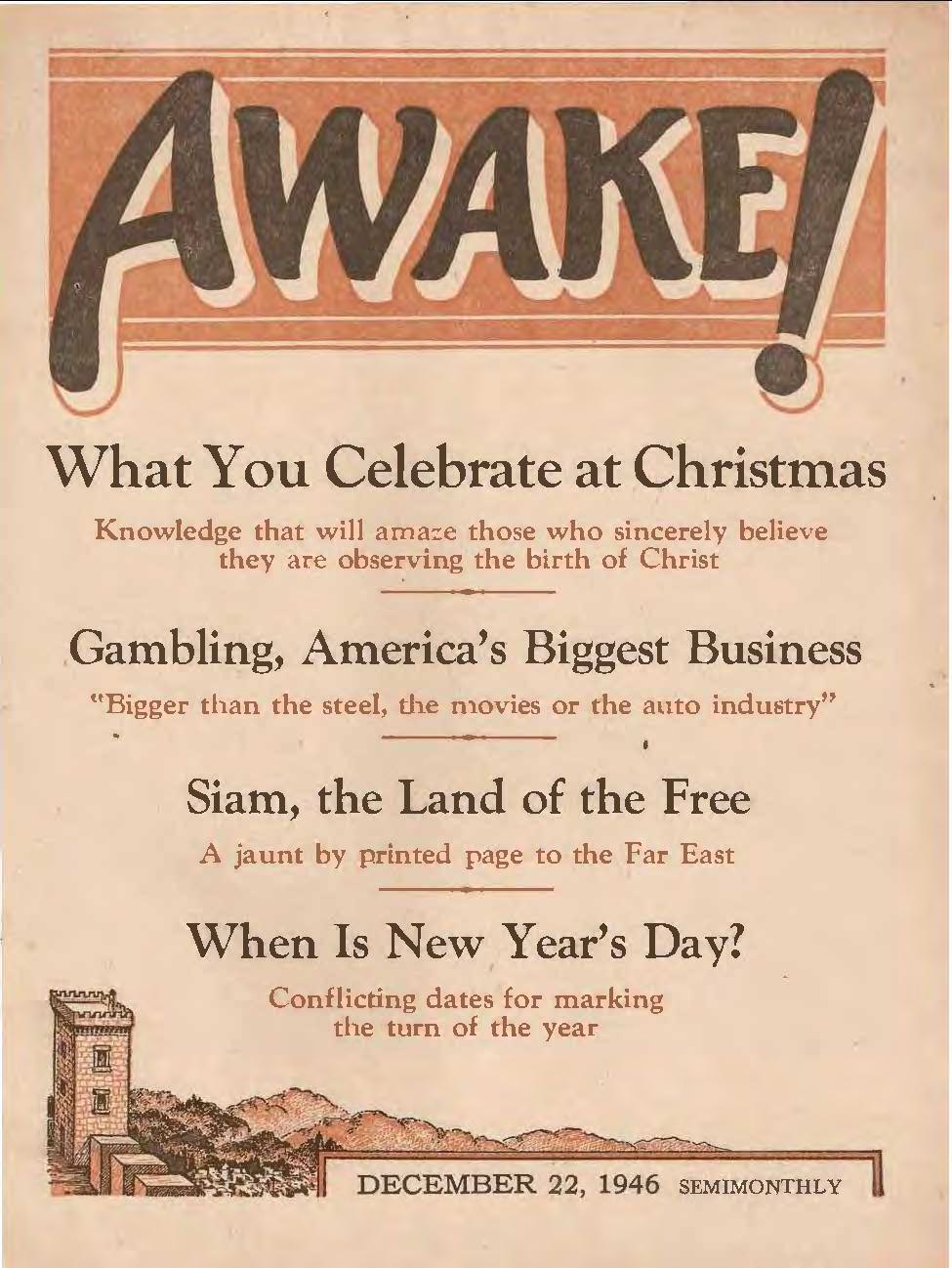
What You Celebrate at Christmas
Knowledge that will amaze those who sincerely believe they are observing the birth of Christ
Gambling, America's Biggest Business
"Bigger than the steel, hie movies or the auto industry"
Siam, the Land of the Free
A jaunt by printed page to the Far East
When Is New Year's Day?
Conflicting dates for marking the turn of the year
THE MISSION OF THIS JOURNAL
News sources that are able to keep yoti awake to the vital issues of our times must be unfettered by censorship and selfish interests. "Awake!" has no fetters. It reaognizes facts, faces facts, is free to publish facts. It is not bound by political ambitions or obligations; it is unhampered by advertisers whose toes must not be trodden on; it is unprejudiced by traditional creeds. This journal keeps itself free that it may speak freely to you. But it does not abuse its freedom. It maintains ntegrity to tTOth. •
''Awake!" uses the regular news channels, but is not dependent on them, Its own correspondents are on all continents, in scores of nations. From the four corners of tha earth their uncensored, on-the-scenes reports come to you through these columns. This jo-^urnal's viewpoint is not narrow, but is international. It s read in many nations, in many languages, by persons of all ages. Through its pages many fields of knowledge pass in review—government, commerce, religion, history, geography, science, social conditions, natural wonders—why, its coverage is as broad as the earth and as high as the heavens.
"Awake I" pledges itself to righteous principles, to exposing hidden foes and subtle dangers, to championing freedom for all, to comforting mourners and stren£thenin£ those disheartened by the failures of a delinquent world, reflecting sure hope for the establishment of a righteous New World.
Get acquainted with "Awake!" Keep awake by reading "Awake!''
--^^^^""^^<^^--
POliLI8"S.Jn> SEMUlONTHLI BY WATCHTOWER BIBLE AND TRACT SOCIETY, INC.
117 Ad!tms SUeet
N. H. Knobb, President
Flvo cents a copy
Remitt:tnc" ahoulri sent to omc:o lt> four edun-tl'l' In cumpllanoo triUi n!l!ulAUous to cuaruntee liJilc drJl^mi or money. Uemil tancr;s •re rtrecptnl .U llrooklYii from oounlrlea whero no Is lunofej), bY intemoUonal money order only. Subscription ratta In different C<tunt^^ Rro here •lilted In lored cnrroncy.
ll.ollco of expiration ("lth ronnoewal lluok) :Is sent at least two Ssues bo!nre aubsnrlptlon expires.
BroollYlll, N. Y., U.S. A.
W. E. Van Aio!iiuROH, Sccretarv One dollar a year
()bah1JO of addreK wbca sent to o11r onJ.:o •••f bo cspc-etd eteclhw \Oihhln nno modth .s<rul your old as '"I.!Jl ,L, new rutdr.c.^.
Ottes YearlY Sub!orlptlon R3ln
Anitriw. U.S.. J.l'T Adame St., Brooklyn 1. N.Y. $1 AuJtralla, r gclilsrunt Bd„ Stathneld, N.S.IV. 6o Cana-a, id lrlillnAvo.. Toronlo 5, Ontario U EnGland, 94 Cra.vco Trrsce. rliludoo. W. !! Gs So"th Africa, !2S Booton ilouse, Cape Town 6s
EnBuod u aeeond-elnsa tnmtr.r at Broo^i, K. Y., Act or Afarth S, 1879, Printed In U. S. A.
CONTENTS
What You Celebrate at Christmas
Date of Christis Birth
The Origin of “Christmas"
Christmas Trees and Santa Claw;
Blasphemous nnd Commercinl
What Price Health?
Vitamins
Easy Come, Easy Go
Gambling, Americn's Biggest Business
Riotous Midwe,;I Gtunljling
The Gambling Capital of America
The Greeks Had a Word for H
Siam, the Lnnri of t1ie Free
The Central Rice Bowl
A Bit of History
Black Light Ourkens Criminal Careers
British Colonies Cru"h Freedom
Jiven the Pretzel Is Religious!
When Is New Year's Day7
Surplus
•‘Thy Word Is Truth"
The Fighting High Priest
Just n Celestial Speck
Watching the World
^"Now it is high time to awakel'—Romans 13:1/ 9j
Volume XXVII
Brooklyn, N. V., Oecsmber 22, 1948
Number 710
What You Celebrate at Christmas
EVERY year at this time there is great excitement within the nations of Christendom. Feverishly the people rush from store to store in the biggest spending spree of the year. Prices are higher; people go far beyond their means; debts are made tJmt take mouths to pay. The precious jewels and trivial toys they get are carefully wrapped in glistening gift-packages for friemls and relatives. 'rhe occasion calls for elaborate preparations, and so the houses and homes are decorated with holly, candles and wreaths. Evergreen trees are trimmed with pretty ornaments, colored . lights, sparkling tinsel and fancy candies. As the shortest day of the year approaches in the northern hemisphere there is a last-mjnute rusli to stock Uie panb*y shelveK and larders with special foods and provisions, sufficient at ordinary times to last a week. Large quantities of wines and liquors are also secured. Nervonslv. housewives cook and bake, for there must he plenty of tasty (•akes, cookies and candies, and all kinds of delicious goodies on hand. Then, at last, after weeks of fuming and fussing and owr-exciteme.nt, the climax is reached on December 25. It is Christmas Day !
But do you know what ah this means? Lnd do you know what you are celebrating on this day of festivHyl In answer, no doubt, you will tell about the birtli of Jesus; about a "star" of Bethlehem that led “three wise men" as they brought gifts; about angels singing to shepherds: «On earth peace, good will toward men." You will say that Christmas is the greatest celebration of the year, for it is the celebration of the Savior's birthday!
But why the Christmas tree and all the trimmings? Why the mistletoe, holly, candles and yuletide logs, the fruits and nuts, and mince pies! \Viy the feasting and banquetin;, the excessive wine and liquor, the drunkenness and licentiousness that goes to make up the "Christ. mas spirit"? Can you answer these questions 1 Or, if it is such a joyful occasion, cau you explain why people say, “I’ll be g)ad when its over"? What has all of this to do with the Savior wlio was finally nailed to a stake If you cannot answer, then you had better read the history of these traditional customs so thoit next year you will know what you celebrate if yon observe Christinas.
First of all the date, December 25. There must he some question as to whether this is the correct date, since the Eastern and Orthodox churches cele-bratr Christmas on January 0. So let us cheek up and find out whether Jesus was horn on December 25.
Date of Christ's Birth
The only reliable history on the sub-jC'cl, of course. is t.lte Bible, which begins with a Teconnting of the birth of .John the Baptist, tlte forerunner of Jesus. ^Al the priests served at the temple during the three great annual feast weeks. Dming ilte balance of the year their temple service wa:-; divided up into "courses", each of a week’s duration. (2 King-s 11:7; 2 Chronicles 23: 8) The account in Luke shows that John's father, Zacharias, was serving at tlte temple in the eighth course of the year, called "Abijah". (Luke 1: 5, S, 23, 4m. Ht(tn. Fer.) The Jewish lunar year began two weeks before the paRsover in the month .Abib, around April l. (Exodus 12: 2) Allowing for the passover week, it follows that the eighth course in wbieh Zacharias served occurred in the early part of our month of June. It was at that time tliat the 'Lord told Zacharias that his wife Elizabeth would conceive a son. Hence John's conceptimn took place sometime during the mouth of Jume.-Luke 1; 23-25.
When Elizabeth was witli child, in the sixth month, the angel of the Lord appeared unto her cousin Mary, the mother of Jesus. (Luke 1: 2U, '27, 30, 31, 36) TJiis was in December, six months after John's conception in June. Hence, the Scriptures show that Jesus was not born in December, but, instead, it was in that month that Mary was first visited by the angel's announcement. Consequently, Jesus was born nine mouths later, around the latter part of September or the first of October.
That the birth of Jesus was in the earlv autumn and not in Decemher is fn.rtlier shown by the fact that the shepherd:; were in the fields with their flocks before the rainy season had set in. (Luke 2: 8-20; Ezra 10: 9, 13) Moreover, Luke's account (3: 21-23) states that when 'Jesus reached thirty. years of age He was baptized in the Jordan river; and that did not occur in the dead of winter. If further proof is necessary. then it can be shown from the Rcriptures that Jesus was nailed to the tree when He waR 33-A years old. And since this occurred at passover time, in the spring of the year, then He must have been born thirty-three years and si:r mouths previously, in the fall of the year.
The Origin of “Christmas"
Why, then, do the peoples of Christendom celebrate December 25 as the birthday of J esns? For the answer we must go back in history more than two thousand years before Christ, to the time of Nimrod. Wicked Nimrod, who was worshiped as god, married hi::; own mother, Semirmuis. She was called ''the queen of heaven”, the •'mother of god". This is where the "mother and son'', or "madonna" idea, found in many pagan religions and in some so-called "Christian religiojis", originated.
Those devil-worshipers, believing that life and immortality proceeded from Nimrod, worshiped the never-dying sun in the Iwanms as the personification and representation of Nimrod's "divinity''. Wheu those idolaters were scattered at the time of their tower-building experiment at Babel, tJieir sun-worshiping religion migrated with them. Every year the Persians, Egyptians and others lteld a great feast in honor of the "birthday" o£ the sun at the winter solstice or tJie sbortest day of the year, when the sun was "re-born". December 25 t jei-efore became the established day when in reality the pagans celebrated Nimrod's birthday.
There were minor variations of this Nimrod-suii worship. For instance, the Arabians, thinking that tJie sun was a female, held their annual Nimrod feast in honor of the moon, but at the correct time. Says Stanley's Sabeam Philosophy: "On the 24-th of the tenth montli [December, according to our calendar] the Arabians celebrated the birthday of the Lord—that is, the Moon/"
Home, to quote the historian Tacitus, was "the common sink into which everything infamous and abominable bows li<e a torrent from aU quarters of the world''. They too held their great "feast of Saturnalia” in honor of the sun. To the north the early Scandjuavians, Anglo-Snxons, Celts, and those of the Druid religion, all held their December feast in honor of the sun's return. The conclusion, therefore, from all of these facts is plain that the celebration of December 25 is purely pagan and demonic in its origin ancl was celebrated long before Christ was horn. For proof of these $taternents see .Hislop's well-known lijs-tory, The Two B-abylons, as well as the standard encyclopedias. The Catholic Encyclopedia, while attempting to cover up these indisputable facts, is forced to grudgingly admit: "The well-known solar feast, however, of Natalis Invicti l 'Birthday of the Unconquered'], eele-hrated on 25 December. has a sttong claim on the responsibility for our December date."
Early Christians had nothing to do with this pagan idolatry. Says the Catholic Encyclopedia: "Christmas was not among the earliest festivals of the Church. Irenaeus and Tertullian omit it irom their lists of feasts." However, not lmig after the apostles fell asleep 'grievous wolves not sparing the (lork' entered in and corrupted pure Christianity. (Acts 20: 29) Terhilian, about A.D. 230. observed tliat those calling themselves Christians were celebrating this pagan feast i.h December.
The century after the Catholic Hierarchy had officially adopted practically all the pagan practices, they celebrated on December 25 wliat they called the "mass of Christ’’, '•Christ-mass," or Christmas. "The Syrians and Armenians," says the Enctjclopcerlia Britannica, "who clung to Jan. 6, accused the Romans of sun-worship and idolatry,’’ • which it was. But calling such ahomina-tion by the name of Christ is more than idolatry; it is the height of blasphemy.
Some people take the attitude, "Oh well, why argue about a date? It makes no difference what date you celehrate as long as you remember tlw birthday of Christ." {inch persons, of course, are ignorant of the fact that when Christ Jived on etuth no one celebrated His birthday, and when He was about to die He com-mnnded His followers to henceforth celebrate His death, not His birth. (Luke 22: 15-20; 1 Corinthians 11: 23-26) The only birthday celebration mentioned in the Bible is whe.re Salome danced to make the birthday of adulterous King Herod ''merry"; yes, merry by having the liead of John the Baptist chopped off! (See Matthew 14: 6-12; Mark 6:21-29.) Even Origen of Alexandria (A.D. 185254) was sharp enough to see the point when he said that *'in the Scriptures sinners alone, not saints, celebrate their birthday''. (The Caitltolic Encyclopeclin, vol. 3, page 72-1) Hence, tho whole idea of celebrating Christmas as the birthday of Christ is entirely foreign to truce Christianity.
When confronted with these facts the clergy take the position of that expres::;ed by the editor of the Catholic World, “llev.” James M. Gillis, C.S.P., when he said: "It is a well-known fact that popes and councils in the early Church delih-emtely placed a Christian festival on or near the day of a previously existing pagan carnival, with the pmrpose of onst-iug the heathenish and generally licentious celebration." (Catholic News, Dec. 2, 19±5) But did the Catholic church, or, for that matter, any of the other uJnucJies that have since celebrated Christmas, oust "the heathen and generally licentious celebration" of the pR-gans? No, they bave not. Go down the line and you will find tlmt instead of ousting the pagan customs Christendom has adopted them to the shutting out of true Christian worship as commanded in the Bible.
Christmas Trees and Santa Claus
The ih—st Christmas tree in the United States was decoj^ated in 1847. Today tJtere are some 10,000,000 trees Nit down and sold every year in this one country alone. England liad its first Christmas tree in 1841. A common misunderstanding is that the Christmas. tree originated in Germany, some say in the seventeenth century, others in the eighth century. However, the facts are that the first evergreen tree was st’t up by Semiramis on the grave of Ninu’od to symbolize that he did ,not really dje, but as au immortal god he had triumphed over death. Thereafter the evergreen became a part of the December pagan festival. In Egypt, where the pine was not available, the green branches of the palm tree were used. In India also there was a scarcity of pines, so they made their own imitation out of straw wrapped with rope and plastered over with mud, into which were stuck oleander twigs for branches. The pagan Romans likewise decorated their homes with green boughs for tJie great feast of Saturnalia. But they also added apples, nuts nnd balls to their Saturnalia decorations.
And what about Santa Clans, where does he come fromt It seems that back in the fourth century there lived a “saint" Nicholas, bishop of Myre, whom tl.te early Dutch settlers in New York called Santa Klaus. His insignia was three golden halls which became the familiar symbol of pa\vm;hops, nnd such places are anything but Christian. Originally Santa was pictured as a rather pale, ascetic and simple fellow. but in 1863 he was dressed up by a cartoonist as a "jolly good fellow". In such costume he stands on the street corners with land extended begging. Christian 1 Never!
So often people call tJieir Santa Clans “St. Nicl,", nnd th.is name has real meaning. Says 'i'he GehMury Dictionary: "Nick [Not found in 1\fE.; 1mown in mod. use only in Oll Nick. the devil, supposed to be a perverted use of (St.) Nicholas . . . ] ” And if it vil help you to remember that Santa is really the Devil, then think of Satan. 'rhe same letters are used to spell hoth. Down Mexico way they have a better way to represent the Devil. Their mythological Santa Claus is called Quetzalcoatl, Quetzal for short, and is pictured as a plumed or feathered serpent.
More Pagan Customs
Candles, yule logs and fireworks that are used at Christmas time are all of pagan origin. Little wax candles just like the ones used todav were used in the feast of Saturnalia. The word "yule" comes from the Chaldee name for ’''infant'' or "little child". Long before Christ was on earth Scandinavians burned the yule log in their annual December festival. To add to the din and noise of the celebration, in Italy, in the fourteenth century fireworks were introduced from the Orient. The Chinese and Hindus had nsed fireworks in their demon-worship long before Europeans knew of gunpowder. Hence there is no Christianity in any of these things.
And what about the unrestrained feasting and drinking that has become a traditional part of Christmastime V Indeed there is nothing Christian in all of tfiis. Tie ancient pagans all celebrated the December occasion with much feasting, drinldngi dancing and unrestrained orgies. Said Tertnllian, in tlte third century, 1'gifts are carried to and fro, new year's day presents are made with din, and sports and banquets are celebrated with uproar.'' At first the Saxons ' drank ale to excess ont of the skulls of their vanquished enemies. Later they drank ilieir brew out of buge wassail bowls.
Gluttony in eating as well as drinking is very much a pad of Christendom's Christmas. The director of a Jarge Philadelphia hospital onee said that on Christmas more cases were treated for acute indigestion than during all the rest of December. These pseudo-Christjan gluttons are condemned in no uncertain terms by Holy Writ. (See Galatians 5:19-21 ; Philippians 3:19; Proverbs 23: 21.) •
Much of the Christmas feasts are built around special dishes that are traditional for tills time of year. But the tradition has come down from the pagans. In many ffiul'opean countries Christmas meat is usually roast pork, a custom that finds its origin with the Druids. who sacrilleed a boar's head to their goddess Ii"reya ut Uris season. Cookies made in the sJape of humans and animals for deeoTations originally were used to represent the animals and lm-rnans that were sacrificed bv the Druids to their demon gods. Even in Jeremiah’s clay the heathen were making special eah:es for "the queen of heaven", who was Nimrod's wife, Semhamis (Jeremiah 7:18). Mince pie with its spicps harks hack to the same land of the Persians.
Orgies of the Mistletoe
The history back of the ivy, holly and mistletoe which are hung in homes at Christmastime is also eye-opening. Ivy in ancient times was asseciated with the drinking parties that were held in honor of Bacchus, the god of wine. In worshiping the sun as the source of life holly was thought to be sacred because it was always green. The Druids considered mistletoe especially sacred, and hence mystic rites were performed with mistletoe at the winter solstice. "The privilege of the mistletoe" permitted a youtli to kiss a girl beneath the mistletoe as many times as he pleased provided he gave he:r a berry each time. With such begiu-ning there was no telling what dehaach-ery followed after the berries were gone. So violent were those kissing orgies that it became a common saying tliat any girl that was not kissed under the mistletoe would not be married during the year. So what place have tliese trimmings in homes unless, in fact, to commemorate these pagan customs?
After tearing away all these pagan traditions from the Christmas celebration are there not some good things leftl What about the gifts to the poor, the Christmas carols and beautiful orchestral music, as well as the fine Christmas art? Doe.s not the cry of 'Peace on eai'th, good will toward men' do some good in this troubled old world?
'fake the matter of gifts for the poor.
Few destitute families are forgotten on Christmas. But what about tb.e rest of the year, who remembers them then 1 Ot does one basket of food last them the whole year! Religionists sootbe their conscience by onee-a-year giving to the poor, which relieves their misery but a moment. Christians remember the poor and destitute throughout the year. The giving of gifts on Christmas is entirely pagan. It was the "wise men", oi' magi, who were heathen of the East, that brought gifts at the birth of .Jesus; not the shepherds notified bv God and tliat came praising God. (ifatthew 2:1-11; Luke 2: 8-20) The exchanging of gifts at the feast of Saturnalia by the pagans is testified to by Tm’tullian and others.
Some lovers of nmsie and art will say tliat the real spirit of Christmas is interpreted ljy Bach and Handel in music, and by Giotto ancl Durer in art, and therefore God must approve of Christmas by inspiring these old mastej^s. God did uot inspire those men any more than He inspired the scientists to produce an atom bomb I The hymns that the pagans sang in their feast of Saturnalia were the forerunners of the Christmas carols.
It was the holy angels that first sang about 'peace on earth and good will toward men', with bumble fishennan-fol-lowers of Christ later taking up the theme. At no time did the Pharisees, lawyers, commercialists and political rulers take up the •peace and good will' song. So today, when yon hear the bjg preachers, hig financiers and hig politicians discordantly crying about a •'just and lasting peace" that they intend to set up, then beware of tht>Jn. They are not asking Christ the King of The Theocracy to rule over them. Rather they are howling the peace-song spoken o{ in 1 Thessalonians 5:3: ''F'or when they sliall say, Peace and safety; then sudden destruction collieth upon them."
Blasphemous and Commercial
From the beginning to the end Christmas is pagan and demonic. There is nothing Christian about it except tlte first part of its name, and this is where great harm is done. Satan the Devil, “old Nick," caused the name of Christ to be attached to this demoniacal celebration in order to bring great reproach upon both Jehovah God and His beloved and anointed King and iii order to turn creatures away from God and His kingdom, from which life and blessings come. Not only is the eternal welfare of the people thus injured, hut also their material interests are damaged by the commercial Christmas racket.
Christmas can be spoken of in terms of so many dollars and cents. It is predicted that the pagan racket this year will take iu from 10 to 25 percent more than it did last year. Ravings accounts alone, sucli as the •'Christmas Clnh" arrangement, wtuwl out nearly $760,000,-00U this year. The •'Christmas card" idea is one of the most lucrative thej^e is. Look at the impractical novelties and worthless junk that are left in the wake of Chris twas every year! Under commercial advertising pressure, which is in-ereaspcl by the newspapers and radios and forwarded by religion, the people, who, for the most part, can il afford it, are forced to pay exorbitant prices for the stuff.
And here is something more to think about. Early Christians had nothing to do •with the Nirn rod-sun worship of the
t®,------ pagans. Early Americans, Pnritans and Quakers who fled from religions persecution to freedom’s shores did not celebrate the re-christened pagan holiday. lii Massachusetts it was outlawed in 1659 and did not become a legal holiday until 1855. In England it was 1'orhidden for eighteen years. Today real Christians do not dishonor Jehovah God and His Christ by celebrating December 25, notwithstanding the boastful claims of the Vatican that they have "sanctified" the pagan practices and orgies of the heathen by their adoption into the Catholic calendar of "holy" days.
However, there is no prohibition on Christmas today. If you want to celebrate this pagan holiday you are free to clo so. Only be honest with yourself and your children. Tell your children that there is more to it tlian gumdrops and lollypops. Tell your children what all the heathenish things mean: the Nimrod trees, yule logs, firecrackers, mince pies, animal cookies and the mistletoe. Tell your children who Santa Clans rea1-ly is. Tell yom children that Christmas is a God-dishonoring fraud that enslaves the people nentally, morally and physically. In sliort, teiJ your children the truth, and not lies. Then only, with such good parental example, they may he expected to tell you the truth. Your children also are entitled to know what they celebrate at Christmas. 1
What Price Health?
(T- — Youthful countenances brightened at the announcement of newly developed spinach-favored ice rream. It looked lke deliverance from the pricking horns of the dilemma, eat distasteful spinnch and be strong or shun it and accept weamt>ss. But alns, KFX wi(;,b passing years the glad prospects of eating spinnch nnd liking it.luwe fadiid1 for the announcement was made eight years ago, and yet no "spinach ice cream".
Modern medicine has not developed a vaccine to combat wu.nton greed. Said Dr. Lendrum, assistant professor at Illinois wedicwJ school, when diseussirig temptations of surgeons, •'A doctor can collect $500 for operating and on.ly $25 for discovering there is no need for an operation." In 11. world where honesty is often considered a weakness, doctors need staunch integrity to resist the infections discu.se of greed.
FOR hundreds of years information has been accumulating which pointed to the fact that certain diseases were caused by improper diet. That some diseases were due to clietarv Uefjciencies first began to be understood when pcUl'-^-l:. a diseuse which lilled thousands of sailors during the fifteenth and sixteenth centuries, 1lil1lil cured simply by administering citrus fruit juices. Greater light was thrown on this theory when an outbreak of beriberi in the Japtuiese navy was brought under control by means of a complete dietary eliange.
Then came the discovery by two American investigators, McCollum and Davis, tJwt ytnmg animals fed upon purified foodstuffs, such as purified casein, starch and lard together with an appropriate salt mixture, failetl to grow and that normal growth was resumed ‘‘"hen natural butter fat and egg yolk were added to thr diet. The) concluded that certain fats a dietary essential
not heretofore recognized, Other experiments by Osborne and Mendel showed that Iaci\ of this essential factor not only retarded .growth but that in older animals it led to known characteristic rli::H"ases. This unknown factor was called an unidentified dietary factoi\ fat-soluble A.
In the year J 912 the name "vitamine" was originated by Dr. Casimir Funk to describe a substance which he had concentrated from yeast and rice polishings, and which proved to be effective in treating beriberi. He believed that there were other substances similarly essen-DECEMBER 22, 19.46 tial to good health and to life itself, and that all of these undiscovered suhstunc-es contained nitrogen. Therefore he used the term "amine’', derived from the chemical description of the nitrogencontaining compounds, and prefixed to "amine" the Latin term "vita'', meaning life. Thereby the word «vitamine" came into existence. Tlte final “e” was later dropped when it was found that not all of these nutritive substances contained nitrogen. The tei’in vitamin was applied then to the known dietary factor, fatsoluble A, and this factor became known as vitamin A. The two subsequently discovered ‘'water soluble factors" were calleU vitajiiios B and C. Today the existence of several vitarnins is known and established, and the existence of several is suspected.
In scientific research much knowledge hns been accumulated relative to vitamins. It is known today that vitamins are not foods iior subsdtutps for foods. Vitamin::; are food constituents, that is, protective factors fmmd naturally in most foods, and must be ingested in sufficient amounts to preserve good health. Vitamins come from both animal and vegetable foods. In general, however, vegetable foods must be regarded as the primary source, since animals depend upon plants for most of their vitamins. Vitamins are built up iu plants as they grow and are transferred to the human ot anima] organism by the use of plant foods in the diet. Vitamins are natmal chemical substances or groups of substances which are found u very minute quantities. Chemically they are emu-pounds of carbon, hydrogen, oxygen, and sometimes nitrogen, sulphur and chlorine.
The first of these fomnd naturally in foods was vitamin A. It exists in three forms in nature. Most dark..,green and yellow colored vegetable products contain one or more of a group of yellowcolored substances known as carotenes, The body is able to absorb these carotenes and convent them into active vitamin A, which it tlten stores, generally in the liveT, for its own use. For this reason these carotenes are referred to as "provitamin A'', or as vitamin A "precursors''. It may he noted, then, that color in vegetables generally indicates a rich smuee of vitamin A. Two forms of true or active vitamin A have lieen identified : ona found - in the livel's of saltwater fisli, known as vitamin A.; the other in the livers of fresh-water flsh, known as vitamin Au. Htrncturally these two forms are closely related, and biologically they exliibit the same activity. Therefore they are referred to simply as vitamin A. In foods of animal origin, such as butter and cheese, vitamin A may ljt> present in the provitamin fonn or in the converted active A form; or both forms may be present. Foods rich in vitamin A which have not been mentioned are broccoli, leUnce, liver (beef), peas (dried) and pumpkins.
The view now accepted is that a deficiency of vitamin A has two main consequences. First, the drying oi‘ hardening of the cellular tissue (epithelium) covering the skin anU mucous membranes. Oue of the most. unpleasant manifestations of this is that of the eve-lids and cornea becoming dry and inflamed and the failure of the tear glands to secrete, resulting in a drying condition of the eve. This disease is known ns xerophthalmia. In seven?, case:; tltis condition mav be followed bv bacterial attack leading to permanent Iosr of :-;iglit. Tlw second consequence of vitamin A de-:fieiency is the condition known as night blindness (nlctnlopia). The ability of tlie eye to sec depends on the presence of a eomplex substance known as visual purplc; on the exposure of light this is converted into the material called visual yellow. If vision is to continue, the visual purple must be reformed and it is in the regeneration of visual purple that vitamin A functions. If an adequate supply of vitamin A is present the rate of regeneration is rapid; if n deficiency ex-jsts, the rate will be slow, thus producing the condition known as night blind-ne:;::>.
Generally an adequate supply of vitamin A stimulates secretion, which lubricates the mucous membranes and skin tissue, preventing dryness. The body has a higher resistance to infection. Yitamin A iR an important aid in reproduction and lactation. It js beneficial in promoting normal growth, teeth formation, and maintaining of good h’altlj.
Vitamin B was (irs.t found to be pre:-;-ent in yeast and in the germ and outer layers of wheat. It wa::; first thought to be a single substance which prevented and cured beriberi. The study of the sources of vitamin B showed that tlwre must be more than one kind of vitamin B present. Heat treatment, which destroyed the ability to prevent beriberi, left the substance remaining endowetl with growth-promoting potency and the ability to prevent. skin lesion known as pellagra. Wlien this growth-promoting factor, which was heat-stable, was omitted from the diet, animals showed symptoms that resemble pellagra, growth was retarded, loss of hair oecurred, sore •mouth, dermatitis and other complica-tiom; arose. From this it was reasoned that yeast and wheat germ containurl at least two kinds of watcr-solnhle vitanu n 13: one, the beriberi preventive; the other (the more heat-stable), the pellagra preventive vitamin. The search for this serond factor resulted in the discovery that there were uot only two substances,
but a group of vitamin B factors. Thus the name vitamin B complex was applied to the group as a whole. Vitamin B complex is now known to contain factors Bi (thiamine), Bz. Ba, B,, Bg and Bs, also known chemically as pyridoxine. Other factors are niacin, pantothenic, paraaminobenzoic and folic acids, choline, biotin, inoaitol, antianemic substance, and other less known factors. Claims have been made for at least five of these factors.
The first is Bt. This is found in wide variety of foods, but the amounts are never very high. The largest proportions of Bi are found in Brewer’s yeast and the embrvo of cereals and wheat. Other fairly rich sources of Bi are egg yolk, muscle meats,. nuts, beans, peas and peanuts, Vitamin Bi is water soluble, and large portions are extracted by the water used in cooking. The presence of halting soda and pro]onged heating is also harmful. A deficiency of this vitamin results in general weakness, nervousness, poor appetite, gastric and intestinal disturbance and a general loss of energy.
Another important factor of the B complex group is the second member, known as B2, or sometimes called vitamin G. The chemical name is riboflavin. A lack of this vitamin causes bloodshot eyes, witli extreme sensitivity to light, burning, itching and dimness of vision. The tongue is often magenta-colored and rongli. In more severe deficiency there develops a condition kno,v:zt as "cheilosis", with fissures in the corners of the month and sehae.eous disturbance of the nose, eyelids and eai’s. If due to ribo-fla^n deficiency, these conditions correct themselves promptly when the vitamin is restored. Sources of the& vitamin are found in bananas, beans. lean beef, whole-wlieat bread, eggs and milk
The tbird constituent of the vitamin B complex group is the substance that prevents pellegra and is now known as niacin, sometimes referred to as nicotinic DECEMBER 22, 1946 acid, or the "P-P" factor, meaning pellagra preventive. Niacin is not affected by the amount of heat involved in cooking, canning or drying. Canned foods such as salmon, coriied bo.ef, vegetables and tomato juice are almost as good as fresh foods for sources of this factor.
It is possible, by means of fuller's earth, to extract from ./east the substance known as vitamin lBo. Cases Jiave been reported of humans who nave been cured of pellagra and beriberi by doses of ttiacin, thiamine, and riboflavin, but who did not completely recover until given the Bs factor. It seesms, therefore, that it is essential to human nutrition and is believed to play a significant part in the vitalization of what; are known as unsaturated fatty acids that are present in a nmnber of vegetable oils.
Knowledge of the remaining factors of the B complex is stil meaner.
The first disease definitely recognized as being due to an inadequate diet is probably sem-vy. The chief characteristic of this disense is tho tendencv for bleeding to occur because ithe capillaries, carrying the blood, fracture very easily. This bleeding takes place imder the skin, fomiing red spots; in the .Joints, causing pain; and the gums bleed and become loose, so that the teeth hall out. In extreme cases the disease is fatal. The British navy discovered that the most effective remedy to bring this disease imder control was Q.!:i\ngei§ and lemons. This antiscorbutic (that is to say, antiscurvy) substance was later ealled vitamin C, which name it $tiill retains. The known function of vitamin C is that it favors good bone and tooth formation. It is necessary in the maintaining of the health of blood vessels.
Oranges, lemons and j^rapefruit, or their canned juices, are the richest, most easily avui lahie year-i‘ouj\id sources. A immll glttssful of fresh o:q' commercially canned juice usually prov ides the official a'mininmmJ’, oi‘ n liiile mpi'e.
Vitamin C is the most ea.sily destroyed of any, air and heat being its bitter enemies. CeTtain fruits lose up to 95 percent of their vitamin C content when cooked, and loss begins the moment the knife pierces the skin. CommercialJy-canned vegetables and fruits often retain good percentages of their original content because tliey may be processed fresh from the field. and are cooked in partial vacuum.
Vitamin D is known for its effectiveness iu the prevention aiid cure of rickets. Because of this it is known as the "antirachitic” vitamin. There are several D vitamins. In fact, at least ten substances liave been reported as having rickets-healing potency. The two most important will be considered ltere. These are vitamin Di (calciferol) and vitamin n? (activated 7 dehydro-cholesterol). 'rhe term vitamin D is commonly used to include both of these forms. These two f'onns of vitamin D arc produced by the action of ultraviolet light upon substances known as sti-iols. The effect of sunlight on the human boclv is similar. The skin contains suitable sterols, and under the influence of certain radiation present in bright sunlight they are converted into vitamin D. These sterols, therefore, can be regarded as provitamins. Vitamin D^ comes from plant life; and vitamin D3, from animal fats. Irradiated yeast widely used in medical [‘reparations is the vitamin D2 form. Vitamin Da is the form occurring in fb.;hJiver. oil:s., irradiated jiiiik, and other irradiated animal prod.ncts.
Vitamin D lH!lps regulate the bodys utilization of calcium and phosphorus.
It is essential for the formation of strong hones, teeth, and. normal growth.
Tn 1922 a substance was found to be present in wheat germ oil that enabled sterile rats to reproduce successfully. This substance was called vitamin E, or the antisterility- vitamin. Various claims have been made relative to the beneficial effects of large amounts of vitamin E on the fertility of cattle and Iwgs, but as faT as human creatures are concerned the importance of E is still in doubt.
Vitaufin-K, named after the German word Koagulabon, aids in the coagulation of the hlood and is therefore Imown as the."anti-hemorrhagic" vitamin. The use of this vitamin is confined principally to the medical profession. It is of value in certain operations, particularly those affecting the liver and gall bladder, and is frequently used as a general jHe-opemtive precantion. TJThi:. vitamin is present in a vaxiety of foodstuff, such as green leafy vegetables, tomatoes, hempseed, soybeans and liver. It is not certain to what extent vitamin K is necessary for humans, but the general consensus o£ opinion is that there is not likely to l)e any deficiency in a normal <liet.
In conclusion, it may be said that vita-mills act in co-operation or interrelation with eaeli other as well as with the minerals, carbohydrates, proteins and fats. Therefore vitamins alone should not be considered as a panacea for human ils, but rather as a dietary essential, interplaying with other dietary factors. which is necessary for buoyant health. The diet should lje well balanced and well varied and every effort should be made to depend on natural food whenever possible.
Easy Come. Easy Go
(l There is more money in circulation in the United States tlum pver before. Before the Wall Sheet crns.h in 1929 there was $4,840,000,000 circulating. In 1940 it was *8,732,000,000. Today there is rnore thnn $28,000,U00,0U0 flowing through lim fljjgers of the people. However hh. You nnd 1:\1. Me nre no better off. If we get higher wnges it meum; that onr living costs nre higher, ow tuxes ure higber, uua our fevers tti’e higher.
'' A-'iURICA is riding high and dizzily
M on what is perhaps the greatest gambling binge in its history." Those were the opening words of a lengthy re-jiort received over our International News Ser'Vice teletype in October. INS staff correspondeuts lu:td just completed a coa«t-to-coast survey of the many and devious gambling rackets throughout the country, and tlieiv report uncovered some very startling -facts.
From the "numbers" racket to the '"thousand-dollar-a-minute" game called chemin tie fer, gambling is a going concern with a daily intake running into the millions. Hoi'Be racing, baseball, football and prize light pools, dice games, pokei', gin 1'tnnmy and ronlette, bingo and blackjack, are only some of the Jeeches that are sucking money out of the spineless public. But take a closer look at tbis billion-dollar business.
In New York .James L. Kilgallen of INS introduces uh to .Michael MacDougall, famous gambling detective, who says that at least $6,000J000 is bet on the Jiorses at a track in a single day. This is but one of the rackets. "A northern New .Jersey syndicate," says MacDougall, "takes a couple of million dollars a week from New Yorkers. *Steerers’ for the syndicate have cars at strategic spots in Manhattan and <rn- the suckers over to .Jersey. The limousines leave every lutlf hour every night." The poorer classes, like those Living in Harlem, can't a ffonl to ride these limousines across the Hudson river, so they gamble at home with what is called the "nmnbers" DECEMBER 22, 191,6 game. This consists of betting on the last three digits of the stock exchange total sales or on the last three numbers of the reeeipts at race tracks as oiven by the totalizer.
If we fly down to Washington, D.C., James Lee of INS will take us around the nation's capitaL to see how the "bigwigs" gamble away their money. Open gambling is not permitted, but undercover horseplayers aTe in full gallop. pouring ont caoh to the tune of nearly $32,000.000 a year. ‘‘Many a pretty government girl,” Lee says, "conceals n tip sheet in her desk an<l dashes out dnilv to make a -furtive telephone call to a bookie."
J'ust outside tJie capital in Virginia and Maryland gambling establishments are doing n landslide business with Washingtonians by telephone and by "rnnners". Although the police force has made the open gambling house as hard to fnd as a vacant hotel room, the people still support the racket. Lee puts it this way: ‘‘The difference between 'Washington gambling and the kind of play that goes ou hi more uninhabited cities like New York, Chicago and San Fj'an-cisco is that most of the chance-taking in the nation's capital is under cover. After all, a Jot of people in Washington work for Uncle Sam and their boss doesn't like gambling. Offieinlly, that is."
Florida i& a winter playground in more than one wav. Each year a cosmopolitan horde of professional gamblers, businessmen, labor leaders, sportsmen and fashionably-dressed women trek
down to •Florida for a fling at gambling, and incidentally, a bit of sunsliine. 'I' hose "in the know” sav that the 1945-46 season down there ai nounted to $200,000,000 “take” by the racketeers.
New Orleans, says Pat McDonnell of INS, was crammed with a great number of '•joints'', some called ''svorting clnbs”, where those who wished to woo Lady Luck could bet anything from a thin dime on up. Tlmt is, up until May 6 of this year, when a new mayor put tile lid on gambling. That "official' closing down, of both the swanky places where $1,000 blue chips were used and the residential places where old ladies played penny ante, only meant that much of the $45,000,000 annual business was moved to the near-by parishes or counties of Jefferson and St. Bernard.
Riotous Midwest Gambling
Swinging on up to St. Louis we learn that remnants of the old Al Capone gang of Chicago are “muscling in’’ 011 lucrative St. Louis gambling. In East St. Louis, where it is said that slot machines are more easily found than telephone booths, the Chicago gangsters in six months skimmed off more than $60,000 in profits. Dave Park of INS ex.plaiu§ why gambling flourishes so out here. Says he: "It has been rumored that East St. Ijouis gamblers have been making substanl ia] contributions to political campaigns for some yeaTs. Such contributions, it is said, always go to both political parties. The party that looks like the potential winner in an election campaign always gets the largest contribution, according to those who profess to know,"
“Metropolitan Cincinnati is studded with casinos and clubs," says the INS man, Thornton Argyle. Here gambling rages at a hectic pace day and night —by day it's the liorse, and by night it's cards, dice, poker, chuak-a-hwk and blackjack The estimated "take" is more than $1,500,000 weekly on a year-round
}4.
basis. The police and reform groups threaten crusades against gambling hom time to time but, like the Uhio river, the games of chance "just roll along".
But the hot spots arp. across the river in the foothills of Kentucky; that is where the real night-life gambling is played. The lush clubs in those regions serve plenty of food with an artistic background of glamorous entertainment. It is iiot unusual in those places to see stacks of chips with a face value of $3,000 to $5,000 in front of players.
In the state of Indiana gambling goes on as in othor places. Some towns, particularly along the Kentucky border, are more open than others. Eugene Cadou of INS says that Indianapolis lias Hs share of baseball pools, pick-and-win tickets, })01icy numbers and punch boards. The baseball pool alone has an annual '‘take" of $3,500,000.
The crime commission of Chicago says that the gambling industry in that city yearly takes in $250,000,000. But Mayor Edward J. Kelly says that tliere is no organized gambling in the windy city. Lee Ferrero of INS didn't believe the mayor, and m he began to investigate for himself. What he dug up makes one think it is the mayor, and not the city, that is windy.
Ferrero can take you around to peek into any number of disreputable beer parlors, pool halls anU dives where they gamble from morning till dark. Or he t:an show yon lush-plush joints and poker palaces, where dice and the "$1,0o0-a-minnte" Frencli card game called chemin de fer are exeeedingly popular. With vlenty of money afloat gambling goes on apace, Kelly notwithstanding, in the big, lusty city of Chicago.
The Gambling Capital of America
For a visit tu the 'Monte Carlo" of .America we must leave Chicago and fly to Las Vegas, Nevada, where Julian Hartt of TNS will show us around the towii that luts more legal gambling
A Wil KE / palaces than any other community in the nation. "Even Reno." says Hartt, "has taken a back seat to Las Vegas as the top attraction of free-mid-easy Nevada, as tourists being divorced of their dollars have exceeded unhappy wives being divorced of their husbands."
Only 90 minutes away from Hollywood by air, Las Vegas received $20,000,000 in profits from tJie thousands of gambling visitors in 1945. .Many tourists fully expect to lose, hut this is not an original idea, sint’e the operators of the "gravy train" also eA-pect them to lose. After all, this is the gambling capital of America.
Out in California the people wildly play the ponies at the tracks the same as the rest of the country. Gin rummy and poker are favored around Hollywood. One of the most spectacular enterprises in recent times was the converting of a mine sweeper into a gambling ship and anchoring it several miles off Long Bench. Taxi service, a la salt watei’J took the customers out to the ship, where professional gamblers cleaned them of their casli as quickly as a fisherman de-scales a fish. The Coast Guard Hmtlly seized the vessel.
From this round-up of news it is evident that a great wave of gambling has engulfed America. Everywhere, harassed businessmen and people with jittery nerves, seeking Telief from the cares of life. steal off to some swanky hideout, country club or race track, where they plunge themselves into an orgy of gambling. Even housewives who ten years ago would have been shocked at the thought of "laying a bet" on the nags can now read the form sheets as readily as an OPA pi’ice list.
Gambling is ‘"the biggest business in America today—bigger than the steel, the movies oi‘ the auto industry'', and the victims ure the millions of gambling fools. People are getting higher wages tltau ever before, but, as the Scottish proverb says, "A fool and his money are soon parted." Riotous and carefree living marks these "lust days'".
But w}io are to blame, when the people arc tanght the gambling bingo game in the churches? Trnst religion's business clergymen not to miss this source of easy mammon.
The. Greeks Had a Word for It
BEYOND the realni of probable speeds at which airplanes will travel in the future are the "estimated" speeds space ships will have when hound for the ruoou. If you ctist a look of skepticism in the direction of the exponents of sneh "hnnships" they will tl!ll yon that a I'ocket hus already risen 104 miles in altit’uclc, nnd oUie1'S are uow under consh’uction that will I’each 500 mitis out into space. They may even quote the New York Hemld Tribtmo: “The War and Navy Devni’Lruents rew’mled today [June 30, 1946] that plans uxe UnUer way to launch a guided missile or rocket to the moon. If all goes well, it was sniU, the attempt wili be wade with the next twelve to eighteen months."
An<l how fast will these moondiounU missiles trnvel t Snme senators say 100,000 miles illi hour. For obtaining nn Pstimnte oo the speed of o space ship with men uLoarcl we are inUebted to the Hindustan Time.?: "Major Alexander de Seversky, fmnous airplane designer, saya that the furst mroi to reach the moon will do so not in n rocket bnt in a space ship, powered by atomic energy at 139,000 miles pel' liour and controlled by artificial gravity.'' One wonders if the ancient Greeks, when they coined the word luflatic, meaning lone who is moonstruck', bad a \'isiou of men today who me planning a trip to the moon.
DECEMBER !12, 194G
Siam, the Land of the Free
FREEDOM is a prize that m/nOf men of all nntions seek to gain ■'Srwct' and retain, and those who obtain some measure of freedom take pride in displaying their jewel before others. Such a people are those who inhabit the central part of the Asiatic peninsula lying between India and China. They call their cotmtry Muong Thai, meaning '•the land or kingdom of the free"; hence the name Thailand. To tlte rest of the world Thailand has been known as Siam since the tlavs when Portuguese traders iirst landed there. They called the country Siao, after the wowl Hhnn, for at that time the people of the country were known as Tai-Slian. Hut whether Thniland or Siam. to many the country will still be thought oi as the "land of the white eleplwnts".
Travel to Siam’s capital, Bangkok, cau be by boat or by plane. Landing at the modern airport and riding into the city in an American-made automobile, things seem very much like what one mav have been accustomed to hack home. But watch out, driver I there's an elephant shuffling along on the road just ahead! The guide assures that stranger things than this will be seen in this land where East meets \Vest.
Siqm's Capital
Until recently, Siam had only two classes of people, the rulers and the rest of the people. TherE' was no "middle class". H owever, it should he remembered that since 1938 the king of Siam has not been tJjf) ahsolnte monarch that he wns prloi* thereto. They have what is called a constitutional monarchy. Oue of the lilles oC Siam's king is Lord or Keeper of the White Elephants", be-eanse in Siam the white elephant is wor-8ltiped and kept in the stables of the king. In Bangkok. the royal capital, one
can see the regal gardens and new the famous elephants. But hold on! they are not white at all! More of a dirty gray than anything el:;e. Actually, they are albinos, with light eye:; and white toenails and less piguimt in their skin than ordinary elephants. After t’eeing the lavish care and huge expenditures showered upon the rare beasts one enn appreciate the force of thf' expression that a person has a "white elephant on his hands" when he is stuck with business or venture that bleeds hiR rf'soutces.
Leaving the richcs of the l\ing'fl beautiful oriental gurdejis, the traveler lieaclR for the center of Bangkok, down along the waterfront, where the masses of the population live. One docs not go far till he must take a water taxi, for the streets become canals and the visitor wonders whether he is not in Yf'nice instead of Siam. A zigzagging course through this system of canals leads to the muddy waters of the Mennm Chao Blirayu. This mighty river of central Siam flows through this metrnpolis of 800.000.
Here are to be seen some strange sights: houses floating on pontoons. otJi-ers built on pileR, whole families !iring in tiny boats tied togethf>r, other bouts darting about with food and wares for sale; indeed they are an umphibiotis people, these Siamese. Bot are thcv Siamese? Not altogether, for there are a great number of Malays, Indians and Chinese mixed in this teeming crowd. Over there on the wharves arr endless queues of barebaclted coolies, persphing u nder the tropical ::mn aH they loud foreign freighters. .But <‘Dough of Chinese junks nnd lighters jostling oiie another. And also enough of the confusing smells that assail the nostrils of tltc visitor to this tnnin port of Hiam. One smell alone proclaims its identity above all competi-
A W.4.KEI tors, the odor of fish. Fish and rice are the main foods of the population.
Walking through the streets of Bangkok one sees two civilizations living side by side, the old Siam and the new Thailand. The old Siam has its narrow streets with vertical signs above the shops, its white, dusty roads that become filthy, muddy hmos in the rainy season, and its throng::; of yellow-robed monks. New Thailand Jjas modern boulevards, automobiles, houses and factories of wood and hrick, and air-conditioned theaters. On the Tight is the Red Cross and on the left is the Boy 8couts headquarters. Over there is a modern mriversity. For entertainment the younger generation enjoy !'meh •Western sports as football, tennis and golf, and in the evenings they patronize cabarets and theaters. Sueh is the capital of Siam.
The Eastern Basin
Geographieallr, Siam divides into four parts: eastern, central, northern and peninsula. But before the tourist strilws out to exp]ore these sectious he must exchange his f o r e i g n money for the coin of the r e al m, the Imht, w o r t 11 a b o u t thirtyeight cents. Traveling northeast from Bangkok the ground steadily rises, till about one hundred miles from the coast a range of mountains is reached that forms the western rim of a huge elevated basin, unproC.netive and of miserable dimate. being either extremely dry or wet. As a result the population of 2,000,000 in this region eke out a scant existence, and even the traveler is glad to board the next train at Ubon back to Bangkok
'rhe promise is that the central and northern parts of Siam will be much more interesting to see than the eastern section, and so after a short rest the tourist takes a river boat up the Menam Chao Bhraya, the "Nile of Siam". The .Menam is not a swift-moving river. In .fact, twice a day it seems to stop flowiiigi reverses itself, and nms upstream! The cmmitry is so low and fiat that the ocean tide affects the stream for a distance of ftfty miles.
The Central Rice Bowl
On either side of this river is a great expanse of fertile country, 55,000 square miles in area. Each year during flood season the tiver overflows its banks, leaving a rich alluvial deposit of silt. This makes it one of the richest rice bowls in the world. Ancl to speak of rice is to speak of Siam itself. Rice is the main dish; rice is the soiiree of the native drink, arak; I'ice is the grain on whicli the livestock feed; dee is the chief export of Siam.
Ii one goes ashore Jie.re he will meet the real Siamese people, the agriculturists attired in their native panung. This dress consists of a piece of cloth a yard wide and three yards long wrapped around the middle of the body with the ends passing between the legs: and looking like the conventional diaper. But the pannng is very practical foi’ working in the rice paddies, and is therefore worn by both men and women. The children scurry about naked. In Bangkok one sees many Chinese (at least 100,000 reside there), but out here in the central plain they are few. The Chinese are noted for tlreir honesty, and they dominate the wholesale and retail businesses. At one time ninety percent of Siam's commerce flowed through their i.ingers.
DECEMBER :ZB, 1946
HoweveT, back to the native Siamese, the people of the soiL They are medium in height, well-formed, of olive complexion, with broad flat noses and prominent lips. Many of the men and Uoys have their heads shaved by the priests in some kind of iriigious rite. But capturing attention are their black teeth! Their blarlmess is due to the Siamese practice of chewing the nut of the betel palm. Wrapping the nut with some tobacco and lime in the betel leaves, tliey make a quid which they tuck away in their chee);:. Some think that only thus can the true Siamese accent, wlricli sound's like a mumble, be spoken, being punctuated, as it were, with frequent sqnirtings of bright red juice.
One tiring that impresses visitors is the politeness of the Siamese. They are also gentle, sympathetic and patient, not given to violence or quarrelsomeness. However, there is nothing of au inferiority complex about them and they have an air of confidence. Perhaps this is because they consider themselves a free people. The Siamese women enjoy as much freedom as do European women.
No longer do great herds of wild elephants roam over the central plain, and the few that remain are seen lazily shuffling along roads as beasts of burden. The water buffalo is the principal domestic animal hereabouts. It is used for cultivating the rice fields, and for pulling carts it replaces the ox.
Meeting these Siamese and listening to them talk arouses curiosity as to their language. The Siamese alphabet consists of forty-four consonants and thirty-two vowels, and these combine to form monosyllabic words, of which there are less than two thousand. This makes it necessary to use the same words to expfess different thoughts, anrl this is provided foT by five different inflections of the voice. For example, the word khao. By a combination of inflections this one word can mean rice, they, badly, white, old or news.
The Highlands of the North
About 150 miles up the river Menmn from Bangkok the waterway forks to form the Me Ping and the 1\fenam Yome. To reach the city of Chiengmai up the Me Ping it is necessary to abandon the steam launch and take an up-country boat powered by a lialf dozen natives. With poles and ropes they struggle over the many rapids in this rough country. Northern Siam consists of parallel ranges and valleys rnnning north and south, the valleys being from 800 to 1,200 feet jn elevation, and t!je ranges towering skyward to make peaks or from 5,000 to 8,000 feet. Heavy forests cover the mountains, and the banks of the streams are blanketed with tropical growth.
At last the tomist reaches Chiengmai. It has taken hint longer to get here from Bangkok than it would have taken him to sail to London. However, Uie trip can be made much faster by rail, but the scenery is not as delightful as that seen by boat. Chiengmai is Siam's second city, both in size and in importance. It was founded in the eleventh centiii’y and is now the center of the great teak trade. Teah""Wood is highly valued for its durability and resistance. It is a very dense wood and win not float until it has dried out; so the elephant is relied upon to get out the 100,000 logs a year.
The Lower Peninsula
Returning to Bangkok, the traveler catches a Diesel train for the fourth sec-timi of Siam, the pmrinsula area. Down the middle of the Malay peninsula on the right runs a chain of mountains that forms the western bouudarv of Siam. On those mountain slopes hugs one of tie densest jungles in the world. This part o£ the country holds the natural wealth of Siam. Besides the valuable woods and copal gums in the forest there are deposits of manganese. tin and quicksilver, together with some silver and gold. 0£ tin alone there is an annual output valued at $9,000,000. Precious gems, particularly rubies and sapphires, also enhance the wealth of the urea.
…