Awake!, October 8, 1946
Download: PDF — Awake!, October 8, 1946
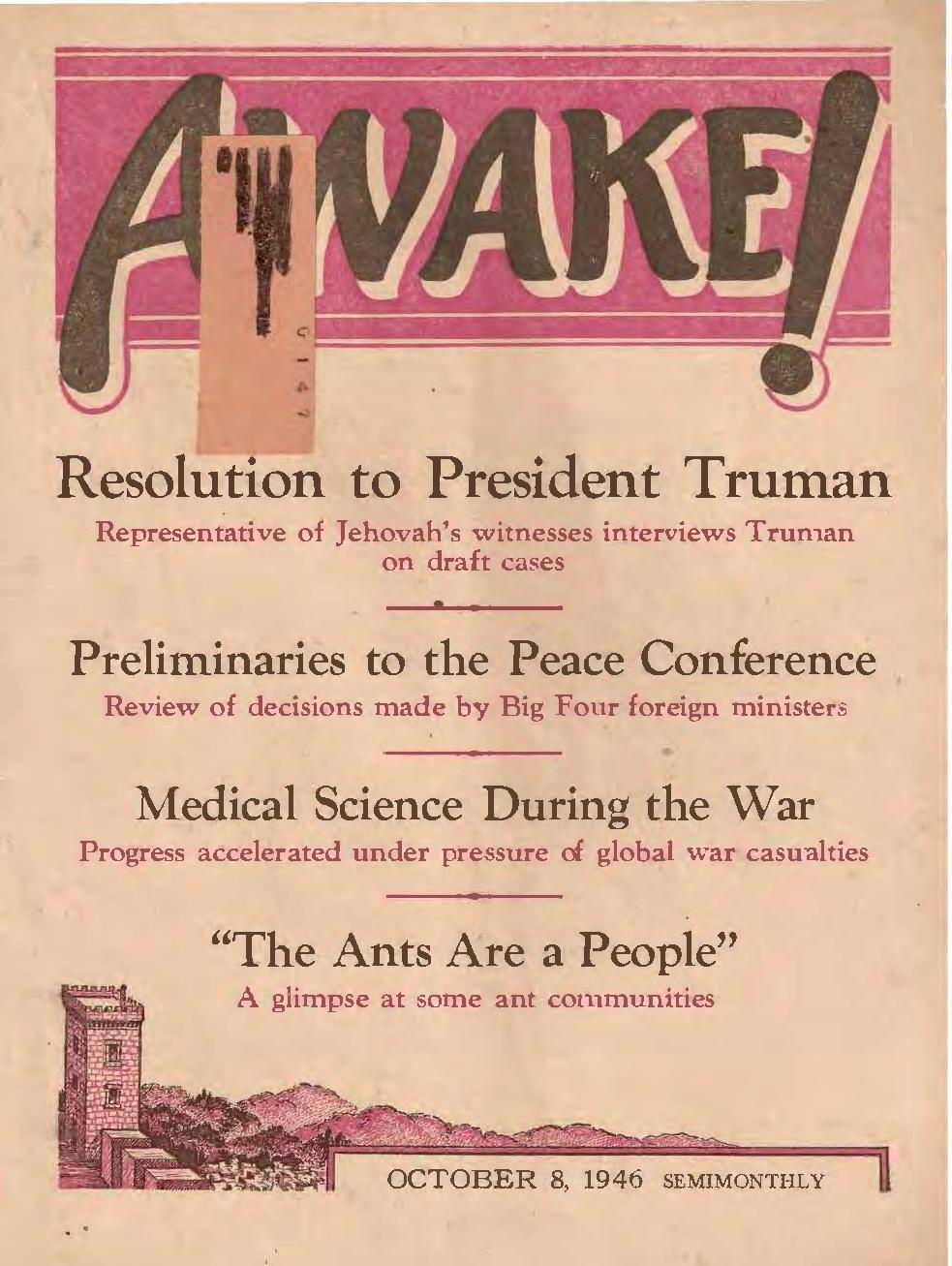
Resolution to President Truman
Representative of Jehovah's witnesses interviews Trunian on draft cases
Preliminaries to the Peace Conference
Review of decisions made by Big Four foreign ministers
Medical Science During the War
Progress accelerated under pressure of global war casualties
"The Ants Are a People"
A glimpse at some ant communities
OCTOBER 8, 1946 semimonthly
THE MISSION OF THIS JOURNAL
News sources that are able to keep you a:wake to the vital issues of our times must be unfettered by censorship and selfish interests. "Awake!" has no fetters. It recognizes facts, faces farts, is free to publish facts. It is not hound by political ambitions or obligations; it is unhampered by advertisers whose toes must not be trodden on; it is unprejudiced by traditional creeds. This journal keeps itself free that it may speak freely to you. But it does not abuse its freedom. It maintains integrity to truth.
"Awake!" uses the regular news channels, but is not dependeat on them. Its own correspondents are on all continents, inscores of nations: From the four corners of the earth their uncensored, on~the!scenes reperts come to you through these columns. This journal's viewpoint is not narrow, but is international. It is read in many nations, in many languages, by persons of al ages. Through its pages many fields of knowledge pass in review—government, commerce, religion, history, geography, science, social conditions, natural wonders—why, its coverage is as broad as the earth and as hi£h as the heavens.
"Awake I" pledges itself to righteous principles, to exposing hidden foes and subtle dangers, to cha.mpioning freedom for all, to comforting mourners and strengthening "those disheartened by the failures of a delinguent world, reflecting sure hope for the establishment of a. righteous New World.
Get acquainted with "Awake!" Keep awake by reading "Awake!"
._,.^^^^-.,^^^^u
l'DBLISBED St:utMON'l'RLY Dr WATCHTOWER BIBLE ^AND TRACT SOCIETY, IN'C.
117 Adams Street Brooklyn 1, N. Y., U. S. A.
N. H. KNunn, Pi'eHident W. E. Van AMBURGII, Secretary
Five cents a copy
Remlttanm: I'lcuse romlt 1103181 note or by postal or Wmi moneY’ '-n-.-f or by bank draft. Wh^n toiu or '"jrirency 13 lost Jn rho ol"\inarv maik. Ihcr •!• no re(lr<ss. nemlttanw tl'oni counttlas whrN the $4jcJ«ts hn}l no Rrimd oi1t1CS iiifl’ be mndc to Ife Brooklyn olllce, but only bY lnt.erO^Uo>t:;l pwm moo<'Y older. Receipt or • new or ronowal •un.scijtUon wUI ho .aeknow'Jcdged uol)i when reque.sted.
Notice to SuilscRiin:its
One dollar a year
Notloo of cxplrat101: Such noiloo ' 'lent wlb the □ritual nt. le.at two itd.ut'ls hetnu tho. :J'\lb^ expi^t. !'(««• wI:W prouplly.
Change ol address: I'Jeu'l ••nrl •riY chouge nr u.drhc:;:i dluct rn lis r.1llier tbko tu Ule nost omoo. Your n;Qn«t >'hould renh OlS at !rfi$T. three wcclo! bctore 11ie dnto ot losw> wltb which It iJ ro lake <<*£ S:i>Dl your nl<l m well as the new address.
l'l.'nl.ued as seoonhill!JIS motl<r •t BrooklYn, N. Y., Act ot Mnreh 8, 1879, l'rlnt.ld il U. S. A.
CONTENTS
Resolution to President Truman
Personal 1 interview by Committee 4
Ooiu't Denial Ground for Pardon 5
Clergy Amnesty i\ppe:il
Pnhlic Press Editorials
Preliminaries to the Peace Conference 9
Who Gets Wlmt9
Second Council Session.
U^xq-jers of God';; Place
Uedical Scienco During the War
Science Cannot Resunect the Dead
On the Eve of Pearl Harbor
Nn Bugs in California'
Blf! LoI'<"
''The Ants Aree a People"
Some Altstonisbing Things Ants Do 2CI
Objections Sustained!
Farmers of Ihc 'Future
“Thy Word Is Truth”
When God's Fatherhood to Man Ceased 25
Electrical Developments
Registration at 18 Still Compulsory
Practical Joke Tumed iuto Blessing
Watehing the World
/WAKE/
Now it is high time to awake.— Romans 13:11
Volume xxvii
Brooklyn, N. Y., October 8, 1946
Number 706
Resolution to President Truman
ON August 10, 1946, at Cleveland, Oliio, the Glad Nutions Theocratic Assembly of Jehovah's witnesses, upon the motion of Nathan H. Knorr, president of the Watchtower Society, unanimously adopted a resolution addressed to the president of the United States. '.the resolution requested Mr. Truman to exercise his pardon powers under the Constitution and grant relief to over 4,000 of Jchovabis witnesses wrongfully convicted and imprisoned as criminals under the Selective Training and Service Act. After briefly summarizing the facts, showing mistreatment of such ministers of Jehovah by hoards and courts under the Act, the resolution was preceded by strojig declarations. Among other things it was declared to President Truman as • follows:
Now that the war has ended, and especially s i n e e all political prisoners in countries conquered by the Allies and Russians have been freed, and amnesty given even to a million despised Nazis (who eruelly persecuted Jehovah's w i t n e s s e s in Germany), it is now time to request that steps be taken to restore these mission a :ry evangelists to the po^ sition they occupied nnder law before their convictions.
The White House
Although no mail can restore to these thousands of misHionary evangelists the time that they have served illegally iu prison, executive clemency by the president of the United States, exercised mtdcr his pardon powers, would restore the civil rights and privileges to all of them and result in the immediate discharge of those now imprisoned.
The resolution to President Truman provided:
Now, THEREFORE, DE IT RESOLVED THAT
(a) The president of the United States be formally requested by a representative of Jehovah's witnesses, in behalf of this assembly, of alJ of Jehovah's witnesses throughout the earth and all other lberty-lovin.g people in this world, to immeUiately issue an order declaring executive demeiicy for sneh missionary evangelists, known.as Jehovah's witnesses, convicted under the Seleetive Training amel Service Act, and grant them full pardon, restoring to them their civil rights, which is nectissary in order to redress the deprivation of !'heir rights and in order that justice may be done.
(b) The chairman of this assembly duly certify to the adoption of this Resolution and deliver :it to the representative of Jehovah's witnesses for personal presentation to the president of the United States, together with a statement of the history of the treatment of Jehovah's witnesses under the Act, as sonu as is convenient for submission.
This resolution was unanimously adopted by upward of 60,000 delegates at Jehovah's witnesses’ convention.
Personal Interview by Committee
For presentation of the resolution mid history an appointment for a persona] interview with President Truman was procured. This was nxed for- 12: 30 p.m. (Ji:astern Standard Time)i Friday, September 6, 1946. Accordingly, on such date and at such time \he committee of three appeared at the White llonse in Washington. The emnmittee was composed of (1) a Missouri law-yer, personal and i?olitjeal friend of .J.lr. Truman, who arranged the apj)ohitmeJit for the committee; ( 2) counsel for Jehovah's witnesses, and ( 3) a fnll-tijne pioneer minister of .Jehovah’s witnesses who during tJie first World 'V ar was an army ammunition officer under Cnptain Rany .S. Tnunan. The interview and presentation lasted about forty minutes.
When Mr. Truman was informed of the purpose of the visit he stated that the matter of executive clemency for men convicted and imprisoned under the Draft Act had been referred by him to the attorney general for study and a report to him ihout what could be done?. He was then informed that the committee desired to present the side of Jehovah's witnesses to him. He was tolcl, also, that more than 60.000 persons who adopted the resolution had ordered the emnmittee to proyida him with the resolution and facts. In reply Mr. Truman stated that 1w would listen to wliat tJte committee linad to say and would see that the projicr thing w as done about it. He added, however, that he had heen a soldier, was a "fighting man'', and did not have anv usc for a man who would not light foi and protect his country.
He was theu informed that Jehovah's witnesses were, neither pacifists nor conscientious ohjcctors, but were ordained ministers of .J ehovah God claiming their neutrality aud. exemption from service, like ministers of religion, to preach to the people. To this statement !h. Truman declared that he would like to know what would have become of this country in the recent war if every person in the United States had taken the stand tliat Jehovah's witnesses took— refusing to be inducted into the armed forces to fight. In answer he was told that not every person could take the stand -because not all persons in the , United States •were ministers of J eho-nah; but that if every person in the United States were one of Jehovah's witnesses Jehovah God would •fight for and protect His people.
Then the president 'vas reminded of examples recorded in the Bible, of how Jehovah fought the e-newy hordes arrayed against His people an<l protected the Israelites in battle. while commanding tliem to stand still and sing the praises of Jehovali. The president said he did not believe it and he clid not think tliat the rulers of the enemy nations believed it.
Mr. Truman waH then told that Jehovah's witnesses did not oppose the conscription of men .:mel that they believed the nation had a right to raise au army, hut that, like the ministers of Jehovah in the clays of the Israelite conscription wlio were exempted from going to war, ,J elmvah’s witnesses today also claimed. exemption, as such is provided for in the Draft Act.
Mr. 1'rmuau \as again told that the committee desired to present the Ride of Jehovah’s witnesses so that lie could better understand tlw problem to he solved. He stated that he would listen Imt that he was prejudiced. However, he added that in spite of that he would Reo that those convicted got a fair consideration and just decision, after he would be finally advised by,the attorney general.
Resolution. Submitted to Truman
Then the certified copy of the resolution adopted by the Glad Nations Theocratic Assembly wa::; banded to President Truman. He was told that it was moved ljy the president of the Watchtower Society and unanimously adopted by more than 110,000 delegates and persons of g.md-will. His consideration of it was respectfully iiivited. He read it quickly.
Following the pTesentation of the 1'esolntion the history of the mistreatment of Jchovnli’s witnesses under the Act by draft boards was given. The president was told how the National Headquarters of the Selective Service System had recognized Jehovah's witnesses as a religions organization with ministers entitled 1o exemption. In great detail he wns shown how .Jehovah's witnesses were regularly engaged in preaching from house to house as did Christ Jesus and His apoE'tles. Mr. Truman was told that Jeljovah's witnesses hear to the people Bible literature* explaining that Goers kingdom of rightponsness is to he .fully established in all the earth as humanity's onJy hope. He was told that m(l';t of the peopl p no longeT went to churches nnU therefore, it was necessary for the message to he taken to them iii their homes. He was informed that Jehovah's witnesses arc the onJy ministers in the country who are meeting the needs of' tlw people liy giving them free Bible education in their homes through Bible studies eoudnct.Pcl by ministers.
Hundred::; or draft boards that had received the evidence submitted to them }ju(1 classified Jehovah's witnesses as ministers, exempting many thommmis of them from t raining ami service, the president was told. lit was also informed that many other draft board::; were prejudiced ancl <lid not exempt over -l,OOO o!
Jehovah's witnesses. It was shown that as a result these th ousands of men were prosecuted for failure to comply with ell-aft-board orders commanding them to do training and service.
l\lr. Truman then interjected that he was still prejudiced. He also added that he had no sympathy for Jehovah's witnesses because of their disrespect for the flag by refusing to salute it and their refusal to show respeet for the law of the land by complying with it . tit this point he •was informed that Jehovah's witnesses had respect for the flag and showed they were good citizens of: the United States. He was informed that not one of Jehovah's witnesses had been disloyal to the government at any time; that they all showed their respect for tie flag and the country by fighting for freedom of speech, press and worship in the courts and otherwise. He was told that Jehovah’s witnesses on the committee, one of whom he knew -personally and with whom lie had been a::;sociated as a soldier and fellow army officer, had the highest respect for the flag and were loyally devoted to the country and the .freedoms for which it i\toorl. The president was reminded thai al others of J e-hovali’s witnesses had the same proper regard for the country and flag, altlwngh they were forbidden by God's law from saluting it or the flag of any nation. Mr. Truman said that perhaps he had been misinformed on this and that at least he was glad to get that statement of the position of Jehovah's witnesses. Tlris was especially impressive to hi1ii since most of the statement about the position of .Tf'Jiovah's witnesses on the flag was made by the committee's member who had served as Mr. Tnmmn's am mmiition officer during the fint World \VaT.
Court Denial of Defense
Ground for Pardon
The conversation then returned to the matter covered by the resolution. Mr. Truman then repeated that he had referred the matter to the attorney general for a repoi’t. He arlded that it would do no good to argue the matter before him, because he was waiting ttnd depending on the attorney general for advice as to what to do. Notwithstanding this, there was theu next presented. the most important ground for pardon, namely, the illegal tria 1 and conviction of .1 ehovah's witnesses in the federal courts. The president then comsented tn he.ar this last ground for the requested reljef.
History of the struggle of Jehovah's witnesses for tlw right to be heard in their defense in the federal courts was snecinetly given. It was pointed out how the federal courts trying Jehovah’s witnesses for failure to report for duty as ordered bv the draft hoards had heeu denied the right to show that the hoards' orders were void because they were exempt by law a::; ministers. It was then shown that the holding’ of the Supreme Court of the United States, that all the eourts had illegally denied Jehovah’s witnesses the right to make their defenses, was strong and additional ground for granting the requested pardon.
TJw interview and presentation ended at about 1 p.m. At the close )fr. Truman wa:; given some literature distributed by Jehovah’s witnesses to prove to him that they as missionary evangelists were engaged in free BihJe education of the people: The hook "Lt>t nod Be Trne", the booklet "Be G/<{£d, Ye Nations". The Watchtower for September 15, 1946, containing the article “Children in the <Time of the Encl' ", and He first issue of Awake! magazine ( August 22. J 9-!G) eon-taining, autong others, thr articlp on juvenile delinquency. Mr. Tnunan’s attention was called to the juvenile clelin-qnency article in the .Awake! magazine. n was pointed out that it showed that the! source of that national problem was the delinquency of parents who shirked their responsibility of properly bringing np children. Tlten his attention was called to the article in The Watchtower that presented the Bible proof of the duty of parents to themselves to instruct their children day and night and at all mealtimes.. The president was interested. He agreed that the problem of child delinquency should be blamed on the parents. Then he also accepted a eopy o1 the complete report of the Glad Nations Theocratic Assembly of Jehovah's witnesses in the 48-page issue of The Messe-nger for August 12, 1946.
In parting, the president's attention was c’Rlled to the fact that the 4,000 of Jehovah 's wi tnes::;es, in wliose behalf the Teque:st for relief was given to him, had not taken their stand to evade training and service under the Act. It was shown that they were found in this predicament for righteousness5 sa kE', for their refusal to nhandon their joh of preaching the gospel of Jehovah’s kingdom. He was informed tliat they wer ′ merely trying to keep covenant with Jehovah, which no man or nation had the right to make fliem break. The preRident said that the matter would he properly considered by him in spite of his prejudice against anyone •who would not figlit fol' the country and defend it.
Clergy Amnesty Appeal
(oj^ Conscientious Objectors
Since the end of the war the matter of amnesty has been given mneli attention and publicity. From time to time big clergymen and religious organizations havP. made statements, which the secular press has pnhlislied, ahont the desirability of granting mnnesty "to all conscientious objectors cjonvirf t:<l and imprisoned under the Act". I11 those published statements slighting reference ha::; heon made to Jehovah’s witnesses. The dergy, who themselves rlid iiot have courage enough to take their stand on ibe t-:idf' of .1 eho-vah clnring the war, are now belatedly crying out protests jn bphalf of the “conscientious ohjpeton;" in an attempt to cover up and divert attention from their own compromising eonduet during the war. They cry out that "4,500 conscientious objectors" have been imprisoned under the Act. It is true that 4,500 men have been imprisoned under the .Act. But only a small percentage of those 4,500 liave been conscientious objectors. Less than five hundred of the 4,500 men cwnvicted and imprisoned were conscientious objectors. Over 4,000 of the 4,500 were the faithful ministers of Jehovah Ood. To lump together as one group all the 4,500 convicted and imprisoned is to jgnore the facts, namely, that Jehovah's witnesses (numbering more than 4,000 of the 4,500 imprisoned) are neither conscientious objectors nor paciiists. Tie conscientious objectors, numbering less than 500 of tlte 4,500 imprisoned. refused to participate in war, basing their i‘e-Jusal on a variety of religious, political, social and academic grounds but making no claim to statutory exemption by reason of a ministerial status such as that rightfully claimed by Jehovah's witnesses because of their contract relationship with .Almighty God which obligates them to obey Him exclusively by publicizing, uninterruptedly, in peacetime and in wartime, His kingdom, among the people.
Public Press Editorials
In spite of the appeal being made by the clergy for the small group of conscientious objectors while the larger numlier of those imprisoned have been Jehovah's witnesses, the religionists' amnesty movement has resulted in arousing a few courageous newspapers to hack up the request for relief for the imprisoned men. For instance, the Denver Post-, leading dajly newspaper in the Rocky Mountain region of the •West, Ou Saturday, August 31, 1946, published an editorial entitled "Why Not an thtnne sty for the Conchies t" Although that editor, like others who blindly follow the pattern drawn for the public press by amnesty-minded clergymen and religionists, improperly conf uses imprisoned witnesses of Jehovah with the comparatively small number of conscientious objectors, his attitude is noteworthy. •While considering his remarks quoted below, readers of this journal can keep in mind the distinction between conscientious objectors and Jeliovab's witnesses as defined in the foregoing paragraphs. Among other things the Den ver Post editor said:
In the light of President Truman's emphasis 01 freedom of conscience and religion in his speech March 6 before the Federal Council of Churches of Christ in America in Col.umhus, Ohio, more than' 300 leading ministers of all denominations are appealing to thim to grant amnesty immediately to all of these men.
'l'hree Denver clergymen—Dean Paul Roberts of St. John's Episcopal cathedral, the Rev. Samuel W. Marble oi Trinity Methodist church and the Rev. Erdmann Smith of the First Baptist church-are among the signei’s of the letter, transmitted to the White House by Dorothy Canfield Fisher, honorary chairman of the Amuesty committee.
What is the genera.} public feeling tegard-ing the "conchies" now 1 The passions of wartime have cooled. It is possihle to consider them now with more objectivity. They did not want to go to war, but, in the great majority of cases. theh’ objections were based on sincere convictions. They paid a heavy price, too, to stand by their beliefs. No compensation, no service points, no protection under the bill of rights. no veterans' benefits, no family alotments, no discharge compensation. Most of tl1em were teachers or farmers or members of religions sects, like the Jehovah's witnesses, who told in many a court that their tenets firmly hade them to refrain from warfare. . . .
Political arrests have always been abhorrent to Amcrii-ans. After World \Var I, the continued incarceration of I. W. W.'s and other draft objrctors hecame a hot issue. Many people came to regard the continued imprisonment not as a military procednre but as a political one. The case of Eugene Debs, Socialist leader, accused of hindering the war, became a cause celebre before he was released from Atlthwtu pirison ill 1921.
The majority of citizens undoubtedly would support the president iu amnesty :for the conscientious objectors now bciore their cases become political footballs.
According to published reports, none of the clergy and their amnesty-minded coreligionists havr ever undertaken to interview President Truman personally iu hehalf of the imprisoned men. The moRt tlH’v have <loni' has heen to send the president letters and petitions signed by clergymen "ho themselves took no stand that caused them to he persecuted during the war. Hu<'h efforts by religion iflts have brought no ei-pression from the president as to his attitude toward the problem. Jehovih*s witnpsses being Hip first lo interview him personally on Uh' question, it is hoped that the publication of this report of thf' interview with him wiH show his attitude to all interested ones. Tt is olwious that if anything at all will he done by him it will not be clone soon. Tn the meanwhile tlw faithful witnesseH of Jehovah will hP required to :-;u J'fpr for righteousness' sake behind prison hars. Their commission from Jehovah to ae-t as Hh; ordained ministers has not been canceled or amnulJpd hv their wrongful conviction and imprisonment.
Regardless of whether President Truman takes an attitude like that of Pharaoh who refused to If't .Jehovah':-; pt>ople go, or that of King Artaxerxes who by letter exempted .Jehovah's ppoplc from duties of state, it i::; certain that •an-nonncing Jehovah’s Kingdom’" ii all this land and in cverv land will continue with increasing vigor by faithful witnesses of Jehovah iiot under 1'E'st raint.
Jehovah and His witnesses do not depend on the granting of clemency to his witnesses wrongililly convj<'ted, in order to carry on Hi:-; work in tlie earth at this time. Yet they do request that, in harmony with the Constitution, the government make due amends for the wrongs committed, contrary to the law of this land, against His people in the comts of the land. To this <‘nd they have ap-pealt>d to the highest cxflcntive authority in the land, the president. He is the only one who can tlo auyUdrg to remedy th(' situation. Even it' lie declines to exercise his powers oi‘ rails to exereise them properly, Jehovah’s witnesses will continue to preach in behalf of aud wait upon the Supreme Om^ of tlw Universe, to whom they wm npp('al to vindicate llis name and Hh; people for the wrongs committed against them.
Perhaps you will he interested in the details and history of the five-year fight between thf Department of Justice of the United States and J ehovah's wit-nesseR in the court::;. If yon desire' to know the l'nll truth ahnu( the outrages committed against tlw nwrv tlian four thousand imprisoned missionaries you "•ill enjoy reading tlw articles "Defemse Denied .Jehovah’s witnesses by Courts" and "Defense Granted Jehovah's witnesses by Courts"' 1hat, respectively, wm apppar in the two succeeding issues of this journal.
llny do thl' heatlli'n rage. aiid tJie peoplp imaginp a 1‘ttiil 'hiny'l Tlip kiii!J‘ of tl:e earth 11et themselves. tmd the rulers lake cocmsel tog"t/ .1', ayaiii11t lilt' Lnril. and agaiUBf his anointed. :m!fiug, Let 11.? break thFir IJtmtl," tt!'twclrr, iiiid twt away their cordis from ttx. Hr tlmt 8-itteth iu tilt' ltt'<itJii:J
11ftall lough: the Lord shall hare tltvm iu dcrtsVn-.
—Psaloi 2:1-4. ■
Preliminaries to the Peace Conference
"lEi' THJf:RE is anotJier war, atomic
J- bombs arc certain to he, used unless a more? destructive weapon is developed. World wars must stop." So said Senator Edwin C. Johnson in commenting on the subject of atomic control, and thereby stressed the necessity for peace, and indirectly lhe importance of' the J)cace councils and cojifcrence in this war-torn world. For. technically at least, the war is not over, even though lighting has ceased for the present. The various nations composing the victorious side of the recent conflict arc as anxioni' I'oi peace and the making ot:' the necessary treaties of peaee as t.re the defeated nations. wlio suffer most. keenly.
rhcre has, therefore, been much talk ahont Jjeaco, or the attainment of those arrangements that will insure peace. It is now well ovp.r a year since hootilities ceased, aml still the center of the ditli-eulty, the German problem. has not heen toncliecl. Austria, too, is an important factor in the solution nf the peaee problem. -
It is sajCi that every world statesman learns sooner or later of the vital position Aus tria occupies in tho structure of Europe, 11ml that if one wishes to subjugal e or liberate all of eastern Europe nne must J,egin with Austria. Vienna has been called the gateway to the East, but to Stalin, who doubtless has taken some notice of the transportation system of Europe. Vienna is the gateway to the West. 1t all depends upon tlw angle from which one views the map.
The Soviet Union has some 140,000 troops in Austria, and armies of occupation in Hnugary, Rnnmnia and Bul-gnrin. That gives the Soviet not a little influence in those countries, and treaties with these lands nre likely to he in Russia's favor. Russia has not been in a hurry to move out.
All this, of course, has a bearing on the importance of Europe itself to world-economy mid world-trade. It is not merelv the fate of this or that nation that is in tJie balance. Europe has until rect=>ntlv been the virtiml center of the world, and vast readjustments had been made, cYeii though but temporarily, when all of Europe was engulfed in war. Now that the war is over, Europe i" comparable to a vacuum, and, since nature abhors a vacmun, some setup must take the place of its previous organization. Witli the exception of the horder states the people Itave no self-government. Something must occupy the plate of government until the peace treaties rut these nations back on their ovm.
Though Europe is sometimes considered to he merely a peninsula extending westward from the Asiatic mainland, it is a very important peninsula. It:; population is far from negligible. In Europe proper, excluding Hussia and Britain, tliere are ruoro people tlian there are in the British Commonwealth, the Soviet Union and all of the •Western Hemis-sphere. 'he peace of Europe, therefore, is an important matter.
The London Conference of H145 having ended in faiure, another conference, designated the Council of Foreign Ministers (of thf’ Big Four), was scheduled to meet in April of 194g. Russia was represented by Molotov, America by Byrnes, France by Hidaull, and Jingland by Beyin. Tt debated for three weeks. Results were most discouraging. The ministers of the four big powers finally decided to call off their meetings fur a month's recess and to meet for further talks iu June and Tnly. They had not reached an agreement on it twenty-five-year alliance to see that Germany remained disarmed, and were not sure tlmt disarmnment was actually being carried out so far. A committee was set up to investigate what was being floue about it in the four zones of occupation. •Was Russia disarming Ihat part or Germany nnder her control! Was Britain properly disarming in its zone? The commit tet- would ascertain the facts. Russia said the operation of armament plants in her zone was not to be investigated !
This session of the council of foreign ministers also made some revision in th . Italian armistice terms, but that was a minor matter. Nothing nmch seemed to have been accomplished. but at least thei’e had heen plenty of talk, which the different ministers could reflect upon during theh recess. The American representative, Secretary nf State James F. Byrnes, upon arrival in Washington, arranged to make his report, which was published in the press on May 21.
JVIto Gets What?
It appeared that a great deal of the time had been devoted. by the council to discussion of who would get what. Neither America nor Britaiu had heen annexing territory. Russia had, and apparently intends to lioJd 011 to what she lias annexed. America’s attitude seemed to be more like that or a merchant who seeks to lmild up good-will among his customers or prospective customers. The secretarv mentioned that while America had udvanced $900,000,000 to Italy to keep it on its feet, Russia demanded $100,000,000 reparations for damage done to Rnssia by Jtalian troops fighting together with the Germans. True, Italy had. hirned to the side of the Allies and aided them in the final stages of the war, but Russia still felt sbe should malm some recompense for the damage inflicted on Russian territory. No final decision was reached.
The next subject was the Italian colonies. Hnssia had previously made a claim for trusteeship of Tripolitania, but now withdrew that demand. The American delegation held the position that the colonies should he administered by a United Nations trusteeshiv. This •was not decided.
Should Greece get the Dodecanese islands 1 The general consensus of opinion seemed to favor this transfer, though nothing definite-! was done.
Agreement on the Balkan treaties was hindered hecanse of economic factors. The Soviet government also stood out against including in the treaties any ar- . rangemcnt for freedom of commerce on the Danube, which is the gateway to central Europe, and as important to that region as the Mississippi is to the central part of the United States.
Trieste
The main bone of contention, however, was Trieste, a port certainly very important to central Europe, but which since World War I had been held bv Italy. However, Italy is not now in position to decide what shall l)e done about it. Russia wants the port to go to Yugoslavia, a country favorable to Russia, and measurably under its influence. The other powers favored Italy, claiming the inhabitants of Tdeste were in the main Italians.
All of this unfinished business, not to mention tlte German and Austrian treaties, were to he taken up again after the recess, during which period the various delegates had opportunity to present the matter to their respective governments. There was considerable perplexity as to what Russia really wanted. It had offered so many objections that it appeared to be the chief obstacle to arriving at any conclusion.
Mo]otov, noting that Britain- and Anwrira seemed to agree on most points, concluded that there was a bloc which hindered progress of the conference. He relt that these two nations were trying to dictate to the Soviet. And, of conrse,'if there was any dictating to 1e done, Russia would do it. He didn't say that last part, but that is the way tlte other parties to the conference were inclined to view the situation. The existence of any kind of bloc was denied.
Second Council Session
When Secretary Byrnes was ready to depart for Paris a secoml time a reporter reminded him that he had said before his fi.rpt trip that he stood in the iieecl of prayer. Be was asked wliat he needed this time. Mr. Byrnes answered, apparently with a smile: "I would say more prayer. But, in aJl seriousness, J do not say that in jt>::;f. f did say it [in jest] originally, but I afterward came to believe that we did stand in need of prayer and I hope those prayers will continne.''
The question as io wlietlter thof:f‘ who were called upon to do the praying had access to the realm where prayers are heard was uot considered. The clergy, however, are prone to wave sucli ‘'minor” considerations aside. and to respond willingly to any and all calls for ••prayer'', whether in war or J>eaee. Hpnco Bishop Oxnam, president of the Federal Council of tlte Churches of Christ in America, issued a call to prayer on he-half of the conference of foreign ministers.
Events in Italy at the time east a slaid-ow .over the very he ginning of the conference, but these disturbances subsided shortly. The council soon was divided on the seemingly all-iniportant theme of reparations. Italy was ilrst up for dis-cnssion. Bevin thought reparations should he waived in the case of Italy, inasmuch as she liad joined the Al lies, although belatedly. in fighting the Nazis. Agreement was "finally reached that Russia would get the $1 UO,OOO,lOO slip demanded. Restitution of Allied property seized by Italy during the war was also considerE-d. One reporter remarked: "It is, perhaps, curious; to ilnd the busiest foreign ministers in the world bickering oYej^ these tiny details. hut it is au nn-fo rt una te n pcossi h-.''
Another stated with reference to ltaly’s pointion as considered by the conference: "Pltiniately Italy must starve if she continues cut off from the Soviet-dominated area of eastern Enrope, trade witli which is vital to her economy. And a pt>aee treaty which leaves in mid-Europe a nation of more than 4W,OOO,OOO peopJ e condemned to gnawing hunger is a mere breeder of trou hle later on.''
As to Trieste, H was finallY decided to make this po rt anrl the surrounding territory of Venmda Ginlia 1111 autonomous state under United Kations protection, thus uot giving it to either Italy or Yugoslavia.
The question of Italian colonies and their disposition was again deferred. The Dorlccanese islands were given to Greece.
One of the surprises of tlw session was Molotov's stnh’uient on Gcrmanv. At the May session of the eounc’il Secretary Byrnes had put- forlli great efforts to arrive at- some method of co-operation in dealing with the German problem, hut to no avail. Particular emphasis wm; placed upon disarmament in order that Russia's security might be assured. Molotov was impervious to any suggestions on the snL.iod, but now came forward with his famous statement on July 10. It was really fnnny for him to start off with, ••The time has come when we should discuss the fate of Herman' and a peai'f' treaty willi that country. The Soviet government hns always hold that tlio spirit of revenge is a pom; counselor in :m<'li affairs.” Tlic Russian minister jwesented this a::-; ::.wmething quite new and original. Also, the following would appeal to the German people: ••rt would be incorrect to adopt a course of Germany’s annihilation as a state or that of itR agrarianization, including the annihilation of i ts own main industries." Such a statement would give the impression that while Russia liad no sitc'lj designs upon Germany, others had. The fact, however, that ever si nce the occupation of Germany Britain and the ITnitccl Stntt-s have heen putting money into the country, while Rnssia has hpeu taking things out, should not he overlooked. Milking the cow is nice work, especially if somebody else keeps feeding it. Mr. Byrnes declared that Russia had already received directly or indirectly $1+,000,000,000 in reparations from Germany. Taxable property hi the part of Silesia taken from eastern Germany was valued at $11,500,000,000, which part Russia gave to Poland in return for that part of Poland which Russia has taken over.
Achievements
\Nlien the foreign ministers' council adjourned its second session it had not yet touched the chief problem. but the following achievements were listed by Senator Connally's speech:
(1) The calling of the pence conference on .July 29.
(2) The agreement to nccord to the twenty-one nations at the ronference complete freedom of discussion and recommendation.
(3) The tlevelopmcmt of a better understanding among the great powers.
( 4) The draft trcaty with Italy, including the internationalization of Trieste, reparations, and agreements with respect to the disposition of the Italian colonies and the award of the Dodeeane.se islands to Greece.
( 5) Real progress with respect to the treaties with the ex-satellite states—Hungary, Finland, Rumania. and Bulgaria.
( 6) 'I'lie decision to submit to the iwaee conference all questions upon which the eoimcH of foreign ministers could not reach agreement.
(7) The tentative tmdershmding tliat .Austria and Germany shall be considered
* latei' in the year by the eouncil of foreign ministers.
This smmnary doubtless presents the "achievements''' of the council in their most favorable light. One additional point must be mentioned and which is even more important than the foregoing. It is n clause found in the treaties drafteel for the nations ol' Only, Rumania, B nlgnria, H nngary and Finland, reading:
"................. Shall take all measures necessary
to sN’iii’e to all persons under juris
diction, without distinction us to ra.cc, sex, language or religion, 1hp enjoyment of human rights and or the fiiiiihuiwiital freedoms, including frecdom \>f expression, of press and publication, or religious worship, of political opinion and or public meeting.
'Plus may be considered. nne of the most important m;pec‘ts of the entire situation. And while it is measurably certain tltat then" will he violations <f such freedoms, yet there will lie basis for an appeal to preserve them.
^^^o ^
Usurpers of God's Place
BLASPHEMOUSLY the Federal Council of Churches of Christ in America •le-elart.>d that the Lctigne of Nations set up in IOH) Wfi8 "the. political expression of the kingdom of God ou emlh’’. The smiie idea !hut im’n •whosp hmuh; me stained with blood will t'stnhlisb the ''Kingdom of God" is ngnin pxpwsstotl by tlw clergy. Bishop G. Bromley Oxnurn, president of the Federal Council of llw Churches of Christ in America, on March 5, 104G, snitl:
‘•There ure those among us wlo declare it is utopian to believe Ihnt tlw Kingdom of Uod ean be built upon the earth. Wlwii I consider tlw works of' Hwn, the auutr.iug wintcles wrought in the realm of applied science. I um Rh'pngthem'tl in my belief that we Nm iin<l will build that kingdom on the earth.”
God's Word giws the lir to Oxnaiu’s boast, dedui’ing that "in the clay::; of tlwse k'ugs shnll the God of ht>avf‘ii set up u kingdom”, without the nse of Inunnu hands. It will be performed by the "zenl of the L()RO of hosts”.—Dnniel 2:44, -1:5; Isaiah H: 6, 7.
$CCedical e)cience
«
Thuring the War
MODERN science, in h gejjeral way, j:s divided into two parts: one division busies itfiel f wiili inventing and perfecting devices for killing people; the other gi’onp seeks new and better ways or saving those that are going down into deatli. During the recent war years medical science did uot lag behind the destructive technicians, but also made forward strides. ,
Snrgery made its greatest advance after the introduction of anesthetics many years ago in spite of the hazards and risks involved in their- use. In an effort to overcome tb!f;c difficnltieR new anesthetic:; luwe been introduced from time to time, the latest being sodium ■pentothal, which, it is claimed, does not produce the after-effects tliat chloroform and etlwr do. It is also nonexplosive and enn be used in connection with the electric needle without ruirnmg the risk of a fire.
New drugs were brought into use for the Jirst time during the war. First. the sulfa drugs ‘vith tlieir variations made leadlines as ''wonder drugs’’. Then penicillin took the center of the stage as a "new wonder drug". And later its cousin streptomycin, made its debut as the ''wonder of wouder drugs”. Another “wonder” drug tried out at the army hospital at Topeka, Kans., was made from chlorophyl, the green coloring matter of plants. It was extracted from grass and alfalfa und found particular use in cleansing wounds. burns and Lone infections while at the same time it alleviated pain.
The old plaster cast lms always beeJi criticized bv those that have had to wear it, because it weighs so much. To overcome this a composition of plastic and fiberglass weighing only one-fourth as much as the conventional cast bas been
developed. It is composed of 80 percent cellulose acetate and 20 percent fiberglass, and also has the advantage oyer the older type in the fact that X-rays are able 1 o pasi’ through it.
Another disadvantage of casts in times past has been the foul odors that arise when encasing infectious wounds and fractured bones. The National Research Council of Canada decided to do something about this, and as a result of its study a material was developed that took advantage of the ahsorbent properties of carbon and micronized silica, and this material in turn was used to impregnate bandages used im:;ide 1be casts.
Surgery and the JYar
After an oj’dered assault on the enemy's stronghold or following an air attack by the enemy the medical corps, in an elTort to save the wounded, would go over the battlefield and pick up as many as po::;silile for hospitalization. Sometimes it was necessary to make emergency operations on the spot like the one following Ute hattie ol' Metz. A medical aide npon finding a soldier gasping for air took a penknife, made an incision in his throat, and tlieii shoved in the soldier's owti fountain pen in his windpipe to keep it open until he could 1je brought to a field hospital.
In the army and navy hospitals amputations, graftings and transplanting-s were made, besides the setting of bones, removal of bullets and treating of wounds. Even after a soldier had undergone such treatment there was always the possibility that complications would develop, necessitating a return to the operating room. For example, a soldier upon returning to the .fighting :U:ont, having apparently recovered after be-iDg shot up somewhere in Africa, complained of occasional pain around the heart. X-rays showed that a lialf-ineli piece of slieil fragment was lodged three inches under the skin right against the heart so tluit with each beat it moved. After cutting through layers uf flesh the doctors were able to remove the metal though it had been in there seven months, aud they did it without damaging the lieart.
Another unusual war casualty was the case of a navy seaman who had been the victim of au air attack in the Pacific theater. Forty-seven days after setting his broken bones and I’eiiioYing shell splinters Jie still complained of pain in the lower part of his body. The doctors found by X-ray that a fused 22-mrn. projectile was lodged in his body. But to remove it was a delicate operation, since a slip of the knife might explode the sltell. After calling in bomb disposal experts for a consultation the operation was successfully performed amid an atmosphere of tension.
Some place in Belgium, near the front, during the war a young doctor remembered that glass tubing had been used as n substitute for the arteries in laboratory work on animals: so, instead of amputating the leg of a soldier who had a section of his artery blown away, he tried to save tho leg by shnnting blood around tb^ wound through glass tubing. Later, when the soldier Jmd recovered sufficiimtly to stand a grafting operation, the glass tubing was replaced with n natural artery.
Russian doctors claimed tliat 71 percent of soldiers who suffered injuries to the lower jaw on the Eastern battlefield were fixed up by surgery. Tliis was made possible by shortening the time between when the wound was inflicted and the time when plastic surgery and hone grafting was begun. Im:tead of waiting six to eight montlis before performing a plastic operation, as the practice theretofore had been, it was begun in three or four weeks and bone grafting was accomplished within one or two months instead of waiting a year. Lockjaw was prevented by the use of special flexible steel pins.
Medical Progj’ess in Other Fields
A new technique was developed for the delicate removal in total darkness of cataracts from the eyes. It was found that the lens of the eye glows in the dark when exposed to invisible ultraviolet rays. Therefore much greater accuracy is possible under ultraviolet light than unde.r ordinary light in removing lens fragments that lie behind the iris of the eye.
The transplanting of healthy eye corneas onto defective eves has been practiced for some time. A case reported during the war told how the eyes of a 59-vear-old woman who liad died were used to restore the sight of an eight-Diontli-old habv that was boi’ii blind. Someday when this baby is old it may boast of having the oldest human eyes iu the wOTld.
The making of artificial eyes has not been the job of the medical profession in times past, but, due to the shortage brought on by the war, dentists have Emtered the :field of eye-making using clentul plasties instead or the special glass formerly used. which had a velvet texture. In addition to the 350,000 wearers of glass eyes there are now several hundred wearing the new plastic type.
Not only were instructors in public speaking surprised to learn that it was possible for a man to talk with his tongue removed, but ah;o medical science was surprised. An old man of 77 years had lost his tongue through a cancer operation, yet he learned to talk by forming the vowels aiid consonants in his throat. A phonograph recording of this feat was made for thm;p who stn<ly speech disorder. It is further reported that persons who are lmndii’ajjped through the loss of tlteir larynx, tit<> upper part of the windpipe, art- also able to speak.
It hns been reported that the skullhone of a monkey was replaced with a transparent plastic encasement in order to detennin’e what happens when concussion of the brain hikes place. Au arti-f.eial concussion is caused, and the results are :fHiiieil; hut what these experiments bave brought n the \vay of practical medical knowledge on the subject is not stated.
Medical science in its experiments has determined the quantity of blood tlmt flows through the bruin. By injecting two-tenths percent solution or Evans Blue it waH possible to measure this flow, and it was founJ that when the body is at rest about 10,000 drops per minute pass through the brain. Tliat is well over a pint a minute. If one breathes rapidly, hs mountain tdimhers do when iheyr lac-k oxygen, the liow is cut down; and when one breathes a high concentration of carbon dioxide the blood flow is increased.
In Paddington, England, it has been announced tlu.it patients who are to undergo a brain operation nrf' first given an injection of malachite green dye in solution. Diseased tissue in the brain -is dypd green, while the healthy tissue remains white, thus enabling the surgeon to tell which part to remove with his scalpel. The dye is conl'liclei'eU nonpoison-ousi and, although the eyes aud skin of the individual are temporarily discolored, after three days tlw stain disappears. More than a dozen successful operations have been attributed to this practice.
This dyeing practice lras also led to the discovery that a certain part of the brain of persons having epilepsy he-comes discolored. Heretofore the cause for this disease has not been known. but this discovery gives hope of a permanent remedy for epilepsy.
i\nd speaking of brain operations calls to mind that Dr. Walter K Dandy, u noted brain sjipi'inlist or John; Hopkins, who recently died. once said, in 1930, that it was possible to ent out hvo-tlrirds ol' a man's brain and yet not damage his intellectual power::;, and proved it by performing such an operation.
Where Medical Science Has Failed
Tn spite of the wonders of surgery in patching np a poor fellow who has been half buried in a bomlt crater, yet when it eomes to stamping ont such cripplingdiseases a:; infantile paralysis the record of medical seirnce is not !-\o good. On April 7, 1945, there were -l-84 new cuses of infantile paralysis. The disease Is ulso called polio. au abbreviation of the name poliomyelitis. 'l'lw highest fj gnre for tlte same period was tlmt for 1940. By the middle of May, 1D-l:5_, there were 642 cases as again!-\t 4-24- for the same period in HJ-l-l:. Tlwn a month later, in the middle of June. there were 9H91 to compare with 657 fur the' same period the year before; an increase or G2 percent!
Doctors have tu;ecl the vibrations of a ((riveting gun" in an effort to stimulate muscle activity in rases of poliomyelitis; but whether such will effert a lasting cure or not, tine appalling fact remains: there is nn increase in the number or victims of this malady and medical science seems nimble to eope with the basic causes for it or to stop the inroads of this wholesale killer. The public press has publicized the fart that someone has made au electrical piano keyboard that will fit over the bed oJ one of these poor vic.tims so tlw.t he ean play music.
Science Caniiot Resurrect the Dead
After years of experimenting with dogs and cats and stillborn bahie;:), the Russians have now succeeded in doing what some might call “resurrecting’' the dead. First they teamed how to keep a dog's heart pulsating after it had been removed from the body; then work was begun on Immnus that were as good as dead. This study indicated that there were di ffereiit degrees in the process known ns the cessation of life. These differences have been classified as agonal. clinieal and biologieal death. Agonal <leatli is considered as the active struggle of t lie dying organism, and is closely connected with e.linical death, which is said to be when the heart and lungs have stopped functioning. Only biological death i:-: referred to as true death from whic:h no man enn escape. In all tln^ee stages cirenhition of hlood in the brain ceases.
The studies of the Russian scientists have shown that if death results from a bad heart, a damaged brain, riddled lungs or poison in the blood, there is nothing tltnt medical science eau do to revive the person. But if one dies of shock or from loss of blood or from snf-iocatiort it has been found that lw stimu-latiojj H is possible to start the heai't and lungs •working once again. A mixhue of warm blood, adrennliu hydrochloride and glucose was used for the purpose, hejng injected under pressure in the artei’v and vein of the arm. .At the same time hellows were used to revive the lungs, giving 25-30 respirations a minute, and after natural breathing was restored artificial respiration was continued at intermittent periods.. Five caRes were reported to have completely recovered, while 37 others that were re-vined for n short time soon died.
Nince "re:m erection” meum; a “standing up again to life" it ii‘ vt-ry apparent tliat niedical sdienee lias not. accomplished this in any sense of the wonl. Only tlw lniinite Creator lias the power to bring back to li I'p thnsfl who arc> really Uead, antl such power He ltaH delegated only to His beloved Ron, Chrlst .J e::;ns, anti not to any •'scientists;" among men.
Some have argued tint wars are a neeessary evil jn cmler that progress may be made in science. But sncJi is only the chatter of foolR. Medical Rcien-til:lts nre not the "inventors';". "creators" or "tmiviors" they are boasted to lie, but wliat little progress they have made in recent years, which has heen comparatively slow, has been as explorers and students of God's iixed anU universal laws. linch greater progress will be made in the Oeld of sciencfo when wars are forever abolished following Armageddon. Then men, fearing and worshiping the great Fountain and Source of all biological wisdom an<l knowledge, will he taught by Rim whose name alone is Jehovah.
Snake Poison
'l' The easp is t.hat of Horace Bro^, an iuvelerate (obneco-ehewer, wim., when he had captmed a black ::mnke in Kentucky, forced its month open unl sjuit thei’c’in n quantity of tobacco Juice. Eyewitnesses said the snake acted strangely antl then ,;ll'ett:hetl out unl tlieU.
Missing the Mark
£ In the hook Tllr Lighter Side of Hi.,tor!t is i‘c‘lalt'd Itow a certain missionary, Dr. Berry, observed n a hospital in Kobe a patient smoking. Tie gave the yotmg fellow, Mumi by name, n pamphlet on the evils of tobacco. But liistend of curing him the figures given nhout the annual amount of money spent on cigarettes kindled in him a new desil'e. Straightway he introduced the cigarette in Japan and made a fortune.
On the Eve of Pearl Harbor
THE grpate!';t disaster in A mpriram, military history was the homhing or J^earl Harbor. Lt was also a uwst humiliating oxpm’iNice for the prum] American people. Public opinion therefore demanded iui investigation into the respon-sihility for the entastroplie, aml so Oon-gress, after calling in aml listening to the testimony of many witnesses, published it:-; eoncln:-;ions, as reported in tliP September 8, 194(), issue of Ama.lce! (page 31). Siiwe much of the testimony introduced before tlte investigating committee was obviously for the purpose of shifting all responsi-hility for the homhing from the shoulders of th £> govern men fs a<1-ministration, it fo uld he well For the th inking public to make tiiei r own investigation.
On Se p t {‘ m b p j‘ 2, 1945, the Chicago Trib-■i/ne puhJisJrpd an article written bv Jolin T. Flynn dealing witli tl te events leading up to the attack hv the J a p n. n e s e on Pearl Harbor. Witli tlw desire of getting the story before the public it was thereafter published in pamphlet form under the title "The Final Seen>t of Penrl Hnrhor”, TJie following excerpt is taken from the secowl the st.ate department. But the formal answer of lite Japanese government to the ultimatum had not eouie. Httt Roosevelt knew what it wuulil bt?. 'l'lw stage is all set for the attack on Brit ish or, better still, British and American territory in the 1’acifi.e. The scenery is beautifully arranged. 1'he president il'l widely advertised as seeking peace. That night at nine o’clock lie sends a dramatie message to llirohito appealing for peace. He knows this to he m; fulile as the breeze around the White Hniisi’ grounds. The Japanese navy is putting to sea; Japanese troops are pouring southward. The intercept ed codes, of which the public knows nothing, have told llw full story.
revised edition of thjs expost>.
We now come to Lhe night before Pearl Harbor in Washington. The president had returned from Warm Springs because of the crisis. The Japanese envoys had held during the week several meaningless sessions with
ljnck uow played again into Uoosevelt's hands. Our Army Intelligence Service I iroke the Japanese code and learned what they were saying among thenuielves. Un that fatt'ful battle eve it got possession of a flocu. inp.lt of extraordinary importance. You will l'p.-eull that thfi next tlay, Stwday, the Japanese asl\iit1 for an apjioin tment at. 1 p.m. with Ilull. They arrived a little late-wlwn the bomhs wt'i'c falling on Hawaii—and pre. sen ted a note breaking off relations with ns. The in-I'idenl has been presented 1o us in shockingly false eo!c?i‘s. \Ve were told how 1 he president was in his study uii Sunday for a day of rest, eon-tident nothing would happen after his appeal the night. bdoi’e to Hirohito not to precipitate war. He was chatting’ with Harry Hopkins and fiddling with his stamp collection, while l\lrs. Roosevelt entertained in another qnarter one of her innumerable groups of uplifters. 1'hcn, all of fi sudden, out of a clear sky, came news of the attack on Pearl Harbor. It's a goodly picture, but utterly fraudulent. 'Thal. is not the way things happened. 'fhc preceding night, Saturday, the government had got hold of the text of that very document which the Japanese would present the next day. It went to 1'\h. Roosevelt at 10 p.m. Hull, Knox and Stimson had it. They knew now what was to happen. Hnll tele^ phoned Knox and Stimson to meet liim next morning for a conference at 10.
Consider the situation that. night. The president and his 1hree aged and slow-moving cabinet membars knew everything, all save the hour and point of attaek. Far out iu the Pacific the blow would fall. What, in the name of simple common sense, would men of ordinary intelligence do? They knew at that very moment the Japanese ships and planes a,nd subs and t roops, muler cover of dni'k-ness, were moving to their appointed targets. They luiew tliat out in that vast Pacific were two commanders, wetelwdly equipped, depending solely on them for information. Would yon not suppose the very first act would be to notify General Marshall tmd Admiral Stark anU then, instantly, Admiral Kimmel and General Short 7 Would you not think that if MatshaH and Stark were not in their offices, they were to be hunted through the town, roused from their slumbers to give them this tremendous news? No. The old gentlemen called a conference among themselves for the next day and went home :for the slumbers so essential in their advanced years. The president had. the news at 10 p.m. He, too, did nothing. Worse than this, a naval aide was told not to give Admiral Stark his copy of the Japanese note until next morning. Why 1 I think Congress ought to ask for some explanation of this.
Tho next morning, Sunday, Admiral Stark, because of the tense situation, went to his oflke. There he found the nnw complete copy o£ the Japannse uot.e. "My God!" he cried, "this means w<tr. I must get word to Kimmel at onee." For some reason that word did not go at all. Another Japanese code message ar-riv.ed and was decoded. By 8: 20 a.m. the text was in hand. It gave the liour at which the envoys were to present their note to Secretary Hull. The hour was 1 p.m. Washington time. Just as it was deeodeU another message was intercepted. It atl vised the twelve .Japanese consuls in the United States that Japan was breaking with this country. All were hurried to Knox, Stimson and the president. They were in the hands of Hull's conference at ll a.m. The bombs would iiot fall on Pearl Harbor for another two and three-quarters hours.
Lieut. Com. Kramer gave a memorandum to Secretary Knox of transcendent importance. The memorandum pointed out that 1 p.m. Washington time was sunrise over Honolulu and dark night at. Manila. Sunrise would be the moment for air attack As a surprise attaek was nidicated, the ]jour of presenting the dspateJi inUicated an air attack ou Pearl Harbor. In other words, we faced an air attack on Pearl Ha.rhor in a little over two hours.
Onn we believe that, tlms warned, the High Command in Washington, on the edge of such a precipice, would not with whatever speed science had yet devised get this tremendous news and its impl ication to the commanders ni Hawaii? Instead the three aging secretaries sat down to a conference. General Marshall did not get the news until ll: 25 a.m. He then sent a warning message to Genera] Short •. There was yet an hour and three-quarters before the explosion. The most precious hom^ and three-quarters the War Department had ever lived through. Time to get many of the ships in motion. Time to get every available nif!Ii mobilized. Time to get every available plane off the ground. General Marshall hart a scrambler phone which would reach Short instantly. He had also the navy's Vowerful short-wave transmitter. Instead o:f using these he sent the message to General Short by commercial radio at or near 12: 18 p.m. Washington time. That would he 6: 48 a.m. Honolulu time. It I’etiched Honolulu at 7:33 a.m. The Japanese planes were at that moment winging to their kill. The message was sent through the streets as the bombs were falling. Thus delayed it reached Army Intelligence office at 11 : 45 a.m. to be decoded. It was delivered to General Short at 2:58 p.m., hours after the great base had been destroyed. Why did not General Marshall use the government's short-wave apparatus? Why did he not use hs scrambler phone which would have pnt this information n the hands of General Short from two and a half to an hour and a half before the attack? His explanation to the Roberts Commission was that. he was afraid it might be intercepted. What difference? If intercepted the Japs would merely know what tpey knew already. But Short would have known it also.
…