Consolation, December 9, 1942
Download: PDF — Consolation, December 9, 1942
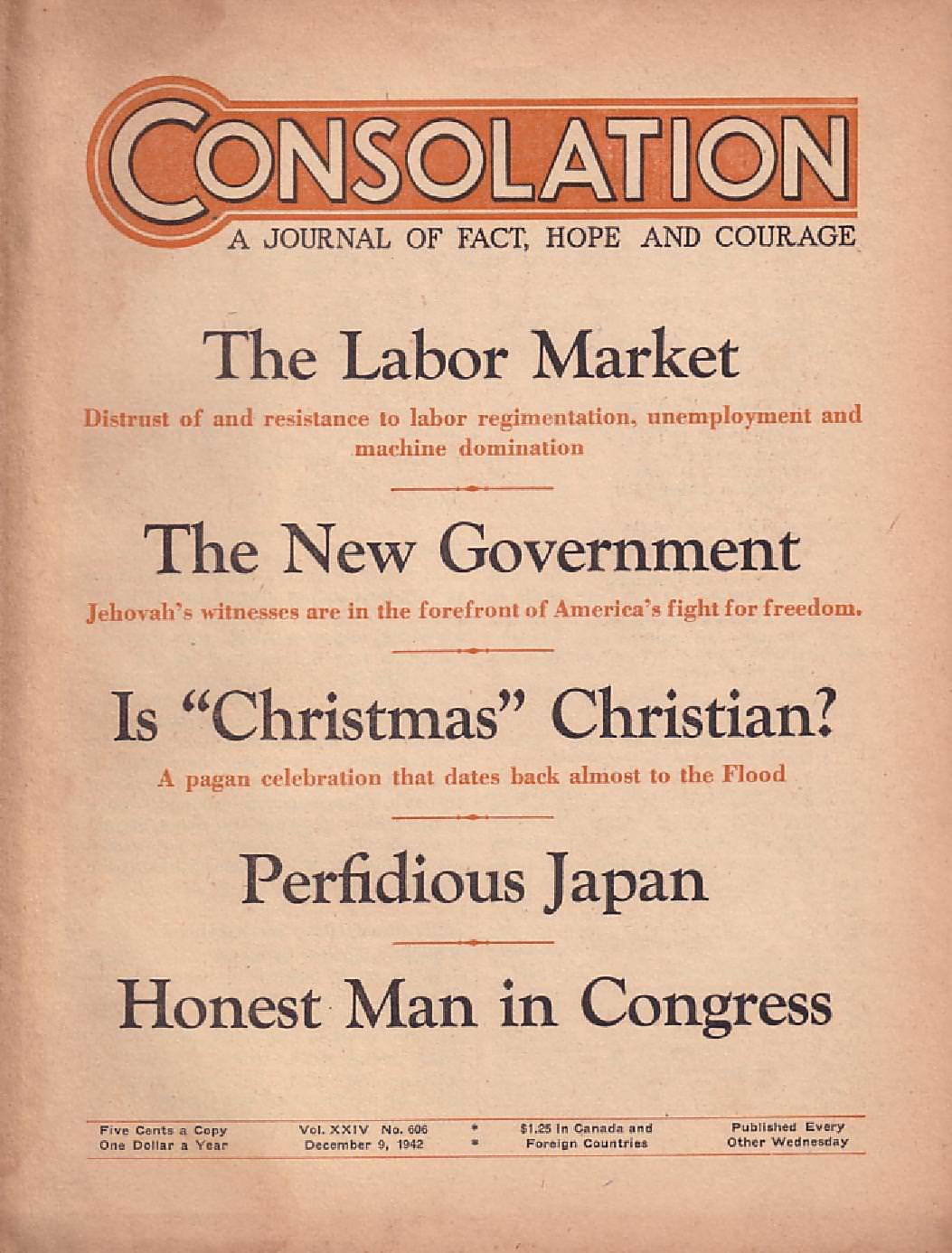
Contents
The Labor Market in the U. S. A. 3
"In Union Is Strength" 5
Frame-ups of Workers 5
Making Unions Responsible 7
Uncle Sam the Model Employer 8
Americans and Their Advantages 9
The New Government
Open Letter to Attorney General Biddle 12
Boys May Be in Mothers' Care 13
The Hate Bill Goes Overboard 14
Moscow, Idaho, in Error 15
"Thy Word Is Truth"
Is "Christmas" Christian? 16
Perfidious Japan 18
Planes over Changteh, Chinhua, and Chin 18
"The Whole World Our Dominion" 19
Three Years to Learn Japanese 20
Legislative and Executive Departments 21
Honest Man Found in Congress 21
An American Is an American 21
Rankin's Attack on the Jews 22
Why Not Ration Rationers? 23
The Situation in Canada 24
Presenting "This Gospel of the Kingdom"
Different Types of "Conclusions" 26
British Comment
Joss House Religion in Britain 29
Inside a Monastery 30
Published every other Wednesday by
WATCHTOWER BIBLE AND TRACT SOCIETY, INC.
117 Adams St., Brooklyn, N. Y., U. S. A.
Editor Clayton J. Woodworth
Business Manager Nathan H. Knorr
Five Cents a Copy
$1 a year in the United States
$1.25 to Canada and all other countries
NOTICE TO SUBSCRIBERS
Remittances: For your own safety, remit by postal or express money order. When coin or currency is lost in the ordinary mails, there is no redress. Remittances from countries other than those named below may be made to the Brooklyn office, but only by International postal money order.
Receipt of a new or renewal subscription will be acknowledged only when requested. Notice of Expiration is sent with the journal one month before subscription expires. Please renew promptly to avoid loss of copies. Send change of address direct to us rather than to the post office. Your request should reach us at least two weeks before the date of issue with which it is to take effect. Send your old as well as the new address. Copies will not be forwarded by the post office to your new address unless extra postage is provided by you.
Published also in Greek, Portuguese, Spanish, and Ukrainian.
OFFICES FOR OTHER COUNTRIES
England 34 Craven Terrace, London, W.2
Australia 7 Beresford Road, Strathfield, N.S.W.
South Africa 623 Boston House, Cape Town
Mexico Calzada de Melchor Ocampo 71, Mexico, D.F.
Brazil Caixa Postal 1319, Rio de Janeiro
Argentina Calle Honduras 5646-48, Buenos Aires
Entered as second-class matter at Brooklyn, N. Y., under the Act of March 3, 1879.
Notanda
The FBI Does a Beautiful Job
◆ The FBI did a beautiful job of stringing the wise men of Germany and getting Hitler to pay the bill. For a year and a half they pumped a lot of baloney over the ocean, sending some 200 or 300 messages. The secret service man that Germany thought was working for Germany was working for Uncle Sam instead. He took the money, made the radio set as instructed, and the FBI finished the job. The last message was to tell the spy headquarters in Hamburg that their New York agent who they thought was working for them, but was really working for the FBI, had received the last $6,000 that they sent. How cheerful they must have felt when they got this glad news!
Robots on Guard
◆ The new robots that guard wire fences in the dark and in storms for 24 hours out of the 24, and for 15 or 20 miles at a stretch, are so sensitive that they can "hear" a person's whisper or the snip of a wire-cutter and pass the sounds instantly to the nearest watchman, multiplied as many fold as is necessary. The device is so efficient that it reports the twittering of a sparrow or the blowing of a soft wind, and the report may be either through a loudspeaker or silently on a moving tape showing the exact second it was received. These robots now guard many miles of wire fence enclosing the nation's war-production plants.
Bullet-proof Glass for Airplanes
◆ Many aviators in wartime lose their lives by being machine-gunned through the windshields of their planes by enemy fliers in the vicinity. The United States Army now has a new bullet-proof glass, three inches thick, which receives the machine-gun bullets, but powders at the point of impact; and the energy of the impact is dissipated in friction.
CONSOLATION
"And in His name shall the nations hope."—Matthew 12:21, A. R. V.
Volume XXIV Brooklyn, N. Y., Wednesday, December 9, 1942 Number 606
The Labor Market in the U.S.A.
REFERENCE to a "Labor Market" reveals at once a sinister fact. It represents men as well as their labors being virtually for sale, so that, from an extension of the idea, they might be regarded as chattel goods. However, things have so far "progressed" in our civilized world that man has himself some little say as to how he and his labors shall be bought and sold. That, at least, has been the situation in recent years. Now, however, there has arisen in the world a beastly power that is turning the clock backward and reverting to the unhappy ages when man was more fully under the control of his masters. Only in certain favored lands has he so far escaped the blight of totalitarianism. America has been only indirectly affected by its depredations.
There is, perhaps, only one condition that may be regarded as even worse than the necessity of selling one's labor (and, in considerable measure, oneself) in order to enjoy the inestimable rights of life, liberty and the pursuit of happiness which the Constitution recognizes as inherent and God-given, and therefore not being subject to abrogation by human laws. That one condition that is worse than the necessity of selling one's labor is the state of being wholly unable to dispose of it, and hence being forced to involuntary idleness.
Widespread unemployment has been one of the characteristics of 'modern civilization. Early in 1940 the American Federation of Labor's "Monthly Survey of Business" revealed the interesting fact that production in the month of December, 1939, was 3 percent higher than in any previous month in American history. But it also revealed the disconcerting fact that there were in December, 1939, about 8,000,000 less jobs and jobholders than in the month of October, 1929, when the previous highest record was made. There is no valid excuse for this situation, but some of the factors that contributed to bringing it about may be considered.
The part that the machine has played in lightening man's labors is too well known to need particular mention. Yet to think that this advantage is the real cause for unemployment is to reason without reason. It may be said that machines have replaced men and women in numberless vocations. There are many factories now, making everything from gyroscopes to silk stockings, where almost every operation is performed mechanically, and only a handful of people are needed to attend the machines, as compared with the thousands previously doing the work. True, men are needed to design and produce the machines; but their number is far less than those displaced by the machines' greater efficiency in production.
Streamlined Production
In Washington, the Works Progress Administration reports that in all manufacturing industries 60 men are now turning out as much product as 100 turned out in 1929; also the factories are producing 32 percent more goods than in 1929 and are doing it with fewer men.
Not only in the shops and factories have machines replaced men in large measure, but also on the farms. Studies made at the Massachusetts State College show that it now takes but 100 minutes of farm work to produce as much wheat as was produced 25 years ago in 248 minutes of work.
· It is astonishing to note the extent to which robots are being used to do the work of humans, work which a few years ago it would never have been supposed that machines could do. There is a hop-picking machine that picks hops twice as fast as human hands can do it. There is a machine that cuts off the tops of beets while they are still in the ground; and the tops are cut at different heights, the same as when the work is done by hand. There is a beet-lifter that loosens the topped beets, shakes the soil loose, and is said never to miss a beet. There is a machine for cracking nuts by gas. A hole is sawed in the shell, the gas is inserted, the shell flies to pieces, and the meat is unbroken. There is a gigantic 'vacuum sweeper' that harvests clover seed in twelve-foot swaths. These are some of the new inventions described by The Associated Press in a dispatch from Davis, California, not so long ago. All these inventions, of course, mean less work for humans, and they also mean the gradual elimination of the small farms, which must give way to the greater efficiency of the larger ones which are able to install the elaborate machinery referred to.
It would seem that these modern inventions would make it unnecessary to employ children to any great extent (although the value of some work for the youngsters is acknowledged). Yet children are employed, both in shops and on farms, in large numbers. Connecticut makes the headlines with tales of nine-year-old children working in the fields at 4:30 in the morning, boys being kicked and cuffed by bosses, children being left to walk home several miles after working twelve hours in the field, and the housing of boys from Florida and Georgia in buildings that are fire hazards. Thus far, Connecticut has not risen high enough to pass laws protecting children in farm work. Wherever the religious Hierarchy of Rome has had sufficient power it has by every means opposed legislation designed to protect the children and to give the jobs to adults and thereby reduce unemployment.
War Brings Work
Not only does the advent of war bring work and more work, but it also reduces for a time those able to perform it. Hence, under present conditions, labor's best times are wartimes. More workers were employed in the United States in May, 1941, than in any other month up to that time in the nation's history. The increase was due to war elsewhere. The much greater increase in employment now is, of course, due to the fact that America is now herself at war. But before considering the aspects of the effect of war on the labor market, the situation preceding Pearl Harbor is given some consideration.
In addition to other difficulties which confront it, labor has to contend with industrial accidents. During the year 1941 the United States lost 101,500 in that manner, which number is more than twice the number of American soldiers killed in France in World War No. 1. In addition, there were 350,000 permanently disabled, and a great host of 9,000,000 more that received minor injuries. These figures include traffic deaths. Every month during the year 1941 there were more slain in automobile accidents than the total casualties at Pearl Harbor.
Eye injuries in American industries occur at the rate of about 1,000 a day, and result, on an average, in a loss of about 27 days of work for each injury. These injuries cost the workers $100,000,000 a year, and employers a like sum. As a result of such injuries about 1,000 yearly lose the sight of one eye, while 100 lose the sight of both eyes.
"In Union Is Strength"
While the dividing of men into groups representative of labor and capital is artificial and inaccurate, the classification may be utilized here as in some degree corresponding to the employing and employed groups. The principle of union and its advantages has long been appreciated and used by the employing classes. The result has been large industrial organizations and trusts. Use of the same principle by the employed, however, has been resolutely resisted by the employing classes, for obvious reasons. The efforts of the workers to band together in their dealings with capital have, nevertheless, progressed and borne fruit. It is largely due to their recognition of the value of co-operation that they occupy the favorable position they do today. Resistance to union demands continues. Some examples follow.
Air Associates at Bendix, N. J., had a minimum wage scale of 40c an hour, and the president of the company, who drew $50,000 to $100,000 a year, tried to keep it there. He hired several gunmen. The workers went on strike. Then the War department intervened, because the plant had large war orders in hand. The minimum pay scales were boosted to 75c for men and 65c for women. Production was boosted 37 percent. The president of the company was fired; so were the gunmen. So says Labor, in reporting this victory for unionism.
Among the battles fought and won by labor is that involving Harry Bridges, West Coast labor leader. After a second trial, lasting three months, the court took notice of the fact that the testimony of competitive labor leader, Harry Lundeberg, was not worthy of belief and that James D. O'Neil (who sought Bridges' deportation) perjured himself on the stand, gave unsworn hearsay testimony, internally contradictory, and that Bridges' testimony on the other hand was honest, consistent and truthful. Thus endeth eight years of persecution of the man that managed the Pacific Coast maritime strike in 1934.
The CIO News, October 6, 1941, reports the office manager of the Birmingham Post, and who also is a state guardsman, as saying, "We took eight men with their guns up to Gadsden the other night and cleaned out the picket line at Republic in no time. Give me my uniform and ten good men with guns and we could clean up the Post strike in a few minutes." This is another sample of the vicious opposition labor has had to deal with to gain reasonable consideration at the hand of capital. It is likewise an example of "law 'n' order" in Alabama in 1941.
The CIO News, in July, 1941, claimed that at Camp Edwards, Mass., three men had to be sent to the camp hospital as a result of a drill in hand-to-hand fighting with what were significantly called "rioting strikers". It mentioned also that there have been large-scale anti-labor maneuvers at Camp Stewart, Ga., Fort Meade, Md., Fort Ord, Calif., Fort Bragg, N. C., and Camp McClellan, Ala.
That workers and strikers might, under certain provocation, get out of hand is doubtless true. They have at times considered such amenities as acid throwing, machine smashing, or the breaking of human jaws. It seems these and other details were taught by local 150 of the United Machinists of the Needle Industries. The course of instruction indicates that the union felt there might be need for such tactics, somewhat on the principle of "an eye for an eye", perhaps, or as a means of persuading unreasonable employers of the justice of their workers' requests.
Frame-ups of Workers
At Detroit, a labor spy for more than four years, William A. Stinson, explained to the National Labor Relations Board how workers known to be friendly to union labor were watched, provoked into some petty violation of the company rules, and then discharged. If the man was very careful to obey the rules, oil and scrap might be dumped on his floor, and then he would be fired for sloppy work. Or a fight might be started by a conspirator; then both would be fired, but the conspirator would be re-engaged. Many an innocent man has died looking for work, all because he believed in the right of labor to organize.
At St. Paul, Minn., the Pioneer Press of April 4, 1941, contained pictures of many men assaulting a worker at the Ford Motor Company's plant at Dearborn, Mich. One of the men with upraised bludgeon, and a terrible look on his face, wore an American Legion cap; one of his comrades also had on a Legion cap. That, probably, made the whole thing "legal" and "American"—or did it?
Homer Wilson, a C.I.O. organizer, after attending a meeting of employees of the Mead corporation mill, was dealt with as follows at a spot near Harriman, Tenn. This is his own statement:
They tied me to a tree and blindfolded me. Someone beat me unmercifully until I thought I was dying. I just gave up and fell down. A voice said, "He ain't out; make him stand up to that tree." Then someone kicked me until I stood up. Then they beat me some more. I fell down again. Then they began to kick me again. Somebody started to lift me up and someone else said, "Let me hit him." Then I was hit on the mouth and four front teeth were knocked out. The men went to the car and got something and came back and began pouring hot tar on me. Somebody remarked, "There's kerosene in the car; just put that on him and set him afire." Someone else said, "Give me a match," and then someone said, "Don't do that; you will start a fire here."
Not Illegal to Hunt for Work
It is not illegal to hunt work, at least not in New York, and not yet. In the Bronx 64 women were taken into custody because they sought work as domestics at their usual rate of 35c per hour. Only one of the 64 was on relief, but they all wanted work, and had applied at what are called the "slave markets" in the section named. At these markets, on the streets, women domestics and young boys gather daily in search of day-to-day housework. After being questioned all day the women were fed and given a day's pay and then released. Welfare agencies had been somewhat disturbed by these open labor markets. But women as well as men must get work in order to live. This was not so easy a year or two ago. The difficulty is at least temporarily eliminated by the increased demand for labor resulting from the war.
About two years ago, in an appeal before a Congressional committee at Washington Miss Florence Birmingham, president of the Massachusetts Women's Political Club, made the statement that there were then 100,000 homeless women in the United States and that the employment of 6,000,000 married women compelled great numbers of young jobless girls to choose the only way left open to them except suicide.
Women in factories often have to contend with or endure many difficulties. The government has found that in 16,000 Pennsylvania factories there are 228,000 women exposed to hazardous dusts, 19,000 to extremes of temperature, 14,000 to unreasonable speed-up operations, 12,000 to metal poisons, 6,600 to paints, and 4,500 to lead compounds. In one-fourth of the factories the workers had to use common drinking cups and common towels. In 600 factories there were no drinking facilities, and 700 had no toilet facilities.
Better wages for women are among the objects of unionism. The Ford Motor Company has agreed to give equal pay to women. In other words, they are to receive the same rates as men when they do the same kind of work. That should always have been the rule everywhere. Unskilled workers at the Ford bomber plants get 95 cents an hour, with pay for skilled mechanics up to $1.60 per hour.
Having given in 100 percent to the C.I.O. the Ford Company now has the right to put union labels on all its cars and the largest automobile shop in the world (85,000 in the River Rouge plant alone) will hereafter be a union shop. The Ford Company has 45,000 employees elsewhere, and all of these go into the new union arrangements, with pay adjustments to suit the C.I.O. demands.
Making Unions Responsible
It is obvious from the foregoing and other evidence that the unions are having their effect in improving the lot of the worker. Their effectiveness, however, has resulted in an abuse of the power wielded by the officials. To check these abuses and to give labor a square deal all round, it does seem, as the New York Daily News suggests, that the government should see to it that union elections are on the level, union books are audited regularly and the findings published, and excessive initiation fees and dues are not charged. The public knows considerable about the way in which racketeers have muscled in on some of the labor unions, to their own enrichment and the despoliation of the actual workers.
In this connection Robert S. Binkerd, in the Atlantic Monthly, inquires:
Why shouldn't annual union elections be required by law? Why shouldn't union members have the protection of a secret ballot in union matters as well as in political matters? Why shouldn't it be a felony to stuff a ballot box at a strike vote, or a union election?
◆ Why shouldn't regular financial reports of union moneys collected and spent be required by law? Why shouldn't such statements be verified under oath, and willful misrepresentations be punished? Why shouldn't independent outside audits of such statements be required by law? Why shouldn't union officials be required to distribute the opportunities for work fairly among their members? Why shouldn't the use of force, intimidation or misrepresentation be just as illegal for union leadership as it already is for the employer? Why shouldn't each labor organization be required to file with the National Labor Relations Board, at least annually, its place of business; the names and addresses of its officers; their term of office and compensation; the date of their election; the scale of dues, assessments and fines; latest financial statement; constitution and by-laws; and any other information necessary to maintain an aboveboard relationship with its own membership, the Government, press, employer and the public?
As an example of the abuse of union power, a three-column story in the New York Times pointed out that to get a job as a carpenter at Fort Meade, Md., a man had to be able to saw and nail and to pay $57.50 to the union. Then he would receive $1.25 an hour for forty hours a week and $2.50 an hour for all overtime. To get extra time with some foremen it was necessary to bring a quart of liquor every other week. No liquor, no work. The big fellows in the union were estimated to have scooped in $400,000 while the scooping was good. The army men who directed the work said that 99 percent of the men did not want to join any union, but they had to join, as it was a union job. The labor cost on this one cantonment job ran to over $12,000,000--more than half the ultimate cost of the camp!
At another army cantonment it was necessary to pay $1,500 for a union card, and in some camps carpenters had to pay as high as $250 to get work. In one camp 170 non-union men were permitted to set glass for the government so long as each one of them paid $2 a day to the union.
What Is Done with Union Funds
The way some portion of the union funds is expended is well illustrated in the Lewis family pay roll. John L. gets $25,000 a year and expenses as president of the United Mine Workers; his daughter Kathryn, $7,500 a year and expenses as secretary of District 50 of the same; his brother Denny, $12,000 and expenses as chairman of United Construction Workers Organizing Committee; his brother-in-law, $6,000 as controller of the C.I.O.; another brother-in-law (Floyd Bell), $40,000 a year for looking after the financial affairs of the U.M.W. locals; the latter's son-in-law, $3,600 a year and expenses as organizer of District 50 of U.M.W.; another brother-in-law (Orin Miller), $5,000 a year as superintendent of the U.M.W. building in Springfield, Ill.; the latter's daughter Ann, $2,400 a year as stenographer in District 12, U.M.W.; another brother-in-law, Dan Collins, $2,600 a year and expenses as organizer for C.I.O.; his cousin, William Thomas, $5,000 as superintendent of U.M.W. building in Washington; and the latter's sister-in-law, Margaret Lindeg, $2,400 as stenographer in U.M.W. So says the Easton (Pa.) Express for April 21, 1942. This one family's haul of $111,500 and expenses for looking after the interests of the United Mine Workers and other C.I.O. affiliates is a mere bagatelle compared with what some of the Big Business heads are doing for their relatives. Yet it seems a big start, and illustrates the need of some effective check. It also explains why some workers are not anxious about joining a union.
Forty years ago George F. Johnson organized the Endicott-Johnson Shoe Company of Binghamton, Johnson City and Endicott, N. Y. The concern paid good wages, divided profits with the employees, provided sick benefits and medical care, promoted according to ability, arbitrated grievances, financed home building at low interest rates and provided free libraries, parks and other things that make life interesting. The A.F. of L. and the C.I.O. wanted to unionize the place. The employees to the number of 15,384 voted on the question. Only 7 percent voted for the C.I.O., 10 percent for the A.F. of L., and 83 percent did not want any union domination at all. They liked the company, liked the management, and wanted to be let alone and have the management let alone, too. However, such ideal conditions are rare, and are the exception to the rule.
Uncle Sam the Model Employer
In October of last year Uncle Sam had 1,086,171 employees and paid them enough that they averaged to receive $153.24 for the month. This is at the rate of $1,849 per year per employee, and justifies in considerable measure Uncle Sam's claim that he is the country's model employer. Besides good wages there are special advantages in working conditions, vacations, sick leave and pensions not open to most citizens. (Why should not these be made the general standard?)
The United States News has pictograms showing that wages generally are now the highest ever. In 1929 the average wage rate was 56.6 cents per hour; in 1939 it was 64.4 cents; and in 1941 it was 72 cents, with the average workman employed 41 hours per week. There is time-and-a-half for overtime and sometimes double pay for work on Saturdays and Sundays; so the workers are now getting just about $30 per week as against $26.40 in the palmy days of 1929 or $24.58 in the shivery days of 1939. This increase in earnings is considerably offset by the great increase in the cost of living.
The average earnings of workers in manufacturing industries at $30 is exceeded by earnings in the war industries, which are about $7 higher. This differential is natural. The war workers have to leave their homes and live under unusual conditions. Their expenses are higher, and if and when peace comes they will find themselves out of work and with their old jobs in the hands of those who stayed in their own homes and worked in the near-by factories and shops.
Uncle Sam had not a particle of trouble hiring men for the rebuilding of Pearl Harbor. When invitation was sent out in New York city for 800 men qualified to do special work, such as boilermakers, acetylene-burners, instrument makers, riveters and bomb-sight mechanics, there was a rush of more than 1,500 men, eager to go, and not one of them mentioned the possibility of the return of Japanese bombers. The men could not take their wives and children. Those selected were not compelled to take any written examinations, but were rushed across the continent in Pullman trains and given the best of everything, American style.
Making Unnecessary Work
The government wanted to build 300 houses for defense workers in Michigan. The first bids were all rejected as too high. The next time the bids were opened the Currier Lumber Company, which makes a specialty of prefabricated homes, had a price $1,400 under the next in line. It could build the houses at $3,200 each and make a profit. The next in line wanted $4,600 per house. Yet the Currier Company’s bid was rejected, because the American Federation of Labor doesn’t believe in prefabrication. The houses might be just as good; they might even be better; but they have less labor in them. And so, says Raymond Clapper, columnist, the bid was rejected, in order that the government would not have to lock horns with the A.F. of L. In this instance the A.F. of L.’s policy is shortsighted and foolish. The government is having difficulty in providing homes for defense workers, and there seems to be no reason for trying to make unnecessary work for anybody.
In Maryland, near the Glenn L. Martin aviation plant, the government has established a trailer city, and it seems that the plan would be practical anywhere. A good trailer home is provided for a rental of $6.50 per week, the A. F. of L. permitting.
Holding rents down to reasonable figures, the Price Administration ordered 20 communities to reduce their rents within sixty days to about what they were on April 1, 1941, and indicated that 100 other areas would be given the same opportunities to make conditions more tolerable for the workers. Yet with costs rising in other fields, an arbitrary clamping down on certain branches only is unwise. It seems that only unwarranted increases in costs, whether of rents or other necessities of life, should be checked—and punished.
Americans and Their Advantages
The advantages which Americans have had over other nationalities thus far seems likely to fade away with the rising costs of the necessities of life. These hitherto advantageous conditions are remarked upon as follows by the Machinery and Allied Products Institute, Chicago:
Numerous studies of the relationship of wages to cost of living have shown that the average American worker can buy approximately twice as much with the earnings of an hour’s work as the English worker, three times as much as the German, and four times as much as the Italian. In most comparisons Sweden ranks closest to the United States, with an hourly wage which will buy approximately two-thirds as much as the hourly wage in the United States.
Probably the best evidence that American incomes are vastly greater, in terms of purchasing power, than those of other countries is the actual goods and services enjoyed. Although the United States contains only 6 percent of the world’s area, and only 7 percent of the world’s total population—
Americans operate 33 percent of the world’s railroads;
Americans drive 80 percent of the world’s automobiles;
Americans use 60 percent of the world’s telephone and telegraph facilities;
Americans own 50 percent of the world’s radios;
America’s 130 million people enjoy more purchasing power than 500 million in Europe, and more than one billion in Asia.
In some respects the war will temporarily increase the prosperity of the workers, although rising costs, as shown, threaten the security of others. There is much work to be done. The four-crew system, now attracting marked attention, works every machine every minute of every day in every week for twenty weeks, but the workers are on the job only forty hours per week. The day is divided into three shifts, beginning at midnight. Each man works five consecutive days and then lays off two successive days every week for three weeks. The fourth week he works six days and is off only one day. Each crew changes shifts weekly. In twenty weeks a man works 105 days, that is, 35 days on each shift. Days off are equalized, and free Sundays also. In twenty weeks each worker has five paydays with ten days' pay each and five paydays with eleven days' pay each. It is a brilliant, clever, excellent arrangement for an emergency calling for the complete use of the machines, and it is good for the men also.
Not only is it important to make full use of machine-power. It is also considered necessary to employ fully all the man-power available, and to see that each man does all he can. All noise to the contrary, there have been no strikes affecting war work worth mentioning. During the first quarter of 1942 the idleness resulting from walkouts amounted to six one-hundredths of one percent of the total hours worked, and this figure would have been still lower than it was if figures did not include non-defense workers' strikes.
Chamber of Commerce
Swings by Its Tail
March 18, 1942, there was a showdown on the labor situation in Congress and the speaker of the House of Representatives made the statement that, on the day previous, out of some 7,000,000 war workers then working there were fewer than 100 of them on strike. This was backed up by a statement by the chairman of the War Labor Board that during January and February strikes were brought down to so low a level that the time lost in war production was only about two one-hundredths of one percent. These facts were published in the New York Times the next day, the news having been furnished by The Associated Press. The fact that Labor was standing by its promise not to strike for the duration of the war was so self-evident that anybody could see it. But the U. S. Chamber of Commerce waited only two days after the overwhelming showing made by Labor and then sent out a letter urging all local bodies, trade and industrial associations to become aggressive in putting pressure on Congress to pass fresh legislation curbing labor. Only a cage of monkeys would have chosen such a time for such an exhibition of ability to swing by a caudal appendage!
Defending the shipyard workers the North Bay Labor Journal arises to remark:
The available shipyard workers of the last World War were in many cases badly spoiled by the cost-plus system used so much then for building ships and under which men were encouraged to loaf and produce as little as possible in order to pad the costs and enlarge the percentages to be paid to the cost-plussers.
The Journal goes on to say that, since the first World War, shipbuilding has lagged in America and practically no new shipworkers were trained. When the second one came along it was necessary to start from scratch, and it was not reasonable to expect men to become expert mechanics overnight. But now the men are getting onto their jobs and it won't be long before an immense output of ships of all kinds will be available for use on the seven seas.
At the Fore River (Mass.) plant of the Bethlehem Steel Company the workmen undertook to clip 29 days off their best previous record for a ship of the size they had to make, a 12,700-deadweight-ton tanker. They beat their own estimate, and the ship went down the ways in 76 days instead of the 119 of record. The cry of the workers was, “We can build ships faster than they can be sunk.” In one of the weeks they erected a thousand tons of steel, which was considered a record in itself. Since then Kaiser, at Oakland, California, launched a 10,000-ton ship in 5 days and is employing solid trainloads of workers from New York city.
Labor seems to be trying to do its part, but its efforts do not appear to be appreciated in all quarters. At the Houston (Texas) Coliseum, in a drive “to increase war production”, several speakers attacked the forty-hour week and time-and-a-half for overtime. The workers present were aroused and demanded to be heard also. This was denied, whereupon a number of them marched to the platform and shouted into the mike that the radio audience was being deceived. The situation became such that the workers were promised a hearing, but they were not allowed to speak until the close of the program, at which time, of course, only those present in the hall itself heard them.
End of the “Labor Market”
Evidently there are those who would be glad to use the war as a means of depriving labor of the gains it has realized through many struggles. Doubtless men can work more than forty hours a week, and they often do. But a reasonable limitation of working hours should be recognized and the workers realize the need of safeguarding themselves from the demands of the never-satisfied Big Business crowd.
The Industrial Health Research Board of the Medical Research Council [some name, that] of Great Britain studied 50 British factories, employing 200,000 workers, and came to the conclusion that men should work not more than 60 to 65 hours per week, and women not more than 55 to 60 hours. Marked benefits to health and to production were noted when long hours were followed by staggered holidays. It was definitely learned that sustained effort produces better results than violent spurts.
Scientific research is, then, on the side of the worker and his rights and reasonable demands. “The labourer is worthy of his hire,” says Scripture; and that is true in all fields. Further, “The profit of the earth is for all,” and a happy condition among man can result only from a more rational and fair distribution of the product of man’s toil. In the New World, wherein dwelleth righteousness, and which is now at the doors, it will no longer be necessary for man to labor and earn his bread by the sweat of his brow, nor will he be called upon to struggle against great odds to get even a reasonable return from his efforts while another walks off with the lion’s share of what has been produced. No longer will it be needful to compete in a “labor market” for the privilege of working or making a living. There will be work enough for all, yet not too much for any. With conditions such that strength will replace weakness and health replace sickness, it will be pleasure to work and produce those things which are for the use and enjoyment of both oneself and other creatures. Inventive ability and exercise that now contribute to idleness and resultant poverty will then be conducive to greater production and consequent wealth.
But only the upright will attain to that world and its blessings. Indeed if the unrighteous were not excluded it could not be realized! For it is the unrighteous and wicked that have continually cast a blight upon the blessings that could otherwise be the portion of mankind. It is for the purpose of eliminating the wicked that Armageddon is fought by Jehovah’s great Warrior-Executioner. The oppressor will be at an end, and earth’s great sabbath of rest will have come. The time is at hand.
RIGHTEOUS RULER
THE NEW GOVERNMENT
Open Letter to Attorney General Biddle
◆ Please find herewith a copy of August 5, 1942, Consolation magazine. While there is other valuable information for you in this issue, the article on page 20 is especially for your attention. The purpose of this letter is not only to bring this subject to your attention, a full report of which you no doubt have in your files, but especially to call your attention to several other similar outrages against Jehovah’s witnesses and in which I had personal experience and witness along at the same time (summer of 1940) and at the hands of the same lawless elements. Although these matters have been repeatedly reported to you, with affidavits, so far as I am informed, nothing has yet been done in bringing the guilty parties to justice.
I hereby again call your attention to two of these experiences, which I briefly summarize as follows:
At Odessa, Ector county, Texas: After having been given permission by the county judge (Mr. Denison) and county commissioners to use the courthouse room and the County Auditorium for assembly places for study and worship and for public meeting, and the new swimming pool for baptism, for the local convention of law-abiding Christian people who are Scripturally known as Jehovah’s witnesses, we assembled at Odessa on June 1, 1940. As soon as we began our regular Saturday afternoon public witness service with the Watchtower and Consolation magazines, a mob, instigated and led by the then county sheriff (Reader Webb) and his deputies, the constable, county judge and county attorney, attacked us and broke up the service and the assembly, made a fire in the street and publicly burned the property of the friends, put 35 of us in a prison cell until 10 a.m. the next day and then drove us for many miles along railroad track to Midland. This matter has been fully reported, with affidavits, to your department and also to the U. S. district attorneys, especially to Mr. Clyde O. Eastus and his assistant, Mr. Wm. Fonville, at Fort Worth. I have copies of many of these affidavit statements from these brethren.
At Seagraves, Gaines county, Texas: One week after the experience at Odessa I went to Seagraves to call on some friends. On arriving there for the first time, I called at the postoffice for mail which had been forwarded to me. The postmaster, who evidently had been watching for me, followed me to my car, and he together with the town marshal (Mr. Asher) and the constable (Mr. Milton) took me and my car to the office of the justice of the peace (Mr. Godwin), the officers stating that I was under arrest. There, after being questioned and threatened for several hours by the officers and members of the (un-) American Legion, I was confined in filthy prison until the next morning. While this was going on, the mob, led by the marshal and constable, opened and plundered my car, damaging the same, and took away money and property to the amount and value of approximately $300, the property consisting of Bibles, literature explaining the Bible, phonographs and many records containing recorded Bible speeches, all of which were used in the Christian educational service which we freely carry on with the people who desire the same; other personal property was also destroyed, being burned that night near the jail, by the mob, in the presence of a large crowd of people who had gathered to see what was going on. The county sheriff was also present and witnessed this mob-action, but did nothing towards performing his duty as an officer of the law, but even further threatened me when I called on him at the courthouse at the county seat (Seminole) the next morning.
Nicolas Argyros, Jehovah's witness, pioneer, placing Kingdom literature with fishermen of Yacuiba, on the shores of Itiyuro river in southeastern Bolivia, South America
Now, you may wonder (and this point of information is very important), why this flare-up of opposition and persecution of Jehovah's witnesses which took place simultaneously and in the same way throughout the United States during the summer of 1940. Read the truthful statements in Judge Rutherford's booklets Conspiracy Against Democracy (particularly pages 16 and 17) and 'The Fifth Column Uncovered' (especially pages 9, 13-15), both of which booklets were published in 1940, and also the booklet Fascism or Freedom, page 14 in particular. You may already have these booklets. However, under separate cover I am sending you a copy of each of the three booklets. From these plainly revealed facts you can clearly see that "Catholic Action", by and through its “fifth-column” activity, had definitely planned to do in America just what it did do in France in 1940. Just before such action was planned to take place a nation-wide petition was circulated by Jehovah's witnesses and companions, which petition embodied the upholding of the Constitution of the United States, the fundamental law of which is based upon the Bible teachings. Except for the bold and courageous stand taken and service rendered by Jehovah's witnesses in the time of crisis, thus enlightening the people and exposing the enemy's plot, even in the face of such violent opposition and bitter persecution by our enemies and their dupes, what would have taken place in America? Judge for yourself. Yours respectfully, A. L. Paschall, Texas.
Boys May Be in Mothers' Care
◆ In Exeter, New Hampshire, religionists caused the arrest of a boy under 10, who, on the street with his mother, was offering the message of God's kingdom in magazine form to those who wished it. He was arrested for violation of the Labor Act. The Supreme Court of New Hampshire dismissed the charges against him, using the following language:
It is thought that the activity in which the boy under the defendant's leadership was engaged is not within the tenor and spirit of the prohibition of sales in public places. His service was not fairly to be classified as a business enterprise or as work, in the ordinary sense of words. To use a common expression, he was not exploited to help as a source of family income and material resources or to promote the defendant's financial welfare. Any exploitation of the boy was for other than pecuniary ends. He was performing a service under his mother's auspices, and the few cents he received were no impaction on the controlling religious character of his service, so as thereby to transform it into one of employment or work. The money-making feature of his service is too insignificant to receive notice as a factor modifying a strictly religious engagement into one with business attributes. The boy was not a newsboy on the occasions in question, and an occupational element, even of temporary duration, is not to be ascribed to his activity. Nor is there any claim that his education required by law was disturbed or menaced. The defendant was not the boy's employer and neither permitted nor suffered him "to be employed or to work", in any reasonable contemplation of the statute. While the defendant was paid for his service as a "pioneer" in his cause, those enlisted under his leadership were followers rather than employees. They were workers only in a sense devoid of business and material gain.
The State's argument that the statute was partly designed to protect the morals of young children by keeping them off the streets and out of public places, is not impressive. So far as concerns the case, the boy was in his mother's custody and general charge. In respect to the statute, it would be a clearly unreasonable discrimination that young persons might be on the streets with nothing to do, while others might not if they had some occupation there.
The Hate Bill Goes Overboard
◆ At the instance of the totalitarian crowd, and in order to "get" Jehovah's witnesses, the New Jersey legislature some years ago passed a bill, commonly called the "hate" bill, which would make it illegal for anybody to tell the truth on any subject if it instilled hatred toward anybody or toward any organization. The Roman Catholic Hierarchy cannot endure that anybody should tell the truth about their horrible doctrines and equally horrible history.
Arizona pioneers enjoying their evening meal in the open
Baptism at Manzanillo, Oriente, Cuba
Magazine publisher for the Kingdom. Fifty years in its service and still at it. Ithaca, N. Y.
The first persons arrested under the bill were Jehovah's witnesses, which showed the intent of the bill. Later others were arrested, and the Supreme Court of New Jersey, when the case got to it, decided that the Act is unconstitutional. Some of the reasons for the decision were as follows:
That the terms "hatred", "abuse," "hostility," are abstract and indefinite admits of no contradiction. When do they arise? Is it to be left to a jury to conclude beyond reasonable doubt when the emotion of hatred or hostility is aroused in the mind of the listener as a result of what a speaker has said? Nothing in our criminal law can be invoked to justify so wide a discretion.
Is it possible to say when ill will becomes hatred or when unworthy, scurrilous or false statements become abuse? As well try to point to a spot within a triangle which is equidistant from every point in the area enclosed as say when hatred takes the place of some lesser emotion. Then these passions or emotions "hatred", "hostility," etc., as well as being abstract, are relative in the individual. There is no norm to judge whether or when such emotion or passion comes into being.
Moscow, Idaho, in Error
◆ The city of Moscow, Idaho, had it all fixed up to see that not one of Jehovah's witnesses did any preaching of the gospel there. They made a law to the effect that "any person may obtain such permit [to distribute printed matter] without charge by applying to any police officer of the City of Moscow, and in his presence saluting the flag of the United States by reciting what is known as the 'pledge of allegiance' and furnishing information sufficient to identify in the future the person performing such salute". But the United States district court nipped the little scheme in the bud, saying, "We are confronted with the requirement of censorship and saluting the flag in the presence of a police officer before one can distribute such literature. Such requirement runs counter to the federal constitution as interpreted by the Supreme Court and numerous other federal courts." Looks as if this Idaho court used better judgment than the Supreme Court of the United States when the latter decided, in its famous 5-4 indecision, that a small-town council can tax the distribution of printed matter of all kinds by demanding a license fee of any size that appeals to them.
(To be continued)
Three of these Texans were mobbed thrice but are still smiling and still going strong in the circulation of the message of hope that makes the hypocrites mad as hops. Incidentally, many of the mob-raisers die of apoplexy sooner or later.
"THY WORD IS TRUTH" - John 17:17
Is "Christmas" Christian?
THAT so-called "Christmas" is religious, even the Jews, and the Moslems and the Chinese, and the Nazis and the Fascists and Communists will admit. But is it Christian? Its celebration by certain religious organizations does not make it Christian, any more than bingo games, lotteries, or card parties in religious parish houses or parish schools are therefore Christian.
Look high and low in the Christian writings of Jesus' apostles and their companions, and you will not find once the word "Christmas", neither the word "mass". Not only is the date of Jesus' birth not given anywhere for the purpose of having it celebrated, but the only birthday celebration mentioned is that of the adulterous King Herod whose step-daughter Salome danced to make the celebration "merry", yes, merry by having the head of the forerunner of Christ, namely, the head of John the Baptist, chopped off. (See Matthew 14:6-12; Mark 6:21-29.) Jesus Christ nowhere instructed His disciples to celebrate His human birthday on the legitimate day or on any fictitious date, and to engage in such a celebration on a religious fixed date, which date is furthermore sacred to a heathen false god, is a case of adding to the Word of God. Concerning this it is written, at Proverbs 30:5, 6: "Every word of God is pure: he is a shield unto them that put their trust in him. ADD THOU NOT UNTO HIS WORDS, lest he reprove thee, and thou be found a liar."—See also Deuteronomy 4:2 and Revelation 22:18, 19.
The early Americans would have nothing to do with "Christmas" celebrations; neither would the early Christians, who knew it only as the pagan "feast of the sun". That feast was celebrated the third day after the winter solstice, namely, on December 25, and it was used to back up the Devil's lie in behalf of the great anti-Jehovah huntsman, Nimrod. (Genesis 10:8-10) The Devil's lie was, "There is no death," and the so-called "Christmas tree" practice symbolizes the lie that Nimrod is not dead, but is immortal in the spirit world. (Genesis 3:4, 5) As shown in every encyclopedia, centuries before the birth of Jesus the heathen worshipers celebrated the rebirth of Sol, the sun, in that connection making use of holly, the mistletoe, the yule log, and the evergreen, which last is the "Christmas tree" of modern times used by the religionists of "Christendom" about which to have a "jolly good time", not barring drunkenness and gluttony and licentiousness. The fact that Jesus was not born in the dead of winter makes no difference to the celebrators. Have not the Roman Catholic priests, from the pope down, said mass on December 25 for many centuries, and is it not therefore "Christmas"?
Jesus being thirty-three and a half years old at the time of His death at Calvary at the beginning of spring, the evidence is that He was born in a season a half-year earlier, namely, at the beginning of autumn, or about October 1, at which time the shepherds could reasonably be watching their flocks by night out in the open fields, and at which time of the year also John the Baptist could seasonably be baptizing repentant Jews in Jordan river and could baptize Jesus now come to thirty years of age. (Luke 2:7-16; 3:21-23) Hence the evidence is that the annunciation to the Jewess, Mary, took place nine months earlier in the year, or sometime in December. Nevertheless Christ Jesus and His heavenly Father in no part of the Bible command any true Christian to celebrate either of these events, and in harmony therewith the dates thereof were withheld. The celebration of "Christmas" is a concession to the heathen, pagan holiday and is a compromise with demon-ism, which is religion.
The evergreen tree, besides picturing to the heathen sun-worshipers that Sol did not really die, was used by other idolaters to show that Nimrod, called the "father of the gods", did not really die, when he was slain by his enemies for his crimes. His mother Semiramis (who had also become Nimrod's wife) announced that her son and husband had been made a god, a demon. The story is not easily traced in history, but sufficient evidence remains in the mythology of various countries to enable students to piece together the story, as is done in the book The Two Babylons, by Hislop. This accounts for it that while the pope and other religionists are celebrating "Christmas", the Nazis of Hitler Germany can on the very same date celebrate with propriety the pagan rites of demon-worshipers of ancient Germany, who celebrated such evergreen-tree rites and carousing and other forms of self-indulgence centuries before Jesus' birth.
Semiramis advanced the thought that she was really the "woman" mentioned in Eden, at Genesis 3:15, and that her husband-son Nimrod was the "seed" who would destroy the "serpent". This "mother and son" or "Madonna and bambino" doctrine runs through all the false religions of earth, and is, no doubt, a part of Satan's religious scheme to get people to lose sight of the real "seed of the woman", namely, Christ Jesus, the "seed" of Jehovah's organization Zion.
The emphasis now is placed by religionists upon Madonna and, secondly, upon the "baby" Jesus, rather than on Jesus Christ, the glorified spirit who is the "express image of God's person" and whose Kingdom has begun with Him in the throne as the highly exalted King and Servant of Jehovah God. In most Catholic churches there is a "baby Jesus" at Christmas time. Catholic Francis of Assisi began the "baby" practice, and claims to have used an empty crib in which there appeared a real live baby Jesus at the opportune moment. Compare this emotional religious tradition with the plain statement of the apostle Paul, at 2 Corinthians 5:16: "Yea, though we have known Christ after the flesh, yet now henceforth know we him [so] no more." Francis was a victim of the demons at the "baby Jesus" trick.
Then, too, those "wise men": the Bible does not say there were three of them. Those "wise men" who traveled to Bethlehem sometime after Jesus' birth were really magicians, or "magi", and hence were astrologers, demonologists, concerning which religious sect see Deuteronomy 4:19 and Isaiah 47:13, 14. Jehovah God chose God-fearing Jewish shepherds to be witnesses to the birth of His Son at Bethlehem, and not those astrologers. Such demon-worshipers, though sincere, were driven by the superstitious fear of the "star" or luminous body which the Devil demonized them to see in the sky. Thereby the Devil misled them and caused them to drop in on murderous King Herod and frighten him about the birth of a newborn king of the Jews and thereby arouse his murderous passions. Whereas the shepherds had not informed Herod of the birth, these "wise men" were obliged to first apply direct to Herod and get the location of the birthplace as at Bethlehem, and thereafter the "star" led them to Bethlehem, with King Herod's soldiers close on their heels to massacre the babes of Bethlehem, including Jesus, if possible. Who, then, sent those "wise men" to seek the child Jesus, and who created that "star" to lead them to Herod, and why, then, should those "wise men", three of them, and the "star" be glorified so much by religionists at "Christmastide"? What Christianity is there in it?
Perfidious Japan
Planes over Changteh, Chinhua, and Chin
◆ It started last November 4. A single Japanese plane appeared over Changteh, northwest of Changsha, in Honan province, flew over the city for about an hour, and disappeared. No bombs were dropped, but after the all-clear sounded, streets and compounds were found liberally sprinkled with rice-grains embedded in little tufts of cotton.
Laboratory examination showed both rice and cotton to contain cultures of bubonic plague: within a week there were cases of bubonic at Changteh, which had not had a case of the disease since the founding of the Chinese Republic.
In December, just after the attack on Pearl Harbor, Japanese planes appeared over Chinhua, Chin, and Chiu, in Chekiang province, again dropping no bombs, but trailing behind them what appeared to be white fumes. This time the white fumes proved to be living fleas, infected with cultures of bubonic and typhus, and fish eggs with the same. The reason for both the fish eggs and the rice is to make contact with the local rats; rats are the best spreaders of bubonic plague, the "black death" of the Middle Ages.—Fletcher Pratt, in a copyrighted dispatch in the Oakland (Calif.) Tribune, March 1, 1942.
American Bombers on the Job
◆ Nineteen days before the Japanese seized several of the Philippine islands, the New York Times had two columns from its Washington correspondent, and illustrated by a map, under the title "Philippines as a Fortress". The article explained that there is "a strong concentration in the Philippines of heavy American bombers" and that "an attacking fleet against the Philippines would be the target of a large and powerful group of some of the best fighting planes in the world". Well, the Japanese, the birds that are descended from the gods, to let them tell it, probably knew something about it, but went ahead and landed on Luzon (largest island in the Philippines), expecting quick results. They got results: in three days their great 29,000-ton battleship, the Haruna, was at the bottom of the ocean; and it is only the beginning of something too big to be stopped by conceit and deceit: a real war.
The Japanese Army at Hong Kong
◆ It is known that fifty officers and men of the British were bound hand and foot and then bayoneted to death.
It is known that ten days after the capitulation wounded were still being collected and the Japanese were refusing permission to bury the dead.
It is known that women, both Asiatic and European, were raped and murdered and that one entire Chinese district was declared a brothel regardless of status of inhabitants.
All the survivors of the garrison, including Indian, Chinese and Portuguese, have been herded into a camp consisting of wrecked huts without doors, windows, light or sanitation. By the end of January 150 cases of dysentery had occurred, but no drugs or medical facilities were supplied. The dead had to be buried in a corner of the camp.—Anthony Eden's statement in Parliament.
Japan Has Plenty of Food
◆ The countries overrun by Japan grow more than twice as much rice as they can use and Japan has no place to sell it. It cannot be stored in the hot, humid regions where it is grown. What to do with it is Hirohito's headache. Japan also has ample supplies of fish, which is as important an item of Japanese diet as is beef in the United States. Japan uses more fish than the United States, Britain and Norway combined, accounting for something like 40 percent of all the fish caught in the world.
"The Whole World Our Dominion"
◆ The Japanese emperor Jimmu Tenno, who claimed that his great-great-great-grandma was the Sun Goddess Amaterasu, left behind him the statement, "We shall build our capital all over the world. We shall make the whole world our dominion." The demons (devils) kidded him into that belief, but it is the overmastering belief of most Japanese people to this day. The textbooks handed out to the new soldiers contain this statement with the information that it is "given to our race and to our troops as an everlasting categorical imperative".
The way Prince Ito, of the royal house of Nippon, put it is thus: "The sacred throne was established at the time when the heavens and the earth became separated. The emperor is heaven-descended, divine and sacred." In case that makes you sick to your stomach, look around you at the pictures of some of these other 'heaven-descended, sacred, divine' birds with their collars on backward that make claims just as bad or worse, and are patting Japan on the back and telling her to go to it and get it while the getting is good. You know who they are, perfectly. So do the silent newspapers.
…