Consolation, July 22, 1942
Download: PDF — Consolation, July 22, 1942
Contents
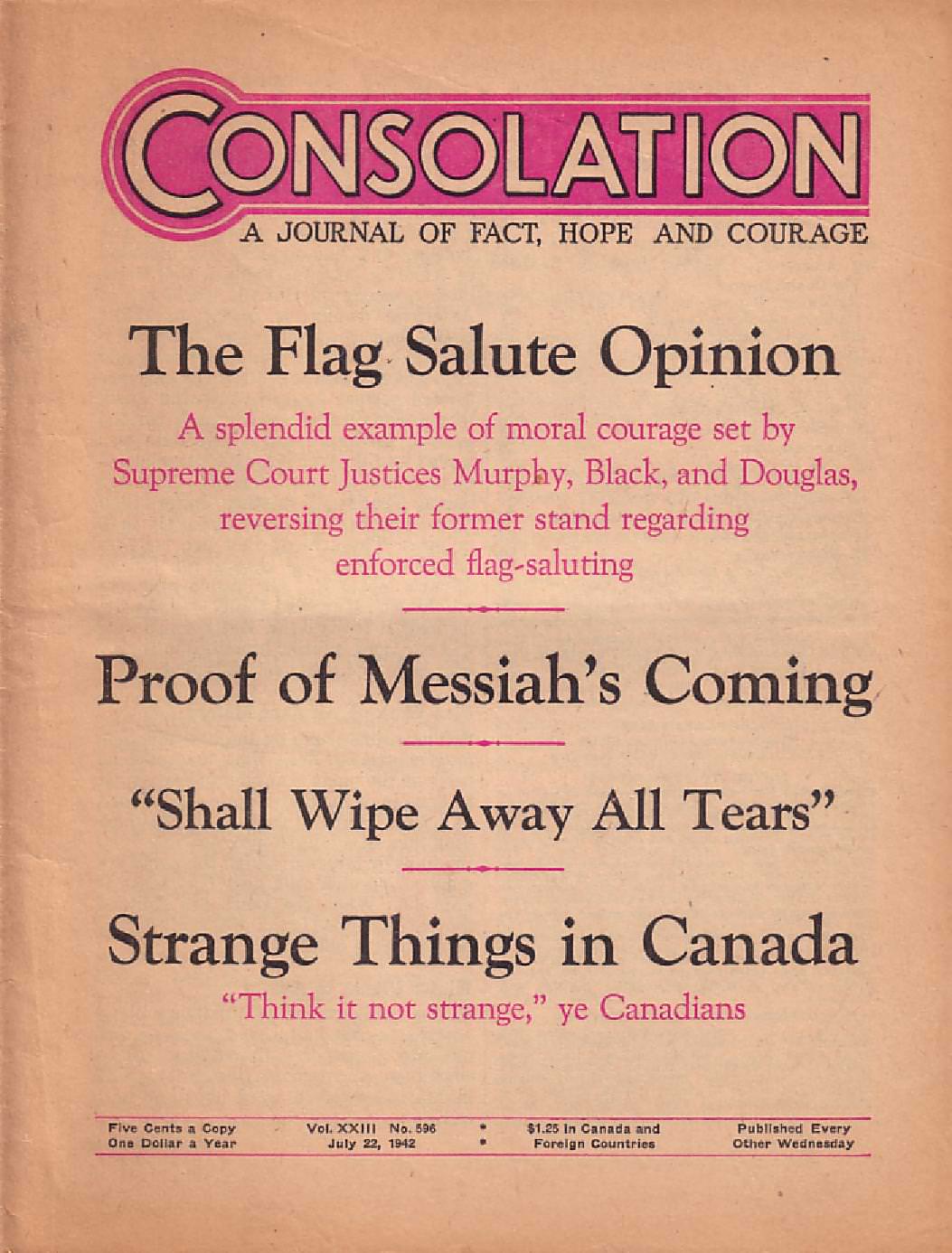
Changed Convictions Regarding Enforced Flag-Saluting ... 3
When the Chief Justice Stood Alone ... 3
Making the State Supreme ... 4
Misconception About Supreme Court ... 5
The Bar Association Knew Better ... 6
The Adverse Comment Continues ... 7
An Awakening at West Point ... 8
Big Business ... 10
Per Capita Income ... 10
Reviewing "Business as Usual" ... 10
Carnegie and Jones-Laughlin ... 11
The Age of Scarcity Is Dead ... 12
Rubber and Tin Magnates ... 13
Buy on Installment Plan ... 14
"Thy Word Is Truth"
Proof of Messiah's Coming ... 16
California and Hawaii ... 18
Bird Personalities ... 19
The New Government
"God Shall Wipe Away All Tears" ... 20
Houston, Texas, Kingdom School ... 21
Witnessing Before Rulers in Yugoslavia ... 22
Celebrating the Bill of Rights ... 23
"In Dixie Land" ... 25
Ramie May Come into General Use ... 25
Presenting "This Gospel of the Kingdom" ... 26
"Think It Not Strange," Ye Canadians ... 29
Published every other Wednesday by
WATCHTOWER BIBLE AND TRACT SOCIETY, INC.
117 Adams St., Brooklyn, N. Y., U. S. A.
Editor Clayton J. Woodworth
Business Manager Nathan H. Knorr
Five Cents a Copy
$1 a year in the United States
$1.25 to Canada and all other countries
NOTICE TO SUBSCRIBERS
Remittances: For your own safety, remit by postal or express money order. When coin or currency is lost in the ordinary mails, there is no redress. Remittances from countries other than those named below may be made to the Brooklyn office, but only by International postal money order.
Receipt of a new or renewal subscription will be acknowledged only when requested. Notice of Expiration is sent with the journal one month before subscription expires. Please renew promptly to avoid loss of copies.
Send change of address direct to us rather than to the post office. Your request should reach us at least two weeks before the date of issue with which it is to take effect. Send your old as well as the new address. Copies will not be forwarded by the post office to your new address unless extra postage is provided by you.
Published also in Greek, Portuguese, Spanish, and Ukrainian.
OFFICES FOR OTHER COUNTRIES
England 34 Craven Terrace, London, W. 2
Australia 7 Beresford Road, Strathfield, N.S.W.
South Africa 623 Boston House, Cape Town
Mexico Calzada de Melchor Ocampo 71, Mexico, D.F.
Brazil Caixa Postal 1319, Rio de Janeiro
Argentina Calle Honduras 5646-48, Buenos Aires
Entered as second-class matter at Brooklyn, N. Y., under the Act of March 3, 1879.
Notanda
Gun Barrels in Three Minutes
◆ It seems a shame that the nation that showed the world how to make airplane engines and automobiles should have to come down to showing them how to make guns; but that seems to be the way it is working out. The airplane was invented in America, and the engines that drive them in every part of the world are of American design or imitation. While Uncle Sam was going places with automobiles, planes and radios, Germany and Japan were bending all their energies toward getting ready to turn the world into a slaughterhouse. So much for the general setting. When Uncle Sam was forced into the war it took her mechanics an hour and three-quarters to rifle a gun barrel. That is 105 minutes. In less than three months they were doing it in 3 minutes. These birds that are bent on slaughter think they know it all. Indeed Japan's motto is, "The sword conquers all things." How like the Devil! At the moment it looks dark. But Satan's rule will end, and in utter humiliation for all who have and manifest his spirit.
Fine Work on Airplane Motors
◆ The adjustments on the best airplane motors are so close that the machine work on the parts that go into them must be done in shops that are air-conditioned at a fixed temperature, and so designed that rays of sunlight may not fall upon the tools or lathes in which the parts are made. A scratch on a gear may make it unusable. When the gears are shipped they are wrapped in the softest absorbent tissue that is obtainable.
Winter Planes to Alaska
◆ The inauguration of a summer plane service to Alaska proved such an immediate success that the service will be continued throughout the year. The flights are twice a week, weather permitting.
CONSOLATION
"And in His name shall the nations hope."—Matthew 12:21, A.R.V.
Volume XXIII Brooklyn, N. Y., Wednesday, July 22, 1942 Number 596
Changed Convictions Regarding Enforced Flag-Saluting
NO ONE can question the sincerity with which Justices Murphy, Black, and Douglas, of the United States Supreme Court, concurred in the 8 to 1 decision in the Gobitis case that it was lawful for the Minersville School District to compel the Gobitis children to salute the American flag or be expelled from school. They thought they were doing right. Now they know they were wrong.
Great concern was aroused among lawyers, teachers, editors and others who are interested in preserving American liberties when on June 8, in expressing themselves against a majority opinion that Jehovah's witnesses are peddlers, because they take the message of the kingdom of God from door to door in book form and accept contributions to aid in covering the cost of the same, they went on record in these words:
The opinion of the Court sanctions a device which in our opinion suppresses or tends to suppress the free exercise of a religion practiced by a minority group. This is but another step in the direction which Minersville School District v. Gobitis, 310 U. S. 586, took against the same religious minority and is a logical extension of the principles upon which that decision rested. Since we joined in the opinion in the Gobitis case, we think this is an appropriate occasion to state that we now believe that it was also wrongly decided. Certainly our democratic form of government functioning under the historic Bill of Rights has a high responsibility to accommodate itself to the religious views of minorities however unpopular and unorthodox those views may be. The First Amendment does not put the right freely to exercise religion in a subordinate position. We fear, however, that the opinions in these and in the Gobitis case do exactly that.
When the Chief Justice Stood Alone
Those familiar with this subject are, of course, aware that when Justices Murphy, Black and Douglas announced their adherence to the above statement it meant that they had swung squarely over to the opinion of Mr. Justice Stone, now the Chief Justice, who endeared himself to all liberty-lovers by his one-man stand against his eight colleagues in the Supreme Court when the Gobitis case was before that body. Some of the points in his minority opinion are presented to refresh the memory of those who have forgotten what he said:
. . . by this law the state seeks to coerce these children to express a sentiment which, as they interpret it, they do not entertain, and which violates their deepest religious convictions.
. . . it is a long step, and one which I am unable to take, to the position that government may, as a supposed educational measure and as a means of disciplining the young, compel public affirmations which violate their religious conscience.
. . . there are other ways to teach loyalty and patriotism, which are the sources of national unity, than by compelling the pupil to affirm that which he does not believe and by commanding a form of affirmance which violates his religious convictions.
The Constitution may well elicit expressions of loyalty to it and to the government which it created, but it does not command such expressions or otherwise give any indication that compulsory expressions of loyalty play any such part in our scheme of government as to override the constitutional protection of freedom of speech and religion. And while such expressions of loyalty, when voluntarily given, may promote national unity, it is quite another matter to say that their compulsory expression by children in violation of their own and their parents’ religious convictions can be regarded as playing so important a part in our national unity as to leave school boards free to exact it despite the constitutional guarantee of freedom of religion. . . . This seems to me no more than the surrender of the constitutional protection of the liberty of small minorities to the popular will.
. . . it would seem that legislation which operates to repress the religious freedom of small minorities, which is admittedly within the protection of the Bill of Rights, must at least be subject to the same judicial scrutiny as legislation which we have recently held to infringe the constitutional liberty of religious and racial minorities.
Making the State Supreme
The job of switching over from freedom of worship of Almighty God to compulsory worship of the state is causing many an anxious moment among thinking people in America in these days. The Louisville Courier-Journal is one of the 171 leading newspapers of the United States that consistently stands for religious liberty and well understands and supports the position taken by Jehovah’s witnesses. Two days after the admission of Justices Murphy, Black and Douglas that they now know they were wrong in the Gobitis case it said editorially:
Jehovah’s witnesses are making quite a record for judicial construction of religious liberty, one of the “vital rights of minorities and individuals”, which Lincoln said “are so plainly assured . . . in the Constitution that controversies never arise concerning them”.
They have arisen, nevertheless, and they divide the Supreme Court five to four on what Chief Justice Stone, dissenting, charges is a second infringement of minority rights by the court. The decision affirms the constitutionality of city ordinances levying a license tax on Jehovah’s witnesses for selling religious tracts.
More significant than the particular issue involved in this case, however, was the recantation of the other three dissenting Justices, Murphy, Black and Douglas. They had concurred in an eight to one decision, reversing a Pennsylvania Federal District Judge and Circuit Court of Appeals, to uphold the compulsory flag salute in schools. Now they take advantage of “an appropriate occasion” to agree with the Chief Justice that the flag salute case was “wrongly decided” and this “but another step in the same direction”, tending to “suppress the free exercise of a religion practiced by a minority group”.
The three Justices must have been profoundly moved by their convictions to make public their change of views when the country is at war and patriotic fervor apt to run to extremes. It is a reassuring exhibition of allegiance to American principles in time of stress, and more impressive for the fact that Justice Murphy is a devout Catholic whose faith has been subjected to scurrilous abuse by peripatetic witnesses.
The two years intervening between the two cases have furnished object lessons to rationalize the practical aspects of the question. The Justices have seen conscientious objectors excused from defending the flag while equally conscientious little objectors to obeisance to any earthly symbol were expelled from school for merely refusing to perform a perfunctory gesture in front of it. Meanwhile, a New England State court balked at the reductio ad absurdum of a similar statute. The judges also declined to obey it. They just couldn’t bring themselves to enforce the truancy law against children willing to attend or to adjudge them delinquent for obeying their parents.
This incident introduced cold logic into a debate on the symbolic character of the flag. It was in defense of the flag as a symbol of the nation’s might and the rights it guarantees that Justice Frankfurter, writing the majority opinion, affirmed legislative power to require the salute as a means of promoting “attachment to the institutions of the country” and “training children in patriotic impulses”. It was in defense of the flag as a symbol of the “freedom of conscience” that Chief Justice Stone denounced the coercion.
The law in operation, at least, vindicates the Chief Justice’s contention that the court was dealing with something more fundamental than pedagogical theories. Obdurate disobedience to it and the acceptance of the consequences demonstrate the conscientiousness of the offenders. And the Chief Justice has gained enough recruits on the bench to indicate that this “vital right” isn’t finally disposed of, even though the great Lincoln might not have been able to see how a controversy could possibly arise over it.
Misconception About Supreme Court
The Supreme Court is not a law-making body. It does decide if national, state or local municipal laws are in harmony with the Bill of Rights. Being human, it makes mistakes, as Justices Murphy, Black and Douglas now courageously admit. Localities affected by the decisions necessarily make the same mistakes. But a Supreme Court decision that school boards may require students to salute the flag does not mean at all that any school board must do so. No municipality must abuse Jehovah’s witnesses.
Another thing; No judge is compelled to follow the Supreme Court into error when it chances to make a mistake. He may stand for what is right and just, even if later he be rebuked for it. The rebuke may in time be changed to an apology, and a public one at that. Only six days before Justices Murphy, Black and Douglas made their public acknowledgment of previous error Judge J. Harold Brennan, of New Cumberland, West Virginia, in a 13-page opinion, acquitted five of Jehovah’s witnesses of charges of refusing to permit their children to salute the flag while attending public schools. Referring to the pledge of allegiance to the flag, portions of the opinion in the case follow:
As an individual I heartily agree with every word quoted. As the court, I cannot accept this conclusion that no religious question is involved, simply because the judge of the court cannot stretch his imagination to cover it. The answer to this statement is that many imaginations have been stretched so as to construe this as a religious rite. The moment any court takes to itself the right to hold a religious view unreasonable, that moment the American courts begin to deny the rights of religious freedom. The very purpose of our guarantees of freedom of religion is that unpopular minorities may hold views unreasonable in the opinion of majorities.
I, personally, agree that there is nothing whatsoever of a religious nature about this salute of the flag. I know of no definition of allegiance that even connotes worship or adoration. Furthermore, to hold the simple language of the Second Commandment to extend so far as to include within its provisions the American flag as a graven image of anything, “that is in heaven above, or that is in the earth beneath, or that is in the water under the earth,” or to hold that this flag salute is bowing down to or serving such an image or likeness, is completely beyond my comprehension. The difficulty is that, when all this is said, I can think of many beliefs incorporated in religions in various parts of the world that are just as incomprehensible to me as this one is. To all of these we guaranteed freedom.
We have to take into consideration what this decision means. A finding of guilty would mean that these defendants must either leave the state of West Virginia or, during one school year, incur possible sentences of one hundred days for every week of the school year, a sentence of twenty days for each day’s absence. As a possible alternative thereto, the child could be sentenced to Pruntytown or Salem (state reformatories), for we cannot hold parents responsible without saying that the child is habitually truant. In this connection, if one will take the trouble to examine the cases he will learn therefrom that the belief of Jehovah's witnesses is this: A person saluting the flag will be slain at the Battle of Armageddon, thereby incurring eternal spiritual death.
This shows that these little children have been taught to fear. It is not believed that the American or the West Virginia constitution permits forcing on a child the choice between a reform school and the hereafter of the damned, even though the second choice exists only in the child's imagination.
As indicated by the possible sentences, what this court is asked to do is to force children, indirectly, to do something against the consciences both of themselves and their parents. This has not been done in America hitherto; we shall not begin it here.
The finding is "not guilty".
Pretense and Humbug versus Facts
Many people never stop to consider for one moment the reasons for and against saluting the scores of kinds of flags now floating in every part of the world. In a vague way the common man is led to believe that a government must be protected and if all the children salute its flag that government will be safe; that subversive organizations must be fought and that non-saluters are subversive, no matter what they believe; that if children have the jail doors staring them in the face they will salute and that will make them patriotic; that if they can be forced to salute, then they will not become Jehovah's witnesses and it will be a distinct gain to the community if there is nobody in it who reverences the Creator. They might not express these conclusions in this way, but that is the essence of what the arm-swingers believe.
The facts are that true patriotism can not be created by legislation; respect for the flag can not be forced; love of country can not be taught with a club; hypocrisy is not patriotism; respect for the country should be taught through educational processes; three of the men that helped make flag salute laws possible now say they made an error thereby, and so they did; that flag salute laws are impossible to enforce; they are an entering wedge to Fascism; they are designed to make criminals of Jehovah's witnesses, and it is admitted by the Supreme Court that the laws are particularly aimed at the witnesses and nobody else; flag salute laws set up machinery to suppress freedom of speech, freedom of worship, and freedom of conscience, and they set up machinery which can be used to persecute innocent people.
The Bar Association Knew Better
The American Bar Association in the first place warned the Supreme Court against adopting this religious ritual; assured them there was no need to recommend such legislation; that it would be new to America to compel a particular form of expression such as a flag salute; that a compulsory flag salute is a thing very different from a voluntary one; that compulsory salute legislation is void because it unjustifiably infringes upon the liberty of an individual, and that the compulsory flag salute cannot be sustained on the ground that public-school education is granted as a matter of grace so that the requirement, even though arbitrary and capricious, can be enforced by expulsion from the public school.
The Bar Association pointed out that neither legislatures nor courts have the power to declare that a given practice does not and can not carry a religious significance, and that a salute must be considered a patriotic ceremony which cannot have any religious significance; they could not see that the overriding of any person's religious belief is essential to the public interest; they wanted to know what would happen if laws were passed compelling all adult persons to salute the flag; they wanted the court to back out of the idea that any official action whatsoever can determine whether or not a particular ceremony carries a religious significance; they wanted to know what would happen if the state were to require everybody to give a particular form of salute at a set time each week.
A year after Justices Murphy, Black and Douglas made their error in the Gobitis case, and a year before they admitted that such was an error on their part, the Bill of Rights committee of the Bar Association reviewed the matter and said that no decision of recent years in the field of civil liberty had aroused so much informed discussion and "it is interesting to note that the critical comment has been largely adverse to the soundness of the decision".
The Adverse Comment Continues
It is a great temptation to produce some of the immense volume of adverse comment that is now flowing through court decisions in state and federal courts and in the newspaper offices of the country, but it seems best to limit this article by giving two selections.
The Chicago Sun's acrid comment first:
Liberty is lost, usually, by people who do not know they are losing it. Liberty is destroyed by people who do not know they are destroying it. The Supreme Court this week undermined freedom of religion and, in doing so, established the basis for knocking out freedom of the press.
And the complete editorial of the Baltimore Sun, June 10, 1942, which follows, Experience shows that the Baltimore Sun continues to hold the position accorded to it by a vote of the American Society of Newspaper Editors as the best-edited paper in the United States. This editorial appeared in its issue of June 10, 1942:
FOUR FOR FREEDOM
Some of those who have been following the reasoning of the new members of the Supreme Court may have been tempted to chuckle yesterday. They read that Justices Black, Douglas and Murphy had reversed themselves in dealing with cases arising from the efforts of local authorities to restrict and regulate the curious religious sect known as Jehovah's witnesses.
On June 3, 1940, these three justices joined five others in upholding the school authorities of Minersville, Pa., who had expelled children of the sect because, on religious grounds, they refused to salute the flag. At that time only the present Chief Justice stood out in support of the theory that the religious freedom guaranteed in the Constitution protected the children in their refusal to salute the flag. On Monday the Supreme Court acted on cases involving local ordinances in Alabama, Arkansas and Arizona which taxed ministers of the sect who distribute pamphlets. The question was whether these ordinances invaded the religious freedom guaranteed in the Constitution. In deciding the cases, Justices Black, Douglas and Murphy joined Chief Justice Stone on the minority side of a 5-4 decision, and added a plain statement that they erred when they joined the majority two years ago.
At first glance the reversal of position by the three justices looked rather like an example of judges learning the job as they go along. There has been a tendency upon the part of many of Mr. Roosevelt's appointees to the bench, including some appointees to the Supreme Court, to be contemptuous of "abstract principles" and to decide cases in accordance with what seemed to the judges to be "right" and "just" in each instance. That, of course, is one of the easiest ways in the world to convert the judges into lawmakers. It is one of the easiest ways to convert the courts into the super-government which Mr. Roosevelt said the old courts had become. It is one of the easiest ways to pass on to judicial dictatorship and on to judicial tyranny. Gradually, this fact has dawned on some of the new judges, and they have been learning more about "principles" and paying more attention to them.
But, in Monday's decision, it seems probable that it was not sudden realization of the value of "principles" that moved the three justices to reverse their position of June 3, 1940, so much as discrimination between principles. Religious freedom is a basic principle. But it is conditioned by another basic principle—order in the community. Religious freedom does not guarantee a man the right to practice his religion in a manner that grossly disturbs the orderly life to which all other men are entitled. Public authorities, at times, must seek a working balance between the two principles. And this results in the courts being called upon to decide whether the working balance has been preserved—whether, in practice, the assertion of the principle of order has led to unwarranted invasion of the principle of religious freedom. That was the issue in all the cases affecting Jehovah’s witnesses.
In the first case, the only member of the Supreme Court who held that the public authorities were carrying the principle of order into an undue invasion of the principle of religious freedom was Harlan F. Stone, the one-time “Morgan lawyer” who was a pillar of the old liberal minority in the pre-Roosevelt court. He held that the children of this eccentric and despised sect were within the religious freedom guaranteed by the Constitution to the humblest when they refused to salute the flag. He held, in effect, that no requirement of public order compelled the Minersville school authorities to limit the children’s exercise of their rights under the guarantee. In the cases decided on Monday, three of Mr. Roosevelt’s neo-liberals came around to the viewpoint of the one-time “Morgan lawyer”. They accepted his position in the old case, while joining his position in the later ones.
For our part, we applaud them. Religious freedom is too precious ever to be limited in the name of public order unless the need is clear and compelling.
Aviation
An Awakening at West Point
◆ Is it possible that the army and navy still haven’t awakened to the primary place the airplane has taken in this war? The evidence would fill books. Pearl Harbor. Crete. The way the Germans used air protection to get their battleships through the Straits of Dover the other day. The cry of everybody in the Far East for planes. Cecil Brown reports from there that 30 flying fortresses six weeks ago might have changed the story. Dutch officials have begged our government frantically for just a few planes—far less than a month’s production. Harold Guard, the United Press correspondent, tells us how brave British troops had to lie in the mud at Singapore while Japanese planes machine-gunned them with not a defending plane in the area. Every dispatch from out there cries for planes. They are not asking for battleships. Battleships are no good without planes to protect them, as the British have finally discovered. I’m not competent to marshal all the evidence that exists.
At Pearl Harbor our people were looking for sabotage, for submarine attack, for naval attack, but they don’t seem to have thought of the possibility of air attack—so the Roberts report tells us. Just a few days ago General Marshall said that pilot training would be added to the curriculum at West Point within a month. They apparently hadn’t bothered with air much before, and had gone on turning out ground-bound officers in the midst of a war in which air had become the key to most decisive actions.—Raymond Clapper, in the New York World-Telegram, February 18, 1942.
The Plastic-Plywood Planes
◆ It is claimed for the plastic-plywood planes that the material is stronger than steel; that the glue impregnates the wood, preventing warping and buckling, and that the elimination of rivet heads and overlapping plates reduces the air drag. The plywood surface resists oil, water and fire, and the bullet holes are clean instead of flowering, which enables repairs to be made quickly and efficiently. A further advantage is that this form of plane makes good use of the services of carpenters, cabinet makers and other types of woodworkers.
Radio Guidance of Model Planes
◆ At Wright Field, Dayton, Ohio, a model airplane without any aviator aboard taxied out onto a runway, took off into the wind, performed figure eights and S curves at a 300-foot altitude, and taxied back to the feet of the judges. Seems uncanny, doesn't it? It was all done by radio. At the same exhibit another plane, this time with an aviator aboard, took a power dive from 500 feet, plunged to within twenty feet of the ground, then climbed steeply, and at 300 feet executed a perfect loop and yet landed safely. This feat had hitherto been considered impossible.
Airplanes Baked in Ovens
◆ The new airplanes made by the Timm Aircraft Corporation, California, have to be baked in an oven before they can fly. They are made by saturating and binding thin strips of spruce with liquid plastics. It seems as though this idea might have great possibilities. Certainly some of the new plastics have greater rigidity and greater strength than some of the metals.
Mastery of Planes over Ships
◆ More and more military men are coming over to the conclusion that the Battle of Crete will go down in history as one of the decisive battles of all time, in that it demonstrated the supremacy of air power over sea power. The soldiers in the Far East declared over and over that it was the Japanese air power that gave it the supremacy in each of its recorded victories.
Recent Aeronautical Achievements
◆ With new planes in the making which are expected to cross the Atlantic in twelve hours, nobody is much interested in the news that a clipper crossed from Lisbon, Portugal, to New York in less than 24 hours; that a woman in California flew over 1,200 miles in less than four hours, or that an army officer flew "entirely blind" from New York to Langley Field, Virginia.
The Effect of Centrifugal Force
◆ The effect of centrifugal force upon the body of an aviator when he makes quick turns or suddenly swoops up after an almost vertical dive is tremendous. The average young adult can withstand 5 times the force of gravity sitting in an upright position for 4½ seconds. At 6.9 times the force of gravity a pilot who weighs 180 pounds feels as if he weighed 1,242 pounds; his blood becomes as heavy as molten lead and tends to pool in his abdomen and legs. For lack of blood in his brain his vision fails and he faints. No normal adult can stand 7 times the force of gravity for 7 seconds without complete loss of consciousness.
400 Minutes to Britain
◆ Doesn't it make you catch your breath when you read that the new bombers (United States Consolidated Liberator) have crossed from Newfoundland to Britain in 400 minutes? That is an average of 330 miles an hour for the 2,200-mile trip. The particular craft that made this spectacular flight had to circle about over its landing field for three hours because it still had too much gasoline aboard to be landed safely.
Airplane Bumps an Automobile
◆ Forty miles west of Salt Lake City an automobile was skipping along toward the Golden Gate, when a messenger from the skies, in this instance an airplane, rammed the rear of the car, badly damaging the automobile, but itself escaping to the west without being injured or identified. Next time somebody crumples up the rear of your car, take a look at the sky ahead and maybe you can see who did it.
Helicopters for the Convoys
◆ The New York Times suggests that helicopters go along to protect the convoys. They can take off from a space 40 feet square, fly at any desired speed up to 90 miles an hour, hover over their prey, and return to their deck at will.
Big Business
Per Capita Income
◆ The average per capita income for the United States is $573 per annum. Above the average are Montana, $579; Oregon, $586; Pennsylvania, $624; Washington, $633; Wyoming, $638; Ohio, $644; Michigan, $656; Illinois, $691; Maryland, $703; Rhode Island, $730; Massachusetts, $757; New York, $814; California, $819; Delaware, $836; New Jersey, $852; Connecticut, $864; and Nevada, at the top, with $960. In the other direction (below the average) are New Hampshire, with $560; Colorado, $551; Indiana, $551; Vermont, $542; Wisconsin, $537; Minnesota, $526; Maine, $504; Missouri, $499; Utah, $487; Arizona, $478; Iowa, $471; Idaho, $470; Florida, $465; Virginia, $455; Nebraska, $444; Texas, $422; Kansas, $418; West Virginia, $401. The thirteen agricultural states at the bottom of the list show that in the states named the ones that feed and clothe humanity are not overpaid: North Dakota, $385; South Dakota, $384; New Mexico, $356; Oklahoma, $354; Louisiana, $350; North Carolina, $335; Kentucky, $330; Tennessee, $325; Georgia, $321; South Carolina, $281; Alabama, $264; Arkansas, $253; Mississippi, $195.
The Morale of the Eaters
◆ Those familiar with the war game maintain that the first requisite of an army is that it be well fed, and the next requirement is that the folks at home be well fed also. That makes it advisable that the cost of living be kept down, so that the common people will not suffer. And so it is just too bad that in a few weeks the cost of living went up 8 percent. There was no necessity for this except that the big fellows want big profits, and the first place they seek them is in the poor man's market basket. The government could stop this if the overpaid congressmen would take the necessary steps. Some progress has been made.
Reviewing "Business as Usual"
◆ The little journal In Fact briefly reviews I. F. Stone's book Business as Usual, and quotes its author as saying:
You cannot fight an anti-Fascist war under the leadership of men who do not hate Fascists. You cannot take men who wear Hitler medals and create an anti-Fascist general staff of them. The preferences of most dollar-a-year men were clear enough. They were more interested in weakening democracy at home than in resuscitating it abroad. They provoked strikes by paying low wages—and then called for bayonets to end them. They shut their eyes to shortages of raw materials at home while they shipped oil, copper, steel and other war materials to our enemies.
And then the editor of In Fact, George Seldes, goes on to say, pungently:
Both Italian Fascism and German Nazism came into power through bloodshed and terrorism. Mussolini and Hitler personally ordered murders committed. Both engaged in wars against defenseless people. Nevertheless, thousands of American congressmen, business leaders and writers acclaimed both of them even after they had committed murder. Many of these persons are still Fascists, although they may be shouting patriotism in the press and the halls of Congress.
Miracle Radio and Miracle Lights
◆ According to the Federal Trade Commission the claims put forth by the Miracle Manufacturing Company of Conshohocken, Pennsylvania, for their aerial loops and radio controls, and by the Defiance Pressed Steel Company, Marion, Ohio, for their Defiance fog lights, have about as much truthfulness to them as these miracle bones, miracle medals and other miracle junk that the great human sucker so readily purchases as soon as he gets a spare dollar. The only trouble is that "the devices will not perform any of the claims made for them", says the commission. So why buy?
Carnegie and Jones-Laughlin
◆ These are big days for the big fellows in the steel business. Wildly and justly indignant the War Production Board charged the Carnegie-Illinois and Jones & Laughlin Steel corporations with "repeated, deliberate violations" of priorities regulations, including diversion of iron and steel to private customers "at the expense of the needs of the armed forces and the Maritime Commission", and inside of four days the undersecretary of the navy telegraphed Jones & Laughlin congratulating them on setting an all-time record of production, and the Carnegie-Illinois company within the same interim was given permission to fly a navy emblem "as evidence of their accomplishment in production". That's putting the whitewash on before the tar had even had time to get cold.
It seems that the War Production Board telegraphed Jones & Laughlin on February 21 prohibiting the shipment of "oil country" casing, tubing or drill pipe after March 14 except on orders carrying priority ratings of A-9 or higher, but although the company had manufactured no such pipe since October, 1941, it immediately put large quantities of high-quality steel into pipe production and in fifteen days produced 570,000 feet of this pipe, of which only 12 percent was delivered on rated orders. The remainder was manufactured on orders for civilian use, bearing no preference ratings whatever. At this point it should be explained that the steel business is geared to big orders, not little ones, and it is next to impossible for politicians to tell steel men how to run their business, and what to make and what not to make, or to make them patriotic.
Soap Floats to the Top
◆ During 1940 Proctor and Gamble, manufacturers of soap, spent $13,600,000 in advertising their wares in magazines and farm papers and by radio. Nine other concerns had expenditures of over $5,000,000 each in the same categories. Thirty-four other corporations expended more than $1,000,000 during 1940 in these classes of advertising. Liggett & Myers Tobacco Co. and American Tobacco Co. expended $5,400,000 each.
The Deluge of War Profits
◆ Leon Henderson's testimony to the Senate Banking and Currency Committee yesterday that corporate profits have jumped 169 percent since 1939 only skimmed the surface of the story government economists are drawing from corporate reports and other sources.
A study of the general industrial picture has convinced the economists that manufacturers have boosted prices an average of 17 percent to cover a 7-percent increase in costs. The other 10 percent has gone into profits.
Even where there has been no official increase in prices—as in steel—increased production has brought big profits. Companies handling 85 percent of the nation's steel output multiplied their prewar profits thirteen times during the third quarter of this year.
Even after paying heavy taxes, the steel companies showed profits more than six times as big during the third quarter this year as they had made before the war.
The copper industry, which has increased prices about 12 percent, is tripling its profits this year. Even after payment of taxes, it is showing more than double its prewar profits.
Increased labor costs have hardly figured in the picture. For industry as a whole, a 3-percent increase in labor costs has been more than covered by a cut of 3.6 percent in overhead expenses. The chief increase in costs has been in raw materials.
Henderson's figures showed that wages and salaries had increased only 32 percent—most of which was not in wage increases, but in payment for additional services to men who are working longer hours or who were not working before. —PM, December 11, 1941.
Tools Kept 35.54-Percent Busy
◆ Most newspapers are big-business enterprises, and every item they publish regarding labor is intended to give the workers a black eye and deck themselves out with a halo and wings. The workers, however, are not as dumb as they used to be, and realizing that the politicians appreciate propaganda, and are held answerable to the common people for what is being done with the billions being appropriated, they must have got a big thrill out of collecting and publishing the facts that, right while the government was straining every nerve to get bomber parts, and while everybody knew that tool and die machines are the bottleneck of production, yet in the Detroit area, over a long period, these machines were used only 35.54 percent of the available time.
Worse than that, says In Fact: “When army and navy officials made a tour of inspection, these plants hurriedly and at great expense set up all their machines with defense jobs, so that when the army and navy inspection passed through their plants these large departments of skilled men were all working feverishly on defense work. After the inspectors departed, the defense jobs were ripped off the machines and replaced by auto tooling jobs.” What kind of business is that? Oh, that is what they call conspiracy. Some would call it sabotage; and some, treason.
Tungsten Carbide
◆ In Fact, March 16, 1942, says that tungsten carbide, hardest substance next to the diamond, is absolutely essential to the armament industry. It costs about $25 a pound to make, but the price went up to $453 a pound when America had to have it. For twelve years, while Germany was getting ready for the present situation, the price of tungsten carbide there has been $40 a pound; this by agreement between Krupp of International Murderers, Inc., fame and America’s own General Electric Company.
The Age of Scarcity Is Dead
◆ Well, the age of scarcity is dead. Dead as Pharaoh’s horses and Balaam’s ass. Man’s six-thousand-year-old struggle against never-enough-for-all has now become a maniacal stampede to escape more-than-enough-for-all. Mechanical energy and science are raining manna and quail. Hence, we madmen—modern wanderers in the wilderness—must pull in our belts to the last notch. Since the days of Old Hickory alone, the productive forces of the nation have been multiplied fortyfold. For the past ten years each of us had 130 iron slaves at our beck and call and we locked them in the dog house while vainly trying to sell ourselves to old man Hard Work for room and board. Yes, the age of scarcity is dead, but its soul goes marching on. In the thousands of offices and directors’ rooms sharp-witted men with sharpened pencils are diligently figuring how to increase the margin above the keep of their sl—servants, by lowering their incomes, reducing their numbers or raising the cost of their keep, and preferably all three. It’s a queer game the sharp-witted men are playing. For the men they seek to get rid of, or whose income they hope to reduce, are also the customers for their goods. So the more they succeed, the greater their failure.—Oscar Ameringer.
The Virus Business
◆ In view of the fact that there is no such thing as pure vaccine virus, and therefore there is no certainty that it may not contain impurities that will result in encephalitis, tetanus and other affections of the central nervous system, and in view of the fact that the country is at war, the Citizens’ Medical Reference Bureau, 1860 Broadway, New York, recommends that the time once used in compelling vaccination should now be used in other ways; this particularly in view of the fact that there is no evidence that vaccination has had anything to do with the wiping out of smallpox.
Rubber and Tin Magnates
◆ Over the years, the rubber and tin magnates of Malaya, with world-wide markets for their goods, and no competition worth mentioning, built up good reserves so that in case of any general smashup in the Far East they could do the noble and generous thing by their employees. When the Japanese came down through their possessions they sacked their European staffs without notice, giving them only one month's salary wherewith to flee to Singapore and thereafter take care of themselves and their families the best they could. Thus the Big Business crowd endear themselves to the common people and show their absolute stupidity. At heart they seem to think that when the Pacelli-Hitler-Matsuoka conspiracy comes out in its full bloom they cannot help but land in a bed of roses if they double-cross those that have trusted them and worked for them in the most trying climate on earth.
Growth of Aviation Industry
◆ At the close of the year 1940 there were 193,000 persons in America engaged in the manufacture of planes, engines and propellers; a year later there were 425,000; and it is expected that by the close of 1942 the number will reach close to 600,000 workers. Area of floor space allowed has gone up in proportion. The allowance of 100 square feet of floor space to each worker does not seem too much. It is only an area 10 feet square.
"High Grade" Insect Fragments
◆ According to word from Washington, if you want "High Grade Chocolates" which contain "insect fragments and mammalian hair fragments resembling those of a rodent", and if you want it adulterated so that "it consists in whole or in part of a filthy substance", you should get in touch with the Tower Candy Company, of Philadelphia. It beats all how trade keeps up.
The Fabric of Si Link Shi
◆ You have often seen the fabric of Si Link Shi, one of the strongest natural fibers known to man. You call it silk. The French call it soie, after the first name of the lady who discovered it. Si Link Shi noticed the caterpillars nibbling at the mulberry leaves and making their winding sheets out of the shimmery threads of gossamer of which the ladies' stockings are now made. She found she could unwind the cocoons, but that the thread was too fragile of itself. Several threads had to be joined. With her own hands she unwound enough cocoons to make a five-strand thread. With this thread she made a garment for herself, and is now a Chinese "saint" because of it. Silk, for its size, is stronger than steel. The first pair of silk stockings seen in the Western world was that made for Queen Elizabeth in the year 1589. Now every girl expects to wear them, as a matter of course.
A Ten-Thousand-Acre Estate
◆ When Robert Walton Goelet, owner of the Ritz-Carlton hotel, died, recently, he left an estate of some $15,000,000, a part of which was a ten-thousand-acre farm near Meru, in the very best part of France. The estate has 139 buildings, rich grain fields, and herds of cattle. It is at present in the hands of the Germans, and will be sold. The Ritz-Carlton goes to Harvard University as a bequest. It is assessed at $3,675,000 and is free of all encumbrance.
The Stick-up in Food
◆ The patriots that control America's food supplies are having a grand time, with the sky as the limit. One of the Missouri congressmen casually mentioned to his fellow counselors that at his farm he sells eggs at 18c a dozen, but pays 40c a dozen in Washington; he gets 10c a pound for his hogs, and pays 36c for bacon in Washington. To intimate that the Washington prices are honest would be compounding a felony.
Synthetic Rubber in Dead Earnest
◆ Chemists have been playing with this subject of rubber for a generation, and have found a great variety of ways in which to make it, but until now the Malayan rubber was cheaper and better. Now the little brown men have Malaya, and Uncle Sam and all the rest of the world are in dead earnest about making synthetic rubber and doing it right away, because they must. It can be made from petroleum, natural gas, agricultural products of various kinds, including potatoes, molasses, grass, dandelion, and goldenrod. Uncle Sam announces that $400,000,000 will be expended in the synthetic rubber industry; so the production should be 400,000 tons a year by the middle of 1943.
Improvement in Hatmaking
◆ A new and decided improvement in hatmaking does away with the tremors of face and hands, called "hatter's shakes", caused by treatment of the fur with mercury nitrate. In the new process the loose fur is fed into one end of a machine, the exact amount of loose fur needed is weighed out, and the fibers are then drawn by suction upon a revolving cone, where they are sprayed with hot water to set the felt. The new machine uses only half as many men as were used by the older types of machine, and the output is twice as great. When the new machines come into general use three-fourths of the hatmakers will be without work.
The Step-up in Aluminum Production
◆ Fifty years ago aluminum was worth $5.00 per pound and the entire supply of the country was kept locked in an office safe in Pittsburgh. Now it is worth 15c per pound and the production in 1943 will be 2,100,000,000 pounds in the United States alone. This will be more than seven times the 1937 production, and more than half as much again as the whole world produced in any year prior to 1939.
Buy on Installment Plan
◆ Buy on the installment plan, and remain in debt and in trouble the rest of your life. It's easy. Millions have done it, and are still doing it, and receive every encouragement at the hands of legislators who are tremendously interested in flag-waving but not much in what happens to John and Mary when they start housekeeping. A Massachusetts legislative commission, however, found that in that commonwealth a couple that thought they were paying interest at 5 percent on the balance due on their vacuum cleaner were actually paying 20 percent. On their washer and ironer, they were told they would be paying 6 percent on the balance, but it was actually 42 percent. On the furniture it was to be 6 percent, and it was 48 percent. On the electric refrigerator it was to be 5 percent, and was 58 percent. And on the radio it was to be 6 percent, but was 488 percent.
The Best Bauxite Ore
◆ Perhaps the best bauxite ore is that found in Dutch Guiana, and though this ore in some form is to be found in almost every country, and is widely disseminated over the United States, yet 60 percent of the ore used by the Aluminum Company of America has come from Dutch Guiana. There are vast deposits of the same grade of ore in near-by Brazil, but the mines have not yet been opened up. Bauxite is the ore from which the aluminum used in airplane manufacture is obtained.
Price-fixing in Lenses
◆ Everybody wondered why it used to cost $7.50 for a pair of "specs" and then the price was jumped to $20. Uncle Sam wondered, too, and fined six corporations for price-fixing. Fourteen other corporations and seven individuals also paid fines, the total for the optical industry reaching to over $157,000. And the probable result is that the prices will come down to something reasonable.
Increasing Popularity of Air Lines
◆ The United States is now crisscrossed by airlines in every direction, and air services are increasingly popular. Fourteen of the big lines showed an operating revenue of $86,689,000 in 1941, as against $73,113,000 the year previous. In their business of carrying freight and passengers the planes navigated 126,205,000 miles, as against 104,824,000 the year previous. Revenue passenger mileage went up from 1,002,604,000 miles to 1,309,343,000. These figures show that on these fourteen lines the average number of passengers per plane was about 8. This seems a small number in view of the fact that a single plane like the Lockheed Constellation of Transcontinental and Western Air carries 57 passengers, besides a crew of 7. And, by the way, this ship can make the trip between Los Angeles and New York in 8½ hours. That's doing 3,000 miles in a hurry.
Henry Is Making Bombers
◆ The Fords have built an $18,000,000 bombing-plane factory, largest of its kind in the world. The machine shop is 900 feet wide and 320 feet deep, while the adjacent assembly room is 1,400 feet long and 400 feet wide. The plant will be devoted exclusively to the manufacture of the long-range, heavy-duty B-24D planes, and here is prophesying that when it gets under full headway it will deliver an output that will astonish the world. A beautiful and expensive booklet just at hand tells of one such bomber every hour and that it can be delivered at any airport in the world.
The Fords Can Get Along
◆ If you want a new car you might get a Ford, but you don't need to feel that you must get one to help Henry out. He and the family can get along. In seven of the early years (1917-1924), when Henry was just getting a nice start, the profits of himself and wife and son, after all expenses were paid, were $526,521,951.
Transocean Bombers
◆ The day of transocean bombers arrived with a bang. Flyers are having their breakfast in Newfoundland and their evening meal in England and are delivering huge bombers regularly in less than 10 hours. Indeed, at current rates of speed they could fly to Berlin in 11¾ hours from Newfoundland. From Iceland to Berlin is only 6 hours. The flying time to Tokyo from Guam is 6½ hours, and from Unalaska it is only 10¾ hours. Don't be surprised any day now to learn that Uncle Sam's boys, from their bases in the island outposts, are dropping their two-ton bombs wherever they please.
Five Miles Up in the Air
◆ Five miles up in the air it is very hard to talk, and next to impossible to whistle, because in the rare atmosphere the breath escapes too easily to make a noise. Eyes become bloodshot, joints ache, and nervous indigestion often shows up. Above 18,000 feet it is necessary to supply additional oxygen for breathing. Some of the new bombers are being designed to fly at an altitude of seven miles. America is now ready to literally darken the skies with planes; not like Italy's either.
Profits Cost Money
◆ The periodical U. S. Week draws attention to the fact that profit increases have already added $13,000,000,000 to the cost of the nation's armament program. That is a bigger pile than Adam would have had if he had received $4 a minute, day and night, from the time he was created until now, and saved every cent of it.
The Childless Adult
◆ The childless adult shows up badly in the fact that every year there are about 10,000 of them that purchase toy trains for their own use, here in America, and ten times that many operate them. A single corporation in Irvington, New Jersey, makes and sells something like 400,000 trains a year.
"THY WORD IS TRUTH" -John 17:17
Proof of Messiah’s Coming
A PRESIDENT of the American Federation of Religious Organizations once said over the radio that the religionists "must robe the earth in the glory of the moral achievements of man, and then Christ can come and visit the earth". On that basis, how far off has this total war for world domination pushed back the coming of the Messiah into the future? But what if the Bible proves that He has already come? Then what must be His judgment of the nations in their present circumstances? How can one prove His coming? By the things happening which were foretold to happen during His presence.
When Jesus Christ had finished His course on earth and ascended into heaven to the right hand of God His Father doubtless He was eager to proceed with the primary work of clearing or vindicating His Father’s name. On His arrival Jehovah God said to His ascended Son Christ Jesus: “Sit thou at my right hand, until I make thine enemies thy footstool.” (Psalm 110:1; Hebrews 10:12, 13) Christ must be obedient to Jehovah and therefore await God’s due time for His Son to act. How long must Christ Jesus wait before beginning the work of destroying Satan’s wicked organization? The Scriptures show He must wait until the end of the “times of the Gentiles”, which Gentile Times began in 606 B.C., extended over a period of 2,520 years, and came to an end in the autumn of A.D. 1914. That was the period of time in which Jehovah permitted Satan to carry on his wicked work in the universe without interruption from God or Christ. At the end of that period of time Jesus Christ, in obedience to His Father’s will, began the great work of ousting Satan and his demons from their position in heaven and establishing the long-awaited Kingdom. The year 1914, therefore, marks the second coming of Christ as KING.
That day has passed and no one has seen Christ Jesus on earth; and this may be taken as an argument by religionists as against His second coming. While that is true, it must be kept in mind that Christ is the great Spirit clothed with all power since His resurrection from the dead, and that it is no more necessary for HIM to be seen on earth than it is necessary for God to be seen on earth. With Him distance amounts to nothing. Just before His death on the tree Jesus said: ‘In a little while the world shall see me no more,’ and then He also said that all would see the evidence of His invisible presence respecting the earth. His power exercised toward things of the earth has its effect just the same, when exercised from heaven, as if He were actually at the earth. His second coming more particularly relates to the turning of His attention to the affairs of the earth, rather than to a bodily coming and appearance.
The prophecy of the Bible, now fully supported by the physical facts in fulfillment of prophecy, shows that the second coming of Christ dates from the latter half of the year 1914. One of the great prophecies bearing upon this point is that set forth in Matthew 24. That record shows that His disciples propounded to Jesus this question: “What shall be the sign of thy coming, and of the end of the world?” meaning the end of Satan’s world, the end of the time of his reign without interference, at which event Christ comes. Jesus’ answer to the question discloses a number of things that would come to pass at that time. He said the beginning of that period of time would be marked by a world war, in which whole nation would rise against whole nation. True to the prophecy, the World War began in 1914. Jesus then said that quickly there would follow famines, pestilences and earthquakes, persecution of the Christian servants of Jehovah, and the producing of the “abomination of desolation”, that is, a world federation of the nations presuming to take the place of God’s kingdom by Christ Jesus. Those things did accompany and follow the World War. Jesus said that the war, famine and pestilences would be merely the beginning of sorrows on the earth, and that means that many other sorrows would follow. You may ask: Does that mean that God and Christ are sending the calamities upon the peoples of the earth? The answer is, No; but it does mean that Satan is responsible for these sorrows and troubles, because he knows that his time is short before the final war of Armageddon, and therefore his effort is to drive the people away from God by inducing them to believe God is responsible for all their woes.
Psalm 2:6 shows that at the end of the waiting period God placed Jesus Christ upon His throne of authority on Zion and directed Him to carry out God’s purposes. Psalm 110:2 states that God now says to His beloved King, Christ: “Go forth and rule thou in the midst of thine enemies.” These scriptures show that Christ must begin His rule while the enemy Satan is still exercising his power in heaven and in earth. The first work of Christ the King, therefore, would be to oust Satan from heaven.
Revelation, chapter twelve, shows that at the beginning of His reign, or birth of His kingdom, which birth is pictured by the birth of a “man child”, there was a great war in heaven between Satan and his demons on the one side and Christ Jesus and His angels on the other side, in which war Satan was worsted and cast out of heaven into the earth. In the twelfth verse of that chapter it is written: “Woe to the inhabiters of the earth, and of the sea! for the devil is come down unto you, having great wrath, because he knoweth that he hath but a short time.” He knows that soon the final conflict will be fought, which will determine whether his demon rule and organization are to continue to exist or not.
Prophecy declares these things must take place at the beginning of the second presence of Christ. These things we have observed have come to pass, and prove the fulfillment of the prophecy. The Devil now confines his operations to things of the earth; and this explains why there is at the present time such great world distress. Again referring to the question on the proof of His coming, note that Jesus further answered in these words (Luke 21:25, 26): “There shall be upon earth distress of nations with perplexity; men’s hearts failing them for fear of what they see coming.” This exactly describes the present distressing conditions that are upon all peoples and nations. Of this great fact all persons are fully aware.
Satan the Devil is doing his utmost to defeat Jehovah’s purpose; but Satan shall not succeed. The time has come to decide the primary issue of universal dominion, or who is supreme, and it will soon be decided. The next great act of Christ Jesus will be that of leading His forces against the Devil and his demons in the battle of Armageddon. In that conflict the Devil and his organization, visible and invisible, will be completely ousted and destroyed, and then full relief will come to the people of good-will.
Let all those who believe in God and in Christ take courage. Christ is come and has begun His reign. Seeing the events concerning the Lord’s second coming, to you of good-will He now says (Luke 21:28): “And when these things begin to come to pass, then look up, and lift up your heads; for your redemption [deliverance] draweth nigh.” Be of good courage. Complete relief is near at hand.
…