Consolation, June 24, 1942
Download: PDF — Consolation, June 24, 1942
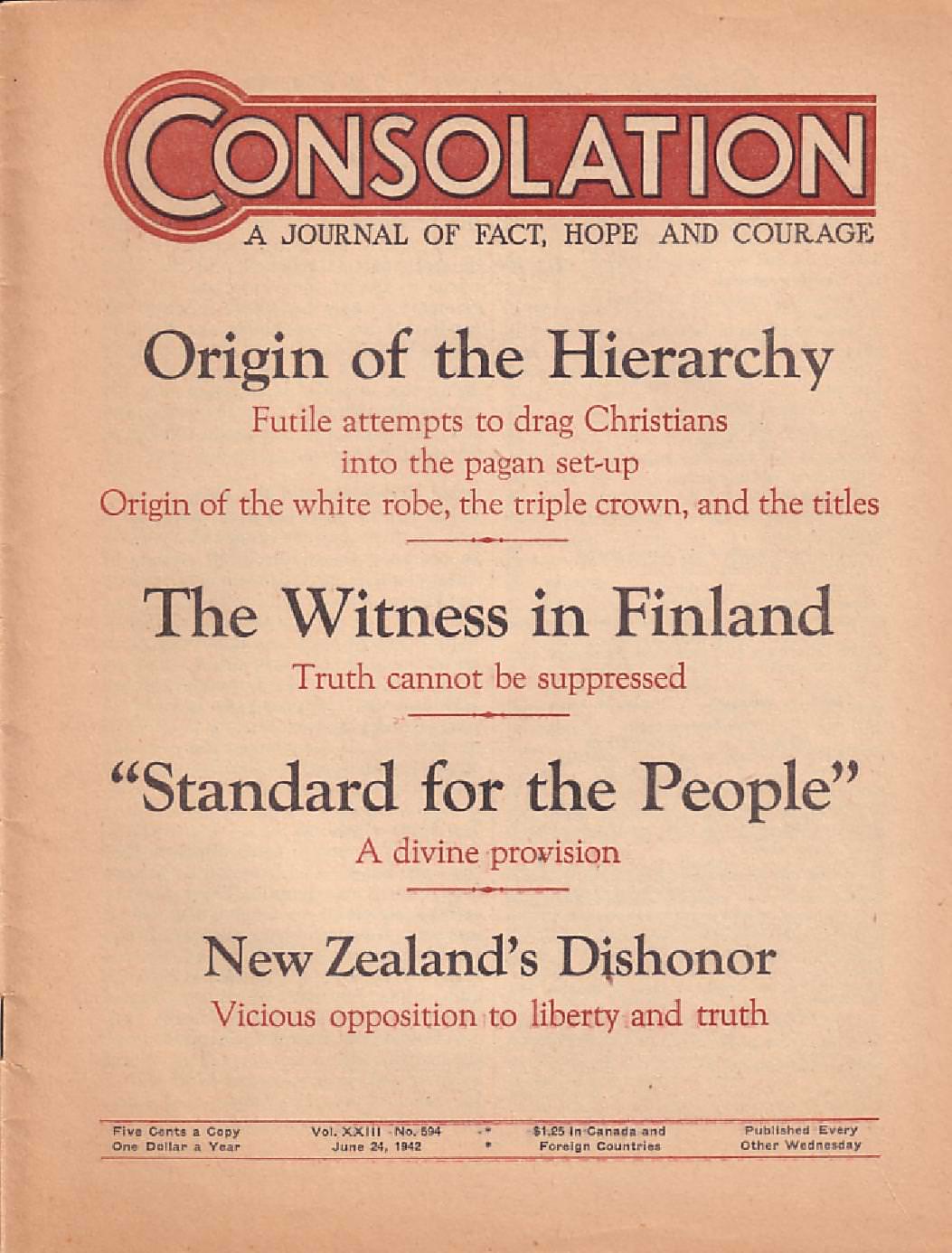
Contents
Origin of the Roman Hierarchy 3
The Diocletian-Galerius Conference 3
Artaxerxes and the Magi Priests 4
Why Pagan Persecutions Ceased 5
Origin of the Pope's White Robe 6
Constantine the Archhypocrite 7
Origin of the Papal Crown 8
Origin of the Blasphemous Titles 9
Back to the Soil 10
The New Government
Vigorously Pressing On in Finland 12
Theocracy 16
Ban on the Bible in Jamaica 16
"Thy Word Is Truth"
"Standard for the People" 17
Aviation 19
The Four-footed Folks 21
Picking His Company 21
Dogs Are Like Humans 22
Notice to Salt Lake City Deer 23
Wild Boar in Connecticut 25
The Ape Mother and the Doctor 26
Presenting "This Gospel of the Kingdom" 26
British Comment
Everlasting Dishonor for New Zealand 29
Australia's Nightmare Is Real 30
Some Schoolboy "Howlers" 30
Seeing the British Isles 31
Published every other Wednesday by
WATCHTOWER BIBLE AND TRACT SOCIETY, INC.
117 Adams St., Brooklyn, N. Y., U. S. A.
Editor Clayton J. Woodworth
Business Manager Nathan H. Knorr
Five Cents a Copy
$1 a year in the United States
$1.25 to Canada and all other countries
NOTICE TO SUBSCRIBERS
Remittances: For your own safety, remit by postal or express money order. When coin or currency is lost in the ordinary mails, there is no redress. Remittances from countries other than those named below may be made to the Brooklyn office, but only by International postal money order.
Receipt of a new or renewal subscription will be acknowledged only when requested. Notice of Expiration is sent with the journal one month before subscription expires. Please renew promptly to avoid loss of copies. Send change of address direct to us rather than to the post office. Your request should reach us at least two weeks before the date of issue with which it is to take effect. Send your old as well as the new address. Copies will not be forwarded by the post office to your new address unless extra postage is provided by you.
Published also in Greek, Portuguese, Spanish, and Ukrainian.
OFFICES FOR OTHER COUNTRIES
England 34 Craven Terrace, London, W. 2
Australia 7 Beresford Road, Strathfield, N.S.W.
South Africa 623 Boston House, Cape Town
Mexico Calzada de Melchor Ocampo 71, Mexico, D.F.
Brazil Caixa Postal 1319, Rio de Janeiro
Argentina Calle Honduras 5646-48, Buenos Aires
Entered as second-class matter at Brooklyn, N. Y., under the Act of March 3, 1879.
Notanda
Innocent Incendiaries on the Farm
◆ Experiments at Iowa State College show that in thirty hours the bacteria in hay which is slightly damp will multiply more than 6,300 times, and the digestive processes of the microbes push the temperature up until, perchance, the danger point is reached and the barn burns to the ground, bugs and all. The calculations are that these innocent incendiaries are responsible for burning some $30,000,000 worth of property every year. The only way to keep them from doing this mischief is to make sure the hay is dry when put in the mow, and that the mows are not made too large. So say the experts.
Dried Vegetables and the War
◆ 350 pounds of dried peas weigh 4,000 pounds when they are canned and packed. In ordinary times this 3,650 pounds of water could be carried around and nobody would give much attention to it, but now space is at a premium and it is different. In the case of tomatoes it is even more noticeable. 125 pounds of dried tomatoes, if canned in the usual manner, weigh 1,800 pounds. The peas ratio is 1 to 10.5 parts water; the tomato ratio is 1 to 13.5 parts water. At the moment there are big opportunities for those that know how to select, dry and pack foods.
Too Many Blessings
◆ The cry arises in some quarters that the Lord has blessed America with more food than it can handle. There are not enough elevators to receive the wheat, nor enough railroad cars to carry it. The food is urgently needed abroad, but the ships are needed for planes and cannons and other features of those "moral achievements of man" in which the Federal Council of Churches offered to clothe the world a little while back. This 'moral achievement clothing' seems to have thus far reached only the diaper stage, and undersized diapers at that.
CONSOLATION
"And in His name shall the nations hope."—Matthew 12:21, A. R. V.
Volume XXIII Brooklyn, N. Y., Wednesday, June 24, 1942 Number 594
Origin of the Roman Hierarchy
THE year 305 (A.D.) stands out as one of the great mileposts of civilization. Diocletian, one of the last pagan emperors of what was left of the Roman Empire, was elected in the year 284. He reigned until 305, when he suddenly, and apparently unexpectedly, dropped the Imperial purple and retired from public life.
His predecessor, Aurelian, had made a supreme effort to establish the pagan worship of the Unconquered Sun with himself as the highest earthly representative of the sun. (The History of Medieval Europe, By Lynn Thorndike, Revised Edition, pages 70, 71)
Under Diocletian paganism, the state religion of the Romans, was to be repaired, reinforced and continued stronger than ever. Christianity, the "new religion" that was distracting the minds of the masses, was to be destroyed. It appears that, if it could not be destroyed, it was to be incorporated into the revamped pagan state religion. While "it is not in our power to relate", yet, from the revelations of Lactantius, private teacher of Crispus, Constantine's son, "we may suspect" what was taking place in "the secret intrigues of the palace" between Diocletian and Galerius. (Decline and Fall of the Roman Empire, By Edward Gibbon, Chapter XVI, paragraph 44)
The Diocletian-Galerius Conference
During the winter of 302, Diocletian was in Nicomedia in Asia Minor, some ninety miles east of Constantinople. One of the two Caesars (at that time) of the empire, Galerius, hero of the Persian war which had just ended, was closeted with him. I say closeted, for it is said that the two rulers of the eastern Roman world were in "secret" consultation during the entire winter. The subject under consideration, "we may suspect," was Christianity and the easiest way to handle it, whether by force of arms or by absorption into the general body of Roman paganism, thereby producing a contaminated—universal, catholic—religion agreeable both to the Christians and to the pagans.
This plan, if adopted, would be nothing new; for "it is true that the Roman emperors borrowed many of their methods of government from the monarchs whom they conquered, and that the Roman law, before it attained to its final perfection", had been reinforced by "the best of the laws of the Mediterranean world". (Thorndike, The History of Medieval Europe, Revised Edition, page 27) And speaking of Emperor Julian, who reigned in the same century with Diocletian and Galerius (he died A.D. 363), Gibbon says: "The same spirit of imitation might dispose the emperor to adopt several ecclesiastical institutions the use and importance of which were approved by the success of his enemies." (Decline and Fall, Vol. II, Chapter 23, page 427; Milman Edition) In fact, all that the Romans had ever had of lands, laws, traditions, customs or religion they had begged, borrowed, adopted or stolen from others.
Galerius was more than a coworker with Diocletian. At this two-man conferHence he assumed the rank and importance of a special envoy with an unusual message based on firsthand information which he had gathered during his recent stay in Persia. For, once again, “we may suspect” that a restless and inquisitive mind of the Galerius type could not long remain in that country or in any other country without seriously investigating the precise form of its religion, and of completely absorbing at least the outline of it, since religion, at that time, and especially the “Christian religion”, was just about as big a threat to the Roman Empire as Nazism is to the democracies at the present time.
After reading Gibbon’s Decline and Fall of the Roman Empire (Vol. 1, pages 227-239: Subject, “Religion of Zoroaster”), we may assume, without doing the slightest injustice to the recorded facts, that Galerius, during this winter and at this two-man conference, laid before Diocletian the following (and other) facts:
Artaxerxes and the Magi Priests
1. During the century that had just passed, Artaxerxes, king of the Persians, had revamped and firmly established, once again, the ancient worship of Zoroaster in the Persian kingdom.
2. His first act was to call a general council composed of the Magi from all parts of the domain—a total of 80,000 prelates responded to this call.
3. Zoroaster frowned upon fasting and celibacy, dubbing them instead “a criminal rejection of the best gifts of Providence”.
4. The Magi, or sacerdotal order, constituted the hierarchy, and the archimagus, who resided at Bach, was respected as the visible head of the hierarchy and the lawful successor of Zoroaster.
5. The destour or priest who received a tenth (tithe) of all material things was reverenced almost as God himself on earth. “If the destour be satisfied, your soul will escape hell torture; you will secure praise in this world and happiness in the next; for the destours are the teachers of religion; they know all things, and they deliver all men.”
6. The Magi were the masters of education in Persia, and to their hands the children even of the royal family were entrusted.
7. By an edict of King Artaxerxes, the exercise of every worship except that of Zoroaster was severely prohibited in the kingdom. Battering rams and flames of destruction soon wiped out of existence the temples and churches of Parthians, Greeks, Jews, Christians and the heretics of the religion of Zoroaster.
So, during this long conference spanning the winter of A.D. 302, with Emperor Diocletian in Nicomedia, history informs us, Galerius proposed, first of all, the calling of a council composed of representatives of pagan Rome, persons distinguished in the civil and military departments of state, thus following closely the methods of the Persian king as stated in the second paragraph just given.
The council was called, and the completed plan for the extermination of the “new religion”—Christianity—was explained, beyond all doubt, to the members of the council. The council lost no time in supporting the plan offered by Diocletian and Galerius. It appears that Diocletian was to supervise the prosecution of the work of destruction and, that done, he was to step down and out as emperor, to make room, apparently, for the head of the new fusion religion that was to take the place of Christianity. (Gibbon, Chapter XVI, pars. 44-48)
No sooner said than done, and the fatal day was set—February 23, A.D. 303. Just as daylight was beginning to break, the Praetorian prefect, accompanied by a number of generals, tribunes and officers of revenue, repaired to the principal church of Nicomedia, which was situated on an eminence in the most populous and beautiful section of the city. The doors were crushed in; the officials conducting the raid broke into the sanctuary; they searched for visible objects of worship—images!—for the pagan Romans were unacquainted with the simplicity of the Christian worship—and, finding none, contented themselves with committing to the flames the volumes of the Holy Scriptures. An army without, provided with instruments of destruction used in besieging fortified cities, took over the church, and in a few hours its towering spire, long the object of indignation and jealousy of the Romans, was leveled to the ground. (Gibbon, Chapter XVI, par. 45)
The next day the general edict of persecution was published. Galerius had held out for burning alive any person who refused to offer the pagan sacrifices, but Diocletian blue-penciled that, and the edict required only that all churches in the empire should be demolished to their foundations, and that anyone presuming to hold secret assemblies for the purpose of worship should be put to death.
Just as soon as the edict was posted in the most conspicuous place in Nicomedia, it was torn down by the hands of a Christian who expressed in doing so, and in terms that could not be misunderstood, his abhorrence for such impious and tyrannical governors. He was not exactly burnt alive, but he was roasted alive over a slow fire for this act.
◆ An endless number of persons, many of high rank, were torn from their families or their labors and thrown into prison; and the court as well as the city was soon polluted by many bloody executions. In a few days Diocletian, fearing for his own life, left Nicomedia. But the persecutions and the executions continued unabated throughout the empire.
There was a series of these edicts, their ultimate aim being, according to their wording, the complete destruction of the “Christian religion”, even the name. The property of all the churches was confiscated: it was sold to the highest bidder, united to the Imperial domain, bestowed on the cities and corporations or thrown to the rabble. Persons of a liberal birth were declared for ever incapable of holding any honors or employments; slaves were for ever deprived of their hope of freedom, and the mere fact that a Roman or a barbarian was found to be a Christian placed him beyond the protection of the law.
Why Pagan Persecutions Ceased
And then, in 305, having issued his final edict, Diocletian, for that unknown reason, suddenly divested himself of the Imperial scarlet. It seems as though he might have been saying, “There, now! I have drawn up the blueprint, go ahead and build the new State church that you wish.”
In 311 Emperor Galerius issued a decree in which he stated that the persecutions were to be discontinued on the ground that they were doing no good.
There were six emperors at this time, and in a few days after this final edict was issued, Emperor Maximin, associate of Galerius in the East, left for the provinces of Asia Minor. He had gone to Asia with the original plan up his sleeve, backed by whom, or encouraged by whom, we know not.
“Cruelty and superstition were the ruling passions of the soul of Maximin.” He was devoted to the worship of the Greek and Roman gods, to the study of magic, and to the belief in miracles. The living pagan prophets or philosophers whom he revered as the favorites of heaven were frequently raised to the government of provinces and admitted into the most sacred councils. The Christians, these men assured him, had been indebted for their victories to their discipline, and that the weakness of Roman paganism “had principally flowed from a want of union and subordination among the ministers of religion”. (Gibbon, Chapter XVI, par. 59)
Origin of the Pope's White Robe
“A system of government was therefore instituted,” Gibbon continues, “which was evidently copied from the policy of the church.” This form of blood transfusion sion put new life into the languishing body of Roman paganism. Maximin was not slow in putting into effect the first form the new Roman State religion was to assume. The historian says:
"In all the great cities of the empire the temples were repaired and beautified by the order of Maximin, and the officiating priests of the various deities were subjected to the authority of the superior pontiff destined to oppose the bishop and to promote the cause of paganism. These pontiffs acknowledged, in their turn, the supreme jurisdiction of the metropolitans or high priests of the province, who acted as the immediate vicegerents of the emperor himself. A white robe was the ensign of their dignity; and these new prelates were carefully selected from the most noble and opulent families. . . . The priests as well as the magistrates were empowered to enforce the execution of the edicts, which were engraved on tables of brass; and though it was recommended to them to avoid the effusion of blood, the most cruel and ignominious punishments were to be inflicted on the refractory Christians." (Gibbon, Ch. XVI, par. 59; italics mine) Keep in mind this white robe.
Here, then, is the first stab, faint though it may be, of that new, compromised religion of the Roman Empire, a religion fashioned entirely along the lines of the organization of "the church", and with officials corresponding to those of "the church", but with pagan names, pagan dress, pagan ceremonies, and destined to produce pagan results. Moreover, it was conceived, set in motion and promoted in its incipiency by pagans. For six years it was in operation, working side by side with Christianity, until the edict of Galerius in 311 extending clemency to "the church". It is not going too far to presume that during this six-year period many a string was being pulled by the compromise party behind the curtains.
It is necessary only to dip here and there into the spirit of the times, at that time, to behold the dense cloud of secrecy behind which any conspiracy might work with comparative freedom. The conferences between Diocletian and Galerius, as we have seen, were entirely in secret. The council of representative men called by these two officials early in 303 was held in secret. And we are told that a secret correspondence between Emperor Licinius and the German Goths led to the civil war between Licinius and Constantine, which resulted in the defeat of Licinius and was the means of his banishment and eventually led to his death.
Constantine, in 312, waged war against another of his co-emperors, Maxentius, emperor of the West, who was defeated and killed by Constantine that year. And the secret hand of tradition has written back into the records that it was during this war with Maxentius that Constantine saw in a vision the "cross" of Christ and heard the words, "In this sign thou shalt conquer," even though he was at that time a pagan and even though till the year of his death, 337, he remained a pagan.
In 305, when Maximin formulated his program for the fusion of Christianity and pagan interests in the empire, there were six emperors of the Roman world: Constantius and Constantine over the West, Maximian and Severus over Italy and Africa, and Galerius and Maximin over the East. Maxentius, successor to Constantius, was murdered by Constantine. Licinius, successor to Maxentius, was murdered by Constantine. Crispus, Constantine’s son, charged with secret designs against his father, was murdered by Constantine. The youthful Caesar Licinius, close friend of Crispus, was murdered by Constantine. And now, in 326, after the two last named murders, Constantine is sole emperor of the Romans. It is also after the historic church Council of Nice, A.D. 325, at which council Constantine presided and took a large hand in formulating the Nicene Creed.
It had long been a custom of pagan Rome, and long remained a custom of pagan Rome, when some far-flung political scheme was being cooked up, to kill off by murder, poison and apparent accident any and all persons or parties who would or might stand in the way of the accomplishment of that scheme. There could always be concocted an alibi for the act.
In the meantime—from 311 till 325—numerous decrees of toleration were issued, Maximin’s pagan cult lined up slowly but completely behind the general slogan ORTHODOXY, and Christians everywhere were termed HERETICS. At the Council of Nice, A.D. 325, the tenets of the new religion were set forth in a creed, which had been perfected during the past twenty years, expressing the first forms of belief of the “new religion”; and any and all opponents were rapidly dubbed “Arians” and marked as objects of future restrictions and persecutions.
Constantine the Archhypocrite
After Constantine accepted or had been elevated to the position of Supreme Pontiff in Maximin’s pagan cult, he published, A.D. 321, two edicts, one of them enjoining the observance of the first day of the week that was being celebrated everywhere by Christians as the Lord’s Day in honor of their risen Lord, but instead of calling it the Lord’s Day, he made use of the expression dies solis, which means day of the sun, or Sunday; and this he did so as not to offend the pagans while he favored the Christians. (Gibbon, Ch. XX, par. 2) The second edict directed the regular consultation of the pagan haruspices.
It is thus plain that at this time we have three religions in the empire: Christianity, soon to break into many fragments behind the name Arianism; paganism, destined to become inactive; and Maximin’s pagan fusionism with Constantine as its first active head, armed with the Nicene Creed, fated to drench Europe in blood under the banners of orthodoxy, universality and catholicism; and fated also to sap the intellects and shackle the progress of the nations of Europe for so many hundreds of years with its vile opiates.
It is not correct to assume that the mind of Constantine was fluctuating between Christianity and paganism in an attempt to decide sooner or later on the one or the other. Not that. Constantine was now putting into effect by law the outline of a new religion, a fusion between Christianity and Roman paganism: a catholic—universal—religion. He was acknowledging, on the one hand, a god for the Christians and, on the other hand, the gods of the pagans. “According to the loose and complying notions of Polytheism, he might acknowledge the God of the Christians as one of the many deities who compose the hierarchy of heaven.” (Gibbon, Ch. XX, par. 6; italics are his.)
By usurpation, intrigue and murder Constantine had made himself (with much undercover assistance) sole emperor of the Roman Empire, also supreme pontiff of the new State church; and he did not blush to assume the office of vicegerent of the Deity—vicegerent being one of the offices of rank in the Maximin pagan cult. “The reigning emperor, though he had usurped the scepter by treason and murder, immediately assumed the sacred character of vicegerent of the Deity.” (Gibbon, Ch. XX, par. 8)
No ruler ever gained as much power as was placed in the hands of Constantine without accomplices. His rapid promotion and ultimate elevation to the position of supreme ruler of the Romans can be accounted for only upon the assumption that he had strong backing. Hence, we are not surprised when Gibbon says “the enemies of Constantine have imputed to interested motives the alliance which he insensibly contracted with the Catholic church, and which apparently contributed to the success of his ambition”. (Ch. XX, par. 8)
The church historian Eusebius, official recorder of the power behind Constantine's throne, considers the second civil war with Licinius (A.D. 323) as a "religious crusade". (See Gibbon, Ch. XX, par. 10, footnote.) If Eusebius is correct, and no doubt he is, for he wrote with the approval and at the behest of Constantine, Licinius saw what was coming—a fusion of Christianity and paganism, with the emperor of the empire recognized as the supreme pontiff of the new setup. Licinius aimed, first of all, to protect himself from the all but certain defeat and murder now facing him, but he was also honest enough, possibly, to oppose any such corruption as a fusion between paganism and Christianity.
Origin of the Papal Crown
Following the defeat and murder of Maxentius by Constantine, a triumphal arch was erected in Rome; and the pagan orator set out in glowing terms the dogmatic assumption that the pagan emperor of the Roman Empire, and he alone, enjoyed, and would continue to enjoy, secret communion with the Supreme Being (Gibbon, Ch. XX, par. 13); and this Supreme Being "delegated the care of mortals to his subordinate deities". That was another way of saying the pagan emperor of Rome was God's sole representative on earth, and that God spoke only to and through him. Thus, the origin of the title on the Papal crown: VICARIUS FILII DEI.
It will be recalled that in 311 Galerius issued his edict which put an end to all persecutions of Christians—for the time being. The next year Constantine defeated and murdered Maxentius, emperor of the West; and from that day till the defeat and death of Licinius, in 323, that "secret correspondence" behind Constantine pushed him higher and still higher through blood and murder until it had seated him, in 325, in the presiding officer's chair at the Council of Nice where the Maximin fusion party backing Constantine succeeded in obtaining an overwhelming ratification of its platform, known to the world as the "Nicene Creed". From that moment Arianism—Protestantism—CHRISTIANITY was a thing separate and apart from ROMANISM. And there, at the Council of Nice, A.D. 325, you have the first Catholic council, the first pope in anticipation, and the beginning of the Papal Hierarchy as it is known to history.
But that was only the beginning. It was not till years—centuries—later that the machinery at that time perfected began to function. It was not, in fact, till the days of Gregory the Great (590-604) that the head of Maximin's fusion cult had firmly established itself as the supreme spiritual and temporal power of the Roman world. That head was the Roman Hierarchy. By this time or long before, the office of emperor of Rome had disappeared; the Roman senate had disappeared; the tribunes had disappeared; the praetorians had disappeared. Gregory the Great was now emperor, supreme pontiff and temporal ruler of the rapidly vanishing Roman Empire. His immediate associates were the senate; his chief bishops, the praetorians; and his lesser lights, the tribunes and what had been the other officers of the empire. The wild beast had eaten his keeper, and the beast now was in full possession of the estate.
But back to Constantine. Just before his death (A.D. 337) he summoned to the Imperial palace in Nicomedia a number of fusion bishops and made known to them that he wished to be baptized. Following the baptism he was given the pagan white garment of a Neophyte. (Gibbon, Ch. XX, par. 17) And after that, says the historian, he refused to wear the Imperial scarlet again. That scarlet was to go to another—his successor on the Imperial throne who was to become, in time, as in the days of Gregory the Great, the supreme pontiff of the Roman world, of the Roman fusion church, and of a deranged, deluded and to-be-pitied Roman people.
"The gratitude of the church has extolled the virtues and excused the failings of a generous patron, who seated Christianity on the throne of the Roman world.” (Gibbon, Ch. XX, par. 18) That is, the pagan Roman world; for it was a pagan scarlet robe, representing a pagan throne, that Constantine, refusing to wear it any longer, tossed into the hands of his pagan successors.
Subsequent pagan emperors exercised supreme jurisdiction over the ecclesiastical order that had been founded by Maximin and firmly established by Constantine—after Constantine, backing Licinius, had murdered Maximin. “The emperors still continued to exercise a supreme jurisdiction over the ecclesiastical order; and the sixteenth book of the Theodosian code represents, under a variety of titles, the authority which they assumed in the government of the Catholic church.” (Gibbon, Ch. XX, par. 19)
The separation of the spiritual and temporal powers of the Roman Empire, which had been united until the days of Constantine, was now introduced and confirmed by the establishment of the Maximin setup in the Nicene Creed and the Theodosian Code. In this setup the pagan title of “supreme pontiff”, which, “from the time of Numa to that of Augustus, had always been exercised by one of the most eminent of the senators, was at length united in the Imperial dignity.” (Gibbon, Ch. XX, par. 20) And in his capacity as supreme pontiff of the empire, the emperor was at liberty, as often as he wished, to perform “with his own hands the sacerdotal functions”. Hence, the origin of “Supreme Pontiff” in Roman Catholicism. It was and is purely pagan.
“While the civil and military professions were separated by the policy of Constantine, a new and perpetual order of ecclesiastical ministers” was established “in the church and state”. (Gibbon, Ch. XX, par. 21; italics his)
The office of bishop throughout the Roman empire was, in the Maximin pagan order, a temporal rather than a spiritual dignity, and in the Theodosian Code provision was made for the office to be filled, not by clergymen (priests), but by laymen. “But the episcopal chair was solicited, especially in the great and opulent cities of the empire, as a temporal rather than a spiritual dignity.” (Gibbon, Ch. XX, par. 22) This was necessary for the reason that the work to be done by the fusion bishops was not spiritual but temporal—business. The bishops, therefore, were appointed as representatives of the emperor, not as representatives of any spiritual order, fusion, catholic, universal or Christian. And so it is to this day.
Origin of the Blasphemous Titles
The bishop—civil officer that he was—was appointed “the perpetual censor of the morals of his people”. The discipline of penance, which came now for the first time into being, was “digested into a system of canonical jurisprudence, which accurately defined the duty of private or public confession, the rules of evidence, the degree of guilt, and the measure of punishment”. (Gibbon, Ch. XX, par. 26)
The principal officers of the empire—not the church—were saluted, even by the emperor himself, “with the deceitful titles of your Sincerity, your Gravity, your Excellency, your Eminence, your sublime and wonderful Magnitude, your illustrious and magnificent Highness.” (Gibbon, Ch. XVII, par. 17; italics his) Hence the origin of some Catholic titles.
The pagan civil Patricians of Constantine were reverenced as the adopted Fathers of the emperor and the republic. (Gibbon, Ch. XVII, par. 20) Hence the origin of “Father” as applied to priests. A pagan title!
During the closing years of Constantine’s reign, “a secret but universal decay was felt in every part of the public administration, and the emperor himself, though he still retained the obedience, gradually lost the esteem of his subjects.” Hence the origin of that certain and fatal spiritual, moral and intellectual blight which follows in the wake of any appreciable amount of Roman Catholic influence.
After this pagan-Christian-fusion faction got through with him, Constantine was a perfect picture or prototype of Emperor Haile Selassie of Ethiopia. Ponder the following:
"The dress and manners, which, toward the decline of his life, he chose to affect, served only to degrade him in the eyes of mankind. The Asiatic pomp, which had been adopted by the pride of Diocletian, assumed an air of softness and effeminacy in the person of Constantine. He is represented with false hair of various colors, laboriously arranged by the skillful artists of the times; a diadem of a new and more expensive fashion; a profusion of gems and pearls, of collars and bracelets, and a variegated flowing robe of silk, most costly embroidered with flowers of gold." (Gibbon, Ch. XVIII, par. 3)
Back to the Soil
Burning Weeds Without Damaging Crops
◆ A new weed-burner, rigged to a cultivator or tractor, travels five miles an hour, covers thirty to forty acres per day, and disposes of weeds and many weevils and lice at an expense of about 8c to 10c an acre. While this device has not yet been patented, the experiments are far advanced, and it looks as if hoe labor might soon be a thing of the past. The weapons are compressed air and crude oil. The worst damage the machine has yet done is to slightly singe some of the young blades of corn, but no real damage has been done to any crops.
Bunches of Plums
◆ At Colchester, Vermont, an old plum tree died and out of its body grew a shoot that is now bearing plums, but they grow in bunches, like grapes. Sixty-one clusters were counted, the largest number of plums in any one cluster being 39. The original tree was not unusual in any respect, nor are nine other plum trees on the place.
Thus the origin of the pope’s outlandish regalia.
In such a costume Constantine was a perfect picture also of a long line of supreme pontiffs in this Maximin pagan-Christian fusion (and confusion!) state church. It is not surprising, therefore, that intellectual and honest Catholics during that great period of the awakening—the Renaissance—should have risked their lives to declare that the Roman Catholic church was and always had been Christian in name only; which was another way of saying it was and always had been, in fact, pagan, with a pagan emperor—Constantine—as its first pope, even though the title, "pope," was unknown at that time.—Valjean Monk, Florida.
Seedless Watermelons Not as Juicy
◆ Dr. C. Y. Wong, of Kwantung, China, breeder of seedless watermelons, finds that the seedless variety are not as juicy and therefore not as palatable as the good old melon with which most readers of this magazine are familiar. Moreover, after he had carefully smeared the blossoms of his watermelon flowers with the salve intended to make them seedless, they sometimes had small seeds, or bits of seeds, or seeds without the hard coatings.
Soy Bean Popularity
◆ The soy bean has attained such popularity that it is now the second most important crop in Ohio, Indiana and Illinois. The Baltimore and Ohio recently sent a "soy bean train" of six cars on a tour of fifty cities and towns.
Bigger and Better Peanuts
◆ Bigger and better peanuts come from inoculating peanut seeds with bacteria which inhabit the roots of soy beans and other pod-bearing plants.
Where the $710,000,000 Goes
◆ There are about 6,000,000 farmers in the United States. Besides the $13,700,000,000 which they will receive for the crops they market ($2,283 on the average) they will also get $710,000,000 in federal grants ($118 on the average) for certain other things. $300,000,000 goes for not planting cotton, corn, wheat, tobacco, potatoes and peanuts. $150,000,000 goes for soil-improvement work, $48,000,000 for sugar payments, and $212,000,000 for parity payments to certain growers.
Lightning as a Fertilizer
◆ Did you know that every thundershower is an enricher of the earth? It is just so. Speeding through the air at 60,000,000 miles an hour a thunderbolt releases nitrogen from the air. It falls in the form of nitric acid. By this means, it is calculated, more than 100,000,000 tons of nitric acid goes to the building up of soils, which is far more than all the fertilizer manufactured by all of earth's fertilizer plants put together can produce.
Use It on the Bugs
◆ The next time you have a headache, and are tempted to use some of this stuff sold to relieve headaches and quench fever, just dust it on infected plants, and you will find it kills melon, cabbage and army worms to beat the band. The one who made the discovery says that he put just a few pounds of the headache powder in a hundred gallons of water and it slaughtered the insects by the million. Seems like a valuable discovery.
Crop Control Payments
◆ Some of the crop control payments for participating in the government's program of cutting down on the acreage of certain commodities are $133,191 to the Prudential Insurance Company, $96,332 to the Metropolitan Insurance Company, $54,946 to the Delta Pine and Land Company of Scott, Mississippi (largest cotton plantation in the world). Eleven other companies received in excess of $35,000.
Putting Apples to Sleep
◆ Niagara county, New York, fruit growers have demonstrated that apples can be "put to sleep" in carbon dioxide gas at temperature of about 40 degrees, kept for a year, and then waked up as fresh and fruity as the day they were picked. The plan, originated at Cornell University, has been developed and much used in Britain and in South Africa.
Success of the Shelterbelt
◆ The shelterbelt of trees planted north to south across the Dakotas, Nebraska, Kansas, Oklahoma and Texas in 1934, to cut down erosion, is a great success. The trees are planted anywhere on farms in that area and prevent the soil from blowing away for a distance of about twenty times the height of the trees, now around 35 feet.
Peanut Oil
◆ Peanut oil is of use in combating the after-effects of infantile paralysis. This is one of the new uses discovered in addition to the 300 already on the record for the lowly peanut. Among these uses are breakfast foods, high protein flour, vegetable milk, ice cream powders, stock feeds, dyes, inks, and cosmetics.
The Big Annual Fire
◆ Every year in the United States more than 30,000,000 acres of timber lands are burned over. This comes to about 47,000 square miles, or an area nearly that of the state of New York. It seems like a big loss. Cigarettes have much to do with it. A careless hunter drops one, and away goes an area a mile square.
Bargain Seed Sets the Farmer Back
◆ Botanists have it figured out that the farmer who purchases bargain seed sets himself back $200 a year, because he loads himself up with Canada thistle, quack grass, field bindweed and dodder, which he has to eradicate and which take the place of crops that might bring him something worth while.
RIGHTEOUS RULER THE NEW GOVERNMENT
Vigorously Pressing On in Finland
◆ The year 1941 has been a wonderful one for our printery. Formerly the number of big books printed each year was about two or three thousand. Some years we printed none at all. This year we have printed 99,000 bound books, 50,000 of which were printed for Sweden. Besides that, we have printed 130,000 booklets, 113,350 copies of The Watchtower, 434,350 copies of our issue of Consolation, 148,600 folders, 166,250 tracts, and 2,400 circular letters; a total of 1,093,950 pieces of literature. As we had no rotary press, we used outside printers for certain work as long as it was possible to get them to work for us. They printed 350,000 booklets, 600,000 tracts, and 113,000 folders; all together, 1,063,000 pieces of literature. Each of these 600,000 tracts contained practically as much written matter as a 32-page booklet. The grand total of all printing thus done for us during the year was approximately 2,000,000 pieces of literature. This works out at three copies for each family in the country. No wonder the Devil has been very angry and made great efforts to stop the work.
A little later a public meeting was arranged in the second-largest city in Finland, where a theater was hired and paid for. We have for some time experienced difficulties there, and this time it was no easy matter to get a suitable hall. Our enemies managed to get the contract canceled, but at the last minute our friends succeeded in obtaining another hall, several kilometers from the hall originally hired. The meeting was advertised to start at seven o'clock in the evening. We had been advised that some of our enemies intended to use eggs at the meeting, and for that reason our friends told those among the people who seemed to be earnest, and who had come to the theater, to go to a certain place where they would get certain information. At that place they were told to go to a third place, where a bus connection had been arranged to take them to the second hall, where the meeting had been advertised to commence at eight o'clock. These arrangements were a means of sifting the people, so that we had a very fine audience. The hall was filled by half-past seven, and so an earlier start was made. The police had received information that we would be starting at eight o'clock, and they arrived whilst the lecture was in progress. They went to the janitor and demanded that he should stop the meeting, but he said that he had no right to do this; so the lecture went on right to the end, after which I and some others were called before the police, who could, of course, now do nothing. The chief of police in that place had said that he would see to it that no meetings would be held in that city. To see the Lord's hand in the matter was a very great encouragement to the friends. Immediately after the meeting several of the interested expressed their desire to symbolize their consecration.
The following evening we had a meeting in Finland's third-largest city. Our friends had succeeded in getting the biggest and best hall in the place. When we arrived, a little before the advertised time of starting, the strong-arm squad was outside informing the people that they could go away as no meeting would be held, and it seemed at first that this would really be the case. We went to one official after another, coming at last to the district governor. He refused to give permission for the meeting to be held, and one of our friends then informed him that the Minister of the Interior had nothing against such meetings. The governor telephoned to the Minister and even at that late hour happened to catch him. The Minister said that the meeting could be held, and the police were so informed. The result was that the Lord had the doors opened just five minutes before the lecture was due to commence, and we had a packed house. There was seating accommodation for 800, but 1,250 managed to get crowded inside, whilst several hundred were turned away. And what a meeting it was! One could see how those present hung upon each word, and when we announced that a meeting would be held at the close for those who had made, or who desired to make, a consecration of themselves to Jehovah, 600 people remained. After the second meeting several were baptized.
Theocracy publishers, Hayne, North Carolina, ready for street work
In order to inform the people of Finland of what was going on, a newssheet headed, “Is Religious Intolerance Practiced in This Country?” was printed. This was signed by the members of the committee who presented the petition before mentioned. In the newssheet it was clearly shown that the clergy were behind the persecution in Finland, and that they used their newspapers in supporting that persecution. Reference was also made to the charge that a wrong motive prompted your writings, and we quoted from the fine article entitled “Love” in the Crisis booklet, so that the people themselves could see that a bad source or wrong motive could not be responsible for such a desire to honor the Most High. The newssheet also contained a challenge, set out in very large type, with the following contents: “For the benefit of our people we challenge all the theologians and religious practitioners in Finland to show where the teachings of the Publishers of THE THEOCRACY differ from the Bible. If they can do that, we for our part will desist from those teachings; but if they cannot do so they must stop their persecution of us and of those who believe as we do, and also stop causing officials to make attacks against innocent people, so that those who are fully consecrated to God and are faithfully following in the footsteps of Jesus may use their small means and powers for the benefit of their country and their fellow men. We are fighting only against false teachings, as the truth alone can bring lasting blessings. We claim that there is not a single place in the Bible where it is stated that the soul is immortal, that there is a trinity of Gods and that Jesus was at the same time God and man, only to mention a few samples of the teachings which are wrongly claimed to be teachings of the Bible. We are willing to pay half the expenses for arranging a debate upon this matter. Let the clergy and preachers of Finland select their best man, and we will choose our man for that occasion. . . . If the clergy and other supporters of religion do not accept this challenge it will prove that they have been promulgating false teachings."
In a few days 300,000 copies of this paper were spread throughout Finland and copies were specially sent to every clergyman in the land. Needless to say, the challenge was not accepted, but a great cry was raised in the papers controlled by the clergy. The most interesting point in the articles published by these newspapers was a denial that the soul is immortal, giving the proof, from the Bible, that the soul dies. It was quite clear that the printers of Helsinki had come to an agreement not to print our newssheet, although one printer said he would like to do so but was afraid of the consequences. Only one firm agreed to do the job, but the price they asked was a million Finnish Marks, or $20,000, which was twenty times the price we ultimately paid to a firm in another town. The young men at the printing works at the latter place said that the job was the only good thing they had ever done.
As the food question has been a very severe one, we have been very grateful to have our little farm. It has been a great help to us and we have had the food we have needed to carry on with the Lord's work. No doubt, the care bestowed upon the crops has had much to do with their successful growth, but it is a noticeable fact that certain vegetables grown on the farm are more than twice the size of those sold on the markets.
One brother had received civil work at a hospital. The doctor in charge demanded that the brother should salute him in military fashion. This was, of course, refused, and a court case ensued, resulting in the brother's receiving a prison sentence of two years and one month. The doctor had no right to demand a military salute, of course, but the real reason for the prosecution was the fact that the brother had been giving a constant witness to all with whom he came in contact, and this had to be stopped.
Theocracy publishers, Wilkes-Barre, Pennsylvania
One of the motor scooters doing service in spreading the knowledge of THE THEOCRACY in Cleveland, Ohio
A Theocratic worker in East London, England
Three brethren were sentenced to death and were actually blindfolded before the firing squad. Just as the order to fire was to be given a messenger ran up with a countermanding order. It was stated that it was not intended that the order to fire should be given, but that the whole thing was done to see if the brethren would give way and agree to do military service. If such was the case the action was entirely illegal. The matter is being looked into, but there is little hope these days of obtaining justice in even a slight degree; for behind the judicial powers stand the clergy, and it is their declared intention that Jehovah's witnesses shall be dealt with in such a way that they will not be able to carry on with their work. They have now succeeded in causing our association to be banned and dissolved, in taking away our literature and in incarcerating the bulk of our most energetic brethren. Yet it has been a great witness to the authorities, and although they have for some time threatened to stop our magazines, by the Lord's grace we are still able to get them out.
The confiscation carried out by the authorities is illegal in every way. They have taken phonograph records, phonographs and magazines to which, according to their own law, they have no right. We protest as much as we are able and use every opportunity to give a witness before the authorities, as Jesus said that for that reason we would be taken before magistrates and the courts. All other public witnessing in Finland has now practically come to an end.
Yet we who are still free are working with magazines, Bibles, concordances and some of our literature which, despite all persecution, is still in our possession.
Almost daily new friends are symbolizing their consecration; and so the work is still going on. We hope and pray that, by the Lord's grace, we may be permitted to be faithful in this service unto the very end. We are looking forward with interest to see how the Lord will guide the work, knowing that soon the enemy with all his organization will be swept away. —1942 Yearbook of Jehovah's witnesses.
Baptism in a river in Brazil
Theocracy
◆ The earliest recorded use of the term “theocracy” is found in Josephus, who apparently coins it in explaining to Gentile readers the organization of the Jewish commonwealth of his time. Contrasting this with other forms of government—monarchies, oligarchies, and republics — he adds: “Our legislator [Moses] had no regard to any of these forms, but he ordained our government to be what, by a strained expression, may be termed a theocracy, by ascribing the power and authority to God, and by persuading all the people to have regard to him as the author of all good things.” (Against Apion, book II, 16)—Catholic Encyclopedia.
Ban on the Bible in Jamaica
◆ That it is the Roman Catholic Hierarchy who are really responsible for this effort to hinder and stop the work of proclaiming the message of God’s Kingdom in this land is clearly shown in the fact that when the Branch servant attempted to obtain permission and a license to import certain Bibles published by a worldly printing concern, not the Society, this was denied, even though such Bibles be sent as a gift to the people of Jamaica. It is well known that the Devil’s Catholic Hierarchy has always done its utmost to keep the people from reading the Bible.—1942 Yearbook of Jehovah's witnesses.
Witnessing in Sweden in Perilous Times
◆ SOUND WORK. There are 1,200 phonographs available for this work, and the sound attendance reported is 292,925, which figure is 26,120 less than that for last year. One case is reported where a pioneer sister had opportunity to get into a military camp and play a lecture to a number of soldiers. Some of these got so interested that they fitted the phonograph onto the radio apparatus in the dining hut, and then several lectures went out to more than 600 people.—1942 Yearbook of Jehovah's witnesses.
Overcoming Difficulties in China
◆ Six hundred copies of the book Enemies (Chinese) were recently ordered from Java Depot. When on arrival in Shanghai we found that these books had been censored—some of the pictures, including that of the pope’s head (center of book) and the Roman Catholic religious inquisition on page 319, had been blotted out. This was evidently done by some religious fanatic in an attempt to cover the exposure and exit (a la Haman) of the Hierarchy. The damage done to the books was irreparable, but we took advantage of the circumstance by inserting a copy of original picture and a printed statement showing how it all happened, etc. This really made the books far more desirable than they otherwise would have been. “The wrath of men shall praise the Lord!”
“There is usually a big crop of missionaries and religious workers in China, but because of hostile conditions, high cost of living, difficulties in traveling, and the hot, sticky summer weather, this gentry has for the most part sought out a more congenial atmosphere elsewhere. One can imagine that those who are forced to remain find the situation anything but pleasant, particularly if one of those witnesses of Jehovah comes along scattering ‘coals of fire over the city’. Truly, Theocracy and God and the State find a mixed reception. It is extremely interesting to watch the facial expressions of those approached and to note their remarks. One missionary, in charge of a rest home, said to me: ‘The Devil?—I don’t believe in any devil.’”—1942 Yearbook of Jehovah's witnesses.
Witness Activities in Switzerland
◆ During the past fiscal year we had 11 regional service conventions, with 4,850 attendants and 232 who symbolized their consecration by immersion, as well as one Theocratic general convention with 1,640 attendants and 77 immersed.—1942 Yearbook of Jehovah's witnesses.
(To be continued)
"THY WORD IS TRUTH" - John 17:17
"Standard for the People"
A STANDARD is a guide directing the people in the course they are to take, and which standard is raised up to enable the people to clearly see that course. In all nations the people in general have had to depend upon their rulers to lift up a standard for them. All standards held up before the people for centuries past have failed, and now every nation of "Christendom" is in distress and perplexity. Such an unsatisfactory condition could not exist if the scheme of government or standard had divine approval and authority. Why have these standards failed, and why is there so much distress all through the earth? Frankly, the answer is, Because the people are in darkness concerning Jehovah and His Word and have been blinded by Satan, "the god of this world," and by his religion.
It is written, in Psalm 33:12, "Blessed is the nation whose God is Jehovah." (Am. Rev. Ver.) While the nations of "Christendom" claim to be operating by divine right and approval, not one of them gives its unqualified allegiance to Jehovah God, and therefore their claim of divine authority is untrue. This unsatisfactory condition has come about in this manner: Men have formed governments and lifted up selfish standards to be followed by the people. These have ignored the instruction of Jehovah's Word and relied upon the wisdom of men and therefore have fallen easy victims to the wily foe Satan. The scheme of Satan has ever been to turn all mankind away from the true God, Jehovah, and to lead them into the paths of selfishness and unrighteousness.
Distressing conditions have now reached a climax, because Satan's world or uninterrupted rule has ended and Jehovah God has announced His purpose to completely destroy Satan's organization and to remove blindness from the eyes of understanding of the people of good-will, that they may see and know that Jehovah is the only true God, from whom all blessings flow. Not only are the people and nations in distress and perplexity, but they have reached an extremity. Before God proceeds to completely destroy Satan's organization, He directs that those who love Him shall lift up before the people God's standard of righteousness, that all people of good-will may see the right way in which to go. Therefore this commandment is written, in Isaiah 62:10, directed to Jehovah's faithful witnesses, to wit: "Go through, go through the gates; prepare ye the way of the people; cast up, cast up the highway; gather out the stones; lift up a standard for the people."
What is that standard which Jehovah commands must be lifted up for the people? That which is of first importance in that standard is that Jehovah is the only true and living God. He is the Creator of heaven and earth, and the source of life and all attending blessings. He created the earth for man and man for the earth. He is the true and lasting Friend of man. His Word, the Bible, is the truth and is the light by which the feet of men are guided properly into the pathway of righteousness. All persons must come to know that Jehovah is God, and must boldly confess it if they would live.
Also, the divine standard shows that Christ Jesus, the beloved Son of God, is the Redeemer of believing and obedient men; that His blood was poured out in death in order that man might have an opportunity to live; that Jehovah raised up Christ Jesus out of death, exalted Him to the highest place in heaven, and committed into His hands all power in heaven and in earth; that Jehovah has made Christ Jesus the King of His THEOCRATIC GOVERNMENT or Kingdom and has appointed the time in which He shall judge the world in righteousness.
◆ Jehovah’s standard also discloses that Satan’s wicked rule must now come to an end; that Christ Jesus, the rightful King of the new world, is now upon His throne and that Christ has thrown Satan out of heaven and that His next great act after having Jehovah’s name declared by His witnesses throughout the earth will be the complete destruction of Satan’s power in heaven and in earth. That destruction of Satan’s organization, of which organization “Christendom” is most prominent on earth, will take place in the great battle of God Almighty, the battle of Armageddon; and, with the fraudulent and wicked rule of Satan for ever destroyed, righteousness will prevail in the earth forever; and then Christ, the great King invisible to mankind, will rule the world in righteousness, and His visible representatives on the earth will carry out His rule of order for mankind’s welfare.
This divine standard points the people, not only to the way of everlasting peace and prosperity, but also to the way of everlasting life and happiness. The fact that Jehovah commanded that His standard be now lifted up for the people is conclusive proof that the time has come when the people desiring life must have an opportunity to know Jehovah God and His purposes. Hence the world-wide educational campaign now carried on by His witnesses in the face of persecution.
Note that the commandment Jehovah gives His witnesses is to “go through the gates; prepare ye the way of the people”. Jehovah’s servants are therefore commanded to take the lead and show the people the way out of Satan’s organization and its religion and show the way that they must go to enter into the favor of Jehovah and His kingdom. They prepare the way for the people by telling them the truth. They point out to the people Jehovah’s great highway, and go up on it in advance of the people of good-will. They gather out the stumbling-stones by showing the people that the many doctrines taught by the religionists of earth are false and hence have caused honest people to stumble. They lift up, not man’s standard, but Jehovah God’s standard, which guides the people into everlasting joy and life.
Never in the history of man has it been so important that the people learn the truth. They must have some aid to know where in the Bible to find the great truths and how to fit these to the facts of today. The books that Jehovah’s witnesses bring to them are such aids disclosing to them Jehovah’s standard; and, learning what is upon that standard, they may rejoice and live forever in happiness.
The standard of Jehovah holds forth a real hope for the people. There can be no hope without faith; and there can be no faith without knowledge and then a confident reliance upon that knowledge. (Romans 10: 13-17) The promises of imperfect men constitute no basis for hope. The promise of Jehovah God is sure and certain, upon which the people can wholly rely. His promise is that the government of the new world shall be upon the shoulder of His beloved Son, who shall be known as the Wonderful Counselor of the people; the Giver of life and happiness, and the Prince of everlasting peace. (Isaiah 9: 6, 7) This promise Jehovah has made and bound with His oath, and then, that He might further assure the people, He adds: “I have spoken it, I will also bring it to pass; I have purposed it, I will also do it.”—Isaiah 46: 11.
“Thou hast given a banner to them that fear thee, that it may be displayed because of the truth.”—Psalm 60: 4.
“Thus saith the Lord God, Behold, I will lift up mine hand to the Gentiles, and set up my standard to the people.”—Isaiah 49: 22.
“And in that day there shall be a root of Jesse, which shall stand for an ensign of the people.”—Isaiah 11: 10.
Aviation
New Flying Boats
◆ Mars, the world’s largest flying boat, has four propellers each 17 1/2 feet in diameter, and itself weighs 67 tons. It carries a crew of 11 men and has an interior space approximately the size of a ten-room house. The Capetown, a forty-two-ton flying boat, took off on its initial flight from New York to Leopoldville in the Congo on November 10, 1941, and on the longest trip. It hopped the ocean between Brazil and British Gambia, in Africa, after stops at Puerto Rico and Trinidad, and also stopped at Liberia, in Africa, going and coming. The round trip is 18,290 miles. Quite likely, future trips from America to the Orient will be via Africa, as the Japanese have severed the route from America to the Philippines, including the submarine cables that connected San Francisco and Manila via Midway, Wake and Guam.
No Private Ocean Flights
◆ The discovery that a private ocean flight to London and return could not be made for less than $100,000 was brought to light when a German refugee father, a man worth some $75,000, was unable to arrange to have his family brought over from London, even when he was willing to put up for the flight every dollar’s worth of property that he possessed. While the war is on, private flights, though not strictly impossible, are virtually so.
Autogiros for Spotting Fires
…