Consolation, June 10, 1942
Download: PDF — Consolation, June 10, 1942
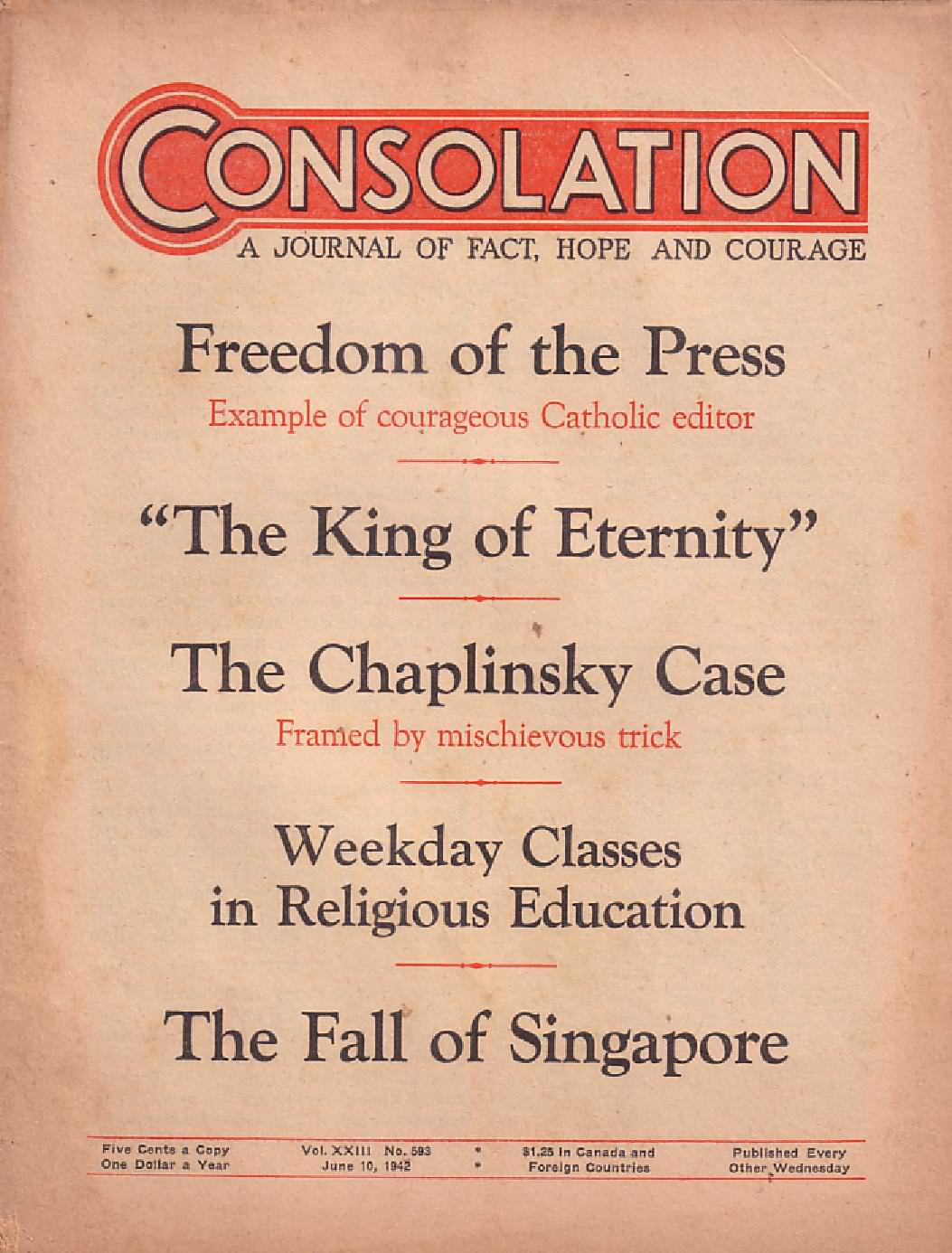
Contents
Freedom of the Press 3
Perplexities of the Church Business 10
Weekday Classes in Religious Education 11
The Rugg Textbooks 12
The Apocrypha Again 12
Flower Lore 13
Flowers as Food 14
Plant Oddities 15
"Sugarin' Off" Parties 15
"Thy Word Is Truth"
"The King of Eternity" 16
"The Earth Hath He Given to the Children of Men."—Psalm 115:16 18
The Carnivorous Plants 18
No Room for the Wheat 18
Earthworms as Soil Improvers 19
The New Government
The Chaplinsky Case, in New Hampshire 20
Argentinians Long for The Theocracy 22
"Jehovah Looseth The Prisoners" 23
She Answered Her Own Question 23
The Flag
Its Friends, Jehovah's witnesses 24
Its Enemies in Its Folds, Catholic Legionnaires, Priests, Dupes 24
Presenting "This Gospel of the Kingdom" 25
Gallimaufry 27
The Fall of Singapore 29
Published every other Wednesday by
WATCHTOWER BIBLE AND TRACT SOCIETY, INC.
117 Adams St., Brooklyn, N. Y., U. S. A.
Editor Clayton J. Woodworth
Business Manager Nathan H. Knorr
Five Cents a Copy
$1 a year in the United States
$1.25 to Canada and all other countries
NOTICE TO SUBSCRIBERS
Remittances: For your own safety, remit by postal or express money order. When coin or currency is lost in the ordinary mails, there is no redress. Remittances from countries other than those named below may be made to the Brooklyn office, but only by International postal money order.
Receipt of a new or renewal subscription will be acknowledged only when requested. Notice of Expiration is sent with the journal one month before subscription expires. Please renew promptly to avoid loss of copies. Send change of address direct to us rather than to the post office. Your request should reach us at least two weeks before the date of issue with which it is to take effect. Send your old as well as the new address. Copies will not be forwarded by the post office to your new address unless extra postage is provided by you.
Published also in Afrikaans, Bohemian, Danish, Dutch, Finnish, French, German, Greek, Hungarian, Japanese, Norwegian, Polish, Portuguese, Spanish, Swedish, Ukrainian; also special Australian edition in English.
OFFICES FOR OTHER COUNTRIES
England 34 Craven Terrace, London, W. 2
Canada 40 Irwin Avenue, Toronto 5, Ontario
Australia 7 Beresford Road, Strathfield, N.S.W.
South Africa 623 Boston House, Cape Town
Entered as second-class matter at Brooklyn, N. Y., under the Act of March 3, 1879.
Notanda
Farm Lands Booming
◆ Farm lands always boom in war times, and are booming now. American crops for 1941 were big, and prices good. In some sections schools were recessed so that the children might help to harvest the crops. Vegetable and fruit canning broke all records, with the government buying the 10 percent extra pack. In World War I farm values in the United States went from $35,000,000,000 to $70,000,000,000, and then subsequently shrank back to normal, leaving vast numbers of farmers, and plenty of banks and insurance companies, victims of the hallucination that booms last forever.
Importance of Worms
◆ One of the greatest manufacturers of plant food is the humble earthworm, of which there are upward of 1,000 varieties known to science. Set two plants in flowerpots of the same size; use the same earth in each. Put earthworms in one of the pots and not in the other, and the pot with the worms will produce a plant of approximately twice the size of that grown in the other pot. Chickens supplied with a percentage of worms in their diet grow much more rapidly than otherwise.
Astonishing Root Growth
◆ Measurements of a clump of prairie grass in a mass of soil seven feet deep and four feet square, conducted by the University of Saskatchewan, disclosed two miles of roots were added by each day's growth, and the total mileage for the clump for a season was 320 miles.
Always Carry Both Cards
◆ Selective Training and Service Act of 1940 and the Presidential regulations thereunder require that each male person who has registered under the Act must at all times carry on his person his registration card and classification card. This should be complied with at all times.
CONSOLATION
"And in His name shall the nations hope."—Matthew 12:21, A. R. V.
Volume XXIII Brooklyn, N. Y., Wednesday, June 10, 1942 Number 593
Freedom of the Press
AT THIS time when America is fighting for the freedom essential to a continuance of democratic government, as well as against the aggressions of the totalitarian abomination, editorial and other comment on the subject of freedom of the press (one of the four fundamental freedoms) is timely. Consolation merely observes that all true freedom must be based upon a recognition of the fact that none is free from obligation to righteousness. This righteousness must be in conformity to the Word of God as it concerns the conduct of men in their relationship to Him and to one another, and the Word of God is found in the record He himself has provided in the Bible, the Holy Scriptures of the prophets and apostles of the people of God.
With this primary fact established and with the appeal to the reader that this be kept in mind in the examination of what follows, Consolation presents the following facts in such sequence as may best impress this truth.
A former well-known columnist a few years ago made the following observation with regard to the influence of a religious organization over the press:
Precarious is the position of the New York newspaperman who ventures any criticism of the Catholic church. There is not a single New York editor who does not live in mortal terror of the power of this group. It is not a case of numbers, but of organization. Of course, if anybody dared, nothing in the world would happen. If the church can bluff its way into a preferred position, the fault lies not with the Catholics, but with the editors.
This columnist subsequently became a Catholic himself, but it is not necessary to conclude that he essentially changed his attitude with regard to this matter.
Liberal Catholics claim a considerable amount of personal discretion in their doing and thinking, and are often a match for their otherwise-minded ecclesiastical monitors. By way of illustration, the course of the editor of the fine Courier-Journal of Louisville, Kentucky, may be mentioned. Although himself a Catholic he rejected the demand that he make an apology for running a birth-control advertisement in his paper. On May 27, 85 Catholics of New Haven, Kentucky, attempted a boycott in a joint letter canceling their subscriptions. Previously 102 readers had threatened reprisals if the apology was not forthcoming. The Courier-Journal replied editorially, declining to submit to coercion, and claiming the right to hold and express opinions even if some Catholics did not approve them, saying "it is no more wicked for a newspaper to disagree with an archbishop than to disagree with the president of the United States". The Courier-Journal is still going strong, although a Protestant or other non-Catholic publisher might have fared less pleasantly.
The courageous stand of this Catholic editor is a reproof to the generality of American editors and publishers. According to a historian, for it is history now, the American press was garroted by the Jesuit organization with reference to the reporting done on the Spanish rebellion. This Philippine historian says:
The fact that a majority of the American people up to the present day do not know the truth about the so-called “civil war” in Spain is solely due to the policy of intimidation of the press in the United States applied by the Roman Catholic Hierarchy. . . . At the beginning of the Fascist invasion of Spain, the American press was impartial and tried to print the truth: that the dictatorship had been voted out by the Spanish people in free elections, that a democratic government had been established, and that the big landowners, big business men, and reactionary militarists had negotiated with the dictators of Italy and Germany to overthrow democracy in Spain. The issue was land, bread, and liberty—not religion. Religion only came in when the Hierarchy made the case of the Fascists’ invaders its own. Within a short time, the Roman Catholic clergy in the United States had started a concerted action to suppress the truth in the American press, and it succeeded. The Spanish people who tried to defend themselves against the foreign invasion led by Spanish generals, were branded as “bolsheviks” while the invaders were held up as saviors of civilization.
There is a tendency now, and a definite tendency, on the part of certain Catholic clergymen to arouse hatred toward the president and the government on the grounds that America is helping the Bolsheviks. This trend will bear watching. That the sympathy of the clergy generally, and the Hierarchy as a whole, is with the totalitarian principle is too well known to require proof. There is, however, a large number of American Catholics whose sympathies are unequivocally with the democratic forces, regardless of the attitude of the Catholic press controlled by their priests.
In the United States Catholic editors incline to give support to what they suggest are the “lesser Fascisms” of Franco’s Spain, Salazar’s Portugal, Degrelle’s Belgium and Petain’s France. (This observation is drawn from pre-war sources. It may be confidently expected that the Japanese assault will drive such sentiments undercover.)
In Canada
The stress of war came to Canada before it reached the United States. It became apparent after a while that the support given to the war effort by Quebec was negligible, and that there was, as a matter of fact, a very definite leaning toward sympathy for the Axis powers. Those who called attention to this situation were quickly attacked as creating and promoting disunity. In an editorial appearing in the Toronto Telegram September 27, 1941, this is apparent.
We are tempted to assert that The Globe and Mail is a hypocrite when it says that any one who champions equal rights and equal obligations for all Canadians is guilty of promoting disunity; for our part we want nothing to do with a unity that is built on special rights and evasion of obligations for any group of the population.
The charge of promoting disunity is evidently a favorite with certain groups, and is sent back and forth with a will. At any rate, The Globe and Mail carried an advertisement which, in bold letters, was headed with the statement: “Why the Italian Apostolic Delegate to Canada, Archbishop Antoniutti, Should Be Expelled for Subversive Activities”; and the archbishop of Toronto took occasion to write the paper a letter, from which the following is an extract:
No country in the world during this war has contemplated such an insult to the historic centre of Christendom as your advertisement demands. President Roosevelt, whose effective good-will to the cause for which Canada is fighting will not be questioned, has sent a special personal envoy to Vatican City. Great Britain, we may be sure, would be horrified at the suggestion of such an offense given by any British group to the highest and most potent moral authority in the world. Only our enemies could and would rejoice at a disagreement between a British country and the Holy See at this crucial time. Only Nazi propagandists will delight in the religious feelings and disunity caused by such an insult to the representative of Pope Pius XII.
While the newspapers of Canada thus appear to still have considerable liberty of expression, the Watchtower and Consolation magazines were prohibited from entering the country, at the behest of a religious organization that, according to many observers, is quietly working against the democracies by all possible means. As a preparatory measure numerous Catholic writers have stressed the word "subversive" with reference to these publications and Jehovah's witnesses, their distributors. This, however, comes with bad grace, and the American people are not so lacking in common sense as to think that Jehovah's witnesses, who are in concentration camps in every one of the totalitarian countries, would lend any aid or comfort to an enemy that is so evidently even more their foe than it is the foe of the democracies.
The tendency to interfere with the freedom of the press receives added impetus at times when the feelings of the people are aroused by such attacks upon their security and freedom as have been made by Japan and other totalitarian interests. This may seem like a paradox, but its truth will be realized when it is seen that such freedom implies not the freedom of the majority to go its own way, however obviously right, but the freedom to weigh impartially and state truthfully whatever is of sufficient weight to be given publicity at all, and in which the people are rightfully interested. Thus a fine balance is indicated, rather than a strong leaning in any direction. Such leanings are, however, granted expression on the editorial page, where they can be properly evaluated as the editor's own views.
Even before the present outbreak the press was concerned about its constitutional prerogatives. During National Newspaper Week last year there was a special effort made to center national attention on the vital importance of the declaration in the Bill of Rights that neither Congress nor any other legal authority shall ever enact any law or promulgate or enforce any policy abridging the freedom of the press.
On that occasion President Roosevelt gave his unqualified endorsement of the observance of this week, in a letter to William N. Hardy, chairman of the National Newspaper Week Committee at Harrisburg, Pennsylvania:
THE WHITE HOUSE
WASHINGTON
August 21, 1941
Dear Mr. Hardy:
The recurrence of National Newspaper Week should awaken in the hearts and souls of all Americans a renewed determination to defend and maintain and perpetuate the priceless heritage of a free press.
The maintenance of an unfettered press, informed by truth and guided by courage and conscience and wholehearted devotion to the public welfare, is a fundamental obligation of patriotism.
I trust as a result of the forthcoming observance that Americans everywhere will have a renewed sense of the incalculable blessing which a free press confers. It must be maintained against all assaults.
Very sincerely yours,
FRANKLIN D. ROOSEVELT.
Earlier in the year a plaque, in stainless steel, was presented to the American Newspaper Publishers' association, during its convention in New York. Under a representation of the American eagle the plaque bore the words:
LEST WE FORGET
Congress shall make no law respecting an establishment of religion, or prohibiting the free exercise thereof; or abridging the freedom of speech or of the press. — U. S. Constitution
It is to be hoped that the press of America will bear in mind, more fully than it did with reference to the Spanish rebellion, that this right involves also a responsibility to give the people the truth in spite of seemingly powerful opposition. Freedom of the press is not merely a freedom to publish what the publishers like, or even what the public itself may like, but to present the events and questions of the day with the proper consideration for truth. An honest newspaper will mirror the world as it is, without distortion or without obscuration, in any direction. It is not the prerogative of the newspaper to form or even influence public opinion. Nor is it justified in selecting and playing up out of due proportion matters of news that have a wide public appeal merely on that score.
Freedom of the press, like every other freedom, still leaves those thus free accountable to Jehovah, the great Judge of all, for the manner in which that freedom is used. Even the free citizens of a human democracy are subject to the requirements of the all-embracing THEOCRACY. Also the publishers and editors of newspapers and periodicals must remember that they are responsible to the Higher Powers for what use they make of the liberty and freedom which is allowed them as intelligent creatures, and which freedom and liberty are recognized, not granted, by the laws of the United States of America.
In this connection it will not be a digression to mention that the Roman Catholic Hierarchy, through its mouthpiece and head, has on various occasions specifically denied the freedom recognized and protected by democratic nations. This denial is probably not taken too seriously by American Catholics, or they may in some manner reconcile it with their own convictions in the matter. Certainly it is not the purpose of this article to call in question their patriotism or to call them "subversive" because of this well-known fact. While it is true that these papal pronunciamentos bear the seeds of disloyalty and subversion, and have indeed borne fruit in that direction on numerous occasions, it is fortunate that the majority of Catholics draw no such conclusions from them. They may be viewed by such as a too strongly stressed principle, that there is no liberty without responsibility. It is true, too, that the Hierarchy at Rome has sought to transfer the place of accountability from heaven to the Vatican, a fruitful source of subversiveness. The same ecclesiastical ruler has said of the Catholic press throughout the world that it is "his very own voice", an unfortunate statement in view of the many divergent opinions and observations.
Thus, it should be recalled that the 'highly blessed' publisher of Social Justice was at one time, and perhaps still is, deeply enamored of Hitler, Goering, Goebbels, et al., as well as their methods. This was true to such an extent that the paper carried almost word-for-word rehashes of the sentiments of that outfit and endorsed them. The "Very Reverend" Lodge Curran, publisher of Light magazine, also ran in the same direction, and his admiration for the totalitarian idea was matched only by his dislike for Jehovah's witnesses; a fact which can be well understood by all who have even the modicum of intelligence that is required to read the comics. It must be concluded that the pope, who called the Catholic press "his very own voice", has had that voice greatly obfuscated by 'sticking his "very own" foot in his mouth'.
The "freedom of the press" outside of the pope's "very own voice" appears to have been limited by the effect of that "voice" on more than one occasion, as is shown at the beginning of this article. One outstanding example may be mentioned. This was on the occasion when religiously zealous mobs of "patriots" suddenly and simultaneously attacked Jehovah's witnesses in many sections of the United States for circulating Scriptural and anti-Hitler books and pamphlets. The New York Post wanted to know the why and wherefore, and asked a statement of Judge Rutherford, one of Jehovah's witnesses, and president of the WATCHTOWER BIBLE AND TRACT SOCIETY, publisher of the literature circulated by them. It was understood that this statement would certainly be published. Hence considerable time was taken to make a complete statement, which the Post promptly refused to publish, although it is in some respects a liberal paper. The people were interested in the facts, but the pope’s “own voice” in the background (this time using the Jesuits, no doubt) had spoken, and “freedom of press” was thrown into the discard for the occasion. [The entire statement was then published by the WATCHTOWER BIBLE AND TRACT SOCIETY for the information of the public, and is still obtainable in pamphlet form.]
President Roosevelt, on April 17, 1941, told the American Society of Newspaper Editors that “free speech is in undisputed possession” of the press, the radio, the moving pictures, and that as far as he was concerned “it will remain there, for that is where it belongs”. He added, “It is important that it should remain there, for suppression of opinion and censorship of news are among the mortal weapons that dictatorships direct against their own peoples and direct against the world.” The chief executive wants no interference with these rights.
Nazi Postmaster at Charleston, S. C.
The postmaster at Charleston, South Carolina, J. G. Thomas, showed his attitude toward freedom of the press by posting upon bulletin boards in the various post offices under his jurisdiction the following notice:
All employes at this office, Station A, and the Navy Yard Branch are requested to keep a very careful watch on the following newspapers, and to furnish me with the names and complete addresses of all persons receiving copies of any of the papers. This information should be treated as confidential and under no circumstances should the addressees be advised that this list of subscribers has been recorded. As soon as the information is obtained, it should be sent to me under cover.
It is sure that more brass has not been shown in Germany or Italy than is shown by this un-American postmaster. He belongs where he would likely put those who take papers he does not approve.
Freedom of the press is somewhat hampered in cases of which the following is an example: The Chattanooga News was run out of business because it stood for the public welfare and was progressive and independent. The editor, John Fort Milton, was obliged to sell out, to Roy McDonald, but started another paper, The Evening Tribune, made possible, in part, by popular subscription. First the building The Evening Tribune had rented was destroyed by fire. Then McDonald wrote contracts for advertising which required the advertisers to limit their advertising to the McDonald paper. The Evening Tribune went into bankruptcy, even though McDonald and his treasurer were convicted later of violating the Antitrust Act.
In view of the foregoing the definition of “freedom of the press” printed in The American Guardian sounds an understandably ironic note:
Freedom of the Press: The right of any and all owners of publications to print anything they see fit, provided it does not conflict with the interests of their advertisers to the extent of withdrawing their patronage, thereby putting him out of business. However, even in such instances, the freedom of the press remains, inasmuch as the owner of the publication in question still retains the inalienable right to decide freely whether to change his mind or go out of business. . . . Also, the right of a non-owner of a publication to write anything the owners of publications may see fit to print.
The important bearing that advertising revenue has on the freedom of the press is evident. It was recognition of this fact that led the publishers of PM to exclude advertising altogether, and to publish information about sales in department stores, etc., as matters of news. It is said that Marshall Field III has sunk $2,000,000 in PM, and that he did it because the other stockholders were pulling out and he did not want to see the enterprise collapse. It was he that said he 'did not know what would become of all his money under present conditions, and he didn't give a damn'. Even with such liberal backing, PM may find it hard going. The "5 cent" price is doubtless one factor that limits its circulation. The venture is a gauge that shows the limitations of freedom of the press.
In Fact, a small, four-page pamphlet published by Geo. Seldes, gives its readers much information that is carefully hidden or kept out of the regular press. Like PM, it carries no advertisements; and while the subscribers do not get much paper for their money, they get lots of news. An example follows:
FREEDOM IN PHILADELPHIA
After 13 years of "fine work" John Malone, financial reporter of the Phil Eve Bulletin was fired because he took a humdrum business report and put a human interest touch to it. That touch, however, touched the department stores of Philadelphia, and dep't stores are No. 1 Sacred Cow and Raging Bull of American journalism.
Malone wrote: "Last week should have been an opportune time for retail store employes in this area to approach their bosses for a raise. The reason: Business was good. Sales in the larger establishments ran 10% ahead. . . ."
For Executive Editor Dwight S. Perrin this suggestion to dep't store and other workers to ask for a raise was treason—to the freedom of the press. He not only fired Malone but issued the most fantastic cockeyed and sacred bull story in journalistic history, saying that Malone had violated journalistic ethics.
The irony of the matter lies in the fact that the Bulletin has been an enemy of labor, liberal and progressive ideas for years, and has slanted its headlines and editorials for reactionary purposes (and Mussolini defines reaction and fascism as synonymous) for years.
Thanks to spirited work by Phil-Camden Newspaper Guild, however, Malone was reinstated. No Perrins, however, are ever fired. They are the mainstays of the sort of freedom of the press which the publishers are now celebrating in their annual convention. - In Fact, April 28, 1941.
Few newspapers publish the Federal Trade Commission's orders to cease and desist from advertising that misrepresents well-known products. Such orders have been directed against such advertisers as Ford, General Motors, Goodyear, Goodrich, Sears Roebuck, the biggest cigaret companies, and many others. It can well be seen why papers that depend on advertising for income would be shy about publishing such information, and it would not be outside of the proper limits of freedom of the press that papers be required to publish such obviously valuable information.
Other Dangers to Freedom
There has been considerable criticism of the publicity activities of the Federal government, which, in 1936, employed press agents to the number of 270, drawing salaries aggregating $521,000 a year. The possibility of using these employees for propaganda purposes brought the whole thing under suspicion as destructive of freedom of the press.
Numerous newspapers suppressed a statement some months ago by General Marshall, chief of staff of the U.S. Army, that Nazi Bundists and their sympathizers had engaged in sabotage in the Army by stirring up protests against the lengthening of service.
In September of last year an attempt by the Navy to influence public opinion against an independent air force, by supplying "editorial" matter to newspapers, was revealed.
The manner in which the press often distorts the news is shown in a dispatch published in the Burlington, Vt., Daily News for June 21, 1941, in which one of Jehovah's witnesses, a woman, was represented as attacking a policeman!
A group like Jehovah's witnesses furnish opportunity to see how exceedingly anxious the press can be to back up the great religious systems to the detriment of the individual's right to worship God
in harmony with the dictates of his conscience. In this particular case the fact was that the brave police officer, supported by two other men (?), attacked the lady witness, destroyed her phonograph and scattered her Bible literature over the street. The public had no way of knowing the facts except as its native common sense revealed the likelihood that there was something wrong with the story.
The coloring of news is well shown in the following bit of editorial wisdom (?) appearing in the St. Louis Post-Dispatch last August after the most remarkable convention, as well as the largest on record, of Christian people since Pentecost. Note the labored effort of the editorial writer to make Judge Rutherford appear ridiculous, by stress on his clothing, which was no different from that of other men in any particular.
IS SOMETHING LACKING?
Wearing a light green suit, a high collar and a green bow tie for his triumphal appearance before the massed assembly of Witnesses of Jehovah at the Arena, "Judge" Joseph F. Rutherford yesterday bitterly attacked a great religious body, which maintains schools, hospitals, homes for orphans and for the aged and charities of many other kinds throughout the world.
The Roman Catholic Church, and the Protestant denominations at which "Judge" Rutherford also rails in his speeches and pamphlets, do not need to be defended. Moreover, under a constitutional guarantee of religious liberty, freedom to criticize another religious group is implicit in freedom of worship.
But it is worth noting that whereas the religious bodies which "Judge" Rutherford flays have far-reaching works of education and charity to speak for them, the Witnesses are singularly without record in this regard. Whatever theological differences the Witnesses may have with the older, established churches, the latter have over years made great social contributions which command the respect of all just men.
The following letter to the editor of the Post-Dispatch, in response to the above "editorial", was not published; for the same reason that the "editorial" was:
Oct. 2, 1941
Editor,
Post-Dispatch
St. Louis, Mo.
Gentlemen:
In your editorial of August 11, the day after 115,000 heard Judge Rutherford's lecture "Children of The King", appear three paragraphs entitled "Is Something Lacking?" You extol the "great social contributions" of the Roman Catholic Church, while you condemn Jehovah's witnesses as "singularly without record in this regard".
This is, of course, the opinion of the Post or one of its Catholic editors, and as such it is not important to Jehovah's witnesses, as we seek the approval of Jehovah only. But it is interesting to note what Jesus said about the "charities" so highly praised in your column: "Therefore when thou doest thine alms, do not sound a trumpet before thee, as the hypocrites do in the synagogues and in the streets, that they may have glory of men. Verily I say unto you, They have their reward. But when thou doest alms, let not thy left hand know what thy right hand doeth: that thine alms may be in secret: and thy Father, which seeth in secret, himself shall reward thee openly."—Matthew 6:2, 3, 4.
The reason, therefore, that you have never heard of the "alms" or "charities" of Jehovah's witnesses is that they do not use the newspaper columns or other publicity agencies to trumpet about them.
Nor is the Roman Catholic Church interested in the welfare of the United States. Her "social contributions", if you mean Jesuit colleges, parochial schools, nunneries, and the like, are opposed to all the American principles of liberty. If you think that the Catholic Hierarchy has fostered Americanism, you are both unfamiliar with history and with the daily Catholic press denunciations of democracy and equality.
Yours for an enlightened press,
ELTON GROVES.
Another instance illustrating the manner in which the press uses what freedom it has is noted in the column-and-a-half review of Chief Justice Stone’s career, in the New York Times, when he was promoted to occupy that position. What may be regarded as the outstanding opinion of this Supreme Court Justice was his courageous, far-sighted and honest one-man minority opinion in the flag-salute case, protesting against the delivering of a helpless minority into the hands of persecutors because of their conscientious personal convictions. The Times carefully refrained from mentioning this important protest in any way. The only approach to it was a carefully worded statement that “Justice Stone has also taken a consistent stand in favor of wholehearted support of civil rights throughout his career, not only in decisions on the bench but also in his early life”. It would not have pleased the censors to have mentioned Jehovah’s witnesses, the ones involved in this outstanding case.
The question remains as to how badly the press really wants freedom. It appears that thus far their fight for freedom has been a rather ignoble struggle to protect their own selfish interests. It is probably too much to hope that those who represent the press will get together and really show that they mean to exercise their rights “with liberty and justice for all” and with a sense of their individual and collective accountability to Him who is a discerner of the thoughts and intents of the heart, and who will render to every man according to his works.
Apprehending an important truth, Roger W. Babson, the statistician, writing from Savannah, Georgia, said:
Although I head a large statistical organization, scouring the country for facts, I am utterly bewildered at times trying to separate the truth from falsehood. Of course, the real remedy for our difficulties will be found in the twentieth verse of the fifth chapter of Deuteronomy (‘Thou shalt not bear false witness against thy neighbor’). Since time immemorial, lying has been recognized as one of the ten basic sins. In fact, the only hope of world peace is to get back to the teachings of the Bible which all nations have, for the time being, thrown out of the window.
Perplexities of the Church Business
THE church business finds the going hard, with the world going the way it is and with the preachers not knowing the first thing about the Bible, and with Jehovah’s witnesses coming around and telling the people the truth. A Los Angeles Universalist church celebrated a Catholic solemn high mass, and a Church of Christ in Springfield, Missouri, refused to observe Easter because it is of heathen origin—which is the truth. At Trinity Episcopal church, Broadway and Wall street, New York, Dr. Frederic S. Fleming stated, truthfully, “The only government to which this world can look forward is a Theocracy.” The three men were pulling three ways. Dr. Fleming’s bishop, “Reverend” Manning, says that his big cathedral is now two-thirds finished and soon one will be able to look right down the main aisle one-tenth of a mile to the high altar. Now, isn’t that something?
The Episcopal business is hard in Seattle, where Shaughnessy runs everything. The St. Louis bank that held the mortgage for $266,316 closed down and the Episcopal cathedral had to blow out the sanctuary light that had been burning eleven years and hand over the keys to the bankers. The dean of the cathedral may have to go work, like other folks.
The missionaries who have returned to Canada complain of starvation wages. One was hardly able to get back; and there was no need that he should.
Weekday Classes in Religious Education
OPINIONS from State boards of education or chief State school officers in some States indicate conditions under which pupils may or may not be released for weekday classes. For example, opinions for Connecticut, Delaware, Nebraska, New Jersey, Rhode Island, Ohio, and Utah leave the decision of whether or not pupils shall be released to the jurisdiction of local school officials. Specific requirements, however, are made in New Jersey for a four-hour school day before pupils may be dismissed, and in Utah the State board of education recommends that not more than three hours a week be used in high schools for classes in religious education. Opinion of the Pennsylvania Department of Public Instruction gives local school boards authority to close school a period earlier than is customary on one day a week for religious instruction.
Number of school systems releasing pupils for weekday classes:
1932 1940
New York . . . . 45 New York . . . . 59
Ohio . . . . . . 20 Minnesota . . . . 29
Minnesota . . . . 19 Ohio . . . . . . 23
Wisconsin . . . . 19 Illinois . . . . . 18
Illinois . . . . . 13 Wisconsin . . . . 13
States which were represented in the 1932 study but not in the 1940 study are Alabama, Arizona, California, Mississippi, and Montana. Reports from Arizona and California stated that classes had been discontinued.
The chief objection to the program was expressed as a violation of the constitutional provision for separating church and state. Other objections included the need for the full school day to provide for regular activities, and dissatisfaction with the management, curriculum, and results of the program as discovered through studies of practice in other school systems. Several replies raised the question: "Why cannot the churches conduct classes at times which do not conflict with school hours?" and suggested that classes be held before or after school.
Approximately one-third of these school systems have carried the program for one year only. The total number of years during which pupils were released ranged from one to sixteen, with a median of two years.
Nearly all of the reports of discontinued programs included explanation for the decision to terminate them. Two major reasons were given: First, decisions of the sponsoring agencies to discontinue the program; and, second, dissatisfaction with the program due to a lack of suitably prepared teachers, inadequately planned programs, and unsatisfactory results. Comments explaining action taken by the churches included the burden placed upon the ministers and church members for both time and money; a waning interest on the part of the community, the teachers, and the pupils; and the factor of church denominations which became a problem in some communities. Dissatisfaction with the program centered chiefly in the teachers' inability to meet the public-school's standards of teaching and to maintain discipline among the pupils. Waning interest of the community and the pupils was largely attributed to inadequate teaching. Other difficulties connected with the conduct of weekday classes included lack of curriculum; too great a distance between schools and weekday centers; inadequate heating of the centers; inadequate attendance records; small numbers of children released, which complicated the school program; and a need for general church supervision. Several superintendents stated that they would be willing to participate again if requested to do so and if the difficulties previously encountered were cared for.—Federal Security Agency, Bulletin 1941, No. 3.
The Rugg Textbooks
THE GREAT TECHNOLOGY introduces his Social Science Series and explains evolutionary steps for this nation's entire social, economic and political readjustment. The Rugg manifesto proposes to create millions of new individual minds and, incidentally, sow the seeds for a new form of government. The nation, it is proposed, will be welded into one social mind.
Doctor Rugg's new program is based on ten axioms in Chapter X of The Great Technology. Creation of a nationwide, organized body of minority public opinion and the exertion of public compulsion upon elected officials is the method Rugg proposes to introduce to the nation to secure social change without violence. A digest of his axioms holds as follows: An economy of abundance may be had on a sixteen or twenty-hour week; divide the social income—some other unit of purchasing power must be found; adopt rigid central control, with basic industries conducted as technological enterprises; let scientific students manage the currency; under the idea that much wealth is fictitious, produce and distribute only real wealth; control surpluses rigorously; divide the social income—take away from the well-to-do; eliminate the middlemen, parasites in the social scheme; the government must control free competition in business; introduce a nation-wide educational program so collective control may be understood.
It is on these axioms that Doctor Rugg proposes to base the new school program. He seriously intends to remake the public school system and to re-mould minority opinion. As he himself admits, it is a first step toward social reconstruction. —A. T., in The New Age.
(The foregoing review of one of the Rugg textbooks will be of interest to many parents who wish to know what their children are being taught in the schools. It also serves to show why some are putting up a fight to prevent the Rugg series from being used. Dr. Rugg's plans for a "new order" are as hopeless as Pacelli's. THE THEOCRACY alone will solve the yawning problems briefly suggested above.—Ed.)
The Apocrypha Again
THE Apocrypha is a collection of religious writings which have been made a part of the Roman Catholic editions of the Bible but were never accepted by Protestants as on a par with the books, from Genesis to Revelation, known to be authentic. There is no reasonable doubt about the unscripturalness of the Apocryphal books. Because of their evident inferiority to the Scriptural books, the Apocryphal books were entirely rejected by the Hebrews, questioned by Catholics as late as the nineteenth century, and put in a class separate from the Scriptures by Protestants. It was not until the Vatican Council in 1870 declared the Apocryphal books to be of equal value with the books of the Bible that even Catholics could bring themselves to accept them as such, and then with misgivings.
For a time the Apocryphal books were included in Protestant editions of the Bible, but were always brought together in a separate section and marked as not of equal importance with the Canonical Scriptures. The Apocryphal books are published by the Oxford Press in a separate volume. The great Bible societies have consistently circulated the Bible without the Apocrypha.
Lately, however, Protestants are losing sight of the value of the Scriptures, and efforts are made in certain quarters to again introduce the spurious Apocryphal books as belonging to the Bible. A recent publication called "The Bible Designed to Be Read as Living Literature", while it omits portions of Job and certain other parts of the Bible, sees fit to include the inferior Apocryphal books.
The University of Chicago Press also issues an edition of the Apocrypha in an "American Translation" and says wilefully, "With the publication of The Apocrypha there is available for the first time in the American Translation the complete Bible." The obvious aim is to convey the untruthful claim that the Apocrypha is a part of the Bible, and by association to bring the Bible itself down to the level of these sentimental, religious, inaccurate and often silly writings. It is a step away from Protestantism toward Rome, and was in all probability engineered by a subtle Jesuit.
Flower Lore
OCCASIONALLY a rose develops another rose out of itself. The center of the parent rose develops a stem which eventually matures into foliage and a second bloom which may be even more beautiful than the first. Such took place at the home of Charles Blevins, San Antonio, Texas, in 1934, and at the home of Dr. Frederick E. Beckman, 562 North Kenmore avenue, Los Angeles, California, in 1935.
Jet-black roses were grown at the Sangerhausen, Germany, rosarium in 1933, and green roses have been growing in England since the days of Queen Elizabeth. They cannot be produced intentionally, but their growth can be continued by cutting and budding. They have occasionally appeared in America.
Rambler roses beautify the cuts of the New York, New Haven and Hartford railroad; they hold the banks excellently and are a delight to the eye of the traveler.
At Hutchinson, Kansas, a rosebud was brought to light which had been encased in concrete for eighteen years. It still had its original color and even a faint fragrance when brought forth from its tomb. How like the resurrection of the just!
In the middle of the seventeenth century an epidemic of tulipomania involved the Netherlands in one of the strangest and wildest panics ever. Wealthy Amsterdam people began buying bulbs from Turkey at fabulous prices; the middle classes followed; the craze spread; other nations followed, and when the bubble burst great numbers of people were ruined. So people can go crazy over flowers. Don't.
At the time of the tulip craze a sailor who carried a message to a merchant received from him, by way of a tip, a red herring. Before leaving the establishment the sailor saw an "onion" on one of the counters and took it with him to eat with his herring. Shortly afterward he was overtaken by the merchant, who had discovered that his cherished Semper Augustus tulip bulb was missing, but by that time the sailor had eaten both the tulip and the herring, at a cost, to the merchant, of $1500. Even at that, the sailor did not particularly enjoy his "onion" appetizer, but doubtless enjoyed telling the story on numerous occasions thereafter.
Many cross the ocean to see the tulips of the Netherlands. Men tend the tulip fields constantly, cutting every fading flower, leaving nothing but choice specimens on exhibition.
A modest but successful way to send flowers to a distant friend is to insert the stems in slits cut in potatoes. Thus inserted, flowers have been known to keep fresh for two weeks.
Flowers as Food
A NEWS dispatch from Berlin told how Germans had been advised, in effect, to butter their bread with daisies.
The Völkischer Beobachter, Hitler's official Nazi daily, said that wild flowers contained more vitamin C, more health-giving minerals and more nourishing salts than most domestic vegetables, but many British Columbians merely laughed it off as propaganda born of necessity.
The fact is, however, that flowers have had a place in the world as food for centuries. In Brazil certain types still are commonly used as a vegetable.
Of course, all children know the edible quality of the ordinary nasturtium and many of their elders can easily recall that tempting salads prepared from them were, a few years ago, a quite frequent item on the menu.
Primroses, likewise, were popularly used for salads in Europe, and marigolds furnished ingredients for soups and broths.
Forty years ago candied violets had become a product of commercial importance in the Old World. At Grasse, France, in the neighborhood of which great quantities of these were grown, old and stale violets were sold to candy makers. They were steamed, dipped in boiled sugar and sold at high prices as "confiture of violets".
In Rumania violets, roses and lime flowers were widely used for flavoring preserves. The ancient Romans made wine of violets. To this day they are used in Turkey in the preparation of sherbets.
In parts of India violets are used as an emetic.
Rosebuds boiled in sugar and made into preserves are eaten by Arabian ladies. In China, dried rosebuds are candied like violets, as also are jasmines.
Tasty preserves are made from yellow pond lilies, and the Turks also prepare a cooling drink from them. The species of lily known to botanists as "Thunbergii" is one of the choicest delicacies of China. It is dried and used for seasoning ragouts and other dishes.
The lilies are grown for market in many provinces of China, being harvested just before they are open. Cooked as a vegetable, they have an agreeable odor and taste. They are much used in sacrifices to ancestors.
The most remarkable of plants that produce edible flowers is the butter tree of India. Its blossoms, during hot months of the year, are the chief means of subsistence of Bhils and other hill tribes of the interior. A method similar to Britain's present blockade of Germany was used under the old Mahratta rule to overpower the lawless Bhils. The butter trees in their country would be cut down, causing a shortage of their principal food.
When fresh, these butter tree blossoms have a peculiar and luscious taste. Usually they are dried in the sun, shriveling to a quarter of their original size. They are prepared by boiling or used in sweetmeats. Sometimes they are baked in cakes. Nearly every animal, wild or domestic, eats the butter tree blossoms greedily.
There are great forests of these trees in India, affording drink as well as food for whole populations. They have more than half their weight in sugar. A powerful alcoholic beverage, said to resemble Irish whisky in flavor, is distilled from them. This is the liquor of the central tableland of India, and every village has a little shop for the dispensing of it.
In Sind and Punjab, as well as in Afghanistan, there is a shrub which botanists call Calligonum polygonoides, but more commonly known as "phogalli". Its small red-pink flowers are dried and eaten by the poorer classes. Usually they are made into bread or cooked with butter. They contain 46 percent of sugar.
In India the young flowers of the banana plant are eaten, while in China they are prepared by pickling them in vinegar.
Also in India the flowers of a kind of sorrel, which have a pleasant acid taste, are made into tarts and jellies. The blossoms of the shaddock are used for flavoring sweetmeats in the same country. —By C. J., in Vancouver Daily Province.
Plant Oddities
◆ The giant Madagascar pitcher plant subsists on rats, and there is on record a story by Dr. Carl Liche, noted Austrian scientist, that at Mkodos, Madagascar, he personally saw a maiden, at javelin point, forced to her death in the fatal embrace of a "man-eating tree" which first stupefied her and then crushed and digested her.
It is claimed that the giant aweto, a New Zealand caterpillar, develops with a parasitic fungus in its body that eventually causes a vegetable plant, sometimes eight inches in height, to grow from the back of its neck. Seems like a tall story, doesn't it? But that is the way the story comes.
The horses are not all dead, and may sometime stage a comeback. They will be interested, and the cows too, in a new form of clover with flowers two inches in diameter, and seven leaves instead of three or the rare four or five or even six sometimes found.
The present generation is interested in the humble English pasture plant Spartina Townsendii, which has the happy faculty of reclaiming the shore front by rendering the soil firm against eroding waves. This plant is now being widely planted on the shores of Britain and the Netherlands, with pronounced success.
Automobile tire manufacturers are interested in California's rapidly spreading punctureweed, whose half-inch thorns play havoc with motorcar tires. Like the "Purgatory" and "hell-fire" rackets, it is a great nuisance but it does keep money in circulation.
"Sugarin' Off" Parties
◆ Haydn S. Pearson, in the New York Times, almost says right out that "you didn't have any fun yet unless when you were young you went to a 'sugarin' off' party"; and it is easy to see that he was there. Here is the way he put it: "Just at the right moment the thick, hot syrup would be dipped from the evaporator and spread on pans of hard-packed snow. It quickly congealed into sticky, sweet candy with a flavor comparable to nothing else in the world. With hot coffee, doughnuts and sour pickles, every one feasted to his heart's content. Then by taking some of the syrup that had been boiled a few minutes more, one could 'stir it down' with a wooden paddle into soft, creamy sugar. Spread on thick slices of fresh, homemade bread which had been covered with a generous coating of butter, it made a sandwich fit for the gods." Probably by now Pearson suffers from occasional indigestion, and wonders what gave it to him, but nobody who ever went to a "sugarin' off" party can question either his truthfulness or his reason for enthusiasm.
715,000 Dispossessed Farmers
◆ Between 1935 and 1940, claims the new census of agriculture, some 715,000 American farmers lost their farms to the banks and insurance companies that held their mortgages. The decline was greatest in Arkansas, Louisiana, Oklahoma, and Texas. Oddly enough, it was largely in this section that the persecution of Jehovah's witnesses by mobs was most prevalent, and there may be some connection, not now discernible.
Bad Guess on Alfalfa Crop
◆ A Nebraska farmer promised his wife she could have the entire alfalfa crop from a nine-acre field if it yielded thirty bushels of seed. His daughter asked if she might have all it yielded over thirty bushels, and he agreed. He thought the yield would be twenty bushels; it was ninety.
"THY WORD IS TRUTH" — John 17:17
"The King of Eternity"
JEHOVAH is the true God; he is the living God, and an everlasting King" (Am. Rev. Ver.); "he is the living God, and King of eternity" (Auth. Ver., margin). So reads Jeremiah 10:10. Jehovah is "the King eternal, immortal, invisible, the only wise God". (1 Timothy 1:17) Says the psalmist: "Before the mountains were brought forth, or ever thou hadst formed the earth and the world, even from everlasting to everlasting, thou art God." "Thy kingdom is an everlasting kingdom, and thy dominion endureth throughout all generations." —Psalms 90:2; 145:13.
Concerning Jehovah's almighty power: Solemnly the angel inquired of the patriarch Abraham: "Is any thing too hard for the LORD?" (Genesis 18:14) And in the face of battle Jonathan, the lover of David, did not hesitate to act on the belief that "there is no restraint to the LORD to save by many or by few". (1 Samuel 14:6) Jesus himself asserts that "with God all things are possible".
Concerning the manifestation of His power and wisdom: Though Jehovah is invisible to human eyes, "dwelling in the light which no man can approach unto; whom no man hath seen, nor can see" (1 Timothy 6:16), yet "the invisible things of him from the creation of the world are clearly seen, being understood by the things that are made". (Romans 1:20) The thousand and one uses of electricity now make the invisible powers of Jehovah God conspicuously manifest. But it is when the secrets of the Bible are opened up to the understanding that the amazed searcher exclaims: "O the depth of the riches both of the wisdom and knowledge of God! how unsearchable are his judgments, and his ways past finding out!" (Romans 11:33) "All things are naked and opened unto the eyes of him with whom we have to do." —Hebrews 4:13.
All creation is the work of God's fingers. He "laid the foundations of the earth, that it should not be removed for ever". (Psalm 104:5) He "stretcheth out the north over the empty place, and hangeth the earth upon nothing". (Job 26:7) He causes the flashes of the light of truth at the due time, and thus He sends "lightnings, that they may go, and say unto thee, Here we are". —Job 38:35.
Jehovah only has foreknowledge of all things, "declaring the end from the beginning." Man cannot comprehend this; hence the Creator graciously explains, saying: "My thoughts are not your thoughts, neither are your ways my ways, saith the LORD. For as the heavens are higher than the earth, so are my ways higher than your ways, and my thoughts than your thoughts." —Isaiah 55:8, 9; 46:10.
Men are changeable, but Jehovah is unchangeable. (Malachi 3:6) "The counsel of the LORD standeth for ever." (Psalm 33:11) Men of the world are unrighteous, but Jehovah's righteousness endures for ever. His is an everlasting righteousness. (Psalms 111:3; 119:142) "The goodness of God endureth continually." (Psalm 52:1) Religious men are not truthful, but "the truth of the LORD endureth for ever." —Psalm 117:2.
He is the One whose "hands have made me, and fashioned me" and "in whose hand is the life of every living thing, and the breath of all mankind". (Job 10:8; 12:10, margin) Not in a mere casual way is He interested in humanity, but "from the place of his habitation he looketh upon all the inhabitants of the earth. He considereth all their works". (Psalm 33:14, 15) "The eyes of the LORD run to and fro throughout the whole earth, to shew himself strong in the behalf of them whose heart is perfect
toward him." (2 Chron. 16:9) The Lord God is not selfishly interested in nor conniving at the wicked: "there is no iniquity with the LORD our God, nor respect of persons, nor taking of gifts [bribes]." (2 Chronicles 19:7) "The Lord pondereth the hearts. To do justice and judgment is more acceptable to the LORD than sacrifice."-Proverbs 21:2, 3.
Jehovah is considerate of those who take their stand on His side. "He knoweth our frame; he remembereth that we are dust." (Psalm 103:14) He is compassionate toward anyone "that hath clean hands, and a pure heart; who hath not lifted up his soul unto vanity, nor sworn deceitfully". (Psalm 24:4) He is gracious toward these. "The LORD taketh pleasure in his people: he will beautify the meek with salvation." (Psalm 149:4) He is merciful; for "his mercy endureth for ever". He is forgiving; for, "if we confess our sins, he is faithful and just to forgive us our sins, and to cleanse us from all unrighteousness." (Ps. 136:3; 1 John 1:9) Hence the admonition is given: "Draw nigh to God, and he will draw nigh to you." (James 4:8) "The LORD is nigh unto all them that call upon him." (Psalm 145:18) "Let us therefore come boldly unto the throne of grace, that we may obtain mercy, and find grace to help in time of need."-Hebrews 4:16.
Jehovah is the personification of faithfulness. He is the One "that keepeth covenant and mercy for them that love him". "There hath not failed one word of all his good promise." (Nehemiah 1:5; 1 Kings 8:56) There is never any slackening of His watchcare over those that love Him. "He that keepeth Israel shall neither slumber nor sleep." "The everlasting God, Jehovah, the Creator of the ends of the earth, fainteth not, neither is weary; there is no searching of his understanding." (Psalm 121:4; Isaiah 40:28, Am. Rev. Ver.) To His faithful ones who are threatened with assault by the enemy He says: "He that toucheth you toucheth the apple of his eye."-Zechariah 2:8.
"God is love." (1 John 4:8) This means He does everything unselfishly. He is the personification of love in His dealings with His devoted children: "for whom the Lord loveth he chasteneth, and scourgeth every son whom he receiveth." (Hebrews 12:6) Since the rebellion of Satan and the disobedience of Adam the name of Jehovah has been reproached and besmirched, and for those who would have a part in the vindication of His name the path is therefore one of suffering. Hence to such it is written: "Let them that suffer according to the will of God commit the keeping of their souls to him in well doing, as unto a faithful Creator." (1 Peter 4:19) Such may know full well that, "whatsoever good thing any man doeth, the same shall he receive of the Lord." (Ephesians 6:8) "If ye then, being evil, know how to give good gifts unto your children, how much more shall your Father which is in heaven give good things to them that ask him?"-Matthew 7:11.
The family of Jehovah God, in heaven and in earth, is and for ever will be those who have actively and enthusiastically participated in the fight for the vindication of His name. Such are lowly in themselves, and to them the vindication of God's name is all-important and the loftiest thing in which they could engage. "For thus saith the high and lofty One that inhabiteth eternity, whose name is Holy; I dwell in the high and holy place, with him also that is of a contrite and humble spirit, to revive the spirit of the humble, and to revive the heart of the contrite ones." (Isaiah 57:15) As in ancient time when He led His chosen nation, going "before them by day in a pillar of a cloud, to lead them the way; and by night in a pillar of fire, to give them light; to go by day and night", so now Jehovah through His Theocratic organization under His beloved Son, Christ Jesus, leads His faithful people today to the blessed hour of that coming vindication of the name of the "King of eternity".-Exodus 13:21.
"The Earth Hath He Given to the Children of Men."—Ps. 115:16
The Carnivorous Plants
◆ The California Darlingtonia, one of the pitcher plant family, devours insects, attracted by its honey glands. As a house plant it is fed raw beef twice a week. All the pitcher family are provided with traps, partially filled with water, into which insects fall and are drowned. Escape is cut off by stiff hairs lining the pitcher mouth and pointing downward.
Butterworts have flat leaves covered with a sticky secretion. Any small insect that lands on one of the leaves is doomed. The edges of the leaf roll inward, pouring out a digestive fluid that consumes the insect body.
The sundew of Africa and Australia discriminates between fragments of meat and eggs and inorganic substances such as particles of sand. When meat or eggs are placed on the leaf, the curling up and digestive process begins at once, but when sand is applied the plant pays no attention to it.
Help Yourself to Apples
◆ At a place in Iowa now called "Apple Treat" a farmer planted by the roadside 100 apple trees at distances of 50 feet apart and invited the public to help themselves to the fruit when it is ready to eat. Thousands have done so, and motorists have driven long distances to see the sight. All the farmer asks is that none take more than a fair share. This puts the visitors and sight-seers on their honor and, incidentally, is a protection to the farmer’s own orchard.
…