Consolation, May 13, 1942
Download: PDF — Consolation, May 13, 1942
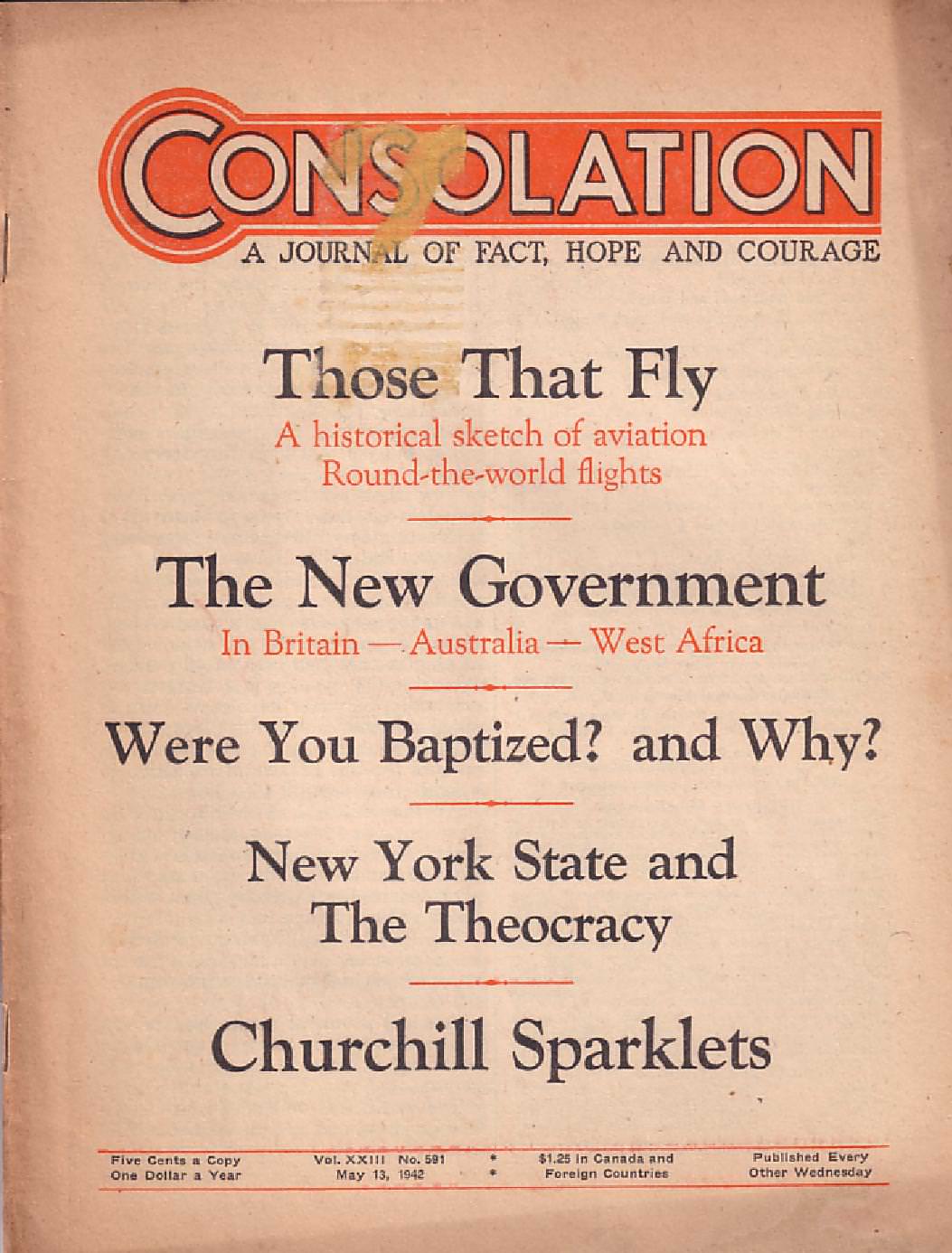
Contents
Those That Fly 3
Not Matter-of-Fact 7
At the North Pole 9
The New Government
Good Reactions in Leicester 12
Interesting Experiences in Australia 13
After the Ban in West Africa 15
"The Increase of His Government" 16
"Thy Word Is Truth"
Were You Baptized? and Why? 17
Acts of The Theocracy in New York State (3) 19
A Real American 20
Results of the Acts of The Theocracy 21
At a Big Metropolis Police Station 23
Under the Totalitarian Flag
Working the "Communist" Bogey 24
Presenting "This Gospel of the Kingdom" 26
British Comment
Churchill Excoriates "The Good Marshal" 29
"Having Great Wrath" 29
Dangerous to Talk About Ships 29
Extracts from Churchill's Address 30
Good Joke on the Cockneys 30
Safety During Air Raids 30
Women in Munition Factories 31
Chinese Money on British Beaches 31
Organized Religion Will Be Irrelevant 31
Losses of Planes 31
Published every other Wednesday by
WATCHTOWER BIBLE AND TRACT SOCIETY, INC.
117 Adams St., Brooklyn, N. Y., U. S. A.
Editor Clayton J. Woodworth
Business Manager Nathan H. Knorr
Five Cents a Copy
$1 a year in the United States
$1.25 to Canada and all other countries
NOTICE TO SUBSCRIBERS
Remittances: For your own safety, remit by postal or express money order. When coin or currency is lost in the ordinary mails, there is no redress. Remittances from countries other than those named below may be made to the Brooklyn office, but only by international postal money order.
Receipt of a new or renewal subscription will be acknowledged only when requested. Notice of Expiration is sent with the journal one month before subscription expires. Please renew promptly to avoid loss of copies.
Send change of address direct to us rather than to the post office. Your request should reach us at least two weeks before the date of issue with which it is to take effect. Send your old as well as the new address. Copies will not be forwarded by the post office to your new address unless extra postage is provided by you.
Published also in Afrikaans, Bohemian, Danish, Dutch, Finnish, French, German, Greek, Hungarian, Japanese, Norwegian, Polish, Portuguese, Spanish, Swedish, Ukrainian; also special Australian edition in English.
OFFICES FOR OTHER COUNTRIES
England 34 Craven Terrace, London, W. 2
Canada 40 Irwin Avenue, Toronto 5, Ontario
Australia 7 Beresford Road, Strathfield, N.S.W.
South Africa 623 Boston House, Cape Town
Entered as second-class matter at Brooklyn, N. Y., under the Act of March 3, 1879.
Notanda
Some Aeronautic Facts
◆ Airplanes are noisy, and constant efforts have been made to reduce the inevitable noise incident to the popping of the exhaust, the churning of the air by the propellers, and the "flutter" of the plane itself, actually a vibration. The Lockwood muffler, reducing the motor's racket 70 percent, carries the noise around a spiral until it exhausts itself before coming out into the open. The placing of airfoils before the propellers and gearing them takes care of another annoying noise. The building of sound-proof cabins for the passengers completes the job of eliminating irritating noise.
Now that airplanes are practically noiseless (to those flying in them), it is interesting to read that a Spartanburg chemist claims to have invented or discovered a substance which may be applied to the plane and make it invisible at a distance of more than a hundred feet.
Over a period of six years the weight of airplane engines was cut 40 percent. Weighing 1 3/4 pounds per horsepower originally, they now have come down to about a pound for the same performance. Lighter materials and construction account for this important reduction in weight where weight is a liability.
At the National Aviation Show in New York in 1936 commercially manufactured planes using automobile engines were an outstanding attraction and first provided a cheap private plane within reach of the average man.
The De Haviland Company of Britain has constructed over a hundred different types of machines since the inception of the company.
A small all-metal monoplane to sell for about $1500 is stamped out like an auto and is able to fly 25 miles per gallon.
The world will be grand when man's God-given powers are all used constructively.
CONSOLATION
"And in His name shall the nations hope."—Matthew 12:21, A. R. V.
Volume XXIII Brooklyn, N. Y., Wednesday, May 13, 1942 Number 591
Those That Fly
AVIATION is the latest and most remarkable advance made by man in the business of getting from place to place with comfort, speed and safety. The really amazing accomplishment shown in this invention is made still more astounding by the very short period of time in which it leaped from fancy and infancy to full maturity. Other inventions were relatively slow in their development, but aviation attained full stature within a few short years. The remarkable fact has been noted by students of the Word of God, and it is but reasonable that they should have sought for some connection between this modern-day marvel and the predicted and expected time of blessing of all the families of the earth foretold in the Word. So it was thought that Isaiah 60:8 referred to the airplane in the words, "Who are these that fly as a cloud, and as the doves to their windows?" But a further consideration of the prophecy as a whole showed that it has a deeper significance, even as Daniel 12:4 refers not to rapid transportation and to increase of secular knowledge, but to increased activity in searching for the meaning of the prophecy itself.
While thus there appears to be no direct reference in the Scriptures to any of the modern inventions, yet the fact of their abundance and scope within comparatively recent times has an indirect bearing upon this "time of the end"; for these inventions have contributed toward the rapid spreading of information by the printed page and thus made possible the wonderful spread of the Kingdom message in harmony with the words of Jesus, "This gospel of the kingdom shall be preached in all the world for a witness unto all nations: and then shall the end [of Satan's world-rule] come."—Matthew 24:14.
As the Reformation released human minds from the thralldom of superstitious fear and opened the way for an ever-increasing circulation and study of the Bible, it paved the way for free and open inquiry into all things, and thus led on to the numerous inventions of the present. It is for this reason that (on page 240) The Harp of God (WATCH TOWER BIBLE & TRACT SOCIETY, 1921) noted a connection between these inventions and discoveries and the days of the presence of the Son of man.
A Flight of Fancy
To return now to the consideration of aviation and some preliminary inventions. When some daring ancestor of modern man first conceived the idea of climbing on the back of a less fortunate creature in order to get over the ground faster, or, at least, with less effort, it must have given him quite a thrill. It is also probable that there were plenty of onlookers who predicted that it wouldn't prove practical or useful or successful. It is hardly likely that this daring innovator started out with mounting a horse. He probably was content to experiment with a less frisky steed—a donkey, perhaps. Anyway, he tried it, and kept it up, and after a while others said, "You've got something there," and also started to grab donkeys for themselves, and pretty soon practically everyone of any account was riding a donkey.
But it wasn't long before the innovators (there are always innovators, somehow) noticed that a horse went faster than a donkey, and hit upon the unheard-of notion they might be able to ride it. They doubtless met with some difficulty in accomplishing the trick, but the thing was done, first by a few, then by more, and it became a common thing, and people just rode along with the greatest of ease, that is, the greatest of ease they could think of until somebody who really was something got the idea that he could hitch the horse to a box with wheels under it, and save himself all the ups and downs associated with horseback riding. He tried it, and it really worked, except for a breakdown now and then. It was safe and smooth riding, just as imagining all this is a fairly safe use of the imagination. Nobody really knows how these things got a start in the past, but it must have been something along the lines here suggested, humanity being what it is.
Other means of transportation, such as rowing, and later sailing, developed in a somewhat similar manner, and all these methods had a considerable number of variations as far as the details were concerned, but the main idea was to get somewhere and get there as fast as possible.
It was a long time before an improvement on these relatively simple methods of travel was found. Then came the idea that steam could be used to propel coaches and vessels, and railways and steamers were the result. Later electricity and combustion engines were used, and electric cars and trains, automobiles and buses appeared. All these were constantly improved, step by step; for it seems that humans see things a little at a time. Hence there was always something new to keep them interested and forward-looking.
Getting Down to Business
But this article is about travel by air and the airplane. Coming to that, we find that it is only in comparatively recent times that men have done anything about flying, with suitable or not so suitable contraptions. The idea goes back quite a way, however.
There is a myth of a fellow, Icarus, who got himself a pair of wings, with the help of Daedalus, his father. He flew, but ventured too near the sun, so that the wax with which his wings were attached melted and he fell down and it was just his luck to fall into the sea. There is a sea called the Icarian sea, and this is the story that is stuck with it. Like all religious fables, this one disproves itself. The higher one flies, the greater the cold. So the whole tale falls down with Icarus.
The myth, however, shows that men had for a long time been thinking about flying. The idea would probably never have occurred to them had it not been for the fact that the great Creator made "fowl that may fly above the earth". Man is not so original; he merely combines and utilizes what he sees; and so the wise man says, "Is there any thing whereof it may be [truly] said, See, this is new?" ---Ecclesiastes 1: 10.
Archimedes, in the third century before Christ, announced certain geometric principles that would have to be observed if man was ever to fly. Those principles are actually followed today. Archimedes (of "Eureka" fame) was no monkey.
Centuries later, Fauste Veranzio gave the matter of flying some thought and boldly tried to put his ideas into effect by jumping off a high tower in Venice with a sort of combination parachute and plane. This was in A. D. 1617. After that it was quite a while before anybody else wanted to try his own or another's wings. One Francesco De Lama did draw a picture of a flying boat which he thought might work. It had four spherical vacuums held together by a framework and supporting a boat with oars and sails.
There is no record that he did anything about it. Maybe he wanted someone else to try it first.
In the beginning of the eighteenth century Karl Friedrich Meerwin thought out a way of flying by means of a glider. He figured that it would take a plane of some 130 feet in area to support the average man; a fairly good estimate according to later findings on the subject. But actual flying came much later. The Wrights experimented both with gliders and with motored planes. Before Wilbur and Orville, however, started their experiments, Alberto Santos-Dumont made a kite-like box plane and flew, or rather hopped, some distance without any serious mishap; but his plane was not a practical flying instrument. He is sometimes referred to as the first man that ever "flew in public". About the time Wilbur and Orville Wright were carrying on their experiments Dr. Samuel P. Langley experimented with steam-driven planes. In fact he had been doing so since A.D. 1896.
The Wrights carried on their experimental flights privately until sure of themselves. They succeeded in making a plane that would remain balanced and an engine that would run it. In December, 1903, Orville made his first actually successful flight at Kitty Hawk, North Carolina, and in 1908 the brothers began to give demonstrations of their success.
Glenn H. Curtiss, another American experimenter, early became proficient in the handling of an airplane, and did much to popularize aviation. In 1910, so rapidly did the invention progress, he flew from Albany to New York, following the Hudson, and stopping to refuel at a point near Poughkeepsie. The superintendent of the Poughkeepsie Insane Asylum invited Curtiss to use the grounds of that institution as a landing field, saying that most flying enthusiasts landed there eventually anyhow. His invitation was not accepted.
The machine used by Curtiss on this epoch-making flight was a biplane, something like a box kite. It outdistanced a train chartered to follow it on the time-schedule of the Twentieth Century Limited, an impressive demonstration.
Fliers at that time sat in the front of their planes, exposed to the weather, rather precariously perched on what was little more than a board. They had not learned that making oneself comfortable adds to one's efficiency; and it may well be that many early mishaps were due to this oversight. It is a far cry from the dangerous and rather rickety contraption flown by Curtiss to the luxury airliners of the present.
It seems that the idea of flying was entertained and that experiments were made by many individuals; so the honor would appear quite clearly not to be due to men, but to the One who made man. Though the names of Dumont, Curtiss and Langley stand out among the early pioneers in the field of aviation, to the Wrights is acceded the credit for the careful and protracted study and experimentation that made aviation a practical reality. Their plane is said to have been the first to apply proper flying principles. This plane, used at Kitty Hawk, was to have been kept at the Smithsonian Institution, at Washington, D.C., and properly marked, but by an error in shipment it was sent on to London, and is now kept in a museum there. Efforts have since been made to have it returned, but nothing definite has been done on the subject.
The World War of 1914
The World War of 1914 gave great impetus to the progressive improvement of airplanes and the development of flying. The warring nations made abundant if not commendable use of aircraft, trying to inflict all possible injury upon their respective opponents. Thus the grim spur of necessity speeded up the progress of aviation.
After the war the constructive use of the airplane asserted itself and progress was rapid and steady. Historic and spectacular flights were the order of the day. Lindbergh's transatlantic flight stands out as epoch-making, although he had been preceded by Alcock and Brown, who flew from St. John's, Nfld., to Ireland, in 16 hours 12 minutes, about half the time it took Lindbergh to fly from New York to Paris, some 1600 miles farther. He did it alone.
Flying across the Atlantic was an exceedingly hazardous undertaking, as was demonstrated by the many unsuccessful attempts made to accomplish this feat. The west-east flight, although considered the easiest, cost the lives of many who made the attempt. In September, 1927, Lloyd Bertaud and his party lost their lives in trying to fly from Old Orchard, Maine, to Rome; and the same month witnessed the unsuccessful attempt of Capt. Terry and Lieut. Jas. Metcalf to fly from Harbor Grace, Nfld., to Croydon, England. Three more fliers, that same year, left Roosevelt Field, New York, to fly to Denmark by way of Harbor Grace, but did not succeed in making even the first lap of the journey.
More successful were Chamberlin and Levine, who flew from New York to Eisleben, Germany, June 4-6, 1927, in 42 hours 31 minutes. Byrd, Noville, Acosta and Balchen made Ver-sur-Mer from New York, June 29-July 1. Others followed in succeeding years. Some made it; others were never heard from again. Ruth Elder, of Lakeland, Florida, with her navigator, Capt. G. W. Haldeman, fell into the Atlantic ocean near the Azores on their way to Europe, in October, 1927. They were picked up by a passing oil-tanker.
Flying overland was hardly less dangerous, and in some respects falling into the ocean may have been preferable. Amelia Earhart, who made the perilous Atlantic crossing dangerously, said afterward that she kept on going when once in the air, although her plane developed engine trouble, because she would rather drown than burn, as she might well have had happen if she had returned to land on the rocky shoreland in the dark.
From 1926 to 1934 there were sixteen major passenger airplane disasters, involving the death of 194 persons. Yet in between 1924 and 1927 planes of the British Imperial Airways flew two million miles and carried 36,500 passengers without fatalities.
The effort of Nobile, in the summer of 1928, to fly to the pole for purposes of exploration met with disaster when his dirigible crashed. Though he carried a wooden cross "blessed" by the then pope (some say a wooden image of the virgin), he quarreled unmercifully with his associates, as he had on a previous flight quarreled with the explorer Amundsen. Amundsen on this later occasion went, in an airplane, to look for Nobile's party, and was never heard from again. Nobile and certain of his companions were rescued. Nobile, the first to leave, in giving an account of the disaster, contradicted himself repeatedly, and, in his first report, omitted to even mention the death of the chief mechanician in the crash. The wooden Indian (virgin, rather) got through O. K. It was to have been planted at the top of the world, but did not make it.
Polar flights and transcontinental, transoceanic and round-the-world flights followed one another in rapid and bewildering succession. They were made with more or less adequate preparation and much daring. A list of these flights would now be monotonous reading, but at the time they were made they were news. Pioneering in new and hazardous territory always makes interesting and thrilling reading, and the conquest of the air was the result of the opening up of a territory that had intrigued the minds of men since Adam and Eve first watched the graceful flight of birds from the security of their paradise-home.
Faster and farther flew the planes, as they also ventured higher and higher. The feats accomplished by the heavier-than-air craft put the almost equally amazing yet less breath-taking progress of lighter-than-air craft in the shade. Yet the dirigibles, balloons and blimps also came in for attention periodically; and their accomplishments made excellent newspaper copy, especially when some unforeseen dangers or catastrophes heightened the dramatics of their performances. However, consideration of these must be left for another number of Consolation.
It was not long until the not altogether uncontrolled imagination of Jules Verne, the author of Round the World in Eighty Days, was far surpassed by actuality in this most marvelous time of earth's history thus far.
No attempt will be made here to recount or even to list all the various and successively thrilling flying ventures of pioneering enthusiasts. These have all come in for attention in the columns of Consolation (formerly The Golden Age) as they took place. A few, however, may be mentioned briefly in passing. Lindbergh's flight has already been referred to. The fact that he flew solo and made the destination determined upon, as well as the fact that he was at the time little more than a boy, all played a part in the appeal to human hearts and minds. Lindbergh's recent unfortunate identification with Nazi sympathizers, whether justified or not, has detracted greatly from his popularity. But that is beside the mark here. No doubt his flight, uneventful enough in itself, was a remarkable achievement for the time and the standards of aeronautics then attained.
Lindbergh's jump across the pond was in many respects matched and in some surpassed by the mischievous achievement of Douglas Corrigan years later, as he hopped "casually" from New York to Ireland "by mistake". The interest appeal was similar, that of youth doing great things simply and with modesty. Corrigan was 30, but his exploit was characterized by youthful nonchalance. "Corrigan's clipper" was purchased for $310. He assembled one power plant from the best parts of two old Wright engines, and made other improvements (badly needed), at a total cost of $900. Instead of de-icers he had a 15-foot pole to knock ice from the wings. When he got ready to cross the Atlantic he went without telling a soul. If he had not "made it" no one would ever have known what had become of him. Out of 125 attempts to cross the North Atlantic since 1929, Corrigan's was the sixth successful solo attempt. The others were Lindbergh, in 1927; Amelia Earhart Putnam, in 1932; James Mattern (to Norway), in 1933; Wiley Post, to Berlin, in the same year; Felix Waitkus, in 1935. Amelia Earhart and Felix Waitkus were forced down before reaching their intended destinations, but, fortunately, they were over land at the time.
Commenting on Corrigan's flight, the London Express said, "It was a foolhardy flight. It was an unnecessary flight. It was great. It was grand. It is about the most remarkable transatlantic flight to date."
The Northern Whig, of Belfast, said: "Flying the Atlantic in an old, dilapidated monoplane, Corrigan turned a gamble with fate into a brilliant and jaunty triumph. Never has there been a long-distance flight so unceremonious and impudently daring, but this irrepressible flier, who has Irish blood in his veins, risked everything and by a combination of audacity and skill and good fortune came safely through and made transatlantic flying look ridiculously matter-of-fact."
Not Matter-of-Fact
Yet flying the North Atlantic was not matter-of-fact, nor could the safety of envisaged airline passengers be left to such chances as were taken by Corrigan. Careful and painstaking attention had to be given to every factor involved, including weather, passengers, comfort, pilots, and finally the airplanes themselves and the thousand and one parts of which they are composed. The pioneering flights of individual men and women only prepared the way.
The first commercial transatlantic round-trip airplane flight was made by Dick Merrill and Jack Lambie, in May, 1937. On that occasion they brought back from England photographs of the coronation of George VI. At that time Merrill had a record of 3,000,000 miles flown, with but one accident.
British flying was for a time well in advance of American attainments. This was also true of aeronautic development in other European countries. But in due course America’s commercial air lines became the best in the world. In America the emphasis was placed on passenger, mail and express transport, while in Europe the concern was chiefly the building up of military air power.
In Britain there were intrepid men and women who had pioneered for the Empire as Lindbergh and others had been pioneering in and for America. The first solo crossing of the North Atlantic from east to west was made by Capt. J. A. Mollison, in August, 1932. His plane was dubbed “the flying gasoline tank” because he sacrificed all the interior furnishings of the plane to make room for the important fuel, great tanks of which surrounded him on all sides. Mollison also made numerous other important flights, such as from England to Cape Town and to Natal, Brazil, by way of Senegal, Africa. The second time Mollison crossed the North Atlantic he was accompanied by his wife, Amy Johnson, also a noted British flier. They cracked up near Bridgeport, Connecticut, but escaped with injuries.
The South Atlantic also was crossed solo, by Capt. Bert Hinkler, sometimes called the “Australian Lindbergh”, because he made a remarkable solo flight, by stages, from England to Australia.
Geo. Stainforth, another British flier of note, in February, 1933, attained a speed of 407 1/2 miles an hour, the record at that time.
While Britain and America were thus making records, Germany was also doing its share. On January 1, 1938, the huge four-motored German transport plane Brandenburg completed at Floyd Bennett Field the first nonstop flight from Berlin to New York, a distance of 3,950 miles, in 24 hours 56 minutes 37 seconds. The aviators followed the great-circle course, which takes into consideration the curvature of the earth and is the shortest possible distance between any two points. This course from any one point to another can be determined by stretching a string between the two points as marked on a globe. As the earth is practically spherical, all flat maps are always more or less distorted and only a globe can give the proper proportions of the various geographical subdivisions. However, flat maps have now been made that are distorted in such a manner as to mark great-circle courses, for use in marking air routes, the only ones that can follow an absolutely direct line.
On the occasion of this German flight the departure, scheduled to take place from the great German airport Tempelhof, was made from another point. Had the venture failed it would then have been denied and so Nazi “prestige” would have been upheld!
The first trip by air from Moscow to the United States was made nonstop by way of the North Pole. This trip also was wrapped in mystery at its beginning. The man who flew the single-motored plane was Valeri Chekaloff. He sat at the controls the whole of the sixty-three hours it took to make this hop from Moscow to Vancouver, Washington. The Russian fliers passed not far from the magnetic north pole, to which the compass points, although it is 1500 miles to the south of the true north pole. This magnetic pole, otherwise reliable, becomes treacherous when navigators fly too near, when they have to rely on the stars for guidance. The flight in distance would equal one made from Barrow, Alaska, to the Panama Canal.
The Russians at the time boasted that only Communists could have made such a flight, although Admiral Byrd and Floyd Bennett flew over the North Pole in 1926. It is, however, probably true that those reared in cold latitudes are best fitted for flying in the far north. A previous flight over a similar route, by Sigismund Levanevsky, in 1935, failed, due to a mechanical defect.
Levanevsky was called the "Lindbergh of Russia". He effected the rescue of James E. Mattern, American round-the-world flier, lost in Siberia, in 1933, and missing several days. In 1934 Levanevsky aided in rescuing 101 Russians adrift on ice off Kamchatka after the crushing of the ship Chelyuskin. On that occasion he won the title "Hero of the Soviet Union", which, like similar honorary titles, means little.
The first successful over-the-pole flight, in July, 1937, was followed by others not so successful. Two Russian navigators were forced down in New Brunswick, Canada, in May, 1939, in an attempt to fly nonstop from Moscow to the World's Fair in New York, following the great-circle route.
At the North Pole
Outstanding among aerohistories is the polar expedition by Russian airmen in May, 1937. The planes left from Rudolph island, northernmost habitation of man. The fliers established a base close to the North Pole and remained there for nearly a year, making observations and collecting data for use in planning transarctic flights. The planes brought a light-weight fur-lined house, weather observation instruments and other equipment, and then left four men behind at the pole to collect the data, and a dog to bark when polar bears came too close.
The Russian Professor Ludol Samoilovitch claimed the Russians were the first to really reach the pole, Peary having failed by a distance of at least a hundred miles. Certain it is that the Russians discovered a new way of getting back from the pole. The floe on which the camp was located drifted southwest at a steady rate, and by February of the following year the camp had drifted to the coast of Greenland, a distance of over 750 miles, and the scientists were rescued from their then dangerous location by icebreakers. The Soviets claimed the pole for themselves, and, for that matter, they are welcome to it. There is nothing but water and ice there anyway; no land at all.
Thus the airplane played a prominent part in important exploration efforts. Admiral Byrd took a plane with him to the Antarctic, though he went there by boat.
As for the Italians. The Montreal stop of the Balbo mass flight was reported at the time as follows:
Dropping gracefully out of the sunlit skies of early afternoon, like majestic birds, twenty-four seaplanes, constituting Italy's mighty aerial armada, came to a safe anchorage here today (July 14, 1933), completing another leg of the epoch-making flight to Chicago. The flagship "Balbo", piloted by Balbo, was the first to alight. As his ship was nosing down there came to him, even beyond the dying roar of his motors, a tremendous salvo of applause from more than 200,000 persons who lined the river bank.
Round-the-World Flights
Going round the world has undoubtedly an appeal, especially since Magellan first tried it. Phineas Fogg, in Jules Verne's novel, made a trip 'round the world in eighty days". That was considered an accomplishment at the time the book was written. In 1889-1890, when the trans-Siberian railroad was first completed, a newspaper reporter, Nelly Bly, made her trip around the world in 72 days 6 hours, stopping at Paris to interview Jules Verne himself. Colonel Burnley Campbell made the trip in 1907 in forty days. John Henry Mears, in 1913, did it in 35 days 21 hours, making use, for the first time in such a tour, of the air, but flew only across Puget Sound.
The American army fliers in 1924 made the next round-the-world trip of note. Their “flight”, however, was more a succession of great hops. The planes were stormbound at Dutch Harbor for two weeks, then flew to the end of the Aleutian islands and faced a stretch of 880 miles across the North Pacific to the Kuriles. They were forced down in the night on the Kamchatkan coast, and rode at anchor until morning, when they went on to the Kuriles. Then on to Japan, China, Burma, Calcutta, Karachi, Bandar Abbas, Bagdad, Constantinople, Bucharest, Vienna, Strasbourg and Paris. Then to London and Kirkwall, Scotland. Then they flew to Iceland, Greenland, and Labrador, and thence to New York by way of Newfoundland. The actual flying time was a little over fifteen days, but actually the fliers were away 175 days; not a very good record, but a start nonetheless. While one of the planes was wrecked en route, and another was forced down, there were no fatalities, and two planes made it all the way, in spite of great hazards and difficulties.
Succeeding round-the-world flights reduced the time bit by bit, until Howard Hughes, in 1938, made it in less than four days, an almost incredible accomplishment. Commenting on this flight, the New York Times said:
We can say with perfect confidence that the airplane of the future will be safer, will go faster and will have a longer flying radius than the ones we have today. The time was, say twenty-five years ago, when such a prediction would have received an unquestioning welcome. Most of us then thought all inventions good and the invention of the flying machine particularly good. Generations of men had dreamed about it. We had it. We were happy to live in an age that could produce such marvels. But now another thought is present. While airplanes were carrying Hughes around the world, Corrigan to Ireland, Donald Bennett westward over the Atlantic, other airplanes, employing similar principles of flight, were engaged on quite different errands. The marvelous controls invented by the Wrights, the engines for which a small army of inventors might claim credit, the delicate instruments for guidance in flight, were being used in China and Spain to kill civilians. At any time they may be used for the same purpose in other countries. The military value of such killings is doubtful. Nevertheless, we have to expect them in any future war.
The forebodings of the Times were realized in the bombing of Warsaw, London, Coventry, and other places. When one contemplates, in the light of these developments, what a vast amount of death and destruction have been wrought by means of the airplane, and what far greater damage it may yet be used to do, the question surely does arise as to whether this wonder of this “time of the end” is a blessing or a curse. The truth of the matter is that all good things may be and are put to evil uses under the present demon-dominated organization of the world. No good thing will long remain a blessing when those upon whom it is bestowed use it for evil ends or when the wicked are in authority.
It is because the Holy Scriptures point to the now imminent day of righteousness under Christ, the invisible King, that one may rejoice in these modern-day inventions which may ultimately be used for the general good of all who are of good-will toward Jehovah God.
The great millennial Sabbath follows the preliminary cleanup of Armageddon, now at the door. Then righteous men will rejoice in the abundance of peace, and in the fullness of God’s blessing for those who shall live upon the earth forever. The earth and its fullness belong unto Jehovah, and He will give it to the righteous. The heaven, even the heavens, are Jehovah’s, but the earth hath He given to His human children.’ ‘He created it not in vain, but formed it to be inhabited.’ ‘Heaven is my throne, and the earth is my footstool, saith Jehovah.’ “I will make the place of my feet glorious."—Psalm 115:16; Isaiah 45:18; 66:1; 60:13.
Tumbling Six Miles
◆ There is nothing to the idea that one falling loses his senses. Near Chicago, Arthur Starnes leaped from a plane 31,400 feet in the air. For about 8,000 feet he was in a succession of violent somersaults, but his head was clear all the time. Three miles from the earth he righted his body by holding his right arm out sidewise from his body like a railroad signal. At a quarter of a mile from the earth he opened his parachute. For a moment this rendered him senseless from the jolt, but less than three seconds later his second parachute opened and he slowed down to an easy landing in a cow pasture. He had been falling 2 minutes 15 seconds before he opened his first parachute, and if he had waited 8 seconds longer than he did he would never have needed to open it at all, but would have hit the earth at a speed of about 128 miles an hour. Starnes' free fall of 29,000 feet is the longest on record. The previous (Russian) free fall record was 25,925 feet. The Russian opened his parachute only 650 feet from the ground.
Around the World in 36 Days
◆ The Pan American clipper was far out over the Pacific when it learned of the attack on Pearl Harbor. A commercial 85,000-pound flying boat, carrying 72 passengers, it could not afford to get entangled with any fighting planes; so it headed for Auckland, New Zealand, and when the time came to return home its captain, Robert Ford, thought the longest way round would be the safest way back. So he flew to New Caledonia, thence to northern Australia, thence to India, then to a Red Sea port, then across Africa, and on to Brazil and back to New York. It wasn't quite around the world, but it was 24,686 miles. The boat came back safe and sound, but it got back too early in the morning and the authorities at La Guardia field made it circle round and round for 62 minutes, until daylight permitted it to settle down as if nothing had happened. The trip took 36 days.
War Babies of the Skies
◆ The capacity of a standard railway tank car is 8,000 gallons; but a single large four-engined bomber, when fully loaded for flight, carries as much as 11,000 gallons, and this may last it less than 24 hours. An ordinary automobile could go around the world five times on the amount of gas used by such a monster every 24 hours. Larger yet, and with an even bigger appetite for gas, is the American B-19, able to carry a cargo of eighteen tons of bombs, and to fly to Europe and back, 7,750 miles, nonstop.
Airgraphs
◆ The British are now carrying mail between Britain and their troops all over the world, and in both directions, by packages in which 4,250 letters go in a single pound, or 264 in one ounce. The letters are photographed on motion picture films, each page occupying one frame. On arrival the letters are photographically enlarged and delivered. The plan works successfully even if the carrying plane is shot down. All that is necessary is to make a fresh print of the original film.
Just Too Bad for the Geese
◆ It is just too bad for the flocks of wild geese when they don't get out of the way of the airplane; for their wings have been found in the planes which they innocently wrecked. Also, and this is more than too bad, it is well established that even a single bird can wreck an airplane if it hits it in a vital spot, and there is a well-authenticated case, in Canada, of a crash, that took twenty lives, due to the wild geese getting in the way.
THE NEW GOVERNMENT
RIGHTEOUS RULER
Good Reactions in Leicester
◆ The most remarkable Theocratic convention held in the British Isles to date has been graphically described and illustrated in The Messenger, both the American and the British edition. Because of the wide publicity given to the event by the Press, friend and foe alike know that the city of Leicester was the location of the Assembly.
Perusing the pages of the Society's souvenir one is transported anew to the convention to live over again those halcyon days of what might be described, when thinking of the booths in the De Montfort Gardens, as "the feast of tabernacles". And yet, as the queen of Sheba said of the glory of Solomon, "the half was not told." How could it be? Even a grudging Press was compelled to characterize the event as a "Five Days' Wonder", so stupendous was the spectacle of Jehovah's organization in action.
And neither is the purpose of this article to amplify or supplement accounts already given. No, it is of the aftermath of the Assembly and of its effects on the people that I would speak. For, living in Leicester, I have often been asked by Jehovah's witnesses how the public reacted after getting over their first amazement, and after the witnesses had 'folded their tents like the Arabs, and as silently stolen away'. Let one or two incidents speak for themselves.
What of the military? For did not the Press give prominence to a fracas or two in which a few rowdy soldiers were involved? Well, soon after the convention the writer was standing "pavement witnessing" in a main thoroughfare, when a military officer, leaving his elegant woman companion, heads straight for him. Anticipating trouble the witness braced himself to receive it. But, no, with every mark of good breeding and gentleness the officer spontaneously asks for a copy of the booklet, and with a few kind words departs.
Again, a delicate sister, not so young as she was, stands in the street with a few booklets, fan-wise in her hand, when three young women of a coarse type come by. One of them seizes the booklets from the weak hands of the witness, and scatters them across the pavement. A passing military officer immediately stoops down, picks up every one of the booklets and graciously returns them to the witness, thus providing a lesson to the young women which it is hoped they would learn.
And the Home Guard? Did not some of them raid "Camp Gideon"? Yes, they did. But calling at a home just after the convention, a witness was told in a self-conscious manner that the man addressed was a Home Guard. Said he, "I suppose you're against us because of that trouble." "Well," the witness replied, "I certainly did not admire the men who let down tents in the darkness on helpless women and children, but we do not magnify the importance of an isolated incident." Result: One Home Guard friend hears record and takes a book and booklet.
Back-calls on people who entertained witnesses at the Assembly have provided wonderful experiences, often resulting in the formation of Model Studies. It is possible to relate only one or two here. Said one hostess, a boardinghouse keeper: "They were the nicest people I have ever entertained. The little girl's knowledge of the Bible astounded me. My son-in-law was so impressed by the demeanor of one of your people standing in the gutter, in the face of the insults of passers-by, that he got out of his car and went over to get some of his literature." Result: A Model Study at that home.
Another case. Says the person of good-will to the witness now holding a Model Study at her house: "To think of the times I have turned you people away, and called you a nuisance."
Canoa do Reino em Manaquiri, Riozinho (Kingdom canoe on the Amazon)
And so one might go on; but time and space forbid. Let the following advertisement, taken from the local Press recently, testify to the results of the Assembly.
Jehovah's witnesses announce: That owing to the increased interest in the City and for reasons of general convenience, THE LEICESTER COMPANY is now divided into Two Units: UNIT NO. 1 continues to meet at KINGDOM HALL, EAST PARK ROAD; and UNIT NO. 2 meets at 76 HIGH STREET (over Halford's). Meetings at both Halls: Sundays 5 p.m., Thursdays 7:30 p.m. No collections. People of Goodwill welcome.
Thus the "sheep" in this city have a splendid opportunity to come into the fold of the Good Shepherd, there to find protection and life. Those who sighed and cried for the hostility shown to Jehovah's witnesses at the time of the Theocratic Assembly have the opportunity of receiving the "mark" of Divine approval on their foreheads before Armageddon breaks. (Ezekiel 9)—Frank R. Freer.
Interesting Experiences in Australia
◆ On July 3, 1940, eighty-three aliens arrived at a local prison from New Guinea, among them seventeen German priests. Soon after their arrival, the archbishop of Sydney, Dr. Gilroy, made personal representation on behalf of these seventeen priests, and had the time of closing of their cell doors advanced from 4 p.m. to 8 p.m. each day. Six and a half days after their arrival at the prison the seventeen Roman Catholic priests were removed to a convent near Sydney.
Contrast this, if you please, with the treatment meted out to two of Jehovah's witnesses. These men, refugees from Hitler's devilish regime of terror and tyranny, arrived in Sydney long before the war began, and led peaceable, quiet lives. When the department of the Interior authorized the admittance of these men to this country, they knew that they were Jehovah’s witnesses. These men, for whom to return to Germany would be sheer suicide, are now interned, and branded Nazis by a lickspittle newspaper whose one aim is to dish out “Catholic Action” propaganda and drag in the dirt everything that is decent and honourable.
BIBLES
In addition to the seizure of the stocks of books, records and phonographs, the Commonwealth seized and locked up thousands of copies of the authorized version of the Bible which were purchased by the Society from the Oxford and Cambridge University Press, London. These Bibles the Commonwealth refuses to release.
The Society’s representative advised the authorities that London was ready to ship further stocks, but that he required absolute assurance that the shipment would be delivered on arrival. This, according to their reply of May 9, they were not prepared to guarantee. Consequently, on May 12 the following telegram was sent to the attorney-general at Canberra:
Your telegram ninth instant delivered my office while absent. I shall be no party to anything that insults the Almighty God, His servants Jehovah’s witnesses, His Majesty the King of Britain, which, in the words of Churchill, stands now for freedom. Action of Federal Government in declaring Christianity illegal in Commonwealth wholly contrary to British tradition. Any persons who think they can dissolve the THEOCRATIC GOVERNMENT of Jehovah God are either demonized or crazy. Bibles referred to in my telegram will be distributed by loyal British subjects. Be advised that a wave of indignation has spread over nation and that we still have in this country thousands loyal Britishers who will stand by Britain in this hour of need notwithstanding fact that leaders have betrayed her. Please give me assurance in writing that Bibles will be immediately handed me on arrival. I have already been humbugged by customs and other officials who are evidently more concerned about serving their foreign controllers at Vatican City than they are about performing duty according to their oath of allegiance to His Majesty the King.—MacGillivray.
Da esquerda para a direita os Irmao forao batisados Miguel Fernandes e Joao Fernandes e Antonio Pestarra que ministrou o batismo (Baptism; interior of Sao Paulo, Brazil)
“Get your latest Watchtower and Consolation” Charlotte, North Carolina
Doorstep phonograph witnessing in St. Louis
Witnessing in the rurals, Deer Lodge, Montana
The attorney-general, in replying, merely referred back to his evasive telegram of May 9, above mentioned. On May 28 a further telegram was sent as follows:
Replying your telegram ninth May. First portion is quite clear, but latter portion puts restrictions on distribution of Bibles. I am not aware that His Majesty King George, Defender of the Faith, has at any time given his ministers authority to prevent people from receiving copies of the Bible or confined the distribution of same to any particular sect. All Christians are Jehovah’s witnesses (Isaiah forty-three ten); and since Christians are the only ones using the Bible, your edict would mean total prohibition of distribution of the Bible in the Commonwealth. Already the Commonwealth is responsible for locking up millions of Bibles and books containing Bible sermons in rat-infested buildings. Mission boats worth thousands of pounds unlawfully taken from their moorings in Sydney have been in the water unattended for four and half months and may now be considered a total loss. My representations to Canberra have been of no avail. Is it any wonder that the good people of this land are beginning to ask whether or not the Government is anti-Christ? —MacGillivray.
Since the ban the little army of Jehovah’s witnesses have concentrated on witnessing with the Bible. All stocks of the Bible held by the Society were confiscated and locked up, but we have been able to get further supplies locally. The publishers have found the Bible work an excellent means of reaching the people, talking to them about the Kingdom and arranging to call back on those who manifest interest. Ways and means are found to get the books and records to those who are genuinely interested. The result has been that back-calls have now reached the former high figures, and the indications are that they will definitely increase month by month in the future. —1942 Yearbook of Jehovah’s witnesses.
After the Ban in West Africa
◆ The Bible may still be circulated in West Africa, though it is illegal to circulate books or tracts explaining it, or casting reflections on the religion racket. The West African Pilot, dated at Lagos, Nigeria, November 25, 1941, has an announcement of a convention of Jehovah's witnesses held that month at Aba, Nigeria, followed by a newspaper report of the same, which many will enjoy:
JEHOVAH'S WITNESSES are holding a Theocratic Convention at Aba on November 1 and 2. Representatives from all parts of Nigeria are pouring in, and from what we have seen they look to be a happy lot. When questioned why they are so happy, they reply: "Because we have had the inestimable privilege of being the publishers of Jehovah's Kingdom and of the day of His vengeance." Truly. As it was in the days of Noah so it is today. Isaiah 34: 8, Luke 21 : 22, Matthew 24 : 14, Luke 17 : 26-30.
FACING THE FACTS we have seen clearly what Jehovah's witnesses have been telling us for the past 18 years is having its fulfilment.
The publishers have informed us that they are anxiously awaiting the declaration of PEACE AND SAFETY which will be the SIGN that the battle of ARMAGEDDON is imminent.
That battle will clean the earth of wicked men and angels, bring untold blessings to the people of good will, and vindicate the name of Jehovah.
We wish the conventioners a happy time in Aba, including Mr. W. R. Brown, who has already arrived by train from Lagos.
JEHOVAH'S WITNESSES HOLD CONVENTION
ABA, Nov. 5.—The Aba African Club Hall, duly decorated by religionists for another purpose and over which was flying a large convention banner, was overcrowded with men and women numbering up to a thousand on the morning of November 1. They are Jehovah's witnesses and had come from all parts of Nigeria to hold a two days' convention.
Special features of the Convention were the instructions given to the publishers regarding how they should now be engaged in comforting all that mourn. On that subject Mr. W. R. Brown delivered a public lecture on Sunday afternoon, at which lecture many had to stay out, as the Hall could not contain the large masses of people who were thirsty for the Truth.
The number of people now forsaking religious churches and taking their stand on the side of Jehovah God and Christ Jesus is borne out by the number of those who symbolized their consecration and were baptized at the Aba river on Sunday morning, November 2. One hundred and fifty-four persons were immersed.
By the willingness of the workers, cooks, stewards, and others who served at the cafeteria, catering for the Conventioners, one could realize the spirit of union that exists among Jehovah's witnesses.
Special favour of Jehovah is the cessation of rain throughout the entire time of the convention.
The Increase of His Government
◆ In view of the world conditions that rapidly grow worse the above result [of the work of Jehovah's witnesses in the earth in the year 1941] would normally be contrary to what might be expected; but all things are possible to Almighty God, who is working in his faithful servants "both to will and to do of his good pleasure". Therefore this marvelous placement of Kingdom literature bespeaks that by his help Jehovah's covenant-keeping people are surmounting the obstacles and demon opposition and are 'putting on more steam', because now the time is short and it is desired to turn in to the King a faithful report, showing increase of the Lord's Kingdom interests, or "goods". This stacks up still higher the pile of stones of testimony which have been piled in the midst of the antitypical Jordan river as Jehovah's people, under the leadership of the Greater Joshua, Christ Jesus, pass through the midst of the people that are rushing down the broad way that ends in the Dead Sea of destruction at Armageddon. Up until October 1, 1940, the distribution of books and booklets amongst these people had totaled 337,749,320 copies. Now, by adding to this the figure for the year just completed [36,030,595], the grand total of such bound literature placed in the past 22 years increases to 373,779,915 copies. "Praise ye Jehovah!" —1942 Yearbook of Jehovah's witnesses.
(To be continued)
"THY WORD IS TRUTH" - John 17:17
Were You Baptized? and Why?
ONLY two perfect men were ever on this earth. The first one disobeyed his Creator’s commandment and was sentenced to death. The second held fast His perfection and integrity and was baptized in water and was also baptized into death. Out of this immersion into death He was raised to life eternal. He left the example for all who would gain endless life in happiness. What, then, does baptism mean?
When the Israelites left the land of the Pharaohs under the command of the prophet Moses, all of them agreed thereby to obey Moses as God’s representative; and Moses was a prophetic pattern of the Greater Prophet to come, the Messiah or Christ. The Israelites followed Moses across the dried bed of the Red sea, made possible by God’s miracle, and under the shadow of His cloud. They were thus hidden or immersed in the cloud and in the sea. Says the inspired writer: “Moreover, brethren, I would not that ye should be ignorant, how that all our fathers were under the cloud, and all passed through the sea; and were all baptized unto Moses in the cloud and in the sea.” (1 Corinthians 10:1, 2) Fifteen centuries later, when John the Baptist came as the representative of the Lord he commanded the Israelites to repent of their sins against God’s covenant with their nation by Moses and to be immersed in water. (Matthew 3:1-11) Those who did repent and were baptized testified thereby that they had changed their course of action and that they would no longer be guided by their own selfishness and would gladly obey the will of God.
Baptism in water, therefore, symbolically and outwardly testifies to an agreement to do God’s will. Those who followed Moses through the waters of the Red sea and under the canopy of the cloud overhead were thus “baptized unto Moses” in the sea and the cloud and were thus protected from the expression of God’s wrath against the Egyptians, representing the Devil’s organization. Likewise, in the great Flood, those who followed Noah into the ark and remained there were hidden or immersed and thereby were baptized unto Noah.—1 Peter 3:21.
Is it necessary for one who today professes to be a person of good-will toward God and His kingdom by Christ Jesus to be baptized or immersed in water? Such is proper and is a necessary act of obedience on the part of one who has consecrated himself to God, that is, agreed or covenanted with God to do the will of God. It is an outward confession that the one being baptized in water has agreed to do God’s will. Baptism or immersion in water does not wash away or cleanse one from sin that resulted to man by reason of the disobedience of the first man Adam. It is the sacrifice or lifeblood of Jesus as a perfect man that cleanses from sin. (1 John 1:7-9) There is no means of cleansing from sin or of remission of sin except by the shedding of the blood of Christ Jesus. (Hebrews 9:22) It is only those who have and exercise faith in the shed blood of Christ Jesus that have their sins remitted. Baptism in water is an outward evidence that the one baptized has entered into a covenant with God to do His will, and this is evidence of faith in the shed blood of Christ Jesus. Submitting to be immersed in water is an act of obedience, illustrating how one has fully put himself in the hands of the Lord; and therefore baptism is necessary and proper to be performed by all who have agreed to do the will of God.
Note this: The perfect man Jesus presented himself before John at the river Jordan and requested to be baptized in the river. John declined to baptize Him because John knew that Jesus was not a sinful man and manifestly John understood that water baptism was solely for the benefit of those who were sinful. Jesus did not explain to John the reason for His request, but to John's objection He replied: "Suffer [Permit] it to be so now: for thus it becometh us to fulfil all righteousness." (Matthew 3:15) Jesus was there perfect, pure, holy and without sin. His water baptism or immersion was a testimony before others that He had fully agreed to do His Father's will. Months later, concerning His baptism into death He said: "I have a baptism to be baptized with; and how am I straitened till it be accomplished!"—Luke 12:50.
It is written that immediately following the baptism of Jesus in the Jordan river those standing by heard a voice of approval from on high: "And, lo, a voice from heaven, saying, This is my beloved son, in whom I am well pleased." (Matthew 3:17) Thus God manifested His pleasure in the obedient act of His beloved Son and at the same time acknowledged Christ Jesus as His Son. Every man who takes his firm stand on the side of God and Christ Jesus will want other persons to know that fact, that they too may see the importance of serving Jehovah; therefore it is proper that he testify to that fact by publicly submitting to immersion or baptism in water. Permitting himself to be put down under the water he by this symbol says: "My selfish will is dead, and henceforth I shall delight to do God's will."
You may ask: "I was baptized or sprinkled when going to my religious denomination, and shall I be baptized again?" Unless you had then intelligently made a consecration of yourself to Jehovah God to do His will and were submerged under the water to symbolize that consecration, your "baptism" then was a mere religious formality and had no acceptance with God. But if you have since come to a knowledge of the truth and devoted yourself unreservedly to God, then you should publicly symbolize that. Such water immersion is proper for all persons who consecrate themselves to God to do His will, according to Jesus' own example for us.
Those who partake of the heavenly blessings and become members of Jehovah's royal house above must undergo another baptism, not in water, but of far deeper significance. Concerning the baptism of those who will be of the heavenly spiritual organization the Scriptures say:—"Know ye not, that so many of us as were baptized into Jesus Christ were baptized into his death? Therefore we are buried with him by baptism into death; that like as Christ was raised up from the dead by the glory of the Father, even so we also should walk in newness of life. For if we have been planted together in the likeness of his death, we shall be also in the likeness of his resurrection: knowing this, that our old man is crucified with him, that the body of sin might be destroyed, that henceforth we should not serve sin,"—Romans 6:3-6.
These words concerning baptism do not relate to water immersion, but do relate to baptism into the death of Jesus Christ. That means that Christ Jesus' true and faithful followers who are members of "his body" must die as He died, namely, a death of sacrifice, in order that they may be raised up in the likeness of the Lord Jesus at the resurrection. Those persons of good-will who make up the Lord's "other sheep" do not have any part in the baptism into Jesus' death. Their hope of everlasting life is entirely earthly, under the heavenly kingdom of God's Anointed King, Christ Jesus. However, all who receive life everlasting, whether in heaven or on earth, must covenant to do God's will, and the baptism in water symbolizes that such covenant has been made. Immersion in symbol says: 'I have put myself entirely under the command of Almighty God, and by His grace I will do His will.' To such ones God provides protection.
Acts of The Theocracy in New York State
(In Three Parts—Part 3)
THE activities of the American Legion against Jehovah's witnesses smack of 'storm trooper' tactics and further the spread of the totalitarian spirit of Hitler, Mussolini, the pope and the Devil.
Recently they distinguished themselves in their courageous (?) attacks on a woman. It seems that a woman guilty of the 'heinous crime' of believing in God's kingdom, and proving it by proclaiming the "good news" to others, is viewed with alarm by ex-soldiers of Olean, New York. In the public press it took a column and a half of Whereases and Resolutions for the Legionnaires and Veterans of Foreign Wars to demand the dismissal of Mrs. Winifred Davis, physical education teacher, because in her spare time she has the courage to circulate in the community the message of God's kingdom. All these ex-draftees need now is a little encouraging newspaper publicity (and they will get it) and they would be sufficiently 'tanked up' to even fight a child that loves God. They have done it elsewhere, so why not in Olean?
…