Consolation, April 1, 1942
Download: PDF — Consolation, April 1, 1942
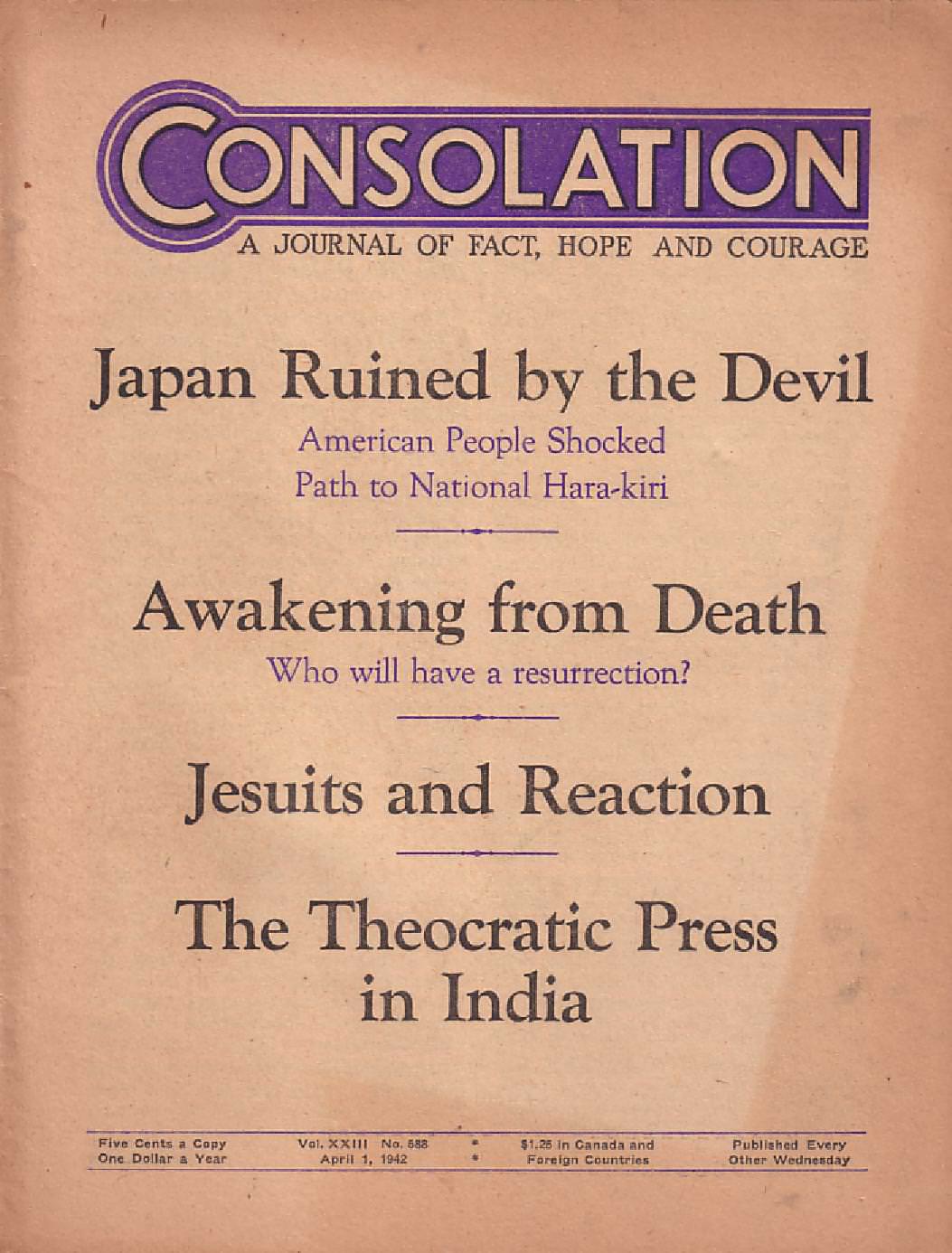
Contents
Japan Ruined by the Devil (Part 4) 3
Betrayed by Its Friends 2
Japan Fears Air Attack 4
The Sinking of the Panay 5
American People Shocked 6
United States' Terms 7
National Hara-kiri? 9
Witnesses in Japan 10
The New Government
Happened in Chicago 12
Do Not Fear Gangsters 12
Facing Is Not Saluting 14
"Thy Word Is Truth"
Awakening from Death 17
Australasia — "Leave Teachers Alone" 19
Under the Totalitarian Flag
The Pope Is in a Tight Spot 20
Nothing to Worry About 20
The Jesuits and Reaction 21
Gems from Churchill's Speeches 24
Birds and Insects 25
Chief of Police Sued for $3,314 26
In Dixie Land 27
Aviation — Studying Weather for Air Travel 28
British Comment
The Theocratic Press 29
The Peace in Syria 31
In a Tel Aviv Grocery 31
Published every other Wednesday by
WATCHTOWER BIBLE AND TRACT SOCIETY, INC.
117 Adams St., Brooklyn, N. Y., U. S. A.
Editor Clayton J. Woodworth
Business Manager Nathan H. Knorr
Five Cents a Copy
$1 a year in the United States
$1.25 to Canada and all other countries
NOTICE TO SUBSCRIBERS
Remittances: For your own safety, remit by postal or express money order. When coin or currency is lost in the ordinary mails, there is no redress. Remittances from countries other than those named below may be made to the Brooklyn office, but only by international postal money order.
Receipt of a new or renewal subscription will be acknowledged only when requested. Notice of Expiration is sent with the journal one month before subscription expires. Please renew promptly to avoid loss of copies. Send change of address direct to us rather than to the post office. Your request should reach us at least two weeks before the date of issue with which it is to take effect. Send your old as well as the new address. Copies will not be forwarded by the post office to your new address unless extra postage is provided by you. Published also in Afrikaans, Bohemian, Danish, Dutch, Finnish, French, German, Greek, Hungarian, Japanese, Norwegian, Polish, Portuguese, Spanish, Swedish, Ukrainian; also special Australian edition in English.
OFFICES FOR OTHER COUNTRIES
England 34 Craven Terrace, London, W. 2
Canada 40 Irwin Avenue, Toronto 5, Ontario
Australia 7 Beresford Road, Strathfield, N.S.W.
South Africa 623 Boston House, Cape Town
Entered as second-class matter at Brooklyn, N. Y., under the Act of March 3, 1879.
Notanda
Betrayed by Its Friends
◆ Roman Catholicism is an officially recognized religion in heathen Japan. This is a significant point, for numerically Catholics are weak in the country. But Rome has played a clever game and gained an advantage in Japan accorded to no Protestant church organization.
The policy Rome has pursued in Japan is that of playing into the hands of the totalitarian crowd, encouraging patriotic ceremonials, which are part of the Shinto religion, and involve practical worship of the god-emperor. Rome also endorses "honor for ancestors and admiration for national heroes". Actually this "honor" and "admiration" involve a form of worship of these dead ancestors. Archbishop Paul Marella, apostolic delegate to Japan, "advocates a wide adaptation to the character, manners and national customs of the Japanese people." The Roman Hierarchy in Japan has 319 churches and chapels, 115 Japanese priests, 127 Japanese monks and 672 Japanese nuns, 293 foreign missionaries, 104 foreign monks, 489 foreign nuns. The Jesuits conduct a university in Tokyo. Out of a population of some 70,000,000 there are only about 120,000 Roman Catholics. Children to the number of 829 are cared for by nuns in 27 shelters. A picture of one such shelter shows some 120 little ones posing for the picture with their caretakers. There is not a single smiling or happy countenance among them. The children look sad, and the nuns "hard". It is pathetic.
The Toronto Globe and Mail for December 9, 1941, carried an article to the effect that Japan was being used as the cat's-paw of the Berlin-Rome Axis, and said, in part:
Japan's entry into the war may be dictated by her own political and economic interests, but the time and the manner of her attack were dictated by Axis strategy.
CONSOLATION
"And in His name shall the nations hope."—Matthew 12:21, A. R. V.
Volume XXIII Brooklyn, N. Y., Wednesday, April 1, 1942 Number 588
Japan Ruined by the Devil (In Four Parts—Part 4)
TREACHERY is the essence of totalitarianism. It knows no loyalty, save to itself; it has no code of honor, except in its own interest. "The man that swears to his own hurt, and changes not" is the complete opposite of all that totalitarianism stands for. The treachery of Japan in its attack upon a nation that was at peace with her is in keeping with the entire course of the totalitarian Axis. For years the ostensibly friendly Japanese nation had been dealing with the United States as with an enemy, while the United States had with almost naive trustfulness dealt with Japan amicably.
Japanese formed the largest racial group in the Hawaiis. They were honored and entrusted with important positions in the police department, as road supervisors, inspectors and government officials. Others were allowed to hold positions in connection with the telephone service. All of these positions offered ideal opportunities for spies, and were so used. In addition there was an espionage network directed by the Japanese consul general in Honolulu, which made use of the hoodlum element from the families of Japanese farmers on the island. The Japanese army intelligence directed a multitude of spies, who occupied positions as storekeepers, restaurateurs and cafe-owners. Japanese naval intelligence also was active, using fishermen and seamen, hotelkeepers and employees, servants in private families and the dealers in fresh produce who supplied fruits and vegetables to the ships in Pearl Harbor and to the army posts and used their eyes and brains to get information, which was conveyed to the spies in the Consulate. The same was true in California. Hawaii had a fifth column which numbered 100,000 potential members. There was no way of telling whether Japanese-American citizens were loyal or not. Thousands undoubtedly were.
While Japan disregarded her treaties generally, there was one treaty she decided to observe, and that was and is her agreement with the Axis, which is actually the basis of her entire policy, with which it is integrated. Japan gave the United States to understand that nothing would be allowed to interfere with her co-operation with the rest of the totalitarian gang.
A Pacific-wide system of undercover communications by means of shortwave radio sets was detected to have been the basis of the Japanese spying operations. Sets large enough to send messages to "fishing" boats offshore conveyed information which was then relayed to battleships, which carried it to Japan. These small sets were found in cellars and other hidden places. The thoroughness of the Japanese fifth-column operations indicates a long period of preparation.
This preparation included the attack upon Chinese cities by means of machine and rapid-fire guns, furnished to the Japanese General Staff by Schneider-Creusot, so that they might try them out in China and convince themselves of their deadliness. The result was heavy orders which required Schneider-Creusot, International Murderers, to add 55,000 laborers to their pay rolls.
It is of interest here to recall that the Japanese Army was organized by a French mission under Marguerie in 1872, and conscription adopted instead of limiting military service to the Samurai class.
In 1931 Japan invaded Manchuria. As her attack on China cost her plenty, it was thought in "authoritative" circles that Japan could not stand the financial strain of a prolonged war; but she has been at it now for ten years, off and on, and seems not yet down and out.
The United States took the initiative in applying pressure to make Japan live up to the Nine-Power Treaty and other peace pacts, with the result that Japan came to regard America as her enemy, feeling that the United States was blocking her road to a continental empire.
It began to be observed by those who had their eyes open. Upton Close remarked that when President Roosevelt authorized resumption of building naval vessels, the Japanese gave up hope of bluffing the United States to withdraw from the Pacific, and got busy preparing to put that country out.
Eugene Chen, three times China's foreign minister, said that Japan's next war would be for the mastery of the Pacific, and that she was even then preparing systematically for war with the United States. This was in early 1932. In January, 1934, Lieut. Gen. Gerth van Wyk, a former commander-in-chief of the Dutch Indian forces, declared that in case of a war between Japan and the United States the odds were that Japan would be the victor; but that the co-operation of the British, French and Dutch would check the Japanese.
In the same year Brig. Gen. William Mitchell, retired, told the Aviation Commission that Japan was America's most dangerous enemy. He advised the building of an air force capable of attacking Japan. This idea was not as "mad" as it was then considered to be by certain editors. Mitchell has now been belatedly honored.
Japan Fears Air Attack
Japan then and now most of all fears air raids. One night a chimney was blown down in one of its large cities, and in a few hours 200,000 inhabitants were homeless. Planes would work havoc in Japan's crowded cities, with their flimsy buildings. Even her munitions and defense industries are housed in wooden structures. Greater Tokyo has 7,094,600 inhabitants; Osaka, 3,394,200; Nagoya, 1,249,100; Kyoto, 1,177,200; Kobe, slightly less. Fire is the calamity most dreaded by the Japanese. Their houses are of wood, with sliding panels and windows of paper. They are raised a few feet off the ground, and fires once started have plenty of draft. In spring the houses are dry and the winds frequent. The prospect of an air raid is an appalling thought to Japanese.
Mention of an air force capable of attacking Japan was therefore not at all pleasant to the Japanese. They didn't like the United States anyway. At the time of the settlement of the Russo-Japanese war President Theodore Roosevelt called the peace conference at Portsmouth. Japan acquired Korea, but lost southern Manchuria, which she most wanted.
After the World War, Woodrow Wilson opposed Japan's retention of Shantung, and she had to give it up. President Harding, summoning the Washington Naval Conference, is held responsible for its fixing the naval strength of Japan at three-fifths of that of the United States and of Great Britain.
President Coolidge, Japan thinks, was responsible for the Exclusion Act of 1924, which has caused much misunderstanding.
The Exclusion Act, however, was not directed merely at Japan, but covered all alien immigrants not eligible to American citizenship. Nor was the bill passed because of undue prejudice against Japan or because of anything said by Japan to the effect that the passage of such a bill would have serious consequences. Its adoption deeply offended Japan.
Japan, however, had been taking unfair advantage of a previous "gentlemen's agreement" which provided for entry of all Japanese having visas, the understanding being that such visas would not be given to mere laborers. Yet Japan sent in thousands of such laborers, and then provided "picture brides" for these laborers. As a result the annual Japanese births in California increased from 455 in 1908 to over 5,000 by 1924.
Japanese workers have long hours and no weekly rest day. They are accustomed to getting off two days a month. In April, 1937, Arthur Shaw, workers' delegate from Great Britain to the World Textile Conference, stated, "Sweating the workers of a country is not the way to make any country great and prosperous." Japan had a work week of fifty-seven hours, a quota which was nine hours longer than the forty-eight hours fixed by the International Labor Conference in 1919.
The competition of Japanese on the West Coast was increasingly resented by Americans, and the more so when Japan attacked China. Employers, both domestic and commercial, would often ask prospective Japanese servants and workers their attitude toward the Far East conflict, and sometimes receive the frank reply, "I am a Japanese, and naturally my sympathy is with Japan."
The Sinking of the Panay
An incident in Japan's war on China was the sinking of the U. S. S. Panay, claimed to have been an error, but almost certainly a deliberate act. Japan received a bill from the United States totaling $2,214,007.36, and paid, and also apologized, but the officers responsible for the outrage were not disciplined, and indication is that they were not particularly blamed. It was a sample of Japanese contempt for America.
While the United States Maritime Commission decided against selling its old Shipping Board vessels to Japan, yet American scrap iron continued to go there from other sources in ever-increasing quantity. Japan indicated an insatiable appetite for this scrap to feed her munition forges. The scrap was considered so important that it was sent in ships making 18-20 knots an hour; a very expensive way to transport junk. Agents for Japan were on hand at every ship sale and at every junk auction of any size. The American government wanted to keep out of any kind of support of the Sino-Japanese War, but private concerns were not particular.
To wage war on China Japan needed 35,000,000 barrels of petroleum; and as she produced only about 5,500,000 barrels herself, she had to import the rest. That explains why certain British and American oil companies continued to send huge quantities of oil to Japan annually, much of which was stored. Japan was getting ready.
While all along intending to attack the United States, Japanese spokesmen continued to profess friendship. Preference for the totalitarian setup and sympathy with the Axis powers, however, was becoming more manifest. A noted Japanese spokesman, Toshio Shiratori, in 1938, said, "I welcome the term fascism as I do the term totalitarianism. There has been enough Anglo-Saxon influence in this country. It is time we allied ourselves with Italy and Germany to prevent encroachments by the popular front. The 'glass house' democracy of the United States and the communism of Soviet Russia go hand in hand."
It became evident that Japan was determined to disregard all limitations as far as the number, tonnage and gun-caliber of warships was concerned. But the visit of three United States cruisers for the opening of the Singapore naval base early in 1938 was resented by the Japanese press and taken as indicating that Britain and America had reached an understanding in the Pacific Ocean.
Japan has renamed Singapore Shanpor.
Japan's naval minister described the Japanese program as one of watchful waiting, but warned that they would not waste time indefinitely with that attitude. He obviously spoke the truth.
American People Shocked
Ambassador Joseph C. Grew, addressing Japanese notables at a luncheon of the America-Japan Society in Tokyo, October 20, 1939, said:
American people have been profoundly shocked over the widespread use of bombing in China, not only on the grounds of humanity but also on the grounds of direct menace to American lives and property, accompanied by the loss of American life and the crippling of American citizens.
The American people, from all thoroughly reliable evidence coming to them, have good reason to believe an effort is being made to establish control, in Japan's own interests, in large areas of the continent of Asia and impose on them a system of closed economy.
The Japanese, however, continued to profess friendship, and at the New York World's Fair presented its Pavilion to the City of New York as an emblem "of that 87-year-old friendship between the United States and Japan, that all will hope may long be preserved".
It was a foregone conclusion, however, that the United States could not indefinitely maintain friendly relationship with a nation that was increasingly sympathetic toward the totalitarianism of Hitler and Mussolini and also increasingly menacing toward the freedom of the seas. But Japan wanted American friendship on its own terms, and not on the democratic and fair basis of the terms laid down by America. In this connection Raymond Clapper, in the New York World-Telegram of November 19, 1941, said, in part:
Without going into detail; it is safe to say that the main thing the United States asks is that there be an end to the Hitler type of conduct in the Orient. With a change to more peaceful methods, and adoption of a policy of equal rights for all nations in the Far East, it would not be difficult for the United States and Japan to reach an agreement. The measures we have adopted, the economic blockade and the military preparations, are strong and were meant to be so. But this government does not want war in the Pacific, and it would be glad to conclude an understanding which assured equality of opportunity to all nations in the Far East. . . The United States will not acquiesce in Hitlerism in the Pacific.
From this it will be seen that while America's attitude toward Japan was still conciliatory, it was without that confidence that is essential to a true friendship. October 15 all outstanding balances of licenses which had been granted for the exportation of No. 1 heavy melting steel scrap were revoked, and the following day the exportation of all grades of iron and steel scrap were placed under the licensing system. Under the new regulations licenses were issued to permit shipments to countries of the Western Hemisphere and Britain only. Until then the bulk of scrap iron and steel exported had gone to Japan.
The halting of war exports to Japan, the extending of lend-lease aid to China and Russia and the freezing of Japanese credits by the United States exerted an increased pressure on Japan with a view to bringing her military statesmen to their senses. But the moves were unavailing. Japan's military caste was hell-bent for mischief.
The Japanese press put on a campaign to bring the United States to terms, Japan dictating the terms, which were set forth in the Japan Times Advertiser as follows:
1. All military and economic aid to Chungking must cease!
2. China must be left "free to deal with Japan," and Chungking advised to make peace with Japan.
3. Military and economic encirclement of Japan must end.
4. Japan's "co-prosperity sphere" must be acknowledged, and Manchukuo, China, Indo-China, Thailand, the Netherlands Indies and other States and protectorates must be allowed to establish their own political and economic relations with Japan without interference of any kind.
5. Manchukuo must be recognized; "nobody will undo what has been done there."
6. The freezing of Japanese and Chinese assets must be ended unconditionally.
7. Trade treaties must be restored and all restrictions on shipping and commerce ended.
Now the Tokyo diet voted a large war outlay, approving a military budget of 3,800,000,000 yen, approximately $1,000,000,000. Japan had been spending nearly a third of its national income on military provisions, a sum that was exceptionally high for a country as poor as Japan. The added outlay was well-nigh overwhelming. But the saying that a government will not be kept back from war because of financial problems was again confirmed. Japan had begun something that she would find hard to finish, and that pride which goes before destruction prevented her from turning back.
United States' Terms
The United States had terms of its own to present. These terms may be summed up as follows: Self-restraint, abstinence from force and from interference with internal affairs of other nations. Settlement of problems by negotiation. Observance of treaties while recognizing occasions for modification by peaceful methods. Promotion of economic security and stability the world over, and the lowering or removing of excessive barriers in international trade. Effective equality of commercial opportunity and equality of treatment. The limitation and reduction of armaments.
These terms or conditions were not acceptable to Japan. It was putting her on an equality with other nations, instead of catering to her unbounded ambition to be the cock of the walk, an ambition that linked the Japanese government with the totalitarian setup. Its "Great Japan-East Asia Construction League", under the presidency of Prince Fumimaro Konoye, had vowed to end the "encroachments" of white and particularly Anglo-American interests on the lands and livelihood of the East Asiatic countries.
Refusing to accede to the terms that would have preserved peace in the Pacific, Japan asserted its close alliance to the totalitarian Axis. The effect of Japan's course was to draw the ABCD powers together, composed of American, British, Chinese and Dutch, an association which Japan might have joined on equal terms, had she not been deceived by the Devil and led down the road to self-aggrandizement and ultimate self-destruction. Japan now began to complain of "military encirclement".
Surrounded now by powers that did not relish Japanese domination as the price of peace, Japan was approaching more and more closely to the brink of war. Many there were in Japan who did not want war. Lieut. Gen. Kisaburo Ando, executive vice-president of the Imperial Rule Assistance Association, told a conference of leading citizens and businessmen that "Japan must prepare herself to meet the situation in such a manner as to gain victory without waging war and thus win a victory over war". Apparently the Imperial Rule did not want this assistance or suggestion. The war lords of Japan, in actual control, had built up a tremendous military machine, and would have to do something with it.
It has been said that Japan has never lost a war. On the other hand, it is pointed out that Japan has never won a major war without the aid of Britain or America. In the Russo-Japanese war they had the support of American bankers, assuring an uninterrupted flow of supplies. In the World War Japan had the British fleet on her side in the Pacific. American Big Business has, until recently, been supplying Japan with the munitions and weapons used in invading China. So says the United States News of October 24, 1941.
Yet the idea that America could win an overnight victory in a war with Japan was deplored by well-informed thoughtful Americans even before Japan had demonstrated her striking power.
Sunday, December 7, the New York Times carried the following:
Japan indicated early today that she was on the verge of abandoning efforts to achieve a settlement of Pacific issues by diplomatic negotiations at Washington. At the same time warnings circulated that Soviet Russia—with an estimated Far Eastern army of 840,000—had joined the United States, Britain, China, the Netherlands Indies and the British Dominions in a united front against Japan.
These reports, carried in the Japanese government-controlled press, served to stir up war sentiment to fever heat, and may have been intended to do so. Obviously they were untrue. Russia has not yet joined the ABCD powers against Japan.
Toward the end of November hopes for peace in the Pacific went down to zero. The Navy ordered permanent black-outs at the Cavite naval base and at Olongapo. Early in the month 500 Japanese residents left the Philippines for Japan, unable to continue business, due to the freezing of Japanese credits. The Japanese newspaper Nichi Nichi said that if Japan "starts marching as one great army she will have no trouble in smashing to smithereens" the so-called British-American-Russian-Netherland "encirclement" of Japan. It said, with the usual wiliness of the totalitarian abomination, that America was assuming control in Chungking and bringing pressure on Hongkong, Singapore and the Netherlands Indies with the pretext of defensive measures against Japan, but really to undermine British influence in the Far East.
Meanwhile Japan got busy encircling the Philippines, with forces in Japan itself to the north, the Japanese mandated islands to the east, and the Indo-China forces on the west. By these moves Japan showed its determination to close not only China, but all of the Orient, to the outside world, and to drive the Western powers completely out of that part of the world, depriving them of essential raw materials.
Japan knew that it would be quite impossible for America to defend all of the 7,000 islands in the Philippine group. She also knew that the Japanese could not get anywhere without taking the main island of Luzon. In the effort to do this Japan was willing to sacrifice any number of her soldiers. Her devil-government did not and does not concern itself with the cost in human lives if it reaches its objective of seating itself on top of everything. So it could afford to be reckless, even as it had taught its virtual slave population to be reckless in carrying out its demands, because, forsooth, were they not descendants of "gods"? And could not the divine (!) emperor make them "gods" if they did die in battle? It is the old, old lure, "Ye shall be as gods!" It is the old trick of exalting some to lordship over their fellow men, to a fictitious divinity, the totalitarian ruse to counteract the democratic fact that "all men are equal".
Japanese Blitz Forecast Long Ago
The Japanese blitz came as forecast seven years ago. The tactics and strategy back of the attack by plane and ship upon the American and British Pacific possessions, together with the follow-up attacks assisted by Japanese soldiers, were forecast in literally hundreds of American newspapers seven years ago. They follow almost exactly a series of predictions made in 1934 by Vice-Admiral Nobumasa Suetsugu in an interview.
It appeared that the Tokyo war lords acted in complete co-operation with Japanese residents in Oahu island of the Hawaiis. Hawaii had an overwhelming non-American population. Out of 423, persons there were 157,905 Japanese, of which 120,552 were "American-born". There were 103,791 Caucasian, 64,310 Hawaiian and part-Hawaiian, 52,569 Filipinos, and 28,774 Chinese. Because of the religious loyalty of most Japanese and American-Japanese to the emperor, Army and Navy men felt that in the event of trouble the entire Japanese population would have to be rounded up; for even if they could be sure of nine out of ten, yet they would never know who the really loyal American-Japanese were likely to be.
Like the German and Italian and other totalitarian governments, Japan is not squeamish about sacrificing its man power. Suicidal efforts are rewarded with plenty of "glory". These totalitarian gangs are good at handing out "glory", but that's about all the people get. Japan won with suicide heroics against Russia in 1904. They captured seemingly impregnable trenches by the simple expedient of filling them with their own dead. In the World War Japanese soldiers saved the day at Tsingtao by getting to the top of the city's wall over piles of its own dead. Deceived by the Devil, Japanese are ready to do anything for their god-emperor. To die for him means special glory. An American military observer remarked on one occasion that in the event of war America would give the Japanese plenty of opportunity to die for their emperor.
Japan's army is larger than America's, numbers only considered, but at the way they are wasting their soldiers, that advantage will be of short duration.
Invasion of the United States is believed to be Tokyo's goal. Gen. Homer Lea, 32 years ago, outlined six areas of combat in a Japanese-American war: the Philippines, Hawaii, Alaska, Washington, Oregon, and California, omitting Japan itself.
National Hara-kiri?
The decision to make war on the United States was made by Nippon's powerful secret society, "the Black Dragon." Japan had to choose between giving up aggression and facing a conflict with the United States. It was a choice between national humiliation and suicide. But in Japanese eyes such suicide would come with honor, it would be a sort of national hara-kiri. That is their patriotism and their religion, the two being inseparable.
At Honolulu a Japanese sailor, trapped in one of the midget submarines destroyed during the December 7 attack on Pearl Harbor, was buried in a section of his little craft. It was found impossible to remove the body. There is a suggestion here of Japan's plight. Trapped in its self-centered pride, it will die in its attempt to carry out its own Devil-inspired scheme.
Tokyo's declaration in 1938 of "Asia for the Asiatics [meaning for Japan]" bolstered the Axis. Its attack upon America and Britain in the Pacific was doubtless influenced by Japan's regard for its Axis connections. The treaty with the Axis is the only one that Japan has observed.
It was remarked as a suspicious circumstance that Hitler in his November Munich speech made no mention of Japan, now obviously a more important factor in the Axis line-up than Mussolini. It may very well be that Hitler already knew what was brewing in the Far East and sought to divert attention from what Japan was about to do by omitting reference to Japan altogether.
It must not be supposed that there is any love lost between the Axis partners. In 1936 Hitler was freely caricatured in Japanese papers, and the German embassy in Tokyo on several occasions made representations to the Foreign Office in objection thereto. The Foreign Office merely replied that they in turn objected to Hitler's reference to the Japanese as an inferior race.
Hitler has not stressed the Nordic superiority quite so strongly of late, and has been said to refer to the Japanese now as “yellow Nordics”. Formerly he referred to them as “yellow vermin” and as “undermen”—creatures less than men. In the German edition of Mein Kampf, at page 319, he says:
Suppose Europe and America would perish and any further Aryan influence on Japan would cease: Japan’s development in science and technique would continue only for a very short time. It would take no more than a few years for the well to dry up. . . . Just as the contemporary Japanese achievements owe their existence to Aryan sources, it was foreign influence and foreign spirit that created Japanese culture in the days of old.
Subversive Priest
Both the Nazis and the Japanese want to rule the world, and so does Rome. Rome’s evident sympathy for the totalitarian setup is evidently due to the fact that it fits in best with its own views and aims. In this connection a letter appearing in the Chicago Daily News of January 5, 1942, is of significance:
A reading of the December 22 issue of Coughlin’s Social Justice prompts one question: What strange immunity is enjoyed by this Fascist who today is the most outspoken apologist for the Berlin-Rome-Tokyo Axis in the United States?
Disunity, treachery to the nation, defeatism and incitement to panic is Charles E. Coughlin’s contribution to America in the greatest crisis in the country’s history.
[He says:] It was the “mumbling, jumbling politicians whose failures got us into this war, and by the God of Peace we will not be silent while we and our sons bear the brunt”. Also, to quote again, “History will decide whether the Japanese attack on Pearl Harbor was dastardly or clever.”
Another editorial comment: “Assuming the United States is victorious, such a victory will bring only grief and disaster—” and also, “when hostilities cease, those of us who are able will be they who will bring to account the warmongers of the world—warmongers whose machinations were responsible for the misery of today.”
There is not one word in Social Justice that would not have been dictated in the offices of the Nazi propaganda ministry in Berlin. Only some special immunity for Charles Coughlin, its proprietor, can account for its continued existence as an instrument of betrayal to this nation and its allies now in a death struggle with fascism.—Norman Freilich, Winnetka.
While this priest as an individual is not worthy of mention, the fact that he is a servant of the Hierarchy in good standing must not be ignored. He speaks as an individual, yet the fact that a Roman Catholic priest in good standing, and with the knowledge that such men are supposed to have, can make such statements as are accurately diagnosed in this letter is amazing.
Witnesses in Japan
The charge of subversion which the Roman Catholic Hierarchy is now attempting to fasten upon Jehovah’s witnesses comes back to that organization as a boomerang, and is demonstrated in utterances like the foregoing. Jehovah’s witnesses pray, “Thy kingdom come,” in harmony with the Lord’s direction. They look for the full establishment of that THEOCRACY in God’s due time. They recognize that in democratic countries they have had greater liberty in the proclamation of the Kingdom message. Democracy, sincerely carried out, is the best safeguard against the encroachments of dictators and demagogues as well as a protection against ecclesiastical oppression. Jehovah’s witnesses in America have no cause to be disloyal. Their headquarters are in America, not in Rome. Their fellow witnesses in Italy, Germany and Japan have suffered the portion of martyrs. They have been persecuted, arrested, imprisoned. They have suffered in concentration camps for years, and still maintain their right to worship God “in spirit and in truth”.
Japan has had the witness, too. As early as 1921 it was reported that some in Japan were showing an interest in the message of the Kingdom, and a booklet describing the blessings of the coming millennium was in course of preparation. A representative of the WATCH TOWER BIBLE & TRACT SOCIETY sent to Japan in 1926 reported,
The Japanese people are very hungry for the good news. They are struggling to get their daily bread, and many commit suicide because it is so hard to live. My privileges are great to carry them the message of comfort, and I am glad to remember that the battle is not ours, but the Lord's.
Many Welcome Kingdom Message
The work progressed rapidly and thousands upon thousands of books and booklets in Japanese were distributed in a decade of zealous activity by Japanese witnesses. In the 1935 Yearbook of Jehovah's witnesses it is stated:
JAPAN: The books and other literature have been seized and confiscated, many of the brethren arrested and thrown into prison, and now only The Golden Age can be published and distributed. . . . Notwithstanding the opposition, this part of publishing the Kingdom message has gone forward during the year, and the circulation of that magazine totaled during the year to the number of 1,143,000. Each issue of the magazine carries the message of the Kingdom. . . . There are now 31,000 subscribers regularly on the list receiving the magazine, besides the numbers being placed in the hands of the people by the faithful remnant who go from place to place to publish the same. Before the publication of the Golden Age magazine the name of Jehovah never was heard of in Japan, but now the people are quite familiar with the name Jehovah and his witnesses.
The Year of Hitler
The following year the Japanese representative of the WATCH TOWER reported:
Since we were forced to stop the publication of The Watchtower in 1933 [note the year] by the oppression, the Lord provided a way to supply the spiritual food for his own people by the circulating-letter system. Both anointed and Jonadabs are well strengthened and rejoiced with wonderful light which shines forth through God's organization. Also they are well supplied with fresh news of the activity of Jehovah's organization on the whole earth by the same system.
The Yearbook also mentions the extent of the work in Korea, directed from Japan's headquarters of Jehovah's witnesses:
During the year 1,068,811 copies of the Golden Age magazine in the Korean language were placed in the hands of the people. There 108 engaged in the work. A number of public meetings were held, in which considerable interest was shown by the people. At least, the Korean people are having the opportunity to hear that Jehovah is God and that his kingdom is the only hope of the world.
Then, in 1940, came this letter (which appears in full in Consolation No. 570):
The outbreak of the Japan-China war on July 7, 1937, gave [the Roman Catholic Hierarchy] a golden opportunity. Taking the tide as it offered, the Catholic-totalitarian gangsters succeeded cleverly in grasping the control of Japan. It is now quite manifest that Japan is entirely in the hand of the Hierarchy. . . . all of our brethren who had been engaging in their witness work were arrested simultaneously throughout the land, and after a year or so a few were acquitted conditionally, while the majority are yet in prison. . . . The enemies of the Kingdom, dominated by demons, not having been able to find in them any guilt that they sought, recently enacted a vicious law by which they are not only able to "lawfully" punish our brethren severely, but even able to never discharge them as long as they remain faithful to Jehovah and His King.
In the other Axis lands a similar course is followed with regard to Jehovah's witnesses. Japan is running true to form. Its end will be according to its works.
RIGHTEOUS RULER
THE NEW GOVERNMENT
Happened in Chicago
◆ I have a baby girl, sew, wash, iron, keep house, and get in 150 hours a month as a pioneer. At a tavern I stated that religion, commerce and politics are doomed to destruction, but I have a message which shows Jehovah has provided a place of protection. The bartender was not interested, but two officers (Irish) seized me by both arms, saying, "What did you say? What's this? Why, we need religion! Girlie, you are doing a terrible wrong."
I pointed out that we need Christianity, but not religion; that the Roman Catholic Hierarchy is a wicked menace heading religions and totalitarian rule plainly foretold in the Catholic Bible; that a course of instruction on the Bible is offered free by Jehovah's witnesses to all who love righteousness; that no one is required to join anything and that all questions will be answered; that if you pursue these Bible studies you can easily see who are your enemies and what you should do if you want protection.
One of the officers tapped his gun and said, "This is my protection." He was asked what he would do when the bombs begin to fall. He was told that the papers, magazines and radios carry censored news and are full of propaganda, but the Bible contains the truth. The officer stated, "I can arrest you for doing this work," but was reminded that he could not do it legally, that the work is not peddling, but is the distribution of Christian literature, preaching the gospel; and that it would be too bad to arrest one of Jehovah's witnesses and thus take his stand against Jehovah God. The officer invited me to be seated while he questioned me at length. Did I believe in self-defense? I did. Where did I get all my information? From the books. He admitted that he had studied to be a Catholic priest; he obtained Salvation and Refugees. Then he picked up the phonograph and played it for all the men. He questioned me as to sin, baptism, venial sin, the killing of a thief, what is hell? where is heaven? Each question was answered briefly, with constant attention being drawn to the free Model Study classes.
The second officer wanted to learn how I could express myself so well; how I could remember what to say; how much schooling I had had; how many people there were who could talk like that; and then contributed 50c for one book and refused to take any change.—Anna Longa.
Do Not Fear Gangsters
◆ Do not fear gangsters, religious or otherwise. They are more afraid of the truth than you are of them. The Devil goes about as a roaring lion, bluffing. "The Lion of the tribe of Judah" does not need to bluff; He can deliver the goods. So much anent persons who threw six beer bottles at a trailer occupied by Jehovah's witnesses at Meppen, Calhoun county, Illinois, and the same night left a bed of live coals in front of the trailer, and on its door was tacked this notice: "Witnesses of Jehovah, beware! Leave Calhoun county or suffer the fate of the flaming torch. Legion of flaming torches." Cowards never sign their names. They sometimes admit the identity of their "church". And it is always the same.
Fighting Almighty God
◆ After fighting Almighty God, resisting His truth and opposing His people, it is reported that Sheriff Blair, at Sparta, Randolph county, Illinois, ran his car into a tree and killed himself. Many such items are now reported. There will be more.
The Spanish company of Jehovah's witnesses in Los Angeles, California, increased to fourfold in a single year.
Boldly
◆ "And he went into the synagogue, and spake boldly . . ." (Acts 19:8) What a descriptive adverb Luke used! It is one of the characteristics of all prophetic preaching. . . . Demetrius, the silversmith, reverted to an old trick to save his lucrative business. He organized against Paul in the name of Diana. That, would capture the public imagination, and it did. Men employ that same trick today to secure their profits. . . . Just recently some sixty Jehovah witnesses were jailed in Joliet, Illinois, for disturbing the peace. The good people were shocked; imagine it, religious people disturbing the peace. But just a moment! Read the lesson again. Paul created a stir at Ephesus when he proclaimed boldly the gospel message. Indeed wherever Paul went he created a stir. What has happened to our Christianity that our preaching creates such a little stir among the people? Have we compromised our gospel so that it has lost its power to create a disturbance? One of the charges against Jesus was that He stirred up the people. Perhaps if we proclaimed His gospel boldly we too would disturb the peace. RACKETEERING.—This is a new word for an old practice. Demetrius was a religious racketeer. He was interested in religion because he made money off of it. We have such people with us today.—John F. Schaefer, in The Evangelical Adult Quarterly.
Taking Care of a Politician
◆ Out of work for a long time, the husband of one of Jehovah's witnesses in Illinois at length obtained a political job, and was hardly in it before representatives from his home town came to his superior and demanded his removal on account of his wife's activities for THE THEOCRACY. Previously he had been very active politically, but, not being willing to bring unfair pressure upon his wife's conscience, and expecting to be discharged anyway, after this he let politics slide and merely attended the best he could to the duties of his office. At the subsequent political election his party was defeated, and because he had been inactive politically, and had looked after his work, he was retained in his job.
Belleville Awakening from the Dead
◆ The lady that takes care of the K. of P. Hall, where we held our last zone assembly, told me she received quite a few telephone calls, Saturday and Sunday, asking her how she was "making out with them there Jehovah's witnesses", and what kind of people they were. She said she told them that Jehovah's witnesses are the nicest people that had been here for a long time. On one of the uptown streets one of the publishers heard a man say, "These witnesses are as thick as bees on the streets."—Louis F. Wilson, Illinois.
Experiences in Illinois
◆ While working with the magazines a publisher accosted a former deputy sheriff who had served as such during the time of persecution during the World War. He was one who had confiscated the literature in this vicinity at that time. He brought up the flag saluting and made this statement: "You had better salute the flag. Get right with the government with this war coming on. You can get right with God later." [That's what he thinks.—Ed.]
In one city in this zone the sexton of a cemetery is quite interested in the truth. He has quite a few opportunities to witness. One day a lady came out with a Methodist preacher. Something was said about the dead, and the sexton told her where the dead are, much to the discomfort of the preacher. The preacher opposed, but the lady returned later for more information. This cemetery is divided by a railroad which passes through one end of it. One day a man who is on the road stopped for a minute and the sexton began to give him the witness. The man says, "I have a book like that," and pulled out the booklet Universal War Near. The sexton offered him a booklet, and he said, "Wait until I read this one and I will trade with you." He sat under a tree while he read it through, and then he took the Protection booklet. A year or more had passed and the sexton had forgotten the incident. One day he saw a man walking down the track, and this man waved and hollered, "That war isn't far off." It was the same man.—E. H. Comstock.
Theocracy publishers, Natchez, Miss.
George Kay, Jr. (6 1/2), San Francisco, gets in 60 hours a month; places bound books as well as magazines.
Facing Is Not Saluting
◆ The pressure of the Hearst publications to place the U. S. flags in all courts will probably be successful, and there seems no objection to the requirement that when court opens all shall stand and face the flag of the country, of which the courts are a legal part. Facing and saluting (or bowing down to or worshiping) are quite distinct and different things. Daniel saw no impropriety in addressing King Darius in the usual manner, "O king, live for ever." He was willing the king should have everlasting life if he went about it in God's way, but he would be thrown into the lions' den before he would obey a law violating God's law.
Big sister (7) and little brother (2 1/2) at Minnesota assembly
When he saluted, bowed down to, kneeled before the Creator, it was He alone to whom he offered obeisance. The apostle Paul was quite willing to address the governor in the usual style, "Most noble Felix" (Acts 24:3), yet on that very occasion he gave such a testimony of THE THEOCRACY and its righteousness, moderation and judgment demands on rulers and others that "Felix trembled". (Vs. 25) No court has any right to demand that any person who faces it lift a finger or incline the head by a hair's breadth, and no law could be passed on the subject that would make a salute in court or out of it legal, because it is against God's law, already written in the Book of the Law.
Not Yet Two Years Old
◆ Prospect was having a bath when I arrived. When dressed she gathered up a nickel and two pennies she had been playing with and insisted that I take them. This I thought nothing of, and laid them back on the table. Presently she gathered them up again and offered them, at the same time reaching for a booklet. I let her have one and she immediately went to the divan, climbed up and began "reading", turning the leaves. I arranged, at length, that she have three for a nickel, one each for mother, daddy and baby. Her mother, who had previously declined to take any, on the ground that her husband, not present, was the reader for the family, consented. The child gave one to her mother, laid one up for daddy, and resumed "reading!" She would be two years old the next day. Who wanted those booklets to go into that home?—Eunice Lamson.
The Poor Filling Station
◆ According to the Roman Catholic papers a filling station operator in Joliet, Illinois, complained that he could not do any business because Jehovah's witnesses were in town, and so the doughty police rushed forth and arrested 76 of the witnesses. Isn't it simply wonderful what influence a poor filling station operator can have with members of his own church? After a few months the case was shamefacedly dismissed.
Children in street magazine work at assembly, Great Falls, Montana. Don't miss the many happy smiles.
The Glory of South Holland
◆ The glory of South Holland, Illinois, was that the town was sewed up tight. If one of Jehovah’s witnesses came there with the message of God’s Kingdom in magazine form, and offered to accept a subscription from some truth-hungry soul, that same soul, if his name chanced to be J. J. Gouwens, could have the lady arrested and she could be fined up to $100 for taking his subscription. It was all very fine for the religious racketeers who have been bleeding the South Holland citizens white for many years. The big black wagon came for the lady, Jehovah’s witness, who chanced to be a demure little person, Mrs. Paul Stein. Mrs. Stein was fined $5 and all was well. But not for long. The case finally got to the Illinois Supreme Court, and that court decided that the city fathers of South Holland had been in the condition of an infant that had been too long without attention. The conclusion of the court was that—"If the conviction was based on soliciting the subscription of a publication without a permit, it was error under the decisions of this court. If the conviction was based on giving or furnishing a book or pamphlets as disclosed by the stipulation, it violated both the State and Federal constitutions. In either event the ordinance would be void."
Not in Germany—but in Illinois
◆ A man, his wife and five children cut off relief rolls—no more coal—no more rent—no more grocery orders—until they meet the demands of the authorities. Where did this take place? In Nazi Germany? No, although it would have been more understandable there. In war-stricken England? No, it happened in Belleville, Illinois. What was the trouble? This man and his family are devout members of Jehovah’s witnesses. Even in England, at war as she is, such a policy is not tolerated. There Jehovah’s witnesses and even Communists share in the limited food supplies and continue to enjoy freedom of belief. Today these people are suffering more than any religious minority in the last century of American history.
Now, we do not agree with Jehovah’s witnesses in many respects. We feel that they make great nuisances of themselves many times. But we do respect their sincerity and their deeply grounded religious convictions. And we do believe in their right to express these same religious convictions under the guarantees of the Constitution of the United States. We also believe that the salute to the flag is a valuable patriotic rite when VOLUNTARILY assumed, but when it becomes compulsory, enforced by starvation and violence, then such a salute becomes an act of fear and the flag becomes a symbol not of freedom but of tyranny. As has been said, "those who seek to enforce a compulsory patriotism are therefore, in fact, enemies of democracy, while the ignorant members of this superstitious cult, who, in heroic sincerity uphold at great cost their faith in God, are its friends."—A portion of a program broadcast over Station WOLF, Syracuse, N. Y., November 6, 1941, by Warren G. Odom, pastor of the James Street Methodist Episcopal church.
A Detroit Landlady’s Testimony
◆ Dear Friend Rosselli: I got your letter and was surprised to get my key, though very glad. I had some keys made, but did not have enough to go around. You are a very good man to send the key, and I thank you very much. These were all nice people and as honest as could be, and I wish there were more people like them.—Agnes McCort.
Dumped Overboard
◆ A Jasper county, Illinois, candidate for state’s attorney said his only promise was that if elected he would protect the county from Nazis, Fascists and Jehovah’s witnesses. He was defeated.
(To be continued)
"THY WORD IS TRUTH" —John 17:17
Awakening from Death
IN ORDER to meet the argument of those who in the days of the apostles denied the resurrection of the dead these words appear, at 1 Corinthians 15:12-18, 20-22: "Now if Christ be preached that he rose from the dead, how say some among you that there is no resurrection of the dead? But if there be no resurrection of the dead, then is Christ not risen. And if Christ be not risen, then is our preaching vain, and your faith is also vain. Yea, and we are found false witnesses of God; because we have testified of God that he raised up Christ: whom he raised not up, if so be that the dead rise not. For if the dead rise not, then is not Christ raised: and if Christ be not raised, your faith is vain; ye are yet in your sins. Then they also which are fallen asleep in Christ are perished. But now is Christ risen from the dead, and become the firstfruits of them that slept. For since by man came death, by man came also the resurrection of the dead. For as in Adam all die, even so in Christ shall all be made alive."//
In agreement with this, the plain teaching of God's Holy Word is, to wit: That death befell man because of the violation of God's law; all mankind inherited the effect of that condemnation; Jehovah God promised to redeem humankind from death and to bring redeemed humankind out of the grave, where those in the memory of God are; He sent His Son, Christ Jesus, to earth, who faithfully witnessed for Jehovah and His coming righteous Government and was killed therefor and then was raised out of death by Jehovah's power and thereby provided the ransom price in order that all men who believe should not perish, but might live. This is a guarantee of the resurrection of those dead in their graves.
When Christ Jesus is installed and enthroned as King of that promised Righteous Government He exercises His all-power in heaven and in earth and speaks with the voice of authority. Concerning that time He said, at John 5:28, 29: "Marvel not at this: for the hour cometh, in which all that are in the tombs shall hear his voice, and shall come forth; they that have done good, unto the resurrection of life; and they that have done evil, unto the resurrection of judgment."—Am. Rev. Ver.
In the resurrection there will be two separate and distinct classes. The everlasting home of the spiritual Christians will be in heaven, while the everlasting home of the other human dead will be on the earth under the kingdom of God by Christ Jesus. The first class will be composed of those who are the faithful followers of Christ Jesus during the period of time that God is selecting His church, of which Christ Jesus is the Head. Paul the apostle of Jesus Christ, and one of the inspired writers of the "New Testament", is of this class. As one of the inspired writers of the Bible he shows that, in order for a creature to go to heaven, he must be a faithful follower of Christ, suffer with Him faithfully unto death, and be made perfect in the spirit in the resurrection. In Philippians 3:7-11 he writes: "But what things were gain to me, those I counted loss for Christ. Yea, doubtless, and I count all things but loss, for the excellency of the knowledge of Christ Jesus my Lord; for whom I have suffered the loss of all things, and do count them but dung, that I may win Christ, . . . That I may know him, and the power of his resurrection, and the fellowship of his sufferings, being made conformable unto his death; if by any means I might attain unto the resurrection of the dead."
This emphatic statement of the Scriptures should for ever put to silence the false claim of the clergy that a man may upon his deathbed repent and go straight to heaven. In order for one to go to heaven and be with the Lord he must be tried and proved faithful. To such Jesus said: “Be thou faithful unto death, and I will give thee a crown of life.” (Revelation 2:10) The apostle knew that he would not go to heaven at death and that he must remain dead until the second coming of Christ. Therefore the record, at 2 Timothy 4:6-8, is: “For I am now ready to be offered, and the time of my departure is at hand. I have fought a good fight, I have finished my course, I have kept the faith; henceforth there is laid up for me a crown of righteousness, which the Lord, the righteous judge, shall give me at that day: and not to me only, but unto all them also that love his appearing.” This is further conclusive proof that the statement made by the clergy, that the good go immediately to heaven, is false. If the good go to heaven immediately at death, why, then, should there be any resurrection of them at all?
Christ Jesus was the first one to be resurrected from the dead. Prior to that His friend Lazarus was awakened out of death by Him for the very purpose of illustrating the manner of the resurrection during His reign. Lazarus afterwards died, and in due time must be brought forth in a complete resurrection UNTO LIFE. In proof that Jesus was the first, it is written, in Colossians 1:18: “He is . . . the firstborn from the dead; that in all things he might have the pre-eminence.” In 1 Corinthians 15:20 it is stated that Christ was the first one raised from those sleeping in death. The promise of the Lord to His faithful followers, as set forth in Revelation 3:21, shows that only the faithful will be with Christ in heavenly glory. To such He said: “To him that overcometh will I grant to sit with me in my throne.” Suchlike attain the resurrection of Christ, and this is called “the first resurrection”; and in Revelation 20:6 it is written: “Blessed and holy is he that hath part in the first resurrection.”
Christ Jesus did not die for the wicked, but for all who or as many as will believe and obey. The other class that Jesus mentioned which shall come forth “unto a resurrection of judgment” all died as sinners. To undergo judgment during Christ’s reign and then have the final decision rendered respecting their worthiness or unworthiness of life such ones must have knowledge. Therefore they must all be awakened out of death to receive this knowledge and be put on trial. In support of this statement it is written: “There shall be a resurrection of the dead, both of the just and unjust.” (Acts 24:15) And in Acts 17:31 the record is that God has appointed a day or due time in which He will judge humankind in righteousness by Jesus Christ, and that the resurrection of Jesus is a guarantee of this. This general resurrection of the dead is due to occur during the period of the 1000-year reign of Christ and after the divine mandate shall have been fulfilled and the earth been made a Paradise as Jesus said to the friendly dying thief on Calvary. (Luke 23:42, 43) In further support of this it is written, in 2 Timothy 4:1: “The Lord Jesus Christ . . . shall judge the quick [the living] and the dead at his appearing and his kingdom.”
Jehovah God, who gave His only begotten Son, is man’s everlasting Friend. Some of His blessings for faithful and obedient man in the resurrection will be peace, prosperity, plenty, happiness and health, and life everlasting in joy on a perfected earth.
For thus saith the Lord that created the heavens; God himself that formed the earth and made it; he hath established it, he created it not in vain, he formed it to be inhabited; I am the Lord; and there is none else.—Isaiah 45:18.
Australasia
“Oh, Leave the Teachers Alone!”
◆ Racketeers all over the world are working the “salute the flag” racket to a finish.* They have found that it smokes out the real Christians and leaves the hypocrites and racketeers contented and happy; and, as the Devil is always happy to make it hot for the real Christians, there is not much said or published that is favorable to the side of the servants of Almighty God.
In New Zealand, however, there have been repercussions. One government spokesman there, when he found the racketeers pushing the teachers to salute the flag, said, “Oh, leave the teachers alone for a change!” The Acting Prime Minister declared that it was grossly unfair to pick on the teachers and not the newspaper editors and others. He said that true loyalty consists in what is in the heart and not in what is in the elbow. He seems to have some common sense. This is very unusual in politicians and should be encouraged. His name is Nash. The Minister of Education was satisfied that the teachers are as loyal and patriotic a body of public servants as are to be found anywhere.
…