Consolation, March 18, 1942
Download: PDF — Consolation, March 18, 1942
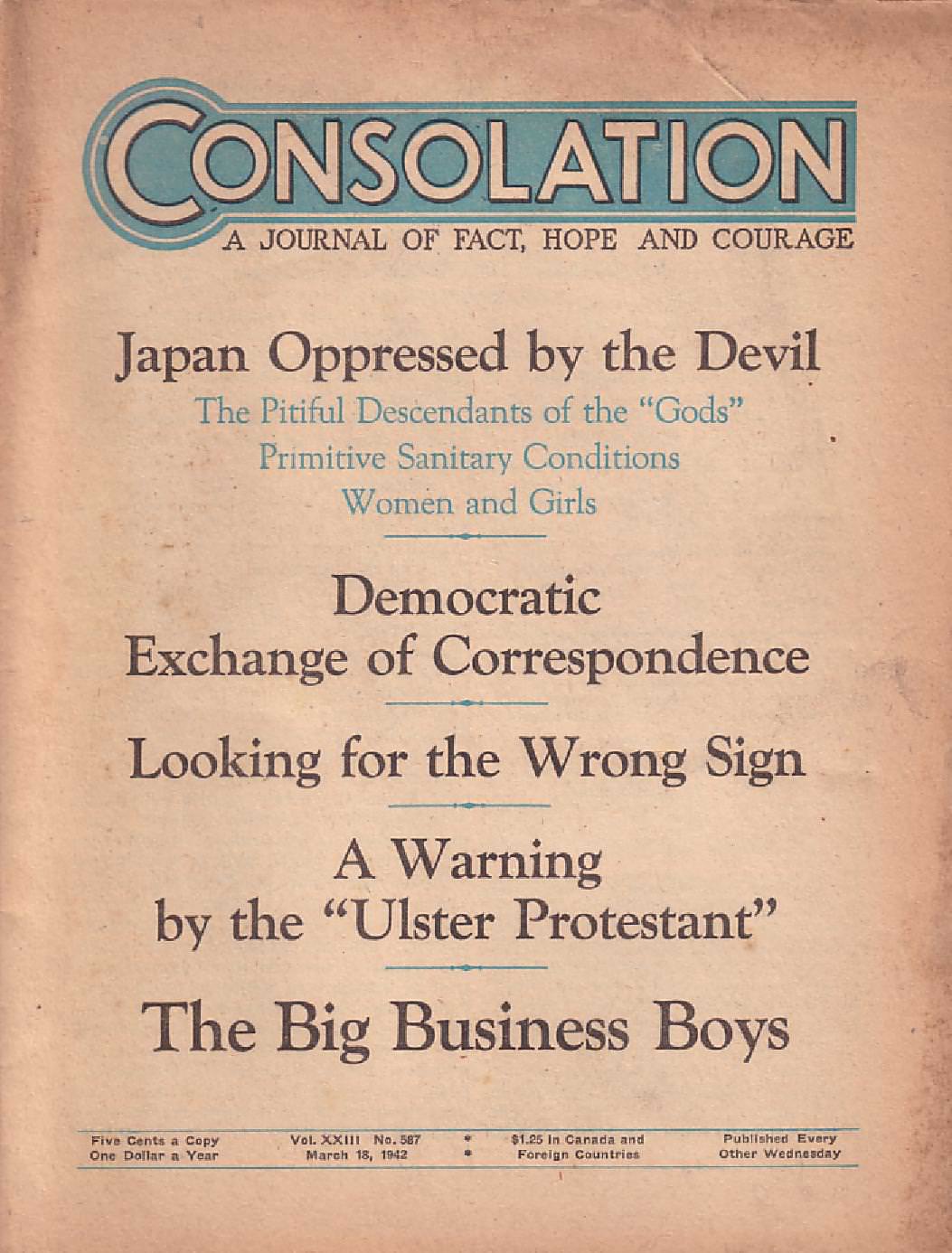
Contents
Japan Oppressed by the Devil (Part 3) 3
Britain Joins the United States 4
The Pitiful Descendants of the "Gods" 6
Primitive Sanitary Conditions 7
Women and Girls 8
"Very Polite" 9
Dies Investigation 11
New Government
Democratic Exchange of Correspondence 12
High-School Witnessing 14
In One of America's Largest Cities 16
Constrained Attendance at Church 16
"Thy Word Is Truth"
Looking for the Wrong Sign 17
Some of Man's Silent and Beautiful Friends 19
Under the Totalitarian Flag
A Warning by the Ulster Protestant 20
Subversive Work in the Philippines 23
Morals of the Jesuits 24
How Does He Feel Now? 24
The Big Business Boys
A Made-to-Order Gas Shortage 25
Big Business as a Murderer 26
Bethlehem's Illegalities 26
Elimination of Small Business 27
British Comment
The English That Was 29
Is Religion a Racket? 29
Published every other Wednesday by
WATCHTOWER BIBLE AND TRACT SOCIETY, INC.
117 Adams St., Brooklyn, N. Y., U. S. A.
Editor Clayton J. Woodworth
Business Manager Nathan H. Knorr
Five Cents a Copy
$1 a year in the United States
$1.25 to Canada and all other countries
NOTICE TO SUBSCRIBERS
Remittances: For your own safety, remit by postal or express money order. When coin or currency is lost in the ordinary mails, there is no redress. Remittances from countries other than those named below may be made to the Brooklyn office, but only by International postal money order.
Receipt of a new or renewal subscription will be acknowledged only when requested. Notice of Expiration is sent with the journal one month before subscription expires. Please renew promptly to avoid loss of copies. Send change of address direct to us rather than to the post office. Your request should reach us at least two weeks before the date of issue with which it is to take effect. Send your old as well as the new address. Copies will not be forwarded by the post office to your new address unless extra postage is provided by you.
Published also in Afrikaans, Bohemian, Danish, Dutch, Finnish, French, German, Greek, Hungarian, Japanese, Norwegian, Polish, Portuguese, Spanish, Swedish, Ukrainian; also special Australian edition in English.
OFFICES FOR OTHER COUNTRIES
England 34 Craven Terrace, London, W. 2
Canada 40 Irwin Avenue, Toronto 5, Ontario
Australia 7 Beresford Road, Strathfield, N.S.W.
South Africa 623 Boston House, Cape Town
Entered as second-class matter at Brooklyn, N. Y., under the Act of March 3, 1879.
Notanda
Altered in Transit?
◆ A New York Times comment on the Pearl Harbor report remarks:
The Secretary of State kept the War and Navy Departments constantly informed for months of the gravity of relations with Japan. Yet these warnings appear to have been of a general rather than a sharply specific character by the time they reached those in command at Pearl Harbor and their principal staff officers. At all events, the Roberts Commission says of those in command at Hawaii that "Without exception, they believed that the chances of such a raid while the Pacific Fleet was based upon Pearl Harbor were practically nil."
From which it appears that somewhere along the line the important warnings were robbed of their effect, with the resultant effect of inflicting severe injury on the fleet and air force. Now, who would have been interested in accomplishing such an effect? Doubtless the totalitarians are all in complete agreement on the desirability of putting the finishing touches on democracy. The oldest totalitarian line-ups in existence are the Japanese and the Roman, and there is not the least doubt that these two are working together. The Jesuits are never mentioned in the press, yet are the most deadly and effective enemies of democracy, and their activities should be closely watched by government agencies appointed to guard against espionage. Yet the chances are good that the Jesuits have their agents in these very organizations, as well as in other important posts. Catholics, while by no means all in sympathy with the Jesuit system, are, in the very nature of things, more likely to be used by that system. Jesuit support of the Japanese cause is indicated in the series of articles now running on "Japan Inspired, Deceived, Oppressed, Ruined, by the Devil." Who and what deprived these important communications of their effect?
CONSOLATION
"And in His name shall the nations hope."—Matthew 12:21, A. R. V.
Volume XXIII Brooklyn, N. Y., Wednesday, March 18, 1942 Number 587
Japan Oppressed by the Devil
(In Four Parts—Part 3)
ONCE it is well established that any person is a habitual, malicious and willful liar, such person should be avoided thereafter by every person who hopes to keep clean hands and a pure heart. On this basis it is hard to see how America can hereafter have anything to do with the lying "statesmen" of Japan except as a matter of absolute necessity.
America can lift up its head at the statement of Cordell Hull made to Ambassador Nomura and Special Envoy Kurusu of Japan at the very time that the world's champion double-crossers were unloading bombs on Pearl Harbor:
I must say that in all my conversations with you [the Japanese ambassador] during the last nine months I have never uttered one word of untruth. This is borne out absolutely by the record. In all my fifty years of public service I have never seen a document [handed to Mr. Hull by the Japanese representatives just previously] that was more crowded with infamous falsehoods and distortions—infamous falsehoods and distortions on a scale so huge that I never imagined until today that any government on this planet was capable of uttering them.
It is impossible to shame a liar. No habitual and vicious liar has any but selfish objectives in view. Nothing such a person says can be believed, and a guttersnipe that tells the truth is a prince compared with a potentate whose word is no good. Emperor Hirohito of Japan, who must certainly have known of Japan's careful and long preparation for the treachery which culminated at Pearl Harbor, said after the attack had begun (and showed his word is worth nothing when he said it):
Establishment of peace in the Pacific, and consequently of the world, has been the cherished desire of His Majesty, for the realization of which he has hitherto made his government to continue its earnest endeavors.
America has been the Simple Simon of diplomacy, and that is one reason her people love her and why they hate and despise the hypocrites whether in the Vatican, the German chancellery or the mikado's roost in Tokyo.
Who was it, Wendell Phillips or William Lloyd Garrison, that said he proposed to tell the truth on the slavery question "though the heavens fall"? Well, he told it the best he could; and slavery ended, did it not?
The first inning of the liar always looks good to the liar and to the hypocrite, but it doesn't look good to the great and good and just God. And the first inning is not the whole game. It's the final score that really counts.
Some Facts About Pearl Harbor
Pearl Harbor is America's mightiest naval base. Shaped like the human hand, the entrance is like the wrist, the harbor itself is like the palm, and then there are five long and wide inlets to form the fingers. The whole Pacific fleet could anchor in Pearl Harbor at one time. In the last forty years the United States has expended $260,000,000, with a view to making it impregnable. The Harbor is about ten miles from Honolulu. In one of the inlets is a $10,000,000 drydock, and
at the entrance are two great fortresses, Weaver and Kamehameha, equipped with 12-inch and 16-inch guns and a great variety of smaller ordnance.
Just one week before the treacherous attack, the Honolulu Sunday Star-Advertiser had a headline eight columns wide screaming, “Japanese May Strike Over Week-End!” The same story contained the news from Washington that Saburo Kurusu, the hypocritical Japanese “peace” ambassador, had been “bluntly warned the nation was ready for battle”. The great humiliation followed just seven days later.
There were bright spots in the story of Pearl Harbor. A motor launch with five men aboard saved almost 100 men from one battleship; these men had been injured or blown overboard into oil-fired waters. When the launch’s propeller jammed and the flames were licking around its wooden hull the naval reserve ensign who had volunteered as its skipper directed the disengaging of the screw and the picking up of more victims from the harbor. Isn’t that something to be thankful for?
Some 3,000 American boys were slain, but it was not all one-sided, not quite. One 5-inch aircraft gun was left with but one man, after his battery mates had all been shot down, ten of them. This lone man operated the gun. He seized a shell, placed it in the tray, dashed to the other side of the gun, rammed it home, took his position on the pointer’s seat, and fired. After the third round, an explosion blew him overboard; but he was rescued.
Britain Joins the United States
Less than a month before the Japanese attack on the United States Churchill said that Britain would join the United States, if attacked by Japan, and do so “within the hour”. Britain did. At the same time Churchill said, “We . . . make it absolutely clear that whether we are supported or alone, however long and hard the toil may be, the British nation and His Majesty’s government at the head of that nation in intimate concert with the governments of the great dominions, will never enter into any negotiations with Hitler or with any party in Germany which represents the Nazi regime.” Whether this will mark the policy of Great Britain and America toward Japan remains to be seen, but it may well apply to Japan’s unscrupulous military clique.
While Japan’s actual attack upon America was preceded by a period of great tension, it was nonetheless treacherous. Japan was all set to make the attack right along. On the last of November Lieut. General Kisaburo Ando said that the Chungking regime of China would collapse as soon as Japan isolated it from American aid, and that the Netherlands East Indies would be “summarily treated” as soon as Japan decided to move in that area. On the same day the ABCD powers were stated to be “collaborating fully in preparation for any eventuality”, in view of Japan’s evident determination to refuse any proposals for a settlement in the Pacific.
The Japanese General Tojo said that American and British “exploitation” of Asiatic peoples must be “purged with a vengeance”. Of course, Japan had not been doing any exploiting! True she had invaded China in 1932, but that was to ‘protect the Chinese’!
Yet the probability of war between Japan and America seemed remote, even though the possibility was seen in 1935, at which time some consolation was derived from the fact that the Japanese would, in the event of war, have but a six-month supply of oil, essential to naval warfare.
Toward the end of 1941 America pulled the marines out of Shanghai, which event the New York Daily News foresaw as marking the approaching end of extraterritoriality in China.
Japanese conversations with America reached a stalemate because of Japanese
Japanese moves into Indo-China, threatening Singapore and the Philippines. Application of an economic blockade by the United States was too much for Japan, unwilling to recede from its position, and unable to stand the pressure put upon her. The triple purpose of the Nipponese policy was, (1) No obstruction by Third Powers to "a successful conclusion of the China Affair". (2) Lifting of "the economic blockade" by the United States and Britain against Japan and a halt to the "military encirclement" of the Japanese Empire. (3) No spread of the European war to East Asia. It will be noted that in these demands there was no give, but all take.
No Honest Desire to Avoid War
Looking back now, it is evident to America that Japan had no real desire to avoid war, but was merely playing for time, continuing the conversations even while getting ready to strike without warning and under cover of apparently friendly moves, suggesting a three-month "truce" or "cooling-off period" during which the conversations could be continued.
William Randolph Hearst was strongly against war with Japan, and said it would take years to conquer Japan. But it may be necessary for America to conquer Japan if it is to keep Japan from conquering the larger part of Asia and the East Indies, perhaps including Australia, and ultimately dominating the Pacific to a degree that would be most unwelcome. Japan is a part of the totalitarian abomination, and, as such, threatens the peace and freedom of the entire world. Hearst has, on the other hand, shown his own leanings toward totalitarianism in the past.
December 11, 1941, the New York World-Telegram carried an article about a Japanese naval textbook which showed the Japanese plan of attack almost exactly as it occurred Sunday, December 7, and which textbook had been turned over to the American Naval Intelligence a year ago last October. Information from secret sources, says the article, indicating that Japan would attack United States possessions in the Pacific in December, 1941, or February, 1942, was sent to the State Department more than a month before the attack. The warnings were sent by an underground information-gathering organization, the Sino-Korean People's League, with an office in Washington.
In the Philippines the expected happened unexpectedly. The Filipinos had long been troubled over the course of Japan in taking over Manchuria, invading China, resigning from the League of Nations, abrogating the Washington Naval Treaty and announcing her intention to retain the Caroline Islands mandated to her by the League. Meantime Japanese goods continued to fill Philippine markets, and where importation of such goods was hindered by high tariffs the Japanese opened factories operated under Philippine names. The Filipinos foresaw the possibility that the independence they expected to get July 4, 1946, would prove to be such merely in name and for only a short time. They foresaw, too, that they would have immense difficulty in building an adequate defense, even in ten years and at the expenditure of $80,000,000. The hope that they could make an invasion too costly for Japan went up in smoke, as they watched their northern neighbor invade China regardless of expense. Yet Japan did not have an easy time getting supremacy, what with MacArthur's prodigious resistance.
The day after its attack upon Pearl Harbor and Manila Japan's expeditionary forces landed in Malaya, resisted by British land and air forces. There was also an air raid on the big naval base at Singapore, and at the same time ten Japanese ships attempted an invasion of Thailand and were attacked by British aircraft off Bangkok. Japan, lying like Hirohito, said the invasion was planned to “maintain Thailand’s independence”. When Japan had crossed the border, British troops entered by way of the Malay border.
Japan considered herself “encircled”, with British bases at Singapore and Hongkong, American bases at Cavite, Philippines, and Guam and Dutch Harbor, and a Russian base at Vladivostok. Japan is also within eight hours’ reach from Chungking, capital of China.
Now that Japan herself has started things, it is altogether probable that the highly vulnerable centers of Tokio-Yokohama and Osaka will experience some of the attention Japan has given Manila, with less likelihood of ability to withstand. Buildings housing the munitions industries at Osaka are made of wood, and the majority of Japanese homes are mere paper shacks. There would be slight chance of extinguishing incendiary bombs and preventing a general conflagration.
The Pitiful Descendants of the “Gods”
Writers have vied with one another in making Japan seem mysterious. The Japanese are no more mysterious than the Nazis and the Fascists and other overbearing, underprivileged, would-be world-rulers with the ego inflated with hot air. The Greeks identified or discovered the phenomenon of demon-possession or obsession that made men do things normal humans did not do or want to do. Paul saw through it, and marked it as diabolical, and of a piece with the devil-obsession current in Palestine about the time of the beginning of the “Christian era”. Hence, in Scripture the influence of demons is identical with the influence of devils, and the “gods” of the heathen are just that, no more and no less. The term “devil” means simply “slanderer”, and the first one to follow the course of slandering and opposing God and righteousness is distinguished as the Devil, capital D. All those who from among the spirit realm followed him or his example are also devils, or demons. Invisible to mankind and unable to obtrude themselves into the consciousness of men unless the barrier of the will is lowered, these “gods” have nevertheless succeeded in playing an important part, potent for evil, in the affairs of the world.—See the booklet Angels; published by WATCHTOWER.
All nations have records, legends and traditions, with at least a substratum of fact, of these “gods”, “demons” or “devils”. Some of them they have mistakenly thought of as good, or considered it to their advantage to get in touch with them, whether directly or through mediums, spiritistic seances or what not. The result is always harmful, whether that fact be immediately recognized or not.
With these facts before one, it can be seen that there may be more than mere myth back of the Japanese claim to close affinity with the “gods”. But now to see what these “gods” have dished out for the generality of the Japanese people.
About half the population of Japan live on farms. The average farmer village groans under an indebtedness of $450 per household. One family in ten subscribes for a newspaper. There may be two radios in a farming village, if it is fairly “prosperous”, one of them in the village school. There is no doctor. Midwives attend to the most necessary cases. In Japan the produce of the farms has not been sufficient for the growing population, and a thinning-out process was followed, and may still be, not of crops, but of babies, by means of mabiki or infanticide.
Japanese are reputedly very clean. The whole family, including the servants, all bathe in the same tub at the close of the day, and in the same heated water. First the father bathes, then the sons according to age, followed by mother and daughters in the same order, and the servants likewise. The last to bathe in a household probably gets used to using the used water. Anyway, there is no quarreling as to who follows whom in the use of the bathroom.
Washing clothes is simple enough; for the Japanese farmer does not wear much of anything. In summer a pair of cotton trousers, and perhaps a short kimono, which in winter is padded. Even in winter a farmer may not be able to afford additional garments, but if he is able he will wear one cotton undergarment through the winter in a climate as cold as that of New England.
The life of the farmer is meager. A little rice and a pickled radish for breakfast, the same for lunch, and more of the same for dinner, with perhaps some bean soup and fish added where it can be had. Hardly a meal for gods!
There is no furniture in the Japanese home, as a rule, unless it is a table. Beds are merely quilts spread on the floor, folded and put away behind sliding screens in the daytime. Thin mats serve as places to sit. Shoes are removed at the door, and an annual cleaning of the mats is considered enough! There is no time for unnecessary work. There is spinning, weaving, planting and other farm work to be done, by men and women, boys and girls.
For many years now farmers' sons and daughters have gone to work in the mills, and sons have had to do soldier duty, from which at least some of them return, bringing back new ideas to the villages. The Japanese farmer is now less inclined to put up with the way things have been managed for him.
Trade Still by Barter
Almost without money, trade in the villages is conducted mainly by means of barter. Poverty tends to increase thefts, which police have difficulty in controlling. Everybody is in debt and underpaid.
Land is exceedingly scarce. The portion under cultivation is only 17 percent of the total area, and much of this is on mountain slopes difficult to cultivate. Large-scale farms are few. Most of the farms are paddy-fields, so constructed that they will hold water in the planting season. The farm of the Japanese family is less than one-thirtieth the size of an average American farm.
Japan is now importing rice from Indo-China, but the people do not like it, as it is a softer rice than that which is home-grown. An effort on the part of the government to make them like it, by mixing one-fifth with four-fifths Japanese rice, was not successful. If cooked long enough to soften the Japanese rice the Indo-Chinese rice would be mush, and if undercooked to prevent this the Japanese rice would be hard. (The Israelites had a law against mixing grains.)
With the increasing food problem and because silk was not being exported as formerly, Japan began plowing up the mulberry orchards, on the leaves of which the silkworms fed, and changing them into grainfields.
Farm hands receive about 13 cents daily; women, 9 cents. Male silk-workers get from 18 to 30 cents; females, 15 to 18 cents.
Distribution of wealth in Japan is such that 60 percent is in the hands of one percent of the population and three-fourths of the people are living on less than half of what they should have for decent living.
The number of underfed children in Japanese schools is great, there being some 8,000 of these in the prefecture of Osaka alone. Many families have lost their livelihood on account of the war with China. The war with America and Britain will only increase the misery. The work-week is from 78 to 91 hours, and in some factories the daily stint is 19 hours.
Primitive Sanitary Conditions
In the larger Japanese cities the drinking water is admittedly pure, but sanitary conditions are still primitive. The Japanese bathe often, and they first scrub themselves before entering the common tub, private or public. But there is no safe sewage system in any Japanese city, not even in Tokyo. Carts that collect waste from humans stop in front of the largest office buildings in the capital, and buckets are emptied into the carts right in public. In the suburbs the carts do not come around so often, though supposed to call once a month. The smell of human dung is almost everywhere.
Rats are plentiful in the cities: gray, black and brown rats. Nobody pays attention to them, even when seen under tables in restaurants. In Tokyo there are some 10,000 stray dogs. In a single day twenty persons bitten by them reported the matter to the police.
The Japanese are susceptible to tuberculosis and similar diseases. They are often seen to wear black or white filters over their mouths and noses when in the streets, but take them off in restaurants, moving-picture houses and other like places. Spitting is common. Trains have numerous spittoons sunk in the floors of coaches. These are at least aimed at, but by no means always successfully. The government has tried to discourage spitting without success.
Tokyo has ordered foam removed from beer before serving. It was discovered that expert beershooters could reduce the beer content of a schooner by 16 per-cent.
There are few automobiles in Japan, and often they are propelled by charcoal-burning engines, the installation of which gives the car a cumbersome appearance.
Japanese houses are matchboxes. Fires are disastrous, as they tend to spread quickly through the flimsy, closely built structures.
The Japanese carry economy to an extreme. On account of the war with China an eighth of an inch was cut from matches.
All persons who leave Japan must declare the number of gold teeth and fillings they have and pay for taking the metal out of the country.
Women and Girls
The duty of women in Japan is to obey the men: daughters, their fathers; wives, their husbands; sisters, their brothers; and when old, obedience is still required—to sons. Japanese tradition holds that the wife is married to the household of the husband, and that is of first importance. The first act, then, after marriage was to go to the shrine and report to the dead souls of his dead ancestors that she was ready for work. If she did not like her husband, whom she had probably never seen before, that was too bad, but nothing could be done about it. She still had her job. If her husband did not like her, he could look for romance on the side, such as with the geisha girls, but she was still the first woman of his household, and that is where the women had their sphere. The war with China has made great changes in this code of triple-obedience. Women are now seen everywhere, doing the work of men away at the front. They serve as bellhops, gas-station attendants, conductors, caddies, bartenders and elevator operators, and are getting a kick out of their new freedom.
Tokyo now has a school to train soldiers' daughters to be soldiers' brides. First on the list of subjects is filial piety.
Yet there are many women in Japan who want their marriages dissolved; and a tree with an interesting history is found in a suburb of Tokyo, to which tree people go who want to be separated from their life-partners. They leave prayer pictures at the tree rather than counting beads or lighting candles, and it is doubtless every bit as good, which is no good. At first the tree was called 'the god of marriage', but evidently many who came to pray remained to jest, praying first for a loving marriage, and later coming back to pray for the privilege of parting, something that is generally frowned upon in Japan. Marriage for love is likewise the exception, as everything is usually arranged by parents, relatives or friends before the bride so much as sees her future husband.
If a daughter is pretty she is likely to be in demand for the houses of prostitution, and if the family is poor or in debt the chances are that she will be sold for two or three hundred yen, considered an advance on the girl’s “earnings”. But there will be many deductions for her cosmetics and kimonos, and the girl will probably remain the virtual property of the “tea-house keeper” for the rest of her life, such as it is. Death from disease generally comes comparatively early in life. The girl often goes into this arrangement with her own consent, for the sake of the family. This “sacrifice” on her part is considered a high honor!
In Yamagata province a certain block of land had been opened and placed on the market for sale. The villagers desired to buy the land, but could not raise the money. They got together and decided to sell their daughters, 57 of them, into the vice quarters and buy the land.
Japanese women regard it a disgrace to cry out in labor. “Rigid self-control, avoidance of braggadocio, quiet behavior” are expected of the women as well as the men in the Japanese scheme.
A writer who told of 1,600 young girls working in a cotton factory told of spotless airy halls provided for them, and that they were well fed (on 5c a day). Another writer said these workers’ dormitories often had vermin in them.
Japanese women in recent years have been allowed to get something of an education, if they had the money to pay for it, which few had. Yet, among the 247 persons chosen from among 2,500 applicants, there were two women who passed in a bar examination in writing. If successful in the required oral examinations they will be the first woman lawyers of Japan.
After attacking Korea, Manchuria and China on the ground that she had to have more room for her growing population, and after slowly meeting defeat in China because of the loss of so many men, the Japanese Welfare Ministry announced that it would present medals to the 10,000 mothers in Japan who have ten children over six. The ministry also selected 100 young Japanese couples, advanced each of them a loan of $70, and agreed that no interest will be charged if they have a child in the second year. The principal was to be reduced 20 percent with each child born.
“Very Polite”
Being a very sensitive, not to say touchy people, the Japanese have stressed politeness to an extent that is probably unequaled anywhere else. It is a social crime to give an answer to a question in such a way as to make it unpleasant to the questioner. Nor should one ask for any favor that might make a refusal necessary. Blunt negatives and direct refusals are unknown in the Japanese code. One must merely suggest or hint at one’s meaning. Failure to do so would mark one as a barbarian, and to the Japanese one of the serious charges against the people of other nations is that they are impolite! An instance of Japanese politeness is found in the story of an American who broke a rare bowl, five centuries old, when participating in a tea ceremony. The owner, without “batting an eye”, remarked: “Yes, that’s what always happens to that old cup.”
As has already been seen, however, Japanese politeness is thoroughly offset by its impoliteness; witness the face-biffing which it considered a suitable expression of its attitude toward Americans.
In Japan it is considered honorable to order a man to slit open his abdomen and permit his bowels to fall out to preserve his honor. And this is done in “a colorful ceremony”, witnessed by important members of the government. In Japan this is called hara-kiri. It is just plain murder to Americans.
Japanese politeness requires them to smile when reprimanded; something that has resulted in plenty of misunderstanding when dealing with foreign employers.
Japanese seem to put very little difference between human and animal life. They do not kill unwanted domestic animals or newborn puppies, but put them out to shift for themselves, with about the same result. They cannot understand why Americans kill such animals painlessly, and yet would not think of killing, for instance, the famine-stricken people of China that way.
Japanese workers do not carry their politeness too far. In Japan, when employees are discharged, they receive two months' pay, called "retirement money". The American manager of the Japanese plant of the Singer Sewing Machine Company ignored this custom, with the result that the Japanese workers very impolitely wrecked his plant and destroyed records of installment sales.
But Suspicious
Japanese have had spyphobia for some time, with rather annoying results to resident and visiting aliens, who found themselves followed by plain-clothes men, stopped by police at almost every important crossroad and generally harassed, but always given profuse apologies when they took the matter to the police station. This was the experience of an American family that for years had lived in Japan, and spoke Japanese fluently.
This suspicion is but a reflection of the fact that many Japanese themselves are not on the up-and-up in their activities in America. It is those that are subversive themselves that on the slightest provocation suspect and accuse others of being subversive. Japanese activities in California have been organized in such a way as to give them every opportunity to spy on America under cover of being fishermen, small businessmen or what not. An article in Friday magazine of May 9, 1941, called attention to the extent of Japanese espionage and fifth-column activity in Mexico and California. Germans were often in evidence along with these Japan-directed activities. There was much photographing being done by "camera enthusiasts" and the films were brought to Japanese stores to be developed. It was easy to get to Japan from Manzanillo.
Japanese born in Japan but now living in America, particularly in California, may have America for their physical home, but Japan is their spiritual home, and claims their religious and patriotic loyalty. They try to indoctrinate their children with the same viewpoint, but not always with success. An article in Ken magazine of May 4, 1939, claimed that the Japanese in California are exceptionally industrious, moral, easily assimilated, and that those of American birth are becoming valuable and increasingly loyal citizens. What effect the war may have on the picture is another question.
Ken, in its issue of June 22, however, revealed that native Americans, some of whom are U. S. Army reserve officers, were co-operating with Japanese, German and Italian agents on the west coast in secret activities pointing to a plan for attacking the United States. It stated that present and former reserve officers of the American armed forces were building and helping to arm a secret army within the United States. The setup was complete, linking the German, Italian and Japanese consulates. They were all ostensibly interested in Communist activity in the United States, and by Americans, which was none of their business. At the same time secret Japanese, Nazi and Italian agents were storing drums of a German-made chemical near the naval and air base at San Diego, capable of sinking the American fleet without firing a single shot. Japanese navy officers were issuing orders to Japanese "farmers" just south of the American border to get more land for building emergency airfields.
The same paper mentioned that the Shiriya, a Japanese "naval" vessel, claimed immunity from search when it
was in port, and at sea mysteriously changed its course, taking its oil cargo to an undisclosed destination in the Pacific. When in port its officers had mysterious conferences in a Tia Juana dance hall.
Seattle Churches Praise Them
The Seattle Council of Churches, probably under the “spiritual” leadership of Bishop Shaughnessy, in November lauded the good character of the Japanese in the Pacific Northwest and assured them of the sympathy and co-operation of the church, saying, “Please do not hesitate to confer with any Christian pastor relative to any problem that may arise.”
But a newsletter published under date of July 9, 1941, points out that there are approximately 90,000 Nisei (American citizens of Japanese ancestry) on the West Coast, of whom two-thirds held dual citizenship. In private Japanese language schools it was found that two sets of textbooks were on hand. One set was shown to investigators and contained nothing objectionable, while the set actually used preached loyalty to Japan and its “god emperor” and treason against the American government. Here is a sample:
As citizens of this country (Japan) and offspring of this (Japanese) nation, we admire its brilliance. Our national language cannot be forgotten in our hearts, not even for a single day, especially if we remember that we are children of Gods. The objective of Japanese education, no matter in what country it may be, is to teach the people never to be ashamed of their Japanese citizenship. First comes language, and then history. We must never forget—not even for a moment—that we are Japanese citizens. . . Be thankful you are a Japanese, and worship the Imperial family.
This trick of dual citizenship is a trick that has immense possibility for harm. It is a trick that has long been used by the Hierarchy and its religious orders. The Catholic population may be less culpable in this matter, but it is often a matter of uncertainty where the loyalty of a person lies whose religious allegiance is so closely identified with the totalitarian spirit of a foreign hierarchy that is religio-political in its aims and objectives.
Dies Investigation
Dies investigators in 1940 made a careful survey of Japanese activities along the West Coast. There were found to be 150,000 Japanese citizens in America (U.S.) all of whom were still Japanese citizens. Additionally, there were 50,000 second-generation Japanese, born in this country. Dies found that 200 key Japanese had been decorated by the emperor during the last two years. Many Japanese were in close co-operation with the Japanese government through the Central Japanese association, directed by Japanese consulates. Japanese truck gardens were found alongside oil tanks and strategic railroads. There were 5,000 Japanese located on terminal islands in Los Angeles harbor convenient to important oil tanks, airfields and shipbuilding companies. Japanese were found in possession of maps showing all the U. S. strategic points and fortifications and of a naval manual giving exhaustive and important information concerning ALL American naval vessels. They also had documents showing the details of Pearl Harbor, the Panama Canal, San Francisco, Manila, Guam, and Vladivostok. Nothing like being well-informed! The Japanese had maps showing the location of submarine cables, mines, channels, wireless stations, Japanese consulates and air bases all along the West Coast. Dies had 52 witnesses ready and was all set to conduct hearings when Matthew Maguire, acting attorney general, sent him a letter to the effect that the State and Justice Departments and the White House were opposed to the inquiry. The greatest caution was deemed necessary in handling the exceedingly delicate situation.
RIGHTEOUS RULER
Democratic Exchange of Correspondence
From R. Judge,*
Hill Top, Ridgeway,
Rayleigh, Essex.
10th September 1941
The Editor,
Sunday Pictorial,
Fetter Lane, London, E.C. 4.
Dear Sir:
Your newspaper excelled all others last Sunday in its article on Jehovah's witnesses. It is difficult to imagine a more insulting and hate-provoking effort than this nonsense by Shirley Long, who could well have concocted it at home, without wasting a journey to Leicester! Most of us arranged our holiday to attend the Assembly, and all those who were there know the true position to be very different from what was described in the attack by your reporter. If such lies and innuendos are to be taken as a sample of the "news" you provide, then it is foolish for anyone to place any credence in anything they read in your newspaper.
Here are some of the actual facts:
(1) Almost all delegates brought their rationed foods with them.
(2) People of good-will in Leicester were kindness itself and showed their sympathy in many different ways.
(3) Soon after the opening the delegates agreed voluntarily not to use trams and buses during workers' rush hours and not to use cafes and restaurants in the city.
* The letters, which (as here shown) are dated respectively the 10th, 13th and 22nd of September, 1941, passed between R. Judge, Hill Top, Ridgeway, Rayleigh, Essex, England, and H. W. Shirley Long, and/or Editor, The Sunday Pictorial, Geraldine House, Rolls Buildings, Fetter Lane, London, E. C. 4, England.—Ed.
THE NEW GOVERNMENT
(4) Jehovah's witnesses are against religion but proclaim the comforting message of God's incoming Government. Jesus and His disciples weren't interested in wars, either!
(5) Soldiers, in utter disregard of law and order, broke into the convention grounds at night and knocked one witness unconscious. They also attacked another after dark in one of the main streets.
(6) Home Guards have bragged that they carried out the smoke-screen exercise over the camping ground in order to cause annoyance and discomfort—and this with the connivance of certain persons who should have been there to prevent such hooliganism.
(7) Judge Rutherford would certainly have been present but for the wartime difficulty of travel to and from the States.
(8) Certain Dominions have banned the work of Jehovah's witnesses as a result of pressure by the Roman Catholic Hierarchy. Your reporter would have heard some of the world-wide protests against this if he had been present on Sunday afternoon.
(9) A telegram was received from three prominent Protestant ministers in London, commending Jehovah's witnesses for their bold stand for liberty and freedom.
The witnesses do not pretend to be interested in a war which is between various nations of Satan's organization on earth. Their efforts are devoted to the service of God and His Kingdom. If Shirley Long claims to be so ardent a supporter of the war effort, why is he not, say, in a munition factory or in the Pioneer Corps instead of taking up time and valuable paper in writing such mischievous rubbish?
I know, of course, that you will not have the courage to publish this letter, but, nevertheless, I sign myself,
R. JUDGE.
Child publishers of THE THEOCRACY at Indianapolis, Ind.
13th September 1941
Dear Mr. Judge:
Thank you very much for writing to me following my article last Sunday on the subject of the Congress of Jehovah's witnesses at Leicester.
The point I want to stress is that I am not concerned in the least with the religious beliefs held by these people, but that I am very much concerned with the fact that ten thousand of them can invade a busy city in wartime and announce that they are neutral about the War.
The question to me is: How can any person in a country fighting for its very existence profess neutrality about that fight?
We owe our daily food and also the fact that we are not in the same position as France to the men of the R.A.F., who smashed the German Air Force last September and to the crews of the two thousand British ships at sea, who bring our supplies to us.
These men risked and gave their lives. They are not neutral.
Yours sincerely,
(SIGNED) H. W. SHIRLEY LONG.
22nd September 1941
Dear Mr. Long:
I thank you for your letter of the 13th September regarding the Leicester Convention of Jehovah's witnesses, and regret the delay in answering.
In all fairness I must point out that it is the newspapers, and not Jehovah's witnesses, who have been doing all the announcing that the latter are "neutral" about the war! There was no need for us to mention this at the Assembly, as all delegates were fully conversant with the position. Leicester did not suffer, either. It has been estimated that the city benefited to the extent that about £9,000 was spent there by the conventioners.
Not being pacifists ("peace at any price", etc.) Jehovah's witnesses do not influence anyone against the war effort. They respect the wish of the majority to take up arms and fight. Conversely, they have the right to expect others to leave them alone to carry on their Scriptural work of proclaiming the incoming of God's Kingdom of righteousness—surely a very comforting message when millions have lost their faith as a result of the hypocrisy of "religion".
The members of the R.A.F. and other forces may all be doing what they consider to be their duty—but so are Jehovah's witnesses! In supporting armed force the majority are chiefly concerned with preservation of self, family or property and care little or nothing about Jehovah God and His service. They are entitled to their viewpoint, of course, even though this may not be right. On the other hand, Jehovah's witnesses, as consecrated Christians in a covenant with God, are ready to lose their lives in His service.
They are not concerned with Number One like most people are. Many thousands of them have endured indescribable persecution in Nazi Germany, U.S.A., Canada and elsewhere, because they are moved by a spirit which knows no narrow personal or national bounds.
As they exist in all countries the effect of their neutrality in the midst of warring nations might be said to cancel itself out. If anything, Britain, so far from being adversely affected by their presence, tends to gain from the fact that Jehovah’s witnesses were far more numerous in Germany than here! In other words, there would today be many more thousands aiding the Nazi war machine if those individuals were not Jehovah’s witnesses. Pursuing the argument on the supposed “danger” of their activities, on the basis of reductio ad absurdum it should be quite obvious to anyone that there would be no necessity for wars if all, or even the majority, of the peoples of the nations were as law-abiding servants of God as are Jehovah’s witnesses!
We have every Scriptural precedent for neutrality. Abraham, Daniel, Nehemiah, Jesus, Paul and all other faithful witnesses for Jehovah were always neutral as regards warring nations not in a covenant with God—and therefore under the control of Satan. We follow in their footsteps and have just as much right to carry on our work as those whom you eulogize have for theirs—more, if anything, as ours is a God-given service, and not one born of expediency or fallible human reasoning.
Kingdom Hall, Spokane, Washington
Betty (7) and Evelyn (10) Maupin; when asked why not in school explain they have been expelled from school for being Christians in West Virginia; they are efficient Kingdom witnesses.
No, Mr. Long, you should not condemn Jehovah’s witnesses merely because you yourself fail to understand their mission. Multitudes do appreciate it—and heed the Biblical warning given in the Acts of the Apostles: to leave God’s witnesses alone and not to oppose them, lest one should be found to be fighting against God.
Yours faithfully,
[Signed] R. JUDGE.
High-School Witnessing
◆ Place—The Waller Branch High School, Chicago. Date—January 31, 1941. This took place in my music class. On this day they were singing patriotic songs. When they had finished singing “The Star-Spangled Banner”, a girl raised her hand, and, upon being recognized by the teacher, said, “Can’t something be done about those people who live in the United States but who don’t salute the flag or sing “The Star-Spangled Banner?” The teacher answered, “Well, there is a certain sect or cult, whose name I can’t remember, who don’t salute the flag. Their case has been brought up in the Supreme Court, but I don’t believe I know what the decision has been.”
Joy Armes; parents are pioneers; when 3½ she was arrested for being a Christian in Oklahoma. Before being jailed she said, “I forgot to leave a Kingdom News; wait a minute,” and while the police fumed she calmly returned. After 3½ hours in jail, Joy said, “I guess Jehovah caused His angels to let us out, just like He did the apostles.”
Then, upon recognition, I spoke, saying, “Jehovah’s witnesses are not a sect or cult, but a Christian organization.”
Then the girl sitting behind me whispered, “Are you one of Jehovah’s witnesses?”
I nodded yes. Not satisfied at having answered emphatically enough by nodding, I turned around and, looking straight at her, said, “That’s right, sure.” Then I overheard another girl say, “At least she’s not afraid to admit it.”
February 3. I decided that I would see the teacher, Mrs. B——, and tell her more about this; so today, after school, I asked her if she remembered the incident that happened a few days ago. She said, “Oh yes, you were the girl who said that Jehovah’s witnesses were not a sect or a cult, but a Christian organization. I was telling my husband all about you last night.”
I then asked, “Would you like to learn the Supreme Court’s decision in this case?”
“Yes, I’d love to. Tell me about it.”
“Well,” I said, “instead of telling you about it I’ll let you read this Consolation, which shows the Supreme Court’s decision of this case, and also this booklet, Loyalty, which shows why we take this stand.”
She said, “Thank you, I’ll be glad to read them.”
Her answers sounded as if she might be a person of good-will toward God. She has been very kindly disposed to me since then, and a few days after this incident she invited me to ride home with her in her automobile after school.
About a week later, in class, when passing my desk, she told me that she enjoyed reading the booklet very much.
Date—February 5. This took place in my English class. The class was discussing reasons why 1941 was the epoch of belief. The teacher asked if they could name some new religions. She suggested the “I Am” organization. Another girl suggested the “Jehovah’s witnesses”. Then I raised my hand, and, upon being recognized by the teacher, said, “I’d like to make a correction there. Jehovah’s witnesses have been in existence ever since the time of Abel. THE WATCH TOWER SOCIETY has been in existence for over 66 years. Jehovah’s witnesses are not a religion, but a Christian organization.”
Immersion at Peoria, Illinois, Assembly
The teacher then remarked, “Thank you. We’re glad to know that.”—Barbara Nicholson, publisher, Chicago Central Unit.
In One of America’s Largest Cities
◆ Included in the names of officials on whom I was to call with the God and the State booklet was that of the warden of the city prison. I called, was taken to the warden’s office, and started to outline the purpose of my visit and the nature of the message contained in the latest booklet.
As soon as he learned that the publication was from the WATCHTOWER he brightened up, said he had long followed the experiences of Jehovah’s witnesses, and was convinced that we are genuine and are doing a Christian work. He listened attentively and agreed to what I said regarding religion and religionists, and accepted the booklet to read.
He asked if I would not like to present copies to his various assistants and other officials at the prison, thereby anticipating a request I was about to make. He had his secretary introduce me to these people, each of whom took the booklet and promised to read the message contained therein.
The warden then took me on a complete tour of the institution, including an inspection of the death cells and the electric chair. Observing some reading rooms in various parts of the building, I asked if he would not place a number of different WATCHTOWER publications in these places. This he readily agreed to do, and I left an assortment of booklets for this purpose.
The high spot of the tour came when he showed me work being done on a new and very elaborate sound-system which was in process of installation, and so arranged with loudspeakers in various offices and corridors that the 800 inmates, with the various attendants and guards, could be addressed at one time, the system being controlled from a master station in the warden’s office.
This gave me an idea, and because this gentleman had demonstrated such good-will toward the message of THE THEOCRACY, I told him that Jehovah’s witnesses would gladly present programs by Judge Rutherford in sound recordings, explaining the meaning of world distress, and pointing out the sure remedy. The warden thought that such programs might be of real help, especially to first offenders, and instantly agreed to put on a series of half-hour WATCHTOWER programs, as often as we may wish. None can help but hear, whether they will hear or whether they will forbear.
In the joys of the service of our King. —Alice Barnes, Pioneer.
Constrained Attendance at Church
◆ In the trouble zone of Illinois is a schoolteacher whose father is a witness for THE THEOCRACY. Several times she has expected to lose her job on account of her father’s activities. The principal of the school informed her that it would be best for her to attend church. She did, and the first Sunday she was there the new preacher, having nothing in the Bible to talk about, talked against Jehovah’s witnesses. She knew that was wrong, and made up her mind that the next Sunday she would merely attend the Sunday school. She did, but it rained hard and she had to stay over and hear a second sermon, and the preacher, knowing nothing more than in the previous week, gave Jehovah’s witnesses a second coat. That was too much, so she decided not to go to church any more and was warned she would lose her job. She started to look elsewhere, when to her surprise she was retained and given a raise of pay, and the fellow teacher who last told her she would lose her job was also retained but got no increase in wages.—E. H. Comstock, Illinois.
(To be continued)
"THY WORD IS TRUTH" —John 17:17
Looking for the Wrong Sign
THE question is asked, If Jehovah's witnesses are the authorized and commissioned representatives of Almighty God, why do not "tongues" form a part of their equipment now as in the times of the apostles?
It was on the day of Pentecost, the fiftieth day after the resurrection of Christ Jesus from the dead. There the invisible power, or holy spirit, of Jehovah God was poured out through Christ Jesus upon the accepted faithful followers of Christ on earth and they began to speak with foreign tongues and thereby to preach the message of God's kingdom to the astounded multitude that gathered about. (Acts 2:1-11) Today, more than nineteen centuries thereafter, certain religionists insist on miraculously given "tongues" as proof of true Christianity.
◆ Manifestly, if Jehovah God wanted His faithful servants to now exercise powers of tongues, He would impart such to them for their use in His service. The fact that He does not now do so shows that He has other means and ways for accomplishing His purpose to the end that "this gospel of the kingdom shall be preached in all the world for a witness unto all nations" before the final end comes upon Satan's world, soon. (Matthew 24:14, 21)
The fact must be recognized that the Kingdom literature which is distributed by millions of copies each year by Jehovah's witnesses in the face of the most bitter persecution by religionists is published in more than eighty languages, the principal languages of the world. As a result the Lord's "other sheep" are being gathered to the side of Him and His THEOCRATIC GOVERNMENT, and they shall form the "great multitude" out of every nation, kindred, people, and tongue, and they shall survive the battle of Armageddon and gain everlasting life on earth in the "new world".
In lands or in foreign countries and colonies where Jehovah's witnesses do not know the language they use a printed "testimony card" or "testimony booklet" to introduce the literature in the tongue which the people there speak, as, for instance, here in New York city, where, as in Jerusalem at Pentecost time, are found practically all the main languages of the earth. Furthermore, the message of Jehovah's THEOCRATIC GOVERNMENT under Christ has been recorded on phonograph discs in many languages, and Jehovah's witnesses carry with them a small phonograph with records in the particular language or languages needed and let the phonograph reproduce the speech in the hearer's native tongue. Sound-cars and sound-boats equipped with loudspeakers are also used to reproduce such recorded speeches, that thousands may hear at one time. By this means, since A.D. 1922 particularly, Jehovah's witnesses have declared the Kingdom gospel to literally hundreds of millions, in many tongues, in all quarters of the earth. Since that date till now, as the genuine records show, more than 373 million books and booklets setting forth that message of THE THEOCRACY have been placed in the hands of the spiritually hungry people, not to include the hundreds of millions of copies of magazines, pamphlets, and free tracts also distributed.
◆ Those who today insist on the "gift of tongues" should answer the question, How much preaching of the Kingdom gospel do they do in "tongues" OUTSIDE OF THEIR RELIGIOUS MEETING-PLACES? They will have to admit, None! Their "gift of tongues", which they think is from God, they possess only for the time being, when seized by some strange power at the meeting-place. Then, too, no one present, not even the one whose tongue makes the strange sounds, understands what the foreign babble means, and thus no one is profited thereby or upbuilt in the knowledge of God and His purpose as recorded in His Word.
Which ones, then, are fulfilling God’s commandments and carrying out the commission He lays upon true and anointed Christians, to wit, "The spirit of the Lord GOD is upon me; because the LORD [Jehovah] hath anointed me to preach good tidings unto the meek; he hath sent me to bind up the brokenhearted, to proclaim liberty to the captives, and the opening of the prison to them that are bound; . . . to comfort all that mourn"? (Isaiah 61:1, 2) Which ones show that the holy power of God is resting upon them and working His will through them, Jehovah’s witnesses or those religionists with imagined "gift of tongues"?
When Christ Jesus, who applied unto himself the above commission to preach, was present in the flesh on earth, He preached the Kingdom gospel in only one language, His parents’ tongue. Did this lack of tongues prove that He was not The Christ? At Pentecost of A.D. 33 "tongues" were given to the faithful disciples. This was for a sign to the unbelievers, and all the foreigners listening heard every one the message in his own tongue and understood what was said, without even an interpreter. The apostle Paul, who spoke with tongues more than all the other disciples, said: "Wherefore tongues are for a sign, not to them that believe, but to them that believe not: but prophesying serveth not for them that believe not, but for them which believe." (1 Corinthians 14:22) Those at religious meetings who babble in what they think is a foreign tongue, to the understanding and profit of none of the hearers, feel puffed up thereat and never consider the words of the apostle, who further said: "I thank my God, I speak with tongues more than ye all: YET in the church I had rather speak five words with my understanding, that by my voice I might teach others also, than ten thousand words in an unknown tongue."—1 Corinthians 14:18, 19.
Even in his day the apostle Paul said: "Do all speak with tongues? do all interpret?" (1 Corinthians, chapter twelve) And then in the next chapter, to wit, chapter thirteen, verses one and eight, he shows that to "speak with the tongues of men and of angels" is not the real test of a Christian, but love, or unqualified devotion, to Jehovah God as expressed by obedience and faithfulness to Him. Furthermore, Paul showed that in course of time the gift of tongues to Christians would stop: "whether there be tongues, they shall cease." They did cease, at the death of the apostles through whom the gift of tongues was given to others, and at the death of those to whom the gift of tongues was imparted through the apostles. (See Acts 19:1-6; 8:14-20.) Today there are no apostles of Christ Jesus on earth in the flesh through whom Jehovah God chooses to communicate the gift of tongues. Nor is the "sign" of "tongues" any longer necessary to accomplish God’s work as commanded, as, for instance, witness the works of Jehovah’s witnesses among every nation, kindred and people and tongue on earth at present.
Religionists who now claim to possess at times the miraculous gift of tongues are at such times possessed of the demons and by them made to babble, and thus are the dupes of the Devil, who always counterfeits God’s methods. In now looking for such an out-of-date "sign" rather than obeying God’s clear commission to His witnesses, let such religionists take heed to Jesus’ warning that "an evil and adulterous generation seeketh after a sign" and that the sign such a generation demands will not be given to it, because contrary to God’s will. Immediately after those words of condemnation Jesus warned the religionists against becoming possessed by demons or "unclean spirits". (Matthew 12:38-45) The demons blind and lead their deceived dupes to destruction. The prayerful study of and faithful obedience to God's Word is your only safe course and protection.
Some of Man's Silent and Beautiful Friends
MANY favorite plants came from the Western world. Begonias were introduced into England from Jamaica, in 1777. Dahlias were introduced into Madrid from Mexico, in 1779. Today more than 8,000 varieties are in cultivation and there are dahlia societies in every state in the United States. At an Englewood, New Jersey, dahlia show three dahlias were exhibited the blossoms of which were respectively 14 1/2 inches, 15 inches and 15 1/2 inches across.
Carnations were raised at Ghent, Belgium, which, when in full bloom, were almost black. Ghent has 700 flower nurseries and several conservatories large enough to provide for the growth of full-sized palm-trees.
Poppies do not agree with other blooms, and, if placed in a bouquet with them, will either wilt or cause the others to wilt, or both.
…