Consolation, February 18, 1942
Download: PDF — Consolation, February 18, 1942
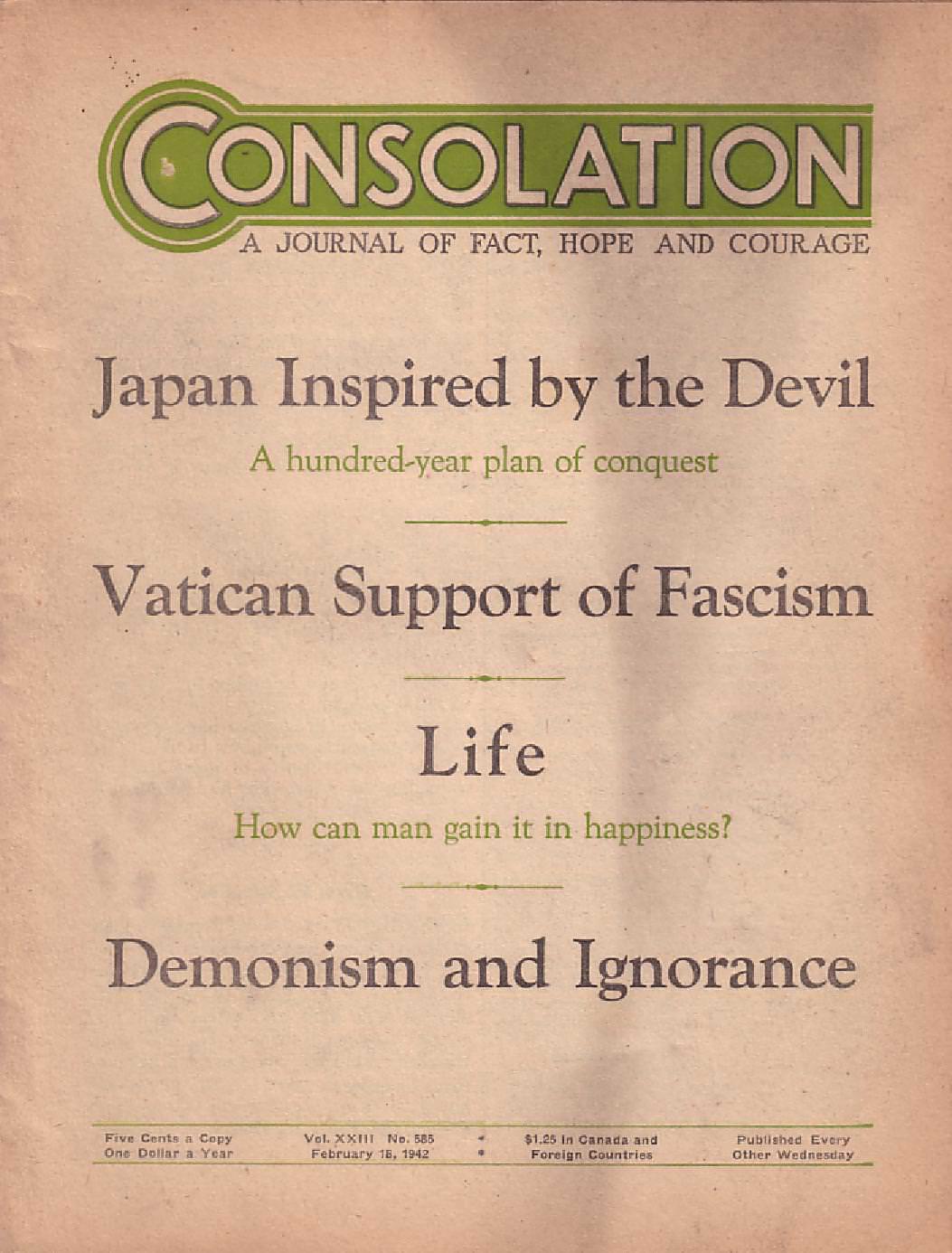
Contents
Japan Inspired by the Devil (Part 1) 3
God, Emperor, and High Priest 3
The Religion Racket in Japan 5
Plans for World Dominion 6
One of the Devil's Theocracies 8
A Hundred-Year Plan of Conquest 9
Many Saw It Coming 10
Under the Totalitarian Flag
Even the Palace Is Worshiped 12
Papal Intrigue and Diplomacy 12
Pope Benedict IX, A.D. 1033-1044 13
Vatican Support of Fascism 14
Center of Totalitarianism 16
Ready to Bargain with the Devil 16
"Thy Word Is Truth"—John 17:17
Life 17
Un-American Discriminations Debarred 19
New Government
Mistaken Patriotism at Lowell 20
Spiritual Weapons Are Mightiest 20
Flag Salute Case in New Zealand 21
A Stirring Decision in Colorado 22
Demon Fires Near San Dimas Church 25
The Land of Free France 26
Does Tobacco Cut Life? 27
British Comment
Demonism and Ignorance 29
'The Ears of the Deaf Unstopped' 30
Published every other Wednesday by
WATCHTOWER BIBLE AND TRACT SOCIETY, INC.
117 Adams St., Brooklyn, N. Y., U. S. A.
Editor Clayton J. Woodworth
Business Manager Nathan H. Knorr
Five Cents a Copy
$1 a year in the United States
$1.25 to Canada and all other countries
NOTICE TO SUBSCRIBERS
Remittances: For your own safety, remit by postal or express money order. When coin or currency is lost in the ordinary mails, there is no redress. Remittances from countries other than those named below may be made to the Brooklyn office, but only by International postal money order.
Receipt of a new or renewal subscription will be acknowledged only when requested. Notice of Expiration is sent with the journal one month before subscription expires. Please renew promptly to avoid loss of copies. Send change of address direct to us rather than to the post office. Your request should reach us at least two weeks before the date of issue with which it is to take effect. Send your old as well as the new address. Copies will not be forwarded by the post office to your new address unless extra postage is provided by you.
Published also in Afrikaans, Bohemian, Danish, Dutch, Finnish, French, German, Greek, Hungarian, Japanese, Norwegian, Polish, Portuguese, Spanish, Swedish, Ukrainian; also special Australian edition in English.
OFFICES FOR OTHER COUNTRIES
England 34 Craven Terrace, London, W. 2
Canada 40 Irwin Avenue, Toronto 5, Ontario
Australia 7 Beresford Road, Strathfield, N. S. W.
South Africa 623 Boston House, Cape Town
Entered as second-class matter at Brooklyn, N. Y., under the Act of March 3, 1879.
Notanda
German, Italian and Japanese Aliens Must Register
◆ Regulations, issued under authority of the Presidential proclamation of January 14, 1942, require all German, Italian and Japanese aliens to apply at the nearest first- or second-class, or county seat, post office for a Certificate of Identification. The requirement applies to all enemy nationals 14 years of age or over who have not yet taken the oath of allegiance before a Federal judge as the final step in acquiring American citizenship. All of these applications must be filed before the end of February. Failure to comply with this regulation may result in internment for the duration of the war.
The regulations require the furnishing of a photograph of the applicant, which is to be attached to an identity card that will be furnished by the Government. The Certificate of Identification will also bear his index fingerprint and signature. He will thereafter be required to carry the certificate at all times.
Before actually applying for the certificates, aliens are urged to obtain from any post office (or neighborhood agency) printed instructions on how to file applications for certificates of identification, which may be obtained by him personally or by a relative or friend.
Draft Registration
◆ The United States Government has amended Selective Training and Service Act requiring all male citizens between the ages of 20 through 44 to register. All men of such ages and whose birth occurred between February 17, 1897, and December 31, 1921, who have not heretofore registered, must go to the designated place of registration where they are on February 16, 1942, and register.
CONSOLATION
"And in His name shall the nations hope."—Matthew 12:21, A. R. V.
Volume XXIII Brooklyn, N. Y., Wednesday, February 18, 1942 Number 585
Japan Inspired by the Devil (In Four Parts—Part 1)
THE Japanese recently celebrated 2,600 years of empire. There is still an older empire, that of Satan, of which he has held the rule more than twice as long as Japan. And there is still an older empire, which has existed from the beginning of creation, and will forever exist, and which will come into its own in the earth at Armageddon, Jehovah's everlasting kingdom.
The newspaper Niroku said solemnly, "The Imperial Family of Japan is as worthy of respect as is God, and is the embodiment of benevolence and justice." Then the paper went on to say "The Imperial Family" is the parent of all mankind on earth; and with equal solemnity this is just to say that no bigger falsehood could be told. The mikado is just an ordinary man, a sinner condemned to death, and without any hope of eternal life except in God's appointed way through Christ.
Every year thousands of school children worship at the shrine of the mikado. Their schoolbooks are carefully prepared to instill into their minds the conviction that the emperor is a god. The theaters, the movies and the story-tellers do the same. Thus the colossal mistake becomes a religion, that the emperor can not err, nor the nation do a wrongful act, nor any of the emperor's servants devoted to the doing of his will. This begets in the Japanese unthinkable pride.
The Japanese are taught that their mikado is a direct descendant of the first god-king of Japan, Jimmu Tenno, that he is above criticism and is accountable to no one except his ancestors.
Lieut. Col. Aizawa testified on the witness stand in a murder trial in Japan, "The Emperor is the incarnation of the God who rules over the universe. Democracy is all wrong." The same account explains that the emperor on 21 occasions each year "appears before the ancestral shrines and performs acts of worship which take us back to the beginnings of human history". How very true!
When the emperor's car passes, all blinds must be drawn and no one may remain on balcony, roof or doorstep. When a tire blew out on the way to the station the chauffeur committed suicide, as an act of penitence. When a Japanese mayor found he had given his son the same name as that given to the emperor he resigned and killed himself in atonement.
God, Emperor, and High Priest
Self-sacrifice to the Tenno is inculcated in every Japanese from childhood onward. The emperor neither drinks nor smokes, and, though he lives in a palace, yet in his trip around the world he marveled at the extravagance shown at Versailles. He shaves and dresses himself, worships the spirits of his ancestors, and sits down to a breakfast of fruit, oatmeal, ham and eggs, toast and coffee. It would all be indescribably funny if there were not some 90,000,000 people that have become hypnotized into thinking he is a god. His own blood brothers are what?
No common person may touch the emperor. His barber and dentist must wear silk gloves when working on him, and his tailor actually fits the emperor's clothes to another man of the same stature. The story is current as truth in Japan that on one occasion a schoolboy rushed into a blazing room to rescue the emperor's picture, found he was unable to escape, ripped the picture from the frame, gashed his abdomen with a sword he snatched from the wall, stuffed the picture therein and died in the flames with the precious portrait in his body. This boy is now one of Japan's national heroes; and that is the spirit that actuates Japan.
The emperor is fond of vegetables, and the world's very best gardeners see that none but perfect products reach his table. When he is on a tour the vegetables are sent to him every day in refrigerator cars. Pretty soft, being a god; isn't it?
When a new ambassador is received by the mikado he advances into the presence alone, bows three times, and reads his letter. The emperor reads his reply and speaks through an interpreter, who must keep his eyes on the ground and whisper. The new ambassador then bows again three times and departs backwards. Readers will remember that when Myron Taylor was admitted to see the pope he also bowed three times. This kind of business burns an American up. He can't understand it.
On one occasion the emperor visited the Kiryu Technical College. The police inspector became nervous, took the wrong road, and landed the party at the college thirty minutes before they were expected. The emperor did not travel over a road first swept, purified, sanded and guarded and did not see persons fittingly garbed for a royal visit. As a result of his error the police inspector, as a matter of course, cut a gash in his own neck four inches long, i.e., tried to kill himself in atonement. The people expected it, but the emperor didn't want it.
Hirohito and the Demons
All the ancestors of Hirohito are as dead as cobblestones; but he does not know that, so once a year he is supposed to go into "the innermost sanctuary to worship his divine ancestress". He did that recently, and after he came out the Japanese Home Minister explained to 3,000 teachers thus: "Dynasties in foreign countries were created by man. Foreign kings, emperors and presidents are all created by men, while Japan has a sacred throne inherited from the imperial ancestors. Japan's imperial rule is therefore an extension of heaven. The dynasties created by men may collapse, but the heaven-created throne is beyond men's power."
The Japanese people recognize 8,000,000 deities, i.e., demons. It is from these that the ancestors of Hirohito received the Japanese throne and, while he may not know it, it is these that he worships when he goes into "the innermost sanctuary" once a year.
As showing the grip this has on the people, a writer in the New York Times says:
The Japanese never use the Imperial name. If implication does not suffice, they simply say: "Tenno"—the Chinese-borrowed phrase, "Son of Heaven." In their quiet manner, by looks only, one's Japanese associates let it be known that their emperor-worship is something on a different plane from anything known in the Western world, something so genuinely a part of their souls that one could no more be frivolous about it than about a child's worship of its mother. Here is a tenderness and respect fundamental somewhere in the depths of humanity.
Likewise one accepts the kneeling fidelity of thousands who, after an all-night vigil, never raise an eye to the bespectacled figure riding past them in the closed carriage for which they have waited. The foreigner willingly puts down his umbrella in the rain, and as often as not surprises himself by kneeling also, although uncompelled, at the last minute.
In other words, that reporter himself probably committed what he well knew was an act of idolatry merely because of the generally reverential, religious attitude of the masses of the people.
The note of his religion was in Hirohito’s declaration of war; for in it he mentioned his “great illustrious imperial grandsire” and his “great imperial sire”, as was to be expected. The Japanese people hold that the line of emperors is the connecting link between them and heaven. In his proclamation he mentioned that he was “seated on the throne of a line unbroken for ages eternal”. That’s stretching at the front end; 2,600 years are not “ages eternal”. Shortly his reign will end in something that will be eternal, however, i.e., eternal destruction, from an angry God at Armageddon. Jehovah’s witnesses have suffered in Japan, and Jehovah will require it at the hands of Hirohito.
Birth of the Crown Prince
When the forty weeks of waiting for the crown prince to arrive drew to a close the empress donned a girdle of plain unbleached silk, four yards long, after it had been consecrated in the presence of the emperor and high court officials, and the event was duly reported to the imperial ancestors, who were dead as door-nails and didn’t know anything about it either before or after it was reported.
When the crown prince arrived all Japan was glad and 35,000 convicts and prisoners had their sentences reduced by as much as one-fourth. The “gods” had been asked that it might be a boy, and it was! The chances were fifty-fifty; for girls come along in about the same number as boys, don’t they?
After seven days Emperor Hirohito placed in his infant son’s hand several names, selected by the court historian, so that the “son of heaven” might have a suitable cognomen. The youngster picked his name, and it turned out to be Tsugunomiya Akihito, which means “The wise and successful prince”. It is a doubtful appellation, in view of the near approach of Armageddon. When he was three months old he was presented formally to 123 of his ancestors; and, as “the dead know not any thing” (Ecclesiastes 9:5), much good it did to either them or him!
◆ Honolulu papers were as much excited about the birth of a crown prince as those in Japan itself. American army officers sometimes say of the Hawaiian Islands that in time of war it may be necessary to capture them; most of the inhabitants are Japanese.
When the crown prince marries he is expected to choose a bride from some one of the thirteen princely houses of Japan. In his youth, and for his entertainment in the palace grounds, in a single summer more than 20,000 fireflies were turned loose. It’s a pretty soft job, being a crown prince. The fireflies are gathered by striking their habitat, usually a tree, a sharp blow with a club, shocking them from their perch to the ground. The picker picks them up, stuffing them into his mouth until he has a substantial mouthful, when they are taken to a common receptacle. Fireflies, placed in transparent receptacles, are used in tea gardens for decorative purposes.
It used to be the rule (and may be yet) that at three years of age the crown prince is put in a separate palace by himself, with a retinue of attendants, of course, and that in order to enter the presence of the emperor he must enter the throne room through a side door and crawl into the presence of the emperor on his hands and knees. What a contrast with the way the American youngster enters the presence paternal which is every whit as important in the eyes of Almighty God as that of Emperor Hirohito.
The Religion Racket in Japan
Those who think what the world needs is more religion should take a little time to consider Japan. If Hitler were to be crowned as an emperor he would certainly claim to be ruling by divine right, for he often mentions his god, which god is the Devil. But in Japan all the school children are taught, and all the Japanese people are supposed to believe, and most of them do believe, that they alone, of all peoples in the earth, have a line of rulers that descended direct from the gods (demons, devils) and that they alone, therefore, have the right to rule the earth. Here are some of their pronunciamientos:
Now it is our oldest and strongest belief that the empire of Japan was originally entrusted to her descendants by Amaterasu-no-mi-kami, known as the Sun Goddess, with the words: “My children, in their capacities of deities, shall rule it.” This was the origin of the Imperial family. This national belief of old is called “Kanagara”, which is, we believe, peculiar to Japan and will be found nowhere else on earth. The phrase “Kanagara” means to “follow the way of the gods” or to possess in one’s self the “way of the gods”. For this reason, or in the same sense, the country of Japan, since heaven and earth began, has been a monarchy and it will be continued thus for ever and ever. From the remote time when our imperial ancestor first descended from heaven and ruled the land, there has been great concord in the empire, and there has never been any factiousness toward the throne.—Professor Bunichi Horioka, foreign-educated Japanese scholar, in an address in Tokyo to an audience consisting mainly of Europeans and Americans.
American statesmen have to holler, “Give us more religion” (on top of the 210 sects that advertise themselves as Christian), but in Japan the people are saturated with it, not knowing anything whatever about the one and only true God, Jehovah, Creator of heaven and earth, but tied down to prostrating themselves before the demons, devils, to whom almost all the so-called “worship” of the world of mankind really goes. Every sect that teaches or stands for either “purgatory” or “eternal torture” is doing that very thing.
Plans for World Dominion
The Scriptures are perfectly plain that the government of the world shall rest forever on the shoulders of Christ Jesus, and that by the appointment of Almighty God, who is the Supreme Ruler over all His universe. See Consolation No. 571, page 2, or look up the scriptures themselves: Matthew 6:9, 10; Luke 19:12; Luke 17:20; Haggai 2:7; Daniel 2:44; Psalm 72:7; Isaiah 9:7; Isaiah 2:4. As Jehovah’s Field Marshal, Christ Jesus will destroy all Jehovah’s enemies at Armageddon, now impending. The Japanese have other ideas, other plans and purposes.
July 25, 1927, the then Japanese premier, Baron Giichi Tanaka, presented to the mikado a plan for first conquering Manchuria, then China, then India, then all Asia, then war with the United States, then the conquest of the Pacific, and ultimately of the whole world. In the New York World-Telegram, December 9, 1941, the American Admiral William Philip Simms stated that the present Premier Tojo of Japan was coauthor of this plan for world domination. Incidentally, this same Tojo, in the same paper, date of December 29, 1941, was reported to be about to make a 500-mile round trip to tell the goddess Ameratsu that the long-projected war with United States and Britain is under way. It seems that the old lady had to wait 23 days to learn about it from his lips. Some goddess!
On January 17, 1939, in an appeal to the League of Nations, Dr. Wellington Koo, of China, told the council that Japanese militarists were aiming at the complete conquest of China and the subjugation of all of Asia. Then, he asserted, the military faction now in control in Tokyo hopes eventually to achieve world domination by making use of the vast resources and manpower of the Far East.
General Sadao Araki, former Japanese Minister of War, in a speech made several years ago, said: “The whites have made the nations of Asia objects of oppression, pure and simple. Imperial Japan cannot and ought not to let their impudence go long unpunished. Our country is determined to propagate its national ideal across the seven seas, to extend and expand it over the five continents of the earth, even if it is necessary to use force to do so.”
Unpublished Regulations
What goes on in the inner councils of Japan's military officials remains hidden, but when the murderer Aizawa was on trial his counsel, Dr. Somei Uzawa, made the statement: "The principles underlying the supreme command in Japan differ from those of foreign countries. The prestige of the imperial structure and the loyalty of the imperial army are unparalleled abroad. The army maintains unpublished regulations, which are only the strongest emphasis on the rights of the supreme command."
All right, if the inside army teachings may not be published, here are two selections from Japanese readers, edited by the Japanese Ministry of Education. The first selection, which is entitled "Citizens' Ambition", is from the New National Language Reader, Vol. 6, Lesson 28, published by San Tin Tang; and the second selection, "The Pacific Ocean," is from Reader for Higher Primary, Lesson 32.
What shall Japan contribute to the world? All Japanese must awaken to their duty to execute the Divine Punishment. By attacking or by punitive treatment, the powers of the world must be broken down in order to fulfil the Divine Mission of Japan. Some day, when, having swept away all rottenness and subjugated all arrogant and impolite countries of the world, Japan shall be the King of the world and lord over the whole universe.
The King of all oceans, you Pacific Ocean! How proud is your beautiful water! Washing the shores of North and South America to the east, touching the sandy beaches of Asia and Australia to the west, reaching the continent around South Pole to the south and meeting the Arctic Ocean to the north, you measure ten thousand miles from north to south and eleven thousand miles from east to west and occupy an area covering one third of the earth's surface. Japan situates on the west. We must live up to this unsurpassable honor and possess an ambition as big as this Pacific Ocean. Going in and out the extensive shores, we must take with our own hands this heaven-sent treasure.
More Accursed Devilish Religion
The path of Japan is traced by the gods and cannot be changed. Our mission is divine. If the gods have destined Japan to rule the world, Japan will rule the world. Our steps in our march forward are not controlled by minorities nor by majorities in the Parliament; they are directed and controlled by the gods, by our ancestors who also were gods like all Japanese are gods.—General Minami, commander in chief of the Japanese Army in Harbin, September 20, 1935.
On March 22, 1896, the then King Oscar II, of Sweden, wrote a letter to Prince Adam Wiszniewski, of Paris, of which the following is a translation, published in the New York Times of November 29, 1931. It shows that almost fifty years ago here was a real statesman who knew a lot more of what is a statesman's business than a lot of people living today who think they are statesmen and are nothing but politicians, and exceedingly poor politicians at that. King Oscar said:
The expansive force of Japan, the patriotic energy of the people, - the "savoir-faire" of the government, the meritorious organization of its military and naval forces, the bravery and admirable devotion of its troops, guided by officers of the army and navy, equally instructed and determined—all this has impressed me exceedingly. One will have to reckon with that Asiatic country, that, up to now, we have underestimated, and I cannot help a feeling of fear and anxiety, thinking of the dangers for a surfeited European civilization which shall come from the Pacific side of the ocean.
Something tells me that a bloody conflict will some day occur, upon which, probably, will depend the lot of Europe; the Occident will succumb to the Orient, where one may already see daily more clearly the strong race of the future, organizing and preparing itself for the great struggle of the future. It is to be hoped that I foresee too darkly and that the future will be better, but at my age one has lost many illusions.
Yours affectionately,
OSCAR.
This Devilish Kodo Business
Ken magazine started out bravely to try to tell the truth, but it could not get any advertisers to stay with it on that basis, and so gave up the fight and, after a vicious attack on Jehovah’s witnesses, expired, as was its due. But on July 14, 1938, under the title “Kodo Rules Japan” and the subtitle “Politics fuses with religion in a fantastic scheme of divinely-inspired Imperialism which teaches that the Mikado, Heaven-born, will rule all the earth”, it had a very interesting story, from which brief extracts appear below:
To know Imperial Japan, know “Kodo”. That is the key word of the Samurai warrior spirit, a word ever on the tongue of the warlords. Kodo has a deep and vital meaning. Every edict of the few years following the Meiji imperial restoration in 1868 contained it. Its import was impressed upon the masses of the Japanese people. “The divine ancestors,” said the interpreters of Kodo, “have performed their duty as prescribed by the Will of Heaven in uniting political administration and religion and in bringing unity of heart between ruler and ruled. This is the supreme Kodo, incomparable in the whole world. But since the intrusion of foreign religions into the country, and the effect of them upon the shallow-minded multitude, Kodo has lost some of its former influence. However, now the destiny of Heaven has brought about the Restoration, though unhappily it has been accompanied by only an imperfect restoration of discipline and culture among the people. Yet with the unification of religion and political administration consequent upon the revival of Kodo the people ought to venerate the foundation of the Divine Empire by Our Heavenly Ancestors, reflect on their duty to it, and resist any temptation to follow alien opinions.”
The intent of the military-supported Government is clear. At any cost Kodo must be revived. The ancient code taught that no sacrifice was to be shirked. The Heaven-born empire under the guidance of its divinely-ordained sovereign must not hesitate short of world dominance. Having, as one leader of the Restoration period declared, “annexed all neighboring countries and then proceeded to the conquest of India,” the next aim would be “The Five Continents” themselves. Fantastic as all this appears, it pictures accurately the spirit of the Japanese militarists.
On August 3, 1935, the Japanese government, which was never anything more than a front for the Japanese army, made the following declaration regarding the so-called “Constitution” of Japan, and which statement shows that that constitution has no real meaning whatever:
The national policy of Japan is clearly revealed in the divine message that the Sun Goddess gave her grandson, the first emperor, on his advent in Japan. Japan is ruled by an unbroken line of emperors and the prosperity of the imperial line is coeval with heaven and earth.
When the Constitution was promulgated Emperor Meiji proclaimed, “We inherit supreme rights from our ancestors and transmit them to our descendants.” Article 1 of the Constitution provides, “The Empire of Japan shall be reigned over and governed by a line of emperors, unbroken from ages eternal.” It is therefore clear that supreme power rests with the emperor.
One of the Devil's Theocracies
The mimic god, Satan, the Devil, has always governed by making use of mimic theocracies, and in Japan he has one that, next to the Roman Catholic Hierarchy, has the rest of them beaten to a standstill. Here is a good place for insertion of some choice paragraphs from the pen of that excellent reporter, Otto D. Tolischus, which appeared in the New York Times Magazine, September 7, 1941. The whole article is extremely interesting, but a few extracts must suffice to establish the point that the Devil himself is back of this whole Japanese religion and government:
Distant as a god, near as a father, Hirohito the Tenno-emperor is to every Japanese, except the few who have fallen into materialistic heresies, the center of temporal and spiritual life. As such he receives divine worship and filial affection. His rule is "coeval with heaven and earth," and in comparison with him all other rulers in the world are either usurpers or mere temporal governors. He is above human judgment, and even discussion of him is a kind of blasphemy. No human dares to look down upon him.
Virtually every Japanese household of whatever religious persuasion, except the few that are Christian, has two altars or shrines. The first is placed higher than the second and it contains not an image but only a symbol of divinity like the mirror dedicated to Amaterasu Omikami, the "heaven-shining, great, august deity" or sun-goddess. The other is dedicated to Buddha and contains his familiar statuette.
Last spring 14,976 soldiers and sailors were deified with solemn ceremonies in the presence of the emperor and 30,000 bereaved relatives, raising the total of those deified to 208,776. A like ceremony for deification of 15,000 more has been decreed by the emperor for October 16 to 21. The closest approach in the West to this observance is the consecration of the Unknown Soldier.
The Shinto cosmogony conceives of the universe not as being created and static but as being born, and therefore growing and developing like any other living organism, which means progressive change. All the religious cults and philosophies have, of course, their own dogma and theology which is expounded by as many sects as divide religions in the West. But to the average Japanese they blend into a more or less unitary concept which may be summed up about as follows:
The Japanese Islands are the hub of the universe and the Japanese people are all born of gods, of which the greatest is the divine mother, Amaterasu Omikami. Her grandson was sent down to earth to rule the Japanese Islands. From this grandson of heaven are descended all the later Tenno-emperors in direct unbroken lineage, which is their title to divinity and to the throne and the basis of their theocratic rule.
On that basis rests Japan's "peerless polity"—a theocracy in secular garb—which is now advanced as a model for the world.
A Hundred-Year Plan of Conquest
Reverting again to the Ken magazine; perhaps you can get hold of a copy of the issue of November 3, 1938, and read the story by John Webster. The main title is "The Cute Little Tiger Cub"; then follows a picture of General Tanaka, and the subhead reads: "Almost a century ago the Japanese Lord Hotta outlined the nibbling-off policy by which Japan was eventually to swallow the world. In 1918, General Nonaka said that peace will come only when the whole world is under one government. Japan plans to bring about such peace. Her department stores already display models of her coming war with the United States. Some people still think they're toys." Some of these paragraphs will make you sick at your stomach when you realize that they were in print for all to read more than three years ago:
Only a thorough weighing of England's position, and the certainty that she—and therefore the United States—would suffer almost any insult in order to postpone a fight, gave Japan confidence enough to proceed with her current arrogant attempt in China.
Two factors influence this English and American attitude. The first is the knowledge that as soon as England becomes involved in Asia, Germany will attack Russia and the often-averted world war—for which everyone is preparing—will be on. The second factor is the desire on the part of the imperialistic foreign office experts of England, France, and America to divide China into two or more distinct political units, so that she may be more easily handled after Japan is disposed of.
The only hitch there is that China is at last unified, by Japan's attack.
This possibility was not quite taken into account in Japan's well-known hundred-year plan of conquest. In 1918, General Nonaka wrote:
"Peace that every man wants will not come until the world is under one central authority. Two new tendencies will follow the World War: a great race in military preparations and a strong denunciation of war."
“Peace will come when the whole world is under one government. The world tends toward this at present. Each existing nation was produced by the conquest of many tribes, and when its central power is strong peace prevails within it. In Japan this is true. The ultimate conclusion of politics is the conquest of the world by one imperial power. The Japanese nation, in view of her glorious history and position, should brace herself to fill her destined role.”
If this is not conclusive enough, there is the Tanaka Memorial. The Japanese, of course, have denied its authenticity, but this reputed forgery has been strangely prophetic. It has predicted every move Japan has made since that time; and so it becomes an interesting document to study for future probabilities. One of the many Korean clerks whom Japanese smugness allowed to be employed in their governmental offices came upon a document which General Baron Tanaka is claimed to have submitted to the emperor in 1927—a plan for a century of aggression. This clerk found its implications so shocking that he made a copy of it, and fled to China, where it was published immediately. It proposes not only every move which Japan has since made, but, in addition, plans the conquest of all Asia and the islands of the Pacific (including Australia) as a final preparation for Japan's “hegemony over the entire world”. The Japanese denial of its authenticity, of course, followed at once, but one must remember that the Japanese word is of little value in international affairs.
Japan, smiling, fawning, obsequious—or vain, boastful and arrogant, as the occasion seems to demand—presents a figure in a high silk hat with a trench helmet underneath, and a frock coat with hand grenades concealed under the tails.
Japan in modern times has engaged in three major military adventures—the two wars with China and the one with Russia. Not once did she enter a formal declaration of war. Her favorite method is to attack an entirely unsuspecting port at night and accomplish her kill before the victim knows he has an enemy. If this happens to us there will be no excuse.
Many Saw It Coming
Many able men saw this coming. One of these was General Smedley D. Butler, now deceased. He put it mildly in an address at Fort Wayne, February 4, 1933, when he told of confidences given him by Japanese officers under the influence of liquor during the Boxer rebellion in China in 1900. They told him it was their purpose to set up a tremendous Oriental empire with themselves at the head of it; that in order to do that they must have war, and that they were then preparing for that war.
In the New York Times, April 6, 1941, Otto D. Tolischus, then in Tokyo, wired that authoritative Japanese spokesmen had set forth their purposes to create a “New Order” in which the entire world is to be divided among the big powers, with Japan at the outset to have all the territories between the date line, the 180th meridian, and the Arabian Sea, containing somewhat less than half the human race.
Quite remarkably, and quite out of harmony with other writers not so observant, and with less experience, Tolischus, who was expelled from Germany because he saw and told too much truth about the Hitler regime, says:
Far the most striking impression that imposes itself on the observer able to compare conditions in Germany and Japan is that after ten years of more or less continuous hostilities, despite the complaints of foreigners and of Japanese themselves, Japan still lives in relative ease and abundance as compared with Germany—for that matter, Russia—and that the full rigors of a wartime regime and “planned economy” must still be realized in Japan.
In his book Challenge: Behind the Face of Japan the author, Upton Close, said: “Providence calls on Japan to undertake the mission of delivering humanity from the impasse of modern material civilization.”
The London Daily Telegraph, November 25, 1937, told of a parade of 80,000 young men in Tokyo, in a sea of waving German, Italian and Japanese flags, and accompanied by a broadcast in which Mr. Nagai, Japanese Minister of Transport, said, in part:
The Sino-Japanese conflict is for us a holy struggle which aims at calling the Nanking Government to account for its anti-Japanese attitude, freeing the Chinese people from the Red danger and guaranteeing peace in the Far East. It is a great joy to us that our friend Italy has joined the anti-Communist agreement and thus further strengthened our anti-Communist camp. The so-called principle of the status quo, through which it was previously thought possible to preserve world peace, leads today to constant contradictions and conflicts and is on the point of breaking down. The aim of our struggle today is to found world peace on the basis of a new order.
The Most Efficient War Machine
Maybe you would like to have a German view of Japanese militarism. The Vossische Zeitung, in 1931, after referring to the lies told to the League of Nations by the Japanese government, said, in part:
It is easy to explain the independence of Japan's armed forces in the face of the Japanese Government. But it is necessary to go back as far as the period when Japan was a bit of Asia, remote, self-contained, ruled not by her sovereign—leading a shadowy existence—but by a 'shogun'. For generations the military caste has ruled. When Japan modernized herself, when she exchanged absolutism for modern ways, gave up the bow and arrow for the machine gun, the kimono for the uniform, one thing remained as of old. That was the independent position of the military within the State. The War Minister and the Navy Minister in the Cabinet at Tokyo are not in control of Army or Fleet. They are only the agents of Army and Fleet in the Ministry. The real Army chief is the General Staff. The real ruler of the Fleet is the Admiralty Staff. These are not even formally responsible to Parliament. They are directly under the sway of the Japanese emperor.
Or maybe you would like a glance at Japanese militarists from British eyes. Neville Whymant was a lecturer at the Military Staff College and the Imperial University at Tokyo, and in an article in the London Evening Standard, February 27, 1936, he put it this way:
It is difficult for Europeans to realize that the modern Japanese, no less than their ancestors of fifteen centuries ago, believe ardently that they are literally descended from the gods, and that in the person of the emperor they have the veritable Son of Heaven in the flesh. A natural development from this is seen in the conviction that a Japanese can never be wrong. For muddle-headed destructiveness the Japanese militarist stands supreme. He is a destroyer simply, convinced that if in the process he, too, is destroyed he attains paradise at a single bound. Militarist Japan has no argument save that of the sword.
On February 6, 1932, Admiral William V. Pratt, Chief of Naval Operations, told the House Expenditures Committee that Japan has the most efficient war machine the world has ever seen, and added, "We could never have such an organization in this country," and gave his reasons for so thinking. Militarists of Japan do things no American would do. The Sunday Worker tells of a recruit that showed up a few minutes late because both parents were sick and he was trying to make some provision for them while he was away. He apologized. The apology was not accepted. He was investigated. His employer said he was a capable, hardworking man, but indifferent to the war. The story proceeds:
The young recruit was shot. Then, according to the Japanese, Fumio Tanabe, a frequent contributor to the anti-imperialist magazine China Today, who received this story direct from friends in Japan, his body was thrown into the street before his home, within sight of his sick parents. More than that, his family and friends were prohibited from touching the corpse. For days it lay in plain sight of all who passed. Finally the stench of the body became so strong that the people in the immediate neighborhood were forced to move away.
UNDER THE TOTALITARIAN FLAG
Even the Palace Is Worshiped
◆ The Imperial Palace occupies a mile square in the heart of Tokyo, the third-largest city in the world. It used to be surrounded by three moats; now it has but one. The palace itself is hidden behind gigantic pine trees. The papers often contain pictures of Hirohito's subjects bowing toward his palace. People who bow toward the palace are supposed to worship not only the living emperor but his deified ancestors enshrined within. How surprised the people would be if they knew the bare fact that all those ancestors are as dead as a row of bricks!
Admiral Togo, who destroyed the Russian fleet in 1905, actually killed himself at the age of 86 by insisting on rising from his bed to bow toward the emperor's palace on the day which commemorated his victory. How foolish it all is!
When Hirohito went to school he was not allowed to compete for grades, but four or five sons of Japanese nobles, including himself, attended lectures and gave rapt attention to what was told them. He was so closely guarded all his life that on one occasion, as a youngster, he is alleged to have said, "I am sick of seeing policemen." And it may very well be the truth.
In truth the Japanese "Theocracy" is no theocracy at all, but is a conglomeration of man-made traditions and superstitions, put over on the people by the demons. The people of Japan are already sick unto death because they have so much of this false teaching, and yet only a few years ago one of the premiers declared as the first plank in his platform that respect for the emperor and for the spirit of the "Theocracy" must be increased. In short, their cry was, "Give us more religion."
More religion does not make for better citizens. One of Japan's most famous murderers, the Lieut. Col. Aizawa, mentioned in paragraph four on page 3, stopped to worship at the imperial shrine on his way to murder a fellow officer.
The Japanese can't "take it" when cartoonists or others lambaste their human god. Vanity Fair got in trouble through representing the emperor drawing a cart, and much of the trouble around Shanghai was due to the fact that a Chinese paper had a little too long and too intimate a story about the mikado's household.
At one time in Japan no subject might see the mikado. When he passed, on his way to visit his ancestors, everybody remained indoors or fell flat on his face. He was too holy to be seen.
Papal Intrigue and Diplomacy
◆ A few clippings from the daily press regarding Papal activities. It is no secret that the most anxious diplomacy the United States has attempted in Europe for some time has been the effort to keep France out of the Axis; for complete surrender of Vichy to Hitler meant that vital African bases would become Nazi steppingstones to South America. But it is a secret that the chief influence the State Department wielded over Vichy was through Bob Murphy, counselor of the American Embassy, who went to mass daily with Marshal Weygand. Murphy was transferred to North Africa especially to nurse Weygand. Ardent co-religionists, they became good friends; and it was upon Murphy's recommendation that vitally important U. S. oil and aviation gasoline was sent to North Africa. Unfortunately this oil and gas—sent despite British protests—now arrives just in time for use by the Nazis when they take over the French bases. —Washington News Letter, September 10, 1941.
Pope Benedict IX, A.D. 1033-1044
◆ Count Alberic, the brother of Benedict VIII and John XIX, succeeded, by means of unbounded bribery, in having his son, Theophylactus, a young man of only eighteen (12?), but far more proficient in vice than became one of his age, elected pope, under the name of Benedict IX. For eleven years did this young profligate disgrace the chair of St. Peter. One of his successors (Pope Victor III), in speaking of him said "that it was only with feelings of horror he could bring himself to relate how disgraceful, outrageous, and execrable was the conduct of this man after he had taken priest's orders". The Romans put up with his misconduct and vices for a time; but, seeing that he grew worse instead of better, from day to day, they finally lost all patience with him, and drove him from the city. The Emperor Conrad . . . conducted him back to Rome and reinstated him in his office; but, on the death of the former (Conrad), Benedict was again forced to leave the city; and his enemies, by making liberal distributions of money among the people, reconciled public opinion to the election of an antipope in the person of John, Bishop of Sabina, who took the name of Sylvester III. After an absence of a few months, Benedict was brought back by the members of the powerful family to which he belonged; but he had scarcely been fairly seated on his throne when he gave fresh offense to the people by proposing a marriage between himself and his cousin. The father of the young lady refused to give his consent to the proposed union, unless Benedict would first resign the papacy, and the archpriest John, a man of piety and rectitude of life, fearing the consequences so great a scandal would bring upon the Church, also offered him a great sum of money if he would withdraw to private life. Benedict, who longed for privacy, that he might the more fully indulge his passions, listened with pleasure to these suggestions, and finally consented to resign and retire to live as a private citizen, in one of the castles belonging to his family. It was the honest purpose of the archpriest John to raise the Holy See from the degradation to which it had been sunk by the tyranny and the bribery of the nobles; but, at the same time, conscious that the only way to defeat them was to outbid them in the purchase of the venal populace, he distributed money lavishly, but judiciously, and thus secured his own election. He took the name of Gregory VI. But the love of power and notoriety soon grew upon Benedict. He repented of the step he had taken, and, coming forth from the privacy which had now lost its fascination, and supported by his powerful relatives, he again put forth his claims to the papacy. There were now three persons (Benedict IX, Sylvester III and Gregory VI) claiming the same dignity. This condition of affairs brought grief to the hearts of the well disposed of all parties, and they, coming together, invited Henry III of Germany . . . to put an end to the confusion and restore order. . . . He caused a synod to be convened . . . at Sutri, at which Sylvester III was condemned and ordered to retire to cloister, and there pass the remainder of his days. Benedict's claims, owing to his resignation, were not taken into account, and Gregory came forward, and, on his own motion, declared that though he had had the best intentions in aiming at the papacy, there could be no question that his election had been secured "by disgraceful bribery and accompanied by simoniacal heresy, and that, in consequence, he should of right be deprived of the papal throne, and did hereby resign it". Accompanied by his disciple, Hildebrand, he afterward retired to the monastery of Clugny. . . . The Romans had sworn that they would not choose another Pope during the lifetime of Gregory, and they therefore begged Henry III, as he with his successors enjoyed the title of Patrician of Rome, to make choice of one. Henry selected for the office Suidger, Bishop of Bamberg, who took the name of Clement II.—Dr. Alzog's Manual of Universal Church History, Vol. II, pp. 316-319.—The Parochial School, by Rev. Jeremiah J. Crowley, page 110.
Vatican Support of Fascism
◆ In an article in The Converted Catholic entitled “Nazi Socialism and Restoration”, November, 1940, L. H. Lehman draws attention to the fact that—
Hitler, Goering and Goebbels and the greatest part of the highest officials in the Third Reich are Catholics by birth and education. Hitler was trained by the Christian-Socialist Party and by the Jesuit-controlled Congregations of Mary. Goebbels was once the treasurer of the Borromean Association, which is also directed by the Jesuits.
Later in the article he explains that— A severe blow to the hopes of liberal Catholic groups was the Syllabus of Errors decreed by Pope Pius IX at Jesuit insistence. One of these “errors”, in particular, fairly took the ground from under the feet of those who had striven for a more progressive and liberal Catholicism. In complete accord with traditional Jesuit intransigence, Pope Pius IX solemnly condemned the proposition that “the Roman Pontiff can and ought to reconcile himself to, and agree with, liberalism and modern civilization”.
The history of the Catholic church entered a new phase with the proclamation of the dogma of the personal infallibility of the pope, which was also railroaded through the Vatican Council (1870) by the machinations of the Jesuits. This was the severest blow of all to the liberal elements, and certain groups hostile to the Jesuits followed Doellinger out of the church and established themselves as the Catholic Christian church. But the vast majority of those who had fought the Jesuits and opposed the dogma of infallibility bowed their heads and submitted with resignation. Bishop Fitzgerald, of Little Rock, Arkansas, held out till the end and voted against it. Archbishop Kendrick, of St. Louis, and five other American bishops left the Council and returned home without voting. From that time the forces of reaction fought on, invisible from the outside, but all the more effectively because they worked by intrigue and trickery. The popes themselves often aided this underhand working—at times they covered up the real intent of the Jesuits and, at other times, they restrained them lest their excessive zeal should wreck the Vatican’s other political maneuvers. In order to prevent the news of the increasingly bitter controversies waged at papal conclaves from reaching the public, Pope Pius XI imposed an oath of perpetual silence on everyone connected with them in the future. All these developments paved the way for the Vatican’s ecclesiastical support for the coming Fascism.
The Hierarchy in Ecuador
◆ In Ecuador the Catholic Church has such a complete hold upon the inhabitants that they will not allow Protestantism taught, and the consequence of her tyranny is that out of every one hundred children born in that country, seventy-five are bastards or illegitimate and have no idea of their father, and the immorality of the priestcraft is so vile that their actions are absolutely passed over without notice, and there is scarcely a single priest to be found in that country but is the father of from ten to twenty-five and thirty children: but still the Roman Church continues to forbid her priests to wed, when they know full well that celibacy in the Catholic Church is the cause of all of this degeneracy.
This state of affairs is not confined to Ecuador alone, but the same state of affairs exists throughout the length and breadth of all Catholic nations which are completely under the power of the pope.
Italy, for instance, which is the home of the pope and which has been the home of the Catholic Church since the beginning of her abominations, is one of the most immoral, illiterate and degraded countries that ever besmirched the face of the earth.—Statement by Mr. Bernard Fresenborg, who was thirty years a priest of Rome, in America’s Menace.
In the Religious Business in China
◆ The “Reverend Father” Ralph M. Fontaine, S.D.S., Elkton, Maryland, is in the religious business in China. To a Consolation reader he writes (sic):
Some time ago I took the liberty of sending you a very attractive Gold Plated Cross and chain. It is now some time since I sent it to you and not having heard from you, I am wondering whether it reached you safely. I am quite anxious to know because the Cross was blessed.
Then the “Reverend” goes on to suggest a contribution of $1, which would mean that the cougher-up of the $1 would get thousands of masses said for him during the year. Or for only five bucks “you will be enrolled as a member during life and after death, thereby assuring yourself of remembrance in thousands of masses while you are living and after death. For an offering of $25 you may enroll your entire family, both the living and deceased”.
It should be explained that as far as the living are concerned there is not an iota of benefit that can come to any of them from any of this outlay, and as far as the deceased are concerned, they are just plain dead. As far as the “Reverend's” worrying about that junk that he sent on approval, because the cross had been “blessed”, his only worry was to see how many suckers would bite and come across with the $1, $5 or $25.
Dead Five Hundred Years
◆ A dispatch from Vatican City says that she that used to be Mrs. Theodor Paleologue, but later got to be Blessed Margherita of Savoy, has been dead 500 years, but when the glass in her coffin was broken the bishop of Alba recognized her, and she looked almost as well as when he last saw her. Her body hadn't corrupted. Have you ever noticed that there is a similarity between these claims of incorruption and those prevalent in Russia in the days of the Czar? It was the Bolsheviks that exposed and advertised the cotton saints of Czarist days.
Clement Too Quick with His Foot
◆ Clement VII, who reigned as pope during the years 1523-1534, was too quick with his foot. It seems that when the much married Henry VIII of England sent one of his messengers to see what could be done about fixing him up with divorces, etc., the pope was in too big a hurry in sticking out his foot to be kissed. A dog that came along with the party from Britain misunderstood the reason for the quick thrusting out of his foot, made a grab for it, and socked his teeth into it. The pope's soldiers killed the dog, and after this the Reformation got under way in Britain. Another angle is possible. Today in America there are two soap concerns, both making good soap, that spend between them $25,000,000 a year explaining to the public how much better their soap is than somebody else's soap. It used not to be so. The good Spanish queen, Isabella, friend of Columbus, so it is claimed, had but two baths in her life, and she must have had to use lots of perfumery to keep down the aroma. Maybe this was so with Clement VII, and the dog took the odor as a personal insult. Who can say?
The Care of Indian Girls
◆ Imagine, if you can, the terrible conditions I had to contend with at this school. There were about sixty girls, ranging in age from five to twenty-five years. They all slept in one large dormitory with beds so close together that there was barely passing space, and I occupied one corner of that room. The accommodations for cleanliness were very poor, and the stench in that sleeping room was simply nauseating, and there was no remedy for it, with the existing conditions. In the morning I had to dress about twenty-five of these girls, and care for the running, mattering sores of many, who were diseased (scrofulous), with an ointment supplied for that purpose by the government physician.—From The Demands of Rome, by Elizabeth Schoffen.
Center of Totalitarianism
◆ For at least thirteen centuries the Papacy has itself been the most totalitarian government ever seen on this earth. Under claim of divine right, the Italian priest who is secretly chosen in a secret conclave at Rome now exercises absolute power over the three hundred million Roman Catholics in the world. To strengthen and perpetuate his sway, he keeps the great majority of them totally illiterate.
In the vast imperial system which he rules, there is not an atom of original authority elsewhere than in him. The two thousand enthroned members of his hierarchy wield minor authority delegated from him. They are all his creatures. Every province and diocese and parish exists by his will and his fiat alone.
Nearly a thousand years ago he created Holy Roman Empire as his fighting right arm. It was the most totalitarian government in the world except the Papacy itself.
Modern popes have repeatedly denounced democratic government and popular sovereignty as wrong and dangerous. The Papacy is now in concordat relations which amount virtually to an alliance with both the Axis powers. Proofs are unmistakable that he is secretly in alliance with them in the present war. He and they were the powers that recognized and supported Franco in his war to destroy democracy in Spain. Popery is the model on which all totalitarian governments are fashioned. — Gilbert O. Nations, in The Monitor.
Ready to Bargain with the Devil
◆ Jesus refused to bargain with the Devil, and so was lied about, persecuted, and finally put to death. Professor Maynard, in The American Mercury, unintentionally explains some of the differences between Christ and His alleged "Vicar". He says of the "Vicar" (and gives him dead away):
Even under present conditions, the Holy See has several times attempted to arrange a concordat, a modus vivendi, with the Kremlin, as it has made concordats with Hitler and Mussolini and Franco. For the church is always ready to make what terms it can with any government.
He also says, and this also is as true as anything ever written, even though apologies and explanations galore are offered to offset it:
The impression prevails in certain circles in this country that the Catholic Church sympathizes with Fascism. Such an impression is, no doubt, partly due to the circumstance that Rome is the center of both Italian Fascism and Catholicism. The impression may have been confirmed in the support given by many (though by no means all) Catholics here and abroad to Franco in the Spanish war. It is further confirmed for some minds by the tinge of anti-Semitism found in Father Coughlin's utterances.
In the days of Christ Jesus in the flesh, how the scribes did love to put themselves emphatically on the side of the Pharisees and emphatically against the Lord Jesus and His fellow witnesses! The scribes today have that disposition.
Hitler's Blasphemies
◆ It is blasphemy for a man like Hitler to take the Lord's name on his lips, but in his secret orders to his troops, October 2, he mentions "God's mercy" because he was able to get his tanks moving faster than the Russians and that he anticipated victory "with the Lord's aid". In the same orders he mentions his Finnish allies, who can't be anything else if they want to; the Rumanians, who are in the same fix; the Italians, who are ditto; and the Slovaks, Hungarians, Spanish, Croats, and Belgians, who are with him in this fight because of their mutual desire that the Pacelli-Hitler conspiracy shall succeed in dominating the world and they thus have a chance to share in the spoils anticipated. The way things are going now, by the time they all get ready to divide up there won't be anything left to divide.
(To be continued)
"THY WORD IS TRUTH" —John 17:17
Life
A CREATURE that breathes, moves, is conscious, and thinks, is properly said to live. Death is the very opposite of life, because a dead man does not breathe, cannot move, is entirely unconscious, and knows not anything, as stated at Ecclesiastes 9:5, 10. If a creature possessed the right to live he might live for ever. The first man Adam had the right to life, but he lost it because of his disobedience to God, and in due time he entirely lost life. No one can get life except by the will of the Creator, Jehovah God; therefore it is written: "For the wages of sin is death; but the gift of God is eternal life, through Jesus Christ our Lord." (Romans 6:23) This text shows that life and death are exactly opposite to each other. God suffers or permits men to have a small measure of life, even though they do not have the right thereto, but in due time every man under demon rule dies; hence it is written, at 1 Corinthians 15:22: "For as in Adam all die, even so in Christ shall all be made alive."
Jesus is the Son of Jehovah God. He was the beginning of God's creation, and thereafter God used Him as His active agent in the creation of all other things. (Revelation 3:14; Colossians 1:15) In the beginning His name was The Word, or Logos. Jehovah by the exercise of His miraculous power caused the Logos to become a man and called His name Jesus, which means that He is the Savior of men that believe and obey. The chief purpose of Jesus' being born a man and coming to earth was that He might vindicate Jehovah's name. God made Jesus His witness to the truth, meaning that Jesus must bear testimony before men of the world. When He was thirty years of age He began to go about amongst the people telling them the truth. He was hated by the Devil and the religious clergy because He told the truth.—John 15:18-25.
The secondary purpose of Jesus' becoming a man was that He might be the Redeemer or Savior of the human race from sin and death and afford man opportunity to live. All the human family are the offspring of the imperfect Adam, but it was the perfect man Adam who violated God's law and was sentenced to death. God must be consistent; therefore He could not reverse His judgment and annul the sentence. His law upon which the judgment was based required the life of the perfect man. God could be consistent, however, and permit another perfect man to pay the death penalty and thereby provide the means for Adam's offspring that obey to be released from death and the effects thereof. An angel could not redeem or buy the right to human life, because an angel is greater than a man. Nothing but a perfect man could give his life a ransom or corresponding price; therefore God caused Jesus to be made a man and in the likeness of sinful man in order that He might meet the requirements of God's law. For this reason it was written, in Hebrews 2:9: "But we see Jesus, who was made a little lower than the angels, for the suffering of death, crowned with glory and honour: that he by the grace of God should taste death for every man." This shows that the death of Jesus may result to the benefit of every man that exercises faith and obeys.
…