Golden Age, February 18, 1931
Download: PDF — Golden Age, February 18, 1931
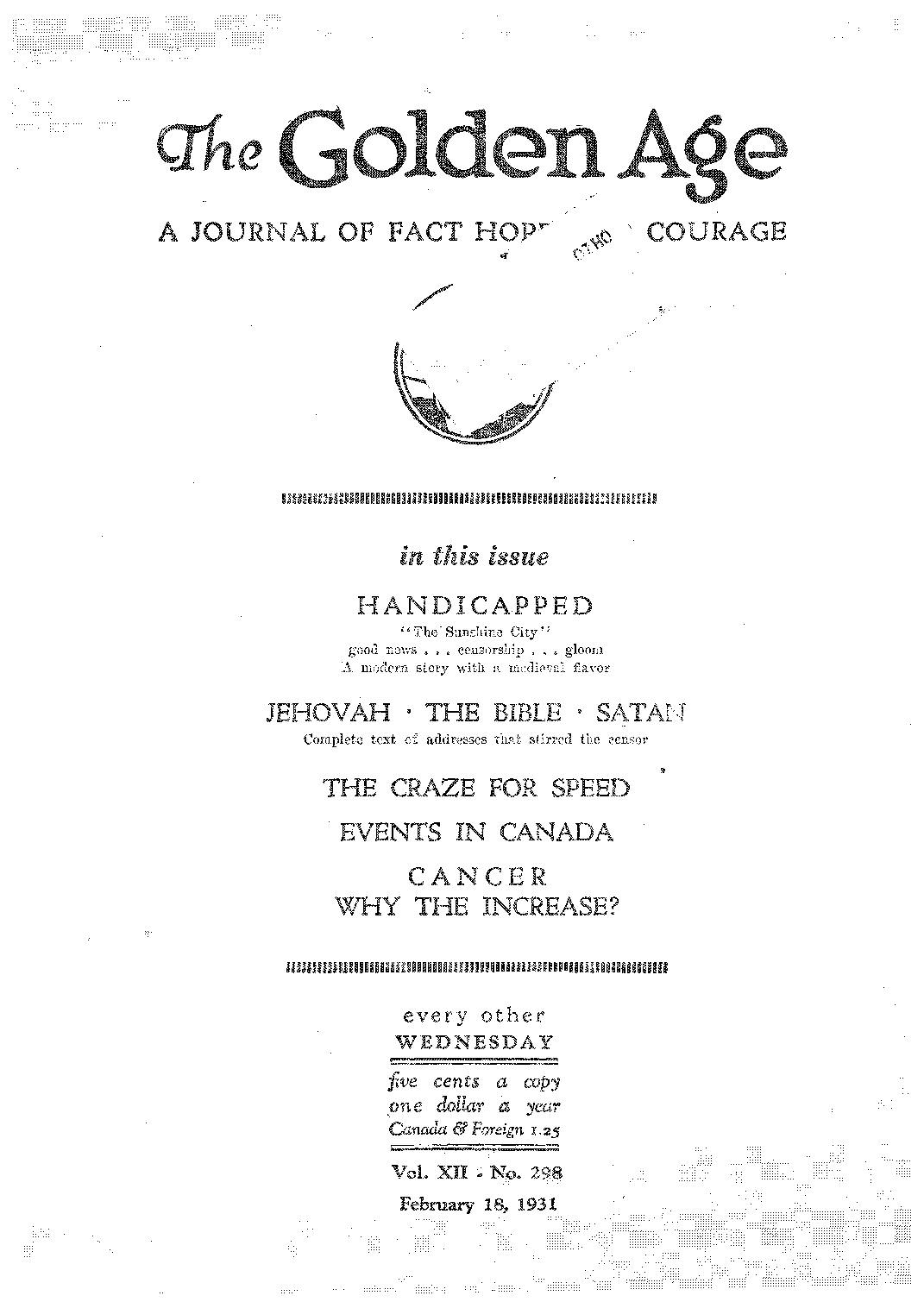
The Golden Age
A JOURNAL OF FACT HOP” ' COURAGE
_ C-:
in this issue
HANDICAPPED
“ The' Sunsliino City” good news , . . censorship . . . gloom A modern story with & medieval flavor
JEHOVAH THE BIBLE • SATAN
Complete text of addresses that stirred the censor
THE CRAZE FOR SPEED '
EVENTS IN CANADA
CANCER
WHY THE INCREASE?
wwmMwmsimmiMOHmmimoHmmmmomfflM
every other
' WEDNESDAY
five cents a copy
one dollar a year
Canada & Foreign 1.25
Vol. XII < No. 298
February 18, 1931
CONTENTS
LABOR AND ECONOMICS
Goose Almost Killed .... 327
D ’Abernon on the Gold Situation 328
England's Unemployment. Insurance .......329
Oppression at Every T< k:< . . . 337
SOCIAL AND EDUCATIONAL
The Handicap of “The Sunshine City" ..... 323
Motes in the Sun’s Kays . . . 327
Gudendorf, Morgenthau and Cadman...... .
Pastor Goes to Work .... 329
Miss Rosemary 0 ’Connor . . . 329
Extracts i-.osi Interesting I.E'J’T";. ■ .
NANUPAC'SURING AND MINING
Buffalo—T.m. :: ter—Hamilton— Toronto
FINANCE—COMMERCE—TRANSPORTATION
Wastage < f CnhCimia Fruit . . 32.8
The Craze for : ..... 330
political— «: ’’n./nc and foreign
Indian Pcerm-. ■ hi Mississippi , 327
Waited U-.dil After Election . . 328
Doctors Failed to Get Children’s Bureau ....... 329
The Round-Table Conference . 337
AGRICULTURE AND HUSBANDRY
Corporation-Grown 28-Cent Wheat........ 327
SCIENCE AND INVENTION
Europe’s Showers of Blood . . 327
Fifty Miles for Ten Cems . . 327
Uses of Solid Carbon Dio:;rm: . . 342
HOME AND HEALTH
A Colorado Teacher on
Vaccination . . .
Cancer—Whs the Incre.v-;:.’
TRAVEL AND MISCELLANY
Twelve Hundred Spanked at Once ....... . 327
See Wliat We All Mis-uH , .327
Polish Pacification of Ukraine . 328
Criticizing the Polish Government 329
Treatment of Natives in South
Africa ......... 329
Events in Canada
RELIGION AND PHILOSOPHY
Jehovah . .
A Modern Church Fol:.in.a . . 343
The Bible....... .
Satan ........ .
Pushing ths Wrong .Kilgg'.gl . . 350
Scheme for Dishonoring God . 350
published every other Wednesday at 117 Adams Street, Brooklyn, N. 1’., U, S. A., ;>/ WOODWORTH, KNORR & MARTIN
Copartner* and Proprietors Address: 111 Adams Street, Brooklyn, N. IL, C. S. A. CLAYTON J. WOODWORTH .. Editor ROBERT J. MARTIN. . Busimws M:imi.gri-’' NATHAN H. KNORR.. Secretary and Treasurer
Five Cents a Copy—8.1.00 A Ykak Make Remittances io THE GOLDEN) EX ACE Notice to Subscribers; For your own safety, remit by postal or express money order. We do not. as a. rule, send acknowledgment of a renewal or a new sulwcripiitra. Renewal Mank (carrying notice of expiration) is sent with the journal one month before the subscription expires. Change of address, when requested, may be expected to appear on address label within one month.
Translations published in Finnish, German, Norwegian, Polish, and Swedish, _ OmCEfS IN Othsb Cohntbibs .
BritvCi ............. 34 Craven Terrace. London, W. 2, England Caiiaflitm ...... ..... 40 Irwin Avenue, Toronto 5, Ontario, Canada Australasian ....... h Beresford Rd,, Strathfleld. N. 8. W., Australia South A frica........ (S Lelie Street, Cape Town, South AMw
Entered as second-class matter at Brooklyn, N, X„ under the Act of Mnreh 3, LLP.
tfte Golden Age
XII M. Wednesday s February I89 1931 Nismbe-g’ 298
The Handicap of aTlie Sunshine City”
OF ALL places that have been favored by the Lord with an ideal location for a home the year around, probably nothing could exceed the beautiful peninsula, Pinellas County, Florida, which juts down into Tampa Bay, one of the finest harbors in the world, and upon which stand the lovely city of St. Petersburg and the village of Clearwater.
In respect to its climate, St. Petersburg is as fortunately situated as it is with respect to its splendid frontage of Tampa Bay on one side and the deep blue waters of the Gulf of Mexico on the other. The peninsula is long enough and ■wide enough to provide all-the-year-around homes for a million people without crowding one another at all, and only some great error of judgment, some trespassing upon the rights and liberties of the people, could prevent St. Petersburg from being a rival of Los Angeles or of the Wonder City of the world.
A little below the 28th parallel of north latitude, the climate is subtropical; but on account of the trade winds which blow steadily across it, climatic conditions are almost as perfect as in San Diego, the city of eternal spring. As in San Diego, the growing season extends throughout the entire year and sunshine is eternal.
But, recently, something of great importance has happened to retard the development of St. Petersburg as a desirable permanent home for those who are tired of wintry storms and the baking heat of less favored climes. This is not the fault of the climate, although, oddly enough, even the climate itself protested against the unwisdom and injustice of the extraordinary phenomenon brought to the attention of our readers in the following paragraphs.
Fiji Has Learned Setter
The Subscription Department tells us that we have four subscribers in the Fiji Islands. There, a hundred years or so ago, it was quite a common thing for a man to divide his mother-in-law amongst his friends and to enjoy eating her for the evening meal. These subscribers, who are now entirely “civilized”, will be astonished that they nowT have rights and privileges which some would vainly attempt to withhold from the highly intelligent citizens of St. Petersburg.
We have eighteen subscribers in the Hawaiian Islands, where, not so long ago, young men and women were encouraged to throw themselves into Kilauea’s boiling crater to prevent its lava from pouring forth upon the fields and villages below. These Hawaiian subscribers now wonder if such things were ever possible; and they will wonder still more when they hear about what has been undertaken in St. Petersburg in the last few weeks.
We have forty-three subscribers in Alaska, where the natives, only a few years ago, undertook to eat some of the explorers who were wrecked upon their shores. .Alaska is more civilized now. It would not undertake to eat explorers now. It has learned to extend a little more liberty of movement and thought to its visitors and friends.
At the opposite end of the world, in Tasmania, we have forty-six subscribers; and in New Zealand, 218. Here, only a little while ago, the tattooed and savage Maoris brandished their spears and sought in vain to guard themselves with their bullhide shields against the onrush, of civilization.
And so we could go on and on around the world, touching here and there what have been its dark spots, only to find that old prejudices and customs have given way and are giving way and the light of the new day is breaking. And this brings us back to the strange occurrence at St. Petersburg in the latter part of December, 1930.
210 Varieties of Clergymen
It is admitted that in the United States today we have 210 kinds of clergymen. At this point it is perhaps well to let some of their own spokesmen say just what they have accomplished and are accomplishing in the way of establishing in the earth the ideal conditions for which Jesus taught us to pray in the petition which embodies the expression, “Thy will Ire done on earth as it is done in heaven.”
323 .
Gypsy Smith, the evangelist, is highly esteemed by the clergy and has been used by them in campaigns all over the earth. Quite likely he has at some time been, thus used by the clergy of St. Petersburg to help them to do what they esteem to be their duty to do, namely, uphold the 210 denominations which, collectively, Mr. Smith considers to be the church. Well, in The Delineator Mr. Smith said, in substance:
The ehureh has education, art, music, position and money, but we have lost hold upon the common people, lost hold upon the coming generation, lost hold on God. I know churches in which nothing could he done even if Christ himself would preach to them; he would not even be welcomed.
Charles M. Sheldon, author of In His Steps, and editor of The Christian Herald, is another gentleman with unusual opportunities to know what has been accomplished, and in the March (1930) issue of The Christian Herald he said:
Say what we may of activities in the church programs, and brag as loud as we often do about church doings, it is a fact that at no time in the history of the church, was it ever so empty of spiritual life. The prayer meetings in the churches would be a joke if they were not a tragedy. In churches of over one thousand members it is rare for fifty members to be found in the prayer service. I have questioned hundreds of ministers in conference meetings with them, and giving frank and honest answers to my questions, almost all of them say the same thing.
Certainly it- is a great error for a city like St. Petersburg to put its destinies in the hands of men who have made nc» better use of their opportunities for teaching the people the truth than is indicated by the expressions of Gypsy Smith and Charles M. Sheldon, which every honest and thoughtful man today knows are true.
A Stupendous Contrast
While, as above plainly shown, sectarianism has been losing its hold upon the people, the Lord has been raising up and using a layman to do the work which the clergy have not done and cannot do, that of explaining the Bible to the people.
What is the reason why in the last ten years Judge Rutherford’s works in explanation of the Bible have been distributed to the extent of 93% million copies, and every week in America -alone his lectures on .Bible topics are broadcast by more than 190 radio stations? It. is because he sticks to the Bible, and the Bible alone, and lets sectarianism go just where Mr. Smith and Mr. Sheldon show it has gone and is going.
Is there any reason why St. Petersburg should lag behind Orlando, Miami Beach and Tampa?
Can it be true that the citizens of St. Petersburg cannot be trusted to hear what goes out regularly from Atlanta, Augusta, Savannah, Columbus, Thomasville, Birmingham, Mobile, Montgomery. Meridian, Bristol, Chattanooga, Knoxville, Memphis, Little Boek, New Orleans, Shreveport and the ten biggest cities in Texas?
All of these cities hover around the Gulf of Mexico. How does it come that their citizens are freely permitted to hear regularly what the clergy of St. Petersburg would fain deny to the people of that community ?
Is there any reason why St. Petersburg should be content to be thrust into the Clearwater village class when it could just as well line up with Nev; York, Chicago, Philadelphia, Detroit, Cleveland, Boston, and all the other biggest cities all over the country, 190 of them?
Is there any reason why a program that is acceptable to the great pioneer broadcasting stations KDKA (Pittsburgh.) and WGY (Schenectady) should be withheld from the citizens of St. Petersburg who wish to listen in to programs of their home station, WSUN?
A Contract Violated, and Why
On November 18, the Radio Control Board at WSUN entered into a contract for twenty-six broadcasts of electrical transcriptions of Judge Rutherford’s lectures on the Bible. These broadcasts were to be from 12:15 to 12:30, noon, each Sunday from December 7, 1930, to May 31, 1931, inclusive.
The village of Clearwater has been accorded some privileges in connection with the city of St. Petersburg in the use of Station WSUN on Sundays. Now it happens that the head man of the village, Mr. Baskin, is a dry candidate. As such, he apparently does not know that Jesus turned water into wine in violation of the Volstead Act, nor that Jesus was called a winebibber, noi’ that He had wine at the last meal He ever had on earth. No doubt Mr. Baskin would be equally shocked if he knew that the Apostle Paul advised that the aged women should not be given to much wine, and thus indicated that the old ladies took an occasional nip, and that he told Timothy that he also could take a little now and then without getting some friendly physician to write him a special prescription.
Mr. Baskin thought it was too bad that in one of his booklets Judge Rutherford should have drawn attention to these and other scriptures, and he also seemed to think that Judge Rutherford's concept of the value of sectarianism is as bad as that held by Gypsy Smith or Charles M. Sheldon.
Accordingly, Mr. Baskin, of the village of Clearwater used his influence with the city of St. Petersburg to violate the contract which had been entered into for the broadcasting of Judge Rutherford's lectures.
How the Violation Was Brought About
The way the violation was brought about was that all the “ministers” in St. Petersburg were invited to hoar the records at 3: 00 o’clock p. m., Saturday, December 13, 1930. About half the “ministers” of the city came. Among them were those whose names are preceded by asterisks (*) in the following list of the city's recognized religious leaders:
• Rev. Schuyler E. Garth, First- Avenue Methodist
• Rev. W. A. Thurston, D. D., Central Baptist
• Rev. David M. Gardner, D. D., First Baptist
J. T. McNew, D. D., Fifth Avenue Baptist
Bev. II. Baldwin, Pine City Baptist
Edward T. Poulson, D. D., Northside Baptist
Rev. Father M. C. Clasby, St. Joseph’s Catholic
Rev. J. J. O’Riordan, St. Mary’s Catholic
•Rev. J. F. Enright, St. Paul’s Catholic
•Rev. G. Hubert Steed, First Christian
E. F. Walker, First Christian Scientist
• Rev. Kerrison Juniper, D. D., First Congregational
Rev. C. H. Bascom, priest, St. Bartholomew’s Episcopal •Chaplain Evan A. Edwards, rector, St. Peter’s Episcopal
Judge M. Henry Cohen, Jewish Temple Beth-El
Rev, R. C. Steinbach, Grace Lutheran
Rev. Theodore K. Finck, Trinity Lutheran
The Rev. Owen M. Andrews, D. D., Allendale Methodist Rev. E. Lewis Peirce, Ninth Avenue Methodist
• Rev. J. W. Branscomb, Childs Park Methodist South Rev. C. Sterling Gardner, Central Methodist
• Rev. Addyman Smith, Grace Methodist
Rev. O. E. Rice, D. D, First Methodist
Dr. J. Wallace Hamilton, Trinity Methodist
Rev. J. R, Hill, Northside Methodist
• Rev. Walker Mayfield, Free Methodist
Rev. W. H. Couch, Pentecostal
’Rev. Tenney I. Deane, B. D., Euclid Presbyterian
"Rev. Janies A. McClure, D. D., First Presbyterian
Rev. E. R. Barnard, West Central Presbyterian
’Rev. C. E. Bovard, D. D., Westminster Presbyterian
Rev. Eve M. Whitney, Spiritualist
Dr. Louise C. Ryerson, Occult Science
Rev. Stannard Dow Butler, D. D., Universalist Unitarian
Rev. J. W. Romberger, Evangelical
Rev. W. T. Watson, Gospel Tabernacle
Dr. J. tV. Hamilton, Pasadena Community .
Rev. Nellie Coonrod, Four Square Gospel
Ensign E. Pickering, Salvation Army
# « * •
To make a long story short, these clergymen, although they said they could find no fault with anything they heard, nevertheless emphatically objected to having Judge Rutherford’s lectures go out, for the reason, as they insisted, that “they would cause controversy”; that is, they would cause the people to see and know and recognize the truth.
Whether through his contact with these clergymen, or however it wTas, the head man of the village of Clearwater insisted that the records should not be broadcast. Mr, Baskin seemed to agree with the St. Petersburg "minister” who testified at the “censorship” meeting that the lectures of- Judge Rutherford were “’worse than Russian communism”. .
Hoivever, after hearing the records, the president of the Radio Control Board could still see no reason for not putting on the program, although he was unwilling to take a stand individually against -the opinion of the “’ministers”.
As a result, the contract was canceled, Mr. Baskin (the prohibition candidate) and the clergy being the only ones who wished it done,
The People Will Decide '
In the long run the people of St. Petersburg are bound to sometime come to a decision as to w’lio is to run their beautiful city: whether it shall be run by intelligent, progressive men, or W’hether even its thinking is to be censored for its residents by men who have accomplished the results pointed out by Gypsy Smith and Charles M. Sheldon.
In order to give everybody a fair opportunity to see just what it was that the “ministers” of Si. Petersburg 'dreaded to have come to the ears of the people o£ their city, we append hereto the three -’lectures which they heard and which speak for themselves.
It seems to us that “The Sunshine City” should remove its handicap by getting rid of .its e’ergy censorship ol! Scripture and common sense. Why try to hang on to a Jonah who is only rocking the boat and sinking the ships There is plenty of room for him elsewhere.
Alarm clocks and overalls are still to be had at moderate prices,, and are no disgrace.
*Be sure to read A-< Possible Explanation (page 348) after carefully considering the three lectures, entitled Jehovah, The Bible. Satan.
Jehovah
JEHOVAH, the Almighty God, the Most High, is the Maker of all things good. He is from everlasting to everlasting, and there is none other. lie covers himself with light for his garment, and all light proceeds from him. He created the heavens and stretched them out like a curtain and filled them with his reflected glory. He laid the chief corner stone and foundations of the earth and built it according to his sovereign will. In its youth he made the cloud for its garment of covering and the thick 'darkness for its swaddling-cloth. He set the sun in the heavens for the light of the earth by day, and the moon and the myriad of stars for its light by night. He even numbered the st:!.rs and gave each one a name. With him everything Is order and there is no confusion. He causes the stars and the planets to take their respective places and move continuously in their assigned orbits. He has made the mountains to lift their heads high above the sea and has commanded the eagle to mount up above the rocky crag and to make her nest in the strong places, fie has clothed the earth in verdure and filled the great forests with beasts and fowls of the air.
He created man in perfection and made him the prince of the earth. The eternal destiny of all creation he holds in his mighty hand. The depth of the riches of his wisdom and knowledge, and the height of his power and love, are too great for the comprehension of man. The Almighty One, however, condescends to invite man to come and reason with him and to learn of his way. To know and to obey God means to have life everlasting in peace and happiness. Where then should man expect to find knowledge and wisdom, except in the revelation of the Almighty God? His Word is a fountain of knowledge and wisdom,, ever flowing- to supply refreshment and life to those who drink therefrom. He is the Fountain of life everlasting.
Jehovah God is the origin and source of all true prophecy. In proof of this statement it is written in Isaiah 44:6: “Thus saith Jehovah, the King of Israel, and his Redeemer, Jehovah of hosts; I am the first, and I am the last; and besides me there is no God. .And who, as I, shall call, and shall declare it, and set it in order for me, since I established the ancient people? and the things that are coining, and that shall come to pass, declare unto them.”
The great Creator has revealed himself to his creatures by several names, each one of which is deeply significant. By his name JEHOVAH is meant his purposes toward his creatures. His name GOD denotes that ho is the Creator of everything that is good. His name ALMIGHTY signifies that his power is without limitation and that nothing can successfully resist him. His name MOST HIGH means that ho is supreme and above all.
Why is there such gross ignorance concerning God and his goodness toward men? The correct answer is that long centuries ago Satan the enemy of God turned man into the paths of unrighteousness, and rebellion and since then lias blinded men to the truth. In doing this Satan has employed divers agencies, many of which, have claimed to represent Ged but who in fact have misrepresented him. Practicing hypocrisy these men have been used by Satan to turn the people away from Jehovah and. into darkness. God could have prevented this, to be sure, but his wisdom led him. to permit the enemy to do .his worst, 'that God might in his due time prove to all intelligent creation that he is supreme and that those who would have life must obey him and walk in the way of righteousness.
The greatest truth that all men must learn is that of and concerning- the kingdom of God. That kingdom, will completely vindicate God’s 'Word and his name and it will, bring paradise and endless joy to the people.
There is no government on earth, that is satisfying to honest men. There never was a government that was satisfactory to honest men. The reason is that there is so much dishonesty practiced amongst men; and. all people are afflicted with disease, sickness and death. That unhappy condition began more than sixty centuries ago, when perfect man was in Eden. The. rebellion of Satan led to the downfall of man and brought death upon all human creation. In that hour of distress God gave his word of promise that ‘the seed of the woman shall bruise the head of him who brought death upon mankind’, The “woman” there
Continued on pngc
Motes is the Sun’s Rays i ' j , ; j;„ ®
Ludendorf, Morgenthau and Cadman
T unaxDOBK, Morgenthau and Cadman are all supposed to be great men, as great men go in this world in our generation. They all predict an early renewal of the World War. Ludendorf goes into details and tolls us-that it will begin in 1932, will last but five wreeks, and that in it France, Belgium, Poland, Rumania and Czechoslovakia will wipe out Germany, Austria, Hungary, Italy, Russia and Britain. France puts all her unemployed into the army.
Europe's Showers of Blood
supposed showers of blood are merely showers - ....
of fine red dust gathered up in the Sahara’ same ^a^e as ^as conie to the individual
IN EUROPEAN history one of the outstanding events during the Middle Ages was the shower of blood that occasionally fell. There have been such showers in recent years, but with the aid of the microscope, the telegraph and the airplane it has been proven that these desert and sprinkled over Europe, sometimes to the extent of more than a million tons at a time.
Twelve Hundred Spanked at Once
AT BRUENN, Czechoslovakia, several hun
dred boys and girls banded together to resist by physical means lowr marks by their professors in high school. The plan worked all right for a lew days, and a professor and his wife were beaten up some, but the youths who did it were overpowered and the net result was a public spanking of twelve hundred young men and women in the public square of the city by the irate parents who learned of the compact.
See What We All Missed
THE Church of Scotland, which has to do with the-education of the youth of that land, has decided that hereafter the Old Testament stories of Adam and Eve in the garden of Eden, : Noah and the flood, and the sacrifice of Isaac ■ by Abraham, will not be taught in the schools : they supervise. In view of the fact that the New ■ Testament declares that in olden times holy men spake as they were moved by the holy : spirit and that thus the Word of God has come ; to us we can all see what we missed that the । dominies of the Church of Scotland were not ; present and on the job when the Old Testament ; was written. What a help these wise men would i have been to the Lord! They almost admit it. i ‘ 337
Fifty Miles for Ten Cents
THE London A'e-r.v Chronicle cites an instance of a one-ton Ford truck carrying four persons which ran fifty miles on 32 pounds of coke, the total cost of which was about 10c, The generator is the design of a London and Manchester chemist. The coke is converted into a gas composed of monoxide and hydrogen -in from ten to fifteen minutes after the fire is lighted. The engine is started with gasoline, and after a .while is turned over to the coke gas.
Corporation-Grown 28-Cent Wheat
T ARGE scale demonstrations in the state of ■*-4 Kansas have proven that corporations can produce wheat at less than 28 cents a bushel, a price at which no individual farmer can exist. The natural result is going to be that wheat growing will be taken over by huge corporations and the independent farmer of today will meet storekeeper. The only hope of deliverance is in
God’s kingdom.
Indian Peonage in Mississippi
Sesaxoii Burton K. Wheeler declares that at
Philadelphia, Mississippi, the center of a number of Choctaw communities, a number of Indians were found in actual peonage, in some instances cropping on shares land which was rightfully their own. One old Indian was found who had "worked twenty years for the same planter and was still in debt to him, although entirely unable to tell how the obligation had been incurred. A standard price for transferring Indian peons from one planter to another was discovered.
Goose Almost Killed
THE Census Bureau furnishes figures to show that from 1919 to 1929 the workers engaged in manufacture decreased by 449,775, but their wages increased by $809,229,749. The increase in the total value added by manufacture was $6,286,762,484. Labor calls attention to this and reminds us that the employer was able to add $7.70 to the value of his goods for every dollar he gave to his employees in the form of increased wages. Now he wonders why nobody has the money to buy his goods. The answer is plain. The goose that laid the golden egg, i. e., the common people that are the ultimate consumers, is almost dead.-
Wastage of California Fruit
DOES it not seem too bad that in the United
States of America there should at this time be millions of people that would be more than glad to eat California’s grapes and peaches and yet thousands of tons of this fruit were bought this past fall with the distinct understanding that no one must be allowed to remove any of it from the vineyards or orchards, but that it must rot where it grew, so as to keep the prices up ? How we do need a sensible government!
Faithfulness of Dogs
THE faithfulness of a dog is well illustrated in a story from Maine, where in zero weather a collie saved the life of a three-year-old child by curling up around and over him after he got lost in the woods and fell asleep. The dog and child were found after a day and a night. Tens of thousands of dogs are disemboweled, burned alive and otherwise tortured in vivisection experiments every year by the alleged medical scientists of America and Europe. No way of curbing these tortures has yet been found.
Waited until after Election
Andkew Mellon’s Gulf Refining Company had a surplus of $225,000,000 at the close of 1929, after paying dividends of $182,000,000 in the previous five years. In October it concluded to lay off 2,500 men at its Staten Island plant, but Mr. Mellon, for some inscrutable reason, had this postponed until after election. Anyway, it was nice of this company, with its $225,000,000 surplus, to give its employees a few more days of work than was originally contemplated.
“Enter into Thy Closet”
THE Reverend S. A. Hug-hart, mayor of Mattoon, Illinois, has agreed that the people of Mattoon may have Sunday movies provided they are opened with prayer. Just who is to offer the prayer is not certain, but it will probably be the film operator. Occasionally when a film breaks one may hear one of these operators say something like a prayer, but it never just occurred to us that it would be appropriate for Sunday use in Mattoon. But Mattoon is a wonderful town, and they will no doubt stand for it all O. K. if the mayor says to do so. Anyway, it will be said in a closet or booth; and that is something.
Polish Pacification of the Ukraine
TN THE Polish pacification of the Ukraine the cavalrymen herd a dozen, twenty or fifty men in a barn or village hall, men against whom no charges have ever been. laid. Each is seized, and laid on a table and beaten until the flesh even five weeks afterwards shows that it has been beaten to a pulp. When he faints, water is poured over him, and he receives another beating when he conies to. At least five have been killed; two because beaten while they were ill, so the Poles say, and three because they tried to escape. Poland must be a. nice place to live.
A Colorado Teacher on Vaccination
A COLORADO teacher says: “My first observations were made while I was studying in the School of Medicine of the Colorado University in. 1914. While we were taught that vaccination had saved countless lives, I noticed that the doctors on the faculty did not- have their own children vaccinated. In the Colorado school where I taught, the children received consistently lower marks after they were vaccinated, and nearly all of them suffered from some skin disease within three months. ... I have proved beyond the peradventure of a doubt that vaccination impairs the mentality of children, reducing the Intelligence quotient’ in a marked degree.”
Lord D’Abernm on the Gold Situation
IN AN address in Liverpool, Lord D’Abernon, former British ambassador in Berlin, laid much of the world’s present troubles to the gold situation. He said in part: “When on the one side you have a vast volume of production, and on the other side you have millions of men insufficiently supplied with the requirements of life, such as food and clothing, the obvious conclusion is that failure proceeds from inadequate facilities of circulation and exchange rather than from excessive ability to produce. The gold standard of the world lias become unstable. The deficiency in the supply of gold will become more marked in the course of a few years, and there is no likelihood either that tl ic production of gold from the mines will increase, or that the nonmonetary demand for gold will fall off. Relief must therefore be derived from remedial measures in the management of'.gold, a greater economy in its use, and a more intelligent utiliza-tian of the reserves whidi exist" The address west on to say that France and the United States own more than half the total gold reserves of the world, and the inference is that this congestion of gold is causing stagnation of world trade.
Criticizing the Polish Government
ITT HAT it means to criticize the Polish gov-» » eminent, that is, if you happen to live in Poland at the time, may be judged from the fact that a group of those who did so were taken to 1 he prison of Brest Litovsk. At midnight they were taken to the execution chamber, and forced to undress and to stand naked with their faces to the wall. At a signal a shot was tired over their heads, and then, after being severely slapped, they were allowed to dress and return to their cells. Poland has ’been favored with the 'uplifting’ influence ■ of the Roman Catholic church’for centuries.
England’s Unemployment Insurance
ENGLAND’S system of unemployment insurance, mistakenly and improperly called the “dole”, is a system under which all workers earning less than $1,217 per annum contribute about 15c a week, their employers another 15c, and the government a third 15c toward the building up of a fund from which the unemployed are sustained when out of work. .Regular receipts of the fund in 1929 were $219,102,906, and the disbursements were $215,872,715, or at the rate of $4.32 a week for each of the persons paid weekly benefits.
Treatment of Natives in South Africa
Miss Winifred Holtby, a former resident of the country of which she writes, says in the English New Leader: “All South African statistics concerning native affairs are unreliable, but at present the white population of about 1,500,000 holds about 280,000,000 acres of land, while 4,700,000 natives hold about 20,000,000’ acres. Natives are not allowed to buy or hire land, except in certain scheduled areas, without special permission of the governor-general; thus they not only hold less than a tenth as much land as the whites, though they are four times as numerous, but their land, on the whole, is poorer.” To which we merely add that Jesus said, “Thou shalt love thy neighbour as thyself,” and, ‘Whatsoever ye would that others should do unto you, do ye even so to them.’
Doctors Failed to Get Children's Bureau
THE United States Public Health Service, composed of M. D.’s, recently made a desperate effort*to grab the Children’s Bureau of the Labor Department, and signally and dismally failed. It was to be put out of business so far as its child health and maternity and infancy activities were concerned, but the head of the bureau, Miss Grace Abbott, forced a fight, and, for the present at least, will be privileged to continue the excellent work which this bureau has been doing. The death rate among babies has steadily dropped, but there Is still plenty to do.
Toledo Pastor Goes to Work
TIRED of sitting around with nothing to do, and desiring to get into some more honest line of work, one of Toledo’s prominent pastors has quit his church and taken a job with an electrical concern. Wise man. He did well to get a job while one was to be had. By the time some of these preachers and priests get ready to lend a hand in the world’s work they may have to wait quite a while for a job. But they will all come to it, sooner or later. The business of resting at other people’s expense, and whining, and shaking collection baskets at them, is about-over. Better days are ahead.
Jfiss Rosemary O’Connor
Miss Rosemary O’Connob., thirteen years of age, wired her father she was coming to Buffalo, which she did, but her telegram was not delivered. She had enough money to pay for a night’s lodging at the Y. W. C. A., and 35c besides. The 35c she promptly invested in Christmas cards at 1c each, which she sold on a street corner at 5e each. She did this twice and went to supper on the profits.
’ In the evening she bought a theater ticket, circulated among the audience and told them she was going to put. on an act, which she did, with the consent of the management. The act was a success and the management paid her $1.50 for it. That paid for her second night at the Y. AV. C. A.
The next day the police and her frantic father found her, planning other business ventures, and in a fair way to make a success of them all. Hurrah for Rosemary O’Connor!
A CHINESE visiting England was 'being shown around by an English friend. After a day of sight-seeing the Englishman took the Chinese back to his hotel, remarking as he did so that they had saved ten minutes by using a taxi on the return trip. Promptly the Oriental wanted to know, “What are we going to do with the ten minutes we have saved?”
Women have been known to run up stairs rapidly so as to squeeze on board an elevated train just coming into the station, and on arriving at their destination have had nothing to do but amuse themselves. by sitting down and watching the trains go by, for quite a considerable time.
A railroad watchman testifies that he has often seen, people risk their lives by running under the gates after he has lowered them., and having gained the opposite side of the tracks they have stood and watched the train pass. Often a passenger will fight for a place in an overcrow’ded bus when one right behind it will take him to his destination within a few seconds of the other. ’
A British philosopher declares that the modern world is a place in which no one knows where he is going, but wants to go there faster and faster. That would seem comical if it were not true.
The Scriptures tell us that “he that believeth shall not make haste”. Jehovah God does not seem to be in haste about anything. Leisure seems to mark every act. It takes but a day to make a moth, but it takes thirty years to make a man.
The lower animals can be stampeded, because they cannot resist the impulse to move when others of their kind move. A mob is the same. Anybody can start a stampede. Rise from your seat in a railway coach several miles before the train gets into the station, and press toward the door, and you will have half the people in the car on their feet in a moment.
The craze for speed has brought an end to the appreciation of leisure, to the reading of good books, to thoughtful and extended conversation and correspondence, to grace of manner, and to much that is best in art. Who can enjoy nature -when it is rushing by at the rate of over a hundred miles an hour? Even the sense of color is lost.
What It Accomplishes
It can he said on the other hand that valuable time is saved by speed, but if the time saved has to be spent in a hospital the net saving is negligible. It may be and often is a valuable advertisement for some railway or steamship line, and occasionally there is a very busy man ■who can make good use of every moment saved in travel, but there are hosts of people who travel swiftly who could drop out of the world and never be missed.
Youth seems to adapt itself to the speed mania more readily than, those of us who were born in the days when the horse and buggy were the vehicles of speedy transport. It is the young men that do the work in American factories. The old men cannot keep the pace. After 45 out they go.
It is said that men who get lost in a desert run furiously until they drop from exhaustion. The running provides them with something to do which enables them to forget that they are lost. By some the speed mania is declared to be another kind of this peculiar form of dread. It is a rush that- is pictured to the mind as a necessity, though the necessity really does not exist.
It is not to be wondered at that children love speed, when their mothers were driving racing ears or skipping around in the clouds only a few minutes before they were born; but at the same time it is just as well to remember that the asylums are overcrowded and new ones can. hardly be built fast enough.
The manager of the largest theater , in New-York declares that he keeps its 6,254 seats filled because everything is speeded up, even the overtures. He has found that speed, not jazz, is what the people want. If they have action, and plenty of it, and at high speed, they are contented.
Describing the time-saving devices now in vogue, the Manchester Guardian mentions the ‘quick lunch tablet’ in which the concentrated essence of a full meal can be sw’allowed instan-ter, and a special electric chair in which in three minutes a man can he given the benefit of an hour’s violent exercise.
Paul Morand, French writer, says of America : “The notion that a thing done quickly is badly done is still deep rooted in European minds. The expression ‘a V americaine’ means to us a mixture of speed and bluff. Twenty million autos in the United States. Trains and carriages
de luxe are called ‘arrows’. Babies ride on the handlebars of a bicycle or in the basket of a motorcycle. Children go to school in. Fords; young people become engaged in Buicks and the old ones are carried to the grave in Packards.’5
The Century magazine says: “Science persists in teaching us how to prolong life by means of right eating and sun bathing; and then it destroys us with its inventions for shattering our nervous systems. Those who are educated to the modern rhythm declare that they think hotter when being whirled along at sixty miles an hour; that the grandeur and glamor of the city is stimulating; that the noise and haste breed ideas and stimulate action.”
Animal* Speedier than Man
Man is not such a speedy animal. The best he has ever been aide to do is to cover 100 yards in a little less than, ten seconds, or at the rate of about 31% feet a second. A camel can go just a little faster, when it is hurried up.
A rabbit can go more than twice as fast as a. man. The driver of a motor ear in Switzerland trailed a rabbit in the road for over three miles and had to operate his car at 34 miles an hour in order to keep up with it. This is at the rate of 50 feet, a second, the speed of a giraffe. Rabbits can do up to 58 feet a second for a considerable distance. A fast horse is faster than the fastest rabbit, but they are of about equal speed.
An English fox hound will make 60 feet a second, and a man running on skis 72 feet. The fastest deer ever accurately timed was a roebuck, which made 74 feet in a second. Some of the smaller antelopes are much more speedy than the larger deer; the Indian cheetah goes at 88 feet a second: and there are trained dogs which are said to have run 90 feet in a second, or about three times the fastest pace of man.
An eagle is a comparatively slow bird on the wing, making only about 75 feet a second. The ostrich makes 80 feet a second, the albatross 88 feet, and a man leaping on skis 100 feet. The homing pigeon has been known to maintain a speed of 132 feet a second for 100 miles; and a falcon has been known to maintain a speed of 133 feet a second for ten times as far, having flown? a distance of 1,000 miles in eleven hours.
The great, heavy, wild goose has been known to rush through the air at the astonishing rate-of 175 feet a second. The ordinary flight of the-swallow is 210 feet a second, and in full flight it has been known to go at the rate of 290 feet a second. The fastest bird in the world is the spine-tailed swift, which skims over the mountains of Asia at the rate of 323 feet a second. This is more than ten times as fast as man can get over the ground unaided.
The fastest fish, the tarpon of Florida, has been known to cover 112 feet a second. The jumping mouse of the African deserts makes eighty leaps of ten feet each a second. This is more than twenty-five times as fast as man can perform the same stunt. The flea can beat the? mouse, with a velocity of 850 feet a second.
The fastest thing on this earth, so far as is now known, is the deer fly, which has the most perfect motor apparatus of any creature. The breathing apparatus is such, that their bodies are virtually all air cells or chambers, which gives them extreme lightness. The' muscles which operate the wings are marvelously powerful, and for short distance this little creature can travel at the incredible speed of 1,175 feet a second. This is thirty-seven times as fast as poor man can navigate on his unaided legs. .
Fast Travel Only a Century Old
Up until 1830 the fastest that man ever traveled was with the use of horses on land and sails on water. The development of the steam engine quickly ran the speeds up to 30, 4.0, 50 and 60 miles an hour. Some of the efforts to forestall or prevent these speeds seem comical now. The British parliament refused at first to grant a charter to Stephenson because lie claimed that his engine would be able to travel at the terrible speed of 12 to 15 miles an hour.
Wise college professors, such as are now on the Power Trust payroll, gave forth opinions that at 60 miles an hour goods would disiistc-gratc, iron bars would melt, and onions would lose their smell. Even when the speeds had been made, the record was denied and declared an impossibility.
Magellan’s ship circled the globe in 1,083 days. In 1872, Jules Verne sent Phineas Fogg around the world, in fiction, in 80 days. Some of ns remember when Nellie 'Bly was sent around by the New York World in 72 days. Since then the Lime has been repeatedly reduced, until the Graf Zeppelin made the trip in less than 22 days.
In June, 1899, Mile-a-Minute Murphy, riding behind a Long-Island railroad train,-within a hood built on the end of the last car, rode a measured mile on a bicycle in sixty-odd seconds. Shortly, the motor cycle and the automobile appeared on the scene.
Just at present we are witnessing the beginnings of rocket propulsion. There is almost no limit at which rockets cannot travel. With adequate fuel supply they could probably go 1,000 miles an hour. A rocket-propelled vehicle has already made 150 miles an hour. Thirty-six rockets were used. The spokes of all four wheels snapped during the test, but the machine remained on the track and finished the course on its hubs.
If man ever travels outside of earth’s atmosphere it will be in a rocket-propelled vehicle. A rocket ear, ascending to the region of the vacuum outside the earth’s atmosphere, would lose thereby none of its force of propulsion. On the contrary, its speed would be increased by virtue of the absence of air resistance.
Speed on the Sea
It would seem that profitable speed on the sea had about reached its maximum,. The Mauretania held the speed record for more than twenty years, and although the Bremen and Europa have both reduced the Mauretania’s record by eight hours, yet there must now be an enormous addition to the size and power of the propelling plant to effect any considerable further increase in speed.
Of course those who do not have to consider the expense of anything can still build destroyers, cruisers and airplane carriers that will run around anything else afloat, but transportation companies cannot, afford to design and operate boats that have little or no space for cargo or passengers.
It is not certain that some of the newest boats can be operated profitably year in and year out; and if they cannot be so operated, then the humbler travelers who go on the slower ships will he made to pay the difference. Travel de luxe ought to be self-sustaining; but it is not, and it is well known that celebrities usually get their hotel and steamer fares at much less than other folks have to pay.
The greatest speed ever attained on water was by Sir Henry Seagrave, on. Lake Windermere, in the Miss England II. The boat overturned and Sir Henry was killed, but before his death he had covered one mile at 96.41 miles an hour, and a second mile at 101.11 miles an hour. The mean between the two, which now constitutes the world's speed record on water, is 98.76 miles an hour.
Speeds on Railways '
There are at least seven well authenticated records of passenger trains doing better than 100 miles an hour away back at the beginning of the present century, between May, 1893, and October, 1904. The first of these was on the New York Central, near Batavia, N. Y., over a measured mile, slightly down grade. The engine was the famous No. 999, and the time, 32 seconds for the mile, was at the rate of 112.5 miles an hour.
The climax was in March, 1901, when the Plant system operated a train between Fleming and Jacksonville, 5 miles, in 2 minutes and 30 seconds, or 120 miles an hour. The Pennsylvania, Burlington and Michigan Central have each operated trains for short distances at over 100 miles an hour.
The fastest scheduled train in the United States is on the Philadelphia and Reading Railway, between Camden, N. J., and Atlantic City. The 55% miles between the two cities are covered in 55 minutes. A noteworthy long-distance train on the American continent is on foe 334-mile Montreal-Toronto run. The Canadian National Railway hauls twelve steel ears over this run at the rate of 55.7 miles an hour. Fastest of all is the Michigan Central’s Wolverine, which averages nearly 58 miles an hour for 228 miles.
The fastest train in the world is the run on the Great Western Railway, England, where the 77% miles from Swindon to Paddington are made in 70 minutes. The Canadian National Railways sent an oil-electric locomotive through from Montreal to Vancouver, 2,944 miles in 67 hours. The Santa Fe Chief is on a 56%-hour schedule, Chicago to Los Angeles, 2,231 miles.
British crack trains are faster than American. Fourteen daily trains over one line between London and Birmingham make more than 55 miles an hour, while the thirty-odd daily trains between London and Manchester and the twenty-eight between London and Leeds are unmatched elsewhere.
In France the Paris-Calais express makes 53.7 miles an hour, and the Paris-Lille express 55.6 an hour. There are twenty passenger trains out of Paris that make 50 miles an hour. Else-
where in Europe the top speeds are 38 miles an hour. . .
The president of the Pere Marquette Railroad predicts that the time will come when concrete ways with reinforced steel beams will crisscross over the country, and trains will run on roller bearings, safely, at 100 miles an hour, or about 147 feet a second. Under the most favorable conditions a distance of nearly half a mile would be required in which to effect a stop.
Freight trains, the country over, stops included, averaged 10.3 miles an hour in 1930, which is 20 percent slower than in 1928. The Erie and some other roads have through freights which are scheduled to make 25 to 30 miles an hour, These trains are carrying double what they carried a few years back.
In driving a train at fast speed it becomes necessary to know how fast the mind will operate in coming to conclusions and acting upon them. In a case in Germany it was demonstrated in court that four seconds was ample time for a conductor to notice that the engine driver was negligent and did not set the brake at the right time, to perceive the danger to the train, to remember his duty to take action, to decide to set the emergency brake and to carry out his decision. This was in. a ease where the engineer was asleep at his post and fourteen persons were killed as a result of the accident which ensued.
AntGrsmbile Speeds
The world’s speed records for automobiles are made at Daytona Beach, Florida, where there is an eleven-mile stretch of disintegrated coquina rock and ordinary sand, wave-rolled and water-packed, which defies duplication as a natural motorway.
In ‘trying for a speed record over this course Sir Henry Seagrave had specially built for him the fastest motor in the world, 900 horsepower, at a cost of above; $50,000. In practicing for the test four miles were needed to pick up speed before entering the mile on >’111011 he was timed electrically and five miles were needed in which to stop. The tires had to be changed after every trip.
The speed with which the nervous system carries messages to and from the brain is about 108.4 feet, a second. Major Seagrave drove his car at the rate of 339.33 feet a second, three times as fast as his brain, was capable of working. To guide him he had a number of red bull’s-eye lights strung over the center of the course. At the end of the course was another guiding light. On the front of the car was a small circle with crossed wires, and in the cockpit an ordinary naked rifle sight.
When the record of 231.36246 miles an hour was made, Mr. Seagrave said, on the one side, was an immense black wall of spectators; on the other side the flagposts rushing by looked like a straight line drawn across a piece of typewriter paper. Spectators said the ear seemed to flutter over the course. Each pebble caused it to leap, as the ordinary spring’ suspension had not time to act.
California has abolished speed laws. It says to the motorist, in substance, £You are subject to punishment for misdemeanor if you drive a vehicle at a speed greater than is reasonable and prudent, having due regard to the traffic, surface and width of the highway? This means that you must not drive at a speed too great to permit you to exercise proper control of the vehicle and to avoid colliding with any other person or vehicle using the liiglnvay in a mechanical manner.
In the last twenty years the speed at which automobiles traverse city streets has almost doubled. Every year the auto kills about 30,000 persons. It seems a high price to pay for speech In actual practice the safe cruising speed is around 30 to 35 miles an hour. The faster speeds, 70 to 80 miles an hour, and up, are supposed to be merely for use in emergencies, but the possession of them invites their use, with the consecjuent disasters now7 so common. An automobile which is to make sixty miles an hour must have engines not twice, but eight times, as powerful as those required to make but thirty miles.
Speeds in the Air
When A. H. Orlebar flew in the Schneider cup races at a speed of 368.8 miles an hour lift was projecting himself through space at the rate of 541 feet a second. And this ought to be fast enough; but higher speeds are contemplated, and it is believed that in a sealed cockpit 1,000 miles an hour would be possible.
At such a speed it would not be possible to make any turns, or to make any movements up or down, as the centrifugal force would either drain or flood a man’s brain, and cause either unconsciousness or death. On the downward thrust of his famous outside loop, when traveling at the rate of 300 miles an hour, Lieutenant James Doolittle states, he felt as if his eyeballs were being torn from their sockets.
At speeds above the reasonable cruising speed of 90 miles an hour there are technical difficulties to be overcome. Thus the resistance in the air increases as the cube of the speed. If to go 200 miles an hour requires an- engine of 500 horsepower, to go at 400 miles an hour will require one of 4,000 horsepower.
That some men are seriously thinking of undertaking flights at 1,000 miles an hour is clear from the fact that the National Advisory Committee on Aeronautics is experimenting in the wind tunnels at their Langley Field (Va.) laboratories with velocities up to that figure.
It is within the bounds of imagination to conceive that, when power can be broadcast, some man may yet go around the entire earth traveling with the sun. But what would be the sense of it, even if such a thing could be done? It would be but insanity.
It is not generally known that an object falling’ from an altitude never attains a greater speed than 118 miles an hour. This velocity is reached within six seconds after falling about 600 feet in quiet air. Thus, Mr. Orlebar flew through the air more than three times as fast as he could have fallen through it, when he attained the record speed of 368.8 miles an hour.
The average velocity of a service-rifle bullet is 398 feet a second, or 271 miles an hour, so it would have done no good for anybody to shoot at Mr. Orlebar for breaking the speed laws, unless they shot ahead of him and counted on his overtaking the bullet and Running into if, for he traveled through, the air nearly 40 percent faster than the bullet could go.
The direction and force of. the wind makes a big difference in flying, or even in driving a car or a railway train or a boat, for that matter. In flying the 700 miles from New York to Chicago the journey may be made one way in. seven hours, and in the other in five hours if the aviator has a twenty-mile wind behind him.
Shape is an important element in speed. The air resistance of a cylinder with semispherical ends is only one-fifth that of a cylinder with flat ends. French locomotives save 15 to 20 horsepower by having rounded boiler fronts. America must do the same and round the corners of freight and passenger cars, to save time and fuel.
It lias been observed that ducks and other swimming birds, fast fish and such swift flyers as the albatross, are rounded and blunt in breast or head, the part that cleaves the air or water. A swift bird on the wing always draws up its legs close to its body and stretches its neck as far ahead as possible. Airplanes are now being designed to make full use of this information. Even the running wheels are tucked away in some designs.
At the greatest speeds and at the greatest heights not only do the fliers need to be provided with artificial supplies of oxygen, but similar provision must be made for the engines, as they choke and die in the thin air the same as humans. At the highest speeds the positive pressure on the nose tends to force the front of a vehicle down, while the suction behind tends to force the tail upward. These and many other exceedingly valuable things have been learned in the operation of the laboratory wind tunnels now connected with engineering schools in all parts of the country.
Buff alo—Rochester—Hamilton—Toronto
BUFFALO, Rochester, Hamilton and Toronto all lie within a few miles of each other’, with Niagara Falls in the center, supplying electric current to all four. Does it make any difference which way the current is ’'shipped'? It should not, but it does. The reason it makes a difference is that the people themselves own the Canadian transmission system, while on the American side the people are at the mercy of what are euphonically called “private corporations”.
Quoting from a state report, just published, under the Ontario commission, here are a few comparisons: A domestic consumer using thirty-six kilowatts a month would pay $1.59 in Buffalo, $2.69 in Rochester, $1.98 in Syracuse. But in Ontario he would pay 95 cents in Hamilton and $1.03 in Toronto. Now note between a large consumer in these cities: If he used 175 kilowatts a month in Buffalo he must pay $5.01, $9.75 in Rochester, $6,15 in Syracuse. In the two Ontario cities for exactly the same service: .Toronto, $2.33; Hamilton, $2.71. Even up to 10,000 kilowatts a month the rates in the two Canadian cities are lower.
UNDER the title “Dear Canada!” the Canadian Magazine, contains an article by Grattan O’Leary concerning the high cost of living in this country, from which we quote in part:
Canada has vast grain fields, raises 350,000,000 bushels of wheat more than she can use. She raises livestock, sheep, pigs; has an abundance of butter, cheese, milk, eggs. Has, at all events, all necessary facilities for the production of such things. Canada, too, has millions of acres of forest, the raw material of shelter: has tens of thousands of square miles of soil producing vegetables and fruits. From the standpoint of food supplies she is self-contained, raises more food than she consumes. And as with shelter and food, so also with fuel. Our scientists never weary of telling us that we have enough coal to last us a million years,
All this being true, how comes it that in Canada food and fuel, clothing and shelter, cost so much ? Why are they costing more now than twenty years ago? Why, • ■specially when we know that transportation and distribution facilities have been improved, and when, as we are assured by the economists, scientific research and modem machinery have increased and cheapened production, reduced overhead costs?
That prices are high, that they are higher than twenty years ago, and that, even more serious, they are higher in Canada than in most other countries, there is no doubt at all. On this point comparative official figures are clear.
Let us take a few illustrations. Bread in 1913 sold for three cents a pound. Today the price is seven cents a pound. Milk in 1913 sold for nine cents a quart. Today it sells for 13 cents a quart. Eighteen or twenty years ago, anthracite coal could be bought for $7.90 a ton. Today it can be bought only at $15.00 a ton. And beef, which sold for 22 cents a pound in 1913, sells in 1930 for 39 cents. The figures are from government publications.
The Dominion Bureau of Statistics and Labor Department keep tab on these things. From their official records, provided by experts after thorough inquiry, the following comparative prices on actual living commodities for the years 1913 to 1930 are 1aken:
Bread
$ .03
$ .07
Milk per quart
.09
.13
.Anthracite coal per
ton 7.90
15.00
Oranges pci? ease
4,73
S.28
Bananas per bunch
1.61
1.30
.Apples per barrel
4.35
8.34
Lemons per case
4,33
8.28
Bacon per pound
.39
Beef pei’ pound
.22
.39
Eggs per dozen
.35
.36
Butter per pound
.32
.36
Then he asks the question, Who is profiteering? and in answer says: ■
All that we know, and we know this for a certainty,, is that the producer is getting little more for his. produce than before the war, that the middleman is getting a lot more.
What is the effect of farm products raised in Canad.a selling higher here than they sell elsewhere? The effect of Canadian flour, and Canadian bacon and other things from Canadian farms selling' lower m England, for instance, than they sell in Canada?
The effect may be considered in two ways: (1) the consequences to the average Canadian householder or working man; (2) the consequences upon Canada’s development.
Let us consider the individual. The average Canadian worker, not a skilled laborer, and working at full time, receives in wages, roughly speaking, about $1,200 a year. What does ho have to pay out ? According to the most competent economists, he must, if he is married and has a family of four, pay out the following:
Rent $300.00
Fuel 105.00
Food 750.00
Clothes 125.00
Drugs and doctors’ bills 50.00
Carfare 100.00
Total $1,430.00
Thus, according to this budget, which certainly seems conservative, a Canadian worker with four of a family, and working full time, would find himself at the end of the year $230 behind. And this assumes that he would have worked full time, that he would not be laid off by illness; assumes, also, that he would pay not a cent for insurance, nor give anything to a church, nor pay out a cent to take his wife and his children to a movie. The idea of recreation, of a vacation, of travel, or of having a radio, or indulging the slightest luxury, is not even considered.
…