Golden Age, March 6, 1929
Download: PDF — Golden Age, March 6, 1929
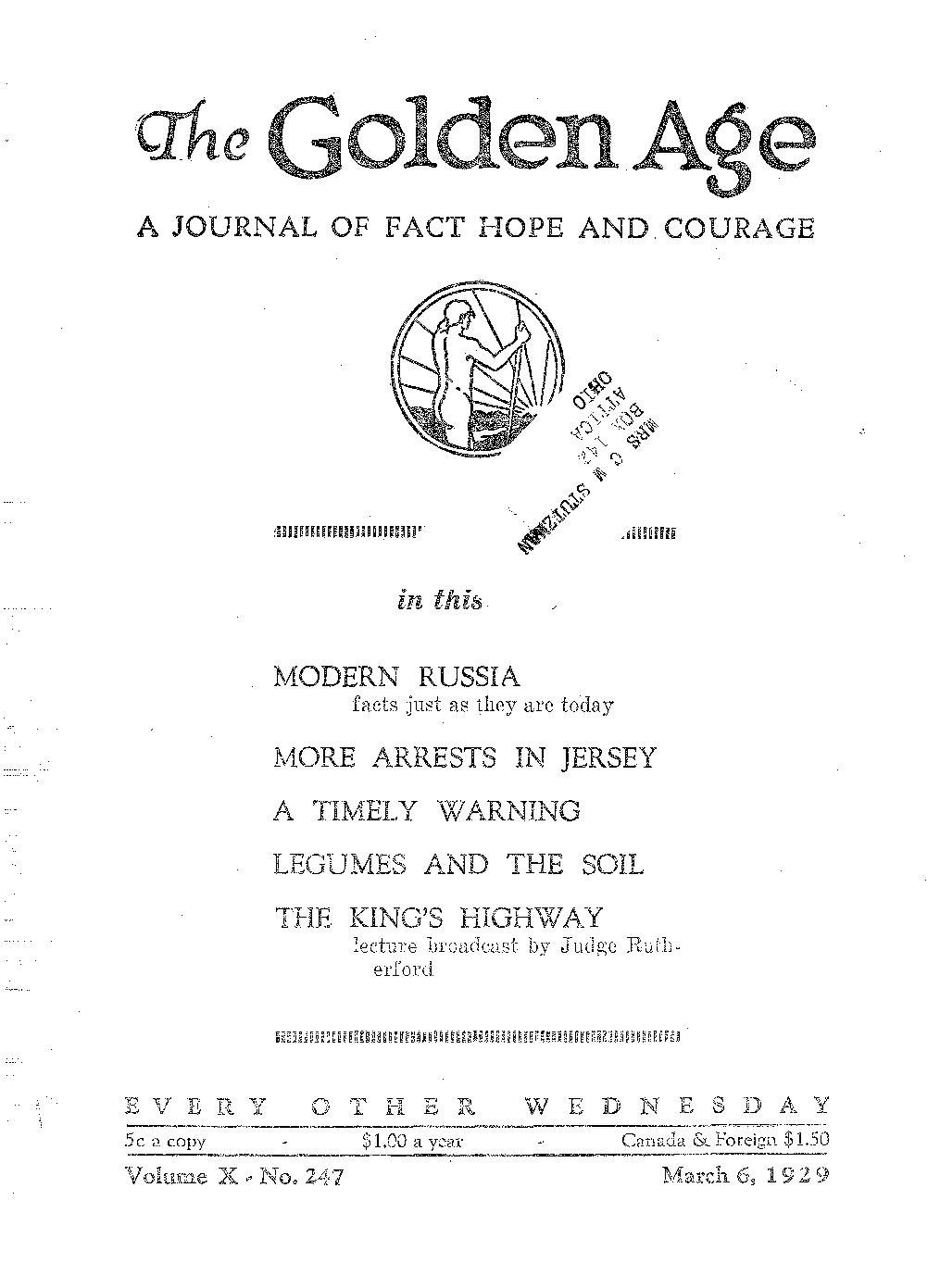
'Qh.e Golden Age
A JOURNAL OF FACT HOPE AND. COURAGE
in this
MODERN RUSSIA
facts just as they are today
MORE ARRESTS IN JERSEY
A TIMELY WARNING
LEGUMES AND THE SOIL
THE KING’S HIGHWAY lecture broadcast by Judge Rutherford
EVERY OTHER WEDNESDAY 5c a copy - $1.00 a year - Canada & Foreign $ 1.50
Contents
............... ====a<^0a_m-=L'LL-....................:...■:---
Labor and Economics
Straws in the WTnd .........i
The Miner-Harvester Experiment ............■'>(>’-’
Disappearance of Jobs
Social and Educational
No Third Degree in England
Twenty Million Chinese Starving ....
Wayward relish Husbands
Political—Domestic and Foiieicn
’Fourth Degree K. of C. Oath .............3t>
. Peasant Rule in Rumania
Teaching Communism to Chikimi
Happenings in Hungary
Events in Canada ................ ■
AGRICULTURE AND lIl'SRANIiliY Reforestation in New York .
LEGUMES AND THE Soil. .
Home and Health Hints most HEALTH Cl L'i'l 'HE
Car Axoro and Spake Not
Open Letter to a Dentist ....
A De-Aluminum ized Editou ............ .
■ Travel and Miscellany
I’bogbkss in Modern Russia ...
Eeligion and Philosophy “My People I.ove To Have It So’’ .
Moke Arrests in New Jersey
A Timely Warning ......
Seating Capacity 8300 .........
‘•The Posthumous Work of Pastor Russell" ........ 373 The New Archbishop of Canteubury .
Bible Questions and Answers .
The King's Highway
The Children's Own Radio Story ............ 383
Published every oilier Wednesday at 117 Adams Street, Brooklyn, N. Y., U. S. A., by ' WOODWORTH, KNORR & MARTIN
Copartners and Proprietors Address: lit Adams Street, Brooklyn, A. Y., U. S. A. CLAYTON J. WOODWORTH .. Editor ROBERT J. MARTIN ■ ■ Business Manager NATHAN n. KNORR .. Secretary and Treasurer
Five Cents a Copy—?1.00 a Year Make Remittances to THE GOLDEN AGE Notice to Subscribers: Wo do not, as a rule, send an acknowledgment of a renewal or a new subscription. A.renewal blank (carrying notice of expiration) is sent with the journal one month before the subscription expires. Changeofaddress, when requested, may be expected to appear on address label within one month.
Foreign Offices
British . s , s , j s 34 Craven Terrace, London, W. 2, England Canadian . . , # . 40 Irwin Avenue, Toronto 5, Ontario, Canada Australasian j » . . 495 Collins Street, Melbourne, Australia South African ..... 0 Lelie Street, Cape Town, South Africa ~
Entered as second-class matter at Brooklyn, N, Y., under the Act of March 3, 1879.
oAc Golden Age
Volume X Brooklyn, N. Y., Wednesday, March 6, 1929 Number 247
Progress in Modern Russia By George Young
This is the first time that the true condition of things in Russia has gone out of that country. Hitherto those who have been to Russia have had their views of what they have seen and heard more or less colored according as their interests were with the workers or with the capitalists. Mr. Young had no ax to grind, and presents the facts just as they are.—Editor.
THE Union of Socialist Soviet Republics [U.S.S.R. (Russian: S.S.S.R.,i.e., Soyus Sotsialisticheskekh Sovietskikh Respublik)] occupies a vast area of 21,200,000 square kilometers, stretching from the Baltic sea and the borders of Poland across Asia to the Pacific ocean and from the frigid shores of the Arctic on the north to the torrid steppes of Turkestan and the borders of Persia on the south.
It is the largest continuous dominion in the world, covering one-sixth of the total surface of the earth; and even among colonial empires the size of its territory is surpassed only by that of the British Empire.
This great country is rich in natural resources. It might almost be termed an undeveloped continent. The forest area is the largest of any nation, covering over 1,350,000,000 acres. The oil resources are capable of supplying one-third of the world’s supply.
The area under cultivate exceeds 250,000,000 acres. Vast stretches are uevoted to the cultivation of wheat, rye and flax, but because of antiquated methods of agriculture and lack of machinery the production is not high. In the subtropical climate of the Crimea, Turkestan, Azerbaijan and Ferghana, grapes, cotton, tea and tobacco grow in abundance.
The coal fields cover a vast area, while the deposits of manganese ores in the Caucasus are the richest in the world. Gold, platinum, silver, mercury, chromium, nickel, zinc, copper, phosphates, etc., add to the natural wealth of the country.
The Soviet Union
The Soviet Union is composed of six allied republics. Within these six republics are ten autonomous divisions and twelve autonomous
territories. These subdivisions are made in order to give the greatest freedom to the respective races and languages of the Union.
The word “soviet” means council. No electoral rights are enjoyed by persons who are employers of labor, or who trade, or who live on rents. The village and town soviets elect delegates to the district soviets, and the latter.elect delegates to the provincial soviets.
For the central government of the Union, at Moscow, the various provinces elect delegates to the Union Congress of Soviets, which is composed of 1,500 delegates and meets once a year, the session lasting from ten to twelve days. At the close of the congress the delegates surrender their mandates.
The Union Congress is the supreme organ of authority. The actual work of legislation on the basis of the principles laid down by the Union Congress is carried out by the Central Executive Committee of the Union. The Central Executive Committee is invested with the authority of the state and is responsible to the Union Congress, carrying into effect its principles and instructions. .
This executive committee is composed of two bodies, the Union Council and the Council of Nationalities. Every bill must have a majority in each of the two councils before it becomes a law. The Central Executive Committee meets at least three times a year, holding brief sessions. A group of twenty-one members remains in permanent session. They are the highest functionaries of the Soviet Union and represent it before the world.
The Council of the People’s Commissars is composed of the chairman and his deputies and ten commissars who are responsible to the Central Executive Committee for the carrying out 355
Th. Golden Age
n ’ 356 JI
!| i of the administration of the affairs of the state. I" These commissars include foreign affairs, army and navy, foreign trade, transport, etc. Other administrative councils also operate, carrying ' out the functions of government assigned to I’ them.
The Russia of the Czars
In order to convey to the average reader a ’ knowledge of the conditions which exist in Soviet Russia, one must keep in mind the conditions ' I which prevailed in the old Russian Empire, j which conditions led up to the great revolution ■ i of November, 1917.
! Through successive generations the imperial ; ( dominions of Russia were extended until the
■ czar of all the Russians ruled over the vast
। territory from the Baltic to the Pacific and : ground into submission some two hundred sub' ject races and nationalities numbering over* :1 160,000,000 people; of these 83 percent were j peasants.
; Although serfdom was abolished in 1861, the lot of the peasants had altered but little. In 1914 less than 25 percent owned their own land.
i Illiteracy was general. Over 80,000,000 people could neither read nor write. The Russia of the j czars was the most backward country in Europe.
The peasants usually lived in villages. In the northern districts the peasant’s home was ' usually built of logs; a single room with an earthen floor and a roof thatched with straw (isba). In the south the houses were built of clay and were whitewashed within and without (khata). Infant mortality was the highest of any country in Europe.
For the children of the peasants there were few of the joys of childhood. Forced by the battle fox’ existence, little barefooted children toiled with their parents, old before their years, victims of conditions over which they had no control.
In the industrial centers the hours of labor were long, the pay was small, and the housing conditions were crowded and unsanitary. In the mining districts conditions were worse. The miners and their families lived on the verge of poverty; very often their dwellings were mere hovels.
Jails, noted throughout the world for their severity, were crowded with unfortunate people. There was neither liberty of speech nor freedom of the press. Thousands of people were ban-
Brooklyn, N. Y,
ished to the frozen wastes of Siberia, while the clergy and the ruling classes lived in ease and luxury.
Church and State
The Orthodox church (Greek Catholic) was closely allied with the state, and rated with power and intolerance. In politics and educational matters the bishops and the priests exercised great influence. The czar was the “holy father”. In upholding the autocratic decrees and principles of czardom as the ruler by divine right, the church was an arm of the state in which the czar had absolute confidence.
During the great war the clergy were the most active in blessing the cannons and battle-flags of the army. They urged the men into the combat and then profited from their bereaved relatives by the sale of holy candles and in offering masses for the souls of the dead.
From the imperial treasury vast sums flowed annually into the church. Monasteries, convents and church estates were scattered throughout Russia. In Moscow alone there were over nine hundred churches, convents and monasteries.
The World War
In 1914, when the civilized nations began to make war upon each other, Russia suffered more than any other nation. Upon her borders the contending armies, now advancing, now retreating, struggled over a battle-front of nearly 1,000 miles, carrying ruin far into Russia.
Millions of acres of fertile land were turned into a blackened wilderness; thousands of villages were abandoned or destroyed; millions of horses, cattle and sheep disappeared; women and children were scattered and decimated by hunger and disease; old men and women were left homeless and destitute; orphan children wandered over the country; refuges crowded into the cities; whole areas were depopulated; want, hunger and ruin reigned over vast stretches of a once fertile country.
The Fall of Church and State
For three years the great war had raged in fury. The Russian armies, poorly equipped, suffered heavily; millions had been killed or taken prisoners. The people at home were discouraged; their sons were fighting and dying for they knew not what. Food was scarce; the suffering was great.
As the conditions in France produced the great French revolution, so likewise the conditions in Russia gave birth to the Russian revolution. In February of 1917, and further on November 7 of the same year, the people arose like the waves of the sea, and the result was the downfall of the church-state empire of the czars of Russia.
Reconstruction
Because of the wounds inflicted by the World War and the revolution, the work of reconstruction would have been a great task; but now another difficulty was added which greatly complicated matters and intensified the difficulties.
Aided by foreign nations, counter-revolutionists were supplied with money and munitions, and civil vrar was stirred up on the Russian frontiers, north, south, east and west. The result was a tremendous loss of life and material destruction. For instance, the large city of Odessa changed hands in mortal combat no less than thirteen times; a large part of the city was laid in ruins.
All over Russia villages, homes, railroads and factories were destroyed; the loss of life was appalling. It was three years before peace was restored. Then followed the great famine of 1921, one of the worst in history.
In the great Volga valley, in the Crimea, ai . in the wheat lands of the Ukrainian Republic no rain fell for nearly a year, crops withered and vegetation died. The conditions were so severe that the government was feeding over 5,000,000 destitute children. It is since this time that most of the work of reconstruction has been carried forth.
Soviet Economic Policy
In the year 1921 the system of military communism came to an end, and a new economic policy based upon a stable currency and the balance of the budget was introduced. Beginning with November, 1922, large banks and credit associations began to be established. The industries were reorganized upon commercial principles and detached from the state. Cooperatives now handle the major portion of trade and industry.
Private trading and enterprise are carried on too, but the cooperative or trust system is that which is favored by the central government. The trust or cooperative under the Soviet system is the legal holder of property. The cooperatives are organized on the commercial principle of profits. Concessions are granted to foreign capital, which concessions are guaranteed by the state.
Industrial Recovery
The recovery of industry has been for the most part general. For instance, the oil industry has been modernized and expanded. The production is now 20 percent higher than in 1913. The coal output is 24 percent greater than in 1914. Living conditions in both the oil and the coal fields have improved.
In the textile and other industries the advancement has been slow and the scale of wages has almost reached the pre-war level. The expansion and reorganization has been hampered by the lack of money and by the need of new7 and modern machinery as well as of skilled mechanical operators. The result is that production is limited and the price of goods and manufactured articles is generally high compared with the price of similar articles in great commercial nations.
The foreign trade turnover of 1925-26 was 32 percent of the prewvar turnover, and is on the increase. Unemployment in the Soviet Union, as in other countries, is a serious problem; various measures have been adopted to alleviate the condition.
The Peasants .
One of the most serious problems facing the Soviet government is the handling of the peasants and the agricultural situation in general. Various law?s and measures have been adopted, but these have failed to bring about the desired results. All land has been nationalized, but the peasants, as a class, vull not accept nationalization. Much land lies uncultivated. What should be the greatest grain-producing country in the. v7orld is confronted -with a great food shortage; in some districts the food shortage is very acute.
There is also a lack of manufactured goods. In the cities long lines of people "wait in front of the stores, but the supply is inadequate. An economic crisis prevails. '
In the villages manufactured goods are scarce and often entirely lacking, prices are high, and the quality of the goods inferior. Foreign manufactured goods can not be imported. It is the
policy of the government to exclude foreign manufactured goods (except such goods and i machinery as are not manufactured in Russia). ! This is in order to protect the state-aided in-j dustries, which are inadequate, to supply the 1 demand of the populace. If a license to import goods is granted, then the duty is prohibitive, I This lack of goods has produced great unrest amongst the peasant population.
ij
n The Agrarian Situation
J Little advancement seems to have been made i; in handling the agrarian situation. As only 17 : percent of the population may be classed as ur-: ban, the success of the Soviet system depends ! not so much upon their city workers as upon the millions who till the soil. So far no equitable and constructive policy of agrarian advancement has been introduced, and as a result an economic crisis exists of the utmost gravity.
The acreage under cultivation is decreasing; much land is reverting to forest. In 1928 over five million acres less land was under crop than in 1927.
Because of the number of horses killed during war and internal strife there is not sufficient to till the soil properly. The production of tractors is slow, consequently the yield per acre is decreasing.
The Communist peasants receive favors and concessions. They are allotted the best machinery and buildings. Their taxes are moderate. In the schools their children are given special privileges. As a whole, the cooperative system of farming has not been successful, largely because of the lack of equitable individual effort on the part of each, member of the community.
The non-eommunist peasants are taxed to the utmost limit and otherwise penalized. Their children are at a disadvantage, especially in the higher schools. In 1927 such a climax of dissatisfaction was reached that the government closed the private grain purchasing agencies, and grain gathering was conducted by military force. The revenue dropped off over $100,000, 000, and nearly 150,000 tons of grain had to be imported. The total number of the Communist party is only 1,370,000 members; while the young Communists total about 2,000,000. This minority directs the policy of Russia’s 140,000, 000. The peasants, as a class, are the most poorly-clad people in Europe.
The Prison System
The prison system has been reorganized; the death penalty (except in rare cases) has been abolished. Ten years is the maximum sentence. Minor offenders are given considerable freedom and receive industrial and educational instruction; and if engaged in prison work, they receive pay, a portion of which is retained until the expiration of the prison term. This is very beneficial. Political prisoners do not fare so well: Siberia is still used; so is banishment, to the dreaded Solovetsky prison settlement in the frozen wastes of the White Sea.
Transportation
During the World War and the three years of civil Avar, over 5,000 miles of railway track and 3,672 bridges and culverts were destroyed. Sixty-five percent of the locomotives and the large majority of the freight cars were unfit for service. This damage has been repaired. The lines have been reballasted and put in running order.
At present a new line is under construction which will cross a territory as large as France. It will connect the cotton belt of Turkestan with the wheat area of Siberia.
Automobiles in Russia are few in number: the roads and highways are probably the poorest in Europe. An effort is now under way to improve the main roads.
At Rostov on Don a factory for the manufacture of agricultural machinery is in the course of erection. It will cover 260 acres, and to complete the undertaking will require five years.
Electrical construction is being given special attention. In the Donetz basin the largest electrical development in Europe is under construction.
Educational Advancement
Special attention is being directed to educational matters and there is a general call for knowledge and for western science and mechanical methods. Schools are being provided as rapidly as the economic conditions will permit. The system of education is based upon the principles of evolution, atheism and communism. An elementary knowledge of military training is also imparted.
At the present time over ten million children are attending the elementary schools. This is three million more than in 1914. Nevertheless the existing schools and teaching staffs are not adequate for the population. Technical schools provide training for nearly 600,000 students. One hundred and thirty-six universities, besides a number of scientific and research institutes, foster higher education.
During the past four years approximately 4,000,000 men and 3,000,000 women have been taught to read and write. During the czar’s rule 87 percent of the women were illiterate. There are 25,579 circulating libraries in operation. The Russian alphabet has been modernized. In large sections of the country where the complicated Arabic alphabet was in general use the Latin alphabet has now been adopted.
The old Julian calendar has been abandoned and the modern Gregorian calendar of the western nations adopted. In the education of the people moving pictures are being employed to advantage. The films with love-making, hugging, killing and shooting scenes are not encouraged.
Films dealing with educational, industrial, historical, geographical and cultural knowledge are given preference. Permanent cinemas to the number of 4,839 have been established in the rural districts, and 1,500 itinerant shows are also in operation. In 1913 there were 12,380 post offices; now there are some 32,870.
Social Conditions
The protection of motherhood is being given special attention. Maternity homes, clinics, and medical and advisory stations have been established in the principal centers. Their services are free. In the cities, playgrounds and recreation parks have been established for the children. In Moscow there is a playground for 30,000 children, with nurses and games and exercises for the smaller children. Athletics are being specially encouraged. In the industrial centers numerous clubs and libraries have been established.
Marriage is looked upon as a contract of mutual cooperation, and when that cooperation is not mutual either party may obtain a divorce. In Moscow, in the year 1926 there were 24,705 marriages and 5,461 divorces. In the obtaining of a divorce either side may apply to the divorce court. The legal facts are noted by the official in charge, and the divorce is granted forthwith. If there are children, then the authorities see to it that the parents support the children until they become of age. According to the Soviet law, marriage is legal only by civil register. In 1926 only 23.3 percent of the marriages were registered with the church.
Censorship
All publications, newspapers, books, magazines, etc., are subject to strict censorship. No books or booklets of any kind may be printed without the permission of the censorship bureau. Likewise, books can not be imported. They must first be submitted to the censorship bureau, and a license obtained granting the right to import into the Soviet Union. Bibles, however, if without notes or comments, may be imported. Meetings and lectures can not be held without permission.
Evolution and Atheism
Theoretically, the Soviet law grants religious freedom throughout the Union; but, whether by government consent or because of over-zealous officials ignoring the law, these principles are n always put in operation. Children under sixteen years of age can not receive any religious instruction except from their parents in their own homes. Public religious instruction of children is not permitted.
The doctrine of evolution is fully exalted in the Soviet Union. The government is openly atheist and looks with disfavor upon any other teaching. In the schools and educational centers the children are being taught accordingly. The liberty of the press of the western nations has not been realized in the Soviet Union. An anti-religious university was recently opened in Moscow.
The Orthodox (Greek Catholic) church has been completely disestablished. The church edifices have been taken over as national property. These buildings may be used, provided they are kept in repair. Many churches are in operation all over Russia, but the church-and-state glory and power of the past is entirely absent.
Creedal Theology and Tradition Responsible
For centuries the Greek Catholic system, with the czar as the “holy father”, and its bishops, priests, monks, nuns, convents and monasteries, fastened itself upon the people. It claimed the sole right to teach God’s Word and that it was a true manifestation of His holy principles, doctrines and precepts. It persecuted all that differed from it.
The unscriptural, God-dishonoring doctrine that before God created man He created a hell of torment in which it was His purpose to torture millions of mankind in undying agony, and that He also prepared a purgatory of suffering from which escape might be hastened by the payment of money to the priests for the offering of masses, etc., has nauseated many thinking people. These doctrines, together with the commercial religious practices of ecclesiasti-cism and its interference in politics and educational matters, have created a strong feeling of repulsion.
It is a great pity that the peoples of the earth are so little acquainted with the true knowledge of God’s Word and of His gracious plans and purposes for the blessing of all mankind. If the nations of the earth would accept His Word as their only guide, then wars and hatred and strife would cease, and peace and true brotherhood would fill the earth.
The God-defaming teachings of ecclesiasti-cism have mistakenly been accepted as the true representation of the plans and purposes of the all-wise and merciful Creator. The result is the present trend toward evolution and atheism. As individuals, the people of Russia are generous and sympathetic, and when the true knowledge of Jehovah’s love is manifested they will rejoice in His loving provision which through the establishment of Messiah’s kingdom will bring blessings to both the living and the dead.
Jfoscoic
■ Moscow is a distinctive city, occidental yet oriental, but decidedly Russian. Caucasearis, Circassians, Jews, Tartars, Georgians, Mongolians and representatives of Asiatic and Oriental races combine to form the 2,000,000 inhabitants of the once “holy” city of Moscow.
On a forty-metre-high terraced hill, overlooking the Moskva River, rises the fortress of the Kremlin. The -walls of this triangular enclosure are studded with nineteen imposing towers. The present battle-scarred, weather-beaten walls with towers and secret passages were erected by Ivan III, in 1485-95. Within this enclosure stand towering golden-domed churches, palaces of czars and patriarchs, toAvers, armories and state buildings, grouped in semi-oriental style and replete vuth the history of centuries of Muscovite power.
Here is located the famous “Tsar Kolokol”, the largest bell in the-world, eight metres high and Aveighing 201,924 kilograms. Over the toAv-ers of the Kremlin rise the golden two-headed eagles, symbol of imperial Russia. All such symbols and monuments of the czars and of Avar have been removed throughout Russia; but for historic and archeolgical reasons the Kremlin is unchanged, except for the removal of the great monuments of the czars.
Outside of the Spasski Gate (“Gate of the Redeemer”), Avhich towers 190 feetin height, lies the Red Square, half a mile long and 500 feet wide, the review ground of Moscow. Immediately under the Kremlin Avail, facing the square, is a small cemetery called “The Brothers’ Graves”, for those Avho fell in the revolution. The Lenin Mausoleum is also located here. From the dome of the state building immediately within the Kremlin Avail, the red flag of the Soviet Union flies day and night. '
At the south end of the square is the extraordinary cathedral Kram Vasiliya Blazhenno-vo. The style of architecture is unknown outside of Russia; the roof is a series of nine spiral domes and bell towers, all different and in variegated colors. It was built by Ivan the Terrible, and is hoav a museum.
On the east of the square rises the colossal commercial arcades, built (1888-94) of stone and containing over 1,000 stores. Here is also located the grim circular stone platform and enclosure called the “Skull Place”, used for hundreds of years as a place Of execution.
At the north end of the square is the Iberian Gate, with imposing towers 150 feet high. Here is located the Iberian Chapel, once considered the holiest place in Russia. Here is the Statue of the Virgin Mary (the Iberian statue). Priests in vestments, Avith an abundance of candles and holy Avater, minister to those Avho still have some faith in the poAver of priestcraft.
On the left, directly opposite this chapel, is the second house of the Moscoav Soviet, On the Avail facing the chapel a large sacred image once stood. This image has been removed, and the inscription, “'Religion is opium for the people,” iioav stands out in bold letters.
At some distance from the Kremlin lies the Avail of the Kitai-Gorod. This Avail Avas erected
to keep back the Tartar hordes who once pressed the Muscovite rulers. - .
For the most part the streets and avenues are wide. Some avenues have parkways and esplanades lined with trees and flowers. Moscow is really a fine city. The city is paved mostly with the old-fashioned cobblestones; a few streets are asphalted. For years the city was neglected, but now the damage of the revolution has been repaired and the appearance is almost normal.
The telephone and street car service is modern and very good. A large number of modern flats have been erected; also a fine post office; but the housing conditions are entirely inadequate for the people crowding into the city.
The rooms are parceled out according to the size of the family. In some quarters numbers of people live in single rooms. In these districts are much want and suffering, poor people underfed and scantily clad. Many beggars, comprising men, women and children, depend upon the passer-by.
Man may do his best to right conditions and may institute new laws and regulations, yet no power but that of the Creator can bring the true desire of mankind, the desire for life and peace and communion with his Maker.
Jehovah the True Deliverer
Even were it possible for the highest aims of ' earthly governments, whether republican, mo-narchial, socialistic or soviet, to be realized, yet , death reigns over all. In a few years poor feeble man (no matter how great he may think him- ; self or may appear in the eyes of his fellows) withers like the grass of the field, and, like a helpless worm, sinks into death.
But when God’s kingdom is fully operative in the earth, then, as man serves and obeys His righteous law, not only will he be blessed with endless joy and the blessings of eternal life in full harmony with the Creator, but the earth itself will become a land of plenty like the paradise of God. Nothing will mar the blessings of peace and true brofi "hood under the invisible power of Christ, the _^deemer.
The time is rapidly approaching when the visible power of God Almighty will be manifest against all oppression and hypocrisy and the God-dishonoring doctrines taught in the name of the Creator. The time limit of the day of evil is rapidly approaching, when in Armageddon the power of the Creator will be manifested and the truth made known. Then “all nations shall call him blessed”.
Straws in the Wind
Reforestation in New York
NEW YORK STATE is pressing for the reforestration of her slopes and ridges that are not suitable for farm work. It is claimed that for an initial cost of $2 one thousand two-year-old seedlings may be purchased from the State Conservation Department, and that in fifty years these will produce $500 w’orth of lumber to an acre.
Russia Seeks American Tourists
EPORTS from Russia are that first class one-hundred-room hotels with baths are to be built in all principal Russian cities, all frontiers are to be thrown open, railway trains and stations are to be kept clean, new uniforms will be provided, and that it is hoped that these inducements will bring in to Russia many of the dollars of American travelers now left outside.
No Third Degree in England
T N ENGLAND the police are not permitted -*■ to cross-examine a prisoner. In this country, in several instances, prisoners have been killed by police while undergoing the third degree. In Pennsylvania an aged Czech who had had one examination by the police, and who came home partially paralyzed, when notified that he was wanted for another grilling committed suicide.
Fourth Degree K. of C. Oath
THOSE who circulate the supposed fourth degree K. of C. oath should also explain that it was published in the Congressional Record by the request of a Catholic, and that the committee which, upon his request, investigated the oath, found that it was not true. We have many times been requested to publish this oath, but have always refused to 'do so.
State Religion in Serbia
STATE religion in Serbia is on the down grade. There are only four churches in Belgrade, a city of 500,000 persons, and this is three more than are necessary. The bulk of the people have forsaken religion entirely.
The Great Kulik Meteor in Siberia
INVESTIGATING a story which filtered in from a savage tribe in northern Siberia, Professor Leonide Kulik, Russian geologist, has found parts of a vast meteor which recently fell in that region, completely devastating it of all life for an area of one hundred square miles. The meteor fell ten years ago and was located only this past summer. It contains iron worth $1,000,000.
The Grand Duke Alexander -
THE Grand Dulce Alexander of Russia is accredited with having recently said: “While I write and work I forget completely my personal self and its interests. I try, according to my strength, to follow the example of Christ. One single desire guides me, namely, to be the willing instrument of the will of Christ.” The Grand Duke was at one time an admiral in the Russian navy. He is a cousin of the late czar.
Czar’s Relatives Find It a Hard World
THE czar’s relatives are finding it a hard world. The former commander of the czar’s bodyguard is manager of the stable of a Chicago chain store owner. His wife, the grand duchess Olga, lives in a six-room house, and helps out the family income by painting pictures. The former master of ceremonies and the lady in waiting to the former empress are running a boarding-house in Copenhagen.
Twenty Million Chinese Starving
IT IS claimed that there are now twelve million starving Chinese and that before spring the number will be at least twenty million. It is known that the gems recently taken from the tomb of one of the old empresses of China would be more than sufficient in value to provide for this vast number of people for the entire winter. The tomb was rifled by soldiers and military officers. Only about $4,000,000 of the gems have been recovered, and these were a mere bagatelle as compared with the total.
Motoring Across Europe
A CANADIAN woman and her American sister have just finished a trip across the length of Europe in an automobile. They went from Spain to near Constantinople and returned, with no molestation.
London Insane over Spiritism
T ONDON continues insane over spiritism. 'A doctor who is a spiritist has tried sending radio messages to Mars. He claims to have made several trips there. He does not know that .it was all in his head. A London lad of seventeen who had lost his mother and subsequently dabbled in spiritism sought relief from the tyranny of the evil spirits by committing suicide. ' '
The Miner-Harvester Experiment
OF THE 8,000 miners who went to Canada to participate in last year’s wheat harvest it is encouraging to note that all but 500 were able to stand the gruelling experience of working from dawn to sunset at a kind of work to which they were unaccustomed. The 500 were returned to Britain, but the others are remaining and will no doubt become permanent residents of Canada.
Where the Money Goes
OF THE government’s expenses for 1927, 31.8 percent went for military expenditures and 51.1 percent for public debt, which was also military expenditures. That makes a total of 82.9 percent of the government’s receipts spent for wars, past, present or future. That leaves 17.1 percent for all the other interests of the people, showing that war is the most absolute foolishness conceivable.
South America the Coming Continent
SOUTH AMERICA may well be termed
“The Coming Continent”. The United States now has as much money invested in Venezuela alone as in the entire continent sixteen years ago. The grand total of American investments in Spanish America is approximately five billion dollars. South America is taking a great interest in aeronautics, with Peru in the lead. The chief use for airplanes in Peru is for cotton dusting, where planes costing half a million dollars are in use for that purpose.
African Languages and Dialects Russian Cloth Sold in India
THERE are 843 known languages and dia- TJRITISH textile industries have shown some lects in Africa, 500 of which have never alarm over the fact that four hundred been reduced to writing. Mohammedanism is packages of Russian fabrics have been sold in spreading throughout the length and breadth of India at ten percent less than is paid for Brit-tiie Dark Continent. ish fabrics of the same quality.
Wayward Polish Husbands
rpEN thousand Polish women and their children are said to be in Poland seeking husbands who left them to come to the United States to seek their fortunes. It seems that many of these men, after arrival here, changed their names, married other wives, and forgot to notify the folks at home.
Raising Fishballs off Maine
FF Lubec, Maine, a fisherman threw overboard several refuse potatoes, and some codfish, on the watch for something to eat, gobbled them up. Another fisherman found the codfish with the potatoes inside them and, according to the New York World, is trying to figure out whether a new style of ready-made fishball can now be raised by the method indicated.
The Frost Ash of Rockaway Beach
ONCE a year millions of frostfish cast themselves up on the beach at Rockaway and commit suicide. The time chosen is the first frost of winter, under the light of the moon. The same phenomenon is observed in New Zealand. Why these fish choose this time and method of putting an end to their lives is unknown, The official name of the frostfish is Lepidopus Cauclatus, but it is' otherwise called the scabbard and the tomcod.
Chicago’s School Children
STUDY of Chicago’s school children shows that 85 percent have physical defects. Of these, 86,000 had defects of palate and teeth, 25,000 had defective vision, 13,000 had enlarged thyroid glands, 10,000 were anemic, 10,000 had enlarged lymphatic glands, 6,000 had pulmonary diseases, 4,000 had skin diseases, and from 1.000 to 2,000 were listed in each of the following: nervous diseases, heart disease, ■ rickets, bone and joint defects, defects of speech, and defects of hearing. The Red Cross estimates that 70 percent of the school children of New York County are defectives.
Making History for Persia
THE first Persian woman to discard the veil, and the first woman to leave Persia Oi n individual passport, is now giving lectures .u this country. In starting for America she flew from Irak to Teheran in five hours, a trip which required forty days by automobile only five years ago.
Crookedness in Massachusetts
T N PROVING, as it has done, that Vanzetti could not have been present at the Bridgewater holdup, The Outlook discovered that the noble State of Massachusetts had either lost or destroyed its copy of the Vanzetti case, and it had to get its copy elsewhere; which is pretty good evidence that somebody in Massachusetts is trying hard to cover up one of the dirtiest records ever made in history. Massachusetts illegally murdered Sacco and Vanzetti.
Peasant Rule in Rumania
ulius JHaxiu, head of the new peasant government. of Rumania, begins his premiership well by putting an end to anti-Semitic riots. The parties who have been controlling the country are doing- everything possible to create unemployment and unrest, but Manin is going ahead with reforms, taking the America of Lincoln’s day as his model. He believes in a real rule of the people, by the people and for the people.
What Are We to Think?
everend Bertram Smith, president of the
British Congregational Union, in an address to the union recently said: “What are we to think of a society in which the most essential services are scarcely rewarded with a living wage, and the greatest fortunes are won by the most idle and most useless members: a society in which the honest, industrious man can toil all his life at work socially essential, for a wage on which he and his family can scarcely live, and in which a worthless speculator can amass an enormous fortune in a few years?”
Disappearance of Jobs
CCORDING to the statistics of the United
States Bureau of Labor, about one and a quarter million jobs have disappeared from the factories of the United States in the last five years. Labor-saving machinery is now actually saving the labor for which it was built.
Hemp in Western Canada
ANADA is adding the production of hemp to her agricultural industries, and with every prospect of making a success of it. Seven hundred acres were sown to hemp near Portage la Prairie in 1927, twice the acreage is reported for 1928, and a material increase is expected for the next year. The manager of the hemp plant at Portage la Prairie claims that farmers can make more by growing hemp than by growing wheat and that the market is not as erratic.
Teaching Communism to Children
THE London Times, referring to the existing scarcity of food in Russia, declares that in a certain school for orphans, near Batum, several hundred children were kept without food two and a half days, being told meantime to pray to God for relief from starvation. When famished they were then told to pray to Lenin, and the food was promptly forthcoming. We do not vouch for the truthfulness of this report; but it may be true, and probably is.
Too Much Ice Cream Causes Death
YOUNG Russian miner won an ice cream eating contest, devouring twenty plates of it in half an hour. This proved too great a shock to his system and in a few hours he died from pneumonia.'
Happenings in Hungary
UNGARIAN students have been on another wild anti-Semitic spree, partly under government protection. Those who resisted them were fined $40 and given fifteen days in jail. The students also were fined $2 each. Hungary expects shortly to put one of the Hapsburgs back on the throne.
War and Peace
IN THE Dutch magazine Kerk en Verde, published at Ammerstol, Holland, December, 1927, the Reverend J. B. Th. Hugenholtz said: “It is not the General Staff, nor the ministers of war, not the big guns, nor death-dealing airplanes, that should be blamed for the wars, but, rather, the clergymen of all denominations, whose eyes are blinded and whose consciences are hardened. Indeed, in a good many places, holy support is outwardly given to militarism: but everywhere, with but few exceptions, the clergymen are the main standby of militarism, whether these clergymen know it, don’t know it, or just don’t want to know it.”
Events in Canada By Our Canadian Correspondent
THE farmer carries the load! That Canada, in common with the rest of the world, is burdened down with taxation to the breaking point, and that the farmer in. particular is carrying the burden, is reflected in no uncertain way in an article entitled “Township Taxation”, by W. L. Smith, a former editor of The Farmers’ Sun, The article reads :
- Of all the subjects that will come up for consideration at the next annual convention of the United Farmers of Ontario, there is none of such immediate importance as that of township taxation.
If you do not believe that, read this:
“In 1906 the total township taxation in Ontario, for all purposes, was a little over six and a quarter million dollars. In 192G, the latest year for which official figures are available, the total was upwards of twenty-seven and a quarter millions.”
If still in doubt, read this further statement:
“The increased taxation in 1926 was levied on a population practically identical in number with that of 1906, the rural population in 1926 being 1,078,956, against 1,052,844 in 1906, an increase of approximately 26,000 in the twenty years.”
Read further:
“'Assessed values of rural property in all Ontario, in round, figures, increased only from 588 million dollars in 1906, to 781 millions in 1926, an increase of 193 millions.” ■
The reader can figure out for himself how much the rate on the dollar must have grown to produce twenty-seven and a quarter millions in taxes from an assessment of 781 millions in 1926, against six and a quarter millions in taxes from an assessment of 588 millions in 1906.
The disparity between taxation and population in 1926 and 1906, and in assessed values as compared with taxation between 1926 and 1906, is continued when earning power in the two periods is taken into account.
The earning power of an Ontario farm can be fairly well measured, at least for the purpose of comparing one year with another, by taking the money value of the crop produced.
Accepting that as a basis, it is found that the money value of all field crops produced in Ontario in 1906, as given in an official report issued by the Ontario government, was 144 million dollars. The same official report places the value of all field crops produced in 1926, at 257 millions, round figures again being used in both cases.
Now how does all this work out?
Roughly, for every hundred dollars’ worth of crop produced on Ontario farms in 1906, one hundred and eighty dollars was produced in 1926. an increase of eighty per cent. For every dollar in assessed values in 1906, there was one dollar and thirty-five cents in 1926, an increase of thirty-five per cent. Population in 1926 was, as already stated, practically the same as it was twenty years before.
But meantime the total of rural taxation in Ontario had jumped from six and a quarter to twentyseven and a quarter million dollars, an increase of between four and five hundred percent.
How long can this enormous growth in taxation as compared with population, assessed values, and earning power in rural Ontario continue without complete rural bankruptcy?
That is, perhaps, enough to digest at one sitting.
Canada Looms Large on the Horizon
It is interesting to note that among the nations of the Avorld Canada stands:
First in wheat exports, nickel, asbestos and newsprint production and in power development, per capita railway mileage and fisheries.
Second in number of phones in use, production of autos, coal resources, per capita exports and total railway mileage.
Third in silver, gold and aluminum production, forest resources and area.
Fifth in foreign trade and in zine production.
Sixth in production of lead and pig iron.
Seventh in production of steel.
Preachers Becoming Honest (?)
For once a preacher tells the truth. An article appearing in the Saskatoon Star-Phoenix tells the following:
Outspoken criticism of the part played by the Christian Church in time of war was voiced by Rev. M. G. Melvin, pastor of Knox United Church, in an answer on “Peace” Sunday afternoon before the Regina Peoples’ Forum in the city hall.
“The church lines itself up with the state, whoops up war and makes the pulpits very recruiting stations,” charged Mr. Melvin, adding the criticism that in the war of the past, the church had invariably sided with the state in military projects, bent on slaying fellowmen, when the church was pledged to the brotherhood of man and to the principles of peace.
“When a righteous war is pre aimed the church baptizes it,” the speaker deck I. in speaking of the propaganda which is handed out in time of war. “The ostensible cause is not the real cause, so an atmosphere of righteousness is created, high sounding words are invented in order to keep up the morale of the warring nation,’ ’ Mr. Melvin said.
“Once war is started, people are fed on falsehood, such as the atrocities stories in the last war. ’ ’
The Flow of Immigration
The flow of immigration, checked by the World War, is once again turned into Canada. The official report states:
Immigration to Canada for the period April to September, 1928, inclusive, amounted to 123,713, compared with 109,025 for the corresponding period of a year ago, according to an official statement here today by the department of immigration and colonization. The ratio of increase is 13 per cent.
For September immigration to Canada amounted to 11,663, compared with 9,061 in September a year ago. By its major classifications, September immigration this year consisted of 4,434 British, 2,739 from United States, and 4,490 from all other countries.
According to occupation, immigrants for the half-yearly period have included 77,440 of the farming class: 5,133 laboring; 6,677 mechanics; 4,038 trading; 663 mining; 11,366 female domestic servants, and 18,396 of all other classes.
Canadians who had gone to the United States intending to remain there permanently and who returned to Canada during September, declaring their intention of remaining permanently in Canada, numbered 3,184. The total of such returning Canadians in the six months’ period is 20,852.
Caribou on the Move
The caribou are on the move too ’ The Family Herald reports:
Many thousands of caribou, travelling in the long, relentless treks which have come to inspire northern bushmen and trappers with fear, are on their journey over miles of muskeg swamp, prairie and treeless barren lands to the south..
Their migration, is a menace to the little settlements on the frontier of civilization in the North country. The avalanche of huge beasts, approaching in that force which knows no resistance, is moving upon villages far south of the latitude at which the caribou usually stop to winter. Miles long are some of the files of the great beasts.
On and on the “trotting death” is advancing. Preparations for the huge antlered animals are being made in the little settlements. Barricades are being set up—fire lines are being established in efforts to stay the onrush of pounding hoofs which mean disaster. The hunting season for caribou opens in Canada November 15. Many Americans have already arrived in the North country in preparation for the opening of the hunting season. Sportsmen will hunt for enjoyment, but inhabitants of the country will hunt to protect their homes from the caribou.
Canadian Radio Situation
The refusal of the government to renew the radio licenses of the I. B. S. A. has resulted in much embarrassment to the prime minister and his colleagues. The government stated that the reason for its action was that the public objected to the programs of the Bible Students. In point of fact, the clergy objected because they could not withstand the truth. The people heard the message gladly and expressed their indignation by a monster petition of some 500,000 names, among which were represented 40 percent of the radio owners. The government, finding itself in an awkward position, has appointed a Radio Commission to investigate the whole radio situation in Canada and bring in a report.
Speaking editorially in regard to the Commission and its work the Saskatoon Star-
Phoenix, under the caption, "Canada’s Radio Policy,” says:
A federal commission is to be named this week to study radio control in Canada. This country is now involved in a discussion with its neighbor' about the allocation of radio wave lengths, the United States claiming 74 to Canada’s six. This is a matter for international negotiation. All that the commission must study is how to make the best possible use of the wave lengths available in Canada whether they be six oi’ more.
At the present time broadcasting in Canada is entirely in private hands, although under government regulation. The department of marine and fisheries has the responsibility of licensing or refusing to license any proposed broadcasting station. It maintains a staff of inspectors and other officers whose work is to prevent chaos in the air, to eliminate interference and to improve reception. A liberal licensing policy has been pursued. Canadians hear from radio stations in the Dominion music of many varieties and argument on both sides of public questions. Only one controversial question has arisen affecting the radio branch at Ottawa. This was when it refused a license to the International Bible Students, against whose programs many protests had been received. It was rather with a view to suiting the public taste than establishing a censorship of religious opinions that the department withheld a permit from the Bible Students. The general policy has been to let the public have what it wants in the way of radio entertainment, the government concerning itself chiefly with the mechanical side of the question. The position in Canada is thus the same as in the United States where a federal commission has the function of distributing wave lengths among the various stations. For a time there was no regulation of radio in the United States, but the federal government had to step in to prevent a state of anarchy in the air.
“My People Love to Have It So”
SUNDAY, November 11, at Waltham Abbey
Church, London, Rev. W. C. Proctor, a special speaker for the Armistice Day program (or "Remembrance Day services”, as they are called in Britain), endeavoring to be faithful to the Bible and to the God of the Bible, argued that the sacrifices of the men in the trenches during the World War could not be compared with the supreme sacrifice of our Lord.
He went on to say that Christ gave his life for his enemies, while these have given their lives for their friends and country and their king. Then he backed this up by saying that while it was true that Christians (1) had gone to the Avar, it should be remembered that two-thirds of them were conscripts and that some of them were criminals.
As a reward for this courageous and faithful kind of preaching, the regular preacher of the church gave him a good laying-out, and others reproached him for his courage in telling the truth. We have this information from the London Chronicle, issue of November 13, 1928, under the heading, “Churchgoers Angered on Armistice Day. Curate Protests.”
BIBLE Students in New 'Jersey are waging a vigorous campaign against the Devil, and the Devil does not seem to like it, not a little bit. On Sunday, December 30, 1928, the police of Englewood (the chief is a Knight of Columbus) arrested twenty of a party of about one hundred who were witnessing the “'gospel of the kingdom” from door to door.
Patrolman Corrigan drew a billy on I. Newman, of Paterson, and threatened viciously to break his head. This was after his prisoner had been placed in a cell for exercising his Constitutional prerogative of preaching the gospel in the way that seems to him best. When his prisoner explained his mission Corrigan interrupted him to say, “Jehovah? We don’t want any Jehovah God around here”; which is doubtless true.
Mrs. Theresa Smith, also of Paterson, showed her spunk. She had a sale almost made when a plain clothes man arrested her and took her to the station-house. After her release she called again on her prospective customer and succeeded in completing her sale, and a friend, Hazel Hessler, delivered the books. She found that her customer had in the meantime protested to the police against their intrusion into her affairs. Probably the police were all reading the 'Sunday papers at the time she telephoned.
Mrs. Elizabeth Pau was stopped as she was leaving a home, was asked where she lived, and when told that she was from Paterson, the plain clothes man who afterward arrested her asked what she was doing. She replied, “Preaching the gospel”; and he replied, “We have enough people up here to preach the gospel and do not need you to come and tell it to us.” It is probably true that they do have too many preachers in Englewood. There will be fewer later, when the Bible Students get through with their work.
The hearing of the Bible Students was set down for the following Friday night, but at their request was postponed for two weeks. In the meantime the town was covered again with literature inviting Englewood residents to listen in to WBBR at 11 o’clock Sunday morning, January 6, when an explanation would be made as to why the arrests had taken place. A full statement of the facts was given over the radio as to why all classes of so-called “religionists” are opposed to the message of present truth.
When the hearing was finally held on Wednesday, January 23, all but two of the defendants •were dismissed. These two, Isaac Newman and Charles Nicita, were fined $10 each. The fines were paid under protest and preparation made to appeal the case. It appeared at the trial that, the arrests started with the arrest of Newman when he called at the hoim of patrolman Bernard Corrigan. This showt, the great advantage of having all your “cops” of one nationality and one religion.
South Amboy Again.
Our readers will remember that last June there was a similar wholesale arrest of sixty-one Bible Students at South Amboy. When the case came to trial the city was hopelessly beaten and the recorder judge asked for time to meditate over and carefully consider the evidence before giving a decision.
On Sunday, January 20, 1929, he was still meditating over the case of last June, and, despite that fact, fresh arrests, of almost the same number of Bible Students, were made in South Amboy on January 20. When brought before the recorder, he publicly admitted that they had been unlawfully arrested, and dismissed them all. '
On this Sunday two of the gentlemen who, with their companions, had engaged in giving to the people at their homes, without charge, copies of Judge Rutherford’s address entitled The Peoples Friend, were suddenly attacked by a gang of ruffians. Both of them were summarily ordered out of town, slapped, punched, kicked and vigorously man-handled.
An item in the Perth Amboy Evening News, of January 22, said:
When interviewed last night, the Recorder stated that no city ordinance on record provided for the arrest or punishment of this particular offense. In reply to the question as to what authority existed for their arrest, the Recorder stated that so far as he knew there was no authority for either the arrests in June of last year, or on the present occasion, intimating that the police had acted unadvisedly. These revelations awaken an interest in the minds of the thoughtful citizens of South Amboy, and they are asking, “How comes this?” “Why this confusion?” Have we an unintelligent legal organization acting haphazard, or where does the trouble rest?
Commenting on the South Amboy situation, T. J. Sullivan, who expressed himself very freely in an address broadcast by Station WBBR, on this same question, said:
It is true that in June, 1928, the Bible Students were arrested (without any just cause or excuse), and were tried. The justice of the peace sitting on the case requested that both parties submit briefs, which was done. Repeatedly the lawyer for the Bible Students requested the Judge for a decision during the six months that followed, without avail. Even a few days prior to the broadcast above mentioned he had advice from the judge that he had not arrived at a decision. If it can be consistently maintained that "prompt hearing and duly dismissed” means that it takes six months to find out that there was no authority for the arrests made, that is the prompt consideration received by the Bible Students. I want to say, however, that until the hearing of Sunday, January 20, the Bible Students had no intimation that the case was dismissed, and very evidently the police officials of South Amboy were also in ignorance of it; otherwise they would hardly place themselves in the ridiculous position of arresting law-abiding citizens for preaching the gospel when they had no law under which they- could hold them, and for a considerable time stand by while misguided children destroyed the property of the Bible Students.
I am accused through the press of making "false expressions and unfounded charges of improper political influence against the city officials of South Amboy”. I submit that if arresting sixty men and women for preaching the gospel of Christ’s Kingdom, refusing to render a decision on their case for over six months, then coming out and saying their case was dismissed, without even advising them or their attorney, and then having a number of Christian men and women arrested six months after the first case was tried, many of these latter being arrested before they had even called upon a solitary individual about the kingdom of God, arrested because they were Bible Students; and further, if the stoning of law-abiding Christians and damaging their property while they drive their cars through the streets of South Amboy, advertising a free public lecture on the Bible, is not unusual for South Amboy, then I was wrong. If the stoning of Christian women on the streets of South Amboy because they dared to preach the gospel of Christ’s Kingdom as He commands them to do is not considered extraordinary by its citizens, then, of course, I was wrong. And in each case the culprits who broke the law and threatened the life and property of these Christian men and women were permitted by officers to go free, while the Christians were arrested.
…