Golden Age, November 28, 1928
Download: PDF — Golden Age, November 28, 1928
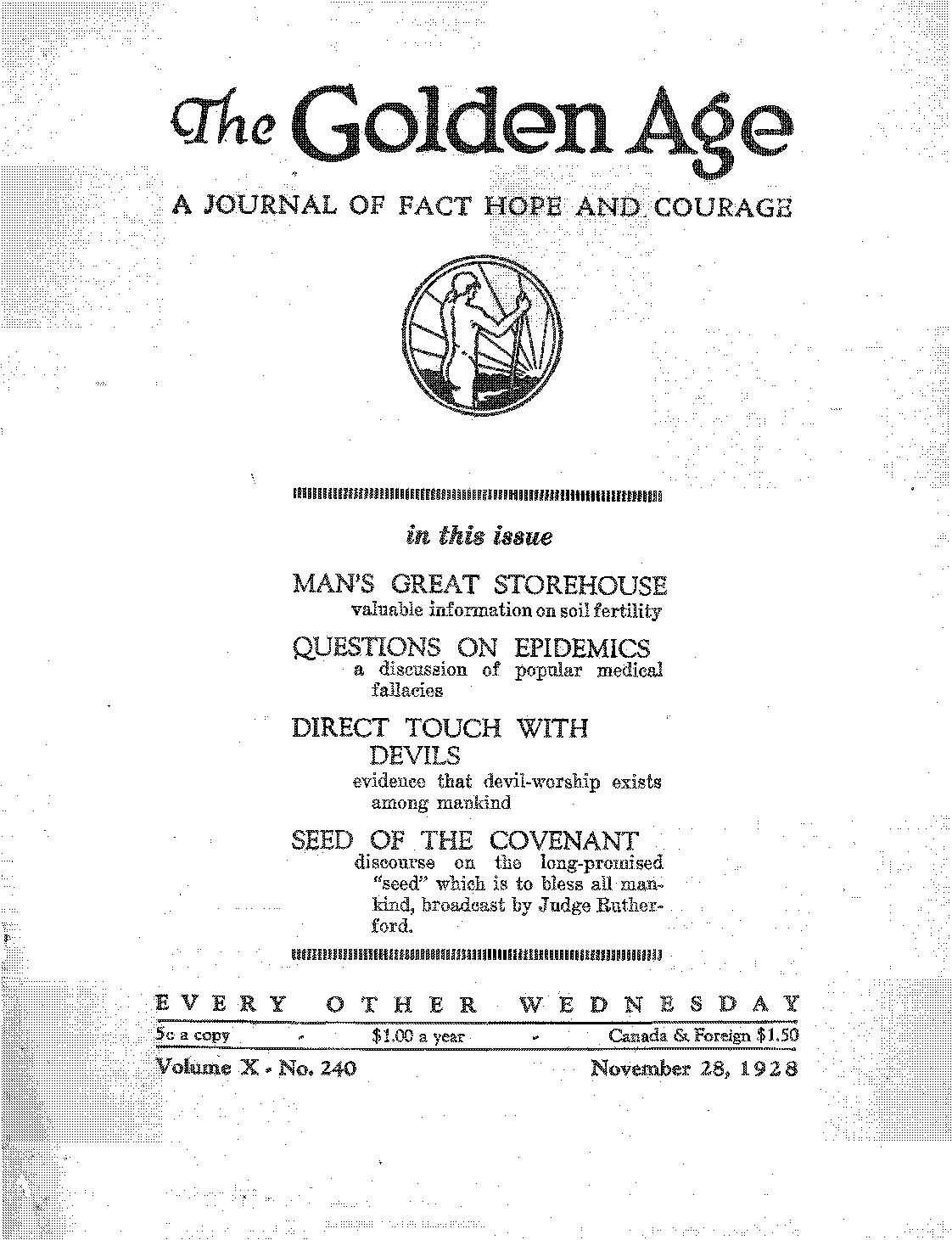
Golden Age
A JOURNAL OF FACT HOPE AND. COURAGE
iniiiiiiiiiiiiiiiiiiiiiiiiiiiiiiiiiiiiiiiHiiiiiiiiiimiiiiiiiiiiiitii
in this issue
MAN’S GREAT STOREHOUSE
valuable information on soil fertility
QUESTIONS ON EPIDEMICS a discussion of popular medical fallacies
DIRECT TOUCH WITH DEVILS
evidence that devil-worship exists among mankind
SEED OF THE COVENANT discourse on the long-promised "seed” which is to bless all mankind, broadcast by Judge Rutherford.
HHiiimimiiiiiiiiiiiiiiifiiiiiiiiiiiiiiiiiimiiiiiiiimiiiiiiiin
EVERY OTHER WEDNESDAY
5 c a copy - $1.00 a year - Canada &, Foreign $ 1.50
Volume X «■ No. 240 November 28, 192 8
Contents
------ —
Labor and Economics
New Zealand’s Labor Market (Slutted ......... • • 152
Social and Educational
More Truth Thaw Poetry ............... 137
Points of Interest .................. 140
Bishop Took the Count ................. 14-1
Priest Probably Could; Not . Read ; . ; . ........ • 144
Recollections of Slave Days . . . . . . . . . . . . . . 14(»
Crime and Criminals .................. 151
Finance—-Com merge—Transportation
Power Trust Makes a Cut ............... Ill
Where the Tax Money Goes ..............142
The Foor. Taxpayer .................. 151.
Political—Domestic and Foreign
Events in Canada .................. 138
One Reason for Postal Deficit ............. 142
Ayiesworth’s Awful Break ............... 142
Building the Kingdom of God ........... 143
Wireless Interference in Britain ............ 14'5
Agriculture and Husbandry
Man’s Inexhaustible and Everlasting Storehouse ...... 131
An Abundance of Food Fob All .............1‘56
The Farmer’s Way to Affluence .............. 137
Home and Health
Doctors May Sew Up Sponges ............. 140
Wholesale Removal of Tonsils ............. 142
Fined $250 for Saving Man’s Life ............ 144
Items on Aluminum Cooking Utensils
Some Thoughts and Questions on Epidemics .
Cooking by Cold Heat ................. 152
Religion and Philosophy
In Direct Touch With the Devils ............ 118
Order, IIeaven’s f1kst law ............. .
Cadman Will Serve the Hash ............... 150
Seed of the Covenant ................. 153
Bible Questions and Answers .............. 157
Tins Children’s Own Radio Story ............ 159
Published every other Wednesday at 117 Adams Street, Brooklyn, N. Y., U. S. A., by WOODWORTH, KNORR & MARTIN
Copartner* «a<? Proprietor* Address: 117 Adams Street, Brooklyn, S. Y., V. S. A. CLAYTON J. WOODWORTH.. Editor ROBERT J. MARTIN.. Business Manager NATHAN H. KNORR .. Secretary and Treasurer
Five Cents a Copy— $1.00 a Year Make Remittances to TUB GOLDEN AGE
Notice to Stihscrihen: We do not, as a rule, send an acknowledgment of a renewal <■-a new subscription. A renewal blank (carrying notice of expiration) is sent with tins journal one month before the subscription expires. Change of address, when requested, may be expected to appear on address label within one month.
Foreign Offices
British , . 34 Craven Terrace, London, W. 2, England
Canadian, ..... 40 Irwin Avenue, Toronto 5, Ontario, Canada Australasian ..... 495 Collins Street, Melbourne, Australia South African ..... 6 Belie Street, Cape Town, South Africa
Entered as second-class matter at Brooklyn, N. Y., under the Act of March 8, 1878.
The Golden Age
iVkltnn* X
Brooklyn, N. Y., Wednesday, November 28, 1928
Number 240
Man’s Inexhaustible and Everlasting Storehouse
A ND God saw every thing that he had made, ■tx and, behold, it was very good.” (Gen. 1:31) Man is only beginning to find out what a wonderful storehouse of good things the earth is; is only beginning to find out how, in spite of all his follies, he can do nothing to permanently injure his inheritance; and is only seeing, in the distance, the wonderful possibilities which lie within his grasp for miking the earth into an Eden where he will be everlastingly happy. All this is the Creator’s plan for him.
The average chemical composition of soil is as follows: ’
CONSTITUENTS
HUMID
REGION
SEMI-ARID REGION
ARID
REGION
Sulphuric acid
.05
.02
.06
Phosphoric acid
.12
.21
.16
Nitrogen in soil
.12
. .22
.13
Manganese oxide
.13
.12
.11
Lune
.13
.70
1.43
Soda .
.14
.32
.35
Potash.
.21
.33
.67
Magnesia
.29
.47
1.27
Humus
1.22
3.24
1.13
Alumina
3.66
4.57
7.21
Iron oxide
3.88
2.08
5.48
Soluble silica
4.04
8.46
6.71
Insoluble matter
84.17
75.04
69.16
In Uncle Sam’s soil library at Washington are fifty thousand bottles which include every type of earth known to science. These have literally been collected from every corner of the earth, despite dangers from bandits, wild beasts, fevers and other terrors.
In Uncle Sam’s own domain he finds 4,053 different varieties of soil, about 1,000 of which are important in his food-producing economy. He is now making a great soil map, at a cost of ®ai^i;inillion dollars. Farmers have only to consult these maps to know which crops are most profitable. ’
1 ?■-i i • iai
Uncle Sam has his own machine for soil analysis. With great rapidity it separates liquid from solid particles, and elements one from another. The machine discloses that the salts appearing in soils are more complex than hitherto supposed. A11 soil is good soil, having an overplus of something needed elsewhere. Man’s job is to assist in the transfer.
Soil Analysis May Fool You
OUR soil may analyze all right and yet it may be unproductive. Food may be on the table, but if it is not properly cooked and if your system can not assimilate it in the form in which it is offered to you, you may starve in the midst of plenty; and just so with a plant. Man’s job is to see that the right food gets to the plants in a form in which they can use it; and he has only begun to learn how to do it. ■
The soil is not only an inexhaustible storehouse, but it is a vast workshop or laboratory in which plant food is being constantly prepared for the use of plants. The object of tilling the soil is to promote the processes by which this is brought about.
In its soil maps the Department of Agriculture maps and classifies the soils on the basis' of their agricultural values. The physical and chemical examinations are used to support observations actually made in the field as to what the plants are doing in the soil itself. '
Some general observations are of value. Almost any plant will thrive in a soil composed of leaf mold, garden loam and clean, gritty sand. The leaf mold contains food instantly available to the plants. Well-rotted barnyard manure is a good substitute when leaf mold can not be had. The loam adds bulk. The sand prevents., caking and helps in the drainage. The sand should constitute about one-third of the volume of the mixture.
Loam is a broad term to describe soil which contains clay with a mixture of grass roots, and usually a little slowly available plant food, Loam can be made of decayed pasture or lawn sod. Dark-colored soils are usually wanner than light-colored ones. Wet soils are colder than dry ones. Soils exposed to the direct rays of the sun are warmer than those not having such a favorable exposure. A soil containing much sand and gravel is warmer than one containing much loam. Heat is an important factor in all life.
Soil Impoverishment Processes
VERY trainload of food that goes east carries some of the fertility of the West along with it. New York harbor is filled with it to such a point that the salt water will barely neutralize it even now. New York would be better off if its riches ivere more evenly distributed; a,nd that applies to its under-water riches as well as its Wall Street ones.
When twenty-five bushels of wheat are cropped from an acre of land.,, there are removed from that acre 29.59 pounds of potash, 20.56 pounds of phosphoric acid and 500 pounds of nitrates, although, as will be shown hereafter, some of these nitrates do not come from the soil but from the air.
There are other mineral substances in. the wheat, besides these three. Wheat and other plants require sulphur, chlorine, potassium, calcium, magnesium, iron, aluminum, sodium, silicon and manganese, and so do the people that eat their fruits, but there is a limit of absorption of all of these by the human body.
Rain-water enriches the soil with nitrogen, and benefits it by washing away its toxins, but it does damage too by erosion. Nevertheless soil eroded in one place will eventually land somewhere else, and it is not impossible that soils thus carried afar may do more good in the end than if left where first manufactured in nature’s laboratory; frequently not, however, as they are often washed to places where there is already sufficient.
There is a certain amount of soil impoverishment caused by the unwise use of certain fertilizers which set some of the soil constituents free and throw them into the drainage water. Lime is constantly removed by leaching. Deep plowing, the plowing under of manure, stubble, stalks and cover crops, the practice of tile drainage and the use of explosives, all. help to render a soil, more permeable to water, and lessen file losses by erosion.
Present losses by erosion are estimated, at not less than $1.00*3,000 a year in the United States. Part of this loss is in fertile soil actually washed away, and part of it is in the creation of gullies which reduce the area for cultivation.
Foods for the Plants
IRST of all foods, a plant must have water.
For each pound of solid matter that it draws from the soil, plant life must have 250 to 500 pounds of water. Not only is water an important constituent of plant tissue, but it is of the greatest importance as a solvent and carrier of food in the plant. The largest part passes out through the leaves by transpiration, which is essential to the healthy growth of the plant.
The value of animal excrements applied to soils on which crops are grown has been appreciated by the husbandman from the beginning. In China this is so clearly understood, and the people are so desperately poor, that boys watch for the droppings of horses and gather them immediately in baskets.
In Belgium the family treasure is its manure heap- or pit. A farmer rears his: family in comfort on three acres of land that has been cropped for two thousand years. Yet within two hours’ ride of New York city are many farms which have been abandoned because their fertility is. supposedly worked out. The American farmer has not properly valued or used the manure made on his place. He has wasted it. The Belgian saves it, solid and liquid.
Denmark is a land of drifting sand, but because the Danish farmer has known how to collect and distribute the manure of his fam animals it has become one of the garden spots of the world, and is a land where poverty is virtually unknown.
Farm manure increases crop production by improving the condition of the soil, as well as by furnishing plant nutrients. In each ton of manure there are 300 to 600 pounds of organic matter. Its rotting loosens and warms the soil, and it is in a very real sense the life of the soil, for it supplies a home and food for soil bacteria.
The use of well-rotted manure owes its popularity in part, to the fact that it supplies an enormous number of bacteria to the land at a time of year when fermentation in the soil itself is proceeding very slowly. The result is a mass infection or mass inoculation of greatest value to the soil.
Billions of Tiny Soil Workers
YOU know what a saltspoon is like. It is the smallest kind of spoon most of us have ever seen or used. Well, the men with the microscopes tell us that a saltspoonful of earth contains from 600,000,000 to 1,000,000,000 workers that are devoting their lives to soil fertility. Hence man has untold billions of friends that he knows nothing about.
Certain kinds of bacteria capture carbon dioxide from the air, build it into their bodies, and when they die, release their organic substances as humus for the enrichment of the soil. Others capture nitrogen from the air, and the plants use that for meat-making materials.
One of the greatest services rendered by bacteria is the breaking down of dead plant and animal bodies. The process is not a simple one. One group of bacteria carries its work as far as its nature permits, and then another group takes it up until another stage has been reached. Were it not for these bacteria the earth would be uninhabitable.
There are other important fertilizing agents in the earth itself, including earthworms and the roots of plants. Collectively these fix the free nitrogen of the air in the soil, or make the organic nitrogen available. They are active agents in the disintegration of rocks and the formation of soils. Good soil management is to so control moisture, aeration, temperatures, etc., that beneficial biological processes are promoted and the harmful restrained.
Bacteria, live, but are not active, in frozen soils. They awaken to activity in the spring. The familiar signs of renewed life in the spring are largely the result of renewed activity on the part of these little workers. In the Orient no farmer would think of engaging in the farming business without a compost heap, a breeding ground for the bacteria without which farming can not be a success.
Mar^g Responsibility to the Land
MAN is a land animal, gets his living from it, and is as much obligated to keep it in prime condition as any other animal: more so, in fact, for he is charged with supervising its affairs. The provision of Deuteronomy 23:12, 13 is a perfectly scientific solution of the sewage problem, the retention of a pure water supply, and the feeding of the soil:
Thou shalt have a place also without the camp, whither thou shalt go forth abroad: and thou shalt have a paddle upon thy weapon; and it shall be, when thou wilt ease thyself abroad, thou shalt dig therewith, and shalt turn back and cover that which cometh from thee.
There is another item that is proper to mention here, because it has more to do with man’s physical welfare than any other one item. All human ailments have their start in the intestines. If these do their work properly the man is a well and happy man. The minute they stop working he is sick, unhappy and out of luck. Doctors thrive on sick intestines.
The posture above indicated is essential for proper evacuation. The knees against the chest thrust the thighs in against the abdominal cavity, open the rectum, straighten out the sigmoid flexure, and with proper food, i. e., little or no white bread and little or no food cooked in aluminum, make evacuation natural, easy, voluminous and enjoyable. .
The French have a form of toilet, a hole in the floor, with places arranged for the feet to rest when in the evacuation posture, which is scientific; but, like all other “civilized” peoples they continue, as we do in America, to waste the valuable plant food locked up in human excreta. There will come a time when this senseless waste will be stopped.
It may be added that the choosing of a different place every day in which to deposit manure is the secret of soil fertility. Liquid and solid manures which are put in a fresh place on a farm every day, and are dug in, in a short time make the soil literally alive with bacteria, and when seeds are planted in such soils they pop out and grow in almost no time.
Commercial Fertilizers
WHEN the farm does not produce enough manure, or when it is thrown away and wasted, as is usually the case, commercial fertilizers are called upon. They were first, mentioned in a book dated 1660, but it was not until 1804 that any light was thrown upon the subject.
By the middle of the last century it was well
.understood that potash, phosphoric acid and nitrogen are valuable constituents of fertilizers. Since then it has been shown that the Legumi-nosae (peas, beans, etc.) have the ability to secure much of their nitrogen from the air, and to leave a supply of nitrogen in organic matter in the soil when plowed under. Fertilization is futile unless the soil, contains humus, decayed vegetable matter.
Although the commercial fertilizer industry is little more than a half-century old, the annual sale of fertilizers is in excess of $325,000,000. Pennsylvania has a law prohibiting the sale in Pennsylvania of any mixed fertilizercontaining less than fourteen percent of total plant food, and it may not have less than one percent of ammonia, one percent of available phosphoric acid and one percent of water soluble potash. The so-called bacteriological fertilizers are mostly fakes, but sold to the gullible at as high as $1 a pound. Home mixed fertilizers are in every way far better for the farmer.
Odorless fertilizer is now produced, but the farmers do not take to it. They have a saying, but not a true one, that “all good fertilizer has a bad odor”, and hence in order to sell them the odorless article the makers were forced to odorize it good and loud to make it, acceptable. Such is life. Until it is “smelled up” the. so-called odorless fertilizer has an agreeable odor like the aroma from a newly opened can of cocoa.
A writer in The Farm Journal tells us that nitrogen fails, to pay its way; that phosphorus increases the yield of wheat and oats, but falls down on corn and grass; that potash by itself is worse than nothing, but that when, the two losers, phosphoric acid and potash, are combined, they are builders and maintainers of the soil and compare quite favorably with manure.
The Rhode Island State College announces that a fertilizer made of equal quantities of ammonium sulphate and nitrate of soda keeps the soil of a lawn in such condition that the grass develops while the weeds are so weakened that they die out. This discovery took twenty years of research. Arsenite of soda destroys weeds but possibly has a bad effect on the soil.
Limestone as a Sweetener
PALESTINE is a limestone land, and God described it as “a land flowing with milk and honey”,. The famous black soils of India and Russia are derived, from limestone. The
extremely productive irrigated regions of the far West are invariably well supplied with Limestone. it is a welt-understood maxim, among farmers that a limestone country is a rich country. . ,
Limestone is soluble in carbonated water, and in hmmid areas needs to be replaced. It has the power of flocculating the soil particles and thus renders soils more porous. Soils containing large amounts of clay are greatly benefited by the addition of lime.
Lime corrects soil acidity, sweetening the soil so that favorable bacteria may develop and aid in the work of making plant food available for the growing crop. Lime will also combine with some of the plant food materials already in the soil to make them, more readily available, and it supplies calcium as a plant food. When limestone is burnt it loses two-fifths of its weight, but its efficiency for soil improvement is not changed at all.
English chalk is limestone, and our forefathers formerly applied fifty to one hundred loads- of chalk, to the acre. and received great and lasting benefits -.from their work. In Cornwall sea sand, containing’ a large percentage of calcium carbonate derived from the shells of sea mollusks, is used successfully for the same purpose. ;
Phosphate Hoek Deposits
TUTANY volcanoes, perhaps all. of them, are 1VX fertilizer factories, making phosphate of lime on a gigantic scale. For miles and miles around Mount Katmai, Alaska, which blew up in 1912, there is now a luxuriant growth . of grass in a region that was. barren, at the. time the explosion occurred.
The phosphate .deposits, of Makatea, northeast of Tahiti, are over the top of an extinct volcano. The whole island is full of caves and hidden pitfalls. Unless a stranger follows the established pathway he is liable to fall Into some vegetation-hidden aperture, and io stay there until the resurrection. Not a nice place to live, ehlr>i ■ ? : H ,■ ! ■.
The phosphate deposits of Nauru, which contain 1(.!0,000,000 tons of highest grade phosphates, were discovered by accident by a petty officer of a steamer calling regularly at the port, The control of this island passed from Germany to Britain at the end of the World .War and assures Britain. New Zealand and Australia all the phosphates they will need for many decades. . Until recently the phosphate deposits of Florida have been the preeminent source for the whole world. Now there are known deposits of great extent in Tennessee, Kentucky, South Carolina, Wyoming, Utah, Idaho, and some in Spain, Tunis and Algeria. It is claimed that the Idaho phosphate resources run into billions of tons.
Nitrogen and Nitrates
THE Lord has made peas, beans and other plants so that they can get nitrogen out of the air. Whatever aids circulation* of the air in soil adds to its nitrogen. A light rain washes it in and a heavy rain washes it out. All nitrogen comes directly or indirectly from the air.
At one time there were immense floating meadows of sea-grass off the coast of Chile. Volcanic upheavals isolated a part of the ocean between ranges of the Andes. In due time the sea water evaporated and the sea-grass and the bodies and bones of fish decomposed and ultimately formed the Chilean nitrate deposits about which we hear so much and which are so widely exploited.
The Chilean nitrate deposits are at an elevation of 3,000 to 5,000 feet and extend for 260 miles along the coast. At the top is a layer of gypsum sand called ‘chuca’. Beneath it is a rocky conglomeration of ten or a dozen materials called ‘costra’. Next downward is another conglomeration in which there is a small quantity of nitrate. This is called ‘kongelo’. Beneath the ‘kongelo’ is found the ‘caliche’, the nitrate deposit proper. Beneath the ‘caliche’ is a layer of clay, ‘coba,’ which lies upon the primitive rock, and beneath which no more nitrate is found. '
The Chilean nitrate deposits give work to nearly half a million persons and provide more than one-half the revenues of the government of Chile. Few things have? ever been more widely or successfully advertised. Shipments are now being made to twenty-eight countries. At the present rate of use they are expected to last about two hundred years.
Germany makes her own nitrates out of the air and has givers, the Chilean nitrate industry a Sard battle in recent years. Because nitrate of soda acts quickly in inducing growth it is much favored by market gardeners. A light dressing on meadow land in early spring assists greatly in hastening growth by furnishing available nitrogen before the conditions are favorable for making available the more inert nitrogen of the soil.
The United States has nitrate deposits near the town of Winkelman, Arizona, but its principal supply, and the principal supply of every country under the sun, is the air we breathe, four-fifths of which is nitrogen. Some of the plants used to bring it down to us are alfalfa, sweet clover, crimson clover, vetches, cow peas, velvet beans, peanuts, soy beans, pinto beans, tepary beans, kudzu grass and corn stalks. In all instances the nitrogen for the soil is obtained by plowing in the roots and waste parts of the plants. Every time a ton of corn stalks is burned $3 worth of nitrates goes up in smoke.
Nitrate of soda has a tendency to puddle the soil and prevent an open floccular structure.
The Potash Industries
THE production of potash fertilizers is largely confined to Germany, where the Stassfurt deposits are 50 to 150 feet in thickness and considered to be inexhaustible. The mines are operated by a syndicate which maintains a uniform price on the output. During the World War there was a world-wide potash famine (and a nitrate famine too). "
Potash beds have been found in the deserts of ■ Texas and New Mexico, but are considered too. far from centers of consumption for development at this time. There are green sands in New Jersey that are full of potash, and one such deposit is being worked. There is also a large potash plant at Searles Lake, California.
It is believed that America’s most likely source of potash is from the seaweed of the Pacific Coast, which often grows one hundred feet long. It also contains nitrates and phosphoric acid, ammonia and iodine. The proposition has been made to transplant this seaweed to the eastern shores of America, to dispose of harbor and sea pollutions and to provide valuable fertilizers. Such practices have been observed in Asia for centuries. The water hyacinth, which rapidly fills up certain streams, is a great gatherer of potash, and is valuable for that reason.
An acre of wheat uses up 100 pounds of potash, cabbage requires 270 pounds to the acre, sugar cane 100 pounds, tobacco 200 pounds, and rice twenty pounds.
Other Plant Foods
SULPHUR fertilization is valuable for alfalfa, clover, beans and peas. It is used to cheek injury from the potato scab fungus, also the fungi that injure celery, sweet corn, field corn, etc. Every coke-oven distills ammonia that is a precious plant food for certain plants.
The fertilization of air by inoculating it with, carbonic acid gas has produced such good results that it has even been proposed to operate plants with a view to utilizing their waste gases in this manner, but it sounds as if such a scheme would be hard on the gardeners and other folks in the vicinity. Under the influence of sunlight, plants draw in carbon dioxide and use this gas to manufacture the starch on which their growth depends.
Probably by this time some of our farmer friends have heard more of the recharging of the soil undertaken last year on a farm near Rochester, N. Y., by Hamilton L. Roe, of Pittsburgh. According to Mr. Roe, land never wears out, but just runs down, as a storage battery does, and needs to he recharged. By using a plow which shoots 103,000 volts of electricity into the earth, Mr. Boe claims, the soil is so rejuvenated that fertilizers and crop rotation are unnecessary. We anticipate further reports on this.
Sweden is getting good results by artificial warming of soils and air under glass by7 means of electric current at 127 volts. By this means lettuce was placed on the market in March. This is not exactly fertilization, but is a related item.
A few years ago we heard something of ra-diumizing the soil, and. great things were claimed for it. Possibly it is still in use. If so, we should appreciate clippings on the subject.
One of the most hopeful, happy things that emerged from the horrors of the World War is the fact that the chemicals cooped up in the shells fired on French soil are gradually making their way out and are benefiting the soil. The shells gave French soil such a turning over as it never had before and have really nourished it, doubled its richness.
And thus God causes the wrath, of man to praise Himi
An Abundance of Food for All
brest J. Kleinhaks, an expert market gardener, a man with thirty-five years’ experience, tells us that under present conditions, with all the blights, .storms and pests taking their toll of the crops, one-fifth of an acre will feed a man or woman 366 days. A square mile would feed 3,200 persons.
The area of the world is 57,255,200 square miles, or 36,643,328,000 acres. If the entire area could be cropped this would provide food for 183,216,640,000 persons, or about nine times as many persons as have ever lived upon the earth. And that is under present conditions.
The idea that man will ever run out of food on this planet is folly. Not only will the earth yield its increase so as to produce far more food per acre than Mr. Kleinhans now produces, but men will return to the Medo-Persian habit of eating one meal a day, and will actually geit more benefit out of the one meal than they do now out of the three or four or five meals some people eat. In the British Isles it seems to a visitor as if the people were eating all the time.
And the chemists are already telling us that they think in a little while they will be able to get food out of the forests, out of the- sunshine and out of the air, and that there is in the ocean a simply inexhaustible supply of minute cellular life which will some time be part of human diet.
So let the mourners who are afraid there will be a resurrection and that everybody will go hungry cheer up. There will be food, for all. There is so much food now that it is necessary to destroy it by the train load so as to keep up the prices of the part that is sold.
What the people need more than food is faith in God, and a set of active bowels which means a healthy brain. Man was given a by the Almighty when he was told to subdue the earth, bring it under control. Just now he is merely groping for the levers of control. Up till now he has been, poisoned, stupefied, clogged and hampered by the Devil.
He has been a slave to politicians, wholesale food magnates, preachers, railroads, bad cooks, worse doctors, an abnormal, appetite, greedy undertakers and aluminum cooking utensils. But the sun is coming up and nothing can ever again push it behind the horizon. Cheer up!
Don’t worry about the deserts. They shall rejoice and blossom as the rose. Don’t worry about the ice-capped mountains. They make excellent scenery; and who wants the earth flat as a pancake? Don’t worry about the oceans. They are our reservoirs of rain, and they would come in handy if some fool should ever set the earth on fixe.
Don’t worry about the volcanoes. Volcanic dust has a profound effect in cooling overheated air and promoting rain, and volcanic ash is an excellent fertilizer. Don’t worry about ' the waterfalls, and crags, and chasms and cliffs and canyons. They are nice to look at.
Don’t worry because here in the East we have hundreds of square miles of rocky land. One of these times men will be running rock crushers overtime and sending soil from these rock piles to the places where it is needed. Stop listening to the world-burners, the hunger-squawkers and the helpless idiots in the pulpit and out.
The earth is all right. All we need is for the Lord to run things instead of the Devil, and we know that that happy time has begun. The very fact that we can face the future with a broad grin and that we heave a sigh of pity for the poor fellows who are in the casket-making and undertaking business shows of itself that the kingdom of heaven is at hand.
The Farmer’s Way to Affluence By W. H. Barton
EVERY square inch of the earth’s surface has a column of air resting on it that weighs approximately fifteen pounds. That fifteen pounds is four-fifths nitrogen, and four-fifths of fifteen is twelve; therefore, there are twelve pounds of nitrogen over each square inch of land, waiting to be mined. Nitrogen is worth an average of about twenty cents per pound; therefore there is $2.40 worth of it over each square inch of land.
Now listen: An acre of land contains 6,272,640 square inches, which at $2.40 per square inch would make $15,054,336, the value of the nitrogen over one acre of land, waiting to be extracted by cooperating with nature in growing and turning legumes, such as vetch, crimson clover, etc. The supply is inexhaustible. You can’t remove it all; you couldn’t use it all if you had it; for plants are like animals: they can eat just so much, and no more, each year.
How can we mine this wealth? By sowing vetch in the fall and turning it in full bloom the next spring, you can easily get sixty pounds of nitrogen, which is equivalent to 400 pounds of nitrate of soda or 850 pounds of cottonseed meal; a value approximating $12, plus the value of the humus-making material plowed under, which, is easily worth as much more in soil ability per acre.
If you thus treated as much as 100 acres each winter, your fertilizer benefit alone would be $1200 a year and $1200 more in soil ability, making a total increase of $2400 a year in soil fertility and soil ability, to say nothing about the 100 percent increase in the crops gathered for the first few years, at least, under this system.
More Truth Than Poetry By F. E. Koob
BAPTIST woman (to colporteur): "Yes, we
: are all Baptists in this family, but I believe there are good and bad in. all: denominations. I know lots of Catholics that are real nice people. Why, they’re just as worldly as we are!”
Catholic (to colporteur): "Our priest has forbidden us to buy those books.” Colporteur: “And do you do everything your priest tells you to do?” Catholic: "Sure! .He’s the priest. He stands between us and ChristF
BUFFALO, -which once roamed the vast prairie land of the North American continent, •were rapidly becoming extinct until a few years ago when the Canadian government put forth an effort to conserve them, with astounding results. The Saskatoon Phoenix contains the following very interesting editorial* upon the matter: .
The saving of the buffalo from extinction in Western Canada is a notable chapter in the history of wild life conservation. In 1900, so far as is known, there was not one specimen of this native western animal at large on the plains. A generation earlier they had been plentiful, but the advent of white settlers, with weapons more effective than the Indians had devised, wiped out the species completely. Today there is a herd of 5,000 buffalo at Wainwright park, while some 9,000 head roam freely near Fort Smith in the Northwest Territories. Beginning in 1925, the surplus animals produced at Wainwright were shipped north in large numbers. The wild herd thus created has flourished and multiplied beyond expectations. Western Canada’s most characteristic wild animal has been successfully brought back, due to a fortunate purchase of a small herd from a Montana plainsman by the Dominion government in 1907.
The bison, says an article in Natural Resources (Ottawa), was once the outstanding big game animal in North America. Its huge bulk, its enormous battering-ram head, its splendid chest and shoulders covered with a magnificent shaggy coat of dark-brown hair, all combined to make it, in the words of a well-known naturalist, “the grandest ruminant that ever trod the earth.” Of all the large quadrupeds that have ever lived no species, it is said, has existed in such enormous numbers, and few have equaled it in value to man. To the Indians and early settlers of the western half of the continent the buffalo meant food, clothing and shelter. Its meat was as well flavored and as nutritious as the finest of beef; its thick robe furnished covering and clothing against the bitter winter cold; its hide was used for tepees and boats, while its horns, hair, hoofs and bones furnished many articles of use and adornment. -
From time to time a certain number of those at Wainwright have been slaughtered, and a commercial disposition made of the meat, heads and robes. Experiments in cross-breeding buffalo, yak and domestic cattle are being carried .out at Buffalo Park, Wainwright, and some extremely interesting results have been secured, indicating that a new breed of animal containing a fair percentage of buffalo blood, and therefore of a hardier type than ordinary domestic cattle and capable of “rustling” for itself in the ■ winter xnon^s, may be obtained.
The Hudson Bay Route
THE Hudson’s Bay Company a short time ago announced that it would carry its supplies to posts in the far Northwest by use of the Hudson’s Bay route. Fort Churchill must therefore become an important center of the company’s business. North of the main line to the Hudson Bay, at the Manitoba-Saskatchewan boundary, a start has been made on the development of the Flin Flon mineral deposit, one of the richest on the North American continent. These are two results from the building of the Hudson’s Bay Bailway. Faultfinders of the project can no longer jeer at the road and argue that it will serve no purpose.
The Toronto Star in a recent editorial said:
Now that the completion of the road to salt water is certain and further argument against it useless and resistance futile, some of the newspapers of Eastern Canada that always treated with derision the whole idea of a Hudson Bay route to Europe begin to shift their ground somewhat. They are no longer quite so sure that the enterprise will be a fizzle. There have been admissions of late that the railway part of it will at least open, up a very extensive country, perhaps highly mineralized and in parts well timbered. One sees interviews much more frequent now with old “salts” who declare that Hudson Bay will be open, to navigation several months of the year—as many months, some of them say, as the port of Montreal is open to ocean vessels.
There is a much more reasonable spirit abroad on this subject, and it is well that it is so, and our prediction is that in course of time it will be almost impossible to hear any one admitting that he was a disbeliever in opening up the Hudson Bay by railway and making of it a gateway to Europe.
That is a good prophecy. The majority of those resisting the development of the Hudson Bay Railway will no doubt in a few years’ time be just as anxious to forget and conceal the opinions they had first formed as those who proclaimed that the C. P. R. enterprise was a foolish one. Montreal’s claim to a natural and inalienable right to control all of Canada’s export trade must be given up. The growth of commerce by the Pacific route has made Vancouver a rival of Quebec’s metropolis.
Despite Montreal’s opposition to the St. Lawrence deep waterway, this will eventually be constructed, making it possible for Atlantic steamers to have access to the Great Lakes, and making Toronto an ocean port. What is more
important, when the Hudson Bay Railway is ..completed, it will give Western Canada access to its nearest seacoast, and a port 750 miles from the center of agricultural production.
Development of the line to the Hudson Bay, the Pacific route and the waterway, have all been strongly opposed by beneficiaries of the arrangement which kept the trade of Canada limited'to a very narrow groove. That a broader and more reasonable view on the general question of Canadian trade routes is beginning to prevail, is something to be much appreciated.
Canadian Bank Mergers
HERE were giants in Noah’s day that swallowed up the fruit of the labor of the peoples of earth. Jesus stated that as it was in Noah’s day so also it would be in our day. How truly His statement is being fulfilled, the following editorial appearing in one of the Western Canadian papers reveals: .
The last issue of the Financial Post carries some illuminating facts and figures bearing on the proposed merger of the Bank of Commerce and the Standard Bank. They show to what an extraordinary degree financial power is already concentrated in Canada.
If the Commerce and the Standard unite there will be ten chartered banks left, which means that there are now eleven. But of these eleven the three largest own nearly three-quarters of the total bank assets of the country. On March 31 last the Royal Bank had assets of $924,770,962, the Bank of Montreal $896,182,587, and the Bank of Commerce $583,107,379. Union of the Standard with the Commerce- will bring the resources of the latter bank close to $700,000,000 and will make the total strength of the “big three” exceed two and a half billions of dollars—an amount greater than the Canadian national debt. The remaining six banks—the Nova Scotia, Dominion, Nationale, Imperial, Toronto, Provinciate and Weybum Security —have assets totalling $906,000,000. Most of these banks, as is well known, are pretty well confined to certain districts and can not be described as national.
Quoting the figures given, a writer in the Financial Post says there is speculation about future possible bank mergers. One that is talked of is a union of the Nova Scotia, Toronto, Dominion, and Imperial—a merger which would produce a bank with close to half a billion in assets. An amalgamation of the two French banks—the Nationale and Provinciale—is also talked of. These mergers would leave the banking business in the hands of five gigantic banks with headquarters in two cities, Montreal and Toronto. This is ..a prospect which the country can not contemplate with satisfaction. Competition in banking is already restricted to such an extent as to limit credit facilities unduly, especially in the newer parts of Canada. A clear statement of the government’s position on thi* question is essential.
Later the same paper editorially says:
These four main banks have bought twenty smaller ones since 1900, and most of the more important amalgamations have occurred in the last ten years. The country is headed straight for a position in which control of credit and banking facilities will be in the hands of three or four powerful institutions and a smaller group of men than the cabinet of Canada. There is a demand, voiced by the more radical members of the House of Commons, for stricter control of banking operations by the government., and even for nationalization of banking. J. S. Woodsworth, Labor member for Centre Winnipeg, at the last session in Ottawa, moved a resolution calling for “the establishment of a national system of banking”. This proposal found little support in the House, and, of course, none at all from the bankers who testified before the banking committee. A union of the Commerce and Standard banks will strengthen, the hand of those who seek radical change of the system. And if the merging process goes any further, the demand will bo, come irresistible. »
Increasing Automobile Accidents
THAT automobile accidents are taking a larg» toll in human lives in Canada, as elsewhere, is only too true. The Phoenix of Saskatoon states in that regard:
The number of deaths in automobile accidents in Canada showed an alarming increase last year, according to information just made public at Ottawa. In 1926 there were 606 deaths directly attributable to the motor car. In 1927 there were 864, an increase of nearly fifty percent. It is certain that there was no such gain in the number of motor cars, or in the number of pedestrians. What the figures show, therefore, is increasing carelessness on the part of drivers despite safety first campaigns, stricter traffic laws, highway improvement and added safeguards at grade crossings. One would suppose, considering these and other measures to minimize risks and discourage recklessness, that the highways might become safer. The contrary is true. They are becoming more dan-, gerous.
Canada, as a whole, has a lower death rate from motor accidents than the United States, and the western provinces of the Dominion have a better record than the rest of the country. There is, however, plenty of room for improvement. Of the 864 deaths caused last year by motor cars, probably more than 800 could have been prevented by the exercise of ordinary care and by obedience to the law.
Pope Must Have Blessed Smith
NO MAN should be in a hurry to make accusations, but at this writing it certainly looks as i£ the Pope must have blessed Al Smith, and blessed him good and plenty.
World Is Fool-Proof
TYoctor Millikan, discoverer of the Millikan ■*-' rays, declares the world has been made fool-proof and can not be destroyed by either the wise or the unwise.
Packard Diesel Airplane Engine
IT IS claimed for the new Packard Diesel airplane engine that it weighs less than two pounds per horse power, is of radial design, aircooled, without spark plugs, carbureters or complex moving parts, and is expected to vastly increase the cruising range of airplanes.
Bullet-Proof Vests
fTVIE Detective, official journal of police an"*> thorities and sheriffs of the United States, contains a double-column advertisement which proclaims in heavy type that 727 faithful officers and guardians-of the liberties of the people were murdered in the year 1927.
'Whiskey Fumes in Philadelphia
IN ONE place in Philadelphia where a whisky plant has been running full blast it'was so dose to the police station that the officers complained of the fumes; but nothing could be done, because protection had been bought and paid for.
Hungary Orders Gas Masks
BELIEVING- that another world war is inevitable, Hungary has ordered a supply of gas masks for the entire civilian population, this at a cost of a million dollars. Shows how much confidence Hungary has in the League of Abominations. .
Doctor May Sew Up Sponges
TN MASSACHUSETTS, recently famed for *• its extraordinary judicial acts, the Supreme Court has ruled that a doctor is not liable for a sponge left in a wound. It takes almost a column to tell why, and it would take another column to convince.
Four Quarts of Mosquitoes
> CLEVELAND man hag invented a ray
which attracts mosquitoes and renders them powerless to escape its attractions. In ten hours it caught and killed four quarts of mosquitoes. This happened at Whitestone, Long Island, N. Y.
Lackawanna Will Electrify
THE Lackawanna has announced that it will electrify all its lines in New Jersey, and may later electrify all the way to Scranton. It is intended to use direct current of 3,000 volts. Mercury are rectifiers will be used in connection with the application of power to trains.
Improvements on Great Northern
THE Great Northern Railway has been electrifying its lines in Washington and building a series of important tunnels, a single one of which eliminates twenty-seven miles of track and reduces the time to the Pacific coast by an hour and a half.
Voice Multiplied One Hundred Million Times A TOBACCO salesman flew over Manhattan recently with an airplane equipped with a microphone and amplifier which multiplied his voice one hundred million times. Flying at an elevation of three thousand feet above the busiest part of Broadway he could be heard with utmost distinctness.
Enemy Need Not Be in Sight
AT AN address in San Diego, Rear Admiral „ Reeves stated that it is now possible for the guns of the largest calibre to hit accurately targets which are so far away that they are out of sight. The location of these targets, namely, the ships of opposing forces, would be determined by aircraft.
Power Trust and University of Alabama
A GIFTED professor of the University of
Alabama goes around giving brilliant addresses before Kiwanis, Rotary and other civic bodies. He is introduced as director of the uni- ® versity work. It now transpires that he was a propagandist of the Power Trust and received from them the comfortable salary of $1,000 a month for feeding the Kiwanis, Rotary and other civic bodies the kind of mental food of which we have all of late had such a sufficiency.
Kendyr Garments Before Long
TT WON’T be long now before we begin to hear of garments made of kendyr. This is a rev.’ fiber plant, from the heart of Asia. We do not know what it is like, but we hear about a thing like this one day, and the next day we see it in the store windows. That is the way things move nowadays.
New York and -London,
NEW YORK has twenty times the crime of
London. It has armored cars traversing its streets, something not necessary in any other civilized country in times of peace. Armed police are: everywhere in evidence. In London none of the police are armed. They do not need to. be.
More Veterans Still Entering- Hospitals
TEN years after the war the number of veterans being cared for in U. S, hospitals continues to increase. There are now 26,384 receiving hospital treatment. About fifty percent of these are suffering from nervous diseases super-induced by the war, and about twenty-five percent from tuberculosis.
Unskilled Women Over Forty
UNSKILLED women over forty years of age .will be assisted to learn salesmanship, merchandising, nursing, candy-making and dressmaking by an association of 125 business and professional women recently organized in New York. This is the truest kind of charity because it helps people to become independent.
Mental Sufferers at Sing Sing
FOR the past tw’o years the prison at Sing’ Sing has had a staff giving special attention to the study of the mental characteristics of prisoners. Out of 827 cases specially studied 18.3 percent were found to be mentally defective,. 3.3 percent w’ere insane and only 25.6 percent -were normal..
New York’s Manless Power Station
npilE New York Edison Company now has in operation a manless power station. It is operated electrically by an operator three miles away and is expected to supply electric current to 300,000 families. If not operated automatically it wordd require the constant services of twelve to eighteen men,
Leopold and Loeb Will Soon Be Free
T EOPOLD and Loeb will soon he free, i. e., in six years they can make application for parole, after committing the most malicious, unprovoked, diabolical murder in history. The excuse is that there was an error in the mittimus. Of course the mittimus was drawn in error; and of course somebody got a fortune for doing it just that way.
Camouflaged Murder Pistols
/CAMOUFLAGED murder pistols are now V' made in Chicago in the. form, of lead pencils and fountain pens. One of them has been found on the streets of New York. It contained a 38-calibre cartridge. It had no trigger, but a small button about the size of a pin head was set in one end and operated a plunger to fire the cartridge. Chicago is a progressive town.
Power Trust Makes a Cut
HDIIE Power Trust in New York city alone has -®- made a cut of $4,500,000 in electric bills, effective October 1, and in their advertisement they announce that this is but the first step. This show’s that it does pay to raise a clamor when you find you are being robbed, and find that the professors are being paid to give three cheers while the robbing is going on.
Hires His Envelopes Made
A LTHOUGH Uncle Sam operates one of the largest and best printing establishments in the world, ■where he prints political fodder free of charge and sends it through the mails without any charge, yet he has a private firm make his stamped envelopes for him and it is estimated that the profits to the printers run at considerably over a million dollars a year.
Progress in Aviation
PROGRESS in aviation is indicated by the purchase c-f an airi>ort in Philadelphia by the Ford interests, The price is said to have been over $1,000,000, The port is only 3.2 miles from the City Hall. Another interesting aviation item is the building at Santa Monica, California, of four-motored, double-decked, airplanes that will carry thirty-five passengers each. They are expected to have a flying radius of 800 miles and to travel up to 150 miles an hour,.
Amphibian Boat in Alaskan Exploration
1FN THIS past summer’s exploration of the <*• Alaskan Peninsula great use has been made of an amphibian boat able to run ashore in any surf and requiring no harbor. The boat, twenty-one feet long, and weighing 3,700 pounds, was a complete success on both land and sea. In shallow water wheels and propellers were used alternately as the depth required.
Wholesale Removal of Tonsils
ONCE a year there is a wholesale removal of the tonsils of all new inmates of the Odd fellows Home at Corsicana, Texas. The man •who cuts out these tonsils probably feels that he is improving upon the work of the Creator in the original design of these children, but as a matter of fact he is lessening their powers of resistance against disease and positively harming them.
Officials Must Be Polite
ORDERS have been issued in Germany that the public are to be treated courteously, that nobody is to be kept waiting unless in case of necessity, and in that case apologies are to be tendered. Seating accommodations are to be provided and correspondence and oral communications are to be in polite language instead of in the dictatorial phraseology so often, used. Some of those rules would be useful elsewhere than in Germany.
Where the Tax Money "Goes
NEW JERSEY is trying to find what becomes of the money collected for taxes, and is finding plenty. A woman in Jersey City was paid $3,000 a year for serving papers and in a year and a half served not one. A saloonkeeper in the city is in its employ as a laborer and, when flat on his back, sick for seven months, and unable to do a stroke of work of any kind, not only received his regular pay but put in bills for overtime and got paid for that too. A sanitary inspector was paid $4,000 for doing nothing, absolutely not a thing. Reporters and editors, all unknown to their regular employers, were found to be listed as city laborers and drawing regular wages for doing nothing at. all. The thieves were evenly divided between the two major parties.
Plenty of Oil After All
SIX years ago everybody was scared because the gasoline would soon be gone, and now a fuel expert, Dr. Gustav Egloff, of Chicago, has upset everybody’s fears by saying there is enough gasoline in the world to last at least another three thousand years. By that time a substitute will certainly be found. In fact, it is claimed that there is a substitute even now which can be manufactured more cheaply than gasoline can be refined.
One More Hell-Fire Windjammer Gone
REVEREND Douglas McDuffie, famous Alabama evangelist, found drunk and in a gutter in Birmingham, was rushed to a hospital, where he was found so far gone, as a result of extreme use of whisky and dope, that he could not be revived. He died cursing, and admitting that he had been a hypocrite and a deceiver of his fellow man. A little honesty at the last, anyway; but a little more as he went along would have been better.
One Reason for Postal Deficit
WE HAVE a slight postal deficit. One of the reasons is that political speeches, printed in the United States 'Government printing office at Washington, at public expense, are sent all over the country, also at the expense of the public, and delivered free of any charge for postage. In operating its self-oiling machine the Administration should not blame the postal employes for burdens which it itself piles upon them and for which no revenue is returned.
Aylesworth’s Awful Break
"O’ H. Ayleswobth is a good one to manage, 1VJL • superintend and direct the religious activities of the Cadman crowd. Aylesworth, it will be remembered, is distinguished for his blundering honesty in admitting that the Power Trust could well afford to have large conventions, with plenty of ladies present, because it is the public that pays all the expense. Aylesworth might go a step further and tell another truth, which is that, in the end, the public will also pay for the Cadman entertainment, and pay well for it too. Bunk is costly; and then, later, the debunking has to be paid for, and that is still more expensive, and very unpleasant besides. .<
Our Puritan Ancestors
TXTE ARE all proud of our Puritan ancestors, ’ » but it comes as a shock to learn that on training day it was the custom to use a dummy in human form as a target. But, of course, the target practice was first opened with prayer, which made it all right. Can’t help but wonder, just now, if the Power Trust opens its meetings with prayer. And the bootleggers. They need •prayer too, except in Philadelphia and Chicago, where it seems now as if everybody else needed it. .
Ripening Fruit by Ethylene
ORANGES and many other fruits are now picked in what would be considered a green state and their ripening is done artificially by the use of ethylene gas. One cubic foot of this mild colorless gas in a room of five thousand cubic feet capacity will transform the contents of the room in five days. A recent discovery is that if fruits which are fully ripe are kept in an air-tight receptacle from which the air has been excluded and which is instead filled with nitrogen, the fruit will keep indefinitely. ■
Criminal Police in St. Louis
An End to Heaving the Lead
udge Jerry Muixoy, of St. Louis, declares THE old-time sailor occupation of heaving the that at least seventy-five percent of the men J- lead to see how deep the water is under-
carrying badges are gangsters robbing the people under guise of the law. The racketeering industry has spread from Chicago to St. Louis, and forty-three bombings of dry-cleaning and other industries have already taken place. One man has been arrested 109 times and never yet convicted of anything. The prosecuting attorney’s office has been accused of accepting enormous bribes.
Good-Bye Brakeman md Switchman
ALL over the country the most progressive railroads are putting in automatic freight ' car controls by which one man in a tower can do the work of an army of brakemen and switchmen, and a wholesale laying off of this class of employes is under way. This work has been dangerous to life and limb, and while the new devices work hardship to these faithful workers in one way, yet in the end the new device will be of great benefit to humanity as a whole.
neath has passed. This work is now done automatically, and done better, and done all the time by a little instrument a foot square, called a fathometer. A vessel can go ahead full speed in any weather and the fathometer, by electribal sounds reechoed from the bottom of the sea, shows at all times how deep the water is. All this makes for safety of navigation, as well as for speed.
No Need of Poverty
Mb. Hoover is accredited with having said:
“We in America today are nearer to the final triumph over poverty than ever before in the history of any land.” That is good as far as it goes and deserves to be supplemented with the truth that there is not a particle of need for any poverty whatever in America at this time. The country is producing far more than it can consume and is sending its surplus into other lands by the billions of dollars every year. American financiers are buying up the world.
Building the Kingdom of God
THE president’s pastor recently told him and all the rest of us that when a man works he is building the kingdom of God. Let’s see. Fall worked when he turned the country’s oil fields over to Doheny and Sinclair. They worked when they forked over-the agreed price. Stewart worked when he lied about his part in the transaction. Daugherty worked. Burns worked.
worked hut President Coolidge, but he did not work. lie did not do a thing. And therefore he had no part in the kingdom. How sad all this is I
Pittsburgh Police Turn Anarchists
PITTSBURGH police on September 9 broke up a convention of insurgent miners who were trying to form a new union, and arrested more than a hundred. The police allowed opponents of the new union full liberty to attack arriving delegates. Four were sent to the hospital-, and one is not expected to live. It will be seen from this that Pittsburgh police are not officers of the law, but of the lawless; and this is not the first time they have shown proficiency in this direction. This incitement to anarchy is to be greatly deplored.
Fined $250 for Saving Man's Life
TN COVINGTON, Virginia, a man named A Bryant was so seriously injured that physicians said he could not live two days. One of them secured a chiropractor who treated the man three months and restored him to health. The chiropractor was then arrested and fined $250 for practising medicine without a license, despite the fact that he gave no medicine and has no confidence in it whatever. The judge who fixed the fine agreed to reduce the fine to $50 if the chiropractor would agree to stop practising and not save any more lives after the medical doctors had given them up.
Bishop Took the Count
IT SEEMS that the brethren of the Holy Trinity Greek Church at Lowell, Mass., do not get along together as well as they should. While some of the flock were holding a meeting the bishop and three hundred zealous and strongarmed brethren tried to storm the fortress and take possession away from those who already had it. It took' forty policemen to get things in tidy shape around the front door after that, and among those that went down for the count was the bishop. He may be a good bishop, but he does not seem suited to such a strenuous flock as they have at the Holy Trinity Church. He should give up his job and go to work.
Priest Probably Could Not Read
VERY person entering the United States must sign a declaration that his list of purchases and gifts from abroad is true and accurate. Probably it is because he could not read that Reverend Rongetti, Roman Catholic priest of Newark, was of the impression that he could bring in Spanish shawls, women’s wrist watches, bead necklaces, women’s waists, embroidered handkerchiefs and twenty-nine bottles of whisky, brandy, gin, benedictine and wines, found in the bottom of his trunk. The priest explained that he thought he could bring in gifts free of duty and had no intention of using any of the whisky, brandy, gin, benedictines, or wine for himself. They were for use in his work as a priest. Reverend Rongetti had to pony up $539.58 in duties and penalties and then they smashed his bottles besides. But he did not care about that, as he certainly did not intend to drink any of it himself. He says so.
…