Golden Age, June 27, 1928
Download: PDF — Golden Age, June 27, 1928
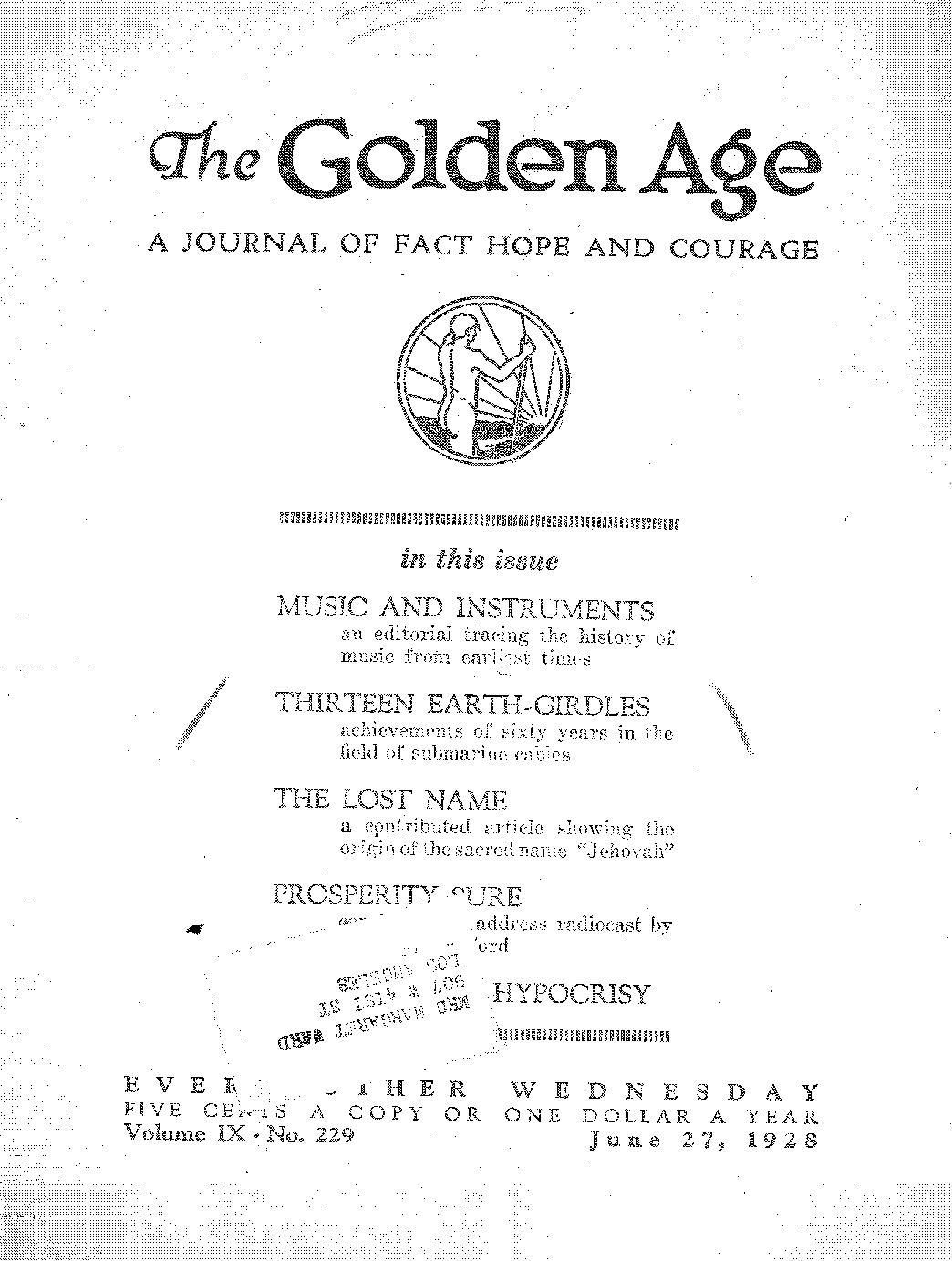
The Golden Age
A JOURNAL OF FACT HOPE AND COURAGE
in this issue
MUSIC AND INSTRUMENTS an editorial tracing the history of music from eail , l tiirns
/ THIRTEEN EARTH-GIRDLES
A achievements of sixty years in the Y
* field of submarine cables *
THE LOST NAME
a contributed article showing the origin of the sacred name " Jehovah”
PROSPERITY ^URE '
' address radiocast by
. - ~ ’ord
HYPOCRISY
(Jgiw ' WIJHItlllllHIIIIIIIIHIIIIII
EVER y i H E R WEDNESDAY FIVE CEmS A COPY OR ONE DOLLAR A YEAR
Volume IX - No. 229 June 27, 1928
Contents of the Golden Age
Wtarr-===========.==.:^
Labor and Economics
Pennsylvania’s Company CoaPTowns . .
What Some Old Men Do .
Two Million New Workers Annually ........... 619
Living from Hand to Mouth
What Machinery Accomplishes ...... .
Dupont War Profits .....
Social and Educational
Brooklyn Police to the Rescue ............. 620
Trinidad Versus New York
Milwaukee’s Part-Time Schools ............. 62“
“Good Luck’’ Letters
Tribune Evolutionists Tniimi>nm........... .
Finance—Com m erce—Tim n sfo station
The Advantages of Competition
Five and Ten-Cent Stores
Phone Service to Western Europe
Thirteen Girdles Around the .Earth ........... 624
Political—Domestic and Foreign
America a Pagan Nation ...
Too Much Sinclair Oil
Europe’s Two Monsters ................ 621
Candid Concession of an Insider ............. 623
Home and Health Eat White Bread .....
Travel and Miscellany Music and Musical Instruments
Not in the School Books
A New Window Suggested
Religion and Philosophy Thu Lost Name ................. .
Bi bus Questions and Answers .
Prosperity Sure (Part 4) . . .....
The Downfall or Hypocrisy ...
The Children’s Own Radio Story ....
Published every other Wednesday at 117 Adams Street, Brooklyn, N. T.» L*. S. A., by WOODWORTH, KNORR & MARTIN
Copartners and Proprietors Address; in Adams Street, Brooklyn, N. Y., V. 8. -4. CLAYTON J. WOODWORTH .. Editor ROBERT J. MARTIN .. Business Manager . NATHAN H. KNOKR .. Secretary and Treasurer
Five Cents a Copy—?1.00 a Year Make Remittances to THE COBDEN A GN Notice to Subscribers: Wo do not, an a rule, Bond an acknowledgment of a renewal or a new subscription. A renewal blank (carrying notice of expiration) is sent with the journal one month before the subscription expires. Change of address, when requested, may be expected to appear on address label within one month.
Foreign Offices
British ....... 34 Craven Terrace, London, W. 2, England Canadian . .... 40 Irwin Avenue, Toronto 5, Ontario, Canada Australasian ..... 495 Collins Street, Melbourne, Australia South African ..... 6 Belie Street, Cape Town, South Africa
Entered as second-class matter at Brooklyn, N. V-. under the Act of March 3, 1879.
Golden Age
Volume IX Brooklyn, N. Y., Wednesday, June 27, 1928 Number 229
___'................... , , . *---.. .... ■ , - , . y, , „„ ,L .......... ,■».,■■■ .. ------------
Music and Musical Instruments
THE musical instruments of the Bible are of three kinds: stringed instruments, consisting of the harp, psaltery, viol, dulcimer and sackbut; wind instruments, consisting of the cornet, flute, horn, organ, pipe and trumpet; and instruments of percussion, as bells, cymbal and tabret, or timbrel. Jubal, great-great-greatgreat grandson of Cain, is given as the inventor of two of these, the harp and organ.
. Jacob’s father-in-law, Laban, was familiar - with the tabret (tambourine) and harp, while Job was familiar with these two and with the . organ, so that the essentials of an orchestra were then in more or less common use.
When the ark was first brought into Jerusalem the accompanying orchestra consisted of psalteries, harps and cymbals. The psaltery > resembled a guitar. Subsequently the regular temple orchestra is said to have consisted of two to six psalteries, two to twelve flutes, trumpets from two upward without limit, harps from nine upward, and cymbals, only one pair.
The root word in the Hebrew, used to denote the inspiration under which the prophets spoke, is the same as that under which the min. strels sang. It is supposed that the enthusiasm of the true prophets for the name of Jehovah and that of the false prophets for Baal is the reason for this use of the Hebrew root. Music w i thout enthusiasm would hardly be music at all.
The encyclopedia tells us that stringed in-■ struments played with bows were unknown at the beginning of the Christian era and that the ■ historical statement that Nero fiddled ’while .....- Rome burned must be put where many other .........■- historical statements belong, in the realm of myths.
. .^ Masterpieces of Music
HE Etude invited a number of musicians to express their opinions as to the world’s
greatest composers, ami found the favorites thirteen in number and in the' following order: Beethoven, Wagner, Bach, followed rather lamely by Mozart, Brahms, Schubert, Chopin, Schumann, Mendelssohn, Tchaikovsky, Debussy, Bizet and Franck.
The musical masterpieces themselves were voted as.seventeen in number: Die Meistersinger, Mass in B-Minor, Fifth Symphony, Tristan and Isolde, followed, after a big drop, by Don Giovanni, Brahm’s First Symphony, Mendelssohn’s Concerto for Violin, Chopin’s Sonata in B-FIat Minor, Schumann’s Piano Concerto, L’Apres-midi d’un Faun, Beethoven’s Sonata Opus III, Beethoven’s Seventh Symphony, St. Matthew Passion, Schubert’s Unfinished Symphony, Schubert’s Erlking and Parsifal.
Beethoven was and is a mystery to mankind. Music dominated his life, yet he was fussy, untidy, suspicious, and did not hesitate to abuse an innocent waiter by pouring a dish of hot stew over his head, meantime roaring with laughter until the tears ran down his face. He arose from his death-bed to shake his fist at the lightning and hail that disturbed his last moments on earth. One of his original manuscripts recent! j7 sold for $3,600.
Of all great musicians named above, Mendelssohn is believed to have had the most marvelous memory. He seldom needed a score, and before his death he played through from meifiqi ry the whole of Beethoven’s Ninth Symphony. It is told of him that on one occasion, when rehearsing without score a chorus from Bach's St. Matthew Passion, he called out at a cer-, tain point: “Please note that at the twenty-third bar the sopranos have C, and not C Sharp.”
Many of these composers enjoyed excellent health. Bach and Brahms were among those, the latter never sick in his life and able to sleep, at any time or place as long as he pleased;;. Wagner* stood on his head at sixty for the sheer fun of showing his friends how much he enjoyed life. Mozart and Schubert died young, anil in poverty, but their works will live for ever. < One of the works of the composer Rossini has an overture and a half because .Rossini hated to get out of bed. He had. partly completed an overture, writing in bed, when he dropped off to sleep. Awaking, he tried to recover his manuscript without leaving the bed. Finding that he could not reach it without too much effort lie started afresh.
611 .
What Music Is
MUSIC is the expression of tones produced by the mathematically regular vibrations of resonant bodies, in contradistinction to a confusion of irregular vibrations designated as noise. Middle C has 256 vibrations to the second, and is produced by sound waves something less than nine feet apart.
Waves at half that distance apart produce a tone one octave higher, half that again the next octave higher. The human ear is able to compass eleven octaves, but there are animals which can hoar notes higher and lower than is possible to any Iranian being.
The practical range of music is from 40 to 4,000 vibrations a second embracing seven octaves.. The highest note on the piano readies 4,224 vibrations, while the piccolo reaches 4,752 vibrations.
Thomas Edison complains that while there are something like 400.000,000 possible changes in tunes, yet he found in going over thousands of humorous songs that for the most part they were written to only nine tunes. He said that lie found by reversing some of the tunes the results were far more interesting and charming than the originals.
While music was and is largely an appeal to the emotions, yet it is also an appeal to the intellect; and it was the harmonization of these two factors that made Beethoven and Wagner the two greatest composers that have yet appeared upon the scene.
Gomposers have pictured every imaginable sound, the hoof-beats of horses, the fluttering of wings, the voices of animals, the rippling of w’aters, the patter of rain, the crashing of t.tiiundeiy and so on ad infinitum. Some of the recent compositions brave attempted to imitate riveting-machines, airpiana propellers, locomotive whistling and hissing, etc. Whether some of these late pieces are really music, or just noise, is a subject now being animatedly discussed.
The Human Voice
"DROBABLY the songs of the angels, when we get to hear them, if we ever do, are more beautiful than the songs of humans; but. so far as most of us have any direct knowledge, or are likely ever to have, the human voice is the most exquisite musical instrument ever made. Who that has heard the incomparable Russian Nightingale, Maria Kurenko, over the radio, can ever forget the inexpressible sweetness of that voice? But, by the end of the Millennial Age, most of the human family will no doubt be able to sing equally well. It is a gift .from God.
Not only is the human voice a gift from God, but there is reason to believe that He enjoys hearing mankind converse with one another. The Scriptures liken the murmur of multitudes in converse with one another to the babbling waters of the brook and declare that when they speak of God. and of their reverence for Him and their hopes in Him that He hearkens and hears and makes record in His book of remembrance.
A normal infant sings and is able to enjoy music before he can either walk or talk. The mother’s lullabies serve a real purpose in the child life. They gratify a natural desire and begin, the child’s musical training. It is astonishing what a musical mother can do for a child, both before and after the child’s birth.
Tone qualities are inherited. A tenor husband and. contralto wife will have tenor-and contralto children. A basso husband and soprano wife will have basso and soprano children. Marriages between bassos and contraltos, or between tenors and sopranos, result in baritone boys and mezzo-soprano girls.
Enrico Caruso’s wonderful voice, perhaps the most rich and powerful tener ever known, is not entirely lost to mankind, even if there were no phonograph records of it, because his little eight-year-old daughter is said to have fallen heir to it. She has already done a phonograph' record, though the record is not for sale.
A Few Celebrities
Madame Sch uma w-IIeimic, now sixty-seven years of age, always attracts great crowds of appreciative listeners whenever she elects
to sing. She is said to he a very lovable woman, who persisted in the training of her voice alter her teacher jn Vienna told her sue had no personality and would belter buy a sewing-machine and go to work.
Melba is sixty-three years of age and has already sung several farewells; but singers like Melba or S Vmr.a»:n-Heink can sing as many ... farewells as they like and the public will always come again when they have one more. Adelina Patti sang farewells for about twenty years.
Jean de Reszke, the man of.two voices, passed out of this life three years ago, at about the same time as Enrico Caruso, his greatest rival. De Reszke, after a brilliant career as a baritone, astonished mankind by an even more brilliant career as a tenor. De Reszke was two men in one.
The possession of two voices at cnee is a gift - which nature sometimes bestows. A London singer, Strathie Mackay, has the power to make one of his vocal chords vibrate at half the rate of the ether, or at a third, fourth or fifth of the rate; and, as a consequence, while singing the ordinary C in the treble clef he is able to sing the C in the bass also, two octaves lower. When discovered, Mackay was earning his living by cleaning windows.
Years ago the noted musical instructor Lou Wiley made a similar discovery at Bradford, Pa. He was stopping at a hotel when his trained ear heard one of the girls in the. kitchen sing four lines of a familiar piece, the first line in soprano, the next in alto, the next in tenor and the next in bass. She became one of the musical ' celebrities of her day.
Love of the Human Voice
LMOST anybody will pause for at least a moment to catch a little of the beauty’ of
a song from somebody who really knows how to sing. Last year at Tuebingen, Germany, a through express train was delayed four minutes because conductor, brakemen, porters and travelers stood in rapt attention while an Italian tenor sang an aria from “Tosca” in one Of the coaches. And it was after midnight, too. n-.w-’-'s of small means are often to be seen at the Metropolitan Opera House, New Yoiri. They have to stand in the rear of the top gallery, font they are there, in any went. One standee found himself in company with, a Russian piano teacher, a German butcher, an Italian laborer and a Cuban music student.
It is known that the radio is hurting the concert stage, if not killing it, though some managers claim to the contrary; yet today there are very few famous voices that are not heard over the radio. Millions of people have heard famous singers by radio who otherwise Avon Id never have heard them. Louise Homer and John McCormack, and Walter Damrosch, musical director, are often heard over the radio.
Sometimes a person gets a little too much music. A Harlem opera singer of note, one who had sung with Caruso and Melba, was haled into court by an irate neighbor because be had such a powerful voice that lie even shook the dishes in the cupboard below. The judge decided that he could sing between 8 a.m. 'and 10 p.m., and as loudly and powerfully as he liked, but must remain mute after that. i
One of the most popular love songs north of the Arctic Circle is “My Girl is Like a Fish”, the most beautiful thing the young man has ever seen, and the song is as popular with the girls as it is with the boys. Down in this part of the world, if a young man would tell his best girl that she is like a fish, it is doubtful whether he would make a hit with it.
Violin, Most Perfect Work of Mas
HE violin, or fiddle (either name is correct), is the most perfect work of man. In its perfected form it has been in existence about four hundred years. The tops are usually made of soft, straight-grained wood, as pine, spruce or balsam; while the hack, sides, neck and head are usually made of hard, highly-figured wood, as maple, sycamore or beech. The inner blocks and linings are usually of pine. All the wood is cut to the quarter, to enhance the tone.
While there are differences in size, outline, arching, sound-holes, peg-bokes, the swing of the scroll, the shape of the button, and the heights of the ribs and sides, yet little change in the violin seems possible or even desirable. The violins made today are no better than, if as good as, those made three hundred years ago.
Antonio Stradivari (1644-1737)-was the acknowledged king of voilin-makers. The instruments which he made are all catalogued. One-third of them are now in the United States. One purchased in 1923 by Zimhalist cost hhn $33,000. It is considered one of the four finest
in the' world. It is called the "Titian” because ' made of bright red wood. ' .
' Only less famous than Stradivari were other violin-makers of his day, Guarnerius del Gesu, NW Carlo Bergonzi and Amati. One of their secrets, the making of a solution of amber called Ore-mona 'Varnish, has been recently rediscovered ......after being lost for two hundred years. The .......popular belief that old violins are valuable -merely because they are old has no support.
It is claimed that the tone quality of a violin which has become sluggish may be improved by placing its sound-holes in close proximity to a radio loud speaker while good violin music is being reproduced. It not infrequently happens that valuable violins are ruined when they fall into the hands of repairmen who do not understand their business.
Seine Violin Celebrities
Fritz Kreisler, recognized as one of the greatest violinists of all time, is also a very fine man personally. It is said that the bulk of his earnings goes to care for the poor, the very poor, those unable to help themselves. Kreisler suffered much during the World War, and for no reason except that he is of German stock. He is one of the few great artists who never broadcast, because he believes the radio injurious to his profession. .
This last season New York, little old blase New York, went wild over a child violinist, the first time anything like that has happened in forty years. Yehudi Meiiuhim, ton years of age, played in Carnegie Hall to standing-room only, while the ablest musicians in New York wiped their eyes because he expressed so perfectly the emotions which charged their beings. The little fellow is quite unspoiled and has gone back to school at his home in San Francisco.
Now for a contrast! Imagine, if you can, a New York millionaire enroute from Europe to New York, who paid a noted violinist $500 to move to a distant part of the boat, because he so detested music and did not wish to hear him playing in a nearby cabin.
Probably that millionaire was a brother to the banker who had one glass eye of which he was very proud. He told an acquaintance that one of his eyes was glass, and asked him to guess which was his good one. Without hesitation the man replied, "The left one is your good one.” Asked how he knew, he said, “Because it has so much more sympathy in it.” It transpired that the left eye was the one made of glass.
Every autumn Atlanta, Ga., has a fiddlers’ contest. No one who can. read music by note is allowed to compete. The present holder of the title was on one occasion' let out of jail so that he could enter a contest of the. same kind, and he won the contest.
Paris is trying out a mechanical violin-player, the violinista, which is to the violin what the player-piano is to the piano. The notes are produced by perforated rolls, the same as on the player-piano. It is hard to believe that this invention can ever come to anything; yet it may. with us, though even the “forte” is little used in describing the instrument. The instrument in its present form is about two hundred years old.
■ Piano, Most Popular Instrument
"WTHEN old Nebuchadnezzar comes back and “ » hears Paderewski or Rubinstein or Franz
Liszt or Chopin or Mendelssohn sit down at a , Steinway concert grand piano and play one. of the Hungarian Rhapsodies or a Beethoven ‘ Concerto through to a finish and then goes and . looks at it, won’t he be surprised when he finds . what his old dulcimer o C 60G B. C. has come to be ?
. Originally the dulcimer, had only two hammers, one in each hand of the musician. What, he could do with those two hammers was all he
. could do. Now a Chicago musician with an eye _ to figures announces that in. the four minutes required to play Rubinstein’s “Staccato Etude” he exerted a force of 14,700 pounds on the keyboard. Some difference!
The harpsichord, superseded by the piano, was played with quills instead of hammers. The clavichord, also superseded by the piano, was much appreciated in its day because the tones could be made to quiver and thus give an echoing or trembling sound of exquisite sweetness and responsiveness. It was the favorite instrunient of Beethoven, Bach and all the early masters. ' ’ .
An attachment consisting principally of a fourth pedal can now be had which restores this clavichord quality of the piano. It enables performers to hold or swell or diminish musical tones after the piano keys have been struck. It is the invention of John Hays Hammond, Jr.
- Christofari, an Italian harpsichord builder, was the first to put hammers on his instrument.
■ He called his completed work “ccmhala colo : piano forte”, meaning “harpsichord with soft ; and loud”. The words “piano forte” still remain
Johann Sebastian Bach, one of the first pianotuners, is considered the father of modern music. Before his time musicians had only a limited number of keys in which to write their music, as they could not tune their instruments to other keys”; but he discovered the lost notes hidden in the strings and began to write music in keys hitherto unknown. Mozart, Chopin, Schumann, Liszt, and Rubinstein became his admirers and followers. It is admitted in Mu-rope that the best pianos and harps in the world are made in the United States.
A Few Piano Celebrities
WHEN Paderewski, generally considered the world’s greatest pianist, began his musical education at the Warsaw Conservatory of Music, his professors told him his .hands were not long enough to make., a good pianist and that he should give up the piano for a trombone. Since then the entire musical world has been glad to listen to him. Incidentally, he was the first president of his native land, Poland.
Paderewski was glad to give up political life and to get back to tIm piano. On one occasion he had surgical operations performed on the tips of all his fingers, to 'enable him to better reach the octave. His life has been one of hard work and well-deserved success.
Percy Grainger, another noted pianist, is accredited with, saying: “Anybody can become proficient at the piano. I’ll go further and say that anybody can become expert, even become a virtuoso, by ceaseless practice. The multitudes who never get anywhere are simply not sufficiently interested in their ambition.”
A new device for teaching- the piano consists of lights which appear above the keys on the student’s piano, aiding correct fingering and reading of notes. These lights are produced by electrical contacts from the instructors piano, who plays along with his pupil.
One of the most curious piano celebrities of all time was Blind Tom, who died four years ago. lie was a simpleton in everything except music, but had the remarkable power of remembering pertcetly and reproducing exactly any Jgge||p -his < presence.
Additionally, he could turn his back to-the piano, and with his hands behind him, play “The Fisher’s Hornpipe” -with one hand, “Yankee Doodle” with the other, and at the same time sing “Tramp, Tramp, Tramp, the Boys Ard Marching”,.in such a way that the three tunes-were melodiously intertwined. At ail his concerts Tom always led the applause.
In moth-infested climates piano users are recommended to always keep two small mothbags inside the piano. It may save much ex-pense in repairs.
Pipe Organs and Bagpipes
ORGANS of all kinds are in much less demand than they were a generation ago, and yet the music is peculiarly majestic, restful and desirable. Moreover, organ-playing is good exercise, is an aid to good complexion ami is an effective antidote for lassitude or ennui.
Pipe-organs are now played by electric motors so skilfully that listeners do not know the difference between machine operation and manual playing by an artist. As with playerpianos and other similar devices the music is obtained by the operation of perforated paper rolls crossing a slotted bar. With this mechanism a large pipe-organ can be operated anywhere without the aid of a musician. Indeed, radios and mechanical devices of all sorts axe rapidly putting an end to the hopes of thousands of musicians.
The pipe-organ in Roosevelt Park, Toi ranee, California, near Los Angeles, is so powerful that it was necessary to remove the console to a point a hundred feet away from the organ proper. When brought closer* the organist’s bench trembled so decidely that she was unable to obtain, the delicate effects required for fine music.
Some Scots maintain that the organ ployed by Jubal was a bagpipe without the bag; others* claim that the instrument originated in Chaldea and has been traced to Persia, Greece and Rome and thence to Scotland; while others, not Scots, are mean enough to claim that Some Highland cottager got the idea through stepping on a cat.
The bagpipe has nine tones, which have nothing to do with the chromatic scale and therefore nothing to do with music, yet there is no musical instrument in the world today which is as national and as much beloved by its users as the bagpipe. Bagpipe music can not be transposed from one key. to another, and as an instrument it is always out of tune. Newer makes have corrected these evils somewhat.
A bagpipe is similar to a church organ in principle. The player maintains the wind pressure on his drones and chanter by keeping the •hag full of wind and regulates the volume of sound by the pressure of his arm on the bag. There are still traveling pipers in Scotland who have all the pride engendered by living up to centuries of traditions.
The pipers of today, like those of a thousand years ago, are attired in plaid jackets, kilts and hose. Brooches hold the plaids at the shoulders. Jeweled dirks and powder-horns are at their sides. Jeweled eases containing knives and forks are in their garters. They still wear the tartans of their clans and sway slowly from side to side, as they play, just as the pipers have always done from time immemorial.
'Banjo, Flute, Kettle-Drum
■rpHE banjo, recognized for many years as •— America’s national musical instrument, but which for a time was nearly lost to sight, is now having a revival and in the bauds of a good performer is a very entertaining and rhythmical instrument.
A Cincinnati professor has made a collection of flutes and a study of them. There are 711 specimens in his collection, -among them flutes made of gold, jade, a rain’s horn and glass. 'When special effects are desired, the Boston Symphony Orchestra sends to Cincinnati to borrow the golden flute, finding no other instrument quite as sweet in tone quality. All these instruments have had their musical values determined by motion-pictures of the waves which they produce.
The tones of the kettle-drum, indicated by the usual notes written in the bass clef, are of the lowest register that the human ear can perceive, and as the tuning is wholly dependent upon the ear, the process is more difficult than is that of tuning any other orchestral instrument. The tympanist, as the performer on' a kettle-drum is called, must be a real musician. He is sometimes called ffihe conductor from the rear”.
Oboe, Saxophone, Trombone
T A. contest in London, Captain Samerzquig recently performed the unique stunt of holding a note on the oboe for two and one-half minutes without a break. Of course this has no musical significance, but is purely of interest as showing how long a single breath can be expended without any fresh intake."
The saxophone was invented in 1846 by a young man named Sax, a resident of Belgium and later of Paris. Though an excellent flute and clarinet player and a splendid workman, he was a poor business man and died penniless and forgotten. It was not until after his death that the saxophone gained its greatest favor. The saxophone is made in nine different sizes and styles, covering a wider range than any other family of instruments. It is easier to play than any other instrument, and is used principally for jazz bands or ragtime music.
The trombone was well known to the ancient Romans, and it is believed it may have been used by the Greeks also. The ancient bands of Venice consisted of trombones only. There were ten in the state band of Henry VIII, and six in the state bands of Queen Mary and Queen Elizabeth.
Recent Musical Inventions
IMPROVED tone and increased carrying power are claimed for a fife with a square instead of a round body. Advantages are claimed for an all-metal guitar, also for an all-metal clarinet. The latter comes from France.
A Philadelphia woman after twenty-seven years of experimentation, lias been granted basic patents for blending light with music. While music is being rendered by the singer or violinist the performer is flooded with lights of various colors and intensities, suited to the musical theme.
A Canadian, Morse Bobb, has invented an electrical -wave organ, an instrument in which the sound is produced electrically instead of by the blowing of air through pipes. It occupies little space and can be moved about with ease. It is claimed that this electrical organ can duplicate all the work of a cumbrous pipe-organ.
Much attention lias been given in the past year to the invention of Prof. Leo Theremin, of the Physicotechnical Institute of Leningrad, which produces ether-wave music by simply waving the hands before a modified radio transmitter. It, produces strange new sounds of a resonance and beauty that no musical instrument has yet been able to achieve. f - ff
A F?.w Orchestral Items ..
THE Illinois School for the Deaf has an orchestra composed of twenty-one pieces which are plawl by p-.-rsons who are deaf-miires, who have never heard a sound in their lives. If is clainn-l that 1: c hand m ar cx-Wrint - - one. Its players keep in touch with one another through their finely developed sense of vibration.
The first definite attempt to organize orchestras was about the end of the sixteenth century, coincident with the development of the opera. John Philip Sousa, who stood before a concert band for thirty years, declares that no band or orchestra is ever in perfect tune. Boston claims to have the finest orchestra and the worst regimental band in the United States.
A Minneapolis man who should have been putting his time to better use has assembled twenty-two pieces of string, wind and percus-— sion instruments, operated simultaneously or in succession with his own hands, feet, knees and mouth and by means of electrically connected motors. The result is said to considerably resemble a brass band.
’The “Hebrew Opera Company is giving low-priced operas in Palestine.
0 The Berlin Philharmonic Society is doing the same thing for music lovers in Berlin; and tile Art League of Service is doing something of the same work in the United States, and finding appreciative listeners.
Now for a musical laugh or two. A Polish orchestra has just gained the world’s record by a sustained performance of 33 hours and 10 minutes. No doubt most of the listeners were found dead when the race was over, because the whole time was spent on jazz.
In England, while Caesar Franck was carrying his symphony up to a climax he stopped suddenly, and, in the interval before it resumed, , a woman’s voice inquired tensely, “Tell me, my dear, where do you buy your stockings?” A phonograph record was being made at the time, and the stocking inquiry is on every record. The record is known as the “Stocking Symphony”.
•• Even greater possibilities were in store when at Carnegie Is all Sir Thomas Beecham’s suspenders broke away from his trousers when, he was in the most exciting part of directing a
P great orchestra. He bravely decided to finish his job and came off victorious, with no worse
consequences than one trouser leg sagging badly over his shoe. < : f ■ z
An item that is not so funny is the fact that 40,000 musical students go to New Aorfepwry year, hoping to get a start toward waking their ’fortunes but just now finding the musical field badly overloaded. Radio has done the musicians, as a body, a vast amount of haimu-nvv
In .France there are twelve hundred blind musicians who earn their living at musical work. Eight organists of large Paris churches arc-blind. TIiere are several blind composers and orchestra conductors in France. ’’
Odd Things Done with Music ’ •<
■JMTUSIC has recognized curative value in the XvJL treatment of the sick, the criminals, and the insane. It awakens the mind from apathy, inhibitions and obsessions. When the French Minister of Justice read some of the letters of the bad boys and girls who had just been favored with, some fine music, he wept and revoked an order which had been in effect for centuries prohibiting the entertainment of prisoners.
In Russia the bezprizorni (child ruffians) were largely subdued through the formation of a bezprizorni orchestra. At a concert their work was received 'with enthusiastic praise by critics. Esthonia is known to have preserved its independence, after seven hundred years of bondage, by keeping alive its ancient folksongs.
Cows give much more milk if music is played at the time of milking. A phonograph running in the milking room is all that is necessary. Sad to say, jazz is said to produce the best results. liens are said to be partial to bagpipe music, and will lay more if given a bagpipe concert.
Delicate music, such as violin or piano, aids the growth of the hair; while loud, obtrusive music, such as that of the saxophone, tuba or bass viol promotes baldness. FlowersI Warn away from musical vibrations. Xylophones .are used to test the carbon brushes*of cU-irk motors, The metronome is now used successfully in teaching shorthand and typewriting.
Experience has shown that v,-;g brings an increased demand for harmonicas.*”The” World War doubled the demand for them, and it still persists. The reason for this is not known. The old idea that performers on wind instruments are especially subject to tuberculosis is found to have no foundation in fact.
America exports more musical instruments than all the rest of the world together. Playerpianos of American manufacture are, literally, to be found in every corner of the world. The Baltimore and Ohio Railroad Company is out with a song entitled, “Hail, the B & O.”
A Few Words About Jazz
JAZZ is not. music, but is syncopation imported from Africa and used there for the same purpose for which it is used here, namely, to arouse passion. In America it was introduced by Chas. Washington, an African drummer in Vicksburg. “Chaz,” as he was commonly caHed. could not read music, but had the natural gift, of syncopation, brought from Africa and handed down by his forebears. It is the Devil’s own music.
Because of the eatchiness of “Chaz’s” drumming lie was called on to do his best on repeats. At the end of the chorus the leader would say, “Now, Chaz!” From this beginning came the wide- spread use of Chaz, more commonly spelled jazz. It had its origin in ragtime some quarter of a century ago.
Jazz has literally turned Handel’s Messiah into “Yes, We Have No Bananas”. Chopin was drawn upon for “My Alice Blue Gown” and “I’m Always Chasing Rainbows”. Strauss’s “The Beautiful Blue Danube” was the reservoir from which was drawn “Iola”. “The Volga Boat Song” was turned by the jazzers into “Russian Rose”, while “Lohengrin” was murdered to produce the buffoonery of “Where Did _ You Get That Hat?” All this is the murder of’ real music.
Sir Henry Coward, famous English musician, says:
“Jazz is a low type of primitive music, found-ed on crude rhythms suggested by stamping, feet and clapping hands. It puts emphasis on the grotesque by the banging and clanging of pots and pans or any shimmering metallic substance reinforced with special drums. It debases both music and instruments by making both farcical. The noble trombone is made to bray like an ass, guffaw like a village idiot and moan like a cow in distress. The silver-toned trumpet, associated, in poetry with seraphim, is made to screech and produce sounds like drawing a nail in a slate, tearing calico, or the wailing of a nocturnal tomcat. Jazz can not be made anything but the essence of vulgarity. The popularization of jazz and the attendants immodest dances is lowering the prestige of the white races.”
In many places the churches have gone in for jazz. But why not? They have gone in for every fool thing ever proposed, and if they refused to adopt jazz it would be a miracle.
When an orchestra was sent to a zoo iuj Philadelphia to record the reactions of the ani-1 mals to jazz it is recorded that Poetre, a twelve-1 year-old Asiatic elephant, was so disgusted that I he blew a trunkful of water all over his tor-1 mentors. Good for Poetre. He had more sensei than the dominies that are now putting on jazz] as part of their regular weekly shows. I
The Advantages
THERE is a real advantage in competition.
As a case in point take the Hell Gate bridge, which connects the Pennsylvania Railroad system. with the New Haven system. New Yorkers and Pittsburghers can use that route and not-pay a cent of extra fare, but everybody else must pay ninety cents extra for their railway ticket and seventy-five cents extra for each piece of baggage.
Moreover, if a through passenger knows he is going by that route and is shrewd enough to provide himself in advance with a ticket from New York to a New England point which -is of Competition
good via the Hell Gate route, such a ticket wil not be accepted without the payment of the additional ninety cents, unless he comes from .Pittsburgh, which is a common point of th^ Pennsylvania and New York Central systems.
Tn other words the Pennsylvania company ia making the people of the South and West paj dearlyfor the Hell Gate connection, butbecaus^ there is competition from New York and Pitts! burgh the New Yorkers and Pittsburghers gel off scot free.. That ought to show that eompetil tion is a good thing. I
Here and There About the World
............................iiiiil arc coal towns in Pennsylvania where no one may give a night’s lodging to a person objectionable to the coal company, towns where a traveling salesman can not enter without a written permit, and towns wnere no one may enter except physicians, undertakers, mnd draymen to move the tenants' goods.
■OME old men who are tire owners of businesses, and there are many such, quite forget that there are any other old men. in the world but themselves and have issued rules preventing the employment of any man over forty years of age, despite the fact that the older men, on account of their greater experience may be, and often are, more valuable than those younger. 'The theory is that younger men are more willing to sacrifice themselves to the speed demon.
faclories in New York city disclosed that ■only three of the factories were reported as “vely/ptah’’,- whiM.fwe^
half the number, were reported as ■’unnecessarily dirty”. In h.m of the factories tl^re had never been any medical examination of any of ■the-applicants for ■ employihent.'
lydingeihwn
■TM A GIN ri a situai ;oii v -mro wmmmg miners are so hard put to it that their wives have to wait at the pitlwad until a load of coal is brought up before they east get credit at the store for groceries for the family. And imagine the still worse conditions when the man himself is-brought up dead. Yet such conditions, we are told, exist in the American bituminous mining industry.
Too Much Sinclair Oil
IFor&rrs: Annually
■NE thing we can not get away from in the
United States, and do not wish to get away from, is the fact that every year there are two .inihion more boys and girls admitted into the ranks of the nation’s workers. Alongside this interesting fact it is noted that in the four years from 1923 to 1.927 there was need of nearly two million fewer workers in. the manufacturing industries, railways, coal mines, farming and building trades. Machinery is catching’ up, and one wonders what will become of the new boys and girls when it fully catches up.
America a Pagan Nation
TJishop McCoxxell, of the Methodist Epis-
copal Church in the United States, in an address in Jerusalem in March, declared: “I come from a nation which is in some’respects pagan. We subscribe to the doctrine of militarism and to the god of materialism, and we have given ourselves over to the pursuit of wealth.” Another speaker at the same missionary conference called attention to the fact that ninety-four percent of an African contingent of forced laborers working for a certain unnamed European. Christian nation had died, or, to put it bluntly, had been murdered by ill-treatment and overwork.
TH.E trouble with (be Sinrinlr oil is that there
is too much of it. It is running down over presidents, attorneys-gcneral, posiawsters-gen-eral, Presbyterian eiders, chairmen of national committees, secretaries of war. of the navy, of the interior and of the treasury untd it gets into everybody's eyes, tars, hair and teeth, and meantime everybody is wondering why the strong silent man is so sil-mt, but they are not • wondiling : why the ■ • Moes Mbt chMsiitog■ruOilll They understand that perfectly well, No wonder he wants to quit. Ue ‘has beard and seen enough oil to last for a lifetime.
SfiS«SSWSW
TOiWc^S. Sa&e : > ■ ||| :'
GP. Ceaiik, Wadena, Iowa, while walking
• with his two dogs, suffered a stroke and fell helpless between the rails. Thereupon one of the dogs, “Trove,” stood guard over his body while the other started down (he track toward an oncoming train and by his furious barking and charging of the engine attracted the notice of the fireman, who caused the engineer to stop the train in time to save Mr. Clark’s life. “Freckles,” the one that slopped the. train, was found mounted upon the pilot of the engine, fighting the locomotive for ail he was worth.
familiar with the movements of trains.
Five and Ten-Cent Stores
THE Woolworth, Kresge and Kress companies now operate among them 2,109 stores.
The average profit per store is about $2,000 a month. The Woolworth Company, with 1,491 stores, has only thirty-six buyers, which is less than one percent of what would be needed if the stores were run separately.
New York Now Overbuilt
THE claim is made that New York city, which a few years ago did. not have homes enough to care for its population, is now overbuilt to the extent of 57,000 apartments. This is not a large number for a city of the size of New York. A few too many apartments tends to make rentals more reasonable.
Hinkler’s Wonderful Flight
Bert Hinkler flew from England to Australia, 11,000 miles, in the month of February, completing the journey in sixteen days, thus practically cutting former records in half. His first day took him to Rome. In seven and one-half days he was in India; and in twelve and one-half days, in Singapore. On two occasions he made non-stop flights of 1,200 miles.
Brooklyn Police to the Rescue
WHEN Brooklyn police learned that a girl of twenty-one, a shirt factory operative, the sole support of father, mother and eight small brothers and sisters, had been cut down to half time, they loaded the family up with groceries, paid a month’s rent in advance, put in some coal, got the girl's employer to put her on full time, and at last accounts were trying to find a job for her father. Hurrah for the Brooklyn police!
Trinidad Versus New York
IN TRINIDAD, a short time ago, a negro pushed a squeaking wheelbarrow from the bank to the docks with boxes plainly marked “Gold”, and no guard. He made six trips through the crowd, none of whom interfered in any way. When the gold arrived in New York it was met by a half-dozen heavily armed detectives and policemen appointed to guard it. And the strange part of it is that New York is considered highly civilized and Trinidad is thought less so.
What Machinery Accomplishes
TpXPERTS who have figured on it declare that the machines operated in the United States produce more goods than could be manufactured by the hand-labor of the entire world.
Germany Forging Ahead
GERMANY is forging ahead wonderfully.
Six hundred thousand young men who used to enter the army every year are now being absorbed in agriculture and industry, and the whole country is humming like a. beehive.
Creation Still Going On
rpiIE discoverer of the Millikan rays, Dr.
Robert A. Millikan, of the California Institute of Technology, has put forward evidence which seems very conclusive that the process of creation is still going on in the heavens and, to use his own language, “that the cosmic rays which have been studied for the past few years constitute the announcements broadcast through the heavens of the birth of the ordinary ele- . ments out of positive and negative electrons.”
Phone Service to Western Europe ..........
rpELEPHONE service is now maintained reg-J- ularly between the eastern, part of the United States and the western part of Europe. Any one who desires and who has the price' may now talk with London, Paris, Brussells, Amsterdam, Berlin or Christiania. It is very plain to be seen how easily the Lord’s new government when fully established will fulfil the prediction, “He shall rebuke many nations afar off.” The thing will be done so simply and naturally that many men will, be slow in realizing that it is God, not man, that is back of these modern inventions.
Doctor Cadman Contradicts Moses
MOSES said to the Jews, “Choose life that ye’.may live,” and went on to speak of Christ, saying, “It shall come to pass that whosoever shall not hear that Prophet shall be destroyed from among the peopled But now comes Doctor Cadman, sure, in spite of Moges, that every man will have immortality by hook or crook somehow, and says that men can no more choose to continue their existence than they can choose to begin it. It all sounefe very fine, but it is neither Scripture nor sense, and it isn’t true. ,
Slumps in British Unions :<
• TN BRITISH trades unions the membership has declined since 1920 from more than eight and a quarter’ millions to less than five and a quarter millions. About 300,000 British workers left the. labor unions last year.
’France’s New Pension Scheme
FTER seven years’ discussion France has adopted a scheme of death, disability and
old age benefits which will employ ten percent of-- wages and salaries, with-a like sum from employers, totaling $200,000,000 annually, and will affect one-half of the populatioji of the country.
World’s Production of Aluminum
HE world’s production of aluminum in 1927 was 225,000 tons, of which the United
States produced 80,000 tons and Canada 30,000 "• tons. The net income of the principal American aluminum company is over $12,000,000 annually. France, Germany, Norway and Switzerland are large producers.
Europe's Two Monsters
uglielmo Ferbebo, historian, lias recently made the following interesting and truth
ful statement: “Europe seems to be menaced today by two monsters that are ready to devour her—nationalism and bolshevism. The intermediate forces between these two extreme doctrines were, however, already weakening before the war. The war has only accelerated the pace of evil.”
Italy’s Broken Promises
IN 1919 and 1920 Italy solemnly promised the 200.000 Germans of the South Tyrol that their languages and cultural institutions -would be respected and that their administrative employes would enjoy all the rights of Italy’s liberal.....democratic system. Today the German
language is proscribed, German school-masters and ministers and priests have been removed and Italians put .in their places, and Italian peasants are being brought in to break the hold which the German peasants have had upon the land for many centuries. All German newspapers have been stopped. The singing of German songs is forbidden, and German inscriptions on tombstones must be Italianized.
Machinery and the Making of Pig Iron ; GENERATION ago* great quantities of la-* bor "were* used in the inanut'«clur«* of pig iron. Seven men now:*do asunuch :as~:sixty men did a few years ago. In the unloading of pig* iron twro men now do the work which was once done by 128 workers. -
London’s High Electric Rates
VERYBODY in the United States wlio is acquainted with the facts knows that electric rates are much higher here than they should be; but they are much worse in London, where the average rates arc about’ double what they are in any other, of the world’s greatest cities, except Berlin, which is about the same.
Old-Aged Malarial Germs •
BRITISH scientist, Sir William Simpson, sealed malaria germs in a test-tube in November, 1901, and after twenty-six years inoculated a guinea-pig with them. The pig took the malaria and died, much to. the surprise of Sir William who had no knowledge that germs could live longer than fifteen years.
,sThe Big Five” and the League
EWSPAPER correspondents- at Geneva declare that everything of importance has
been taken out of the hands of the League of Nations. “The Big Five,” Britain, France, Germany, Italy and Japan, get together in a hotel room and decide what they will do; and then, to save the face of the League, they call a, public meeting of the council and repeat their private performance. ■
Britain’s Assistant UnderSecretary of State
Dismissed
I). Gbegory, Assistant Under-Secretary of
• State, of the British Foreign Office, formerly Secretary of the British Mission at the Vatican, has been dismissed from his post. At the time of the publication of the alleged Zinoviev letter, which caused the downfall of the British Labor Government, Mr. Gregory was suspended by Prime Minister MacDonald, because he was. believed guilty of misconduct in the matter. He refused to attend the inquiry which MacDonald instituted-. Gregory and a companion clerk namc-.i O’AIalley were Found guilty of speculating in French francs at a time when the British Government was trying to persuade France that no such speculations had the approval or knowledge of the British Government. Persons who can read between the lines ought not now to have much difficulty in locating the origin of the Zinoviev letter. Gregory and O’Malley are both Catholics.
Synthetic Fertilizer Next
THE Llano Colonist is authority for the statement that four tons of fertilizer can now be produced from one ton of straw, with the addition of suitable moisture, limestone, ammonium sulphate and acid phosphate. Straw of the fall before is ready for use as a fertilizer the next spring.
Dupont War Profits -
TXURING- the World War the Dupont Powder ■i-' Trust made so much money that it does not now know what to do with it It is said to be now the largest single stock-holding interest in the country. It' recently sold out its $14,000,000 of Steel Trust shares at a profit of about $2,600,000, all made in nine month’s tiin<j,
The War in Nicaragua '
UP TO February 1, 21 American boys had been killed in the war in Nicaragua, 45 had been wounded and 1,410 had been invalided home to the United States. How many Nicaraguans have been killed is not known. General Sandino, several times reported killed, insists that he is not dead.
Averages 78% Miles an Hour
IN THIS 9,390-mile flight from Washington to St. Louis, Mexico City, Panama, Bogota, Caracas, San Juan, Port au Prince and Havana, Colonel Lindbergh averaged 78$ miles an hour, because the actual flying time for the trip was 120 hours. This is considered slow for airplane travel.
Horrible Famine in Shantung
TN SEVENTY of the 107 counties in Shantung province half of the population of 24,000,000 people are now7 down to living on. one bowl of gruel a day. Excessive taxes, civil wars and failure of crops have discouraged the people, and two million of them, are migrating to Manchuria. In eomdless? villages the people are living on only bark and boiled grass.
Conditions in Mexico
MEXICO’S differences with the United States 1 over oil rights have all been satisfactorily settled by the voluntary action of the Mexican government. General Obregon, sole candidate for presidency of the Mexican republic, is out with a manifesto urging the Mexican people to abandon gambling and alcohol. ~
China’s Effective Boycott
A TRAVELER returned from China reports that in Hong Kong the Chinese boycott against westerners was so complete that although stopping at an $8.50 a day hotel he had to carry his own baggage and take care of his own room because the hitherto ultra-polite Chinese would do nothing for him.
Industrial Courts of Inquiry
A NOVELTY in England which is bringing excellent results is the industrial court of , inquiry, composed of fellow workers, who, in ease of any accident, hold an inquiry immediately upon the spot, to determine the cause of the accident, the blame and the remedy. It is found that a great reduction in accidents results. The men serve in alphabetical rotation.
Python Hunters of Borneo
K WRITER in a Singapore, Straits Settlements, paper reports having just returned from a trip to the interior of Borneo, where .his hosts made a habit of obtaining their meat supply by killing ten-foot pythons. One lithe athlete tackled the python in its home tree while a half-dozen waited below to dispatch it when it would fall to the ground.
Diphtheria Murders at Bundaberg
BUNDABERG, Australia, mourns the loss of twelve beautiful children sacrificed to the superstition that the filthy pus drawn from the veins of a sick horse and injected into the blood of the little ones will prevent diphtheria. In Dallas, Texas, in 1.919, ten little ones were thus killed; and after a similar tragedy at ■ Baden, near Vienna, in which six babies were slain, in September, 1924, the Austrian government put a stop to such injections. In sixty5i;s cases in the United States, parents have been awarded substantial damages for injuries thus done to their children. Infantile paralysis andj epileptic fits have followed such injections.
'Tanks Unromantic and Terrifying
fl 1'1 Ameer of Afghanistan saw British tanks level a brick house, go right through the walls of. a fort and go down the vertical walls of a ravine and up on the- other side and his well-expressed conclusion was, “How unromantic and terrifying Western warfare is.” The joke of it is that the Ameer is only a poor heathen visiting a Christian nation to find out how to live.
Milwaukee’s Part-Time Schools
IN MILWAUKEE there are thirteen thousand students employed in various industries who. are obliged by law to spend a certain number of hours in school every week. Part-time school la.ws are also in effect in New Pork and California. A prominent educator recently said of these schools that they constitute the best device ever offered in this or any other country for the improvement of the masses of the people.
Sweden Raising Food Electrically
WEDENis making a success of raising food electrically. Electric current Is chc-ap, and after two years of experimentation it has been found that all sorts of vegetables can be produced ten months in the year by running the current through the soil in glass-covered beds,’ Some of these electrical gardens are above the Arctic Circle. ■
‘If an Ox Fall into the Pit’
THE Lord said that if an ox should fall into the pit on the Sabbath day’ the owner would help it out as a matter of course: but it seems that nothing like that is allowed at Ocean Grove. A man who came there with, 'his sick and helpless wife was denied permission to enter with his automobile on a Sunday, and was obliged to carry his wife in his arms from point to point so that the Christianity of the pious Ocean Grovers might not be disturbed.
Candid Confession of an Insider
THE following letter from, a member of the
United States House of Representatives may be helpful to those who are expecting Christ’s kingdom to come about by legislation at Washington. It is addressed to one of our subscribers who had interested himself in a certain proposed reform:
Your letter has been received and with my endorsement. has been laid before the Committee. Do not get the idea it will effect any useful purpose. The Committee has already forgotten it and will, never recall it.
Why? This is a political government. Things are done or not done because the course taken is believed to be wise politically. The merits of a question are purely secondary, not to be considered until the political significance is carefully considered and the probable consequence forecast. If it is best for the party in power to do a given thing, it will be done; otherwise, not.
Nothing is going to be done by this session except pass the appropriation bills. There will be no tax reduction, no Muscle Shoals legislation, no farm relief, very probably no Mississippi flood relief, no reduction of freight rates, no reduction of power rates. Nothing will be done looking to the breaking of the strangle-hold that Invisible Government has upon Visible Government.
The Governor has appointed me Circuit Judge. I am soon resigning from Congress to go back home for keeps.
Not in the School Books (Selected)
UNTIL 1637 scalping was unknown in New
England. The Puritans began by offering cash for the heads of their enemies. Later they accepted scalps if both ears were attached. Bounties differed over a period of one hundred fifty years, and in different parts of the country. The French were first to offer bounties for the scalps of white people. The English quickly followed suit. At the time of this story the English were offering as high as $500 for a warrior’s scalp, and from $150 to $50 for those
of women and children. French prices were somewhat lower than the English. Over a long period of years human hair was a larger item of traffic than fur and in one lot the Senecas delivered and received payment for one thousand fifty scalps taken from the heads of v h ’•« men, women and children along the frontiers, Christian races, not savage ones, were the inspiration behind these horrible deeds, in that bloody dawn of our history when the United States was about to be born. ;
Thirteen Girdles Around the Eartli
Cable Construction and Laying <-11^
TJTTA percha is the sine qua non of cable construction. If it had never been discovered it is doubtful if there would be any submarine cables in the world today. It is apparently the only insulator sufficiently perfect to enable a wire to be carried through thou- -sands of miles of ocean depth and to bear upon its surface the news and business of the world.
In the latest cables there is now a thin wrapping of permalloy between the copper cables and the gutta percha exterior. This permalloy,......•
composed of eighty percent pure nickel and twenty percent pure iron, is the most easily magnetized and demagnetized of all metals, making it peculiarly valuable for submarine work, where large magnetic effects are desired from small currents.
There are three sizes of cable: 'deep sea,’ which is one inch in diameter and is laid where there is practically no movement on the bottom; 'intermediate,’ which Sis one and three-fourths inches in diameter and is used where there are greater strains; and 'shore end’, which is two and three-fourths inches in diameter ami is used close to shore, where the strains are greatest of all.
In laying cable an effort is- made to avoid subterranean mountain peaks, precipices ami gorges. Theoretically the cable should always lie in a bed of level mud. Just such a bed, four hundred miles wide, stretches from Europe to America in the North Atlantic. It is known as ‘Telegraph Plateau’, and was seemingly placed where it was .placed by the Creator for the very purpose for which it is used.
Three Great Inventions
HREE great inventions may be said to have made the cable a practical thing for everyday use. The first was the siphon recorder, invented by Lord Kelvin in 1870, an extremely delicate device by which a tiny siphon, with one end in the ink bottle and the other suspended over the paper, splutters tiny droplets of ink .....■
on the moving paper as the feeble signals come i in from the other side of the world. This -:~ magnetically operated instrument is the most : important part of modern cable apparatus. o The second great invention doubled the spqgd........
of all cables. This invention by Dr.. Alexander I
C24
TjWRGET,. for a moment, that you are living Jr in the wireless age, and think of the splendid achievements of the past sixty years in the field of submarine cables, during which time the earth has been girdled with a mileage of cables which would reach around it more than thirteen times.
In 1852 Dover and Ostend were connected by a cable seventy-five miles long, and two years later Sweden and Denmark were connected, as were also Italy and Corsica, and Corsica and Sardinia. The first transatlantic cable was laid in 1858, but. the current was so feeble that a message of ninety words took sixty-seven minutes to transmit. The cable weighed a ton to the mile. ■
The first practical transatlantic cable, laid in 1886, was lighter and stronger than the foregoing; but although if is now 'dead’, it served a great purpose in its day. The first tariff rates were $100 for twenty words, with $5 for each additional word. In 1872 the rates dropped to $1 a word and now range from 121c to $1.33, depending on destination and service desired.
…