Golden Age, October 19, 1927
Download: PDF — Golden Age, October 19, 1927
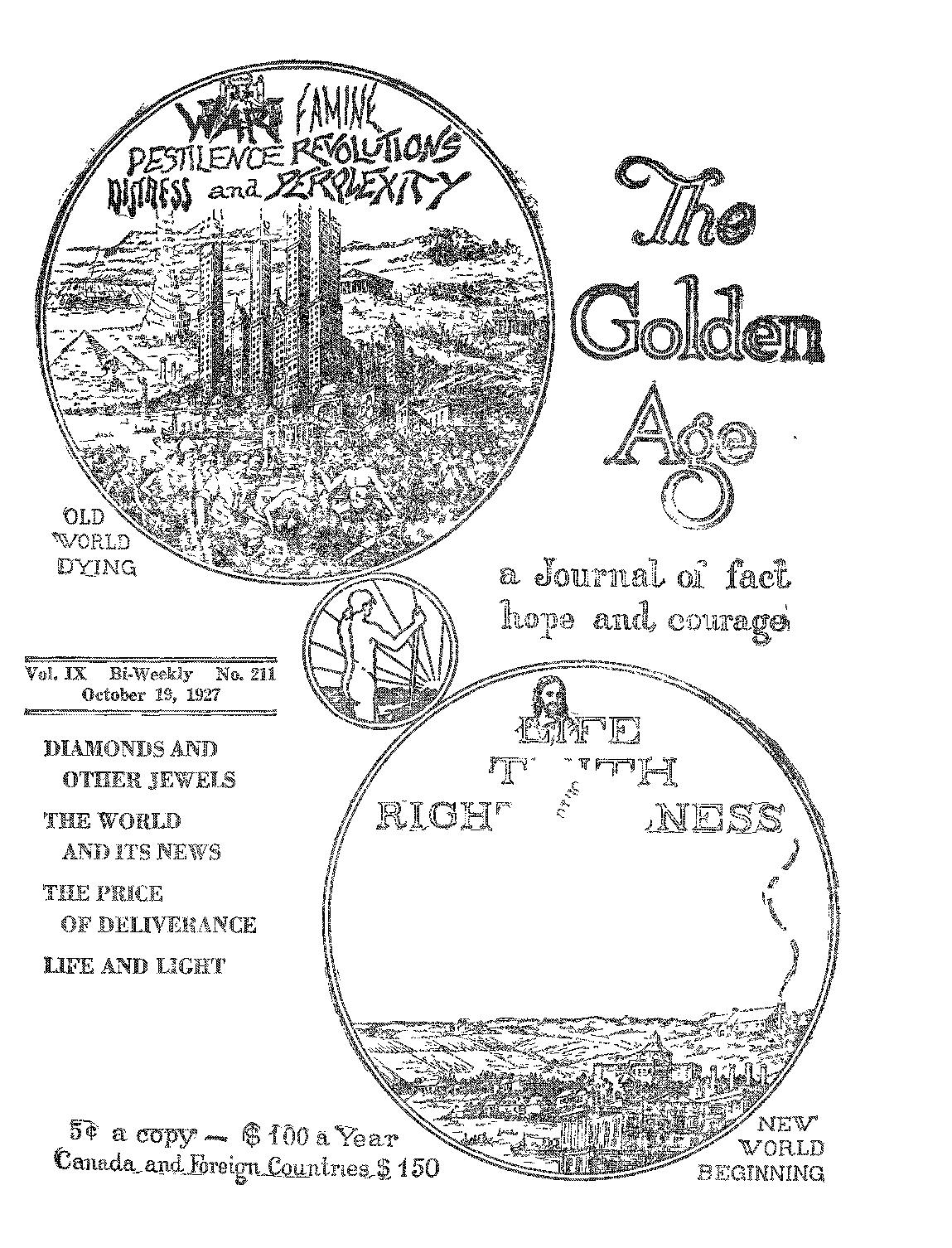
LIFE AND LIGHT
DIAMONDSAND
OTHER JEWELS
THE WORLD
AND ITS NEWS
THE PRICE
OF DELIVERANCE
Vol. IX Bi-Weekly No. 211
October 19, 1927
OLD
WORLD
DYING ^5
a copy — $ TOO a Year t)aiiada,and^Breign^Qujitrie^^ 150
NEV
WORLD BEGINNING
Contents of the Golden Age
Social and Educational
Stas World and Its News ................ 42
A Help to Humanity ................. 42
World Getting Much Smaller .............. 42
Georgia Flogs Women ................. 42
Finance—Commerce—Tkanspobtation
Freight Delivery at Night ............... 48
flow to Send Money .................. 61
Political—Domestic and Foreign
What the World War Cost ............... 44
Wall Street’s War in Nicaragua ............. 44
Whipping-Post Plagues Alabama ............ .45
The End of Sacco and Vanzetti ............. 48
Every Postmaster a Censor ............... 48
Lloyd George and Clemenceau on War ........... 49
Agriculture and Husbandry
Small Profits of Farmers ................ 43
Science and Invention
New Heat-Besisting Steel ................ 43
Germany’s Synthetic Gasoline .............. 45
The Effects of Arsenical Smoke ............. 47
Travel and Miscellany
Diamonds and Other Jewels ................ 33
Two Battles with Whales ................ 43
Flood Sufferers in Hard Luck .............. 47
Religion and Philosophy
In Churchless Mexico .................43
Jews’ Time of Wailing Is Past ...... ........ 48
Tub Pbics: ot Delivkbancb ................ 50
Light and Life .................... 56
Forgetting God 62
JjTTTt® Studies fob Little People 63
Published every other Wednesday at 117 Adams Street, Brooklyn, N. Y., U. 8- A., by WOODWORTH, HUDGINGS & MARTIN
Copartners and Proprietors Address: lit Adams Street, Prooklifn, Jt. X.s U.S.A CLAYTON X WOODWORTH . . . Editor ROBERT J. MARTIN . Business Manager WM. F. HUDGINGS . . Sec’y and Treas.
S'lisi Cents a Copy—$1.00 a Yeas, Maksi RbmittahCks to TH® GOLUBS AG$ Xottce to Subscribers: We do not, as a rule, send a card of acknowledgment foi a renewal or for a new subscription. A renewal blank (carrying notice of expiration) will be sent with the journal one month before the subscription expires. Change of address, when requested, may be expected to appear on address label within one month. Forhok Oswicbs : British ..... 34 Craven Terrace, Lancaster Gate, London W. 2 Canadian ......... 38-40 Irwin Avenue, Toronto, Ontario Australasian ....... 495 Collins Street, Melbourne; Australia South African ...... 6 Lelie Street, Cape Town, South Africa
Entered aS second-class matter at Brooklyn. N. X. under ths Act of March 3. 187®
oA Golden Age
gc—-—■v-.-.vx:,-,-— .,L. ■ ■ 1 .........-'"’T-r1 -v ----...—.................fl----.....................?KSJgzs2""T"Wft
Volume IX Brooklyn, N. Y», Wednesday, October 19, 1927 Number 211
Diamonds and Other Jewels
BEFORE the Israelites went dowm into Egypt
Judah had a signet ring, which shows that jewelry was in fashion 1800 years before Christ. The Egyptians had plenty of jewels, many of which were taken from them by the Israelites when the latter left for Canaan. Jewels were a part of the dress of the high priest, divinely so arranged.
In the symbolisms of the Song of Songs our Lord is likened to the beryl and the sapphire. Throughout the prophets liberal use is made of various precious stones. The foundations of Zion are to be laid with sapphires, her pinnacles are to be of rubies, and her gates of garnets.
Those that fear the Lord and speak often of Him are to be a royal diadem in the hand of their God in the day when He makes up His jewels. God likens Himself to the jasper and the sardius; and the foundations of the Nev.’ Jerusalem are likened to twelve gems in a passage familiar to all. (Revelation 21:19, 20) As gems are exquisite evidence of the Creator’s wisdom and skill and taste, and will always be pf interest to humanity, we are justified in giving them some attention.
Russia the Jewel Center
THE Russian rulers have always had a passion for precious stones; and as for centuries they were absolute monarchs, and could do as they would in any direction, they accumulated the greatest collection of jewels in the world.
With the overthrow of the Czar’s government his jewels, valued at $250,000,000, became the possession of the people of Russia; and the Soviet has contrived to handle them in such a way as to make them a source of income. They have been on exhibition, admission fees ranging from 25c to $1.
The Russian crown was estimated to be worth about $52,000,000. It was made in 1762 for the coronation of Catherine II and figured subsequently in the crowning of seven monarchs, including the last. It weighs five pounds, is set with 4,936 gems, and took four years to make.
Among the gems in the crown are seventy-five large diamonds. An odd thing about the crown is that the great ruby, large as a pigeon’s egg, when closely examined by Norman C. Weiss," diamond merchant of New York and London, turned out to be a tourmaline, and therefore much less valuable than was supposed. This crown has been broken up, and the gems sold.
When the Soviet government ’was formed, a great effort was made to smuggle gems out of Russia, where they are cheap, to other lands vhere they are expensive. At the customs border gems have been found in bread, milk, potatoes, cabbages, boot heels and many other unlikely places.
Russia has not only been a great place for the collection of gems, but it has also been a great place for their production. It is said that in the voids of Lapland, where the people are still savages, and know noihing about the great governmental changes which have taken place in the Russian domain, children have been found playing with rubies, aquamarines, and diamonds of various tints and surpassing beauty, entirely innocent of the fact that they were playing with fortunes.
Jewels in India and China
OR centuries the Indian Maharajahs have absorbed most of the wealth of the countries that they have ruled, and have converted it into jewelry. When one of these potentates goes abroad, he takes a satchel full of gems to the English bank in his native capital, and deposits them as a fund to draw checks against Some ^even carry the gems with them and sell them one at a time as they need funds.
Once a year in Peking there is a jewel fair which is a matter of great interest to the Chinese. As illustrating the splendid qualities of the Chinese people, the New York Times says of this fair:
A huge crowd jams and pushes. Thousands of persons worm their way among the. stands. Nowhere is there strife, nowhere discourtesy, now here drunken men, in spite of the fact that at this holiday time plenty of alcohol goes down human throats. If there were a row in this crowded place, dozens of stands, with their fortunes in tiny objects, would roll in the dust; but nothing like that ever happens.
It is not until we get to Western lands, where there is an overplus of the common or garden variety of Christianity, that people have to watch out for their jewels with special care. Take the pope, the chief saint of all saints, and let him tell it. He keeps his great collection of gems in the Morgan Ilarjes bank in Paris, where Mussolini cannot get them, in case he should ever go on the warpath.
The farther west you go the worse it is. In Cincinnati they have a jewel show every fall; but the jewels themselves are fastened to curtains and swung ninety feet above the street, and illuminated with forty 18-inch searchlights, so nobody can take them without leave. That keeps them safe.
In New York and elsewhere it is now the custom for a dame who has a house party to have her gems brought from the safety deposit vault in an armored car and. returned there the same night. She never sees them except when some great social event demands them.
Uses of Jewels
EWEL merchants are always glad to spread the impression that jewels are the safest of investments, because they can always be turned into money; and without doubt, if the jewels are large enough and of recent cutting, they do constitute a sort of insurance. But tie holder of a small stone is liable to be disappointed when he comes back to the dealer for an appraisement of his stone by being told that the styles have changed since his diamond or other gem was bought, and that it is of little value.
Jewels do have some industrial value, principally for bearings in watches, but also for scientific and precision instruments, phonograph needles, wire and filament drawing instruments. But the principal reason for their purchase is that people like to look at and have in their possession rare and beautiful things; and it is a reasonable enough desire. A tungsten alloy has been produced in Germany which, is only onetenth of a degree less hard than the diamond, and on account of its metallic nature it holds a cutting edge better than the diamond itself.
An item states that snuff-taking has revived among the society women of London; but that the real object of the revival is not because the women wish the snuff, but because they wish an excuse for carrying around the beautiful little jeweled boxes as articles of adornment. There does not seem to have been any material change in the ladies since Cleopatra made a fool out of Mark Anthony and caused him the loss of the Boman empire
Why Diamonds are Appreciated
HEBE are some other gems that on account of their scarcity are more expensive, weight for weight, than diamonds; but the diamond remains the king of all the gems. It is the hardest substance in nature. It cannot even be scratched except by another diamond. It cannot be dissolved by any known liquid nor melted under any attainable degree of heat. When burned in a flame it consumes without ashes, giving off a brilliant light.
The beauty of the diamond is what is called its fire, the gleams of blue and red that change constantly as the light falls upon it. The more perfectly it is cut the more perfect are these reflections. In its natural state the diamond, uncut and unpolished, is not so brilliant
About six thousand diamonds have been found in Scott County, Arkansas, but none of them were very large. There is a diamond field in British Guiana, along the Mazeruni River; another larger and older field in the state of Minas Geraes, Brazil; and diamonds still come from India. But the diamond business of the world is in the hands of the De Beers syndicate of South Africa, and South Africa is so large a producer of these gems that in considering the subject all other districts may be ignored.
Diamonds are always a volcanic product, consisting of carbon crystallized out of molten rock by enormous heat. In South Africa these are found “in place”, i. e., where they w’ere originally formed. Moreover, they are found in astonishing numbers and of a size far greater than are found elsewhere. There are only six green diamonds known. One of these was discovered in South Africa in 1922.
On the coast of southwest Africa is a stretch of sea beach, 270 miles long, which passes through what was once a diamond field. Most of the gems found here are verv small, but highly polished, and have a total annual value of over $13,000,000.
Histpry of the Diamond
HE first diamonds came from the Golconda mines of India. Slowly they drifted to 1101116
and to the F« East. Today the United States consumes fifty percent more diamonds than all the rest of the world put together, the annual gem business of the country running around $450,000,000. '
The first diamond discovered in South Africa was in 1867. It was in the hands of a witch doctor, a spirit medium. A white man stood on the edge of a crowd, in which the black man was chanting and holding in his hands a brilliant pebble. After weeks of bartering the 'white man finally got the pebble, the famous Star of South Africa; and the diamond rush was on.
At the last diamond rush, which took place in March of this year, 25,000 runners ran the three miles from the starting line to the Gras-fontein farm and scattered over it to peg claims. Hundreds of police marshaled the runners in lines two miles long, and at some ponds fourteen d<wp.
The world’s largest diamond is the Cullinan, discovered in 1905, which weighed in rough, 3,024 carats (1.37 lbs.) and measured 4x2x2V> inches. It vTas almost flawless and of the coveted blue-white tint. The Transvaal Colony purchased this stone for $750,000 and presented it to King Edward VII of England. It was cut into four pieces, the largest for the British king’s sceptre, the next largest for his crown, and the other two for the queen’s crown.
After the Cullinan, the next in size is the Orloff, which was set in the Czar’s sceptre. But the next in beauty is believed to be the Regent or Pitt diamond, which at one time adorned Napoleon’s sword and which is still kept among the so-called royal jewels of France.
The most famous jewel in the world is the Kohinoor, originally 794 carats, but reduced to 280 carats by an unskilled cutter. This gem is first mentioned in the Memoirs of the Sultan Baber in 1526. In 1739 it was in possession of Shah Mohammed, who kept it under his turban, which he never took off. Shah Nadir wanted the gem; so he came to Shah Mohammed, executed a treaty of eternal friendship with him, and to seal his vow, set his own pearl-studded crown on Mohammed's head, and placed Mohammed’s turban, with its hidden Kohinoor, on his own. Mohammed was too much of a gentleman to mention the dirty trick that had been played on him. When the British overran India they seized the gem. For six weeks it was in the vest pocket of a viceroy, where it narrow lv escaped being sent to the vash. Finally it landed in the British crown.
Diamond Mining and Cutting
IAM0ND deposits are in circular form, inclosed in a ’wall of shale. Near the surface ns the so-called yellow’ ground, but the farther down one goes into the ancient volcano the bluer becomes the ground, and it is this blue ground that contains the diamonds.
After the blue giound is brought to the surface it is spread out and exposed to the action of the air for four months, during which time it gradually crumbles, the mumbling action being assisted by frequent harrowing. It is then washed and screened; and the screenings are passed over sloping, vibrating tables covered with thick grease. The diamonds stick to the grease. Then they are boiled in live steam, the grease runs off to be used over again, and only the diamonds remain.
A young medical student, Van Berquen, a Hollander, discovered in Paris, in 1456, a method of embedding two diamonds in cement and rubbing them together. The resultant powder furnished the first means for cutting and polishing diamonds.
Present-day diamond cutting is substantially the same as in the days of Van Berquen. A groove is cut in the stone, a thin steel blade is placed in the groove, and the stone is cut by a sharp blow on the blade. A single wrong stroke may ruin a stone, causing irreparable loss.
After the cutting the stones are polished. rere are now about a thousand skilled cutters
New York, earning from $125 to $175 and tipward per week; and on account of its being the world’s greatest diamond market New York has come to be the center for diamond cutting. The finest stones, originally cut in Holland, are now frequently brought to New York to be recut, in order to improve their brilliancy.
A first-class lapidary must understand thoroughly the lavs of i eflection and refraction, bo as to get the best results from Ids stone. The very smallest diamonds have eighteen facets, the large ones have fifty-eight. Brilliants have an octagonal face; roses have a flat base surmounted by two rows of triangular facets; table diamonds are thin stones cut with triangular facets.
Diamond Production and Marketing
THE value of the diamonds produced in South
Africa from date of discovery to the present is set at $872,000,000, and at present ninety-eight percent of the world’s output comes from there. The total weight of cut and polished diamonds in the world is set at 46,355,474 karats. This quantity would weigh, ten and one-half tons and would about fill an ordinary-sized bathroom. Of this amount about one-fourth are estimated to be in the United States, and their value is set at $4,000,000,000. The best uncut stones are now sent here to be cut.
Diamonds are weighed on scales so delicate that a part of a hair will disturb the balance. Prices are influenced by weight, shape, color, degree of perfection, brilliancy, proportions, cutting, etc. If imperfect, the nature of the imperfection and its location in the stone play an important part in determining its value. Experts add up these factors in a sum of figures, and by this means arrive at the value of the stone.
Occasionally there is a little unofficial mining of diamonds done. A gentleman in Topeka, Kansas, bought a pair of trousers from an army and navy salvage company. He paid 94c for the trousers and found an $800 diamond in one of the pockets. A lady in Philadelphia was preparing a chicken dinner, and found a diamond pin worth $400 which had been picked up somewhere by the enterprising bird. A woman in New York found a $500 diamond ring in a fish. A diner in the same city was incensed because he found a stone in his salami, but his anger was appeased when he got $100 for his find. A taxi driver in London started to throw away a bit of broken glass which had fallen to the floor of his car. On second thought he kept it, and learned that it was a diamond worth $10,000.
A sad case, reflecting the same features, is that of a little five-year-old child in Zurich, Switzerland. Her father, a gem dealer, was showing the little one a case of diamonds, rubies and >apphires. He was called to the telephone, and on his return found the child choking to death. She had swallowed gems worth $4,000, and died with a diamond in her trachea.
The Origin of Pearls
npliE Lord has endowed the oyster and other mollusks with the power of taking up carbonate of calcium from the water and converting it into a shell, the interior of which is lined vitli a perfectly smooth, lustrous material called nacre, or mother-of-pearl.
Any foreian substance which gets into an oyster shell is covered with this nacre, and thus, bit by bit, a pearl is formed. The usual origin of natural pearls is that a baby flukeworm finds its way into an oyster shell; and the oyster, in the effort to get rid of its enemy, covers it little by little, until it becomes one of the most precious of all gems.
In recent years the Japanese house of Mik-imoto has become famous for its skill in inserting a fair-sized ball of nacre or even lead into the oyster, and thus forcing the production of wThat are really true pearls but are called in the trade cultured pearls. The cultured pearls can be detected from the natural ones only by plunging them into cedar oil which is brilliantly lighted by convergent lights, though some New York dealers claim to be able to detect them instantly by their relatively smaller size and relative lack of warmth.
Besides the Japanese cultured pearls, there are produced in Paris and elsewhere artificial pearls, having as a foundation opaque glass or crushed mother-of-pearl. On the surface of this are blown from three to twenty coatings of fish silver. Poisonous chemicals are used in the manufacture of these artificial pearls, and women engaged in their production have been killed by the fumes. But the gems themselves, when finished, are not known to have done injury to anybody.
The Pearl Fisheries
IT SEEMS as if everything about the pearl business is painful. The natural gems are products of the pain of the oyster in its effort to get rid of intrusions, and the cultured gems are not less so. The production of the artificial gems is injurious to the makers, and the securing of the natural gems from the bed of the ocean is the most painful of all.
The pearl diver, to start with, must he a magnificent specimen of humanity; for only a man of great physique can endure the mere descent into fifty or seventy-five feet of water, and the return to the surface, to say nothing of doing any work while there. When a white man goes down into such depths he always has on a diving suit.
But the native pearl diver goes down, nude, without any protection. Prolonged holding of his breath produces lung disease. Pressure on his ear drums produces diseases of the middle ear. Working with his eyes open in salt water injures his eyes. Pressure on his legs causes in time a paralysis of his legs. During the five months of the season he can eat only one meal a day and that after sunset. Once or twice in the day he may have a slight sip of coffee. His wages are practically nothing.
There is no filthier business in the world than pearl recovery, and nothing more sickening to the sense of smell. Millions of oysters are brought to the surface, allowed to rot in the tropical sun and are then put into troughs and washed until every grain, of sand has been examined. The odor clings for weeks, and persists after repeated hot baths and new garments have been utilized. All this is so that milady may sliine.
The Luster of the Pearl
THE great beauty of a true pearl is in its sub-•*- dued luster, which is said to be somber or bright, according to the moods of the wearer, and to reflect the tint of the wearer's skin. Pearls expand and contract on exposure to heat or cold, and therefore need to be kept in mild, uniform temperatures.
When brought into contact with hot, damp or gaseous atmospheres pearls absorb the impurities, and the brilliancy of the exterior deteriorates. They are affected by exudations of the skin of some wearers, by their diseases, by acids, smoke, knocking or dropping. A pearl may even die, thus losing all its luster. After being worn, pearls should always be carefully wiped with a soft piece of chamois.
A dead pearl can sometimes be restored by an expert by peeling, like an onion, though there is no certainty of the operation’s being successful. The Ceylonese feed dead pearls to chickens. After a few hours they kill the chickens, finding that some of the outer covering has been removed in the light friction to which they are subjected in the crop.
A peifect pearl must have one of the five perfect shapes, globe, pear, drop, egg or button, and must have a perfectly clear skin of white, cream, pink, gray, brown. or black. It must not have a cloud or a blot or a haze, must be absolutely free from cracks, scratches, spots, flaws, indentations, shadowy reflections or blemishes, and must not show any evidences of having been polished. Such a pearl, of large size, is worth $100,000, or about four times the value of a diamond of the same size.
Buddhists greatly admire pink pearls. The Chinese prefer the cream colored, and maintain that they keep their luster longer than any others, on account of the fact that the oysters are allowed to die and putrefy in their shells, the shells opening of themselves on the death of the oyster. In the West black pearls and white pearls are most admired. A lady in Washington has a string of black pearls that cost her hubby $400,000. The string of pearls once owned by Madame Thiers, whose husband was once president of France, was sold for $759,244.
A maid in New York came near choking to death on a giant pearl which she thought was part of a clam. Her mist ress demanded the gem, but lost her maid and the gem, too, the courts holding that what the girl had tried to sw’allow belonged to her, which was quite right, of course.
A pedestrian found a string of dirty beads in front of the Biltmore hotel in New York, tossed them contemptuously to the doorman; and that worthy and another servant, in a day or two, were paid $240 each for finding a $10,000 string of pearls which the owner had lost in getting into a taxi.
The Pearl Button Industry
H1HIRTY thousand people in the United States J- make their living out of the fresh-water pearls that are taken out of the Mississippi River. Almost everybody in America has pearl buttons on some part of his clothing. The shells from which the buttons are made are worth from $3 to $20 a ton. The total yearly crop is worth $15,000,000; and after it is wmrked up into buttons it is, of course, many times greater. Eight thousand women are employed in the pearl button industry. The recovery of this material reaches along the Mississippi, Black and White Rivers. A large center for it is Muscatine, Iowa.
Amber Beads, Once Famous
MBER heads are not so famous as they were a generation ago. The principal source of supply is the Baltic Sea. The time of fishing is in the fall. The amber is found in seaweeds, and comes in lumps of all sizes and shapes. It is usually pale yellow, but may be reddish or brownish, and either transparent or opaque.
It is believed to be a fossilized resin of vegetable origin, probably from the giant pine or fir trees which once lined the Baltic shores. The modern catches do not come up to the great yields of earlier days. Amber emits an agreeable odor when rubbed, and bums with a bright flame and a pleasant smell. It has the power of acquiring an electrical charge by friction. Living organisms, survivals of some ancient epoch, have been found imprisoned in amber, and manifested life and great activity when released from their prison, at least so says a French scientist. When amber is heated in an oil bath, it becomes soft and flexible and is thus rendered workable.
Amethyst—Aquamarine—Carbonada
THE amethyst is a variety of quartz, stained a violet blue or purple by a trace of iron or manganese. It is a very handsome stone, much used for charms, seals and rings. If not found in such large quantities it ■would be much valued as a precious stone.
The aquamarine is a member of the beryl family and is growing in popularity because of its beautiful coloring. It is principally found in North Carolina, but samples of it have been found in three of the New England states.
The carbonada, or black diamond, is a coke-like-looking substance of inconspicuous appearance, found only in Borneo and in the states of Bahia and Minas Geraes, Brazil. It is of almost priceless benefit to humanity, not for jewelry, for which it is unfitted, but as points to the diamond drills that today are doing the heavy end of the world’s excavating.
Coral—Emerald—Jade
ORALS and cameos come from Naples, Italy ; but the Japanese are gradually taking this trade away from the Neapolitans, because corals of the first quality are no longer to be found in the Mediterranean. This trade was at one time out* of the great industries of Naples.
The emerald was the earliest known of the precious stones. Tn a heathen temple at Bangkok, Siam, the biggest emerald in the world, eighteen inches long, is carved into an image of Buddha. Siberia and Colombia, especially the latter country, are the only present sources of supply. Emeralds never are found in gravel, but are always embedded in rock formations.
Jade is newly popular, but to the untutored eye is not specially beautiful. It comes in blue, green, yellow, black and white. It is the popular stone in China, where it is worked by hand exclusively. All Chinese dignitaries are supposed to have jade ornaments on their person.
Jet—Moss Agate—Ruby
ET is a light-weight bituminous mineral, supposedly fossilized wood. It takes a very high polish and is very easy to carve. Queen Victoria was very fond of it, and this fact brought it into great favor during her reign. There are jet mines in England, France and Spain.
Moss agates are a product of India, Montana and Colorado. With exquisite beauty nature has etched the loveliest of tiny plants and flowers upon transparent agate. They are usually found after the heavy spring rains. Only the most expert of craftsmen can grind them property. A little too much pressure, and the pictures which were ages in forming are rained for ever. Many of the most beautiful moss agates are kept in Denver and are not for sale.
Rubies come from Ceylon and Siam. A genuine red ruby of the best color is the most expensive of gems, being from three to ten times in value of diamonds of its own size. Most stones sold as rubies are cheap stones or glass Imitations.
Sapphire® md Opals
THE sapphire is one of the most beautiful of stones. One-half of all the sapphires come from Siam. Burma and Australia produce them, and there are sapphire mines in Fergus County, Montana. The sapphire owes its beauty to its phosphorescence.
Opal is formed by the deposition of silica from water. Its brilliant tints are due to so many minute cracks, reflecting light at different angles from their edges. Softer than most gems, opals must be aged slowly in clay, to permit their water to evaporate. Thieves, not knowing this, once stole a large quantity of these in Nevada, only to have them turn into dross in their hands. The Nevada deposits were formed by the inundation of a petrified forest by a flow of volcanic ash and lava.
Opals are found in black, blue, green, yellow, pink and deep red. They come from Idaho, Nevada, Australia, Hungary, Honduras, and Mexico. At Whitecliffs, New South Wales, tons of opals are brought to the surface every day. Only those having the living flash are preserved.
Tourmaline—Turquoise—Zircon
THE tourmaline, or rubellite, is frequently passed off for the ruby, which it much resembles. It has the electrical property of attracting ashes or straws, and for that reason was credited with all kinds of magical powers.
The turquoise, or Turkey-stone, is found’in some places on the shores of the Mediterranean; hence the name. Other sources are Persia, China, Tibet, Russia, and some American states, notably New Mexico. The hue is a robin’s egg blue or blue-green, which fades on exposure to a bright light. This curious characteristic has caused this stone to be credited with magical powers. The gem, opaque, has a waxy luster.
The zircon is softer than the diamond, but looks so much like it that only an expert can. tell the difference. This stone is found in great abundance in Queensland, Australia, and is frequently passed off for the diamond.
Synthetic Gems and Staining
AS FAR as their practical value is concerned, the synthetic gems which are made today in great quantities are as good as the regular thing. Artificially made rubies and sapphires have been in existence since 1893. Over two and one-half tons of such geana have been turned out at the Heller plant, in Geneva, Switzerland. They are identical with the native gems except for minute bubbles and striae, visible only under the microscope.
Synthetic diamonds have been made; but the cost is as yet $200,000 a carat, or about a thousand times the cost of nature’s work along the same lines. The German chemists are working at this problem; and if they conquer it there will be real diamonds in the 5c and 10c stores, because the material out of which the diamond is made is one of the commonest tilings there is, namely, pure carbon. It is said that every hour we breathe out enough carbon to make a $100,000 diamond, if there was any way to collect it.
The fraudulent diamonds are made by treating ugly brown and yellow stones with radium, so that they become snow-white. Then the gems are tinted with the peculiar bluish-white tint of the costliest Cape diamonds, and to all appearance they are the genuine article, but when dipped in nitric acid they become their original dirty brown.
Fraudulent emeralds are built up of three parts, fastened together by invisible cement. The top piece consists of a very thin shaving of a real emerald. Imitation amber beads will stand the old time test of picking up paper, when rubbed on wool. An expert gem-stainer will stain colorless stones so as to represent any desired gem. The Italians are experts in imitating jet.
In Vienna there is now an institute where young men can go and study the differences between real and synthetic and fraudulent gems. These differences are no longer discernible to the naked eye; and since nobody but an expert can tell the difference, and the phony gems make lots of people happy, why -worry about it at all!
The interest of the Christian in this subject is largely centered at this time in the evidence which the Scriptures provide that Almighty God looks upon those of His true people who are still in the world as His jewels. “They shall be mine, saith the Lord, in that day when I make up my jewels.” (Malachi 3:17) That day is this very day in which we now live, the year 1927. The jewels are now being gathered up, soon to shine for ever in God’s glory.
New York Uses Lots of Grapes
TJEFORE prohibition went into effect New York used 300 carloads of grapes annually.
A current news item states that the consumption this year will be 20,000 cars. Somebody must have found that grape juice is refreshing when prepared in the right way.
Millions Wish to Come
AS MANY as 1,501,000 applications for admission to the United States are now on file in the offices of United States consuls in Europe, despite the fact that the deposit of an eight-dollar fee is required with each of the applications. At the present rate of entry it will be ten years before this number will be absorbed.
Alberta’s Great Hail Storm
ON JULY 20th Cochrane, Alberta, was visited by a hail-s1 onn of unprecedented size. The hailstones were of the size of baseballs. One of them measured four indies in diameter. Samples brought into Calgary four hours after the storm were still large enough to injure seriously anybody hit by one of them.
New Heat-Resisting Steel
TEN tons of a new heat-resisting steel have been manufactured at Copenhagen. In tests pieces of the new steel and of ordinary steel were placed in a recarburetor and left for six weeks at a temperature of 1,100 degrees. At the end of the period the ordinary steel had disappeared, but the new steel was uninjured.
A Help io Humanity
A LITTLE consideration of the following item from a German newspaper lends considerable force to the darkens rejoiner to the colored lady who had jilted him: “You don’t weigh no fifteen hundred pounds you don’t stop the world from going round”:
Every human being has two parents, four grandparents, eight greatgrandparent«, sixteen parents in the fonrth) thirty-two in the fifth, and sixty-four in the sixth generation, etc. In the sixteenth generation every one already has 65,532 parents. Sixteen generations cover a period of 500 years. Among the 65,532 parents each human being now living has had back to the fourteenth century, there surely have been persons from •very station or rank of life, rich and poor, great and lowly; and the difference in the origin of men can, therefore, not have been very great.
World Getting Much Smaller
EVERY day the world is getting smaller. The floating university seems now to be an established institution. Young men and women, 500 at a time, under fifty teachers, spend a year in the university ship, visit all the important countries in the world, and round out their educations by contact with representatives of all nations in their home lands.
Deep-Sea Monster
WE HAVE before us a photograph of a deepsea monster caught four hundred miles off the Farallon Islands. This elephant-head fish, as it is called, is approximately triangular in form, an extremely ugly-looking thing. The fish, which lbws deep down in the ocean, exploded on being brought to the surface. It weighed six hundred pounds.
New York's Big Turtle
AT Bayshore, L. I., N. Y., only forty-three miles from New York City, the largest trunk-hack turtle ever found has just been captured. It has a shell seven and a half feet in length and weighs half a ton. Its head was a foot across, and the flippers three feet long. A wound in its neck, caused by a harpoon, caused its death twenty-four hours after capture.
Marriage Hites at Fort Worth.
THE practice of unemployed persons, called preachers, hanging around the court-house at Fort Worth, Texas, has become such a nuisance that these men, who lie in wait for young couples wishing to marry, have been ordered to stand outside. One of these men admitted that he made over fifty dollars a week hanging around the marriage license bureau.
Georgia Flogs Women
NOT to be outdone by their fellows in Alabama some of the righteous ones in Georgia have turned their holiness into action, with the result that on one occasion recently at Clarkesville six women and girls were taken from their homes and flogged. The floggers claimed to be more righteous than those they flogged, but how they got so much information is not stated. Although eight men were identified as participants, none of them were indicted by the grand jury.
/email Is Winning the Peace
rl Great Britain the number out of work is increasing, while in Germany it is steadily towing less. Relieved of the necessity of spend-Jftg hundreds of millions on armaments Germany is spending her surplus energy in beautifying her cities, and thus is advertising to all She world what fools the militarists really are.
TWlng for Sport
WRITING on the stupidity and wastefulness of those who find pleasure in the destruction of life George Bernard Shaw, said: “Wanton slaughter of birds is caused by indifference to the beauty and interest of bird life and song, and callousness to glazed eyes and blood-bedabbled corpses, combined with a boyish love of shooting.”
Item of Encouragement
THE work of the Birmingham News is begin-J- ning to bear fruit The ringleader in one ©f the flogging outrages has been sentenced to from eight to ten years in the State penitentiary. Six other men will be tried for the same offense. One of these has already been fined $50 for contempt of court in talking about the 'ease after h® was indicted.
The Days of Burglary Ended
THE days of burglary are short now. By a newly devised arrangement of invisible cameras and electric lights burglars may be motion-pictured while at their work, making their subsequent detection practically certain. The devise works at either day or night, and is set in motion when a person or object passes between the camera and the light.
h&ss of the Armour Fortune
IT IS not easy to understand the reputed loss of ths Armour fortune. J. Ogden Armour Sms reputed to be the world’s second richest jnan, but at the time of his death was found to have a very small fortune indeed. By his own admissions he claimed to have lost a million dollars a day for 130 days. One can but wonder how that would have been possible, unless he had contracted far in advance to purchase live Stock at prices away above the market. Perhaps that is the correct explanation.
Food Bad for Animals
IT IS bad for any kind of animals to feed them over-much meat, over-much sugar, over-hot food, over-strong tea or over-much white bread or potatoes, especially if they are inclined to insufficient exercise. To do this means that nine out of ten of the animals, if they chance to be human beings, will die of cancer. Better feed them on vegetables and fruits.
Two Battles with Whales
NEWS dispatches report that it took an
Alaska man five days to kill a forty-foot whale that got caught in his salmon trap. He finally had to use dynamite. In a bay of Japan recently five thousand fishermen and civilians managed, after a twenty-four hour battle, to capture seven of a herd of whales that had invaded the local waters.
An Aged Fisherman’s Discovery
Jeremiah Pratt, seventy-four years of age, one of the crew of a fishing vessel from Gloucester, Mass., is now able to retire from the fishing business. When fifteen miles off Cape May, N. J., he discovered a lump of ambergris weighing twenty-eight pounds two ounces. Perfumery manufacturers offered him $12,500 for the lump. He intends to raise chickens for the rest of the time he has left.
The Break-Up of Big Estates
THE break-up of big estates goes on throughout eastern Europe. Stirred by fear of what happened in Russia Rumania has put eighty-nine percent of its land into the hands of the peasants; 50,000 new farms have been created in Esthonia; in Latvia no farmer can hold more than 125 acres; and in Lithuania the maximum is 35. Poland and Hungary remain slow to read the handwriting on the wall.
In Churchless Mexico
TN CHURCIILESS Mexico, land of supposed J- banditry, ignorance and lawlessness, men carry sacks of money through crowded streets without fear of robbery or violence. But in America the banks have to use armored cars, and all bank messengers and express clerks have to be accompanied by armed guards in order to safeguard their valuables. Why waste sympathy on Mexico 1
What the World IFar Cost
THE property loss of the World War was $29,960,000,000. Its direct cost in money was $186,333,637,097. It resulted in 9,988,771 known dead, 2,991,800 presumed dead, 6,295,512 severely injured and 14,002,512 otherwise wounded. As fast as they can possibly do so, the nations of Europe are getting ready for another war much bigger than the last one.
Saving the INNes
NEW YOKE CITY in 1915 had an infant mortality rate of 99 deaths under one year of age per 1,000 live births. By 1925 this rate had dropped to 64, and actual saving of 4,490 babies. The United States Chamber of Commerce claims that every baby is worth $10,000 to the country. Viewed from the monetary standpoint alone, the saving of $44,900,000 is remarkable evidence of human progress. What a pity to destroy any of these babies in war!
Getting Ready for the Fliers
HpHE United States Chamber of Commerce recommends that in every city the roofs of large factories and office buildings shall bear the name of the place in letters of large visibility, so that as the fliers come along they will be able to tell accurately where they are. This s<-t ms like a very good idea; but it will be spoiled as soon as some bright advertising man hears of it and makes up his mind to catch the eyes of the travelers tip in the blue sky.
Wail Street’s War in Nicaragua
President Coolidge and everybody else in
America knows that Congress alone has the right to deciare war, and that therefore Wall Streets war in Nicaragua is illegal. But it is real war, nevertheless; for there is real money at stake. The Nicaragua bonds that were bought in Wall Street for less than forty-live cents on the dollar are now up to par. The latest dispatch from General Feland of the American Marines gives the details of how five United States bombing planes killed 300 of the Nicaraguans, and says, ‘‘At Ocotal he [the air commander] led the planes to the attack with the highest tactical skill and distinguished courage. He broke the masses of the enemy, destroyed the greater part of them and drove the remainder from the field.”
What’s Wrong With This?
CALLING attention to the fact that one prison contractor produces sixteen million work shirts at a wage cost of less than one-fourth that of other shops, Oscar Berman Wants to know what would be wrong if the prisoners were paid decent wages, one-fourth to go to their families, one-half to' the state and the' balance to be kept as a fund for the prisoner himself on his release. Certainly it would be much better than the present inhuman, lop-sided arrangement.
Chinese Dragon a Reality
T\T THE island of Komodo. Sunda group, Dutch East Indies, hundreds of specimens of the Chinese dragon still survive, the only place in the world where these are now to be found. Natives claim that some of these reptiles attain to a length of twenty-one feet. White hunters have found and killed specimens nearly ten feet in length. These man-eating crocodiles are much feared by the poor natives of Komodo. The island is used as a penal colony.
Preacher-Ridden Alabama
T TNDEIi this title the Birmingham News contains a contribution from J. P. Edwmrds in which Mr. Edwmrds says: “The same spirit that existed in Geneva, Switzerland, in the days of John Calvin, exists today in Alabama. If they were in a large enough majority here, they would burn heretics and disbelievers at the stake today. Instead of doing this, they take it out in flogging helpless men and women into insensibility.”
Liberty in Alabama
ALABAMA believes in liberty, at least liberty for Hie whites. An aged Negro, Arthur Hitt, as a result- of r> lifetime of industry, had sixty acres of land at Palmer Station which were conservatively estimated as worth $6,000. A mob of white men descended upon his home at midnight, took him seven miles away, flogged him so hard that ugly welts will disfigure his body for the remainder of his life, and compelled him to sell out for $800. The district is famous for the amount of its contributions to missions to the heathen. Authorities who have undertaken an investigation of the rase have been warned by telephone and in person to suspend operations.
Small Profits of Farmers
IN A review of the earnings of farmers as com
pared with other business men Commerce and Finance states that the net earnings available for capital and management as percentages of all capital employed decreased from 5.2 percent to 4.2 percent, whereas comparable percentages earned by all corporations on their total capital investment appear to have been about 13 percent, in 1925, as computed from reports of the United States Treasury Department, and were about the same in 1926. The farming business of the country has never recovered since the Federal Deserve Bank stuck the knife into it in May, 1920. There v ere no mortgaged farms in Oklahoma in 1890, but 80 percent of these farms were under mortgage in 1925.
Whipping-Post Plagues Alabama
IN 1918 in the city of Birmingham, Alabama, whipping-posts were established in the courthouse yard and on the corner of Twenty-eighth Street and Eighth Avenue, to whip those failing to go to work or to go to the war. The first public whipping occurred in the court-house yard. This illegal practice is now recurring in the state to torment the authorities.
Just at present the state is stirred by the flogging of a nineteen-year-old boy, claimed to have been partly intoxicated and to have been armed with a revolver at the time the offense was committed for which he was flogged. The (loggers were hooded and robed, and the license tags on their automobiles were also covered.
Newspaper reports do not disclose whether the young man that was flogged, Jeff Calloway, Oneonta, was flogged to death or not, but seem to intimate that he was. Several days later, while the Alabama government was, according to the papers, “running every available clue to earth,” a tall lean man stood in front of the First National Bank of the town for more than two hours, distributing neatly printed dodgers defending the flogging, and not the slightest effort was made to interfere with him in any way.
It is apparent that Alabama wishes the reputation of being civilized, and of upholding law and order, but lets it go at that If that state really wished to stop illegal whippings it would have to punish what are supposed to be some of the “best” citizens of the state, and no Alabama governor has the courage to undertake the task.
The Vienna Riots
BINGHAMTON, New York, physician who was caught in the area of the riots in Vienna in July says that the fury of the mobs was incredible. Angered because a political prisoner of opposite beliefs had been released, they murdered many policemen, started fires in every room of the Palace of Justice, threw out valuable records, and acted for all the world like so many maniacs.
Germany’s Synthetic Gasoline
IT IS expected that within two years Germany will produce by synthetic methods at least one-fifth of the gasoline she will use. The Standard Oil Company of New Jersey has confirmed the report that they have joined hands with the Germans who are engaged in this enterprise. The basis of this synthetic liquid fuel is the Bergius process of treating coal.
Berlin Talks with Buenos Aires
ERLIN has just been engaged in telephone conversation with Buenos Aires, which is surely a great triumph in radio communication. A cable dispatch from Buenos Aires declared that the radio message was heard clearly. Denes von Mihaly, a Hungarian electricial engineer, now resident in Berlin, claims that by January first he will have television sets for sale in London, that the sets will work with only one valve, and that they will be sold for $100.
Tfe Political Shell Game
THE Associated Press says: “Cardinal Gasparri, who in the name of the Pontiff is the supreme controller of the church’s political affairs throughout the world, declared in his message to the apostolic delegate that the Holy See maintains itself completely extraneous from any interference in the present campaign for the presidential election in the United States, just as the Holy See always keeps itself outside of any international questions of purely political character in any other country of the world.” In other words Gasparri looks after the church’s political affairs, but there are no political affairs to be looked, after. Now you see it and now you do not. What gentleman would like to bet ten dollars that he can tell which shell now covers the pea? (Whichever place you look it is somewhere else.)
Lie Corrected in Three Years
FTER three years the Tory government of England has admitted that it lied when it gave general circulation to the famous Zinovieff letter connecting Premier MacDonald with the Soviet government. It was the circulation of this letter that resulted in the overthrow of the Labor Government in Great Britain. Britishers, like Americans, enjoy being lied to, especially if the people that do the lying are the moneyed men of the country.
An Interesting Letter
YOUNG lady living in Bush, Illinois, writes us a very interesting letter. She says:
I hare all your books; and I understand them, too, I am sixty-four years old, and have been gray-headed; but my hair is now a natural brown. I am now cutting my third set of teeth, seven of which are already in use and others coming through the gums. I have laid aside my false teeth, which are good as ever and which cost me fifty dollars. I am in good health, having had a doctor only once in the last sixteen years.—M. E. H.
Education in Catholic Countries
ALU of the Catholic children in America are being taught in Catholic schools. AIany teachers in the pubbe schools are Catholics. Books and newspapers become more and more Catholic. Mexico shows what happens when all education is in Catholic hands. In four hundred years only thirty percent of the Mexican people were taught to read. Colombia is seventy-nine percent illiterate; Brazil, eighty-five percent.
In a Madrid Contend
HE London ouuday News, August 7th, 1927, tells us that a girl in a Madrid convent witnessed an assault on one of the nuns by a mam It does not say what business the man was in, but it was some man that had access to the convent and felt that he had the right to assault a nun. The girl was warned that she must keep silent on the subject, but she told her mother what she had seen. She returned to the convent, where she also was assaulted. Her father went to see her, but was told she was not there. He obtained permission from the police to make a search, did so, found his daughter, and in his rage opened fire on everybody in sight, killing five nuns and wounding two more. How long, O Lord, how long!
The Drift to the Cities
IN Rhode Island 97.5 percent of the people live in cities of over 2,500 population; in Massachusetts 94.8 percent; in New York 82.7 percent; in New Jersey 78.4 percent; California 68 percent; Illinois 67.9 percent; Pennsylvania 64.3 percent; Ohio 63.8 percent, and the country as a whole 51.4 percent. The cities are the centers of wealth and poverty, education and ignorance, culture and crime.
Up in New York State
P IN New York State, so it is claimed, a certain dominie, disappointed because his choir leader smelled of home brew, tried to rectify the situation. He preached a violent sermon, ending with the declaration that all homo brew should be thrown into the river. As soon as he sat down, the choir leader arose and said, “IVe will sing as our concluding hymn, Shall we Gather at the River?” This story is vouched for by a lady who claims she heard somebody tell the story.
The Profit of Being Great
THE profit of being great does not always go to the great themselves. Thus, when Lindbergh and his mother spent a day or two in New York City as the guests of the city, the hotel bill paid by the city was $1,443.75. Wonder who got the seventy-five cents. The bill for the float was $2,250. Floats come high. Then there were $13,101 for grand stands, $12,324 for tickets and invitations to the chosen ones and $4,820 for the menu cards and official dinner. New York paid the bill.
New York the Printing Center
NE-FOURTII of the printing of the United
States is done in New York, and that means one-twelfth of the printing of the world. An item in the New York Times tells that one New York printing house, invited to make reproductions of some delicate ivory miniatures owned by a Pittsburgh millionaire, spent $6,000 of its own money experimenting, and then reported that the task was impossible for any printer. This service cost the Pittsburgh man nothing, and explains why some jobs come to New York from the ends of the earth. The actual printing® and mailing of magazines is more and mor® drifting -west, nearer to the center of population.
Terror-Ridden Alabama
TTTITH rare courage the Birmingham News VV publishes the facts regarding a terrible outrage in that unhappy state. Raiders carried Off an inoffensive Negro boy and whipped him Into unconsciousness. After three weeks he was still unable to be moved, and at last reports was hovering between life and death, unconscious most of the time. After this horrible deed was done, it was discovered by the lash gang that they had the wrong man." This part of Alabama is strong for eternal torment and plenty of it. Everything is directed by the preachers.
Foreign Newspapers in United States
THE 563 newspapers in foreign languages which are published in the United States have an average circulation of about 13,500 for each issue of each journal. This total of seven and one-half million circulation suggests that about one-third of the citizens of the United States are still interested in the tongue of their fathers. The popular languages, in their order, are German, French, Polish, Italian, Czechoslovak, Yiddish, Spanish, Swedish, Danish, and Hungarian.
Flood Sufferers in Hard Luck
THE Most Reverend Monsignor Fumasoni-Biondi, papal delegate at Washington, waited on President Coolidge and served notice on him that the pope had prayed for the flood sufferers in the Mississippi Valley. Thereupon the president went on his vacation without calling a special session of Congress to look after their interests, and the flood sufferers have been passing through horrible experiences. When the pope starts to pray, it is high time to look for a life preserver, a parachute or a fire extinguisher. Hard luck is sure to follow.
The Effect of Arsenical Smoke
MAJOR C. E. G. Nye in the London Daily Mail, urging that the government immediately render enough cellars gas proof so as to accommodate the whole of London’s seven-millions population, makes the following observations: One part in ten million of air will incapacitate a man completely within a minute; when a cloud of the smoke was passed over a goat pen it killed all the goats except four, and those four were in such agony that they battered their own brains out to bring death; when a brother officer unintentionally walked into a cloud of this dust so thin that he did. not know it was there, he described his sensations as if the mucous membranes had been stripped with a red-hot scalpel and subsequently irrigated with scalding brine; in four days a splendid athlete was reduced to a pitiful, shivering wreck; and death came to end his sufferings only after three months. The major goes on to say that smoke generators for generating arsenical smoke of this nature are inexpensive to make and that in a little while a thousand of them could be pitched over the edge from airplanes, and that would be the end of London.
Faith in Life
TN AN effort to stop the wave of student sui-eides a Boston gentleman has offered $1,000 for the production of the best play which shall hold up faith in life to the youth of America. This attempt is well meant, but starts at the wrong place. If the monkey-v orshipers would cease their prattle and would encourage belief in Almighty God, the student suicides would eease in short order. The fear of Jehovah is the beginning of all true wisdom. In most colleges this has been altogether lost, and there is nothing to take its place.
The Way of the Impasse
rPHOUGIITFUL people are wondering what -®- will happen when New York gets to the impasse, and the time is surely coming. Even now, at certain hours of the day, it is virtually impossible for even pedestrians to find their way about, and trucks sometimes have to encircle a block seven times before they can receive or deliver freight. Sydney and Melbourne have forbidden sky-scrapers entirely. Paris and other European cities forbid them. In Chicago the limit of height has been fixed at 265 feet, after which there must be setbacks.
Got the Wrong Department
A LITTLE girl in Cuyahoga Falls, Ohio, wrote the War Department, wanting a baby brother or sister one or two days old, but would be willing to take one two or three weeks old if the others 'were out of stock. She was sure that the neighbors next door would be interested, as indeed seems reasonable. Reminds us of a little Scranton boy that wanted his mother to get him a little brother, a colored boy, so that he could play with him and yet, at the same time, the family could raise their own ash-man. That is what you might call far-sightedness.
Freight Delivery at Night
IN THE effort to postpone for a little while the time when New York’s streets will become impassable and impossible, the greatest merchants of the city are now considering the question of keeping shipping and receiving departments open all night, including all freight stations and steamship piers. Might as well do it. This will give a breathing spell long enough to build a few hundred more sky-scrapers; and by the time they are built the whole of New York v ill look like Park Row at one o’clock on Saturday afternoon.
The End of Sacco and Vanzetti
LETTER in the Boston Herald expressed the belief that it is better to execute two innocent men than to undermine public confidence in the law. This is the Massachusetts attitude of mind. Ninety-nine witnesses bore testimony that neither Sacco nor Vanzetti could have been at the scene of the crime, for which they w ei e convicted, at the time they must have been there to commit tine crime. For three weeks aft°r the crime they made no attempt to escape or concealment, did not alter their rvay of living, spent no more money and when arrested did not know why they were arrested. No portion of the stolen $15,000 was ever traced to either of them, nor was it shown that either of them was ever in the car in which the mur-•dereis escaped. The state’s star witness, Mary Splaine, glancing from a window sixty feet distant at a man previously unknown to her, in a car traveling at the rate of fifteen miles an hour, had those extraordinary powers so valuable to certain kinds of district attorneys and certain kinds of police, that she was able in a space of three seconds to observe sixteen details of a man, including his weight, the size of his hand, the color of his shirt, his complexion and the length of his hair, and to positively say that it was Sacco one year after the murder, although, interestingly enough, she had failed to identify him six wmeks after the murder. It only remains to add that these men, whose sufferings are now ended, were found guilty by a jury whose foreman had publicly declared before the trial that whether guilty or not they ought to hang anyway. To the everlasting credit of both Sacco and Vanzetti they insisted to the last that they were innocent of the crime for which they were executed and refused absolutely to allow any priest to go through any formulas intended to prepare them in the next world for -what was evidently denied them here.
…