Golden Age, October 5, 1927
Download: PDF — Golden Age, October 5, 1927
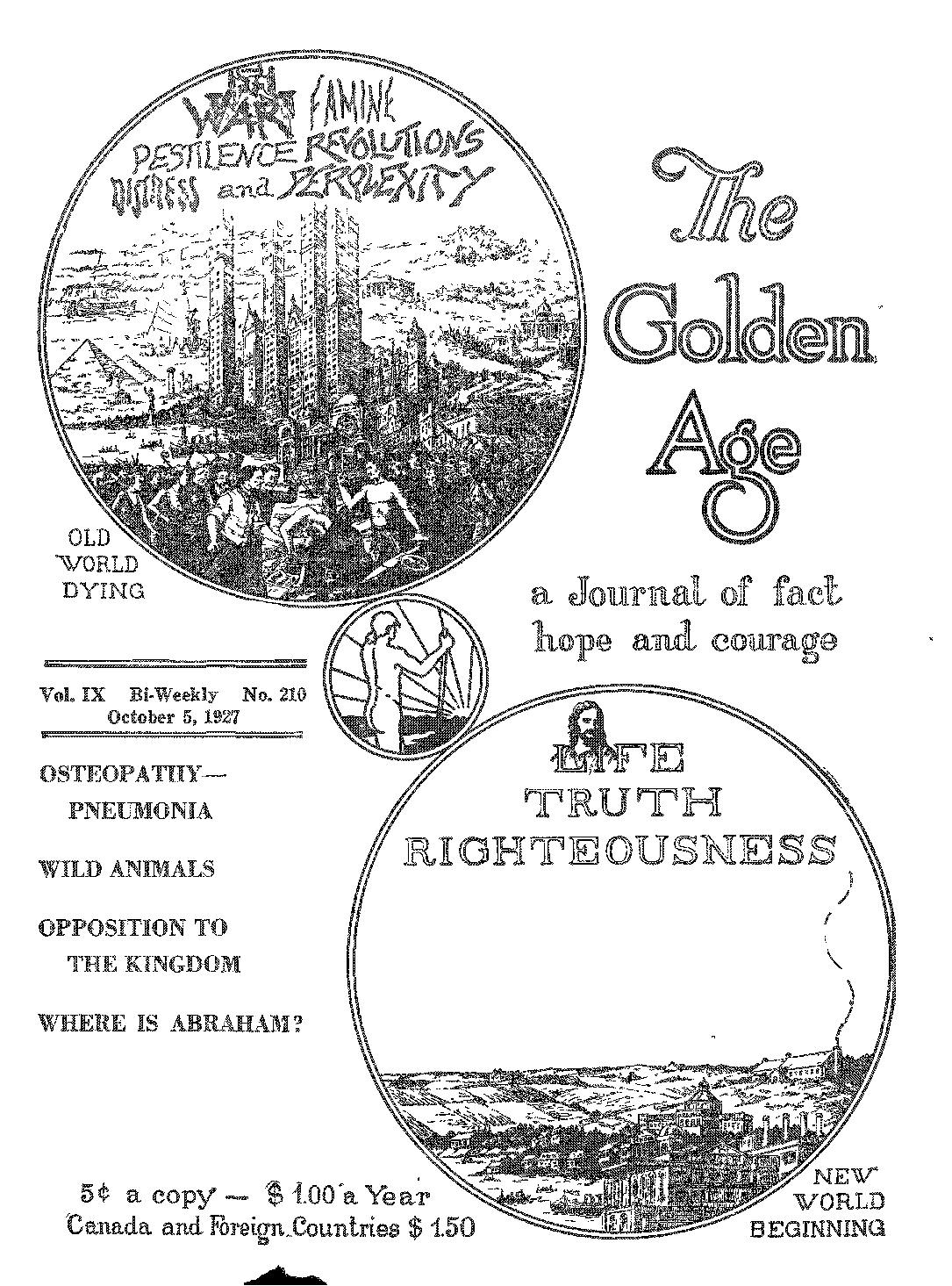
Contents of the Golden Age
Wt=Bg==..-==r :-;;::.-?rrrrr==r==—----tg^====^gc==^ . ■■—===w
Social and Educational
Items Sundry and Divers ................8
London’s Low Homicide Record ...... ...... .9
Four Men Equal to One Woman ............. 10
Who Cases fob the Cripples? .............. 15
Political—Domestic and Foreign
Naval Disarmament Upward ............... 8
Reduction of Publie Debt ................ 8
Impending Collapse of World Credit ........... 9
Agriculture and Husbandry
Mussolini as a Farmer ................ 8
Cheap Method of Killing Weeds and Bugs ......... 10
Home and Health
Osteopathy—Pneumonia ................. 3
Doctor Pierces a Dead Heart: Life Returns ......... 8
Arrangement of Kitchens ................ 8
Travel and Miscellany
Sea Serpents In the Pacific ............... 9
Fbusibatino Nati he’s Plans .............. 11
Jew silem’s Water Supply ............... 11
Wild Animals .................... 12
October Has Come (Poem) ............... To
Religion and Philosophy
A WONDERFUL CONTRAST ............... , . 7 $100,000 a Year Not Enough ............... 9 The Day After Tomorrow ............... 10
Bible Student’s Home Dynamited ............ 10
Pbesbytebtan Texts .................. 15
Thk Press of Toronto ................. 16
Bible Questions and Answers .............. 16
Opposition to the Kingdom .................. 17
Utopia (Poem) .................... 22
Where is Abraham? .................. 23
A Reasonable Inference ................ 29
The Saiiob <.:•»' Israel ................. 30 tots Studies for Little People ............. 31
Published every other Wednesday at 117 Adams Street, Brooklyn, N. Y-, U. 8- A., by WOODWORTH, HUDGINGS & MARTIN
Copartners and Proprietors Address; UI AdoiM Street, Brooklyn, S. Y., U.S.A. CLAYTON J. WOODWORTH . „ . Editor ROBERT J. MARTIN . Business Manages WH. S’. HUDGINGS . Sec’y and Treaa.
3Tw Cents a Copy—11.00 4 Ybas Mad Bbmittakces to THB GOLDSN AGS Jlotiee to Subsoribere; We do not, as a rale, send a card of acknowledgment tot a renewal or for a new subscription. A renewal blank (carrying notice of expiration) will be sent with the journal one month before the subscription expires. Change of Address, when reguested, may be expected to appear on address label within one month. Fobhign Owicbs s British ..... 84 Crave# Twace, Lancaster Gate, London W. 2 Canadian ......... 88-40 Irwin Avenue, Toronto, Ontario Australasian ....... 495 Collins Street, Melbourne, Australia South Africa ...... 8 Wl® Street, Cape Town, South Africa
■Interact as second-class matter at Brooklyn, N. Y.. under the Act of March 3. 1878
The Golden Age
Volumo IX Brooklyn, N. Y., Wednesday, October 5, 1927 Number 210
Osteopathy — Pneumonia By Mae Johnson Work, D. 0.
THE osteopath is by education a physician.
We practise a complete natural method. We diagnose a case and treat it. We must know diseases in all their phases and manifestations. We must be skilled anatomises; for we are anatomical engineers, expert body mechanics, and effect relief by scientific adjustment of the structures of the body. Thus it is plain that to speak of osteopathy as “rubbing” is gross carelessness of speech, and to call it “massage” is a confession of ignorance as to its fundamental principles.
When the rraehine of life slips a cog and one is stricken, say with pneumonia, there is neither time nor opportunity to begin investigation into the merits of the mme ancient or the more modern treatments. If in such a crisis a person is going to avail himself of the best aid* modern science has evolved, he must decide in advance just what that treatment is. He must know from the beginning what sort of physician to put in charge of his case; for it is rarely that physicians and systems of treatment are to be exchanged in the midst of any attack of a dangerous nature such as pneumonia or typhoid fever; and even if the right method of treatment is adopted at the eleventh hour, it may be too late to save life.
It becomes a solemn duty, therefore, to learn now what is to be known concerning the best way to combat pneumonia. Your own life or that of any member of your household may depend solely upon your information on this subject. Since to be informed is to be prepared, if you are fully posted as to just what the best treatment is you surely will not put your trust in any other method less reasonable and less efficacious. This then is your opportunity (if you 'do not already know) to learn about the success osteopathy ordinarily has with this disease. Unfortunately for human life too few people, including physicians, know the simple truth as I shall relate it.
Osteopathy is able to prevent pneumonia from developing at the stage of the initial chill, when the forces that make for death are developing within the system.
This fact has been fully demonstrated by the army of more than 6,000 osteopathic physicians whose experience as a profession extends through over thirty years. It has been shown under this system of treatment that the mortality is reduced very much below the customary twenty percent of medical practice. The best osteopathic authorities say that five percent would more correctly represent the fatalities under this treatment. It would seem, therefore that one’s chances under osteopathic care would be about four times as good as if treated in the medical way.
Indeed, in the experience of the individual practitioner this estimate of losses under the osteopathic system has proven much too liberal One practitioner of the new science, who for ten years before studying osteopathy was an M. D. in charge of Iho operators of a steel mill, among whom pneumonia was and still is very common, has reported treating one hundred cases without a single fatality. He has found also that the majority of his cases do not now develop typical pneumonia when he gets them in the early stages, and that the average duration of the disease is briefer than it used to b® when he treated them medically.
So gratifying has osteopathic experience proven in these cases that the practitioners of this system feel a greater degree of confidence in being able to render more real aid to their patients than do the M. D.s, who confess that experience teaches them there is very little their system can do for their pneumonia patients beyond good nursing, whose benefits, of course, are afforded equally by all schools. The osteopath approaches the sick bed, expecting to fiiid 'lesions” (or abnormal conditions) in the spinal tissues of his patients, which osteopathic research has found to be an underlying cause of disease. In this disease the lesion is usually well defined.
I haye never known of an osteopathic physician to report finding one person having pneumonia in whom some such defect was not present. You will see, then, it must be pretty universal among those who come down with this disease. The patient may have this lesion pointed out so that he, too, can recognize its presence, because it feels congested and sore under finger pressure.
Now the osteopathic doctor approaches his patient, feeling in advance that he will pretty surely find this or some other lesion responsible for inducing the disease, feeling sure, too, that if such a lesion exists he can correct it, feeling sure, further, that if he corrects the lesion it will assist nature very materially in curing the sufferer.
But there is another entirely different aspect of this treatment which devotes itself to adjusting the slipped cogs in the machinery of life and to restoring the nerves, blood vessels, bones, cartilages, ligaments, muscles and fascias to their positions, relations, tensions and activities. That is the aspect of giving relief from pain, conserving the patient’s comfort in his trying ordeal. Altogether apart from considerations of relief, the ability of osteopathy to ease pain and promote comfort would justify its employment in such eases were nothing else considered. Yet it does more. It reduces fever, promotes secretion, relieves nervous distress, strengthens tho heart, favors the activity of the bowels and kidneys and promotes sleep; all of which, of course everybody knows, is the very quintessence of corrective measures. It does more than all that, too. It helps nature to overcome the congestion in the lungs which is threatening to suffocate the patient.
There is not time here to go into the reasons why a ‘‘lesion” should cause sickness, but it is all important to the lay person that these tilings are so; that they are matters of everyday experience and proof under osteopathy; and that the victim'of pneumonia has a much better chance for limiting his suffering and making good recovery if he gets his lesions adjusted by an osteopathic physician than if he lets them alone. That is the message I would give you here: Removing lesions, as osteopathy does it, relieves disease.
Now the question is as I stated it at -the outset, If pneumonia strikes you down, or strikes down some other person in your home, shall the lesion be attended to, in the light of this modern knowledge, or will the oldtime treatment, with its death-rate of one in five, satisfy you? The time to make up your mind is now, before there is any apparent need of applying this knowledge.
I should like to tell of a case neither unusual nor difficult from the osteopathic viewpoint, just a simple condition of which the “medic” makes hard work. We might call it “The Story of a Lost Voice”, told by an eastern practitioner. This particular ease after five weeks of whispering, began to talk. It was the same old story of a “cold” which settled in the larynx and bronchi, annoying him during the daytime with voicelessness, and in the night time with continual coughing. During all these weeks he had been forced to write his letters longhand because he could not whisper his dictation, and he had to have a clerk answer his telephone. The medical doctor had called at his home about every evening and had steamed him and doped him until, as the man put it, he seemed ashamed to take any more money. But still the patient whispered through the day and coughed through the night.
After the first osteopathic treatment he was better; after the second he was still better; and after the third his office associates and clerks began to realize that he was well; and when he told them that “three osteopathic treatments had done it”, on every side they were surprised.
Some time ago there was another lost voice ease not unlike the first one, the case of a campaign orator who had been using his voice in the interest of his cause until two days before election the voice disappeared entirely. The M. D. told him to go to bed. Instead, he called an osteopath. There was one more campaign speech to be made and he must make it. The voice returned during the treatment, and he was told that he might be able to speak for fifteen or twenty minutes from the platform.
He said that he must speak an hour, and ha was told he was probably asking for the impossible. But he did speak the full hour through; and one of his audience said that she was surprised to learn that he was so much of an orator, and that his voice rang out like that of a trained platform speaker.
A third ease of this sort recently: A publieschool teacher, after having whispered to her class for about a month, in desperation “tried” osteopathy. With the second treatment she was talking. These are not difficult cases. They are not unusual cases. A prominent osteopathic physician compiled statistics during the recent war which will interest yon. He says:
' The influenza-pneumonia pandemic, including the recrudescence, covered a period of some six or eight months; yes, within that time hardly a family in the world but that some member, immediate or more remote, was stricken. Estimates have been made that 10,000,000 deaths resulted from these two diseases within that short six or eight months. Do you grasp the full meaning of that statement? The World War lasted four and a quarter years, during which time the majority of the people, including the greatest minds of the world, were devoting their whole time and efforts to the destruction of their fellow men. Billions upon billions of dollars were spent for that purpose. The result was over 7,500,000 battle deaths. But as great, as shocking, as horrifying as that is, it does not compare with the destructiveness of this influenza-pneumonia pandemic which, in about as many months as the war lasted years, killed some 10.000.000 human beings; and no one can estimate the destruction and suffering that will result from iffi after effects.
Now, if you had epidemic pneumonia and were being treated by osteopathy, you would, according to the statistics, have had nine chances to one in favor of your recovery; but if living in Chicago and being treated by medicine, your chances would have been only three to one, while in New York there would have been two chances in your favor and three chances against your recovery.
In view of the bitter opposition waged by the American Medical Association against the passage by Congress of the bill making licensed osteopathic physicians eligible to take the regular examination for commissions in the Medical Department of the Army and Navy, I feel that we are justified in taking a pardonable pride in what we were able to do in these pandemics in comparison with what the medical men did.
There were more than 500 licensed osteopathic physicians in the Army and Navy, doing only the work of the prhate. When the epidemics were raging and the boyi were literally dying by the thousands, were not these 500 licensed osteopathic physicians with their professional training ordered to help care for the afflicted? They vore not. Why not? Because their degree was D. O., mds-ad of M. D. When the b<n s at all the great camps in the country and overseas were coming down by the thousands with pneumonia and dying at the rate of 31 out of every JOO, and the Medical staffs were being worked to death, and were wholly inadequate to handle the large number of pneumonia eases, were not those licensed osteopathic physicians called to aid in saving those dying boys? They were not.
If 330 or 340 out of every 1,000 soldiers with pneumonia under medical care died, and only 100 out of every 1,000 cases under osteopathic care died, who is responsible for those additional 240 deaths in every 1,000, the difference between the two records?
Osteopathy is also successful in treatment of asthma. An asthmatic equally dreads an attack of asthma. We frequently hear its victims say they would rather be dead than go through another “spell”, as they call it. Here is a disease that haunts its victims with ceaseless dread.
They cannot hide nor run away from the awful fear of the impending attack. Oue of its victims said: “It is like a roaring lion, crouched, ready to spring upon its victim any moment.” That is a terrifying picture, but it is true. Asthma is temporary and partial suffocation, due to closing of the air passages into the lungs. There is a spasmodic contraction of the smaller bronchial tubes. This must be followed by the characteristic paroxysmal attacks of difficult breathing. The attack usually comes on suddenly. with a feeling of anguish and constriction about the chest. It usually comes on in the early morning flours, but may come any time.
There is no mistaking a well-marked attack of asthma. The breathing is accompanied with loud and prolonged wheezing, the face is flushed and bathed in perspiration, the eyes are staring and protruding, and there is the awful feeling of impending death for want of breath. With such distress is it any wonder that attacks are so terrifying and demoralizing? A. T. Still, M. D., the founder of osteopathy, searched long and patiently for some rational cause for this disease. He discovered the true source of it to be reflex irritations causing spasmodic constrictions of the muscle coats of the bronchioles.
Pressures on the little nerves produce undue stimulation in them, causing a spasmodic contraction of the muscular wall of the tubes.
Scientists have long known that undue pressure on nerves and blood vessels impairs their functions; but not until Dr. Still pointed this out was it realized to be such an important factor in the causation of disease. In his search for the underlying facts of this disease, he discovered that contracted muscles, congested tissues and bony displacements produced pressure on the nerves and blood vessels in close contact with them, and that the pressure was the cause and asthma the resulting effect of the pressure on the bronchial nerves and blood vessels. Having found the cause, he then directed his attention to a means for its removal that nature might effect a correction in the diseased part. His 'work along this line resulted in a system of manipulations designed to remove pressure from the nerves and blood vessels to the tubes. Under his skillful attention, large numbers of eases were relieved; and none, even the worst, failed to show at least some measure of relief. This pressure, whether from congested tissue, contracted muscles or bony displacements, may cause spasmodic contraction of the bronchial tubes, resulting in an attack of asthma.
Osteopathic physicians are daily demonstrating Dr. Stilbs theory of pressure on nerves and blood vessels as the cause of disease, not only of asthma but of most ordinary diseases. Asthma is selected here for detailed explanation merely as a type of disease in general. You should realize, then, that stomach, liver, borvel and kidney diseases, and of the special senses may be explainable in the same way, and that these will weld equally well to the same regulative and adjustive treatment.
Thus it comes about that osteopathic doctors axe conclusive in proving the claim that a perfectly adjusted bodily mechanism needs no 'drugs to relieve its ailments. How futile it is to try to relieve asthma by the administration of cocaine and other poisonous extracts! It is impossible for any extract to dissipate any of the foregoing disturbing factors. The cause must he removed; otherwise the effects will continue unabated.
As an illustration of this, a man forty-five years of age had suffered with frequent attacks for twenty years, finally reaching the point where he had to be propped up in bed in order to get any sleep when the attacks were on. Hi. condition was due to a tissue lesion in the nature of a semi-solid lump in the lower part of the neck on the right side. This lump, which was about the size of the first joint of the thumb, was pressing on the motor-sensory nerves to the bronchial tubes; and when pressed upon by the fingers or through wearing a collar an attack of asthma would immediately follow. This showed conclusively that pressure from the lump was the cause of the asthma: and a further demonstration that it was the cause of the attacks was that when the lump was removed the asthma disappeared entirely. By careful manipiiJativ® adjustment to open up the drainage to the congested aiea, the lump disappeared, and with it the asthma that had hung to him for twenty years. After a lapse of six veais there had not. been the slightest return of the old trouble.
Another case: A woman of fifty years of age who had suffered untold agonies for a number of years from attacks of asthma, had tried all kinds of remedies to no avail, and as a result was quite skeptical about osteopathy. But through her mother, who had been relieved of a severe attack of lumbago, she was induced to consult an osteopath. She was unconvinced on her first visit, and bluntly stated that she, “did not believe that osteopathy could cure asthma in a hundred years”. On her departure she was handed a copy of a magazine containing a simple article on asthma and acted to read it. She took it home, and in the course of a few days returned to further investigate the nature and claims of osteopathy. She was finally convinced of the wisdom of beginning treatment. Alter examination, the physician told her the cause of her asthma was located between her shoulders at the third and fourth dorsal vertebrae. When told that the disturbance between her shoulders could be removed without using the knife, she joyfully submitted to treatment, and in a short time was completely relieved. She often remarks she is glad her prejudice against osteopathy "was overcome; for now she can go about and breathe like other people and not harbor that awful fear of an impending attack. This was a case of asthma caused by pressure on the vasomotor nerves to the bronchial tubes.
AT THE time of the Dempsey-Sharkey prize fight, Thursday night, July 21, fifty-one radio stations were hooked up the National Broadcasting Company to tran. nit the news of the fight simultaneously all over the United States and Canada. In addition to the rumored disappointment brought by this event to the promoter of the fight, reports from many regions indicate that heavy static prevalent that night practically destroyed the value of the broadcast. Up to that time this was the largest hook-up in the history of radio.
Three days later, on the afternoon of Sunday, July 24, two more stations, fifty-three in all, were hooked up by the National Broadcasting Company to distribute throughout North America the address of Judge J. F. Rutherford. The result was a tremendous success, judging by the overwhelming and unparalleled public response which has come, as we are informed, to the offices of the National Broadcasting Company and to Judge Rutherford. The only station reporting any static interference on that date was the one at Portland. Maine.
It is manifest that Jehovah, who 'makes the sun to shine’ and also ‘raises the stormy wind’, predetermined that this address should be heard by the people, and ordered the elements to that end. In this connection a portion of the brief announcement made by Mr. Graham McNamee at the conclusion of the address is noteworthy. Mr. McNamee said:
Ladies and gentlemen: The address to which we have just listened was delivered by Judge Joseph F. Ruther-ford. At the opening of the Judge’s address it was a very cloudy, rainy, bad day up here in Toronto, Canada, this beauty spot on the north shore of Lake Ontario. Since the beginning of the talk it has become fair and beautiful. . . .
No doubt there will be in due time a still greater use of the radio for some other message that Jehovah has to give to mankind. This seems certain for the reason that advices received from Great Britain, Hawaii, Australia, South Africa and South America indicate that extensive efforts to pick up and rebroadcast Judge Rutherford’s address of July 24 in those parts of the world were unsuccessful.
It is believed that daytime radiation at the point of origin is accountable for this, scientifically speaking. From the larger point of view, it was not Jehovah’s time. That will come soon, however, we feel sure. As it was, the whole of America got the message, perhaps twenty-five million people; and that was enough for this time.
A list of the fifty-three stations that participated in the big hook-up, located in forty-five cities of the United States and Canada, is given below. It will be noticed that five stations in Chicago, and two each in New York, Pittsburgh, Cincinnati and Oakland availed themselves of this unusual opportunity to serve their audiences. Inability of the Broadcasting Company to arrange in time for the necessary interconnecting facilities made it impossible to include several additional stations that communicated their “eleventh hour” decision to have a part in the event.
WEAF New York
KSD
St. Louis
WJZ
New York
KYW
Chicago
WCSH Portland, Me.
WMAQ Chicago
WBZA Boston
WEBH
Chicago
WTAG Worcester
WORD
Chicago
WBZ
Springfield
WGES
Chicago
WMAF S. Dartmouth
woe
Davenport
WJAR
Providence
WCCO
Minneapolis
WTIC
Hartford
WOQ
Kansas City
WGY
Schenectady
KVOO
Bristow, Okla,
WLTT
Philadelphia
WFAA Dallas
WRC
Washington
WOAI
San Antonio
WSYR
Syracuse
WHO
Des Moines
WHAM Rochester
WOW
Omaha
WGR
Buffalo
KOA
Denver
WCAE Pittsburgh
KSL
Salt Lake City
KDKA Pittsburgh
KGO
Oakland
WTAM Cleveland
KFWM Oakland
WAIU
Columbus
KGW
Portland, Ore.
WSAI
Cincinnati
KOMO Seattle
WLW
Cincinnati
KHQ
Spokane
WGHP Detroit
CKCX
Toronto, Ont.
WHAS Louisville
CJGC
London, Ont.
WSM
Nashville
CKOC
Hamilton, Ont
WMC
Memphis
CHYC
Montreal, Que,
WJAX
Jacksonville
WBT
Charlotte, N. C.
CFYCVancouver, B. C.
Items Sundry and Divers
Mussolini as a Farmer
MOST versatile of all rulers of our times Premier Mussolini has found time to plow and plant and harvest a little farm where he has been testing out 140 varieties of grains gathered from all parts -of Italy. He entered his farm as one of the regular competitors in the Italian wheat-raising competition promoted by the Minister of National Economy.
Detection Faster than Escape
AWiCO, Texas, bank cashier embezzled $32,000, went to the nearest seaport and took the first boat for New York. As he walked up the gangplank on his arrival he was met by detectives, who showed him his photograph, sent by telephoto process from Waco, and took him in charge. He admitted his identity and his guilt.
Honolulu’s Wonderful Child Musician
HONOLULU has a wonderful child musician, Dorothy Johnson, who is only four years of age. At present she is in Chicago studying music. In a competition with students of mature age Dorothy won one of the prizes. The judges were behind a curtain, and did not know that Dorothy was the one at the piano when they decided in her favor.
Naval Disarmament Upward
AFTER weeks of discussion at Geneva, in which Great Britain flatly refused to accept the United States demand of equal naval strength, the only thing the three countries Britain, America and Japan had been able to agree upon was to increase the standard size of submarines from 1,000 tons and four-inch guns to 1,800 tons and five-inch guns.
Doctor Pierces a Dead Heart: Life Returns
LITTLE Anna Scotto, a twelve-year-old Carteret, N. J., girl was rescued from quicksands blue and apparently lifeless. A doctor rushing to the scene, emptied the girl’s lungs, and then examined her heart for some evidence of heart action; but there was none. He drove a hypodermic needle containing adrenalin directly into her heart; and after a terrible fight for life, she revived and is now out of danger.
Increasing Use of Rayon
RAYON or artificial silk is a weak thread when it becomes wet, but the strength and lustre and inexpensiveness have led to a constantly widening use. Originally made from spruce wood and cotton linters, rayon is now obtained from shells, cornstalks and even garbage. Some rayon threads are stronger than others. There is a great future ahead for rayon fabrics.
Arrangement of Kitchens
SCIENTIFIC study of household duties shows that the right arrangement of the kitchen is ice box, kitchen cabinet, stove, work table to dining room, and on the return journey work table, counter for soiled dishes, sink diain board, china closet. All movements should be arranged from left to right. Work thus arranged saves years in a woman’s life. Small kitchens are better than large ones, and dining alcoves than dining rooms.
Achievements of Augustin F. Mrnsa
BLINDED at nine years of age Augustin F.
Massa paid his way through college by acting as a professional checker player in one of New York’s parks. He offered a gift to anybody who could defeat him; otherwise he retained a small fee. He was able to keep eight checker games going at one time. Now he has finished his course of law training at Columbia University and has been admitted to the bar with full honors. Best wishes to Augustin F. Massa I
Reduction of Public Debt
SINCE August 31st, 1919, when the war debt was at its peak, the net debt of the United States has been reduced from twenty-five and one-half billions of dollars to eighteen and one-half billions. This is an average annual reduction of almost a billion dollars per year, and makes one wonder why the interest-bearing debt of the United States was held steadily at almost one billion dollars per year from 1900 to 1916 inclusive. If the country can now pay every year a billion 'dollars to reduce the debt, why was it necessary during all those years to pay interest on such a vast sum? Who got the interest and why?
Train Operation bp Radio
UNTIL recently there was no effective meth” od of communicating between the engine and caboose of a long freight train. The conductor either had to send a brakeman on the perilous trip over the tops of the cars or else use the emergency valve to stop the train,-thus causing an expensive delay. Radio communication on a low wave length has now been tried and found to work perfectly. There are a receiver and a transmitter at each end of the train.
4 New Flax Which Ooes Not Ran Oat
AFTER some years of experimentation the Department of Agriculture has succeeded in developing a variety of flax, the “Saginaw”, which does not run out; that is to say, growers of the Saginaw will not need to import fresh supplies of seed from Europb every four years, as has hitherto been necessary. Nearly all the fiber flax of the world is grown at present from seed originating in the region of Psokof in Russia.
a Year Not Enough
APART from funds for keeping the abbey in repair it seems that the British government, which means in other words the rank and file of the common people, pays Westminster Abbey $100,0® year. The Very Reverend Fox-ley Norris, the dean of the old wreck, thinks this is not enough, as it only leaves about $40,000 a year to split up between the professional singers who constitute his choir. He has been broadcasting an appeal for more money.
Impending Collapse of World Credit
Sm George Paish, leading British economist, is credited with having recently said at Oxford University that “the United States is creating credit on a scale which cannot last. The view <jf the world’s leading bankers and economic experts is that a great smash must come unless it Aanges its financial policy.” Concerning the effect of such a smash Sir George said, ‘If there i» a break in world credit, as many leading authorities fear, (here would be nothing less than starvation in the world’s great cities. The loss of Iff® might even be greater than that occasioned by the war/
Sea Serpents in the Pacific
SIXTEEN reputable citizens of British Columbia, living in two different places, report having seen in the waters of the Pacific Ocean near their homes two sea serpents, each about thirty feet long. The head is about two .feet broad, with enormous mouth and bulging eyes. The diameter of the body is estimated at thirty inches. Below the lower jaw the skin hangs in the form of a pouch. It is believed that these serpents are responsible for the scarcity of fish in that vicinity this spring.
London?® Low Homicide Record
FOR the year 1926 London reports only seventeen murders. In the same year the murders in Chicago were about five hundred, and Chicago is a much smaller city. Of the seventeen cases in London sixteen were followed by arrests, while only a small proportion of the Chicago murders are ever traced in any manner. Traffic accidents in London are increasing greatly as automobiles become more plentiful There were 1,003 deaths from such accidents in London in 1926.
Words of Wisdom from St. Albans
PF A free for all fight which the British bench of bishops are having over their prayer book, the Bishop of St. Albans, in a reply to Sir William Joynson Hicks, set forth the evidence that the common people of Britain are making progress. He said, to quote the London Daily News, that “people talked as if the whole bench of Bishops were made up of a set of congenital village idiots”. The Britisher, once he awakens, is a discerning individual. The only trouble is that it takes him so many hundred years to awaken.
Standard*® Quarrelsome Babies ■
TWO of the babies of the dissolved Standard
Oil Company are in a quarrel The New York baby has entered into contracts to buy oil from Soviet Russia, while the New Jersey baby is not willing to go into any such unholy alliance. However, this is a case where there are advantages in having two or more babies. The piety of the New Jersey baby upholds the honor of the family, while the perspicacity of the New York baby brings in the coin of the realm. Thus the family is benefited all around, and all the stockholders are made happy. We laugh.
Four Men Equal to One Woman
Y A vote of 229 to 164 the men of Oxford University have decided that the proportion of women to men in the University shall be allowed to become as great as one to four. By what ingenious method of reasoning they make out that four men are equal to one woman, and that if the four club together and hold on to their rights they do not need to be afraid of her, does not appear. The younger men have complained that the presence of women makes them study too hard, as the women have a way of getting their lessons with which the men cannot easily compete.
Soviet Grappling with Bezprizorni
THE Soviet government is reported by the Manchester Guardian as making real progress in its efforts to domesticate and educate the wild boys and girls that a year ago roamed over Russia to the estimated number of 300,000. Raids upon their haunts are made periodically; and the children thus gathered in are taken to homes, where they are kept for part of the time under lock and key and for part of the time are given their liberty. They are taught trades, and are being treated so well that some of the poor outcasts voluntarily present themselves at the homes to take the place of those 'who escaped to return to their old haunts.
Cheap Method of Killing Weeds and Bugs
IT TIAS been known for years that electricity can be used to kill the weeds that take the food from growing plants, that it can be used to kill the myriad forms of insect life that destroy the plants, and that it can be used to enrich the soil by bringing out of the air the nitrogen upon which plants feed. Now a Pittsburgh inventor, Hamilton L. Roe, has invented a two-bladed plow which is connected with the tractor in such a way that it creates a current of 103,000 volts between the two plow blades, accomplishing all three results at one time and at almost no expense. The device is being tried out on the farms of Donald Woodward, near Le Roy, New York; and the tests thus far made indicate that land thus treated is much more productive than adjoining land treated with 900 pounds of fertilizer per acre. The experiment is attracting wide interest and, if completely successful, will revphrtlwiiw agriculture.
The Day After Tomorrow
THE Cosmopolitan Magazine contains an extraordinary article by Sir Philip Gibbs in which he concludes that there are only two ways in which a world catastrophe may be averted: Either by killing off the scientists or by reforming man’s moral and intellectual nature. Wireless pow’er transmission will shake to pieces the whole elaborate structure of civilization based upon human labor. Pictures, translated into sound, will tell their story to the ends of the earth. Men will obtain their food direct from the energy imparted by the sun. Boundaries have already become a joke; for there are no boundaries to the air. Sir Philip says: “The last time I came back from Switzerland I breakfasted in Basle, lunched in Paris, took tea in Croyden, and was home two hours before dinner in a country house seven miles from the railway station. It took me seven hours instead of thirty-six by train and boat. Switzerland is five times nearer my country village.”
Bible Student’s Home Dynamited
NYBODY who has ever met John A. Hitt, of East St. Louis, HL, knows that he is one of the most gentle and lovable of men. .A locomotive engineer interested in the Bible, ho wanted his friends to hear Judge Rutherford's address at Toronto, broadcast on July 24th by the courtesy of the National Broadcasting Company. In an advertisement in a local paper ho stated that a copy of the lecture could be obtained. by addressing him at his home, 712 North 33rd St., in that city. At 2:40 a. in., five days after the lecture was given, while five people, including two women and a child, were in the house, an automobile drove up, planted a dynamite bomb and blew the front of the house off, inflicting $500 damage. No Bible Student is surprised at this. Every Bible Student knows the church affiliations of the one church whose members have assassinated our presidents, and whose members have constituted the principal population of our jails, and knows to a moral certainty who was responsible for this outrage. The police of East St. Louis can give no explanation. They think the bomb was intended for somebody else, but we do not think so. We think it was an attempt to punish free speech and free listening, and there is only one institution in the
United States that really fears free speech and is, earth’s greatest menace to life and hates it Everybody knows what that institution earth’s greatest hat$rj)f the Bible/
Frustrating Nature's Plans
(Reprinted from the Montreal Family Herald, and Weekly Star.)'
VAST multitudes of mice recently swarmed into California, and so numerous were they that they impeded traffic. The rodents travelled across the country like a great moving carpet I They were fought with poison gas.
What is the reason for this plague? It is simply that man for years past has waned against creatures such as hawks and. coyotes, that prey upon mice, leaving the latter free to increase their numbers out of all normal proportions
If a heavy spanner were to be flung into the midst of some delicate machinery it is obvious thet the machine would be throw?' out of gear. No sane man would dream of doing such a thing if he wished the maebi is to continue tunctioning. And yet that is a parallel of man’s behavior tov>a -d, Nature.
Nature has her own very intricate system for keeping a just balance between ths varied forms of life; and when man interferes, the mechanism is upset. But where ®n inanimate machine cannot hit back, Nature can and does most surely get her revenge.
At the present, time the whole world is paying the penalty of upsetting the balance of Nature. In Britain, the rat, owing mainly to the destruction of some of its natural enemies, the owl, the weasel, the kestrel, and so gj, has increased to such an extent that it has become g ww menecc. According to the Inrfduto of Applied Pestology, the progeny of every pair of rats amount in ® year to about one thousand individuals, which destroy produce worth. £1,500, and the annual cost of the rat population is sense £ i’05«)00?00()
Other countries have suffered in like manner through, tinkering with Nature. The mongoose was introduced into Jamaica to dear the sugar fields of rats. It not only accomplished the task set it, but swept away all the poultry and wild birds, and. then accounted for the ground lizards, thus giving full scope for the multiplication of insects. As a result, the Government waa obliged to take strong measures for the extermination of the mongoose.
. . . Nature, indeed, has taken a heavy toll from all civilized peoples for their presumption in interfering with, the working of her laws. Treasure, vast possessions, human lives, all have been exacted mercilessly and without stint
But, appalling as Nature’s revenge has already been, its full intensity has yet to be felt There is still to come an insect war on humanity. This terror is approaching us like & thief in the night, partly because W0 have not allowed for the immense variety and the amazing birth-rate of insects. There are about 750,000 species, some of which have enormous colonies. In a wasps’ nest there may be four thousand individuals, and as. ant-hill sometimes contains millions of inhabitants.
A single female housefly might in one season, Professor Howard calculates, become the ancestress of a family of 4,4.72,286,103,628,713,559,320, and a still greater horde might spring from one greenfly, since its descendants in only the fifth generation might nun> ber 6,000,000,000,000.
Jerusalem’s Water Supply
TERITS AJ^'EM, lying’ as it does 2460 feet above D sea level, on an arid plateau, has always had a difficult problem to solve in obtaining a sufficient supply of water. Hitherto the chief reliance has been upon the rainfall, and its storage in the 6,000 cisterns built for the purpose within the city.
Now that a real-estate boom is on in the Holy ’City steps have had to be taken to greatly increase the water supply and this has been done by putting in a pumping station at the great spring in the Ain Farah Gorge, six miles northeast of the city, where it is said David watered his sheep, and to the neighborhood of which the shepherds of that part of Palestine still resort for the same purpose.
It is interesting to note that the per capita wealth of the United States is placed at $2919.00; Britain $2662.00, and Australia $2585.00; Denmark $1737.00; France $1285.00; while the other nations are far down the list.
Wild Animals W "rife®, Tait
COMPARATIVELY few people have seen the larger wild animals in their natural eon-litiom Fewer still have been able to gain any aequaiiitance with their real disposition. Our knowledge is generally confined to what we have Been in a zoo or a menagerie. There, inside some buildiqg with a nasty fetid atmosphere and behind strong iron bars, we have beheld some of the great beasts. We come away believing that we have seen, for instance, a jungle lion. But that spiritless, eowed, half-dead creature bears little resemblance to the actual king of beasts. Absent is the dignity and regal bearing of the' noblest of all the lower animals in its native haunts. -
The only other source of knowledge of wild animals within the reach of most people is that derived from ordinary travel and story books. A few individuals, however, have enjoyed the privilege of hunting expeditions. To the delight and wonderment of their friends they bring home skins and furs, heads and tusks, as trophies of their so-called sport Some write books, describing their thrilling adventares-sand wonderful escapes from the jaws of toe fierce and furious lion or leopard.
Doubtless most of these hunters relate each incident exactly as it occurred. Their victim was fierce, and its fury at being taken was awful to behold. But that is just what we should expect under such conditions. In all creatures the instinct of self-preservation brings out the worst side of their nature. The hunter himself is not at his best when trembling with fear. As a consequence he sees only the baser side of the animal he pursues. They are for toe time being mutual enemies, bent on exterminating each other.
Is it possible under such circumstances to get a true impression of native wild animals! Even toe fiercest of them are among the creatures over which man was originally given dominion (Genesis 1:26; Psalm 8:6-8), but that dominion has been lost through selfishness and cruelty. As originally created, animals of all classes would regard naan as their friend and benefac-tor.*But now, even under the best conditions at present possible, they have good reason to always look on man with suspicion.
Can toe Edenic condition of mutual friendship be restored! Is it possible for man and toe larger and fiercer creatures to get so dose one another tat mutual understanding and aj>* predation may be gained t
These thoughts were prompted by the recent perusal of a book by Wynant D. Hubbard, ®a« titled, “Wild Animals: A White Man’s Conquest of Jungle Beasts.” (D. Appleton & Co., London and New York) Mr. Hubbard spent three years in Rhodesia and East Africa, and was practically all that time in closest contact with wild creatures. His vocation was the securing of living specimens for American zoos. He give# positive assurance that he has put down toe stories related in his book exactly as they oo curred, and they are exciting enough.
To that author animals are much more interesting than human beings. His love for living creatures and his experiences with them changed him from merely a hunter-naturalist into a man who believes that all wild animals reason, communicate, teach and learn, and ate therefor® capable of domestication. Mr. Hubbard’s animal farm at Tara is best described in his own words: '
Around our three living hutsjind the kitchen were grouped kraals, wire cages, paddocks, raws of poles with baboons attached, lengths7 of wire to which were tied leopards, and cheetahs, without any attempt at system. . . . Near the cattle kraal were the little antelopes which needed warm fresh milk. Opposite this row of paddock# was the carnivorous alley. Near the kitchen tore® leopards had their rtm. Next to them was a little cheetah running on a light chain attached to thirty yards of heavy steel wire. Then five baboons.
Civet eats came next. Long and low, with heavy manes on their yellow spotted eoats, they were the only animals among over five hundred which we were unable to tame. . . . Three hundred yards from the kitchen starting point the alley ended with the pythons’ eage. . . . The dining room was perpetually being commandeered for us as a home for the youngsters that needed constant feeding and looking after. Tame sable antelopa wandered around free, and our three bluejays used the roof tops as their particular home.
In his hunting expeditions Mr. Hubbard had many narrow escapes and startling adventures. His object, of course, was to secure young animals. Usually great risks had to be run and often the older animals had to be slain. With a company of experienced natives and a large group of dogs he penetrated far into the African* jungle. The dogs proved useful in confusing the older animals, by snarling and snapping at their feet and legs, and helped in isolating those young specimens which it was his purpose to secure.
In these excursions much useful knowledge was gained, and unique opportunities ■were ©ffered of studying the mentality of wild animals. Among the residents in the colony were three young elephants. Mary, the smallest, was only three feet high when caught, and had not cut its teeth. It had to be taught to drink from a bottle, and progressed nicely on forty-five bottles of gruel per day. After teething was over Mary was allowed to go out with the two larger elephants, which were under the charge of sixteen natives. About noon they were brought into the camp to have their bath, in a holo near an ant-hill which was filled -with water each day. Into this they rushed with screams of pleasure, kicking the mud in all directions, standing on their heads, and rolling over.
The exciting story of the capture of Jim, the second elephant, is typical of many others related in the book. After the dogs had isolated him from the herd of elephants, he was chased about by a horde of dogs, natives and white men for many hours. .At, last he wms caught and tied up with strong ropes between four trees. There he was left for the night. The vdiole company withdrew", kindled fires, prepared and ate their supper; and all being thoroughly worn out, lay down to rest.
Suddenly there was heard a cracking of twigs; the dogs barked, the men got up and seized their weapons, and the eamp was in great commotion. The herd of elephants had returned to rescue Jim. The men took refuge in the darkness on an ant-hill. The infuriated elephants, trumpeting furiously, tramped out the fires, crashed down small trees, and created general pandemonium. This continued until the day broke, when the elephants took themselves away. Then the hunters came trembling dowm from the ant-hill, and found that, after all, Jim was still there.
Instinctive Fear
ONE of the most interesting chapters in the book is headed, “Do African Animals Think?” Mr. Hubbard has concluded that wild animals are able to “put two or more facts together and act upon a conclusion drawn from the whole”. He doubts whether there is among them such a thing as instinctive fear. Fear is usually the result ox the experience of the young animal itself, or that gained from adult example.
In the farm at Tai a two pythons (large snakes) were kept in a large open-air cage, twenty-five feet long, fifteen feet wide, and six feet high. After a time it became necessary to feed the pythons, and their natural food is small mammals and birds. Three fowls and a goat were put into the eage, but they showed no fear of the snakes. The goat moved about feeding on the gra»s, and oven stepping over the long snake--bodies. The fowls actually stepped right on them. The pythons, strange to say, took no notice of tilthr intended victims, and ultimately had to be forcibly fed.
No very young animal when brought into captivity showed fear of human beings; and among these were leopards, cheetahs, baboons, monkeys, several kinds of cats, antelopes, zebras. etc. A leopard kitten was quite at home among some fifty dogs savage enough to capture elephants and buffaloes alive. Skillum, the full-grown leopard, formed a special friendship with a Great Dane; and no one ever saw either spit or growl at the othev
One of the most interesting illustrations of lack of instinctive fear was Janey, the six-months-old tvarl-hog. It was continually digging itself out of its pen, and immediately it found itself free it came snorting and puffing into the dining room. After being slapped and chased out it would return, over and over again. Quite freely this animal crossed the zone of the tethered leopard, oblivious of the fact that warthogs are the favorite food of the leopard.
The wild wmrt-hog shows considerable foresight. It always browses .near an ant-hill hole, into which it enters backwards when pursued by an enemy. The sable antelope, when pursued by dogs, lies down, drawing itself into a circular body which can be effectively defended by means of its long, curving, sharp horns. When pursued by man its fleetness is its sole defence.
An interesting example of animal reasoning is recorded of a lioness, in a cage with three cubs. One of the little ones, while gambolling, struck the mother on the face with its claws. The lioness immediately caught the careless youngster, gave it & slight shaking, and put it into a corner of the cage with its face to the wall About ten minutes after, the cub, evidently believing its chastisement was over, returned to its play.
Elephants have been observed passing along a dry stream, carefully looking at the ground. When they come to a spot where they evidently detect the scent of water, they scoop away some of the sand or gravel with their forefeet, and after waiting for a short time the water seeps up. In the wild fruit season, if a tree is too firmly rooted to be pulled down by a single elephant, one wrill often secure the help of another; and by their united strength they may pull the tree down, and secure the fruit they want.
Lions have a clever system of stampeding cattle out of a kraal. Mr. Hubbard says that one evening, before the moon appeared, he heard some commotion among the cattle. While getting his rifle and preparing to go out he hoard a lion give a terrifying roar on the up-vind side of the kraal. Immediately there was a bellowing and cracking of poles as the kraal gave way and some sixty oxen stampeded. When the moon arose it was found that two lionesses had been waiting on the down-wind side about fifty yards away, and had killed one of the oxen.
A Vision of the Future
IN HIS intimate acquaintance with wild animals Mr. Hubbard has come to Hie definite conclusion that (1) any wild animal can be tamed provided it is obtained when very young, and handled by an understanding, sympathetic, patient person; that (2) wild animals on the veldt are grossly misrepresented when pictured as being inherently quarrelsome, vicious, or savage; and that (3) although any ;vild animal can be tamed, only certain ones offer possibilities as future domestic animals. These are the buffalo, the eland, the elephant, the bush pig, the wild dog, the bush cat, the guinea fowl and possibly the zebra.
The greatest difficulty confronting settlers in many parts of Central Africa is the tsetse fly. Ite bite is fatal to all our cattle and horses, and causes sleeping sickness in the human species. No effective means have yet been found for destroying it or checking its depredations. But all native African, animals are immune from the bite of the tsetse fly. Therefore Mr. Hubbard sees the approach, of a new era for that vast and fertile region. Already there are farms where native animals are freely used for domestic purposes. In an ecstasy of enthusiasm the writer declares:
I see a vision. It is a farm on the borders of the tsetse-fly belt in Central Africa. There are many cages and kraals. There are laboratories, aquariums and stables. It is a big experimental station for the study of the psychology of wild animals. Here the possibilities for domestication, latent in all wild animals, are being tried out. I see young elephants walking about under the guidance of natives. Some are being trained to drag and pile logs. Others are running the plow. Still others are learning to carry a howdah. Grazing in a vlei is a mixed herd of buffalo and cattle. There are zebra and pigs and birds of all descriptions. There are domesticated antelopes, and even lions and leopards. Here crossbreeds of all kinds are being developed and experimented with.
Mr. Hubbard, in a blurred way, sees a glimmer of the kingdom of Christ. The picture he gives us here is fine, but how much more enhancing is that vision as seen by the Prophet Isaiah :
“The wolf shall dwell with the lamb, and the leopard shall lie down with the kid; and the calf and the young lion and the falling together; and a little child shall lead them. And the cow and the bear shall feed; their young ones shall lie doivn together; and the lion shall eat straw like the ox. And the sucking child shall play on the hole of the asp, and the weaned child shall put his hand on the cockatrice den. They shall not hurt nor destroy in all my holy mountain : for tlse earth shall be full of the knowledga of the Lord, as the waters cover the sea/’—■ Isa. 11: 6-9; see also Job 5: 22, 23; Hosea 2:18.
This picture shows what is meant by man having dominion “over the fish of the sea, and over the fowl of the air, and over the cattle, and over all the earth, and over every creeping thing that creepeth upon the earth”. (Genesis 1:26) It is not a selfish dominion. It is a condition in which each appreciates his own relationship the one to the other. It is a mutual understanding, based on a mutual appreciation.
What a wonderful transformation will be seen when man has fully yielded his stubborn, will to the Lord! When God has put His law in their inward parts and written it in their hearts (Jeremiah 31:33), the love which man will then feel toward God and toward his neighbor will overflow to the lower animals. Then fear will be eliminated on both sides. There will be no cruelty, no neglect, no injustice—not even the thought of such things.
In those days all men will see clearly how Satan betrayed his trust—how he appropriated to himself both God’s dominion and man’s. His wicked, malevolent influence has been exerted over the whole earth and over all creatures. But his power is being broken. He whose right it is has come and is taking the reins of government. Soon God will take His own dominion again, and man also will have his privileges restored. But God must be first, all and in all.—1 Cor. 15:28.
Who Cares for the Cripples? ByD.E.Pay
[We print the following because there Is a side of this Question that is not often considered, but we knew Intimately a one-anncd man that raised a family of ten child”en, and raised them well. It was a hard fight, however, and would have been for anybody. It was much more so for a one- armed man.—Ed.]
I HAVE just lately become a reader of The
Golden Age. I have found more interesting reading in this little magazine than all the newspapers in the great cities put together; and you are fearless' More power to you.
I am a cripple, having lost an arm. In the past ten years high-salaried beggars have been condemning the cripples and disguising themselves as charitable workers. But the crippled man or woman gets nothing from these organisations. If we did, we would not have to sell pencils on the streets.
I myself have written the best I know how to all the big newspapers, asking them to point out the way for a cripple to earn an honest living, and asking them to stop using the name “Guild for Organized Beggars” as a description of the blind and crippled. I have asked Mr. Arthur Brisbane to write on this subject. He says he does not know what to write. I have written to magazines, talked to some very fine men and women. They say. “Just keep on trying.”
If nobody knows what to do, why do they want to arrest us for selling pencils, and then turn around and give to some high-salaried beggars! I -understand the Salvation Army is worth $30,000,000 in property in the United States alone. Still they are beggars. And all the churches are beggars.
So I am coming to you in the name of the Lord to give us a helping hand. This thing of a cripple or blind man getting $75 or $200 per day is nothing but some so-called Christian organization trying to increase its salary.
It takes me a whole week to make my room rent, $3.25 per week, for a housekeeping room. By cooking my own meals I “get by”.
Here’s hoping you will go deep into this question and give the truth, no matter whom it hurts.
Presbyterian Texts
TN ROCHESTER, New York, June 12th to 1 August 28th, one of Jhe Presbyterian churches had a series of powerful sermons on important texts from the Presbyterian .Bible. The topics as advertised were twelve in number, as follows: Going to School, Children’s Day, Where the Roses Bloom, Making America Beautiful, Annual Lily Slips, Outgoing Ships, Seeing the World at Home, Keeping Cool, Sheltering Trees, The Splendor of the Sun, The Wind is Blowing, and The Summer is Ended.
Rochester is an important religious center. In one of these centers recently one of the “doctabs” who furnish food for the mind has explained to a waiting world that it is not fra® that man descended from the monkey. H® originally came from a plant somewhat like the cabbage. In another center another “doetah” thought that in a little while the chemists would be able to make a synthetic “doetah”, thus proving that man really had no Creator.
Honest now’! Could you blame the Almighty God for wiping the slate completely clean ©£ such walking trash?
The Press of Toronto
IT SEEMS that the newspapers of Toronto are almost completely under the control of the clergy, managed so-to-speak by two-legged people that are not women, and that are not men because they wear skirts and do unmanly things. It is an unmanly thing that some Reverend has done in that journal of limited and feeble circulation published in Toronto which travels under the nom de plume of Saturday Night.
The little sheet is so excited that in referring to Judge Rutherford it uses such unmanly names as heavy-jowled, flannel-mouth, wandering blatherskite, professional liar, lying demagogue, etc., all of which harm nobody but itself; and then, after a defence of the “reputable clergymen,” informs its trusting readerg that “during the World War the 1. B. S. A. sold out to Bernstorff and was caught in the act of distributing proGerman propaganda in Canadian cities and towns”, every word lintrue.
In order to square himself or herself Avitli the class of readers that gather to make up the subscription list to Saturday Night, the Very Most Reverend smooths the ruffles out of his skirt or out of her skirt, or whichever it is, and lets out this gem:
On the night of July 21st reputable fathers of families anxious to listen in on the progress of the Dempsey-Sharkey prize fight were kept out by the high power oratory at the Toronto Coliseum. On Sunday July 24th the religiously inclined were prevented from hearing their favorite message because the leather-lunged Rutherford had the air. Millions now living would rather di® than be compelled to listen very often to his discoursea.
…