Golden Age, September 21, 1927
Download: PDF — Golden Age, September 21, 1927
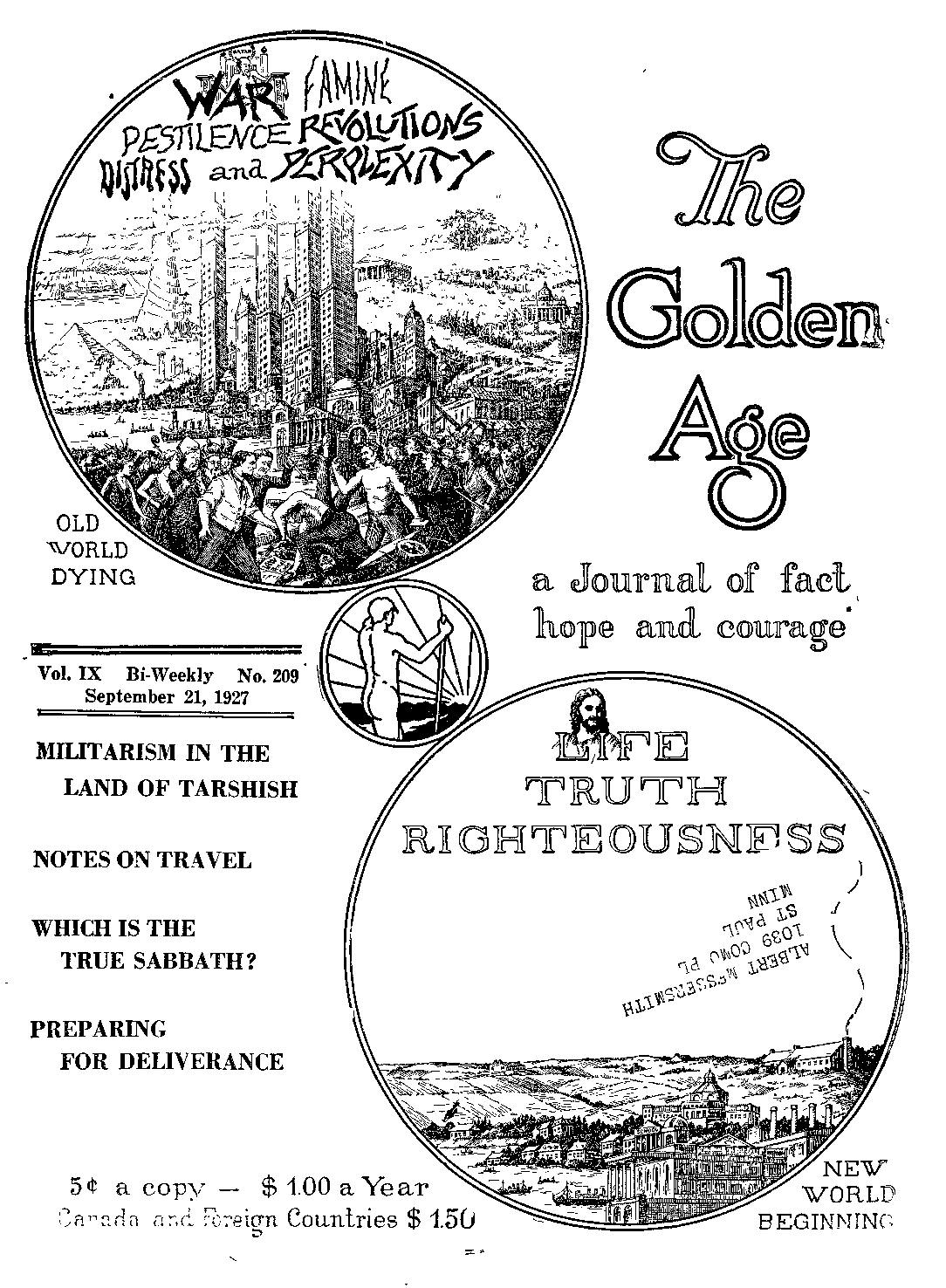
assaw
Contents of the Golden Age
----------------=s=a=g===ggai»
Political—Domestic and Foreign
Militarism in the Land or Tabbhish
Notoriously Bad Government
Too Many Priests .................. 805
Spanish People and Their Possessions
The Cities of Spain .
The Present Dictatorship ............... 808
Events in Canada .................. 814
The Stow Progress ok Liberia .............. 828
Agriculture and Husbandry
Electrocution of Kansas Wheat ............. 828
Science and Invention
Radio on the Grand Canal ............... 808
Travel and Miscellany
Notes on Travel and Travelers ............. 8®
Vacations by Automobile ............... 8®
Tramps and Commuters ................ 810
The Gypsy Business ................. 811
Ocean Trips and World Tours .............. 812
Magellan and Del Cano ................ 813
The Making of Pittsburgh ............... 821
Religion and Philosophy
The Episcopal Convention at San Francisco ........ 815
Which is the True Sabbath? .............. 816
Throe Sabbaths Specifically Referred To ......... 816
Has the Sabbath Been Changed? ............. 817
Sunday in the Days of Constantine ........... 818
Is the Seventh Day Binding Upon Christians? ....... 819
Where He Got His Idea..... 821
Preparing for Deliverance ............... 822
Bibm: Questions and Answers .............. 829
Gon’s Covenant with Israel .............. 830
Little Studies for Tattle Pkopie ............. 831
Published every other Wednesday at 117 Adams Street, Brooklyn, N. X., U. S. A., by WOODWORTH, HEDGINGS & MARTIN '
Copartners and Proprietors Address: lit Adams Sheet, Broohljfn, W. Y., U.S.A CLAYTON J. WOODWORTH . , . Editor ROBERT J. MARTIN . Business Manager WM. M HUDGINGS . . Sec-y and Tress.
Elva Cents a Cow—$1.00 a Year Make Remittances to THE GOLUBS AGB, Notice to Subscribers: We do not, as & rule, send a card of acknowledgment for a renewal or for a new subscription. A renewal blank (carrying notice of expiration) will be sent with the journal one month before the subscription expires. Change of address, when requested, may be expected to appear on address label within one month. Foreign Offices: British . .... 34 Craven Terrace, Lancaster Gate, London W. 2 Canadian ......... 38-40 Irwin Avenue, Toronto, Ontario Australasian ....... 495 Collins Street, Melbourne, Australia South African ...... 6 Lrile Street, Cape Town, South Africa
Entered as second-class matter at Brooklyn. N. X.. under the Act of March 3. 1879
gMHfc
Golden Age
Volume VIII Brooklyn, N. Y., Wednesday, September 21, 1927 Number 209
Militarism in the Land of Tarshish
THE Spanish "Cavalier” has been and is the glory and the ruin of Spain. War, glory and ruin are the natural opposites of peace, happiness and prosperity. Militarism and eeclesiasticism, when combined, make the ideal form of misgovernment; and Spain has been blessed with all three.
It is apparent that Spain remained unoccupied until a few centuries prior to the beginning of the Christian era. Spanish history may be said to date only from the time of the Carthaginian invasion in 238 B. C. Prior to that time the Phoenicians had visited it for ore and had founded some settlements there, connected with the mining industry. Its name was then Tar-tessus or Tarshish.
The Bomans occupied two hundred years in subjugating the country, completing the task about the time of the birth of our Lord. Constantine planted the Roman Catholic religion there. With the fall of the Roman Empire Spain was overrun with the Vandals, who named the southern part of Spain Vandalusia, now Andalusia.
The Vandals were in turn conquered by the Goths, who founded Gothalauia, now Catalonia, the most progressive and intelligent part of the whole Spanish peninsula. The Moors conquered Spain in the year 711 and for seven and a half centuries gave Spain the best government it has ever enjoyed. The Moors were driven out the year before the Spanish Jew, Columbus, crossed the Atlantic in search of the land discovered by Leif Ericson 500 years before.
While the Moors ruled Spain the Christian religion was tolerated; and the Moslem cities of Cordova, Saragossa, Toledo, Valencia and Seville, became centers of education and culture. — The Moslem universities were the most advanced “ in Europe and attracted students of all faiths from all parts of the continent
Although the Moorish architecture of Spain is considered by many architects to be the finest in the world, representing the very highest grade of workmanship known, yet the presence of these intelligent Moslems was offensive to the popes; and year after year and century after century they urged on a war of extermination against them, which finally succeeded.
The Rewards of Intolerance
THE rewards of intolerance have been what might have been expected. When the Moors were driven out, and with them the Jews, the best brains in the country disappeared; and "There were left only the militarists, priests, aristocrats and other loafers who never, in any country, have been anything but a curse and a burden to the real citizens of the land.
It followed naturally that cavorting around in armor, spear in hand, became the principal business of Spaniards; and in a modified form it is so today. Workers in any line, tradesmen, merchants, etc., were looked down upon. Butchers like Cortez and Pizarro became the heroes of the populace, and bullfights became the national pastime. Progress stopped dead.
Another curious effect of the intolerance practised in the expulsion of the Jews, in July, 1493, is that a million Jews, unable to flee, accept the Roman Catholic religion; and today n>\ lv percent of the Spanish people are so tho; ghly Jewish in appearance as to be readily mistaken for them. The dreaded Spanish Inquisition, intended to destroy the Jews, has / turned its authors into Jews themselves, at * least Jews in appearance.
The crushing of Moors and Jews was the destruction. of Spain. The discoveries in the Western Hemisphere made Spain the mother of twenty nations; but she was unable to- hold them, because unable to give them a proper gov-©rnment. The landslide of all Spanish America Siy from the mother country took place in the t twenty-five years of the nineteenth century.
Triiddad, Uruguay, Chile, Mexico, Paraguay, Peru, Honduras, Costa Biea, Guatemala, Yucatan, San Salvador, Argentine, Colombia, Ecuador, Venezuela, Panama and Bolivia fought themselves free one after the other ;-and in 1819 Florida had to be sold to the United States. Since then Cuba, Porto Rico and the Philippines have broken away or been absorbed by Uncle Sam.
Tfte Latest JforoccaB JPar
IN THE minds of the Moors, and of the Spaniards, too, the account which was opened in the year 711 A. D. is not yet settled. There are scores of Moorish families who still cherish the deeds to properties which were taken away from their ancestors over four hundred years ago. They fondly hope that sometime they will get those properties back.
As far as the Spaniards are concerned they are still haunted with the thought that it is their business to make the Roman Catholic religion dominant over the Mohammedan faith; and inasmuch as Morocco has rich agricultural lands, besides immensely rich iron ore and phosphate deposits, this zeal for godliness is considerably augmented over what it would be if Morocco were all desert land. War is business, religion is business, and business is business most of all.
Taking the apostle’s famous expression to the Corinthians, and modifying it to suit Christendom’s present standards, we might say, ‘Now abideth these three, politician, priest and profiteer, and these three are one, but the greatest of these is the profiteer.’
Curious as it may seem, the Moroccans are averse to being swallowed alive, and have no fancy for Spanish misrule; hence every twenty-five years they make another strike for liberty; and although Abd El Krim is now safe in exile on an island in the Indian Ocean, yet another Will arise in his place, as a matter of course, in the philosophy of the Mohammedan Moor.
So fearful were the rulers of Spain of the prowess of Moorish fighters that Queen Isabella, four hundred years ago, left as her dying request an urgent message to all who might follow hw, that they should mvw ©ease to rmder-tohe toe wnptete mtbjqgattoR of the Moors, as otherwise Spain would never be safe from recapture by them.
That Queen Isabella was not such a bad judge is shown by the fact that for many years Spate has had two-thirds of its large amy oomstimtiy in Morocco; and although her army actually on Moroccan shores outnumbered the Moroeean forces seven to one, yet only the cooperation of the immensely powerful French prevented the Moors from driving the Spanish armies into the Mediterranean.
American, Cuban and English soldiers of the World War who subsequently enlisted for service with Spain against the Moors reported horrible experiences, brutal officers, bad food, worse quarters, scant medical attention, insanitary hospitals, no blankets, shirts or underwear, with wages of sixty cents a day out of which they were expected to buy uniforms, food, arms, ammunition and washing.
Notoriously Bod Government
MONG the poor of Spain there is a story or fable current which shows how they feel about the government. The patron saint of Spain is supposed to have asked for Spain that it might have sunny skies, fruits, flowers and pretty women. Then, remembering another important item, he went back to heaven and also asked that Spain might have a good government, but was told that he was too late, as Spain already had received its share of favors. The poor used to tell this story and laugh. Now they omit the laugh.
For generations Spain has been governed locally by caciques or political bosses under the domination of thedoeal priest. The only policy of these caciques has been to buy or order votes, ruin opponents, dispense privileges, sell government documents and protection, and make sure to flop toward whatever system is for the moment in power.
This has brought about what is called the “rotativista” system by which one bunch of politicians run things as long as they dare and then resign, and another crowd will take up the reins where they left off and do the same things all over again. There are no political parties. The way this works out has resulted in as many as twenty premiers in six years, with mdy teto budget approved by toe ps&mwt It wffi titerefm be mb tost though Spm te a wistttetowil
gKinwKKB 21, J »27 monarchy the part which the people play in the government is a very small one.
For several decades Spain has been the one place in the world where an international swindle. the Spanish prisoner scheme, could be worked. The triri< consists of writing; letters abroad, supposedly from a prison, saying that a convict had Lid" in a certain place a trunk which contains a fortune, and that its hiding place would he revealed in response to a cash remittance of a specified amount, trillions of dollars were made by this hoary old swindle.
Bis Most Catholic Majesty, Alphonso
LPHONSO, King of Spain, is a posthumous child: and as he had no older brothers, he was literally born a king. Ho is the only monarch in the world who bears the papal title of ASost Catholic Majesty. This is because Spain is Today the last monarchical stronghold of the papacy.
When Alphonso goes to Romo to see the pope . he receives honors accorded to no other ruler. By the papal throne are two smaller thrones, one for Alphonso and one for Victoria his wife. . Both Alphonso and Victoria bend the knee before the pope, then kneel on the steps of his - _ throne and kiss his toe and hand.
Alphonso is a past master in the art of polities. He is for whichever side wins, as all good politicians are; and yet he has a certain kind of courage which all must admire. When invited to Barcelona, capital of Catalonia, the center of republican sentiment in Spain, and when it was supposed that the invitation was a trap, he surprised everybody and gained favor all around by accepting the invitation and walking the streets there with no visible means of protection. On this occasion he attended two banquets, one by the labor muons, supposed to be his enemies, and another given by capitalists.
Alphonso has done many tyrannical things. He has suppressed the Catalan language and local parliament and has abolished the jury system of trials all over Spain; yet he professes willingness to run for the office of first President of Spain, if they want a republic; and at the same time he contrived to have all Spain elect himself and his queen as honorary Mayor and | Mayoress of every city and town in Spain, and to request him to maintain the present dictatorship for three years more. If that does not show the work of a clever politician won’t somebody point out what would be ?
Too Many Priests
"OTITHIX the past few years the number of * « American visitors to Spain has increased from about 6.000 a year to 50,000. One of these visiting Toledo, and writing in the Minnesota Star, says that a Spanish professor told him there are entirely too many priests in Spain and that his guide expressed the same idea. One. in the whole world, and on a desert island, would be plenty. ,
The man himself says that the Spanish priests are distinctly voluptuous in appearance, that they look anything but spiritual as they waddle along the streets holding some yards of cassocks over their shoulders, but that they are everywhere, crowding the railway compartments and the best hotels, and openly flaunting their women in the streets and cafes. Lotteries and gambling are popular. Few people attend church in Spain, except on festive days.
If there were a spark of manhood in these priests, let alone religion, they would certainly wish to render some real service to their fellow men. They have plenty of opportunity. There are five thousand towns and villages in Spain without roads, and they could work off some of their excess fat in road work. Tn the Las Hur-des region of Estreniadura are thousands of people living in caves and holes, sickly, degenerate and forsaken, like the savages of the Congo or the Niger. Surplus priestly energy could be used in building houses for these unfortunates. -
At Ajanguiz, near Bilboa, in 1923, the people tiring of excessive funeral costs, organized a cooperative movement of undertakers, coffin makers, grave diggers and hm-kmen, and purposely left the priest out because his charges were too high. A shoemaker died, the first to pass away after the cooperative movenment was formed. The village priest invaded the death chamber, seized the corpse and started with it toward his church. A crowd gathered, chased the priest away, took the corpse to the cemetery and buried it in so-called consecrated ground, while the village blacksmith preached the funeral sermon. Now the priest has left town and the cardinal refuses to send another, and the people are in luck until he does.
At the command of the papacy Spain recently withdrew from the League of Nations, because Protestant Germany was granted a place on the permanent Council which was denied to Catholic Spain.
Education and Transportation
ALTHOUGH there has been "compulsory” education in Spain for seventy years, yet today forty-five percent of the Spanish people cannot even read. Seville, a city of 150,000 people, is reported to have 500 wine shops and one book store. A constant censorship of the press is maintained. Many who are well informed of her difficulties think that Spain would take an immediate jump forward if this censorship could be dropped.
Spanish Socialists have made efforts to get the bullfights suppressed. They think, and rightly, that the attention of the people should be directed toward the real problems of life. They cannot afford sufficient schools, and yet they spend large sums to see the bullfights. The Spanish people mourn more over the death of a favorite bullfighter than they do over the death of their pope or king.
A ridiculous improvement in bullfighting is the proposed encasement of the horses in an armor made out of old automobile tires, so that the bulls will not gore them to death. When the people begin to see the savagery and foolishness ©f the whole thing it means the end of that so-called sport.
Spain is slowly awakening. Automobiles contest the right of way with the bull carts. Fifty-five percent of these, autos come from the United States. Spanish aviators have no superiors. Nobel prizes for literature and for medicine have been awarded to Spaniards. Spanish music is most entrancing. Bobbed hair has carried the women by storm. The end of Old Spain is here.
In architecture Spain has none to excel her. Her tapestries are the most valuable in existence, and while the Boman Catholic church stedfastly presses against the introduction of any education except what she approves, which is none at all, yet by one means or another it is coming in. The message of present truth is Sweeping over the country and will carry all before it, in God’s due time. Spain hopes, by means of a great exposition, to put herself in a position of leadership among Spaniah-speak-ing countries of the world.
Spain was the last country in Europe to build railroads, and has the worst and slowest ones. The fastest trains run only thirty miles an hour, and most of them make only about half that. Stations are unheated and unlighted. Travelers in the wildest parts of Spain must expect much discomfort.
An important transportation project which Is under way, in the hands of a private firm, is the canalization of the Guadalquiver River from Seville to Cordoba, The State is contributing to the work, which it is expected will require twenty years to complete.
Climate and Products
SPAIN is, next to Switzerland, the most mountainous country in Europe. It may be said to be surrounded by mountains, and in addition there are two chains going through the country east to west. These mountains, once well timbered but now mostly denuded of forests, are rich in gold, silver, quicksilver, copper, lead, iron, iron pyrites, zinc, gypsum, marl, chalk, limestone, sandstone, serpentine and granite. Fifty-five percent of Europe’s copper comes from Spain.
There are great extremes of climate at differ- -ent seasons and in different parts of Spain. The winters are unusually severe and the summers unusually hot, considering the latitude. In the northwest the severe winters make it impossible to raise olives and other southern fruits. In the southeast, about Valencia, the climate is eternal spring. In the.summer time the southwest is insufferably hot.
The great diversity of climate has given rise to an equally great diversity of plant and animal life. In the vicinity of Madrid butterfly collectors have found 350 species, many of them not seen elsewhere. Spain leads the world as a producer of olives and corks, She has important textile plants, and produces considerable paper, glass, sugar, wine and pottery. Her Malaga grapes and raisins are famous everywhere, except in California.
Spanish People and their Possessions
BUT for the twin curses of Roman Catholicism and militarism Spain would today be the foremost country in Europe. It has within itself everything necessary to make an empire. and one of the grandest mixtures of racial strains on the planet. Basques, Celts, Vandals, Goths, Suevi, Alans, Visigoths, Jews and Irish have invaded the land one after another and left their indelible impress upon posterity.
The Romans made such an impression that Spanish is today nearest to pure Latin of any living language. A number of famous Romans were born in Spain—-Seneca, Martial, Lucan, Quintilian, for example. As a rule Spanish men and women have good physiques. They are naturally brilliant, and under favorable circumstances are capable of great exploits.
In Spain, as everywhere else, those who do nothing have the best of everything and plenty of it, while those who do everything have nothing. Lazy, useless pets of the church have great estates, which they cannot cultivate and will not allow’ others to cultivate. Hence there is nothing for the sons of the poor to do but to emigrate.
Cuba, Argentina, Brazil and Uruguay are supplied with a never-ending stream of Spanish immigrants, and as workers they have no superiors; but, like the Italians, they do not emigrate permanently. Forty percent of them manage to spend their last days in the old home town, which always remains to them the most delightful spot on earth.
Most Spanish girls who are educated prefer poverty rather than the disgrace of earning money by doing anything useful. These girls never go out without chaperones. They are usually dressed in black, owing to the custom of wearing mourning for every distant relative that dies.
Business men and men of the Tippah elawses’ lunch at two o’clock, take a nap and return to business at four. At present there is a none too friendly rivalry between Spain and Italy, to see which will wield the predominant influence in South America.
Spain is approximately six hundred miles Square. Besides the mainland it still controls the Balearic Isles in the Mediterranean, with their major (Majorca) and minor (Minorca) islands. The name Balearic, from the Greek iallein, to throw, has reference to the ancient skill of the slingers in Hannibal’s army, who came from these beautiful islands.
Another valuable possession still remaining to Spain is the Canary group of islands, 150 miles off the West Coast of Africa, where are found 420 species of flowering plants not found elsewhere. There are thirteen islands in the group, some of considerable size.
The Cities of Spain ’
THE total population of Spain is 22,000,(MX).
Madrid and Barcelona each have three-fourths of a million; Valencia and Seville each have a quarter of a million. Seville is considered the most interesting city, architecturally speaking. It has many magnificent Moorish buildings, notably the Alcazar.
Cadiz is interesting because the narrowness of the land-approach prevents its capture by a military force. It has one of the finest harbors in the world, and is said to have kept its unbroken position as a great city from an earlier time than any other city in Europe.
Madrid, in the geographical center of the country, has bitterly cold winters and terribly hot summers. The outstanding architectural feature is the royal palace, made of white granite, 470 feet square and 100 feet high. In general the architecture of Madrid is considered inferior.
Gibraltar rock is two miles long and three-fourths of a mile wide, and has an elevation of 1,439 feet. The name, Gebel-al-Tarik, means the height or rock of Tarik. Tarik was the name of the Moorish general who landed his troops there at the time of the invasion of Spain in 711 A. D. There is a number of remarkable caves in this rock, all very difficult of access. The British had no natural right to this rock; but they took it because they wanted it, and have kept it for the same reason. They have made of it the strongest fortress in the world.
Chiefest of all architectural treasures of Spain or of the world is the Alhambra, at Granada, the ancient palace of the Moorish monarch. A writer says of this palace:
The walls are covered with delicate stucco work; the ceiling is inlaid with diversified work of white, blue and gold, imitating stars set in the heavens. So wondrously are marble, brick and stucco fashioned and put together that, seen from the end of a vista, the combination of pillars, arehe«, windows and walls has the appearance of lace curtains hung and looped in graceful fashion* Doorways, arches, domes, colonnades, fountains, filigre® work, ticllised windows, blue, brown, red and gold colorings, sparkling fountains, soft couches and the lightness and grace of it all, make the Alhambra a veritable fairyland that stands unapproached in the history of architecture. It is a magic group of palaces, possible only to
game order of minds that created the Arabian Nights’ entertainments.
The Most Progressive City
HE most progressive city in Spain is Barcelona, Catalonia. It has more factories than all the other big cities put together; and the province, of which it is the center, pays in taxes eighty percent of the national expenditures; yet this city, because its inhabitants speak the Catalan language, is the special object of wrath and repression by the Spanish rulers.
Catalan professors are dismissed, Catalan leaders are assassinated, and hundreds of her workers are executed, imprisoned or exiled, all because they dare to think. Naturally, the inhabitants want relief from the oppressions of the Roman Catholic system of misgovernment, and the more earnest their desire for relief the more the screws of intolerance and force are applied. Catalonia feeds the Spanish government and gets whipped for it.
Catalonia lies next to France and was for centuries an independent country. Periodically it united, now with Spain and now with France, but always sought independence; and was in a fair way to got it when the dictatorship was established. It had a separate legislature, but this was taken from it.
What the Catalonians want is not so much actual separation from Spain as the right to use their own laws and their own language in their courts. But the Castilians of Madrid want everybody in Spain to think the same way on every subject, and that is to think as the pope thinks, or thinks he thinks. Tn order to save expenses it has been the custom for Spanish secret service mon to shoot in cold blood any Catalan they desired to get rid of. No later than 1926 nine prominent lawyers of Barcelona were banished for daring to use the Catalan language in court.
The Present Dictatorship
THE present dictatorship of Spain is no worse than any other would be in a country like Spain. Prisons have been filled without the prisoners being given a trial; discontented workmen have been pitched out of prison windows into the sea; others have been shot in large numbers.
General Primero de Rivera was military governor of Barcelona when he decided to annex Spain. In his army of 311,000 men he has 369 generals and 20,000 staff officers. However, the army is to be cut in half. General Rivera is a hard-working man; he does not seem to be moved by personal ambitions but to be really doing the best he can to govern the country.
Unlike Mussolini, he is trying to find a way out of his dictatorship by establishing a so-called Patriotic Union; but a dictatorship is a dictatorship, no matter by what name it is called, and if the political party in power has no genuine opposition it is in effect a dictatorship. No doubt the people of Spain would prefer a military dictatorship rather than one managed by politicians or priests.
The vote of the directorate to have confidence in themselves should not be taken seriously. The voting was controlled by soldiers. Those who wanted to vote in favor of continuing the dictatorship did so; those who objected to it knew that the wise thing to do was to remain away from the polls, and did so. Anybody ought to be able to get up a vote in favor of himself when he controls everybody in the country.
Of the various attempts from without and within Spain to overthrow the power of the military it seems necessary to say but little. Spain is governed by a military soviet; and until that soviet falls out among its own members, or until the Lord takes a hand and definitely ousts it, there does not seem any great likelihood of its being set aside. Power is power, and in the hands of the military it has weapons behind it which unarmed men cannot meet. The day when a few men could get together a lot of old muskets and upset a powerful government, backed by military force, is not so likely; to happen now as it was once.
• Radio on the Grand Canal
ITALY has become enthusiastic over the radio, with radio; and as Americans glide about the I and it has invaded Venice. Now, for the de- canals in the moonlight they can hear Italiaa lactation of travelers, the gondolas are fitted operas without inconvenience or expense.
TpVERY Jew was compelled by God’s law to
take three vacations a- year. At Passover time, at Pentecost and at the Feast of Tabernacles, namely, spring, summer and fall, every male Jew was compelled to appear before the Lord in the court of the temple at Jerusalem.
It was a good idea. It gave a little rest from toil, a journey, an opportunity for the exchange of ideas, an occasion for worship, and a return home with fellow travelers all imbued with the same hopes and aims. These occasions were for one week each. The women often but not always went along.
There is a growing idea that vacations are a necessity, and so they are. The legislature of Brazil has passed a law making it compulsory for employers to give and for employes to take fifteen days of paid vacation each year. This is in addition to 120 Sundays and holidays, wherein the bulk of the people of that hot country do little or ffo work,
Daniel Guggenheim, principal builder of the great smelting industries which bear his name, is reported to have in substance, that a man who works all the time, year in and year out, is only half a man; and it is so. Constant work at high tension without an opportunity to jest unfits a man.
In Lancashire, England, mill districts, the annual vacation or holiday, or “wake”, as it is called, is so much of a function that on an ordinary Saturday morning in mid-August as many as sixty-two special trains have been observed coming into Blackpool by the Sea, bringing mill workers for their wake. These workers save for this throughout the year, a certain amount every pay-day. „
Americans until a generation ago were a vacationless people; but now they are beginning to learn that vacations really pay, in the renewed vitality and spirit of cheerfulness and industry which they bring. It is being urged upon the large employers of labor that they give paid vacations to all workers; as, for most workers, a vacation which is not paid for is no vacation at all
Factions by Automobile
AS AMERICA has over 20,000,000 automo- :
biles in use it goes without saying that these i vehicles play a most important part in the va-eatto® plane of most of our countrymen. Not < 809
infrequently they are used for a trip to the far South or far West in the -winter and for another extended trip in the summer.
In the enterprising state of California there are three hundred municipal auto camps. Many of them are entirely free, and include besides free parking and camping, hot and cold water, shower baths, cabins, tables and tableware. When a charge is made it is seldom over fifty cents a day. The city or town that does not have a "Welcome” sign at each end of the main street is a rarity.
From the United States Public Health Department Bulletins and other sources of information we gather that prospective automobile campers and vacationists should have in their outfits, for use in emergencies, a strong hand-ax, a short-handled spade, a tow-rope, a mosquito wash consisting of two parts each of citronella and spirits of camphor and one part cedar oil, and a little chloride of lime for treating drinking water suspected of harboring possible evils.
The same bulletins advise a thorough washing of the hands with soap and water immediately after touching poison ivy, and then a relathering and letting the lather dry on. Bathing with sea water is also advised. Another application is a teaspoonful of boric acid in a glass of hot water, applied when cool. Another is bicarbonate of soda made into a very thin paste.
For a trip across the continent the advice is to use a closed car and the least possible amount of baggage, a wet sponge and chamois for wiping windshields and windows, colored spectacles for persons with sensitive eyes, regular meals for everybody and fruit juices for drinks instead of water. Also it is good to carry one or two pillows for varying the back rests.
The whole country is being traversed now by automobile bus lines, some of which are over a thousand miles in length. These provide interesting trips for those who wish to travel by automobile but cannot afford to operate private cars. Owners of private cars may now take them to Europe, with very little extra expense and bother. They go as excess baggage.
The Enforced Vacationists
npiHS scheme of civilization under which we live is cursed with a system of enforced, va
cations for those who can least afford it; i. e.,
common laborers. These common laborers, used Bow in the construction of railroads, tunnels, highways, and bridges, again in harvesting wheat, again in lumbering or ice gathering or a “ hundred other like occupations, are important factors in our civilization; yet they have no permanent work and hence no permanent homes.
It is easy enough to refer to these unfortunates when out of work as hoboes, and even to do it with a sneer: but they are a legitimate product of this brain age and whoever sneers at them is sneering at something that represents himself, for he helped to make them. These men are called hoboes
It is astonishing how quickly people get out of sympathy with a man that has the misfortune to be out of work, and that through no fault of his own. A wealthy man who frequently visits New York has a hobby of dressing up like a laborer and going about asking for work. In more than half of the cities where he has tried this he was arrested, although not even once suspected of crime.
Pittsburgh has a district, Homestead Street, where men of this type gather, looking for jobs. If they insist on union wages, as is their right, and refuse to take any job offered them, no matter what the pay, they may and often do get thirty days in jail as vagrants. Is there anything fair about that? New York and Buffalo have municipal lodging houses where such men can go, bathe, sleep, get a good breakfast and go out looking for honest work without feeling that society has done them injury.
Tramps and Committers
HHHE wilful vacationists are those who do not want work and who work only when forced to it, and yet love to travel. An expert calls such men tramps. A hobo will work all the time, if he can get the work to do. A tramp will work only when he must. A bum works not at all and travels not.
Dr. Naseher, specialist in geriatrics, tells us that there is a disease, ergophobia, usually permanent hut sometimes spasmodic. He narrates a case of this kind where an efficient worker when under the influence of an attack would ’drop his tools and for several days would lie idle. He could not explain why he would not wxk, resented any urging, and when pressed tee hard manifested something akin to insane
S«.
fear. When the attack passed, he resumed work and was as industrious and happy as anybody. Is prison the right place for a man of this kind?
The same physician refers to another form of mania oppressing some of the workers of all classes, claustrophobia, a morbid distress or fear when in a room or closed space, a kind of mania which impels a man to travel even when ho cannot afford to and ought not to do so.
A little boy of Muskogee, Oklahoma, has this wanderlust so implanted in his organism, and so developed, that by the time he was nine years old he had run away from home thirty times, his father claiming that at that age lie had then not been at home more than three months in the past three years.
A young man apologized to a young lady for not proposing to her, on the ground that he knew he had this wanderlust in his blood too deeply implanted for him ever to maintain an ordeily home in one place; another offered marriage to a maid iffliie hope that it would cure him of wanderlust to assume the responsibilities of a family, but a. sudden attack a few days before the date set fdtTme wedding found him far away when the date arrived.
Should we put a commuter into this class? Where else does he belong? A resident of Bea-_^. eon, New York, travels 130 miles each day to and from his work in New York City, a total of thirty hours a week and 39,000 miles a year. He has kept this up for twenty-five years, making altogether about a million miles thus far, and is still going, at last reports. He must like to travel; but as he works regularly and pays his own way, whose business is it? Others have commuted from, longer distances; some make 200 miles or more a day.
The Language of Tramps
CHHE World Tomorrow contained some years ago an interesting article on tramps which gave some of their signs, by which they guide their fellows. The article, written by an expert on the subject, stated that this sign language is now largely a thing of the past but once was widely used.
These signs take the form of crosses, triangles or squares and are quite onintelKgible to the uninformed. Some of them, however, have | a basis of interpretation. Thus, a cross may iwn “Be pious here”. A eat means, *Only wo-
bb to toe house.” A sledge-hammer means, *lbu must work for what you get” A rooster masns, *There is an alarm dock here* Jagged paxdtel lines suggest the teeth of a bad dog. to vertical chain or scrawl signifies, “Pass on: nothing doing.”
When tramps travel in packs, as they often So, and have a headquarters, called a “Jungle”, toeir custom is to send out the youngest member of the gang to collect the food. This is on the Basis that most mothers will feed a hungry boy. The boy’s excuse for not eating on the premises M that his poor old father, who is sick, is waiting for him down the track. He goes on from place to place, getting one hand-out at each three homes visited.
Twenty hand-outs are considered a “feed” for ten men. An expert can even collect dessert by asking some motherly soul to please exchange toe bread and butter which he has just received for a piece of pie. Result, he gets the pie and keeps the bread and butter.
Some women, however, are too smart for them. One ex-tramp, now a member of the Chicago Health Department, states that on one occasion when he had started to address a lady by saying, “Lady, will you please?” she interrupted him by saying, “Get out of here, you dirty bum. It is only tramps that call me lady’.”
There is a certain amount of what might be called “tramp baggage”. This is baggage which to never daimed. Some of it is left because the accumulated charges for storage are considered worth more than the package. Some contain liquid refreshments which the owners are fearful to claim. Some contain samples of merchandise which have been abandoned by commercial men because the particular side-line did not pay. Some baggage is lost through sheer carelessness of servants in overlooking one item of some wealthy traveler’s paraphernalia.
The trfpsjf Business
A MONG all races the gypsies are one of the most interesting, and useless. Like the preachers and priests and monks and nuns, many of them have no useful work to do in the world; but instead of preying on the minds of too credulous to support them in idleness, working along the lines of fear, they accomplish the ime malts by working along the lines of fraperwtoHon and clairvoyance.
In other words, the devotees of <tanta^ are promised that if they will be good, and if they will pay, they can have good htok when they die, while those who come to toe gypsy not have to be good. AU they have to do to to pay, and they can get the good luck while they live.
But the relatives of the gypsy seeker do not have to continue to pay for the rest of their lives to make sure that their deceased one gets his good luck after his charring season, to over. The gypsy only holds out his or her hand once and then hikes on, to look for some other dupe. The two lines of business are the same in that they are both under the influence of demons, governed by them.
Gypsies have a language of their own, Romany, which in three hundred years of their history in England has not been corrupted by the admission of a single English word. While their traditions are that they sprang from Egypt, yet their language shows that they came from India. The fact that they make their living telling fortunes indicates also that they came from India, the World’s center of demonism and witchcraft.
Gypsies have their own kings. The principal business of a modern gypsy king is to keep his tribe out of trouble with toe police. At stated intervals hundreds of them gather at a certain fortified church that rears itself out of toe arid salt marshes and sand dunes of a desert-like stretch of the Mediterranean coast of France. There, away from all other peoples, they talk over their common interests, transact intertribal business and worship their common saint and ancestor, a Negress named Sarah, supposed to have been a servant of Mary, toe mother of our Lord.
The gypsies have suffered much. At one time they were banished from England under pain of death. In 1725 all the gypsies in Prussia were put to death by order of Frederick William of Prussia. In 1802 the gypsy conference in toe south of France was raided, and all the delegates were put on shipboard and landed on a desolate part of toe African coast. In 1772, in Hungary, forty-five gypsies were tried and executed for cannibalism. A subsequent investigation by Emperor Joseph II disclosed that toe person alleged to have been murdered and eaten had never even existed.
Gfpsies in America
TN. AMERICA nobody interferes much with gypsies, except that the school authorities compel the children to attend school, much to their sorrow. They cannot understand why they should have to be indoors with their feet in tight shoes, when they might be outdoors among the birds and trees.
Tn New York City, much to their disgust, and to their real physical injury, the gypsies were compelled to move from their tents into vacant stores. The gypsy clJldren do not thrive under these conditions. On the contrary, they soon become emaciated, losing their ruddy, outdoor appearance.
.Most gypsies are honest, as honest as others. Some are industrious, the women making has-kets, and the men working as coppersmiths, blacksmiths, harvest hands, etc. Hungarian gypsies are accredited by Liszt with being the founders of Hungarian national music. Gypsy girls rarely bob their hair. If they do, they are punished.
Gypsies have a post-office clearing house for their mail at Fort Smith, Ark., where an adopted gypsy and his wife keep an accurate record of the movements of the tribes, forward their mail, handle their bequests and other legal business. They are great traders, the men having become as expert in swapping flivvers as they once were in swapping horses. Modern gypsies travel exclusively by automobile, the horse having passed out.
There are said to be 20.000 gypsies in the British Isles, 50,000 in Spain, 280,000 in Hungary, 46,000 in Serbia, 52,000 in Bulgaria. 15,000 in Poland, 300,000 in Rumania, 16,000 in Czechoslovakia, 10,000 in Lithuania, 1,551 in Finland and 50,000 in Russia.
The penal code of Rumania provides that gypsies serve but half the sentences of others in prison, on the ground that because of their wandering habits and outdoor life they are punished more severely by six months than other people are by a year within walls.
The true gypsies hate and despise the spurious gypsies who camp along the road, who steal fruit and chickens and who dress up like real gypsies only to beg, steal and bootleg. Most American gypsies are fairly well-to-do. Some of them have farms which they work every sum-mw, hitting the pike again as soon as the crops are gathered. The mother is the real boss of the gypsy family. She controls the property and manages the children and the pocketbook. The gypsies have the belief that God has kept them separate in blood all these generations for some high destiny. And it may be true. Who knows?
Oe&an Trips &nd World Tours
EFORE one can travel abroad he must have a passport. Until recently Uncle Sam penalized his citizens who wished to travel abroad, by charging $10 for visiting the passports of tluwe who desired to see America. This foolish charge worked hardships two ways. It kept sightseers out of America and led to retaliatory charges abroad, so that Americans who wished to visit many of the small countries of Europe had a considerable bill to pay for what is really a disservice instead of a service.
Non-immigrant vise fees have now been eliminated entirely between the United States and Germany, Denmark, Sweden, Switzerland, Finland and Esthoma, Lichtenstein, Albania, Iceland, Persia, Siam and Japan, Mexico, and Central America, and have been reduced to $2 for Bulgaria, Jugoslavia, Austria and Spain. To save inconvenience all vises should be obtained < in New York, from the consulates, before sailings
In 1924 all the principal steamship companies inaugurated what is variously called college cabin, student third cabin or tourist third cabin rates to Europe. These rates were designed to give good accommodations to students, teachers, artists, authors and others who desired to visit Europe but could not afford expensive accommodations. In three years the number of persons carried in these accommodations increased from 5,000 to 45,000. Third-class tours around the world are now obtainable. These tourists accommodations are considerably better than the ordinary steerage.
Until very recently the nobility of Europe, and men and women of prominence on both sides of the ocean, were able to buy steerage tickets and then “for advertising purposes” were permitted to travel de luxe in the very best cabin suites. So many prominent people bobbed up that finally these folks got to monopolizing half of all the first-class space. Now the titled, and wealthy, and prominent, and lucky, pay the < same rates as common folks, unless they hap- ' pen to be close relatives of the owners. The masher of persons carried across the ocean in 1» was 732,151.
and Del Cana
OBLD tours started with ^Magellan and Del Cano in 1519. Their first trip took
three years, and Drake consumed a like time when he went around in 1577. Thomas Cook conducted the first tour around the world in 1872 and it took 222 days, but the last two months were spent in Egypt and Palestine.
In 1889 Nellie Bly went around in 72 days, 6hours and 11 minutes. In the period from 1901 to 1913 the record was rapidly reduced until in the latter year Mears, a citizen of the United States, made the trip in 35 days, 21 hours and 35 minutes. In 1926, using airplanes part way, Evans and Wells, also Americans, cut the record to 28 days, 14 hours and 30 minutes.
Since the flights of Lindbergh, Chamberlain and De Pinedo, it begins to look as if the time may come when aviators might, by flying the oceans, as well as the continents, circumnavigate the earth in two weeks or even less. These flights, however, will not be around the earth’s ' greatest girth.
For several years there have been steamer ^-Jjnes which make regular trips around the world.
The Dollar Line Steamships sail around the world every two weeks from San Francisco via Honolulu, Yokohama, Shanghai, Hongkong, Manila, Singapore, Penang, Colombo, Suez, Alexandria, Naples, Genoa, Marseilles, Boston, New York, Havana, Canal Zone and Los Angeles, back to San Francisco.
The trip can be made with reasonable com-Jort, including all expenses, for $1250, and occupies 112 days, including stopovers of 7 days at Now York, 1 at Havana, 1 at Los Angeles, 3 at San Francisco, 1 at Manila, 2 at Singapore, 1 at Colombo, 1 at Genoa and 1 at Boston. Or, two weeks may be added to the length of the trip at any point by stopping over and taking the next boat.
The Travelers’ Aid Society serves a useful purpose in piloting little children and others across the oceans and the continents. They attend to some 200,000 youngsters a year between the ages of 5 and 16. They recently guided a । litU® tot of five years of age all the way from
Angeles to the home of her grandparents i» England* Both her parents had died.
Trip Should Be Carefully Planned
TRIP to Europe should be carefully planned in advance, and in detail. May and June are the best months to visit the British Isles. Midsummer is best for northern France, Switzerland, Germany, Scandinavia, Austria and the Balkans. Southern France, the Riviera, southern Italy, Sicily, Greece and the shores of the Mediterranean are best in the spring and fall. The Azores, Madeira and Canary Islands are pleasant the year around.
Miles vary in different countries. The American mile is 5,280 feet, the Italian 5,298 feet, the Turkish 5,478, the Arab 6.429, the Prussian 24,711, the Danish 24,732, the Flemish 20,607, the Viennese 24,807, and the Swiss mile is 27,-405 feet, or considerably over five of our miles. Most tourists now travel in Europe either second-class or third-class.
Wales contains some of the most charming scenery in the British Isles, and is a country not much visited. Perhaps that is on account of its names of places, which are so forbidding. Wales boasts the longest named post office in the world. The name means, in Welsh, “Church of St. Mary in a hollow of white hazel, near to a rapid whirlpool and to St. Tysdio’s church, near to a red eave.’’ The Welsh have shortened all this and boiled it doivn into their one little word LLan-f airpw llgwngyllgogerychwyrndrolm llllandysili-ogogogoch.
Why France should be such a Mecca for American tourists, when the French, are so eager to borrow American money, and are so loath to repay it, and yet so quick to show their hostility to those who have been their friends in a military and financial way, is a problem we will not attempt to solve. At present there are 3,000 penniless Americans in Paris, without work and without money to get home. Their lot is a most unhappy one.
All citizens of foreign countries entering France must obtain vises or be arrested. The reason for this is that there is now considerable unemployment there. A nuisance of travel in France is that besides the regular tips which must be made to all classes of hotel employes ten percent is added to the regular hotel bill as a “service” charge, on the theory that it will relieve the patrons of the very tips which they are forced to give. This was intended to be a blessing but worked out reversely. '
. The French complain that the Americans of today are more thrifty than they were before the war. They stay at first-class hotels but get their meals at fixed price restaurants for only five or six francs, which at present rates of exchange mates a very, cheap meal.
The people of European countries value their art treasures. When a tourist in Athens complained of the $5 fee required for visiting the Parthenon lie was plainly told that all the gold of America assembled together would not be Sufficient to purchase the fortune Greece has in her antiquities and that the charge is just. Nevertheless it seems like a hold-up.
It will be a long time before mankind exhaust® the interesting things to be found on this terres-' trial ball. An engineer returned from Malaya after a stay of six years in the densest jungle in the world reports that while there he saw full-grown deer which he could put into his pocket, fish that elimbed trees and gazed at the passers-by, other fish that could be bounced like a rubber ball, frogs provided with parachutes and birds that could be heard flying a mile away. At least two of these items are credible, the diminutive deer and climbing fishes having been reported by others.
Events in Canada By onr Canadian Correspondent
UNDER the caption “War Debts in Vancouver'5 the Daily Province has an interesting editorial on the economic outcome of forcing Germany to pay war debts. It says:
The City Council divided, four to three, yesterday, on the proposal to purchase cheaper goods in Germany rather than dearer goods in Scotland. Whether or not that division, with the decision in favor of ths German goods which came of it, accurately represents public opinion in the matter, it is hard to say. What there is no doubt about is that the discu«ion about it in the council did faithfully represent that tangle of crosspurposes and contradictions and blind alleys involved in the ‘problem of international war debt«. And while, in itself, the action of the council in buying fifty-one German water valves for $7500, rather than pay $11,000 for the same number of Scotch water valves is nothing for anybody io get excited or angry about, and is indeed hardly worth discussion, it is worth discussion for the local light it throws upon a state of affairs which is profoundly affecting the economic welfare of all the world.
There was sentiment on both, sides of the council yesterday, and there was also on both sides what the speakers themselves, and probably most of the rest of would honestly describe as hard business sense. Thus, the majority in view was that the war was over; that if Germany was to pay her war debts, the only way she could do it was by selling us her goods; that if you were going to debar German goods for sentimental reasons, you were practically going to cut off your own nose to spite Germany’s face. _
The minority view was that a public British body should not trade with the Germans on any consideration. It was true that Vancouver could save $3500 on this contract by giving it to a German firm. But the Ger-mani'were "cutting the throat of everybody in the world,
'i
even yet”. It «as not for us to worry about how they were to pay their war debts. And however they paid them, it should not he with “Vancouver money”.
The point is, of course, that there is truth here on both sides. It is true that if Germany is to pay her war debt’-', the only way she can do it is to sell goods to the creditor nations. And it is also true that the only „ way Germany can sell goods at all to her creditors and late enemies is to sell Cheaper goods.** And that means however little we like the sound of it, “cutting the throat-*** of evert body in the world.” It is economic conditions imposed upon Gmuany by the victor nations which enable Germany to turn out water valves for Vancouver for sixty percent of the price that those valves can be made in Scotland. And if those economic conditions prescribe longer hourh and shorter pay for German workers than for Scottish workers, well, Germany seems quite prepared to swallow the pill and bide her time. For the international trade which we have virtually forced upon Germany at the point of our Allied bayonets will remain when the debts are settled; or, at least, that is ” the way Germany looks at it.
The last irony of this situation was illustrated by the Labor member of the council, and there is some irony in that, too, who said that Germany had been admitted to the society of respectable nations in the League of Nations, and there was no reason why Vancouver should take this so seriously as to throw away three or four thousand dollars. And so we go on in this vicious circle, demanding that Germany shall pay her war debts, forcing Germany to sell us cheap goods in order to pay them, throwing British workmen out of employment in the process, and then finding ourselves so hard up that wa do not see how we can remit the German debt, anyhow. Of all the sorry chickens of an evil brood that have come home to roost with us since the war, there is none
WA msta worse eempKoy fox us than the policy of W debts.
That another government-owned railway is paying its way is reflected in a statement of the Treasurer of Ontario, wherein, replying to a statement in the Legislation recently, he said that $999,065 was the total revenue received in the last fiscal year by the Government from the mining lands of Northern Ontario. The total revenue received from the lands and forests of Northern Ontario, other than mining lands, was $4,016^00. The total net operating profits of the Timiskaming & Northern Ontario Railway (government-owned) in the last fiscal year amounted to $982,963.
The judgment of the Judicial Committee of the Privy Council in the Labrador boundary ease leaves no doubt as to the ownership of the vast water powers on the Hamilton River.
Both the Muskrat Falls and the Grand Falls go to Newfoundland and there will be no appeal on the part of Canada. The Grand Falls are 302 feet high, and constitute one of the most wonderful cataracts in the world.
Newfoundland, by the decision, gets an area of 112,000 square miles, or a territory greater in extent than England, Scotland and Wales combined.
Ontario will now move faster by reason of Moyal assent having recently been given in the Ontario Legislature to bills affecting the Highway Traffic Act whereby a new thirty-five-mile limit per hour became effective on highways outside of cities, towns and villages in place of twenty-five miles an hour, formerly the limit.
Apart from undeveloped natural resources the national wealth of Canada is officially estimated at twenty-two billion dollars, which works out at $2,525 per head.
There are no accurate figures available showing what the national wealth was at Confederation, sixty years ago, but it is estimated at less than one and a half billions and as the population at that time was about. 3,400,000, the average wealth was but slightly over $400.00. The average Canadian is therefore worth six times what he was sixty years ago. It should be remembered though that the dollar today has not the same purchasing power of the dollar of 1867.
Agriculture makes up about eight billions of the present total wealth; urban real estate almost six billions; the railway over two billions.
By provinces Canada’s national wealth is as follows:
Dollars
Per Capita
P. E. Island
$ 119,912,060
$1,353
Nova Scotia
752,691.986
1,437
New Brunswick
597,596,369
1,541
Quebec
5.541,819,967
2,347
Ontario
7,353,397,816
2,507
Manitoba
1,650,495,868
2,705
Saska! chew an
2,845,642,985
3,757
Alberta
1,950,973.479
3,317
B. Columbia
1,365,896.120
2,604
Yukon
16,869,792
4.058
22,195,302'443 2,525
The Episcopal Convention at San Francisco
AT THE Episcopal convention in San Francisco a New York Reverend delicately admitted his superiority to the apostles, and another reverend gent, also a rector, from Ann Arbor, Michigan, advocated unmarried unions, the so-called companionate marriage. It is surely great business putting such gents at teaching the young and teaching religion to everybody. These men are real anarchists, the chosen boon companions of Big Business and Big Politicians.
They are at all times bitterly opposed to anybody except themselves undertaking to explain Ose Scriptures to the people.
AT THE same convention in San Francisco at which the two reverend gents last mentioned illuminated the sky line by their remarks on the inspiration of the Scriptures and on trial or convenience marriages a layman got tired of the performance, strode to the platform and said:
You of the clergy have a job of your own to perform. Have you done it so well you can afford to spend your time in settling political and industrial matters? Or is that the layman’s job? I thought that the job of the clergy, by which they are oath-bound, was to give us of the laity spiritual sustenance so that we can execute our ministry.
[Uadtoeast from Station WBXJli cm a wave length of 256,3 meters by T. X Sullivan.]
npiIE conceptions of the sabbath entertained -*• by the people of Christendom today are so many and varied that it is almost impossible to treat this subject from the standpoint of a lecture, Therefore instead of treating it as a lecture this evening, I am going to take it up from the standpoint of questions and answers; and in this manner I trust we shall be able to bring out the various divergent beliefs and measure them against that great touchstone, the Word of God.
In approaching this subject, the first question that naturally arises is, What is the meaning of the sabbath?
The word sabbath means intermission or rest. It is taken from a root word meaning to repose, to desist from exertion. This is also the manner in which the word is used in the Bible. It describes the rest of man and of beast and of the land. A correct understanding of the meaning of the word is essential to a proper understanding of the subject. There are many people who claim that this word means a rest from certain prohibited things, but that it permits certain other things. There is nothing in the Bible to support such a conclusion.
…