Golden Age, March 9, 1927
Download: PDF — Golden Age, March 9, 1927
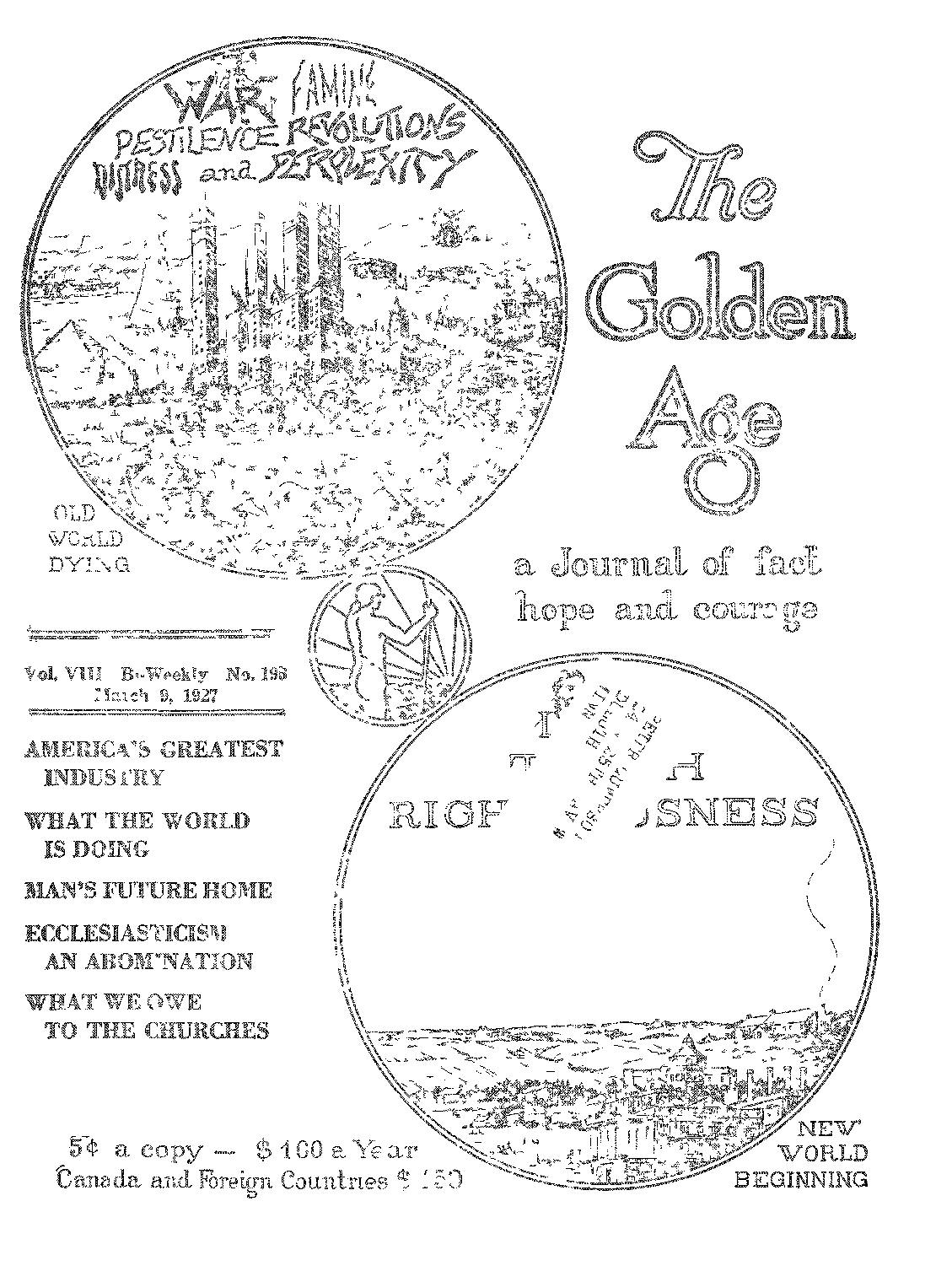
age Golden Age
Vehasss® VIII
Brossklysi, N. Y., W®«iaesdaj'f Msfeh 1S27
Nrambew
America’s Greatest lachistry
IT WOULD hardly be necessary to tell any one who lives in America that the greatest in-dxxotiy of this country is the automobile industry. The evidences of it. are on every hand. It seems a good time to take a glance at. this subject.
In 1741 Solomon de Coste of Normandy wrote a book, in which he endeavored to show that it would be possible to propel carriages bv steam power. Me thus backed up the prognostications ©f the mediaeval monk, Boger Bacon, who foresaw a time coming when “we shall be able to propel carriages with incredible speed, without the assistance of any animal.”
But de Coste lived in an evil time; and because Cardinal Richelieu had never seen an automobile, and did not think such a device was possible, and perhaps did not think that it was desirable, he used his gentle influence with the authorities and had poor de Coste put. into a madhouse.
But others in France, in a later day, took up de Coste’s idea; and there is now, at Le Mans, France, in the magnificent stable on the estate of Marquis de Broc, a steam-propelled stage mid bmlt in J 878 at enormous expense, which made long trips at a speed of about 28 miles ei hour. Tue coach had a powerful engine in f ■■out and chimney in the roar. The Marquis dis-« litinuU infiiie it because it frightened the n ylrioTri horses.
k wsm wd riirilar vehicle, hot less -is.-r> tve, was bu’I by A. J. Reese, Augusta, Ky., in ’58 and v. a- the fit st steam-driven con-triv, to travel Kentucky highways, long preceding steam threshers. Another relatively old automobile, built in 1891, was until recently in active use jn t ’rance and was exhibited in Paris in 1921, atom ingmuch interest. The patriarchal ©Id bus has iron rim wheels and an engine hidden below the body of the car. Its motor is even now as good as ever.
SE5
America entered the automobile field late in the day. One of the patriarchs in this country is Elwood Haynes, whose first ear was tried out on July 4th, 1894. On that date Mr. Haynes, then living at Kokomo, Ind., had his auto drawn by a horse three miles out on a level road. He then took a brave chance, unhitched the horse, and same tearing in over those miles in twenty-six minutes, or at the rate of seven miles an hour!
A year before Haynes made his trial trip at Kokomo, French racing machines had made fifty miles an hour on the old Guttenberg, N. J. race track, at the Three Counties Fair, in 1893. Two years later, at the Times-Heradd Contest at Englewood, Chicago, the best speed made by any American machine was seven miles an hour. This was November 28,1895.
When Mr. Haynes came to Chicago to participate in the Times-IIeratd Contest, he had proceeded not more than six or eight blocks down. Michigan Avenue when a policeman insisted that he leave the boulevard at once and continue his journey by a back street. Auto™ mobiles were in disfavor.
America finally stepped on the gas in 19011902. In the fall of the latter year the Automobile Club of America entered seventy-five starters in a race from New York to Boston and return. The speed limit was fixed at 14 miles an hour. All but seven of the starters finished the trip. Th-re are Fords now in use that are over 20 yews old--and they look it
Importance ©/ the Automobile
IN THE whole world there are now about 24g 600.000 operative automobiles, and over 20,000,000 of these are in the United States. Oneeighth of the total number are motor trucks. More than 3,200.000 persons are employed in motor vehicle and allied lines.
The automobile bill of the American people is in excess of $14,000,000,000 a year. Of this amount 26% geos for mCuT‘ eod releaseries, 18% for depreciation, 14% for upkeep and repairs. 11% for driver^’ wagto. 8% ici gasoline, €% for garage service. 5% for rires 5% for taxes, 4% for interest 0” ir-v Miami and the balance equally divided Mmn insurance and lub 'ieation.
Ninety percent of all phu sennv im the cuto-muhile in profession?! service. Ai least a rraJ-bon persons have i o other w^y of getting fo and from their homes. Lor year's fro oankers ic’d eve!jbody that xlv ancr’GL** v-a* an t-rtiavsw ganee and would ru>» tne 3mrffry, Ite today Amorita could not Jc *te ’* ~fr'S« J ° *s d"%g
^outIL
xi. e’l >quent, ferev il In vuvo tve ?Ia '> rise-Ipf'j rite ter
»>< u. ‘guagc i»e_ t 'i ’onrir^fiiiie,
bit.। ‘Lug yev-v of +re a to t^'c *ia vawsll; dsL oyed dvtsuco; wb h '~fs loaco it tip for m>a to c< a thousand the ■ -•! -ss i.^er jo u e in the
which. las st mi ated v d <ns to sL'dy the ue-c> anics oi the auto ru th as iv.« on gxte'jftilv to eLor iMihanioal pur'ints; vk % des ham«_c<’ ■% lone-fines* of country life and opened up tv the farmer and Ms fairily conveniences ana advantages for doing business vlv’ch be never knew lefare; which has caved thousands of Uvea by the fact tl at ICO.uCO Lw-ci- who ose auto-h obiles can cover the nteance to the bed of ^ckness m a few mlmiles as compared with hours m ire past. . . .
If heaven "had de-M to confer upon mankind wire one great, outstanding Mesdiig for the advancement of Js material interest, for the broadening of human life, for the power to quicken men’s thoughts, giving them facilities to cover distances impossible in the pa«t, to have opened up new avenues of trade and travel, new sources of boundless pleasure, .t is scarcely conceivable that even. heaven could have devised a scheme mors superbly planned for the bereft- of mankind, other than that of eternal salvation itself, thgr? the blessing beetoved by the automobile.
The automobile is properly accredited with* the enormous roadbwldiug program new ‘a progress, calling for the expenditure of $1 (XX),-000,000 a year, to say nothing of the -remei’JvCb upbuilding of all suburban comnmn Les.
It has reduced the expenses of irr v.dir g cab s-wm It has become w o-Ftee most important exported coirmodM^s. It ettp’rs ere person in seven of the popuM’CJ. I# i«* a 5raa+ed that the country ityelF ro-’M ateote Lroo tndlion a rs per year more -1 v. Ite 4',-ven mih on now bought The averag' cot Gt < wfrg pi d operating a ear is $700 a year.
States registering ever a million cars a year are, New York, Cabfcr-ma, Pennsylvania, Ohio, Illinois, Michigan; over half a million, Texas, Massachusetts, Indiana, Iowa. Missouri, Wisconsin, New Jersey, Minnesota; over a quarter million, Kansas, Oklahoma, North Carolina, Florida, Washington, Nebraska, Virginia, Kentucky, Connecticut; over 100,000, Tennessee, Georgia, Colorado, Maryland, Oregon, West Virginia, Louisiana, Alabama, Arkansas, Mississippi, South Carolina. South Dakota, North Dakota, Maine. Di«+ri',+ of Columbia. Rhode I«Iaad; over 50,000, Montana, Utah, Idaho, New Hampshire, Vcrmorri Ariwa; over 20,000, New Mexico, IVyoming, Delaware, Nevada.
The largest per capita automobile owner-Lip i claimed tor the little island of Martha s \ me-yard, 20 miles long by 5 iteles wide, where there is a machine to every 3.77 persons. The rcH-dont population of the inland is 4,720.
Influence upon liailro&Js
TIE sudden expansion of the automobile into the largest transportation unit of the coun
try has ox course greatly affected the railways. The automotive freight shipped over the railroads of the United Stares last year amounted to 3.040,000 carloads, a very great factor in IM railroad traffic of the country. ■•
But it necessarily follow that a very Jarga part of those 3,040,000 carloads will cut into the future freight loadings of at least some of tha railroads of the country. Every one of those cars will carry either freight or passengers, and that is the business and the only business raite roads have.
Every now and then reports come in that thia* or that branch line of some railroad has beeB abandoned, and many more will have to go. TW short line railroad is a bad investment, except under unusual conditions. Thft motor bus aW the motor truck can do all its work and giw tetter service for less money. Not ar® the rail»> roads always treated fairly. ’
The Boston and Mte'ne Railroad Company has pointed out that while it was compelled to pay $152,000 in local raxes from Greenfield to Springfield, inclusive, much of which went ifttft ♦he ccnsuractjon and maintenance of highway^ practically aU of its passenger business wa»7 taken away by bus companies which, paid mA- ‘ irg for the use of the toghways thus provided.
The only section of the country where the railroads admit having been benefited by the automobile is in the so-called Black Belt of Georgia, Alabama, Mississippi and Louisiana. -The railroads in this area are far apart, and there are not many first-class highways. In this area the automobile has become a feeder of rail’ road traffic instead of a competitor.
Enthusiasts of the auto affect to believe that in time it may displace the railroad altogether, but we think the railroads are here to stay. Th© economy and efficiency with which railroads can haul immense loads at- high speed seems to give them a permanent place in human plans. >
But it is pointed out that while a railway locomotive is hardly safe at a higher speed than 65 miles per hour, yet a racing automobile on a broad firm road can make 90 or 100 miles an hour, and has been known to ran 1,000 mile® .without a stop. !
Estimates are that motor vehicles take $200,1 ©00,000 more annually out of the public than the gross earnings of all the railway lines in the ©ountry. The competition is increasing all the time, with air transportation looming up not far, ahead. 1
''Automobile® in New York
NEW YORK is not like many other great cities where the traffic can spread out. The island of Manhattan is long and narrow, which makes an ugly traffic problem to handle, but it is sur-, prising to see how well it is handled. Traffic moves rapidly and in great volume. *
Automobiles and tracks work much damage' to city property in a year. In Central Park alone about four cast iron lamp posts are mowed down every week, with more in winter than in summer. The smashing of sidewalk corners, due to turning the4eomers too sharply, is a common occurrence.
Th® speed law of New York City is 30 miles, bo fine; 31 miles, $31, with $1 extra for each additional mil®. For second offenders a fine of $50 and two days in jail; for third offenders, $100 fine and five days in jail, plus revocation of license.
Parking is a problem in every city, and increasingly. It is specially difficult in New York. !A change in parking regulations has been known to ruin a restaurant, which could not aecommo-ftate itself to the resultant loss of patrons.
It is estimated that 75% of the tracking business of New York City is in the hands of the United States Tracking Corporation, which is an amalgamation of twenty-seven or more smaller concerns.
Many a narrow-minded pinhead who would not have an ex-convict in his employ, in office or factory, confidently entrusts himself and all his valuables to these same poor fellows, who must work at something, and who have found that they can make an honest living by driving a track or a taxi.
And it is not so easy, either. Sometimes a taxicab driver will lose two hours waiting for a , passenger. He must be of sound physique, with ‘ good eyes, without epilepsy, vertigo or heart trouble, dean in dress and person and not addicted to intoxicants. The taxi rates are low to New York City—15^ or 20$ for the first onefourth mile, and Rt for each additional onefourth mile.
Automobiles in. Other L^nds
THEBE are over half a million automobiles in
Great Britain, a like number in Canada, and a slightly less number in France. Germany, Australia and Argentina each have over 100,000. Italy, Belgium, Spain and India each have 50,000 or more; while New Zealand, British South Africa, Sweden, Dutch East Indies, Brazil, Mexico and Cuba each have 30,000 or more.
, The United States has one automobile for every six persons, Hawaii one for every eleven, Canada one for every thirteen. At last reports Afghanistan had one ear, the kingdom, of the Hedjaz had four cars all told, and in China there was one car for every 31,871 persons.
In 1907 an Italian drove his motor car from Peking to Paris, a distance of 10,000 miles, without a mishap. The trip was mad® via the Gobi desert, Moscow and Berlin, and consumed eight weeks. One of the most elaborate ImUet-yroof ears ever made is owned by the governor-general of Manchuria.
Spain imported 14,000 ears last year and is now expecting to make her own, or at least soma of them. Britain and Japan prefer small rara.
There are many motorcycles in England, soma of them of a type never seen in America. Henry Ford has opened a branch, factory st
Chester, England? with the expectation of doing |iBtsHSs there shortly; • |fl|<s- . Bi Until recently it was against the law to
Operate a inetc-r vehicle in Bewnufia. In '?&-salera the government requires that toto be •used on automobiles in place of horns. The speed limit of Nazareth is fixed at ten miles per hour.
Writing of the difficulties of taxieab drivers In London the Manchester Owsrdte® says:
A young man. who haa just succeeded, arte? aiany aiterapts, A passing the Kxsmimtioa for a iicenaa to drive a taxi-cab, has given roe his views about the great-»ess of . '
test questions embrace die whole of the Metropolitan -’frit ' * * v 4 - > .
ef learning, and less than SOfg of those who take the knowledge test ever manage to survive to the end.
Comes of Airtowtsbile Accidents
THE causes of automobile accidents are being -1 examined, critically at this time. Most of the accidents are the fault of the drivers of the cars. When drivers go out without knowing whether or not brakes and steering gear are in good order, whether or not there are any loose nuts, whether or not there is plenty of gasoline, oil and water in the ear, and whether or not there are proper tools and spare inner tubes on hand, trouble may be confidently expected sooner or later. . .
Headlight glare is a cause of many accidents. The General Electric Company is trying to perfect a system of lighting country roads which may make the use of headlights less necessary than at present. But how a driver can be presented from using bright headlights when he should use dim ones is a puzzle yet unsolved. A. late device illuminates the front hubs of cars, so as to indicate the extreme width, and in a measure offset the effect of headlight glare.
Drivers gel too self-eonfident. They increase Meir speeds beyond either necessity or reason, gad when, something goes wrong they find the car is out of control. Experienced drivers occasionally go to Bleep at the wheel, especially cm long, straight, level stretches of read. It is ri aimed that only one out of four drivers approaches grade crossings 'with sufficient cam to insure safety. .....m; ■.
Hr. • .rm pla.-^c mififoci" sign.- m ernrrifiumy f "Mto of w '‘fond on fwum ‘ ■ bed g pto d ~f
e.rcwrms in mfo a vrv rw to h’do foe view of 1 th“ crossing jtsrifi or .ma curve in such a way ps to hide the continuation of the road, and the &pp. much of coming cars. piri|||||||||
Some intersections are so situated with refer-enee to important highways t’mt ftoy have to -e&rry sore travel than is safe, w ti.n five corners at L~r x, I ; . 'r a dri r -ri to.t 40,000 autorm., wmy ricrircz..’ h*.li« ' day. A test at midday shotted. ‘ 0 < am s- ; ’~u< m ; from 12.10 to 1.10 p. m. ‘
'Accidents to Pedestrians and Others ......
"fT IS r. * _ . ' '. w. uai
*3' " . ' • . " ' I a _ ; „
less the driver is there also. Emergency brat-:,: sometimes release themselves. This happened near New 'fork, and a 'woman and child barely escaped death because the woman instead of.....
knowing how to - - - T y' < f - -how to use her lungs.
- . ,, t . - p > -Z.n m- , _ , .
2,150 persons were struck by autos elm mrt? crossing streets at other than regular crossings. This resulted in the Botary Club of that city putting on an intensive campaign to -teach rite ■ ■ people three words, "Cross at Crossings.”.....• • • ••<■
In New York City, over a period of four years, 1,772 pedestrians were killed by privately owned cars, 942 more by motor trucks and 112 by taxicab drivers. In nearly all of these instances the drivers were going too fast, though the pedestrians were at fault, too. It has been suggested that all pedestrians on dark reads' should arm themselves with lanterns, so that the drivers can see them.
As a matter of fact there are myriads of peapie driving ears who lack the perfect eoordina-tioa of mind and muscle which is necessary fcz the proper operation of such a vehicle.
Shefeto Trjfinff fo Frotert Itself
SOCIETY is trying to protect itself agamsV, the loss and maiming of so v m > ' ‘
bera. Signs forewarn of steep grades r bril curves or bridges. O’ a’?ro. - a . write-’ washed. In one instance a human 1 rr "
les was sent .about the highways with ».vroo^gg leg and a handful "" M' " * ' to to
moWists if they would like to yr re ago.
•The New York Tirs.es cord to to- foil to’ ing ten, commandments for greater road safety •
(1) Always remember you are an engineer, fully responsible. (2) Always test your brakes when starting, and have them inspected frequently. (3) Never pass a street ear when it is stopping, or, if the law permits, proee,'d very slowly past it at the legal distance. (4) Exercise especial care in crossing in front of & street ear or in passing it. as you cannot tell what may be coming on the other side. (5) Always signal with hand when slowing down, turning or stopping, even though you have an automatic or mechanical warning device. (6) Look before you back, and sound the born three times. (7) Try to drive with using the horn as little as possible. A sudden noise may stop pedestrians in their tracks rather than warn them. (8) Do not cxmnt too much on the common, sense of the other fellow. No one is 100 percent alert all the tune. (9) Drive slowly in streets where children are playing. Remember your own ehihlhood, (10) Cross crossings cautiously Warning bells may be out of order, watchmen or gate oper-ato-s may be off duty. Trains cannot stop as quickly as you can. Shift into second to avoid stalling on tracks,
The courts do what they can to protect society also. Fines, jail sentences, the impounding of machines, and the bringing of crippled victims face to face with those that have maimed them, have all been used. In New York a child who lost both arms by a truck running up on the sidewalk was awarded $60,000. But even $60,-000 for the loss of both arms is nothing. Who would be willing to lose one aim. for that sum, to say nothing of both?
Automobile Fatalities
ITH over 20,000 automobile fatalities a year., or about one per year for each 1,000
u»adtines m operation, the consideration of automobile fatalities is an unpleasant task. The total nuumte killed by aiwomubiLs in the United States jr. W’"J was 22,500. The number of fa£alit’ss in 5926 was slightly loss than in 1925. "Ls improvement is 'raced to tbr greater caie fui’roi dAw voder 15 years of age. due to ,-di s. at on j the .cJLooJs.
The steaJj.y inci^asing deata <-ate for several years was due to the greatly increased use of automobiles owir the year previous. In 1917 there were only a fourth oi the autos on the streets of America that there were m 1925. It stands to reason that four times as many ears would make some increase in the fatalities.
In St. Louis a monument has been erected to automobile-killed children. It bears the inscription, "In memory of child life, sacrificed on the altar of uaste and lecklessness.”
Does Siotwinff Breed Rudenew^
THERE is a general impression among many that motoring breeds rudeness, that there is not the fellow feeling for those in trouble that once prevailed among those who used the highways. There is no question but that the ownership of an automobile generates in certain types of minds a. feeling of power, selfishness, and disregard of the rights of others which engenders like feelings on the part of those who have been mistreated. When one has been treated with discourtesy by another, or by several, the tendency is. to pass it on.
Hogging the road, hogging the parking spaces, refusing to help fellow autoists in trouble, and thanklessness or worse toward those who do go out of their way to help—all move in one general direction. Besides this there are many drivers of automobiles who have no good intentions toward anybody. It is well known that the automobile is one of th@ greatest auxiliaries of crime. Every modern gang of criminals has its chauffeuras a matter of course.
Some small towns are discourteous to all auto-mobilists passing their way, by seeming to take it for granted that every one should know the name of the town, a most unreasonable idea. Courtesy begets courtesy. Ill-treatment or discourteous treatment suggests & like course.
Effect upon the Health
IT HAS never been claimed for the automobile that it is an unmixed blessing. To hold that its effect upon the health is uniformly good would start an argument right away. There are people who are made nervous by automobile ndinv, and there are men in New York who are vr-nliing to come to Now York City by that mod** ui conveyance for that reason.
Coitain Sfrests a-e obnost vnhvable on ao-cGimt of thv noises maae by the passing automobiles, and by Ine gases wh”eh thex Jisehaige. it is behoved that the menace from fu res • be overcome if the gases were discharged vertically from the top of the car, and it may come to be required eventually flat it be done in that 'way.
Automobiles are very destructive of wild life. In making a trip of 632 miles by automobile in Iowa, there were counted 225 dead bodies of reptiles, birds and mammals, while on another trip of 211 miles, there were counted 105 dead arurnals Thm* fi imres c-n^u-st a d^ily los** of all species of aor^hlp and Wri of somewhere in the neighborhood of l«OOJ,OiX).
Tfc? TMfi &f Afflt&sn®Mes
TN 1920 H v,as paid that ^pc-r^h M the esis ** manufactured annually fell into the hands of tMtm Fiynns of an ^’isuranee eoiopanx ••— Hivrtc that 250,000 cars, valued at $218.(Xk.O’J0 were stolen to the IT. S. last year, but four out oi the five stotou cars were recovered.
w ow diere ”ei>, gaiag •> n Jie vldnny nt the great cities vhicb 4 a - wg hu8.,<«n>s vorbing ok «rcl?u t r ,-ner. bodies,
ri More accurate methods of ® at«» legrrtra-i j ’ l'avo stoppo 1 §0T> e oi ■£
1 May mobi of the cars ®foh>-j &i. fak.-«. by jn»- ideib, who ahtuckn lie ux L~ t it has £< rved its purpose. TLt lock is the Kst pn lee-t.-ui aguuiit theft, because a. soil cs the part use «4 diverting the attention of the thief to the car wai by that is not locked and therefore more (triy secured. In Brtckly^ somt years ago a down automobile owners got into trouble with the police by arranging with thieves to steal thmr ears, so that they could collect the insurance and buy new ears.
New methods of stealing cars come up ever and anon. One method which has been used sue-cessfully is to shadow a car known to have Uquoaj aboard. The thieves, disguised as revenue officers, confiscate the car, telling the owner bw he can recover it. But fearing to get caught he lets the eax* go.
In Ballas, Texas, «n auto thief hired'an attorney to get Juin off on a ehaige-ojbstealing a car, but was unable to pay the attorney’s fee of $400. Promising to pay*vn a few miiMstfc^-ae went out, stole-the lawyer’s own car, sold it for $600 in cash and. offered to-tako the purchaser to dinner. After ordering a big meal he pretended to be ill, slipped out the back door, wentiaround in front and stole the car-agai^y drove it back to the attorney's office, went inambpaid his bilheud had $200 left. ’
In New York City an automobile parked opposite Police Headquarters, and m dear viw o£ the Buieau of Criminal Identification, was stolen at noon wliile detectives and plain slothes men, police officials and patrolmen passed and repaasod yithin a few feet.
_ has a law which automatically cancels the license cf any thief, and another which 1’equhes ewy ^ar owner to take out a policy of at least $5,000 cn every ear that be owns or opsiates.
Automcb’e snavtyards have been found ih 5ar,Gjs pacts. one cu, Summit, IL., in an old tjuarry, ohe re Lake Thue near Buffalo, one m th/* Eo.«t Lnei, off IlJletl’s Cove, cars put there ay cnneis so ’•fiat they could collect the iufeuiince. nr left Lmie by ioj udeis to escape detection. One autcmot.le graveyard, where at tai* w-.r t vuk v r io <ca y c.»nri % auce on toe put cf the owners, was fennd off Corpus Chii!--.i5 Te^as: *har many cats Laung bc< n 'e-coveicd hem th*2 bottom of Mieles Bay. t het® th.’'” *■’ere an ri by tic p nt Elenin 'HuH. S'rt i pt over 'hat city.
.4 Few n;nt^ for C&.r Owners
BOM vaiious. suuucs we have coilertri a few mi +s foi ovjuers o" cars. If you car.
get any benefit out of these hints we are glad:
An auto expert recommends using a stethoscope for listening to the heart-beats of *he motor. He has found this valuable in locating causes of trouble.
Autos are shattered by bumps. A car that is kept on -smooth roads will last almost indefinitely. The more the bumps the shorter the lite of the car. No machinery ever made can stand such rough usage continually.
Parking ears so that they rub against the curb makes the wheels wobbly. Wobbly tvheels wear out a tire in a fraction of the time otherwise required. Loose spokes also greatly reduce the life of the tires.
The New York Worid proposes the following questionnaire for automobile owners:
(1) Number of patois J-®f lubrication on your c&? (2) Give at least three reasons for overheating of engine. (3) Xias and oil consumption per mfie. (1) Hoad speed in miles per hour at which engine will perform most« efficiently and economically (5) Firing order of cyhn- ’ ders. (6) On average road, driving at a speed of 23 miles per hour, what dtoance is required to bring your car to a dead stop? (7) Driving in high speed on a Iciel roan, vhat is the lapse of time in seconds to accelerate hom five to twenty five miles per* hour? (8), How many gallons of vater are required to fill the cool-mg system if your cai ? (9) TWial i« the purpose of the various speeds of a transmission? (10) What is the wr* rect giade of Imbricating cd you shoulu use for your cart
S&m.e Projected Improvements
IT IS predicted that as the automobile engine was really the cause of the airplane coming into practical use, so the development of the airplane engine will ere long greatly increase the power of the motor car. The claim is made that a six-cylinder engine need not weigh more ilian 120 pounds to generate fifteen horsepower and give thirty to forty miles to the gallon of gas. The Diesel engine in miniature offers possibilities of even greater mileage.
It is predicted that the closed car of the future may not weigh over 9C0 pounds and that it may be principally made of cotton. Great improvements are considered possible in the tire mechanism. involving not the abandonment of rubber but alternate rings of it with, other materials.
It is interesting to know that the steering wheels of Ford ears -are made of .straw, mixed with rubber and other materials, and subjected to live steam while under a pressure of 2,000 pounds do the square inch. As it cools it takes ©n an almost flint-like hardness.
Some persons profess to believe that the time will come when automobiles will be propelled by coal dust, which may happen, for almost anything can happen nowadays; but it does not sound very convincing. A French scientist declares that the automobile of the future will h@ driven by water, which will be catalyzed in the car, so that the propulsive force will be hydrogen gas. This does not sound convincing, either.
Il is significant'that many inventors in varK ob parts of the world continue their efforts ta find a" substitute for gasoline. Methanol, a Get-ynafr-produet, it f reely predicted, will soon bc-eome cheaper than gasoline and is a better fuel Natalite-, made of-decayed vegetables, garbage and other not at present deleetable materials; it is said can even now almost meet the price of gasoline. In Britain alcohol made from sugar beets and oth^r sugary, starchy or woody materials, is considered a coining fuel. Perhaps Natalite is only another name for this alcohol
Automobile Oddities
HE Oldsmobile five-passenger coach, it is said, though rot so intended by the designers, may be easily and quickly transformed into a perfect Pullman sleeping compartment
A man at Bangor, Maine, has an amphibian motor car and motor boat, with a seventy horsepower motor which enables the craft to maintain a speed of twenty-five miles on wator and fifty miles an hour on land. Air-tight pontoons under the running board keep the -e&T afloat.
The IT. S. Army has perfected a motor CM that will respond to guidance and operation by wireless, and the ear has been driven without anybody aboard through crowded city streets. It is operated by wireless from a ear fifty feet in the rear.
There is a car in use on the streets-^: Lcmetes which weighs altogether only 150 pounds and costs less than $300. It seems to us that there is a real future for cars of such a type.
The most luxurious car in the world is a 45-horsepower, .^-cylinder car built for the Maharajah of Bharatpiir, Rajputana. It is finished hi solid mahogany and satinwood veneer, inlaid with mother of pearl. The interior fittings ar® of silver and cut glass. •
Berlin has invented & car specially designed io go through the. air with, the least possible resistance. The motor as on the rear The car is called the Rumple®, raiadw car. '
Automobile tramps are now common ih the United States. The whole family goes north in the summer and south in the winter. The mem# bers •work-when they ear, or when they#earc^to% neglect the education of their children, ®®d dangerous and unpleasant factors oftewilisal tlon. t
The Standard Oil Company gives the annmfl operating costs of automobiles in pereent@ge-gs as follows:
©il anebgrease ............—.......x--------..... 1.12%
Gasoline —...---------------- ..... .......... AO.26%
Tires ________________________________.......... AO.42% >
Bepreeiation ........................................'15,38%
-Miscellaneous .................. — ’%0.6offi>
Repairs .................. ..................... 49.17%
Total ......................,.lW.00% t
A Few Speed Records
OME speed records are 153 miles per h»ar by
Milton, an American, in a Dusenbury car, and 156 miles per hour by Major Segrave, a Briton, in a Sunbeam ear. The 3,423 miles from New York to San Franriseo have been made by L B. Miller, of San FrancReo, in 102 hours, 45 minutes. This was at a sjieed of 33.4 miles aa
hour day and night, and is within six hours of the fastest limited train sehedsles. Frank Effiatt of Culver City, California, claims the speedway tecord of 250 miles at an average speed of 127.87 miles an how, which is fast enough.
Ifo fTi8 of Tfu;e
THE following, clipped from a Kansas paper, may find aa echo in the hearts of many auto twners:
My auto, ’tis of thee, start; road to poverty—ef thte I bhsmt: I blew a pile of dough on you rtree yw’® ggoj sow you refuse to go, ox won’t, « «?-'■?. Through town and goantryside, yon were my joy and pride—$ happy day I I loved thy dandy hue, thy alee white tires new; bat now ft seems you’re through, in every way. To thee, old rattle box, earns many bumps and knocks—for I grieve. Badly thy top is tom, frayed aie thy seate ata worn ’ the whooping cough effects thy horn, I do better®, Thy perfume swelled the breexe, while folks wuld dta® and wheeze, as we pass by. I paid for thee a price, *twuld buy a mansion twice; now folks are yelling "lea”, I wonder why. Thy motor has the grip, thy spark plug has the pip—what woe is thine I I, too, have suffered chills, fatigue and kindred ffla, to meet thy repair bills, me® th-ou art min®. Gone is my bank roll now,» mom fwould choke ® cow, as on« before. Yet. if I had the dough, so help me Jota, Td go and buy the whole Auto Show, ®nd speed some more.
What the World Is Doing
ptedlaeast tom WBW ®r ® wav» feagft o£ 4M.4 metes by ft® Editor. I
York?* W&ter
tpHE average daily water consumption of New J- York City varies, according to the prosperity of the times, from 96 gallons to 136 gallons per person per day. In the heart of the hotel ffistriet it is 100 gallons. The whole United States comes here periodically to wsb up. Boston uses only 111 gallons, while Cleveland and St Louis use about the same as Hew York Philadelphia uses 165 gallons and Chicago » 278 gallons, which is twice as us itWmld be.
,. S5rtj“ Aapfe ®
TF ALL the people in the United States were *• to eai an apple a day every day in the year it would take & freight train reaching from Seattle to Buffalo to carry the crop that would be required. As a matter of fact the total present apple crop would only be about half large enough, and only about half of the crop that is jprodueed actually goes io market. But even at that we do manage to eat 125,000 earloads, aud that would make a train which would reach from ComiectMM.it to Missouri. It surely takes some food to feed 125,000,000 people.
X&Ag T®wr< the Feffetabte®
MAN is gradually moving toward the vegetables as his diet. In the United States we are now consuming lettuce of the value of |25r 4
000,DOT per year. The four most important vegetables, in their order, are, the Irish potato, sweetpotato, tomato and lettuce; the first three came from America, but lettuce came from Europe. America added to the world’s diet, sweet corn, green beans and peppers; Europe added celery, asparagus and carrots; Asia contributed onions, cabbage, cucumbers, cauliflower and eggplant; while all kinds of melons came from Africa.
An Improvement in if ilk Serrfm
NEW YOEK is promised an improvement in its milk sendee. The forty quart silk cans are to disappear and in their place the milk will be shipped in glass-lined tanks holding 12,000 quarts each, two tanks to each car. At the New York terminal the milk is to be piped to other glass-lined tanks, which win transport it to the pasteuriratioa and bottling works.
.Ostak S&tg ©f Cnfored Babies
IN THE city of Chicago, of every 1,000 colore infants born, 126.2 die in infancy; while of the white infants only 73 die. But in Leavenworth, Kansas, of every 1,000 colored infants bora, 571.4 die; while of the whites only 77.4 die. These figures show that the colored people get a raw deal di around.
A Nearly PaMew CMMtif th i
HE iajeetis® of a solution of ether and common olive oil, originated at the New York City Lying-in Hospital, is said to have been used in 700 caws in the Maternity Division of the Log Angetes Department of Public Health with such wiformly and markedly favorable results as to herald a new era in ehildbirtln Parh&pg the curse of Genesis 3:16 is now passing way,
T&e Ofcwfer Brtt ,
H® American Bed Cross has published a map showing the iceanoa of the 854 disasters in which it has served in the United States in the past twenty-one years. Few stater escaped, but the principal belt is in the lower' Mississippi and Ohio valleys. A line drawn from Altoona to Atlanta, time© to Galveston, Okla-
homa City and back to Altoona via Stoi«g* irotades most of the mtaataopheg raved. * la' addition there is a heavy showing in westem-Wisconsin, western North Dakota andntwtthnrac ■ Montana. - -
Detroit F. J£ C. A. Brie fa BM
. - dtuuuRedl Th® center of the storm passed wer
qpIIE big business bosses who all Wbatter Bwre« iu-
A ¥» M. C. A. seem to have gotten t&afcdxwtk. strumente, so that the exact speed of the wind tation in Dutch when they ordered the Bxeca- irnot 'known, tat it is believed to haw tern five Secretary to cancel an invitation wtiri he
had extended te the president of the American, Federation of Labor to address the young men -on the occasion of the last annual convention of the Federation, held in Detroit. Big Business is America’s Mussolini, and getting mor® so every
Miami
WBITO in the Maw/octarera' says that as early as last Novwdjer Miami had recovered from the .effects of the Brrart®.
He writes:
I visfeHte stem m of south Florida [in Hot®* aW' as I ri'd just after the stem. tod passed-TheTfwar/ ig positively wonderful, and no visitor to Miami would know any stem had visited tofe phens®a» enal rite had he no previous knwMgc of ®ty di*-tiwtefflw ftse lari rammer. The tart week of Octofer »w m» money and more baanesg torn th« sw: wteS ® year ago. As my interests take me eentmuwsly ©wto® state, both by Win ted by highway, I hav® been & cm* and «®fal The Wins are already erwded into
s-aii Florida, The h^hwyss sr® afire with ■writer^ ** ®wtam ©fibs sfeM^y of tiss state.
M ftawr a®g® ff&ttM 'poiIB tltyg Mete the tamme struck Warf ” the Weather Bureau had sent word to al ■pointe on tha«S«rfh Florida wart to prepare for a burrisme-iten moving westward. An ex* perienoed sea captain made meh disposition of the boats under his ear© that none of them were
125 miles an hour. It required eight days for the storm, to travel from Barbados, where it originated, to Lomriana, where it disappeared. It was not, of wjree, traveling at the «h»® ve« lority al the white.
Hew Hctoptasm fe Produced
ristfeM ffife K M a A ..
the Detroit Y. M. C. Ads withdraw!
of its invitation to the president of the American Federation of Labor, to address its. members, Tfcc Natw» says: , -
The Y» M. CL A is conducting a $5,000,000 bofldfag Wnprign m Detroit, toward which the non-union Wrd fm had pMgcd $1,500,000, the non-wiem Fisher.
corporation $300,000, and the non-union S.- 3. Kresge Company, which pays its girls $7.50 a week, $300,000. Among the directors and officers of the Detroit M. 0. A. ars Trvasn IL Newbeny, who w« feswl to reign item the United States Senate bwame ®f ©mpaiira*wd sees Ala: and Ctales Beecher Warms, whom toe Sesste Mtssd to «nfim m Attorney Several
AT A HCTUKE at Qari Untearrity, W* eester, lass., Dr. L. R. G. Cres&n, fas* baud of the famous medium “Margery**, showed pictures of Margery tatea in seance, with the ectoplasm, pouring from her right ear awl spreading over her face and the upper part her body. Dr. Crandon, who is a surgeon, ®A* mils that it is this ectoplasm, exuded from the body-of the mediwi, which mores tables, ®w &tes voices and produces other gpirifetw pl-?-nomena. The ertoplasm, when analysed, is fomd to be composed of human cells. Our expianafiea of this phenomemm is and always has bees that this ectoplasm is eroded from the homsm rtiy. pushed out, or drawn out, by the demeans have obsessed the body.
Doheny’s $ld@ft00,000 Yellow Peril
IN THE best editorial we have read in a long time the New York World, not content to let an important matter die, takes the hide off the Doheny-Fall defense that they took away Uncle Sam’s oil because of a threat of war by Japan. The World shows this could not possibly have been the case, and gives three excellent reasons to back up its opinion:
In the first place, the oil leases were signed after the 'Washington Arms Conference, which pledged the United States and Japan to arbitration at the first sign oi any trouble between the two countries; second, only one man in the Navy Department urged the Doheny leases, w< ' many men in the department urged
. mt thorn, on the ground that the navy would 1 ds store of oil, vhieh it did; third, if the Deneny defense was true and orders had aeiual-ly been issued for mobilization, Doheny w ?,s under.al .ing a drilling program cover’ng several ye?rs, and war uocn not waff several jears for anybody. But finally, as the World points out Doheny twice testified that he exiwotod "n ma^e $103,000,000 out of the oil Eases. hence ’ a nad 100,000.000 reasons for seeing the velbw peril as yellow as posable.
The Mearagua Muddle
'KJTCARAGUA, at the time American troops
’ last left there in 1926, had a Liberal government, eh ctU by a lax go majority of the votes of the people. By a military coup the Liberal government was oveitniown and the Congress, without consulting the people, elected a new prt'idenf, a Co. .-ewativc. Both the United Sia+es and the Mexican government had adopted, theonih ally, ’he pMcy of sot x^eoguiz ing rulers who have gained, office by force. Following this policy Mexico recognized as the government of F e* ’Tgua the faction represented by Dr. Sacasa, vice precidoxii of the Liberal government that was overturned, while the United States recognized as the government ox Nicaragua the faction represented by Mr. Diaz, elected in the manner explained. This gave Nicaragua two governments. It seems that the best thing would have been to have another election, and not defend a blunder by trumped up charges that Mexico has gone Bolshevist. Sometimes Big Business is a poor diplomat.
Uncle Sum’s War Expenditures
TN THE first four months of 1926 the war ■*" appropriations of the United States Government totalled $1,132,287,000, of which amount $31,312,000 was for the Navy Department, $339, 616,000 was for the War Department, $100,000,000 was for war planes, and the balance was for what is labeled “Independent Offices”, which includes the Veterans’ Bureau as the principal item. The so-called Espionage Act, the purpose of which is to prevent free speech in time of war, is still on the statute books. All is ready for the dance as soon as it begins. If you believe in peace, better speak for it now7, because soon it will he too late; and then the horrid system of lies, murder, hypocrisy, profiteering and bedevilment generally will be again in full swing
Beuting Swords- into Plowshares
ECAUSE a Plainfield, N. J. war memorial contained the familiar quotation from Isaiah’s piophecy about the time coming when swords would be beaten into plowshares, sundry military organizations refused to participate in the deck canon of the memorial These organizations all have their chaplains and all pretend to be Christians. Christ Himself often spoke approvingly of Isaiah as a prophet, but those militarists refer to His words as blatant pacifism. Can it be possible that they regard themselves as superior to Christ?
Senator Owen Tells the Truth
exatob R. L. Owen, one of the principal counsellors of the government in President
Wilson’s reign, now says:
The whole question of the cancellation of the war debts is based on the theory that the late war was as mneh our sfisir as it was Europe’s, that we were fighting for democracy against German aggression, and that we were obliged to take up arras against Germany as she aimed at world domination which would ultimately involve the United States. This is not the true situation ; as any one realizes who has investigated the facts, read the postwar literature and studied the official documents and state papers that have since come to light.
If Senator Owen had said this in 1918 he would have been sent to Atlanta. But it is better to tell the truth eight years late than not to teU it at all.
Deaths by Poison Gm
PROBABLY most of those now living will die by poison gas, when the time comes.
The best for suffocation is phosgene, which eau be earned by the wind far and wide, suffocating all. Mustard gas burns the flesh off. Chloropicrin produces intense vomiting and disablement. Lachrymatory causes floods of tears. Lewisite is a good bnining gas, wlwh it is believed will penetrate any mask and pass down into the kings, burning the victim inside ami out. If the snrply of these runs out there are the disease ink Tobes to fall back on. But the trouble is that when the time comes we shall have no choice in these matrere, but shall Lave to take whichever kind is Landed out to us; and none of them seems to look very good.
.Ve Control of Ga» Warfare
IT SEEMS impossible for the nations to agree on any method of controlling gas warfare.
All nations are agreed that it should be forbidden, but all are getting ready to use it. Part of the nations want an ironclad agreement that all nations shall unite in a gas attack upon the first nation that uses gas warfare; but as every nation will insist that some other nation used it first, such an agreement would mean nothing; and the United States, Great Britain and Japan ~ have refused to be a party to such a pact. They •would prefer no gas warfare at all.
Armies May Be of No Use
PimsinioT Ibvimf of the University of St
Andrews, Scotland, tells us that there is one chemical, a late product of the World War. that could incapacitate a soldier if a single drop ri’ if happened to be merely picked up by the heel of his shoe. Imagine this liquid scattered over a No Man's Land in place of the barbed wire entanglements of the late war. Unaware of this poison on the ground, the soldier stepping on it may still be ignorant of its presence; for it is fatal many hours, even days, after exposure to it. Go if ground, were captured by the batteries of an enemy, it could not be traversed; and no infantry could advance toward the retreating army. The Prophet Isaiah (43:17) declares that the time approaches when cavalry, &mies and all their equipment and appurtenances together, shall become extinct, be quenched as rew.
Bfimp'o- Crops ef Fruit
THE Lord certainly bkssed Amrerica with plenty cf fruit in 1926. One railroad station in Northwestern Arkansas shipped out 642 earloads of grapes. Beikeley County, West Virginia, had a fabulous apple crop; but could not find vays to dispose of if evmt at $2 50 per barrel of 400 apples So it erected a cider fountain in the confer of Martinsburg and invited everybody to help himself to free cider and the finest apples. There was such a glut of apples in the New York maJret that several carloads were given away to keep tlnm i’n m spoiling. But in many fruit stores they continued la sell at lOd apiece.
Coliform® Bursting with Blessings
CALIFORNIA’S orange and leimm crop for 1926 was above the ten year average; almonds were double the 1925 pionuefion; apples showed a 60% increase over 1925; peached were 25% more plentiful than last year; the pear crop was by far the largest ever produced; rice doubled last year’s crop; grapes greatly exceeded 1925, and pasturage is six points ahead of the ten-year average. There seems to be almost no limit to the food California can produce.
Drying Hay Artificially
THE New York Times contains an article by Carson Hathaway concerning a device for ’drying alfalfa artificially. The outfit costs about $20,000, but makes haying independent of the weather, saves all the loaves, which are the best part of the hay, makes the hay more palatable, and saves all the protein and minoials of the hay. It is believed that this device can be used to great advantage in sections where hay is produced prohfically. and whore there is too much wet weather to msure a harvest by usual methods. .All the haj for a locality would need to be dried at the one depot, but the drying cost' per ton would not be excessive.
Cropes Grown ir the South
THE tremendous increase in grape corn'iimp-tion in New York City incidental io prohibition has resulted m a great expense of grape growing. Grapes of the California type are being produced in the Lake county disk-wt; they are admirable in size, color, flavor and ‘lopping quality. In the Ozark grape rtgicn hundreds of ears e I Concord grapes were produced this lasx season. The yield was large and the quality excellent.
Hain Breeds Pests
rpEX AS had a chance this last fall to see what a difference in living conditions can be brought about by a change in climatic conditions. There was more rain than usual during threshing time. As a result horse-flies multiplied as never before. Many valuable animals died. Others were slaughtered at a sacrifice. Milk supply ran low. Teams could not be kept at work in the fields.
Japanese Beetle Pest in Jersey
THE Japanese beetle pest, which somehow got. a start in New Jersey in 1916, has extended its riunous operations over 6,000 square miles, and is advancing at the rate of ten miles a year. The Federal Bureau of Entomology expended more than $100,000 in the last year in the effort to find a way of exterminating ths pest. The entire state of New Jersey was put under quaiairline for the pest; but it spread to Harrisburg, Pennsylvania, and up into New York state. In the business part of Philadelphia last August, twenty-eight of the beetles were found on a man’s hut at one time. As many as 300 have been found on one apple. It destroys all plant life, even roots.
The Southern Cotton Paw
SOUTHERN cotton growers claim that the gwermneiit’s early cotton report for 1926 cost them al least a half billion dollars, declaring that it caused 787,000 bales to be dumped on the market in one week, and that the price consequently dropped $23 a bale* The growers last fall endeavored to organize the entire South, to get a uniform agreement that, in 1927 only a quarter crop shall be produced. In this agreement, in which bankers and business men are expected to cooperate, the planters hope to find a way to work off their present surplus at a lair price. This is substantially Brazil’s method with coffee, and Britain’s method with rubber.
Th® Uses of Per^mwn Wood
MOST people know the persimmon tree for its “puckery” but delightful fruit, but may not know that it is the chief source of supply for the manufacture of golf dub Loads, shoe lasts, shuttles for textile mills, and other articles which require hardness, toughness, fineness of texture and smoothness when subjected to wear. Consequently persimmon wood now commands a higher price than most other native woods of the United States. The supply of persimmon wood is small, as the tree does not grow to large size.
Twenty-Six Million Homes
RADIO men who have been, studying the problem assert that there are twenty-six million homes in the United States, five million of which are equipped with radio. Their present ambition is to make radio apparatus of such types that every one of these homes can be supplied with radio in some form. America is the only country in which no license is necessary for one who would have radio in his home.
Bow the Earth Looks to an Acrobat
HOW the earth looks to an acrobat is revealed by motion pictures taken by a parachute diver at Washington. With an automatic motion picture machine strapped to his belt, he dove from an airplane several thousand feet in the air, turning over and. over for several hundred feet as he descended, until his parachute checked these curious procedures.
A E&rtsme in Old Stumps
A FEW years ago it looked as if about the most worthless thing in. the world was a lot of old stumps. Now they are being blown out at the rate of fifty to a hundred acres per day, and taken to plants where they are boiled to recover the turpentine they contain. The promoters are making millions of dollars out of the enterprise.
Suyar at Tm Cents Per Pound
THIS New York Times contains an article respecting experiments by the Bureau of Standards to making sugar from the roots of artichokes. The aitichokes contain twelve to sixteen percent of sugar as against six percent of sugar in the sugar beet. The new sugar is said to be two to three times as sweet as cane sugar, is not injurious to diabetics, is more palatable than cane sugar, and it is firmly believed can be produced so as to retail profitably at two cents per pound.
'Opening &f the Bunk ®f Sexie®
N SEPTEMBER 1st, 1925, at the opening of the Bank of Mexico, a large photograph was taken, showing crowds of people entering the bank to put their money into the institution. This photograph was published the next mora-ing in the Mexican paper El Denwcsata. Fourteen months later the same iaeitical picture ws published in the magazine Inbcsfy over the curious title, “Catholics withdrawing deposit3 ri ora the Bank of Mexico in proles', against the seizure of Clr rch property.” This information with documentary evidence comes from the Mexican Consul.
CancAto Smp&ssiUe Smnugratlsn Emblem
LIKE the old -time fouiteen-ftf teen game, Canada’s immigration problem is uftsolvabl?. As soon as they exo old enough the joung men fioek to the United States; then they s«nd for their wives and later bring in the old folks. The cities of New Branswick and Nova Scotia show a material shrinking of population, all because the youth have fled to warmer lands. The population of Halifax has shrunk 38,000 in three years, and St. John, N. B. is smaller than it was twenty-five years ago. Canada has arranged with the British government for the transportation of immigrants at a cost of $15 each, but has stipulated that only agricultural workers and domestic servants will be accepted.
Naimt® Szt^s mth
THE 1926 session of the League of Nations was opened with a Roman mass. This cer-omouy consists in brief of a man with a cross on his back ordering Christ io come down out of Leaven and take His place in a soda cracker, Which the man v ith the cross on his back then breaks in two and thus sacrifices Christ afresh, contrary to the Scriptures and to all reason and eomnwi sense. But it was all right, as the League of Nations is a Catholic instiiutioix
ia Oto Brithh Emyire
HE Prime Ministers of the British Dornin-ions meeting in London have solemnly
Bgreed, to use their ow Bngoag6t that “they are retosomc® communities within the British Empire, equal in state, in no way subordinate mm to another in any aspect of their do-mesth
or external affairs, though united, b’y a common allegiance to the Crown, and freely associated as members of the British Commonwealth of Nations”. The title of the king has been changed to conform to the establishment of the Irish Free State as a Dominion. The opinion is expressed in Commerce and Ftnance that “the Empire is now the most singular poLtieal organization on the face of the earth, one of which the United States or any other nation that is acceptable could become a part without sacrificing one jot or tittle of da sovereignty”. And we Lave SueL respect for British diplomacy. ami the vay they have cleaned us out nre ami time again at the barg&uj counter, that we are almost in< lined to say that that is really wnat the whole change 01 front was and is hopmg to accomplish. ’
Details cf the British R491
THE giant British airship R-101, which Is "®- now building, and is exported to be put into service early m 1928, will be 730 feet long, with a diameter of 130 feet in the center, equipped with five engines of 600 horsepower each. The airship will carry one hundred passengers with their baggage and ten tons ©f mail. Mooring mastswill be constructed atlsmailiaontheSuea Canal, and at Karachi, India. The one at Pulham, England, is already up. The trip from Pulliam to Jsmailia will be made in two and one-half days, and to Karachi in five days. By this route and this method Britain hopes to be able to reach Australia in eleven days. Thore will be two decks with all the usual comforts ol home, including shower baths, the water for which will be obtained from the atmosphere enroute.
SBesia Petes for German Rsulen
ALL will remember when Silesia w&g spilt between Germany and Poland after ihv
World War. Fxom the part which was givw to Poland 300,000 Germane wore expelled, with Meme suffering, several years ago. This was don® t© make sure that the eteiuwi Polish majority of 60% of the population would be effective majority. Well! To show hw cfe limwst the whole piece of polities] ritieawry was, Polish Silesia has elected a Germs® ticket in every one of its mclwlrisi ©©stem, ero» induding the capital
Man’s Futore Home
[Radiocast frost Statloe WBBR on a wave length of 416 4 meters by Judge Rutherford.]
THIS morning the country round about is blanketed in beautiful snow. When th© sun, arose, and its brightness lighted up the earth, the snow to some extent reflected the glory of the great Creator Jehovah God. The reverential man is then reminded of the wisdom, love and power of the great God and Giver of every good and perfect gift; and desires to give Him praise therefor.
I opme, however, that only a small proportion e* the rwcipln sfon to consider that j?l> the things beaut till about, us are fxom the gracious hand of Jeboi ah upw of tivu gre concerned Witts otl --w fo* g' ’ a* y are poor ana are meditat-fod- imv t1 y <jn keep warm and pm/idc food fo' th'ir 1 ''-ess >s. Jfoov an wfooat houms. lii net o:j' a small i ercent of ear’us uopuU-tion own th-ir own hemes Homeless, poor end sick the barrtifid snow folds fot Ltd© Merest tO 1 B _
ilow foeridc homes tbfo moraiug a:-gc * <io are Tno-'ltl y5 who have pr> vi] fn” f1 ew '..(Ves «A is.mJ.ie • ah uial money car I nv let fl c” j. u Jhe” rori ertab^e nor havy ' F t a-brought sorrow into their
Lybb " Sn t- >talto, n.e loss of I owed c-iiaa or Lfo’fo. ' '■> t ul>. wa':ac foe worJ cold and (foemhss to t .cm. There is none really happy u-ifos he 'tov’s of foe I o^d
Eat if I cou’d convince you this morning that tie g-cat JTd i1 God puttosof fo give the hrb isce he ’Ifo and s* r ngth of bodv and min provide a h ’Ll for etery one. and establish everlasting peace and happiness, and make earth a ver^a'fo -mradise for marg that would bring conifow to your minds and heaits. I wouhi love to comfort seme this morning who morw, It you wil1 beai* vith me for a fev moments I wih tell you something of man’s future home, and of some of the attending blessings that Got! uas in store for foe human ram.
“But,” you may afo. “ar^ you now about to state what is merely your opinion as to what the future holds 1” I answer, No. The mere opinio^ ©f man on any subject is of small value unless that opinion is supported by competent evidence coming from a truthful source. God’s Word is true. Written in times of old by holy men, who w®re moved upon by the power of Jehovah thus to write, the Bible states what is the purpose of Jehovah God. He never fails in one of His promises. In Jtfo own. due time He will carry them out. Through His prophet Isaiah He says (46:11): “I have purposed it, I will bring it to pass”; and in 55:11: “My word shall not return unto me void, but it shall accomplish that . . . whereto I sent it.”
In my last lecture here I submitted the Scriptural proof that God created man perfect; in His dup time God will restore the obedient ones of mankind to that original perfection. It therefore becomes of vital interest to krow where the Lome of the perfect man wdl be. It is manifest the* in order to be m harmony with his perfect (Tunis® a perfect mar woi 1J. need & perfect < nv, that vhieh is pleasing to the eye and a yjy to the soul.
I*, is > me that the Scriptures show that a few of the ham an race, because of faithfulness dur-ng the Gospel Age, will be changed at the first resmicrtion from luman to spiwt be ncs. But foe forintuies dciimtete show that these will be a very small number. It seems strange, then, fort inieilivent men, who claim to be teachers of firn Bible, have so long held before the people the (bought *nat the only nope of salvation is to go to heaven; and that all those who do not find eternal life uj heaven must be eternally tormented in some place beneath the earth.
These have passed by entirely the great array of scriptures which show that the habitation of mankind in general will be on the earth. Bean ng upon tins point, it is of very gieat importance to know what kind of home Adam, the perfect man created by God, had and possessed It would he reasonable to expect that the Creator would provide that perfect man a home in harmony with his perfection. The Scriptures leave no doubt as to this, but dearly state:
“And the Lord God planted a garden eastward in Eden; and there he put the man whom he had formed. And out of the ground made the Lord God to grow every tree that is pleasant to the sight, and good for food; the tree of life also in the midst of the garden, and the tree of knowledge of good and evil. And a river went out of Eden to water the garden; and from thence it was parted, and became into four heads.
“‘The name of the first is Pison; that is it which eompasseth the whole land of Havilah, where there is gold; and the gold of that land is good: there is bdellium and the onyx stone, And the name of the second river is Gihon; the same is it that eompasseth the whole land of Ethiopia. 'And the name of the third river, is Hiddekel: that is it which goeth toward the east of Assyria. And the fourth river is Euphrates.
…