Golden Age, February 9, 1927
Download: PDF — Golden Age, February 9, 1927
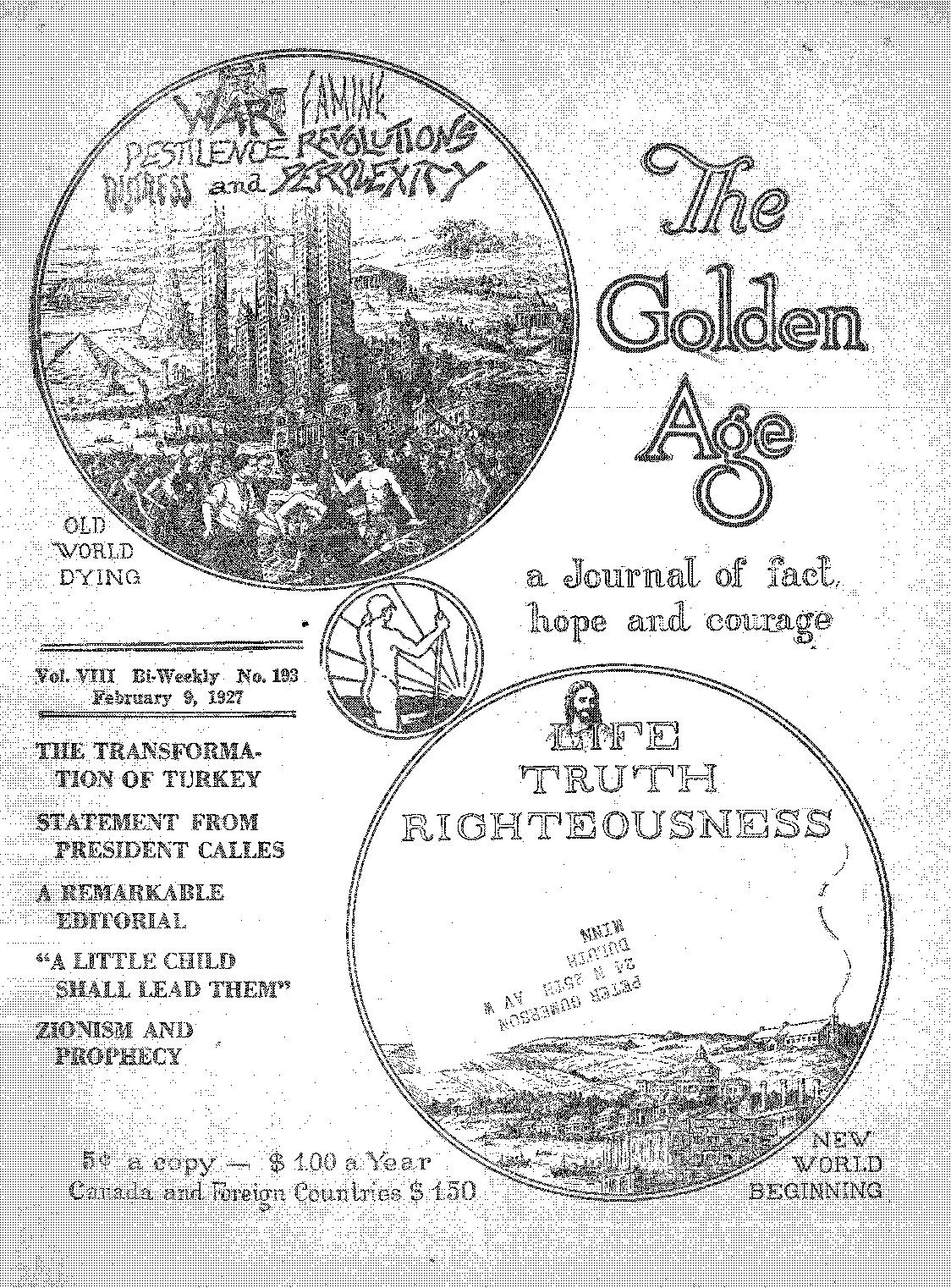
Contents of the Golden Age wfc=-===^^
Labor and Economics
Five-Day Week at the Ford Plants ............ 802
Effect of the Five-Day Week .............. 302
Social and Educational
Go Slower and Save the Kiddies ............ 302 A Sncc’ssful Battle with a Blizzard ........... 303 Mourners Walled too Loudly .............. 301 Another Rum Industry Smashed . . . . ..... . . 304
Uphokhng ifco Majesty of the Law ir. Ctioiin? ..... 304
Finance—Commerce—Transportation
Ford Sees too Much Credit ............. . . 302
Four Hundred Cars a Minute .............. 302
Across the Continent in 83 Hours ........ 303
Enter the Pullman Bus ...... . ..... 303
Akron Tire Factories ........ ..... 303
Pennsylvania Installs Safety Devices ........... 303 The B & O Motor Coaches ............... 303
Political—Domestic and Foreign *
The Tkansfoematton of Tubkev ............. 291 A Remabkablk Editobial [World-Wide Conditions] ...... 301 _ Mr. Nathan Straus Puts It Up to Mr. Ford . ........302
j Armed Guards for the Mails ........... . . 304
Mail Robbing Is a Poor Business ...... ...... 304
&.NOTHEB Statement From President Calles ......... 310
" Religion and Philosophy
"And A Little Child Shall Lead Them” .......... 305 Bible Questions and Answers .............. 311 Zionism Fuinusa Pbofhecy ............... 312 Little Studies to® Little People ............. !?13 Studies in “The Hasp of God” .............. 319
Published every other Wednesday at 11" Adams Street, Brooklyn, N. Y., U. S. A., i>y WOODWORTH, HUDGINGS & MARTIN
Copartners and Proprietors Address: 111 Ailaiat Street, Sroolclyn, N. V., U.S.A CLAYTON .1. WOODWORTH . . . Editor ROBERT J. MARTIN . Business Manager WM. P. HUDGINGS . . Soe’y and Tfeas.
Five Cents a Copy- $1.00 a Ybab Maks Remittances to THS GOLDS# AGS Xotice to Subscribers; We do not, as a rale, semi a card of acknowledgement for a renewal or for a new subscription. A renewal blank (carrying notice of expiration) will be sent with the journal one month before the subscription expires. Change of address, when requested, may be expected to appear on address label within one month. Foreign Offices : British ..... 34 Craven Terrace, Lancaster Gate, London W. 2 Canadian ......... US-40 Irwin Avenue. Toronto, Ontario Australasian ....... 495 Collins Street, Melbourne, Australia South African ...... 6 Leiie Street, Cape Town, South Africa
Entered as second class matter at Brooklyn, N. Y.s under the Act of March 3, 1878
Golden Age
V®hxm® VIII Hjmskyloj No Y,s W®djraes^ay9 Fdbsrsxagy 1S27 Msamher
The Transformation of Turkey
ALTHOUGH the Turks or Turanians themselves claim for the Turk direct descent from the sons of Japheth, yet historians generally are agreed that they aie of Mongol ©rigiii, from the region north and west of China, perhaps from around Lake Baikal.
Early in the thirteenth century, two or more Turkish clans were living in the northern part of Persia, having migrated thither from their own grazing lands far to the east and north. Then a war came on in which the Persians were involved. The Turks in their midst took a hand in the fracas and their side won the fight The result was that these Turks were awarded a grant of land in the northern part of Asia Minor. Omar Khayyam, the poet, was of this tribe. He died in 1123.
In the year 123S a son was born to the chief of these Turks. His name was Osman, or Othman. He was the founder of the Ottoman Empire. A just, truthful, energetic and capable man, he died at the age of 70, the ruler of a large territory, accepted as the head not only of the Turks but of the Phrygians, Cappadocians and Cili-caans, who then made up the population of Asia Minor. The modern Turk is a blend of all these ancient peoples.
Converted to Mohammedanism, and with smiie aataral genius for carrying forward the pc mliar teachings of the prophet, the Turks in Xn I took possession of Constantinople; and Wit. 'i the next hundred years, under the reign of b man the Magnificent, they threatened to ©veni all Europe. They were checked under the walls of Vienna.
In 1083 A. 1). they made another grand effort against Europe, and were barely stopped by John III of Poland, otherwise known as Sobieski. From that time until very recently the power of th© Turk has been waning everywhere.
Byzantium~~~C&nstantm&ple-^S tamb&al
TN THE year 660 B. C. a band of Dorian i J- Greeks settled on the site of the present city of Constantinople, calling it Byzantium. On the 11th of May, A. I). 330, the Emperor Constan- , tine changed the name of the city to New Borne,. and inaugurated it as the new capital of the Roman Empire. The chief patriarch of the Greek church still signs himself Archbishop of New Rome. To perpetuate the name of its founder the name of the city was changed to Constantinople.
With the wealth of the Roman Empire at his back Constantine, in an incredibly short time, made New Rome a city of churches and palaces ; and such it has ever remained. But today the royalty that inhabits its palaces are the American and European tourists. Roman emperors and Mohammedan caliphs have passed away, and their palaces have either become uninhabited or have been turned into hotels.
Along the edges of Constantinople’s waterways today stretch twenty consecutive miles of the most famous palaces in the world, or their ruins. In the Dolma Bagtche palace, 2,100 feet in length, were housed 1,200 harem inmates; while the stables had a capacity for 600 horses, and 150 coachmen and footmen.
Constantinople is surrounded with water on all sides, except on. the u^st. Like the center of Pittsburgh, the city is triangular in shape. It has great markets, consifeLng of hundreds of stops wider one stone roof—some of them so great tl’jt a guide is necessary to prevent a stranger from gettirg lost. The intricacies of its streets baffle all but the experienced. The jzoducts of every country in the world are on display in the market places.
There are three parts to Constantinople— Stamboul, belonging to the Turks; Pera, belonging to the western. Europeans; and Galata, be-
GOLDEN AGE
longing to other eastern peoples besides the . Turks. Stamboul is admitted to be the most quiet, orderly and respectable of the three sec-( tions. Pera is a center of drunkenness and vice, ? such, as westerners specialize in; while Galata, with its white slavery, opium dens and disease, 1 is admitted to be one of the moral pest holes of the world.
In Stamboul it is said that a woman may walk alone at night from one end of the city to the other, unmolested, among the “terribb Turks”. But in Pera she will soon find herself in the company of painted women from so-called Christian countries, and inert whom no one wishes to know. In Galata she would not be safe at all.
Sudden Changes in ike Capital City
BEAT changes have come over Constantinople in the last few years. Immediately after the World War, in the Pera and Galata sections, it was a “wide open” town in the worst sense in which that expression is used. In October, 1923, as soon as the control of the city was turned back to the “unspeakable Turks", 5,000 drinking establishments were immediately closed; and the Greek Christians who had been running them had to seek other occupations.
Turkey is desperately poor, but there has been a great improvement in her city streets during the past twenty years. They have been, widened, straightened and paved. Multitudes of wooden buildings have been replaced with concrete structures. Sanitation has been improved.
Once a very cheap place to live, Constantinople has become a competitor of New York in the high prices charged for things. At her best hotel a single room without bath costs $7.80 per day; while a room with bath, for one person, costs $11.70 per day. Bills are made out in Turkish, and thirty percent is added at all first-class hotels and restaurants as a tax for government benefit.
The markets of Constantinople have been closed to foreign physicians, dentists, pharmacists, etc., who were not registered there before the World War. Even the Russian hospital, as well as several others which rteie started since the war, has been ordered closed. Public drunkenness has been punished by forty strokes with the bastinado, and heavy fines.
SaocKi-Yjf, N. Sa
Constantinople has numerous and exceedingly beautiful fountains, all of white marble. Its mosques are famous. Its cemeteries, of great antiquity, extend for miles around the city and suburbs and have become a great forest. Its quays accommodate 1,200 large ships at one time. The harbor is a narrow stream, called The Golden Hom, deep, commodious and well sheltered.
At the entrance to the late Palace of the Sultan is a largo and lofty gate, styled “the high door” or “the sublime porte”, which latter has become a well-known Turkish diplomatic phrase—all political business being transacted, as supposed, under this portal.
Until recently, when there was a fire in (An-stantinople runners were depended upon to notify the fire depai tment. Four men would then return with the fire engine on their backs: and on reaching the fire they would haggle with the owner for a suitable price for putting out the fire, which usually resulted in the entire building being consumed.
The Location of the City
ONSTANTINOPLE is said to be the most strategically located city in the world.
Though often besieged it has never been captured but twice, once by the Crusaders in 1204 and once by the Turks in 1453. The futile attempt of the British, with its resultant costly sacrifice of human lives in the Dardanelles, in 1.917, is still a nightmare in Europe. Situated at the meeting point of Europe and Asia, it is in absolute control of one of the principal routes from western Europe to eastern Europe, and from western Europe to Asia. Nearly all the waterborne commerce of Russia, Persia, Rumania, Serbia and Bulgaria must pass its doer.
Above the city is the Bosporus; Wow i- toe Hellespont, or the Dardanelles as it is mw called, where Xerxes crossed on his great expedition against Greece in 480 B. C. The Dardanelles are 40 miles in length, and from one to four miles wide. Thei e is always a rapid ew-rent in the channel, which is increased in volume and velocity by the winds which blow in the same direction, with the stream for at least ten months in the year. In 1811 the poet Byron swam the Dardanelles in a little over an hour.
For three centuries no ships could traverse the Dardanelles without the consent cf the
Turks. For centuries previous the waters had been the scenes of many battles to determine who should have the right to collect taxes for passage, or in other words who should be the legal hold-up man.
The climate of Constantinople is said to be well adapted to make people easy going, -while < the gorgeous scenery makes an appeal to the outdoors such as is not the case in London, New York, Paris or Chicago. Climate has more to do with temperament than all other forces combined. It is this which is said to Le responsible largely for the charge that the Turk is indolent.
The Ottoman Empire
BOUT the end of the 17th century the Ottoman Empire embraced Egypt, Mesopota
mia, Asia Minor, Greece, Bulgaria, Rumania, Hungary and parts of Austria and Russia. Since then, until recently, it has been steadily shrinking. In 1878 its area was 1,600,000 square miles, ami its population 40,000,000. But Ballcan wars, and wars with Greece more recently, had reduced the European area so greatly that at the beginning of the World War, the area of the Turkish Empire was estimated at only 710,224 square miles, with a population of but 21,273,900.
Since then Palestine has gcme to Great Britain; while Arabia has set up in business for itself, as the kingdom of the Hejaz; and a part of Armenia has gone Bolshevik and has set up a Soviet. The present area of Turkey is therefore but 494,538 square miles, and the population is reduced to approximately 14,378,000.
In 1913 Turkish imports from all countries amounted to $112,000,000 and exports to $81,-000,000. Ten years later, after the World War had left its mark across the face of the earth, Turkish imports had been reduced to $40,000,-000 and exports to $12,000,000. Turkish business of all kinds, until recently, -was largely in the hands of Greeks and Armenians. It is said that the Turks themselves transacted only twelve percent of the business of their country.
Enter Kemrf Pash®
NTER quietly into Turkish affairs, immediately after the World War, one of those
men who change the pages of history—Mustapha Kemal, who, disdaining high titles such as sultan or king which he might have had and with none to say him nay, is content to be known by the relatively common title of pasha, -which means general.
Under the reign of Sultan Abdul Hamid H, Kemal was a student in and eventually a graduate of the war academy at Constantinople. Entering the army with the rank of lieutenant, he was exiled by the sultan because of his liberal proclivities.
He was one of the fomenters of the revolution of 1918, whereby the sultan lost his throne. He -was averse to Turkey’s going into the war on the side of Germany, and had tried to persuade the British to finance a neutral Turkey with the Young Turks, of whom Kemal was & leader, in charge o.f things.
It was Kemal’s fate to incur the displeasure of the men of his own party, and to be thrown by them into prison. Here he pored day after day over a map of Turkey and surrounding countries until he knew every detail. This knowledge he has since used with tremendous i effect.
Unlike most Turks Kemal has a broad, Germanic face, -with high cheek bones; and with his fair complexion and blonde hair he would pass for a western European anywhere. Some writers contend that Jewish blood flows in his veins. He is said to have a pleasantly modulated voice of unusual sweetness for a man. As a military chieftain he ranks among the very highest in modern history. As president of the Turkish Republic he is one of the most remarkable men of this generation.
Whereas he could easily have been a dictator likS Mussolini, with absolute powers, Kemal has labored incessantly and successfully to give Turkey a democratic government. Instead of making the National Assembly a mockery, stripped of all power, he has steadily enlarged its authority and responsibility, and has definitely sought to increase its sense of freedom and self-government. He is the George Washington of Turkey.
Almost Insurmountable Difficulties
IN ATTEMPTING the liberation of his country after the World War Kemal faced almost insurmountable difficulties. The country was in a state of ruin. Disastrous wars in the Balkans had placed the country in dire need of almost everything when the World 5YiarM which was much worse, came along and made corui-twns still harder.
AH the industries of country and city v. • re given over to the production of war nec^-ssili -3. Germany and Austria, where Turkey had formerly obtained many of her requirements., were in dire need themselves; and the rest of f e world was in arms against her. All men ?L.e to bear arms were taken away from agrieultrm ■, Turkey's main industry, with a resultant ri-calculable loss to the country as t, whole.
The country was afflicted v..fn a code 01 mixed civil and religious law?, so complicated that a commission after months of study reported that to codify the laws would take a committee of fifty experts one hundred years to complete the task, even if they worked ten hours a daw Thereupon the National Assembly, with Kemal at their head, repealed ail the old laws in a bunch, and adopted wholly the entire Swiss Civil Code. Besides the 1800 articles taken from the Swiss Code, 700 articles were taken from the Italian Penal Code and 700 from the German .Commercial Code.
The National Assembly, consisting of 200 deputies, sits in a room which looks much Iffle a schoolroom, with three deputies at each desk, like schoolboys. But they are hard-working schoolboys, and they are determined to make Turkey a modem country. Nothing escapes their attention. Even the public clock, which had hitherto shown Turkish time, was changed to agree with the time used elsewhere.
Sc effecrive were the regulations regarding the adoption of European dress that in a day practicaliy every fez in Turkey was discard *1, not a turban or a kalpak was to be seen, and Panama hats were in evidence everywhere, m October, 19’25, a new constitution was adopted, proclaiming a republic, with a president elect jd for four-or five years. Out of 197 votes cast for the first president, Kemal received 196; his o’-.n yote was cast for a friend, as a matter of courtesy.
T/?£ Passing af ths €s3iphsle
TBOK about fifteen hundred years the religicjs X and much of the civil government of Mohammedan peoples has been in the hands of religious sovereigns, called caliphs. At first there yas but the one line of caliphs. They reigned at Medina and their rale extended Io. the limits if the Moslem world. Then, for hundreds of years, there were sectional or factional caliphates, with headquarters respectively at Bagdad, Damascus, Cairo and Cordova. But for the last three hundred years, since the Turks conquered Egypt, the Sultan of Turkey has been the recognized caliph or supreme spiritual head of th© Moslem world.
Like every other union of church and state, the caliphate was one of the greatest enemies of human progress conceivable. The power was in the hands of the religious leaders. For centuries the taxes of Turkey were collected by the various religious bodies—Mussulman, Greek Catholic, Boman Catholic and Armenian Catholic—and the government had nothing to say about how they were collected, or how much of them were turned into the government treasury after they were collected. Under the privileges accorded to these religious institutions, the government was helploss in reorganizing its educational system.
As in Mexico and elsewhere, every attempt at reform in Turkey has found these antiquated and tyrannical religious institutions standing across the path of progress. Envious foreign countries have used the religious systems there as a catspaw in their rivalries with one another, and constantly supported them as one of the best means of keeping Turkey ignorant, backward and weak.
Becoming thoroughly convinced that the caliphate was a source of weakness and not of strength, the Turkish National Assembly in November, 1922, formally ended it by first ousting the sultan and declaring that the temporal authority of the sultan had passed to the Assembly, and then announcing that the caliphate as a temporal power had ceased to exist. Since then Moslems all over the world have been trying desperately to resurrect the corpse of an authority that has passed out. In addition, Kemal and his friends have closed all the monasteries and set the priests to work
The Passing &f the Sultan
UNTIL 1909 Turkey was an absolute m<w arehy. The will of the sultan was supreme Af his death he was succeeded by the oldest living male born in his harem. Until then all children born in the harem had equal rights. There was no nobility.
'• The last sultan of Turkey, Mohammed VI, was unceremoniously expelled from the country in November, 1922. He left the capital almost penniless, and died of a heart attack at San Remo, Italy, May 17th, 1926. In March, 1924, the remaining princes of the House of Othman were expelled from the country. Each was given $516 in money and told to leave the country by the evening of March 7th. The departure was so sudden that they were forced to sell their personal belongings at prices said to average not much more than one percent of their real value.
So ended the oldest empire in Europe, if we bar the pretensions of the papacy, which claims to be an empire but which has no temporal authority at this time; it was an empire at one time, but now is not, though desperately trying to regain its standing as such.
The Pawing of the Harem
HORTLY after the passing of the caliphate, the banishment of the sultan and the dispersion of his family, came new laws abolishing polygamy and requiring the registration of marriages. The harems had become too expensive for the men to handle, anyway; the women were impoverished and were rebelling, and a change was inevitable.
The Turkish family is a sort of elan. The whole elan lives under one roof. In the old days the ladies of the family lived apart, having their own apartments separate and apart from those of the men, and to a large extent had their own customs and laws. The sultana or first wife was a power, not only in the harem, but in the empire itself. The long period of three eentnrieg following ths reign of Solyman the Magnificent is referred to by the Turks as the “Reign of M7omen”, on account of the great power which the sultanas exercised during that time.
The harem suggests to western minds quite a different institution from what it suggests to the eastejier; because the latter knows that while a harem may contain a great number of women, yet most of these are the sisters, sisters-in-law, daughters or cousins of the head of the family, and not all wives or concubines as the westerner supposes them to be.
While the Turks until recently secluded their women folk behind veils and lattices, yet they had the full right to hold property and make contracts, and some have served as regents with marked success. The mother of Genghis Khan was an able and successful general
Today Turkish, women are practising law in Turkey; some of them are serving as editors;, the veil has been done away with. On® is president of a college. Much of the progress mad® recently by the women of Turkey is accredited to that bright and capable woman, Latif© Hanoum. She was the wife of Kemal Pasha, but for some unknown reason he has divorced her. Power to grant divorces rests in his hands by law.
One writer, discussing the emancipation, of Turkish womanhood and the general progress there, says:
To a large degree the harem system has been responsible for the stagnation and deeadanc© of Turkey, for it fa a nemesis even, m a “man-mad® world” that men and races may not rise higher than their estimate of women. The state rest® upon the foundation of the family. With the passing of the harm on® may at least hope for the regeneration of the Turkish peopla.
Edueati&n and Art
IN THE period of the renaissance, 1400 to
1500 A. D., Constantinople was the library of the world. It is to the credit of the Turks that when the capture of the Eastern Roman Empire occurred, in 1453, these libraries, which had been, in process of accumulation for a thousand years, were not disturbed.
It cannot be said that the Turk has been a patron of literature, but it can be said of him that he has been a collector and preserver of it It is said that there are even now in Constantinople immense quantities of rare old manuscripts in Greek, Latin, Hungarian, Arabic and other eastern languages, never yet examined by modern scholars, and sure to throw much light ou the history of past ages.
In the matter of education the clergy have been the curse of the Ottoman Empire, as they have been in every country. The teaching of the children lias been entirely in their hands. As a consequence, the Mohammedan teachers h?ve taught the children wider their ear© that Mohammed knew it all, and that there must never be any progress beyond the mixture of sense and nonsense that goes to make up that palpable plagiarism on the Bible, the Koran.
The Armenian and Greek Catholw schools have been just as bad, but along different Jims. Each of these schools has been a breeding pla 'e of Armenian and Greek nationalism, which bog had on the one hand the objective of a great Armenian state in the central and eastern portions of Asia Minor, and on the other a gret t Greek state covering the rest of Asia Min.'1’, with Constantinople as its capital.
Under the leadership of Kemal Pasha ti e Turkish government is now taking up vigorocs-ly the work of teaching its own citizens something besides the nonsense of th- Koran. Old men with white beards are now going to school and learning their loitcis; over 70,000 adult Turk’s aie going to school for the first time m their lives.
L odor the government of the dead hand if Mohammed, and of the stupid, bigoted mid superstitious priests who have made the teachings of the Koran clear (?) to the common people, painting, sculpture and architecture ha\e been a dead letter in Turkey for centuries. The first public introduction of human statuary into that land took place when a statue of Kemal Pasha in citizen's clothes, executed by an Austrian sculptor, was recently unveiled.
The Turkish, custom of interior decoration is to hang the walls with carpets and silks. Owing to this custom there are no pictures on Turkish walls; although some of them are diversified with colored plates and tiles, and with inlaid brackets supporting lightly engraved brass vessels.
Shackles Slowly Falling
TXT HEN one considers the grip rhat tut Jl< «-’ » lem faith has had upon the Turks. <.~d still has, too much prog’ww ’its! not be . -peeled forthwith. Turkey is just row trying to live a western life with an eastern j dig ion, m d the two do not mix.
Some idea of what effect the Moslem reli/cn may have upon a man may be judged from lie fact that some devout Arabs who have made the trip to Me<wa, and who have ’here seen the sacred stone from which Mohammed is supposed to have ascended into heaven, have borp known immediately to blind both tbtir eyes that they might not thereafter behold anything less holy. “ “
The Turk is not friendly to the Christian religion, because his experience with those who profess the Christian religion has been most unhappy. He has been imposed upon at every; turn by Christian (?) nations that wanted his lands or Iris oils or the Dardanelles or something else, and that have lied to him and about him, in the newspapers and out, until his confidence in them and in their religion is nil.
But Mohammedanism is failing the Turk, and just in God’s due time. Whereas only a few years ago every Turk was required by law to observe the fast of Ramazan, yet it anpears that this year at the College of Galata-Sorai, where its observance is optional, only 50 out of 700 paid any attention to it. What the Turk needs is the ti tifli, and this will be his inheritance sho i’dy.
There is now complete freedom of the press in Turkey, except that newspaper correspondents must confine themselves to the truth and no longer make it their business to poison the minds of the world against Turkey. Otherwise they are likely to get their walking papers out of the country, as happened in three hours to the correspondent of the London Times.
Hou> Terrible Is the Turk?
VERYBODY in western lands is familiar with the expression “the terrible Turk"’, and takes it for granted; but a study of this matter brings to light some altogether unexpected things.
It is conceded that the Turk is of Mongolian origin; but in six centuries, through forcible intermarriage with Caucasians and the living of an independent and indolent state of existence, he has become Caucasian in. appearance and has developed a fine, robust constitution which makes him a dreaded foe. A writer says that “defiance and confidence, resulting from centuries of domination, indifference, nonchalance and lack of ambition developed from the fatalist religion he professes, are the unmistakable signs of his countenance”.
But now note what intelligent men from Christian lands who have spent years in Turkey have to say about the Turks and then’ ways. Their testimony should be given more weight than those who have some religious, political or financial axe to grind.
Pierre Loti, the French writer, says:
I have lived for a long time in the Orient; I have mixed with all classes of society; and I have become absolutely convinced that the Turks alone, in all that mass of irreconcilable races, are at bottom honest, that they alone have delicacy of feeling, tolerance and courage, combined with kindliness.
Alex. L. Jenkins, professor of Mechanical Engineering at the University of Cincinnati, says:
After a year in Turkey I wish to state that the Turks are one of the finest peoples I have ever known, and also one of the most grossly maligned. A Turk’s word is as good as his bond. He will never fail to make good his promise or verbal contract. Constantinople, with its many nationalities, has a reputation of being a city of commercial robbers, filled with liars, cheats, swindlers and every form of dishonesty. With this in mind I approached a Christian missionary for advice which might protect me from these bandit robbers. His only suggestion was the simple suggestion that I confine my business dealings with pure Turks. This I did, and was not only satisfied but greatly pleased. They axe truthful, honest, just and most courteous.
Paul Bowerman, Instructor in the American College in Constantinople, says:
Ae an instructor in an American college, whose students were drawn from the wealthiest and most respected families, I was particularly fortunate in coming into dose and intimate contact with young Levantines of every nationality. It was not surprising to find them almost universally dishonest; but little by little I began to discover that dishonesty could be separated into two different categories, conscious and unconscious dishonesty. Into the first category fell the Greeks, Bulgarians and Armenians—all those, in fact, who lived nominally in the western fashion, who were Christians. These boys knew well enough the difference between right and wrong, as we understand it, and deliberately chose the wrong. They would never admit cheating, even though I had caught them red-handed. The Turkish boys, on the oilier hand, were a novel experience. Quite as dishonest as the others, they could see no good reason for being otherwise, and were therefore quite fees to acknowledge their guilt.
The i«ne write says;
The Turk is no more perfect than the rest of us; but, like most of us, he is good enough when left alone. That is ail he wants. The years of meddling by the European powers have exasperated the Turks, at intervals, to the point of ferocity. ... Ue saw his words twisted into unheard-of promhes; he saw the battleships ateared for action in his harbor and ready to enforce
edfete that iaued ti» Allied wad he suffered the helpless rage of one who knows, he has been cheated and can see no means of redress. . . . The Armenian massacres were inexcusable; hut the world docs not know that equal excesses were committed on both sides, that one Turk has been victimized for every Greek or Armenian. ... I have seen countless photographs of Turkish men and women beheaded and piled in heaps. I have seen tens of thousands of Turkish refugees driven out of Thrace and Smyrna by the treaty of Sevres, which gave that territory to Greece, and I have listened to the ghastly story of their eviction. That, too, has been suppressed.
Another, an American missionary in Turkey, says:
There are two Turkeys; the real Turkey, and that existing in the imagination of foreigners. And the reading of history has a tendency to convince one that the religious persecutions and massacres with which we are so tragically familiar had their origin in that baleful fusion of race, religion, and polities which is the curse of the Near East, rather than in religious fanaticism pure and simple.
Tte SMO to Xngora
/CONVINCED that the safety of the Turkish Republic lay in getting away from the guns
of Christian battleships, the Young Turks surprised the world by moving their capital from Constantinople hundreds of miles into the interior, to the ancient city of Galatia, now called Angora.
Galatia is the same city mentioned in the New Testament, to the Christian church of which the Apostle Paul addressed one of his epistle®. It was founded by Midas, king of Phrygia, in remote antiquity. At one time it was a great city, in view of its location hundreds of miles badt from the seacoast; but declined with the rise of Constantinople. Angora is famous for its eats and its goats.
Conquered in tarn by Alexander the Great* Mithridates, Pompey, the Saracens, the Crusaders, Tamerlane and the Turks, Angora has plenty of history, having been considered $t one tine the most beautiful provincial city of the Roman Empire. The air there is exhilarating and full of sudden changes. The trip from Constantinople is made by rail in twenty-four hours. Sleeping-car and dining-ear sendee is maintained.
The Burning of Smyrna
ONE of the most recent horrors charged up to the Turks is the burning of Smyrna. Like
Constantinople, Smyrna was a cosmopolitan city, the fig and the rug city of the world. In 1909, 110,000 camel loads or 49,500,000 pounds of figs were marketed here. For centuries it has been the most important place of trade in the Levant.
At the time the city was occupied by the Greeks, after the World War, there were then 10,000 more Turks than Greeks in the city. If the Greeks had let well enough alone they would have been there yet; but they conceived the idea of bringing the whole of Asia Minor under their control, and it was a bigger job than they bargained for.
At length the Turks, goaded to desperation, Suddenly came to life. An army was hastily collected, and under the brilliant leadership of Kemal Pasha the Greeks were literally swept into the sea. The Turks had had much provocation. Not only had their country been penetrated deeply by hostile forces, but their seacoast dties had been bombarded by Greek warships, all in violation of the law of nations.
On their retreat to the seacoast the Greeks prepared their own rain by burning cities, ruining crops, murdering and maiming noncombatants, and thus doing everything possible to inflame the minds of their pursuers. Hundreds of villages were thus rained, with, the result that 'thousands of Turkish refugees starved to death. It is hard for soldiers to be kind under such conditions affecting those they love.
Nevertheless, Irving T. Bush, President of the New York State Chamber of Commerce, says concerning what followed:
The true story of Smyrna will never be known. When the Greek army, in their retreat, reached the sea, the Turks were close behind. American, eyewitnesses have fold me that the first Turkish cavalry to enter Smyrna conducted themselves well. The officer in command rode rt the head of his men, calling out to the Greek soldiers to throw their arms into the sea. Nearly all did so, but two substantial American business men. of excellent character saw, at different places in the heart of the city, two Greek soldiers throw band bombs into the ranks ©f the. Turkish cavalry. The officer was wounded and two of his men killed. One at these Americans, who lad lived in Smyrna, for years, srid he marveled at the . mtraint of the Turk when he knew what desolation and
the Greek wops had Mt behind,
The captain of the freighter “Winona”, which was the last steamship to enter the port before the Turks regained the city, reported the occurrence as follows:
I stood near the custom-house and saw the Turkish advance column march through the main street in an orderly manner and hoist the national flag. So far as I could learn, the regular troops under Kemal Pasha behaved well. Civilians were killed and women attacked by the Turkish bandits, who had been living in the mountains since the Greeks entered the country in the spring of 1921. . . . The Turkish soldiers, I later learned, were ordered to stop the slaughter, but could not do much. The soldiers themselves were incensed against the Greeks, who had fired every village in their retreat toward Smyrna.
Finance and Transportation
HpuBKEY, notwithstanding her loss of terri--*• tory, came out of the war in better financial condition than any other European belligerent, for the reason that she had no reparations to pay and no foreign war debt. The extravagances of former sultans must still be atoned for, but the currency has not been inflated since 1918.
The Young Turks have been going in for engineering, and as a consequence they are improving the transportation conditions, which needed improving as badly as in any part of the whole world. Even to this day the freight in Turkey, including safes and pianos, is carried, for miles on the backs of men, called hamels. AH the moving of household goods from one part of a city to another is done by hamels.
In the western part of Turkey there are 2795 miles of railroads. Much of this mileage was destroyed by the Greek invaders, but has been rebuilt by Turkish engineers from the ruined materials left scattered behind. Most of the country roads are very bad also, but the National Assembly has passed a law requiring every male between the ages of eighteen and sixty to do from six to twelve days’ work on the roads every year; and under the skilful direction of educated engineers this is beginning to tell. Motor tracks and automobiles are making their appearance in Turkey.
Agrieultun and Husbandry
FARMING methods in Turkey are an Equated, yet the soil is fertile capable of large crops. Turkish figs, TurMsh tobacco, Turkey
red wheat, and Turkish attar of roses are still famous. Other less known crops which are famous in certain markets are Smyrna licorice, Angora pears and Merzifoum apples. There are 20,000,000 acres of neglected forests in Turkey.
Besides the usual domestic animals of the West, the Turk makes use of the camel and buffalo. He has also to contend with many wild animals, and must take into account the lion, hyena, jackal and wild boar.
Manufacturing and Mining
THERE has never been a geological survey of Turkey, but it is known that there are valuable copper mines at Arghana—-valuable deposits of silver, zine, iron and antimony. There are also supplies of emery, borax, coal, petroleum, arsenic and mercury. These all need development.
Tn 1923 the National Assembly ratified the Chester Concession, which empowers the Ottoman-American Development Company to develop oil, copper and iron deposits; build railways, canals, ports and cities; engage in forestry; install telephones, telegraphs and electric lights; construct hotels, health stations, banks and observatories. It is also to build for the Turkish government, in some open and appropriate spot, a perfect capital, with buildings surpassing those of any existing capital. For some reason this concession is slow in functioning. Perhaps it fears the new liberal government.
Turkey has few factories, though there are important productions of rugs, carpets, leather, oils and soap. New laws have been passed regulating these and all other industries, in the interests of the workers.
Mining companies must provide houses, baths, dispensaries, kitchens, schools and mosques for their workmen and children, and must also provide working clothes. All forced labor is forbidden. Children under sixteen cannot be employed below ground, nor under thirteen at all. Meals must he provided at a uniform price. The working day is fixed at eight hours, with double pay for overtime. In ease of non-payment of wages when due, coal or other assets can be seized and sold on behalf of the workmen. There is enough in this to frighten New York capitalists, who do not believe in such things.
Getting Rid of the Patriarch
emau Pasha is certainly a long-headed man.
Not content with getting rid of the Moslem caliphate, which has made its headquarters in Constantinople for three hundred years, he has also gotten rid of another religious incubus; by taking advantage of a technicality he quietly dispossessed the Patriarch of the Greek Catholic Church, which had its headquarters in the same city, and which for five hundred years has been an international nuisance. Kemal then ap« pointed a Turkish successor.
There was a general howl when the GreeK Patriarch was ousted; the Catholics said that Kemal the Mohammedan was persecuting Christians; but the man whom he ousted was discovered acting as a spy for the Greek government, and since he had personally entered the country since October 30, 1918, and therefor® automatically came under the exchange provisions, Kemal thought it would be a good time to give him the air and acted with his usual promptness and effectiveness.
The smug church press yelled its head off, with the usual papal line of talk that “the ecumenical patriarchate has always remained beyond the jurisdiction of international conferences, because of its spiritual [1] and exclusively religious [?] character”; but the old boy had to go, and the air in Turkey is already better for the change. Kemal is a 32nd degree Mason. At present the Greek Patriarch is in Greece, traveling throughout the country and making what trouble he can for the International Bible Students and any others who dare to use their brains in his presence.
The Treaty of Lan same
AFTER the World War the powers dictated the Treaty of Sevres, whereby Turkey was to give up almost all her European territory, including the city of Constantinople, with a neutral zone on both sides of the straits. Turkey was thrust back into Asia and the Greeks were encouraged to take what was left.
This program all worked nicely except the last part, namely the part the Greeks were to play; and but for Kemal Pasha and his knowledge of the Turkish map that might have succeeded, too. But it failed; and after driving the Greeks into the sea at Smyrna the Turkish
80© troops suddenly showed up in overpowering strength on the eastern shore of the straits.
It was not convenient at that time for the British to engage in a new war with the Turks, so peace negotiations were opened. The result, after five months of deliberation, was that Turkey got back all she had lost, except that the control of the straits is now, theoretically, in the hands of a Straits Commission, consisting of one representative each from Turkey, France, Great Britain, Italy, Japan, Bulgaria, Greece, Rumania, Russia and Yugoslavia. If the United States signs the treaty it will have a representative there also.
In negotiating the Treaty of Lausanne, which was to all practical purposes dictated by Kemal Pasha, he made it plain that Turkey is determined to get rid of the foreigners in their midst who have made them so much trouble; hence a time limit has been set within which they must wind up their business and depart. No man who is not a Turk can hold office. All signs have to be in Turkish.
With outward sympathy for the Armenians, inward sympathy for the Greek Church patriarchate, practical sympathy for the Mohammedan caliphate, and actual sympathy for the financiers of Great Britain who are ambitious to take over as much of this earth and its oils and other valuables as they can hang on to, the bishops of the Episcopal Church are striving hard to discourage Uncle Sam from approving the Lausanne Treaty. Thus far they have been successful.
The British occupation of Constantinople «ost John Bull $29,115,000, for which he has received nothing in exchange. He has not even secured for the Allies the control of the straits, which are firmly held at both ends and on both aides by the Turks.
Dr. Charles F. Gates, President of Robert * College, Constantinople, who has lived in Tur-‘ key for forty-five years, says:
The Turks are firmly convinced that the European nations use the protection of the Christians only as s pretext for interfering in the internal affaire of Turkey and for the furtherance of their own selfish aims. This exasperates the Turke to the last degree and makes them more determined to get rid of the Christiana in order that Europe may have no pretext for interference.
Bsoortnr, N. I.
Kurdistan and Mosul
TT IS well known that Britain and Turkey came J- very near going to war over the Mosul oil fields, for two reasons: (1) Because British oil men wanted the Mosul oil; and (2) because Britain ’wanted the key to Kurdistan, so as to erect another buffer state on the road to India.
It was a clear case of commercialism for Britain to hang on to the Iraq mandate and get it renewed for another twenty-five years; everybody knew that the real reason for this undue interest was the Mosul oil that was involved. But Turkey has a double reason for hanging on so stubbornly; Kemal Pasha knows that if he loses Mosul he will not only lose the oil but will lose control of the 1,CGO,CU) Kurds who constitute an important part of the population of the Turkish Republic.
These Kurds tire Moslems, renegade Armenians who have accepted the Moslem faith, and are notorious the world over as one of the most cruel people in the world. The sultan used to employ Kurdish soldiers in his campaigns against the Armenians, and they .could always be depended upon to play their part v> ell. They have been known to dispose of unwelcome prisoners by tying the luckless creatures .hand and foot and then rolling them off from declivities, taking pot shots at them as they went.
If Britain could control Kurdistan (which lies partly in Turkey, partly in Persia and partly in Iraq) it would eventually place all these countries more firmly under British influence. Mosul is the key to Kurdistan, and for that reason Kemal will not let it go. There was a serious outbreak of Kurds in February, 1925, which Kemal finally subdued, hanging twenty-two of the leaders.
An agreement regarding Mosul was finally reached which gives Turkey and the Standard Oil Company a part of the Mosul oil, and gives Turkey some advantages from a military point of view. The dispute was finally settled by a Swedish gentleman now deceased, Hjalmar Bran ting.
The Present Outlook
OF LATE there have been hints that Turkey’s next troubles will be with Italy, and that for no other reason than that Italy wants a place for her surplus population and is said to have concluded that Asia Minor would be a
good place for them. It has even been hinted that Italy is arming Greece, and that the live countries will make an attempt to regain the ground which CHeece lost when Smyrna was burned. Italian firms are known to be now making for Greece, tanks, armored cars and other munitions, of the value of $10,001),000; and Italy is known to have advanced the money to buy them.
But secure in Ills mountain capital Kemal Pasha, with a half million of the bravest trained soldiers in tli° world. to confident of his ability to harn-Ie any situation which may develop. He knows that Em ope in general, that is to say. the League of Nations, does not dare openly to encourage any general campaign against Turkey, else Turkey would at once go Bolshevik and throw in her lot witn Russia, come what may.
There has been a generally good understanding between the new Turkey and the new Russia for some years. This is said to have been noticed at the Lausanne Treaty conferences; and is accentuated by the treaty between the two countries, executed this year, whereby each binds itself to abstain from attacking the other or joining in any agreement directed against the other.
It is true that Turkey is deciding what foreigners may live in Turkey, and where; and in what businesses they may engage. All banks and big corporations must employ fifty percent Moslem Turks or go out of business. Their books must be kept in Turkish. They must pay war tax, income tax, education tax, two and one-half turnover tax, and other taxes.
All this seems severe. No doubt it is. Perhaps it was severe for the Kemal government to demand that Coiistantiuople policemen must shave off their beaids: but there was no help for it. These had to come oft'. But in view of all that this man Kemal has done toward establishing a true republic, the following survey made by an American writer seems quite in order:
Attested as his pledge is by the Liberation of women, restrictions of the harem, the attempt to establish a sound judicial system, separation of church and state and experimental adaptation of the economic policies of the modern states to Turkey”"s medieval conditions, however grotesque and unhappy the consequences in some eases, one venders why America has, of all nations, shown no official sympathy lor this people struggling toward self-government out of a broody past which it did not of-ficnlly denounce at the time by a severance of relations, but from vhich thc-y are now trying to sever themselves.
A Remarkable Editorial
THE Log Angeles Times contains a remarkable editorial from which we quote in part:
England, saved from debacle only by a fortunate chance, is a caldron of unrest, with a stubborn coal strike paralyzing her industrial ganglia.
In the Ear East the Philippines clamor for An dependence”, the while rival world powers wait to fail to blows over possession of the islands the moment they forsake the tegis of America.
Religious riots are spilling blood in the .streets of Calcutta. Hindus and Mohammedans, Brahmans, Buddhists, Parsees and Aryans wait only for the lifting of the restraining “white” hands to fly at each other's throats.
Earth’s oldest city, Damascus, lies in. ruins where overlords and underdogs have clashed. France turns from a Pyrrhic victory in Morocco to fresh conflict in. Syria.
Italy, Spain, Poland, Greece, Portugal grasp at the straw of military dictatorships. European democracies fumble and fail before financial emergencies.
Watchman on the mountain height, tarn back the pages of history and take hope.
In the twilight of the old world were forebodings, inurmurings, confusion. The sands of the centuries were running out.
That which Jeremiah feared, Ezekiel foresaw and Amos denounced had come to pass.
The Ark of the Lord was lost—Zion’s spiritual strength had failed. The Holy City had passed from one bondage to another, to Egypt, Babylon, Persia, Antiochus of Syria and finally to the Roman conqueror, Pompey. Ills creature, the bloody Herod, reiguwi in Jerusalem.
With the downfall of Atheros the golden age of art had been submerged. The Egypt of the Pharaohs retained but a shadow of its ancient glory. The Persia, of Cyrus had crumbled at the gulf of I«sns.
Rome was in revolut ion, the old republic torn to pieces by the rivalries of its victorious generals. Over the leaders of enlightened thought, its priests, artists, philosophers. lawmakers in Chaklea and Judea, in Hellas and Persia, in Sjna and Egypt brooded the dark angel, Azracd.
The military dictator was abroad in the land.
Change, unrest, ovcrtrirniug—yet so the woild passed from the darkness of B. C. into the light of Anno Domini
On American Shores
[Radiocast from WBBB. on s. wave length of 4164 meters by the
Five-Day Week at the Ford Plants
AT THE Ford plants the five-day week has been made a permanent feature. Since 1919 the minimum wages of workers at the Ford , plants have been $6 per day. Men with prison records are not denied work at the Ford plants, nor is there any just reason why they should be denied employment anywhere. In Japan it is against the law to discriminate against them, and it ought to be so here and everywhere. Many of our richest malefactors never go to prison at all.
92^65 Raises of Pay
THE Ford Company has raised the pay of 92,466 employes, to offset the inauguration ©f the five-day instead of six-day week. It is claimed that this is a purely business move, that it is believed that the men will produce as much in five days as in six, and that with an extra day of leisure there will be more attention given to mental development than has hitherto prevailed.
Effect of the Five-Day Week
Ma. Mellon, Secretary of the Treasury, is afraid that Henry Ford’s five-day week, if put into general use, would seriously curtail production. Suppose it did! Would it not be better for the workers to have reasonably regular work during five days a week than to drive ahead overtime for a few months and then have to lay off in complete idleness while stocks are sold offl Ten years ago the average worker produced twenty-five percent less goods than he does now; but even then he occasionally bad long idle spells, because the output could not ae disposed of. It is admitted that a shorter work week would greatly increase the sale of books and other literature.
Ford Sees Too Much Credit
TOO much credit always means a smash at some time or other, and your Uncle Henry Ford sees one coming now unless the American people ease up some on their policy of buying things on credit Ford says very truly that today old and young alike have been talked into pledging their freedom for months and years to come, that myriads of them own nothing. Not only are they exchanging their freedom for goods, but in many instances they are exchanging for the cost of persuading them to buy, and in part for buying on time.
«oa
<fe Nathan Straus Puts It Up to Mr. Ford
TN THE firm belief that Henry Ford has been A mistakenly led into a campaign of slander against the Jewish people, Mr. Nathan Straus, at the National Conference on Palestine, put it squarely up to Mr. Ford that together they should appoint a committee of ten Christian men, eight of whom Mr. Ford could himself select, while Mr. Straus would select the other two; and Mr. Straus believes that if Mr. Ford submits the facts to this committee there can he but the one answer. It looks as if it was up to Henry to either put up or shut up.
Go Slower and Save the Kiddies
IN THE month of October, in New York City, nineteen children were killed in the str^e+s by automobiles because they tried to cross at some other place than the Crossings; four more were killed at the crossings themselves; four more ran off the sidewalk into the street and were slain; three were killed stealing rides: three because their view was obstructed; three because they were playing in the streets; and six more for other reasons; total, forty-two in one month.
New Elevated Motorway in Sight
NEW YORK, which was the first to elevate its street railway traffic to overhead structures, is proceeding along logical lines in 'ts proposed construction of a new elevated motorway from Canal Street to its junction with Riverside Drive. The structure will carry six lines of traffic, enabling it to handle 5.000 cars hourly in each direction. At convenient intervals there will be ramps for entering and leaving the structure, but no crossings will stop traffic.
Four Hundred Cars a Minute
WHEN the Holland vehicular turmel under the Hudson river is opened for traffic next March it will have a capacity of four hundred cars a minute, half of them pouring out on the Jersey side and half of them on the New York side. The ventilation of the tunnel, or of the two tunnels (for there is one each way) is such that the entire air of the tunnel can be changed in forty seconds. The work will have taken five years and is estimated to cost $46,000,000. Over 115,000 tons of cast iron tunnel lining were used in its construction.
Across Continent in S3 Hours
IN A Wills-Sainte Claire roadster Louis B.
Hiller of San Francisco has completed the trip from San Francisco to New York, 3,367 miles, in 83 hours, 12 minutes, which is ten hours less than the fastest time ever made by a railway train between the two points. An average speed of more than 40 miles an hour was maintained the entire distance. No stops were made except for gas, oil and sandwiches.
14 Successful Battle with a Blizzard
TWELVE miles from a hospital, and with snow four to six feet deep in drifts across the roads, an Iowa physician declared that only an immediate operation would save the life of a five-year-old youngster. This was at nine o’clock at night. The next morning at three o’clock the youngster was at the hospital and the operation was successfully performed. The farmers of the entire countryside turned out with their teams and cut the road through.
Bus Lines Cmtinae to Grow
NOT all bus lines operate at a profit, but the bus business continues to grow nevertheless. An official count on a recent day in New York showed that 7,960 persons were brought into the city from New Jersey points by this means. It is probable that bus lines operating across state boundaries will be brought under Interstate Commerce regulations.
Sator the Pullman Bus
THE Pullman Bus has entered the transportation field. There are at least three routes where the buses run all night, one from New York to Boston, one from Denver to Amarillo, Texas; and the third, from Seattle to Los Angeles, extends practically the whole length of the Pacific Coast. In some of the buses on the Pacific Coast there are kitchenettes, with stewards in charge who serve excellent meals,
Akron*® Tire Faet&ries
AUTOMOBILE tires have been the making of Akron, Ohio, the population of which, jumped in ten years from 69,067 to 208,435. The eleven great tire factories at Akron turn out about half the entire tire production of the country. The value of the product of those eleven plants last year was $480,300,347. There are 115 other tire plants elsewhere, mostly in Ohio.
150fl&9 New Strap Banger®
THE business population of the new buildings constructed in lower Manhattan during 1926 is estimated at 150,000, which means that that many more people must be squeezed into the already overcrowded subways and other means of communication daily. The streets of New York are already so filled with automobiles that one can barely get across them in safety. Some time somebody will discover that the situation is impossible and the erection of skyscrapers will cease, as indeed it should.
Five Winter Days in California
THE tired Chicago business man can now work all day Friday, get his supper at home, hop on a train at eight o’clock at night and the next Monday morning arrive in Los Angeles at 9:00 a. m. lie can stay there through five perfect days of heavenly sunshine, leave there at six o’clock Friday night and be back in Chicago at 11:00 a. m. Monday, having lost but one week from his work. No doubt this new train service will be much appreciated and much used.
Pennsylvania Installs Safety Devices
PROBABLY the largest installation of safety devices ever undertaken is that of the Pennsylvania Railroad, now engaged in installing $8,000,000 worth of train control devices. Th® Pennsylvania may have been spurred to this act by the recent accident east of Pittsburgh; but in any event it is doing the wise thing, and bound to increase its patronage materially at the expense of other roads not similarly equipped.
The B and O Motor C&swhe®
WHEN the through trains of the Baltimore and Ohio Railroad arrive in Jersey City nowadays, they find standing beside them a Beet of motor coaches which take the passengers tree of charge to the Grand Central Station, ria several routes, or drop them off at hotels or Other central points enroute. These motor coaches are run both ways on schedule, so that, for all practical purposes, the B and O now has railroad stations all over the heart of New York.
Rcd/roads Increase Dividends
rp.HE Baltimore and Ohio has raised its divi--*• dend from five to six percent. The Pennsylvania has increased its dividends from six to seven percent and, it is said, will water its stock once more shortly. The New York Central already pays seven percent, and will water its stock $100,000,000 right away. We hear nothing now of these roads raising the wages of their employes, or of their helping the weaker roads. Somebody once said, “Them as has gits; and them as hasn’t don’t git.”
The Vanishing Farm Wagon
TWENTY-FIVE years ago the farm wagon was a necessity. About 600,000 of them were turned out annually. Besides these, there were 1,500,000 carriages produced. In addition, there were horse accessory lines, whips, harness, blankets, horseshoes. To all intents and purposes these great industries of twenty-five years ago have now ceased to exist
Mourners Wailed Too Loudly
A BUNCH of Detroit mourners are wishing now that they had mourned more softly.
A gang of bootleggers rigged up a fake funeral procession. As they passed through Detioit streets they mourned so loudly that the police suspected something wrong, made an investigation and seized the whole cavalcade. In the hearse were fifty cases of beer. The mourners also were well supplied. Next time they will probably be more restrained in their grief.
…