Golden Age, January 12, 1927
Download: PDF — Golden Age, January 12, 1927
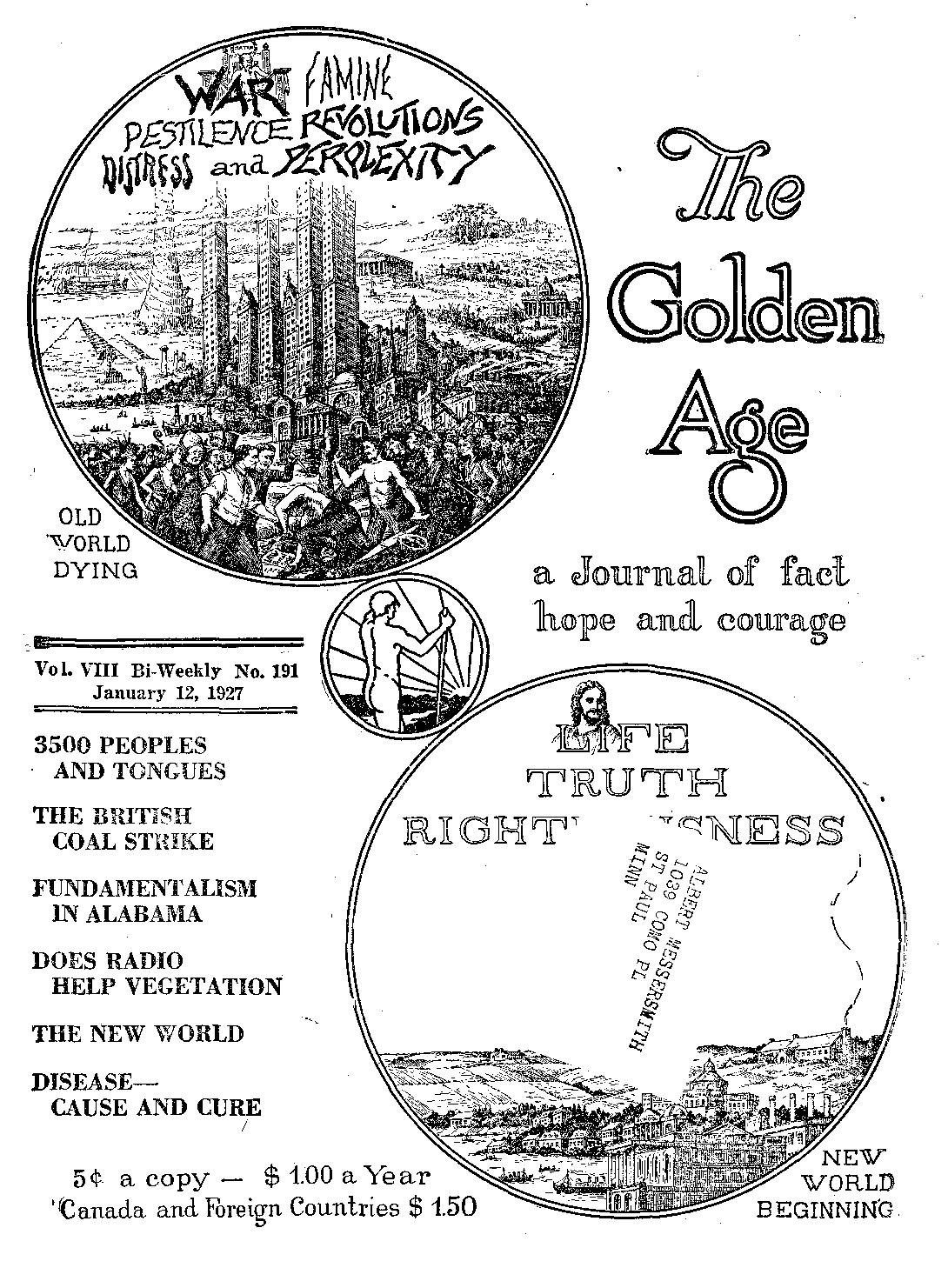
Contents of the Golden Age
Social and Educational
Thirty-Five Htobed Tongues .............. 227
Origin of the Alphabet ................ 227
Proofreading a Fine Art ................ 227
Additional New Words ................ 229
Changes in Meaning of Words .............. 229
Fundamentalism in Alabama .............. 238
The Price of Sealskins ................ 241
Radio Programs ............. 253
Finance—Commerce—Transportation
A Ticket for Around the World ............. 235
Small Businesses Going to the Wail ........... 237
Political—Domestic and Foreign
Foreign News Items .................. 233
The Coal Strike ................... 233
Britain’s Coal Problems Not New ............ 233
Britain’s Drink Bill ................. 233
Thomas Muib, The Romantic Career of a Glasgow M:>n ..... 236
Ex-President Obregon’s Statement ............ 239
Science and Invention
A Still Greater Electric Generator ............ 237
Ai® Pockets Scientifically Explained ........... 240
Does Radio Benefit Vegetation? ............. 240
Science Sees the Millennium Coming ........... 241
Religion and Philosophy
The New World ................... 242
Disease — Cause — Treatment — Cube .......... 247
Dittlb Studies fob Bittle People . 254
How to Become a Bible Student ............. 234
Studies in “The Harp of God” .............. 255
Published every other Wednesday at 18 Concord Street, Brooklyn, N U.S.A., by WOODWORTH, HUDGINGS & MARTIN
Copartners anti Proprietors Address. 18 Concord Street. Brotsictyn, V. F.. u. S. A. CLAYTON J. WOODWORTH . . . Editor ROBERT J. MARTIN . Bustoass Manar WM. F. HUDGINGS . . Sec’y and Treas.
Fiv® CENTS A COM—$1.00 A Ybais Makes Rbmittancb# ro 2’1?® GOLDEN Am Notice to Subscribers: We do not, as a rule, send a card of acknowledgment for a renewal or for a new subscription. A renewal blank (carrying notice of expiration) will be sent with the journal one month before the subscription expires. Change of address, when requested, may bs expected to appear on address label within one month, Fommhn Offices : British ..... 34 Craven Terrace. Lancaster Gate, London W. 2 CoatnHtm ...... . 3>M0 Irwin Avenue, Toronto, Ontario
Aiutral«»ivt ...... 4-95 Collins Street, Melbourne, Australia South Afrioast ...... 6 Lelle Street, Cape Town. South Africa
Bntered as second-class matter at Brooklyn. N. Y., under the Act of March & 187®
ahe Golden Age
Vtiwne Till
Brooklyn. N.Y., Wednesday, Jaimwy 12,1S27
Nssmber 191
rhirty^Five Hundred Tongues
THIRTY-FIVE hundred languages and dialects are spoken in the world. It would take about four pages of The Goijjex Age merely to give a list of them. A child would as soon learn one language as another; hut today the children are busily engaged learning thirty-five hundred of them, deftly twisting their little tongues about sounds that to most of us resemble human. ideas no more than do the sounds made by birds or beasts.
The words "language” and "tongue” come from a common root, lingw., By common acceptance certain sounds come to represent certain ideas, and the transmission of these sounds from one person to another constitutes human speech or language, the tongue being the principal organ involved.
For some strange reason America is said to lead the world in the number of its languages, which are estimated at 1,625; Asia has 937; Europe has 587 and Africa has 276. Many families of languages exist, giving evidence that originally they came from one parent tongue.
The most important parent language or group of languages is what is called the Indo-European, comprising most of the languages spoken in Europe and some of those in Asia, including the great peninsula of India. It. has nine grand divisions; Indian, Persian, Greek, Slav, Armenian, AUmman, Celtic, Latin and Teutonic. lu’Jian, French, Spanish and Portuguese are languages; while Dutch, Geminn, Danish,. K« ruegbn, Swedish and English are Teutonic l&i mages.
b * c rmd grand division is the Semitic group: Fhamfeian, Hebrew, Babylonian, Assyria^ Aramaic, Arabic and Ethiopia Same of these languages have ceased to exist. Other groups are the' Hamitie, Chinese, Turanian' Mongolian, Ihmimh, South African, Central 'African and American, which latter includes the many dialects of the American Indians,
Origin of the Alphabet
THE letter “A” is the picture of an Egyptian ox yoke, turned upside down. "B” was the picture of a Louse. "C" was the picture of a camel. "D” was a door. “E” was the picture of a lattice window. "F" was a hook. "G” is another form of "C”. “Il’’ was a fence, originally with three bars across, instead of one. “I” and “3” are one and the same. "K” was the hollow of the hand. "M” represented the waves of the sea. “N” was a fish, hung up by the jaw. “0” was an eye. “Q” was a head and neck viewed from, the back, and “R” the same in profile. "8” was a molar tooth. "T” and "X” were crosses. "Y” was a crossroads. BF’ and 'A™ are one and the same. “W” is simply “UU”.
The English alphabet has three letters which are useless, namely €, Q and X. They might as well bo dropped. But it needs several more letters. The dictionaries show us that we have eight sounds for “A’’, five for "E”, three for "I”, four for “0” and six for “U”. Then we have two sounds which we spell with an "00”, an "OU”, an "01”, a "CH”, an "NG”, a ‘WIT”, an "SH”, a “TH”, etc. We would be better off if we had at least thirty more letters to take care of these sounds. Thon if we keew how to sjjell a word we could pronounce it, which is something nobody can he sure o? now.
There are plenty of words, however, which can be made out of the 26 letters we mv have. Somebody has figured out that these can be combined in 6401,733,239,439,359,000 ways, which is enough for a start, anyway; and we can add the rest, after we get the other thirty letters.
.Frmff rsurfmy a. Fine Art
EW people realize how great a burden rests upon a proofreader, or how rapidly that burden is increasing. Almost anybody ean read proof after a fashion; but to read proof well
quires an excellent education, a, great fund of knowledge on an infinite variety of subjects, and a sense of the value of punctuation and capitalization that is almost intuitive.
How important punctual'on is to the meaning of a sentence is laughably illvslrrted in the case of a woman who meant to write, tragically: "Woman! Without Ivr. u'er is a a.xage’’; but failing to properly prneluW t'r statement she actually conveyed to papm d.t rather unfortunate thought: “Woman wiikoi. h*r man is a savage.”
A Chicago author spent $12 tit 3:15 A. M. telephoning to his Nev York p-Alisher tn insist that a comma b<- put into a certain hue in his hook which was to go to press the next day. H e claimed that the omission of the eoimna destroyed the rhythm of the sentence vhkh r^nd: "If all women v. ere like yon, there would be no had men.” Perhaps in this instance d e importance of the comma was unduly emphasized.
Standards in typoquphy, spelling and punctuation are charging constantly;and everypub-lisher has certain rules of his own, all of which go to make the lot of 11 e proofieade” more difficult. One English w’der put all bos punctuation marks at the end <ri h’.s book and told his readers to insert these to suit themselves.
He English Tongue
ENGLISH is becoming the dominant language of the world. It was the language used at the peace conference at Versailles, and when M. Clemenceau was called to account for it in the French Chamber he reiterated that it was not his fault if two-thirds of the world spoke the English tongue. However, it is not so dominant as that; for it is spoken by only about 180,000,000 of earth’s population, or about oneninth.
English is what it is, not so much because in the last two centuries the British people have overrun the earth and imposed their will upon one-fourth of the human family, as they have done, but because in preceding ages Britain itself was overrun by Celts, Romans, Angles, Saxons, Jutes, Danes and Normans, and each brought in their quota of words and terms which have combined to make the English language the finest medium of human expression.
English is Japan’s language of commerce, and its position as the language of trade is so secure that when Germany was figuring on eon-quoting the world she schooled ail her boys and girls in English, believing that in the readjustment of things this knowledge would prove invaluable.
Many linguists deplore what they cal! gross inconsistencies in English grammatical rules. It is said that bri'oro Profrs«or Smith, the English lecturer at the Moscow University, opened his course in En°hsh grammar, he prefaced it with the remark, ‘Before we start on our slud-its, I want you to grasp firmly the fact ihat there is no grammar in English, There i& anarchy.”
Tt is claimed that Englislmien stand well up among the world’s linguists. In England it is said that the ros'dents of Neweasfle-rpou-ryne speak the purest English of any dwellers in Britain proper. In America it is claimed that 1 hr purest English in the world is spoken ;n t!;-o vicinity of Rochester, N. Y.
The translation of the Bible did mi'ch to rvrv-form tho hodgepodge of English into a permanent tongue; but there has been considerable change in the tongue since Wycliffe made his first translation, as is quickly reveaW by comparing his rendering of Matthew 8:1-10 with the Authorized Version which was made 231 years afterward, and is now itself 315 year* old, Wycliffe’s translation reads:
Forsothe when Jhesus hadde comen dotm fro the H, many cumpanyes folewiden hym. And loo! a lepronse man cummynge worshipide hjm, sayinge: Lord, if thou Molt, thou maist make me dene. And Jhesus holdyuge forthe the bond, touchide hym, sayinge: I m ole: be thou maad dene. And anoon the lepre of hym was clensid. And Jhesus saith to hym: See, say thou to no man: but go, sbewe thee io piestis, and offer that gifte that Aloyses comaundide, m to witnessing to hem. Sotheiy when he hadde entnde in to Caphamaum, centurio neighide to hym, preyinge hym, and saide: Lord, my child lyeth in the ho us site on the palsie, and is yuel tourmentid. And Jhesus saith to hym: I shad eiune, and shal hele hym. And centurio answerynge saith to • hym: Lord, I am not worthi that thou entre vadir my roof: but oonly say bi word, and my child shal i» helid. For wlii and I am a man ordeyud vndff yowr, hauynge vndir me knightis: and I say to this, Go, and he goth.: said to an other, Come thou, and he someth? and to my seraaunt, Do thou this thing, and he doth. Sotheiy Jhesus, heerynge these thingia, wentiiisfe, and. saide to men suynge him; Trewly I say to you, I fotti nat so grete feith in YsraeL
No American Language
THERE is no perversion of English in America worth mentioning. The British people have no trouble in understanding Americans and the Americans have no trouble in understanding the British. There are a few odd usages of certain words, some of which have been mentioned in our columns previously, but their meaning is readily comprehended on both sides of the water.
A few other words may be mentioned. Americans speak of druggists, hardware stores, dry goods stores, suspenders, canes, boardwalks, chickenyards. gasoline, undershirts, lumbt r and molasses, ■while their British cousins prefer to call these chemists, ironmongers, drapery shops, braces, sticks, promenades, fowlruns, petrol, vests, deals and treacle; but the only one of these likely to cause any confusion is the word • vest, which has the double meaning in Aim nca of a man’s outer garment and a woman’s under shirt. The American' “guess” was used by Chaucer and Sh'ikespeare.
There are more than a hundred languages Spoken in New York City, but these are not jumbles of English and something else. They are the languages of all the principal nationalities of the world, just as those languages are spoken bv the natives in their home lends. The English remains pure, kept so by the teachers in America’s public schools.
The teachers have their troubles teaching English to the cosmopolitan youngsters, too. One teacher who asked a pupil to write the flag salute had the following handed in: “I pledge a legion to the flag and the Republican for which it stands One nation invisible with liberty and injustice for all. Amen.”
The kid-> do not make all the mistakes, either. & furniture dealer in writing to a customer gave him the cheering information, “We can offer you a dining-room table that will seat twelve persons with round legs or one in mahogany which will seat fourteen persons with square legs.”
To accommodate and aid the foreign language newspapers of America, the government maintains a Foreign Language Information Service which supplies information in sixteen languages. It averages to give out about a thousand items a week.
Addition of New Words
EVERY day sees new words added to the
English language. Sometimes these start as slang, such as the words cab, mob, fad, cad, crook, dude, crank, pep; and, after a time, by common use, they become an accepted part of the language. There is a time when the words are slang, another when they are vulgar, and finally a time of acceptance or abandonment.
The World War brought a great number of new words and terms into existence: blimp, blighty, eamouflige, dud, slacker, hooch, etc. A London dictionary gives some others which are net &o well kiomn here: clobber (clothing), conchy (consc '1 ous objector), cushy job (good pay and 1 < to de), dixie (field service kettle), eyewash ( o humbug), fed up (to have had more than enm< h). no flies on one (no fool), strafe (punish)
America has nnmeious terms of Indian origin winch have been •< ken over and given a modern meaning. Thus the Algonquin term mugii urn/pt originally a capmni or superior person, has come to moan a * r>u of derision for those who consider themt^-K - superior to their party and then leave it or < i<e pretext.
Political cornl lions abroad bring in new words which soon cr.me into general use; as for example, the uom- Bolshevild, Czecho-Slovak, Fascismo. Fascists.. The last three
words stand foi tA curious brand of anarchy developed m Itch, which glorifies personal violence in the na •>! the law.
The woid w m i is said to have W.*n taken over from tin i. of the natives of the Carib Islands. These natives had the unpleasant habit of eating stranueis. At first called earibules, the term was <•!.• t md to cambales and then ts cannibals.
Very often l<< -Sators, educators mid others attempt to fasten mu words on the language; but unless the public “catches on” and approves by frequent or constant use, it is all in vain. The late President Harding’s coinage of “normalcy” is an example of a new word that found favor. There are stales in words as there are in clothes, but no one regulates the style except the people themselves.
Changes in Meanings of Words
ALL who are familiar with the Authorized
Version of the Bible can remember numer-
■otM instanees of words which have changed their meaning. The word prevent once meant to go before, suffer meant to permit* charity meant love* hell meant the tomb; but these and many Other words are now used differently.
The word girl once meant an infant of either sex. The word wife, from the Anglo-Saxon weve, once signified any woman, married or single, who had woven her quota of bed and table linen and was therefore a graduate ww, ready for marriage.
The word ferry once meant to drag out or to carry. Its application to a boat or vessel for carrying goods or passengers was an afterthought, but finally came to be the principal meaning of the word. The word earmark comes from marks actually put on the ears of cattle in olden times to distinguish their ownership. Exploit and red are new meanings of old words.
Words sometimes get bobbed. Thus the word vanguard has been shortened to van, hobby* horse has bean shortened to hobby, distillery has been shortened to still, attending has been shortened to tending, disport has been shortened to sport, acute has been shortened to cute, withdrawing room to drawing room.
Seme words are forbidden or held in great ‘disfavor in specified places. In London theatres the word fire is forbidden; brewery workers dislike to mention water; hospital employes avoid disease; Herr Krupp forbade the use of the word death in his presence or about his works. Scottish fishermen are said to avoid the words rabbit, salmon and minister while they are at sca
The Jw® of
THE early dictionary makers traveled an uncharted. sea and they made many mistakes, which provide no small amount of amusement to the lexicographers of today. They copied one another’s errors, and thus showed that they are like all the rest of the human family, which is still engaged in that pastime. .
Bullokar’s dictionary, published in 1616, had 5,080 words; Phillips’ dictionary, in 1658, had 13,000; Johnson’s dictionary, in 1756, had 50,000; Noah Webster’s, in 1828, had 70,000; the Standard, edition of 1924, contains 500,000, and the editors compiled 250,000 more that could have been used if thought advisable.
t It to said that in order to keep the Standard up to date about 1,000 persons are constantly scanning the newspapers to note any new words that are used, white about 500 expert etymologists and definers, professors in the greatest universities, stand ready to assist with definitions, etc., as needed.
Perhaps the greatest of all dictionaries is the Oxford Dictionary, which has been in process of preparation since 1857 and is now completed. This work is really a history of the English language, in ten volumes, giving quotations which illustrate the first and last appearance of every notable point in the life history of every word. The work is of a permanent nature, contains 425,000 words and has cost in the neighborhood of $6,2S0,000. .
The origin of the English language is put at 60% Saxon, 30% Latin, 5% Greek and 5% from all other sources. One oddity of language is that the word “sack" is found in some form in almost every language under the sun, and means the same in all languages. Some of the fon» are Egyptian sok, Latin sancus, Greek saridms, Hebrew saq, Italian sacco, Spanish s&co, Dutch zak, French and Irish sao» Swedish sack.
It is said that the origin of the term “getting the sack”, meaning thereby the discharge of a person from his employment, reverts to the gentle Turkish custom “of getting rid of undesirable persons by sewing them up in a sack and tossing them into the Bosphorus.
Lmgaaga Wit&fi® the £an«e
THE Lip Language is a language within the English-(and every other tongue). In its highest form this language is a part of life in the Lancashire cotton mills. The roar of the machinery makes human speech almost impossible, but by long experience the girls get to understand one another perfectly across the room by merely watching each other’s lips.
The language of the underworld is a language al by itself, filled with revolting and obscene terms, profanity, expressions of craftiness and crime about which the least said the better. The language of teamps is akin to this, intended to point out the treatment to be expected at the houses marked.
The language of humanity needs no words. A smile, a caress of a child, a bow indicating thankfulness or humility, a shrug of the shoulders, a turning outward of the palms of the hands
a sigh, a tear of sympathy, a proffer of the extended hand, a gift of food or clothing, a light in the eye, a kind or a harsh tone in the voice-all these and other similar movements are lan-gnaecs within every language. They need no dictionary.
Pazzb s and riddles have a language all their own. The p mt Homer is said to have died of chagr'n be<vme he could not guess the answer to a nddl pr pounded to him. CroS'word puzzles are sir to have caused the lestoration of many word.', vhidi ver? slipping out of use.
French and Other Romance Languages
NTIL the treaty of Versailles French was the diplomatic language of the world, the second language of everybody who had two. It is spoken by about 60,000,000 people. Littre’s dictionary of the French language confines itself to words that have entered the French language since the seventeenth century. It lists 210,000 words. French is one of the official languages of Switzerland. which, has no language of its own but makes use of French, Italian and German. It is also one of the official languages of Belgium, which likewise has no native language but uses French, Dutch or German.
Spanish is one of the few languages in the world which, like the English, is growing in popularity. Ochoa’s dictionary of the Spanish language contains 120,000 words. TV? Snanmh tongue is spoken by about 50 000,000 persons. Pcxtuaal at one time broke a vay from Spam, and now 30,000,00li people speak Portuguese
A" “Tier ?,f! Spmrasdi have some natuul trouble w.-ierstmoding each other, even uW rhci co’rec'ly When an Anxmii
adVvrti-er wished to announce .in a Span' m paper that he had fur sale some siiigle-ltoi m buggy harms:’ the Spamah pnhber.timi an-noimced wuh absolute veibal accuracy tha* the Arae icon vould dispose of ‘H«rr,egs full of bugs, for a bachelor horse.” When the American tried to adverL&o monkey-wixrchcs and iron washers tlm Spanish translated them “Wrenches foe u.odkeyo” and “Machinos to elean non”.
Petriwhi's dictionary of the Italian language eontadus 140 000 words, like the French, Spanish and Portuguese, of I atin origin. Those four languages taken together are styled the Iio manec orkt’x knguages. Italian is spoken by about 40,000,000 jreople.
German, Russian and Balkan Tongues
RIMM’S German dictionary har been in the making since 1854, and is not yut finished. It contains approximately 150,000 words, limiting itself to words brought into the tongue sine® the middle of the fifteenth century. The German language is spoken by about 120,000,000 people.
AU the languages of the world are in a ferment at this tune. Among the peoples once included in the Gorman and Austrian empires this breaking up of languages is particularly noticeable. German and Czech tongues are contesting for the mastery in Czeeho-Slovakia; likewise German and Polish in Poland.
In the Balkans the Albanian tongue is blossoming out with its own literature and aspiring for supremacy. In Finland th°re is a contest on between Finnish and Swedish; in Macedonia there is strife among Bulgarian, Greek and Serbian; in Bessarabia between Roumanian and Ukrainian; in Schleswig-Holstein between German and Danrah.
Before the war Russian was the official language of all eastern Europe and northern Asia. It is spoken by about 90,000,000 persons. The Russians are e nsidered the Lest natural linguists in the u orld. fill tongues seem to come to them naturally. Dahl’s dictionary of the Russian language lists 140,000 words.
Yiddish—Hebrew—Norse—Irish
IN NEW YORK there are published icday five
Xxdd’sh dailies, five weeklies, thr°e or four irvrahl er a j ” Wr pne 5 mA. I r of the t: ilnw ha" « e>i id- i.en of ° J,GOO Yid-vsh :s related ’‘o <Le C nr- . tung? as dudeo-Es-panolis to Ou Spanish. Both w w? are slowly OTvwg wav tu ancient rknrn.7, viach Iris be-e<M e the a«vi ted la>guige of Cm Jevs of Pale shut.
Todny tro «n IkbWw JewY-L childre.. who know i o o>her ’;.n na< c (kan drat spoken by Ring Draw, bit tl-rar voe.wmlara .Las been enriched by the ad kt.on V ma. y wo/ds from, the z rab’e. winch are nerded to brim the ’an-gnrae of three thousand years ago uho accord with iBcdern life.
In Iceland a successful effort is being made to keep alive in its original, form the Old Norse language, which ekewhcie has been dead for a thousand j ears. Within the last few years im-
migrants from Iceland have arrived in New York unable to speak any other tongue than the Old Norse.
A great effort is being wde in Ireland to re* vine the Old and Middle Irish tongues. A dictionary of these tongues is in preparation. There is a wealth of material available, and la due time we may see Ireland again speaking its aiudent tongue.
In Spain the Caledonians are pressing hard for autonomy, in the hope of haring Catalonian taught in the schools instead of Spanish.
In South Africa studios are being made of the dicks and eroakings which make up the languages of the Bufetaieu and Hottentots, with the hope of creating permanent records before these languages disappear. Beeords are being made on phonographs and these will he preserved and studied.
REECE has been the scene of a fight between Classical Greek and Modern Greek, styled Dimotiki. There for two thousand years the language of the class room has been one thing and the language of the people another. Now, much to the regret of philologists, Dimetiki is being taught in the schools.
Classical Greek is one of the most perfect of languages. On account of the accuracy and elegance of its words and phrases the Holy Spirit selected Greek as the language in which to convey to mankind the writings of the apostles and the sayings of the Lord.
A recent find among languages is the dead language of Sogdian, cmee an important tongue in central Asia. Several mamiseripts in. this tongue have been discovered, written in the clearest binds ink on fine paper, white kid or silk, and as legible today as they were 1,000 years ago, when written. They are being deciphered.
The Chinese language is said to be the most difficult language in the world to learn, because each of the -100 words of one syllable has four 'different meanings. depending upon the tone in which it is spoken; and this principle runs through the entire language.
Thus the word la may be a noun, adjective, verb or adverb, meaning respectively greatness, great, to be great and greatly, all depending upon the iidfectkrn given the spoken word. The
Chinese are said to be the second best linguists in the world; and while Chinese is hard for an adult Westoner to master, yet fta children if bora to China and brought up among Chinew pluywdos, team Chinese more readily than : they do English from their parents. ;
OLAPUK, the first important artificial lan*
* guago, was invented to 1878 and learned | by a Hullion people within nine years; but it • has had its day and is largely displaced by Esperanto, invented in 1887. Esperanto has been introduced into the schools of- Russia by official decree. It is taught in twenty-three institutions for higher education in Japan, and is bring taught m five Chinese cities. It is afeo taught in the business colleges of Nuremberg, Germany, and Is said to find considerable favor with railway men of eontmeatal Europe who are face to face with the perplexities of variant tongues. The general management of the Austrian Federal Railways has established courses to Esperanto for its men.
Esperanto has many ardent friends and many savage critics. The League of Nations Committee on international cooperation declined to endorse it, but since then the stations at Prague and Moscow have been broadeasting their programs in Esperanto, and tho chief broadcasting station at Paris announces its programs in French, English and Esperanto.
Ido was invented in 1907. It is claimed for it that its alphabet is English, with a single sound for each letter, the spelling is absolutely phonetic, every word has tat one invariable meaning, the accent is governed by a single rule, the infinitive has the aeeent on the last syllable, and all other words of more than one syllable on the last syllable but one. There are but twenty grammatical endings to be memorised, all nouns end in O, all adjectives in A, and all adverbs in E. Americans recogmw at sight 79% of the words, Germans 61%, French 91%, Spanish 79%. There are no exceptions ta the Ido grammar. Twice as many of the League of Nations investigators advocate Ido as advocated Esper* onto; namely, two in one case and one in ths other.
At present Music constitutes the nearest approach to a universal language, and fortamtriy it is part of every broadcasting program to-
3ay. Motion-pictures run a close second. What language to take the place of the 3500 now in the future will develop in bringing forth one use ve have no idea and make no prophecy.
Foreign Ff ewe Items By Ovr Corresponded
The Cecil Strike
HE one fortunate aspect of th c^al .strike in Britain w? b the fact that if occurred during the summer, while most housewives do without die fine and cook on the gas stove. Out memories are still frosh concerning the suffering in America with the intense cold during the strike of miners there last winter.
There is another fortunate result of Britain’s coal strike, and that is, the poor pit ponies are brought to the surface and g'vcn a chm’<\> to graze m tae green fields and bi rathe the Imsh air. Eur'htin1 re. many miners ar? ran We who. with the usual toll of accidents tha. or err daiij in the mines, would otherv.ise have beer; killed.
Tt was evident that the miners would be forced by starvation back to work, and under conditions even less favorable than what they had previous to the strike. The government passed the bill increasing the working day from seven to eight hours on the theory that i.with the extra hour there would be more output and that thus all the mines could be made to pay dividends. But if any pit or mine becomes a non-paying enterprise, why should it not be closed down like any other business that does not pay? AVhy should the whole industry be forced to suffer because of certain non-productive companies?
The mine owners refused a national agreement as regards wages, although the government warned them, announcing that if it had known that the owners did not uesire a national wage agreement the Eight Hour Bill would never have been passed. And so they wrangled through it; the miners demanding a national agreement, and the eoeJ owners a district agreement.
The government finally proposed to pass an Act of Parliament, setting up a National Arbitration Tribunal; but it is questionable if this will do any good. The coal owners were determined to win the strike by starving the miners until they submit to the conditions named— lower wages and longer hours. So the men
h?<'k 4o woik to keep Emir wives and children urn slrrvui-xi, but with bitterness and jmdified auger i.<, .h ‘r hearts. Il is doubt-nd ■’+ I l?iy 'U W nf the hours of labor will '•e the ompu^ o. i.he nmitb.
Britafafo Ccal Problems AW New
ODAV‘S troubles m tl<e British ccal mining industry are serious enough, but theie were aieo irouhlcs m die past. Afi or Henry ITT had gi an+ed a chart' i to the citizens of Newcastle, pej muting tl cm to aig coa1, another Ling,
IV, striedy ; combi*-''1 th-' of the commocity for household pnipo«o3. This was because the ladle.- of the rouit alleou! that the gnuiKO «nd Fnj';<-s y-p>p I'liimg H>oir> c-mimEX” N--
The cii zeiis of Loi.son then took a hand. They protested agamst the use of coal by brewers and dyws, and the kmg nominated a commission to try the offenders. For a first offence they bed to pay a heaiy line; for a second, their wmaces and kilns were broken up. That may seem sufficiently drastic; but as these penalties did not stop the practice of coal-burnmg, it was finally made a capital offence. At least one hat’dened sinner was duly tried and actually hanged for the grave offence of burning coal in the city of London.
For a considerable time, therefore, no Brit-i«aev dared use coal; but the invention of the vertical chimney gradually brought it back into favor in the empire.
Uritain’s Brink Bill
HE expenditure for 'nto'deating-liquors in Great Britain in 1&25 was slightly lower
than in 1924; but the consumption, measured in terms of absolute alcohol, was practically the same, states Mr. George B. Wilson, the political and literary secretary of the United Kingdom Alliance, in his annual statement as io the consumption of liquor in Great Britain for the year 1925. '
The expenditure per head of the population in 1925 was £7.45 against about £7.5s in 1924, and the expenditure and consumption in England and Wales (which are not separable) and Scotland respectively were probably about as folio v s:
England and Wales Scotland Great Britain
Population 38.890,000
Expenditure £2-85,000,000
Per bead £7.7.0
Spirit^ (proof gallons) 0.29
Beer (bulk gallons) 24.60
4,8q3,000 43,783,000
£30.000,000 £315,000.000
£6.2.6 £7.4. 0
0.56 0.32
9.4 22.75
An interesting comparison of the drink bill of 1925 with the amounts spent on national services, is made in the report; and to it is appended I be observation that, whatever view may be taken as to the national expenditure for intoxicating liquor, the amount spent for drink is so large ns. to challenge consideration.
A drink hill of £315,000,000 is contrasted with, for instance, a total annual charge for social sm-vkes of £307,000,000, in which public educate n and unemployment claim bet ween them but £126,000.000, with smaller sums for health insurance and puirims.
The bnrdm of Britain’s National Debt interest is £305,000.000; while < nh £80,000,000 are spent upon bread, and £76,000,000 upon milk, and the free hospitals (in 1923) received but £8 213,000 for their upkeep, yet- Britain’s drink hi!l is gr'vrir than her National Debt interest by £ 13 riGr ,030.
A ta11, IS civen. showing the amount of British, Si (itisb uid aorihem Wish whiskey ex-u<;> d to ri i r * ’ w i-ri, and ‘mparately ri the Th , ri blues, thmada end ri'*r cm,mines to ril ri nA splits .-ire regulrri Bopped by Pu ji Gml n> atlnig in comer! v- th American *’! < < ri <’ei s ’ engag'd m m mi iimimg. The sta-tislics mov tint b< far the -neai-'r amount of Bi ri» mu oi is cun-mmed at home.
2 s.t i cm f, n. b. ri <1 » riirimy shipped to the » cm’> u-i-'swn’’ C/.6. Allowing for 'he lo< < '-tr ?■ nr m <he importing eorn-
trri and pi A ••uh riy io 'ria. the ouantiri sh'vyz p rfr oiutirr purp^-'s rrobahlv d» 1 do* or- cod rifO0,! 00 g'rim «•. for winch t•' Soot tish vljriri'' trace rauril ahcri £2,000,000. This quantity represents loss than 2 percent of the spirit consumption of the U. S. A. in 1917 before Prohibition.
Toll of London’s Streets
STREET accidents in London have increased by nearly 10,000 in three months. According to official figures just issued, the total for the second quarter of 1926 was 30,717, compared with 20,725 for the previous three months. Private motor-cars and motor and pedal cycles are the chief cause of the increase.
There were 254 fatal accidents (over 18 a week), during that quarter, an increase of 67. The following table shows how the total is made up:—
June
March
Omnibus
Tiamcar
Cabs
Private ears
Motor-cycles
Trade vehicles
Do, horse-drawn
Horses ridden.
Cycles
- ■„
Ml 1 -1
m-.,«....,.u
Total
Figures for the remainder of the year are not yet available, but it is doubtful if they will prove any more hopeful when they are made public.
Canon and the Ten Commandments
Gavon Peter Gbuen, at the annual meeting of the Manchester and Salford Penny Savings Banks Association, said he considers there is liiore morality in £50 in a savings bank than in the Ten Commandments. "The Tim Comnsiid-iwts,” he said, "tell you what to do, but the £59 in the savings bank make you want to do it.” II? confessed, awl so do we, that he sometimes feeds hopde>sly out of dat°, a mid-Victorian marooned down here in the 20th century.
Irivrri for the Pope/
y’l BOTE message to the Fiendi press spvs * rial "his holiness” "he pope ha« authorized e urinals, archbishop5*, bud ops, canons and j rek'tes to ’.veer artuirial silk stockings instead of natural silk, as a means of economy. And dear reader, the same decree'authorises these dignitaries io wear imitation fur tvirunings instead of the real article. We are in favor of the decree; it is in keeping with the fact that the Boman CaAlie religion is only a pretense, a counterfeit, a shoddy imitation of the real thing; but we never expected that the pope would issue a tall to advertise it.
A Ticket for Around the World
rpiIEBE is an interesting article in the British
Children's Newspaper vith the above title. Very much sooner now than many of us think, we shall be able to go to the booking-office of the Charing Cross of the air al Cruyden, and say to the clerk: “A flying ticket round the world, please.”
Two items of news have in«t ^nctad London which indicate the dawn of the era of globegirdling traffic by air. One item describes the vast new airship, the largest of its kind ever contemplated, which is about to lie built for the American government. This leviathan, containing six and a half million cubic feet of gas. is to be driven by eight engines at a high speed while carrying a hundred passengers; and it has been decided to employ it in a series of experimental commercial flights between New York and London. That is one new and vital link in the ccmi ng world-air-chain.
The other item, which was recently communicated to London from northern Europe, is that a complete scheme has now been drafted for a trunk airway, more than 5,000 miles long, extending from Moscow, via Vladivostock, as far as Tokyo, Japan. At Moscow this great airway is to connect with a service of metal aeroplanes which already flies via Konigsberg to Berlin; while at Berlin a stretch of German-operated airway extends to Amsterdam, wdiere it establishes a daily connection with the British Imperial Airway service flying regularly to and from London. What this Moscow-Tokyo line will mean, therefore, as soon as it begins operating, is that a traveler will be able to ascend from London and fly eastward as far as Japan.
Already a provisional time-table lias been worked out for this great section of the Round-the-World Airway, measuring nearly 7000 miles; and, reckoning actual flying time, a passenger will be able to travel from London to Tokyo in about 80 hours I
Nor is this all. Already there is planned a service of multi-engines air-boats, which are to span the Pacific between Tokyo and San Francisco. These machines, flying at a high speed, will have their time-tables so arranged as to connect accurately at Tokyo with the winged craft which have borne passengers from London. This will mean that, in only about 50 hours after reaching Tokyo world-voyages from London can land in San Francisco.
From there their journey may be confirmed eastward at unabated speed. Awaiting ttam at the San Francisco air-port will be a nev’ and luxurious type of passenger land-plane which is now being developed for the United States Continental Airways. In one of these immense machines our travelers of the new era v ill be carried across America at such s. r^ce tb',+ ’’•’'thin 30 hours after leaving San Frnn<-is<'o they will be gliding down into New York Cny.
Here, moored to a tall steel tower, rei dy for their ai rival, will ho one of the colossal oceantype airships, veritable liners of the sky. Ascending the mooring tower in an electric elevator, the travelers will enter the airship through a covered-m vesffble, and tta i icmter ship will then cast off and head out acioss the Atlantic for Europe, maintaining such a luecd that within not more than about 60 hours after leaving New York she will be over London, where she will be moored to another gioat tower, 200 feet high, and her passengers discharged. Without reckoning time spent at stopping-places the globe will thus have been girdled completely by air within a total flying period of approximately 200 hours, which is a little over eight days, or one-tenth the time suggested by Jules Verne a while ago hen he startled the passing generation will* the •’unbelievable'’ idea of “around the world in eighty days*’.
France Gets a Shower of Mud
JI .RANCE has been getting a shower of warm mud. Near Marseilles, during a heavy rainstorm, the laindrops were so heavily impregnated with sand, presumably from th<‘ Sahara Desert, that in some of the adjacent villages th© housetops were covered yellow. Elsewhere, at other times, there have been showers vhich brought down fishes, lizards, toads, hogs and even small turtles, snatched into (he hemmiis by wind storms, carried far afield and <1ro med, to the groat surprise and sometimes to die dismay of the inhabitants.
Thomas Muir, The Romantic Career of a Glasgow Man By Peter Bunn (Glasgow)
IN THE beautiful cemetery of Chantilly, near
Paris, is the grave of Thomas Muir of Huntershill, who in his short, unhappy life of thirty-four years, passed through adventures such as have fallen the lot of few outside the pages of fiction.
His name will ever be honored for the work he did in social reform; but it is rather the extraordinary incidents in his career, especially following his sedition trial, that we here wish to relate.
Muir was born in 1764, in an old landmark in High Street, Glasgow, long since improved out ©f recognition. He studied for the law, and became one of the most promising advocates at the Scottish Bar. Very soon, however, he was denouncing the corruption of the times and urging the need of social reform. The Reform Association, which he established in the Star Hotel in Ingram Street, Glasgow, attracted much attention; and the Ayrshire branch numbered Robert Bums among its members for a time. '
Banishment
WHEN Muiifo fiery speeches reached the ears of the government his friends warned him of the danger he was incurring; but he would not desist. Going to London to consult some friends there, he was tempted to visit Paris also, then in the throes of the French Revolution, in the hope of getting a glimpse of his hero, Lafayette. During his absence from Scotland he was summoned to appear in Edinburgh before the<uthorities, on a charge of sedition.
With undaunted courage Muir returned (but not without great difficulty, for war meanwhile had broken out between Britain and France) and faced his accusers. In spite of his brilliant speech in his own defence, and in spite of the efforts of good friends in the House of Commons, he was convicted, sentenced to fourteen years banishment; and vias sent from Ins native country to Botany Bay, Australia, a convict.
Muir arrived in Australia in 1794—being then thirty years of age—to begin his fourteen years exile. The governor and he soon became the best of friends, and the cultured young prisoner settled down to his new life in the convict colony. He taught many of the convicts to read and write. His father’s parting gift to him, a Bible, was the textbook used by him in teaching this strange class. The same Bible served him well on another critical occasion in his life, as will be mentioned. The two years spent in exile in Sydney were probably the happiest years of Thomas Muir's life, and his banishment came to an end in a most dramatic manner.
One day in 1796 an American ship, the "Otter sailed into Botany Bay harbor, ostensibly to take on water and supplies. Iler officers came ashore and made themselves agreeable with the governor, and also met some of the prisoners ; and when the "Otter” left next morning Muir’s hut was found to be empty. In a letter pinned on his pillow lie ll.anked the govexuor for his kindness. President George Washington, having heard of Muir’s hard lot, had sent the "Otter” al] the way from th Pacific Coast of America specially to rescue him from exile, and the mission had been carried out as planned.
In The Hands ef Indians
UIR was fated never to meet George Washington, however. The voyage which had begun so well ended in disaster; the “Otter” being completely wrecked near Vancouver, B. C. The unfortunate Scotsman escaped the waves, but fed into the hands of the Indians. But they, strange to say, treated him well, and he lived for several weeks among them.
Muir then set out southward, actually walked over 4.000 miles, alone, unarmed, taking his bearings from the stars, and finally reached the city of Panama. There the Spaniards, who were then at war with Great Britain, arrested him and took him by way of Vera Cruz to Havana; and from there they put him aboard one of two frigates sailing for Cadiz, Spain.
We now come to one of the most remarkable incidents in this remarkable life. Nearing Cadiz the two Spanish frigates fed in with the British fleet; and as Britain and Spain were at war, a fight followed. The Spaniards surrendered; but the last shot fired in the action laid low five men on one of the ships, and Muir was one of the five. The captors then boarded the Spanish vessels; and a young British officer, turning over the dead with his foot before ordering them to be cast over the side, saw a Bible fall out of tha blood-stained clothes of one of them. He was surprised to see that it was an English Bible, and looking at the man. saw that he was still alive. He was more amazed, on a second glance, to
recognize in the wounded man an old college chum, none other than Thomas Muir! He had his old friend sent ashore and delivered to the care of the Spanish Governoi of Odiz; for he knew that the British government had get a price on Muir’s head since his escape from Bor any Bay, and that this was the best means of saving his lite.
Thanks to Napoleon, Muir finally reached the French capital once again, after having traveled at mind the weild during four wri p,il yearsf and m Paris he was received with every honor, be was iw t-nfe at last; bin aley lie enjoyed his Mmetms-s mM reedom for em\ G dit short me; tl<s. His, health had '.wen completely under-raiW by bis many hamships ana sufferings; and in Stptemhei 1798 be passed away, at the untjiT'eh ?ge fit thirty-four, far from his native Scotland, and was buried by his French friends at ( han ally.
A Still Greater Electrical Generator By Gf'dge Stigers
IX YOUE issue of Noicinboi 3rd, page 70, you he-,c an item on the ‘"V.'oild's Largest Generator’ now being installed in the plant of the New York Edison Company, which is to develop 80,000 horsepower.
Pei naps it would be interesting for you to know that in the Crawford Ave. Station of the Commonwealth Edison Company at Chicago, there is now running a 75,000 K. AV. Generator uhich develops approximately 100,000 horsepower, vlOeli is somewhat in excess of 80,000 horsepower of the New’ York Edison’s ''Giant’'.
The Commonwealth. Edison Company of Chicago has bid the fournlriion for, and is now installing, a new 90,000 K. IV. unit which, is expected to develop approxmmt ly 120,000 Loi power.
It is known to electrical mon that Chicago is the center of the world's greatest power pool, which the late Dr. Steinmetz of the General Electric Company, predicted a few years ago.
A now firm, is now being formed in Chicago to be knoun as The State Line Generating Company, and they expect to build the world's largest generating plant, which vill he built on filled-in land in Lake Michigan, at the Indiana-Illinois stare line.
They expect to nave their first unit, a 208,000 K. IV., or 280,000 horsepower, in service late in 1929.
Small Business Going to the Wall
THE trend of the small business is definitely toward the wall. The chain stores are adding link upon link. The larger factories are taking over more and more of the smaller plants and closing them down, to rust away. Any person traveling much around the country can hardly, fail to see the truth of these statements.
The small business is doomed. .No matter how well it is organized it cannot produce goods as economically as the larger unit. In 1923 the per capita production in the larger plants was 48.1 percent greater than in the plants of less than $1,OOO,(XX> output of product per year.
In 1923 the plants producing $1,000,000 of product employed 57.1% of all wage earners and produced 6G.4% of all manufactures. The small manufacturer is doomed. The jobber is doomed. The giants with their chain stores will soon have everything in their hands, to do with as they will.
The giants are sure to put up prices more and more as they get things more and more under their control. They will add on "service charges” for this, that and tile other thing, gas, water, electricity, telephone and other necessities, until they will literally have the common people eating out of their hands. This is no prophecy. It is fact, based upon the accumulated evidence everywhere available.
The Lord’s kingdom is the only way out of the dilemma; and unless all indications fail the giants are bound, soon or late, to try to put into effect some stringent regulations against any questioning that their diabolical arrangement is not itself Christ’s kingdom for which He taught us to pray.
Fundamentalism in Alabama
Fundamentalism, like everything else, is to be known by its works. Alabama is a sort of center of fundamentalism in the United States. Nearly every good Alabaman is a Fundamentalist; that is to say, he is a believer in eternal torture. How this works out in practice is disclosed by the following testimony of what happened at the Flat Top, Alabama, prison eamp. The account was published in the Memphis Commercial Appeal’.
■ ■•Pugh ■said Knox came to Flat Top with several other prisoners on. Aug. 8, and went down in the mines on Aug. 9. That night, he said, the cheek runner came out complaining that Knox didn’t or couldn’t do any work on account of his heavy weight. The warden the next morning kept Knox out of the mines and let him do some whitewashing. That was on Saturday, according to Pugh, who stated that the warden told Knox he would have to go into the mine on Monday. Knox went into the mine Monday and he understood that “some of the men in the mines beat him up that day", lie said that Knox had marks on him and' came to the hospital every evening when he came out of the mines. Prisoners told him• Knox was “beaten up” practically every day that lie had been in the mines.
Pugh said Knox went down to work Wednesday morning and the same thing happened that day. Knox, lie stated, came out of the mine Wednesday afternoon and the warden had the doctor examine him that evening. The dWor d’do’t see any reason why Knox should have come out of the mine. Knox, he sain, was sent back to Work Thursday morning. •
Thw-day rih-rmen, Pugh stated, the men came out as u.-trrl uh r A w r. ibrmi -.b wi'b th-b- tub—the time b '' c ■<>' h -ii t\ >> . .a" ip m W m <* f D Houston came from the <-L t.> ~ t at ;' 11< wr^on yard used for , «. h m I i't ' a , uU < ‘h vat full of cold water. He asked him what he was going to do and Houston replied: “They aid going to bring that fellow around here and duck him to see if they ean’t persuade him to work.” He testified he told Houston that “they were fixing to drown the man, and he fold me that they had beat him up ail day and couldn’t get any work out of him at all”.
Shortly afterwards, Pugh said eight or ten men came, bringing Knox from the mouth of the mines. Knox was being dragged, he said.
Asked r ' • -> <■ . 5 Pugh replied:
“The negroes. There was a bunch of those negro flunkies on top, working around the wash bouse and the prison.”
OBlkiWliWanta.Dggiwnnd:,orie or .two of his sons .-w fr-' 1 (' r m .v ,wn. , mi va.li.u tb’ lOtAllWM h'd. -0 : ■ • P i ■ P
*'? herd Tu' m'dm air> ,t K! - hit,” ho confirm d. “tell one of the uegr.'A to g<; ,K-wn and imu the steam m this vat. I knew hc-w fast that water would heat up with the steam pipes they have there; and after a few minutes this man’s cries became so alarming that I decided to go out and plead for his life. I went through the hall and went out at the backdoor and when I got to the door the warden asked me ‘What the h— I waa doing coming out there?’ or "'What the h— I wanted?? I told him I had come out to plead for this man’s lif® and that they ought to be ashamed for treating him like that. I walked on out there. Mr. Davis’ son told me that they had held Knox under water for five minutes at the time and it didn’t even faze him. Well, I stood around there and, of course, th-> v -in r kept getting hotter and he kept begging more pitifully and looked to ,mel like he was screaming loud enoiight to have everybody; hear in the whole country around.”
Pugh stated-in his testimony that all the wbiffi prisoners had collected in the lower end of the white coll of the prison to see what they could—that they ‘‘couldn't see exactly how it was carried on, hut they could hear the man begging for his life”. Pugh said there wasn’t any whipping there at that time but stated: “This man was begging the warden to take him out of that hot water and beat him to death, or shoot him to death, Knox saying, ‘Any kind of death besides this? He begged the warden and told him that he bad a mother a”d he would love to see his mother again. The waidtu told him, ‘No, you want me to take you out and beat you up and put you in the hospital where you can show i our bruises and injuries to everyone that comes amuud ami tell them I did it? He added, ‘Pm going to wind ymi up and bury you? ”
Pugh further charged that, as the “ducking” wm tinned, they would pull Knox’s Lead above water .aiic .h.y it on the curb of the vrt and that, s i th * lab r. ho ,e ; his mid v.u- rei.'hl.' H M'-crei. llt im> ’ ..a -a .y Pugh testified Mai t1 < u ’t(i • a 1 Luo e I uLn, m places. Asked who was doing too “diwbhW j stated that it was several of the negroes and ilouston. Asked if Homer Anderson was “in that”, he replied in the affirmative and proceeded to give the names of Joe Payne, Tom Owens, Albert Lewis ami Sam Rebiu-son as having part in it. He said they were all at Flat Top with the exception of Homer Anderson, who had been paroled.
Pugh said that Knox lay with his head on the curbing for some little bit and that he wasn’t able to make any fuss at ail. But it could be seen he was breathing. After he had lain there for some seven or eight minutes, Pugh testified the warden said: “Boys, lie is just possumiag on us. Stick him back under?’ They did so, and “when they brought him up at that time, just the time they re < * » < '~y L_ 1 ,i . , H 1 t > -•> . 1
U a m w v .e 1 a i w m m - -e ■’ u ■ m ~T ,1 w.w A 1, .rnd rrl fi ; u wrn.dmr rm «' T ' ’’ 1 Pi soU; jim. d < (<, jTt.s *o n,,i to th- iii'pi'l and g t & 1 o-im” o' mu’' w.c "'d ir re Jimi K ly rerhs his heart, wAich Im did. Knox was carried by negroes into the hospital and in the bathroom there, he said, afior he, Push, had carried out mstruetiouB to go in and run all the premiere into the negro ward and close the door between the wards.
After the body of Knox had been carried into the bathroom, Pugh alleges, it was set down in a bathtub of water. He s-aul as soon as that was done, ‘'■'the warden told the- negro, Homer Anderson, to get ‘■time poison and fix it up and pump it into his stomach, which he did. He went into the dressing room and I suppose took eight or ten or wajhe more tablets and put into a gallon wa«hpan and filled it full of water aod took a stomach pump cut of the drug room and ran it through his mouth and down into his stomach and poured this poison into his stoath ”
Aftei the poison was pumped into the stomach of the dead man, Pugh said that every one went off and that Warden Davis’ son came back to sec him and sa’d that his "'father warted to know if v>? ihoiipld ve had enought of that stuff in his stomach”, adding “You want to be sure about that.”
Pugh alleged that Harden Davis came back to see him a little later “and told me that if I ever opened mv mouth about it that, of course, it would mean a lifetime sentence for him and probably at the same time a long sentence for me. 1 told him I didn’t figure that I was in any way responsible for what had happened and t’mii I didn't feai that part at all."’ it was at this point in his statement that- Pugh testified that “everywhere you would touch the skin on Knox's body the skin, ■would slio off, and a finger nail would eouie off, or half off.” *
Pugh said the death certificate vh'ch he partly filled out had been tampered with, a piece of paper having been pasted over the original line railing for the cause of death. Pugh said a letter written to Knox's next of kin uas returned in the mails as undeliverable because of improper address. lie “didn’t know whether the letter was intentionally misdirected”.
Pugh said the warden went over to see the prison doctor after - Knox died and told him the man had committed suicide and that there wasn't any use for him to come up. The doctor made the certificate the next morning on what the warden had told him. H« stated the doctor looked at the body, but did not mad® an examination.
Pugh said the vat was of concrete, five feet wide, seven feri long, and three fe~t deep. He said Knox wa4 put into the cat vifh his mining clothes on and that his hands were not handcuffed. or tied. Pugh declared he win n itlun five feet of Knox and was looking at him when “he was protesting against them ducking him any more’’. He said Knox was standing practically still; that the negroes had him by the hands.
Afiied to derer Ko Know Pugh said he would think he weighed something over ?">o pounds, was about five leet live inches tall and that he had light hair. In anwr to a que^+'on, Pugh -a.d he know that Knox’s head had been put under v»aler; that the negroes had hold of him, b'd he didn't know what part of his'body they had hold of Tn reipome to a request, Pugh described the place vheie the body of Knox was interred.
Pollowing the alleged forcing of poison into the body of the dead man, Pugh testified that Homer Anderson, the negro, smashed the bottle of tablets on the radiator, scattering the tablets and glass over the room, in an effort to make it appear that he had struck it from Knox’s hand. Pugh stated that it was first planned to make it appear that he, Pugh, had struck the bottle from Knox’s hand, but when he refused to sign a statement given him by the warden, the responsibility was placed on Homer Anderson. At the bottom of the statement Pugh said, “lie just put it ‘'Hospital Steward.* Well, I was known as the hospital steward and he my assistant.”
The testimony above given was supported by that of several other witnesses, all of whom agree that this man, who wa‘s too stout to work at mining, n as cooked alive. One witness stated that wherever the skin was touched on the body it would slip off, and that the fingers were burned so badly that when the skin came off some of the meat came with it. Fundamentalists must find great joy in looking forward to an eternity of this sort of thing.
Ex-President Obregon?s Statement
REFERRING to the suspension of Roman
Catholic public services in Mexico ex-President Obregon has issued a statement in which he said: “Only the masses of the people have been deprived of the practice of religion, as their circumstances do not permit them to hire automobiles to take a priest to their homes, to erect altars or to pay for such services. The result of this maneuver will be that in a few months more, in a year perhaps, the lower classes will grow familiar with the situation thus created and then the liberated party will have to thank the members of the clergy for having themselves undertaken to convince the masses of our people that they are perfectly well able to live without their spiritual aid."
Air Pockets Scientifically Explained By Wm. IL R. Balston
IN The Golden Age No. 178, issue of July 14, 1926, I read with interest the article entitled Air-Pockets” by J. A. Bohnet; and with the author’s permission I would like to go into more detail. It is not my desire to be unkind or critical, but merely to express some facts based on actual flying experience.
I am not proud of it, but must admit the fact that I was a flying officer in the U. S. Army ilir Service during the “war to end war”. Thus I gained first-hand information concerning air currents.
There are, actually, no spaces in the firmament in which there is no air; but where a downward convectional current comes m contact with an jpward coiiveclional current, there is a disturbance of more or less magnitude.
The air over a ploughed field, a lake or a swamp falls rapidly, -due to the cool surface of the earth, which condenses the air and makes it heavier. But the air over a field of grain, corn or grass, or over an expanse of sand or stone, rises, due to the warm surface of the earth, which expands the air and makes it lighter. These upward and downward movements of air are termed “convectional currents”.
For a crude illustration: If an airplane is flyrag at an altitude of say 4000 feet over a field of grain, using the upward convectional current to help support it and then suddenly enters an area over a ploughed field where the eon-vectional current is downward, the ship will rock and roll; and a green flyer will enjoy anything but peace of mind. This is what flyers call “air-pockets”. In other words, the air falls out from under the ship, with the result that the ship drops down until it gets into one or the other of these air currents where it becomes jerkily righted.
…