Golden Age, December 29, 1926
Download: PDF — Golden Age, December 29, 1926
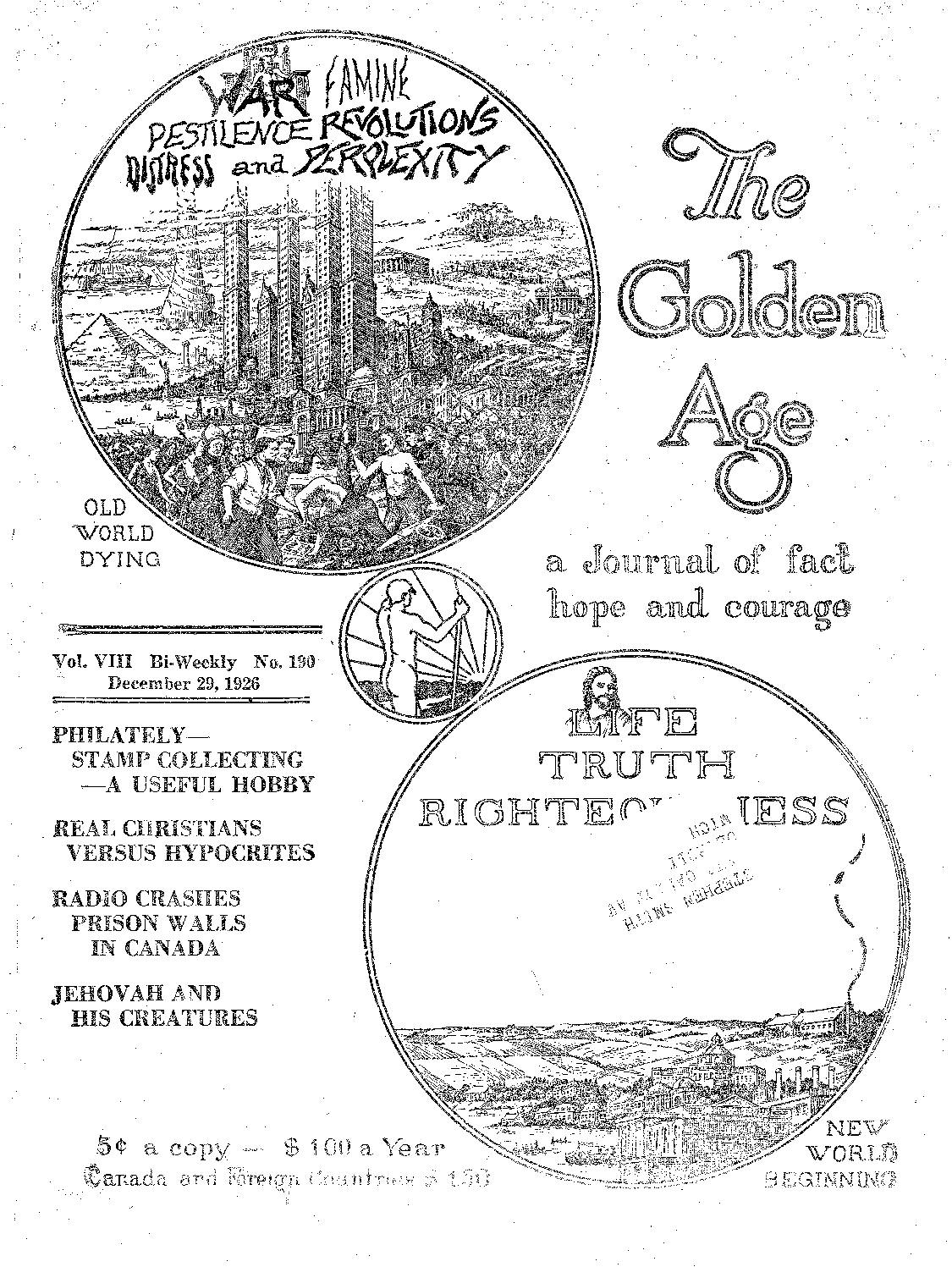
Contents of the Golden Age
SA-'.-——------ ■ ’"I??” --' ■
Social and Educational Philately—A Useful Hobby
Putting Pawnee on the Maij
Child Modernists.......
i Radio Programs
i ■
Finance—Commerce—Transportation ' • Eubope’s. Great Idle Plants
Buying Stocks on Margin ....
Political—Domestic and Foreign America 'to Pay Europe’s War Bills ’ . . . . . ..
Marshal Foch’s View of the Next War .......... 203 How Civilized Society Protects Itself . . .
Agriculture and Husbandry.. The American Cranberry
Save the Babies .......
Travel and Miscellany
Jewish Possessions in Palestine (With map)...... .
What. Actually Happened at Miami Beach .
Religion and Philosophy
British Sunday Schools Fading Away
The Real Christian and the Hypocrite
Breaking Through Prison Walls in the North by Radio . . . 210
Jehovah and His Creatures
Bible Questions and Answers
Little Studies for Little People
, studies 1N “The Harp of God”
Published every other Wednesday at 18 Concord Street, Brooklyn, N. Y„ u. S. A by WOODWORTH, HUDGINGS & MARTIN
Copartners and Proprietors Address: IS Concord Street. Brooklyn, N. Y., 17. S. A.
CLAYTON J. WOODWORTH . . . Editor ROBERT J. MARTIN . Business Manager
WM. F. HUDGINGS . . Sec’y and Treas. ■
Five Cents a Copy—$1.00 a Year Make Remittances to TUB GOLDEN AGE Notice to Subscribers: We do not, as a rule, send a card of acknowledgment for a renewal or for a new subscription. A renewal blank (carrying notice of expiration) will be sent with the journal one month before the subscription expires. Change of address, when requested, may be expected to appear on address label within one month.
Foreign Offices : British.....34 Craven Terrace. Lancaster Gate, London W. 2
Canadian , ........3.8-40 Irwin Avenue, Toronto, Ontario
Australasian....... 495 Collins Street, Melbourne, Australia
South African......6 Lelie Street, Cape Town, South Africa
Entered as second-class matter at Brooklyn, N. Y., under the Act of March 3, 1878
The Golden Age
Volume VIII - Brooklyn, N. Y., Wednesday, December 29, 1926 Number 190
Philately —: A Useful Hobby
J
rpiIEBE are people in this world who think j -®- themselves superior persons and who affect to look down upon those who make collections of postage stamps, but the work of the philatelist is not in vain. He is a collector of history and of art, and sometimes on a large scale. Philate-
] ly also encourages the study of geography. '
• ' ’ A collection of stamps of all the countries in the world,-showing the stamps which are in use on the day this paper falls into the hands of our
1 subscribers, would give a very fair idea of the H progress which those countries have made to
date in the designing, engraving, Hthographing and printing industries. A similar collection
; made ten years ago would give a very fair idea l of the same items at that date, and the same \ would be true of a collection fifty years old. It ; would provide reliable history which in a few j instances could not be obtained so well elsewhere.
Governments usually pay much attention to ; their stamps. The stamps represent the govern-i ment and the people in a very special way. They go'out to the ends of the earth, to be seen, admired, collected and preserved. It is claimed that the most truthful likeness of Queen Victoria known to exist is on a Canadian revenue stamp.‘It is also claimed that the only known picture of Sydney, New South Wales, as it was in the early days, is found on an old postage • stamp. '
. Many artists are philatelists. They find that .the stamps which fall into their hands give them new and accurate ideas respecting styles and customs, buildings, historical characters, the
' formation of letters and figures, and the re-। suits which can be accomplished in engraving i: on tinted paper. The stamps of France are eon
. f fiidered masterpieces .in this latter respect.
J The word “philately’ comes from two Greek i words, philos, a friend or admirer, and atelei-a, i exemption from taxation. The first journal de, voted to the philatelic art appeared in Belgium in 1863, and the first public sale of stamps at auction occurred in London in March, 1872. Stamp dealers sell (for about 15 cents per 1,000) “hinges” for mounting stamps in albums securely, and yet in such a way that they can be quickly transferred to other places as desired.
Stamps of the United States
HE first stamps issued by the United States government appeared in 1847, since which
time an average of more than twenty-five new designs has appeared each year. Prior to 1847 the postmasters of . some cities issued their own stamps; and these now bring, in some instances, prices as high as $15,000 each. If the United States was slow in getting started in the printing of its own stamps, it has made up for this since; because it is claimed that the stamps now cancelled annually in American post offices would, if placed end to end, girdle the earth five times. '
With the World’s Columbian Exposition, held at Chicago in 1893, the United States began the execution of a series of historical designs which are unique, beautiful and valuable. The principal events in American history are thus made a matter of pictorial record and spread broadcast over the earth. The stamps issued in 1893, ranging in value from one cent to five dollars, showed Columbus’ portrait, his solicitation of aid from Isabella, Isabella pledging her jewels, Columbus’ flagship, his fleet, his first view of land, his mingling with the natives, his welcome at Barcelona, his. announcement of his discovery, his recall, his incarceration, his restoration to favor, etc. ,
One of the amusing things in this series is that on the one cent stamp Columbus is shown as sighting land, at which time he was smooth shaven, not a whisker in sight. On the two cent stamp, representing his landing, which supposedly took .place a few minutes after the scene
shown, on the one cent stamp, Columbus has a beautiful beard; but how he grew such a magnificent beard in so short a time is known only to the artists who made the portraits and the officials who approved the designs.
In 1898 this government recognized the TransMississippi and International Exposition, held at St. Louis, by featuring western items such as Marquette on the Mississippi, Indians hunting buffalo, the prairie schooner, a prospector, troops guarding a railroad train, Fremont on the Rocky Mountains, range cattle in a storm, the Mississippi River bridge, etc.
In 1901 came the Pan American Exposition at Buffalo, and with it the transportation stamps, steamers, railway trains, automobile, bridges, locks, etc. The Louisiana Purchase Exposition held at St. Louis in 1904, brought stamps of historical personages connected with the purchase. The Jamestown Exposition of 1907 brought pictures of early Virginia scenes, John Smith, Pocahontas, etc.
In 1909 the Hendrik Hudson celebration brought out a picture of the “Half Moon" and the “Clermont”, also a stamp commemorating the purchase of Alaska from Russia. The opening of the Panama Canal brought pictures of Balboa, the Panama Canal, the Golden Gate, and San Francisco Bay. The conclusion of the World War brought forth some victory stamps. The Pilgrim Tercentenary was the occasion for stamps illustrating the “Mayflower”, the Landing of the Pilgrims and the Signing of the Compact. In 1924 the Huguenot Tercentenary was similarly recognized and commemorated.
The stamps of 1925 and 1926 are appropriate to the Sesqui-Centennial recently held in Philadelphia, illustrating Washington at Cambridge, Washington taking command of the American .army, the birth of liberty, the battles of Lexington and Concord, the Liberty Bell, etc.
Interesting South American Stamps
1IREE of the most valuable stamps known in the world were issued by the little country
of British Guiana, South America. A pair of circular two cent stamps of British Guiana, bearing the Georgetown! postmark and the date of 1850, sold in London in 1921 for over $20,000. In order to get a similar pair Mr. J. J. Duveen, a New York stamp collector, sent a representative all the way to South America to obtain them.
A British Guiana one cent stamp of 1856, the only one known to be in existence, was recently purchased from the French government, by Arthur Hinds, of Utica, N. Y., for 1,075,000 francs, or about $35,000. The stamp was originally the property of Von Ferrary who, at the time of his death in Switzerland during the World War, had the most famous collection in the world. His mother before him was a famous collector of stamps.
Von Ferrary had plenty of money to gratify his hobby, and devoted his life to the collection of rare stamps. Believing it would be best cared for there he left the entire collection to the Berlin Postal Museum, but it was seized by the French government and is being broken up and sold. More than 50,000,000 francs has been real* ized from it to date. Philatelists will never forgive the French government for this act of vandalism. Von Ferrary was a quiet, shy, harmless old man who tried ail his life to keep out of the limelight into which his great collection constantly led him.
It is claimed that the best map of the Venezuela boundary dispute territory is to be found engraved on the Venezuela stamps for 1896. The Tacna-Arica plebiscite stamp is of great interest to philatelists, as is also the Chilean stamp of Robinson Crusoe’s island, Isla de Juan Fernandez. In the year 1922 Guatemala issued no less than thirty-five new designs of stamps.
Asiatic and African Stamps
MONG the Asiatic stamps printed in 1922, Armenia had forty-nine designs, Indo-China forty designs, the Far Eastern Republic thirty-six designs, and Turkey and Siberia each thirty-five designs. Iraq or Mesopotamia has the distinction of possessing a series off stamps designed by women. They portray native life and characteristics in an exceptionally artistic manner.
Among the African stamps printed in 1922 there were thirty-five Egyptian designs. A curious slip in the formation of a single Arabic character on one of these stamps caused the condemnation of 5,000,000 of them, doomed to be used up on official papers and thus eventually to be destroyed. The incorrect stamps bring a high premium.
Liberia has an interesting series of stamps commemorating the planting of the colony of free negroes from the United States by Jehudi
n* GOLDEN AGE
Dkcxmbkr 29, 1929
Ashmun, D. D., in the Summer of 1822. The colony was and is a success. The principal feature of the designs is the sailing ship in which the colony was brought, and the small boats putting off from it to land. Ashmun, a lover of his fellow men, remained in Liberia six years and planted there a strong colony of more than 1,200 persons. He was a graduate of the University of Vermont.
The Sudan British government pictures on one of its stamps Sir Slatin Pasha, author of “Fire and Sword in the Sudan”, making his escape from the Arabs on a camel.
The highest price ever paid for a stamp was paid by Arthur Hind, Utica, N. ¥., textile manufacturer. He is reported to have paid $50,000 for an envelope mailed in 1847 in the African island of Mauritius, and bearing both the one and two penny values.
Europe—-The Philatelist’s Paradise ■
MONG the European stamps issued in 1922, Hungary had thirty-six designs, Ireland forty-two, Danzig forty-four, Italy sixty, Germany sixty-one, Russia sixty-two, Lithuania seventy and Austria seventy-four. Two years previous, before the boundaries of Europe were adjusted following the World War, there were 370 plebiscite stamps in use, in various parts of Europe.
Although the king of England is an enthusiastic philatelist, yet Britain and British possessions generally give scant attention to new and interesting designs. When a new sovereign comes to the throne his or her face is supposed to be of surpassing interest to all generations, until another one appears. Nevertheless, London is the recognized center of the philatelic art.
In 1923, at the International Stamp Exhibition in London, the United States government placed on exhibition a complete set of all the stamps issued up to that time in this country. Five hundred exhibitors had their collections at the exhibition. Their value was estimated at $5,000,000.
Although neither Britain nor any British possession has ever recognized Shakespeare on a stamp, yet Denmark shows on one of its stamps of 1920 a view of Kronborg Castle, which is the castle made famous as Elsinore Castle in Hamlet. Belgium has issued several flood stamps, the purpose of which is to raise fund's for the relief of flood victims.
Spain has issued (in 1905) ten large pictorial stamps, illustrating scenes from “Don Quixote”. Portugal has issued stamps in four designs honoring St. Anthony of Padua. On the back of each is printed a Latin prayer. Portugal has also honored her poet de Camoens, and Vasco da Gama, the explorer.
In 1899 Malta issued a stamp commemorating the landing of St. Paul on that island. Montenegro, in 1893, commemorated the four hundredth anniversary of the establishment of printing in that kingdom, now part of Yugoslavia.
Italy has celebrated the six hundredth anniversary of the death of Dante. Fiume, which d’Annunzio seized on behalf of Italy, had a stamp in 1920 bearing d’Annunzio’s likeness. Italy has announced that it will sell advertising privileges on its stamps, and hopes to make from $10,000,000 to $15,000,000 a year by this means.
Austria has issued stamps bearing portraits of Haydn, Mozart, Beethoven, Schubert, Bruckner, Strauss and Wolf. Poland has issued a stamp bearing the likeness of Paderewski. Bulgaria has commemorated a living poet, Ivan Vasoff, and a deceased friend of the nation, an English journalist, J. D. Bourchier. Roumania has honored the memory of her late beloved queen, Carmen Sylva, by several scenes, portraying her in various poses, writing, nursing a wounded soldier, spinning and weaving.
Europe’s Great Idle Plants
Felix Deutsch, general manager of the German General Electric Company, says of the
European industrial situation: “During the war and since the war, new factories were built in every land, while the old ones were enlarged, partly to meet the demands of war needs and partly in an effort to win economic independence from other lands. I estimate today’s industrial capacity at 40 to 50 percent above that of prewar. Against this there is a lower buying power. The result is extraordinarily sharp competition, precluding the possibilities of profit.” , "
The American Cranberry By Lily Haxworth Wallace
AMERICAN cranberries were originally found by the early Pilgrims in Massachusetts on the Cape Cod Peninsula. There they grew wild on the low marshes near the shore. The good housewives picked and preserved them as a delicacy. It is probable that the Pilgrims served cranberries with the wild turkey at Thanksgiving time, and in this manner the cranberry became closely associated with turkey and our Thanksgiving Dinner.
Cranberries have been cultivated approximately one hundred years, during which time the industry has undergone a steady improvement. It has developed rapidly in the last twenty years through improved methods of cultivation, marketing, grading and packing. Cooperation among the growers has also been a factor in this development which has changed some 25, 000 acres of waste, bog or marsh land into productive, valuable property. The maximum crop produced prior to 1907 was less than 400,000 barrels. The average crop of the last four years has been 600,000 barrels.
The cranberry grows on a vine which spreads over the ground. The runners attain a length of several feet. Uprights which bear the fruit reach a height of four to ten inches. They cover the ground closely and give a cranberry bog the appearance of a beautiful green meadow. Each upright may bear from one to seven berries. Cranberries mature quickly; the vines are usually in full bloom on July 4th, and the fruit is ready for harvesting early in September.
There are many varieties of cranberries which vary in shape, size, color, flavor and keeping quality. The predominating ones are Early Blacks, Howes, Jerseys, McFarlins, Bell and Cherry, Centennials and Champions. Early Blacks come on the market in September, and about the middle of October all varieties are usually ready.
The dictionary briefly defines the cranberry as ’’the scarlet berry of a plant growing in marshy land, or the plant itself.” But to those who have actually seen cranberries growing this seems an indifferent description; for the delicate 'stems with their small glossy leaves toning in color from the palest to the darkest green, with here and there dainty white starlike flowers with a deep red tongue, and the berries themselves also toning from pale green to yellow, rose and crimson, according to their maturity, make a picture of wondrous beauty.
The cultivation of this highly useful fruit is carried on principally in the Cape Cod district of Massachusetts, the southern part of New Jersey, and the northern part of Wisconsin, and the cranberry season runs from September first until April. That season is one reason for referring to the fruit as especially useful; for it comes into market just about the time that most fruits, with the exception of apples and the ’ practically year-round citrous varieties, are at an end, so that the housekeeper who for any reason has not been able to stock her store closet with jams and jellies for Winter use can ' still fill the empty glasses with quivering ruby cranberry sauce and cranberry jelly, ready for . consumption not only as an accompaniment to the turkey but with other meats as well—with pork in place of apple sauce, with roast beef or with chicken, as a spread for bread, as a filling for sandwiches, as a pleasing acid to offset some of the starchy dishes which we are apt to use in such great quantity during the Winter months.
Cranberries Have Medicinal Value
HOHE cranberry contains a large percentage of A malic acid, which, being converted into alkaline carbonates in the blood, helps to purify the blood and also acts as a germ killer and disease preventive. It is because of this very quality that the cranberry is of especial value to those ’ having a tendency to eczema or other ills which are traceable to a lack of alkaline carbonates in the system.
There is something especially intriguing about a dish of rich cranberry jelly; the color, form, tang, all combine to provoke interest; and is it not fortunate that a food so good to look at, so simple to prepare, so inexpensive, should possess the added quality of being so good for us?
The following is the most reliable recipe for cranberry jelly:
Cranberry Jelly
COOK until soft the desired quantity of cranberries with one and one-half pints (three cups) of water for each two pounds (eight cups) of berries. Strain the juice through a jelly bag. Measure the juice and heat it to the boiling point. Add one cup (one-half pound) of sugar for every two cups of juice; stir untilthe sugar is dissolved; boil briskly for five minutes; skim and pour into glass tumblers, porcelain or crockery molds.
EEany Ways to Use Cranberries
BUT cranberry jelly is only one of the many ways of using cranberries; however housekeepers are beginning to appreciate them. 1 have already mentioned their value with meats. Here, however, is another thought in that same connection: 'When preparing a pot roast cook a cupful of cranberries right with it: their pleasing acid permeates the meat, serving two purposes, (a) they give a subtle.new flavor and (b), quite as important; they break up the tough muscles, making a less costly piece of meat just as tender as a high-priced one.
■Cranberry Sanae
_ m ..Dmrry sauce is:
1 pound (4 crips} cranberries, g cups boiling water.
iy2 to 2 cups sugar (% to 1 pound).
Boil sugar and water together for five minutes: skim; add the cranberries and boil without gm v ' r ?d} until
all. the skins are broken. Tiemove from the fire When the popping stops.
1 served cranberry sauce with baked ham one night recently. At first the guests looked askance; it was something new, you know, something for which they were not prepared, but after once tasting the combination, they approved, and those housekeepers among the guests evidently noted the idea for future use in their own homes.
Did you ever use cranberry sauce or jelly as a cake filling? Use a plain sponge or cup cake and put the sauce, combined 'with whipped cream, between and on. top of the layers—of course, this must be for prompt service—a kind of glorified shortcake. Do not blend the cream and sauce until just before they are to be used and be generous in the quantity yon use. Better have a reserve stock for the “seconds” which, arc sure to be demanded I
Try cranberry sauce as a filling for an old-fashioned jam roly poly, either the baked or the steamed variety, serving fiard sauce or additional cranberry sauce with the pudding.
It always seems a pity to discard the cranberry skins, as must be done when jelly is made, because they help to provide that most valuable roughage necessary in the diet. There is altogether too much elimination of roughage; we use too many refined and condensed foods which have been so carefully prepared that they have lost much of their vitality. If you do not like the feel of the skins, try the plan of passing the cranberries through the food chopper (using the coarse knife). They will cook very miielri more quickly, be full of juice, and the bulk of the skins will be there, even though not as apparent as when the berries are cooked whole. Perhaps this is only a way of beating the devil round a stump, but that is just what we housekeepers have to do at times in order to make our families eat with enjoyment the foods which we know are good for them.
~ J fiu -i By Henry Wilson
IQAWNT1TT Oklahoma, is getting on the map. Js- The cause of this is its churches and public schools. The clergy are not satisfied with tho grades the students have been making—or rather with their staying homo from church to get their lessons—so they had a. meeting with the Superintendent of Schools and put into effect a wonderful plan, whereby all students who attend some Sunday School nine Sundays out of ten. are to be given credit of ton percent on their school grades. In that way they get credit of
ten percent in grammar, arithmetic, etc., without working! Just what we should expect—the preachers always believe in getting something for nothing. • ■ ;
The choir in the Christian Church of Pawnee now appears in white robes, in imitation of tho Catholic ritual. Then ones a week at that ehureh they are going to hold a circus for the school children, with witches, fortune tellers, etc. That, too, should help them tremendously in arithmetic—-and in godliness. Pawnee is progressiva,
- /
Save the Babies By 0. Erf (Ohio State Vnwersity)
HAVE you had time to give the milk supply your best thought? Milk is the best food available for the development of your children and for your own health and comfort.
The relative value of foods as economical sources of protein is shown by the fact that milk at 15c a quart is equal in protein food value to beef at 34.9c a pound or eggs at 37c a dozen.
In addition to this, milk is of value because it supplies vitamins which promote growth and health and which are found in no other foods in the same form.
You should buy the best milk obtainable. It is cheapest in the end. Buy only raw milk, which is the form intended by nature for consumption.
Especially should expectant mothers, adolescent children and convalescents have only raw milk.
When milk is pasturized some of its value is lost. This may be replaced to some extent by fruit juices, but it is practically impossible to determine the correct proportions.
Raw milk from inspected herds comes from healthy cows, tuberculin tested; housed in clean, well aired, well lighted, comfortable stables; fed nourishing feeds that have grown upon well fertilized soil so that they contain all the elements of nutrition supplied by the soil, sun, air and moisture; milked by clean men or milking machines, into clean utensils; cooled immediately after milking; and delivered within eighteen hours.
To comply with the regulations of the Board of Health of the city of Columbus, raw milk must contain less than 30,000 bacteria per cubic centimeter, while pasteurized milk may contain 1,000,000 bacteria per cubic centimeter before pasteurization. By the application of heat 95% of the bacteria are supposed to be killed, so that 50,000 bacteria per cubic centimeter may remain, and the regulations still be complied with.
Pasteurized milk is collected from every imaginable source. Much of it comes from cows that have not been tested for tuberculosis. Even though the tubercular germs are supposed to be killed by the application of heat, would you not prefer milk which has never contained them? There is a question whether the application of sufficient heat to destroy the tubercular germs does not injure the flavor and digest!-
bility of milk. ■
Is it not better to keep milk clean than to permit it to become contaminated and then try to purify it ?
Such milk can never he so good as that which, has been kept clean. It requires more time and more expense to keep milk clean, but its additional value makes it worth more.
For drinking’ buy only raw milk from inspected herds whose owners are members of raw milk associations, which are organizations for the purpose of safeguarding the raw milk supply.
Buy only bottled milk.
Place milk in the refrigerator as soon as. delivered. Bacteria increase rapidly in milk which stands in the sun or is allowed to become warm.
Keep milk in the original container and in the refrigerator until the moment of serving.
Milk poured from the bottle should never be returned to it.
Keep the bottle covered at all times with a paper cap or an inverted tumbler. When outside, this prevents the entrance of flies or dust which may carry dangerous bacteria. When inside it prevents milk from absorbing odors.
Keep the refrigerator clean and sweet by means of proper drainage and frequent washing with hot water and sal soda.
"Wash the bottles as soon as empty, by rinsing first with lukewarm water and then with hot water.
Do not use the bottles for anything except milk.
Return the bottles promptly.
If there is any infectious disease in your home, do not return bottles except with permission of the Board of Health.
Remember that clean, raw milk, properly eared for, is the best food obtainable for promoting health, comfort and happiness, and that it is nourishing and economical.
British Sunday Schools Fading Away . .
BRITISH Sunday Schools are fading away, that the net loss is 1,775,073. Only 4,741,012
In the twenty years from 1906 to 1926 the Sunday scholars now remain. Oddly enough the Episcopalians lost 942,087 from their Sunday church membership has increased slightly durSchools, and the Free Churches lost 832,986, so ing that period. .
. 200
Child Modernists, el. al.
mHB writer is sometimes engaged in the work of preaching the gospel in Canada, under the auspices of the Watch Tower Bible & Tract Society. Being- informed that The Golden Age has assumed some responsibility in the matter of giving timely hints concerning the entertainment of such speakers during their visits, I trust that you will not therefore think it amiss if I make the following suggestions: .
(1) That 1 be allowed a room with a family that has not more than sixteen small children.
(2) That said children be taught a few items of civilization according to the lines laid down in the Bible, before the speaker arrives.
(3) That the following antics on the part of said children be reduced to a minimum, to wit: waking up before daybreak, singing songs, yelling, squealing, jumping over the furniture, performing somersaults, and doing other acrobatic stunts throughout the house while the adult portion of the family is trying to sleep.
(4) That children be instructed by their parents that it is unseemly for them to mount up into one’s lap when not invited to do so. Inheriting, as I do, certain traits from my cannibalistic ancestors, I experience a strong tendency to eat up any child who so comports himself; hence I issue this timely warning.
(5) That I deem it uncultured for a juvenile anarchist to climb upon the piano stool and drum on the instrument while I am trying to talk to adults on serious religious subjects; and that under these conditions there is a possibility of my losing my equilibrium, hitting the child’s manners with a verbal club, and treating the mother to some ironical observations on the subject of child training.
(6) That I object to a number of persons being entertained by a child in a room where a religious meeting is going on; and that such doings, if persisted in, may result in my becoming an inmate of a public institution for the non eonnpos mentis, thus causing me to become a ourden on the community.
(7) That it grates on my nerves to hear a small boy call his mother a fool, even when he is telling the truth. Veracity is not always to be pointedly and audibly indulged in. There is a time for all things. When the boy grows older he may look back upon his precocious perspicacity and regret that he expressed his views so
By W. Sargent
ingenuously and at a time when his mother was incapable of defending herself. "Ladies first” should be a point of etiquette with boys as well as men; ■ and if only they could be brought to see this it might give greater dignity to the maternal portion of earth’s inhabitants.
“Boys will be boys” is still a maxim, but much of its force has been impaired by the conditions of the times. These modern days have produced a certain kind of boy that is not a boy according to any previously accepted standards. On the contrary, the boy of this type is a heterogeneous aggregation of revolutionary and ungovernable proclivities, so disorderly as to make a timber wolf seem tame and innocuous in comparison.
Of course there are boys of another kind, well-trained boys; and when I find one I take off my hat to him and to his parents, for they deserve it. I rejoice in such a boy; for he is a prince among his fellows. Of course he delights in the boyish games of coasting, skating, ball playing and all other healthful sports. He is a normal, jolly boy, full of dynamic force and ready for anything in season; but he is also kind, thoughtful, considerate of others, unobtrusive, obedient to parents, and seems always to know his place in the presence of his elders. ■
One day I saw a healthy, strapping boy of this sort gladly assist a feeble old gentleman with his grips from a steamboat to a landing, and thence some little distance further to a railway station. When the old gentleman proffered him a coin the boy, touching his cap, said, “No, thank you, sir; I didn’t do it for money.” And he didn’t; he did it as a pure native expression of princely qualities which had been instilled into his impressionable mind by godly parents. That is what I call a real boy, one to be proud of.
On another occasion I was carrying some handbills, when a gust of wind blew several of them along the street. A small boy chased them, caught them, dusted them with his handkerchief, and returned them to me. I could see a fine, happy expression in his face. I bowed, smiled, and said, “I thank you, my young man.” He lifted his hat, bowed, returned the smile and replied, “You’re quite welcome, sir.” When such a boy as this comes around I always want to shake hands with him and say, “God bless you”; for he is the embryo of a real man, and soma day the world will rejoice in him.
Jewish Possessions, in Palestine
MANY of our readers will be interested in the .■accompanying map of Jewish possessions in Palestine, which shows the location of 189,360 dunams (quarter-acres) of land now held by Jewish colonists. This land is in forty-six loca-
tions, much of it being in the valley of JezreeL Concerning the work done in this valley since' the land came into possession of the Jews, a little booklet published by the Jewish National Fund says:
During the last four or five
rs th;
Fund has
the swamps of the valley of
m an outlet to the sea. More n 20.000 have been dried out in this fashion. Drainage and water supply pipes have been installed to a length of fifty-four kilometers; also 2.5 kilometers of beton canals. Many advantages have been derived from this work:
hood of the er; have been made
■hile swamps faithful. In-
j stead of abandoned Arab and | even German villages, new Jew' ish settlements are growing up,' : safe from malaria. .
: 2. New tracts of land have
i been added which are the best in the country.
| 3. The water which once caused
i swamps now forms springs which are used for drinking and for systematic irrigation of the fields and plantations.
Only those. who have visited ■ the valley are able to estimate the achievement of the National Fund. The curse of the country has been transformed in a short time into an eternal blessing by the power of the J e wish pioneers.
The same little book says that the present Jewish, population of the world is 15,000,000 divided as follows: United States, 4,000, 000; Poland, 3,000,000; Soviet Russia, 2,580,000; Roumania, 1,700,000; Germany and Hungary,
England, Austria and
Czecho-Slovakia, each over 300,000; France, Lithuania, Argentine, Canada, Morocco, Soviet 'Asia and Palestine, each over 150,000; Holland, Greece, Latvia and Mesopotamia, each over 100,000; Belgium, Italy, Jugoslavia, European Turkey, Asiatic Turkey, Persia, Algiers, Tunis, Egypt and South Africa, each over 50,000; Bulgaria, Syria, Arabia and Abyssinia, over 25,000; Switzerland, Brazil, English India, China, Afghanistan, Tripoli and Australia, over 20,000.
America to Fay Europe’s War Bills
THAT in the end America can confidently calculate on losing most or all of the money she has put into paying Europe's war bills is the opinion of Frank H. Simonds, publicist. In an article copyrighted by the McClure Newspaper Syndicate, which appeared in the Boston Sunday Herald and other newspapers, Mr. Simonds said in part:
The discussion of the justice of our policy can hardly have any importance now, because it is thoroughly established that Europe will never recognize that justice. Much less is there any use in maintaining that we have been generous, at. a moment when Uncle Sam has become Uncle Shylock for a whole continent. The moment has arrived when we must face with absolute clarity the essential fact that Europe believes we are insisting upon payments which are not fair and pursuing toward a continent which is stricken the most selfish and grasping policy in human history.
Now the end of all the present dispute is perfectly patent. We are going to lose the money we lent to Europe during the war, save for some relatively small sums which may be paid during a short time and solely ' ^because such payments are a detail in getting more money from us in the shape of commercial loans and credits. And these incidental payments will have the same result as pouring kerosene upon a fire.
Washington has steadily maintained that the resentment discoverable in Europe was transient and that prosperity would come quickly and then the debt payments would become so insignificant that they would cease to be an issue. By contrast, for three years at least, the fever of European resentment has been growing and it is very far from having reached the possible maximum yet, while it is clear that there has been no such recovery of prosperity as was cheerfully predicted in the American capital.
Cancellation of the debts en bloc now would not change the European estimate of our spirit. Such an act would merely be interpreted as an eleventh-hour discovery that we could not collect and that the attempt to collect threatened to be unprofitable. We are going to be Uncle Shylock in Europe now until the present generation has disappeared. The mere official declaration that we have been generous arouses a storm of passionate resentment from Moscow to London and a flood of contemptuous recrimination.
The nation which really has us at its mercy is tho British, because it is paying and is immune from any American criticism; and it is therefore in the perfect position to rally the whole European continent against us. We are making the British pay through the nose. They are paying, but they are also giving the whole continent the lead in what is becoming a continent-wide campaign against the United States.
In any event, one must perceive that the whole problem is changing and widening. France is on the edge of a collapse which has many points of resemblance with that which preceded the French revolution. Europe is in a condition of unrest and unstable equilibrium which make any explosion in any considerable country almost sure to have grave repercussions elsewhere.
Marshal Foch’s View of the Next War
IN AN interview with an eminent Swiss newspaper correspondent, Marshal Foch, Generalissimo in the World War, is quoted as saying:
I should say by the amplitude of present "preparation, that the next struggle is apt to be much swifter, much more severe, than the last, much, more terrible to the civil populations. There will not be time to construct defensive weapons after the war begins.
In the field each infantryman will carry a light machine gun as he carried his rifle in the last war. From the barrage of a single machine gun, carried and operated by a single infantryman, not even the birds of the . air will escape at short range.
I think cavalry will be employed as more mobile even than light motor cars. Tanks operated by individual combatants; tanks carrying from fifty to one hundred soldiers each; other tanks able to ford rivers and climb hills, and carrying as much as from twenty-five to fifty tons of munitions, will be used.
Skies will be darkened by a fleet of from one hundred to one thousand aeroplanes, some dropping poison gases, others covering the skies with black clouds, and still other discharging bombs and machine guns on the enemy.
Fiji ■ g torpedoes will be operated electrically from headquarters, hundreds of miles away f rom the actual battle area; aeroplanes and huge balloons, with a capacity to carry tons of engines of destruction over the enemy, will also be operated from a distant source; various “wave lengths” will be let loose throughout the atmosphere.
Within a very short time the radio energy will be so controlled that a combatant nation’s battle forces will “charge” the very air of the enemy country.
It would be an easy matter for one nation to destroy another quickly if the attacking nation alone had such devices. But as nearly every nation will,., on the outbreak of the mighty struggle, bring out secret devices of its own, the struggle may be’longer. When the next war is ended, much of our world will find itself crippled physically, financially and morally.
How Civilized Society Protects Itself
TJ OW civilized society protects itself is suffi-ciently told in the following dispatch, which is here published just as sent out recently by the Associated Press. Attention is called particularly to the last paragraph, which shows the high plane upon which civilized society now lives:
BOSTON. (A. P.).—Jesse Harding Pomeroy, state prison’s oldest “lifer,” today rounded out 50 years behind the bars, 41 of them a span of “living death” in solitary confinement. Sixty-five years old and still hopeful of ultimate freedom, Pomeroy is believed to. have set a record for prison endurance.
The prison doors closed behind him in 18'76 as'-a 15-year-old boy. Convicted of first degree murder and sentenced to be hanged, his extreme youth won commutation to life imprisonment and solitary confinement.
In such a state he grew through young manhood to middle age, and nine years ago came into the comparative freedom of the prison building, an old man. Annually his mother carried her fight for a pardon to the governor. Annually her request was refused, and since her death Pomeroy has continued the unsuccessful fight alone.
Prison authorities have never allowed him to be interviewed, but a friend visiting him recently gained two facts: That he is opposed to capital punishment as a breeder of crime, and that he saved money and contributed to the World War Liberty Loans.
“'After every capital punishment case another seriou? crime is committed,” said Pomeroy.
“Society imprisoned Pomeroy because he killed,” he told his friend, “but accepted his money to make it possible for others to kill.”
Buying Stocks on Margin By Joseph Greig
TUTUCH of the mystery and razzle-dazzle of getting rich by “dealing in stocks” will surely lose its spell over the get-rich devotee, as soon as stock brokers’ methods are exposed by the sharp eye of the Real Owner of heaven and earth. And even now a caustic slant is had in the following answer to a subscriber of the New York Wall Street Iconoclast-.
On every margin transaction there is a printed slip whereby you swear away the rights the law aims to give you for your protection. You give the broker the right to hypothecate your supposed 100 shares of Muck Trucks with the bank, or with anybody else, for any loan amount whatever, and the broker may mix your stock and any other stock or collateral in any of his borrowings.
When the broker fails, your account is among the “general assets” which the bankers and other creditors take over. You OWN nothing. Moreover, the broker’s printed slip, which serves as a contract with you, gives the broker the right to call on you to put up more margin and even to take up and pay for your stock IN FULL at any time, in HIS judgment, or for any reason that SUITS HIM, or for no reason at all, or you will be sold out.
Over 90 percent of “investors” in stocks on margin do not know these little “tricks” of the game in which they sit, and where, even if they knew the rules of the game, the game would be unbeatable, what with the cards being marked and stacked by the inside, and then dealt from under the table. Of course, when you buy any property on a 50 percent mortgage, you really see the property, you DO own it and occupy and use it, and your mortgage falls due on certain dates, and your interest payments are FIXED as to date and amount.
In “investing” in securities on margin you do not see any property, you do not want to take up the property, you can' be called on for more margin at any time for any reason or no reason, or even be compelled to take up your stock and pay for it IN FULL without warning, or be sold out, and your loss is UNLIMITED, not at all limited to the stake you “invest.” If the broker theoretically loses in selling you out, YOU are liable under the law for HIS LOSS, besides having lost the whole stake you put up.
The Real Christian and the Hypocrite [Radiocast from Watchtower WBB'R on a wave length of 416.4 meters, by R. H. Barber.]
A CHRISTIAN is a follower of Christ, one who believes and practises the teachings of Christ. A Mohammedan is a follower of Mohammed; a Lutheran is a follower of Luther; a Wesleyan is a follower of Wesley; and a Christian is always a follower of Christ.
It is self-evident that there could be no Mohammedans before Mohammed’s day, neither could there be Lutherans before Luthers day,, nor Wesleyans before Wesley’s day; and it should be self-evident that there could be no Christians before Christ came into the world.
To be a follower of Christ, one must live after Christ’s time. This means that there was not a Christian on earth for the first 4128 years of the history of man, from Adam’s time until Jesus’ time. Luke tells us, in Acts 11:26, that the followers of Jesus were first styled Christians in Antioch.
Long before Jesus came to earth, there were many persons among the Jewish nation who worshiped the true and only God, whose name is Jehovah; but they were not Christians, because not followers of Christ. Even so today there are millions of Jews who worship Jehovah God, and yet repudiate Jesus Christ and are therefore not Christians. Jesus Himself worshiped God, but it would be entirely improper to call Jesus a Christian, because a Christian is a follower of Chfist.
Many Professed Christians are Hypocrites
THERE are many professing Christians on earth today who deny the teachings of Jesus, and refuse either to practise or to teach them. All such are hypocrites, for a hypocrite is one who claims to be a follower of Jesus and yet either minimizes, belittles or repudiates the teachings of Jesus Christ. If such a person would honestly announce himself as an infidel or a heathen he would not be a hypocrite. An infidel is not a hypocrite.
All of the denunciations of our Lord were leveled at the hypocrites of His day. According to the Bible the worst crime in the list of crimes is that of hypocrisy; that is, claiming to be a Christian yet denying or belittling the teachings of Christ. Hear the Master’s repeated denun-. ciation of this class: “Woe unto you, scribes and Pharisees, hypocrites.” The apostle speaks of such as having the form of godliness but denying the power thereof. .
Let me repeat the definition of Christian. A Christian is one who believes that Jesus is the Son of God, and also believes the teachings of Jesus, and to the extent of his ability practises and preaches the same. Neither evolutionists nor modernists can in any sense of the word properly claim to be Christians for the reason that they deny that Jesus is the Son of God, deny that He is the Messiah, deny His virgin birth, all of which is repeatedly and emphatically taught in the Word of Truth by Jesus Himself.
Jesus also taught that He gave His life a ransom for all. The evolutionists and the modernists deny that there was any necessity for such a ransom. Jesus taught that, as a result of His death as a ransom price, all that are in the graves shall hear His voice and come forth; but the evolutionists and the modernists deny that there is anyone in the grave; they claim that the dead are more alive than ever, either in heaven or in hell; in fact they deny every fundamental teaching of our Lord.
What is a Hypocrite
IN VIEW of these well-known facts, it is not only absurd for evolutionists and modernists to call themselves Christians, but it is the height of impertinence and presumption. By claiming to be Christians, and yet denying the teachings of Jesus, they are sailing under false colors, and place themselves squarely in the class which Jesus called hypocrites.
Their mistake consists in thinking more highly of themselves than they ought to; they are wise in their own conceits.
As a proof of their conceit we often hear them say, when cornered with some Scripture text: “I am a graduate of such and such a college, and have taken a four years’ course in a theological seminary.” They seem to forget that the early disciples of Jesus were ignorant and unlearned men; that the wisdom of this world is foolishness with God; that not many great, wise or noble would be called; and that the world by wisdom knew not God.
People, quite generally, think that a hypocrite is either a drunkard, a thief, a murderer, a
liar or an adulterer; but a man who is merely a slave to his appetite or passion is not a hypocrite. Tie is but a member of the fallen race; and the fallen tendencies, bequeathed to him by heredity from his ancestors, have gained control ; he is their slave. Such deserve our pity and sympathy and help. But no honest man could sympathize with a hypocrite, for a hypo- • crite is the embodiment of selfishness and'dishonesty. ■
Try to think of a man professing to be your best friend, yet for some personal advantage lies about you and slanders you behind your, back. That man is a hypocrite. Think of him belittling you and ridiculing you behind your back, and doing other things which make your ■'friends lose respect for you and all confidence in you. - You would not consider such a man your- friend in any sense of the word. While claiming to be your friend he is in reality your worst enemy. No excuse could.be offered for such a course, and he would be deserving of the severest -censure and condenmnation. A man. ’might be a drunkard and yet be unselfish, honest and good-hearted. But hypocrisy springs from an evil, wicked and malicious heart. No man was ever a hypocrite by heredity.
Jesus Despises Hypocrites
EAD the twenty-third chapter of Matthew ' and note carefully our Lord’s arraignment of the hypocrites of His day, and you will get a better idea of what a hypocrite is than in any other way. Jesus said, “All their works they do to be seen of men.” “They make broad their phylacteries and enlarge the border of their garments, they love the uppermost rooms at the feasts, and the chief scats in the synagogues, and greetings in the markets, and to be called Rabbi ”
In other words, they desired to be in the limelight at all times; they loved the plaudits of men; they, played to the galleries at all times; they made long prayers on the street corners to be/seen of men. They were not serving the Lord, but were serving themselves—their own selfish ambitions. They were using their religion to gain the praises and honor of men for themselves. They cared nothing for the Lord nor for His Word nor His name. They were pious, sanctimonious frands—hypocrites—and in scathing words Jesus denounced them as, such.
Hear Jesus’ words in Matthew 23:25-28: “Woe r^ito you, scribes and Pharisees, hypocrites ! for ye make clean the outside of the cup and the platter, but within ye are full of .extortion and excess. Thou blind Pharisee, cleanse first that which is within the cup and platter, that the . outside may be clean also. Woe unto • you, scribes and Pharisees, hypocrites! for ye are like unto whited sepulchers, which indeed appear beautiful outward, but within- are full of dead men’s bones and all uncleanness. Even so -ye, also, outwardly appear righteous unto men,/ but within ye are f ull of hypocrisy and iniquity.”
Be it noted also that this same class of men. whom Jesus denounced so scathingly were highly esteemed by men. Men admired their piety, their sanctimoniousness, their wisdom and their devotion; and yet Jesus called them the most wicked class of men .on the earth in His time.
■ Why these two different.estimates of the same class? The answer is that the common people had been taught that pomp and ceremonies, vestments and rites, piety and sanctimoniousness, constituted real religion ; but Jesus knew that these things were only the cloak behind which hypocrisy hid itself. Jesus knew that these things were man-made and not ordained of God, and therefore did not have God’s approval. The scribes and Pharisees knew the same thing, yet used these things to impose upon the credulity and ignorance of the common people.
The Modem Hypocrites ■
HESE Pharisaical hypocrites of Jesus’ day have their counterpart in our day. The clergy class have succeeded in separating themselves from the “laity”, and have made the people believe that this separation is approved of God.
The clergy love to have prominence, not only in religious matters but in secular affairs. They love to be called Reverend, Father, and D. D. They love to wear a peculiar garb—long skirts, vestments, peculiar collars—as a sort of badge, marking them as a separate and distinctive class from the common people. They love pomp, ?■ ceremony and ritualism. They delight in magnificent church edifices, tall steeples, expensive pipe organs and large financial reports.
The sermons of the clergy of today deal with such subjects as prohibition, moral and social reforms, corruption in politics and in other high.
places; and seldom do they mention the ransom work of the Lord Jesus, or the kingdom of Christ, the resureef ion of the dead or “the restitution of all things, spoken by the mouth of all the holy prophets since the world began”.— Acts 3:19-21.
Rather they take much time to deny the virgin birth of Jesus, which is clearly taught in the Bible. They spend much time trying- to prove the theory of evolution, a thing which is not mentioned nor even hinted at in the Scriptures. They devote much time trying to prove the theory of eternal torment, and thus prove that God is a fiend and devoid of love in the face of the plain Scriptural statement that “'the dead know not anything”.—Ecclesiastes 9: 5.
But more than all this, the clergy have taught the common people, who look to them as their teachers and guides, to believe that their titles, peculiar garb, ceremonies, magnificent buildings and lectures on reforms are the things that constitute true religion; and that one who is engaged in doing these things, or in some way supporting them, is a real Christian. The truth is that these things are but the camouflage behind which the real hypocrite hides himself. Professing to be followers of Jesus, they deny the doctrines which Jesus taught, and engage in a work in which Jesus never participated.
Jesus Was No Hypocrite
ESHS never taught the doctrine of eternal torment ; He never allowed the people to address Him as “Your holiness”, “Reverend,” “Doctor,” or any other title. He wore no peculiar garb, designed to mark Him as a being above the average man. He did not beg money to build expensive churches or organs; he did not indulge in ritualism or ceremonies; nor did he deliver any lectures on prohibition, moral or social reforms, on the latest scandal or murder ; and neither did He take any part in any of the political affairs of His day, nor did He ever, in a single instance, urge the young men of His day to engage in war. The majority of the clergy do all of these things, and many more which we might name, which Jesus never did. How, then, can they honestly claim to be followers of Jesus? They cannot; the very claim itself is an act of hypocrisy.
We are glad to say, however, that there are some clergymen who are not hypocrites; there are some who love the Lord, and are trying to the best of their knowledge and ability to preach the gospel of Jesus Christ. They deplore the conditions that exist in religious circles today. They are not in sympathy with the theories of evolution and modernism, or any effort to discredit the teachings of the Bible or to ridicule the claim of Jesus that He is the Son of1 God. There are still a fewT such clergymen; but they are regarded as old fogies, out of date, back numbers.
What is a True Christian?
OW let us examine what the Scriptures have to say about a real Christian. How-does one become & real Christian? Before investigating this subject I call your attention to the fact that in becoming a Christian one does not have to join any one of the denominational churches; Jesus was not a member of any of them, nor did He advise anyone to join them.
In fact, not one of the denominations of our day was in existence when Jesus was on earth, nor for a number of centuries thereafter. They are purely man-made inventions, and instead of uniting the Lord’s people in one flock they serve the purpose of dividing them into over two hundred flocks;.and they set up barriers, called creeds, which hinder Christians from getting together.
Ail real Christians Jesus acknowledges as His brethren, as St. Paul informs us in Hebrews 2:11: “Both he that sanctifieth and they who are sanctified are all one, for which cause he is not ashamed to call them brethren.” In Luke 8: 21, Jesus said: “My brethren are those who hear the word of God and do it.” In these words we have a description of a real Christian— “those who hear the Word of God and do it.”
Those who deny the Word of God are not Christians, neither are those wfho add to the doctrines and teachings of the Word things that are not written therein; neither are they Christians who refuse to do the things written in the Word. “Those who hear the Word of God and do it”—that is a very simple statement, and yet it comprehends all that is necessary to become a Christian.
Jesus said: “God so loved the world that he gave his only begotten Son, that whosoever be-lieveth on him might not perish, but have everlasting life.” What do these texts teach us?
They teach most emphatically that it is necessary to hear, that is, understand, the Word of God; and further, that it is necessary to believe that Word; and still further, that it is necessary to obey it. To be a Christian one must do all these things.
How to Become a Christian
OW let us trace the steps by which a sinner may become a genuine Christian. (1) He must repent of his sins, which means that he becomes disgusted with the course of sin which he has been following, and has an honest desire to change his course. This does not make him a Christian, however; he might become sick and tired of sin, and yet not change his course of action.
. Repentance simply means a change of mind, but far more than this is necessary in order to become a Christian. (2) The next step is called conversion, which means a change of the course of action—a right-about-face as regards his conduct. Conversion means that the drunkard will stop drinking, that the liar will stop lying, and the thief will stop stealing. But this step does not make any one of them a Christian; a man might stop drinking, lying, stealing, or following a course of immorality, for purely selfish purposes—that he might have the esteem of men or amass a larger bank account, or because of fear of being arrested and put into jail.
It must be remembered that there are thousands of good, noble men and women who do not drink, lie, steal, swear or live immoral lives; and yet who never even profess to be Christians. Notable, among these was the great infidel, Col. Robt. G. Ingersoll.
Purity, however is the only “Christian” standard set before the people by the average clergymen, evangelist or Sunday School teacher. They claim that if a sinner reforms and ceases to do grossly sinful things he is a Christian and has a sure passport to heaven. This false claim has done much harm, by lulling the people to sleep and making them think that they have done all that is necessary when they have merely stopped doing these tilings. What further step is necessary?
Christians Must Stand for the Truth
IF A MAN is honest in his desire to become a Christian, he will go to the Word of Truth to find out what is God’s will concerning him.
Jesus said: “Ye shall know the truth, and the truth shall make you free”; and again He said: “Sanctify them through thy truth, thy word is truth.” The Apostle Paul said: “Study to show thyself approved unto God, a workman that needeth not to be ashamed, rightly dividing the word of truth.” Jesus said again: “My brethren are those who know the will of God and do it.”
It is necessary to study the Bible in order to get the true doctrines—the truth. Many people think that doctrines are unnecessary. We often hear clergymen and others say: “It makes no difference what you believe, if you only live right.” This is a great mistake. It is absolutely necessary to know The TRUTH—to know the true doctrines of the Scriptures if you would be a Christian.
Doctrines mean teachings, and if we do not have correct doctrines we might be guilty of following the course of the hypocrites of Jesus’ day and of our day, viz., teaching for doctrines the commandments of men; or we might be believing and teaching the doctrines of devils, of which St. Paul speaks in 1 Timothy 4:1. Many doctrines which are taught today by professing Christians are really the commandments of men or the doctrines of devils. They misrepresent both the Bible and the heavenly Father.
Note a few of the texts that emphasize doctrines : In Matthew 22:33, the people were astonished at Jesus’ doctrine. In John 7:16, Jesus said: “My doctrine is not my own, but his that sent me.” The apostle, in 1 Timothy 1:3, exhorts Christian leaders that they teach no other doctrines; and in Romans 16:17 he urges the saints to hold fast the form of doctrine which was delivered unto them. Likewise John says, in 2 John 9: “Whosoever transgresseth and abideth not in the doctrine of Christ hath not God.” A great many other texts emphasize the importance of true doctrine.
…