Golden Age, December 1, 1926
Download: PDF — Golden Age, December 1, 1926
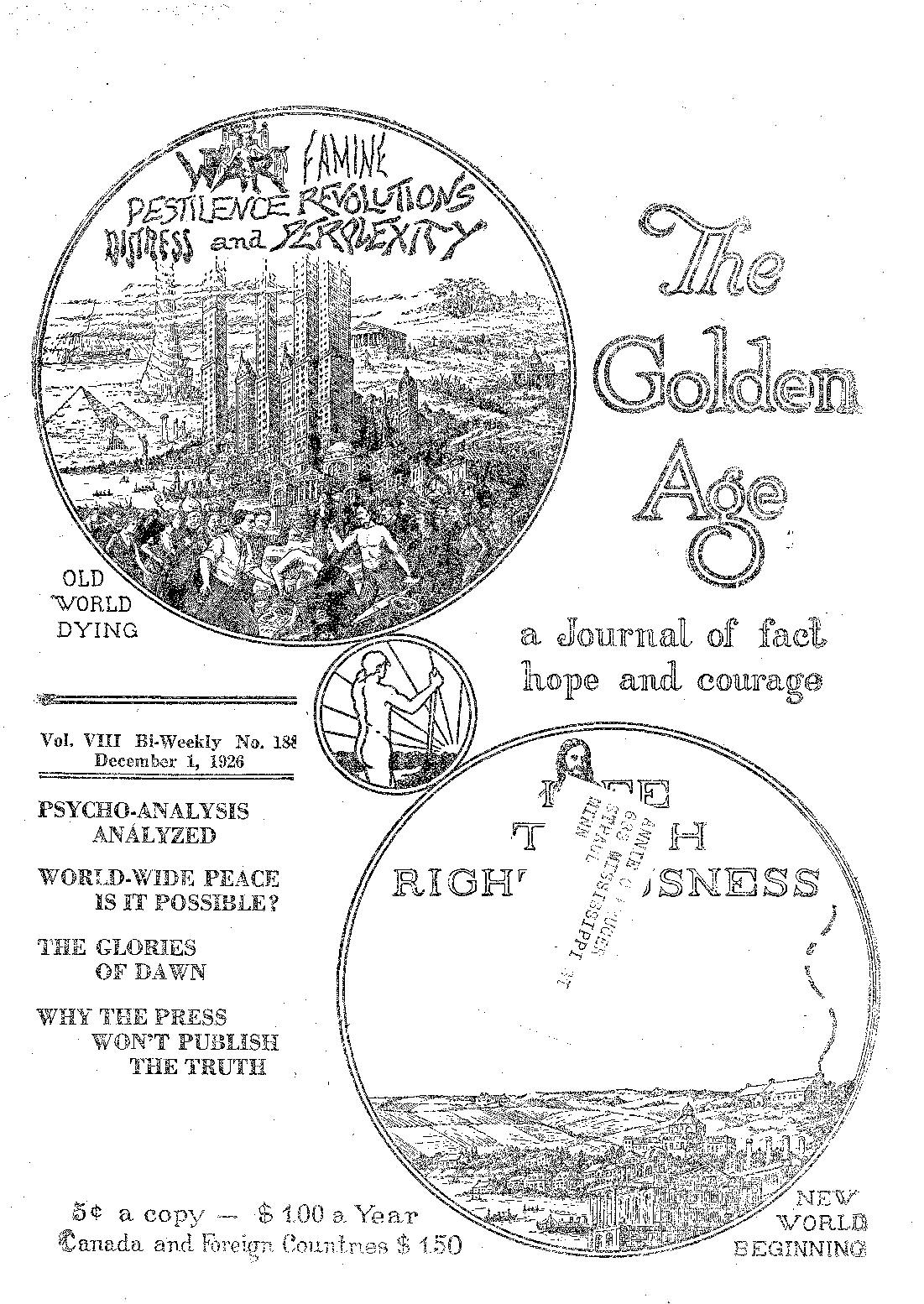
THE GLORIES OF DAWN
WORLD-WIDE PEACE
IS IT POSSIBLE?
PSYCHO-ANALYSIS ANALYZED
WHY THE PRESS
WON’T PUBLISH THE TRUTH
Vol. VIII Bi-Weekly No. 183
December 1, 1926
OLD ’WORLD DYING
k©pe anA courage
5$ a copy — $ 100 a Year Canada and Foreign Countries $ 1.50
NEY
VGRLB £. EGINN ING
Contents of . the. Golden Age
_^;jjzrS====z=^-^=== ~^======—
Labor aw Economics The Would and its News ............. .
Rents Are Still Unduly High
Wage Rates of Common Labor
Senator Shipstead and the Living Wage
Social and Educational
Professor Fisher’s Findings-on Prohibition ......... 139
A Radio Hero at Miami
A New Method of Fighting Forest Fires
A Radio Expert’s Prophecy
Radio Programs .......
Finance—Commerce—Transportation
Automobiles Continue to Kill
Mr. Hinman's Trip Through Georgia
The Sukkar Barrage in India
Holland’s Conquest of the Zuyder Zee
Operating Trains by the Human Voice
Russia a Good Customer ’
OFFICERS OF THE S. S. “BKBMEN” VINDICATED
Political—Domestic and Foreign
Alphonso EScaped a Prison Cell
i Is America Preparing Brazil for War? ...
Great Rejoicing at Friedrichshaven
1 German Borrowings Exceed Payments ......... .
Vienna Makes Stringent Deportment Laws
Travel and Miscellany The Airway in Western Australia ....
Appkmoiating the Glories of Dawn ...
Religion and Philosophy Psycho-Analysis Analyzed ...
Is World-Wide Peace Possible? When?
Jesus’ Tbip to Chicago
The Millennium at Bmdgepobt
Why the Press Does Not Publish the Truth
A Prophecy Now Being Fulfilled
Little Studies fob Little People
Studies in “The Harp of God” ...
Published every other Wednesday at 18 Concord Street, Brooklyn, N. Y., U. S. A bv S WOOD WORTH, HUDGINGS & MARTIN
I ' Copartners and Proprietors Address; 18 Concord Street. Brooklyn, N. y., U.S.A.
I - CLAYTON J. WOODWORTH . . . Editor ROBERT J. MARTIN . Business Manager
WM. ff. HUDGINGS . . Sec’y and Treas.
ii Five Cents a Copt—$1.00 a Year Mike Remittances to THE GOLDEN AGE
5 Notice to Subscribers: We do not, as a rule, send a card of acknowledgment for a
p renewal or for a new subscription. A renewal blank (carrying notice of expiration)
j will be sent with the journal one month before the subscription expires. Change of
j address, when requested, may be expected to appear on address label within one month.
5 Foreign Offices : British ..... 34 Craven Terrace, Lancaster Gate, London W. 2
Canadian ......... 38-40 Irwin Avenue, Toronto, Ontario Australasian ....... 49o Collins Street, Melbourne, Australia South African ...... 6 Lelie Street, Cape Town, South Africa
, Entered as second-class matter at Brooklyn, N. Y., under the Act of March 3, ISIS!
The Golden .Age
Volume VIII Brooklyn, N.Y., Wednesday, December 1, 1926 Number 188
Psycho-Analysis Analyzed By 0. L. Bosenkrans, Jr.
THE writer premises that he considers Psycho-Analysis an admixture of truth and error. If, in his endeavor to confute some of its errors, he has mistaken the one for the other, his apology must be an admitted lack of superabundant knowledge of the subject, together with the limitations of his brain. The subject is so comprehensive, the authorities so numerous, and the literature so extensive that naturally none but a specialist is competent to do it justice. But a specialist would try to convert the reader, thereby counteracting the purpose of this examination. We hope, then, that the reader will excuse what may be the presumption of ignorance, nor deprecate this satire as unfair; it is intended as a deodorizer.
The older schools of psychology concerned themselves chiefly with the tabulation of mental manifestations rather than with their promptings. Eventually the dictum was established that our minds are dual in their activity, comprising objective and subjective spheres. The latter, being the more mysterious, stimulated particularly the curiosity of investigators. It was conceived of as virtually a separate entity from our conscious selves, quite irresponsible and devoid of principle or loyalty to the ego, yet possessed of such incalculable potentialities that it must be rigorously kept in subjection by its master, the objective mind, lest alien, hostile influences transform it into a foe within.
Hypnotism—Auto-Suggestion-—Mental Science
ITMANITY,- having outgrown warlocks and water-sprites, was becoming too matter-of-fact and required revitalization ; so hypnotism and auto-suggestion were introduced to the world to start new vibrations of anxiety. On this foundation w’as erected the modernly popular wlll-to-power science of mental-culture, which is rooted in oriental pantheism and traces its genealogy back to the original esoteric philosophy common to the inner circles of the pagan priesthood of Babylon, Egypt, and Greece. Mental science proved captivating to both mediocre animalistic minds and victims of nerve tyranny. It justified the first in their aggressive selfishness, and promised the latter release from their discomfort.
Indirectly mental science committed the world to a new code of ethics, whereby to confess a weak will became the unpardonable sin. This code became an integral factor' in human interrelations. Mental science, however, proved inadequate to explain the baffling complexities of human nature; hence psychiatrists found it unavailable as a therapeutic agency. So they abjured occultism, and through independent research formulated a new system based primarily on the examination of unbalanced minds. Their conclusions differed materially from the will-culturists; psycho-analysts assert that our mental make-up is predetermined by pre-natal and infantile experiences and cannot be appreciably remodeled by any deliberate exercise of the will in adult life. So the program of occultism was partly frustrated; the house was somewhat divided against itself.
Following their Eastern preceptors, the various schools of mental culture had proclaimed that personal salvation was self-achieved—there was no requirement for Advocate or Mediator, but an imperative necessity for developing our wills. Since life is brief and filled with uncertainties, will-culture does not restrict itself to temporal salvation but presumes to determine also the personal status after death. Hell, here and hereafter, must be the abode of the weak-of-will. .
A Do-As-You-Please Philosophy
npHE psycho-analysts, however, pooh-poohed the foregoing assumption of the will-cul-turists; yet in the sequel their goals are found to be identical, though differently attained. Success and happiness, they both aver, lie in the complete expression of self “translated into social values”. To speak more succinctly, selfishness is “sublimated” into public service. But we are not indebted to either of these schools for the origin of this observation; for Volney ad- • vanced the same idea back in the eighteenth century.
. 131
A modern example might be furnished by any eminent inventor who, for self-glorification, contributes to the comfort of his fellow creatures. This is the doctrine of the New Individualism, or do-as-you-please philosophy, which trusts to destiny to inscribe your personal strivings on the credit column of public benefactions.
This self-assertive instinct, we are informed, is the backbone of “character” and the motivepower of success. It is a much-snubbed propensity in our industrially-organized society, whose bogey is anarchy. Civilization is infested with damaged goods—egoes whose self-assertiveness suffered permanent impairment in ehildhood through family discipline. Solomon Was unfamiliar with psycho-analysis or he would have never handed down that misleading precept about sparing the rod. Some of its victims, powerless to reconcile the internal conflict between instinctive impulses and artificially-imposed conscious ideals, develop a “religious complex”—ah, super-tragedy! dooming their w’hole lives to futile and purposeless struggling with the conscience obsession!
The implication is that piety is incompatible with the “will-to-live”. Instead of exerting wholesome self-assertion, the pious yield to. morbid self-abasement, the “protective impulse of a -whipped dog”, -which lowers blood pressure and slows the heart beat, predisposing to a negative attitude toward life in maturity, to an incorrigible sense of failure. In effect, piety is identified with neurosis; the cowed child grows up into the Puritan.
Well, our pioneer ancestors resorted to their parental privileges to an extent we would deem immoderate, yet their progeny subdued the wil-demess and laid the foundations for an empire. Their religious Complexes were open and manifest, and they carried their muskets to meeting house to discourage unseemly interruptions by the red man. History absolves them from abnormal timorousness or incompetency.
A Glorification of Selfishness
IGNORING historical data, the psycho-analysts say that since only one instinct ought to be allowed to dominate the ego at a time, when in doubt give the right of way to self-assertion (selfishness). In other words, high-ball it through; show the house cat, at least, who is ■boss. Meekness is anathema; it reveals the type of men immortalized by Barnum's proverb. Shun humbleness; for it is at best a species of self-deception, an “over-compensation”, camouflaging hidden batteries of soul-rebellion. Ideas are prone to impersonate their opposites in the subconscious; the meek soul is a parricide at heart, too cowardly to submit to self-examination. Avoid superlative goodness; it is'’a snare! Little angel face, you are incurring the gravest risk of amounting to, very small potatoes, not to mention an untimely demise. Supporters of reform tickets do not carve the political pies, customarily. .
To the query, Does not all this emphasis placed on self-assertion prejudice social stability? The phycho-analyst replies: “Oh, no! not necessarily: since our inherent 'herd complex’ regulates and minimizes inordinate self-assertion.” The desire of the individual for “herd approval” precludes too flagrant trespassing on his neighbors’ claim-stakes. The ideal is embodied in that ancient worldly philosophy: Seek to be “highly esteemed among men”; remain “in good standing” among your associates; be careful not to offend the popular code. This guarantees protection to society from over-ambitious members who might otherwise climb bodily into the-trough and try to monopolize it. Truly an estimable quality this “herd complex”, the lack of which must have seriously handicapped the first pair in Eden.
Are vre to infer from the admonition to vigorously assert ourselves that. selfishness is a consummate virtue? Alas! my benighted brother; too long have our honest, instructive impulses been libeled and thwarted by the deplorable moralistic fallacy that our animal nature is base and despicable; whereas to the enlightened understanding it is really nobler and more ethical than those superimposed moral laws which hamper its untrammeled expression.
Those acquisitive and coprophiliac propensities, inherited doubtless from remote pre-Simian
ancestors who poked their long snouts into this Psycho Analysis as a Religion and a Cure
and that, should not evoke disgust and condemnation; but should be recognized as more truly exalting than false, arbitrary ideals, such as aesthetic admiration for a sunset, and the like. After all, can one eat a sunset? Ah, those gloomy apostles ! How inferior were the standards which they imposed on the world to those of glorious pagan antiquity, with its thyrsus, its lotus and its priapic gods!
Zs Sex the Goal of Existence? .
TYO WE understand, then, that sex is the goal J-' of existence, the sum of human effort ? The psycho-analyst answers, “Yes, but not in a sense implying sensuality. We venerate sex in its relation to posterity. Nature’s goal is the creation of the child; wherefore the pursuit of happiness lies neither in sex nor in marriage, for their own sake, but in the home. Unbridled hetero-sex-uality is but a cheating of the Imago, who hovers yearningly above the cradle.” Indeed, though masquerading as a scientific euphemism, we discern truth here, and gladly acknowledge it.
Whether, deliberately or not, each son of Eve seeks a materialization of the love image in his heart, longing to revive within the holy precincts of a new home the cherished glamour of his own childhood. But on the other hand, unless fathers nurse their girl babies, why should they impress the latter with a love image ? Methinks an inconsistency lurks here. Truth and error-are cunningly interwoven in the psycho-analyst web, lest the pattern prove undisguisably ugly.
In a general rvay, we are to suppose that happiness is intimately involved with domesticity; in spite of inherited pointed-ear proclivities that tempt some men away into lives of singleblessedness and adventure. Herein a marked distinction is afforded between the older schools of mental science and psycho-analysis. The former counseled us to lift ourselves up, and ever upward through the seven heavens, by our boot-straps; while the latter bids us rest content with a temporal salvation. Nevertheless, man is mortal and exposed to perpetual hazard; and woman, moreover, in many individual cases, is in current civilization defrauded by her very numerical superabundance from achieving this goal. Must the surplus reconcile itself to eternal nnfulfilment of its dream?
IS IT not a defect of this pseudo-religion that it makes no provision for an ultimate righting of wrongs'? But the ardent advocate retorts: “This, sir, is a hasty assumption, not warranted by our philosophy; there exists no insuperable obstacle to a heavenly reward of some sort, since the unconscious mind reveals that its great dynamic wish is for personal power and im' mortality. .
“We must, of course, concede that not a shred of actual scientific evidence has turned up in support of this; in candor we are obliged to acknowledge that exhaustive tests have, so far, demonstrated nothing tangible; but we infer that man must have a soul from the phenomenon that the unconscious mind has no record of personal death, acting always on the assumption of an infinite sequence of tomorrows.” Its goal of omnipotence and immortality is the wish to be a god.
As a therapeutic agency, too, psycho-analysis is a failure, unless it takes cognizance of the immortality dogma; for no cure is possible unless the patient subscribes to it. AVe recall that the initial human imperfection was endangered by this very temptation toward omnipotence and immortality.
In the Eleusinian Mysteries a basket was carried, containing in a casket a phallus, an egg and a serpent. The first two symbolized fire and water, the active and passive procreative principles; while the latter represented the Great Destroyer who perpetuates life by eternally renewing it. The serpent symbolizes his mystic power of regeneration by periodically casting his skin. The picture coincides with the psycho-analyst philosophy, and it is obvious who is the Galen of this school of therapeutics!
At any rate psycho-analysis has proved nothing by its argument except,, perhaps, that the minute plant-lice have immortal souls! But we esteem it a corroboration of divine mercy that cattle be allowed to browse on, oblivious to the butcher; and that like theirs, our instinctive animal mind (if we have one) should be unaware of death. Our psychic engineer should not be perpetually reminded that machinery wears out, lest he grow discouraged.
''Like the Roman Confessional
pSYCHO-ANALYSTS pretend to be at variance with New Thought, .but the two systems have standardized interchangeable pasts. Will-culture is impotent to release you from the thrall of "complex” and “repression”, so your ego must search for other egress. The remedy, of course, is to consult a psycho-analysis specialist, who (for a consideration) will direct his flashlight into obscure corners of your mind, and drag out long-forgotten, unclean memories for laboratory research work. He will interpret the mystic symbolism of your chaotic dreams, rousing chaste blushes at recollection of inadvertent “exhibitionism” when at some past time you flaunted your bare foot before the public gaze. Gently he will inveigle you into confession of the more shameful episodes of your early experience, habitually stifled by the “censor”, lest you walk abashed in crowds.
You are told that you are a neurotic, an exaggerated human being; that your sole chance for recovery from this pestiferous ultra-humanness is to permit the triumphant emergence of your repressed animality into your consciousness. It resents being snubbed, so it pounds vociferously on the parlor door. Make it welcome, and it will then retire unobtrusively into a corner; though in practice, we suspect, it will muddy the carpet somewhat; and your “censor” will become a balked housekeeper, deprived of her mop and duster.
Perhaps the most cherished dogma of the psycho-analyst is the CEdipus myth, according to which practically every son harbors subconsciously incestuous passion for his mother, and every daughter for her father. This “clarifies” sundry freaks of behavior, explaining filial hatred and jealousy of the opposite parent! We trust some misconception lingers here; if not, it almost seems as if ignorance were preferable to enlightenment, and a pity that the sapient investigators ever acquainted the public with their discoveries, so that humanity might retain its immemorial illusions concerning parental affection and filial duty. Surely the disclosure that parental love is a species of unconfessed eroticism poisons the well-springs of mutual respect and esteem within the family circle; the austere countenances of Lares and Penates are Suffused with shame, when luring lust creeps to the hearthstone.
Undermining the Dignity of Life
X INSTRUCTING- the public to ascribe all motives to sex, the purity of human interrelations is vitiated; the old moral dignity of life infracted. A confusion of ethical values is instilled whereby sex-delinquency ceases to be more than a venial offense; pubescent pruriency is encouraged, and social decorum violated by free discussion between the sexes of erstwhile tabooed themes. The barroom and the bavcdy-house left unsmirched the garments of racial ideality, because the latter did not frequent these resorts; but the nomenclature of psycho-analysis sanctifies lewd speaking in the classroom.
Innocence is no longer valid when we are asked to believe that even the cooing infant in its perambulator is preoccupied in ministering to its inborn erotic cravings; but these, the psycho-analyst gravely explains, are not yet specifically localized into the zones of maturity. Wherefore mitigate your astonishment at the doctrine that the baby admiring its little toes is indulging in a form of subconscious sex-gratification, “'narcissism”! Surely in a world incorrigibly irreverent concerning sex, to suggest cynicism in this relation concerning immaturity is to add more fuel to the smouldering fires of Armageddon!
Ambi-sexuality is another evil propensity hidden in the dark chambers of our subconsciousness, according to the psycho-analysts; but I fail to coincide with them in identifying it as a basic primeval instinct. We fallen creatures are universally susceptible to the whispers of invisible malignancy, whether or not we have “clairaudient ears”. An implicit reliance on traditional morality is a safeguard, but these latter-day monitors undermine even this defense by egging us on to flout the inhibitions of our conscious moral “censor”. They condone this introductory phase of moral laxity, because in the majority of cases it is supposed to restore marital prowess by neutralizing our stultifying “repressions”.
The mind having dismissed its gate-keeper, a motley throng of undesirable visitors gain entrance, obstreperously announcing themselves blood-relatives. But the adroit P. A. practitioner calms your agitation; explaining that everything is perfectly proper, that your horror of these reprobate impulses is no more than an “anxiety” obsession, a symptom of neurosis. The insidious idea is thus implanted that sin is a phantasy imposed by the moral censor to keep within bounds primordial instincts long outlawed by civilization.
'Explaining Away Sin and Disease
IN RADICAL disagreement with Christian Science, psycho-analysis indorses mind-cure solely for nervous ailments, disclaiming its efficacy with regard to_ organic diseases. However, the divergency becomes less apparent when it is considered that the psycho-analysts’ field of effort is the subconscious; and the latter is supposed to control our involuntary physical functions, such as circulation, respiration, digestion, etc.
Subtly reminiscent of Mrs. Eddy’s “Science and Health” is the following by a feminine exponent of psycho-analysis: “Absurd as it sounds, ‘nerves’ turn out to be a question of morals; a neurosis, an affair of conscience; a nervous symptom, an unsettled ethical struggle.” Sin, declared Mrs. Eddy, is ill health. And it has been alleged by certain of her detractors that she herself was not the originator of her doctrine; but coolly appropriated, without acknowledging the debt, a system devised by a specialist in nervous diseases, who was also an Orientalist, for use in his practice. The subconscious is quite amenable to suggestion; nevertheless even in a state of hypnosis it appears to rebel at such a command as, “You are a sausage; eat yourself” I
Psycho-Analysis, like every other mind-healing cult which has come under our notice, has established no free clinics. It follows that pio-longed and difficult cases are not to be shunned as an unalloyed nuisance. Cures are not guaranteed. Some patients, from lack of confidence in the practitioner, or being too diffident to un-bosom themselves unreservedly of those thoughts and memories which the average person habitually covers up, stubbornly resist treatment. Among such unsatisfactory cases are some who have been guilty of the most monstrous ingratitude, accusing the practitioners of fraud and charlatanism! Some erstwhile advocates, who are themselves regular physicians, have since written books purporting to expose the science as a tissue of falsehoods and misconceptions.
Staple Reliance of the Practitioner
ONE staple reliance of the psycho-analyst practitioner is a presumed-, almost universal, chafing of adult human beings against sex-deficiency; the inference being that happiness is centered here and is otherwise unobtainable, unless through “sublimation”. Our suspicion is that in this connection a concomitant of decadent society has been extended beyond its proper sphere. Our congested, artificial urban habits of life do not represent normalcy. Nature’s effort today in emphasizing sex-deficiency may be directed to counterbalance over-population. A degenerate race may be approaching that stage forewarned of by Pastor Russell, where it may be no longer able to transmit the spark of life.
A consequence is preternatural personal solicitude in respect to this, which reflects, itself in . aphrodisiacal advertisements and phobias of sex perversion. An eminent psycho-analyst pronounces all mankind to be “sex insane”, and proves his case to the reader’s satisfaction. Still, we are inclined to modify this opinion where sober-minded citizens are concerned, preoccupied with business, family cares and gathering infirmities. Only pubescents and the salacious-minded are perpetually reading covert improprieties between the lines of ordinary behavior.
Howbeit, as in Caesar’s day, when neighborly intuition seeks with mutual avidity for the hidden vice it is an infallible symptom of social rottenness. If mankind is really “sex insane” in our generation, it indicates abnormalcy—a condition approximating senility. Normalcy takes sex-sufficiency for granted; decrepitude builds up “compensation” (to use their own terms), by parading its own pretended virility and denouncing the inadequacy in its neighbor.
Parallelling the Degenerate Roman World
UR age parallels the degenerate Roman world in many features. Like that, we are submerging our racial ideals in Oriental mysticism; but—to again borrow a word from, psychoanalysts—we “rationalize” it, making it attire itself in vesture more suitable to our matter-of-factness, substituting in lieu of Mahatma and Buddhisattva scientific parlance. It must acquire a Protean faculty of accommodating itself in one place to mititant feminism, in another to biology and therapeutics. As a therapeutic agency it receives a cordial welcome from a nervously unstrung generation, unable to adapt their physical organism to the keyed-up, unnatural mode of existence demanded by the age of gasoline and electricity.
Some of our worst maladies, according to these mind physicians, are attributable to our nefarious “repressions”. They point out that when you block or suppress an impulse you but divert it into unforeseen channels of activity; you cannot obliterate it; it reappears disguised as anger, jealousy, or hypochondria. The assumption here seems to be that all men are by nature created free and equal providing that their animal impulses are given free rein in early life; but civilization is hostile to the “libido”, imposing arbitrary rules and restrictions. The defects of civilization are supposed to arise from a Zoroastrian conflict between primitive instincts and racial ideals. The Jukes family is left out of the discussion.
The subconscious mind, we are told, is the realm of our primal instincts. Its storehouse of old memories comprehend uncounted generations, stretching back into post-glacial times. Reprehend not too harshly little Johnny for "tin-canning” Fido, or his little sister for snapping a clothes pin onto her own stub nose; these "sadist” and “masochistic” traits serve to exemplify the recrudescence of a waddy-club wooing inheritance. Victorian prudery has been responsible for much ignorant groping in wrong directions by children.
You have been puzzled by Miss Blond’s inordinate partiality for quinine? We discern in this idiosyncrasy a "drug compulsion”, a subconscious reassertion of infantile curiosity. Perhaps the teaching of sex hygiene would have obviated this trouble. Probably the misplaced affection of some middle-aged ladies for their lap-dogs signifies subconscious yearning for the "snuggle-puppies” of their high-school days.
Explaining Away Humanity
HOW dimly do we apprehend our "inner selves”, according to psycho-analyst philosophy I Do not felicitate yourself, my friend, on your humanitarianism. That tenderness, evoked (as you imagine) by childish winsomeness, is hut the “rationalization” of a cannibalistic or ogreish ravening for a little-girl-stew. Those periodic yieldings to fits of generosity are mexi-tai sprees which serve to lift you out of the soul-dwarfing daily grind by removing your “inhibitions”. It is salutary at odd moments to forget the potter’s field. And be not too positive respecting that stem practicality that you pride yourself on; while your conscious ego is concentrating on the market reports your subconscious mind is eagerly scanning the bargain sales of ruffled skirts. Its appetite is omnivorous. And unbeknown to you it has for many years been accumulating a prodigious mass of data which is of no possible use to you, personally, so far as you are able to judge.
Some aspects of psycho-analysis are so indelicate as scarcely to bear handling without longhandled tongs. Indeed the psycho-analysts themselves have been fain to invent a nomenclature unintelligible to the student without a glossary. For popular consumption the doctrine is presented in such seemly innocuous form that not even the most squeamish can take offense; but the advanced student must allow himself to be escorted into veritable latrines and cesspools of these mind analysts. Here he imbibes the valuable knowledge that infantile eroticism, improperly trained, crystallizes itself in unmentionable vagaries.
Antiquity accepted “inversion” as an institution, and glorified it. We outlaw it. Hence, our “natural” instincts undergo “transference”, resulting in coldness and asperity in inter-masculine relations, but affect exaggerated homage for the opposite sex. Hence, likewise, the latter-day fascination of “boyish” maidenhood. Do the revised interpretations of ancient iniquity ignore Lot’s wife?
Van Teslaar defines psycho-analysis as psychology herded into the evolutionist fold. AU the other sciences had jointed-up and taken the pledge, except old-fogey atomistic psychology, which clung dotingly to its ossifications; until Freud, with his revolutionary hypotheses, appeared as the Sakyamuni of mental science.
However, in spite of Freud’s great reputation among them, not all the leading authorities accept his views in their entirety. Adler declines to subscribe to the theorem that sex constitutes the basic purpose of individual development, himself substituting, but somewhat indefinitely, “purposiveness”. Dr. Emanuel takes the heterodox standpoint that consciousness of guilt is not; rdoted in the CEdipus complex, but in distaste for work..
Repudiation of the Bible
WHETHER Dr. Ludwig Levy was a pensionary of the German captains-of-in-dustry, we cannot say; hut he endorses enthusiastically the “sweat of face” as the great panacea, the “only lasting satisfaction in life”. The worker who harbors fears of “hurting himself” and “stalls” on the job is effecting a subconscious “transference” of his dread of the effects of onanism. Both are neurotic phobias, equally fallacious!
The Jewish religion, Dr. Levy opines, represented a Puritanical reaction against the sexual orgies into which the older idolatries had degenerated. “Very characteristic of the author of Genesis,” he remarks, “is the divine punishment for sinful transgression, which is work.” Work thus “becomes a burden, an evil”. Evidently he embraces the common error which ascribes the fall of man to sexual temptation. In their anxiety to confute the Scriptures men of science frequently betray their own egregious ignorance of its texts.
Jung also takes issue with Freud on some important dogmas, but concurs with his colleagues in tacit repudiation of the Bible. He avers that the “rationalism of modern life has driven the irrational into the subconscious”; that the will to live, regardless of logical considerations, bears a certain analogy to religious faith, which requires the implicit acceptance of some opinion or other; and infers that the fall of man symbolizes our life-denying tendencies, such as “humbleness”.
“The God of the Old Testament stands above all as the strict disciplinarian, the representative of the principle “Thou shaft not’, in contrast to Christ, the representative of the principle ‘Thou shaft love’,” we are told. This bold dissociation of the Son from the Father as two incarnate but irreconcilable principles, is a favorite concept of the New Religionists who strive assiduously to champion the false Messiah. Neither is there anything in the four Gospels to warrant identifying the love enjoined there as eroticism.
Ferenczi, another apostle of psycho-analysis, likewise gives us a hint that his confidence in the ancient Book is very slight, when he refers to humanity’s undying longing to rehabilitate childhood’s paradise as the veritable golden age, “which poets project from the past into the future.” Is it not more probable that our fleeting Edenic reminiscences are in a sense antitypical, serving, like maternity, to remind us that other laws will prevail in a reorganized, purified world than spiritual Nietzscheism, and that the loftiest dreams of our race were not mere phantasies?
Psycho-analyst authorities admit telepathic suggestion as being a factor of the mind that cannot be ignored, yet their explanation of the phenomenon is not altogether clarifying. Whether these alien, interloping thoughts represent mental telegraphy, demoniac suggestion or subconscious reactions is a matter for the reader to ponder over and for subsequent development to demonstrate.
Conclusion
WE CONCEDE that psycho-analysis embodies certain fundamental truths, but maintain that these truths have been artfully blended with errors, arising from misconceptions concerning unfathomed laws of nature. It cannot be gainsaid that the reproductive urge pervades in a sense the complete psychological history of the individual. Infancy is a preparation for the procreative life; old age, a regretful relinquishment; but sexuality is by no means the whole of human life.
Even psycho-analysts recommend as necessary the diversion of surplus sexual impulse into channels of “sublimation”. This is defined as a “switching over of our surplus energy into socially valuable work”. It is recognized that the love instinct, unlike its nutritive competitor, possesses unique potentialities for constructive creative effort. We witness sublimation in the manifold activities of human life where sex is not conspicuous. The actor sublimates his “exhibitionist” impulses; the cruel boy becomes the surgeon in maturity; the curator’s enthusiasm is but transcended sexual curiosity.
Says C. A. Coe: “Society’s great task is the understanding of the life-force, its manifest efforts at expression and the way of attaining this, and to provide as free and expansive ways as possible for the creative energy which is to work marvelous things for the future.” Noble, soul-stirring words—if it were truly feasible to avert the impending cataclysm into which civ-Hization is rushing headlong, and to perpetuate ©nr man-made millennium for an indefinite term ; of cycles!
But events are moving swiftly toward a consummation. Secure as we feel ourselves to be, bulwarked by concrete and steel, ready ; though men be to abjure revealed religion and ' the ethical code of our forefathers, and to hail psycho-analysis as the great illuminator which teaches them how to expend their surplus ‘‘"libido” in altruistic endeavor—all this nevertheless will prove futile to halt the whirlwind’s progress. The wisdom of our wise men shall perish with the existing order of things.
Where Sex Will Eventually End
WE CANNOT but entertain a suspicion that this modern trend to reduce all motives to sex-basis correlates progressive sex-apathy. As sex-propinquity cools under feministic onslaught, the professors artificially essay to revive it. But the race has damned sex in this age by an unholy traffic with forbidden knowledge, by permitting it in a special sense to become an instrument of diabolism. Since seximpulse is an integral factor in our make-up, must we argue sterility and torpor, a vegetative existence in the hereafter, because procreation shall have become superfluous ?
We can only guess that in the coming days those age-old, fundamental impulses will not atrophy but will become “sublimated” by mankind into altruism in its broadest sense. The loftier mutual affection among human beings will itself merge into parental, filial, fraternal, connubial—every manifestation of love—into a profounder, more satisfying sentiment than anything now conceivable. All humanity, except the incorrigible who are to be destroyed, will come into harmony with the eternal laws of the universe, and. will enjoy life in its fullness, in peace and righteousness forever.
Glossary of Unfamiliar Terms
Ambi-sexuality, the state of being distinguished by both sexes, Anathema, forljidden, proscribed.
Aphrodisiacal, stimulating sexual appetite.
Buddhisattva, supreme wisdom a la Buddha, theosophy. Charlatanism, quackery.
Coprophiliac, loving filth.
Eleusinian Mysteries, secret religious rites practiced by tha Greeks.
Eroticism, unnatural sexual appetite.
Esoteric, secret, confidential.
Gaien, famous Greek physician, living 200 B. C.
Hetero-sexuality, depraved feeling toward the opposite sex. Hypochondria, morbid melancholy.
Imago, adult, sexually matured.
Inversion, reversal of the natural sex order.
Libido, sexual desire.
Lotus, indolent enjoyment.
Masochistic, sexually perverted and willing to be treated cruelly along with it.
Neurosis, a disease of the nerves.
Neurotic, afflicted with nervous disease.
Oedipus, A Greek king who unknowingly married his own mother.
Onanism, Genesis 38: 9.
Pantheism, the doctrine that everything, conceived of as a whole, is God.
Parricide, murderer of ancestors or offspring.
Phallus, figure of male generative organ used as a symbol. Phobias, morbid fears.
Priapic, fruitful and sensual.
Propinquity, local nearness.
Protean, playing different parts.
Pruriency, lascivious curiosity.
Psychology, science of the human mind.
Sadist, sexually perverted and cruel along with It, Sakyamuni, the family name of Buddha.
Salacious, lustful.
Sapient, possessing deep wisdom (often used ironically). Thyrsus, the Bacchic wand, a staff wreathed in ivy and Sublimated, refined, etherealized.
vine leaves.
Waddy-club, a thick club used by uncivilized, primitive people. Warlock, a sprite, imp.
The World and Its News
Heists are Still Unduly High
rpiIEBE has been a drop of nearly six percent A in rents since July, 1924, but they are still unduly high as compared with the average price of 404 commodities compiled by the Bureau of Labor Statistics of the IL S. Department of Labor. The, average price of those commodities for August, 1926, was 149.2% as compared with file prices prevailing in 1913. The average rents ©f small apartments and such quarters as are usually occupied by workers are 175% higher than were the rents of the same quarters the year the war started. This is too big a difference.
Wage Hates of Common Labor
THE Department of Labor, Bureau of Labor
Statistics, has issued a bulletin giving statistics of labor conditions throughout the country. The average hourly wage of common laborers on July 1st., 1926, was 42.8 cents, ranging from 33.6 cents, in sawmills, to 47.9 cents in the petroleum refining industry. In Chicago the hourly wages of bus drivers vary from 42.9 cents to 87.5. There is a similar wide variation of bus drivers’ wages in New York City.
Senator Shipstead and the Living Wage
IN AN address at Duluth, United States Senator Shipstead ridiculed the slogan of “a living wage”, which seems to suggest that a mere living is sufficient. He pointed out that a horse gets a living wage, and in addition is fed all winter, so that he can wrork again in the spring; that a laborer-is paid only when he works, and must be paid enough so that he can feed himself out of his savings when he is unemployed.
Natural Soaps of the West
THE West has two natural soaps, one of which is the seed of a plant, and works up into a quite satisfactory lather. The other is a white rock scientifically known as amargosite, which is now being mined near Death Valley, California. The Indians have used both of these soaps from time immemorial.
Automobiles Continue to Kill
A LITTLE while ago it was reported that there was a slight falling off in the number of persons killed by automobiles, and all began to take courage for the future; but the latest figures are that the killings in 1926 will probably show an increase from 17.9 persons to about 18.9 persons per 100,000 of population. Camden is now the most dangerous city. Chicago is only half as bad, and New York only 40% as bad. Norfolk is the safest city of all.
War in the Holy City
A LITTLE while ago Chicago was dubbed the
Holy City, but since Mr. Bonzano went home it has fallen back into its old ways. ' In a suburb called Cicero . a noted bootlegger was about to open a, new saloon in a territory controlled by another crowd. Accordingly thirty gunmen raced through the street past his saloon, firing machine guns at the saloon as they passed. One of the cars carrying the gunmen belonged to the Chicago police department. Two innocent bystanders were shot, but the bootlegger who was opening the new saloon escaped unhurt.
Prof. Fisker’s Findings on Prohibition
Processor Irving Fisher, in a new book entitled “Prohibition at Its Worst”, presents elaborate statistics to shove that “'the flow of alcohol down human throats in the United States is at present certainly less than sixteen percent, probably less than ten percent, and possibly less than five percent of pre-prohibition consumption”. Professor Fisher’s statistics were gathered from the police departments of 626 cities and towns.
Mr. Hinman’s Trip Through Georgia
Me. George W. Hinman is always interesting.
He has recently been making a trip through Georgia. The state is prospering but it needs more capital and just now is wondering why $15,000,000 of American money are sent to Germany to finance German farmers when so many Georgia farmers need help; why $25,000,000 of American money are sent to Congo to develop cotton fields that will displace Georgia cotton fields; and why other millions have gone to Europe to finance the European steel trust, when Georgia has manufacturing industries that could have used it all.
The Sukkar Barrage in India
AT A point on the Indus River near Sukkar
American excavators of mammoth proportions are constructing a dam and water system which will provide more reclaimed land than the cultivable areas of Upper and Lower Egypt combined. The dams are constructed of stone sawn by the. latest types of stone sawing machinery. They vary in weight from five to tw'enty-five tons. These excavators scoop up at a single dip the equivalent of five ordinary wagon loads.
The Airway in Western Australia
FROM north to south along the whole western coast of Australia, Derby to Perth inclusive, there has been maintained for several years an air service that has worked splendidly. Some 20,000 letters .are transported every month, besides passengers and a quantity of perishable freight. Many doctors and patients have been carried. Stops are made at the important towns. The longest non-stop flight in the route is 310 miles. The total mileage flown is over 600,000.
A Radio Hero in Miami
A LMOST immediately after the great storm that devastated the regions about Miami, an amateur radio broadcasting station, operated by J. Y. Haisch, succeeded in making radio contact with Jacksonville; and in the next twentyeight hours it handled hundreds of messages. After a half hour’s rest Mr. Haisch was back on the job again. It is believed that his efforts saved many lives.
Holland’s Conquest of the Zuyder Zee
HOLLAND has made many invasions of the ocean with her dikes, but is outdoing herself in the work now under way for the reclamation of two-thirds of the Zuyder Zee. The reclaimed portion will amount to nine hundred square miles. The dikes are already far out into the Zee, and are expected to meet in about four years. What is left of the Zee will be drained off and replaced by fresh water from the Rhine.
Operating Trains by Human Voice
THE New York Times reports a most interesting exhibition by a London inventor, in which two electric trains obeyed his commands to go, stop or back, as he desired. This was accomplished by the use of a microphone so set as to correspond to the particular pitch of his voice. The inventor is Major Raymond Phillips.
'Alphonso Escaped a Prison Cell
NEWS has just leaked out that King Alphonso narrowly escaped a prison cell. It seems that the king was actually arrested by the followers of De Rivera at the time that that notable seized the government, but was given his liberty "when he promised that he would do as De Rivera said. Had he not done so De Rivera, it is said, had determined to turn Spain into a republic, with himself as its first president. .
Russia a Good Customer
DURING the year 1925' Russia purchased from the United States $44,401,000 in cotton, $16,000,000 in machinery and $12,000,000 in flour. There were also considerable purchases of oil well supplies, chemicals, dyes, resin and nonferrous metals. The total Russian purchases during the year were $87,088,000, which, is considerable business to get from a customer that you won’t even recognize.
Is America Preparing Brazil For War?
THE Arbitrator, which is usually careful in -®- its statements, declares that since 1922 thirty-five United States naval officers have been training Brazil to prepare her navy for the next war, and that these officers are to remain for four years more at the expense of American taxpayers, in addition to the compensation received from Brazil. One can but wonder who has the authority or the right to make such uses of Uncle Sam’s funds.
Great Rejoicing at Friedrichshaven
LpiIERE is great rejoicing at Friedrichshaven, J- Lake Constance, over the assurance that Spain will open in 1929 an air service between Seville and Buenos Aires, with a new airship, the L-Z-127, that will be built at that place. The Germans have never lost their confidence in the Zeppelin, though the Lake Constance plant has been virtually idle ever since the Shenandoah disaster.
German Borrowings Exceed Payments
Commerce and . finance says: “To date German borrowings abroad have exceeded her reparation payments, which can scarcely have failed to grease the exchanges and make easier her transfers.” To reduce the foregoing to the plain facts, American financiers are buying up German industries, and if it were not for this buying Germany could not pay what she is paying and required to pay.
A New Method of Fighting Forest Fires
ANEW method of fighting forest fires has been discovered in France which gives promise of being of great value. It has been learned that a certain species of acacia tree is almost unburnable. The plan is to divide the forests into squares, separated by rows of these acacia trees, closely set together. It is believed that this may mean the solution of the forest fire problem. At any rate it seems a plan well worth trying.
Vienna Makes Stringent Deportment Laws
VIENNA has enacted some deportment laws which seem stringent and yet good withal.
Persons must not sing, whistle or talk too loudly on the streets; they must not impede pedestrian traffic by reading while walking; they must not carry excessively large packages; they must not use unseemly language, and they must not stop to converse in the middle of the street.
A Radio Expert’s Prophecy
Hugo Gernsbach, editor of Radio News and of Science and Invention, in a recent speech over the radio said:
Fifty years hence all of our crops will be grown under glass by electric cultivation, and instead of reaping once a year, we shall have four crops. We shall have glass-* covered farms, stretching for hundreds of miles into tha distance, with double glass walls to keep the heat during the night. These will be artificially heated by cheap power, and electrically stimulated.
Mr. Gernsbach sees future plowing, sowing, watering and harvesting all done electrically.
Radio Programs
[Station WBBB, Staten Island, New York City.—416.4 meters.]
Sunday Morning, December 12
10: 00 Watchtower Concert Orchestra.
10:25 Fred Twarosehk, tenor.
10:40 Bible Lecture—Judge Rutherford.
11:10 Fred Twarosehk, tenor.
11:20 Sunday School Lesson, “The Boy
—W. N. Woodworth:
11: 35 Fred Twar®schk, tenor.
11: 45 Watchtower Concert Orchestra.
Samuel”
Sunday Morning, December 19 10:00 Watchtower Concert Orchestra.
10:20 Forrest J. Kienihans, baritone.
10:40 Bible Lecture—Judge Rutherford. ■
11:10 Forrest J. Kleinhans, baritone.
11:20 Sunday School Lesson, “Samuel the Just Judge”
—F. W. Franz.
11: 40 Watchtower Concert Orchestra.
Sunday Afternoon, December 12 2:00 Watchtower String Quartette.
2: 25 Fred Twarosehk, tenor.
2:40 Bible Lecture, “The Day of God’s Vengeance” —R. H. Barber.
3:10 Fred Twarosehk, tenor.
3: 20 Buskin Macknight, cellist.
3: 35 Bible Instruction—Martin L. Hartman,
4:00 Watchtower String Quartette.
Sunday Evening, December 12
7:00 Watchtower Violin Quartette and Organ.
7:20 Vocal Selections.
7: 35 Bible Lecture, “Ecclesiasticism an Abomination in the Lord’s Sight”—R. H. Barber.
8: 05 Vocal Selections.
8:15 Watchtower Violin Quartette and Organ.
8: 30 Bible Questions and Answers—Judge Rutherford,
Tuesday Evening, December 14
7 : 30 Rudolph Clemento, violinist.
7: 50 World News Items of General Interest '
—C. J. Woodworth.
8:10 Billie Frederick, tenor.
8: 25 Rudolph Clemento, violinist.
8: 45 Billie Frederick, tenor.
9:00 Bible Lecture, “Who Shall Live Happily Forever?” ■ —C. A. Wise.
Thursday Evening, December 16
7: 30 Piano Duets—R. K. Nunn and F, S. Barnes.
7 : 45 Stanley Gohlinghorst, baritone.
8: 00 Bible Lecture, “The Wages of Sin”—S. M. Van Sipma.
8: 30 Stanley Gohlinghorst, baritone.
8:45 R. K. .Nunn, pianist.
9: 05 Helpful Items on Health and Hygiene.
Friday Evening, ^December 17
7 : 30 Watchtower Concert Trio.
7.: 50 Vocal Selections.
8:00 Bible Lecture, “Does God Torment Anyone?”
—Martin L. Hartman.
8:30 Joseph Bonaccorso, violinist.
8:50 Watchtower Concert Trio.
9:00 Bible Lecture, “The Dead Soon to Come Back to Earth”—W. F. Hudgings. ' Sunday Afternoon, December 19
2: 00 Watchtower Violin Quartette.
2: 20 Choral Singers.
2:35 Bible Lecture, “The Dawn of the Glorious Day” —H. P. Kleinhans.
3: 05 Forrest J. Kleinhans, baritone.
3: 20 Choral Singers.
3:30 Watchtower Violin Quartette.
.3 : 45 Bible Instruction—Eldore Bergsbaken,
4 : 05 Choral Singers.
4 :15 Watchtower Violin Quartette.
Sunday Evening, December 19
7: 00 Watchtower Concert Trio.
7: 20 Billie Frederick, tenor.
7:35 Bible Lecture, “The Reign of the King of Kings” —R. S. Emery.
8: 05 Billie Frederick, tenor.
8:15 Watchtower Concert Trio.
8: 30 Bible Questions and Answers—Judge Rutherford.
Tuesday Evening, December 21
7: 30 Professor Charles Rohner, violinist.
7: 50 Irene Kleinpeter, soprano.
8: 05 World News Items of General Interest. ■
8 : 30 Irene Kleinpeter, soprano.
8: 45 Professor Charles Rohner, violinist.
9: 00 “Listening in”—on Professor Thomas Standwell and Harry Goodwin.
Thursday Evening, December 23
7: 30 Bandura Quartette. ■
7: 45 Vocal Selections.
8: 00 Bible Lecture, “Our Christmas Tree”—H. H. Riemer.
8 : 30 Vocal Duets. ’
8: 45 Pandura Quartette.
9:00 Items on Health and Hygiene.
Friday Evening, December 24 7 : 30 Watchtower Concert Orchestra.
8: 00 Christmas Carols.
8:15 Christmas Discourse.
8: 55 Christmas Carols and Anthems, 9:15 Watchtower Concert Orchestra.
Is World-Wide Peace Possible? When?
[Badtoeart from Watchtower WBBR on a wave length of 413.4 meters by B. L. Beaulieu.]
PBIOB to the outbreak of the great World
War In 1914, world-wide peace seemed not only a possibility but a probability for the very near future. It was declared that settling disputes by means of war was archaic, and that we moderns had finally discovered that it was better for all concerned to settle our differences by means of arbitration. We had peace treaties and peace palaces; reciprocity was the order of the day; and pacifists were not only quite respectable but distinctly honored. The great nations were prepared for war, it is true; but these' armaments, it was declared, were merely to enforce peace. The world intended to have peace if it had to fight for at, and the sequel shows that they did have to fight for it—but then didn’t get it.
The prophets of old had foretold of an era of world-wide peace. The Christian had hoped and had prayed for it to come. Many of the world’s great leaders had industriously sought for it. The vast majority of the race wanted it, and even thought they almost had it. Everybody said "Peace, peace”—and then the greatest war of all history broke out. Other wars have followed it; armaments still increase in spite of the cry for disarmament; and there appears to be but little hope that the world will ever reach a time when war is no more. We still cry “Peace, peace”; but it is as the prophet said, we cry “peace, peace, when there is no peace. , . . We looked for peace, but no good came; and for a time of health [a time of safety], and behold trouble.”—Jeremiah 8:11,15.
Force is still king in the earth, and arbitration is only for the weak. We still have the Hague Peace Tribunal, and in addition the league of Nations and the World Court; and yet we do not have peace. Only those who find it inconvenient to fight appeal to these. When Wbyssinia finds her rights encroached upon by the great nations of England and Italy, she appeals to the League of Nations because she cannot hope to gain anything by going to war with these great powers.
But when Mussolini has a little difficulty with Greece, he knows a better way to get what he wants—the time-honored method of force. So we continue to have peace treaties and new battleships, peace conferences and new wars, peace talk and warlike action. The world talks about
142 peace and disarmament while it is actually arming to the teeth, ostensibly for defense but actually for another world-wide struggle.
Practically every nation on the face of the earth, whether it be great or small, rich or poor, is crushing* its people under tax burdens grievous to be borne—in order that it may maintain an army on semi-war footing, and that it may build new battleships, which are obsolete before they are launched. The United States, one of the most peace-loving nations on earth, has led the world by reducing its army to a peacetime basis, practically for police duty only, and by scrapping a portion of its navy.
This nation has time and again suggested further disarmament on both land and sea. Its suggestions have fallen on barren ground, and only recently it has through its president found it necessary to warn the great powers of the world that if a halt is not called to the everincreasing preparations for future wars the United States will find it necessary to prepare on a scale unprecedented in the past. If the United States, with no desire for aggression, with no quarrel with anyone, is forced to thus prepare, it can at once be seen that the hope for immediate world-wide peace is an illusory one.
The history of the human race has been a record of wars and rumors of wars, aggression and insurrection, oppression and revolution. We see history repeating itself. It is no wonder then that many have now said that world-wide peace is impossible. Many now declare that war has always been and will always continue to be. They say that the stronger has always imposed his will upon the weaker, and that the law of the survival of the fittest continues to operate. Their argument seems plausible.
Man has tried for centuries to bring about a state of peace and has failed. Indeed, the facts of history demonstrate that man will always fail by his own efforts; but thank God there is a higher power which will one day operate to accomplish that which man cannot do. God declares prophetically through the Psalmist: “He maketh wars to cease unto the, end of the earth, . . Be still and know that I am God.”—Psalm 46:9,10.
World-wide peace is an impossibility so far as the efforts, of man are concerned, and for three outstanding’ reasons:
qOLDEN AQE
1. The nations are preparing for war, and history shows that when preparations are complete, near will follow.
2. The Christian denominations, to whom we should be able to look to bring about such a state of peace, have shown their incapacity.
3. There is no organization or influence in the earth which has the power to enforce peace.
Taking up the first reason why mankind through its own efforts cannot establish worldwide peace, we notice again the continued expenditures of the various nations to be “prepared”. One would think that the late World War should have taught the peoples of earth one lesson at least, and that is that preparation for war only makes war inevitable. Yet the nations do not dare to cease their preparations. Fear still controls them. Each nation fears the others, knowing full well wfliat a well-prepared nation might do against a host of unprepared ones if it desired.
Every nation knows that our civilization is based upon selfishness, and that nations conduct themselves even as individuals do. Each man is looking out for his own interests regardless of the interests of others. Every nation does precisely the same thing. Each nation looks across its boundaries and sees its neighbor training men, launching battleships, buying airplanes, storing up munitions, etc., etc. .
Fear takes hold of its leaders, and they demand that their nation do likewise. So long as the world is selfish, just so long as we distrust one another and have good reason for so distrusting, disarmament is'an impracticability. That being the case, wars cannot be stopped by human effort or resolve. The moment that preparations are complete, history has demonstrated in countless instances that those who are prepared force that very thing for which they are prepared; and war results.
This is exactly in accord with the Bible. The prophetic statements that have been made centuries ago are being f ulfilled today. We are living in the time of the greatest trouble of all ages, foretold by our Lord Jesus and by the Prophet Daniel. Our Lord has declared that at the time of His return for the purpose of establishing His kingdom, there would be a great gathering together of nation against nation and kingdom against kingdom. He quotes Daniel, and says: “Then shall be great tribulation, such as was not since the beginning of the world to this time, no nor ever shall be [thereafter].”— Matthew 24:21.
Again speaking of this time, as recorded in Luke 21: 25, 26, Jesus declares: “Upon the earth [there shall be] distress of nations with perplexity, ... men's hearts failing them for fear, and for looking after those things which are coming; on the earth.” Notice that Jesus did not say that; they would be afraid of the things that are here] and exist, but that they would be fearful because; of things they seo coming. That is exactly the' case. Our great statesmen and political leaders believe they can handle the situation as it now is, but they look into the future with foreboding. They hope that “they can muddle through somehow”, but they are not sure. They fear and they quake; they try one scheme after another, but still the future looks black.
Remedy after remedy is tried even for present troubles, but the solution is not found. Great statesmen have even declared that if there, shall be another such war as the last one, our civilization itself would not survive it. Yet the nations continue to prepare for the next war and thus make it a. certainty. Truly they are heeding the injunction of Joel: “Proclaim ye this among the Gentiles; Prepare war, wake up the mighty men, let all the men of war draw near; let them come up: beat your plowshares into swords, and your pruninghooks into spears: let the weak say, I am strong.”
Since the fall of man from original perfection, selfishness and force have prevailed. But for God's intervention they would always prevail, until the race had exterminated itself; and the time has come for that to take place. We are living in the day of God's anger, in which He will demonstrate the incapacity of fallen man to rule himself and to bring about a state of world-wide peace and happiness. God says that He will shake the present order to its very foundations, until “everything that can be shaken shall be shaken”. Through His prophet Haggai He has given a description of the present time: “Yet once, it is a little while, and I will shake the heavens, and the earth, and the sea, and the dry land; and I will shake all nations.”—Haggai 2: 6, 7. .
It is very evidently God’s purpose to let present events take their course in order that the words of Jesus may be fulfilled: “All they that take the sword shall perish with the sword.” (Matthew 26: 52) That the above is the correct interpretation of Haggafis prophecy we are assured by the Apostle Paul, who quotes it in Hebrews 12: 26, 27, as follows: “He hath promised, saying, Yet once more I shake not the earth only, but also heaven. And this word, Yet once more, sgnifieth the removing of those things that are shaken, as of things that are made, that those things which cannot be shaken may remain.” Expressed otherwise, the apostle is stating that inasmuch as God is to shake the nations and the heaven and the earth but once only, everything that is shakable shall- be removed, that only those things which are eternal may remain.
To what is the apostle referring, however, when he says: “Those things that are shaken, as of things that are made,” talking about both the heaven and the earth? He cannot be talking about the literal heaven and the literal earth. Jehovah has stated that “heaven is my throne, and the earth is my footstool.” (Isaiah 66:1) Surely God is not going to shake His own throne nor His footstool; furthermore, we have been informed by Solomon in Ecclesiastes 1:4 that "the earth abideth forever”. It follows that the literal earth cannot be one of those things that are made which is to be removed. These passages must have a symbolic meaning.
…