Golden Age, August 11, 1926
Download: PDF — Golden Age, August 11, 1926
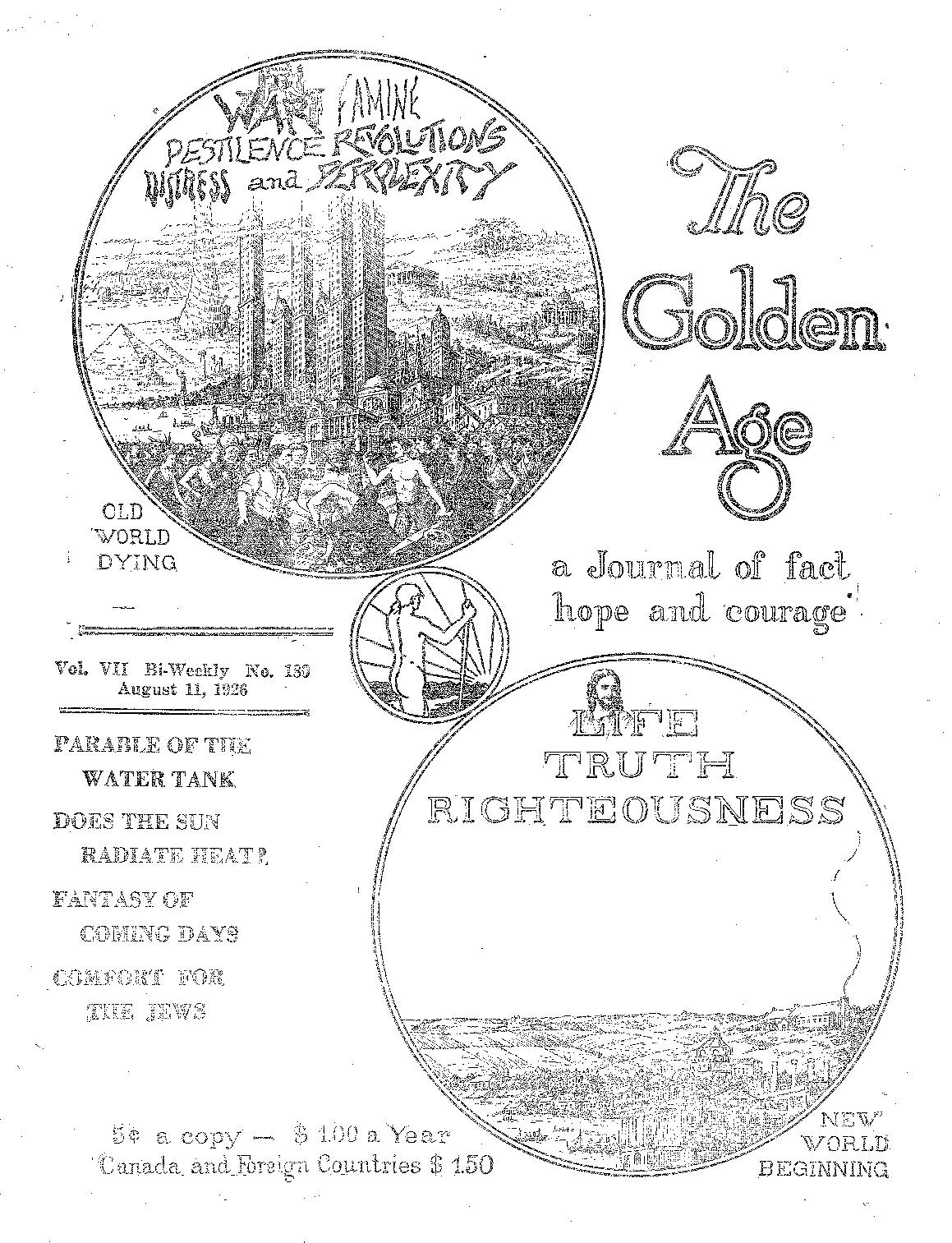
DOES THE SUN
RADIATE HEAT ?.
FANTASY OF
COMING DAYS
COMFORT FOR
' IjQ
5<P a copy
A
’ C anada and .Fore ian .Countries $ l.oO
AjU a va?~
PARABLE OF THE WATER TANK.
Vol. VII Bi-Weekly No. 180
August 11, 1926
OLD 'WORLD DYING
a Journal of fact
i 1 ,t V
C/ 3PYD BEGINNING
Contents of the Golden Age
«**—■■■■■■ . ...................... .. . '8^00. .. -.............
Labor and Economics The Parable of this Wateb Tank
Social and Educational ! "Orthe Earth Earthy” ................ 721
Radio Programs .......
Finance—Commerce—Transportation Pebb and There Throughout the World
Federal Aid in Roadbuilding ....
Boosting the Boulder Dam Project
Engineers Employ Beavers ............... 708
: . Political—Domestic and Foreign
. What American Militarists Are Doing .......... 707
Purpose of the Espionage Act
Not an Adjunct of Militarism .............. 707
Objections to Checking Up Aliens. ...
Un-American Proceeding at Daytona ........... 708
Radio In the Next War ................ 709
[ White Men Doomed in Africa .............. 710
t Italy’s Forthcoming Colonial War ............ 710
[{The Clergy and the Cadet Movement in Canada ....... 719
Agriculture and Husbandry [ _ Uncle Sam Needs Fertilizers .............. 707
Cotton Production in Paraguay . .
I
. Science and Invention
| .Does the Sun Radiate Heat to the Earth?. ........ 722
| Home and Health
| Solar Plexus — “Brain of the Stomach”
i Travel and Miscellany
i A Remarkable Deliverance
Religion and Philosophy
A Fantasy of the Coming Days
What is the Soul? ........
A Youth’s Attitude Toward Present Evils ......... 725
Comfort fob tub Jews ....
Bible Questions and Answers
Studies in “The Harp of God”.............._
! -------. __ _ _ '
Published every other Wednesday at 18 Concord Street, Brooklyn, N. Y., U. S. A., by WOODWORTH, HUDG1NGS & MARTIN
Copartners and Proprietors Address: 18 Concord Street, Brooklyn, N. Y., V. B. A. CLAYTON J. WOODWORTH . . . Editor ROBERT J. MARTIN . Business Manager WM. E. HUDGINGS . , Sec’y and Treas.
Five Cents a Copy—$1.00 A Year Make Remittances to THE GOLDEN AGE Foreign Offices ; British ..... 34 Craven Terrace, Lancaster Gate, London W. 2 Canadian- ......... 38-40 Irwin Avenue, Toronto, Ontario Australasian ....... 405 Collins Street, Melbourne, Australia South African ...... 6 Lelie Street, Cape Town, South Africa
Entered as second-class matter at Brooklyn, N. Y., under the Act of March 3, 1873
G=’.tea Age
..........r-™,- . ,----------—........, — „ .-------,.,-T.rlrn.......----- T ........ ,„, fnmrgr-E., Volume VII Brooklyn, N.Y,, Wednesday, August 11. 192fi Number 18<
Here and There Throughout the World
What American Militarists are Doing
AN EDITORIAL writer in the Hawaiian
Ilochi makes the following pointed statement;
When it comes to calling people traitors to their country and their God, we might point out that those who are helping to militarize a nation like America are preparing for an ultimate catastrophe just as surely as did the war-lords of Germany, who built up a war machine that made war inevitable and that became a monster which dragged its country down to ruin.
Germans Think America Militaristic
GERMAN paper calls attention to the fact that in American universities training as reserve officers is obligatory, that the General
Staff provides ammunition and rifles and encourages shooting galleries in the basement of schools, that in the summer every citizen can enjoy military training under most agreeable circumstances, and that the number of men in the camps in 1924 was three times the .entire German army. It concludes as a result that America is one of the most warlike nation on earth. Next thing we know somebody in Germany will be getting up fourteen points and wanting to come over here and wage war to make the world safe for democracy.
Purpose of the Espionage Act
ON HIS return from Bermuda Mr. E. V.
Debs, four times candidate for president on the Socialist ticket, but now deprived of citizenship, is reported by the New York Sim as saying:
The constitution states explicitly that Congress shall have no right to abridge freedom of speech. It is the first article in the bill of rights. The espionage law grew out of our entry into the World War. It was directed at spies, yet under the law not a single spy was prosecuted. The actual purpose of the espionage law was to suppress free speech and to silence all those who opposed the war,
Not an Adjunct of Militarism
WE ARE assured by officers of the Boy
Scouts that the sole object of that organization is to make and keep the youth of the land trustworthy, loyal to home, parents and country, helpful, friendly, courteous, kind, obedient, cheerful, thrifty, brave, clean and reverent; that, contrary to the misconceptions of some, it does not have military titles or uniforms, and is not intended as a training ground for militarism.
Federal Aid in Roadbuilding
NCLE SAM is taking a fatherly interest in perfecting for national purposes a little more than 200,000 miles of highway. At present the national expenditures in this direction are about $100,000,000 annually. But as a matter of fact the government is nothing out. The income from state and national taxes on gasoline, automobile registration and licenses, property taxes on automobiles, etc., amounts to more than ten times that sum every year. It pays to build good automobile roads.
Boosting the Boulder Dam Project
THE New York Evening Journal is doing effective work boosting the great Boulder Dam project. It calls attention to the fact that this dam will insure the physical and financial security of Imperial Valley, now one of the richest spots on earth; will make possible more electrical power than is developed at Niagara; and will irrigate an immense area, with estimated returns in taxes every year amounting to more than half of the cost of the entire project.
Uncle Sam Needs Fertilizers '
TN THE United States, where five pounds of J- fertilizer are used to the acre, the wheat crop averages fourteen bushels per acre. In Denmark, w
England, Belgium and Holland, where the amount of fertilizer per acre ranges from three to thirty times as much as in the United States, the wheat crop averages about three times as much per acre. Fertilization pays.
Low Wages Cause Hard Times
REFERRING to the oft recurring periods of hard times in the United States the National Catholic Welfare Conference says, very truthfully and very accurately:
The chief trouble is that our industrial and agricultural system turns out an enormous quantity of goods, but in the producing of it the great majority receive too little money to buy back their share of what they produce.
Installment Idea Spreading
A FEW years ago it was considered a disgrace for anybody to buy anything on the installment plan. Now all this is changing. People are buying all kinds of things, clothing, furniture, homes, automobiles, almost everything in fact, by this method, installment sales in the United States aggregating $5,000,000,000 annually. And governments are paying by installments, too.
Objections to Cheeking Up 'Aliens
AMONG the objections found by the Immigration Committee of the Chamber of Commerce of the United States to the proposed registration of aliens are that this registration would not accord with American principles, would necessitate constant surveillance of a considerable part of the population, would arouse hostility and distrust, would entail large expenditures, and could not be effectively enforced.
Un-American. Proceeding at Daytona
DAYTONA BEACH, Florida, has followed the cruel and mischief-making example of Britain in South Africa, by requiring American citizens, Negroes, some of whom recently fought for their country in France, to carry passes after-dark. By this un-American rule Negroes dti their way home from work have been arrested; and all are deprived of access to their churches, lodges and other social institutions lor night meetings.
Air Mail Service to Dallas
A IR mail service both ways has been opened between Chicago and Dallas, taking in Moline, St. Joseph, Kansas City, Wichita and Oklahoma City on the way. The trip from Chicago to Dallas required twelve hours. Kansas City, which requires eleven and one-half hours by the fastest trains, was reached in four hours and one minute, despite stops at Moline and St. Joseph. Air mail service between New York and Boston started on July 1st.
Musicians Miles Apart Play in Unison
Q TATION WRNY has been treating the public to the novelty of radio transmission of an organ and an orchestra playing simultaneously while the two Were five miles apart. It is believed that this marks the beginning of a time when musicians will be able to broadcast at home, accompanied by orchestra located at any convenient near-by point.
A Benediction Over Dogs
A SUNDAY pictorial contains a picture of a squad of six priests, dressed up in their best petticoats, engaged in the act of blessing about two dozen dogs, prior to the St. Hubert stag hunt. There is nothing in the picture to indicate that this hurt the dogs any, despite the fact that when a late pope blessed the Spanish fleet, the result was that it went to the bottom of the sea.
Mean Trick Played mi a Buzzard
SOMEBODY played a mean trick on a buzzard away back in 1882. He wired a bell to the bird’s neck, and for forty-four years the buzzard played tunes all over the southern states, sending word ahead that it was coming. Recently somebody shot the poor thing and took off the bell, which bore the 1882 date.
Engineers Employ Beavers
THE New York Warid contains an interesting story of the work done by eight beavers and their descendants placed in the area, of the Palisades Interstate Park. Liberated in a swamp area, these little workers in the last few years have inundated fifty or more acres, creating artificial lakes, and thus removing the breeding places of mosquitoes. At the present time the colony numbers about two hundred and the work of dam building proceeds apace.
The Wombat is Not so Good
THE New York Times tells us that the wombat, found in Australia, is not so good a friend to engineers as is the beaver. The wombat, which looks like a little bear, has a pouch like a kangaroo, and is adorned with a tuft of hair on its nose, is a persistent digger, and recently caused a landslide interfering with Melbourne’s water supply. It undermined the aqueduct, and sent twenty million gallons of water to waste.
Fish Trust Dissolved
THE Fish Trust, which controlled the fish business of New York City and dictated prices to jobbers and retailers throughout a wide territory, has been perpetually enjoined, restrained and prohibited from further combinations of the sort. Seventeen firms and twelve individuals pleaded guilty to the government’s charges and were fined a total of $31,000.
President Calles on Conditions in Mexico
TO A committee of twenty-one business men, one of whom was the former governor of Colorado, President Calles of Mexico recently said:
With respect to the religious question, we ars motivated by a liberal point of view. In our minds all beliefs fit in. We respect all cults and are tolerant in every sense. The Mexican Catholic priests have always tried to keep the people in ignorance and vice, because these are the best weapons for the enslaver, the powerful and the clergy. The present government is doing an intense educational work in its attempt to improve the material, spiritual and economic work of the people; and, incredible as it may seem, the priests are the greatest obstacles.
Haitians Object to Losing Country
THE Haitians are objecting to the American
Army of Occupation, claiming the loss of popular elections, the illegal designation of a president, the depreciation of the currency, the maladministration of the national debt, the seizure by American companies of lands that have been held by families for several generations, and the increase of prostitution due to the presence of the military forces.
Haiti Now Has Good Roads
ONE development of the seizure of Haiti has been that the Haitians now have good roads, which is something they never had before. Coffee from the interior is now brought to the coast by automobile, whereas formerly the onlj way of transport was by cart or donkey.
Horrible Conditions in Porto Rico
Santiago Iglesias, secretary of the Pan-Amer* ican Federation of Labor, claims that there are 500,000 unemployed in the one small island, that more than 60 percent of the profits produced in the island are sent away to absentee landlords, that interest rates range from 12 percent to 24 percent, that 40 percent of th© population die illiterates, while the starved peons are ravaged by tuberculosis and other dread diseases. Porto Rico has always been a strictly Roman Catholic country.
Mexico Adopts Metric System
"K/TEXICO has adopted the metric system, and since November 1, 1925, requires that all invoices and shipping documents submitted for clearance to the customs house be made out in that system.
Cotton Production in Paraguay
TN 1922 there were 9,790 acres planted to cot-ton in Paraguay. Two years later the acreage was 48,000. Paraguay possesses the necessary climate, good soil and labor necessary to raise cotton successfully. It is claimed that it has 22,000,000 acres of land available for cotton growing.
Radio in the Next War
WHAT radio will be able to do in the next war is indicated by what recently happened in England. An eminent clergyman, not having anything useful to do, amused himself by broadcasting a mock account of the capture of London by revolutionists, describing the burning of the houses of Parliament and executions in Trafalgar Square. Thousands of his hearers believed every word and were thrown into a panic. In the next war lies will be spread more quickly and more effectively and possibly even more plentifully than they were in the last one, by radio.
'Complete Tie-up of the Press
THE first day of the British general strike resulted in an almost, complete tie-up of the press. The London Times was reduced from twenty-eight pages to a leaflet eight by thirteen inches fin size, run off on a mimeograph. The British government started a newspaper of its own, called the British Gazette, consisting of four pages, two of which were blank. Winston Churchill was editor. It managed to get out 7,000 copies of this by 11: 00 p. m. the first day. The paper contained among other things several items regarding the zoo, which were treated as a great joke all around. The tie-up was complete.
Impossible Transportation Conditions
THE first day of the British strike showed how helpless is civilization when its transportation facilities are crippled. So many automobiles, bicycles and other vehicles crowded into London that the traffic in the streets was beyond. capacity to carry, and barely moved. The only way to get about in the city was to walk. Other incidents of the day were: An increase of four cents per quart in the price of milk, almost total stoppage of travel in all directions by rail, seven of the largest theatres closed, a net weekly loss to the nation of $250,000,000, a few taxicabs turned over, an authorization to the police, subject to order of a Cabinet Minister, to enter any premises forcibly, 250 Americans refused to debark from the Mauretania on arrival at Southampton, and hundreds of Americans endeavored to flee to the Continent.
White Men Doomed in South Africa
THE Manchester Guardian, showing that the fate of South Africa hinges on the settlement of what to do with the Hindu population, declares that these hundreds of thousands of brown men have penetrated into every part of the economic life of Natal. Indian storekeepers live with their wives and families under the shop counters, consume next to nothing, and long hours after his white rival has closed the shutters the Indian’s door is open and the light burning. The Hindus live under the most unsanitary conditions. The whites simply cannot meet the competition they are called on to face. Politics may postpone the trouble for a season, but the white man is doomed.
Mussolini Exterminates Black Hand
1UT ussoniNi has done another thing that cannot fail to make him many friends. With rare courage he demanded of the Sicilian Prefect of Police that he drive out of existence the Mafia,, or Black Hand, which has spread to the four corners of the earth. In the raids which followed 450 persons were arrested, including several officials and well known men and women.
Italy’s Forthcoming Colonial War
TSJUMEBO'US newspapers in Italy, all of them extreme partisans of the Fascisti movement, are freely discussing the colonial war which, they mutually agree, Italy is about to wage. In a recent letter to the aviator Marquis de Pinedo, Mussolini himself made reference to what he termed “the coming day” in such language as to leave no doubt that he has a day of conquest in mind. The Italian press are discussing whether the war will be a war against or a Avar side by side with France. It is freely predicted that it could only be the latter if France bought Italy by a previous surrender to her of half her colonies, or consented to combine with Italy as a single state, loyally recognizing Borne as the capital. Asia Minor is most freely predicted as the probable seat of the conflict when it conies.
Mussolini’s Concessions to Papacy
TVTussolini has placed crucifixes in all govern-1¥JL ment offices, ordered the Te Deum to be sung at all government functions, put an end to Masonry, introduced religious services in the schools under the tutelage of the Church, required the teachers to graduate in religious pedagogy at some Church college, and finally has increased the Italian state’s pay to the clergy. It is freely predicted that the temporal power will be restored to the Pope within two years.
The Stuff of Which Rif flans are Made
THE stuff of which Biffians are made is disclosed by the feat of Hammouch Ben Iladge in carrying a dispatch seventy miles over rough terrain between sunset and sunrise. It is believed that there are few athletes in the civilized world that could equal this record. Hammouch made a mile every seven minutes throughout the- night.
The Parable of the Water Tank
THERE was a certain very dry land,"the people whereof were in sore need of water.
'And they did nothing but to seek after water from morning until night, and many perished because they could not find it.
Howbeit, there were certain men in that land who were more crafty and diligent than the rest, and these had gathered stores of water where others could find none, and the name of these men was called capitalists. And it came to pass that the people of the land came unto the capitalists and prayed them that they would give them of the water they had gathered that they might drink; for their need was sore. But the capitalists answered them and said:
“Go to, ye silly people! Why should we give you of the water which we have gathered? For then should we become even as ye are, and perish with you. But behold what w’e will do unto you. Be ye our servants and ye shall have water.”
And the people said, “Only give us to drink and we will be your servants, we and our children.” And it was so.
Now the capitalists were men of understanding, and wise in their generation. They ordered the people who were their servants in bands with captains and officers, and some they put at the springs to dip, and others did they make to carry the water, and others did they cause to seek for new springs. And all the water was brought together in one place, and there did the capitalists make a great tank for to hold it, and the tank was called the Market; for it was there that the people, even the servants of the capitalists, came to get water. And the capitalists said unto the people:
“For every bucket of water that ye bring to us, that we may pour it into the tank, which is the Market, behold! we will give you a penny; but for every bucket that we shall draw forth to give unto you that ye may drink of it, ye and your wives and your children, ye shall give us two pennies, and the difference shall be our profit, seeing that if it were not for this profit we would not do this thing for you, but ye should all perish.”
. And it was good in the people’s eyes; for they were dull of understanding. And they diligently brought water unto the tank for many days; and for every bucket which they did bring, the capitalists gave them every man a penny; but
(From Edward Bellamy's "Equality”}
for every bucket that the capitalists drew forth from the tank to give again unto the people, behold! the people rendered to the capitalists two pennies.
And after many days the water tank, which was the Market, overflowed at the top, seeing that for every bucket the people poured in they received only so much as would buy again half a bucket. And because of the excess that was left of every bucket, did the tank overflow; for the people were many. But the capitalists were few, and could drink no more than others. Therefore did the tank overflow.
And when the capitalists saw that the wrnter overflowed, they said to the people:
“See ye not the tank, which is the Market, doth overflow? Sit ye down, therefore, and be patient; for ye shall bring us no more water till the tank be empty.”
But when the people no more received the pennies of the capitalists for the water they brought, they could buy no more water from the capitalists, having naught wherewith to buy. And when the capitalists saw that they had no more profit because no man bought water of them, they were troubled. And they sent forth men in the highways, the byways, and the hedges, crying, “If any thirst let him come to the tank and buy water of us; for it doth overflow.” For they said among themselves, “Behold, the times are dull; we must advertise.”
But the people answered, saying, “How can we buy unless ye hire us, for how else shall we have wherewithal to buy? Hire ye us, therefore, as before, and we will gladly buy water, for we thirst; and ye will have no need to advertise.” But the capitalists said to the people: “Shall we hire you to bring water when the tank, which is the Market, doth already overflow? Buy ye, therefore, first water; and when the tank is empty, through your buying, we will hire you again.” And so it was because the capitalists hired them no more to bring water that the people could not buy the water they had brought already; and because the people could not buy the water they had brought already, the capitalists no more hired them to bring water. And the saying went abroad, “It is a crisis.”
And the thirst of the people was great; for it was not now as it had been in the days of their fathers, when the land was open before them, for every one to seek water for himself, seeing that the capitalists had taken all the springs and the wells and the water therein, and the vessels and the buckets, so that no man might come by water save from the tank, which was the Market, And the people murmured against the capitalists, and said: “Behold the tank runneth over, and we die of thirst. Give us therefore of the water, that we perish not.”
m
But the capitalists answered: “Not so. The water is ours. Ye shall not drink thereof unless ye buy it of us with pennies.” And they confirmed it with an oath, saying’, after their manner, “Business is business.”
But the capitalists were disquieted that the people bought no more water, whereby they had no more any profits; and they spake one to another, saying, “It seemeth that our profits have stopped our profits; and by reason of the profits we have made, we can make no more profits. How is it that our profits are become unprofitable to us, and our gains do make us poor? Let us therefore send for the soothsayers, that they may interpret this thing unto us”; and they sent for them.
Now, the soothsayers were men learned in dark sayings, who joined themselves to the capitalists by reason of the water of the capitalists, that they might have thereof and live, they and their children. And they spake for the capitalists unto the people, and did embassies for them, seeing that the capitalists were not a folk quick of understanding, neither ready of speech.
And the capitalists demanded of the soothsayers that they should interpret this thing unto them, wherefore it was that the people bought no more water of them, although the tank was full. And certain of the soothsayers answered and said, “It is by reason of overproduction”; and some said, “It is glut.” But the signification of the two words is the same. And others said, “Nay, but this thing is by reason of spots on the sun.” And yet others answered, saying, “It is neither by reason of glut, nor yet of spots on the sun, that this evil hath come to pass, but because of lack of confidence.”
And while the soothsayers contended among themselves, according to their manner, the men of profit did slumber and sleep; and when they awoke they said to the soothsayers: “It is enough. Ye have spoken comfortably unto us.
Now gfi’ ye and speak comfortably likewise unto this people, so that they be at rest and leave us also in peace.”
But the soothsayers, even the men of the dismal science (for so they were named of some) were loath to go forth to the people lest they should be stoned; for the people loved them not. And they said to the capitalists:
“Masters, it is a mystery of our craft that if men be full and thirst not, but be at rest, then shall they find comfort in our speech even as ye. Yet if they thirst and be empty, find they no comfort therein, but rather mock us; for it seemeth that unless a man be full our wisdom appeareth unto him but emptiness.” But the capitalists said: “Go ye forth. Are ye not our men to do our embassies ?”
And the soothsayers went forth to the people and expounded to them the mystery of overproduction, and how it Avas that they must needs perish of thirst because there was overmuch water, and how there could not be enough because there was too much. And likewise spoke they unto the people concerning the sunspots, and also wherefore it was that these things had come upon them by reason of a lack of confidence. And it was even as the soothsayers had said; for to the people their wisdom seemed emptiness. And the people reviled them, saying, “Go up, ye bald-heads! Will ye mock us? Doth plenty breed famine? Doth nothing come out of much?” And they took up stones to stone them.
And when the capitalists saw7 that the people still murmured and would not give ear to the soothsayers, and because also they feared lest the people should come upon the tank and take of the Avater by force, they brought forth to them certain holy men (but they were false priests), who spake unto the people that they should be quiet and trouble not the capitalists because they thirsted. And these holy men, who Avere false priests, testified to the people that this affliction was sent to them of God for the healing of their souls; and that if they should bear it in patience and lust not after the water, neither trouble the capitalists, it Avould come to pass that after they had given up the ghost they would come to a country where there should be no capitalists, but an abundance of water. Howbeit, there were certain true prophets of God also; and these had compassion on the people, and would not prophesy for the capitalists, but rather spake constantly against them.
Now, when the capitalists saw that the people still murmured and would not be still, neither for the words of the soothsayers nor for those of the false priests, they came forth themselves unto them, and put the ends of their fingers into the water that overflowed in the tank and wet the tips thereof. And they scattered the drops from the tips of their fingers abroad upon the people who thronged the tank, and the same of the drops of water was charity; and they were exceedingly bitter.
And when the capitalists saw yet again that neither for the words of the soothsayers, nor for those of the holy men who were false priests, nor yet for the drops that were called charity, would the people be still, but raged the more, and crowded upon the tank as if they would take it by force, then took they counsel together and sent men privily forth among the people. And these men sought out the mightiest among the people and all who had skill in war, and took them apart and spake craftily with them, saying,
“Come, now, why cast ye not your lot in with the capitalists? If ye will be their men and serve them against the people, that they break not in upon the tank, then ye shall have abundance of water, that ye perish not, ye and your children.”
And the mighty men and they who were .skilled in war hearkened unto this speech and suffered themselves to be persuaded; for their thirst constrained them. And they went within unto the capitalists and became their men; and staves and swords were put into their hands and they became a defence unto the capitalists, and smote the people when they thronged upon the tank.
And after many days the water was low in the tank; for the capitalists did make fountains and fish-ponds of the water thereof, and did bathe therein, they and their wives and their children, and did waste the water for their pleasure.
And when the capitalists saw that the tank ■was empty, they said, “The crisis is ended”; and they sent forth and hired the people that they should bring "water to fill it again. And for the water that the people brought to the tank they received for every bucket a penny but for the water which the capitalists dre^ forth from the tank to give again to the people they received two pennies, that they might hav< their profit. And after a time did the tank again overflow even as before.
And now, when many times the people had filled the tank until it overflowed and had thirsted till the water therein had been wasted by the capitalists, it came to pass that there arose in the land certain men who were called agitators, for that they did stir up the people. And they spake to the people, saying that they should associate, and then would they have no need to be servants of the capitalists and should thirst no more for water. And in the eyes of the capitalists were the agitators pestilent fellows ; and they would fain have crucified them, but durst not for fear of the people.
And the words of the agitators which they spake to the people were on this wise:
‘Tie foolish people, how long will ye be deceived by a lie, and believe to your hurt that which is not? For behold all these things that have been said unto you by the capitalists and by the soothsayers are cunningly devised fables. And likewise the holy men, who say that it is the will of God that ye should always be poor and miserable and athirst, behold! they do blaspheme God and are liars, whom He will bitterly judge, though He forgive all others. How cometh it that ye may not come by the water in the tank? Is it not because ye have no money? And why have ye no money? Is it not because ye receive but one penny for every bucket that ye bring to the tank, which is the Market, but must render two pennies for every bucket ye take out, so that the capitalists may have their profit? See ye not how by this means the tank must overflow, being filled by that ye lack and made to abound out of your emptiness? See ye not also that the harder ye toil, and the more diligently ye seek and bring the water, the worse, and not the better it shall be for you by reason of the profit, and that forever?”
After this manner spake the agitators for many days unto the people, and none heeded them, but it was so that after a time the people hearkened. And they answered and said unto the agitators:
“Ye say the truth. It is because of the capitalists and of their profits that we are in want, seeing that by reason of them, and their profits we may by no means come by the fruit of our labor, so that our labor is in vain; and the more we toil to fill the tank the sooner doth it overflow, and we may receive nothing because there is too much,'according to the words of the soothsayers. But behold, the capitalists are hard men, and their tender mercies are cruel. Tell us if ye know any way whereby we may deliver ourselves out of our bondage unto them. But if ye know of no certain way of deliverance, we beseech you to hold your peace and let us alone, that we may forget our misery.”
And the agitators answered and said, “We know a way.”
And the people said, “Deceive us not; for this thing hath been from the beginning, and none hath found a way of deliverance until now, though many have sought it carefully with tears. But if ye know a way, speak unto us quickly.”
Then the agitators spake unto the people of the way. And they said:
“Behold, what need have ye at all of these capitalists, that ye should yield them profits upon your labor? What great thing do they, wherefore ye render them this tribute? Lo, it is only because they do order you in bands and lead you out and in and set your tasks and afterward give you a little of the water yourselves have brought, and not they. Now, behold the way out of this bondage! Do ye for yourselves that which is done by the capitalists; namely, the ordering of your labor, and the marshalling of your bands, and the dividing of your tasks. So shall ye have no need at all of the capitalists and no more yield to them any profit, but all the fruit of your labor shall ye share as brethren, every one having the same: and so shall the tank never overflow until every man is full and would not wag the tongue for more. And afterward shall ye with the overflow make pleasant fountains and fishponds to delight yourselves withal, even as did the capitalists; but these shall be for the delight of all.” . And the people answered, “How shall we go about to do this thing? For it seemeth good to us.”
And the agitators answered, “Choose ye discreet men to go in and out before you and to marshall your bands and order your labor, and these men shall be as the capitalists were. But behold, they shall not be your masters as the capitalists are, but your brethren and officers who do your will; and they shall not take any profits, but every man his share like the others, that there may be no more masters and servants among you, but brethren only. And from time to time, as ye see fit, ye shall choose other-discreet men in place of the first to order the labor.” .
And the people hearkened, and the thing was very good to them. Likewise seemed it not a hard thing. And with one voice they cried out, . “So let it be as ye have said; for we will do it!”
And the capitalists heard the noise of the shouting and what the people said, and the soothsayers heard it also; and likewise the false priests and the mighty men of war, who were a defence unto the capitalists. And when they heard they trembled exceedingly, so that their knees smote together, and they said one to another, “It is the end of us!”
Howbeit, there were certain true priests of the living God who wmuld not prophesy for the capitalists, but had compassion on the people; and when they heard the shouting of the people and what they said, they rejoiced with exceeding great joy, and gave thanks to God because of the deliverance.
And the people went and did all the things that were told them of the agitators to do. And it came to pass as the agitators had said, even according to all their words. And there was no more any thirst in that land, neither any that was an hungered, nor naked, nor cold, nor in any manner of want. And every man said unto his fellow, “My brother,” and every woman said unto her companion, “My sister”; for so were they with one another as brethren and sisters which do dwell together in unity. And the blessing of God rested upon that land forever.
“I never saw a sadder thing In all the city’s strife,
Than that worn host of ragged men Who waited there for life.
They did not ask for lordly things, For temples or for lands;
“They only asked for right to use The glory of their hands.
They did not ask for alms or gold, Nor things of lordly worth;
They only asked the right to share The labor of the earth.”
A Fantasy of the Coming Days
THE evening sunlight was giving forth its splendor behind the purple hills that were traced so clearly against the orange-colored atmosphere. The high clouds were as pearls set in the fading light of the upper sky. The sun had just descended out of sight behind those western hills, after a glorious and perfect day.
Standing by the cottage, or shall I say mansion, for such it seemed, were two people looking toward the west; Edward and Winnifred; both the outward expression of perfect health and beauty, a unity of strength and meekness. [After feasting upon the scene for a few moments, Edward turned to his companion and expressed the wish that his favorite artist, a 17th century master, might be there to witness it, exclaiming:
‘What a scene for Loretto! How he would have reveled in this harmony and contrast of shade and color, perfect to the utmost degree I” And then he added, “Yet how trivial is man’s attempt to portray these glories of nature in a few colored pastes.”
Being constant admirers of things beautiful, and having the energy of youth at its best, these two could follow God’s works in minutest detail. No wonder the scene brought to their minds one whose work on canvass and in stone resembled, even though but feebly, God’s work in nature! What wonder that they wished the master artist might be there to view with them the present going down of the. sun!
Just then Edward, glancing in the opposite 'direction, saw a human form in the distance. Being unable to distinguish his outline clearly, he mused: “Who is this, Winnie, coming from the east? Some stranger, surely, but looks like some one we know. Why! It’s Loretto, the famous painter himself! It must be he. What a coincidence!”
“Can you inform me as to the way to the city?” the stranger inquired.
“Friend, we can; but first step inside and we will make you welcome. Are you not Loretto, the painter?” “I am Loretto,” he answered. Somewhat puzzled, he followed them into the cottage. “Where am I? This reminds me of the old, old days of delight and toil; I seem surrounded with friends,” Loretto cried as several small pictures, hanging tastefully on the wall, drew his attention.
By F. Bradshaw {England}
These are reproductions of your frescoes from Italy; and here some of your works in stone,” explained Edward. “I dare say they remind you of your shepherd days, with theix peaceful as well as wolflike moments.”
“Where am I?” again inquired Loretto in wonderment.
“You are on earth, my friend,” said Edward, “but this is now the golden age; and at the wish of friends you have again entered upon a human career. But conditions are now righteous. Brother is no longer against brother; love is the ruler of all hearts, and sweet accord must everywhere prevail. Stay a little while and you shall go on to the city on the morrow, before the sun is at its height.”
Loretto, still bewildered, accepted the hospitality. Glancing around in childlike wonderment, he remarked:
“How splendid everything is! The garden, the house! What a happy abode; a palace, yet small. I am almost lost in its surroundings; yet how cozy and how comfortable!”
“Yes, we are very comfortable and happy here. We grow most of our own food. Our meals are simple; there is no want, and we have every opportunity to be happy in the fullest sense of the word. And you see other mansions peeping up amongst the trees round about Building, architecture and the other arts are progressing slowly but surely to a magnificent perfection. Each structure is a true outward expression of the builder, and all are built with loving care.”
Loretto arose early on the morrow, so eager was he to feast upon the beautiful landscape. “The hills appear to be enriched with jewels!” he exclaimed in ecstacy. “I do feel like seeing a little more of this wonderful world before the sun is at its height. So with your permission I will walk along in the fresh morning air.”
“You cannpt mistake the city,” said Winnifred, pleased at her guest’s evident enjoyment of the surroundings. “The road is in perfect condition and will lead you there. But be sure to let us have your company by the evening.”
With the blessing of the two, Loretto went along the highway to the city. Finally he came to a hill overlooking a wide valley, and what a sight to behold! “Surely this is the city,” he mused; “but different from any I ever saw before.” Tower upon tower arose upward from
the depth of the valley. Purple and gray windings, extending up into the sky, it seemed to him. What a sight!
A .short rest to enjoy the surroundings seemed to the bewildered Loretto to be opportune. The buildings were wonderful in their slim proportions, as they rose from the gray depth of the valley into the sunlight above. And the depths seemed to have a light of their own not of the sun.
“May we take you onward, friend?” came the sound of a clear voice from behind. On looking around Loretto saw a magnificent chariot which had apparently come from nowhere.
“I thank you, friend/’ he replied; “I did intend to go on into the city, but was first enjoying the scene at the distance. I will gladly accompany you. But how did you get here? I heard nothing.”
“We travel very quietly,” said the stranger in the chariot. “We travel exceedingly fast, but noiselessly and with perfect control.”
They skimmed along at an amazing speed, smooth as glass. Nearer and nearer came the city, with steeples and pinnacles ascending higher and higher from the silvery haze of the river into the glorious sunlight above.
Loretto alighted in a great thoroughfare. How strangely was it illuminated! And chariots not of horses but propelled by some unseen force traversed the smooth streets. Though he at first thought that danger was lurking in every step, yet he soon saw that no accidents occurred. Everything was perfectly managed; chariots were under perfect control.
As he walked down the wide thoroughfare he heard someone call: “Welcome, friend. How would you like to make a journey over the city?” Loretto turned and faced another stranger, who had a queer-looking chariot that resembled the body of a bird with outstretched wings.
Impelled by the good will and kindly manner of the occupant, Loretto promply mounted the proffered chariot. They were soon ascending above the earth! The chariot, stretching its wings in. magnificent fashion, passed above the sparkling pinnacles, the purple depths, where other chariots passing in numberless and endless variety could be seen below.
“This all seems so strange. The golden age and these.marvels, are they not very nerve racking?” suggested Loretto to his new-found friend.
“No, much to the contrary,” answered his informant. “There is no enmity between man and man; all is peaceful. There is no commercial spirit, yet the inventive genius of man is much to the fore. You wonder at the lighting of the avenues. With these pinnacles §nd towers the avenues below would be very dark; but now with the invention of a new light, we can get about in comfort. We spend a few hours each day to attend the various machines; everybody is willing, and the world’s work goes smoothly on.”
As the chariot descended a little closer to the 1 city,, a palace yard could be discerned. Loretto wondered at seeing there a number of people dressed in strange dark attire and with what seemed begrimed faces, walking leisurely and cheerfully across the lawn.
Alighting again, this time they found themselves opposite what Loretto discerned to be a palace of palaces, because of its surpassing grandeur of color and its embellishments of pomegranates, vines, cherubim, eagle, winged lion, winged calf, and winged man. Stepping inside he saw a huge concourse of people. A voice seemed to come from somewhere in the center. A perfect calm reigned as. the voice gave out the message of the law, “Love ye one another.”
Approaching one end of the hall Loretto found a number of small tables and a counter. In the center of the counter was a moving belt which carried dishes of fruit, bread and other edibles, mostly uncooked natural foods. As these moved along they were taken up by respective purchasers. No one was in attendance to prevent stealing or cheating. Speaking your order into a machine a card appeared, giving the price of the products, which seemed exceedingly reasonable. In due course the food ordered came along the moving counter, and the purchaser took it and then dropped the money into a box provided for the purpose. Seeing Loretto’s apparent embarrassment, a fellow visitor proffered the necessary value, and he enjoyed a hearty and healthful meal.
Loretto mused on the foregoing events, wondering and marveling at the strange pieces of machinery which he had witnessed. What a saving there seemed in this arrangement I Would the meal have been any pleasanter if served by a smiling and friendly waiter? Who made ths machines? How unusual it all seemed, and so greatly in contrast to the sheepfold and markets he.remembered from his 17th century days. But he quickly recalled that this is now the golden age, and that his former experiences were causing him as yet to be out of touch with everything.
Leading from the hall of this palace where he stood was a long corridor with vaulted ceiling, replete with figures and palms hewn in stone and embossed in colors, and illuminated with the same strange light that glorified the entire city. It all seemed so strange; though stranger yet were the people flitting here and there in horseless chariots- which slipped along as on glass, and the other chariots which flew through the air like birds.
Then, too, there was a moving pavement for pedestrians. The people in the corridor, conversing in friendly tones, were all moving in one direction on one of those pavements. Loretto soon found himself amongst them and moving ■with them. The 'walls and ceiling of the palace were one feast of-artistic color, portraying the noblest characters of history. These were indeed a pleasure for Loretto to behold. The work was perfect, and the lighting effects enabled them to be seen in all their artistic glory.
The end of the corridor reached, there was a small square room. When Loretto and the others stepped into this room there seemed to be put in motion some hidden machinery, and the room began moving upward and upward. Gallery after gallery, thronged with happy people, Loretto passed on his way upward through the palace, until they finally came to a standstill in the bright sunlight.
Stepping from the elevated room he entered another and larger room, with large cabinets arranged in regular succession, side by side.
A general hum, as of many subdued but persistent voices, filled the room. What was it all about? Loretto could see only one person to speak to; and he seemed to be in attendance at these cabinets.
“Good afternoon, friend. I perceive that you are a stranger here and are wondering at the appearance of this room,” he said to Loretto in kindly tones. “A number of visitors find their way up here when looking around the city. This is the room where the power is generated for lighting the avenue and driving the machines which move the counter and pavements and other things about the city. We are on the top of the highest pinnacle in the city, and therefore this is the best place from which to obtain the force from the air by which the power is generated for the apparatus in each of these cabinets you see about this room. The metal ornament' at the apex of the pinnacle receives the force, and it is conducted in various unseen ways through these cabinets.”
Loretto found the attendant and the room very interesting, and spent much time looking around. Returning to the avenue below, and feeling ready for a more quiet place, free from so many surprises, Loretto inquired the way to the outskirts of the city. No sooner had he spoken than he was gathered up into a chariot and quickly, though tenderly, placed on the very spot whence he first saw the city.
How beautiful were the hedgerows, the trees, the mansions, though small, peeping up above the trees; how pleasant the natural light! Walking was a pleasure, though progress was not so fast as by the horseless chariot. Loretto arrived back at the house of his friends at the setting of the sun.
“And how does our friend like the city?” asked Edward and Winnifred.
Ht is wonderful, magnificent! But may I inquire what it is all about ? How happy everybody seemed in their passing to and fro, so different from what I have been used to. The whole thing is so marvelous and so new to me that I cannot understand it. Is this quick passing here and there necessary to the well-being of mankind? Why those men dressed in dark attire and with begrimed faces, whom I saw in a castle yard ? They seemed cheerful and happy, but why are they dressed so differently, from all others ? And the voice giving out the law in the palace; that was so strange.”
Edward laughed good-naturedly. “Those men in the dark attire are doing their bit to make the inventions that seem necessary for the general welfare. Each man does his allotted time each day or week. There has not yet been found anything to take the place of human labor in the first instance. But it is pleasant; no hardships on anybody; just healthful, enjoyable exercise. We are yet in the early stage of the golden age; there are still some relics of the past; and there may be several years yet before everything is perfect. In the palace of the law the voice is transnjitted from some distance over the seas.
The law is publicly broadcast for our guidance, that we may have health and happiness.”
“I enjoy the city, but like the quiet countryside most/’ said Loretto, after pondering thoughtfully; “and I assume that you do also, seeing that you have built your house in this delightful corner.” Edward and Winnifred nodded in assent.
The sun was again setting in the west. The three friends enjoyed the inspiring scene in quiet wonderment for some time, as they sat at ease in the wings of the vine-clad porch. '
“All the dwellings seem to be splendidly situated, and enclosed with shrubbery and flowers, each of a somewhat different design; portraying, I assume, the mind of the dweller,” said Loretto, finally breaking the silence in his impetuous fervor. “But I notice over there is one building, larger and more magnificent than the rest. It belongs to someone of importance, I suppose.”
“We are all servants of the same Master now. However, that building will interest you; similar ones are spotted throughout the country,” said Edward.
They enjoyed the scene In quiet, by the vine-clad porch
Whilst he thus spake the sweet intonation of a cultured human voice, accompanied by the deep strains of a wonderful organ, came over the calm air in the purple sunset. Edward hastened to explain the strange phenomenon to his guest: ‘
“There! singing again as usual at the setting of the sun! The music comes from the building which you have just pointed out. The building is also used for the art of writing poems in color and in stone, as well as in melodious sounds. The a.rt of making the home beautiful is keenly followed by all. These places are built with great care, and are specially adapted to the housing of the arts. The personal touch is in everything. Every invention for organ or piano is designed to augment the human faculties. .
“All have an arrangement -whereby they can hear the music in their homes, as it is broadcast from yonder building. These instruments are made during many hours of careS^l labor, and need careful adjusting, though the result as yet lacks the personal touch that is obtained ■when in the same room with the speaker or instrumentalist.” As Edward finished, the friend’s countenance beamed with happy anticipation.
“There is something different here all the time. I am well pleased; and if you like, I will make my home amongst you,” said Loretto gleefully.
“Friend, we bid you welcome amongst us, and trust you will build some beautiful dwelling, pointing tower-like upward. Time is plentiful, and there are willing hands to assist you. A few animals of fine form and physique will aid us in the heavier work,” responded Edward.
“Do you visit the palace of the law for instruction, that you may walk according to it?” inquired Loretto.
“We do, and following humbly the commandment, “Love ye one another,’ we find happiness in its truest form,” quickly declared Winnifred; “and often in the evening comes a visitor, one of God’s messengers, with help and guidance for every step, whose words are as the breath of life to every one around.”
The singing faded away with the waning light, and the friends retired to rest in the calm
The Clergy and the Cadet Movement in Canada • By Our Canadian Correspondent
THE Great War does not appear to have taught a lesson to the clergy, unless it be to satisfy them that they can hope to keep their jobs only through the efficiency of an army, and that realizing the unpreparedness in 1914, they think it wise and a part of their commission to see that when the next war breaks out their work as recruiting agents will be easier: as witness the following resolution passed at a meeting of the Church of England Synod of the Diocese of Toronto as reported in the Mail and Empire, Toronto:
Members of the Synod left no doubt as to their attitude on cadet training in the public and high schools of the province, when during the afternoon session Rev. G. M. Barrow gave notice of motion that this synod hereby places on record its hearty and cordial approval of the system of cadet training in the primary and secondary schools, and endorses the same as an excellent method of physical training and as an efficient means of inculcating a sound spirit of patriotism and discipline in the youth of the present day. The motion was received with enthusiastic applause.
When the motion was put at the closing session of the synod, Rev. G. M. Barrow, in introducing the subject, laughingly remarked that he did not wish to be understood as trying to interfere with the work of the League of Nations.
“I am not bringing this forward in a militaristic manner. I desire to do it for the benefits to be derived from physical training, and as an efficient means of inculcating sound patriotism. What is needed more than anything else in the youth of today is discipline. I believe that the security of the future for the men of the country lies not in training them to be soldiers but to act on the sound of the word.”
The Telegram of Toronto in its report says: With the full weight of his authority Bishop Sweeny declared: “1 am enthusiastic over this resolution, it is a fine thing. [Hear I Hear!] If I have any erectness of physique I owe it to the cadets; being an officer’s son, my father saw to it that I held myself erect and that I attended all the drills.
“I will be awfully sorry if this synod turns out to be a lot of old ladies who don’t approve of this sort of thing.”
After an amendment had been voted down the Rev. II. Ben Oliel of Collingwood, wearing a military button on his ministerial coat, speaking to the motion said:
“Most of the people, especially those who were nearer the front than Canada, could remember the year 1916.
It was a terrible nightmare. We were simply holding ourselves, waiting and enduring agonies, while manj others were falling, simply because we were not prepared ; and we do not desire that any evil influence should bring upon ourselves, or the Empire or Christian civilization, the agony of 1916. Therefore let us in all manliness and in sincerity support every good thing that will support Christianity and Civilization.”
The report adds:
Those supporting the main motion were in many cases men who wore the returned man’s button on their ministerial coats, while those against were in the main younger men.
That the clerical support is not confined to the Church of England is. evident from the following report in the Toronto Daily Star:
The general assembly of the United Church is lining up to follow the example of the Toronto Synod of the Anglican church and debate fully the question of cadet training in primary and secondary schools in this country. But unlike the Toronto Anglican Synod, which was more or less unanimously in favor of cadet training when the vote was taken yesterday, the general assembly will probably be split wide open on the issue; with the final vote showing the church opposed to the Anglican view and condemning cadet training as too militaristic. One of the strongest proponents of cadet training is Rev. Dr. W. H. Hincks, of High Park United Church, who will fight for preparedness in the general assembly as against “piteous sentimental pacifism”.
These are the professed ambassadors of the Prince of Peace 1
In this connection we are reminded that in 1923 the Presbyterian Witness quoted General Haig, Commander-in-Chief of the British forces in France, as saying, “It is the business of the churches to make my business impossible.”
Regarding Evolution, a writer in the Toronto Globe gives the following information:
About 1916, when Professor Leuba sent out a questionnaire to American Scientists (?) asking them if they believed in a personal God, of the less eminent scientists fifty-nine percent of biological, and sixtyeight percent of the psychological scientists said that they did not; and in the more eminent scientists the percentage was greater, being eighty-four percent of biologists and eighty-seven percent of psychologists who were Agnostics. Professor Leuba also sent questionnaires to the students of nine large colleges and the answers showed fifteen percent of the freshmen and forty-five percent of the graduating class had abandoned belief in orthodox religion.
During a four-day mission conducted on behalf of the Jews in Knox Presbyterian Church, Toronto, by Kev. Fred Clark and Rev. George Bell, Mr. Clark made the following statement: “The church is stagnant, and has even contempt for the Jews, when it should be holding out its hand to them.” He told of a prophecy made by Dr. Gratton in one of his books that 1917 would be a year of great happenings for God’s ancient people, and of the carrying out of that prophecy when Allenby took Jerusalem. He would have been nearer the mark had he hit upon 1918, when the Jews were given back their land under the Balfour Declaration, at the full end of “Israel’s double”, according to the prophets of old. '
The watchword of the day seems to be “Probe”. From the freight rate probe we learn that seventy-one percent of Canadian grain left Atlantic ports via United States of America last year. Early in the session of the Commission, Commissioner Oliver interrupted a witness to ask: “Are we in Canada to produce wheat for American railroads to carry?”
The probe in the Customs Department reveals wholesale smuggling, coming and going, with the connivance of customs officials on the Canadian side of the border who have been waxing rich at the public expense.
Then there was a probe into the election frauds in the West which revealed that one hundred and eleven votes cast for a conservative candidate were credited to the liberal candidate, whereby, the latter was declared elected and holds his seat in Parliament in spite of the exposure. And so it goes. .
The Toronto Star in reviewing a recent book “Twenty-Five Years 1892-1916” by Viscount Grey of Falloden, as a contribution “to the already voluminous and ever-growing literature of Armageddon”, quotes him as saying:
Even now, with all the experience of war behind us. It is doubtful whether Europe is penetrated with a sense that war must be. prevented in future, and that this must be the common purpose of all nations—learn &r perish is the rule for nations as for individuals. The future, the life of European civilization, well depends Upon whether a wiser or more instructed spirit prevails, [f it does not, our present civilization will perish, as others have done before it, and the future progress of mankind will depend on the rise of something new, some human agency outside Europe, and perhaps not of European race.
…